EP0329029A2 - Hochtemperaturbeständige aromatische Polyether - Google Patents
Hochtemperaturbeständige aromatische Polyether Download PDFInfo
- Publication number
- EP0329029A2 EP0329029A2 EP89102296A EP89102296A EP0329029A2 EP 0329029 A2 EP0329029 A2 EP 0329029A2 EP 89102296 A EP89102296 A EP 89102296A EP 89102296 A EP89102296 A EP 89102296A EP 0329029 A2 EP0329029 A2 EP 0329029A2
- Authority
- EP
- European Patent Office
- Prior art keywords
- phosphine oxide
- units
- temperature
- molar ratios
- groups
- Prior art date
- Legal status (The legal status is an assumption and is not a legal conclusion. Google has not performed a legal analysis and makes no representation as to the accuracy of the status listed.)
- Granted
Links
Classifications
-
- C—CHEMISTRY; METALLURGY
- C08—ORGANIC MACROMOLECULAR COMPOUNDS; THEIR PREPARATION OR CHEMICAL WORKING-UP; COMPOSITIONS BASED THEREON
- C08G—MACROMOLECULAR COMPOUNDS OBTAINED OTHERWISE THAN BY REACTIONS ONLY INVOLVING UNSATURATED CARBON-TO-CARBON BONDS
- C08G75/00—Macromolecular compounds obtained by reactions forming a linkage containing sulfur with or without nitrogen, oxygen, or carbon in the main chain of the macromolecule
- C08G75/20—Polysulfones
- C08G75/23—Polyethersulfones
-
- C—CHEMISTRY; METALLURGY
- C08—ORGANIC MACROMOLECULAR COMPOUNDS; THEIR PREPARATION OR CHEMICAL WORKING-UP; COMPOSITIONS BASED THEREON
- C08G—MACROMOLECULAR COMPOUNDS OBTAINED OTHERWISE THAN BY REACTIONS ONLY INVOLVING UNSATURATED CARBON-TO-CARBON BONDS
- C08G65/00—Macromolecular compounds obtained by reactions forming an ether link in the main chain of the macromolecule
- C08G65/34—Macromolecular compounds obtained by reactions forming an ether link in the main chain of the macromolecule from hydroxy compounds or their metallic derivatives
- C08G65/38—Macromolecular compounds obtained by reactions forming an ether link in the main chain of the macromolecule from hydroxy compounds or their metallic derivatives derived from phenols
- C08G65/40—Macromolecular compounds obtained by reactions forming an ether link in the main chain of the macromolecule from hydroxy compounds or their metallic derivatives derived from phenols from phenols (I) and other compounds (II), e.g. OH-Ar-OH + X-Ar-X, where X is halogen atom, i.e. leaving group
- C08G65/4012—Other compound (II) containing a ketone group, e.g. X-Ar-C(=O)-Ar-X for polyetherketones
- C08G65/4043—(I) or (II) containing oxygen other than as phenol or carbonyl group
- C08G65/405—(I) or (II) containing oxygen other than as phenol or carbonyl group in ring structure, e.g. phenolphtalein
Definitions
- the invention relates to aromatic polyether plastics with high glass and decomposition temperatures, which are flame-retardant and thermoplastically processable compositions, and to processes for their production.
- Aromatic polyethers with plastic properties partly include for a long time to the state of the art and have also gained economic importance as technical products.
- Common properties of the aromatic polyethers which are advantageous for many applications are their softening temperature above 150 ° C. and their thermoplastic processability.
- aromatic polyethers In addition to polymers such as polyxylenol, which is known commercially as PPO and which is alternately composed of aromatic and ether oxygen units in the polymer chain, aromatic polyethers also include polymers which, in addition to the characteristic aromatic and oxygen units, also other characteristic atomic groups in the polymer molecule contain.
- Aromatic polyether sulfones which are also known as polyarylsulfones and are known as technical products on the market, are known here (Ullmanns Encyclopedia of Industrial Chemistry, 4th edition, volume 15, pages 429 to 431 and 434 to 435).
- aromatic polyethers with phosphorus-containing structural elements for example triphenylphosphine oxide units, in the polymer chain are known which are characterized as flame-retardant or non-combustible plastics.
- Aromatic polyethers can generally be prepared by polycondensation of the chemical building blocks.
- phosphorus-containing polyarylene ethers of DE-A 32 03 186 are obtained by polycondensation of a bifunctional phosphine or phosphine oxide, in particular the corresponding dihalogen compound, with a further bifunctional aromatic compound, in particular a bishydroxy compound.
- aromatic polyethers of the "Cardo" type are described. They are produced by polycondensation of dihalogen compounds of type I, where R is SO2 or CO, with bisphenols of type II, in which R is a cyclic organic group, of which a carbon atom is the link connecting the two aromatic rings of compounds of type II . This quaternary carbon atom is part of the main polymer chain after polycondensation.
- the properties of the phosphorus-containing polyethers with the coumaran building blocks are not yet satisfactory due to their relatively high water absorption capacity and high smoke formation in the event of fire.
- the building blocks A, B and C which are connected to one another via ether oxygen bridges can be linked to one another in the polyether according to the invention in regular or in statistical order.
- the new, thermoplastically processable polymers with the "coumaran" building blocks A with about 30 to 50 degrees C higher heat resistance and than plastics with lower water absorption and which are stable to hydrolysis have significant advantages Use as materials in technical areas, such as the electronics industry or in aircraft construction.
- the glass transition temperatures, Tg, of the new polyethers according to the invention are, depending on the structural structure, in the range from about 150 to 300 degrees C, in particular in the range from 180 to 280 degrees C and advantageously in the range from 200 to 260 degrees C.
- the new polymers are amorphous ; they can also be easily processed from solutions.
- essentially bifunctional chemical building blocks A ', B' and C ' are used, which differ from the basic building blocks A, B and C by two distinguish additional functional groups.
- reactive compounds are used in particular those with halogen, preferably with fluorine and chlorine, and those with phenolic hydroxyl groups, which are preferably reacted as phenolate.
- suitable bifunctional starting compounds are also those which contain both a halogen group and a phenolic group in the same molecule.
- the compounds A ', B' and C ' are used in such a ratio to one another that the reacting halogen and OH groups are equivalent. It is thereby achieved that the polycondensates according to the invention have a reduced viscosity with an ⁇ sp / c> 25 dl / g, measured in chloroform according to DIN 7745, part 2, in accordance with ISO 1628/6, and thus have plastic properties.
- the polycondensation conditions to be used in the production of the new aromatic polyethers are analogous to those for the production of phosphorus-containing polyarylene ethers according to DE-A 32 03 186 or corresponding to US 4,492,805 or US 4,175,175.
- reaction media and solvents such as xylenes or polar aprotic solvents such as N-methylpyrrolidone, dimethylformamide, N, N-dimethylacetamide, dimethyl sulfoxide, sulfolane
- reaction temperatures from 100 to 300 degrees C
- strong basic alkali compounds in particular sodium or potassium carbonate or alkali hydroxides, such as KOH or NaOH
- the preparation of the aromatic polyethers according to the invention can advantageously with other known measures for the production of aromatic polyethers, such as the addition of small amounts of Cu I - or Cu II compounds, such as Cu2O or Cu II acetate, and / or Alkali salts such as KF or those of organic acids are added (Journal of Polymer Science: Part C No. 16, pp. 715-724 (1967); EP-A 0 244 167). As a result, the polycondensation is accelerated and / or the polycondensation temperature is reduced.
- other known measures for the production of aromatic polyethers such as the addition of small amounts of Cu I - or Cu II compounds, such as Cu2O or Cu II acetate, and / or Alkali salts such as KF or those of organic acids are added (Journal of Polymer Science: Part C No. 16, pp. 715-724 (1967); EP-A 0 244 167).
- the presence of copper compounds and / or of alkali metal salts, such as KF, has an effect both in the preparation of the polyethers according to the invention which contain the "coumaran" building block A and in the production of "coumaran” building block A-free polyesters, such as they are obtained for example in the polycondensation of 4,4'-difluorobenzophenone or 4,4'-dichlorobenzophenone with bisphenol A and 9,9-bis- (4'-hydroxyphenyl) fluorene (German patent application P 37 25 058.2), accelerating to Implementation to obtain polycondensates with relatively high molecular weights, ie polycondensates with plastic properties.
- the polycondensation in the presence of copper compounds and / or alkali salts such as KF has a particular effect advantageous when using less reactive starting compounds, such as when using 4,4'-dichlorobenzophenone.
- the starting compound A 'for the introduction of the "coumaran" unit A into the polyether (1) according to the invention has been that of benzil and resorcinol according to Rec. Trav. Chim. Pays-Bas 1986, 87 (6), 599 - 608 producible 3,8-dihydroxi-5a, 10b-diphenylcumarano-2 ′, 3 ′, 2,3-coumaran has proven itself.
- the functional halogen or hydroxyl groups are preferably in the 4,4 position. In the starting compounds B however, other positional isomers can also be present in a minor amount.
- phosphorus-containing compounds can be used as starting compounds B 'in addition to the compounds given above.
- the functional groups in these are preferably in the p-position to the carbon atom bonded to the phosphorus atom.
- Preferred phosphorus-containing representatives of B ' are 4,4'-dichlorotriphenylphosphine oxide, 4,4'-dichlorodiphenylmethylphosphine oxide, 4,4'-difluorotriphenylphosphine oxide and 4,4'-difluorodiphenylmethylphosphine oxide.
- starting compounds C 'for incorporating C into the polyether are hydroquinone, 4,4'-dihydroxydiphenyl 4,4'-dihydroxydiphenyl ether, 2,2-bis (4-hydroxyphenyl) propane or bifunctional cardo compounds such as e.g. 9,9-bis (4-hydroxyphenyl) fluorene.
- the new polyethers may also have branched structures.
- the starting compounds C ′ are, for example, the compounds tris (4-fluorophenyl) phosphine oxide, tris (4-hydroxiphenyl) phosphine oxide, 1,3,5-tris (4′-hydroxiphenyl) benzene, 1,4- Bis (4 ', 4 ⁇ -dihydroxitriphenylmethyl) benzene, but optionally also aliphatic polyhydroxy compounds, such as pentaerythritol.
- the xylene was distilled off via the water separator at approximately 180 ° C. and the reaction mixture which remained was kept at this temperature until the molecular weight Mw of the polycondensate was approximately 80,000 (measurement: GPC, calibration with polystyrene). Then about 0.2 mol of methyl chloride was passed through the reaction mixture.
- Plastics with the following properties were obtained: Example No. Molverh. BA: C Elongation at break (%) E-module (MPa) Tensile strength (MPa) UL94 class. Smoke density (1.5 / 4 min) Glass temp. (Grade C) Water absorption (23 ° C) (%) 2nd 3: 1 65 2770 72 V-1 3/41 3rd 1: 1 V-0 1/13 223 0.6
- the reaction was carried out as described in Example 1, with the exception that only dihydroxy-5a, 10b-diphenyl-coumarano-2 ', 3', 2,3-coumaran was used as bisphenol.
- the plastic had the following properties: Elongation at break (%) E-module (MPa) tensile strenght UL94 class. Smoke density (1.5 / 4 min) Glass temp. (Grade C) Water absorption (23 degrees C) (%) 9.2 2490 82.8 V-0 1/7 274 0.88
- Example No. Glass temperature 1) (degree C) Molar ratio of bisphenol A: coumaran bisphenol 5 199 7: 3 6 218 1: 1 1) determined by differential scanning calorimetry (DSC)
- the reaction was carried out as described in Example 5, with the exception that other bisphenols were used instead of bisphenol A.
- the polyethers are obtained from 4,4'-dichlorodiphenyl sulfone: coumaran bisphenol: bisphenol in a molar ratio of 2: 1: 1.
- the reaction mixture was then heated to the reflux temperature with an oil bath under a nitrogen atmosphere and the water which formed was removed in the course of 2.5 hours. After the water had been completely removed, the xylene was distilled off using a water separator at about 180 to 190 ° C. and the reaction mixture which remained was kept at this temperature for 5 hours.
- the mixture was diluted with 50 ml of N-methylpyrrolidone and suctioned off from the solid constituents of the reaction mixture.
- the polycondensate was filtered off and dried at 150 ° C. in vacuo to constant weight. Yield 24 g (91% of theory).
- the molecular weight Mw of the polycondensate was approximately 61,000 (measurement: GPC, calibration with polystyrene).
- the reaction mixture was then heated to about 180 ° C. in an oil bath under a nitrogen atmosphere.
- the water formed was drawn off over the top of the column during the reaction time of 1 hour and 20 minutes.
- the remaining reaction mixture was cooled, diluted with 100 ml of N-methylpyrrolidone and suctioned off from the solid components of the reaction mixture.
- the polycondensate was filtered off and dried at 150 ° C. in vacuo to constant weight. Yield 21.5 g (90% of theory).
- the molecular weight Mw of the polycondensate was approximately 121,000 (measurement: GPC, calibration with polystyrene).
- the reaction was carried out as described in Example 20, except that the reaction mixture was only heated to a temperature of 150 to 160 degrees Celsius. After a reaction time of 4 hours, a polycondensate with a molecular weight Mw of approximately 155,000 was obtained. The yield was 21.1 g (88% of theory).
- the reaction was carried out as described in Example 20, except that the reaction mixture was only heated to a temperature of 130 to 140 degrees C. After a reaction time of 10 hours, a polycondensate with a molecular weight Mw of about 55,000 was obtained. The yield was 21 g (88% of theory).
- the reaction was carried out as described in Example 20, except that as a solvent Dimethylacetamide was used.
- the reaction temperature was 150-160 degrees C and the reaction time was 10 hours.
- a polycondensate with a molecular weight Mw of approximately 70,000 was obtained.
- the yield was 21.6 g (90% of theory).
Landscapes
- Chemical & Material Sciences (AREA)
- Health & Medical Sciences (AREA)
- Chemical Kinetics & Catalysis (AREA)
- Medicinal Chemistry (AREA)
- Polymers & Plastics (AREA)
- Organic Chemistry (AREA)
- Crystallography & Structural Chemistry (AREA)
- Polyethers (AREA)
- Polymers With Sulfur, Phosphorus Or Metals In The Main Chain (AREA)
- Laminated Bodies (AREA)
Abstract
[(A - O)a (B - O)b (C - O)c] , (1)
worin
der Baustein A der Strukturformel
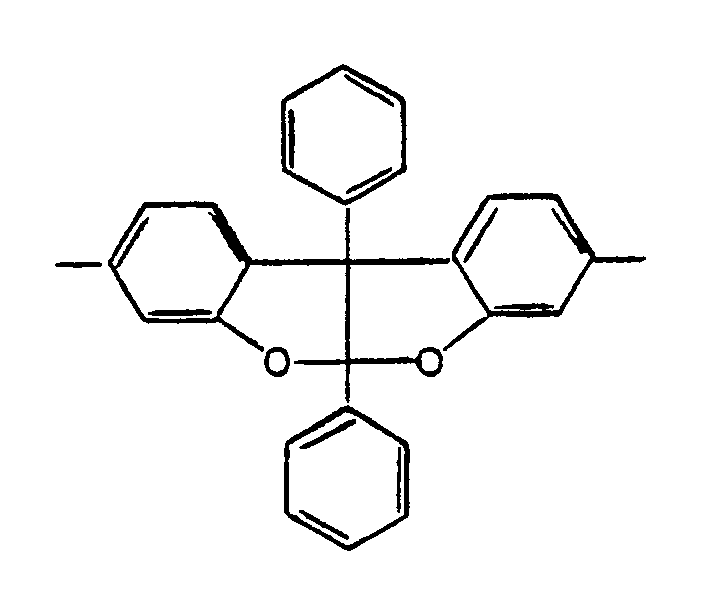
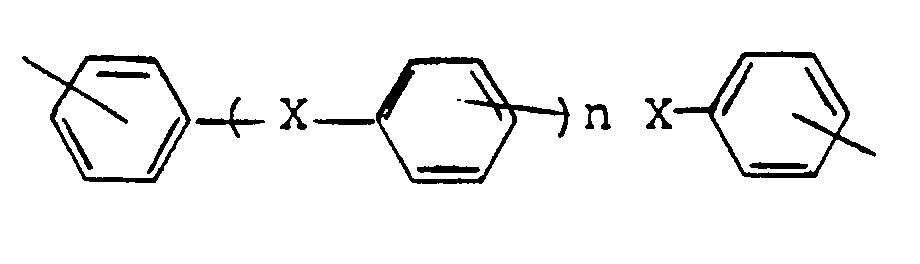

(a + c) : b = 1 : 1 bis 1 : 100 sind,
wobei für den Fall, daß X CO und/oder SO₂ und/oder bis 99 Mol-% Phosphinoxid von der Summe der molaren Anteile der Carbonyl-, Sulfon- und Phosphinoxidgruppen in der Struktureinheit 1 sind, die molaren Verhältnisse
a : c = 100 : 0 bis 1 : 99,
und für den Fall, daß X nur Phosphinoxidgruppen sind, die molaren Verhältnisse
a : c = 99 : 1 bis 1 : 99
betragen.
Description
- Die Erfindung betrifft aromatische Polyether-Kunststoffe mit hohen Glas- und Zersetzungstemperaturen, die schwerbrennbare und thermoplastisch verarbeitbare Massen darstellen, sowie Verfahren zu ihrer Herstellung.
- Aromatische Polyether mit Kunststoffeigenschaften gehören z.T. schon lange zum Stand der Technik und haben teilweise auch als technische Produkte wirtschaftliche Bedeutung erlangt. Für viele Anwendungszwecke vorteilhafte gemeinsame Eigenschaften der aromatischen Polyether sind ihre über 150 Grad C liegende Erweichungstemperatur und ihre thermoplastische Verarbeitbarkeit.
- Zu den aromatischen Polyethern gehören neben Polymeren wie dem Polyxylenol, das als PPO im Handel bekannt ist, und das abwechselnd aus aromatischen- und Ethersauerstoffeinheiten in der Polymerkette aufgebaut ist, auch Polymere, die außer den charakteristischen Aromaten- und Sauerstoffeinheiten noch weitere charakteristische Atomgruppen im Polymermolekül enthalten.
- Bekannt sind hier aromatische Polyäthersulfone, die auch als Polyarylsulfone bezeichnet werden und als technische Produkte auf dem Markt sind (Ullmanns Encyclopädie der technischen Chemie, 4. Auflage, Band 15, Seiten 429 bis 431 und 434 bis 435).
- Aus der DE-A 32 03 186 (= US 4 492 805) sind aromatische Polyether mit phosphorhaltigen Strukturelementen, z.B. Triphenylphosphinoxideinheiten, in der Polymerkette bekannt, die sich als schwerbrennbare bzw. unbrennbare Kunststoffe auszeichnen.
Die Herstellung aromatischer Polyether kann im allgemeinen durch Polykondensation der chemischen Bausteine erfolgen. So werden beispielsweise phosphorhaltige Polyarylenether der DE-A 32 03 186 durch Polykondensation eines bifunktionellen Phosphins bzw. Phosphinoxides, insbesondere der entsprechenden Dihalogenverbindung, mit einer weiteren bifunktionellen aromatischen Verbindung, insbesondere einer Bishydroxyverbindung, erhalten. - Die chemischen Bausteine für die Polykondensation sind danach und wie auch in der US-Patentschrift 4 175 175 beschrieben, vorzugsweise symmetrische Verbindungen des Typs I


und symmetrische Verbindungen des Typs II

- Als chemische Bausteine für die Herstellung der aromatischen Polyether kommen aber auch Verbindungen der Typen I und II in Frage, in denen die reaktiven Gruppen X bzw. Y ganz oder zur Hälfte gegen Y bzw. X ersetzt sind.
- In Polymer Science USSR, 14, (1972), 2962 - 2970, sind aromatische Polyether des "Cardo" Typs beschrieben. Sie werden hergestellt durch Polykondensation von Dihalogenverbindungen des Typs I, wobei R SO₂ oder CO ist, mit Bisphenolen des Typs II, in denen R eine cyclische organische Gruppe ist, von welcher ein Kohlenstoffatom das die beiden aromatischen Ringe von Verbindungen des Typs II verbindende Glied ist. Dieses quartäre Kohlenstoffatom ist nach der Polykondensation Teil der Polymerhauptkette. Beispiele solcher Bisphenole sind danach u.a. Phenolphthalein und Phenolfluoren (= 9,9-Bis-(4-hydroxyphenyl)fluoren).
- Phosphorhaltige Polyarylenether, die analog derjenigen der DE-A 32 03 186 aufgebaut sind, aber "Cardo"-Bausteine, u.a. auch in 3,8-Stellung etherartig gebundene 5a, 10b-Diphenyl-cumarano-2′,3′,2,3-cumaran-Einheiten, neben den Phosphor-Bausteinen enthalten, sind in den deutschen Offenlegungsschriften 35 21 123 und 35 21 124 (= US 4 696 993) genannt. Die phosphorhaltigen Polyether mit den Cumaran-Bausteinen befriedigen wegen ihres relativ hohen Wasseraufnahmevermögens und ihrer hohen Rauchbildung im Brandfall in ihrem Eigenschaftsbild noch nicht.
- Es war daher die Aufgabe, aromatische Polyether mit in 3,8-Stellung etherartig gebundenen 5a,10b-Diphenyl-cumarano-2′,3′,2,3-cumaran-Bausteinen, die amorph, als Kunststoff verarbeitbar und stabil sind, sich durch hohe Glastemperaturen Tg auszeichen und sich in einer wesentlich verringerten Wasseraufnahme und verbessertem Brandverhalten von den aromatischen Polyethern mit der Phosphinoxid-Cumaran-Struktureinheit unterscheiden, zu finden.
- Es wurde gefunden, daß durch vollständigen, aber auch schon durch teilweisen Ersatz des Phosphinoxid-Bausteins in dem bekannten "Phosphinoxid-Cumaran"-Polyether durch andere aromatische Bausteine, wie dem Benzophenon- oder dem Diphenylsulfon-Baustein, die beispielsweise mit Monomeren des oben angegebenen Typs I einbaubar sind, und in die auch noch andere aromatische Bausteine, beispielsweise über die ebenfalls oben angegebenen Monomeren des Typs II, einbaubar sind, aromatische Polyether erhalten werden, die neben bekannten guten Eigenschaften die in der Aufgabe skizzierten weiteren und vorteilhaften Eigenschaften aufweisen.
- Die Erfindung betrifft daher hochtemperaturbeständige aromatische Polyether mit einer reduzierten Viskosität ηsp/c > 0,25 dl/g, gemessen in Chloroform nach DIN 7745, Teil 2, entsprechend ISO 1628/6, und mit in 3,8-Stellung etherartig gebundenen 5a,10b-Diphenyl-cumarano-2′,3′,2,3-cumaran-Bausteinen A der wiederkehrenden Struktureinheit 1
[(A - O)a (B - O)b (C - O)c], (1)
worin
der Baustein A der Strukturformel

und/oder
(a+c) : b = 1 : 1 bis 1 : 100 sind,
wobei für den Fall, daß X CO und/oder SO₂ und oder bis 99 Mol-% Phosphinoxid von der Summe der molaren Anteile der Carbonyl-, Sulfon- und Phosphinoxidgruppen, in der Struktureinheit 1 sind, die molaren Verhältnisse
a : c = 100 : 0 bis 1 : 99,
und für den Fall, daß X nur Phosphinoxidgruppen sind, die molaren Verhältnisse
a : c = 99 : 1 bis 1 : 99
betragen. - Die Erfindung betrifft damit auch Polyether mit der Struktureinheit 1, deren Anteil an Phosphinoxidgruppen in den B-Bausteinen maximal 90 Mol-%, vorzugsweise maximal 50 Mol-% der Summe der molaren Anteile der Carboxyl-, Sulfon- und Phosphinoxidgruppen beträgt, und insbesondere auch solche, die phosphinoxidfrei sind.
Enthalten die Polyether nur B-Bausteine mit Phosphinoxidgruppen, so liegen darin die molaren Anteile von A und C bevorzugt in den Verhältnissen
a : c = 90 : 10 bis 10 : 90 vor. - Von den Verhältnissen (a + c) : b = 1 : 1 bis 1 : 100 ist das Verhältnis (a + c) : b = 1 : 1 ein ausgezeichnetes.
- Die über Ethersauerstoffbrücken miteinander verbundenen Bausteine A, B und C können in dem erfindungsgemäßen Polyether in regelmäßiger oder in statistischer Folge miteinander verknüpft sein.
- Ein hervorragend geeigneter, erfindungsgemäßer Polyether besteht beispielhaft aus "Cumaran"-Einheiten (A), 4,4′-Benzophenon-Einheiten (B) und 2,2-Bis(1,4-phenylen)propan-Einheiten (C) in den molaren Verhältnissen
(a + c) : b = 1 : 1, wobei
a : c = 30 : 70 bis 100 : 0, vor allem
a : c = 30 : 70 bis 90 : 10 bedeuten. - Gegenüber bekannten Polyethern, einschließlich den bekannten des Cardo-Typs, haben die neuen, thermoplastisch verarbeitbaren Polymeren mit den "Cumaran"-Bausteinen A mit etwa 30 bis 50 Grad C höheren Wärmeformbeständigkeiten und als Kunststoffe mit geringerer Wasseraufnahme und die hydrolysestabil sind, deutliche Vorteile bei der Anwendung als Werkstoffe in technischen Bereichen, wie z.B. der Elektronikindustrie oder im Flugzeugbau. Die Glastemperaturen, Tg, der neuen erfindungsgemäßen Polyether liegen in Abhängigkeit vom strukturellen Aufbau im Bereich von etwa 150 bis 300 Grad C, insbesondere im Bereich von 180 bis 280 Grad C und vorteilhafterweise im Bereich von 200 bis 260 Grad C. Die neuen Polymeren sind amorph; sie lassen sich auch aus Lösungen gut weiterverarbeiten.
Ein Vorteil der neuen Polymeren ist, daß der "Cumaran"-Baustein A, eingeführt insbesondere über die entsprechende 3,8-Dihydroxiverbindung, so aus Benzaldehyd über Benzil und dessen Umsetzung mit Resorcin, d.h. aus billigen Ausgangsstoffen und in einfachen Verfahrensweisen zugänglich ist. - Für die Herstellung der neuen aromatischen Polyether (1) mit den aromatischen Grundbausteinen A, B und C durch Polykondensation werden im wesentlichen bifunktionelle chemische Bausteine A′, B′ und C′ eingesetzt, die sich von den Grundbausteinen A, B und C durch jeweils zwei zusätzliche funktionelle Gruppen unterscheiden. Als reaktive Verbindungen werden insbesondere solche mit Halogen, vorzugsweise mit Fluor und Chlor, und solche mit phenolischen Hydroxylgruppen, die vorzugsweise als Phenolat zur Reaktion gebracht werden, eingesetzt. Neben Dihalogenverbindungen und Bisphenolen, wie sie u.a. weiter oben als Verbindungen des Typs I und Verbindungen des Typs II beschrieben sind, kommen als bifunktionelle Ausgangsverbindungen auch solche infrage, die im gleichen Molekül sowohl eine Halogengruppe als auch eine phenolische Gruppe enthalten.
Die Verbindungen A′, B′ und C′ werden in einem solchen Verhältnis zueinander eingesetzt, daß die miteinander reagierenden Halogen- und OH-Gruppen äquivalent sind. Dadurch wird erreicht, daß die erfindungsgemäßen Polykondensate eine reduzierte Viskosität mit einem ηsp/c > 25 dl/g, gemessen in Chloroform nach DIN 7745, Teil 2, entsprechend ISO 1628/6, und damit Kunststoffeigenschaften haben. - Die bei der Herstellung der neuen aromatischen Polyether anzuwendenden Polykondensationsbedingungen sind denen für die Herstellung von phosphorhaltigen Polyarylenethern nach DE-A 32 03 186 bzw. entsprechend US 4 492 805 oder der US 4 175 175 analog. Dies betrifft insbesondere die Verwendung geeigneter Reaktionsmedien und Lösungsmittel, wie z.B. Xylole oder polare-aprotische Lösungsmittel wie N-Methylpyrrolidon, Dimethylformamid, N,N-Dimethylacetamid, Dimethylsulfoxid, Sulfolan, die Reaktionstemperaturen von 100 bis 300 Grad C und die Kondensationsmittel, für die stark basische Alkaliverbindungen, insbesondere Natrium- oder Kaliumcarbonat oder Alkalihydroxide, wie KOH oder NaOH in einer zur abzuspaltenden Halogenidmenge etwa äquivalenten Menge eingesetzt werden. Zur Herstellung der Polymeren werden unter den genannten Bedingungen Reaktionszeiten von 30 Minuten bis etwa 50 Stunden benötigt.
- Darüber hinaus kann die Herstellung der erfindungsgemäßen aromatischen Polyether vorteilhaft mit weiteren, bekannten Maßnahmen zur Herstellung von aromatischen Polyethern, wie dem Zusetzen von geringen Mengen von CuI- oder CuII-Verbindungen, wie z.B. Cu₂O oder CuII-acetat, und/oder dem Zusetzen von Alkalisalzen, wie KF oder solchen von organischen Säuren durchgeführt werden (Journal of Polymer Science: Part C No. 16, pp. 715-724 (1967); EP-A 0 244 167) durchgeführt werden. Dadurch wird eine Beschleunigung der Polykondensation und/oder die Herabsetzung der Polykondensationstemperatur erreicht.
- Die Gegenwart von Kupferverbindungen und/oder von Alkalisalzen, wie KF, wirkt sich sowohl bei der Herstellung der erfindungsgemäßen, den "Cumaran"-Baustein A-enthaltenden Polyethern, als auch bei der Herstellung von "Cumaran"-Baustein A-freien Polyethern, wie sie beispielsweise bei der Polykondensation von 4,4′-Difluorbenzophenon oder 4,4′-Dichlorbenzophenon mit Bisphenol A und 9,9-Bis-(4′-hydroxyphenyl)fluoren erhalten werden (Deutsche Patentanmeldung P 37 25 058.2), beschleunigend auf die Umsetzung zum Erhalt von Polykondensaten mit relativ hohen Molekulargewichten, d.h. von Polykondensaten mit Kunststoffeigenschaften, aus. Die Polykondensation in Gegenwart von Kupferverbindungen und/oder Alkalisalzen wie KF, wirkt sich besonders vorteilhaft bei der Verwendung weniger reaktiver Ausgangsverbindungen, wie z.B. beim Einsetzen von 4,4′-Dichlorbenzophenon, aus.
- Als Ausgangsverbindung A′ für die Einbringung der "Cumaran"-Einheit A in die erfindungsgemäßen Polyether (1) hat sich das aus Benzil und Resorcin nach Rec. Trav. Chim. Pays-Bas 1986, 87 (6), 599 - 608 herstellbare 3,8-Dihydroxi-5a,10b-diphenylcumarano-2′,3′,2,3-cumaran bewährt.
- Für die Einführung des B-Bausteins in das Polykondensat (1) werden als Ausgangsverbindungen B′, solche der Formel

X = SO₂ oder CO und Y = Halogen, insbesondere F oder Cl, oder OH, wie
4,4′-Difluordiphenylsulfon, 4,4′-Dichlordiphenylsulfon, 4,4′-Dihydroxidiphenylsulfon, 4-Chlor-, 4′-hydroxidiphenylsulfon, 4,4′-Difluorbenzophenon, 4,4′-Dichlorbenzophenon, 4,4′-Dihydroxibenzophenon, 4-Chlor-, 4′-hydroxibenzophenon, 4,4′-Difluorterephthalophenon und/oder 4,4′-Difluorisophthalophenon eingesetzt. - Die funktionellen Halogen- bzw. Hydroxygruppen stehen bevorzugt in 4,4 -Stellung. In den Ausgangsverbindungen B können aber auch in untergeordneter Menge andere Stellungsisomere vorhanden sein.
- Bei der Herstellung des Polyethers können als Ausgangsverbindungen B′ außer den oben angegebenen Verbindungen auch phosphorhaltige Verbindungen eingesetzt werden. Die funktionellen Gruppen stehen in diesen vorzugsweise in p-Stellung zu dem an das Phosphoratom gebundenen C-Atom. Bevorzugte phosphorhaltige Vertreter von B′ sind
4,4′-Dichlortriphenylphosphinoxid,
4,4′-Dichlordiphenylmethylphosphinoxid,
4,4′-Difluortriphenylphosphinoxid und
4,4′-Difluordiphenylmethylphosphinoxid. - Beispiele für Ausgangsverbindungen C′ zum Einbau von C in den Polyether sind Hydrochinon, 4,4′-Dihydroxydiphenyl 4,4′-Dihydroxydiphenylether, 2,2-Bis(4-hydroxyphenyl)propan oder bifunktionelle Cardoverbindungen wie z.B. 9,9-Bis(4-hydroxyphenyl)fluoren.
- Die neuen Polyether können aber auch, wie dies in der deutschen Offenlegungsschrift 35 21 123 für phosphorhaltige Polyarylenether beschrieben ist, gegebenenfalls verzweigte Strukturen haben. Für die Einführung von Verzweigungsstellen im Polyether kommen als Ausgangsverbindungen C′ beispielsweise die Verbindungen Tris(4-fluorphenyl)phosphinoxid, Tris(4-hydroxiphenyl)phosphinoxid, 1,3,5-Tris(4′-hydroxiphenyl)benzol, 1,4-Bis(4′,4˝-dihydroxitriphenylmethyl)benzol, aber gegebenenfalls auch aliphatische Polyhydroxiverbindungen, wie z.B. Pentaerythrit in Betracht.
- Synthese eines Polyethers aus 4,4′-Difluorbenzophenon (1), Beisphenol A (2) und Dihydroxy-5a,10b-diphenyl-cumarano-2′,3′,2,3-cumaran (3) im Molverhältnis 1:2:3 = 4:1:3.
- In einem 6 l Vierhalskolben mit Rührer, Innenthermometer, Stickstoffzuleitung und Wasserabscheider mit aufgesetztem Rückflußkühler wurden 85,6 g (0,375 mol) Bisphenol A, 443,7 g (1,125 mol) des Cumaranderivats 3, 327,3 g (1,5 mol) 4,4′-Difluorbenzophenon, 219,7 g Kaliumcarbonat, 2,25 l N-Methylpyrrolidon und 0,7 l techn. Xylolgemisch vorgelegt. Die Reaktionsmischung wurde nun unter Stickstoffatmosphäre mit einem Ölbad auf Rückflußtemperatur erhitzt und das sich bildende Wasser innerhalb von 2 Stunden ausgekreist. Nach vollständiger Entfernung des Wassers wurde das Xylol über den Wasserabscheider bei ca. 180 Grad C abdestilliert und das zurückbleibende Reaktionsgemisch bei dieser Temperatur so lange gehalten, bis das Molekulargewicht Mw des Polykondensats ca. 80 000 betrug (Messung: GPC, Eichung mit Polystyrol). Anschließend wurden ca. 0,2 Mol Methylchlorid durch die Reaktionsmischung geleitet.
- Nach Abkühlung wurde der Ansatz mit 500 ml N-Methylpyrrolidon verdünnt und von den festen Bestandteilen des Reaktionsgemischs abgesaugt. Der Polyether wurde anschließend in der 7-fachen Menge Wasser/Ethanol (Volumenverhältnis = 7 : 3) ausgefällt, von der Flüssigkeit durch Filtration getrennt und nach 18-stündigem Trocknen bei Raumtemperatur in möglichst wenig Methylenchlorid gelöst. Die Lösung wurde zur 5-fachen Menge Ethanol zugetropft, wobei das Polykondensat ausfiel. Das Produkt wurde in Vakuum bei 140 Grad C bis zur Gewichtskonstanz getrocknet. Ausbeute: 701 g (88 % d.Th.)
- Die Analyse erfolgte durch C-13-NMR- bzw. IR-Spektroskopie.
- An durch thermoplastische Verarbeitung (Extrusion) erhaltenen Werkstücken wurden folgende Eigenschaften ermittelt.
Mw 1) Reißdehnung (%) E-Modul2) (MPa) Zugfestigkeit (MPa) Ul 94-Klassif.3) Rauch dichte4) (1,5/4 min) Glastemp.5) (Grad C) Wasseraufnahme6) (23 Grad C) (%) 96000 38 2750 81 V-0 2/19 ca.235 0,76 1) GPC, Eichung mit Polystyrol 2) DIN 53 455 3) Test der Underwriter Laboratories, USA; V - 0 ist beste Klassifizierung 4) Rauchkammer entsprechend den Vorschriften des National Bureau of Standards, USA 5) Differential Scanning Calorimetry (vgl. E.A. TURI, Ed. "Thermal Characterization of Polymeric Materials" pg. 169, Academic Press, New York 1981) 6) DIN 53 495 - Die Umsetzung wurde wie in Beispiel 1 beschrieben durchgeführt, mit der Ausnahme, daß das Molverhältnis Bisphenol A: Cumaranderivat = 3 : 1 bzw. 1 : 1 betrug.
- Man erhielt Kunststoffe mit folgenden Eigenschaften:
Beisp. Nr. Molverh. B.A:C Reißdehnung (%) E-Modul (MPa) Zugfestigkeit (MPa) UL94-Klassif. Rauchdichte (1,5/4 min) Glastemp. (Grad C) Wasseraufnahme (23 °C) (%) 2 3:1 65 2770 72 V-1 3/41 3 1:1 V-0 1/13 223 0,6 - Die Umsetzung wurde wie im Beispiel 1 beschrieben durchgeführt mit der Ausnahme, daß als Bisphenol nur Dihydroxy-5a,10b-diphenyl-cumarano-2′,3′,2,3-cumaran eingesetzt wurde.
Der Kunststoff besaß folgende Eigenschaften:Reißdehnung (%) E-Modul (MPa) Zugfestigkeit UL94 Klassif. Rauchdichte (1,5/4 min) Glastemp. (Grad C) Wasseraufnahme (23 Grad C) (%) 9,2 2490 82,8 V-0 1/7 274 0,88 - Die Umsetzung wurde wie in Beispiel 1 beschrieben durchgeführt mit den Ausnahmen, daß anstelle von 4,4′-Difluorbenzophenon das 4,4′-Dichlordiphenylsulfon verwendet wurde (in der gleichen Molmenge) und daß die Ansätze um den Faktor 5 verkleinert wurden. Dementsprechend wurden die Reaktionen im 2 l-Rundkolben durchgeführt. Die Reaktionszeiten blieben wie im Beispiel 1 beschrieben.
Beispiel Nr. Glastemperatur 1) (Grad C) Molverhältnis Bisphenol A: Cumaranbisphenol 5 199 7 : 3 6 218 1 : 1 1) bestimmt durch Differential Scanning Calorimetry (DSC) - Die Umsetzung wurde wie in Beispiel 5 beschrieben durchgeführt, mit der Ausnahme, daß anstelle des Bisphenol A's andere Bisphenole eingesetzt wurden. Die Polyether werden erhalten aus 4,4′-Dichlordiphenylsulfon: Cumaranbisphenol: Bisphenol im Molverhältnis 2 : 1 : 1.

- Es wurde wie in Beispiel 7 beschrieben gearbeitet mit der Ausnahme, daß anstelle des 4,4′-Dichlordiphenylsulfon das 4,4′-Difluortri phenylphosphinoxid eingesetzt wurde

- Die Umsetzung wurde wie in Beispiel 5 beschrieben durchgeführt, mit der Ausnahme, daß anstelle des 4,4′-Difluorbenzophenon 4,4′-Difluor-iso- und/oder -terephthalophenon eingesetzt wurden. Das Molverhältnis Bisphenol A zu Cumaranderivat betrug 1 : 1.
Man erhielt Produkte mit folgenden EigenschaftenBeispiel Nr. eingesetztes reaktives Dihalogenid Glastemperatur (Grad C) 15 4,4′-Difluor-terephthalophenon 199 16 4,4′-Difluor-isophthalophenon 182
reduzierte Viskosität ηsp/c in dl/g, nach DIN 7745, Teil 2, entsprechend ISO 1628/6 -
der Polykondensate nach:
- Synthese eines Polyethers aus 4,4′-Dichlorbenzophenon (1), Beisphenol A (2) und Dihydroxy-5a, 10b-diphenyl-cumarano-2′,3′,2,3-cumaran (3) im Molverhältnis 1 : 2 : 3 = 4 : 1 : 3.
- In einem 250 ml Kolben mit Rührer, Innenthermometer, Stickstoffzuleitung und Wasserabscheider mit aufgesetztem Rückflußkühler wurden 2,85 g (0,0125 mol) Bisphenol A (2), 14,8 g (0,0375 mol) des Cumaranderivates (3), 12,55 g (0,05 mol) 4,4′-Dichlorbenzophenon (1), 11,05 g (0,08 mol) Kaliumcarbonat, 0,1 g Kupfer(I)acetat, 0,4g Kaliumfluorid, 75 ml N-Methylpyrrolidon und 45 ml o-Xylol vorgelegt.
- Die Reaktionsmischung wurde nun unter Stickstoffatmosphäre mit einem Ölbad auf Rückflußtemperatur erhitzt und das sich bildende Wasser innerhalb von 2,5 Stunden ausgekreist. Nach vollständiger Entfernung des Wassers wurde das Xylol über den Wasserabscheider bei ca. 180 bis 190 Grad C abdestilliert und das zurückbleibende Reaktionsgemisch für 5 Stunden bei dieser Temperatur gehalten.
- Nach Abkühlung wurde der Ansatz mit 50 ml N-Methylpyrrolidon verdünnt und von den festen Bestandteilen des Reaktionsgemisches abgesaugt. Der Polyether wurde anschließend in 1,4 l Ethanol/Wasser (Volumenverhältnis = 1 : 1) ausgefällt, von der Flüssigkeit durch Filtration getrennt und nach 18-stündigem Trocknen bei 150 Grad C im Vakuumtrockenschrank in 300 ml Dichlormethan gelöst und in 1,6 l Ethanol ausgefällt. Das Polykondensat wurde abfiltriert und bei 150 Grad C im Vakuum bis zur Gewichtskonstanz getrocknet. Ausbeute 24 g (91 % d.Th). Das Molekulargewicht Mw des Polykondensates betrug ca. 61 000 (Messung: GPC, Eichung mit Polystyrol).
- Die Umsetzung wurde wie in Beispiel 17 beschrieben durchgeführt, mit der Ausnahme, daß kein Kaliumfluorid zugesetzt wurde. Man erhielt ein Polykondensat mit einem Molekulargewicht Mw ca. 33 000. Die Ausbeute betrug 24,3 g (92 % d.Th)
- Die Umsetzung wurde wie in Beispiel 17 beschrieben durchgeführt, mit der Ausnahme, daß kein Kupfer-(I)-acetat zugesetzt wurde. Man erhielt ein Polykondensat mit einem Molekulargewicht Mw ca. 9 000. Die Ausbeute betrug 23,5 g (88 % d.Th).
- Synthese eines Polyethers aus 4,4′-Difluorbenzophenon (1), Bisphenol A (2) und 9,9-Bis(4′hydroxyphenyl)fluoren (3) im Molverhältnis 1 : 2 : 3 = 10 : 4 : 6.
- In einem 250 ml Kolben mit Rührer, Innenthermometer, Stickstoffzuleitung und Kolonnenkopf mit aufgesetztem Rückflußkühler wurden 4,57 g (0,02 mol) Bisphenol A (2), 10,62 g (0,03 mol) 9,9-Bis(4′-hydroxyphenyl)fluoren (3), 10,91 g (0,05 mol), 4,4′-Difluorbenzophenon (1), 11,05 g (0,08 mol) Kaliumcarbonat, 0,1 g Kupfer-(I)-acetat und 50 ml N-Methylpyrrolidon vorgelegt.
- Die Reaktionsmischung wurde nun unter Stickstoffatmosphäre mit einem Ölbad auf ca. 180 Grad C erhitzt. Das gebildete Wasser wurde während der Reaktionszeit von 1 Stunde und 20 Minuten über den Kolonnenkopf abgezogen. Das zurückgebliebene Reaktionsgemisch wurde abgekühlt mit 100 ml N-Methylpyrrolidon verdünnt und von den festen Bestandteilen des Reaktionsgemisches abgesaugt. Der Polyether wurde anschließend in 1,4 l Ethanol/Wasser (Volumenverhältnis = 1 : 1) ausgefällt, von der Flüssigkeit durch Filtration getrennt und nach 18-stündigem Trocknen bei 150 Grad C im Vakuumtrockenschrank in 350 ml Dichlormethan gelöst und in 1,6 l Ethanol ausgefällt. Das Polykondensat wurde abfiltriert und bei 150 Grad C im Vakuum bis zur Gewichtskonstanz getrocknet. Ausbeute 21,5 g (90 % d. Th). Das Molekulargewicht Mw des Polykondensates betrug ca. 121 000 (Messung: GPC, Eichung mit Polystyrol).
- Die Umsetzung wurde wie in Beispiel 20 beschrieben durchgeführt, mit der Ausnahme, daß Kupfer-(II)-acetat anstelle von Kupfer-(I)-acetat zugesetzt wurde. Man erhielt ein Polykondensat mit einem Molekulargewicht Mw ca. 118 000. Die Ausbeute betrug 18,1 g (76 % d.Th).
- Die Umsetzung wurde wie in Beispiel 20 beschrieben durchgeführt, mit der Ausnahme, daß keine Kupferverbindung zugesetzt wurde. Man erhielt ein Polykondensat mit einem Molekulargewicht Mw ca. 30 000. Die Ausbeute betrug 21 g (88 % d.Th).
- Die Umsetzung wurde wie in Beispiel 20 beschrieben durchgeführt, mit der Ausnahme, daß das Reaktionsgemisch nur auf eine Temperatur von 150 bis 160 Grad C erhitzt wurde. Nach einer Reaktionszeit von 4 Stunden erhielt man ein Polykondensat mit einem Molekulargewicht Mw ca. 155 000. Die Ausbeute betrug 21,1g (88 % d.Th).
- Die Umsetzung wurde wie in Beispiel 20 beschrieben durchgeführt, mit der Ausnahme, daß das Reaktionsgemisch nur auf eine Temperatur von 130 bis 140 Grad C erhitzt wurde. Man erhielt nach einer Reatkionszeit von 10 Stunden ein Polykondensat mit einem Molekulargewicht Mw ca. 55 000. Die Ausbeute betrug 21 g (88 % d.Th).
- Die Umsetzung wurde wie in Beispiel 20 beschrieben durchgeführt, mit der Ausnahme, daß als Lösungsmittel Dimethylacetamid verwendet wurde. Die Reaktionstemperatur betrug 150 - 160 Grad C und die Reatkionszeit 10 Stunden. Man erhielt ein Polykondensat mit einem Molekulargewicht Mw ca. 70 000. Die Ausbeute betrug 21,6 g (90 % d.Th).
Claims (6)
[(A - O)a (B - O)b (C - O)c] , (1)
worin
der Baustein A der Strukturformel


(a + c) : b = 1 : 1 bis 1 : 100 sind,
wobei für den Fall, daß X CO und/oder SO₂ und/oder bis 99 Mol-% Phosphinoxid von der Summe der molaren Anteile der Carbonyl-, Sulfon- und Phosphinoxidgruppen in der Struktureinheit 1 sind, die molaren Verhältnisse
a : c = 100 : 0 bis 1 : 99,
und für den Fall, daß X nur Phosphinoxidgruppen sind, die molaren Verhältnisse
a : c = 99 : 1 bis 1 : 99
betragen.
a : c = 90 : 10 bis 10 : 90
betragen.
(a + c) : b = 1 : 1
beträgt.
(a + c) : b = 1 : 1 mit
a :c = 30 : 70 bis 100 : 0
enthalten.
Priority Applications (1)
| Application Number | Priority Date | Filing Date | Title |
|---|---|---|---|
| AT89102296T ATE98969T1 (de) | 1988-02-18 | 1989-02-10 | Hochtemperaturbestaendige aromatische polyether. |
Applications Claiming Priority (2)
| Application Number | Priority Date | Filing Date | Title |
|---|---|---|---|
| DE3804988 | 1988-02-18 | ||
| DE3804988A DE3804988A1 (de) | 1988-02-18 | 1988-02-18 | Hochtemperaturbestaendige aromatische polyether |
Publications (3)
| Publication Number | Publication Date |
|---|---|
| EP0329029A2 true EP0329029A2 (de) | 1989-08-23 |
| EP0329029A3 EP0329029A3 (en) | 1990-08-16 |
| EP0329029B1 EP0329029B1 (de) | 1993-12-22 |
Family
ID=6347617
Family Applications (1)
| Application Number | Title | Priority Date | Filing Date |
|---|---|---|---|
| EP89102296A Expired - Lifetime EP0329029B1 (de) | 1988-02-18 | 1989-02-10 | Hochtemperaturbeständige aromatische Polyether |
Country Status (5)
| Country | Link |
|---|---|
| US (1) | US4990588A (de) |
| EP (1) | EP0329029B1 (de) |
| JP (1) | JPH01254736A (de) |
| AT (1) | ATE98969T1 (de) |
| DE (2) | DE3804988A1 (de) |
Cited By (1)
| Publication number | Priority date | Publication date | Assignee | Title |
|---|---|---|---|---|
| CN110041478A (zh) * | 2019-05-05 | 2019-07-23 | 大连理工大学 | 新型可结晶可溶解含双酚芴结构聚醚醚酮酮树脂及制备方法 |
Families Citing this family (7)
| Publication number | Priority date | Publication date | Assignee | Title |
|---|---|---|---|---|
| DE3934712A1 (de) * | 1989-10-18 | 1991-04-25 | Bayer Ag | Polycarbonate mit verbesserter waermeformbestaendigkeit |
| DE4010029A1 (de) * | 1990-03-29 | 1991-10-02 | Bayer Ag | Polyester und polyestercarbonate auf basis von 3,8-dihydroxy-5a,10b-diphenylcumarano -2',3',2,3-cumaran |
| US5874516A (en) * | 1995-07-13 | 1999-02-23 | Air Products And Chemicals, Inc. | Nonfunctionalized poly(arylene ethers) |
| US20060069236A1 (en) * | 2004-09-27 | 2006-03-30 | General Electric Company | Polyethersulfone compositions with high heat and good impact resistance |
| JP2010126693A (ja) * | 2008-11-28 | 2010-06-10 | Nagase Chemtex Corp | 非対称型の多官能水酸基含有縮環構造化合物及び縮環構造含有樹脂 |
| WO2011071340A2 (ko) * | 2009-12-11 | 2011-06-16 | 한양대학교 산학협력단 | 투명성과 고내열성을 갖는 폴리아릴렌에테르계 중합체 및 그 제조 방법 |
| CN105801830B (zh) * | 2016-05-03 | 2018-01-19 | 中国航空工业集团公司北京航空材料研究院 | 一种耐高温聚碳酸酯及其制备方法 |
Family Cites Families (7)
| Publication number | Priority date | Publication date | Assignee | Title |
|---|---|---|---|---|
| US4175175A (en) * | 1963-07-16 | 1979-11-20 | Union Carbide Corporation | Polyarylene polyethers |
| DE3203186A1 (de) * | 1982-01-30 | 1983-08-11 | Röhm GmbH, 6100 Darmstadt | Phosphorhaltige polyarylenaether |
| DE3521123A1 (de) * | 1985-06-13 | 1986-12-18 | Röhm GmbH, 6100 Darmstadt | Phosphorhaltige polyarylenaether und verfahren zu ihrer herstellung |
| DE3521124A1 (de) * | 1985-06-13 | 1986-12-18 | Röhm GmbH, 6100 Darmstadt | Verfahren zur herstellung phosphorhaltiger polyarylenaether |
| US4748227A (en) * | 1986-04-25 | 1988-05-31 | Amoco Corporation | Process for preparing poly(aryl ether)ketones using a sodium carbonate/organic acid salt catalyst |
| US4774314A (en) * | 1986-04-25 | 1988-09-27 | Amoco Corporation | Preparing poly(aryl ethers) using alkaline earth metal carbonates, organic acid salts, and optionally copper compounds, as catalysts |
| DE3725058A1 (de) * | 1987-07-29 | 1989-02-09 | Roehm Gmbh | Thermoplastisch verarbeitbare polyarylenether mit 9,9-bis-(4'-hydroxyphenyl)fluoren |
-
1988
- 1988-02-18 DE DE3804988A patent/DE3804988A1/de not_active Withdrawn
-
1989
- 1989-02-08 US US07/308,110 patent/US4990588A/en not_active Expired - Fee Related
- 1989-02-10 AT AT89102296T patent/ATE98969T1/de not_active IP Right Cessation
- 1989-02-10 DE DE89102296T patent/DE58906465D1/de not_active Expired - Fee Related
- 1989-02-10 EP EP89102296A patent/EP0329029B1/de not_active Expired - Lifetime
- 1989-02-16 JP JP1035194A patent/JPH01254736A/ja active Pending
Cited By (1)
| Publication number | Priority date | Publication date | Assignee | Title |
|---|---|---|---|---|
| CN110041478A (zh) * | 2019-05-05 | 2019-07-23 | 大连理工大学 | 新型可结晶可溶解含双酚芴结构聚醚醚酮酮树脂及制备方法 |
Also Published As
| Publication number | Publication date |
|---|---|
| ATE98969T1 (de) | 1994-01-15 |
| US4990588A (en) | 1991-02-05 |
| DE3804988A1 (de) | 1989-08-31 |
| EP0329029A3 (en) | 1990-08-16 |
| JPH01254736A (ja) | 1989-10-11 |
| DE58906465D1 (de) | 1994-02-03 |
| EP0329029B1 (de) | 1993-12-22 |
Similar Documents
| Publication | Publication Date | Title |
|---|---|---|
| DE3382700T2 (de) | Verwendung eines amorphen aromatischen thermoplastischen Polymeren. | |
| EP0301409A2 (de) | Thermoplastisch verarbeitbare Polyarylenether mit 9,9-Bis-(4'-hydroxyphenyl)fluoren | |
| EP0688824B1 (de) | Homogene Polmerlegierungen auf der Basis von sulfonierten, aromatischen Polyetherketonen | |
| EP0388358B1 (de) | Neue Polyarylenether | |
| EP0327984A2 (de) | Polyaryletherketone mit verbesserter Verarbeitbarkeit | |
| EP0329029B1 (de) | Hochtemperaturbeständige aromatische Polyether | |
| DE3614753A1 (de) | Hochtemperaturbestaendige copolykondensat-formmassen | |
| DE4423349C2 (de) | Polyamidimidharze, die Isophorondiamin enthalten und Verfahren zu ihrer Herstellung | |
| DE1520379B2 (de) | Phenylsulfongruppen enthaltende lineare Polykondensationsprodukte und Verfahren zu deren Herstellung | |
| EP0623641A1 (de) | Verfahren zur Oxidation von Thioethergruppen enthaltenden Polyarylenverbindungen | |
| EP0205124B1 (de) | Verfahren zur Herstellung phosphorhaltiger Polyarylenäther | |
| EP0479192A2 (de) | Modifizierte Polyarylenether-Blockcopolymere | |
| EP0096799B1 (de) | Phosphorhaltige Polyarylenester und Verfahren zu ihrer Herstellung | |
| DE68905225T2 (de) | Polyimiaharzzusammensetzung. | |
| EP0206099B1 (de) | Phosphorhaltige Polyarylenäther und Verfahren zu ihrer Herstellung | |
| EP0327980A2 (de) | Hochtemperaturbeständige Polyarylether mit verbesserter Verarbeitbarkeit | |
| EP0265842A2 (de) | Hochtemperaturbeständige Polyethersulfon/Polyetherketon-Blockcopolykondensate | |
| EP0161453B1 (de) | Temperaturbeständige aromatische Polyether | |
| EP0378105A2 (de) | Hochtemperaturbeständige Polysulfon-Polyimid-Blockcopolykondensate, Verfahren zu ihrer Herstellung durch Schmelzkondensation und ihre Verwendung | |
| EP0447358A2 (de) | Lösliche Polyarylenethersulfone | |
| EP0604881B1 (de) | Homogene Polymerlegierungen auf der Basis von sulfonierten, aromatischen Polyetherketonen | |
| EP0412934A2 (de) | Modifizierte Polyarylenethersulfone | |
| EP0483502B1 (de) | Hochtemperaturbeständige, benzthiazolhaltige Polyarylether | |
| EP0322609A2 (de) | Hochtemperaturbeständige Blockcopolykondensate mit verbesserter Wärmeformbeständigkeit | |
| EP0103731A2 (de) | Phosphorhaltige Polyarylenester und Verfahren zu ihrer Herstellung |
Legal Events
| Date | Code | Title | Description |
|---|---|---|---|
| PUAI | Public reference made under article 153(3) epc to a published international application that has entered the european phase |
Free format text: ORIGINAL CODE: 0009012 |
|
| AK | Designated contracting states |
Kind code of ref document: A2 Designated state(s): AT BE CH DE ES FR GB IT LI NL SE |
|
| PUAL | Search report despatched |
Free format text: ORIGINAL CODE: 0009013 |
|
| AK | Designated contracting states |
Kind code of ref document: A3 Designated state(s): AT BE CH DE ES FR GB IT LI NL SE |
|
| 17P | Request for examination filed |
Effective date: 19900829 |
|
| 17Q | First examination report despatched |
Effective date: 19920923 |
|
| GRAA | (expected) grant |
Free format text: ORIGINAL CODE: 0009210 |
|
| AK | Designated contracting states |
Kind code of ref document: B1 Designated state(s): AT BE CH DE ES FR GB IT LI NL SE |
|
| PG25 | Lapsed in a contracting state [announced via postgrant information from national office to epo] |
Ref country code: IT Free format text: LAPSE BECAUSE OF FAILURE TO SUBMIT A TRANSLATION OF THE DESCRIPTION OR TO PAY THE FEE WITHIN THE PRE;WARNING: LAPSES OF ITALIAN PATENTS WITH EFFECTIVE DATE BEFORE 2007 MAY HAVE OCCURRED AT ANY TIME BEFORE 2007. THE CORRECT EFFECTIVE DATE MAY BE DIFFERENT FROM THE ONE RECORDED.SCRIBED TIME-LIMIT Effective date: 19931222 Ref country code: ES Free format text: THE PATENT HAS BEEN ANNULLED BY A DECISION OF A NATIONAL AUTHORITY Effective date: 19931222 Ref country code: FR Effective date: 19931222 Ref country code: BE Effective date: 19931222 Ref country code: GB Effective date: 19931222 Ref country code: NL Effective date: 19931222 Ref country code: SE Effective date: 19931222 |
|
| REF | Corresponds to: |
Ref document number: 98969 Country of ref document: AT Date of ref document: 19940115 Kind code of ref document: T |
|
| REF | Corresponds to: |
Ref document number: 58906465 Country of ref document: DE Date of ref document: 19940203 |
|
| PG25 | Lapsed in a contracting state [announced via postgrant information from national office to epo] |
Ref country code: AT Effective date: 19940210 |
|
| PG25 | Lapsed in a contracting state [announced via postgrant information from national office to epo] |
Ref country code: CH Effective date: 19940228 Ref country code: LI Effective date: 19940228 |
|
| EN | Fr: translation not filed | ||
| NLV1 | Nl: lapsed or annulled due to failure to fulfill the requirements of art. 29p and 29m of the patents act | ||
| GBV | Gb: ep patent (uk) treated as always having been void in accordance with gb section 77(7)/1977 [no translation filed] |
Effective date: 19931222 |
|
| PLBE | No opposition filed within time limit |
Free format text: ORIGINAL CODE: 0009261 |
|
| STAA | Information on the status of an ep patent application or granted ep patent |
Free format text: STATUS: NO OPPOSITION FILED WITHIN TIME LIMIT |
|
| REG | Reference to a national code |
Ref country code: CH Ref legal event code: PL |
|
| PG25 | Lapsed in a contracting state [announced via postgrant information from national office to epo] |
Ref country code: DE Effective date: 19941101 |
|
| 26N | No opposition filed |