EP0329255A2 - Nichtgewobener Artikel aus wärmebeständigem Material, Verfahren zur Herstellung desselben und Vorrichtung zum Ausführen des Verfahrens - Google Patents
Nichtgewobener Artikel aus wärmebeständigem Material, Verfahren zur Herstellung desselben und Vorrichtung zum Ausführen des Verfahrens Download PDFInfo
- Publication number
- EP0329255A2 EP0329255A2 EP89200375A EP89200375A EP0329255A2 EP 0329255 A2 EP0329255 A2 EP 0329255A2 EP 89200375 A EP89200375 A EP 89200375A EP 89200375 A EP89200375 A EP 89200375A EP 0329255 A2 EP0329255 A2 EP 0329255A2
- Authority
- EP
- European Patent Office
- Prior art keywords
- fibres
- level
- air flow
- conveying
- set forth
- Prior art date
- Legal status (The legal status is an assumption and is not a legal conclusion. Google has not performed a legal analysis and makes no representation as to the accuracy of the status listed.)
- Granted
Links
- 238000000034 method Methods 0.000 title claims abstract description 31
- 238000004519 manufacturing process Methods 0.000 title claims abstract description 15
- 239000000463 material Substances 0.000 title claims abstract description 9
- 229910052500 inorganic mineral Inorganic materials 0.000 claims abstract description 15
- 239000011707 mineral Substances 0.000 claims abstract description 15
- 239000011230 binding agent Substances 0.000 claims abstract description 12
- 239000000919 ceramic Substances 0.000 claims abstract description 12
- 230000027455 binding Effects 0.000 claims abstract description 6
- 238000009739 binding Methods 0.000 claims abstract description 6
- 239000000203 mixture Substances 0.000 claims abstract description 6
- 238000001035 drying Methods 0.000 claims abstract description 3
- 239000000835 fiber Substances 0.000 claims description 42
- 239000011324 bead Substances 0.000 claims description 7
- 239000003365 glass fiber Substances 0.000 claims description 6
- 239000012535 impurity Substances 0.000 claims description 5
- 238000004891 communication Methods 0.000 claims description 4
- 239000004576 sand Substances 0.000 claims description 3
- 238000011144 upstream manufacturing Methods 0.000 claims description 3
- 239000007858 starting material Substances 0.000 claims description 2
- 239000011521 glass Substances 0.000 abstract description 10
- 239000000047 product Substances 0.000 description 7
- 238000009499 grossing Methods 0.000 description 6
- 238000000926 separation method Methods 0.000 description 6
- 235000019587 texture Nutrition 0.000 description 5
- 238000007664 blowing Methods 0.000 description 4
- 229920000728 polyester Polymers 0.000 description 4
- 230000015572 biosynthetic process Effects 0.000 description 3
- 239000011810 insulating material Substances 0.000 description 3
- 238000004080 punching Methods 0.000 description 3
- 229920002994 synthetic fiber Polymers 0.000 description 3
- 239000011248 coating agent Substances 0.000 description 2
- 238000000576 coating method Methods 0.000 description 2
- 239000002131 composite material Substances 0.000 description 2
- 238000007380 fibre production Methods 0.000 description 2
- 238000002844 melting Methods 0.000 description 2
- 230000008018 melting Effects 0.000 description 2
- 238000002203 pretreatment Methods 0.000 description 2
- 239000002994 raw material Substances 0.000 description 2
- XLYOFNOQVPJJNP-UHFFFAOYSA-N water Substances O XLYOFNOQVPJJNP-UHFFFAOYSA-N 0.000 description 2
- 239000004677 Nylon Substances 0.000 description 1
- 239000000853 adhesive Substances 0.000 description 1
- 230000001070 adhesive effect Effects 0.000 description 1
- 239000010425 asbestos Substances 0.000 description 1
- 239000004566 building material Substances 0.000 description 1
- 230000006835 compression Effects 0.000 description 1
- 238000007906 compression Methods 0.000 description 1
- 230000000694 effects Effects 0.000 description 1
- 230000009970 fire resistant effect Effects 0.000 description 1
- 238000009413 insulation Methods 0.000 description 1
- 239000011490 mineral wool Substances 0.000 description 1
- 229920001778 nylon Polymers 0.000 description 1
- 230000000149 penetrating effect Effects 0.000 description 1
- 230000000717 retained effect Effects 0.000 description 1
- 229910052895 riebeckite Inorganic materials 0.000 description 1
- 239000007787 solid Substances 0.000 description 1
Images

Classifications
-
- D—TEXTILES; PAPER
- D04—BRAIDING; LACE-MAKING; KNITTING; TRIMMINGS; NON-WOVEN FABRICS
- D04H—MAKING TEXTILE FABRICS, e.g. FROM FIBRES OR FILAMENTARY MATERIAL; FABRICS MADE BY SUCH PROCESSES OR APPARATUS, e.g. FELTS, NON-WOVEN FABRICS; COTTON-WOOL; WADDING ; NON-WOVEN FABRICS FROM STAPLE FIBRES, FILAMENTS OR YARNS, BONDED WITH AT LEAST ONE WEB-LIKE MATERIAL DURING THEIR CONSOLIDATION
- D04H1/00—Non-woven fabrics formed wholly or mainly of staple fibres or like relatively short fibres
- D04H1/70—Non-woven fabrics formed wholly or mainly of staple fibres or like relatively short fibres characterised by the method of forming fleeces or layers, e.g. reorientation of fibres
- D04H1/72—Non-woven fabrics formed wholly or mainly of staple fibres or like relatively short fibres characterised by the method of forming fleeces or layers, e.g. reorientation of fibres the fibres being randomly arranged
- D04H1/732—Non-woven fabrics formed wholly or mainly of staple fibres or like relatively short fibres characterised by the method of forming fleeces or layers, e.g. reorientation of fibres the fibres being randomly arranged by fluid current, e.g. air-lay
-
- D—TEXTILES; PAPER
- D04—BRAIDING; LACE-MAKING; KNITTING; TRIMMINGS; NON-WOVEN FABRICS
- D04H—MAKING TEXTILE FABRICS, e.g. FROM FIBRES OR FILAMENTARY MATERIAL; FABRICS MADE BY SUCH PROCESSES OR APPARATUS, e.g. FELTS, NON-WOVEN FABRICS; COTTON-WOOL; WADDING ; NON-WOVEN FABRICS FROM STAPLE FIBRES, FILAMENTS OR YARNS, BONDED WITH AT LEAST ONE WEB-LIKE MATERIAL DURING THEIR CONSOLIDATION
- D04H1/00—Non-woven fabrics formed wholly or mainly of staple fibres or like relatively short fibres
- D04H1/40—Non-woven fabrics formed wholly or mainly of staple fibres or like relatively short fibres from fleeces or layers composed of fibres without existing or potential cohesive properties
- D04H1/42—Non-woven fabrics formed wholly or mainly of staple fibres or like relatively short fibres from fleeces or layers composed of fibres without existing or potential cohesive properties characterised by the use of certain kinds of fibres insofar as this use has no preponderant influence on the consolidation of the fleece
- D04H1/4209—Inorganic fibres
- D04H1/4218—Glass fibres
-
- D—TEXTILES; PAPER
- D04—BRAIDING; LACE-MAKING; KNITTING; TRIMMINGS; NON-WOVEN FABRICS
- D04H—MAKING TEXTILE FABRICS, e.g. FROM FIBRES OR FILAMENTARY MATERIAL; FABRICS MADE BY SUCH PROCESSES OR APPARATUS, e.g. FELTS, NON-WOVEN FABRICS; COTTON-WOOL; WADDING ; NON-WOVEN FABRICS FROM STAPLE FIBRES, FILAMENTS OR YARNS, BONDED WITH AT LEAST ONE WEB-LIKE MATERIAL DURING THEIR CONSOLIDATION
- D04H1/00—Non-woven fabrics formed wholly or mainly of staple fibres or like relatively short fibres
- D04H1/40—Non-woven fabrics formed wholly or mainly of staple fibres or like relatively short fibres from fleeces or layers composed of fibres without existing or potential cohesive properties
- D04H1/42—Non-woven fabrics formed wholly or mainly of staple fibres or like relatively short fibres from fleeces or layers composed of fibres without existing or potential cohesive properties characterised by the use of certain kinds of fibres insofar as this use has no preponderant influence on the consolidation of the fleece
- D04H1/4209—Inorganic fibres
-
- D—TEXTILES; PAPER
- D04—BRAIDING; LACE-MAKING; KNITTING; TRIMMINGS; NON-WOVEN FABRICS
- D04H—MAKING TEXTILE FABRICS, e.g. FROM FIBRES OR FILAMENTARY MATERIAL; FABRICS MADE BY SUCH PROCESSES OR APPARATUS, e.g. FELTS, NON-WOVEN FABRICS; COTTON-WOOL; WADDING ; NON-WOVEN FABRICS FROM STAPLE FIBRES, FILAMENTS OR YARNS, BONDED WITH AT LEAST ONE WEB-LIKE MATERIAL DURING THEIR CONSOLIDATION
- D04H1/00—Non-woven fabrics formed wholly or mainly of staple fibres or like relatively short fibres
- D04H1/40—Non-woven fabrics formed wholly or mainly of staple fibres or like relatively short fibres from fleeces or layers composed of fibres without existing or potential cohesive properties
- D04H1/42—Non-woven fabrics formed wholly or mainly of staple fibres or like relatively short fibres from fleeces or layers composed of fibres without existing or potential cohesive properties characterised by the use of certain kinds of fibres insofar as this use has no preponderant influence on the consolidation of the fleece
- D04H1/4382—Stretched reticular film fibres; Composite fibres; Mixed fibres; Ultrafine fibres; Fibres for artificial leather
- D04H1/43835—Mixed fibres, e.g. at least two chemically different fibres or fibre blends
-
- D—TEXTILES; PAPER
- D04—BRAIDING; LACE-MAKING; KNITTING; TRIMMINGS; NON-WOVEN FABRICS
- D04H—MAKING TEXTILE FABRICS, e.g. FROM FIBRES OR FILAMENTARY MATERIAL; FABRICS MADE BY SUCH PROCESSES OR APPARATUS, e.g. FELTS, NON-WOVEN FABRICS; COTTON-WOOL; WADDING ; NON-WOVEN FABRICS FROM STAPLE FIBRES, FILAMENTS OR YARNS, BONDED WITH AT LEAST ONE WEB-LIKE MATERIAL DURING THEIR CONSOLIDATION
- D04H1/00—Non-woven fabrics formed wholly or mainly of staple fibres or like relatively short fibres
- D04H1/40—Non-woven fabrics formed wholly or mainly of staple fibres or like relatively short fibres from fleeces or layers composed of fibres without existing or potential cohesive properties
- D04H1/44—Non-woven fabrics formed wholly or mainly of staple fibres or like relatively short fibres from fleeces or layers composed of fibres without existing or potential cohesive properties the fleeces or layers being consolidated by mechanical means, e.g. by rolling
- D04H1/46—Non-woven fabrics formed wholly or mainly of staple fibres or like relatively short fibres from fleeces or layers composed of fibres without existing or potential cohesive properties the fleeces or layers being consolidated by mechanical means, e.g. by rolling by needling or like operations to cause entanglement of fibres
-
- D—TEXTILES; PAPER
- D04—BRAIDING; LACE-MAKING; KNITTING; TRIMMINGS; NON-WOVEN FABRICS
- D04H—MAKING TEXTILE FABRICS, e.g. FROM FIBRES OR FILAMENTARY MATERIAL; FABRICS MADE BY SUCH PROCESSES OR APPARATUS, e.g. FELTS, NON-WOVEN FABRICS; COTTON-WOOL; WADDING ; NON-WOVEN FABRICS FROM STAPLE FIBRES, FILAMENTS OR YARNS, BONDED WITH AT LEAST ONE WEB-LIKE MATERIAL DURING THEIR CONSOLIDATION
- D04H1/00—Non-woven fabrics formed wholly or mainly of staple fibres or like relatively short fibres
- D04H1/40—Non-woven fabrics formed wholly or mainly of staple fibres or like relatively short fibres from fleeces or layers composed of fibres without existing or potential cohesive properties
- D04H1/44—Non-woven fabrics formed wholly or mainly of staple fibres or like relatively short fibres from fleeces or layers composed of fibres without existing or potential cohesive properties the fleeces or layers being consolidated by mechanical means, e.g. by rolling
- D04H1/46—Non-woven fabrics formed wholly or mainly of staple fibres or like relatively short fibres from fleeces or layers composed of fibres without existing or potential cohesive properties the fleeces or layers being consolidated by mechanical means, e.g. by rolling by needling or like operations to cause entanglement of fibres
- D04H1/48—Non-woven fabrics formed wholly or mainly of staple fibres or like relatively short fibres from fleeces or layers composed of fibres without existing or potential cohesive properties the fleeces or layers being consolidated by mechanical means, e.g. by rolling by needling or like operations to cause entanglement of fibres in combination with at least one other method of consolidation
- D04H1/485—Non-woven fabrics formed wholly or mainly of staple fibres or like relatively short fibres from fleeces or layers composed of fibres without existing or potential cohesive properties the fleeces or layers being consolidated by mechanical means, e.g. by rolling by needling or like operations to cause entanglement of fibres in combination with at least one other method of consolidation in combination with weld-bonding
-
- D—TEXTILES; PAPER
- D04—BRAIDING; LACE-MAKING; KNITTING; TRIMMINGS; NON-WOVEN FABRICS
- D04H—MAKING TEXTILE FABRICS, e.g. FROM FIBRES OR FILAMENTARY MATERIAL; FABRICS MADE BY SUCH PROCESSES OR APPARATUS, e.g. FELTS, NON-WOVEN FABRICS; COTTON-WOOL; WADDING ; NON-WOVEN FABRICS FROM STAPLE FIBRES, FILAMENTS OR YARNS, BONDED WITH AT LEAST ONE WEB-LIKE MATERIAL DURING THEIR CONSOLIDATION
- D04H1/00—Non-woven fabrics formed wholly or mainly of staple fibres or like relatively short fibres
- D04H1/40—Non-woven fabrics formed wholly or mainly of staple fibres or like relatively short fibres from fleeces or layers composed of fibres without existing or potential cohesive properties
- D04H1/54—Non-woven fabrics formed wholly or mainly of staple fibres or like relatively short fibres from fleeces or layers composed of fibres without existing or potential cohesive properties by welding together the fibres, e.g. by partially melting or dissolving
- D04H1/542—Adhesive fibres
- D04H1/55—Polyesters
-
- D—TEXTILES; PAPER
- D04—BRAIDING; LACE-MAKING; KNITTING; TRIMMINGS; NON-WOVEN FABRICS
- D04H—MAKING TEXTILE FABRICS, e.g. FROM FIBRES OR FILAMENTARY MATERIAL; FABRICS MADE BY SUCH PROCESSES OR APPARATUS, e.g. FELTS, NON-WOVEN FABRICS; COTTON-WOOL; WADDING ; NON-WOVEN FABRICS FROM STAPLE FIBRES, FILAMENTS OR YARNS, BONDED WITH AT LEAST ONE WEB-LIKE MATERIAL DURING THEIR CONSOLIDATION
- D04H1/00—Non-woven fabrics formed wholly or mainly of staple fibres or like relatively short fibres
- D04H1/70—Non-woven fabrics formed wholly or mainly of staple fibres or like relatively short fibres characterised by the method of forming fleeces or layers, e.g. reorientation of fibres
- D04H1/72—Non-woven fabrics formed wholly or mainly of staple fibres or like relatively short fibres characterised by the method of forming fleeces or layers, e.g. reorientation of fibres the fibres being randomly arranged
-
- D—TEXTILES; PAPER
- D04—BRAIDING; LACE-MAKING; KNITTING; TRIMMINGS; NON-WOVEN FABRICS
- D04H—MAKING TEXTILE FABRICS, e.g. FROM FIBRES OR FILAMENTARY MATERIAL; FABRICS MADE BY SUCH PROCESSES OR APPARATUS, e.g. FELTS, NON-WOVEN FABRICS; COTTON-WOOL; WADDING ; NON-WOVEN FABRICS FROM STAPLE FIBRES, FILAMENTS OR YARNS, BONDED WITH AT LEAST ONE WEB-LIKE MATERIAL DURING THEIR CONSOLIDATION
- D04H1/00—Non-woven fabrics formed wholly or mainly of staple fibres or like relatively short fibres
- D04H1/70—Non-woven fabrics formed wholly or mainly of staple fibres or like relatively short fibres characterised by the method of forming fleeces or layers, e.g. reorientation of fibres
- D04H1/72—Non-woven fabrics formed wholly or mainly of staple fibres or like relatively short fibres characterised by the method of forming fleeces or layers, e.g. reorientation of fibres the fibres being randomly arranged
- D04H1/736—Non-woven fabrics formed wholly or mainly of staple fibres or like relatively short fibres characterised by the method of forming fleeces or layers, e.g. reorientation of fibres the fibres being randomly arranged characterised by the apparatus for arranging fibres
-
- Y—GENERAL TAGGING OF NEW TECHNOLOGICAL DEVELOPMENTS; GENERAL TAGGING OF CROSS-SECTIONAL TECHNOLOGIES SPANNING OVER SEVERAL SECTIONS OF THE IPC; TECHNICAL SUBJECTS COVERED BY FORMER USPC CROSS-REFERENCE ART COLLECTIONS [XRACs] AND DIGESTS
- Y10—TECHNICAL SUBJECTS COVERED BY FORMER USPC
- Y10T—TECHNICAL SUBJECTS COVERED BY FORMER US CLASSIFICATION
- Y10T428/00—Stock material or miscellaneous articles
- Y10T428/29—Coated or structually defined flake, particle, cell, strand, strand portion, rod, filament, macroscopic fiber or mass thereof
- Y10T428/2904—Staple length fiber
- Y10T428/2905—Plural and with bonded intersections only
-
- Y—GENERAL TAGGING OF NEW TECHNOLOGICAL DEVELOPMENTS; GENERAL TAGGING OF CROSS-SECTIONAL TECHNOLOGIES SPANNING OVER SEVERAL SECTIONS OF THE IPC; TECHNICAL SUBJECTS COVERED BY FORMER USPC CROSS-REFERENCE ART COLLECTIONS [XRACs] AND DIGESTS
- Y10—TECHNICAL SUBJECTS COVERED BY FORMER USPC
- Y10T—TECHNICAL SUBJECTS COVERED BY FORMER US CLASSIFICATION
- Y10T442/00—Fabric [woven, knitted, or nonwoven textile or cloth, etc.]
- Y10T442/60—Nonwoven fabric [i.e., nonwoven strand or fiber material]
- Y10T442/699—Including particulate material other than strand or fiber material
Definitions
- the present invention relates to a non-woven article as set forth in the preamble of claim, to a method as set forth in the preamble of claim 4 for the manufacture thereof, and to an apparatus as set forth in the preamble of claim 11 for implementing the method.
- Fire-resistant fibres like mineral, glass or ceramic fibres are presently used for manufacturing mineral felt essentially in two ways:
- the fibre is sucked onto a suction wire to form a web.
- the article has a compact texture and high weights per unit area. This method cannot be applied for manufacturing thinner qualities.
- Another drawback is the formation of granular and bead-like impurities in the articles. It is not possible to admix bonding fibres in the article and final bonding of the article is effected with adhesives which evaporate at low temperatures and, thus, make the use of such article at high temperatures difficult.
- Another presently applied technique is to use a mineral, glass or ceramic fibre for manufacturing a web by means of water, much the same way as manufacturing paper.
- a mineral, glass or ceramic fibre for manufacturing a web by means of water, much the same way as manufacturing paper.
- this method it is possible to include other fibres as well, there cannot be employed long (over 50 mm) synthetic fibres as composite or bonding fibres.
- Another major drawback is that, when emerging from a machine, the non-woven web is wet and especially thick qualities require high-powered drying, resulting in a less economic production line. Also in this method, the final bonding for providing a firm article can only be effected by suing an organic binder with all its above-mentioned drawbacks.
- An object of the invention is to provide a non-woven article having qualities superior to the prior art articles.
- an article of the invention is substantially characterized by what is set forth in the characterizing clause of claim 1.
- the article is characterized in that its essential texture is formed by discontinuous fibres which may consist of ceramic fibre, mineral fibre, glass fibre or a composition thereof, said discontinuous fibres being directed in the three-dimensional structure of said article in arbitrary directions relative to each other without forming any distinguished areas, in which the fibres lie in a common plane, as e.g. in paper.
- a web-like article for example, contains hence a considerable number of fibres that are directed crosswise and angularly relative to the plane of said web. This produces pockets between the fibres to decrease the density of an article.
- the articles can only be bonded by needlepunching in case there is solely used the heat-resisting discontinuous fibres as mentioned above.
- the article can have admixed therein also a binder which is included in the texture at a temperature lower than discontinuous fibres in the form of melting/softening fibres, the share of discontinuous fibres in the article being in this case at least 70 % by weight.
- a method of the invention is characterized by what is set forth in the characterizing clause of claim 4.
- the fibres By bringing the fibres with with a properly applied air flow to a plane, through which the air flow is passed, the fibres can be set in a finished article in arbitrary directions giving the produced web a particular loft and elasticity.
- the annexed subclaims also disclose a few preferred embodiments of the method.
- the fibres can be fed from a first conveying level to a second conveying level, e.g. by means of an air flow from the top of a first lower conveying level to the bottom surface of a second conveying level and the finished web is retained there by virtue of an air flow passed through the conveying level.
- the starting material comprises mineral fibres that are not pretreated and contain beads and possibly sand, these can be pretreated for producing a highly clean web comprising only discontinuous fibres and possibly composite fibres.
- a method of the invention can be carried out in an appa ratus having the characterizing features set forth in the characterizing clause of claim 11 and preferred embodiments for an apparatus of the invention have been disclosed in the non-independent claims based thereon.
- a web manufactured by a method of the invention can be subjected to an after-treatment for producing a finished article.
- the fibres can be bonded by needlepunching only or, if there are bonding fibres involved, it is possible to use both needlepunching and thermal binding.
- the finished article can thus be in the shape of a mineral wool type of fluffy or lofty insulating material but the web can also be used for manufacturing boards, beams etc. used as building elements by compressing superimposed non-woven webs into a more compact texture during thermal binding. In the latter case, the density of such article will be lower than that of the corresponding articles manufactured by traditional methods.
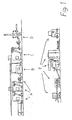
- Reference character A in fig. 1 indicates a pretreatment unit
- character B indicates a separating unit
- character C indicates a supply unit
- character D indicates a web-forming unit
- character E indicates per se known after-treatment equipment.
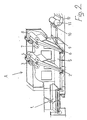
- Fig. 2 shows a pretreatment assembly A at the forward end of a production line in a perspective view and partially cut away.
- Bundles of fibre are forwarded onto a conveyor 1, automatically controlled by photocells. From conveyor 1 the fibre travels to an elevator bucket 2 whose studs lift the fibre up along a fast-rotating smoothing roll 3.
- the smoothing roll 3 throws the unopened bundles of fibre back down as long as they are opened and the fibres are able to pass between smoothing roll and elevator bucket 2. Thereafter, the fibres hit a fast-rotating release roll 4 which flings the fibres down onto a conveyor belt 5. This is followed by a second set of the same operations, i.e.
- conveyor belt 5 is followed by an elevator bucket 6, a smoothing roll 7 and a release roll 8 for flinging the completely opened fibres down onto a conveyor belt 9.
- This conveyor carries the fibres between feeding rolls 10 for advancing the fibres towards the surface of a fast-rotating studded roll 11.
- the studded roll is formed by coating a roll with a studded strip and on the roll surface the studs are at a very dense pitch.
- the roll has a surface speed of circa 800-1100 m/min and a mechanical impact provided by the studs produces such an effect that impurities, such as beads, carried by the fibres are removed from the rest of the fibre and, thus, a suitable fibre material can be separated from raw material.
- the raw material to be used comprises fire-resisting discontinuous fibre, glass fibre, ceramic fibre or any mixture thereof, the average length of fibres being circa 4 mm but there may be included fibres having a length of up to 20 mm.
- the term "discontinuous fibres" refers to the opposite of filament fibre, i.e. to precisely dimensioned fibres which are produced in precise dimensions during the actual fibre production (mineral fibres and ceramic fibres) or which are cut to a precise dimension from a filament (glass fibre). In order to produce a desired article, length of the fibres must be in any case less than 60 mm.
- fibres are being fed in a pretreatment assembly, it is possible to admix therein at the same time some fibre, such as some synthetic fibre, which serves as a binder during a thermal bonding process effected later and whose length can be up to 120 mm, whereby said fibre can be any fibre, according to a particular application e.g. PET (polyester) or glass.
- the binder forming fibre must have a lower melting point than the fibre forming the actual product texture and glass fibre can used as a binder provided that the rest of the fibre comprises ceramic fibre or mineral fibre.
- the fibres, impurities removed therefrom and possibly other matter drifting along are carried from pretreatment assembly A to a separation assembly B, shown in fig. 3 in a side view.
- a separation assembly B shown in fig. 3 in a side view.
- the separation assembly comprises a closed box 14 which receives an intake duct 12 coming from studded roll 11 and from which issues an intake duct 13 connected with a source of suction, such as a conventional fan.
- suction supplied through duct 13 the fibres are sucked through the box into duct 13 in a manner that the fibres, being lighter in weight, rise up into said duct 13.
- the inlet of intake duct 12 is located lower than the outlet of intake duct 13 and, furthermore, between these ports is mounted a horizontal flow baffle 14′ which blocks a linear flow in the box between said ports, creating a bend in the flow path and this enhances the separation of heavier matter from the fibres.
- the beads and other impurities, such as sand, removed from the fibre fall through the holes of a screen-like conveyor belt 15 fitted below said horizontal baffle 14 into a receptacle chute 15′ from which they can be removed from time to time.
- the heavier matter, such as unopened bundles of fibre remains however on top of conveyor belt 15 which carries it outside said box 12 for passing it to a fan 16 which blows it along a line 17 shown in fig. 1 back to pretreatment assembly A.
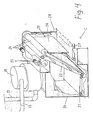
- Fig. 4 illustrates a supply or feeding assembly C located downstream of separation assembly B.
- the other end of flow duct 13 coming from separation assembly B is passed through a cyclone 18 for separating the fibres from finer solid matter which is carried away through a vacuum pipe 19.
- the refined fibres fall into a box 20 below the cyclone.
- the box contains a horizontal conveyor belt 21 which receives the falling fibres and pushes them onto a studded belt 22 which carries the fibres obliquely upwards and at the top section of this belt loop the fibres travel between smoothing roll 23 and belt 22.
- the smoothing roll 23 distributes the fibres uniformly in lateral direction, whereafter a release roll 24 drops the fibres vertically into a volume feeding chute 25 whose movable back wall 26 presses the fibre web or mat to uniform density.
- the chute 25 opens at its bottom above a conveyor belt 27 and the fibre mat travels upon conveyor 27 forward from below said chute 25 between a roll 28 shown by dash-and-dot lines and a conveyor, the latter compressing the web uniformly onto conveyor 27 which carries it forward to the following unit.
- it is also possible to adjust a desired weight per unit area for the finished non-woven web by adjusting the speed of conveyor 27, the fibre volume in the feeding chute being constant.
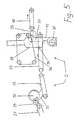
- Fig. 5 is a side view of a web-forming unit D.
- the conveyor 27 carries the fibre from below a slow-rotating feeder roll 29 towards the surface of a fast-rotating studded roll 3.
- the studded roll is coated with a studded strips and the studs are positioned at a very dense pitch and their length is circa 2 mm.
- the surface speed of said studded roll is circa 2000-2500 m/min.
- the fibres are thus carried along with the air flow and remain on top of conveyor wire 32 while said air flow is sucked through the wire.
- the fibres build a relatively uniform mat or web on wire 32 which carries them forward onto a foraminous conveyor nelt 33.
- the mat has some corrugation in it and still includes some areas wherein the fibres extend in parallel direction, which results from turbulence of the air flow.
- Conveyor belt 33 carries the fibre mat forward to a point 34, whereat a powerful air flow is supplied below conveyor belt 33 by means of a fan 35 along a duct 41 opening below said belt 33, said air flow penetrating through belt 33 by virtue of its foramens and blowing the fibres at this point to an air-permeable conveyor wire 36 above.
- the top of surface of conveyor belt 33 carrying the fibre mat in the beginning and the bottom surface of conveyor wire 36 intended for the final build-up of a fibre mat are at this point located opposite to each other and provide therebetween an open space 37 wherein the air flow passed through said conveyor belt 33 picks up the fibres from the top surface of belt 33 to the bottom surface of belt 36.
- said conveyor wire 36 in other words on the backing side of a fibre mat in view of its build-up surface, there is a suction duct 38 into which the air flow is passed from space 37 through wire 36. All of the air flow blown through conveyor belt 33 is passed through wire 36 and, for this purpose, said space 37 is sealed as tightly as possible both at the side edges of conveyor belt 33 and those of conveyor wire 36 and also upstream of the point of blowing and downstream of the point of blowing by only leaving the gaps for allowing the fibre mat into space 37 above belt 33 and from space 37 to the bottom surface of wire 36.
- the conveyor belt 33 comprises a wire structure, e.g. a conventional nylon wire having foramina that are circular and relatively large in diameter, circa 1,5 mm in diameter.
- the upper section in a conveyor wire may consist of a normal wire but a particularly preferred and uniform setting of fibres is obtained by using a so-called honeycomb-type of wire.
- the air flow in space 37 has a speed of circa 10-30 m/s which is sufficient to provide a sufficient intermingling of the fibres and to set them in random directions on settling on conveyor wire 36.
- Conveyor belt 33 and conveyor wire 36 are carried in the same directions and a relatively even mat that lies first on lower conveyor belt 33 leads to the formation of a product having a uniform weight per unit area also on upper conveyor wire 36.
- a fibre mat on conveyor wire 36 is carried between said wire and a nip roll 39 onto a conveyor belt 40 for carrying the finished article forward.
- said fibre mat is advanced to after-treatment equipment, used for final bonding of the fibres and designated in fig. 1 with reference E.
- the fibre mat consists exclusively of mineral fibres or the like, it will only be bound by needlepunching in a conventional needlepunching machine in which the binding is effected mechanically by punching with needles.
- the structure includes binder-forming bonding fibres as mentioned above, such as glass or polyester fibres, it is possible to employ also thermal bonding in addition to needlepunching. Thermal bonding can also be accompanied by other additional operations, such as compressing fibre mats into sheets, beams or similar rigid structures.
- the above-described method can be applied for manufacturing from mineral glass or ceramic fibres or their mixtures some mat-shaped or sheet-like articles, whose weight per unit area is within the range of 60-3000 g/m2.
- the best way of comparing articles of the invention with traditional heat-resisting non-woven products is to compare their desities to each other.
- the density of both mat-like articles and those compressed into sheets and beams is circa 5 times less than that of the products manufactured from the same materials with prior known methods.
- the strength qualities are in the same order.
- glass can be used either as a structure-forming fibre, the binder comprising a synthetic fibre, such as PET, or glass can be included in the articles as a binder, the main structure consisting of mineral fibres and ceramic fibres which melt at higher temperatures than glass.
- the articles can be used in all fire-resisting materials, such as interior carpets and shapes in vehicle industry, underlying carpets and sound-proof surfaces in ship-building industry, roofing felt, PVC-coating bases as well as building boards.
- One important application of these articles includes high-temperature insulations, e.g. products for replacing health-hazardous asbestos.
- the planes or levels need not be necessarily located as a first conveying plane below a second conveying plane but what is required is that the surfaces of these conveying planes be directed towards each other for providing therebetween a space, wherein the above-described blowing of the fibres can be effected.
- said planes be aligned with each other in vertical direction and preferably as described above, i.e. the first conveying plane below the second conveying plane.
Landscapes
- Engineering & Computer Science (AREA)
- Textile Engineering (AREA)
- Chemical & Material Sciences (AREA)
- Inorganic Chemistry (AREA)
- Mechanical Engineering (AREA)
- Nonwoven Fabrics (AREA)
- Woven Fabrics (AREA)
- Inorganic Fibers (AREA)
- Treatment Of Fiber Materials (AREA)
- Gloves (AREA)
- Perforating, Stamping-Out Or Severing By Means Other Than Cutting (AREA)
- Glass Compositions (AREA)
- Socks And Pantyhose (AREA)
- Yarns And Mechanical Finishing Of Yarns Or Ropes (AREA)
- Adhesives Or Adhesive Processes (AREA)
- Manufacturing Of Printed Circuit Boards (AREA)
- Macromolecular Compounds Obtained By Forming Nitrogen-Containing Linkages In General (AREA)
- Macromonomer-Based Addition Polymer (AREA)
- Optical Fibers, Optical Fiber Cores, And Optical Fiber Bundles (AREA)
Applications Claiming Priority (2)
| Application Number | Priority Date | Filing Date | Title |
|---|---|---|---|
| FI880755A FI83888C (fi) | 1988-02-17 | 1988-02-17 | Foerfarande och apparatur foer framstaellning av en fiberprodukt. |
| FI880755 | 1988-02-17 |
Publications (3)
| Publication Number | Publication Date |
|---|---|
| EP0329255A2 true EP0329255A2 (de) | 1989-08-23 |
| EP0329255A3 EP0329255A3 (en) | 1990-06-06 |
| EP0329255B1 EP0329255B1 (de) | 1994-05-18 |
Family
ID=8525936
Family Applications (1)
| Application Number | Title | Priority Date | Filing Date |
|---|---|---|---|
| EP19890200375 Expired - Lifetime EP0329255B1 (de) | 1988-02-17 | 1989-02-16 | Nichtgewobener Artikel aus wärmebeständigem Material, Verfahren zur Herstellung desselben und Vorrichtung zum Ausführen des Verfahrens |
Country Status (23)
| Country | Link |
|---|---|
| US (1) | US5014396A (de) |
| EP (1) | EP0329255B1 (de) |
| JP (1) | JP2688518B2 (de) |
| KR (1) | KR0124541B1 (de) |
| CN (1) | CN1026905C (de) |
| AT (1) | ATE105881T1 (de) |
| AU (1) | AU622645B2 (de) |
| CA (1) | CA1318117C (de) |
| CZ (1) | CZ278421B6 (de) |
| DD (1) | DD283660A5 (de) |
| DE (1) | DE68915305T2 (de) |
| DK (1) | DK171616B1 (de) |
| ES (1) | ES2053944T3 (de) |
| FI (1) | FI83888C (de) |
| HU (1) | HU212019B (de) |
| IE (1) | IE74874B1 (de) |
| NO (1) | NO172296C (de) |
| PL (1) | PL160752B1 (de) |
| PT (1) | PT89761B (de) |
| RU (1) | RU2019408C1 (de) |
| SK (1) | SK277732B6 (de) |
| WO (1) | WO1989007674A1 (de) |
| YU (1) | YU35589A (de) |
Cited By (4)
| Publication number | Priority date | Publication date | Assignee | Title |
|---|---|---|---|---|
| EP0636717A1 (de) * | 1993-07-29 | 1995-02-01 | Valeo | Herstellungsverfahren eines aus mineral- und organischen Fasern zusammensetzten Bandes und das erhaltene Band |
| US5883023A (en) * | 1997-03-21 | 1999-03-16 | Ppg Industries, Inc. | Glass monofilament and strand mats, thermoplastic composites reinforced with the same and methods for making the same |
| US5883021A (en) * | 1997-03-21 | 1999-03-16 | Ppg Industries, Inc. | Glass monofilament and strand mats, vacuum-molded thermoset composites reinforced with the same and methods for making the same |
| WO2011035782A1 (de) * | 2009-09-24 | 2011-03-31 | Matecs Sp.Z O.O. | Anlage und verfahren zur herstellung von faservlies auf der basis von glasfasern und damit hergestelltes faservlies |
Families Citing this family (20)
| Publication number | Priority date | Publication date | Assignee | Title |
|---|---|---|---|---|
| DE4009407A1 (de) * | 1990-03-23 | 1991-09-26 | Rath Deutschland Gmbh | Verfahren zur herstellung von bindemittelfreien anorganischen mischfaserprodukten |
| BE1005056A3 (fr) * | 1991-07-03 | 1993-04-06 | Yves Farber | Procede et installation de fabrication de feutre. |
| US5273821A (en) * | 1991-11-12 | 1993-12-28 | The Carborundum Company | High strength ceramic fiber board |
| JP3479074B2 (ja) * | 1993-01-07 | 2003-12-15 | ミネソタ マイニング アンド マニュファクチャリング カンパニー | 可撓性不織マット |
| US5458960A (en) * | 1993-02-09 | 1995-10-17 | Roctex Oy Ab | Flexible base web for a construction covering |
| US5665300A (en) * | 1996-03-27 | 1997-09-09 | Reemay Inc. | Production of spun-bonded web |
| US5955177A (en) * | 1996-09-03 | 1999-09-21 | 3M Innovative Properties Company | Fire barrier mat |
| US7563504B2 (en) * | 1998-03-27 | 2009-07-21 | Siemens Energy, Inc. | Utilization of discontinuous fibers for improving properties of high temperature insulation of ceramic matrix composites |
| US6244075B1 (en) | 1999-10-22 | 2001-06-12 | Owens Corning Fiberglas Technology, Inc. | Blower for lifting insulation pack |
| KR20000058604A (ko) * | 2000-02-02 | 2000-10-05 | 한경숙 | 내화성 건축용지 및 이의 제조방법 |
| JP4730495B2 (ja) * | 2001-05-25 | 2011-07-20 | イビデン株式会社 | 触媒コンバータ用保持シール材及びその製造方法、触媒コンバータ |
| WO2002103171A1 (en) | 2001-05-25 | 2002-12-27 | Ibiden Co., Ltd. | Alumina-silica-based fiber, ceramic fiber, ceramic fiber complex, retaining seal material, production method thereof, and alumina fiber complex production method |
| JP4834550B2 (ja) * | 2003-10-06 | 2011-12-14 | サン−ゴバン・イソベール | 空調または換気チャネル |
| DE602005027173D1 (de) * | 2004-10-08 | 2011-05-12 | Ibiden Co Ltd | Honigwabenstruktur und verfahren zur herstellung |
| RU2389603C2 (ru) * | 2008-03-26 | 2010-05-20 | Оао "Максмир" | Поточная линия для изготовления изделий вертикально-слоистой структуры непосредственно из ковра горизонтально-слоистой структуры и способ ее функционирования |
| ES2718827T3 (es) * | 2009-07-31 | 2019-07-04 | Rockwool Int | Método para fabricar un elemento que contiene fibra mineral y un elemento producido por este método |
| GB201012860D0 (en) * | 2010-07-30 | 2010-09-15 | Rockwool Int | Method for manufacturing a fibre-containing element and element produced by that method |
| US8636076B2 (en) | 2010-10-26 | 2014-01-28 | 3M Innovative Properties Company | Method of firestopping a through-penetration using a fusible inorganic blended-fiber web |
| PL2670901T3 (pl) * | 2011-01-31 | 2020-02-28 | Rockwool International A/S | Sposób wytwarzania elementu zawierającego włókno mineralne |
| CN106015839A (zh) * | 2015-11-23 | 2016-10-12 | 福建赛特新材股份有限公司 | 一种真空绝热板使用的内部芯材和真空绝热板的制造方法 |
Family Cites Families (14)
| Publication number | Priority date | Publication date | Assignee | Title |
|---|---|---|---|---|
| US2468827A (en) * | 1944-10-04 | 1949-05-03 | American Viscose Corp | Electrostatic control of fibers |
| NL285866A (de) * | 1961-11-24 | |||
| JPS49116B1 (de) * | 1965-06-11 | 1974-01-05 | ||
| GB1154324A (en) * | 1965-08-27 | 1969-06-04 | Cape Insulation Ltd | Heat Insulating Materials |
| US3669823A (en) * | 1969-06-04 | 1972-06-13 | Curlator Corp | Non-woven web |
| SE343243B (de) * | 1970-10-14 | 1972-03-06 | Ingenioersfa B Projekt Ab | |
| CA1003616A (en) * | 1973-03-01 | 1977-01-18 | Rando Machine Corporation | Machine for forming random fiber webs |
| JPS5155474A (en) * | 1974-11-07 | 1976-05-15 | Nippon Mineral Fiber Mfg | Garasutansenino komitsudoseihinno seizohoho |
| DE3325669C2 (de) * | 1982-08-16 | 1986-05-28 | Armstrong World Industries, Inc., Lancaster, Pa. | Verfahren und Vorrichtung zur kontinuierlichen Herstellung einer Faservliesbahn |
| US4432714A (en) * | 1982-08-16 | 1984-02-21 | Armstrong World Industries, Inc. | Apparatus for forming building materials comprising non-woven webs |
| FR2541323A1 (fr) * | 1983-02-23 | 1984-08-24 | Saint Gobain Isover | Amelioration de la repartition dans un feutre de fibres produites a partir de roues de centrifugation |
| ATE31091T1 (de) * | 1984-01-06 | 1987-12-15 | Isolite Babcock Refractories | Verfahren zur herstellung einer keramikfasermatte. |
| EP0168757B1 (de) * | 1984-07-20 | 1990-05-23 | Rogers Corporation | Rückseitige Beleuchtung für passive elektrooptische Anzeigevorrichtungen und hiermit verwendbare transflektive Schicht |
| AT390971B (de) * | 1986-03-24 | 1990-07-25 | Fehrer Textilmasch | Vorrichtung zum nadeln eines mineralfaservlieses |
-
1988
- 1988-02-17 FI FI880755A patent/FI83888C/fi not_active IP Right Cessation
-
1989
- 1989-02-10 NO NO890572A patent/NO172296C/no not_active IP Right Cessation
- 1989-02-14 DK DK067189A patent/DK171616B1/da not_active IP Right Cessation
- 1989-02-15 CZ CS891006A patent/CZ278421B6/cs not_active IP Right Cessation
- 1989-02-15 SK SK1006-89A patent/SK277732B6/sk unknown
- 1989-02-15 AU AU29965/89A patent/AU622645B2/en not_active Ceased
- 1989-02-15 US US07/311,501 patent/US5014396A/en not_active Expired - Fee Related
- 1989-02-16 EP EP19890200375 patent/EP0329255B1/de not_active Expired - Lifetime
- 1989-02-16 DE DE68915305T patent/DE68915305T2/de not_active Expired - Fee Related
- 1989-02-16 IE IE49589A patent/IE74874B1/en not_active IP Right Cessation
- 1989-02-16 ES ES89200375T patent/ES2053944T3/es not_active Expired - Lifetime
- 1989-02-16 CA CA 591254 patent/CA1318117C/en not_active Expired - Fee Related
- 1989-02-16 YU YU35589A patent/YU35589A/xx unknown
- 1989-02-16 AT AT89200375T patent/ATE105881T1/de not_active IP Right Cessation
- 1989-02-17 PL PL1989277772A patent/PL160752B1/pl unknown
- 1989-02-17 CN CN89101845A patent/CN1026905C/zh not_active Expired - Fee Related
- 1989-02-17 HU HU89806A patent/HU212019B/hu not_active IP Right Cessation
- 1989-02-17 JP JP3641989A patent/JP2688518B2/ja not_active Expired - Fee Related
- 1989-02-17 KR KR1019890001845A patent/KR0124541B1/ko not_active Expired - Fee Related
- 1989-02-17 WO PCT/FI1989/000030 patent/WO1989007674A1/en not_active Ceased
- 1989-02-17 DD DD89325843A patent/DD283660A5/de not_active IP Right Cessation
- 1989-02-17 PT PT89761A patent/PT89761B/pt not_active IP Right Cessation
- 1989-10-12 RU SU894742250A patent/RU2019408C1/ru not_active IP Right Cessation
Cited By (5)
| Publication number | Priority date | Publication date | Assignee | Title |
|---|---|---|---|---|
| EP0636717A1 (de) * | 1993-07-29 | 1995-02-01 | Valeo | Herstellungsverfahren eines aus mineral- und organischen Fasern zusammensetzten Bandes und das erhaltene Band |
| FR2708632A1 (fr) * | 1993-07-29 | 1995-02-10 | Valeo | Procédé de réalisation d'un ruban composé de fibres minérales et de fibres organiques et ruban ainsi réalisé. |
| US5883023A (en) * | 1997-03-21 | 1999-03-16 | Ppg Industries, Inc. | Glass monofilament and strand mats, thermoplastic composites reinforced with the same and methods for making the same |
| US5883021A (en) * | 1997-03-21 | 1999-03-16 | Ppg Industries, Inc. | Glass monofilament and strand mats, vacuum-molded thermoset composites reinforced with the same and methods for making the same |
| WO2011035782A1 (de) * | 2009-09-24 | 2011-03-31 | Matecs Sp.Z O.O. | Anlage und verfahren zur herstellung von faservlies auf der basis von glasfasern und damit hergestelltes faservlies |
Also Published As
Similar Documents
| Publication | Publication Date | Title |
|---|---|---|
| US5014396A (en) | Non-woven article made of a heat-resisting material, method for manufacturing the article and apparatus for implementing the method | |
| US3071822A (en) | Method and apparatus for forming a mat | |
| US6475315B1 (en) | Method for making nonwoven fibrous product | |
| US2931076A (en) | Apparatus and method for producing fibrous structures | |
| EP1016757B1 (de) | Mehrschichtiger Vliesstoff, daraus hergestelltes Laminat und Verfahren zur Herstellung des Vliesstoffs | |
| US3158668A (en) | Method and apparatus for mat forming | |
| EP0536904A1 (de) | Verfahren und Vorrichtung zur Trockenherstellung einer Materialschicht aus langen Fasern | |
| US2993239A (en) | Production of integral layered felts | |
| US4432714A (en) | Apparatus for forming building materials comprising non-woven webs | |
| US4476175A (en) | Building materials comprising non-woven webs | |
| US4106163A (en) | Apparatus for the dry production of non-woven webs | |
| GB2125450A (en) | Building materials and process and apparatus for manufacture thereof | |
| US4435353A (en) | Processes for forming building materials comprising non-woven webs | |
| US1928264A (en) | Heat insulating product and method of forming same | |
| WO1991006407A1 (en) | Method and apparatus for the manufacture of mineral wool plates | |
| GB2054681A (en) | Flexible sheet materials | |
| US2546266A (en) | Apparatus for making insulation batts and boards | |
| CA1232734A (en) | Building materials comprising non-woven webs | |
| JP3373210B2 (ja) | マット様製品の製造方法 | |
| GB2162465A (en) | Building board |
Legal Events
| Date | Code | Title | Description |
|---|---|---|---|
| PUAI | Public reference made under article 153(3) epc to a published international application that has entered the european phase |
Free format text: ORIGINAL CODE: 0009012 |
|
| AK | Designated contracting states |
Kind code of ref document: A2 Designated state(s): AT BE CH DE ES FR GB GR IT LI LU NL SE |
|
| PUAL | Search report despatched |
Free format text: ORIGINAL CODE: 0009013 |
|
| AK | Designated contracting states |
Kind code of ref document: A3 Designated state(s): AT BE CH DE ES FR GB GR IT LI LU NL SE |
|
| 17P | Request for examination filed |
Effective date: 19901130 |
|
| RAP1 | Party data changed (applicant data changed or rights of an application transferred) |
Owner name: PARGRO OY AB |
|
| 17Q | First examination report despatched |
Effective date: 19920714 |
|
| RAP1 | Party data changed (applicant data changed or rights of an application transferred) |
Owner name: ROCTEX OY AB |
|
| GRAA | (expected) grant |
Free format text: ORIGINAL CODE: 0009210 |
|
| AK | Designated contracting states |
Kind code of ref document: B1 Designated state(s): AT BE CH DE ES FR GB GR IT LI LU NL SE |
|
| PG25 | Lapsed in a contracting state [announced via postgrant information from national office to epo] |
Ref country code: GR Free format text: LAPSE BECAUSE OF FAILURE TO SUBMIT A TRANSLATION OF THE DESCRIPTION OR TO PAY THE FEE WITHIN THE PRESCRIBED TIME-LIMIT Effective date: 19940518 |
|
| REF | Corresponds to: |
Ref document number: 105881 Country of ref document: AT Date of ref document: 19940615 Kind code of ref document: T |
|
| REF | Corresponds to: |
Ref document number: 68915305 Country of ref document: DE Date of ref document: 19940623 |
|
| REG | Reference to a national code |
Ref country code: ES Ref legal event code: FG2A Ref document number: 2053944 Country of ref document: ES Kind code of ref document: T3 |
|
| ITF | It: translation for a ep patent filed | ||
| ET | Fr: translation filed | ||
| EAL | Se: european patent in force in sweden |
Ref document number: 89200375.7 |
|
| PLBE | No opposition filed within time limit |
Free format text: ORIGINAL CODE: 0009261 |
|
| STAA | Information on the status of an ep patent application or granted ep patent |
Free format text: STATUS: NO OPPOSITION FILED WITHIN TIME LIMIT |
|
| 26N | No opposition filed | ||
| REG | Reference to a national code |
Ref country code: GB Ref legal event code: IF02 |
|
| PGFP | Annual fee paid to national office [announced via postgrant information from national office to epo] |
Ref country code: AT Payment date: 20020218 Year of fee payment: 14 |
|
| PGFP | Annual fee paid to national office [announced via postgrant information from national office to epo] |
Ref country code: SE Payment date: 20020221 Year of fee payment: 14 Ref country code: GB Payment date: 20020221 Year of fee payment: 14 |
|
| PGFP | Annual fee paid to national office [announced via postgrant information from national office to epo] |
Ref country code: FR Payment date: 20020225 Year of fee payment: 14 |
|
| PGFP | Annual fee paid to national office [announced via postgrant information from national office to epo] |
Ref country code: CH Payment date: 20020226 Year of fee payment: 14 |
|
| PGFP | Annual fee paid to national office [announced via postgrant information from national office to epo] |
Ref country code: LU Payment date: 20020227 Year of fee payment: 14 |
|
| PGFP | Annual fee paid to national office [announced via postgrant information from national office to epo] |
Ref country code: NL Payment date: 20020228 Year of fee payment: 14 Ref country code: ES Payment date: 20020228 Year of fee payment: 14 |
|
| PGFP | Annual fee paid to national office [announced via postgrant information from national office to epo] |
Ref country code: BE Payment date: 20020305 Year of fee payment: 14 |
|
| PGFP | Annual fee paid to national office [announced via postgrant information from national office to epo] |
Ref country code: DE Payment date: 20020314 Year of fee payment: 14 |
|
| PG25 | Lapsed in a contracting state [announced via postgrant information from national office to epo] |
Ref country code: LU Free format text: LAPSE BECAUSE OF NON-PAYMENT OF DUE FEES Effective date: 20030216 Ref country code: GB Free format text: LAPSE BECAUSE OF NON-PAYMENT OF DUE FEES Effective date: 20030216 Ref country code: AT Free format text: LAPSE BECAUSE OF NON-PAYMENT OF DUE FEES Effective date: 20030216 |
|
| PG25 | Lapsed in a contracting state [announced via postgrant information from national office to epo] |
Ref country code: SE Free format text: LAPSE BECAUSE OF NON-PAYMENT OF DUE FEES Effective date: 20030217 Ref country code: ES Free format text: LAPSE BECAUSE OF NON-PAYMENT OF DUE FEES Effective date: 20030217 |
|
| PG25 | Lapsed in a contracting state [announced via postgrant information from national office to epo] |
Ref country code: LI Free format text: LAPSE BECAUSE OF NON-PAYMENT OF DUE FEES Effective date: 20030228 Ref country code: CH Free format text: LAPSE BECAUSE OF NON-PAYMENT OF DUE FEES Effective date: 20030228 Ref country code: BE Free format text: LAPSE BECAUSE OF NON-PAYMENT OF DUE FEES Effective date: 20030228 |
|
| PG25 | Lapsed in a contracting state [announced via postgrant information from national office to epo] |
Ref country code: NL Free format text: LAPSE BECAUSE OF NON-PAYMENT OF DUE FEES Effective date: 20030901 |
|
| PG25 | Lapsed in a contracting state [announced via postgrant information from national office to epo] |
Ref country code: DE Free format text: LAPSE BECAUSE OF NON-PAYMENT OF DUE FEES Effective date: 20030902 |
|
| EUG | Se: european patent has lapsed | ||
| GBPC | Gb: european patent ceased through non-payment of renewal fee | ||
| REG | Reference to a national code |
Ref country code: CH Ref legal event code: PL |
|
| PG25 | Lapsed in a contracting state [announced via postgrant information from national office to epo] |
Ref country code: FR Free format text: LAPSE BECAUSE OF NON-PAYMENT OF DUE FEES Effective date: 20031031 |
|
| NLV4 | Nl: lapsed or anulled due to non-payment of the annual fee |
Effective date: 20030901 |
|
| REG | Reference to a national code |
Ref country code: FR Ref legal event code: ST |
|
| REG | Reference to a national code |
Ref country code: ES Ref legal event code: FD2A Effective date: 20030217 |
|
| PG25 | Lapsed in a contracting state [announced via postgrant information from national office to epo] |
Ref country code: IT Free format text: LAPSE BECAUSE OF NON-PAYMENT OF DUE FEES;WARNING: LAPSES OF ITALIAN PATENTS WITH EFFECTIVE DATE BEFORE 2007 MAY HAVE OCCURRED AT ANY TIME BEFORE 2007. THE CORRECT EFFECTIVE DATE MAY BE DIFFERENT FROM THE ONE RECORDED. Effective date: 20050216 |