EP0330036A1 - Verfahren zur Herstellung von p-Hydroxy-benzaldehyden - Google Patents
Verfahren zur Herstellung von p-Hydroxy-benzaldehyden Download PDFInfo
- Publication number
- EP0330036A1 EP0330036A1 EP89102424A EP89102424A EP0330036A1 EP 0330036 A1 EP0330036 A1 EP 0330036A1 EP 89102424 A EP89102424 A EP 89102424A EP 89102424 A EP89102424 A EP 89102424A EP 0330036 A1 EP0330036 A1 EP 0330036A1
- Authority
- EP
- European Patent Office
- Prior art keywords
- iron
- cresol
- mol
- manganese
- metal
- Prior art date
- Legal status (The legal status is an assumption and is not a legal conclusion. Google has not performed a legal analysis and makes no representation as to the accuracy of the status listed.)
- Granted
Links
- RGHHSNMVTDWUBI-UHFFFAOYSA-N 4-hydroxybenzaldehyde Chemical class OC1=CC=C(C=O)C=C1 RGHHSNMVTDWUBI-UHFFFAOYSA-N 0.000 title claims abstract description 93
- 238000000034 method Methods 0.000 title claims abstract description 38
- 238000002360 preparation method Methods 0.000 title claims abstract description 5
- XEEYBQQBJWHFJM-UHFFFAOYSA-N Iron Chemical compound [Fe] XEEYBQQBJWHFJM-UHFFFAOYSA-N 0.000 claims abstract description 63
- 229910052760 oxygen Inorganic materials 0.000 claims abstract description 33
- 229910052742 iron Inorganic materials 0.000 claims abstract description 32
- 239000001301 oxygen Substances 0.000 claims abstract description 32
- QVGXLLKOCUKJST-UHFFFAOYSA-N atomic oxygen Chemical compound [O] QVGXLLKOCUKJST-UHFFFAOYSA-N 0.000 claims abstract description 31
- 239000011572 manganese Substances 0.000 claims abstract description 23
- 229910052748 manganese Inorganic materials 0.000 claims abstract description 18
- 239000002904 solvent Substances 0.000 claims abstract description 16
- 150000004697 chelate complex Chemical class 0.000 claims abstract description 15
- 230000003647 oxidation Effects 0.000 claims abstract description 15
- 238000007254 oxidation reaction Methods 0.000 claims abstract description 15
- 150000002931 p-cresols Chemical class 0.000 claims abstract description 15
- PWHULOQIROXLJO-UHFFFAOYSA-N Manganese Chemical compound [Mn] PWHULOQIROXLJO-UHFFFAOYSA-N 0.000 claims abstract description 13
- 150000004032 porphyrins Chemical class 0.000 claims abstract description 7
- 229910052739 hydrogen Inorganic materials 0.000 claims abstract description 6
- 239000001257 hydrogen Substances 0.000 claims abstract description 6
- 125000001997 phenyl group Chemical group [H]C1=C([H])C([H])=C(*)C([H])=C1[H] 0.000 claims abstract description 6
- 229910052736 halogen Inorganic materials 0.000 claims abstract description 5
- 150000002367 halogens Chemical class 0.000 claims abstract description 5
- 125000000027 (C1-C10) alkoxy group Chemical group 0.000 claims abstract description 4
- 125000006552 (C3-C8) cycloalkyl group Chemical group 0.000 claims abstract description 4
- WPBNNNQJVZRUHP-UHFFFAOYSA-L manganese(2+);methyl n-[[2-(methoxycarbonylcarbamothioylamino)phenyl]carbamothioyl]carbamate;n-[2-(sulfidocarbothioylamino)ethyl]carbamodithioate Chemical compound [Mn+2].[S-]C(=S)NCCNC([S-])=S.COC(=O)NC(=S)NC1=CC=CC=C1NC(=S)NC(=O)OC WPBNNNQJVZRUHP-UHFFFAOYSA-L 0.000 claims abstract description 3
- 239000000126 substance Substances 0.000 claims abstract description 3
- 239000002738 chelating agent Substances 0.000 claims abstract 2
- 150000002431 hydrogen Chemical class 0.000 claims abstract 2
- IWDCLRJOBJJRNH-UHFFFAOYSA-N p-cresol Chemical compound CC1=CC=C(O)C=C1 IWDCLRJOBJJRNH-UHFFFAOYSA-N 0.000 claims description 80
- 229910052751 metal Inorganic materials 0.000 claims description 35
- 239000002184 metal Substances 0.000 claims description 35
- 239000000203 mixture Substances 0.000 claims description 27
- 150000003839 salts Chemical class 0.000 claims description 17
- 239000013522 chelant Substances 0.000 claims description 14
- OKTJSMMVPCPJKN-UHFFFAOYSA-N Carbon Chemical compound [C] OKTJSMMVPCPJKN-UHFFFAOYSA-N 0.000 claims description 12
- 239000002585 base Substances 0.000 claims description 12
- 150000002736 metal compounds Chemical class 0.000 claims description 11
- PXHVJJICTQNCMI-UHFFFAOYSA-N Nickel Chemical compound [Ni] PXHVJJICTQNCMI-UHFFFAOYSA-N 0.000 claims description 9
- 150000002739 metals Chemical class 0.000 claims description 8
- 239000003513 alkali Substances 0.000 claims description 7
- RYGMFSIKBFXOCR-UHFFFAOYSA-N Copper Chemical compound [Cu] RYGMFSIKBFXOCR-UHFFFAOYSA-N 0.000 claims description 6
- 150000001340 alkali metals Chemical class 0.000 claims description 6
- 229910052802 copper Inorganic materials 0.000 claims description 6
- 239000010949 copper Substances 0.000 claims description 6
- 229910052783 alkali metal Inorganic materials 0.000 claims description 5
- 239000011651 chromium Substances 0.000 claims description 5
- 229910052684 Cerium Inorganic materials 0.000 claims description 4
- ZMIGMASIKSOYAM-UHFFFAOYSA-N cerium Chemical compound [Ce][Ce][Ce][Ce][Ce][Ce][Ce][Ce][Ce][Ce][Ce][Ce][Ce][Ce][Ce][Ce][Ce][Ce][Ce][Ce][Ce][Ce][Ce][Ce][Ce][Ce][Ce][Ce][Ce][Ce][Ce][Ce][Ce][Ce][Ce][Ce][Ce][Ce] ZMIGMASIKSOYAM-UHFFFAOYSA-N 0.000 claims description 4
- 125000000008 (C1-C10) alkyl group Chemical group 0.000 claims description 3
- KMHSUNDEGHRBNV-UHFFFAOYSA-N 2,4-dichloropyrimidine-5-carbonitrile Chemical compound ClC1=NC=C(C#N)C(Cl)=N1 KMHSUNDEGHRBNV-UHFFFAOYSA-N 0.000 claims description 3
- VYZAMTAEIAYCRO-UHFFFAOYSA-N Chromium Chemical compound [Cr] VYZAMTAEIAYCRO-UHFFFAOYSA-N 0.000 claims description 3
- 229910052804 chromium Inorganic materials 0.000 claims description 3
- 150000001875 compounds Chemical class 0.000 claims description 3
- XLYOFNOQVPJJNP-UHFFFAOYSA-M hydroxide Chemical compound [OH-] XLYOFNOQVPJJNP-UHFFFAOYSA-M 0.000 claims description 3
- 229910052759 nickel Inorganic materials 0.000 claims description 3
- BQCADISMDOOEFD-UHFFFAOYSA-N Silver Chemical compound [Ag] BQCADISMDOOEFD-UHFFFAOYSA-N 0.000 claims description 2
- 229910001854 alkali hydroxide Inorganic materials 0.000 claims description 2
- 229910001860 alkaline earth metal hydroxide Inorganic materials 0.000 claims description 2
- 229910052793 cadmium Inorganic materials 0.000 claims description 2
- BDOSMKKIYDKNTQ-UHFFFAOYSA-N cadmium atom Chemical compound [Cd] BDOSMKKIYDKNTQ-UHFFFAOYSA-N 0.000 claims description 2
- BTIJJDXEELBZFS-QDUVMHSLSA-K hemin Chemical compound CC1=C(CCC(O)=O)C(C=C2C(CCC(O)=O)=C(C)\C(N2[Fe](Cl)N23)=C\4)=N\C1=C/C2=C(C)C(C=C)=C3\C=C/1C(C)=C(C=C)C/4=N\1 BTIJJDXEELBZFS-QDUVMHSLSA-K 0.000 claims description 2
- 229940025294 hemin Drugs 0.000 claims description 2
- 229910052747 lanthanoid Inorganic materials 0.000 claims description 2
- 150000002602 lanthanoids Chemical class 0.000 claims description 2
- 229910052758 niobium Inorganic materials 0.000 claims description 2
- 239000010955 niobium Substances 0.000 claims description 2
- GUCVJGMIXFAOAE-UHFFFAOYSA-N niobium atom Chemical compound [Nb] GUCVJGMIXFAOAE-UHFFFAOYSA-N 0.000 claims description 2
- 229910052709 silver Inorganic materials 0.000 claims description 2
- 239000004332 silver Substances 0.000 claims description 2
- 229910052715 tantalum Inorganic materials 0.000 claims description 2
- GUVRBAGPIYLISA-UHFFFAOYSA-N tantalum atom Chemical compound [Ta] GUVRBAGPIYLISA-UHFFFAOYSA-N 0.000 claims description 2
- 229910052720 vanadium Inorganic materials 0.000 claims description 2
- GPPXJZIENCGNKB-UHFFFAOYSA-N vanadium Chemical compound [V]#[V] GPPXJZIENCGNKB-UHFFFAOYSA-N 0.000 claims description 2
- JZRYQZJSTWVBBD-UHFFFAOYSA-N pentaporphyrin i Chemical compound N1C(C=C2NC(=CC3=NC(=C4)C=C3)C=C2)=CC=C1C=C1C=CC4=N1 JZRYQZJSTWVBBD-UHFFFAOYSA-N 0.000 claims 2
- QGKVXWDADKTZHW-UHFFFAOYSA-N azaporphyrin Chemical compound C1=C(N=2)C=CC=2C=C(N=2)C=CC=2C=C(N2)C=CC2=CC2=CNC1=N2 QGKVXWDADKTZHW-UHFFFAOYSA-N 0.000 claims 1
- 230000001590 oxidative effect Effects 0.000 abstract 1
- OKKJLVBELUTLKV-UHFFFAOYSA-N Methanol Chemical compound OC OKKJLVBELUTLKV-UHFFFAOYSA-N 0.000 description 69
- HEMHJVSKTPXQMS-UHFFFAOYSA-M Sodium hydroxide Chemical compound [OH-].[Na+] HEMHJVSKTPXQMS-UHFFFAOYSA-M 0.000 description 53
- XLYOFNOQVPJJNP-UHFFFAOYSA-N water Chemical compound O XLYOFNOQVPJJNP-UHFFFAOYSA-N 0.000 description 46
- 229910001868 water Inorganic materials 0.000 description 46
- IGCQTZQTGKNFLX-UHFFFAOYSA-N 4-[2-[2-(4-hydroxyphenyl)ethoxy]ethyl]phenol Chemical compound C1=CC(O)=CC=C1CCOCCC1=CC=C(O)C=C1 IGCQTZQTGKNFLX-UHFFFAOYSA-N 0.000 description 22
- AHXXIALEMINDAW-UHFFFAOYSA-N p-hydroxybenzyl methyl ether Natural products COCC1=CC=C(O)C=C1 AHXXIALEMINDAW-UHFFFAOYSA-N 0.000 description 22
- 239000011541 reaction mixture Substances 0.000 description 21
- XEKOWRVHYACXOJ-UHFFFAOYSA-N Ethyl acetate Chemical compound CCOC(C)=O XEKOWRVHYACXOJ-UHFFFAOYSA-N 0.000 description 18
- 238000006243 chemical reaction Methods 0.000 description 16
- ODVRHJKVXOGKEJ-UHFFFAOYSA-N iron 5,10,15,20-tetraphenyl-21,23-dihydroporphyrin Chemical compound [Fe].c1cc2nc1c(-c1ccccc1)c1ccc([nH]1)c(-c1ccccc1)c1ccc(n1)c(-c1ccccc1)c1ccc([nH]1)c2-c1ccccc1 ODVRHJKVXOGKEJ-UHFFFAOYSA-N 0.000 description 15
- -1 iron ions Chemical class 0.000 description 13
- WQDUMFSSJAZKTM-UHFFFAOYSA-N Sodium methoxide Chemical compound [Na+].[O-]C WQDUMFSSJAZKTM-UHFFFAOYSA-N 0.000 description 12
- QPLDLSVMHZLSFG-UHFFFAOYSA-N Copper oxide Chemical compound [Cu]=O QPLDLSVMHZLSFG-UHFFFAOYSA-N 0.000 description 11
- 239000003426 co-catalyst Substances 0.000 description 10
- ORTQZVOHEJQUHG-UHFFFAOYSA-L copper(II) chloride Chemical class Cl[Cu]Cl ORTQZVOHEJQUHG-UHFFFAOYSA-L 0.000 description 10
- KWYUFKZDYYNOTN-UHFFFAOYSA-M Potassium hydroxide Chemical compound [OH-].[K+] KWYUFKZDYYNOTN-UHFFFAOYSA-M 0.000 description 9
- 239000012298 atmosphere Substances 0.000 description 9
- 239000003054 catalyst Substances 0.000 description 9
- KXGJFQRICKVJSQ-UHFFFAOYSA-N iron(3+) 5,10,15,20-tetraphenyl-21,23-dihydroporphyrin Chemical compound [Fe+3].c1cc2nc1c(-c1ccccc1)c1ccc([nH]1)c(-c1ccccc1)c1ccc(n1)c(-c1ccccc1)c1ccc([nH]1)c2-c1ccccc1 KXGJFQRICKVJSQ-UHFFFAOYSA-N 0.000 description 9
- 229910021592 Copper(II) chloride Inorganic materials 0.000 description 8
- LFQSCWFLJHTTHZ-UHFFFAOYSA-N Ethanol Chemical compound CCO LFQSCWFLJHTTHZ-UHFFFAOYSA-N 0.000 description 7
- 239000000706 filtrate Substances 0.000 description 7
- 239000000047 product Substances 0.000 description 7
- 239000003446 ligand Substances 0.000 description 6
- RLSSMJSEOOYNOY-UHFFFAOYSA-N m-methyl-PhOH Natural products CC1=CC=CC(O)=C1 RLSSMJSEOOYNOY-UHFFFAOYSA-N 0.000 description 6
- 125000002496 methyl group Chemical group [H]C([H])([H])* 0.000 description 6
- 230000020477 pH reduction Effects 0.000 description 6
- 239000000243 solution Substances 0.000 description 6
- 238000010626 work up procedure Methods 0.000 description 6
- VEXZGXHMUGYJMC-UHFFFAOYSA-N Hydrochloric acid Chemical compound Cl VEXZGXHMUGYJMC-UHFFFAOYSA-N 0.000 description 5
- 239000002262 Schiff base Substances 0.000 description 5
- 150000004753 Schiff bases Chemical class 0.000 description 5
- 150000001412 amines Chemical class 0.000 description 5
- 230000015572 biosynthetic process Effects 0.000 description 5
- ZWYCMWUUWAFXIA-UHFFFAOYSA-N iron(2+);5,10,15,20-tetraphenylporphyrin-22,23-diide Chemical compound [Fe+2].C1=CC(C(=C2C=CC([N-]2)=C(C=2C=CC=CC=2)C2=CC=C([N-]2)C(C=2C=CC=CC=2)=C2C=CC3=N2)C=2C=CC=CC=2)=NC1=C3C1=CC=CC=C1 ZWYCMWUUWAFXIA-UHFFFAOYSA-N 0.000 description 5
- 150000002696 manganese Chemical class 0.000 description 5
- WKBOTKDWSSQWDR-UHFFFAOYSA-N Bromine atom Chemical compound [Br] WKBOTKDWSSQWDR-UHFFFAOYSA-N 0.000 description 4
- ZAMOUSCENKQFHK-UHFFFAOYSA-N Chlorine atom Chemical compound [Cl] ZAMOUSCENKQFHK-UHFFFAOYSA-N 0.000 description 4
- RTZKZFJDLAIYFH-UHFFFAOYSA-N Diethyl ether Chemical compound CCOCC RTZKZFJDLAIYFH-UHFFFAOYSA-N 0.000 description 4
- PXGOKWXKJXAPGV-UHFFFAOYSA-N Fluorine Chemical compound FF PXGOKWXKJXAPGV-UHFFFAOYSA-N 0.000 description 4
- 229910021578 Iron(III) chloride Inorganic materials 0.000 description 4
- 239000012670 alkaline solution Substances 0.000 description 4
- 150000001408 amides Chemical class 0.000 description 4
- GDTBXPJZTBHREO-UHFFFAOYSA-N bromine Substances BrBr GDTBXPJZTBHREO-UHFFFAOYSA-N 0.000 description 4
- 229910052794 bromium Inorganic materials 0.000 description 4
- 239000000460 chlorine Substances 0.000 description 4
- 229910052801 chlorine Inorganic materials 0.000 description 4
- 229910017052 cobalt Inorganic materials 0.000 description 4
- 239000010941 cobalt Substances 0.000 description 4
- GUTLYIVDDKVIGB-UHFFFAOYSA-N cobalt atom Chemical compound [Co] GUTLYIVDDKVIGB-UHFFFAOYSA-N 0.000 description 4
- 229910052731 fluorine Inorganic materials 0.000 description 4
- 239000011737 fluorine Substances 0.000 description 4
- 125000004435 hydrogen atom Chemical class [H]* 0.000 description 4
- RBTARNINKXHZNM-UHFFFAOYSA-K iron trichloride Chemical compound Cl[Fe](Cl)Cl RBTARNINKXHZNM-UHFFFAOYSA-K 0.000 description 4
- 150000007522 mineralic acids Chemical class 0.000 description 4
- 150000007524 organic acids Chemical class 0.000 description 4
- 235000005985 organic acids Nutrition 0.000 description 4
- 238000003756 stirring Methods 0.000 description 4
- 125000004191 (C1-C6) alkoxy group Chemical group 0.000 description 3
- QTWJRLJHJPIABL-UHFFFAOYSA-N 2-methylphenol;3-methylphenol;4-methylphenol Chemical compound CC1=CC=C(O)C=C1.CC1=CC=CC(O)=C1.CC1=CC=CC=C1O QTWJRLJHJPIABL-UHFFFAOYSA-N 0.000 description 3
- QGZKDVFQNNGYKY-UHFFFAOYSA-N Ammonia Chemical compound N QGZKDVFQNNGYKY-UHFFFAOYSA-N 0.000 description 3
- LSNNMFCWUKXFEE-UHFFFAOYSA-M Bisulfite Chemical compound OS([O-])=O LSNNMFCWUKXFEE-UHFFFAOYSA-M 0.000 description 3
- QMMFVYPAHWMCMS-UHFFFAOYSA-N Dimethyl sulfide Chemical compound CSC QMMFVYPAHWMCMS-UHFFFAOYSA-N 0.000 description 3
- LYCAIKOWRPUZTN-UHFFFAOYSA-N Ethylene glycol Chemical compound OCCO LYCAIKOWRPUZTN-UHFFFAOYSA-N 0.000 description 3
- VTLYFUHAOXGGBS-UHFFFAOYSA-N Fe3+ Chemical compound [Fe+3] VTLYFUHAOXGGBS-UHFFFAOYSA-N 0.000 description 3
- DGAQECJNVWCQMB-PUAWFVPOSA-M Ilexoside XXIX Chemical compound C[C@@H]1CC[C@@]2(CC[C@@]3(C(=CC[C@H]4[C@]3(CC[C@@H]5[C@@]4(CC[C@@H](C5(C)C)OS(=O)(=O)[O-])C)C)[C@@H]2[C@]1(C)O)C)C(=O)O[C@H]6[C@@H]([C@H]([C@@H]([C@H](O6)CO)O)O)O.[Na+] DGAQECJNVWCQMB-PUAWFVPOSA-M 0.000 description 3
- ZMANZCXQSJIPKH-UHFFFAOYSA-N Triethylamine Chemical compound CCN(CC)CC ZMANZCXQSJIPKH-UHFFFAOYSA-N 0.000 description 3
- 229930003836 cresol Natural products 0.000 description 3
- 239000012043 crude product Substances 0.000 description 3
- 238000001035 drying Methods 0.000 description 3
- 150000002170 ethers Chemical class 0.000 description 3
- 238000001914 filtration Methods 0.000 description 3
- 239000007789 gas Substances 0.000 description 3
- 238000004128 high performance liquid chromatography Methods 0.000 description 3
- RAXXELZNTBOGNW-UHFFFAOYSA-N imidazole Natural products C1=CNC=N1 RAXXELZNTBOGNW-UHFFFAOYSA-N 0.000 description 3
- 229910052757 nitrogen Inorganic materials 0.000 description 3
- NFHFRUOZVGFOOS-UHFFFAOYSA-N palladium;triphenylphosphane Chemical compound [Pd].C1=CC=CC=C1P(C=1C=CC=CC=1)C1=CC=CC=C1.C1=CC=CC=C1P(C=1C=CC=CC=1)C1=CC=CC=C1.C1=CC=CC=C1P(C=1C=CC=CC=1)C1=CC=CC=C1.C1=CC=CC=C1P(C=1C=CC=CC=1)C1=CC=CC=C1 NFHFRUOZVGFOOS-UHFFFAOYSA-N 0.000 description 3
- RKCAIXNGYQCCAL-UHFFFAOYSA-N porphin Chemical compound N1C(C=C2N=C(C=C3NC(=C4)C=C3)C=C2)=CC=C1C=C1C=CC4=N1 RKCAIXNGYQCCAL-UHFFFAOYSA-N 0.000 description 3
- YNHJECZULSZAQK-UHFFFAOYSA-N tetraphenylporphyrin Chemical compound C1=CC(C(=C2C=CC(N2)=C(C=2C=CC=CC=2)C=2C=CC(N=2)=C(C=2C=CC=CC=2)C2=CC=C3N2)C=2C=CC=CC=2)=NC1=C3C1=CC=CC=C1 YNHJECZULSZAQK-UHFFFAOYSA-N 0.000 description 3
- 125000004169 (C1-C6) alkyl group Chemical group 0.000 description 2
- POILWHVDKZOXJZ-ARJAWSKDSA-M (z)-4-oxopent-2-en-2-olate Chemical compound C\C([O-])=C\C(C)=O POILWHVDKZOXJZ-ARJAWSKDSA-M 0.000 description 2
- VXSCPERJHPWROZ-UHFFFAOYSA-N 2,4,5-trimethylphenol Chemical compound CC1=CC(C)=C(O)C=C1C VXSCPERJHPWROZ-UHFFFAOYSA-N 0.000 description 2
- ZFBNNSOJNZBLLS-UHFFFAOYSA-N 2,6-Dimethoxy-4-methylphenol Chemical compound COC1=CC(C)=CC(OC)=C1O ZFBNNSOJNZBLLS-UHFFFAOYSA-N 0.000 description 2
- MTIDYGLTAOZOGU-UHFFFAOYSA-N 2-bromo-4-methylphenol Chemical compound CC1=CC=C(O)C(Br)=C1 MTIDYGLTAOZOGU-UHFFFAOYSA-N 0.000 description 2
- XOYFUGFNIAEQQZ-UHFFFAOYSA-N 2-chloro-4-methyl-6-propan-2-ylphenol Chemical compound CC(C)C1=CC(C)=CC(Cl)=C1O XOYFUGFNIAEQQZ-UHFFFAOYSA-N 0.000 description 2
- YCOXTKKNXUZSKD-UHFFFAOYSA-N 3,4-xylenol Chemical compound CC1=CC=C(O)C=C1C YCOXTKKNXUZSKD-UHFFFAOYSA-N 0.000 description 2
- DOZRDZLFLOODMB-UHFFFAOYSA-N 3,5-di-tert-Butyl-4-hydroxybenzaldehyde Chemical compound CC(C)(C)C1=CC(C=O)=CC(C(C)(C)C)=C1O DOZRDZLFLOODMB-UHFFFAOYSA-N 0.000 description 2
- UOTMHAOCAJROQF-UHFFFAOYSA-N 3-bromo-4-hydroxybenzaldehyde Chemical compound OC1=CC=C(C=O)C=C1Br UOTMHAOCAJROQF-UHFFFAOYSA-N 0.000 description 2
- VQZRLBWPEHFGCD-UHFFFAOYSA-N 3-chloro-4-methylphenol Chemical compound CC1=CC=C(O)C=C1Cl VQZRLBWPEHFGCD-UHFFFAOYSA-N 0.000 description 2
- IAVREABSGIHHMO-UHFFFAOYSA-N 3-hydroxybenzaldehyde Chemical compound OC1=CC=CC(C=O)=C1 IAVREABSGIHHMO-UHFFFAOYSA-N 0.000 description 2
- GEHPICAZCITNQL-UHFFFAOYSA-N 5,10,15,20-tetrakis(2-chlorophenyl)-21,23-dihydroporphyrin Chemical compound Clc1ccccc1-c1c2ccc(n2)c(-c2ccccc2Cl)c2ccc([nH]2)c(-c2ccccc2Cl)c2ccc(n2)c(-c2ccccc2Cl)c2ccc1[nH]2 GEHPICAZCITNQL-UHFFFAOYSA-N 0.000 description 2
- PJOJZHHAECOAFH-UHFFFAOYSA-N 5,10,15,20-tetrakis(4-methoxyphenyl)-21,23-dihydroporphyrin Chemical compound COc1ccc(cc1)-c1c2ccc(n2)c(-c2ccc(OC)cc2)c2ccc([nH]2)c(-c2ccc(OC)cc2)c2ccc(n2)c(-c2ccc(OC)cc2)c2ccc1[nH]2 PJOJZHHAECOAFH-UHFFFAOYSA-N 0.000 description 2
- SFQNUQLWBBZIOZ-UHFFFAOYSA-N 5,10,15,20-tetrakis(4-methylphenyl)-21,23-dihydroporphyrin Chemical compound Cc1ccc(cc1)-c1c2ccc(n2)c(-c2ccc(C)cc2)c2ccc([nH]2)c(-c2ccc(C)cc2)c2ccc(n2)c(-c2ccc(C)cc2)c2ccc1[nH]2 SFQNUQLWBBZIOZ-UHFFFAOYSA-N 0.000 description 2
- NLZUEZXRPGMBCV-UHFFFAOYSA-N Butylhydroxytoluene Chemical compound CC1=CC(C(C)(C)C)=C(O)C(C(C)(C)C)=C1 NLZUEZXRPGMBCV-UHFFFAOYSA-N 0.000 description 2
- 239000005749 Copper compound Substances 0.000 description 2
- IAZDPXIOMUYVGZ-UHFFFAOYSA-N Dimethylsulphoxide Chemical compound CS(C)=O IAZDPXIOMUYVGZ-UHFFFAOYSA-N 0.000 description 2
- 229910021577 Iron(II) chloride Inorganic materials 0.000 description 2
- KFZMGEQAYNKOFK-UHFFFAOYSA-N Isopropanol Chemical compound CC(C)O KFZMGEQAYNKOFK-UHFFFAOYSA-N 0.000 description 2
- LRHPLDYGYMQRHN-UHFFFAOYSA-N N-Butanol Chemical compound CCCCO LRHPLDYGYMQRHN-UHFFFAOYSA-N 0.000 description 2
- 229910019142 PO4 Inorganic materials 0.000 description 2
- NQRYJNQNLNOLGT-UHFFFAOYSA-N Piperidine Chemical compound C1CCNCC1 NQRYJNQNLNOLGT-UHFFFAOYSA-N 0.000 description 2
- JUJWROOIHBZHMG-UHFFFAOYSA-N Pyridine Chemical compound C1=CC=NC=C1 JUJWROOIHBZHMG-UHFFFAOYSA-N 0.000 description 2
- PMZURENOXWZQFD-UHFFFAOYSA-L Sodium Sulfate Chemical compound [Na+].[Na+].[O-]S([O-])(=O)=O PMZURENOXWZQFD-UHFFFAOYSA-L 0.000 description 2
- QAOWNCQODCNURD-UHFFFAOYSA-N Sulfuric acid Chemical compound OS(O)(=O)=O QAOWNCQODCNURD-UHFFFAOYSA-N 0.000 description 2
- DKGAVHZHDRPRBM-UHFFFAOYSA-N Tert-Butanol Chemical compound CC(C)(C)O DKGAVHZHDRPRBM-UHFFFAOYSA-N 0.000 description 2
- 150000001242 acetic acid derivatives Chemical class 0.000 description 2
- CUJRVFIICFDLGR-UHFFFAOYSA-N acetylacetonate Chemical compound CC(=O)[CH-]C(C)=O CUJRVFIICFDLGR-UHFFFAOYSA-N 0.000 description 2
- 150000001298 alcohols Chemical class 0.000 description 2
- 150000008044 alkali metal hydroxides Chemical class 0.000 description 2
- 125000000217 alkyl group Chemical group 0.000 description 2
- 239000008346 aqueous phase Substances 0.000 description 2
- 125000004432 carbon atom Chemical group C* 0.000 description 2
- 150000007942 carboxylates Chemical class 0.000 description 2
- 150000001805 chlorine compounds Chemical class 0.000 description 2
- 150000001869 cobalt compounds Chemical class 0.000 description 2
- GVPFVAHMJGGAJG-UHFFFAOYSA-L cobalt dichloride Chemical compound [Cl-].[Cl-].[Co+2] GVPFVAHMJGGAJG-UHFFFAOYSA-L 0.000 description 2
- 150000001880 copper compounds Chemical class 0.000 description 2
- 125000000113 cyclohexyl group Chemical group [H]C1([H])C([H])([H])C([H])([H])C([H])(*)C([H])([H])C1([H])[H] 0.000 description 2
- 230000000694 effects Effects 0.000 description 2
- 125000001495 ethyl group Chemical group [H]C([H])([H])C([H])([H])* 0.000 description 2
- 238000001704 evaporation Methods 0.000 description 2
- 230000008020 evaporation Effects 0.000 description 2
- 230000002349 favourable effect Effects 0.000 description 2
- 238000010438 heat treatment Methods 0.000 description 2
- 229910001385 heavy metal Inorganic materials 0.000 description 2
- 150000004679 hydroxides Chemical class 0.000 description 2
- NMCUIPGRVMDVDB-UHFFFAOYSA-L iron dichloride Chemical compound Cl[Fe]Cl NMCUIPGRVMDVDB-UHFFFAOYSA-L 0.000 description 2
- IPFASKMZBDWRNG-UHFFFAOYSA-N manganese 5,10,15,20-tetraphenyl-21,23-dihydroporphyrin Chemical compound [Mn].c1cc2nc1c(-c1ccccc1)c1ccc([nH]1)c(-c1ccccc1)c1ccc(n1)c(-c1ccccc1)c1ccc([nH]1)c2-c1ccccc1 IPFASKMZBDWRNG-UHFFFAOYSA-N 0.000 description 2
- 125000000449 nitro group Chemical group [O-][N+](*)=O 0.000 description 2
- 239000012074 organic phase Substances 0.000 description 2
- 239000003960 organic solvent Substances 0.000 description 2
- UXIJQZSBOOKEKZ-UHFFFAOYSA-N oxocopper hydrate Chemical compound O.[Cu]=O UXIJQZSBOOKEKZ-UHFFFAOYSA-N 0.000 description 2
- 235000021317 phosphate Nutrition 0.000 description 2
- 238000004064 recycling Methods 0.000 description 2
- SMQUZDBALVYZAC-UHFFFAOYSA-N salicylaldehyde Chemical compound OC1=CC=CC=C1C=O SMQUZDBALVYZAC-UHFFFAOYSA-N 0.000 description 2
- 239000011734 sodium Substances 0.000 description 2
- 229910052708 sodium Inorganic materials 0.000 description 2
- 229910052938 sodium sulfate Inorganic materials 0.000 description 2
- 235000011152 sodium sulphate Nutrition 0.000 description 2
- 150000003467 sulfuric acid derivatives Chemical class 0.000 description 2
- 238000005406 washing Methods 0.000 description 2
- 239000002351 wastewater Substances 0.000 description 2
- 125000004178 (C1-C4) alkyl group Chemical group 0.000 description 1
- 229910000667 (NH4)2Ce(NO3)6 Inorganic materials 0.000 description 1
- QFMZQPDHXULLKC-UHFFFAOYSA-N 1,2-bis(diphenylphosphino)ethane Chemical compound C=1C=CC=CC=1P(C=1C=CC=CC=1)CCP(C=1C=CC=CC=1)C1=CC=CC=C1 QFMZQPDHXULLKC-UHFFFAOYSA-N 0.000 description 1
- FAIACLOKYTYHSR-UHFFFAOYSA-N 1-(2-hydroxyphenyl)butane-1,3-dione Chemical class CC(=O)CC(=O)C1=CC=CC=C1O FAIACLOKYTYHSR-UHFFFAOYSA-N 0.000 description 1
- VILCJCGEZXAXTO-UHFFFAOYSA-N 2,2,2-tetramine Chemical compound NCCNCCNCCN VILCJCGEZXAXTO-UHFFFAOYSA-N 0.000 description 1
- BPRYUXCVCCNUFE-UHFFFAOYSA-N 2,4,6-trimethylphenol Chemical compound CC1=CC(C)=C(O)C(C)=C1 BPRYUXCVCCNUFE-UHFFFAOYSA-N 0.000 description 1
- KUFFULVDNCHOFZ-UHFFFAOYSA-N 2,4-xylenol Chemical compound CC1=CC=C(O)C(C)=C1 KUFFULVDNCHOFZ-UHFFFAOYSA-N 0.000 description 1
- VEUMANXWQDHAJV-UHFFFAOYSA-N 2-[2-[(2-hydroxyphenyl)methylideneamino]ethyliminomethyl]phenol Chemical compound OC1=CC=CC=C1C=NCCN=CC1=CC=CC=C1O VEUMANXWQDHAJV-UHFFFAOYSA-N 0.000 description 1
- FXWFZIRWWNPPOV-UHFFFAOYSA-N 2-aminobenzaldehyde Chemical compound NC1=CC=CC=C1C=O FXWFZIRWWNPPOV-UHFFFAOYSA-N 0.000 description 1
- 125000004174 2-benzimidazolyl group Chemical group [H]N1C(*)=NC2=C([H])C([H])=C([H])C([H])=C12 0.000 description 1
- ZMOMCILMBYEGLD-UHFFFAOYSA-N 2-chloro-4-hydroxybenzaldehyde Chemical compound OC1=CC=C(C=O)C(Cl)=C1 ZMOMCILMBYEGLD-UHFFFAOYSA-N 0.000 description 1
- DLGBEGBHXSAQOC-UHFFFAOYSA-N 2-hydroxy-5-methylbenzoic acid Chemical class CC1=CC=C(O)C(C(O)=O)=C1 DLGBEGBHXSAQOC-UHFFFAOYSA-N 0.000 description 1
- SDTMFDGELKWGFT-UHFFFAOYSA-N 2-methylpropan-2-olate Chemical compound CC(C)(C)[O-] SDTMFDGELKWGFT-UHFFFAOYSA-N 0.000 description 1
- IKEHOXWJQXIQAG-UHFFFAOYSA-N 2-tert-butyl-4-methylphenol Chemical compound CC1=CC=C(O)C(C(C)(C)C)=C1 IKEHOXWJQXIQAG-UHFFFAOYSA-N 0.000 description 1
- MHIITNFQDPFSES-UHFFFAOYSA-N 25,26,27,28-tetrazahexacyclo[16.6.1.13,6.18,11.113,16.019,24]octacosa-1(25),2,4,6,8(27),9,11,13,15,17,19,21,23-tridecaene Chemical class N1C(C=C2C3=CC=CC=C3C(C=C3NC(=C4)C=C3)=N2)=CC=C1C=C1C=CC4=N1 MHIITNFQDPFSES-UHFFFAOYSA-N 0.000 description 1
- AAVSHQOVBKPECT-UHFFFAOYSA-N 3-(methoxymethyl)phenol Chemical compound COCC1=CC=CC(O)=C1 AAVSHQOVBKPECT-UHFFFAOYSA-N 0.000 description 1
- VAJVGAQAYOAJQI-UHFFFAOYSA-N 3-[18-(2-carboxylatoethyl)-3,8,13,17-tetramethyl-22,23-dihydroporphyrin-21,24-diium-2-yl]propanoate Chemical compound N1C(C=C2C(C)=CC(N2)=CC=2C(=C(CCC(O)=O)C(=C3)N=2)C)=CC(C)=C1C=C1C(C)=C(CCC(O)=O)C3=N1 VAJVGAQAYOAJQI-UHFFFAOYSA-N 0.000 description 1
- KFKRXESVMDBTNQ-UHFFFAOYSA-N 3-[18-(2-carboxylatoethyl)-8,13-bis(1-hydroxyethyl)-3,7,12,17-tetramethyl-22,23-dihydroporphyrin-21,24-diium-2-yl]propanoate Chemical compound N1C2=C(C)C(C(C)O)=C1C=C(N1)C(C)=C(C(O)C)C1=CC(C(C)=C1CCC(O)=O)=NC1=CC(C(CCC(O)=O)=C1C)=NC1=C2 KFKRXESVMDBTNQ-UHFFFAOYSA-N 0.000 description 1
- MOTVYDVWODTRDF-UHFFFAOYSA-N 3-[7,12,17-tris(2-carboxyethyl)-3,8,13,18-tetrakis(carboxymethyl)-21,22-dihydroporphyrin-2-yl]propanoic acid Chemical compound N1C(C=C2C(=C(CC(O)=O)C(=CC=3C(=C(CC(O)=O)C(=C4)N=3)CCC(O)=O)N2)CCC(O)=O)=C(CC(O)=O)C(CCC(O)=O)=C1C=C1C(CC(O)=O)=C(CCC(=O)O)C4=N1 MOTVYDVWODTRDF-UHFFFAOYSA-N 0.000 description 1
- XNBNKCLBGTWWSD-UHFFFAOYSA-N 3-[8,13,18-tris(2-carboxyethyl)-3,7,12,17-tetramethyl-21,24-dihydroporphyrin-2-yl]propanoic acid Chemical compound N1C(C=C2C(=C(C)C(=CC=3C(=C(CCC(O)=O)C(=C4)N=3)C)N2)CCC(O)=O)=C(CCC(O)=O)C(C)=C1C=C1C(CCC(O)=O)=C(C)C4=N1 XNBNKCLBGTWWSD-UHFFFAOYSA-N 0.000 description 1
- MJPDRZNCPYMJSA-UHFFFAOYSA-N 3-chloro-4-hydroxy-5-propan-2-ylbenzaldehyde Chemical compound CC(C)C1=CC(C=O)=CC(Cl)=C1O MJPDRZNCPYMJSA-UHFFFAOYSA-N 0.000 description 1
- DIRCLGLKRZLKHG-UHFFFAOYSA-N 4-hydroxybenzenesulfonamide Chemical compound NS(=O)(=O)C1=CC=C(O)C=C1 DIRCLGLKRZLKHG-UHFFFAOYSA-N 0.000 description 1
- MNVMYTVDDOXZLS-UHFFFAOYSA-N 4-methoxyguaiacol Natural products COC1=CC=C(O)C(OC)=C1 MNVMYTVDDOXZLS-UHFFFAOYSA-N 0.000 description 1
- BTOLHHOZXZUGOB-UHFFFAOYSA-N 5,10,15,20-tetrakis(1,3-benzodioxol-5-yl)-21,23-dihydroporphyrin Chemical compound C1OC=2C=C(C=CC=2O1)C1=C2C=CC(C(=C3C=CC(=C(C=4C=CC(=C(C5=CC=C1N5)C1=CC5=C(C=C1)OCO5)N=4)C1=CC4=C(C=C1)OCO4)N3)C1=CC3=C(C=C1)OCO3)=N2 BTOLHHOZXZUGOB-UHFFFAOYSA-N 0.000 description 1
- VJEVAXUMNMFKDT-UHFFFAOYSA-N 5,10,15,20-tetrakis(2,3,4,5,6-pentafluorophenyl)-21,23-dihydroporphyrin Chemical compound Fc1c(F)c(F)c(c(F)c1F)-c1c2ccc(n2)c(-c2c(F)c(F)c(F)c(F)c2F)c2ccc([nH]2)c(-c2c(F)c(F)c(F)c(F)c2F)c2ccc(n2)c(-c2c(F)c(F)c(F)c(F)c2F)c2ccc1[nH]2 VJEVAXUMNMFKDT-UHFFFAOYSA-N 0.000 description 1
- FKNWRTVLTBKEHX-UHFFFAOYSA-N 5,10,15,20-tetrakis(2,4-dimethoxyphenyl)-21,23-dihydroporphyrin Chemical compound COc1ccc(c(OC)c1)-c1c2ccc(n2)c(-c2ccc(OC)cc2OC)c2ccc([nH]2)c(-c2ccc(OC)cc2OC)c2ccc(n2)c(-c2ccc(OC)cc2OC)c2ccc1[nH]2 FKNWRTVLTBKEHX-UHFFFAOYSA-N 0.000 description 1
- JLLYLQLDYORLBB-UHFFFAOYSA-N 5-bromo-n-methylthiophene-2-sulfonamide Chemical compound CNS(=O)(=O)C1=CC=C(Br)S1 JLLYLQLDYORLBB-UHFFFAOYSA-N 0.000 description 1
- QTBSBXVTEAMEQO-UHFFFAOYSA-N Acetic acid Chemical compound CC(O)=O QTBSBXVTEAMEQO-UHFFFAOYSA-N 0.000 description 1
- BVKZGUZCCUSVTD-UHFFFAOYSA-M Bicarbonate Chemical compound OC([O-])=O BVKZGUZCCUSVTD-UHFFFAOYSA-M 0.000 description 1
- ROFVEXUMMXZLPA-UHFFFAOYSA-N Bipyridyl Chemical group N1=CC=CC=C1C1=CC=CC=N1 ROFVEXUMMXZLPA-UHFFFAOYSA-N 0.000 description 1
- BTBUEUYNUDRHOZ-UHFFFAOYSA-N Borate Chemical compound [O-]B([O-])[O-] BTBUEUYNUDRHOZ-UHFFFAOYSA-N 0.000 description 1
- KSFOVUSSGSKXFI-GAQDCDSVSA-N CC1=C/2NC(\C=C3/N=C(/C=C4\N\C(=C/C5=N/C(=C\2)/C(C=C)=C5C)C(C=C)=C4C)C(C)=C3CCC(O)=O)=C1CCC(O)=O Chemical compound CC1=C/2NC(\C=C3/N=C(/C=C4\N\C(=C/C5=N/C(=C\2)/C(C=C)=C5C)C(C=C)=C4C)C(C)=C3CCC(O)=O)=C1CCC(O)=O KSFOVUSSGSKXFI-GAQDCDSVSA-N 0.000 description 1
- OYPRJOBELJOOCE-UHFFFAOYSA-N Calcium Chemical compound [Ca] OYPRJOBELJOOCE-UHFFFAOYSA-N 0.000 description 1
- VOPWNXZWBYDODV-UHFFFAOYSA-N Chlorodifluoromethane Chemical compound FC(F)Cl VOPWNXZWBYDODV-UHFFFAOYSA-N 0.000 description 1
- RPNUMPOLZDHAAY-UHFFFAOYSA-N Diethylenetriamine Chemical compound NCCNCCN RPNUMPOLZDHAAY-UHFFFAOYSA-N 0.000 description 1
- MYMOFIZGZYHOMD-UHFFFAOYSA-N Dioxygen Chemical compound O=O MYMOFIZGZYHOMD-UHFFFAOYSA-N 0.000 description 1
- KCXVZYZYPLLWCC-UHFFFAOYSA-N EDTA Chemical compound OC(=O)CN(CC(O)=O)CCN(CC(O)=O)CC(O)=O KCXVZYZYPLLWCC-UHFFFAOYSA-N 0.000 description 1
- PIICEJLVQHRZGT-UHFFFAOYSA-N Ethylenediamine Chemical compound NCCN PIICEJLVQHRZGT-UHFFFAOYSA-N 0.000 description 1
- 229910002554 Fe(NO3)3·9H2O Inorganic materials 0.000 description 1
- 229910000590 K2MnF6 Inorganic materials 0.000 description 1
- WHXSMMKQMYFTQS-UHFFFAOYSA-N Lithium Chemical compound [Li] WHXSMMKQMYFTQS-UHFFFAOYSA-N 0.000 description 1
- FYYHWMGAXLPEAU-UHFFFAOYSA-N Magnesium Chemical compound [Mg] FYYHWMGAXLPEAU-UHFFFAOYSA-N 0.000 description 1
- 229910021380 Manganese Chloride Inorganic materials 0.000 description 1
- GLFNIEUTAYBVOC-UHFFFAOYSA-L Manganese chloride Chemical compound Cl[Mn]Cl GLFNIEUTAYBVOC-UHFFFAOYSA-L 0.000 description 1
- KWYHDKDOAIKMQN-UHFFFAOYSA-N N,N,N',N'-tetramethylethylenediamine Chemical compound CN(C)CCN(C)C KWYHDKDOAIKMQN-UHFFFAOYSA-N 0.000 description 1
- 229910019804 NbCl5 Inorganic materials 0.000 description 1
- 229910052779 Neodymium Inorganic materials 0.000 description 1
- MUBZPKHOEPUJKR-UHFFFAOYSA-N Oxalic acid Chemical compound OC(=O)C(O)=O MUBZPKHOEPUJKR-UHFFFAOYSA-N 0.000 description 1
- 229920000388 Polyphosphate Polymers 0.000 description 1
- 239000004793 Polystyrene Substances 0.000 description 1
- ZLMJMSJWJFRBEC-UHFFFAOYSA-N Potassium Chemical compound [K] ZLMJMSJWJFRBEC-UHFFFAOYSA-N 0.000 description 1
- 229910002828 Pr(NO3)3·6H2O Inorganic materials 0.000 description 1
- 229910052777 Praseodymium Inorganic materials 0.000 description 1
- 229910004537 TaCl5 Inorganic materials 0.000 description 1
- DGEZNRSVGBDHLK-UHFFFAOYSA-N [1,10]phenanthroline Chemical compound C1=CN=C2C3=NC=CC=C3C=CC2=C1 DGEZNRSVGBDHLK-UHFFFAOYSA-N 0.000 description 1
- JQRLYSGCPHSLJI-UHFFFAOYSA-N [Fe].N1C(C=C2N=C(C=C3NC(=C4)C=C3)C=C2)=CC=C1C=C1C=CC4=N1 Chemical compound [Fe].N1C(C=C2N=C(C=C3NC(=C4)C=C3)C=C2)=CC=C1C=C1C=CC4=N1 JQRLYSGCPHSLJI-UHFFFAOYSA-N 0.000 description 1
- XJJWWOUJWDTXJC-UHFFFAOYSA-N [Mn].N1C(C=C2N=C(C=C3NC(=C4)C=C3)C=C2)=CC=C1C=C1C=CC4=N1 Chemical class [Mn].N1C(C=C2N=C(C=C3NC(=C4)C=C3)C=C2)=CC=C1C=C1C=CC4=N1 XJJWWOUJWDTXJC-UHFFFAOYSA-N 0.000 description 1
- 125000002777 acetyl group Chemical group [H]C([H])([H])C(*)=O 0.000 description 1
- 230000001476 alcoholic effect Effects 0.000 description 1
- 229910000272 alkali metal oxide Inorganic materials 0.000 description 1
- 229910052784 alkaline earth metal Inorganic materials 0.000 description 1
- 150000001342 alkaline earth metals Chemical class 0.000 description 1
- 229910052782 aluminium Inorganic materials 0.000 description 1
- XAGFODPZIPBFFR-UHFFFAOYSA-N aluminium Chemical compound [Al] XAGFODPZIPBFFR-UHFFFAOYSA-N 0.000 description 1
- 229910021529 ammonia Inorganic materials 0.000 description 1
- 238000004458 analytical method Methods 0.000 description 1
- 150000001450 anions Chemical class 0.000 description 1
- 239000007864 aqueous solution Substances 0.000 description 1
- 229910052785 arsenic Inorganic materials 0.000 description 1
- 150000003935 benzaldehydes Chemical class 0.000 description 1
- 150000001642 boronic acid derivatives Chemical class 0.000 description 1
- 150000001649 bromium compounds Chemical class 0.000 description 1
- 235000010354 butylated hydroxytoluene Nutrition 0.000 description 1
- 229910052791 calcium Inorganic materials 0.000 description 1
- 239000011575 calcium Substances 0.000 description 1
- 150000004649 carbonic acid derivatives Chemical class 0.000 description 1
- 150000001728 carbonyl compounds Chemical class 0.000 description 1
- 238000005119 centrifugation Methods 0.000 description 1
- KLMHOLCGHWVPMP-UHFFFAOYSA-N chembl1979974 Chemical compound C1=CC(Cl)=CC=C1C(C1=CC=C(N1)C(C=1C=CC(Cl)=CC=1)=C1C=CC(=N1)C(C=1C=CC(Cl)=CC=1)=C1C=CC(N1)=C1C=2C=CC(Cl)=CC=2)=C2N=C1C=C2 KLMHOLCGHWVPMP-UHFFFAOYSA-N 0.000 description 1
- 150000004035 chlorins Chemical class 0.000 description 1
- 150000001860 citric acid derivatives Chemical class 0.000 description 1
- 239000003086 colorant Substances 0.000 description 1
- 230000000052 comparative effect Effects 0.000 description 1
- 239000008139 complexing agent Substances 0.000 description 1
- 238000009833 condensation Methods 0.000 description 1
- 230000005494 condensation Effects 0.000 description 1
- 239000007859 condensation product Substances 0.000 description 1
- 239000000470 constituent Substances 0.000 description 1
- 150000004696 coordination complex Chemical class 0.000 description 1
- 150000001879 copper Chemical class 0.000 description 1
- 150000004038 corrins Chemical class 0.000 description 1
- 150000001896 cresols Chemical class 0.000 description 1
- 238000004132 cross linking Methods 0.000 description 1
- 125000000640 cyclooctyl group Chemical group [H]C1([H])C([H])([H])C([H])([H])C([H])([H])C([H])(*)C([H])([H])C([H])([H])C1([H])[H] 0.000 description 1
- 125000001511 cyclopentyl group Chemical group [H]C1([H])C([H])([H])C([H])([H])C([H])(*)C1([H])[H] 0.000 description 1
- 125000001559 cyclopropyl group Chemical group [H]C1([H])C([H])([H])C1([H])* 0.000 description 1
- 125000002704 decyl group Chemical group [H]C([H])([H])C([H])([H])C([H])([H])C([H])([H])C([H])([H])C([H])([H])C([H])([H])C([H])([H])C([H])([H])C([H])([H])* 0.000 description 1
- PBGGNZZGJIKBMJ-UHFFFAOYSA-N di(propan-2-yl)azanide Chemical compound CC(C)[N-]C(C)C PBGGNZZGJIKBMJ-UHFFFAOYSA-N 0.000 description 1
- WCYBYZBPWZTMDW-UHFFFAOYSA-N dibutylazanide Chemical compound CCCC[N-]CCCC WCYBYZBPWZTMDW-UHFFFAOYSA-N 0.000 description 1
- UZBQIPPOMKBLAS-UHFFFAOYSA-N diethylazanide Chemical compound CC[N-]CC UZBQIPPOMKBLAS-UHFFFAOYSA-N 0.000 description 1
- 238000006471 dimerization reaction Methods 0.000 description 1
- JGUQDUKBUKFFRO-CIIODKQPSA-N dimethylglyoxime Chemical compound O/N=C(/C)\C(\C)=N\O JGUQDUKBUKFFRO-CIIODKQPSA-N 0.000 description 1
- 238000004821 distillation Methods 0.000 description 1
- 239000003814 drug Substances 0.000 description 1
- 229940071106 ethylenediaminetetraacetate Drugs 0.000 description 1
- 238000000605 extraction Methods 0.000 description 1
- 150000002222 fluorine compounds Chemical class 0.000 description 1
- 125000002485 formyl group Chemical group [H]C(*)=O 0.000 description 1
- 238000001640 fractional crystallisation Methods 0.000 description 1
- 150000004820 halides Chemical class 0.000 description 1
- 150000008282 halocarbons Chemical class 0.000 description 1
- CTHCTLCNUREAJV-UHFFFAOYSA-N heptane-2,4,6-trione Chemical compound CC(=O)CC(=O)CC(C)=O CTHCTLCNUREAJV-UHFFFAOYSA-N 0.000 description 1
- 125000004051 hexyl group Chemical group [H]C([H])([H])C([H])([H])C([H])([H])C([H])([H])C([H])([H])C([H])([H])* 0.000 description 1
- 125000002887 hydroxy group Chemical group [H]O* 0.000 description 1
- 239000000543 intermediate Substances 0.000 description 1
- 150000004694 iodide salts Chemical class 0.000 description 1
- PNDPGZBMCMUPRI-UHFFFAOYSA-N iodine Chemical compound II PNDPGZBMCMUPRI-UHFFFAOYSA-N 0.000 description 1
- 150000002500 ions Chemical class 0.000 description 1
- BAUYGSIQEAFULO-UHFFFAOYSA-L iron(2+) sulfate (anhydrous) Chemical compound [Fe+2].[O-]S([O-])(=O)=O BAUYGSIQEAFULO-UHFFFAOYSA-L 0.000 description 1
- WBJZTOZJJYAKHQ-UHFFFAOYSA-K iron(3+) phosphate Chemical class [Fe+3].[O-]P([O-])([O-])=O WBJZTOZJJYAKHQ-UHFFFAOYSA-K 0.000 description 1
- 229910000359 iron(II) sulfate Inorganic materials 0.000 description 1
- 125000000959 isobutyl group Chemical group [H]C([H])([H])C([H])(C([H])([H])[H])C([H])([H])* 0.000 description 1
- 125000001449 isopropyl group Chemical group [H]C([H])([H])C([H])(*)C([H])([H])[H] 0.000 description 1
- 239000007791 liquid phase Substances 0.000 description 1
- 229910052744 lithium Inorganic materials 0.000 description 1
- 150000002672 m-cresols Chemical class 0.000 description 1
- 150000002678 macrocyclic compounds Chemical class 0.000 description 1
- 229910052749 magnesium Inorganic materials 0.000 description 1
- 239000011777 magnesium Substances 0.000 description 1
- 239000011656 manganese carbonate Substances 0.000 description 1
- 235000006748 manganese carbonate Nutrition 0.000 description 1
- 239000011565 manganese chloride Substances 0.000 description 1
- 235000002867 manganese chloride Nutrition 0.000 description 1
- 150000002697 manganese compounds Chemical class 0.000 description 1
- 229910000016 manganese(II) carbonate Inorganic materials 0.000 description 1
- SQQMAOCOWKFBNP-UHFFFAOYSA-L manganese(II) sulfate Chemical compound [Mn+2].[O-]S([O-])(=O)=O SQQMAOCOWKFBNP-UHFFFAOYSA-L 0.000 description 1
- 229910000357 manganese(II) sulfate Inorganic materials 0.000 description 1
- 238000004519 manufacturing process Methods 0.000 description 1
- 229910000000 metal hydroxide Inorganic materials 0.000 description 1
- 150000004692 metal hydroxides Chemical class 0.000 description 1
- 229910044991 metal oxide Inorganic materials 0.000 description 1
- 125000004108 n-butyl group Chemical group [H]C([H])([H])C([H])([H])C([H])([H])C([H])([H])* 0.000 description 1
- QEFYFXOXNSNQGX-UHFFFAOYSA-N neodymium atom Chemical compound [Nd] QEFYFXOXNSNQGX-UHFFFAOYSA-N 0.000 description 1
- 150000002823 nitrates Chemical class 0.000 description 1
- 150000002825 nitriles Chemical class 0.000 description 1
- 150000002883 o-cresols Chemical class 0.000 description 1
- HCIIFBHDBOCSAF-UHFFFAOYSA-N octaethylporphyrin Chemical compound N1C(C=C2C(=C(CC)C(C=C3C(=C(CC)C(=C4)N3)CC)=N2)CC)=C(CC)C(CC)=C1C=C1C(CC)=C(CC)C4=N1 HCIIFBHDBOCSAF-UHFFFAOYSA-N 0.000 description 1
- 125000002347 octyl group Chemical group [H]C([*])([H])C([H])([H])C([H])([H])C([H])([H])C([H])([H])C([H])([H])C([H])([H])C([H])([H])[H] 0.000 description 1
- 238000006384 oligomerization reaction Methods 0.000 description 1
- 150000003891 oxalate salts Chemical class 0.000 description 1
- YHBDIEWMOMLKOO-UHFFFAOYSA-I pentachloroniobium Chemical compound Cl[Nb](Cl)(Cl)(Cl)Cl YHBDIEWMOMLKOO-UHFFFAOYSA-I 0.000 description 1
- 150000004707 phenolate Chemical class 0.000 description 1
- NBIIXXVUZAFLBC-UHFFFAOYSA-K phosphate Chemical compound [O-]P([O-])([O-])=O NBIIXXVUZAFLBC-UHFFFAOYSA-K 0.000 description 1
- 239000010452 phosphate Substances 0.000 description 1
- 150000003013 phosphoric acid derivatives Chemical class 0.000 description 1
- 229910052698 phosphorus Inorganic materials 0.000 description 1
- IEQIEDJGQAUEQZ-UHFFFAOYSA-N phthalocyanine Chemical compound N1C(N=C2C3=CC=CC=C3C(N=C3C4=CC=CC=C4C(=N4)N3)=N2)=C(C=CC=C2)C2=C1N=C1C2=CC=CC=C2C4=N1 IEQIEDJGQAUEQZ-UHFFFAOYSA-N 0.000 description 1
- SIOXPEMLGUPBBT-UHFFFAOYSA-M picolinate Chemical compound [O-]C(=O)C1=CC=CC=N1 SIOXPEMLGUPBBT-UHFFFAOYSA-M 0.000 description 1
- 229920000570 polyether Polymers 0.000 description 1
- 238000006116 polymerization reaction Methods 0.000 description 1
- 239000001205 polyphosphate Substances 0.000 description 1
- 235000011176 polyphosphates Nutrition 0.000 description 1
- 229920002223 polystyrene Polymers 0.000 description 1
- 229920001021 polysulfide Polymers 0.000 description 1
- 239000005077 polysulfide Substances 0.000 description 1
- 150000008117 polysulfides Polymers 0.000 description 1
- 150000004034 porphyrinogens Chemical class 0.000 description 1
- 229910052700 potassium Inorganic materials 0.000 description 1
- 239000011591 potassium Substances 0.000 description 1
- XAEFZNCEHLXOMS-UHFFFAOYSA-M potassium benzoate Chemical compound [K+].[O-]C(=O)C1=CC=CC=C1 XAEFZNCEHLXOMS-UHFFFAOYSA-M 0.000 description 1
- LPNYRYFBWFDTMA-UHFFFAOYSA-N potassium tert-butoxide Chemical compound [K+].CC(C)(C)[O-] LPNYRYFBWFDTMA-UHFFFAOYSA-N 0.000 description 1
- PUDIUYLPXJFUGB-UHFFFAOYSA-N praseodymium atom Chemical compound [Pr] PUDIUYLPXJFUGB-UHFFFAOYSA-N 0.000 description 1
- 125000001436 propyl group Chemical group [H]C([*])([H])C([H])([H])C([H])([H])[H] 0.000 description 1
- 229950003776 protoporphyrin Drugs 0.000 description 1
- 238000000746 purification Methods 0.000 description 1
- UMJSCPRVCHMLSP-UHFFFAOYSA-N pyridine Natural products COC1=CC=CN=C1 UMJSCPRVCHMLSP-UHFFFAOYSA-N 0.000 description 1
- PMWXGSWIOOVHEQ-UHFFFAOYSA-N pyridine-2,6-dicarbaldehyde Chemical class O=CC1=CC=CC(C=O)=N1 PMWXGSWIOOVHEQ-UHFFFAOYSA-N 0.000 description 1
- 239000012429 reaction media Substances 0.000 description 1
- 230000035484 reaction time Effects 0.000 description 1
- 238000011084 recovery Methods 0.000 description 1
- 238000009419 refurbishment Methods 0.000 description 1
- LMHHRCOWPQNFTF-UHFFFAOYSA-N s-propan-2-yl azepane-1-carbothioate Chemical compound CC(C)SC(=O)N1CCCCCC1 LMHHRCOWPQNFTF-UHFFFAOYSA-N 0.000 description 1
- 229910052711 selenium Inorganic materials 0.000 description 1
- 238000000926 separation method Methods 0.000 description 1
- CQLFBEKRDQMJLZ-UHFFFAOYSA-M silver acetate Chemical compound [Ag+].CC([O-])=O CQLFBEKRDQMJLZ-UHFFFAOYSA-M 0.000 description 1
- QDRKDTQENPPHOJ-UHFFFAOYSA-N sodium ethoxide Chemical compound [Na+].CC[O-] QDRKDTQENPPHOJ-UHFFFAOYSA-N 0.000 description 1
- 238000005507 spraying Methods 0.000 description 1
- 239000007858 starting material Substances 0.000 description 1
- 125000001424 substituent group Chemical group 0.000 description 1
- LSNNMFCWUKXFEE-UHFFFAOYSA-L sulfite Chemical class [O-]S([O-])=O LSNNMFCWUKXFEE-UHFFFAOYSA-L 0.000 description 1
- 150000003462 sulfoxides Chemical class 0.000 description 1
- 229910052717 sulfur Inorganic materials 0.000 description 1
- 239000004094 surface-active agent Substances 0.000 description 1
- 238000003786 synthesis reaction Methods 0.000 description 1
- OEIMLTQPLAGXMX-UHFFFAOYSA-I tantalum(v) chloride Chemical compound Cl[Ta](Cl)(Cl)(Cl)Cl OEIMLTQPLAGXMX-UHFFFAOYSA-I 0.000 description 1
- 125000000999 tert-butyl group Chemical group [H]C([H])([H])C(*)(C([H])([H])[H])C([H])([H])[H] 0.000 description 1
- 150000003568 thioethers Chemical class 0.000 description 1
- XOOUIPVCVHRTMJ-UHFFFAOYSA-L zinc stearate Chemical class [Zn+2].CCCCCCCCCCCCCCCCCC([O-])=O.CCCCCCCCCCCCCCCCCC([O-])=O XOOUIPVCVHRTMJ-UHFFFAOYSA-L 0.000 description 1
Classifications
-
- C—CHEMISTRY; METALLURGY
- C07—ORGANIC CHEMISTRY
- C07C—ACYCLIC OR CARBOCYCLIC COMPOUNDS
- C07C45/00—Preparation of compounds having >C = O groups bound only to carbon or hydrogen atoms; Preparation of chelates of such compounds
- C07C45/27—Preparation of compounds having >C = O groups bound only to carbon or hydrogen atoms; Preparation of chelates of such compounds by oxidation
- C07C45/32—Preparation of compounds having >C = O groups bound only to carbon or hydrogen atoms; Preparation of chelates of such compounds by oxidation with molecular oxygen
- C07C45/33—Preparation of compounds having >C = O groups bound only to carbon or hydrogen atoms; Preparation of chelates of such compounds by oxidation with molecular oxygen of CHx-moieties
- C07C45/34—Preparation of compounds having >C = O groups bound only to carbon or hydrogen atoms; Preparation of chelates of such compounds by oxidation with molecular oxygen of CHx-moieties in unsaturated compounds
- C07C45/36—Preparation of compounds having >C = O groups bound only to carbon or hydrogen atoms; Preparation of chelates of such compounds by oxidation with molecular oxygen of CHx-moieties in unsaturated compounds in compounds containing six-membered aromatic rings
Definitions
- the invention relates to an improved process for the preparation of p-hydroxybenzaldehyde and its derivatives by oxidation of the underlying p-cresols with oxygen in the presence of chelate complexes of iron and / or manganese.
- p-Hydroxy-benzaldehydes are important intermediates for industrial synthesis of flavorings, crop protection products, colorants and pharmaceuticals.
- p-cresol derivatives in the liquid phase in the presence of a base and a cobalt compound or metallic cobalt and an alcohol as solvent can be used to form p-hydroxy Oxidize benzaldehydes.
- a base and a cobalt compound or metallic cobalt and an alcohol as solvent can be used to form p-hydroxy Oxidize benzaldehydes.
- a selectivity of p-hydroxybenzaldehyde of 78% is achieved with a conversion of 92%.
- this process is improved in that a salt of the metals cobalt, manganese, nickel or chromium is used in combination with activated carbon.
- a salt of the metals cobalt, manganese, nickel or chromium is used in combination with activated carbon.
- 6.7 mol% of cobalt chloride and 6.7% by weight of activated carbon, based on the p-cresol used, are used.
- the addition of activated carbon increases the reaction rate.
- US 4,471,140 the addition of an amine is equally effective.
- JP 62/132 836 (1987) describes the oxidation of p-cresol to p-hydroxybenzaldehyde in the presence of a mixture of an iron (III) and a nickel (II) compound carried out and thus a faster achievement of the equilibrium brought about.
- the selectivities are 52-81% and the sales 42-54%.
- JP 62/135 443 (1987) oxidizes in the presence of iron (III) compounds, preferably iron (III) salts, and thus achieves a selectivity of 40-60% with 40-50% conversion.
- P-cresols which can be used according to the invention are those of the formula (I).
- Halogen can be fluorine, chlorine, bromine or iodine, preferably fluorine, chlorine or bromine.
- alkyl groups in C1-C10 alkyl or C1-C10 alkoxy are, for example, methyl, ethyl, propyl, isopropyl, n-butyl, i-butyl, t-butyl, hexyl, octyl or decyl.
- These alkyl groups preferably have 1-6 C atoms, particularly preferably 1-4 C atoms.
- C3-C8-cycloalkyl includes cyclopropyl, cyclopentyl, cyclohexyl, cyclooctyl and their derivatives mono- or disubstituted with methyl or ethyl;
- C sei-C6-cycloalkyl may be mentioned, which may be substituted by methyl.
- Phenyl can be mono- or disubstituted by halogen of the type mentioned, by C1-C4-alkyl of the type mentioned or by nitro.
- R11, R12 and R13 independently represent hydrogen, fluorine, chlorine, bromine, C1-C1-alkyl, C5-C6-cycloalkyl, phenyl or C1-C6-alkoxy.
- R21 represents hydrogen, fluorine, chlorine, bromine, C1-C6-alkyl, cyclohexyl, phenyl or C1-C6-alkoxy
- R22 is hydrogen, C1-C6-alkyl or C1-C6-alkoxy.
- p-cresols that are only mentioned as examples are: 2-bromo-p-cresol, 3-chloro-p-cresol, 2,4-dimethylphenol, 3,4-dimethylphenol, 2,4,5-trimethylphenol, 2,4,6-trimethylphenol, 2,6-dimethoxy- p-cresol, 2-tert-butyl-p-cresol, 2,6-di-tert-butyl-p-cresol, 2-chloro-6-isopropyl-p-cresol.
- P-Cresol is used in a particularly preferred manner.
- the process according to the invention permits selective oxidation of only the methyl group which is p-position to the OH group to formyl group.
- the other substituents, too Methyl groups, remain unchanged.
- mixtures of cresols are also suitable as starting material which, in addition to the optionally substituted p-cresol, also contain o- or m-cresols.
- the isomers not reacted according to the invention apart from the p-cresol remain essentially unchanged.
- a chelate complex of iron and / or manganese is used as catalyst in the process according to the invention, in which the iron or the manganese can be present in 2, 3 or 4 valence.
- the chelating ligands can be 2-6-toothed.
- the metal in the chelate complex, can have 4-, 5- or 6-fold coordination.
- the coordination sites in the ligand can be the elements N, O, S, P, Se, As, preferably N and O.
- chelating ligands are: ethylenediamine, diethylenetriamine, triethylenetetramine, 2,2-dipyridyl, 1,10-phenanthroline, terpyridyl, carboxylates, oxalate, 1,2-bis (diphenylphosphino) ethane, ⁇ -diketonates, for example acetylacetonate and the like derived Schiff bases, dioximes from ⁇ -diketones, for example dimethylglyoxime, tropolonato complexes and Schiff bases derived therefrom; Triketones, for example 2,4,6-heptane trione and Schiff bases derived therefrom; Schiff bases derived from salicylaldehyde, for example bis (salicylaldehyde) ethylenediamine; Schiff bases derived from acetoacetylphenol and 2,6-diformylpyridine; Chelate complexes with the ligands N, N, N ′, N′-te
- Macrocyclic are preferably used Polyethers and polysulfides, porphyrin analogues, possible macrocycles through condensation of carbonyl compounds with amines, eg tetrabenzo [b, f, j, n] - [1,5,9,13] -tetraazacyclohexadecin as self-condensation product of o-aminobenzaldehyde.
- Porphyrins and related, chemically modified systems for example corrins, phlorins, oxophlorins, porphyrinogens, azaporphyrins, benzoporphyrins, chlorins, are particularly preferred.
- the porphyrins can be of natural origin, e.g. Haematoporphyrin, Deuteroporphyrin, Protoporphyrin, Uroporphyrin, Koproporphyrin or purely synthetic, e.g. Octaethylporphyrin.
- Synthetic porphyrins are preferably used, particularly preferably mesotetraarylporphyrins, e.g.
- Tetraphenylporphin Tetraphenylporphin (TPP), tetrakis (4-methoxyphenyl) porphine, tetrakis (2,4-dimethoxyphenyl) porphine, tetrakis (3,4-methylenedioxyphenyl) porphine, tetrakis (4-methylphenyl) porphine, tetrakis - (2-chlorophenyl) porphine, tetrakis (pentafluorophenyl) porphine.
- TPP Tetraphenylporphin
- each coordination site does not necessarily have to be occupied by a chelating ligand.
- Free coordination positions can be occupied by any donor, for example by anions of inorganic and organic acids such as OH ⁇ , Cl ⁇ , Br ⁇ , F ⁇ , J ⁇ , N3 ⁇ , NO3 ⁇ , NO2 ⁇ , SO42 ⁇ , SO3 ⁇ , phosphate, borate , Carboxylate, by amines such as triethylamine, pyridine, piperidine, imidazole, by sulfides such as dimethyl sulfide, dimethyl sulfoxide.
- the chelate complexes can have one or more metal centers, they can be dimeric, oligomeric or polymeric.
- the dimerization, oligomerization or polymerization can occur by bridging between the metal centers via donor molecules or by crosslinking the chelating ligands with one another.
- the metal centers can e.g. Oxo or Peroxo bridged.
- the chelate complexes can be cross-linked with a polymeric carrier, e.g. with a suitably functionalized polystyrene.
- the metal chelate complex can also be used in combination with a surfactant, e.g. Activated carbon can be used.
- a surfactant e.g. Activated carbon
- the molar ratio of iron and / or manganese chelate complex to p-cresol used is 0.000001-0.05, preferably 0.00001-0.005, calculated as metal.
- the iron and / or manganese chelate complex is highly effective even in the smallest amounts.
- the exemplary embodiments listed below clearly show that the use of simple iron or manganese salts, as well as the use of simple iron or Manganese complexes or complex salts in the oxygen oxidation of p-cresols to p-hydroxy-benz aldehydes is only comparatively little effective in the process according to the invention.
- Simple iron or manganese salts are understood to mean: The salts of inorganic and organic acids, hydrated and dehydrated, for example FeCl3 ⁇ 6 H2O, FeCl2 ⁇ 4 H2O, FeSO4 ⁇ 7 H2O, Fe2 (SO4) 3 ⁇ x H2O, Fe (NO3) 3 ⁇ 9 H2O, iron phosphates, Mn (OAc) 2 ⁇ 4 H2O, Mn (OAc) 3 ⁇ 2 H2O, MnCl2 ⁇ 4H2O, MnSO4 ⁇ 4H2O, MnCO3, Mn (NO3) 2 x 6H2O.
- Examples of simple iron or manganese complexes or complex salts which are also only slightly effective are mentioned: K3Fe (CN) 6, NaFeCN5NO, K2MnF6.
- Such co-catalysts which can be used advantageously but not absolutely necessary in the process according to the invention, are compounds of the metals copper, chromium, nickel, silver, vanadium, niobium, tantalum, cadmium, cerium or other lanthanides such as neodymium or Praseodymium. It is furthermore very surprising that even the use of iron and / or manganese compounds, although these metals already occur in the chelate complexes according to the invention, in addition to these chelate complexes, bring about an improvement in the process according to the invention.
- Such metal compounds can be added individually or in combinations of any number as co-catalysts. In these compounds, the metal can assume any of the individually possible oxidation levels.
- metal compounds Possible uses of such metal compounds are the metal salts of inorganic acids, for example the halides, such as fluorides, chlorides, bromides or iodides, the sulfates, nitrates, carbonates, phosphates, borates, sulfites, cyanides or the salts of organic acids, such as the acetates, stearates, oxalates , Citrates, or ion exchangers containing such metals bound.
- Metal complexes or complex salts and metal chelate complexes can also be used. It is also very surprising that even the elemental metals act as co-catalysts in the same way as the metal compounds.
- the metal chelate complexes and the salts of inorganic or organic acids are preferably used as cocatalyst.
- chlorides, sulfates, nitras are particularly preferably used te, acetates, oxides and hydroxides in hydrated or dehydrated form.
- the metal salt can also be used in combination with a complexing agent, preferably in combination with ammonia or amines, for example copper chlorides together with tetramethylethylenediamine.
- inorganic salts of copper and / or cerium are used as the cocatalyst.
- the use amount of the co-catalyst is not specifically limited. The high effectiveness is striking even in very small concentrations.
- a molar ratio of cocatalyst to p-cresol used of 0.00001-0.1, preferably 0.0001-0.01 may be mentioned.
- the molar ratio of iron and / or manganese chelate complex to cocatalyst is unspecific and is selected, for example, in the range 0.001-1000: 1, preferably 0.01-100: 1. If, on the other hand, the metal compounds mentioned which are active as co-catalysts are used individually or in any combination without the iron and / or manganese chelate complexes described, their effectiveness in the oxidation of p-cresols is comparatively very low.
- Suitable bases for the process according to the invention are all which have a higher basicity than the p-cresolates which can be produced therefrom, for example metal hydroxides, metal alcoholates and metal amides of alkali metal and alkaline earth metals and, as far as alcoholates or amides are concerned, aluminum.
- Important metals among these are, for example, sodium, potassium, lithium, calcium and magnesium.
- Alcoholates include methylate, ethylate, isopropylate and tert-butoxide.
- the amides can be, for example, diethylamide, ethylamide, diisopropylamide, dibutylamide, etc.
- the hydroxides and the alcoholates are preferred; sodium hydroxide, potassium hydroxide, sodium methylate, sodium ethylate and potassium tert-butoxide are particularly preferred.
- the base is used in an amount of 1-10 equivalent base per mole of p-cresol; 1.5-6 equivalents of base are preferably used.
- a base mixture of one of the alkali metal or alkaline earth metal hydroxides mentioned and one of the alkali metal alcoholates mentioned has proven particularly favorable.
- Preferred base mixtures are those of an alkali hydroxide and an alkali alcoholate of methanol or ethanol. Mixtures of sodium or potassium hydroxide and sodium methoxide are particularly preferred.
- the proportionate composition of such base mixtures of alkali or alkaline earth hydroxide and alkali metal alcoholate which offer an advantage over working with only alkali or alkaline earth hydroxide on the one hand and exclusively alkali alcoholate on the other hand, can vary in the wide range from 1:50 - 50: 1. Is preferably carried out at an equivalent ratio of alkali metal hydroxide to alkali metal alcoholate of 8: 1 - 1: 4, particularly preferably 4: 1 - 2: 3.
- Solvents for the process according to the invention are those which do not react or react very slowly with oxygen under the reaction conditions and dissolve the starting components, for example alcohols, ethers, halogenated hydrocarbons, amines, amides, sulfoxides. Such solvents can be used individually or in mixtures of two or more. If these solvents are completely or partially miscible with water, such mixtures with water are also suitable.
- the alcoholic solvents are preferred, for example methanol, ethanol, isopropanol, butanol, tert-butanol and / or ethylene glycol.
- Pure oxygen or oxygen in dilute form for example in the form of oxygen-containing gases, can be used as oxygen for the process according to the invention.
- the economically most favorable form of the oxygen which can be used according to the invention is atmospheric air.
- the pressure of the oxygen or of the gas containing oxygen is not subject to any particular restriction and can be between 1-100 bar, preferably 1-10 bar.
- the oxygen content is also not subject to any restrictions when using gases containing oxygen. It is primarily based on operational aspects, such as operational safety and the speed of implementation.
- the oxygen can, for example, be fed into the reaction medium, for example using frits; however, it can also be drawn into the reaction mixture by vigorous stirring.
- the reaction temperature can vary within wide limits, for example from 0-200 ° C, preferably 20-100 ° C.
- the catalysts are first separated from the reaction mixture (for example by filtration or centrifugation) and reinserted if necessary; Furthermore, unreacted p-cresol and the part of the reaction mixture which was only oxidized to the p-hydroxybenzylalkyl ether stage are returned to a subsequent batch.
- the type of refurbishment depends on the execution conditions. If, for example, the metal chelate complex is sparingly soluble in the solvent used, such as iron tetraphenylporphin in methanol, it can be filtered off directly from the reaction mixture together with the cocatalyst, which, when used appropriately, for example as a metal salt, then as an insoluble oxide hydrate, if necessary was diluted enough to dissolve feedstocks and products. The filtrate can then be evaporated, taken up in water and the p-hydroxybenzaldehyde released by acidification.
- the solvent used such as iron tetraphenylporphin in methanol
- the metal chelate complex is readily soluble in the solvent used, such as, for example, manganese tetraphenylporphin in methanol, but is insoluble in water, the solvent can be evaporated from the reaction mixture, the residue can be taken up in water and the metal chelate complex can be filtered off together with the co-catalyst present as insoluble oxide hydrate. Because products and feedstocks come in the form of their salts (phenolates) are sufficiently soluble in water. The p-hydroxybenzaldehyde can in turn be released from the filtrate by acidification.
- solvent used such as, for example, manganese tetraphenylporphin in methanol
- water can be added directly to the reaction mixture (provided there is sufficient miscibility with the solvent) and the water-insoluble metal chelate complex is filtered off together with the co-catalyst present as the oxide hydrate.
- the organic solvent is separated from the filtrate, for example by distillation, and the p-hydroxybenzaldehyde is released from the aqueous alkaline solution by acidification.
- Examples of particularly advantageous embodiments are: methanol as solvent, sodium hydroxide, sodium methoxide, potassium hydroxide or mixtures of these as base, iron tetraphenylporphine as metal chelate complex and a copper compound such as CuCl2 ⁇ 2 H2O or CuO as co-catalyst.
- a preferred work-up variant consists in drying the reaction mixture by spraying, dissolving the soluble constituents of the dry residue in hot water and then filtering off the iron tetraphenylporphin and the insoluble copper oxide hydrate and, if appropriate, recycling.
- the reaction mixture is generally 2-50, preferably 3-20 parts by weight of water per 1 part by weight for oxidation added p-cresol added.
- the solution is heated to 50-90 ° C and filtered at this temperature.
- the water can be added directly to the reaction mixture, the resulting solution can be heated to 50-90 ° C and the iron tetraphenylporphine can be filtered off together with the oxide hydrate of the copper.
- the reaction mixture is diluted to 1.5-5 times its volume with methanol, the solution is heated, preferably to 40-65 ° C., and the sparingly soluble iron tetraphenylporphine is filtered off together with the insoluble oxide hydrate of the copper. The filtrate is then spray-dried and the residue is taken up in water.
- All of the work-up variants listed here can be changed in such a way that, before the iron and / or manganese chelate complex and the co-catalysts present as metal oxide hydrates are filtered off, the pH of the strongly alkaline solution is adjusted to a value between 9-13 by acidification. This measure can, if necessary, reduce the solubility of the metal compounds.
- p-hydroxy-benzaldehyde and, if present, p-Hy droxy-benzylalkyl ether and unreacted p-cresol released.
- the p-hydroxybenzaldehyde can be separated off and purified by the known methods, for example by fractional crystallization, if appropriate with the aid of the bisulfite adduct formation method.
- Very pure p-hydroxybenzaldehyde can be obtained by extracting the crude product with aqueous bisulfite solution and then releasing the p-hydroxybenzaldehyde by acidification.
- the separation and purification of p-hydroxybenzaldehyde is particularly easy in connection with the method according to the invention if SO2 is introduced directly into the alkaline solution obtained after filtering off the catalysts in the method according to the invention, for example until the solution has reached pH 2.
- SO2 is introduced directly into the alkaline solution obtained after filtering off the catalysts in the method according to the invention, for example until the solution has reached pH 2.
- a suitable organic solvent unreacted p-cresol or, if cresol mixtures were used, the unreacted o- and m-isomers, as well as the p-hydroxybenzyl methyl ether and resinification products, can be separated off.
- the SO2 is then expelled from the aqueous solution by acidification and heating and the p-hydroxybenzaldehyde is released.
- Example 2 Procedure as in Example 1, with the difference that 1.0 g of activated carbon was added. The reaction was stopped after 4 hours and the reaction mixture was worked up as in Example 1. 10.36 g of crude product containing 80.1% of p-hydroxybenzaldehyde were obtained, 7.2% p-hydroxybenzyl methyl ether, 2.0% p-cresol. This results in 69.3% for the p-hydroxybenzaldehyde selectivity and 5.5% for the p-hydroxybenzylmethyl ether selectivity when the p-cresol is converted by 98.1%.
- a mixture of 10.8 g (0.10 mol) of p-cresol, 12.0 g (0.30 mol) of sodium hydroxide, 25 g of methanol, 0.10 g (0.14 mmol) of iron tetraphenylporphin (as FeTPPCl) and 0.043 g (0.25 mmol) CuCl2 ⁇ 2 H2O were stirred in an oxygen atmosphere under normal pressure at 60 ° C for 7 hours.
- a mixture of 10.8 g (0.10 mol) of p-cresol, 12.0 g (0.30 mol) of sodium hydroxide, 25 g of methanol, 0.10 g (0.14 mmol) of iron tetraphenylporphin (as FeTPPCl), 0.043 g (0.25 mmol) CuCl2 ⁇ 2 H2O and 0.137 g (0.25 mmol) (NH4) 2 Ce (NO3) 6 were stirred in an oxygen atmosphere under normal pressure at 60 ° C for 7 hours.
- the reaction mixture and procedure are as in Example 3.
- the aqueous phase was concentrated with 50 ml. Acidified HCl and removed the SO2 as completely as possible by heating and applying a slight vacuum.
- the released p-hydroxybenzaldehyde was extracted from the aqueous phase by shaking three times with ethyl acetate, the organic phase was deacidified by washing with hydrogen carbonate solution, dried over sodium sulfate and evaporated.
- the residue was 8.74 g of a colorless, finely crystalline product with a content of 99.4% p-Hydroxybenzaldehyde (yield 71.2%).
- Table 1 shows the results regarding the conversion of the p-cresol and the selectivities in the formation of the p-hydroxybenzaldehyde (p-HBA) and the p-hydroxybenzylmethyl ether (p-HBME).
- Table 1 Example No.
- Catalyst recycle A mixture of 10.8 g (0.10 mol) of p-cresol, 12.0 g (0.30 mol) of sodium hydroxide, 25 g of methanol, 0.30 g (0.43 mmol) of iron tetraphenylporphin (as FeTPPCl) and 0.128 g (0.75 mmol) CuCl2 ⁇ 2 H2O was stirred in an oxygen atmosphere under normal pressure at 60 ° C for 6 hours. The methanol was then distilled off under reduced pressure, the residue was taken up in 70 ml of water, heated to 70 ° C. and filtered.
- the filter residue was washed twice with 15 ml of hot water, dried and for the next oxidation, which was carried out in the same way, with the difference that neither further iron tetraphenyl porphine nor further copper chloride (also not in addition with the exception of the 6th recycle) was used , added to the starting mix.
- Working up was carried out as in Example 1.
- Table 3 shows the results of the catalyst recycle. In the 6th recirculation, 0.04 g of CuCl2 ⁇ 2 H2O was additionally added. After the 10th recycling, the amount of catalyst was still 0.14 g. 0.11 g of pure tetraphenylporphin could be isolated from this.
- the reaction mixture contained neither 3-hydroxybenzaldehyde nor 3-hydroxybenzyl methyl ether.
- Examples 37-47 below were performed in a larger reactor with proportionately higher amounts of methanol and base compared to Examples 1-36.
Landscapes
- Chemical & Material Sciences (AREA)
- Organic Chemistry (AREA)
- Organic Low-Molecular-Weight Compounds And Preparation Thereof (AREA)
- Catalysts (AREA)
- Low-Molecular Organic Synthesis Reactions Using Catalysts (AREA)
Abstract
Description
- Die Erfindung betrifft ein verbessertes Verfahren zur Herstellung von p-Hydroxy-benzaldehyd und seinen Derivaten durch Oxidation der zugrundeliegenden p-Kresole mit Sauerstoff in Gegenwart von Chelatkomplexen des Eisens und/oder Mangans.
- p-Hydroxy-benzaldehyde sind wichtige Zwischenprodukte für industrielle Synthesen von Aromastoffen, Pflanzenschutzprodukten, Farbstoffen und Pharmazeutika.
- Die Herstellung von p-Hydroxy-benzaldehyden ist durch Oxidation von p-Kresolen möglich, wobei die selektive Oxidation mit Luftsauerstoff von industriellem Interesse ist.
- Nach EP 0 012 936 lassen sich p-Kresolderivate in flüssiger Phase in Gegenwart einer Base und einer Kobaltverbindung oder metallischem Kobalt und einem Alkohol als Lösungsmittel mit Sauerstoff zu p-Hydroxy- benzaldehyden oxidieren. Beispielsweise wird beim Einsatz von1 Mol-% Kobaltchlorid und 3 Mol an Natriumhydroxid, bezogen auf eingesetztes p-Kresol, eine Selektivität an p-Hydroxy-benzaldehyd von 78 % bei einem Umsatz von 92 % erreicht.
- Nach US 4.453.016 wird dieses Verfahren dadurch verbessert, daß ein Salz der Metalle Kobalt, Mangan, Nickel oder Chrom in Kombination mit Aktivkohle eingesetzt wird. Im dort aufgeführten Beispiel wird mit 6,7 Mol-% Kobaltchlorid und 6.7 Gew.-% Aktivkohle, bezogen auf eingesetztes p-Kresol, gearbeitet. Der Zusatz von Aktivkohle erhöht die Reaktionsgeschwindigkeit. In gleicher Weise wirksam ist nach US 4.471.140 auch der Zusatz eines Amins.
- Eine Selektivitätsverbesserung gegenüber der durch Kobalt katalysierten Sauerstoffoxidation von p-Kresol zu p-Hydroxy-benzaldehyd wird nach JP 61/24 535 (1986) erreicht, wenn in Gegenwart einer Kombination aus einer Kobalt-und einer Kupferverbindung gearbeitet wird. Durch den Einsatz von zusammen 1,5 Gew.-% Kobalt- und Kupfersalz wird eine Selektivität von 87 % p-Hydroxy-benzaldehyd bei einem p-Kresolumsatz von 97 % erzielt. Nach JP 62/153 240 (1987) kann die Menge der eingesetzten Kobaltverbindung auf ein Zehntel reduziert werden, wenn der Anteil an Eisenionen gleichzeitig unter 6 ppm gehalten wird.
- In JP 62/132 836 (1987) wird die Oxidation von p-Kresol zu p-Hydroxy-benzaldehyd in Gegenwart eines Gemisches aus einer Eisen(III)- und einer Nickel(II)-Verbindung durchgeführt und damit ein rascheres Erreichen der Gleichgewichtseinstellung herbeigeführt. Die Selektivitäten liegen bei 52-81 % und die Umsätze bei 42-54 %. In JP 62/135 443 (1987) wird in Gegenwart von Eisen(III)-Verbindungen, bevorzugt Eisen(III)-Salzen, oxidiert und damit eine Selektivität von 40-60 % bei 40-50 % Umsetzung erzielt.
- Die bisherigen Verfahren haben den Nachteil, daß
- a) das katalytisch wirksame Schwermetall zum Teil in beträchtlichen Mengen, meist von ca. 1 Mol-%, bezogen auf p-Kresol, eingesetzt wird, wobei bevorzugt wasserlösliche Salze verwendet werden, und
- b) die p-Hydroxy-benzaldehyd-Selektivitäten zum Teil nur mäßig sind.
- In allen diesen Verfahren gelangen bei der anschließenden wäßrigen Aufarbeitung die Schwermetallsalze in das Abwasser, wodurch dieses Abwasser schwierig zu entsorgen ist und die Katalysatormetalle verloren gehen.
- Es wurde nun ein Verfahren zur Herstellung von p-Hydroxy-benzaldehyden der Formel
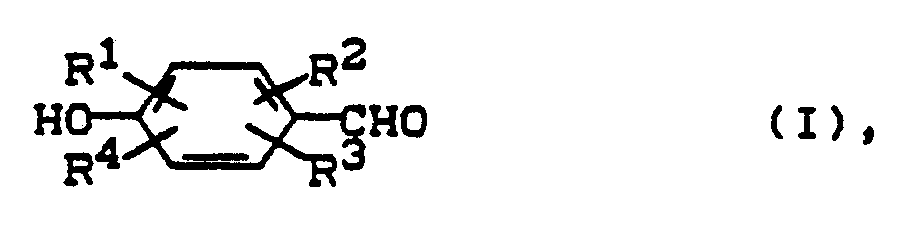
R¹ bis R⁴ unabhängig voneinander Wasserstoff, Halogen, C₁-C₁₀-Alkyl, C₃-C₈-Cycloalkyl, Phenyl oder C₁-C₁₀-Alkoxy bedeuten,
durch Oxidation von p-Kresolen der Formel
R¹ bis R⁴ die angegebene Bedeutung haben,
mit Sauerstoff in Gegenwart basisch reagierender Stoffe in einem Lösungsmittel gefunden, das dadurch gekennzeichnet ist, daß in Gegenwart eines Chelatkomplexes von Eisen, Mangan oder Eisen und Mangan gearbeitet wird. - Das erfindungsgemäße Verfahren hat folgende Vorteile:
- 1. p-Hydroxy-benzaldehyde können aus den zugrundeliegenden p-Kresolen in hoher Selektivität hergestellt werden;
- 2. die zur Verfahrensdurchführung notwendigen Metallmengen sind deutlich geringer als bei bisherigen Verfahren; und
- 3. der Katalysator ist rückführbar und stellt damit in ökologischer Hinsicht einen bedeutenden Fortschritt dar.
- Erfindungsgemäß einsetzbare p-Kresole sind solche der Formel (I).
- Halogen kann Fluor, Chlor, Brom oder Iod sein, bevorzugt Fluor, Chlor oder Brom.
- Die Alkylgruppen in C₁-C₁₀-Alkyl bzw. C₁-C₁₀-Alkoxy sind beispielsweise Methyl, Ethyl, Propyl, Isopropyl, n-Butyl, i-Butyl, t-Butyl, Hexyl, Octyl oder Decyl. In bevorzugter Weise haben diese Alkylgruppen 1-6 C-Atome, in besonders bevorzugter Weise 1-4 C-Atome.
- C₃-C₈-Cycloalkyl umfaßt Cyclopropyl, Cyclopentyl, Cyclohexyl, Cyclooctyl und deren ein- oder zweifach mit Methyl oder Ethyl substituierten Derivate; bevorzugt sei C₅-C₆-Cycloalkyl genannt, das durch Methyl substituiert sein kann.
- Phenyl kann durch Halogen der genannten Art, durch C₁-C₄-Alkyl der genannten Art oder durch Nitro ein- oder zweifach substituiert sein.
- In bevorzugter Weise werden p-Kresole der Formel

R¹¹, R¹² und R¹³ unabhängig voneinander Wasserstoff, Fluor, Chlor, Brom, C₁-C₆-Alkyl, C₅-C₆-Cycloalkyl, Phenyl oder C₁-C₆-Alkoxy bedeuten. - In besonders bevorzugter Weise werden p-Kresole der Formel

R²¹ für Wasserstoff, Fluor, Chlor, Brom, C₁-C₆-Alkyl, Cyclohexyl, Phenyl oder C₁-C₆-Alkoxy steht,
R²² Wasserstoff, C₁-C₆-Alkyl oder C₁-C₆-Alkoxy bedeutet. - Wichtige, jedoch nur beispielhaft genannte p-Kresole sind:
2-Brom-p-kresol, 3-Chlor-p-kresol, 2,4-Dimethylphenol, 3,4-Dimethylphenol, 2,4,5-Trimethylphenol, 2,4,6-Trimethylphenol, 2,6-Dimethoxy-p-kresol, 2-tert.-Butyl-p-kresol, 2,6-Di-tert.-butyl-p-kresol, 2-Chlor-6-isopropyl-p-kresol. In ganz besonders bevorzugter Weise wird p-Kresol eingesetzt. - Das erfindungsgemäße Verfahren erlaubt die selektive Oxidation nur der zur OH-Gruppe p-ständigen Methylgruppe zur Formylgruppe. Die anderen Substituenten, auch Methylgruppen, bleiben unverändert. Aufgrund dieser Selektivität sind auch Gemische von Kresolen als Ausgangsmaterial geeignet, die neben dem gegebenenfalls substituierten p-Kresol auch o- oder m-Kresole enthalten. Die nicht erfindungsgemäß umgesetzten Isomeren außer dem p-Kresol bleiben im wesentlichen unverändert.
- Als Katalysator wird im erfindungsgemäßen Verfahren ein Chelatkomplex des Eisens und/oder Mangans eingesetzt, worin das Eisen bzw. das Mangan 2-, 3-oder 4-wertig vorliegen kann. Die Chelatliganden können 2-6-zähnig sein. Im Chelatkomplex kann das Metall 4-, 5- oder 6-fache Koordination aufweisen. Die Koordinationsstellen im Liganden können die Elemente N, O, S, P, Se, As, in bevorzugter Weise N und O sein.
- Beispiele für derartige Chelatliganden sind: Ethylendiamin, Diethylentriamin, Triethylentetramin, 2,2-Dipyridyl, 1,10-Phenanthrolin, Terpyridyl, Carboxylate, Oxalat, 1,2-Bis-(diphenylphosphino)-ethan, β-Diketonate, z.B. Acetylacetonat und davon abgeleitete Schiff-Basen, Dioxime aus α-Diketonen, z.B. Dimethylglyoxim, Tropolonato-Komplexe und davon abgeleitete Schiff-Basen; Triketone, z.B. 2,4,6-Heptantrion und davon abgeleitete Schiff-Basen; vom Salicylaldehyd abgeleitete Schiff-Basen, z.B. Bis-(salicylaldehyd)-ethylendiamin; vom Acetoacetylphenol und 2,6-Diformylpyridin abgeleitete Schiff-Basen; Chelatkomplexe mit den Liganden N,N,N′ ,N′-Tetrakis[(2-benzimidazolyl)methyl]alkandiamin, Polyphosphate, Pyridin-2-carboxylat, Ethylendiamintetraacetat. Bevorzugt eingesetzt werden makrocyclische Polyether und Polysulfide, Porphyrinanaloga, durch Kondensation von Carbonylverbindungen mit Aminen mögliche Makrocyclen, z.B. Tetrabenzo[b,f,j,n]-[1,5,9,13]-tetraazacyclohexadecin als Selbstkondensationsprodukt des o-Aminobenzaldehyds. Besonders bevorzugt sind Porphyrine sowie damit verwandte, chemisch abgewandelte Systeme, z.B. Corrine, Phlorine, Oxophlorine, Porphyrinogene, Azaporphyrine, Benzoporphyrine, Chlorine.
- Die Porphyrine können natürlichen Ursprungs sein, z.B. Haematoporphyrin, Deuteroporphyrin, Protoporphyrin, Uroporphyrin, Koproporphyrin oder rein synthetischer Art, z.B. Octaethylporphyrin. Bevorzugt eingesetzt werden synthetische Porphyrine, besonders bevorzugt meso-Tetraarylporphyrine, z.B. Tetraphenylporphin (TPP), Tetrakis-(4-methoxyphenyl)-porphin, Tetrakis-(2,4-dimethoxyphenyl)-porphin, Tetrakis-(3,4-methylendioxyphenyl)-porphin, Tetrakis-(4-Methylphenyl)-porphin, Tetrakis-(2-chlorphenyl)-porphin, Tetrakis-(pentafluorphenyl)-porphin.
- Im Metallchelatkomplex muß nicht notwendigerweise jede Koordinationsstelle durch einen Chelatliganden besetzt sein. Freie Koordinationsstellen können durch beliebige Donoren besetzt werden, z.B. durch Anionen anorganischer und organischer Säuren wie OH⁻, Cl⁻, Br⁻, F⁻, J⁻, N₃⁻, NO₃⁻, NO₂⁻, SO₄²⁻, SO₃⁻, Phosphat, Borat, Carboxylat, durch Amine wie Triethylamin, Pyridin, Piperidin, Imidazol, durch Sulfide wie Dimethylsulfid, Dimethylsulfoxid.
- Die Chelatkomplexe können eines oder mehrere Metallzentren aufweisen, sie können dimer, oligomer oder polymer sein.
- Die Dimerisierung, Oligomerisierung oder Polymerisierung kann durch Brückenbildung zwischen den Metallzentren über Donormoleküle oder durch Vernetzung der Chelatliganden untereinander zustande kommen. Die Metallzentren können z.B. Oxo- oder Peroxo-verbrückt sein. Beispiele für dimere Oxo-verbrückte Eisen- und Manganchelatkomplexe sind (FeTPP)₂O, (MnTPP)₂O, (FePc)₂O, (MnPc)₂O (TPP = Tetraphenylporphyrin, Pc = Phthalocyanin). Die Chelatkomplexe können mit einem polymeren Träger vernetzt sein, z.B. mit einem geeignet funktionalisierten Polystyrol.
- Der Metallchelatkomplex kann auch in Kombination mit einem oberflächenaktiven Stoff, z.B. Aktivkohle eingesetzt werden.
- Das molare Verhältnis von Eisen- und/oder Mangan-Chelatkomplex zu eingesetztem p-Kresol liegt bei 0,000001 - 0,05, vorzugsweise bei 0,00001-0,005, berechnet als Metall. Erstaunlicherweise ist der Eisen- und/oder Mangan-Chelatkomplex bereits in geringsten Mengen hochwirksam. Aus den weiter unten aufgeführten Ausführungsbeispielen geht deutlich hervor, daß der Einsatz einfacher Eisen- bzw. Mangansalze, ebenso wie der einsatz einfacher Eisen-bzw. Mangankomplexe oder -komplexsalze bei der Sauerstoffoxidation von p-Kresolen zu p-Hydroxy-benz aldehyden im erfindungsgemäßen Verfahren nur vergleichsweise wenig wirksam ist. Unter einfachen Eisen- bzw. Mangansalzen werden verstanden: Die Salze anorganischer und organischer Säuren, hydratisiert wie dehydratisiert, beispielsweise FeCl₃ · 6 H₂O, FeCl₂ · 4 H₂O, FeSO₄ · 7 H₂O, Fe₂(SO₄)₃ · x H₂O, Fe(NO₃)₃ · 9 H₂O, Eisenphosphate, Mn(OAc)₂ · 4 H₂O, Mn(OAc)₃ · 2 H₂O, MnCl₂ · 4H₂O, MnSO₄ · 4H₂O, MnCO₃, Mn(NO₃)₂ x 6H₂O. Als Beispiele einfacher Eisen- bzw. Mangankomplexe bzw. -komplexsalze, die ebenfalls nur wenig wirksam sind, seien erwähnt: K₃Fe(CN)₆, NaFeCN₅NO, K₂MnF₆.
- Es ist daher umso erstaunlicher, daß Chelatkomplexe des Eisens und/oder des Mangans im erfindungsgemäßen Verfahren eine so völlig unerwartet hohe Wirksamkeit und das bereits in kleinsten Konzentrationen entfalten; dies gilt insbesondere für die Eisen- und Manganporphyrine. Bei hohen Umsetzungsgeschwindigkeiten und hohem Umsetzungsgrad werden hohe p-Hydroxy-benzaldehyd-Selektivitäten erreicht; dies gilt insbesondere, wenn in bevorzugter Form der Eisen- und/oder Manganchelatkomplex, insbesondere der entsprechende Porphyrinkomplex in Kombination mit einem der im folgenden genannten Co-Katalysatoren eingesetzt wird.
- Solche Co-Katalysatoren, die vorteilhaft aber nicht zwingend notwendig im erfindungsgemäßen Verfahren eingesetzt werden können, sind Verbindungen der Metalle Kupfer, Chrom, Nickel, Silber, Vanadium, Niob, Tantal, Cadmium, Cer oder anderer Lanthanide, wie Neodym oder Praseodym. Es ist weiterhin sehr erstaunlich, daß selbst der Einsatz von Eisen- und/oder Manganverbindungen, obwohl diese Metalle bereits erfindungsgemäß in den Chelatkomplexen vorkommen, zusätzlich zu diesen Chelatkomplexen noch eine Verbesserung des erfindungsgemäßen Verfahrens bewirken. Solche Metallverbindungen können einzeln oder zu mehreren in beliebigen Kombinationen als Co-Katalysatoren zugesetzt werden. Das Metall kann in diesen Verbindungen jede der individuell möglichen Oxidationsstufen einnehmen. Mögliche Einsatzformen solcher Metallverbindungen sind die Metallsalze anorganischer Säuren, beispielsweise die Halogenide, wie Fluoride, Chloride, Bromide oder Iodide, die Sulfate, Nitrate, Carbonate, Phosphate, Borate, Sulfite, Cyanide oder die Salze organischer Säuren, wie die Acetate, Stearate, Oxalate, Citrate, oder Ionenaustauscher, die solche Metalle gebunden enthalten. Es können weiterhin auch Metallkomplexe bzw. Komplexsalze und Metallchelatkomplexe eingesetzt werden. Es ist weiterhin sehr erstaunlich, daß selbst die elementaren Metalle in gleicher Weise wie die Metallverbindungen als Co-Katalysatoren wirksam sind.
- In bevorzugter Weise kommen als Co-Katalysator die Metallchelatkomplexe und die Salze anorganischer oder organischer Säuren zur Anwendung. Für den Einsatz als Metallchelatkomplexe gilt das bereits für die obligatorisch einzusetzenden Eisen- und/oder Manganchelatkomplexe Gesagte. Unter den Metallsalzen werden besonders bevorzugt eingesetzt die Chloride, Sulfate, Nitra te, Acetate, Oxide und Hydroxide in hydratisierter oder dehydratisierter Form. Das Metallsalz kann ferner auch in Kombination mit einem komplexierenden Agens, bevorzugt in Kombination mit Ammoniak oder Aminen, eingesetzt werden, beispielsweise Kupferchloride gemeinsam mit Tetramethyl-ethylendiamin.
- In besonders bevorzugter Weise werden anorganische Salze von Kupfer und/oder Cer als Co-Katalysator eingesetzt.
- Die Einsatzmenge des Co-Katalysators ist keiner spezifischen Beschränkung unterworfen. Auffallend ist die hohe Wirksamkeit bereits in sehr kleinen Konzentrationen. Beispielsweise sei ein molares Verhältnis von Co-Katalysator zu eingesetztem p-Kresol von 0,00001-0,1, vorzugsweise von 0,0001-0,01, genannt. Das molare Verhältnis von Eisen- und/oder Manganchelatkomplex zum Co-Katalysator ist unspezifisch und wird beispielsweise im Bereich 0,001-1000:1, bevorzugt 0,01-100:1, gewählt. Werden andererseits die als Co-Katalysatoren wirksamen genannten Metallverbindungen einzeln oder in beliebigen Kombinationen ohne die beschriebenen Eisen- und/oder Manganchelatkomplexe eingesetzt, ist ihre Wirksamkeit bei der Oxidation von p-Kresolen vergleichsweise sehr gering.
- Als Basen für das erfindungsgemäße Verfahren sind alle geeignet, die eine höhere Basizität aufweisen als die daraus herstellbaren p-Kresolate, beispielsweise Metallhydroxide, Metallalkoholate und Metallamide von Alkali- und Erdalkalimetallen und, soweit es sich um Alkoholate bzw. Amide handelt, von Aluminium. Wichtige Metalle unter den genannten sind beispielsweise Natrium, Kalium, Lithium, Calcium und Magnesium. Als Alkoholate seien das Methylat, das Ethylat, das Isopropylat, das tert.-Butylat aufgeführt. Die Amide können beispielsweise Diethylamid, Ethylamid, Diisopropylamid, Dibutylamid usw. sein. Unter den genannten Basen sind die Hydroxide und die Alkoholate bevorzugt, insbesondere bevorzugt sind Natriumhydroxid, Kaliumhydroxid, Natriummethylat, Natriumethylat und Kalium-tert.-butylat.
- Die Base wird in einer Menge von 1-10 Äquivalenten-Base pro Mol des p-Kresols eingesetzt; in bevorzugter Weise werden 1,5-6 Äquivalenten-Base eingesetzt.
- In der Praxis erweist sich der Einsatz eines Basengemisches aus einem der genannten Alkali- oder Erdalkalihydroxide und einem der genannten Alkalimetallalkoholate als besonders günstig. Bevorzugte Basengemische sind solche aus einem Alkalihydroxid und einem Alkalialkoholat des Methanols oder Ethanols. Im besonderen bevorzugt sind Gemische aus Natrium- oder Kaliumhydroxid und Natriummethanolat. Die anteilmäßige Zusammensetzung solcher Basengemische aus Alkali- oder Erdalkalihydroxid und Alkalimetallalkoholat, welche einen Vorteil gegenüber dem Arbeiten mit einerseits ausschließlich Alkali- oder Erdalkalihydroxid und andererseits ausschließlich Alkalialkoholat bieten, kann in dem weiten Bereich von 1:50 - 50:1 schwanken. Bevorzugt wird bei einem Äquivalentverhältnis von Alkalihydroxid zu Alkalialkoholat von 8:1 - 1:4, besonders bevorzugt 4:1 - 2:3 gearbeitet.
- Lösungsmittel für das erfindungsgemäße Verfahren sind solche, die unter den Reaktionsbedingungen nicht oder nur sehr langsam mit Sauerstoff reagieren und die Ausgangskomponenten lösen, beispielsweise Alkohole, Ether, halogenierte Kohlenwasserstoffe, Amine, Amide, Sulfoxide. Solche Lösungsmittel können einzeln oder in Gemischen von zwei oder mehreren eingesetzt werden. Sofern diese Lösungsmittel ganz oder teilweise mit Wasser mischbar sind, kommen auch solche Mischungen mit Wasser in Frage. Die alkoholischen Lösungsmittel sind bevorzugt, beispielsweise Methanol, Ethanol, Isopropanol, Butanol, tert.-Butanol und/oder Ethylenglykol.
- Für den Fall der Verwendung von Alkoholen als Lösungsmittel findet man im Reaktionsgemisch gegebenenfalls substituierte p-Hydroxy-benzylalkylether der Formel

R¹ bis R⁴ den oben angegebenen Bedeutungsumfang haben und
R⁵ der Alkylrest des als Lösungsmittel verwendeten Alkohols ist. - Die Menge dieser Ether schwankt mit den Reaktionsbedingungen.
- Als Sauerstoff für das erfindungsgemäße Verfahren kann reiner Sauerstoff oder Sauerstoff in verdünnter Form, beispielsweise in Form von Sauerstoff enthaltenden Gasen eingesetzt werden. Die wirtschaftlich günstigste Form des erfindungsgemäß verwendbaren Sauerstoffs ist die atmosphärische Luft. Der Druck des Sauerstoffs bzw. des Sauerstoff enthaltenden Gases ist keiner besonderen Einschränkung unterworfen und kann zwischen 1-100 bar liegen, vorzugsweise bei 1-10 bar. Der Sauerstoffgehalt ist bei Verwendung von Sauerstoff enthaltenden Gasen ebenfalls keiner Beschränkung unterworfen. Er richtet sich in erster Linie nach betrieblichen Gesichtspunkten, wie der Betriebssicherheit und der Umsetzungsgeschwindigkeit. Der Sauerstoff kann beispielsweise in das Reaktionsmedium eingespeist werden, beispielsweise unter Verwendung von Fritten; er kann jedoch auch durch kräftiges Rühren in das Reaktionsgemisch eingezogen werden.
- Die Reaktionstemperatur kann in weiten Grenzen schwanken, beispielsweise von 0-200°C, bevorzugt 20-100°C.
- Bei der Aufarbeitung im Anschluß an das erfindugsgemäße Verfahren werden zunächst die Katalysatoren vom reaktionsgemisch abgetrennt (beispielsweise durch Filtration oder Zentrifugieren) und gegebenenfalls wieder eingesetzt; des weiteren wird nicht umgesetztes p-Kresol und der Teil des Reaktionsgemisches, der nur bis zur Stufe des p-Hydroxy-benzylalkylethers oxidiert wurde, in einen Folgeansatz zurückgeführt.
- Die Art der Aufarbeitung richtet sich nach den Ausführungsbedingungen. Ist beispielsweise der Metallchelatkomplex im verwendeten Lösungsmittel schwer löslich, wie etwa Eisentetraphenylporphin in Methanol, kann er zusammen mit dem Co-Katalysator, welcher bei entsprechender Einsatzform, beispielsweise als Metallsalz, anschließend als unlösliches Oxidhydrat vorliegt, direkt vom Reaktionsgemisch abfiltriert werden, wobei dieses bei Bedarf genügend verdünnt wurde, um Einsatzstoffe und Produkte zu lösen. Das Filtrat kann anschließend eingedampft, in Wasser aufgenommen und der p-Hydroxy-benzaldehyd durch Ansäuern freigesetzt werden.
- Ist der Metallchelatkomplex im verwendeten Lösungsmittel gut löslich, wie beispielsweise Mangantetraphenylporphin in Methanol, in Wasser aber unlöslich, so kann das Lösungsmittel aus dem Reaktionsgemisch abgedampft, der Rückstand in Wasser aufgenommen und der Metallchelatkomplex zusammen mit dem als unlöslichem Oxidhydrat vorliegendem Co-Katalysator abfiltriert werden. Da Produkte und Einsatzstoffe in Form ihrer Salze (Phenolate) vor liegen, sind sie in Wasser ausreichend löslich. Aus dem Filtrat kann durch Ansäuern wiederum der p-Hydroxy-benzaldehyd freigesetzt werden.
- In einer noch weiteren Variante kann das Reaktionsgemisch direkt mit Wasser versetzt werden (vorausgesetzt, es besteht ausreichende Mischbarkeit mit dem Lösungsmittel) und der wasserunlösliche Metallchelatkomplex zusammen mit dem als Oxidhydrat vorliegenden Co-Katalysator abfiltriert werden. Aus dem Filtrat wird das organische Lösungsmittel beispielsweise destillativ abgetrennt, und aus der wäßrig-alkalischen Lösung wird der p-Hydroxy-benzaldehyd durch Ansäuern freigesetzt.
- Als Beispiele für besonders vorteilhafte Ausführungsformen seien genannt: Methanol als Lösungsmittel, Natriumhydroxid, Natriummethanolat, Kaliumhydroxid oder Gemische aus diesen als Base, Eisentetraphenylporphin als Metallchelatkomplex und eine Kupferverbindung, wie CuCl₂ · 2 H₂O oder CuO, als Co-Katalysator.
- Eine bevorzugte Aufarbeitungsvariante besteht darin, daß man das Reaktionsgemisch durch Versprühen trocknet, die löslichen Bestandteile des trockenen Rückstandes in heißem Wasser löst und sodann das Eisentetraphenylporphin und das unlösliche Kupferoxidhydrat abfiltriert und gegebenenfalls recyclisiert. Der Reaktionsmischung werden dabei im allgemeinen 2-50, vorzugsweise 3-20 Gew.-Teile Wasser pro 1 Gew.-Teil zur Oxidation einge setztes p-Kresol zugefügt. Für den Fall, daß das Natrium- oder Kaliumsalz des p-Hydroxy-benzaldehyds in kaltem Wasser schlecht löslich ist, wird die Lösung auf 50-90°C erwärmt und bei dieser Temperatur filtriert. In einer Variante dieser Aufarbeitungsform kann das Wasser direkt zum Reaktionsgemisch gegeben werden, die entstehende Lösung auf 50-90°C erwärmt werden und das Eisentetraphenylporphin zusammen mit dem Oxidhydrat des Kupfers abfiltriert werden.
- In einer noch weiteren Aufarbeitungsvariante wird das Reaktionsgemisch mit Methanol auf das 1,5-5-fache des Volumens verdünnt, die Lösung erwärmt, vorzugsweise auf 40-65°C, und das schwerlösliche Eisentetraphenylporphin zusammen mit dem unlöslichen Oxidhydrat des Kupfers abfiltriert. Sodann wird das Filtrat durch Versprühen getrocknet und der Rückstand in Wasser aufgenommen.
- Alle hier aufgeführten Aufarbeitungsvarianten können dahingehend geändert werden, daß vor dem Abfiltrieren des Eisen- und/oder Manganchelatkomplexes und der als Metalloxidhydrate vorliegenden Co-Katalysatoren der pH-Wert der stark alkalischen Lösung durch Ansäuern auf einen Wert zwischen 9-13 eingestellt wird. Durch diese Maßnahme läßt sich die Löslichkeit der Metallverbindungen gegebenenfalls herabsetzen.
- Aus der wäßrig-alkalischen Lösung werden durch Ansäuern der p-Hydroxy-benzaldehyd und, soweit vorhanden, p-Hy droxy-benzylalkylether und nicht umgesetztes p-Kresol freigesetzt. Die Abtrennung und Reinigung des p-Hydroxy-benzaldehyds ist nach den bekannten Methoden, beispielsweise durch fraktionierte Kristallisation, gegebenenfalls unter Zuhilfenahme der Methode der Bisulfit-Adduktbildung möglich.
- Sehr reiner p-Hydroxybenzaldehyd läßt sich durch Extrahieren des Rohprodukts mit wäßriger Bisulfitlösung und anschließendes Freisetzen des p-Hydroxybenzaldehyds durch Ansäuern gewinnen.
- Die Abtrennung und Reinigung des p-Hydroxybenzaldehyds gelingt in Verbindung mit dem erfindungsgemäßen Verfahren besonders einfach, wenn in die bei dem erfindungsgemäßen Verfahren nach dem Abfiltrieren der Katalysatoren anfallende alkalische Lösung direkt SO₂ eingeleitet wird, beispielsweise bis die Lösung pH 2 erreicht hat. Durch Extraktion mit einem geeigneten organischen Lösungsmittel lassen sich dann nicht umgesetztes p-Kresol oder im Falle, daß Kresolgemische eingesetzt wurden, die nicht umgesetzten o- und m-Isomeren, sowie der p-Hydroxybenzylmethylether und Verharzungsprodukte abtrennen. Aus der wäßrigen Lösung wird anschließend durch Ansäuern und Erwärmen das SO₂ ausgetrieben und der p-Hydroxybenzaldehyd freigesetzt.
- Ein Gemisch aus 10,8 g (0,1 Mol) p-Kresol, 12,0 g (0,30 Mol) Natriumhydroxid, 25 g Methanol und 0,10 g (0.14 mmol) Eisentetraphenylporphin (als FeTPPCl) wurde in einer Sauerstoffatmosphäre unter Normaldruck bei 60°C 2,5 Stunden gerührt.
- Anschließend wurde das Methanol unter vermindertem Druck abdestilliert, der Rückstand in 70 ml Wasser aufgenommen, auf 70°C erwärmt und filtriert. Von dem Filter konnten nach dem Trocknen 0,092 g Eisentetraphenylporphin zurückgewonnen werden. Das Filtrat wurde mit verdünnter Schwefelsäure angesäuert und mit Ethylacetat extrahiert. Nach Abdampfen des Ethylacetats im Vakuum verblieben 11,04 g Produkt mit einem Gehalt an (ermittelt durch HPLC = Hochdruckflüssigkeitschromatographie) 9,0 % Kresol, 55,5 % p-Hydroxybenzaldehyd, 5,3 % p-Hydroxybenzylmethylether. Das entspricht einem Kresol-Umsatz von 90, 8 %, einer p-Hydroxybenzaldehyd-Selektivität von 55,3 % und einer p-Hydroxybenzylmethylether-Selektivität von 4,7 %.
- Durchführung wie Beispiel 1 mit dem Unterschied, daß 1,0 g Aktivkohle zugesetzt wurde. Die Umsetzung wurde nach 4 Stunden abgebrochen und das Reaktionsgemisch wie im Beispiel 1 aufgearbeitet. Man erhielt 10,36 g Rohprodukt mit einem Gehalt an 80,1 % p-Hydroxybenzaldehyd, 7,2 % p-Hydroxybenzylmethylether, 2,0 % p-Kresol. Daraus folgt für die p-Hydroxybenzaldehyd-Selektivität 69.3 %, für die p-Hydroxybenzylmethylether-Selektivität 5,5 % bei einer Umsetzung des p-Kresols von 98,1 %.
- Ein Gemisch aus 10,8 g (0,10 Mol) p-Kresol, 12,0 g (0,30 Mol) Natriumhydroxid, 25 g Methanol, 0,10 g (0,14 mmol) Eisentetraphenylporphin (als FeTPPCl) und 0,043 g (0,25 mmol) CuCl₂ · 2 H₂O wurden in einer Sauerstoffatmosphäre unter Normaldruck bei 60°C 7 Stunden gerührt.
- Das Reaktionsgemisch wurde wie in Beispiel 1 aufgearbeitet und brachte folgendes Ergebnis:
Umsetzung des p-Kresols: 96,4 % p-Hydroxybenzaldehyd-Selektivität: 78,2 % p-Hydroxybenzylmethylether-Selektivität: 3,4 % - Ein Gemisch aus 10,8 g (0,10 Mol) p-Kresol, 12,0 g (0,30 Mol) Natriumhydroxid, 25 g Methanol, 0,10 g (0,14 mmol) Eisentetraphenylporphin (als FeTPPCl), 0,043 g (0,25 mmol) CuCl₂ · 2 H₂O und 0,137 g (0,25 mmol) (NH₄)₂ Ce(NO₃)₆ wurden in einer Sauerstoffatmosphäre unter Normaldruck bei 60°C 7 Stunden gerührt.
- Das Reaktionsgemisch wurde wie in Beispiel 1 aufgearbeitet.
Ergebnis: Umsetzung des p-Kresols: 98,8 % p-Hydroxybenzaldehyd-Selektivität: 82,0 % p-Hydroxybenzylmethylether-Selektivität: 0,3 % - Reaktionsansatz und Durchführung wie in Beispiel 3. Die Abtrennung und Reinigung des p-Hydroxybenzaldehyds erfolgt über das Bisulfit-Addukt in der nachstehend beschriebenen Weise:
Nach Beendigung der Sauerstoffeinleitung wurde das Methanol vom Reaktionsgemisch abdestilliert, der Rückstand in 70 ml Wasser aufgenommen, auf 70°C erwärmt und filtriert. Auf dem Filter verblieben nach Auswaschen mit Wasser und Trocknen 0,115 g Katalysatorgemisch, bestehend aus Eisentetraphenylporphin und Kupferoxidhydrat. In das alkalische Filtrat wurde anschließend bei Raumtemperatur SO₂ eingeleitet, bis pH=2 erreicht war. Danach wurde noch 1 Stunde gerührt und dann zweimal mit Ethylacetat ausgeschüttelt. Die resultierende organische Phase wurde über Natriumsulfat getrocknet und das Lösungsmittel abdestilliert. Es blieben 2,31 g Öl als Rückstand mit der Zusammensetzung (Ausbeute)p-Kresol 2,8 % (0,6 %) p-Hydroxybenzaldehyd 11,7 % (2,2 %) p-Hydroxybenzylmethylether 32,1 % (5,4 %) - Die wäßrige Phase wurde mit 50 ml konz. HCl angesäuert und das SO₂ durch Erwärmen und durch Anlegen eines leichten Vakuums möglichst vollständig entfernt. Der freigesetzte p-Hydroxybenzaldehyd wurde aus der wäßrigen Phase durch dreimaliges Ausschütteln mit Ethylacetat extrahiert, die organische Phase durch Waschen mit Hydrogencarbonatlösung entsäuert, über Natriumsulfat getrocknet und eingedampft.Als Rückstand fielen 8,74 g farbloses feinkristallines Produkt mit einem Gehalt von 99,4 % p-Hydroxybenzaldehyd an (Ausbeute 71,2 %).
- Ein Gemisch aus 10,8 g (0,10 Mol) p-Kresol, 12,0 g (0,30 Mol) Natriumhydroxid, 25 g Methanol, 0,10 g (0,14 mmol) Eisentetraphenylporphin (als FeTPPCl) und 0,25 mmol der in Tabelle 1 aufgeführten Metallverbindungen wurden in einer Sauerstoffatmosphäre unter Normaldruck bei 60°C innerhalb der ebenfalls in Tabelle 1 angegebenen Zeit intensiv gerührt. Das Reaktionsgemisch wurde wie in Beispiel 1 aufgearbeitet und mittels HPLC analysiert. Die Tabelle 1 zeigt die Ergebnisse hinsichtlich der Umsetzung des p-Kresols und der Selektivitäten in der Bildung des p-Hydroxybenzaldehyds (p-HBA) und des p-Hydroxybenzylmethylethers (p-HBME).
Tabelle 1 Beispiel Nr. Metallverbindung Reaktionszeit (h) Umsetzung % Selektivität % p-HBA p-HBME 6 (NH₄)·Ce(NO₃)₆ 6 96,2 74,6 2,8 7 Mn(OAc)₂·4 H₂O * 7 91,1 62,9 11,7 8 Cr(NO₃)₃·9 H₂O 7 88,1 57,5 12,2 9 FeCl₂·4 H₂O 7 91,6 61,8 15,5 10 Ni(NO₃)₂·6 H₂O 7 96,0 58,4 17,2 11 VO(acac) * 7 96,9 68,7 11,9 12 AgOAc * 7 94,8 53,3 17,8 13 NbCl₅ 7 98,6 63,9 3,1 14 TaCl₅ 7 99,4 70,2 11,6 15 Cd(NO₃)₂·4 H₂O 7 95,1 61,2 12,1 16 Nd(NO₃)₂·6 H₂O + Pr(NO₃)₃·6 H₂O (7:3) 7 94,9 62,1 18,6 *Ac = Acetyl, acac = Rest von Acetyl-acetonat - In den Beispielen 17 bis 25 wurde zum Vergleich die Wirksamkeit einfacher Eisen- und Mangansalze sowie die Wirksamkeit einiger als Co-Katalysator eingesetzter Metallverbindungen ohne Zusatz von Eisentetraphenylporphin, jedoch unter sonst gleichen Bedingungen wie in den vorangegangenen Beispielen, bei der Sauerstoffoxidation von p-Kresol getestet.
- Ein Gemisch aus 10,8 g (0,10 Mol) p-Kresol, 12,0 g (0,30 Mol) Natriumhydroxid, 25 g Methanol und dem in Tabelle 2 genannten Metallsalz in der dort angegebenen Menge wurde in einer Sauerstoffatmosphäre unter Normaldruck bei 60°C innerhalb 7 Stunden intensiv gerührt. Die Ergebnisse hinsichtlich der Umsetzug des p-Kresols und der Selektivitäten in der Bildung des p-Hydroxybenzaldehyds (p-HBA) und des p-Hydroxybenzylmethylethers (p-HBME) sind in Tabelle 2 zusammengefaßt.
Tabelle 2 Beispiel Nr. Metallverbindung (zugesetzte Menge) Umsetzung % Selektivität % p-HBA p-HBME 17 FeSO₄·7 H₂O (2,5 mmol) 25,7 41,8 7,0 18 K₃Fe(CN)₆ (2,5 mmol) 31,5 2,2 0,7 19 FeCl₃·6 H₂O (1 mmol) 33,9 51,2 1,5 20 FeCl₃·6 H₂O (5 mmol) 32,0 48,0 6,4 21 Ni(NO₃)₂·6 H₂O (1,0 mmol) 10,9 7,2 2,5 22 Mn(OAc)₂·4 H₂O (1,0 mmol) 16,2 9,2 - 23 Cr(NO₃)₃·9 H₂O (1,0 mmol) 8,3 10,1 - 24 FeCl₃·6 H₂O (1,0 mmol) + Ni(NO₃)₂·6 H₂O (1,0 mmol) 33,3 48,9 0,4 25 CuCl₂·2 H₂O (1,0 mmol) 33,9 12,1 4,7 - Katalysatorrückführung: Ein Gemisch aus 10,8 g (0,10 Mol) p-Kresol, 12,0 g (0,30 Mol) Natriumhydroxid, 25 g Methanol, 0,30 g (0,43 mmol) Eisentetraphenylporphin (als FeTPPCl) und 0,128 g (0,75 mmol) CuCl₂·2 H₂O wurde in einer Sauerstoffatmosphäre unter Normaldruck bei 60°C 6 Stunden gerührt. Anschließend wurde das Methanol unter vermindertem Druck abdestilliert, der Rückstand in 70 ml Wasser aufgenommen, auf 70°C erwärmt und filtriert. Der Filterrückstand wurde zweimal mit je 15 ml heißem Wasser ausgewaschen, getrocknet und bei der nächsten Oxidation, die auf dieselbe Weise durchgeführt wurde mit dem Unterschied, daß weder weiteres Eisentetraphenylporphin noch weiteres Kupferchlorid (auch nicht ergänzend mit der Ausnahme der 6. Rückführung) eingesetzt wurde, zum Ausgangsgemisch hinzugefügt. Die Aufarbeitung erfolgte wie im Beispiel 1. In der Tabelle 3 sind die Ergebnisse der Katalysatorrückführungen zusammengestellt. Bei der 6. Rückführung wurde ergänzend nochmals 0,04 g CuCl₂·2 H₂O hinzugefügt. Nach der 10. Rückführung betrug die Katalysatormenge noch 0,14 g. Daraus konnten 0,11 g reines Tetraphenylporphin isoliert werden.
Tabelle 3 Umsetzung % Selektivität % P-HBA p-HBME Beispiel 26 91,2 56,7 2,4 Rückführung 1 96,2 64,2 15,76 2 94,5 63,6 9,7 3 91,7 67,0 10,7 4 95,4 64,5 16,7 5 95,7 59,3 7,4 6 88,8 62,4 10,4 7 95,9 60,5 9,0 8 92,0 66,4 13,9 9 90,5 61,9 3,2 10 89,6 73,9 0,2 - Ein Gemisch aus 10,8 g (0,10 Mol) p-Kresol, 12,0 g (0,30 Mol) Natriumhydroxid, 25 g Methanol und dem in Tabelle 5 genannten Metallkomplex in der dort angegebenen Menge wurde in einer Sauerstoffatmosphäre unter Normaldruck bei 60°C 5-7 Stunden gerührt. Das Reaktionsgemisch wurde wie in Beispiel 1 aufgearbeitet. Zu den Ergebnissen siehe Tabelle 4.
Tabelle 4 Beispiel Nr. Metallverbindung (zugesetzte Menge in mmol) Reaktionszeit (h) Umsetzung % Selektivität % p-HBA p-HBME 27 MnTPPCl* (0,15 mmol) 5 48,8 62,8 6,4 28 (FeTPP)₂O** (0,15 Mol) 6 92,5 61,2 5,3 29 Eisenphthalocyanin (0,50 mmol) 6 35,4 42,5 6,9 30 Eisenporphyrazin (0,30 mmol) 7 33,7 64,6 15,5 31 Hämin (0,30 mmol) 7 56,1 48,5 3,9 * Mangan-tetraphenylporphin mit Ladungsausgleich durch Cl⁻ ** Sauerstoff-verbrücktes dimeres Eisenporphyrin; Eisen-tetraphenylporphin mit Ladungsausgleich durch Cl⁻ wurde mit NaOH behandelt, wobei sich die dimere Form mit Sauerstoffbrücke bildete. - Zu einem m/p-Kresolgemisch, bestehend aus 10,8 g (0,10 Mol) p-Kresol und 10,8 g (0,10 Mol) m-Kresol, wurden 50 g Methanol, 24,0 g (0,60 Mol) Natriumhydroxid, 0,20 g (0,28 mmol) Eisentetraphenylporphin (als FeTPPCl) und 0,085 g (0,50 mmol) CuCl₂ · 2 H₂O gegeben und das Ganze in einer Sauerstoffatmosphäre bei 60°C unter Normaldruck während 7 Stunden intensiv gerührt. Das Reaktionsgemisch wurde wie in Beispiel 1 aufgearbeitet. Die Analyse brachte folgendes Ergebnis:
Umsetzung des p-Kresols: 98,0 % p-Hydroxybenzaldehyd-Selektivität: 75,1 % p-Hydroxybenzylmethylether-Selektivität: 13,8 % Rückgewinnung des m-Kresols: 87,6 % - Das Reaktionsgemisch enthielt weder 3-Hydroxybenzaldehyd noch 3-Hydroxybenzylmethylether.
- Von den in Tabelle 5 aufgeführten p-Kresolderivaten wurden jeweils 0,10 Mol zusammen mit 12,0 g (0,30 Mol) Natriumhydroxid, 50 g Methanol, 0,10 g (0,14 mmol) Eisentetraphenylporphin (als FeTPPCl) und 0,043 g (0,25 mmol) CuCl₂· 2 H₂O in einer Sauerstoffatmosphäre bei 60°C unter Normaldruck innerhalb der in Tabelle 5 angegebenen Zeit intensiv gerührt. Die Reaktionsgemische wurden analog Beispiel 1 aufgearbeitet und die Produkte analysiert. Der Umsetzungsgrad der entsprechenden p-Kresole sowie die Selektivitäten bezüglich der Bildung der 4-Hydroxybenzaldehydderivate sind in der Tabelle 5 zusammengestellt.
Tabelle 5 Beispiel Nr. p-Kresolderivat Reaktionszeit (h) 4-Hydroxybenzaldehydderivat Selektivität (%) Umsatz (%) 33 3-Chlor-p-kresol 5 2-Chlor-4-hydroxybenzaldehyd 72,7 95 34 2-Brom-p-kresol 3 3-Brom-4-hydroxybenzaldehyd 83,1 86 35 2-Chlor-6-isopropyl-p-kresol 5 3-Chlor-5-isopropyl-4-hydroxybenzaldehyd 67,2 98 36 2,6-Di-t-butyl-p-kresol 4 3,5-Di-tert.-butyl-4-hydroxybenzaldehyd 52,1 97 - Die nachstehend aufgeführten Beispiele 37-47 wurden in einem größeren Reaktor bei anteilmäßig höheren Methanol- und Basenmengen, verglichen mit den Beispielen 1-36, durchgeführt.
- In einem 1 l-Reaktor wurde in ein auf 60°C erwärmtes Gemisch aus 54,0 g (0,50 Mol) p-Kresol, 250 g Methanol, 100 g (2,5 Mol) Natriumhydroxid, 0,25 g (0,35 mmol) Eisentetraphenylporphin (als FeTPPCl) und 0,10 g (1,3 mmol) Kupfer(II)oxid während 7 Stunden unter kräftigem Rühren ein Sauerstoffstrom von 5,0 l/h geleitet. Während der gesamten Reaktionszeit wurde die Temperatur bei 60°C gehalten.
- Nach Beendigung der Reaktion wurde das Methanol unter vermindertem Druck abdestilliert, der Rückstand in 700 ml Wasser aufgenommen, mit konz. Salzsäure auf pH = 11,5 eingestellt, dann auf 70°C erwärmt und filtriert. Das Filtrat wurde nach dem Abkühlen auf Raumtemperatur mit konz. Salzsäure angesäuert und anschließend mit Ethylacetat extrahiert. Nach Abdampfen des Ethylacetats im Vakuum verblieben 60,8 g Rohprodukt mit einem Gehalt von 76,9 % p-Hydroxybenzaldehyd, 1,9 % p-Hydroxybenzylmethylether und 0,4 % p-Kresol.
Ausbeute an p-Hydroxybenzaldehyd: 76,6 %. - Durchführung wie Beispiel 37 mit dem Unterschied, daß anstelle des Natriumhydroxids 138 g (2,5 Mol) Natriummethanolat (98 %) eingesetzt wurden.
Umsatz >99 %Ausbeute: 70,4 % p-Hydroxybenzaldehyd 0,5 % p-Hydroxybenzylmethylether - In einem 1 l-Reaktor wurde in ein Gemisch aus 81 g (0,75 Mol) p-Kresol, 250 g Methanol, 60 g (1,5 Mol) Natriumhydroxid, 54 g (1,0 Mol) Natriummethanolat, 0,375 g (0,53 mmol) Eisentetraphenylporphin (als FeTPPCl) und 0,15 g (1,9 mmol) Kupfer(II)oxid bei 60°C während 8 Stunden unter kräftigem Rühren ein Sauerstoffstrom von 5,0 l/h geleitet.
Aufarbeitung wie in Beispiel 37.
Umsatz >99 %Ausbeute: 85,3 % p-Hydroxybenzaldehyd 2,6 % p-Hydroxybenzylmethylether - Durchführung wie Beispiel 39 mit dem Unterschied, daß die Menge an Eisentetraphenylporphin auf 0,075 g (0,11 mmol) reduziert wurde.
Umsatz >99 %Ausbeute: 86,1 % p-Hydroxybenzaldehyd 1,7 % p-Hydroxybenzylmethylether - In einem 1 l-Reaktor wurde in ein Gemisch aus 54,0 g (0,50 Mol) p-Kresol, 250 g Methanol, 50 g (1,25 Mol) Natriumhydroxid, 54 g (1,0 Mol) Natriummethanolat, 0,10 g (1,3 mmol) Kupfer(II)oxid und 0,07 mmol Eisentetraarylporphin (als FeTAPCl = Eisentetraarylporphin mit Ladungsausgleich durch Cl⁻; TAP = Tetraarylphorphin) mit den in der Tabelle 6 aufgeführten Tetraarylporphin-systemen bei 60°C während 7 Stunden unter kräftigem Rühren ein Sauerstoffstrom von 4,0 l/h eingeleitet. Die Ergebnisse sind in der Tabelle 6 zusammengefaßt. Der p-Kresolumsatz war jeweils >99 %.
Tabelle 6 Beispiel Nr. Tetraarylporphin Ausbeute % p-HBA p-HBME 41 Tetrakis-(4-methoxyphenyl)porphin 92,9 0,7 42 Tetrakis-(3,4-methylendioxy-phenyl)porphin 88,4 1,4 43 Tetrakis-(4-methylphenyl)porphin 87,7 1,1 44 Tetrakis-(4-chlorphenyl)porphin 76,2 6,8 45 Tetrakis-(2-chlorphenyl)porphin 83,5 0,7 46 Tetrakis-(4-t-butylphenyl)porphin 81,3 1,9 47 Tetrakis-(2,4-dimethoxyphenyl)porphin 90,6 0,6
Claims (10)

R¹ bis R⁴ unabhängig voneinander Wasserstoff, Halogen, C₁-C₁₀-Alkyl, C₃-C₈-Cycloalkyl, Phenyl oder C₁-C₁₀-Alkoxy bedeuten,
durch Oxidation von p-Kresolen der Formel

R¹ bis R⁴ die angegebene Bedeutung haben,
mit Sauerstoff in Gegenwart basisch reagierender Stoffe in einem Lösungsmittel, dadurch gekennzeichnet, daß in Gegenwart eines Chelatkomplexes von Eisen, Mangan oder Eisen und Mangan gearbeitet wird.
Priority Applications (1)
| Application Number | Priority Date | Filing Date | Title |
|---|---|---|---|
| AT89102424T ATE56937T1 (de) | 1988-02-24 | 1989-02-13 | Verfahren zur herstellung von p-hydroxybenzaldehyden. |
Applications Claiming Priority (2)
| Application Number | Priority Date | Filing Date | Title |
|---|---|---|---|
| DE3805697A DE3805697A1 (de) | 1988-02-24 | 1988-02-24 | Verfahren zur herstellung von p-hydroxy-benzaldehyden |
| DE3805697 | 1988-02-24 |
Publications (2)
| Publication Number | Publication Date |
|---|---|
| EP0330036A1 true EP0330036A1 (de) | 1989-08-30 |
| EP0330036B1 EP0330036B1 (de) | 1990-09-26 |
Family
ID=6348013
Family Applications (1)
| Application Number | Title | Priority Date | Filing Date |
|---|---|---|---|
| EP89102424A Expired - Lifetime EP0330036B1 (de) | 1988-02-24 | 1989-02-13 | Verfahren zur Herstellung von p-Hydroxy-benzaldehyden |
Country Status (7)
| Country | Link |
|---|---|
| US (1) | US4929766A (de) |
| EP (1) | EP0330036B1 (de) |
| JP (1) | JP2788747B2 (de) |
| AT (1) | ATE56937T1 (de) |
| DE (2) | DE3805697A1 (de) |
| DK (1) | DK83689A (de) |
| IL (1) | IL89368A (de) |
Cited By (3)
| Publication number | Priority date | Publication date | Assignee | Title |
|---|---|---|---|---|
| EP0451650A1 (de) * | 1990-04-13 | 1991-10-16 | Bayer Ag | Verfahren zur Herstellung von o-Hydroxy-benzaldehyden |
| US5773664A (en) * | 1995-02-01 | 1998-06-30 | Bayer Aktiengesellschaft | Process for the recovery of 4-hydroxybenzaldehyde from reaction mixtures containing same |
| WO2001009072A1 (en) * | 1999-07-30 | 2001-02-08 | Port Elizabeth Technikon | Process for the production of hydroxy-substituted aromatic aldehydes and ketones |
Families Citing this family (11)
| Publication number | Priority date | Publication date | Assignee | Title |
|---|---|---|---|---|
| US5475156A (en) | 1994-06-06 | 1995-12-12 | General Electric Company | Method for making a 2,6-dialkylphenol |
| US5693869A (en) * | 1994-12-09 | 1997-12-02 | Council Of Scientific & Industrial Research | Process for the single step oxidation of 3-phenoxytoluene to 3-phenoxybenzaldehyde |
| ATE312103T1 (de) * | 1999-01-25 | 2005-12-15 | Nat Jewish Med & Res Center | Substituierte porphyrine und deren therapeutische verwendungen |
| DE60140783D1 (de) * | 2000-09-08 | 2010-01-28 | Shinetsu Chemical Co | Seltenerd-Legierung, Seltenerd-Sintermagnet und Herstellungsverfahren |
| TW476749B (en) | 2000-11-17 | 2002-02-21 | Nat Science Council | Process for preparing 2,6-dimethylphenol |
| CN101462933B (zh) * | 2009-01-14 | 2012-09-05 | 中北大学 | 一种催化氧化合成对羟基苯甲醛的方法及设备 |
| CN103183594A (zh) * | 2013-03-15 | 2013-07-03 | 北京工业大学 | 金属卟啉-金属盐复合催化剂催化氧化对甲酚制备对羟基苯甲醛的方法 |
| CN111250162B (zh) * | 2018-11-30 | 2023-01-31 | 中国科学院大连化学物理研究所 | 一种固体碱催化剂及其制备方法、应用 |
| CN111470952A (zh) * | 2020-04-30 | 2020-07-31 | 厦门中坤化学有限公司 | 一种采用选择性氧化间对混合甲酚制备高纯间甲酚的方法 |
| CN117623874B (zh) * | 2023-11-28 | 2026-04-28 | 上海东庚化工技术有限公司 | 一种混合甲酚的分离方法 |
| CN118904382B (zh) * | 2024-07-19 | 2026-04-21 | 浙江工业大学 | 一种用于对甲酚高效合成4-甲基儿茶酚的催化剂及其制备方法和应用 |
Citations (6)
| Publication number | Priority date | Publication date | Assignee | Title |
|---|---|---|---|---|
| DE1128847B (de) * | 1954-08-16 | 1962-05-03 | Ruhrchemie Ag | Verfahren zur Herstellung von Carbinolen und Ketonen |
| US3073867A (en) * | 1960-01-11 | 1963-01-15 | Robert D Offenhauer | Process for the manufacture of acetophenone |
| US3666815A (en) * | 1969-06-10 | 1972-05-30 | Tno | Method for the catalytic oxidation of alkyl aromates |
| EP0012939A1 (de) * | 1978-12-13 | 1980-07-09 | Sumitomo Chemical Company, Limited | Verfahren zur Herstellung von Derivaten des 4-Hydroxybenzaldehyds |
| US4453016A (en) * | 1982-09-07 | 1984-06-05 | The Dow Chemical Company | Preparation of aromatic aldehydes |
| US4471140A (en) * | 1982-08-19 | 1984-09-11 | The Dow Chemical Company | Preparation of aromatic aldehydes |
Family Cites Families (3)
| Publication number | Priority date | Publication date | Assignee | Title |
|---|---|---|---|---|
| FR2498180A1 (fr) * | 1981-01-20 | 1982-07-23 | Hoechst France | Procede de preparation d'hydroxybenzaldehydes |
| DE3525848A1 (de) * | 1985-07-19 | 1987-01-22 | Hoechst Ag | Verfahren zur isolierung von p-hydroxybenzaldehyd |
| JPS62135443A (ja) * | 1985-12-10 | 1987-06-18 | C K Fine Kemikaruzu:Kk | パラヒドロキシベンズアルデヒドの製造方法 |
-
1988
- 1988-02-24 DE DE3805697A patent/DE3805697A1/de not_active Withdrawn
-
1989
- 1989-02-13 EP EP89102424A patent/EP0330036B1/de not_active Expired - Lifetime
- 1989-02-13 AT AT89102424T patent/ATE56937T1/de not_active IP Right Cessation
- 1989-02-13 DE DE8989102424T patent/DE58900015D1/de not_active Expired - Lifetime
- 1989-02-16 US US07/311,481 patent/US4929766A/en not_active Expired - Lifetime
- 1989-02-20 JP JP1038482A patent/JP2788747B2/ja not_active Expired - Fee Related
- 1989-02-21 IL IL89368A patent/IL89368A/xx not_active IP Right Cessation
- 1989-02-23 DK DK083689A patent/DK83689A/da not_active Application Discontinuation
Patent Citations (6)
| Publication number | Priority date | Publication date | Assignee | Title |
|---|---|---|---|---|
| DE1128847B (de) * | 1954-08-16 | 1962-05-03 | Ruhrchemie Ag | Verfahren zur Herstellung von Carbinolen und Ketonen |
| US3073867A (en) * | 1960-01-11 | 1963-01-15 | Robert D Offenhauer | Process for the manufacture of acetophenone |
| US3666815A (en) * | 1969-06-10 | 1972-05-30 | Tno | Method for the catalytic oxidation of alkyl aromates |
| EP0012939A1 (de) * | 1978-12-13 | 1980-07-09 | Sumitomo Chemical Company, Limited | Verfahren zur Herstellung von Derivaten des 4-Hydroxybenzaldehyds |
| US4471140A (en) * | 1982-08-19 | 1984-09-11 | The Dow Chemical Company | Preparation of aromatic aldehydes |
| US4453016A (en) * | 1982-09-07 | 1984-06-05 | The Dow Chemical Company | Preparation of aromatic aldehydes |
Non-Patent Citations (1)
| Title |
|---|
| PATENT ABSTRACTS OF JAPAN, Band 11, Nr. 365 (C-460)[2812], 27. November 1987; & JP-A-62 135 443 (C K FINE KEMIKARUZU K.K.) 18-06-1987 * |
Cited By (3)
| Publication number | Priority date | Publication date | Assignee | Title |
|---|---|---|---|---|
| EP0451650A1 (de) * | 1990-04-13 | 1991-10-16 | Bayer Ag | Verfahren zur Herstellung von o-Hydroxy-benzaldehyden |
| US5773664A (en) * | 1995-02-01 | 1998-06-30 | Bayer Aktiengesellschaft | Process for the recovery of 4-hydroxybenzaldehyde from reaction mixtures containing same |
| WO2001009072A1 (en) * | 1999-07-30 | 2001-02-08 | Port Elizabeth Technikon | Process for the production of hydroxy-substituted aromatic aldehydes and ketones |
Also Published As
| Publication number | Publication date |
|---|---|
| DK83689D0 (da) | 1989-02-23 |
| US4929766A (en) | 1990-05-29 |
| IL89368A (en) | 1993-02-21 |
| EP0330036B1 (de) | 1990-09-26 |
| JP2788747B2 (ja) | 1998-08-20 |
| IL89368A0 (en) | 1989-09-10 |
| JPH01254637A (ja) | 1989-10-11 |
| DK83689A (da) | 1989-08-25 |
| ATE56937T1 (de) | 1990-10-15 |
| DE3805697A1 (de) | 1989-09-07 |
| DE58900015D1 (de) | 1990-10-31 |
Similar Documents
| Publication | Publication Date | Title |
|---|---|---|
| EP0330036B1 (de) | Verfahren zur Herstellung von p-Hydroxy-benzaldehyden | |
| EP2257514B1 (de) | Verfahren zur herstellung von olefinisch ungesättigten carbonylverbindungen durch oxidative dehydrierung von alkoholen | |
| DE3854316T2 (de) | Durch einen halogenierten Liganden enthaltende Eisenkoordinationskomplexe katalisierte Oxidation von Kohlenwasserstoffen. | |
| DE19512618A1 (de) | Platinmetall enthaltende Träger-Katalysatoren und Verfahren zur Herstellung von Diarylcarbonaten | |
| DE19512615A1 (de) | Platinmetall enthaltende Träger-Katalysatoren und Verfahren zur Herstellung von Diarylcarbonaten | |
| DE2755937A1 (de) | Verfahren zur steuerung der grundmolaren viskositaetszahl von polyphenylenaether-reaktionsmischungen | |
| DE1767939B2 (de) | Verfahren zur Herstellung von Molybdänkatalysatoren | |
| EP0451650B1 (de) | Verfahren zur Herstellung von o-Hydroxy-benzaldehyden | |
| DE3219828A1 (de) | Verfahren zur herstellung von alkylencarbonaten | |
| DE2338861A1 (de) | Verfahren zur katalytischen vinylierung aromatischer verbindungen | |
| DE2546139C2 (de) | Verfahren zur gleichzeitigen Herstellung von ε-Caprolacton und Essigsäure | |
| DE2702014A1 (de) | Verfahren und katalysator zur herstellung von saeureamiden | |
| DE69214559T2 (de) | Allylische Oxidation von Olefinen | |
| EP1169281A1 (de) | Singlet sauerstoff oxidation von organischen substraten | |
| DE4316180A1 (de) | Verfahren zur Herstellung von Aldehyden | |
| DE2620644A1 (de) | Verfahren zur herstellung von carbonylverbindungen durch oxidation von olefinen mit molekularem sauerstoff | |
| DE1667848A1 (de) | Edelmetallverbindungen enthaltende Loesungen und deren Verwendung zu katalytischen Reaktionen | |
| DE60010867T2 (de) | Verfahren und zusammensetzung zur hydroxylierung von aromatischen verbindungen | |
| US4471140A (en) | Preparation of aromatic aldehydes | |
| DE69731967T2 (de) | Verfahren zur selektiven herstellung von 2-hydroxybenzoesäure und von 4-hydroxybenzaldehyd und derivaten | |
| EP0008699A1 (de) | Verfahren zur Herstellung von Arylglyoxylsäuren | |
| DE2633785A1 (de) | Verfahren zur herstellung von alkylenglykolestern | |
| DE2460665C2 (de) | Verfahren zur Herstellung von p-Chinonen | |
| DE60007282T2 (de) | Verfahren und zusammensetzung zur hydroxylierung von aromatischen substraten | |
| EP0179931B1 (de) | Verfahren zur Herstellung von Thiurampolysulfiden |
Legal Events
| Date | Code | Title | Description |
|---|---|---|---|
| PUAI | Public reference made under article 153(3) epc to a published international application that has entered the european phase |
Free format text: ORIGINAL CODE: 0009012 |
|
| 17P | Request for examination filed |
Effective date: 19890215 |
|
| AK | Designated contracting states |
Kind code of ref document: A1 Designated state(s): AT BE CH DE FR GB IT LI NL SE |
|
| 17Q | First examination report despatched |
Effective date: 19900103 |
|
| GRAA | (expected) grant |
Free format text: ORIGINAL CODE: 0009210 |
|
| AK | Designated contracting states |
Kind code of ref document: B1 Designated state(s): AT BE CH DE FR GB IT LI NL SE |
|
| REF | Corresponds to: |
Ref document number: 56937 Country of ref document: AT Date of ref document: 19901015 Kind code of ref document: T |
|
| REF | Corresponds to: |
Ref document number: 58900015 Country of ref document: DE Date of ref document: 19901031 |
|
| GBT | Gb: translation of ep patent filed (gb section 77(6)(a)/1977) | ||
| ET | Fr: translation filed | ||
| ITF | It: translation for a ep patent filed | ||
| PLBE | No opposition filed within time limit |
Free format text: ORIGINAL CODE: 0009261 |
|
| STAA | Information on the status of an ep patent application or granted ep patent |
Free format text: STATUS: NO OPPOSITION FILED WITHIN TIME LIMIT |
|
| 26N | No opposition filed | ||
| ITTA | It: last paid annual fee | ||
| EAL | Se: european patent in force in sweden |
Ref document number: 89102424.2 |
|
| REG | Reference to a national code |
Ref country code: GB Ref legal event code: IF02 |
|
| PGFP | Annual fee paid to national office [announced via postgrant information from national office to epo] |
Ref country code: DE Payment date: 20030124 Year of fee payment: 15 |
|
| PGFP | Annual fee paid to national office [announced via postgrant information from national office to epo] |
Ref country code: SE Payment date: 20030131 Year of fee payment: 15 Ref country code: NL Payment date: 20030131 Year of fee payment: 15 |
|
| PGFP | Annual fee paid to national office [announced via postgrant information from national office to epo] |
Ref country code: GB Payment date: 20030212 Year of fee payment: 15 |
|
| PGFP | Annual fee paid to national office [announced via postgrant information from national office to epo] |
Ref country code: FR Payment date: 20030219 Year of fee payment: 15 |
|
| PGFP | Annual fee paid to national office [announced via postgrant information from national office to epo] |
Ref country code: CH Payment date: 20030220 Year of fee payment: 15 Ref country code: AT Payment date: 20030220 Year of fee payment: 15 |
|
| PGFP | Annual fee paid to national office [announced via postgrant information from national office to epo] |
Ref country code: BE Payment date: 20030226 Year of fee payment: 15 |
|
| PG25 | Lapsed in a contracting state [announced via postgrant information from national office to epo] |
Ref country code: GB Free format text: LAPSE BECAUSE OF NON-PAYMENT OF DUE FEES Effective date: 20040213 Ref country code: AT Free format text: LAPSE BECAUSE OF NON-PAYMENT OF DUE FEES Effective date: 20040213 |
|
| PG25 | Lapsed in a contracting state [announced via postgrant information from national office to epo] |
Ref country code: SE Free format text: LAPSE BECAUSE OF NON-PAYMENT OF DUE FEES Effective date: 20040214 |
|
| PG25 | Lapsed in a contracting state [announced via postgrant information from national office to epo] |
Ref country code: BE Free format text: LAPSE BECAUSE OF NON-PAYMENT OF DUE FEES Effective date: 20040228 |
|
| PG25 | Lapsed in a contracting state [announced via postgrant information from national office to epo] |
Ref country code: LI Free format text: LAPSE BECAUSE OF NON-PAYMENT OF DUE FEES Effective date: 20040229 Ref country code: CH Free format text: LAPSE BECAUSE OF NON-PAYMENT OF DUE FEES Effective date: 20040229 |
|
| BERE | Be: lapsed |
Owner name: *BAYER A.G. Effective date: 20040228 |
|
| PG25 | Lapsed in a contracting state [announced via postgrant information from national office to epo] |
Ref country code: NL Free format text: LAPSE BECAUSE OF NON-PAYMENT OF DUE FEES Effective date: 20040901 Ref country code: DE Free format text: LAPSE BECAUSE OF NON-PAYMENT OF DUE FEES Effective date: 20040901 |
|
| EUG | Se: european patent has lapsed | ||
| GBPC | Gb: european patent ceased through non-payment of renewal fee |
Effective date: 20040213 |
|
| REG | Reference to a national code |
Ref country code: CH Ref legal event code: PL |
|
| PG25 | Lapsed in a contracting state [announced via postgrant information from national office to epo] |
Ref country code: FR Free format text: LAPSE BECAUSE OF NON-PAYMENT OF DUE FEES Effective date: 20041029 |
|
| NLV4 | Nl: lapsed or anulled due to non-payment of the annual fee |
Effective date: 20040901 |
|
| REG | Reference to a national code |
Ref country code: FR Ref legal event code: ST |
|
| PG25 | Lapsed in a contracting state [announced via postgrant information from national office to epo] |
Ref country code: IT Free format text: LAPSE BECAUSE OF NON-PAYMENT OF DUE FEES;WARNING: LAPSES OF ITALIAN PATENTS WITH EFFECTIVE DATE BEFORE 2007 MAY HAVE OCCURRED AT ANY TIME BEFORE 2007. THE CORRECT EFFECTIVE DATE MAY BE DIFFERENT FROM THE ONE RECORDED. Effective date: 20050213 |