EP0330212A2 - Polypropylenfaser mit sehr guter Elastizität - Google Patents
Polypropylenfaser mit sehr guter Elastizität Download PDFInfo
- Publication number
- EP0330212A2 EP0330212A2 EP89103218A EP89103218A EP0330212A2 EP 0330212 A2 EP0330212 A2 EP 0330212A2 EP 89103218 A EP89103218 A EP 89103218A EP 89103218 A EP89103218 A EP 89103218A EP 0330212 A2 EP0330212 A2 EP 0330212A2
- Authority
- EP
- European Patent Office
- Prior art keywords
- fibers
- fiber
- range
- residence time
- seconds
- Prior art date
- Legal status (The legal status is an assumption and is not a legal conclusion. Google has not performed a legal analysis and makes no representation as to the accuracy of the status listed.)
- Withdrawn
Links
Images
Classifications
-
- D—TEXTILES; PAPER
- D02—YARNS; MECHANICAL FINISHING OF YARNS OR ROPES; WARPING OR BEAMING
- D02G—CRIMPING OR CURLING FIBRES, FILAMENTS, THREADS, OR YARNS; YARNS OR THREADS
- D02G1/00—Producing crimped or curled fibres, filaments, yarns, or threads, giving them latent characteristics
- D02G1/12—Producing crimped or curled fibres, filaments, yarns, or threads, giving them latent characteristics using stuffer boxes
-
- D—TEXTILES; PAPER
- D01—NATURAL OR MAN-MADE THREADS OR FIBRES; SPINNING
- D01F—CHEMICAL FEATURES IN THE MANUFACTURE OF ARTIFICIAL FILAMENTS, THREADS, FIBRES, BRISTLES OR RIBBONS; APPARATUS SPECIALLY ADAPTED FOR THE MANUFACTURE OF CARBON FILAMENTS
- D01F6/00—Monocomponent artificial filaments or the like of synthetic polymers; Manufacture thereof
- D01F6/02—Monocomponent artificial filaments or the like of synthetic polymers; Manufacture thereof from homopolymers obtained by reactions only involving carbon-to-carbon unsaturated bonds
- D01F6/04—Monocomponent artificial filaments or the like of synthetic polymers; Manufacture thereof from homopolymers obtained by reactions only involving carbon-to-carbon unsaturated bonds from polyolefins
- D01F6/06—Monocomponent artificial filaments or the like of synthetic polymers; Manufacture thereof from homopolymers obtained by reactions only involving carbon-to-carbon unsaturated bonds from polyolefins from polypropylene
-
- D—TEXTILES; PAPER
- D10—INDEXING SCHEME ASSOCIATED WITH SUBLASSES OF SECTION D, RELATING TO TEXTILES
- D10B—INDEXING SCHEME ASSOCIATED WITH SUBLASSES OF SECTION D, RELATING TO TEXTILES
- D10B2401/00—Physical properties
- D10B2401/06—Load-responsive characteristics
- D10B2401/061—Load-responsive characteristics elastic
Definitions
- the invention relates to highly resilient polypropylene fibers which are particularly useful in carpeting and upholstering.
- the invention pertains to a process for producing highly resilient polypropylene fibers.
- Polypropylene is an ideal fiber to be used in carpeting and upholstering, limited only by its poor resiliency.
- Resiliency is a measure of the ability of a fiber to recover fully its original dimensions upon release of a stress which is compressing it. With polypropylene carpet, this poor resiliency is best demonstrated by the "walking out" of a sculptured carpet in a highly trafficked area, or by the matting which occurs on the walked on areas of level pile carpets. Upholstery containing polypropylene fibers will also exhibit this matting phenomenon.
- the resiliency of the fiber is determined by a compression recovery test, a non-ASTM test that determines the percent height recovery of a compressed wad of carded fiber in a specified time.
- the polypropylene which is used in the present invention may be any essentially linear highly crystalline isotactic polypropylene which has a high molecular weight. Generally such polymers have a melting point of about 165°C (329°F). Such polymers are commercially available.
- the polypropylene used in the present invention is generally prepared using a coordination polymerization method. This polymerization method uses a reduced transition metal catalyst, generally in the form of a slurry of a very small solid particle in an inert medium. This method is well known in the art.
- additives including such dye receptors as polyamines, polyvinyl pyridines, polyamides, organic pigments such as phthalocyanine etc., inorganic pigments such as cadmium salt series, carbon black etc., and stabilizers, plasticizers, flame retardants, etc., may be incorporated into the polypropylene to modify the properties thereof.
- the conversion of the bulk polypropylene to fiber form is accomplished by any of the usual spinning methods. Since polypropylene can be melted under reasonable temperature conditions, the production of the fibers is preferably done by melt spinning as opposed to solution processes. The fibers are melt spun at a temperature in the range of about 420°F to about 640°F, with a temperature in the range of about 450°F to about 625°F preferred.
- the polymer In the process of melt spinning, the polymer is heated in an extruder to the melting point and the molten polymer is pumped at a constant rate under high pressure through a spinnerette containing a number of holes.
- the liquid polymer streams emerge downward, or in other directions, from the face of the spinnerette usually into a cooling stream of gas, generally air.
- the streams of molten polymer are solidified as a result of cooling to form filaments and are brought together and are wound up on bobbins.
- the polymer melt in the extruder may be protected from oxygen by blanketing it with steam or an inert gas such as carbon dioxide, nitrogen etc.
- the size of the filaments will be in the range of about 1 denier/filament to about 130 denier/filament, with a filament size in the range of about 1.8 denier/filament to about 18 denier/filament preferred.
- a drawing step is performed to orient the molecular structure of the fibers.
- the drawing step may be carried out in any convenient manner using techniques well known in the art such as the use of heated rolls, heated circulating gas oven, steam oven, radiant panel heater, a heated plate, heated liquids, or the like. The methods are not critical but the temperature should be sufficient to impart crystallinity during drawing. Although any draw ratio (i.e., drawn length/undrawn length) can be employed, a draw ratio above about 3.0:1 is used, preferably 3.5:1 to 6:1.
- the spinning and drawing steps are done in a manner to produce sufficient crystallinity so that the fibers can withstand the heat treating step. This requires avoiding excessive heat in spinning for a given polymer and providing sufficient heat in drawing.
- the drawn fiber can have any tenacity, but will generally have a tenacity measured on single fibers in the range of about 3 grams/denier to about 4.5 grams/denier, with a tenacity in the range of about 3.5 grams/denier to about 4.4 grams/denier being preferred.
- the fibers are then crimped.
- the type of crimp imparted to the fibers can be described as either a sharp edge angular or non-helical crimp. These are the so-called two- dimensional or sawtooth crimps.
- the preferred method of imparting such a crimp is a stuffer box assembly.
- the fiber has an average crimp count in the range of about 4 crimps per inch to about 20 crimps per inch, with an average crimp count in the range of about 6 crimps per inch to about 15 crimps per inch being preferred, 6 to 10 being most preferred.
- crimp After a crimp is imposed in the fibers, they are taken from the texturing region and are heated in suitable means at a temperature sufficient and for a time sufficient to allow the crimp imparted in the fiber to be permanently set so that the fibers will have an improved compression recovery.
- the fiber is heat treated at a temperature sufficient and for a residence time sufficient to allow the crimp imparted during the crimping step to be permanently set into the fiber so that the fiber will have a compression recovery of at least about 250 percent, although a compression recovery of at least about 275 percent is preferred, and a compression recovery of at least 290 percent being most preferred.
- the compression recovery of the fiber after the heat treating step will of course depend upon both the temperature at which it was treated, and the residence time for which the fiber was treated.
- the heat treating temperature will be in the range of about 280°F to just below the softening point of the fibers.
- the softening point of the fibers is in the range of about 320°F to about 329°F.
- a preferred heat treating temperature is in the range of about 284°F to about 315°F, with the most preferred temperature being in the range of about 289°F to 311°F.
- the residence time required to heat treat the fibers depends upon the type of heating device used and the openness of the fiber bundle. With good heat transfer such as with condensing steam or high velocity air, 5 seconds to 1 minute is sufficient, whereas with lower velocity air circulation where fiber is piddled on a conveyer belt, between 1 and 8 minutes could be required. Generally, about 5 seconds to about 8 minutes, preferably 5 seconds to 3 minutes is used, most preferably 5 seconds to 1 minute. Once the fiber reaches the desired temperature, it takes very little time, less than 30 seconds, to obtain the desired resilience properties.
- the steps of spinning, drawing, crimping and heat setting can be done as one continuous process if desired, or spinning can be done separately and the remaining steps done continuously, i.e. the steps can be intermittent or continuous or any combination thereof.
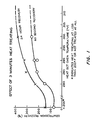
- Figure 1 shows the relationship between compression recovery as measured after both 24 hours and 60 seconds versus oven heat treating temperatures, at a constant residence time of 3 minutes. This figure clearly shows the sharp increase in the fiber resilience, as measured by compression recovery at heat treating temperatures above about 280°F.
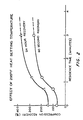
- Figure 2 shows the relationship between compression recovery as measured after 24 hours and after 60 seconds versus residence time, at a constant oven heat treating temperature of 295°F. This figure clearly shows the sharp increase in the fiber resilience, as measured by compression recovery at residence times above about 30 seconds.
- the fibers of this example were extruded from crystalline polypropylene pellets of eight melt index (Marlex® 9374 polypropylene made by Phillips Petroleum Co.) containing heat and U.V. stabilizers and antioxidants and a combination of organic and inorganic pigments to produce colored fibers.
- This resin was melted and brought to 520°F in a conventional extruder, forced under pressure through spinnerettes with 70 round holes, each hole 0.7 mm diameter, cooled with cross-flow quench air at 60°F, 90 feet per minute, and wound onto a tube at 510 meters per minute. Lubricant and antistat were applied during spinning.
- Fiber was withdrawn from an array of these tubes to form a tow which, after drawing at 4.8 draw ratio, was one million denier, and each drawn filament was 18 denier.
- Conventional seven-roll draw stands were used, with rolls of the first and second stands heated to 250°F and the third stand not heated. The stand speeds were 31, 125, and 150 meters per minute. Additional fiber finish was applied after drawing.
- the tow was heated with steam before entering a conventional Fleissner stuffer-box crimper having 5-inch wide water-cooled rolls, where 6 to 8 crimps per inch were imparted.
- the crimped tow was piddled (distributed) onto a moving perforated-metal conveyor belt through which heated air circulated in a Proctor and Schwartz oven.
- the air temperatures and residence times were those indicated in FIGURES 1 and 2.
- the heat treated tow was cut to make staple of about 3.25 inches with a conventional Lummus cutter.
Landscapes
- Engineering & Computer Science (AREA)
- Textile Engineering (AREA)
- Mechanical Engineering (AREA)
- Chemical & Material Sciences (AREA)
- Chemical Kinetics & Catalysis (AREA)
- General Chemical & Material Sciences (AREA)
- Artificial Filaments (AREA)
- Yarns And Mechanical Finishing Of Yarns Or Ropes (AREA)
- Multicomponent Fibers (AREA)
Applications Claiming Priority (2)
| Application Number | Priority Date | Filing Date | Title |
|---|---|---|---|
| US16023288A | 1988-02-25 | 1988-02-25 | |
| US160232 | 1993-11-30 |
Publications (2)
| Publication Number | Publication Date |
|---|---|
| EP0330212A2 true EP0330212A2 (de) | 1989-08-30 |
| EP0330212A3 EP0330212A3 (de) | 1990-09-19 |
Family
ID=22576062
Family Applications (1)
| Application Number | Title | Priority Date | Filing Date |
|---|---|---|---|
| EP19890103218 Withdrawn EP0330212A3 (de) | 1988-02-25 | 1989-02-23 | Polypropylenfaser mit sehr guter Elastizität |
Country Status (12)
| Country | Link |
|---|---|
| EP (1) | EP0330212A3 (de) |
| JP (1) | JPH01298231A (de) |
| KR (1) | KR890013232A (de) |
| CN (1) | CN1036052A (de) |
| AU (1) | AU607311B2 (de) |
| BR (1) | BR8900872A (de) |
| DK (1) | DK89589A (de) |
| FI (1) | FI890896A7 (de) |
| NO (1) | NO890769L (de) |
| PT (1) | PT89787A (de) |
| YU (2) | YU40289A (de) |
| ZA (1) | ZA891115B (de) |
Cited By (8)
| Publication number | Priority date | Publication date | Assignee | Title |
|---|---|---|---|---|
| US5945215A (en) * | 1996-09-16 | 1999-08-31 | Bp Amoco Corporation | Propylene polymer fibers and yarns |
| US6716511B2 (en) | 1996-09-16 | 2004-04-06 | Bp Corporation North America Inc. | Propylene polymer fibers and yarns |
| EP2161361A4 (de) * | 2007-06-22 | 2011-04-27 | Uni Charm Corp | Vliesstoff und sein herstellungsverfahren |
| WO2015192007A1 (en) * | 2014-06-13 | 2015-12-17 | Invista North America S.A.R.L. | Mechanically crimped fiber tow having increased bulk and crimp take-up |
| US10271999B2 (en) | 2014-11-06 | 2019-04-30 | The Procter & Gamble Company | Crimped fiber spunbond nonwoven webs/laminate |
| US10357410B2 (en) | 2014-11-06 | 2019-07-23 | The Procter & Gamble Company | Pre-strained laminates and methods for making the same |
| US11213436B2 (en) | 2017-02-16 | 2022-01-04 | The Procter & Gamble Company | Substrates having repeating patterns of apertures for absorbent articles |
| US12127925B2 (en) | 2018-04-17 | 2024-10-29 | The Procter & Gamble Company | Webs for absorbent articles and methods of making the same |
Family Cites Families (4)
| Publication number | Priority date | Publication date | Assignee | Title |
|---|---|---|---|---|
| US3152380A (en) * | 1961-05-05 | 1964-10-13 | Du Pont | Process for treating polypropylene fibers |
| US3461521A (en) * | 1967-11-24 | 1969-08-19 | American Enka Corp | Process for manufacture of yarns |
| US3587145A (en) * | 1969-06-19 | 1971-06-28 | Bancroft & Sons Co J | Crimping apparatus with heating and cooling cage |
| US4221838A (en) * | 1972-12-29 | 1980-09-09 | Phillips Petroleum Company | Crimped thermoplastic fibers |
-
1989
- 1989-02-13 ZA ZA891115A patent/ZA891115B/xx unknown
- 1989-02-22 PT PT89787A patent/PT89787A/pt unknown
- 1989-02-23 JP JP1044999A patent/JPH01298231A/ja active Pending
- 1989-02-23 NO NO89890769A patent/NO890769L/no unknown
- 1989-02-23 KR KR1019890002307A patent/KR890013232A/ko not_active Withdrawn
- 1989-02-23 YU YU00402/89A patent/YU40289A/xx unknown
- 1989-02-23 EP EP19890103218 patent/EP0330212A3/de not_active Withdrawn
- 1989-02-24 FI FI890896A patent/FI890896A7/fi not_active Application Discontinuation
- 1989-02-24 BR BR898900872A patent/BR8900872A/pt unknown
- 1989-02-24 DK DK089589A patent/DK89589A/da not_active Application Discontinuation
- 1989-02-25 CN CN89101153A patent/CN1036052A/zh active Pending
- 1989-02-27 AU AU30781/89A patent/AU607311B2/en not_active Ceased
-
1990
- 1990-05-07 YU YU88790A patent/YU88790A/sh unknown
Cited By (21)
| Publication number | Priority date | Publication date | Assignee | Title |
|---|---|---|---|---|
| US5945215A (en) * | 1996-09-16 | 1999-08-31 | Bp Amoco Corporation | Propylene polymer fibers and yarns |
| WO2000009787A1 (en) * | 1996-09-16 | 2000-02-24 | Bp Amoco Corporation | Propylene polymer fibers and yarns |
| US6716511B2 (en) | 1996-09-16 | 2004-04-06 | Bp Corporation North America Inc. | Propylene polymer fibers and yarns |
| EP2161361A4 (de) * | 2007-06-22 | 2011-04-27 | Uni Charm Corp | Vliesstoff und sein herstellungsverfahren |
| WO2015192007A1 (en) * | 2014-06-13 | 2015-12-17 | Invista North America S.A.R.L. | Mechanically crimped fiber tow having increased bulk and crimp take-up |
| US11813150B2 (en) | 2014-11-06 | 2023-11-14 | The Procter & Gamble Company | Patterned apertured webs |
| US11491057B2 (en) | 2014-11-06 | 2022-11-08 | The Procter & Gamble Company | Crimped fiber spunbond nonwoven webs / laminates |
| US10646381B2 (en) | 2014-11-06 | 2020-05-12 | The Procter & Gamble Company | Crimped fiber spunbond nonwoven webs / laminates |
| US11135103B2 (en) | 2014-11-06 | 2021-10-05 | The Procter & Gamble Company | Apertured webs and methods for making the same |
| US11202725B2 (en) | 2014-11-06 | 2021-12-21 | The Procter & Gamble Company | Crimped fiber spunbond nonwoven webs / laminates |
| US12226295B2 (en) | 2014-11-06 | 2025-02-18 | The Procter & Gamble Company | Patterned apertured webs |
| US11324645B2 (en) | 2014-11-06 | 2022-05-10 | The Procter & Gamble Company | Garment-facing laminates and methods for making the same |
| US10357410B2 (en) | 2014-11-06 | 2019-07-23 | The Procter & Gamble Company | Pre-strained laminates and methods for making the same |
| US11633311B2 (en) | 2014-11-06 | 2023-04-25 | The Procter & Gamble Company | Patterned apertured webs |
| US11766367B2 (en) | 2014-11-06 | 2023-09-26 | The Procter & Gamble Company | Patterned apertured webs |
| US10271999B2 (en) | 2014-11-06 | 2019-04-30 | The Procter & Gamble Company | Crimped fiber spunbond nonwoven webs/laminate |
| US11998431B2 (en) | 2014-11-06 | 2024-06-04 | The Procter & Gamble Company | Patterned apertured webs |
| US12144711B2 (en) | 2014-11-06 | 2024-11-19 | The Procter & Gamble Company | Patterned apertured webs |
| US12138144B2 (en) | 2014-11-06 | 2024-11-12 | The Procter & Gamble Company | Patterned apertured webs |
| US11213436B2 (en) | 2017-02-16 | 2022-01-04 | The Procter & Gamble Company | Substrates having repeating patterns of apertures for absorbent articles |
| US12127925B2 (en) | 2018-04-17 | 2024-10-29 | The Procter & Gamble Company | Webs for absorbent articles and methods of making the same |
Also Published As
| Publication number | Publication date |
|---|---|
| NO890769L (no) | 1989-08-28 |
| AU3078189A (en) | 1989-08-31 |
| NO890769D0 (no) | 1989-02-23 |
| ZA891115B (en) | 1989-10-25 |
| FI890896A0 (fi) | 1989-02-24 |
| FI890896L (fi) | 1989-08-26 |
| BR8900872A (pt) | 1989-10-17 |
| DK89589D0 (da) | 1989-02-24 |
| AU607311B2 (en) | 1991-02-28 |
| KR890013232A (ko) | 1989-09-22 |
| CN1036052A (zh) | 1989-10-04 |
| YU40289A (en) | 1990-10-31 |
| DK89589A (da) | 1989-08-26 |
| EP0330212A3 (de) | 1990-09-19 |
| FI890896A7 (fi) | 1989-08-26 |
| PT89787A (pt) | 1989-10-04 |
| JPH01298231A (ja) | 1989-12-01 |
| YU88790A (sh) | 1994-01-20 |
Similar Documents
| Publication | Publication Date | Title |
|---|---|---|
| CA1197039A (en) | Copolyester binder filaments and fibers | |
| CA1208899A (en) | Trilobal filaments exhibiting high bulk and sparkle | |
| JP5484383B2 (ja) | ポリ(トリメチレンテレフタレート)ステープルファイバの製造方法、およびポリ(トリメチレンテレフタレート)ステープルファイバ、糸および布 | |
| EP1115923B1 (de) | Propylenpolymerfasern und -garne | |
| US3505164A (en) | Self-bulking conjugate filaments | |
| EP0634505A1 (de) | Verbessertes Propylenpolymer-Garn und daraus hergestellter Artikel | |
| US3118011A (en) | Process for preparing helically crimped composite filaments | |
| US6294252B1 (en) | Precursor fiber bundle for production of a carbon fiber bundle, a process for producing the precursor fiber bundle, a carbon fiber bundle, and a process for producing the carbon fiber bundle | |
| AU607311B2 (en) | Resilient polypropylene fibers and preparation thereof | |
| US3686848A (en) | Highly resilient polypropylene yarn | |
| CA2388867A1 (en) | Poly(trimethylene terephthalate) tetrachannel cross-section staple fiber | |
| EP0350626A2 (de) | Verfahren zur Herstellung von Polybutylenterephthalat-Teppichgarn | |
| CA2208493C (en) | Bicomponent fibers having distinct crystalline and amorphous polymer domains and methods of making the same | |
| US3262257A (en) | Polypropylene bulked yarn | |
| US2296202A (en) | Process of making artificial wool | |
| WO1997013896A1 (en) | Improvements in and relating to hollow fiber identification | |
| US4751760A (en) | Wholly aromatic polyamide fibers and composite fibers, process for production thereof and use thereof | |
| EP0648868B1 (de) | Verfahren zur Herstellung von Garnen für Kunstrasen | |
| DE4320593A1 (de) | Multifilament-Garn aus Polyäthylennaphthalat und Verfahren zu seiner Herstellung | |
| US3788940A (en) | Polyolefin-polyamide composite filaments having an improved adhering property and a method thereof | |
| US3832435A (en) | Process for the manufacture of crimped fibers and filaments of linear high molecular weight polymers | |
| JPS5846572B2 (ja) | 詰綿用巻縮ポリエステル繊維 | |
| EP2177651B1 (de) | Verfahren zur Herstellung von PTT-Fasern mit verbesserter Einkräuselung | |
| US3817823A (en) | Crimpable composite polycarbonamide filament | |
| JPH0126314B2 (de) |
Legal Events
| Date | Code | Title | Description |
|---|---|---|---|
| PUAI | Public reference made under article 153(3) epc to a published international application that has entered the european phase |
Free format text: ORIGINAL CODE: 0009012 |
|
| AK | Designated contracting states |
Kind code of ref document: A2 Designated state(s): AT BE CH DE ES FR GB GR IT LI LU NL SE |
|
| PUAL | Search report despatched |
Free format text: ORIGINAL CODE: 0009013 |
|
| AK | Designated contracting states |
Kind code of ref document: A3 Designated state(s): AT BE CH DE ES FR GB GR IT LI LU NL SE |
|
| 17P | Request for examination filed |
Effective date: 19910220 |
|
| 17Q | First examination report despatched |
Effective date: 19920807 |
|
| STAA | Information on the status of an ep patent application or granted ep patent |
Free format text: STATUS: THE APPLICATION IS DEEMED TO BE WITHDRAWN |
|
| 18D | Application deemed to be withdrawn |
Effective date: 19921218 |