EP0330249A2 - Sonde à l'état solide pour la détermination de la concentration d'hydrogène avec une électrode de référence à l'état solide et procédé pour la fabrication d'une telle sonde - Google Patents
Sonde à l'état solide pour la détermination de la concentration d'hydrogène avec une électrode de référence à l'état solide et procédé pour la fabrication d'une telle sonde Download PDFInfo
- Publication number
- EP0330249A2 EP0330249A2 EP89200215A EP89200215A EP0330249A2 EP 0330249 A2 EP0330249 A2 EP 0330249A2 EP 89200215 A EP89200215 A EP 89200215A EP 89200215 A EP89200215 A EP 89200215A EP 0330249 A2 EP0330249 A2 EP 0330249A2
- Authority
- EP
- European Patent Office
- Prior art keywords
- hydrogen
- solid
- sensor
- zirconium
- state
- Prior art date
- Legal status (The legal status is an assumption and is not a legal conclusion. Google has not performed a legal analysis and makes no representation as to the accuracy of the status listed.)
- Granted
Links
- 239000001257 hydrogen Substances 0.000 title claims abstract description 29
- 229910052739 hydrogen Inorganic materials 0.000 title claims abstract description 29
- UFHFLCQGNIYNRP-UHFFFAOYSA-N Hydrogen Chemical compound [H][H] UFHFLCQGNIYNRP-UHFFFAOYSA-N 0.000 title description 25
- 238000004519 manufacturing process Methods 0.000 title description 2
- 239000004020 conductor Substances 0.000 claims abstract description 16
- 239000007789 gas Substances 0.000 claims abstract description 11
- 125000004435 hydrogen atom Chemical class [H]* 0.000 claims abstract description 7
- 150000004678 hydrides Chemical class 0.000 claims abstract description 5
- 229910001092 metal group alloy Inorganic materials 0.000 claims abstract description 3
- 229910052987 metal hydride Inorganic materials 0.000 claims abstract description 3
- 150000004681 metal hydrides Chemical class 0.000 claims abstract description 3
- 229910000166 zirconium phosphate Inorganic materials 0.000 claims description 42
- LEHFSLREWWMLPU-UHFFFAOYSA-B zirconium(4+);tetraphosphate Chemical compound [Zr+4].[Zr+4].[Zr+4].[O-]P([O-])([O-])=O.[O-]P([O-])([O-])=O.[O-]P([O-])([O-])=O.[O-]P([O-])([O-])=O LEHFSLREWWMLPU-UHFFFAOYSA-B 0.000 claims description 31
- 239000012528 membrane Substances 0.000 claims description 19
- QOKYJGZIKILTCY-UHFFFAOYSA-J hydrogen phosphate;zirconium(4+) Chemical group [Zr+4].OP([O-])([O-])=O.OP([O-])([O-])=O QOKYJGZIKILTCY-UHFFFAOYSA-J 0.000 claims description 11
- -1 titanium hydride Chemical compound 0.000 claims description 11
- 229910000048 titanium hydride Inorganic materials 0.000 claims description 10
- 229910000568 zirconium hydride Inorganic materials 0.000 claims description 10
- QSGNKXDSTRDWKA-UHFFFAOYSA-N zirconium dihydride Chemical compound [ZrH2] QSGNKXDSTRDWKA-UHFFFAOYSA-N 0.000 claims description 9
- 238000001246 colloidal dispersion Methods 0.000 claims description 4
- 239000007787 solid Substances 0.000 abstract description 14
- BASFCYQUMIYNBI-UHFFFAOYSA-N platinum Chemical compound [Pt] BASFCYQUMIYNBI-UHFFFAOYSA-N 0.000 description 20
- 238000000034 method Methods 0.000 description 12
- 239000006185 dispersion Substances 0.000 description 7
- 229910052697 platinum Inorganic materials 0.000 description 7
- XLYOFNOQVPJJNP-UHFFFAOYSA-N water Substances O XLYOFNOQVPJJNP-UHFFFAOYSA-N 0.000 description 7
- 238000011088 calibration curve Methods 0.000 description 6
- 150000002431 hydrogen Chemical class 0.000 description 6
- 239000000203 mixture Substances 0.000 description 6
- 238000002360 preparation method Methods 0.000 description 6
- 238000004544 sputter deposition Methods 0.000 description 6
- KDLHZDBZIXYQEI-UHFFFAOYSA-N Palladium Chemical compound [Pd] KDLHZDBZIXYQEI-UHFFFAOYSA-N 0.000 description 4
- 239000011248 coating agent Substances 0.000 description 4
- 238000000576 coating method Methods 0.000 description 4
- 239000000725 suspension Substances 0.000 description 4
- 239000010936 titanium Substances 0.000 description 4
- 229920000557 Nafion® Polymers 0.000 description 3
- RTAQQCXQSZGOHL-UHFFFAOYSA-N Titanium Chemical compound [Ti] RTAQQCXQSZGOHL-UHFFFAOYSA-N 0.000 description 3
- QCWXUUIWCKQGHC-UHFFFAOYSA-N Zirconium Chemical compound [Zr] QCWXUUIWCKQGHC-UHFFFAOYSA-N 0.000 description 3
- 238000006243 chemical reaction Methods 0.000 description 3
- 238000005259 measurement Methods 0.000 description 3
- WGYKZJWCGVVSQN-UHFFFAOYSA-N propylamine Chemical compound CCCN WGYKZJWCGVVSQN-UHFFFAOYSA-N 0.000 description 3
- 238000003756 stirring Methods 0.000 description 3
- 229910052719 titanium Inorganic materials 0.000 description 3
- 229910052726 zirconium Inorganic materials 0.000 description 3
- XKRFYHLGVUSROY-UHFFFAOYSA-N Argon Chemical compound [Ar] XKRFYHLGVUSROY-UHFFFAOYSA-N 0.000 description 2
- KRHYYFGTRYWZRS-UHFFFAOYSA-N Fluorane Chemical compound F KRHYYFGTRYWZRS-UHFFFAOYSA-N 0.000 description 2
- AQTIRDJOWSATJB-UHFFFAOYSA-K antimonic acid Chemical compound O[Sb](O)(O)=O AQTIRDJOWSATJB-UHFFFAOYSA-K 0.000 description 2
- 238000005260 corrosion Methods 0.000 description 2
- 230000007797 corrosion Effects 0.000 description 2
- 238000000151 deposition Methods 0.000 description 2
- 239000012153 distilled water Substances 0.000 description 2
- 238000001035 drying Methods 0.000 description 2
- 238000001704 evaporation Methods 0.000 description 2
- 230000008020 evaporation Effects 0.000 description 2
- 239000000463 material Substances 0.000 description 2
- 229910052751 metal Inorganic materials 0.000 description 2
- 239000002184 metal Substances 0.000 description 2
- 229910052763 palladium Inorganic materials 0.000 description 2
- DHRLEVQXOMLTIM-UHFFFAOYSA-N phosphoric acid;trioxomolybdenum Chemical compound O=[Mo](=O)=O.O=[Mo](=O)=O.O=[Mo](=O)=O.O=[Mo](=O)=O.O=[Mo](=O)=O.O=[Mo](=O)=O.O=[Mo](=O)=O.O=[Mo](=O)=O.O=[Mo](=O)=O.O=[Mo](=O)=O.O=[Mo](=O)=O.O=[Mo](=O)=O.OP(O)(O)=O DHRLEVQXOMLTIM-UHFFFAOYSA-N 0.000 description 2
- 238000012360 testing method Methods 0.000 description 2
- 235000011178 triphosphate Nutrition 0.000 description 2
- 239000001226 triphosphate Substances 0.000 description 2
- UNXRWKVEANCORM-UHFFFAOYSA-N triphosphoric acid Chemical compound OP(O)(=O)OP(O)(=O)OP(O)(O)=O UNXRWKVEANCORM-UHFFFAOYSA-N 0.000 description 2
- QKRQKXFTLBQFGH-UHFFFAOYSA-L uranyl hydrogenphosphate Chemical compound OP1(=O)O[U](=O)(=O)O1 QKRQKXFTLBQFGH-UHFFFAOYSA-L 0.000 description 2
- 101100283604 Caenorhabditis elegans pigk-1 gene Proteins 0.000 description 1
- UGFAIRIUMAVXCW-UHFFFAOYSA-N Carbon monoxide Chemical compound [O+]#[C-] UGFAIRIUMAVXCW-UHFFFAOYSA-N 0.000 description 1
- 208000005156 Dehydration Diseases 0.000 description 1
- BQCADISMDOOEFD-UHFFFAOYSA-N Silver Chemical compound [Ag] BQCADISMDOOEFD-UHFFFAOYSA-N 0.000 description 1
- 229910000831 Steel Inorganic materials 0.000 description 1
- 239000002253 acid Substances 0.000 description 1
- 229910045601 alloy Inorganic materials 0.000 description 1
- 239000000956 alloy Substances 0.000 description 1
- 229910052786 argon Inorganic materials 0.000 description 1
- 229910002091 carbon monoxide Inorganic materials 0.000 description 1
- 238000005119 centrifugation Methods 0.000 description 1
- 238000004587 chromatography analysis Methods 0.000 description 1
- 230000018044 dehydration Effects 0.000 description 1
- 238000006297 dehydration reaction Methods 0.000 description 1
- 230000008021 deposition Effects 0.000 description 1
- 238000001514 detection method Methods 0.000 description 1
- 238000010828 elution Methods 0.000 description 1
- 239000000839 emulsion Substances 0.000 description 1
- 238000005516 engineering process Methods 0.000 description 1
- 238000004880 explosion Methods 0.000 description 1
- 238000001914 filtration Methods 0.000 description 1
- 239000000446 fuel Substances 0.000 description 1
- 238000010438 heat treatment Methods 0.000 description 1
- ZPCBGJHMSJOYLP-UHFFFAOYSA-J hydrogen phosphate;zirconium(4+);hydrate Chemical compound O.[Zr+4].OP([O-])([O-])=O.OP([O-])([O-])=O ZPCBGJHMSJOYLP-UHFFFAOYSA-J 0.000 description 1
- 230000001771 impaired effect Effects 0.000 description 1
- 229910052500 inorganic mineral Inorganic materials 0.000 description 1
- 229910003480 inorganic solid Inorganic materials 0.000 description 1
- 238000007689 inspection Methods 0.000 description 1
- 238000011835 investigation Methods 0.000 description 1
- 239000003014 ion exchange membrane Substances 0.000 description 1
- 238000012886 linear function Methods 0.000 description 1
- 150000002739 metals Chemical class 0.000 description 1
- 239000011707 mineral Substances 0.000 description 1
- 238000012544 monitoring process Methods 0.000 description 1
- 229920000620 organic polymer Polymers 0.000 description 1
- 239000002245 particle Substances 0.000 description 1
- 239000004033 plastic Substances 0.000 description 1
- 238000000717 platinum sputter deposition Methods 0.000 description 1
- 238000001556 precipitation Methods 0.000 description 1
- PYNUOAIJIQGACY-UHFFFAOYSA-N propylazanium;chloride Chemical compound Cl.CCCN PYNUOAIJIQGACY-UHFFFAOYSA-N 0.000 description 1
- 239000012925 reference material Substances 0.000 description 1
- 229920006395 saturated elastomer Polymers 0.000 description 1
- 229910001415 sodium ion Inorganic materials 0.000 description 1
- 229910001251 solid state electrolyte alloy Inorganic materials 0.000 description 1
- 239000010959 steel Substances 0.000 description 1
- 239000000126 substance Substances 0.000 description 1
Images



Classifications
-
- G—PHYSICS
- G01—MEASURING; TESTING
- G01N—INVESTIGATING OR ANALYSING MATERIALS BY DETERMINING THEIR CHEMICAL OR PHYSICAL PROPERTIES
- G01N27/00—Investigating or analysing materials by the use of electric, electrochemical, or magnetic means
- G01N27/26—Investigating or analysing materials by the use of electric, electrochemical, or magnetic means by investigating electrochemical variables; by using electrolysis or electrophoresis
- G01N27/403—Cells and electrode assemblies
- G01N27/406—Cells and probes with solid electrolytes
- G01N27/411—Cells and probes with solid electrolytes for investigating or analysing of liquid metals
- G01N27/4112—Composition or fabrication of the solid electrolyte
- G01N27/4114—Composition or fabrication of the solid electrolyte for detection of gases other than oxygen
-
- G—PHYSICS
- G01—MEASURING; TESTING
- G01N—INVESTIGATING OR ANALYSING MATERIALS BY DETERMINING THEIR CHEMICAL OR PHYSICAL PROPERTIES
- G01N27/00—Investigating or analysing materials by the use of electric, electrochemical, or magnetic means
- G01N27/26—Investigating or analysing materials by the use of electric, electrochemical, or magnetic means by investigating electrochemical variables; by using electrolysis or electrophoresis
- G01N27/403—Cells and electrode assemblies
- G01N27/406—Cells and probes with solid electrolytes
- G01N27/407—Cells and probes with solid electrolytes for investigating or analysing gases
- G01N27/4073—Composition or fabrication of the solid electrolyte
- G01N27/4074—Composition or fabrication of the solid electrolyte for detection of gases other than oxygen
Definitions
- the present invention relates to a sensor in completely solid state for determining the concentration of a gas, in particular of hydrogen.
- Some examples relevant to the detection of hydrogen are: - In case hydrogen leaks occur in closed rooms, such leaks should be quickly detected, in order to prevent any explosion risks. - Many metals and their alloys (for example, steels, titanium, zirconium, and so forth) react with hydrogen to yield hydrides, with their mechanical characteristics being consequently impaired. - In many corrosion phenomena, hydrogen is generated: therefore, the presence of hydrogen can be indicative of the fact that a corrosion process is taking place (this is useful in particular in order to check parts which are not easily accessible in case of a direct inspection). - The continuous monitoring of hydrogen in reactions producing or consuming such a gas can be useful in order to control the same reactions for the best.
- n 2 (in that the process is: H2 ⁇ 2H+ + 2e).
- the unknown P H2 pressure can be obtained from a potentiometric measurement of E.
- protonic conductors are therefore endowed with applicative potentialities in hydrogen sensors.
- organic polymers such as Nafion in hydrogen form, can be used as protonic conductors, such as described by J. Jensen in "Solid State Protonic Conductors for Fuel Cells and Sensors" (page 1, Editors: Godehough J.B. Jensen, Poitier A., Odense University Press, 1985).
- a reference in the solid state reported in the relevant technical literature is constituted by a silver foil.
- the present Applicant has found that, in the presence of high hydrogen partial pressures, a total reduction of Ag+ in the protonic conductor may take place.
- the present Applicant has found that such a drawback can be prevented from occurring by using, contrarily to as reported in the technical literature by Lyon S.B. and Fray J.D. (Solid-State Ionics, 9-10, 1295/1983), electrodes which consist of hydrides of a metal or of hydrides of a metal alloy placed into contact with the protonic conductor, such as, e.g., interstitial titanium hydride (TiH x ) or interstitial zirconium hydride (ZrH x ):
- the solid-state sensor for determining the concentration of a gas, in particular of hydrogen which is the object of the present invention, is essentially constituted by electrodes separated by a solid-state protonic conductor, wherein the solid-state reference electode is constituted by a metal hydride selected from the group consisting of titanium and zirconium hydrides.
- Those gases can be determined, which are capable of altering the electrochemical potential of protons at the interface between the protonic conductor and the monitored gas.
- protonic conductor those known from the technical literature, such as, e.g., uranyl hydrogen phosphate, antimonic acid, phosphomolybdic acid, zirconium hydrogen phosphate and dizirconium triphosphate in hydrogen form, can be used.
- Zirconium phosphate can preferably be in film form, or in a membrane form.
- a small amount of the aqueous dispersion of colloidal zirconium phosphate can be directly stratified on the reference electrode. After the evaporation of water, the electrode is thus coated by an adhering, thin and compact film of zirconium phosphate.
- the sensor can be subsequently finished by depositing on said film, by sputtering, a thin platinum layer. By such a route, a total sensor thickness lower than 1 mm can be obtained.
- a suitable technology such a method is particularly well suited for accomplishing microsensors for hydrogen gas in completely solid state.
- catalysing electrodes those known from the technical literature can be used; among them, platinum and palladium may be cited for exemplifying purposes.
- the preparation of the titanium hydride or zirconium hydride reference electrode can be carried out, e.g., by heating a thin sheet of titanium or zirconium (of from 0.25 mm to 1 mm of thickness) at a temperature comprised within the range of from 400 to 700°C, for a time comprised within the range of from 2 to 10 hours, in the presence of hydrogen gas.
- Zirconium hydrogen phosphate monohydrate having a layer structure of type, -Zr(HPO4)2.H2O (preferably prepared by means of the method of precipitation in the presence of hydrofluoric acid, as described by Alberti G. and Torraca E. in J. Inorg. NUCl. Chem., 30, 317 (1969), was intercalated up to 50% of its total capacity with propyl-amine. With strong stirring, in such a way a colloidal dispersion of lamellar particles of zirconium phosphate in propylammonium form can be obtained.
- Dispersions containing 1 gram of zirconium phosphate in 200 ml of water do not appreciably settle, and therefore can be easily maintained at room temperature for long time periods (even for some months) after being prepared.
- a mineral acid should be added (generally 0.1M HCl, in an amount of 25 ml per each 100 ml of dispersion).
- zirconium phosphate still remains in the dispersed state.
- such dispersions tend to settle, even if slowly, and can be easily separated from the solution (e.g., by means of centrifugation at 2,000 revolutions per minute).
- Zirconium phosphate is then dispersed again in distilled water, and the treatment with HCl is repeated, until propyl-ammonium chloride is completely removed.
- a suspension of colloidal zirconium phosphate in hydrogen form is evenly sprayed (e.g., by means of a sprayer device for use in chromatography) onto a sheet of titanium hydride or zirconium hydride. After drying in air, the sheet results to be coated with an adhering and compact film of zirconium phosphate.
- a slab of the material to be coated is placed on the bottom of a Petri dish having a diameter slightly larger than said slab. Above the slab a layer of a few millimiters of colloidal suspension of zirconium phosphate is deposited. After water evaporation, the slab remains coated with an adhering film of zirconium phosphate.
- a drop of suspension is deposited and is allowed to dry. This treatment can be repeated a plurality of times, until a film having the desired thickness is obtained.
- the dispersion of zirconium phosphate in distilled water is slowly filtered through a flat filter of a porous plastic material, in its turn placed above a paper filter. After the end of the filtration the filter, bearing the zirconium phosphate stratified on it, is dried. After such a drying, from the filter the deposited zirconium phosphate can be easily separated as a compact membrane, endowed with a certain flexibility; the thickness of said membrane is a function of the amount of suspension used, of the concentration of suspended solids in it, and of the surface area of the filter.
- a good method used by the present Applicant in order to obtain an active enough platinum surface consists in carrying out a Pt sputtering directly on the film layer, or on the membrane of zirconium hydrogen phosphate.
- the conditions most frequently used by the present Applicant are: electrical current intensity 15 mA; argon pressure 0.05-0.1 mbar; sputtering time 10-20 minutes.
- Another method used by the present Applicant consists in adding platinum black to a colloidal dispersion of zirconium phosphate (10-20 parts of platinum black per each part of zirconium phosphate). Platinum black is emulsified by stirring. A few droplets of such an emulsion is deposited on the membrane of zirconium phosphate, and is allowed to dry.
- the sensors according to the present invention can be schematized as shown in Figure 1.
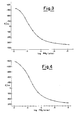
- N2/H2 mixtures of known composition By using N2/H2 mixtures of known composition, a calibration curve was obtained. Such a curve, at room temperature, is reported in Figure 2.
- Example 3 The sensor of Example 1 was used in order to generate the calibration curve of hydrogen in air. Such a curve, at room temperature, is reported in Figure 3.
- the relevant calibration curve is shown in Figure 4.
- a sensor according to Example 4 was used in order to determine hydrogen, in the presence of air, at 100°C.
- the relevant calibration curve is shown in Figure 6.
- a sensor according to Example 1 was used in order to determine hydrogen, in the presence of air, at 200°C.
- the relevant calibration curve is shown in Figure 7.
- a sensor according to Example 1 was used in order to investigate into the interference by carbon monoxide in air at room temperature. It was found that high CO partial pressures, equal to 10 ⁇ 3 atm, give a slight interference corresponding to a H2 pressure lower than 5.10 ⁇ 6 atm.
- a reference electrode constituted by TiH x (prepared at 650°C under a hydrogen stream for from 3 to 4 hours, and then quickly cooled) was placed into contact with a polymeric organic ion-exchange membrane IONAC MC 3235 (of 0.25 mm of thickness), which was previously converted into the H+ form by means of elution of the Na+ ion with HCl.
- the free face of said membrane was coated, by means of a sputtering carried out under the same conditions as of the preceding examples, with a thin platinum layer.
- the speed of response of such a sensor is of the order of 10 seconds.
- a sensor at all similar to the sensor disclosed in the preceding example was prepared by using a commercial NAFION membrane, as the protonic conductor, in H+ form (thickness 0.1 mm). Very good results, at all similar to those as already reported for the polymeric membrane of the preceding example, were obtained.
- the gas mixtures under investigation were saturated with water (relative humidity ⁇ 90%) before being fed to the sensor.
Landscapes
- Chemical & Material Sciences (AREA)
- Life Sciences & Earth Sciences (AREA)
- Health & Medical Sciences (AREA)
- Biochemistry (AREA)
- Chemical Kinetics & Catalysis (AREA)
- Electrochemistry (AREA)
- Physics & Mathematics (AREA)
- Analytical Chemistry (AREA)
- Molecular Biology (AREA)
- General Health & Medical Sciences (AREA)
- General Physics & Mathematics (AREA)
- Immunology (AREA)
- Pathology (AREA)
- Investigating Or Analyzing Materials By The Use Of Fluid Adsorption Or Reactions (AREA)
- Measuring Oxygen Concentration In Cells (AREA)
- Investigating Or Analyzing Materials By The Use Of Electric Means (AREA)
Applications Claiming Priority (2)
| Application Number | Priority Date | Filing Date | Title |
|---|---|---|---|
| IT1947788 | 1988-02-22 | ||
| IT8819477A IT1215930B (it) | 1988-02-22 | 1988-02-22 | Sensore a stato solido per determinare la concentrazione di gas con un elettrodo di riferimento solido. |
Publications (3)
| Publication Number | Publication Date |
|---|---|
| EP0330249A2 true EP0330249A2 (fr) | 1989-08-30 |
| EP0330249A3 EP0330249A3 (en) | 1990-12-05 |
| EP0330249B1 EP0330249B1 (fr) | 1994-11-09 |
Family
ID=11158351
Family Applications (1)
| Application Number | Title | Priority Date | Filing Date |
|---|---|---|---|
| EP89200215A Expired - Lifetime EP0330249B1 (fr) | 1988-02-22 | 1989-02-01 | Sonde à l'état solide pour la détermination de la concentration d'hydrogène avec une électrode de référence à l'état solide et procédé pour la fabrication d'une telle sonde |
Country Status (6)
| Country | Link |
|---|---|
| US (1) | US5453172A (fr) |
| EP (1) | EP0330249B1 (fr) |
| AT (1) | ATE114045T1 (fr) |
| DE (1) | DE68919243T2 (fr) |
| ES (1) | ES2063112T3 (fr) |
| IT (1) | IT1215930B (fr) |
Cited By (2)
| Publication number | Priority date | Publication date | Assignee | Title |
|---|---|---|---|---|
| WO2004025289A1 (fr) * | 2002-09-14 | 2004-03-25 | Cambridge University Technical Services Limited | Appareil et procede de detection d'hydrogene |
| EP1260814A3 (fr) * | 2001-05-15 | 2004-07-14 | NGK Spark Plug Company Limited | Capteur de gaz et méthode de mesure de la concentration d'un gaz |
Families Citing this family (10)
| Publication number | Priority date | Publication date | Assignee | Title |
|---|---|---|---|---|
| US6073478A (en) * | 1998-02-02 | 2000-06-13 | Her Majesty The Queen In Right Of Canada, As Represented By The Minister Of Natural Resources | Hydrogen sensor using a solid hydrogen ion conducting electrolyte |
| US6103080A (en) * | 1998-02-11 | 2000-08-15 | The Regents Of The University Of California | Hydrocarbon sensors and materials therefor |
| US6176989B1 (en) | 1998-12-28 | 2001-01-23 | Teledyne Technologies Incorp. | Electrochemical gas sensor |
| JP3953677B2 (ja) * | 1999-03-12 | 2007-08-08 | 日本特殊陶業株式会社 | ガスセンサ |
| US6638416B2 (en) * | 2001-09-24 | 2003-10-28 | Delphi Technologies, Inc. | Hydrogen sensing process |
| ITPG20020013A1 (it) * | 2002-03-13 | 2003-09-15 | Fuma Tech | Membrane a conduzione protonica contenenti fosfato di zirconio o fosfati solfoarilenfosfonati di zirconio dispersi in una matrice polimerica |
| US7664607B2 (en) | 2005-10-04 | 2010-02-16 | Teledyne Technologies Incorporated | Pre-calibrated gas sensor |
| TWI410625B (zh) * | 2008-12-31 | 2013-10-01 | Ind Tech Res Inst | 氣體感測材料及包含其之氣體感測器 |
| JPWO2011145150A1 (ja) * | 2010-05-21 | 2013-07-22 | 国立大学法人 新潟大学 | 水素ガスセンサー |
| KR101256599B1 (ko) | 2011-03-14 | 2013-04-19 | 한국표준과학연구원 | 수소화물을 이용한 수소 정량용 기준물질, 그 기준물질의 제조방법 및 그 기준물질을 이용한 수소 정량 분석방법 |
Family Cites Families (14)
| Publication number | Priority date | Publication date | Assignee | Title |
|---|---|---|---|---|
| US3218242A (en) * | 1962-01-04 | 1965-11-16 | Union Carbide Corp | Measurement of the concentration of dissolved oxygen in liquids |
| US3565769A (en) * | 1967-10-17 | 1971-02-23 | United Nuclear Corp | Method and apparatus for determination of hydrogen content in a high temperature fluid |
| US3727058A (en) * | 1971-02-16 | 1973-04-10 | Hughes Aircraft Co | Hydrogen ion device |
| GB1481509A (en) * | 1973-07-18 | 1977-08-03 | Nat Res Dev | Ion selective electrodes and in methods of measuring the concentrations of ions |
| US4179491A (en) * | 1976-11-15 | 1979-12-18 | National Research Development Corporation | Electrical device with separator as conductor for hydrogen cations |
| GB1594223A (en) * | 1977-01-21 | 1981-07-30 | Nat Res Dev | Determination of hydrogen |
| DE3127820A1 (de) * | 1981-07-14 | 1983-02-03 | Max-Planck-Gesellschaft zur Förderung der Wissenschaften e.V., 3400 Göttingen | Galvanisches element |
| JPS5850458A (ja) * | 1981-09-22 | 1983-03-24 | Toyo Soda Mfg Co Ltd | ガルバニ−電池式湿度センサ− |
| GB2128751B (en) * | 1982-10-15 | 1986-01-29 | Nat Res Dev | Hydrogen concentration meter |
| US4689122A (en) * | 1983-12-29 | 1987-08-25 | Uop Inc. | Gas detection apparatus and method with novel electrolyte membrane |
| US4661211A (en) * | 1985-07-10 | 1987-04-28 | Uop Inc. | Gas detection with three-component membrane and sensor using said membrane |
| US4664757A (en) * | 1985-12-27 | 1987-05-12 | Uop Inc. | Method and apparatus for gas detection using proton-conducting polymers |
| JPS62172257A (ja) * | 1986-01-27 | 1987-07-29 | Figaro Eng Inc | プロトン導電体ガスセンサ |
| IT1237882B (it) * | 1989-12-12 | 1993-06-18 | Eniricerche Spa | Sensore a stato solido per determinare la concentrazione di gas che possono reagire con idrogeno |
-
1988
- 1988-02-22 IT IT8819477A patent/IT1215930B/it active
-
1989
- 1989-02-01 DE DE68919243T patent/DE68919243T2/de not_active Expired - Fee Related
- 1989-02-01 EP EP89200215A patent/EP0330249B1/fr not_active Expired - Lifetime
- 1989-02-01 ES ES89200215T patent/ES2063112T3/es not_active Expired - Lifetime
- 1989-02-01 AT AT89200215T patent/ATE114045T1/de not_active IP Right Cessation
-
1992
- 1992-05-05 US US07/879,122 patent/US5453172A/en not_active Expired - Fee Related
Cited By (4)
| Publication number | Priority date | Publication date | Assignee | Title |
|---|---|---|---|---|
| EP1260814A3 (fr) * | 2001-05-15 | 2004-07-14 | NGK Spark Plug Company Limited | Capteur de gaz et méthode de mesure de la concentration d'un gaz |
| US7306712B2 (en) | 2001-05-15 | 2007-12-11 | Ngk Spark Plug Co., Ltd. | Gas sensor and method for measuring gas concentration using the same |
| WO2004025289A1 (fr) * | 2002-09-14 | 2004-03-25 | Cambridge University Technical Services Limited | Appareil et procede de detection d'hydrogene |
| US9028671B2 (en) | 2002-09-14 | 2015-05-12 | Cambridge Enterprise Limited | Hydrogen sensing apparatus and method |
Also Published As
| Publication number | Publication date |
|---|---|
| ATE114045T1 (de) | 1994-11-15 |
| DE68919243T2 (de) | 1995-04-20 |
| US5453172A (en) | 1995-09-26 |
| EP0330249B1 (fr) | 1994-11-09 |
| EP0330249A3 (en) | 1990-12-05 |
| IT1215930B (it) | 1990-02-22 |
| ES2063112T3 (es) | 1995-01-01 |
| DE68919243D1 (de) | 1994-12-15 |
| IT8819477A0 (it) | 1988-02-22 |
Similar Documents
| Publication | Publication Date | Title |
|---|---|---|
| EP0330249B1 (fr) | Sonde à l'état solide pour la détermination de la concentration d'hydrogène avec une électrode de référence à l'état solide et procédé pour la fabrication d'une telle sonde | |
| Batchelor-McAuley et al. | The electroanalytical detection of hydrazine: a comparison of the use of palladium nanoparticles supported on boron-doped diamond and palladium plated BDD microdisc array | |
| US4900405A (en) | Surface type microelectronic gas and vapor sensor | |
| Wang et al. | Cellulose acetate coated mercury film electrodes for anodic stripping voltammetry | |
| US4265714A (en) | Gas sensing and measuring device and process using catalytic graphite sensing electrode | |
| Miura et al. | Solid-state oxygen sensor using sputtered LaF3 film | |
| Grubb et al. | Palladium-palladium oxide pH electrodes | |
| US5344546A (en) | Electrical measuring cell for determinging ammonia, amines, hydrazine amines, hydrazine and hydrazine derivatives | |
| US5344548A (en) | Solid state sensor device for the determination of the concentration of gases which can react with hydrogen | |
| Xia | New insights into the influence of upd Sn on the oxidation of formic acid on platinum in acidic solution | |
| EP0432840A2 (fr) | Détecteur à l'état solide pour la détermination de la concentration de gaz pouvant réagir avec l'hydrogène | |
| US5250171A (en) | Sensor for carbon monoxide | |
| Isoaho et al. | Pt-grown carbon nanofibers for detection of hydrogen peroxide | |
| EP0330248A2 (fr) | Sonde à l'état solide pour la détermination de la concentration d'un gaz | |
| Łukaszewski et al. | The method of limited volume electrodes as a tool for hydrogen electrosorption studies in palladium and its alloys | |
| Filimonenkov et al. | Three kinds of Pt electrocatalysts for the non-enzymatic glucose sensing in a neutral medium | |
| Villiard et al. | Comprehensive studies of formation and reduction of surface oxides at rhodium electrodes at 298 K | |
| Alberti et al. | Potentiometric and amperometric gas sensors based on the protonic conduction of layered zirconium phosphates and phosphonates | |
| Nikolelis et al. | Hemoglobin modified bilayer lipid membranes (BLMs) biosensor for carbon dioxide detection | |
| Miura et al. | Solid electrolyte oxygen sensor using LaF3 sputtered film workable at room temperature | |
| Guessous et al. | Thin films of chalcogenide glass as sensitive membranes for the detection of mercuric ions in solution | |
| Grincienė et al. | Peculiarities of electrochemical bismuth film formation in the presence of bromide and heavy metal ions | |
| Christensen et al. | Comparative Study of Conventional and Cellulose Acetate‐Coated Mercury Film Electrodes for Speciation of Lead in the Presence of Humic Acid | |
| Danilov et al. | Effect of adsorption of anions on the kinetics of the copper adatom layer formation at polycrystalline platinum | |
| Palanker et al. | Catalytic activity and capacitance of tungsten carbide as a function of its dispersity and surface state |
Legal Events
| Date | Code | Title | Description |
|---|---|---|---|
| PUAI | Public reference made under article 153(3) epc to a published international application that has entered the european phase |
Free format text: ORIGINAL CODE: 0009012 |
|
| AK | Designated contracting states |
Kind code of ref document: A2 Designated state(s): AT BE CH DE ES FR GB GR IT LI LU NL SE |
|
| PUAL | Search report despatched |
Free format text: ORIGINAL CODE: 0009013 |
|
| AK | Designated contracting states |
Kind code of ref document: A3 Designated state(s): AT BE CH DE ES FR GB GR IT LI LU NL SE |
|
| RHK1 | Main classification (correction) |
Ipc: G01N 27/406 |
|
| 17P | Request for examination filed |
Effective date: 19901224 |
|
| 17Q | First examination report despatched |
Effective date: 19921217 |
|
| GRAA | (expected) grant |
Free format text: ORIGINAL CODE: 0009210 |
|
| AK | Designated contracting states |
Kind code of ref document: B1 Designated state(s): AT BE CH DE ES FR GB GR IT LI LU NL SE |
|
| REF | Corresponds to: |
Ref document number: 114045 Country of ref document: AT Date of ref document: 19941115 Kind code of ref document: T |
|
| ET | Fr: translation filed | ||
| REF | Corresponds to: |
Ref document number: 68919243 Country of ref document: DE Date of ref document: 19941215 |
|
| REG | Reference to a national code |
Ref country code: ES Ref legal event code: FG2A Ref document number: 2063112 Country of ref document: ES Kind code of ref document: T3 |
|
| ITF | It: translation for a ep patent filed | ||
| EAL | Se: european patent in force in sweden |
Ref document number: 89200215.5 |
|
| REG | Reference to a national code |
Ref country code: GR Ref legal event code: FG4A Free format text: 3014093 |
|
| PLBE | No opposition filed within time limit |
Free format text: ORIGINAL CODE: 0009261 |
|
| STAA | Information on the status of an ep patent application or granted ep patent |
Free format text: STATUS: NO OPPOSITION FILED WITHIN TIME LIMIT |
|
| 26N | No opposition filed | ||
| PGFP | Annual fee paid to national office [announced via postgrant information from national office to epo] |
Ref country code: DE Payment date: 20010122 Year of fee payment: 13 |
|
| PGFP | Annual fee paid to national office [announced via postgrant information from national office to epo] |
Ref country code: GB Payment date: 20010131 Year of fee payment: 13 Ref country code: ES Payment date: 20010131 Year of fee payment: 13 |
|
| PGFP | Annual fee paid to national office [announced via postgrant information from national office to epo] |
Ref country code: SE Payment date: 20010206 Year of fee payment: 13 |
|
| PGFP | Annual fee paid to national office [announced via postgrant information from national office to epo] |
Ref country code: LU Payment date: 20010213 Year of fee payment: 13 Ref country code: FR Payment date: 20010213 Year of fee payment: 13 Ref country code: AT Payment date: 20010213 Year of fee payment: 13 |
|
| PGFP | Annual fee paid to national office [announced via postgrant information from national office to epo] |
Ref country code: CH Payment date: 20010219 Year of fee payment: 13 |
|
| PGFP | Annual fee paid to national office [announced via postgrant information from national office to epo] |
Ref country code: NL Payment date: 20010228 Year of fee payment: 13 Ref country code: GR Payment date: 20010228 Year of fee payment: 13 |
|
| PGFP | Annual fee paid to national office [announced via postgrant information from national office to epo] |
Ref country code: BE Payment date: 20010313 Year of fee payment: 13 |
|
| REG | Reference to a national code |
Ref country code: GB Ref legal event code: IF02 |
|
| PG25 | Lapsed in a contracting state [announced via postgrant information from national office to epo] |
Ref country code: LU Free format text: LAPSE BECAUSE OF NON-PAYMENT OF DUE FEES Effective date: 20020201 Ref country code: GB Free format text: LAPSE BECAUSE OF NON-PAYMENT OF DUE FEES Effective date: 20020201 Ref country code: AT Free format text: LAPSE BECAUSE OF NON-PAYMENT OF DUE FEES Effective date: 20020201 |
|
| PG25 | Lapsed in a contracting state [announced via postgrant information from national office to epo] |
Ref country code: SE Free format text: LAPSE BECAUSE OF NON-PAYMENT OF DUE FEES Effective date: 20020202 Ref country code: ES Free format text: LAPSE BECAUSE OF NON-PAYMENT OF DUE FEES Effective date: 20020202 |
|
| PG25 | Lapsed in a contracting state [announced via postgrant information from national office to epo] |
Ref country code: LI Free format text: LAPSE BECAUSE OF NON-PAYMENT OF DUE FEES Effective date: 20020228 Ref country code: CH Free format text: LAPSE BECAUSE OF NON-PAYMENT OF DUE FEES Effective date: 20020228 Ref country code: BE Free format text: LAPSE BECAUSE OF NON-PAYMENT OF DUE FEES Effective date: 20020228 |
|
| BERE | Be: lapsed |
Owner name: ENIRICERCHE S.P.A. Effective date: 20020228 |
|
| PG25 | Lapsed in a contracting state [announced via postgrant information from national office to epo] |
Ref country code: NL Free format text: LAPSE BECAUSE OF NON-PAYMENT OF DUE FEES Effective date: 20020901 |
|
| PG25 | Lapsed in a contracting state [announced via postgrant information from national office to epo] |
Ref country code: DE Free format text: LAPSE BECAUSE OF NON-PAYMENT OF DUE FEES Effective date: 20020903 |
|
| PG25 | Lapsed in a contracting state [announced via postgrant information from national office to epo] |
Ref country code: GR Free format text: LAPSE BECAUSE OF NON-PAYMENT OF DUE FEES Effective date: 20020909 |
|
| GBPC | Gb: european patent ceased through non-payment of renewal fee |
Effective date: 20020201 |
|
| EUG | Se: european patent has lapsed |
Ref document number: 89200215.5 |
|
| REG | Reference to a national code |
Ref country code: CH Ref legal event code: PL |
|
| PG25 | Lapsed in a contracting state [announced via postgrant information from national office to epo] |
Ref country code: FR Free format text: LAPSE BECAUSE OF NON-PAYMENT OF DUE FEES Effective date: 20021031 |
|
| NLV4 | Nl: lapsed or anulled due to non-payment of the annual fee |
Effective date: 20020901 |
|
| REG | Reference to a national code |
Ref country code: FR Ref legal event code: ST |
|
| REG | Reference to a national code |
Ref country code: ES Ref legal event code: FD2A Effective date: 20030312 |
|
| PG25 | Lapsed in a contracting state [announced via postgrant information from national office to epo] |
Ref country code: IT Free format text: LAPSE BECAUSE OF NON-PAYMENT OF DUE FEES;WARNING: LAPSES OF ITALIAN PATENTS WITH EFFECTIVE DATE BEFORE 2007 MAY HAVE OCCURRED AT ANY TIME BEFORE 2007. THE CORRECT EFFECTIVE DATE MAY BE DIFFERENT FROM THE ONE RECORDED. Effective date: 20050201 |