EP0330980A2 - Herstellung von vorimprägniertem Fasermaterial zum Formen eines Gegenstandes aus lückenlosem Verbundwerkstoff - Google Patents
Herstellung von vorimprägniertem Fasermaterial zum Formen eines Gegenstandes aus lückenlosem Verbundwerkstoff Download PDFInfo
- Publication number
- EP0330980A2 EP0330980A2 EP89103047A EP89103047A EP0330980A2 EP 0330980 A2 EP0330980 A2 EP 0330980A2 EP 89103047 A EP89103047 A EP 89103047A EP 89103047 A EP89103047 A EP 89103047A EP 0330980 A2 EP0330980 A2 EP 0330980A2
- Authority
- EP
- European Patent Office
- Prior art keywords
- thermosetting resin
- fibrous material
- accordance
- bath
- resins
- Prior art date
- Legal status (The legal status is an assumption and is not a legal conclusion. Google has not performed a legal analysis and makes no representation as to the accuracy of the status listed.)
- Withdrawn
Links
Images

Classifications
-
- B—PERFORMING OPERATIONS; TRANSPORTING
- B29—WORKING OF PLASTICS; WORKING OF SUBSTANCES IN A PLASTIC STATE IN GENERAL
- B29C—SHAPING OR JOINING OF PLASTICS; SHAPING OF MATERIAL IN A PLASTIC STATE, NOT OTHERWISE PROVIDED FOR; AFTER-TREATMENT OF THE SHAPED PRODUCTS, e.g. REPAIRING
- B29C70/00—Shaping composites, i.e. plastics material comprising reinforcements, fillers or preformed parts, e.g. inserts
- B29C70/04—Shaping composites, i.e. plastics material comprising reinforcements, fillers or preformed parts, e.g. inserts comprising reinforcements only, e.g. self-reinforcing plastics
- B29C70/28—Shaping operations therefor
- B29C70/54—Component parts, details or accessories; Auxiliary operations, e.g. feeding or storage of prepregs or SMC after impregnation or during ageing
-
- B—PERFORMING OPERATIONS; TRANSPORTING
- B29—WORKING OF PLASTICS; WORKING OF SUBSTANCES IN A PLASTIC STATE IN GENERAL
- B29B—PREPARATION OR PRETREATMENT OF THE MATERIAL TO BE SHAPED; MAKING GRANULES OR PREFORMS; RECOVERY OF PLASTICS OR OTHER CONSTITUENTS OF WASTE MATERIAL CONTAINING PLASTICS
- B29B15/00—Pretreatment of the material to be shaped, not covered by groups B29B7/00 - B29B13/00
- B29B15/08—Pretreatment of the material to be shaped, not covered by groups B29B7/00 - B29B13/00 of reinforcements or fillers
- B29B15/10—Coating or impregnating independently of the moulding or shaping step
- B29B15/12—Coating or impregnating independently of the moulding or shaping step of reinforcements of indefinite length
-
- C—CHEMISTRY; METALLURGY
- C08—ORGANIC MACROMOLECULAR COMPOUNDS; THEIR PREPARATION OR CHEMICAL WORKING-UP; COMPOSITIONS BASED THEREON
- C08J—WORKING-UP; GENERAL PROCESSES OF COMPOUNDING; AFTER-TREATMENT NOT COVERED BY SUBCLASSES C08B, C08C, C08F, C08G or C08H
- C08J5/00—Manufacture of articles or shaped materials containing macromolecular substances
- C08J5/04—Reinforcing macromolecular compounds with loose or coherent fibrous material
- C08J5/0405—Reinforcing macromolecular compounds with loose or coherent fibrous material with inorganic fibres
- C08J5/042—Reinforcing macromolecular compounds with loose or coherent fibrous material with inorganic fibres with carbon fibres
-
- C—CHEMISTRY; METALLURGY
- C08—ORGANIC MACROMOLECULAR COMPOUNDS; THEIR PREPARATION OR CHEMICAL WORKING-UP; COMPOSITIONS BASED THEREON
- C08J—WORKING-UP; GENERAL PROCESSES OF COMPOUNDING; AFTER-TREATMENT NOT COVERED BY SUBCLASSES C08B, C08C, C08F, C08G or C08H
- C08J5/00—Manufacture of articles or shaped materials containing macromolecular substances
- C08J5/04—Reinforcing macromolecular compounds with loose or coherent fibrous material
- C08J5/0405—Reinforcing macromolecular compounds with loose or coherent fibrous material with inorganic fibres
- C08J5/043—Reinforcing macromolecular compounds with loose or coherent fibrous material with inorganic fibres with glass fibres
-
- C—CHEMISTRY; METALLURGY
- C08—ORGANIC MACROMOLECULAR COMPOUNDS; THEIR PREPARATION OR CHEMICAL WORKING-UP; COMPOSITIONS BASED THEREON
- C08J—WORKING-UP; GENERAL PROCESSES OF COMPOUNDING; AFTER-TREATMENT NOT COVERED BY SUBCLASSES C08B, C08C, C08F, C08G or C08H
- C08J5/00—Manufacture of articles or shaped materials containing macromolecular substances
- C08J5/24—Impregnating materials with prepolymers which can be polymerised in situ, e.g. manufacture of prepregs
- C08J5/241—Impregnating materials with prepolymers which can be polymerised in situ, e.g. manufacture of prepregs using inorganic fibres
- C08J5/243—Impregnating materials with prepolymers which can be polymerised in situ, e.g. manufacture of prepregs using inorganic fibres using carbon fibres
-
- C—CHEMISTRY; METALLURGY
- C08—ORGANIC MACROMOLECULAR COMPOUNDS; THEIR PREPARATION OR CHEMICAL WORKING-UP; COMPOSITIONS BASED THEREON
- C08J—WORKING-UP; GENERAL PROCESSES OF COMPOUNDING; AFTER-TREATMENT NOT COVERED BY SUBCLASSES C08B, C08C, C08F, C08G or C08H
- C08J5/00—Manufacture of articles or shaped materials containing macromolecular substances
- C08J5/24—Impregnating materials with prepolymers which can be polymerised in situ, e.g. manufacture of prepregs
- C08J5/249—Impregnating materials with prepolymers which can be polymerised in situ, e.g. manufacture of prepregs characterised by the additives used in the prepolymer mixture
-
- B—PERFORMING OPERATIONS; TRANSPORTING
- B29—WORKING OF PLASTICS; WORKING OF SUBSTANCES IN A PLASTIC STATE IN GENERAL
- B29K—INDEXING SCHEME ASSOCIATED WITH SUBCLASSES B29B, B29C OR B29D, RELATING TO MOULDING MATERIALS OR TO MATERIALS FOR MOULDS, REINFORCEMENTS, FILLERS OR PREFORMED PARTS, e.g. INSERTS
- B29K2105/00—Condition, form or state of moulded material or of the material to be shaped
- B29K2105/0058—Liquid or visquous
- B29K2105/0061—Gel or sol
-
- B—PERFORMING OPERATIONS; TRANSPORTING
- B29—WORKING OF PLASTICS; WORKING OF SUBSTANCES IN A PLASTIC STATE IN GENERAL
- B29K—INDEXING SCHEME ASSOCIATED WITH SUBCLASSES B29B, B29C OR B29D, RELATING TO MOULDING MATERIALS OR TO MATERIALS FOR MOULDS, REINFORCEMENTS, FILLERS OR PREFORMED PARTS, e.g. INSERTS
- B29K2105/00—Condition, form or state of moulded material or of the material to be shaped
- B29K2105/0058—Liquid or visquous
- B29K2105/0064—Latex, emulsion or dispersion
-
- B—PERFORMING OPERATIONS; TRANSPORTING
- B29—WORKING OF PLASTICS; WORKING OF SUBSTANCES IN A PLASTIC STATE IN GENERAL
- B29K—INDEXING SCHEME ASSOCIATED WITH SUBCLASSES B29B, B29C OR B29D, RELATING TO MOULDING MATERIALS OR TO MATERIALS FOR MOULDS, REINFORCEMENTS, FILLERS OR PREFORMED PARTS, e.g. INSERTS
- B29K2105/00—Condition, form or state of moulded material or of the material to be shaped
- B29K2105/25—Solid
- B29K2105/251—Particles, powder or granules
-
- C—CHEMISTRY; METALLURGY
- C08—ORGANIC MACROMOLECULAR COMPOUNDS; THEIR PREPARATION OR CHEMICAL WORKING-UP; COMPOSITIONS BASED THEREON
- C08J—WORKING-UP; GENERAL PROCESSES OF COMPOUNDING; AFTER-TREATMENT NOT COVERED BY SUBCLASSES C08B, C08C, C08F, C08G or C08H
- C08J2379/00—Characterised by the use of macromolecular compounds obtained by reactions forming in the main chain of the macromolecule a linkage containing nitrogen with or without oxygen, or carbon only, not provided for in groups C08J2361/00 - C08J2377/00
- C08J2379/04—Polycondensates having nitrogen-containing heterocyclic rings in the main chain; Polyhydrazides; Polyamide acids or similar polyimide precursors
- C08J2379/08—Polyimides; Polyester-imides; Polyamide-imides; Polyamide acids or similar polyimide precursors
Definitions
- thermosetting prepreg which is subsequently placed in the desired configuration and is cured to a predetermined solid form over an extended period of time.
- the drapable and tacky nature of such prepregs has greatly aided in their use when forming composite articles having a complex configuration since adjoining plies tend to adhere well to each other and stay in place during the composite formation process.
- Such resulting thermosetting prepregs commonly must be used promptly following their manufacture or stored under refrigeration so as to eliminate problems resulting from the premature curing of the same.
- thermosetting resins When attempts have been made to dissolve thermosetting resins in a solvent and to impregnate a fibrous material followed by evaporation of the solvent, difficulties commonly have been encountered. For instance, some thermosetting resins are not readily soluble thereby making uniform impregnation difficult to achieve. Complete solvent removal commonly has been a problem and contributes to void formation in the resulting composite article. Also, the solvent may be injurious to workers in the area unless special and often costly procedures are used to provide the requisite worker protection.
- Blends of reinforcing fibers and thermoplastic fibers have been proposed for use in the formation of composite articles wherein the thermoplastic fibers are melted to form the matrix phase. Such blends inherently lack tack which is useful during layup to form a fiber-reinforced composite article.
- the matrix will not be uniformly dispersed among fibers in the resulting composite article. This will result in a voidy product having resin-rich and resin-lean areas and unpredictable non-uniform mechanical properties.
- British Patent No. 1,264,432 concerns the application of a dispersion of particles of a thermoplastic polymer to newly spun glass fibers.
- British Patent No. 1,424,168 concerns the formation of a stiff sheet or tape prepreg wherein fibers are contacted with a bath containing water, thickening agent, and thermosetting resin or thermoplastic polymer particles which immediately thereafter are melted at a temperature between 60 to 100°C. to cause the particles to adhere to the fibers. Uniform fiber impregnation would not be achieved and the stable tacky and pliable product of the present invention would not result.
- U.S. Patent No. 4,292,105 concerns the impregnation of a fibrous material from a bath of the specified composition containing water, thickener, and thermosetting resin or thermoplastic polymer particles. The conditions described would not achieve uniform impregnation to produce a quality prepreg. Also, in the working examples the product would have no drapability since it was heated to fuse the polymer.
- U.S. Patent No. 4,626,306 concerns the impregnation of a fibrous lap with particles of a thermosetting resin or thermoplastic polymer by dipping in a bath containing the particles in the absence of a binding agent. Uniform fiber impregnation would not be achieved and the stable tacky and pliable product of the present invention would not result.
- U.S. Patent No. 4,680,224 makes reference to the impregnation of fiber strands with a poly(arylene sulfide) powder or a slurry of such powder.
- the patent is devoid of teachings concerning how such impregnation can be accomplished in the improved manner contemplated herein or how one could provide the improved product of the present invention.
- An improved preimpregnated fibrous material suitable for the formation of a fiber-reinforced composite article which comprises (a) a plurality of adjoining substantially parallel reinforcing filaments, (b) an effective amount of a polymeric water-soluble binding agent (preferably a polyacrylic acid binding agent possessing a cross-linked molecular structure wherein the molecules are extended), (c) aqueous medium, (d) and solid particles of thermosetting resin substantially uniformly dispersed between adjoining filaments in the absence of fusion bonding, which inherently (1) is drapable and tacky at ambient conditions, (2) is handleable without segregation of the particles within the fibrous material, and (3) which upon the application of heat and pressure can be transformed into a substantially void-free composite article of a predetermined configuration wherein the thermosetting resin becomes substantially completely cured and forms the matrix phase.
- a polymeric water-soluble binding agent preferably a polyacrylic acid binding agent possessing a cross-linked molecular structure wherein the molecules are extended
- aqueous medium
- a fibrous material comprising a plurality of adjoining substantially parallel filaments initially is selected for use as fibrous reinforcement in the present invention.
- Such fibrous material may be provided as a single multifilamentary end, a plurality of multifilamentary ends each comprising a plurality of substantially parallel filaments, a cloth ( e.g. , woven, knitted, or braided) which incorporates a plurality of substantially parallel filaments, etc.
- fibrous tows or tapes of varying widths conveniently may be selected as the reinforcing fibrous material.
- a single tow of a relatively narrow width may be impregnated.
- wider fibrous materials having widths of 1 to 48 inches or more likewise may undergo such impregnation.
- fibrous materials which heretofore have been used as fibrous reinforcement in the production of composite articles commonly are selected.
- representative fibrous materials include carbon, glass, aramid, silicon carbide, silicon nitride, boron nitride, other synthetic polymers capable of use at elevated temperatures, mixtures of these, etc.
- the preferred carbonaceous fibrous materials contain at least 90 percent carbon by weight which may comprise carbon which is either amorphous or graphitic in nature.
- Preferred carbonaceous fibrous materials commonly contain at least 3,000 ( e.g. , 3,000 to 12,000 or more) substantially parallel filaments per end. Such carbon filaments commonly are approximately 4 to 10 microns in diameter.
- Representative preferred carbonaceous fibrous materials for use in connection with the present invention are Celion carbon fibers which are commercially available from BASF Structural Materials, Inc., Charlotte, North Carolina, U.S.A.
- glass filaments which are capable of being readily impregnated by the flow of the impregnation bath described hereafter may be selected. Such glass filaments commonly have a diameter of approximately 10 to 20 microns ( e.g. , 12 to 13 microns).
- Suitable aramid fibers are commercially available from E.I. DuPont, Wilmington, Delaware, U.S.A., under the Kevlar trademark and may have a diameter as low as 5 to 8 microns.
- the fibrous material preferably is unsized, or if a size is present such size does not preclude the ready insertion of the thermosetting resin particles between adjoining filaments during the impregnation step (described hereafter). It is, of course, important that the reinforcing fibers selected well retain their fibrous integrity and reinforcing properties at the temperature used to consolidate and cure the thermosetting resin particles while in association with such fibers during composite formation. For instance, in a preferred embodiment the fibrous reinforcement can withstand temperatures greater than 537.8°C. ( i.e. , 1000°F.).
- small solid particles of a matrix-forming thermosetting resin initially are dispersed in an aqueous medium containing a dissolved polymeric binding agent and having a relatively low viscosity. Thereafter the viscosity of the dispersion is substantially increased to form a stable improved impregnation bath having a plastic flow characteristic with shear-thinning behavior (as described hereafter).
- thermosetting resin which is selected for use in the present invention must be capable of being placed in a powder form (i.e. , as small solid particles at ambient conditions while in a less than a fully cured state) and be capable of forming a substantially void-free matrix when heated under pressure to accomplish consolidation and curing.
- a powder form i.e. , as small solid particles at ambient conditions while in a less than a fully cured state
- thermosetting resin When heated at an appropriate temperature such particles of thermosetting resin will either completely or partially melt or otherwise be rendered pliable and/or heat-sinterable at their adjoining surfaces so as to form the predetermined configuration of the composite article.
- the solid particles of thermosetting resin be capable of undergoing complete melting when heated and that such melting take place at a temperature below that at which substantial additional crosslinking takes place.
- the substantially complete curing of the thermosetting resin when heated under pressure may take place via a condensation reaction, an addition reaction, or combination of condensation and addition reactions.
- Conventional curing agents, hardeners, or other agents designed to initiate or promote the desired crosslinking may also be present.
- the curing takes place via a condensation reaction with the evolution of gaseous by-products, means are provided to accommodate the removal of such volatiles ( i.e. , an open mold or a vacuum bag procedure) during at least a portion of the composite formation step (as described hereafter).
- a thermosetting resin is selected which cures during at least the final portion of the composite formation step via an addition reaction without the evolution of a gaseous product.
- the use of a thermosetting resin which undergoes such addition reaction during curing simplifies the achievement of the desired substantially void-free composite article when the preimpregnated fibrous material of the present invention is transformed.
- thermosetting resin exhibits a continuous use temperature of at least 25°C., and most preferably a continuous use temperature of at least 90°C. Such continuous use temperature is determined by measuring the fully moisture saturated glass transition temperature of the substantially completely cured thermosetting resin.
- Representative solid particulate resins for use when practicing the present invention include thermosetting resins selected from among the phenolic resins, polyester resins, melamine-formaldehyde resins, urea-formaldehyde resins, casein-formaldehyde resins, polyimide resins, polyurethane resins, epoxy resins, diallyl phthalate resins, vinyl ester resins, polybutadiene(1,2) resins, cyanate ester resins, cyanamide resins, etc.
- the preferred thermosetting resins for use in the present invention are the polyimide resins, epoxy resins, and cyanate ester resins.
- the phenolic resins commonly are formed by the reaction of phenol and formaldehyde and may be of either the resole or novolac types.
- Representative commercially available phenolic resins which may be provided in solid particulate form are the PLENCO 07200 molding compounds available from Plastic Engineering Co. of Sheboygan, Wisconsin, U.S.A., and DUREZ 17080 molding compound available from Occidental Chemical of North Tonawanda, New York, U.S.A.
- the polyester resins commonly are either alkyd resins or unsaturated polyester resins.
- the alkyd resins are formed by the reaction of saturated dibasic acids with polyhydroxy compounds.
- the unsaturated polyester resins are formed by the reaction of dibasic acids (e.g. , fumaric acid) or anhydrides (e.g. , maleic anhydride) which are partially or completely composed of 1,2-ethylenically unsaturated monomer units with dihydric alcohols.
- dibasic acids e.g. , fumaric acid
- anhydrides e.g. , maleic anhydride
- the resulting polymer commonly is dissolved in a reactive vinyl monomer, such as styrene, vinyl toluene, diallyl phthalate, or methyl methacrylate.
- a free radical initiator such as an organic peroxide results in a cross-linking reaction between the unsaturated polymer and the unsaturated monomer.
- a free radical initiator such as an organic peroxide results in a cross-linking reaction between the unsaturated polymer and the unsaturated monomer.
- Representative commercially available alkyd resins which may be provided in solid particulate form together with their source are the GLASKYD 2000-4000 series of molding compounds available from American Cyanamid of Perrysville, Ohio, U.S.A.
- a representative commercially available unsaturated polyester resin is PALATAL HT resin which has been partially cured to become a solid at ambient temperature. Such unsaturated polyester resin is commercially available from BASF Aktiengesellschaft of Ludwigshafen, West Germany.
- melamine-formaldehyde, urea-formaldehyde, and casein-formaldehyde resins frequently are termed amino resins. These commonly are formed by the condensation of melamine, urea or casein with formaldehyde resulting in a cross-linked resin.
- Representative melamine resins which may be provided in solid particulate form are the PERSTORP 791-796 resins which are available from Perstorp, Inc. of London, England.
- the polyimide thermosetting resins are preferred for use in the present invention and include the poly(bismaleimide) resins. These may be provided as crosslinkable homopolymers, copolymers, or terpolymers, and are commonly produced by the reaction of an aromatic dianhydride with an aromatic diamine. Particularly preferred high use temperature polyimides are of the reverse Diels-Alder (RDA) polyimides. During the formation of the RDA polyimides, amide formation first takes place. This is followed by imidization and an irreversible Diels-Alder reaction, and a combination via an addition reaction to form a stable cross-linked polyimide.
- RDA reverse Diels-Alder
- the preferred RDA polyimide resins are substantially fully imidized and are capable of undergoing an addition cross-linking reaction in the substantial absence of the generation of volatile by-products.
- Fully imidized PMR-15 polyimide is commercially available from Hysol Grafil Composite Components Co. of Cleveland, Ohio, U.S.A. and is an example of a particularly preferred RDA polyimide for use in the present invention.
- the fully imidized PMR-15 polyimide is prepared from three monomers: monomethylester of 5-nornborne-2,3-dicarboxylic acid, dimethyl ester of 3,3′,4,4′-benzophenone tetracarboxylic acid, and 4,4′-methylene dianiline in the mole ratio 2:2.087:3.087.
- Another representative commercially available thermosetting polyimide is THERMID 1P-600 resin available from National Starch and Chemical Company of Bridgewater, New Jersey, U.S.A.
- the poly(bismaleimide) resins undergo polymerization by reaction of the maleimide double bond with another unsaturated system or by the Michael addition of nucleophylic species at relatively low temperature without the evolution of volatile by-products.
- Such poly(bismaleimide) resins may be modified in the sense that usual comonomers, such as vinyl or allyl compounds or diamino or aminophenol compounds, are added.
- a preferred poly(bismaleimide) resin is modified 5250-2 poly(bismaleimide) resin supplied by BASF Aktiengesellschaft of Ludwigshafen, West Germany.
- Other representative poly(bismaleimide) resins are KERIMID resin available from Rhone-Poulenc Inc. of Monmouth Junction, New Jersey, U.S.A. or Rhone-Poulenc S.A. of Paris, France, and the Compimide resins available from Technochemie GmbH of West Germany.
- thermosetting polyimide resins commonly have been introduced to the fibrous reinforcement while dissolved in a solvent. Accordingly, the present invention offers significant processing advantages since there is no need to remove and handle a solvent which in at least some instances may pose a health hazard when practicing the concept of the present invention.
- solvent removal in the prior art commonly is time consuming, requires the use of special equipment, and requires the use of special procedures to protect workers in the area.
- the polyurethane resins are formed by the reaction of diisocyanates with polyols, polyamides, alkyd polymers, and polyether polymers.
- Representative commercially available polyurethane resins which may be provided in solid particulate form are the US0050, 60, 70 and 80 series resins available from Dexter Co. of Arlington, Texas, U.S.A.
- the epoxy resins contain epoxide groups and commonly are curable by reaction with an appropriate curing agent such as an amine, alcohol, phenol, carboxylic acid, acid anhydride, or mercaptan. Brominated epoxy resins, cycloaliphatic epoxy resins and epoxyimide resins are included in the epoxy classification.
- Representative commercially available epoxy resins which may be provided in solid particulate form are Rigidite 5208 resin available from NARMCO of Anaheim, California, U.S.A. which has been partially cured to become a solid at ambient temperature; Epon 1000 and 2000 resins available from Shell Chemical Co. of Houston, Texas, U.S.A.; and MH19F-0217 novolac epoxy resin available from Dexter Co. of Arlington, Texas, U.S.A.
- diallyl phthalate resins commonly are supplied as prepolymers such as diallyl phthalate or diallyl isophthalate and commonly are cured by peroxides. Other variations include trifunctional diallyl maleate, triallylcyanurate, and allyl carbonate.
- Representative commercially available diallyl phthalate resins which may be provided in solid particulate form are the DAP molding compounds available from Cosmic Plastics of San Fernando, California, U.S.A.
- the vinyl ester resins commonly are esters of acrylic acid and/or methacrylic acid. They are often derived from an epoxy resin. Frequently, the curing is accomplished via the polymerization of unsaturation.
- Representative commercially available vinyl ester resins which may be provided in solid particulate form are PALATAL V7519 resin available from BASF Aktiengesellschaft of Ludwigshafen, West Germany, which has been partially cured to become a solid at ambient temperature.
- Polybutadiene(1,2) resins commonly are crosslinked by means of the pendant vinyl group in the prepolymer stage.
- the hardness and crosslink density is a function of the severity at the post cure time and temperature.
- cyanate ester and cyanamide resins were introduced during the early 1970's and are formed when the monomers essentially trimerize via an addition reaction to form thermosetting modified triazine structures.
- Representative commercially available cyanate ester resins which may be provided in solid particulate form are those of the BT series available from Mitsubishi Gas Company of Japan.
- the matrix-forming thermosetting resin preferably is provided as small solid particles having a particle size in the range of approximately 0.1 to 100 microns, and most preferably a particle size of 0.1 to 20 microns. In a particularly preferred embodiment at least 50 percent of the particles are smaller than 10 microns. Accordingly, the mean particle size preferably is less than 50 microns.
- Those thermosetting resins which melt with difficulty or are merely heat-sinterable are provided as extremely small particles. Cryogenic grinding or other known grinding or particle-forming techniques may be employed to provide the thermosetting resin in an extremely fine powder form.
- the aqueous medium in which the solid particles of thermosetting resin are dispersed contains water as the major component and optionally may include in a minor concentration one or more water-miscible organic liquids which do not interfere with the desired uniform impregnation (e.g. , methanol, ethanol, isopropanol, ethylene glycol, etc.).
- water-miscible organic liquids which do not interfere with the desired uniform impregnation
- the presence of such water-miscible organic liquids because of their increased volatility, may expedite the removal of a portion of the aqueous medium following impregnation, should this be desired.
- the aqueous medium is substantially pure water.
- a suitable polymeric binding agent is dissolved in an effective concentration in the aqueous medium in which the solid particles of thermosetting resin are initially dispersed while at a relatively low viscosity.
- Such binding agent must be capable of facilitating a substantial increase in the viscosity of the dispersion during a subsequent step of the process to form an improved highly stable gelled impregnation bath having a plastic flow characteristic with shear-thinning behavior wherein the polymer particles are substantially uniformly suspended.
- Such increase in viscosity commonly is accomplished through the addition of an agent which interacts with the dissolved polymeric binding agent.
- the resulting impregnation bath containing the dissolved polymeric binding agent when caused to flow between adjoining filaments of the fibrous material by the application of work; exhibits a shear-thinning behavior which inherently results in a reduction of the impregnation bath viscosity and thereby greatly aids in the incorporation of the solid particulate thermosetting resin between adjoining filaments.
- the binding agent when present in the resulting impregnation bath also causes the filaments to adhere well to each other and to exhibit tacky properties in the presence of the aqueous medium.
- the preferred water-soluble polymeric binding agent which possesses the requisite properties for use in the present invention is a polyacrylic acid binding agent possessing a cross-linked molecular structure.
- Such binding agent is a water-soluble carboxy vinyl polymer (sometimes termed carboxy polymethylene) of the following basic structure:
- the crosslinks are slight in nature and commonly are provided by polyalkenyl polyether at a level which allows for water solubility.
- this material has been known as "carbomer”.
- This polymeric binding agent is commercially available from B.F. Goodrich, Cleveland, Ohio, U.S.A. under the Carbopol trademark, and is described in its May, 1986 publication entitled "Carbopol® Water Soluble Resins”.
- water-soluble binding agents of this type which are available from B.F. Goodrich are Carbopol 910, Carbopol 934, Carbopol 940, and Carbopol 941.
- the polyacrylic acid binding agent possessing a cross-linked molecular structure advantageously may possess a molecular weight from 450,000 to 4,000,000, and preferably from 750,000 to 3,000,000. Such binding agents commonly possess a coiled molecular structure when purchased.
- the water-soluble binding agents employed in the present invention commonly are provided in the dispersion prior to the substantial increase in viscosity in a concentration of approximately 0.01 to 5 percent (e.g. , 1 to 5 percent) based upon the total weight of the dispersion, and preferably in a concentration of approximately 0.01 to 2 percent by weight based upon the total weight of the dispersion. If the concentration of the binding agent is too low, the desired subsequent substantial increase in viscosity will not be possible or the level of tack obtained will not be sufficient. Also, if the concentration of binding agent is too great, no concomitant advantage will be realized and the binding agent may interfere with the desired composite properties.
- the higher molecular weight binding agents offer the advantage of functioning at lesser concentrations. Accordingly, in a particularly preferred embodiment the water-soluble binding agent is present in the initial dispersion in a concentration of approximately 0.1 to 1.5 percent by weight ( e.g. , in a concentration of approximately 0.1 to 0.8 percent by weight).
- the particulate thermosetting resin commonly is provided in the initial dispersion containing the dissolved polymeric binding agent in a concentration of approximately 5 to 50 percent by weight based upon the total weight of the dispersion, and preferably in a concentration of approximately 10 to 30 percent by weight ( e.g. , approximately 15 percent by weight).
- the initial dispersion may optionally contain a surfactant in a minor concentration to aid in the wetting of the particles of the thermosetting resin.
- the surfactant may be present in a concentration of approximately 0.005 to 0.5 percent by weight of the total dispersion, and preferably in a concentration of 0.01 to 0.2 percent by weight.
- Any surfactant may be employed provided it does not interfere with the subsequent viscosity increase or otherwise adversely influence the resulting product, such as through the creation of an excessive amount of foam or bubbles.
- Representative surfactants which may be used to advantage in the present process include surfactants based on alkylaryl polyether alcohols ( e.g. , alkyl phenoxypolyethoxy ethanol), sulfonates and sulfates.
- a surfactant commercially available from the Rohm and Haas Company, Philadelphia, Pennsylvania, U.S.A., under the Triton X100 trademark, may be used to advantage.
- a small amount of a lubricant such as glycerine may optionally be provided in the initial dispersion.
- glycerine may be provided in a concentration of approximately 2 percent by weight.
- good results are achieved in the total absence of such lubricant.
- a finely divided particulate filler may also be included in the impregnation bath in order to modify the properties of the resulting composite article.
- Representative fillers include carbon powder; metallic powders, such as aluminum, titanium, etc.; silicates; silicon; tungsten carbide; porcelain; clay; feldspar; quartz; titanates; mica; glass beads; silica; etc.; and discontinuous fibers such as inorganic or organic fibers. In a preferred embodiment such fillers are not employed.
- the viscosity of initial dispersion is sufficiently low so that the resin particles can be thoroughly dispersed throughout the aqueous medium while using moderate agitation. Particularly good results are obtained when both the polymeric binding agent and the particulate thermosetting resin are blended together as solid particles and are thereafter introduced into the aqueous medium with moderate agitation.
- the viscosity of the initial dispersion is well below 50,000 cps. when tested using a Rheometrics Stress Rheometer (Model RSR/M) while operating at a shear rate of 0.01 reciprocal second.
- the viscosity of the initial dispersion is no more than 30,000 cps., and most preferably no more than 20,000 cps. ( e.g.
- the viscosity of the dispersion is raised to at least 50,000 cps. when tested using a Rheometrics Stress Rheometer at a shear rate of 0.01 reciprocal second.
- Such viscosity increase preferably is at least 50 percent, and viscosity increases of 1.5 to 25 times, or more, may be utilized.
- the resulting viscosity will be within the range of approximately 50,000 to 3,000,000 cps. when using a Rheometrics Stress Rheometer at a shear rate of 0.01 reciprocal second, and preferably within the range of 50,000 to 1,000,000 cps. ( e.g. , 50,000 to 250,000 cps.).
- Such viscosity increase also is accompanied by a significant increase in the tackiness and binding properties of the binding agent.
- the viscosity commonly is caused to increase through the addition of an agent which interacts with the dissolved polymer binding agent.
- Such interaction in preferred embodiments may be accomplished through the adjustment of the pH of the initial dispersion.
- the dispersion inherently exhibits an acidic pH which commonly falls within the range of approximately 2.5 to 3.5.
- the corresponding adjustment in the pH causes the stiffening (i.e.
- the base used to stiffen the previously coiled molecules of the binding agent may be sodium hydroxide.
- a base selected from the group consisting of ammonia, an alkyl amine, and mixtures of the foregoing.
- Representative alkyl amines suitable for use in the process of the present invention have a boiling point less than 100°C. and include methylamine, ethylamine, trimethylamine, and mixtures of these.
- the utilization of an ammonia or alkyl amine base in the context of the present invention has been found to make possible the formation of a composite article which exhibits superior mechanical properties.
- the ammonia or alkyl amine preferably is dissolved in an aqueous solvent when added to the previously formed dispersion of solid particles of a thermosetting resin in an aqueous medium which contains an effective amount of the dissolved polyacrylic acid binding agent (as described).
- the ammonia and/or alkyl amine is provided in a relatively dilute concentration in water of approximately 5 to 20 percent by weight when added to the dispersion of thermosetting resin particles.
- ammonia is dissolved in water to provide an ammonium hydroxide solution.
- the viscosity of the dispersion is caused to increase as the ammonia and/or alkyl amine interacts with the dissolved polyacrylic acid binding agent (as described) to form an ammonium or alkyl ammonium polyacrylate binding agent having stiffened molecules possessing a cross-linked molecular structure.
- borax i.e. , Na2B4O7 ⁇ 1OH2O
- the initial dispersion may be simply acidified whereby the pH is lowered in order to bring about the required substantial increase in viscosity.
- the plastic flow behavior of the resulting impregnation bath provides the particulate thermosetting resin in a vehicle which is capable of bringing about the impregnation of the fibrous material in a highly uniform manner over an extended period of time.
- the particulate thermosetting resin is well suspended therein, thereby making possible the formation of a consistent and uniform product.
- the resulting impregnation bath possesses a plastic flow rheology characterized by a Brookfield Yield Value above the minimum value required to permanently suspend even the largest particles of the thermosetting resin present in the static bath while under the influence of gravity.
- Minimum Brookfield Yield Value can be theoretically calculated for any specific particle of thermosetting resin in accordance with the following equation:
- the Brookfield Yield Value for any dispersion can be determined with sufficient accuracy using a Brookfield RVT viscometer and spindle No. 1 in accordance with the following equation:
- the Brookfield Yield Value of the impregnation bath is at least 1.5 times the Minimum Brookfield Yield Value, and most preferably at least 2 times the Minimum Brookfield Yield Value ( e.g. , 2 to 10 times, or more) in order to build further stability into the improved impregnation bath which is utilized in the process of the present invention.
- the adjoining substantially parallel reinforcing filaments are impregnated with the improved impregnation bath under conditions wherein the bath is caused to flow between adjoining filaments by the application of work wherein the bath flow inherently results in a substantial reduction of the relatively high viscosity of the bath which aids in the incorporation of the particulate thermosetting resin between adjoining filaments.
- the improved impregnation bath exhibits a shear-thinning behavior which is an important element of the present invention. For instance, a dispersion viscosity of 100,000 cps.
- the improved impregnation bath may be caused to flow between the adjoining filaments of the fibrous material by any one of a number of techniques.
- the adjoining filaments are somewhat spread at the time of impregnation.
- the impregnation may be carried out while the fibrous material is immersed in the impregnation bath. Work is applied to the bath as the adjoining filaments while under tension are passed in contact with at least one solid member ( e.g. , a stationary rod or roller).
- the impregnation may be carried out as the filaments contact the outer surface of at least one perforated tube through which the bath is forced, or the filaments while in contact with the impregnation bath are passed through a die and/or between one or more sets of rollers.
- the impregnation of the fibrous material may be carried out immediately following fiber formation with the fibers passing to the impregnation apparatus.
- the content of the aqueous medium in the resulting fibrous material is controlled to provide a product having the particles of matrix-forming thermosetting resin substantially uniformly dispersed between adjoining filaments in the absence of fusion bonding.
- the concentration of aqueous medium in the resulting fibrous material is controlled at the desired level.
- such aqueous medium within the fibrous material is controlled at a concentration above approximately 40 percent by weight, and preferably within the range of approximately 10 to 70 percent by weight based upon the total weight.
- the aqueous medium is provided at a concentration within the range of approximately 40 to 60 percent by weight.
- the fibrous material following impregnation is dried under conditions wherein a portion of the aqueous medium is volatilized and then is immediately used for composite formation, or is otherwise stored under conditions wherein it is sealed and further loss of the aqueous medium is minimized or prevented prior to composite formation.
- the resulting fibrous material following drying to remove aqueous medium is subsequently contacted (e.g. , sprayed) with additional aqueous medium in order to maintain the desired characteristics. Accordingly, the quantity of aqueous medium within the product can be reduced or increased at will to fine tune the characteristics of the resulting product to best meet the needs of a specific end use.
- the resulting product which is suitable for the formation of a substantially void-free composite article contains the particles of matrix-forming thermosetting resin in a concentration of approximately 6 to 45 percent by weight, and preferably in a concentration of approximately 8 to 30 percent by weight ( e.g. , approximately 15 percent by weight).
- the resulting product contains the fibrous material in a concentration of approximately 15 to 55 percent by weight ( e.g. , approximately 20 to 30 percent by weight), and the water-soluble binding agent in a concentration of approximately 0.02 to 2.2 percent by weight ( e.g. , approximately 0.04 to 1.5 percent by weight).
- the resulting product prior to composite formation is drapable at ambient conditions and can readily be shaped in a manner similar to that of a prepreg formed using an uncured or partially-cured thermosetting resin which is not in solid particulate form.
- drapable character preferably is evidenced by a flexural rigidity of less than 15,000 mg. ⁇ cm., and most preferably less than 10,000 mg. ⁇ cm. ( e.g. , less than 5,000 mg. ⁇ cm.) when tested in accordance with ASTM D1388. This enables the formation of a composite article by filament winding or a composite article wherein the impregnated fibrous material must assume a complex configuration within a mold.
- the tacky nature of the product can be attributed to the gelled nature of the impregnation bath. This enables adjoining layers of the fibrous material to well adhere and to remain at a predetermined location during composite formation.
- the resulting fibrous material passes the tack test of NASA Technical Bulletin 1142.
- the product prior to composite formation is highly stable and handleable without segregation of the particles within the fibrous material. Such absence of segregation leads to the retention of the solid particles of thermosetting resin, prevents their migration within the fibrous material, and leads to the formation of a highly uniform composite article with no significant variation throughout its cross section.
- Substantially void-free composite articles can be formed from the product of the present invention upon the application of heat which exceeds the melting temperature of the thermosetting resin particles or reaches the temperature at which the thermosetting resin particles become heat-sinterable followed by curing. In preferred embodiments such temperature is below that at which any significant crosslinking of the resin occurs during the initial melting and/or heat sintering, and the temperature subsequently is raised to a higher temperature at which substantial crosslinking takes place.
- the thermosetting resin becomes substantially completely cured to form the matrix phase of the resulting composite article.
- the major portion of the aqueous medium may be removed when the fibrous material is either inside or outside the mold.
- Typical mold pressures during composite formation are approximately 0.3 to 4 MPa ( e.g. , 0.6 to 2.5 MPa).
- the substantially void-free nature of the product is manifest by less than a two percent void content in the composite article which is produced (preferably less than one percent void content).
- the product of the present invention is capable of forming a composite article having a zero degree flexural strength of at least 60 percent of the theoretical value when tested in accordance with ASTM D790-84a, Method II, Procedure A, at a span-to-depth ratio of 32:1, and most preferably at least 70 percent of the theoretical value.
- the product of the present invention is capable of forming a composite article having a zero degree flexural modulus of at least 80 percent of the theoretical value when tested in accordance with ASTM D790-84a, Method II, Procedure A, at a span-to-depth ratio of 32:1, and most preferably at least 85 percent of the theoretical value.
- E F (theoretical) K F [V f E f + (1-V f )Em]
- the improved composite article mechanical properties made possible when using a dissolved polyacrylic acid binding agent possessing a cross-linked molecular structure and ammonia or an alkyl amine to adjust the pH are particularly apparent when one examines the 90° tensile strength values in accordance with ASTM D3039.
- the product of the present invention is capable of forming a composite article having a 90° tensile strength in accordance with ASTM D3039 of at least 60 percent of the theoretical value, and most preferably at least 80 percent of the theoretical value.
- a support 102 has affixed thereto supporting members 104 for a plurality of spools of fibrous tow 106 spaced across a surface thereof.
- the fibrous tows 108 while shown as a singular line in reality are comprised of a plurality of substantially parallel filaments.
- the tows are maintained under tension by means of spaced rollers in a spaced relationship to each other.
- the tows 108 are then passed through a series of eyelets which are spaced apart from each other on support member 122.
- the plurality of tows is then passed around a series of rods identified by reference numerals 124, 126, and 128.
- the tows 108 proceed through the aligning apparatus they begin to take on a sheet, fabric, or tape-like undirectional configuration. There could be a greater number of rods comprising the aligning rods 124, 126, and 128 as desired.
- the plurality of tows are fed to a grooved roller 132.
- a roller 138 is eccentrically mounted on shaft and rotates in clockwise direction so that the tows may be alternatingly lifted and uniformly spread about the grooved roller 132.
- the eccentrically mounted roller 138 has a smooth surface which facilitates movement of the tows over the roller. A plurality of these eccentric and grooved rollers are shown in aligning section 144. Positioning roller 133 passes the tows to the eccentrically mounted roller 138.
- the tows are impregnated in the impregnation section 150 where the tows 108 are in a parallel side-by-side arrangement with each tow 108 abutting another tow.
- the sheet-like tape is then passed over a plurality of perforated stainless steel tubes 152.
- the impregnation bath maintained in a plurality of reservoirs 156 is pumped under a pressure maintained by pressure valves 158 through inlet tubes 160 and through the perforations 162 of the tubes 152.
- the perforated tubes 152 are maintained in position in section 150 by nuts.
- the liquid impregnation bath is forced to flow between the adjoining filaments of the sheet-like tape both from above and below as it passes over and under the perforated tubes 152 thereby insuring that the fibrous bundles are thoroughly impregnated to the desired level with the impregnation bath.
- the apertures are distributed only over a radius portion of the tube 152 which is in contact with the sheet-like tape.
- the fibrous tow passes into the impregnation section by passing over inlet positioning rod 168 and exits the coating section by passing over outlet positioning rod 170.
- the sheet-like tape is impregnated at station 150, it is sized to the desired form by passing through the die section 174 comprised of upper and lower die members 176 and 178 respectively. These die members have pointed section 180 and 182, respectively, to pinch or nip the impregnated sheet-like tape 184 thereby causing excess impregnation bath 186 to remain in the impregnation section 150. By the action of the die, the impregnation bath more thoroughly impregnates the sheet-like tape. The impregnation bath acts as a lubricant as the impregnated sheet-like tape passes through die members 176 and 178. The die members maintain a pressure on the sheet-like tape.
- the impregnated tape passes into the die members 176 and 178 while passing over trough.
- the impregnation bath 186 in excess of that required for impregnation of the tape, is pinched out by the die members onto the trough for return to the impregnation section 150.
- the dies allow production of materials to a desired aerial weight and dimension (thickness and width).
- the impregnated sheet-like tape After the impregnated sheet-like tape leaves the die members, it then proceeds to a series of rollers which squeeze the impregnated tape in order to fully spread the impregnation bath in, through and about the fibrous material that makes up the tape as is shown in the bottom left portion of Fig. 1.
- the impregnated tape passes through a series of opposed rollers 200 and 202 maintained under tension in roller section 210.
- a fine coating spray of the impregnation bath optionally is applied in the spray chamber 212.
- the spray chamber may or may not be used depending upon the processing characteristics desired in the impregnated sheet-like tape. In a preferred embodiment no coating is applied.
- the impregnated tape may be dried to remove a portion of the aqueous medium of the impregnation bath in heating chamber 214 by passing the impregnated sheet-like tape between heating elements.
- This passage may be aided by upper and lower continuous belts moving in the same direction and which may be perforated polymeric belts, such as Teflon polytetrafluoroethylene belts.
- the heating chamber maintains the temperature at an appropriate level to evaporate in a controlled manner a portion of the aqueous or volatile materials present in the impregnated sheet-like tape. It is to be appreciated that the appropriate concentration of aqueous medium in the sheet-like tape may be controlled with precision in the heating chamber.
- Electric resistance heating elements (or steam heating elements) 222 control the drying temperature in the drying unit 214. It is to be appreciated that the moisture content of the impregnated tape can vary depending on the drying time and temperature.
- an effective amount of an adhesive may be sprayed in spray chamber 224 as the dried impregnated tape passes. However, in a preferred embodiment no adhesive is applied.
- the impregnated sheet-like tape 184 is formed into a roll 226 supported on shaft 226A.
- the tape is covered along top and bottom sides by protective sheet material 228.
- the triple-ply arrangement forms the roll 226.
- a laminate may be prepared from the same and shaped into a desirable configuration. Because the present invention obtains a tacky and drapable product that may be shaped to a predetermined configuration in a relatively easy manner, composite articles having a complex configuration readily can be formed. For instance, a plurality of impregnated sheet-like tapes 184 such as those obtained from the apparatus as best shown in Fig. 1, can be cut to the desired size. The sheets are then placed into an opposed pair of mold members. By the application of appropriate heat and pressure the final configured part is obtained. The application of known mold release coatings such as silicon-based materials are generally applied prior to the insertion into mold members.
- the final shaped part 254 is a composite laminate having useful mechanical properties. It is characterized as being lightweight, and may be used in the formation of various aerospace and automotive components.
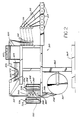
- FIG. 25 is a schematic diagram of an overall apparatus to be utilized in the present invention.
- a plurality of tows 312 are fed to the impregnating apparatus 310 from spools 314.
- a particularly preferred tow would contain 12,000 substantially parallel carbon filaments per tow of Celion carbon fibers available from BASF Structural Materials, Inc., Charlotte, North Carolina, U.S.A.
- Approximately 60 spools can be provided at position 314.
- the tow is maintained under tension between rollers 316, 318 and introductory roller 320.
- a heating chamber 322 volatilizes any sizing that may be present on the tow.
- a temperature range in the heating chamber 322 may be from 400°C to 925°C., preferably about 600°C.
- the tow can be passed over roller 326 and through a solvent reservoir 324.
- the solvent therein could be used to remove any sizing agent that may be present. Suitable solvents would be the aromatic, chlorinated aliphatic and heterocyclic materials such as methylethyl ketone, methylene chloride, acetone, xylene, methylpyrrolidone.
- Rollers 330 underneath the level of solvent 328 may be adjusted to provide an appropriate residence time in the solvent tank.
- the fibrous material After the fibrous material leaves the solvent tank, it is then impregnated with the impregnation bath.
- a number of different techniques can be utilized to accomplish the desired impregnation through the application of work. The only requirement is that the impregnation bath well flow between adjoining filaments.
- the objective is to have as minimal voids as possible, i.e. , minimal portions of the tow that are not in contact with particulate thermosetting resin.
- Fig. 2 shows the tow 312 being immersed from top to bottom in an immersion tank of chamber 332 which includes heating elements 334 and 334′ for bath temperature control positioned in heat element chambers 335 and having respective wire leads 336 and 336′.
- the fibrous material 312 as it proceeds through the impregnation bath 338 is wound about multiple rollers 340 and 342.
- Roller 342 slides in slot 344 back and forth to permit appropriate tension on the fibrous material.
- the roller 342 may be replaced by a bar arrangement which would permit the filaments of the fibrous material to be spread out on the bar, thereby permitting the thermosetting resin particles to further surround the filaments.
- ultrasonic equipment attached to either the rollers and/or the bars would permit further surrounding of the tow with the impregnation bath thereby improving the impregnation.
- the ultrasonic equipment causes movement of the fibers and the particles of thermosetting resin thereby increasing the impregnation of the fibrous material.
- the ultrasonic equipment is readily available in the industry, such as Sonicator ultrasonic equipment, commercially available from Heat Systems, Inc. of Farmingdale, New York, U.S.A.
- the fibrous material passes from the immersion tank of chamber 332 through a die (shown in Figs. 28 and 29) which will size the fibrous material.
- Shown in Fig. 25 is a heating chamber 346 which can control the temperature of the tow as it leaves the heated impregnation tank or chamber. In this case one may be able to dry the impregnated fibrous material to a particular aqueous medium content, in a controlled manner. The resulting fibrous material is then ready for take-up on take-up roll 360 after passing over introductory roller 358.
- the tows impregnated through the use of the equipment heretofore described instead of being a collection of individual filaments take on the shape of a tape or sheet.
- Such tape or sheet can vary in size. Even if a narrow tape is prepared, the tape adheres well on a roller due to the tacky nature of the resulting impregnated fibrous material to an adjacent wrap which is laid next to it in a side-by-side relationship.
- the dissolved polymeric binding agent (previously described) assists in adhering the thermosetting resin particles to the filaments as well as within tows which comprise the tape.
- the resulting produce Due to the complete impregnation of the fibrous material with the impregnation bath, the resulting produce is "drapable", that is, it has the ability to hang or stretch out loosely and is capable of being readily easily folded.
- the multiple tows now in the sheet-like form can be shaped to any desired configuration, such as in a die for forming a bulk head door of an aircraft. Once in the die, it can be molded at an appropriate temperature and pressure.
- Other aircraft end uses could be landing gear doors, cowl components, wing to body fairing, outboard ailerons, stabilizer tips, rudders, elevator wings, fuselage, and the like.
- An alkyl phenoxypolyethoxy ethanol surfactant in a quantity of 2.5 grams is dissolved in 3362 grams of distilled water and combined at ambient temperature conditions with an aqueous dispersion of 750 grams of solid particles of M-100 PMR-15 polyimide thermosetting resin in 780 grams of water.
- the M-100 PMR-15 polyimide resin is of the reverse Diels-Alder type and is commercially available from Hysol Grafil, Cleveland, Ohio, U.S.A., and is fully imidized as purchased. Once this polyimide resin is postcured via an addition cross-linking reaction its glass transition temperature is typically approximately 321°C.
- the particles of M-100 PMR-15 polyimide thermosetting resin have been ground to a mean particle size of 4.8 microns, with the largest particle size being approximately 24 microns.
- the surfactant is commercially available from Rohm and Haas Company as Triton X100 surfactant.
- water-soluble polyacrylic acid binding agent possessing a molecular structure which is cross-linked with polyalkenyl polyether are slowly added to an agitated bath of the aqueous powder dispersion mentioned above.
- the water-soluble binding agent is commercially available from B.F. Goodrich as Grade 941 Carbopol polymer and has a molecular weight of approximately 1,250,000.
- the viscosity of the dispersion is found to be 160,000 cps. when measured with a Rheometrics Stress Rheometer (Model RSR/M) while operating at a shear rate of 0.01 reciprocal second. This viscosity is accompanied by a high shear-thinking behavior which enables good dispersion of the particles of thermosetting resin while being agitated.
- the Brookfield Yield Value of the dispersion is found to be 70 dynes/cm.2 when tested on a Brookfield RVT viscometer as previously described.
- the Minimum Brookfield Yield Value required to suspend the largest particles of M-100 PMR-15 thermosetting polyimide resin present in the dispersion is 4.1 dynes/cm.2. Accordingly, the resulting impregnation bath is highly stable and the actual Brookfield Yield Value exceeds the calculated Minimum Brookfield Value to suspend even the largest M-100 PMR-15 polyimide thermosetting resin particles present by more than 85 times.
- the resulting impregnation bath is next poured into an impregnation apparatus similar to that illustrated in Fig. 25 containing several stationary non-rotating bars immersed within the bath.
- a tow of approximately 12,000 substantially continuous Celion carbon filaments in unsized form available from BASF Structural Materials, Inc., under the designation G30-500 is selected to serve as the fibrous reinforcement.
- the filaments of the tow possess a diameter of approximately 7 microns.
- This tow is fed in the direction of its length from a single bobbin located on a tension controlled creel, and while under tension, is passed through the impregnation bath while in contact with the stationary non-rotating bars immersed in the bath. Following passage over the bars the multifilamentary tow is passed through a rectangular metallic die having polished surfaces situated at the bottom of the impregnation bath.
- the substantially parallel carbon filaments are impregnated with the impregnation bath as the bath is caused to flow between the adjoining filaments.
- Such flow inherently results in a significant reduction in the viscosity of the impregnation bath which greatly aids in the incorporation of the solid M-100 PMR-15 polyimide thermosetting resin particles between the carbon filaments.
- the M-100 PMR-15 thermosetting resin particles tend to be locked within the fibrous material in a highly uniform manner.
- the die also aids in the control of the width and thickness of the resulting impregnated tow.
- the resulting impregnated tow is next wound on a rotating drum using a transversing laydown guide to form a rectangular sheet having a width of approximately 30.5 cm.
- the resulting sheet product following drying for two hours at ambient conditions to remove a portion of the water contains approximately 30.1 percent carbon fibers by weight, approximately 13.2 percent solid M-100 PMR-15 polyimide thermosetting resin particles by weight, approximately 0.7 percent ammonium polyacrylate binding agent having stiffened molecules possessing a cross-linked molecular structure by weight, and approximately 56 percent water by weight.
- This product contains the matrix-forming M-100 PMR-15 thermosetting resin particles substantially uniformly dispersed between adjoining fibers in the absence of fusion bonding and can be handled without the segregation of the particles.
- the product When tested in accordance with the drape test of ASTM D-1388, the product is found to be highly drapeable both in the 0° and 90° directions and to exhibit a flexural rigidity of approximately 10,000 mg. ⁇ cm. Also, the product is tacky and is found to pass the tack test of NASA Technical Bulletin 1142.
- the product while in a flat configuration is allowed to substantially completely dry to a water content of approximately 2 percent while at ambient conditions, and contains the M-100 PMR-15 thermosetting resin particles well bound therein.
- Ten flat plies containing 31.6 percent by weight of the M-100 PMR-15 thermosetting resin particles measuring approximately 10.2 cm. x 10.2 cm. are laid up in the 0° direction in a matched metal mold at room temperature conditions and placed in a platen press. The mold is heated to 275°C. with no applied pressure. Once this temperature is achieved, a pressure of 2.1 MPa is applied. The mold is then held at these conditions for approximately 30 minutes, after which the mold is heated up to 300°C. and held for another 30 minutes. The thermosetting resin is substantially completely cured to form the matrix phase.
- the press is then turned off, thereby allowing the mold to slowly cool under 2.1 MPa pressure. Once the mold cools to 50°C., it is removed from the press and the resulting composite article in the form of a panel is removed from the mold. The resulting panel is postcured for 13 hours at 315°C. in a circulating air oven. It is then allowed to cool slowly to ambient temperature.
- the resulting panel formed from the impregnated product which is dried prior to placing in the mold, has a thickness of 0.154 ⁇ 0.001 cm., a theoretical carbon fiber volume of 61.2 percent, and a void content of less than 1.5 percent.
- Test specimens are cut from panels, molded in the above described manner and four point, 0° flexural tests are conducted in accordance with ASTM D790-84a, Method II, Procedure A, using a span-to-depth ratio of approximately 32:1 and a crosshead speed of approximately 0.5 cm./minute, and 90° tensile tests are conducted in accordance with the procedure of ASTM D3039.
- a 0° flexural strength of 1550 MPa is exhibited, which represents a 66 percent translation of that theoretically attainable.
- a 0° flexural modulus of 122 GPa is exhibited, which represents an 86 percent translation of that theoretically attainable.
- a 90° tensile strength of 40 MPa is exhibited which represents a 72 percent translation of that theoretically attainable.
- Such 90° tensile strength value evidences superior adhesion between the carbon fibers and the matrix formed upon the substantially complete curing of the thermosetting resin.
- thermosetting resin in a quantity of 0.75 grams is dissolved in 1230 grams of distilled water and combined at ambient temperature conditions with 223 grams of solid particles of a modified 5250-2 poly(bismaleimide) thermosetting resin formed in accordance with the teachings of United States Patent No. 4,644,039.
- the modified 5250-2 poly(bismaleimide) thermosetting resin in supplied by BASF Aktiengesellschaft of Ludwigshafen, West Germany and is advanced to produce a melting temperature of approximately 70 to 80°C. and a gel time of approximately 10 minutes at 160°C. Since the thermosetting resin is a solid at room temperature, it can be ground to powder form.
- this modified 5250-2 poly(bismaleimide) thermosetting resin is postcured, its glass transition temperature is typically approximately 321°C.
- the particles of poly(bismaleimide) thermosetting resin have been ground to a mean particle size of 25 microns, with the largest particle size being 130 microns.
- the surfactant is commercially available from Rohm and Haas Company as Triton X100 surfactant.
- water-soluble polyacrylic acid binding agent possessing a molecular structure which is cross-linked with polyalkenyl polyether are slowly added to an agitated bath of the aqueous powder dispersion mentioned above.
- the water-soluble binding agent is commercially available from B.F. Goodrich as Grade 941 Carbopol resin and has a molecular weight of approximately 1,250,000.
- the pH of the resulting dispersion is found to be 3.7.
- the viscosity of the dispersion is found to be 120,000 cps. when measured with a Rheometrics Stress Rheometer (Model RSR/M) while operating at a shear rate of 0.01 reciprocal second. This viscosity is accompanied by a high shear-thinning behavior which enables good dispersion of the particles of thermosetting resin.
- the Brookfield Yield Value of the dispersion is found to be 45 dynes/cm.2 when tested on a Brookfield RVT viscometer as previously described.
- the Minimum Brookfield Yield Value required to suspend the largest particles of the poly(bismaleimide) thermosetting resin present in the dispersion is 10.9 dynes/cm.2. Accordingly, the resulting impregnation bath is highly stable and the actual Brookfield Yield Value exceeds the calculated Minimum Brookfield Value to suspend even the largest poly(bismaleimide) thermosetting resin particles present by more than 25 times.
- the resulting impregnation bath is next poured into an impregnation apparatus similar to that illustrated in Fig. 25 containing several stationary non-rotating bars immersed within the bath.
- a tow of approximately 12,000 substantially continuous Celion carbon filaments in unsized form available from BASF Structural Materials, Inc., under the designation G30-500 is selected to serve as the fibrous reinforcement.
- the filaments of the tow possess a diameter of approximately 7 microns.
- This tow is fed in the direction of its length from a single bobbin located on a tension controlled creel, and while under tension, is passed through the impregnation bath while in contact with the stationary non-rotating bars immersed in the bath. Following passage over the bars the multifilamentary tow is passed through a rectangular metallic die having polished surfaces situated at the bottom of the impregnation bath.
- the resulting impregnated tow is next wound on a rotating drum using a transversing laydown guide to form a rectangular sheet having a width of approximately 30.5 cm.
- the resulting sheet product following drying for two hours at ambient conditions to remove a portion of the water contains approximately 29.7 percent carbon fibers by weight, approximately 14.6 percent solid poly(bismaleimide) thermosetting resin particles by weight, approximately 0.7 percent ammonium polyacrylate binding agent having stiffened molecules possessing a cross-linked molecular structure by weight, and approximately 55 percent water by weight.
- This product contains the matrix-forming poly(bismaleimide) thermosetting resin particles substantially uniformly dispersed between adjoining fibers in the absence of fusion bonding and can be handled without the segregation of the particles.
- the product When tested in accordance with the drape test of ASTM D-1388 the product is found to be highly drapeable both in the 0° and 90° directions and to exhibit a flexural rigidity of approximately 10,000 mg. ⁇ cm. Also, the product is tacky and is found to pass the tack test of NASA Technical Bulletin 1142.
- the product while in a flat configuration is allowed to substantially completely dry to a water content of approximately 2 percent while at ambient conditions, and contains the poly(bismaleimide) thermosetting resin particles well bound therein.
- Ten flat plies containing 34.0 percent by weight of the poly(bismaleimide) thermosetting resin particles, measuring approximately 10.2 cm. x 10.2 cm. are laid up in the 0° direction in a matched metal mold at room temperature conditions and placed in a platen press. The mold is heated to 150°C. with no applied pressure, at a rate of 1.5°C./minute. Once this temperature is achieved, a pressure of 1.4 MPa is applied. The mold is then held at these conditions for approximately 60 minutes, after which the mold is heated up to 180°C. and held for another 6 hours.
- thermosetting resin is substantially completely cured to form the matrix phase.
- the press is then turned off thereby allowing the mold to slowly cool under 1.4 MPa pressure. Once the mold cools to 50°C. it is removed from the press and the resulting composite article in the form of a panel is removed from the mold. The resulting panel is postcured for 12 hours at 230°C. in a circulating air oven. It is then allowed to cool slowly to ambient temperature.
- the resulting panel formed from the impregnated product which is dried prior to placing in the mold, has a thickness of 0.180 ⁇ 0.001 cm., a theoretical carbon fiber volume of 57.5 percent, and a void content of less than 1.5 percent.
- Test specimens are cut from panels, molded in the above described manner, and four point, 0° flexural tests are conducted in accordance with ASTM D790-84a, Method II, Procedure A, using a span-to-depth ratio of approximately 32:1 and a crosshead speed of approximately 0.5 cm./minute, and 90° tensile tests are conducted in accordance with ASTM D3039.
- a 0° flexural strength of 1500 MPa is exhibited, which represents a 67 percent translation of that theoretically attainable.
- a 0° flexural modulus of 122 GPa is exhibited, which represents a 92 percent translation of that theoretically attainable.
- a 90° tensile strength of 41 MPa is exhibited which represents a 65 percent translation of that theoretically attainable.
- Such 90° tensile strength value evidences superior adhesion between the carbon fibers and the matrix formed upon the substantially complete curing of the thermosetting resin.
Landscapes
- Chemical & Material Sciences (AREA)
- Engineering & Computer Science (AREA)
- Materials Engineering (AREA)
- Chemical Kinetics & Catalysis (AREA)
- Manufacturing & Machinery (AREA)
- Health & Medical Sciences (AREA)
- Medicinal Chemistry (AREA)
- Polymers & Plastics (AREA)
- Organic Chemistry (AREA)
- Mechanical Engineering (AREA)
- Inorganic Chemistry (AREA)
- Composite Materials (AREA)
- Reinforced Plastic Materials (AREA)
Applications Claiming Priority (2)
| Application Number | Priority Date | Filing Date | Title |
|---|---|---|---|
| US157836 | 1988-03-03 | ||
| US07/157,836 US4919739A (en) | 1986-11-07 | 1988-03-03 | Production of improved preimpregnated material comprising a particulate thermosetting resin suitable for use in the formation of a substantially void-free fiber-reinforced composite article |
Publications (2)
| Publication Number | Publication Date |
|---|---|
| EP0330980A2 true EP0330980A2 (de) | 1989-09-06 |
| EP0330980A3 EP0330980A3 (de) | 1990-09-05 |
Family
ID=22565478
Family Applications (1)
| Application Number | Title | Priority Date | Filing Date |
|---|---|---|---|
| EP19890103047 Withdrawn EP0330980A3 (de) | 1988-03-03 | 1989-02-22 | Herstellung von vorimprägniertem Fasermaterial zum Formen eines Gegenstandes aus lückenlosem Verbundwerkstoff |
Country Status (6)
| Country | Link |
|---|---|
| US (1) | US4919739A (de) |
| EP (1) | EP0330980A3 (de) |
| JP (1) | JPH01316222A (de) |
| KR (1) | KR890014637A (de) |
| AU (1) | AU3086489A (de) |
| CA (1) | CA1330410C (de) |
Cited By (10)
| Publication number | Priority date | Publication date | Assignee | Title |
|---|---|---|---|---|
| EP0478477A1 (de) * | 1990-09-28 | 1992-04-01 | Babolat Vs | Verfahren und Einrichtung zur Herstellung einer Saite zur Bespannung von Tennisschlägern oder ähnlichem und Saite, die daraus resultiert |
| NL1002828C2 (nl) * | 1996-04-09 | 1997-10-14 | Syncoglas Sa Nv | Versterkingsmateriaal. |
| USH1715H (en) * | 1996-08-13 | 1998-04-07 | Babolat Vs | Process and device for the manufacture of a string for stringing tennis rackets or the like and string resulting therefrom |
| EP1054091A1 (de) * | 1999-05-20 | 2000-11-22 | SA Schappe | Unidirektionale Bahn aus Kohlenstofffasern |
| US6416843B1 (en) | 1997-09-11 | 2002-07-09 | Metso Paper, Inc. | Caring doctor blade and method for manufacture of same |
| EP1325805A1 (de) * | 2001-12-25 | 2003-07-09 | Maschinenfabrik J. Dieffenbacher GmbH & Co. | Faserstrangzuführ- und Faserstrangvorwärmvorrichtung bei der Herstellung von faserverstärkten Kunststoffmassen |
| US6919118B2 (en) | 1997-03-28 | 2005-07-19 | Societe Nationale D'etude Et De Construction De Moteurs D'aviation-Snecma | Method and machine for producing multiaxial fibrous webs |
| CN102066638B (zh) * | 2008-06-23 | 2013-12-25 | 利巴机械制造有限公司 | 生产多轴向纱线织物的方法、单向纤维层以及生产单向纤维层的方法、多轴向纱线织物和具有基体的复合材料部件 |
| WO2020074789A1 (fr) * | 2018-10-09 | 2020-04-16 | Max Sardou | Ruban preimpregne thermodurcissable anti fissuration |
| WO2022069471A1 (de) * | 2020-09-29 | 2022-04-07 | Php Fibers Gmbh | Haftfähiges bändchengarn |
Families Citing this family (60)
| Publication number | Priority date | Publication date | Assignee | Title |
|---|---|---|---|---|
| US6040251A (en) * | 1988-03-14 | 2000-03-21 | Nextec Applications Inc. | Garments of barrier webs |
| US6312523B1 (en) | 1988-03-14 | 2001-11-06 | Nextec Applications, Inc. | Apparatus of feedback control for the placement of a polymer composition into a web |
| US5876792A (en) * | 1988-03-14 | 1999-03-02 | Nextec Applications, Inc. | Methods and apparatus for controlled placement of a polymer composition into a web |
| US5954902A (en) * | 1988-03-14 | 1999-09-21 | Nextec Applications, Inc. | Controlling the porosity and permeation of a web |
| US5856245A (en) * | 1988-03-14 | 1999-01-05 | Nextec Applications, Inc. | Articles of barrier webs |
| US6083602A (en) * | 1988-03-14 | 2000-07-04 | Nextec Applications, Inc. | Incontinent garments |
| US5846604A (en) * | 1988-03-14 | 1998-12-08 | Nextec Applications, Inc. | Controlling the porosity and permeation of a web |
| US5698303A (en) * | 1988-03-14 | 1997-12-16 | Nextec Applications, Inc. | Controlling the porosity and permeation of a web |
| US5912116A (en) * | 1988-03-14 | 1999-06-15 | Nextec Applications, Inc. | Methods of measuring analytes with barrier webs |
| US5874164A (en) * | 1988-03-14 | 1999-02-23 | Nextec Applications, Inc. | Barrier webs having bioactive surfaces |
| US5958137A (en) * | 1989-03-10 | 1999-09-28 | Nextec Applications, Inc. | Apparatus of feedback control for the placement of a polymer composition into a web |
| US5248550A (en) * | 1989-02-13 | 1993-09-28 | Lockheed Corporation | Encapsulation of thermoplastic particles for production of composites |
| US5935637A (en) * | 1989-03-10 | 1999-08-10 | Nextec Applications, Inc. | Method of feedback control for the placement of a polymer composition into a web |
| US5205898A (en) * | 1990-11-15 | 1993-04-27 | The United States Of America As Represented By The Administrator Of The National Aeronautics And Space Administration | Continuous fiber thermoplastic prepreg |
| US5183527A (en) * | 1991-04-12 | 1993-02-02 | Moore Business Forms, Inc. | Perimeter pressure seal module |
| US5792398A (en) * | 1991-06-12 | 1998-08-11 | Glasis Holding Ab | Hot pressing method of forming a composite laminate containing expanded thermoplastic particles |
| AU5090293A (en) * | 1992-09-09 | 1994-03-29 | Clock Spring Company L.P. | High tensile strength composite reinforcing bands and methods for making same |
| US5355567A (en) * | 1992-12-18 | 1994-10-18 | Hoechst Celanese Corporation | Process for preparing engineered fiber blend |
| US5397523A (en) * | 1993-07-20 | 1995-03-14 | Cincinnati Mliacron Inc. | Method and apparatus for sizing composite tows |
| CN1041015C (zh) * | 1993-08-24 | 1998-12-02 | 钟表弹簧公司 | 高拉伸强度的复合加强带及其制造和应用方法 |
| US5395477A (en) * | 1993-10-20 | 1995-03-07 | The United States Of America As Represented By The Administrator Of The National Aeronautics And Space Administration | Apparatus for consolidating a pre-impregnated, filament-reinforced polymeric prepreg material |
| US5534302A (en) * | 1995-01-05 | 1996-07-09 | National Science Council | Method of preparing a fiber reinforced modified phenolic resin composite |
| US6071602A (en) * | 1995-06-07 | 2000-06-06 | Nextec Applications, Inc. | Controlling the porosity and permeation of a web |
| US6013361A (en) * | 1995-10-31 | 2000-01-11 | Lockheed Martin Corporation | High performance structural laminate composite material for use to 1000° F and above, apparatus for and method of manufacturing same, and articles made with same |
| US5866272A (en) * | 1996-01-11 | 1999-02-02 | The Boeing Company | Titanium-polymer hybrid laminates |
| US5651850A (en) * | 1996-01-11 | 1997-07-29 | The Boeing Company | Method of fabricating hybrid composite structures |
| US5700347A (en) * | 1996-01-11 | 1997-12-23 | The Boeing Company | Thermoplastic multi-tape application head |
| US6174483B1 (en) | 1997-05-07 | 2001-01-16 | Hexcel Cs Corporation | Laminate configuration for reinforcing glulam beams |
| US6039832A (en) * | 1998-02-27 | 2000-03-21 | The Boeing Company | Thermoplastic titanium honeycomb panel |
| US6334589B1 (en) * | 1998-05-11 | 2002-01-01 | Lockheed Martin Corporation | Cyanate ester composites for oxygen containment |
| US6375125B1 (en) * | 1998-05-11 | 2002-04-23 | Lockheed Martin Corporation | Hybrid composites for oxygen propulsion systems |
| US6494405B1 (en) * | 1998-05-11 | 2002-12-17 | Lockheed Martin Corporation | PEAR composites for oxygen systems |
| CN1454135A (zh) * | 2000-09-13 | 2003-11-05 | 戴维燃料电池部件公司 | 复合材料的生产方法 |
| US6875473B2 (en) * | 2001-01-08 | 2005-04-05 | J. D. Lincoln, Inc. | Woven fabric with a modified ester resin for use as a wet friction liner |
| US7173469B1 (en) * | 2002-01-24 | 2007-02-06 | Cypress Semiconductor Corp. | Clocking system and method for a memory |
| WO2005022109A1 (en) * | 2003-08-29 | 2005-03-10 | Airbus Deutschland Gmbh | Apparatus and method for automatically fabricating tape with threads for visualization of air streams on aerodynamic surfaces |
| US7682656B2 (en) * | 2004-06-14 | 2010-03-23 | Agruim Inc. | Process and apparatus for producing a coated product |
| EP1827714B1 (de) * | 2004-11-30 | 2019-07-10 | Agrium Inc. | Verfahren und vorrichtung zur beschichtung eines produkts mit gesteuerter abgabe in einer drehtrommel |
| WO2007106390A2 (en) | 2006-03-10 | 2007-09-20 | Amesbury Group, Inc | Apparatus and method for manufacturing reinforced weatherstrip, and such a weatherstrip |
| DE102006018133A1 (de) * | 2006-04-19 | 2007-10-25 | Airbus Deutschland Gmbh | Vorrichtung und Verfahren zur Herstellung einer Testklebestreifenrolle zur Sichtbarmachung von Luftströmen |
| US20090291223A1 (en) * | 2008-05-24 | 2009-11-26 | He Yufang | Method for transversely soaking prepreg |
| GB2471318A (en) | 2009-06-26 | 2010-12-29 | Hexcel Composites Ltd | Conductive prepreg |
| GB2471319A (en) * | 2009-06-26 | 2010-12-29 | Hexcel Composites Ltd | Manufacturing composite materials containing conductive fibres |
| US20110117231A1 (en) * | 2009-11-19 | 2011-05-19 | General Electric Company | Fiber placement system and method with inline infusion and cooling |
| US9616594B2 (en) | 2012-08-06 | 2017-04-11 | The Boeing Company | Radius fillers for composite structures, composite structures that include radius fillers, and systems and methods of forming the same |
| CN105307843B (zh) * | 2013-05-07 | 2017-11-10 | 内乌沃卡斯公司 | 制造复合材料的方法 |
| US10035309B2 (en) | 2014-04-03 | 2018-07-31 | The Boeing Company | Radius fillers for composite structures, composite structures that include radius fillers, and systems and methods of forming the same |
| US10105942B2 (en) | 2014-08-20 | 2018-10-23 | The Boeing Company | Systems and methods for forming radius fillers for composite structures |
| US9643395B2 (en) | 2014-08-20 | 2017-05-09 | The Boeing Company | Systems and methods for forming radius fillers for composite structures |
| US10329834B2 (en) | 2015-02-13 | 2019-06-25 | Amesbury Group, Inc. | Low compression-force TPE weatherseals |
| CA2991051C (en) | 2015-07-02 | 2023-09-05 | Neuvokas Corporation | Method of manufacturing a composite material |
| CN104943202B (zh) * | 2015-07-03 | 2017-06-23 | 浙江大学 | 碳纤维复合材料轴流风机叶轮成型固化装置 |
| RU2640553C2 (ru) * | 2016-04-26 | 2018-01-09 | Общество С Ограниченной Ответственностью "Анизопринт" | Композитная армирующая нить, препрег, лента для 3D печати и установки для их изготовления |
| EP3504051B1 (de) * | 2016-08-24 | 2020-10-07 | Basf Se | Vorrichtung und verfahren zur imprägnierung von faserstrukturen |
| JP7254764B2 (ja) * | 2017-07-31 | 2023-04-10 | ビーエーエスエフ ソシエタス・ヨーロピア | 規定された繊維体積含有量を有する繊維を含浸させる装置 |
| US10730236B2 (en) * | 2017-08-02 | 2020-08-04 | Ethicon Llc | System and method for additive manufacture of medical devices |
| ES2962144T3 (es) * | 2018-04-25 | 2024-03-15 | Asahi Chemical Ind | Moldeado de resina reforzado con fibra continua y método para la fabricación de la misma |
| CA3160198A1 (en) | 2019-11-12 | 2021-05-20 | Neuvokas Corporation | Method of manufacturing a composite material |
| EP4144498B1 (de) | 2021-09-06 | 2024-12-04 | Universität Stuttgart | Verfahren und vorrichtung zum tränken eines faserhalbzeugs mit einem flüssigen matrixsystem |
| CN116082832A (zh) * | 2022-12-23 | 2023-05-09 | 广东泰塑新材料科技有限公司 | 一种基于尼龙的气凝胶复合材料的制备方法 |
Family Cites Families (25)
| Publication number | Priority date | Publication date | Assignee | Title |
|---|---|---|---|---|
| CA588381A (en) * | 1959-12-08 | J. Tierney Hubert | Reinforced resinous structural material | |
| GB178811A (en) * | 1921-04-22 | 1923-08-15 | Ernest Hopkinson | Improvements in or relating to processes for the production of fabrications of rubber and filamentary material and to products obtained thereby |
| US2596162A (en) * | 1945-03-01 | 1952-05-13 | Marco Chemicals Inc | Method of polymerizing fiber-reinforced resinous materials and product |
| US2609319A (en) * | 1949-01-05 | 1952-09-02 | Olin Mathieson | Laminated pipe and process of making same |
| FR1267996A (fr) * | 1959-07-07 | 1961-07-28 | Pittsburgh Plate Glass Co | Solution d'apprêt pour fibres de verre |
| US3116192A (en) * | 1959-07-07 | 1963-12-31 | Pittsburgh Plate Glass Co | Glass fiber treatiment |
| US3334071A (en) * | 1964-04-14 | 1967-08-01 | Du Pont | Polyimides from dimaleimides and bisfulvenes |
| GB1264432A (de) * | 1969-04-28 | 1972-02-23 | ||
| US3779854A (en) * | 1971-06-18 | 1973-12-18 | Pennwalt Corp | Polyvinylidene fluoride laminate construction and method |
| JPS5750654B2 (de) * | 1973-03-28 | 1982-10-28 | ||
| JPS5090775A (de) * | 1973-12-24 | 1975-07-21 | ||
| FR2272119B1 (de) * | 1974-05-20 | 1977-03-18 | Rhone Poulenc Ind | |
| US3970495A (en) * | 1974-07-24 | 1976-07-20 | Fiber Science, Inc. | Method of making a tubular shaft of helically wound filaments |
| DE2436555C3 (de) * | 1974-07-30 | 1979-12-13 | Maizena Gmbh, 2000 Hamburg | Verfahren zur Herstellung von Pfropfpolymeren durch Umsetzen von Stärke mit wasserlöslichen oder in Wasser dispergierbaren Vinyl- und/ oder Acrylpolymeren |
| US4067845A (en) * | 1975-12-08 | 1978-01-10 | The Budd Company | Maturation of polyester compositions for viscosity index control |
| US4268473A (en) * | 1977-08-15 | 1981-05-19 | Champion International Corporation | Aluminum-filled epoxy embossing caul and means for production |
| GB1604620A (en) * | 1977-11-10 | 1981-12-09 | Britton A | Application of liquid material to webs |
| US4292105A (en) * | 1978-12-28 | 1981-09-29 | Union Carbide Corporation | Method of impregnating a fibrous textile material with a plastic resin |
| US4238542A (en) * | 1979-02-13 | 1980-12-09 | Tile Council Of America, Inc. | Method of using adhesive joint dressing compositions and product |
| FR2516441A1 (fr) * | 1981-11-18 | 1983-05-20 | Spie Batignolles | Procede de fabrication de profiles en resine thermoplastique chargee de fibres, installation pour la mise en oeuvre, profiles obtenus et leur utilisation |
| CA1238167A (en) * | 1983-04-07 | 1988-06-21 | James E. O'connor | Process for preparing shaped objects of poly(arylene sulfide) and product thereof |
| US4680224A (en) * | 1984-03-06 | 1987-07-14 | Phillips Petroleum Company | Reinforced plastic |
| GB8430949D0 (en) * | 1984-12-07 | 1985-01-16 | Smith Tech Dev | Impregnating fibre reinforcements |
| US4721639A (en) * | 1986-03-14 | 1988-01-26 | Basf Corporation | Bis-maleimide resin systems and structural composites prepared therefrom |
| US4894105A (en) * | 1986-11-07 | 1990-01-16 | Basf Aktiengesellschaft | Production of improved preimpregnated material comprising a particulate thermoplastic polymer suitable for use in the formation of substantially void-free fiber-reinforced composite article |
-
1988
- 1988-03-03 US US07/157,836 patent/US4919739A/en not_active Expired - Lifetime
- 1988-04-18 CA CA000564388A patent/CA1330410C/en not_active Expired - Fee Related
-
1989
- 1989-02-22 EP EP19890103047 patent/EP0330980A3/de not_active Withdrawn
- 1989-03-01 AU AU30864/89A patent/AU3086489A/en not_active Abandoned
- 1989-03-03 KR KR1019890002705A patent/KR890014637A/ko not_active Withdrawn
- 1989-03-03 JP JP1051824A patent/JPH01316222A/ja active Granted
Cited By (15)
| Publication number | Priority date | Publication date | Assignee | Title |
|---|---|---|---|---|
| FR2667330A1 (fr) * | 1990-09-28 | 1992-04-03 | Babolat Vs | Procede et dispositif pour la fabrication d'une corde pour le cordage de raquettes de tennis ou similaire et corde en resultant. |
| EP0478477A1 (de) * | 1990-09-28 | 1992-04-01 | Babolat Vs | Verfahren und Einrichtung zur Herstellung einer Saite zur Bespannung von Tennisschlägern oder ähnlichem und Saite, die daraus resultiert |
| NL1002828C2 (nl) * | 1996-04-09 | 1997-10-14 | Syncoglas Sa Nv | Versterkingsmateriaal. |
| WO1997037835A1 (en) * | 1996-04-09 | 1997-10-16 | N.V. Syncoglas S.A. | Reinforcement material |
| USH1715H (en) * | 1996-08-13 | 1998-04-07 | Babolat Vs | Process and device for the manufacture of a string for stringing tennis rackets or the like and string resulting therefrom |
| US8062448B2 (en) | 1997-03-28 | 2011-11-22 | Snecma Propulsion Solide | Machine for producing multiaxial fibrous webs |
| US6919118B2 (en) | 1997-03-28 | 2005-07-19 | Societe Nationale D'etude Et De Construction De Moteurs D'aviation-Snecma | Method and machine for producing multiaxial fibrous webs |
| US6416843B1 (en) | 1997-09-11 | 2002-07-09 | Metso Paper, Inc. | Caring doctor blade and method for manufacture of same |
| FR2793813A1 (fr) * | 1999-05-20 | 2000-11-24 | Schappe Sa | Nappe unidirectionnelle de fibres de carbone |
| US6410126B1 (en) | 1999-05-20 | 2002-06-25 | Sa Schappe | Unidirectional tape of carbon fibers |
| EP1054091A1 (de) * | 1999-05-20 | 2000-11-22 | SA Schappe | Unidirektionale Bahn aus Kohlenstofffasern |
| EP1325805A1 (de) * | 2001-12-25 | 2003-07-09 | Maschinenfabrik J. Dieffenbacher GmbH & Co. | Faserstrangzuführ- und Faserstrangvorwärmvorrichtung bei der Herstellung von faserverstärkten Kunststoffmassen |
| CN102066638B (zh) * | 2008-06-23 | 2013-12-25 | 利巴机械制造有限公司 | 生产多轴向纱线织物的方法、单向纤维层以及生产单向纤维层的方法、多轴向纱线织物和具有基体的复合材料部件 |
| WO2020074789A1 (fr) * | 2018-10-09 | 2020-04-16 | Max Sardou | Ruban preimpregne thermodurcissable anti fissuration |
| WO2022069471A1 (de) * | 2020-09-29 | 2022-04-07 | Php Fibers Gmbh | Haftfähiges bändchengarn |
Also Published As
| Publication number | Publication date |
|---|---|
| AU3086489A (en) | 1989-09-07 |
| EP0330980A3 (de) | 1990-09-05 |
| JPH0588643B2 (de) | 1993-12-24 |
| JPH01316222A (ja) | 1989-12-21 |
| US4919739A (en) | 1990-04-24 |
| CA1330410C (en) | 1994-06-28 |
| KR890014637A (ko) | 1989-10-25 |
Similar Documents
| Publication | Publication Date | Title |
|---|---|---|
| US4919739A (en) | Production of improved preimpregnated material comprising a particulate thermosetting resin suitable for use in the formation of a substantially void-free fiber-reinforced composite article | |
| US4943472A (en) | Improved preimpregnated material comprising a particulate thermosetting resin suitable for use in the formation of a substantially void-free fiber-reinforced composite article | |
| US4894105A (en) | Production of improved preimpregnated material comprising a particulate thermoplastic polymer suitable for use in the formation of substantially void-free fiber-reinforced composite article | |
| US5128198A (en) | Production of improved preimpregnated material comprising a particulate thermoplastic polymer suitable for use in the formation of a substantially void-free fiber-reinforced composite article | |
| US5198281A (en) | Non-woven flexible multiply towpreg fabric | |
| US5171630A (en) | Flexible multiply towpreg | |
| US5296064A (en) | Flexible multiply towpreg tape from powder fusion coated towpreg and method for production thereof | |
| US5094883A (en) | Flexible multiply towpreg and method of production therefor | |
| EP0013244B1 (de) | Verfahren zur Imprägnierung eines faserigen Textilgebildes mit einem plastischen Harz | |
| US5593758A (en) | Method for preparing preforms for molding processes | |
| EP1819503B1 (de) | Kontinuierliches pultrusionsverfahren zur herstellung von hochleistungs-strukturprofilen | |
| US5302419A (en) | Towpregs from recycled plastics by powder fusion coating and method of production therefor | |
| CN103826819B (zh) | 用树脂浸渍的挠性补强纤维纱 | |
| TWI793219B (zh) | 碳纖維之製造方法 | |
| CN104937014A (zh) | 经浸渍的增强纤维纱及其在生产复合材料中的用途 | |
| EP0338115A2 (de) | Verfahren zur Herstellung eines thermoplastische Polymere enthaltenden vorimprägnierten Materials | |
| EP0455149A2 (de) | Imprägniertes und wärmeverdichtetes Faserkabel und Verfahren zu dessen Herstellung | |
| US20140205831A1 (en) | Flexible reinforcing fiber yarn pre-impregnated with resin | |
| US5618367A (en) | Dry powder process for preparing uni-tape prepreg from polymer powder coated filamentary towpregs | |
| US5360661A (en) | Towpregs from recycled plastics by powder fusion coating | |
| EP0368412B1 (de) | Verfahren zur Herstellung eines flexiblen, polymerimprägnierten Verstärkungsmaterials, derart hergestelltes polymerimprägniertes Verstärkungsmaterial und auf Basis dieses Verstärkungsmaterials hergestellte Formstücke | |
| CA2076736A1 (en) | Flexible, drapeable towpreg containing fused thermosettable particles having high glass transition temperatures | |
| JPH0768542A (ja) | 非粘着性表面を有するプリプレグ及びその製造方法 | |
| Muzzy et al. | Flexible multiply towpreg | |
| FILAMENTARY | Wilkinson et al.[45] Date of Patent: Apr. 8, 1997 |
Legal Events
| Date | Code | Title | Description |
|---|---|---|---|
| PUAI | Public reference made under article 153(3) epc to a published international application that has entered the european phase |
Free format text: ORIGINAL CODE: 0009012 |
|
| AK | Designated contracting states |
Kind code of ref document: A2 Designated state(s): CH DE ES FR GB IT LI NL |
|
| PUAL | Search report despatched |
Free format text: ORIGINAL CODE: 0009013 |
|
| AK | Designated contracting states |
Kind code of ref document: A3 Designated state(s): CH DE ES FR GB IT LI NL |
|
| 17P | Request for examination filed |
Effective date: 19901227 |
|
| 17Q | First examination report despatched |
Effective date: 19920727 |
|
| STAA | Information on the status of an ep patent application or granted ep patent |
Free format text: STATUS: THE APPLICATION HAS BEEN WITHDRAWN |
|
| 18W | Application withdrawn |
Withdrawal date: 19930303 |