EP0331399A1 - Verfahren zum Zersplitterungsprengen - Google Patents
Verfahren zum Zersplitterungsprengen Download PDFInfo
- Publication number
- EP0331399A1 EP0331399A1 EP89301936A EP89301936A EP0331399A1 EP 0331399 A1 EP0331399 A1 EP 0331399A1 EP 89301936 A EP89301936 A EP 89301936A EP 89301936 A EP89301936 A EP 89301936A EP 0331399 A1 EP0331399 A1 EP 0331399A1
- Authority
- EP
- European Patent Office
- Prior art keywords
- holes
- blast
- blasting
- area
- void
- Prior art date
- Legal status (The legal status is an assumption and is not a legal conclusion. Google has not performed a legal analysis and makes no representation as to the accuracy of the status listed.)
- Withdrawn
Links
- 238000005422 blasting Methods 0.000 title claims abstract description 43
- 238000000034 method Methods 0.000 title claims abstract description 17
- 238000013467 fragmentation Methods 0.000 title claims abstract description 16
- 238000006062 fragmentation reaction Methods 0.000 title claims abstract description 16
- 239000002360 explosive Substances 0.000 claims abstract description 24
- 239000004575 stone Substances 0.000 claims abstract description 19
- 239000011800 void material Substances 0.000 claims abstract description 18
- 239000012634 fragment Substances 0.000 claims abstract description 12
- 239000000463 material Substances 0.000 claims abstract description 10
- 238000005553 drilling Methods 0.000 abstract description 8
- 229940000425 combination drug Drugs 0.000 abstract 1
- 239000011435 rock Substances 0.000 description 18
- 238000005474 detonation Methods 0.000 description 5
- 238000010586 diagram Methods 0.000 description 4
- 230000001965 increasing effect Effects 0.000 description 2
- 230000001939 inductive effect Effects 0.000 description 2
- 230000035939 shock Effects 0.000 description 2
- 238000007796 conventional method Methods 0.000 description 1
- 238000004880 explosion Methods 0.000 description 1
- 238000010304 firing Methods 0.000 description 1
- VIKNJXKGJWUCNN-XGXHKTLJSA-N norethisterone Chemical compound O=C1CC[C@@H]2[C@H]3CC[C@](C)([C@](CC4)(O)C#C)[C@@H]4[C@@H]3CCC2=C1 VIKNJXKGJWUCNN-XGXHKTLJSA-N 0.000 description 1
- 239000000843 powder Substances 0.000 description 1
- 238000004901 spalling Methods 0.000 description 1
- 230000002889 sympathetic effect Effects 0.000 description 1
Images


Classifications
-
- F—MECHANICAL ENGINEERING; LIGHTING; HEATING; WEAPONS; BLASTING
- F42—AMMUNITION; BLASTING
- F42D—BLASTING
- F42D3/00—Particular applications of blasting techniques
- F42D3/04—Particular applications of blasting techniques for rock blasting
-
- F—MECHANICAL ENGINEERING; LIGHTING; HEATING; WEAPONS; BLASTING
- F42—AMMUNITION; BLASTING
- F42D—BLASTING
- F42D1/00—Blasting methods or apparatus, e.g. loading or tamping
Definitions
- This invention relates to a method of fragmentation blasting.
- blast area In fragmentation blasting, a number of blast holes are drilled in an area of rock, known as the blast area.
- the detonation of the explosive results in shock energy radiating out from the explosive energy source.
- this wave energy overcomes the compressive strength of the rock around the periphery of the shothole. This results in the rock being crushed to powder for several centimeters around the circumference of the shothole.
- the energy is not sufficient to overcome the compressive strength of the rock and is transmitted in wave form through the rock until it comes in contact with a 'free face', when it is refracted and reflected back into the rock as a tensile force.
- the refracted energy is dissipated from the 'free face' and is responsible for the spalling of the rock from the front of the face observed when blasting.
- the reflected energy waves travel back into the rock and as the tensile strength of rock is less than the compressive strength it results in the rock being cracked.
- the gas volume and heat generated by the explosion then expands into these cracks and propels the rock into the atmosphere.
- Blasting stone to reduce it to a desired size is a function of the amount of explosive energy applied to fragment the stone.
- the amount of explosive in relation to the amount of stone is termed the blasting ratio.
- the amount of explosive per unit volume of stone should be sufficient to reduce the rock to fragments of the desired size, namely 9" and less, but in practice, such a blasting ratio would produce a gas volume and amount of heat which would project its stone completely out of control with detriment to safety and loading.
- Another impractical method would be to drill small diameter blast holes in such a number that sufficient energy could be applied in a controlled manner but even if such could be done it would be uneconomic.
- the machinery for transporting the large initial fragments of stone to the primary crusher and the primary crusher itself are expensive items and savings in cost could be achieved if the initial fragments were already in the region of 15 cubic inches.
- a method of fragmentation blasting which includes the step of forming blast holes through the blast area and also void holes spaced between blast holes, whereby said void holes form free faces internally of the blasting area and will, in association with external free face retract and reflect energy waves as additional tensile forces to more fully fragment the stone.
- the method also includes the step of splitting the blast area on a plane at or adjacent to the floor bottom to induce an interface therebetween before fragmentation blasting takes place.
- the method also includes the step of pre-splitting the back and side face or faces of the blast area before fragmentation blasting takes place.
- the method includes the step of sequentially blasting the blast holes.
- Said sequential blasting preferably includes the steps of detonating in sequence the explosive material in individual blast holes.
- each blast hole Preferably also, separate quantities of explosive material are provided in each blast hole to form at least two spaced decks and preferably, each deck is ignited separately.
- the sequential blasting of individual blast holes and of the decks in each blast hole are controlled by a combination of short delay detonators and a sequential blasting machine.
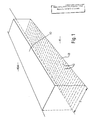
- the numeral 10 denotes an end portion of a mass of rock 10A, the end portion 10 of which is to be quarried by fragmentation blasting, i.e. primary blasting, it is therefore known as the blast area.
- the blast area is firstly split from the quarry floor 11 of the rock mass. This operation is conducted prior to the primary blasting. It consists of drilling holes 12 on a plane as near as possible to the plane of the quarry floor 11 and to a depth equal to the desired depth D of the blast area. These holes are lightly loaded with explosives and detonated simultaneously to induce a crack between all holes. By inducing an interface 13 between the quarry floor 11 and the volume of rock in the blast area 10.-
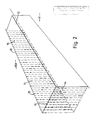
- pre-splitting of the back and side face or faces may also be conducted prior to primary blasting (Fig. 2). This involves drilling holes 14 along the desired back and side line of the blast area 10 on single planes. These holes are loaded with explosives and detonated simultaneously. Thus a crack 15 is induced along the back and side wall of the blast area. By inducing this break, energy from the primary blast is not required to overcome the shear force necessary to shear the blast bulk stone away from the back and side wall.
- a pattern of substantially upright holes 16, 17 are drilled through the blast area, being slightly angled downwardly and forwardly. A selection of these holes 16 are loaded with explosive material, i e. blast holes while others 17 remain empty as 'void holes'.
- the tensile energy wave will not have dissapated as much energy in travelling through the rock if it has a shorter distance to travel.
- By drilling void holes 17 in the blast area 10 a greater area of 'free face' is available to the energy waves, i.e. the surface area of the circumference and length of the void holes becomes 'free face'.
- the geometry and balance of the void and primary blast holes 17, 16 will depend upon individual circumstances.
- the diameter of the void and blast holes will also depend upon individual circumstances.
- the void and blast holes have a diameter of 5 5 8 ".
- the depth of the void and primary blast holes will be such that they touch the plane of the horizontal pre-split holes. Explosive loading of the blast holes will require to be designed so that a balance and even distribution of energy is achieved.
- each blast hole 16 Arranged in each blast hole 16 are two or more spaced 'decks' of explosive packages or 'charge weights' 18.
- two decks per hole have been considered, but there may be more than two per hole provided there is sufficient distance between the decks to avoid sympathetic detonation.
- the energy should be applied to the rock in a uniform and balanced manner and, because of the increased blasting ratio, it should be applied at a speed which will minimise excessive projection of the stone.
- sequential blasting is applied where not only are the individual blast holes detonated on a separate time delay but there is a separate delay interval between decks in each hole.
- Sequential Blasting employs the use of an exploder which has an inbuilt facility to transmit electrical detonation pulses at a predetermined timing to initiate several blasting circuits.
- the diagram, Fig. 4 sets out a typical three row blast using standard sequential timing and will be familiar to those skilled in the art.
- the diagram shows 30 blast holes each containing two charge weights. It also shows the detonation delay time D and detonation firing time F (in milli seconds) of the two charge weights in each blast hole. From this it can be seen that the charges are detonated in sequence, there being in this example five circuits which are actuated in sequence, each, after the first circuit, commencing while the previous circuit is still proceeding through its sequence.
- the diagram also indicates the echelon line 20 and the echelon angle 21.
Landscapes
- Engineering & Computer Science (AREA)
- General Engineering & Computer Science (AREA)
- Drilling And Exploitation, And Mining Machines And Methods (AREA)
Applications Claiming Priority (2)
| Application Number | Priority Date | Filing Date | Title |
|---|---|---|---|
| GB8804635 | 1988-02-27 | ||
| GB888804635A GB8804635D0 (en) | 1988-02-27 | 1988-02-27 | Method of fragmentation blasting |
Publications (1)
| Publication Number | Publication Date |
|---|---|
| EP0331399A1 true EP0331399A1 (de) | 1989-09-06 |
Family
ID=10632497
Family Applications (1)
| Application Number | Title | Priority Date | Filing Date |
|---|---|---|---|
| EP89301936A Withdrawn EP0331399A1 (de) | 1988-02-27 | 1989-02-27 | Verfahren zum Zersplitterungsprengen |
Country Status (2)
| Country | Link |
|---|---|
| EP (1) | EP0331399A1 (de) |
| GB (1) | GB8804635D0 (de) |
Cited By (8)
| Publication number | Priority date | Publication date | Assignee | Title |
|---|---|---|---|---|
| WO2001020248A1 (en) * | 1999-09-16 | 2001-03-22 | Dae Woo Kang | Method of blasting rock using air tubes charged in a blasthole |
| WO2002073120A1 (en) * | 2001-03-09 | 2002-09-19 | Brandrill Torrex (Proprietary) Limited | Mining method |
| WO2002101196A1 (en) * | 2001-06-12 | 2002-12-19 | Barry Anthony Hodgkinson | A method of excavating a hard material body |
| AU784685B2 (en) * | 2002-03-28 | 2006-06-01 | BELLAIRS, Jennifer Annette | A method of blasting |
| US20120242135A1 (en) * | 2009-09-29 | 2012-09-27 | Orica Explosives Technology Pty Ltd, | Method of underground rock blasting |
| CN112161538A (zh) * | 2020-09-28 | 2021-01-01 | 中国建筑材料工业建设西安工程有限公司 | 一种复杂矿区环境控制爆破方法 |
| CN117072167A (zh) * | 2023-08-28 | 2023-11-17 | 昆明理工大学 | 一种通过开设预裂缝保护预留矿柱的方法及设备 |
| CN117308715A (zh) * | 2023-10-23 | 2023-12-29 | 铜陵有色金属集团铜冠矿山建设股份有限公司 | 一种二步骤采场回采防充填体混入方法 |
Citations (6)
| Publication number | Priority date | Publication date | Assignee | Title |
|---|---|---|---|---|
| US1205378A (en) * | 1916-01-22 | 1916-11-21 | Albert L Negstad | Automobile-brake. |
| US2609750A (en) * | 1946-05-16 | 1952-09-09 | Atlas Powder Co | Process of blasting |
| US2772632A (en) * | 1954-06-15 | 1956-12-04 | Union Carbide & Carbon Corp | Blasting of rock bodies |
| US3654866A (en) * | 1970-06-18 | 1972-04-11 | Hercules Inc | Mach effect in presplitting |
| US3877373A (en) * | 1969-11-19 | 1975-04-15 | Du Pont | Drill-and-blast process |
| US4690058A (en) * | 1986-04-09 | 1987-09-01 | C-I-L Inc. | Smooth wall blasting in rock |
-
1988
- 1988-02-27 GB GB888804635A patent/GB8804635D0/en active Pending
-
1989
- 1989-02-27 EP EP89301936A patent/EP0331399A1/de not_active Withdrawn
Patent Citations (6)
| Publication number | Priority date | Publication date | Assignee | Title |
|---|---|---|---|---|
| US1205378A (en) * | 1916-01-22 | 1916-11-21 | Albert L Negstad | Automobile-brake. |
| US2609750A (en) * | 1946-05-16 | 1952-09-09 | Atlas Powder Co | Process of blasting |
| US2772632A (en) * | 1954-06-15 | 1956-12-04 | Union Carbide & Carbon Corp | Blasting of rock bodies |
| US3877373A (en) * | 1969-11-19 | 1975-04-15 | Du Pont | Drill-and-blast process |
| US3654866A (en) * | 1970-06-18 | 1972-04-11 | Hercules Inc | Mach effect in presplitting |
| US4690058A (en) * | 1986-04-09 | 1987-09-01 | C-I-L Inc. | Smooth wall blasting in rock |
Cited By (11)
| Publication number | Priority date | Publication date | Assignee | Title |
|---|---|---|---|---|
| WO2001020248A1 (en) * | 1999-09-16 | 2001-03-22 | Dae Woo Kang | Method of blasting rock using air tubes charged in a blasthole |
| WO2002073120A1 (en) * | 2001-03-09 | 2002-09-19 | Brandrill Torrex (Proprietary) Limited | Mining method |
| WO2002101196A1 (en) * | 2001-06-12 | 2002-12-19 | Barry Anthony Hodgkinson | A method of excavating a hard material body |
| AU784685B2 (en) * | 2002-03-28 | 2006-06-01 | BELLAIRS, Jennifer Annette | A method of blasting |
| US20120242135A1 (en) * | 2009-09-29 | 2012-09-27 | Orica Explosives Technology Pty Ltd, | Method of underground rock blasting |
| US9243879B2 (en) * | 2009-09-29 | 2016-01-26 | Orica Explosives Technology Pty Ltd | Method of underground rock blasting |
| US9482507B2 (en) | 2009-09-29 | 2016-11-01 | Orica Explosives Technology Pty Ltd | Method of underground rock blasting |
| CN112161538A (zh) * | 2020-09-28 | 2021-01-01 | 中国建筑材料工业建设西安工程有限公司 | 一种复杂矿区环境控制爆破方法 |
| CN117072167A (zh) * | 2023-08-28 | 2023-11-17 | 昆明理工大学 | 一种通过开设预裂缝保护预留矿柱的方法及设备 |
| CN117072167B (zh) * | 2023-08-28 | 2024-02-13 | 昆明理工大学 | 一种通过开设预裂缝保护预留矿柱的方法 |
| CN117308715A (zh) * | 2023-10-23 | 2023-12-29 | 铜陵有色金属集团铜冠矿山建设股份有限公司 | 一种二步骤采场回采防充填体混入方法 |
Also Published As
| Publication number | Publication date |
|---|---|
| GB8804635D0 (en) | 1988-03-30 |
Similar Documents
| Publication | Publication Date | Title |
|---|---|---|
| CN100504281C (zh) | 爆破多层物质的方法 | |
| EP3198218B1 (de) | Verfahren zur sprengung mit verzögerung | |
| Liu et al. | Numerical modelling of the effects of air decking/decoupling in production and controlled blasting | |
| US7707939B2 (en) | Method of blasting | |
| US4248303A (en) | Explosive well-fracturing system | |
| CA2103736A1 (en) | Shaped explosive charge, a method of blasting using the shaped explosive charge and a kit to make it | |
| CA1259854A (en) | Smooth wall blasting in rock | |
| RU2234673C1 (ru) | Способ взрывания восходящих скважин | |
| KR101696409B1 (ko) | 뇌관 폭약의 위치차를 이용한 발파 패턴 및 혼합기폭방식의 암반 발파 방법 | |
| RU2112207C1 (ru) | Способ формирования скважинного заряда | |
| RU2090830C1 (ru) | Способ формирования детонационной волны в заряде взрывчатого вещества | |
| US2772632A (en) | Blasting of rock bodies | |
| KR100317825B1 (ko) | 미진동 암반파쇄방법 | |
| US3626850A (en) | Explosive assembly | |
| EP3274555B1 (de) | System und verfahren zur unterirdischen sprengung | |
| US4522448A (en) | Method and apparatus for reclamation by reducing highwalls to gradable rubble at augered or longwalled mining sites | |
| US20060027123A1 (en) | Explosive pressure wave concentrator | |
| RU2019696C1 (ru) | Способ дробления горных пород | |
| RU2594236C1 (ru) | Способ взрывного разрушения массива разнопрочных горных пород рассредоточенными и укороченными скважинными зарядами с кумулятивным эффектом | |
| RU2140055C1 (ru) | Способ разрушения горных пород | |
| RU2133447C1 (ru) | Способ взрывного разрушения трещиноватых горных пород при отбойке на открытую поверхность | |
| Verma et al. | Application of Controlled Blasting Techniques for Development of Stable Slope-A Case Study | |
| Kalyan et al. | A study on various surface blast initiation systems | |
| RU2210671C2 (ru) | Способ взрывной разгрузки удароопасных участков горного массива | |
| Pearton | Evaluating the viability of pumpable emulsion explosives for use in narrow reef mining operations |
Legal Events
| Date | Code | Title | Description |
|---|---|---|---|
| PUAI | Public reference made under article 153(3) epc to a published international application that has entered the european phase |
Free format text: ORIGINAL CODE: 0009012 |
|
| AK | Designated contracting states |
Kind code of ref document: A1 Designated state(s): AT BE CH DE ES FR GB GR IT LI SE |
|
| 17P | Request for examination filed |
Effective date: 19900226 |
|
| 17Q | First examination report despatched |
Effective date: 19910704 |
|
| STAA | Information on the status of an ep patent application or granted ep patent |
Free format text: STATUS: THE APPLICATION IS DEEMED TO BE WITHDRAWN |
|
| 18D | Application deemed to be withdrawn |
Effective date: 19910829 |