EP0332071B2 - Process for preparing especially bluish nacreous pigments - Google Patents
Process for preparing especially bluish nacreous pigments Download PDFInfo
- Publication number
- EP0332071B2 EP0332071B2 EP89103742A EP89103742A EP0332071B2 EP 0332071 B2 EP0332071 B2 EP 0332071B2 EP 89103742 A EP89103742 A EP 89103742A EP 89103742 A EP89103742 A EP 89103742A EP 0332071 B2 EP0332071 B2 EP 0332071B2
- Authority
- EP
- European Patent Office
- Prior art keywords
- pigment
- pigments
- mica
- reduction
- color
- Prior art date
- Legal status (The legal status is an assumption and is not a legal conclusion. Google has not performed a legal analysis and makes no representation as to the accuracy of the status listed.)
- Expired - Lifetime
Links
- 239000000049 pigment Substances 0.000 title claims description 69
- 238000004519 manufacturing process Methods 0.000 title claims description 8
- GWEVSGVZZGPLCZ-UHFFFAOYSA-N Titan oxide Chemical compound O=[Ti]=O GWEVSGVZZGPLCZ-UHFFFAOYSA-N 0.000 claims description 102
- QGZKDVFQNNGYKY-UHFFFAOYSA-N Ammonia Chemical compound N QGZKDVFQNNGYKY-UHFFFAOYSA-N 0.000 claims description 42
- 239000010445 mica Substances 0.000 claims description 34
- 229910052618 mica group Inorganic materials 0.000 claims description 34
- 230000009467 reduction Effects 0.000 claims description 27
- 238000000576 coating method Methods 0.000 claims description 18
- 229910021529 ammonia Inorganic materials 0.000 claims description 17
- 239000011248 coating agent Substances 0.000 claims description 13
- 239000004408 titanium dioxide Substances 0.000 claims description 13
- 238000000034 method Methods 0.000 claims description 12
- 230000003287 optical effect Effects 0.000 claims description 12
- 230000008569 process Effects 0.000 claims description 7
- 238000006243 chemical reaction Methods 0.000 claims description 5
- ATJFFYVFTNAWJD-UHFFFAOYSA-N Tin Chemical compound [Sn] ATJFFYVFTNAWJD-UHFFFAOYSA-N 0.000 claims description 3
- 150000001875 compounds Chemical class 0.000 claims description 3
- ZOKXTWBITQBERF-UHFFFAOYSA-N Molybdenum Chemical compound [Mo] ZOKXTWBITQBERF-UHFFFAOYSA-N 0.000 claims description 2
- 229910052750 molybdenum Inorganic materials 0.000 claims description 2
- 239000011733 molybdenum Substances 0.000 claims description 2
- WFKWXMTUELFFGS-UHFFFAOYSA-N tungsten Chemical compound [W] WFKWXMTUELFFGS-UHFFFAOYSA-N 0.000 claims description 2
- 229910052721 tungsten Inorganic materials 0.000 claims description 2
- 239000010937 tungsten Substances 0.000 claims description 2
- 238000013019 agitation Methods 0.000 claims 1
- 239000002932 luster Substances 0.000 claims 1
- 239000002245 particle Substances 0.000 description 22
- 239000000047 product Substances 0.000 description 20
- IJGRMHOSHXDMSA-UHFFFAOYSA-N Atomic nitrogen Chemical compound N#N IJGRMHOSHXDMSA-UHFFFAOYSA-N 0.000 description 13
- 239000007789 gas Substances 0.000 description 11
- 239000010936 titanium Substances 0.000 description 10
- OGIDPMRJRNCKJF-UHFFFAOYSA-N titanium oxide Inorganic materials [Ti]=O OGIDPMRJRNCKJF-UHFFFAOYSA-N 0.000 description 10
- RTAQQCXQSZGOHL-UHFFFAOYSA-N Titanium Chemical compound [Ti] RTAQQCXQSZGOHL-UHFFFAOYSA-N 0.000 description 7
- 239000000203 mixture Substances 0.000 description 7
- SOQBVABWOPYFQZ-UHFFFAOYSA-N oxygen(2-);titanium(4+) Chemical class [O-2].[O-2].[Ti+4] SOQBVABWOPYFQZ-UHFFFAOYSA-N 0.000 description 7
- 229910052719 titanium Inorganic materials 0.000 description 7
- 229910052757 nitrogen Inorganic materials 0.000 description 6
- MYSWGUAQZAJSOK-UHFFFAOYSA-N ciprofloxacin Chemical compound C12=CC(N3CCNCC3)=C(F)C=C2C(=O)C(C(=O)O)=CN1C1CC1 MYSWGUAQZAJSOK-UHFFFAOYSA-N 0.000 description 5
- 239000003086 colorant Substances 0.000 description 5
- 229910000069 nitrogen hydride Inorganic materials 0.000 description 4
- 229910010413 TiO 2 Inorganic materials 0.000 description 3
- 238000004040 coloring Methods 0.000 description 3
- 230000007423 decrease Effects 0.000 description 3
- SGHZXLIDFTYFHQ-UHFFFAOYSA-L Brilliant Blue Chemical compound [Na+].[Na+].C=1C=C(C(=C2C=CC(C=C2)=[N+](CC)CC=2C=C(C=CC=2)S([O-])(=O)=O)C=2C(=CC=CC=2)S([O-])(=O)=O)C=CC=1N(CC)CC1=CC=CC(S([O-])(=O)=O)=C1 SGHZXLIDFTYFHQ-UHFFFAOYSA-L 0.000 description 2
- CURLTUGMZLYLDI-UHFFFAOYSA-N Carbon dioxide Chemical compound O=C=O CURLTUGMZLYLDI-UHFFFAOYSA-N 0.000 description 2
- 241001561902 Chaetodon citrinellus Species 0.000 description 2
- QPLDLSVMHZLSFG-UHFFFAOYSA-N Copper oxide Chemical compound [Cu]=O QPLDLSVMHZLSFG-UHFFFAOYSA-N 0.000 description 2
- UFHFLCQGNIYNRP-UHFFFAOYSA-N Hydrogen Chemical compound [H][H] UFHFLCQGNIYNRP-UHFFFAOYSA-N 0.000 description 2
- XLOMVQKBTHCTTD-UHFFFAOYSA-N Zinc monoxide Chemical compound [Zn]=O XLOMVQKBTHCTTD-UHFFFAOYSA-N 0.000 description 2
- MCMNRKCIXSYSNV-UHFFFAOYSA-N Zirconium dioxide Chemical compound O=[Zr]=O MCMNRKCIXSYSNV-UHFFFAOYSA-N 0.000 description 2
- 238000010521 absorption reaction Methods 0.000 description 2
- 239000002537 cosmetic Substances 0.000 description 2
- 230000000694 effects Effects 0.000 description 2
- 238000002474 experimental method Methods 0.000 description 2
- 238000003958 fumigation Methods 0.000 description 2
- 239000011521 glass Substances 0.000 description 2
- PCHJSUWPFVWCPO-UHFFFAOYSA-N gold Chemical compound [Au] PCHJSUWPFVWCPO-UHFFFAOYSA-N 0.000 description 2
- 229910052737 gold Inorganic materials 0.000 description 2
- 239000010931 gold Substances 0.000 description 2
- 238000010438 heat treatment Methods 0.000 description 2
- 239000001257 hydrogen Substances 0.000 description 2
- 229910052739 hydrogen Inorganic materials 0.000 description 2
- 150000002500 ions Chemical class 0.000 description 2
- 239000004922 lacquer Substances 0.000 description 2
- 230000004048 modification Effects 0.000 description 2
- 238000012986 modification Methods 0.000 description 2
- KELHQGOVULCJSG-UHFFFAOYSA-N n,n-dimethyl-1-(5-methylfuran-2-yl)ethane-1,2-diamine Chemical compound CN(C)C(CN)C1=CC=C(C)O1 KELHQGOVULCJSG-UHFFFAOYSA-N 0.000 description 2
- 239000003973 paint Substances 0.000 description 2
- 239000000843 powder Substances 0.000 description 2
- 229910052709 silver Inorganic materials 0.000 description 2
- 239000004332 silver Substances 0.000 description 2
- 239000000758 substrate Substances 0.000 description 2
- XOLBLPGZBRYERU-UHFFFAOYSA-N tin dioxide Chemical compound O=[Sn]=O XOLBLPGZBRYERU-UHFFFAOYSA-N 0.000 description 2
- 150000003609 titanium compounds Chemical class 0.000 description 2
- 239000002966 varnish Substances 0.000 description 2
- UGFAIRIUMAVXCW-UHFFFAOYSA-N Carbon monoxide Chemical compound [O+]#[C-] UGFAIRIUMAVXCW-UHFFFAOYSA-N 0.000 description 1
- -1 Fe2O 3 Chemical class 0.000 description 1
- NRTOMJZYCJJWKI-UHFFFAOYSA-N Titanium nitride Chemical compound [Ti]#N NRTOMJZYCJJWKI-UHFFFAOYSA-N 0.000 description 1
- 239000002253 acid Substances 0.000 description 1
- 150000007513 acids Chemical class 0.000 description 1
- 230000000996 additive effect Effects 0.000 description 1
- 239000003513 alkali Substances 0.000 description 1
- PNEYBMLMFCGWSK-UHFFFAOYSA-N aluminium oxide Inorganic materials [O-2].[O-2].[O-2].[Al+3].[Al+3] PNEYBMLMFCGWSK-UHFFFAOYSA-N 0.000 description 1
- 230000008901 benefit Effects 0.000 description 1
- 230000033228 biological regulation Effects 0.000 description 1
- 230000015572 biosynthetic process Effects 0.000 description 1
- 239000001569 carbon dioxide Substances 0.000 description 1
- 229910002092 carbon dioxide Inorganic materials 0.000 description 1
- 229910002091 carbon monoxide Inorganic materials 0.000 description 1
- 239000000919 ceramic Substances 0.000 description 1
- 230000008859 change Effects 0.000 description 1
- 239000007795 chemical reaction product Substances 0.000 description 1
- 238000001816 cooling Methods 0.000 description 1
- 229910052593 corundum Inorganic materials 0.000 description 1
- 239000013078 crystal Substances 0.000 description 1
- 238000007872 degassing Methods 0.000 description 1
- YGANSGVIUGARFR-UHFFFAOYSA-N dipotassium dioxosilane oxo(oxoalumanyloxy)alumane oxygen(2-) Chemical compound [O--].[K+].[K+].O=[Si]=O.O=[Al]O[Al]=O YGANSGVIUGARFR-UHFFFAOYSA-N 0.000 description 1
- 238000009826 distribution Methods 0.000 description 1
- 238000004043 dyeing Methods 0.000 description 1
- 230000003760 hair shine Effects 0.000 description 1
- 230000001771 impaired effect Effects 0.000 description 1
- 230000003993 interaction Effects 0.000 description 1
- 238000011835 investigation Methods 0.000 description 1
- 238000005259 measurement Methods 0.000 description 1
- 229910044991 metal oxide Inorganic materials 0.000 description 1
- 150000004706 metal oxides Chemical class 0.000 description 1
- 238000010327 methods by industry Methods 0.000 description 1
- 238000007431 microscopic evaluation Methods 0.000 description 1
- HCNGUXXTNNIKCQ-UHFFFAOYSA-N molybdenum(6+) Chemical compound [Mo+6] HCNGUXXTNNIKCQ-UHFFFAOYSA-N 0.000 description 1
- 229910052627 muscovite Inorganic materials 0.000 description 1
- 239000012299 nitrogen atmosphere Substances 0.000 description 1
- JCXJVPUVTGWSNB-UHFFFAOYSA-N nitrogen dioxide Inorganic materials O=[N]=O JCXJVPUVTGWSNB-UHFFFAOYSA-N 0.000 description 1
- 230000001151 other effect Effects 0.000 description 1
- 230000003647 oxidation Effects 0.000 description 1
- 238000007254 oxidation reaction Methods 0.000 description 1
- IYVLHQRADFNKAU-UHFFFAOYSA-N oxygen(2-);titanium(4+);hydrate Chemical compound O.[O-2].[O-2].[Ti+4] IYVLHQRADFNKAU-UHFFFAOYSA-N 0.000 description 1
- 230000019612 pigmentation Effects 0.000 description 1
- 239000004033 plastic Substances 0.000 description 1
- 229920003023 plastic Polymers 0.000 description 1
- 229920000728 polyester Polymers 0.000 description 1
- 229920005989 resin Polymers 0.000 description 1
- 239000011347 resin Substances 0.000 description 1
- 230000000284 resting effect Effects 0.000 description 1
- 238000001878 scanning electron micrograph Methods 0.000 description 1
- 239000007787 solid Substances 0.000 description 1
- 239000002904 solvent Substances 0.000 description 1
- 229910001220 stainless steel Inorganic materials 0.000 description 1
- 239000010935 stainless steel Substances 0.000 description 1
- 230000009897 systematic effect Effects 0.000 description 1
- SYRHIZPPCHMRIT-UHFFFAOYSA-N tin(4+) Chemical compound [Sn+4] SYRHIZPPCHMRIT-UHFFFAOYSA-N 0.000 description 1
- 231100000331 toxic Toxicity 0.000 description 1
- 230000002588 toxic effect Effects 0.000 description 1
- FZFRVZDLZISPFJ-UHFFFAOYSA-N tungsten(6+) Chemical compound [W+6] FZFRVZDLZISPFJ-UHFFFAOYSA-N 0.000 description 1
- XLYOFNOQVPJJNP-UHFFFAOYSA-N water Substances O XLYOFNOQVPJJNP-UHFFFAOYSA-N 0.000 description 1
- 229910001845 yogo sapphire Inorganic materials 0.000 description 1
Classifications
-
- C—CHEMISTRY; METALLURGY
- C09—DYES; PAINTS; POLISHES; NATURAL RESINS; ADHESIVES; COMPOSITIONS NOT OTHERWISE PROVIDED FOR; APPLICATIONS OF MATERIALS NOT OTHERWISE PROVIDED FOR
- C09C—TREATMENT OF INORGANIC MATERIALS, OTHER THAN FIBROUS FILLERS, TO ENHANCE THEIR PIGMENTING OR FILLING PROPERTIES ; PREPARATION OF CARBON BLACK ; PREPARATION OF INORGANIC MATERIALS WHICH ARE NO SINGLE CHEMICAL COMPOUNDS AND WHICH ARE MAINLY USED AS PIGMENTS OR FILLERS
- C09C1/00—Treatment of specific inorganic materials other than fibrous fillers; Preparation of carbon black
- C09C1/0015—Pigments exhibiting interference colours, e.g. transparent platelets of appropriate thinness or flaky substrates, e.g. mica, bearing appropriate thin transparent coatings
- C09C1/0021—Pigments exhibiting interference colours, e.g. transparent platelets of appropriate thinness or flaky substrates, e.g. mica, bearing appropriate thin transparent coatings comprising a core coated with only one layer having a high or low refractive index
-
- C—CHEMISTRY; METALLURGY
- C01—INORGANIC CHEMISTRY
- C01P—INDEXING SCHEME RELATING TO STRUCTURAL AND PHYSICAL ASPECTS OF SOLID INORGANIC COMPOUNDS
- C01P2002/00—Crystal-structural characteristics
- C01P2002/50—Solid solutions
- C01P2002/52—Solid solutions containing elements as dopants
-
- C—CHEMISTRY; METALLURGY
- C01—INORGANIC CHEMISTRY
- C01P—INDEXING SCHEME RELATING TO STRUCTURAL AND PHYSICAL ASPECTS OF SOLID INORGANIC COMPOUNDS
- C01P2006/00—Physical properties of inorganic compounds
- C01P2006/60—Optical properties, e.g. expressed in CIELAB-values
- C01P2006/62—L* (lightness axis)
-
- C—CHEMISTRY; METALLURGY
- C01—INORGANIC CHEMISTRY
- C01P—INDEXING SCHEME RELATING TO STRUCTURAL AND PHYSICAL ASPECTS OF SOLID INORGANIC COMPOUNDS
- C01P2006/00—Physical properties of inorganic compounds
- C01P2006/60—Optical properties, e.g. expressed in CIELAB-values
- C01P2006/63—Optical properties, e.g. expressed in CIELAB-values a* (red-green axis)
-
- C—CHEMISTRY; METALLURGY
- C01—INORGANIC CHEMISTRY
- C01P—INDEXING SCHEME RELATING TO STRUCTURAL AND PHYSICAL ASPECTS OF SOLID INORGANIC COMPOUNDS
- C01P2006/00—Physical properties of inorganic compounds
- C01P2006/60—Optical properties, e.g. expressed in CIELAB-values
- C01P2006/64—Optical properties, e.g. expressed in CIELAB-values b* (yellow-blue axis)
-
- C—CHEMISTRY; METALLURGY
- C09—DYES; PAINTS; POLISHES; NATURAL RESINS; ADHESIVES; COMPOSITIONS NOT OTHERWISE PROVIDED FOR; APPLICATIONS OF MATERIALS NOT OTHERWISE PROVIDED FOR
- C09C—TREATMENT OF INORGANIC MATERIALS, OTHER THAN FIBROUS FILLERS, TO ENHANCE THEIR PIGMENTING OR FILLING PROPERTIES ; PREPARATION OF CARBON BLACK ; PREPARATION OF INORGANIC MATERIALS WHICH ARE NO SINGLE CHEMICAL COMPOUNDS AND WHICH ARE MAINLY USED AS PIGMENTS OR FILLERS
- C09C2200/00—Compositional and structural details of pigments exhibiting interference colours
- C09C2200/10—Interference pigments characterized by the core material
- C09C2200/102—Interference pigments characterized by the core material the core consisting of glass or silicate material like mica or clays, e.g. kaolin
-
- C—CHEMISTRY; METALLURGY
- C09—DYES; PAINTS; POLISHES; NATURAL RESINS; ADHESIVES; COMPOSITIONS NOT OTHERWISE PROVIDED FOR; APPLICATIONS OF MATERIALS NOT OTHERWISE PROVIDED FOR
- C09C—TREATMENT OF INORGANIC MATERIALS, OTHER THAN FIBROUS FILLERS, TO ENHANCE THEIR PIGMENTING OR FILLING PROPERTIES ; PREPARATION OF CARBON BLACK ; PREPARATION OF INORGANIC MATERIALS WHICH ARE NO SINGLE CHEMICAL COMPOUNDS AND WHICH ARE MAINLY USED AS PIGMENTS OR FILLERS
- C09C2200/00—Compositional and structural details of pigments exhibiting interference colours
- C09C2200/30—Interference pigments characterised by the thickness of the core or layers thereon or by the total thickness of the final pigment particle
- C09C2200/301—Thickness of the core
-
- C—CHEMISTRY; METALLURGY
- C09—DYES; PAINTS; POLISHES; NATURAL RESINS; ADHESIVES; COMPOSITIONS NOT OTHERWISE PROVIDED FOR; APPLICATIONS OF MATERIALS NOT OTHERWISE PROVIDED FOR
- C09C—TREATMENT OF INORGANIC MATERIALS, OTHER THAN FIBROUS FILLERS, TO ENHANCE THEIR PIGMENTING OR FILLING PROPERTIES ; PREPARATION OF CARBON BLACK ; PREPARATION OF INORGANIC MATERIALS WHICH ARE NO SINGLE CHEMICAL COMPOUNDS AND WHICH ARE MAINLY USED AS PIGMENTS OR FILLERS
- C09C2200/00—Compositional and structural details of pigments exhibiting interference colours
- C09C2200/30—Interference pigments characterised by the thickness of the core or layers thereon or by the total thickness of the final pigment particle
- C09C2200/302—Thickness of a layer with high refractive material
-
- C—CHEMISTRY; METALLURGY
- C09—DYES; PAINTS; POLISHES; NATURAL RESINS; ADHESIVES; COMPOSITIONS NOT OTHERWISE PROVIDED FOR; APPLICATIONS OF MATERIALS NOT OTHERWISE PROVIDED FOR
- C09C—TREATMENT OF INORGANIC MATERIALS, OTHER THAN FIBROUS FILLERS, TO ENHANCE THEIR PIGMENTING OR FILLING PROPERTIES ; PREPARATION OF CARBON BLACK ; PREPARATION OF INORGANIC MATERIALS WHICH ARE NO SINGLE CHEMICAL COMPOUNDS AND WHICH ARE MAINLY USED AS PIGMENTS OR FILLERS
- C09C2200/00—Compositional and structural details of pigments exhibiting interference colours
- C09C2200/30—Interference pigments characterised by the thickness of the core or layers thereon or by the total thickness of the final pigment particle
- C09C2200/306—Thickness of an absorbing layer
-
- C—CHEMISTRY; METALLURGY
- C09—DYES; PAINTS; POLISHES; NATURAL RESINS; ADHESIVES; COMPOSITIONS NOT OTHERWISE PROVIDED FOR; APPLICATIONS OF MATERIALS NOT OTHERWISE PROVIDED FOR
- C09C—TREATMENT OF INORGANIC MATERIALS, OTHER THAN FIBROUS FILLERS, TO ENHANCE THEIR PIGMENTING OR FILLING PROPERTIES ; PREPARATION OF CARBON BLACK ; PREPARATION OF INORGANIC MATERIALS WHICH ARE NO SINGLE CHEMICAL COMPOUNDS AND WHICH ARE MAINLY USED AS PIGMENTS OR FILLERS
- C09C2200/00—Compositional and structural details of pigments exhibiting interference colours
- C09C2200/30—Interference pigments characterised by the thickness of the core or layers thereon or by the total thickness of the final pigment particle
- C09C2200/308—Total thickness of the pigment particle
-
- C—CHEMISTRY; METALLURGY
- C09—DYES; PAINTS; POLISHES; NATURAL RESINS; ADHESIVES; COMPOSITIONS NOT OTHERWISE PROVIDED FOR; APPLICATIONS OF MATERIALS NOT OTHERWISE PROVIDED FOR
- C09C—TREATMENT OF INORGANIC MATERIALS, OTHER THAN FIBROUS FILLERS, TO ENHANCE THEIR PIGMENTING OR FILLING PROPERTIES ; PREPARATION OF CARBON BLACK ; PREPARATION OF INORGANIC MATERIALS WHICH ARE NO SINGLE CHEMICAL COMPOUNDS AND WHICH ARE MAINLY USED AS PIGMENTS OR FILLERS
- C09C2220/00—Methods of preparing the interference pigments
- C09C2220/20—PVD, CVD methods or coating in a gas-phase using a fluidized bed
Definitions
- the present invention relates to a process for the production of particularly bluish dark pearlescent pigments by reducing mica pigments coated with titanium dioxide with ammonia.
- Japanese Laid-Open No. 126 468/84 likewise describes pearlescent pigments based on mica, in which the mica surfaces are coated with titanium dioxide and lower titanium oxides or only with lower titanium oxides. These pigments are also obtained by a reducing treatment of mica particles coated with titanium dioxide, e.g. Hydrogen. Titanium dioxide mica pearlescent pigments with interference colors are selected as the starting products. These interference colors depend on the thickness of the titanium dioxide layer, which can be from 20 to 200 ⁇ m. Depending on the thickness of the TiO2 layer, the interference colors of the starting pigments can range from silver, gold, red, violet, blue to green. The aim of the reducing treatment is to obtain pigments which are distinguished by a fresher color tone than the starting pigments.
- DE-OS 34 33 657 describes a pearlescent pigment in which mica platelets are provided with a two-layer coating.
- the first coating as described in Japanese Patent Application 126 468/84 cited above, consists of low oxides of titanium or mixtures of these oxides with titanium dioxide.
- a second coating which consists of titanium dioxide, is applied to this first coating.
- pearlescent pigments are also described in Japanese Offenlegungsschrift 184 570/85, in which mica platelets are coated with titanium oxides or titanium oxynitrides, which, as in the above-mentioned Japanese laid-open publication 164 653/83, are obtained by a reducing treatment of mica particles coated with TiO 2 with ammonia become.
- Titanium oxides or titanium oxynitrides are compounds of the formula Ti x N y O z , where x values from 0.2 to 0.6, y values from 0.05 to 0.6 and z values from 0.1 to 0.9 can accept.
- Pigments with interference colors such as silver, gold, red, blue and green are also obtained here.
- the pigments mentioned have the advantage that they contain no toxic components and are therefore suitable for dyeing cosmetics, that they are thermally stable and that they are readily compatible with resins. It has been shown, however, that if one wishes to use a color other than black, these pigments are difficult to produce reproducibly, and in particular pigments with a particularly bluish color, i.e. with a hue corresponding to a CILAB color value of b * ⁇ -10 (measured at an angle difference of 20 ° to the specular angle, standard illuminant D 65), if at all, can only be produced at random.
- the present invention was therefore based on the object of producing pearlescent pigments which are distinguished by a particularly bluish hue in a reproducible manner by reducing mica pigments coated with titanium dioxide with ammonia at elevated temperatures.
- Optical layer thickness is understood to mean the product of the geometric layer thickness x refractive index of the anatase (2.5) or the rutile (2.7).
- TiO2 coated mica particles which have an optical layer thickness of 50 to 100 nm, are silvery, while they show a blue interference color at optical layer thicknesses of 300 to 340 nm.
- the blue color (CILAB color value b *) and the dark color (CILAB color value L *) of the reduced products cannot be decoupled.
- the reduction conditions can be set so that there are relative intensity differences in the blue and dark colors. While the darkening increases with increasing reduction time, the blue coloring goes through a maximum and then decreases again. In the case of very largely reduced samples, there is a reddish hue as the blue color decreases.
- ammonia as the reducing gas is of primary importance, since other reducing gases such as hydrogen or carbon monoxide can achieve a less intense blue coloration of the reaction products. It has further been shown that the use of dried ammonia is also important since the use of moist ammonia makes the reduction very difficult. It is therefore advantageous to use ammonia with a residual moisture content of ⁇ 0.02 mg H2O / l NH3. Since water is formed in the reducing treatment, even if only in small amounts, it is expedient for the gas to flow through the reaction space at a flow rate of at least 1 cm / sec. Of course, the ammonia used for the reduction can be diluted with gases which are inert to the reaction components and products, such as nitrogen or carbon dioxide. The proportion of ammonia can be reduced to 10% by volume.
- the reduction temperature plays an important role. Beginning dark and blue color is already visible from 400 ° C, the upper limit of the reduction is determined by the temperature stability of the mica substrate. Mica (muscovite) shows structural instabilities from approx. 860 ° C, releases up to 4% by weight of H2O and becomes more fragile. In order to avoid such undesirable phenomena, it is advisable not to carry out the reduction above the maximum temperature of 860 ° C. To achieve particularly bluish products, the reduction is therefore carried out at temperatures of 750 to 850 ° C. With increasing reduction time the darkening increases, the blue coloring goes through a maximum.
- the duration of the reducing treatment depends on the temperature and the modification in which the TiO2 is present in the coating, i.e. as rutile and / or anatase. It has surprisingly been found that coatings of the starting pigments, which are completely in the rutile form, can be reduced more quickly than pigments in which the TiO 2 is present in the anatase form or anatase in a mixture with rutile. In other words, this means that, under comparable conditions, with mica pigments coated with rutile, faster pigments with the desired b * value of ⁇ 10 can be achieved than with coatings containing anatase. This is surprising for the reason that the rutile form of the titanium dioxide is the less energy-intensive and therefore much less reactive modification of the titanium dioxide. Mica pigments coated with rutile are therefore preferably used.
- the duration of the treatment according to the invention is generally 4 to 8 hours, with shorter reduction times being required at temperatures in the upper part of the range from 750 to 850 ° C., and longer reduction times in the lower part in order to achieve comparable results.
- the reduction time increases, the blue color increases and goes through a maximum and then decreases again. Along with this, the darkening increases continuously, so that it is in your hand to influence the brightness of the bluish pigment by the duration of the reduction.
- the crystal structure of the TiO2 coating is of importance for the production of dark bluish pearlescent pigments with a b * value of ⁇ -10 (measured at a 20 ° angle difference to the gloss angle, standard illuminant D 65).
- Systematic studies have shown that coatings that are completely in the rutile form are reduced much more quickly at high temperatures than anatase coatings or coatings that only partially contain rutile. Under comparable conditions, rutile pigments are always much more blue, ie with more negative b * values, than anatase-coated pigments.
- Remarkable bluish products are obtained when using mica pigments with an optical layer thickness of TiO2, especially in the rutile form of 300 to 340 nm. With these layer thicknesses, the pigment to be used shows a weak blue interference color. While the blue interference color is hardly noticeable with the powder used, with increasing reduction and darkening there is a disproportionate intensification of the blue coloring. This is due to an additive effect of the interference color and the absorption color on the part of the lower titanium oxides. In the special case of blue reduced interference pigments, the blue interference color and the blue absorption color of the reduced lower titanium oxides are intensified.
- a further intensification of the blue color during the reduction is effected by doping the TiO2 coating with foreign ions such as oxides of the hexavalent tungsten, the hexavalent molybdenum and / or the tetravalent tin.
- These foreign ions are either already built into the TiO2 coating during the production of the TiO2-coated mica, or they are left by subsequently heating the starting product in the presence of tungsten (+6), molybdenum (+6) or tin (+4) -Diffuse compounds into the TiO2 coating.
- the particularly bluish dark pearlescent pigments are used in the pigmentation of high-quality paints and varnishes, especially of two-layer automotive effect paints, plastics, printing pastes, decorative ceramics and cosmetic products such as powders, nail varnishes, eye shadows etc.
- the pigments can be used alone or in combination with other effect pigments or color pigments are used.
- the blue color and the dark color of the reduction products are measured and quantified using a colorimeter using the CILAB method.
- the procedure is analogous to Examples 1 to 5, except that instead of the anatase-coated mica pigment, a rutile-coated pigment of the same titanium content and the same particle diameter and particle thickness is used.
- the optical thickness of the TiO2 layer is 90 to 100 nm.
- the light microscopic examination of the pigments obtained in this way shows that very homogeneous products are obtained in which each mica particle of a batch produces the same color impression.
- the reaction parameters and results of the color value measurement are shown in Table 2.
- the gas mixture flows through the reactor at a speed of 3.5 cm / sec.
- the system is then switched to nitrogen fumigation and rotated further until it cools down.
- the pigment obtained shows a brilliant blue color with high saturation.
- the light microscopic examination shows that a very homogeneous product is obtained in which each mica particle produces the same color impression. The following color values are measured:
- the experiment was carried out analogously to Example 15, except that instead of the anatase-coated mica pigment, a rutile-coated pigment with the same titanium content and the same particle diameter and thickness was used.
- the optical thickness of the TiO2 layer is 300 to 340 nm.
- the product obtained shows an extremely brilliant blue color with high saturation.
- the light microscopic analysis shows that a very homogeneous product is obtained in which each mica particle produces the same color impression. The following color values are measured:
- TiO2-coated mica pigment (16.4% by weight of Ti) with an average particle size of 22.4 ⁇ m determined by cilasgranulometry is used. Over 95% of the particles have a size between 12 and 48 ⁇ m.
- the TiO2 coating has a rutile structure and is doped with Sn+4 (0.7 wt.% Sn4+ based on the total weight of the pigment).
- the optical layer thickness of the TiO2 layer is 90 to 100 nm.
- the drum is flowed through at 27 rpm for 6 hours with heated to 600 ° C NH3 gas (residual moisture ⁇ 0.02 mg H2O / l NH3, flow rate 3.5 cm / sec). It is then cooled under nitrogen.
- the product shines deep blue-black. After the reduction, it has an average particle size of 22.8 ⁇ m determined by cilasgranulometry.
- the platelets appear in the microscope with a homogeneous color impression.
- the color values are:
Landscapes
- Chemical & Material Sciences (AREA)
- Organic Chemistry (AREA)
- Pigments, Carbon Blacks, Or Wood Stains (AREA)
- Paints Or Removers (AREA)
- Inorganic Compounds Of Heavy Metals (AREA)
Description
Vorliegende Erfindung betrifft ein Verfahren zur Herstellung von besonders blaustichigen dunklen Perlglanzpigmenten durch Reduktion von mit Titandioxid belegten Glimmerpigmenten mit Ammoniak.The present invention relates to a process for the production of particularly bluish dark pearlescent pigments by reducing mica pigments coated with titanium dioxide with ammonia.
Aus der japanischen Offenlegungsschrift 164 653/83 ist ein Verfahren zur Herstellung von Perlglanzpigmenten bekannt, bei dem schuppenartiger Glimmer, der mit Titanoxid oder Titanoxidhydrat beschichtet ist, in einem Ammoniakstrom bei Temperaturen von 600 bis 950°C behandelt wird. Die Titandioxidschichten können auch noch Metalloxide wie Fe₂O ₃, ZnO, Al₂O₃, ZrO₂, SnO₂, CuO und Cr₂O ₃ enthalten. Durch diese reduzierende Behandlung, bei der nach Angaben der Offenlegungsschrift Titanmonoxid entstehen soll, werden Pigmente erhalten, deren Farbton von blau, blaustichig bis nach schwarz bzw. schwarzbraun reicht, wobei die schwarzen Töne dann erhalten werden sollen, wenn das gesamte Titandioxid in Titanmonoxid umgewandelt worden ist.From Japanese published patent application 164 653/83 a process for the production of pearlescent pigments is known, in which scale-like mica, which is coated with titanium oxide or titanium oxide hydrate, is treated in an ammonia stream at temperatures of 600 to 950 ° C. The titanium dioxide layers can also contain metal oxides such as Fe₂O ₃, ZnO, Al₂O₃, ZrO₂, SnO₂, CuO and Cr₂O ₃. This reducing treatment, in which, according to the published patent, titanium monoxide is to be obtained, pigments are obtained whose color ranges from blue, bluish to black or black-brown, the black tones being obtained when all the titanium dioxide has been converted into titanium monoxide is.
In der japanischen Offenlegungsschrift 126 468/84 werden ebenfalls Perlglanzpigmente auf der Basis von Glimmer beschrieben, bei denen die Glimmeroberflächen mit Titandioxid und niedrigeren Titanoxiden oder lediglich mit niedrigeren Titanoxiden beschichtet sind. Diese Pigmente werden ebenfalls durch eine reduzierende Behandlung von mit Titandioxid beschichteten Glimmerpartikeln, mit z.B. Wasserstoff, erhalten. Als Ausgangsprodukte wählt man Titandioxidglimmer-Perlglanzpigmente, die Interferenzfarben aufweisen. Diese Interferenzfarben sind abhängig von der Dicke der Titandioxidschicht, die von 20 bis 200 µm betragen kann. Die Interferenzfarben der Ausgangspigmente können je nach Dicke der TiO₂-Schicht von silber, gold, rot, violett, blau nach grün reichen. Durch die reduzierende Behandlung sollen Pigmente erhalten werden, die sich gegenüber den Ausgangspigmenten durch einen frischeren Farbton auszeichnen.Japanese Laid-Open No. 126 468/84 likewise describes pearlescent pigments based on mica, in which the mica surfaces are coated with titanium dioxide and lower titanium oxides or only with lower titanium oxides. These pigments are also obtained by a reducing treatment of mica particles coated with titanium dioxide, e.g. Hydrogen. Titanium dioxide mica pearlescent pigments with interference colors are selected as the starting products. These interference colors depend on the thickness of the titanium dioxide layer, which can be from 20 to 200 µm. Depending on the thickness of the TiO₂ layer, the interference colors of the starting pigments can range from silver, gold, red, violet, blue to green. The aim of the reducing treatment is to obtain pigments which are distinguished by a fresher color tone than the starting pigments.
In der DE-OS 34 33 657 wird ein Perlglanzpigment beschrieben, bei dem Glimmerplättchen mit einem zweischichtigen Überzug versehen sind. Der erste Überzug besteht, wie in der oben zitierten japanischen Patentanmeldung 126 468/84 beschrieben, aus niedrigen Oxiden des Titans oder aus Gemischen dieser Oxide mit Titandioxid. Auf diesem ersten Überzug ist ein zweiter Überzug aufgebracht, der aus Titandioxid besteht. Diese Pigmente sollen sich durch einen kräftigeren Farbton und Perlglanz sowie eine überlegene Verträglichkeit und Stabilität sowie Widerstandsfähigkeit gegenüber der Einwirkung von Licht, Säuren, Alkali, Lösungsmitteln und Wärme auszeichnen. Sie haben aber den Nachteil, daß sie gegenüber den Ausgangsprodukten einen zusätzlichen Verfahrensschritt zu ihrer Herstellung benötigen.DE-OS 34 33 657 describes a pearlescent pigment in which mica platelets are provided with a two-layer coating. The first coating, as described in Japanese Patent Application 126 468/84 cited above, consists of low oxides of titanium or mixtures of these oxides with titanium dioxide. A second coating, which consists of titanium dioxide, is applied to this first coating. These pigments are said to have a stronger shade and pearlescent as well as superior compatibility and stability as well as resistance distinguish it from the effects of light, acids, alkali, solvents and heat. However, they have the disadvantage that they require an additional process step for their production compared to the starting products.
In der japanischen Offenlegungsschrift 184 570/85 sind schließlich ebenfalls Perlglanzpigmente beschrieben, bei denen Glimmerplättchen mit Titanoxiden bzw. Titanoxinitriden beschichtet sind, die, wie bei der oben genannten japanischen Offenlegungsschrift 164 653/83 durch eine reduzierende Behandlung von mit TiO₂ beschichteten Glimmerpartikeln mit Ammoniak erhalten werden. Unter Titanoxiden bzw. Titanoxinitriden werden Verbindungen der Formel TixNyOz verstanden, wobei x Werte von 0,2 bis 0,6, y Werte von 0,05 bis 0,6 und z Werte von 0,1 bis 0,9 annehmen können. Auch hier erhält man Pigmente mit Interferenzfarben wie silber, gold, rot, blau und grün.Finally, pearlescent pigments are also described in Japanese Offenlegungsschrift 184 570/85, in which mica platelets are coated with titanium oxides or titanium oxynitrides, which, as in the above-mentioned Japanese laid-open publication 164 653/83, are obtained by a reducing treatment of mica particles coated with TiO 2 with ammonia become. Titanium oxides or titanium oxynitrides are compounds of the formula Ti x N y O z , where x values from 0.2 to 0.6, y values from 0.05 to 0.6 and z values from 0.1 to 0.9 can accept. Pigments with interference colors such as silver, gold, red, blue and green are also obtained here.
Die genannten Pigmente haben den Vorteil, daß sie keine giftigen Komponenten enthalten, und daher zum Färben von Kosmetika geeignet sind, daß sie thermisch stabil und daß sie mit Harzen gut verträglich sind. Es hat sich jedoch gezeigt, daß diese Pigmente, falls man einen anderen Farbton als schwarz wünscht, nur schwer reproduzierbar herzustellen sind und insbesondere Pigmente mit einem besonders blaustichigen Farbton, d.h. mit einem Farbton entsprechend einem CILAB-Farbwert von b* ≦ -10 (gemessen bei einer Winkeldifferenz von 20° zum Glanzwinkel, Normlichtart D 65), wenn überhaupt, dann nur zufällig herstellbar sind.The pigments mentioned have the advantage that they contain no toxic components and are therefore suitable for dyeing cosmetics, that they are thermally stable and that they are readily compatible with resins. It has been shown, however, that if one wishes to use a color other than black, these pigments are difficult to produce reproducibly, and in particular pigments with a particularly bluish color, i.e. with a hue corresponding to a CILAB color value of b * ≦ -10 (measured at an angle difference of 20 ° to the specular angle, standard illuminant D 65), if at all, can only be produced at random.
Der vorliegenden Erfindung lag daher die Aufgabe zugrunde, Perlglanzpigmente, die sich durch einen besonders blaustichigen Farbton auszeichnen, in reproduzierbarer Weise durch Reduktion von mit Titandioxid belegten Glimmerpigmenten mit Ammoniak bei erhöhten Temperaturen herzustellen.The present invention was therefore based on the object of producing pearlescent pigments which are distinguished by a particularly bluish hue in a reproducible manner by reducing mica pigments coated with titanium dioxide with ammonia at elevated temperatures.
Es wurde nun gefunden, daß diese Aufgabe dadurch gelöst werden kann, daß man Glimmerpigmente einsetzt, deren optische Schichtdicke 50 bis 100 nm oder 300 bis 340 nm beträgt, die Behandlung mit Ammoniak bei Temperaturen von 750 bis 850°C durchführt und die Pigmente während der Reduktion in ständiger Bewegung hält.It has now been found that this object can be achieved by using mica pigments whose optical layer thickness is 50 to 100 nm or 300 to 340 nm, carrying out the treatment with ammonia at temperatures of 750 to 850 ° C. and the pigments during the Reduction keeps moving.
Unter optischer Schichtdicke wird das Produkt aus geometrischer Schichtdicke x Brechungszahl des Anatas (2,5) bzw. des Rutils (2,7) verstanden. TiO₂ beschichtete Glimmerpartikel, die eine optische Schichtdicke von 50 bis 100 nm aufweisen, sind silbrig, während sie bei optischen Schichtdicken von 300 bis 340 nm eine blaue Interferenzfarbe zeigen.Optical layer thickness is understood to mean the product of the geometric layer thickness x refractive index of the anatase (2.5) or the rutile (2.7). TiO₂ coated mica particles, which have an optical layer thickness of 50 to 100 nm, are silvery, while they show a blue interference color at optical layer thicknesses of 300 to 340 nm.
Bei der erfindungsgemäßen Behandlung der mit TiO₂ beschichteten Glimmerpartikel bildet sich ein komplexes Gemisch. Röntgenuntersuchungen zeigen, daß sich neben nicht reduziertem TiO₂ je nach Reduktionsbedingungen eine Vielzahl von oxidischen und/oder nitridierten Titanverbindungen bilden mit einer Oxidationszahl von Ti < 4, z.B. niedrigere Titanoxide bis zum TiO, Titanoxinitride und auch Titannitrid. Die blaue Farbe in den erfindungsgemäß erhaltenen Pigmenten beruht vermutlich auf oxidischen Titanverbindungen, in denen das Titan in der dreiwertigen Stufe vorliegt wobei die Helligkeit des Pigmentes beeinflußt wird durch Anwesenheit des dunklen TiO und TiN.In the treatment according to the invention of the mica particles coated with TiO 2, a complex mixture is formed. X-ray studies show that in addition to non-reduced TiO₂, depending on the reduction conditions, a large number of oxidic and / or nitrided titanium compounds are formed with an oxidation number of Ti <4, e.g. lower titanium oxides up to TiO, titanium oxynitride and also titanium nitride. The blue color in the pigments obtained according to the invention is presumably based on oxidic titanium compounds in which the titanium is in the trivalent stage, the brightness of the pigment being influenced by the presence of the dark TiO and TiN.
Die Blaufärbung (CILAB-Farbwert b*) und die Dunkelfärbung (CILAB-Farbwert L*) der reduzierten Produkte sind nicht zu entkoppeln. Die Reduktionsbedingungen können jedoch so eingestellt werden, daß sich relative Intensitätsunterschiede in der Blau- und Dunkelfärbung ergeben. Während mit zunehmender Reduktionsdauer die Dunkelfärbung zunimmt, durchläuft die Blaufärbung ein Maximum und nimmt dann wieder ab. Bei sehr weitgehend reduzierten Proben stellt sich bei abnehmender Blaufärbung ein rotstichiger Farbton ein.The blue color (CILAB color value b *) and the dark color (CILAB color value L *) of the reduced products cannot be decoupled. However, the reduction conditions can be set so that there are relative intensity differences in the blue and dark colors. While the darkening increases with increasing reduction time, the blue coloring goes through a maximum and then decreases again. In the case of very largely reduced samples, there is a reddish hue as the blue color decreases.
Ein eingehendes Studium zum Reduktionsverhalten von TiO₂-beschichteten Glimmerpigmenten zeigt, daß die Bildung eines möglichst blaustichigen Reduktionsproduktes vom Zusammenwirken zahlreicher Parameter und Faktoren abhängt.An in-depth study of the reduction behavior of TiO₂-coated mica pigments shows that the formation of a blue-tinted reduction product depends on the interaction of numerous parameters and factors.
Von Bedeutung ist zunächst die Wahl von Ammoniak als reduzierendes Gas, da mit anderen reduzierenden Gasen wie Wasserstoff oder Kohlenmonoxid eine nicht so intensive Blaufärbung der Reaktionsprodukte erzielt werden kann. Es hat sich weiter gezeigt, daß die Verwendung von getrocknetem Ammoniak ebenfalls von Bedeutung ist, da die Anwendung von feuchtem Ammoniak die Reduktion stark erschwert. Vorteilhaft setzt man daher Ammoniak mit einer Restfeuchte von ≦0,02 mg H₂O/l NH₃ ein. Da sich bei der reduzierenden Behandlung Wasser, wenn auch nur in geringen Mengen, bildet, ist es zweckmäßig, daß das Gas mit einer Strömungsgeschwindigkeit von mindestens 1 cm/sec den Reaktionsraum durchströmt. Selbstverständlich kann das zur Reduktion dienende Ammoniak mit gegenüber den Reaktionskomponenten und -produkten inerten Gasen, wie Stickstoff oder Kohlendioxid, verdünnt sein. Der Anteil des Ammoniaks kann bis auf 10 Vol.% herabgesetzt werden.The choice of ammonia as the reducing gas is of primary importance, since other reducing gases such as hydrogen or carbon monoxide can achieve a less intense blue coloration of the reaction products. It has further been shown that the use of dried ammonia is also important since the use of moist ammonia makes the reduction very difficult. It is therefore advantageous to use ammonia with a residual moisture content of ≦ 0.02 mg H₂O / l NH₃. Since water is formed in the reducing treatment, even if only in small amounts, it is expedient for the gas to flow through the reaction space at a flow rate of at least 1 cm / sec. Of course, the ammonia used for the reduction can be diluted with gases which are inert to the reaction components and products, such as nitrogen or carbon dioxide. The proportion of ammonia can be reduced to 10% by volume.
Der Reduktionstemperatur kommt eine wichtige Rolle zu. Beginnende Dunkel- und Blaufärbung zeigt sich bereits ab 400°C, die Obergrenze der Reduktion ist durch die Temperaturstabilität des Glimmer-Substrates bestimmt. Glimmer (Muskovit) zeigt je nach Provinienz ab ca. 860°C strukturelle Instabilitäten, gibt bis zu 4 Gew.% H₂O ab und wird brüchiger. Um derart unerwünschte Erscheinungen zu vermeiden, ist es zweckmäßig, die Reduktion nicht über der Maximaltemperatur von 860°C durchzuführen. Zur Erzielung von besonders blaustichigen Produkten wird daher die Reduktion bei Temperaturen von 750 bis 850°C durchgeführt. Mit zunehmender Reduktionszeit nimmt die Dunkelfärbung zu, die Blaufärbung durchläuft ein Maximum.The reduction temperature plays an important role. Beginning dark and blue color is already visible from 400 ° C, the upper limit of the reduction is determined by the temperature stability of the mica substrate. Mica (muscovite) shows structural instabilities from approx. 860 ° C, releases up to 4% by weight of H₂O and becomes more fragile. In order to avoid such undesirable phenomena, it is advisable not to carry out the reduction above the maximum temperature of 860 ° C. To achieve particularly bluish products, the reduction is therefore carried out at temperatures of 750 to 850 ° C. With increasing reduction time the darkening increases, the blue coloring goes through a maximum.
Die Dauer der reduzierenden Behandlung richtet sich nach der Temperatur und der Modifikation, in der das TiO₂ in der Beschichtung vorliegt, d.h. als Rutil und/oder Anatas. Es hat sich überraschenderweise gezeigt, daß Beschichtungen der Ausgangspigmente, die vollständig in der Rutilform vorliegen, rascher reduziert werden können als Pigmente, in denen das TiO₂ in der Anatasform oder Anatas im Gemisch mit Rutil vorliegt. Dies bedeutet in anderen Worten, daß man bei vergleichbaren Bedingungen bei mit Rutil belegten Glimmerpigmenten rascher Pigmente mit dem gewünschten b*-Wert von ≦ 10 erreicht, als mit anatashaltigen Beschichtungen. Dies ist aus dem Grunde überraschend, als es sich bei der Rutilform des Titandioxids um die energieärmere, und somit wesentlich reaktionsträgere Modifikation des Titandioxides handelt. Bevorzugt werden daher Glimmerpigmente eingesetzt, die mit Rutil beschichtet sind.The duration of the reducing treatment depends on the temperature and the modification in which the TiO₂ is present in the coating, i.e. as rutile and / or anatase. It has surprisingly been found that coatings of the starting pigments, which are completely in the rutile form, can be reduced more quickly than pigments in which the TiO 2 is present in the anatase form or anatase in a mixture with rutile. In other words, this means that, under comparable conditions, with mica pigments coated with rutile, faster pigments with the desired b * value of ≦ 10 can be achieved than with coatings containing anatase. This is surprising for the reason that the rutile form of the titanium dioxide is the less energy-intensive and therefore much less reactive modification of the titanium dioxide. Mica pigments coated with rutile are therefore preferably used.
Die Dauer der erfindungsgemäßen Behandlung beträgt im allgemeinen 4 bis 8 Stunden, wobei man bei Temperaturen im oberen Teil des Bereiches von 750 bis 850°C kürzere, im unteren Teil längere Reduktionszeiten benötigt, um zu vergleichbaren Ergebnissen zu gelangen. Bei zunehmender Reduktionszeit nimmt die Blaufärbung zu und durchläuft ein Maximum um dann wieder abzunehmen. Damit einhergehend nimmt die Dunkelfärbung laufend zu, so daß man es in der Hand hat, die Helligkeit des blaustichigen Pigmentes durch die Reduktionsdauer zu beeinflussen.The duration of the treatment according to the invention is generally 4 to 8 hours, with shorter reduction times being required at temperatures in the upper part of the range from 750 to 850 ° C., and longer reduction times in the lower part in order to achieve comparable results. As the reduction time increases, the blue color increases and goes through a maximum and then decreases again. Along with this, the darkening increases continuously, so that it is in your hand to influence the brightness of the bluish pigment by the duration of the reduction.
Von Bedeutung für die Herstellung von dunklen blaustichigen Perlglanzpigmenten mit einem b*-Wert von ≦ -10 (gemessen bei 20° Winkeldifferenz zum Glanzwinkel, Normlichtart D 65) ist die Kristallstruktur der TiO₂-Beschichtung. Systematische Untersuchungen zeigten, daß Beschichtungen, die vollständig in der Rutil-Form vorliegen, bei hohen Temperaturen sehr viel schneller reduziert werden als Anatas-Beschichtungen oder Beschichtungen, die nur teilweise Rutil enthalten. Rutilpigmente liegen nach vergleichbaren Bedingungen stets sehr viel blauer, d.h. mit negativeren b*-Werten vor als Anatas-beschichtete Pigmente.The crystal structure of the TiO₂ coating is of importance for the production of dark bluish pearlescent pigments with a b * value of ≦ -10 (measured at a 20 ° angle difference to the gloss angle, standard illuminant D 65). Systematic studies have shown that coatings that are completely in the rutile form are reduced much more quickly at high temperatures than anatase coatings or coatings that only partially contain rutile. Under comparable conditions, rutile pigments are always much more blue, ie with more negative b * values, than anatase-coated pigments.
Bemerkenswert blaustichige Produkte erhält man bei Verwendung von Glimmerpigmenten mit einer optischen Schichtdicke des TiO₂, insbesondere in der Rutilform von 300 bis 340 nm. Bei diesen Schichtdicken zeigt das einzusetzende Pigment eine schwach blaue Interferenzfarbe. Während die blaue Interferenzfarbe beim eingesetzten Pulver kaum erkennbar ist, zeigt sich bei zunehmender Reduktion und Dunkelfärbung eine überproportionale Intensivierung der Blaufärbung. Dies ist auf einen additiven Effekt der Interferenzfarbe und der Absorptionsfarbe seitens der niederen Titanoxide zurückzuführen. Im Sonderfall von blauen reduzierten Interferenzpigmenten verstärken sich die blaue Interferenzfarbe und die blaue Absorptionsfarbe der reduzierten niederen Titanoxide.Remarkable bluish products are obtained when using mica pigments with an optical layer thickness of TiO₂, especially in the rutile form of 300 to 340 nm. With these layer thicknesses, the pigment to be used shows a weak blue interference color. While the blue interference color is hardly noticeable with the powder used, with increasing reduction and darkening there is a disproportionate intensification of the blue coloring. This is due to an additive effect of the interference color and the absorption color on the part of the lower titanium oxides. In the special case of blue reduced interference pigments, the blue interference color and the blue absorption color of the reduced lower titanium oxides are intensified.
Bei der Ausarbeitung der Verfahrenstechnik zur Herstellung der besonders blaustichigen dunklen Perlglanzpigmente zeigte sich, daß Verfahren, die ein allseitiges Umspülen der einzelnen Pigmentpartikel möglich machen, bei weitem dem eingangs erwähnten bekannten Verfahren, bei dem reduzierendes Gas in die ruhende Schüttung der plättchenförmigen Perlglanzpigmente eindiffundieren muß, überlegen sind. Allerdings dürfen im Reduktionsgas bewegte Pigmente mechanisch nicht geschädigt werden, da sonst ihre optische Wirkungsweise beeinträchtigt wird. Die erforderliche schonende Behandlung bei weitgehend allseitiger Umspülung der Einzelpartikel durch Reduktionsgas gelingt in einem beheizten Drehrohr, oder einer Drehtrommel, in die Stolperleisten eingebaut sind.During the elaboration of the process engineering for the production of the particularly bluish dark pearlescent pigments, it was found that processes which make it possible to rinse the individual pigment particles on all sides by far have to diffuse the known process mentioned at the beginning, in which reducing gas diffuses into the resting bed of the platelet-shaped pearlescent pigments. are superior. However, pigments moving in the reducing gas must not be mechanically damaged, as otherwise their optical effect will be impaired. The necessary gentle treatment, with the individual particles being largely flushed around on all sides by reducing gas, is achieved in a heated rotary tube or a rotary drum in which trip strips are installed.
Eine weitere Intensivierung der Blaufärbung bei der Reduktion wird durch Dotierung der TiO₂-Beschichtung mit Fremdionen wie Oxiden des sechswertigen Wolframs, des sechswertigen Molybänds und/oder des vierwertigen Zinns bewirkt. Diese Fremdionen werden entweder bereits bei der Herstellung der TiO₂-belegten Glimmer mit in die TiO₂-Beschichtung eingebaut, oder man läßt sie durch nachträgliches Erhitzen des Einsatzproduktes in Gegenwart von Wolfram (+6), Molybdän (+6) oder Zinn (+4)-Verbindungen in die TiO₂-Beschichtung eindiffundieren.A further intensification of the blue color during the reduction is effected by doping the TiO₂ coating with foreign ions such as oxides of the hexavalent tungsten, the hexavalent molybdenum and / or the tetravalent tin. These foreign ions are either already built into the TiO₂ coating during the production of the TiO₂-coated mica, or they are left by subsequently heating the starting product in the presence of tungsten (+6), molybdenum (+6) or tin (+4) -Diffuse compounds into the TiO₂ coating.
Rasterelektronenmikroskopische Aufnahmen zeigen, daß die Pigmentpartikel ihre äußere Form während der Reduktion nicht verändern. Die Partikelgrößenverteilung bleibt ebenfalls praktisch gleich. Aus lichtmikroskopischen Untersuchungen geht hervor, daß die anfallenden Pigmentpartikel einen homogenen Farbton haben. Als Ausgangsprodukte kommen alle TiO₂-beschichteten Glimmersubstrate, wie sie nach bekannten Methoden hergestellt sind, in Frage. Solche Methoden sind beispielsweise beschrieben in den US-Patentschriften 3 087 028, 3 087 829, 4 038 099, der DE-OS 22 14 545, der EP-OS 45 851 und im Pigment Handbook Wiley Interscience, Vol. 1, Seite 829 ff (1987).Scanning electron micrographs show that the pigment particles do not change their outer shape during the reduction. The particle size distribution also remains practically the same. Light microscopic investigations show that the pigment particles obtained have a homogeneous color. All TiO₂-coated mica substrates, such as those produced by known methods, are suitable as starting products. Such methods are, for example described in US Pat. Nos. 3,087,028, 3,087,829, 4,038,099, DE-OS 22 14 545, EP-OS 45 851 and in Pigment Handbook Wiley Interscience, Vol. 1, page 829 ff (1987).
Die besonders blaustichigen dunklen Perlglanzpigmente finden Anwendung bei der Pigmentierung hochwertiger Lacke und Anstrichstoffe, besonders von Zweischicht-Automobileffektlacken, Kunststoffen, Druckpasten, dekorativer Keramik und kosmetischen Produkten wie Pudern, Nagellacken, Lidschatten usw. Die Pigmente können für sich allein oder in Kombination mit anderen Effektpigmenten oder Farbpigmenten eingesetzt werden.The particularly bluish dark pearlescent pigments are used in the pigmentation of high-quality paints and varnishes, especially of two-layer automotive effect paints, plastics, printing pastes, decorative ceramics and cosmetic products such as powders, nail varnishes, eye shadows etc. The pigments can be used alone or in combination with other effect pigments or color pigments are used.
Die nachfolgenden Beispiele erläutern die Zusämmenhänge.
- A) Folgende Apparatur wurde in den Beispielen 1 bis 15 eingesetzt:
Elektrisch beheizbarer Trommelreaktor aus Edelstahl (RA4), Durchmesser 10 cm, Länge 15 cm. Zur besseren Durchmischung des Produktes ist der Reaktior innen mit sechs in Längsrichtung verlaufenden Stolperleisten von 2 cm Höhe ausgerüstet. Der Reaktor besitzt eine zentrische Öffnung zum Be- und Entgasen. Über ein in den Reaktor einragendes Düsenrohr wird das Reduktionsgas zugeführt. Die Beheizung erfolgt von außen dadurch, daß der gesamte Reaktor in einen aufklappbaren, elektrisch beheizbaren Muffelofen gestellt wird. - B) Zur Bestimmung der CILAB-Farbwerte der erfindungsgemäß hergestellten Produkte diente folgende Vorschrift:
2 g des Pigmentes werden in 18 g eines Polyester-Mischlackes mit 21 Gew.% Feststoffanteil eingerührt und fünf Minuten lang im Red Devil dispergiert. Mit diesem pigmentierten Lack wird ein Rakelabzug auf einer Glasplatte von 2 cm Dicke angefertigt (Planrakel, Naßfilmdicke 200 µm). Nach 30-minütigem Ablüften an der Luft erfolgt die Messung der Farbwerte durch die Glasoberfläche mit einem DATACOLOR Spektralphotometer MCS 111 mit Metallic-Meßkopf GK 111 bei einer Winkel-Differenz von 20° zum Glanzwinkel. Die Angaben der Farbwerte (L*, a* und b*) beziehen sich auf die Normlichtart D 65. Dabei entspricht L* der Helligkeit, a* dem Rot- bzw. Grünanteil und b* dem Blau- bzw. Gelbanteil.
- A) The following apparatus was used in Examples 1 to 15:
Electrically heated drum reactor made of stainless steel (RA4), diameter 10 cm, length 15 cm. For better mixing of the product, the inside of the reactor is equipped with six lengthwise tripping strips of 2 cm in height. The reactor has a central opening for gassing and degassing. The reducing gas is fed in through a nozzle tube projecting into the reactor. Heating takes place from the outside by placing the entire reactor in a hinged, electrically heatable muffle furnace. - B) The following rule was used to determine the CILAB color values of the products produced according to the invention:
2 g of the pigment are stirred into 18 g of a polyester mixed lacquer with a solids content of 21% by weight and dispersed in the Red Devil for five minutes. With this pigmented lacquer, a doctor blade is made on a glass plate 2 cm thick (flat doctor blade, wet film thickness 200 µm). After 30 minutes flashing off in the air, the color values are measured through the glass surface with a DATACOLOR spectrophotometer MCS 111 with a metallic measuring head GK 111 at an angle difference of 20 ° to the gloss angle. The details of the color values (L *, a * and b *) refer to the standard illuminant D 65. L * corresponds to the brightness, a * to the red or green component and b * to the blue or yellow component.
Die Blaufärbung und die Dunkelfärbung der Reduktionsprodukte ist mit einem Farbmeßgerät nach der CILAB-Methode gemessen und quantifiziert. Je dunkler die Proben anfallen, desto niedriger ist der L*-Wert (Helligkeit), je blauer die Proben sind, desto negativer ist b*.The blue color and the dark color of the reduction products are measured and quantified using a colorimeter using the CILAB method. The darker the samples, the lower the L * value (brightness), the blue the samples are, the more negative b * is.
In dem unter A) beschriebenen Trommelreaktor werden 200 g eines handelsüblichen silberfarbenen Perlglanzpigmentes, bestehend aus mit 30,5 Gew.% TiO₂ in der Anatasform beschichteten Glimmerplättchen mit Teilchendurchmessern von 5 bis 50 µm (mittlerer Durchmesser 14,2 µm) und Teilchendicken von 0,1 bis 0,5 µm bei einer optischen Schichtdicke der TiO₂-Schicht von 90 bis 100 nm eingefüllt. Unter Drehen des Reaktors (30 U/Min) wird mit Stickstoff gespült und auf 600°C bzw. 800°C aufgeheizt. Nach Erreichen der Temperatur wird auf Begasung mit über KOH getrocknetem Ammoniak (Strömungsgeschwindigkeit 3,5 cm/sec, Restfeuchte ≦0,02 mg H₂O/l NH₃) umgestellt und die Reduktion 30, 60, 240 bzw. 360 Minuten lang durchgeführt. Anschließend wird wieder auf Stickstoff-Begasung bis zum Abkühlen auf Raumtemperatur unter weiterem Drehen umgestellt. Die lichtmikroskopische Untersuchung der so gewonnenen Pigmente zeigt, daß sehr homogene Produkte erhalten werden, bei denen jedes Glimmerteilchen einer Charge den gleichen Farbeindruck erzeugt. Nach o.g. Vorschrift werden die Farbwerte vermessen. Die Reaktionsparameter und Ergebnisse sind der Tabelle 1 zu entnehmen.
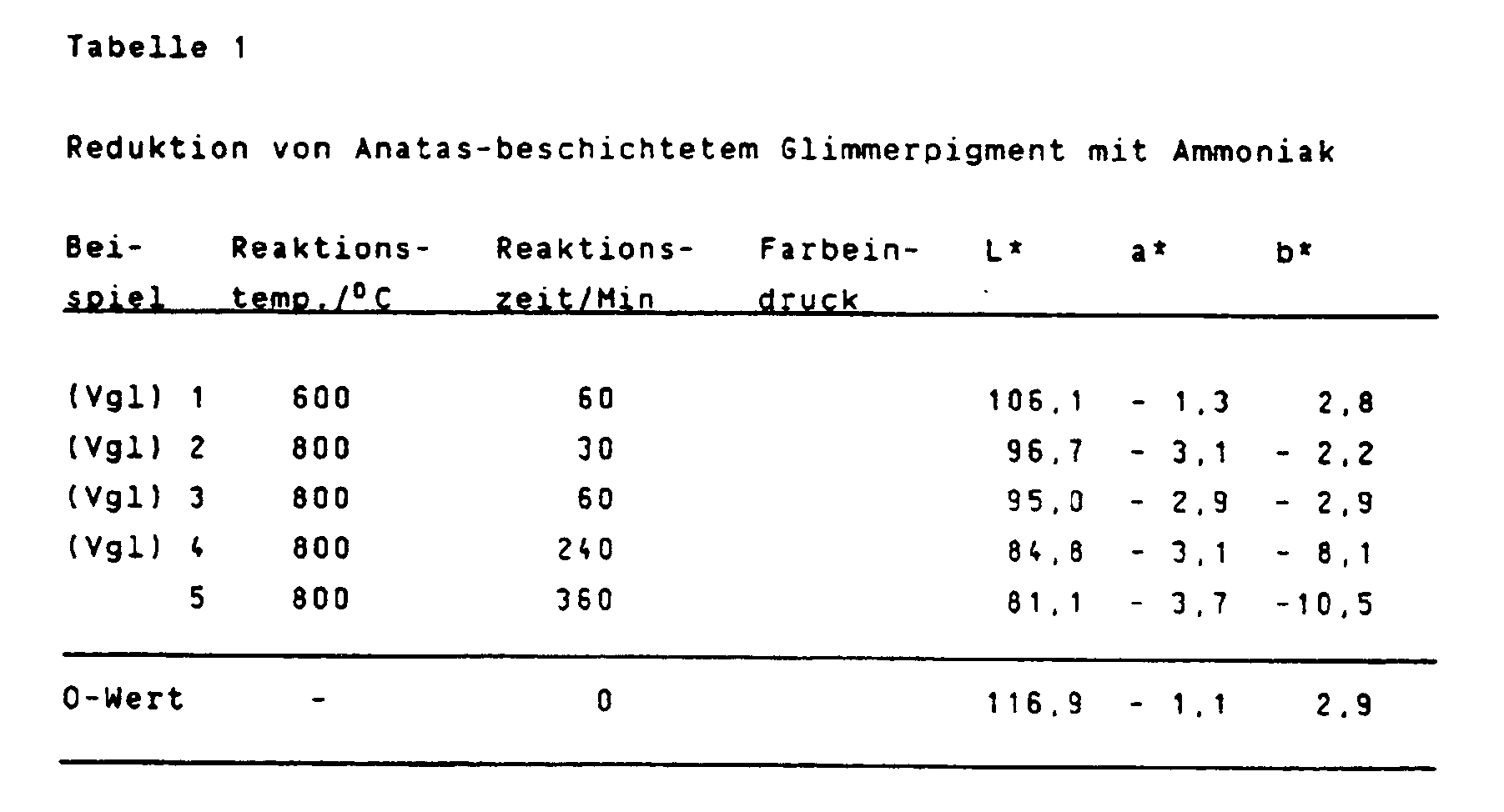
Aus der obigen Tabelle 1 ist zu ersehen, daß bei einer Temperatur von 800°C erst nach 6 Stunden ein besonders blaustichiges Pigment erhalten wird.From Table 1 above it can be seen that at a temperature of 800 ° C a particularly bluish pigment is obtained only after 6 hours.
Die Durchführung erfolgt analog den Beispielen 1 bis 5, nur daß anstelle des Anatas-beschichteten Glimmerpigmentes ein Rutil-beschichtetes Pigment gleichen Titangehaltes und gleicher Teilchendurchmesser und Teilchendicke eingesetzt wird. Auch die optische Dicke der TiO₂-Schicht beträgt 90 bis 100 nm. Die lichtmikroskopische Untersuchung der so gewonnenen Pigmente zeigt, daß sehr homogene Produkte erhalten werden, bei denen jedes Glimmerteilchen einer Charge den gleichen Farbeindruck erzeugt. Die Reaktionsparameter und Ergebnisse der Farbwertmessung sind der Tabelle 2 zu entnehmen.

Aus der Tabelle ist zu ersehen, daß bereits nach 4 Stunden bei einer Temperatur von 800°C ein besonders blaustichiges Pigment erhalten wird, das blaustichiger ist, als das bei längeren Reduktionszeiten aus mit Anatas beschichteten Glimmerpigmenten gemäß Beispiel 5, das aber eine Behandlungszeit von 6 Stunden erfordert.From the table it can be seen that after 4 hours at a temperature of 800 ° C., a particularly bluish tint is obtained which is more bluish than that with longer reduction times from mica pigments coated with anatase according to Example 5, but which has a treatment time of 6 Hours required.
In den unter A) beschriebenen Trommelreaktor werden 200 g eines handelsüblichen Perlglanzpigmentes mit blauer Interferenzfarbe, bestehend aus mit 45,5 Gew.% TiO₂ in der Anatasform beschichteten Glimmerplättchen mit Teil chendurchmessern von 5 bis 50 µm (mittlerer Durchmesser 14,2 µm), Teilchendicken von 0,1 bis 0,5 µm und einer optischen TiO₂-Schichtdicke von 300 bis 340 nm eingefüllt. Unter Drehen des Reaktors (30 U/Min) wird mit Stickstoff inertisiert und auf 800°C aufgeheizt. Nach Erreichen der Temperatur wird auf Begasung mit einer Mischung aus über KOH getrocknetem Ammoniak und getrocknetem Stickstoff (mit 30 Vol.% Ammoniak in der Mischung, Restfeuchte ≦0,02 mg H₂O/l Gas) umgestellt und die Reduktion 60 Minuten durchgeführt. Die Gasmischung durchströmt den Reaktor mit einer Geschwindigkeit von 3,5 cm/sec. Anschließend wird auf Stickstoff-Begasung umgestellt und bis zum Abkühlen weiter gedreht. Das erhaltene Pigment zeigt eine brillante blaue Farbe mit hoher Sättigung. Die lichtmikroskopische Untersuchung zeigt, daß ein sehr homogenes Produkt erhalten wird, bei dem jedes Glimmerteilchen den gleichen Farbeindruck erzeugt. Es werden folgende Farbwerte vermessen:

Die Durchführung des Experimentes erfolgte analog dem Beispiel 15, nur daß anstelle des Anatas-beschichteten Glimmerpigmentes ein Rutil-beschichtetes Pigment gleichen Titangehaltes und gleicher Teilchendurchmesser und Teilchendicke eingesetzt wird. Auch die optische Dicke der TiO₂-Schicht beträgt 300 bis 340 nm. Das erhaltene Produkt zeigt eine äußerst brillante blaue Farbe mit hoher Sättigung. Die lichtmikroskopische Analyse zeigt, daß ein sehr homogenes Produkt erhalten wird, bei dem jedes Glimmerteilchen den gleichen Farbeindruck erzeugt. Es werden folgende Farbwerte vermessen:

In diesem Versuch wird TiO₂-belegtes Glimmerpigment (16,4 Gew.% Ti) mit einer durchschnittlichen cilasgranulometrisch bestimmten Partikelgröße von 22,4 µm eingesetzt. Über 95 % der Partikel haben eine Größe zwischen 12 und 48 µm. Die TiO₂-Belegung hat Rutil-Struktur und ist mit Sn⁺⁴ dotiert (0,7 Gew.% Sn⁴⁺ bezogen auf das Gesamtgewicht des Pigments). Die optische Schichtdicke der TiO₂-Schicht beträgt 90 bis 100 nm.In this experiment, TiO₂-coated mica pigment (16.4% by weight of Ti) with an average particle size of 22.4 µm determined by cilasgranulometry is used. Over 95% of the particles have a size between 12 and 48 µm. The TiO₂ coating has a rutile structure and is doped with Sn⁺⁴ (0.7 wt.% Sn⁴⁺ based on the total weight of the pigment). The optical layer thickness of the TiO₂ layer is 90 to 100 nm.
15 kg dieses Pigments werden in eine außenbeheizte, mit vier 2 cm breiten Stolperleisten ausgekleideten Trommel (Länge 1 m, Durchmesser 0,3 m) eingetragen und unter N₂-Atmosphäre auf 800°C erhitzt.15 kg of this pigment are introduced into an externally heated drum lined with four 2 cm wide trip bars (length 1 m, diameter 0.3 m) and heated to 800 ° C. under an N₂ atmosphere.
Dann wird die Trommel bei 27 U/Min 6 h lang mit auf 600°C erwärmtem NH₃-Gas durchströmt (Restfeuchte ≦0,02 mg H₂O/l NH₃, Strömungsgeschwindigkeit 3,5 cm/sec). Anschließend wird unter Stickstoff abgekühlt.Then the drum is flowed through at 27 rpm for 6 hours with heated to 600 ° C NH₃ gas (residual moisture ≦ 0.02 mg H₂O / l NH₃, flow rate 3.5 cm / sec). It is then cooled under nitrogen.
Das Produkt glänzt tief blauschwarz. Es weist nach der Reduktion eine durchschnittliche cilasgranulometrisch bestimmte mittlere Partikelgröße von 22,8 µm auf. Die Plättchen erscheinen im Mikroskop mit einem homogenen Farbeindruck.The product shines deep blue-black. After the reduction, it has an average particle size of 22.8 μm determined by cilasgranulometry. The platelets appear in the microscope with a homogeneous color impression.
Die Farbwerte sind:

Claims (4)
- A process for preparing a particularly bluish pearl luster pigment by reduction of a titanium dioxide coated mica pigment with ammonia at elevated temperatures, which comprises using a mica pigment whose TiO₂ coating has an optical layer thickness of from 50 to 100 nm or from 300 to 340 nm, performing the treatment with ammonia at from 750 to 850°C in a rotating tube or drum fitted out with trip strips, and thereby keeping the pigment in constant agitation during the reduction.
- A process as claimed in claim 1, wherein the TiO₂ coating on the mica pigment used is exclusively in the rutile phase.
- A process as claimed in claim 1 or 2, wherein the ammonia has been diluted with a gas which is inert toward the reaction components.
- A process as claimed in any of claims 1 to 3, wherein the TiO₂ coating of the starting pigment has been doped with a compound of hexavalent tungsten, hexavalent molybdenum and/or tetravalent tin.
Applications Claiming Priority (2)
| Application Number | Priority Date | Filing Date | Title |
|---|---|---|---|
| DE3808070A DE3808070A1 (en) | 1988-03-11 | 1988-03-11 | METHOD FOR PRODUCING PARTICULARLY BLUE-TONE PEARL PIGMENTS |
| DE3808070 | 1988-03-11 |
Publications (3)
| Publication Number | Publication Date |
|---|---|
| EP0332071A1 EP0332071A1 (en) | 1989-09-13 |
| EP0332071B1 EP0332071B1 (en) | 1992-02-26 |
| EP0332071B2 true EP0332071B2 (en) | 1995-11-15 |
Family
ID=6349440
Family Applications (1)
| Application Number | Title | Priority Date | Filing Date |
|---|---|---|---|
| EP89103742A Expired - Lifetime EP0332071B2 (en) | 1988-03-11 | 1989-03-03 | Process for preparing especially bluish nacreous pigments |
Country Status (6)
| Country | Link |
|---|---|
| US (1) | US4948631A (en) |
| EP (1) | EP0332071B2 (en) |
| JP (1) | JP2728294B2 (en) |
| DE (1) | DE3808070A1 (en) |
| ES (1) | ES2038350T5 (en) |
| FI (1) | FI92839C (en) |
Families Citing this family (44)
| Publication number | Priority date | Publication date | Assignee | Title |
|---|---|---|---|---|
| FI85548C (en) * | 1990-06-14 | 1992-04-27 | Nokia Oy Ab | MOTTAGNINGSFOERFARANDE OCH MOTTAGARE FOER DISKRETA SIGNALER. |
| DE4137860A1 (en) * | 1991-11-16 | 1993-05-19 | Merck Patent Gmbh | INTERFERENCE PIGMENTS |
| DE69307501T2 (en) * | 1992-03-26 | 1997-06-12 | Merck Patent Gmbh | PLATE-SHAPED PIGMENTS AND THEIR PRODUCTION PROCESS |
| DE4238380B4 (en) * | 1992-11-13 | 2004-02-19 | Merck Patent Gmbh | Process for coating substrate materials with a glossy coating |
| DE4419089A1 (en) * | 1994-06-01 | 1995-12-07 | Basf Ag | Interference pigments used for security documents and packaging |
| DE4421933A1 (en) * | 1994-06-23 | 1996-01-04 | Basf Ag | Glossy pigments with nitrogen-containing metal layers |
| JP3542388B2 (en) * | 1994-10-11 | 2004-07-14 | 株式会社資生堂 | Pigment containing low order titanium oxide and method for producing the same |
| DE19511696A1 (en) * | 1995-03-30 | 1996-10-02 | Basf Ag | Luster pigments based on reduced titanium dioxide coated silicate flakes |
| DE19511697A1 (en) * | 1995-03-30 | 1996-10-02 | Basf Ag | Process for the preparation of bluish gloss pigments |
| DE19525503A1 (en) | 1995-07-13 | 1997-01-16 | Basf Ag | Goniochromatic gloss pigments based on transparent, non-metallic, platelet-shaped substrates |
| DE59704636D1 (en) * | 1996-04-25 | 2001-10-25 | Ciba Sc Holding Ag | Colored gloss pigments |
| US5958125A (en) * | 1996-07-05 | 1999-09-28 | Schmid; Raimund | Goniochromatic luster pigments based on transparent, nonmetallic, platelet-shaped substrates |
| DE19640188A1 (en) * | 1996-09-30 | 1998-07-02 | Basf Ag | Condensation-resistant, bluish gloss pigments |
| DE19822046A1 (en) * | 1998-05-16 | 1999-11-18 | Basf Ag | Goniochromatic gloss pigments based on heated, titanium-coated silicate plates in a reducing atmosphere |
| US6056815A (en) * | 1999-03-08 | 2000-05-02 | Em Industries, Inc. | Methods and compositions related to pearlescent pigments |
| US6794065B1 (en) * | 1999-08-05 | 2004-09-21 | Kabushiki Kaisha Toyota Chuo Kenkyusho | Photocatalytic material and photocatalytic article |
| DE19953655A1 (en) | 1999-11-08 | 2001-05-10 | Basf Ag | Goniochromatic gloss pigments based on heated, titanium dioxide-coated silicate flakes in a reducing atmosphere |
| DE10137831A1 (en) | 2001-08-02 | 2003-02-13 | Merck Patent Gmbh | Multilayer interference pigments |
| DE10151844A1 (en) | 2001-10-24 | 2003-05-08 | Merck Patent Gmbh | Colored interference pigments |
| CA2494902A1 (en) | 2002-10-16 | 2004-04-29 | Patrice Bujard | Reducing pigments |
| KR20070051345A (en) | 2004-08-23 | 2007-05-17 | 시바 스페셜티 케미칼스 홀딩 인크. | Manufacturing method of flake pigment based on aluminum and SiOZ (Z = 0.7-2.0) |
| US8349067B2 (en) | 2006-11-09 | 2013-01-08 | Sun Chemical Corp. | Multi-colored lustrous pearlescent pigments |
| US7850775B2 (en) | 2006-11-09 | 2010-12-14 | Sun Chemical Corporation | Multi-colored lustrous pearlescent pigments |
| US8323396B2 (en) * | 2006-11-09 | 2012-12-04 | Sun Chemical Corp. | Orange pearlescent pigments |
| US8221536B2 (en) | 2006-11-09 | 2012-07-17 | Sun Chemical Corp. | Cosmetic comprising multi-colored lustrous pearlescent pigments |
| US8211224B2 (en) * | 2006-11-09 | 2012-07-03 | Sun Chemical Corp. | Multi-colored lustrous pearlescent pigments and process for making |
| US8906154B2 (en) * | 2006-11-09 | 2014-12-09 | Sun Chemical Corporation | Coating, ink, or article comprising multi-colored lustrous pearlescent pigments |
| US20100011992A1 (en) * | 2007-01-11 | 2010-01-21 | Patrice Bujard | Pigment mixtures |
| KR20100056459A (en) | 2007-07-12 | 2010-05-27 | 바스프 에스이 | Interference pigments on the basis of perlite flakes |
| US20100322981A1 (en) * | 2007-11-16 | 2010-12-23 | Basf Se | Bright interference pigments |
| US8211225B2 (en) | 2008-04-09 | 2012-07-03 | Sun Chemical Corp. | Magnetic pigments and process of enhancing magnetic properties |
| JP2010185073A (en) * | 2009-01-13 | 2010-08-26 | Ako Kasei Co Ltd | Dichroism pigment which has vivid appearance color and interference color |
| US8936799B2 (en) | 2009-10-28 | 2015-01-20 | Basf Se | Pigments with improved sparkling effect |
| CN102741358B (en) | 2010-02-04 | 2015-11-25 | 巴斯夫欧洲公司 | There is the color compositions improving sparkle effect |
| KR101834029B1 (en) | 2010-07-28 | 2018-03-02 | 바스프 에스이 | Use of perlite based effect pigments for finishes with antique, or patina appearance |
| US8585818B1 (en) * | 2013-03-14 | 2013-11-19 | Basf Se | Coated perlite flakes |
| WO2014202179A1 (en) | 2013-06-17 | 2014-12-24 | Merck Patent Gmbh | Transparent, electrically semiconducting interference pigments with high color strength |
| DE102016004164A1 (en) | 2016-04-11 | 2017-10-12 | Merck Patent Gmbh | pigment mixture |
| CN112004891A (en) | 2018-04-04 | 2020-11-27 | 阿尔塔纳股份公司 | Effect pigments based on pigmented hectorite and coated pigmented hectorite and their manufacture |
| US11421111B2 (en) | 2019-04-12 | 2022-08-23 | Eckart Gmbh | Radar frequency transparent effect pigment mixture, formulations and coatings thereof |
| WO2023275359A1 (en) | 2021-07-02 | 2023-01-05 | Heliosonic Gmbh | Radiation induced printing method using an effect pigment mixture |
| US20250263536A1 (en) | 2022-10-14 | 2025-08-21 | Eckart Gmbh | Recyclable plastic parts with metallic appearance and being automatically recognizable by nir spectroscopy and sortable |
| EP4638608A1 (en) | 2022-12-21 | 2025-10-29 | ECKART GmbH | Radar transparent mixtures of metal effect pigmets with semiconductor effect pigmentsor semiconductor effect pigments with silvery absorbing pearlescent pigments and coating formulations thereof |
| WO2025219190A1 (en) | 2024-04-17 | 2025-10-23 | Eckart Gmbh | Effect pigment preparation for powder coating |
Family Cites Families (5)
| Publication number | Priority date | Publication date | Assignee | Title |
|---|---|---|---|---|
| JPS58164653A (en) * | 1982-03-26 | 1983-09-29 | Mitsubishi Metal Corp | Production of dark iridescent pigment |
| JPS58184570A (en) * | 1982-04-22 | 1983-10-28 | Rhythm Watch Co Ltd | Double whole body swing type time piece |
| JPS59126468A (en) * | 1983-01-11 | 1984-07-21 | Shiseido Co Ltd | Pigment composed of mica and titanium |
| US4623396A (en) * | 1983-09-14 | 1986-11-18 | Shiseido Company Ltd. | Titanium-mica composite material |
| JPS61392A (en) * | 1984-06-12 | 1986-01-06 | 株式会社三協精機製作所 | Timer apparatus of washing machine |
-
1988
- 1988-03-11 DE DE3808070A patent/DE3808070A1/en not_active Withdrawn
-
1989
- 1989-03-03 ES ES89103742T patent/ES2038350T5/en not_active Expired - Lifetime
- 1989-03-03 EP EP89103742A patent/EP0332071B2/en not_active Expired - Lifetime
- 1989-03-09 US US07/321,109 patent/US4948631A/en not_active Expired - Lifetime
- 1989-03-09 FI FI891130A patent/FI92839C/en not_active IP Right Cessation
- 1989-03-13 JP JP1058035A patent/JP2728294B2/en not_active Expired - Fee Related
Also Published As
| Publication number | Publication date |
|---|---|
| US4948631A (en) | 1990-08-14 |
| FI891130L (en) | 1989-09-12 |
| EP0332071A1 (en) | 1989-09-13 |
| ES2038350T5 (en) | 1996-01-01 |
| FI891130A0 (en) | 1989-03-09 |
| ES2038350T3 (en) | 1993-07-16 |
| DE3808070A1 (en) | 1989-09-21 |
| JP2728294B2 (en) | 1998-03-18 |
| FI92839B (en) | 1994-09-30 |
| FI92839C (en) | 1995-01-10 |
| JPH01275665A (en) | 1989-11-06 |
| EP0332071B1 (en) | 1992-02-26 |
Similar Documents
| Publication | Publication Date | Title |
|---|---|---|
| EP0332071B2 (en) | Process for preparing especially bluish nacreous pigments | |
| EP0338428B1 (en) | Metal oxide coated aluminium pigments | |
| EP0580022B1 (en) | Brilliant pigments based on aluminium platelets coated with metal oxide and with total carbon content lower than one tenth per cent weight | |
| DE3433657C2 (en) | ||
| EP0616626B2 (en) | Glossy pigments based on platelike silicate substrates provided with multiple coatings | |
| EP3283573B1 (en) | Pearlescent pigments based on monolithic substrates, method for production and use of the pearlescent pigments | |
| EP0579091B2 (en) | Lustrons pigments with metal sulfide coating | |
| EP0571836B1 (en) | Brilliant pigments consisting of flaky metallic substrates with multiple coatings | |
| EP0381047B1 (en) | Glossy pigments coated with a metal oxide | |
| EP0803549B1 (en) | Brilliant coloured pigments | |
| DE69016099T2 (en) | Chromatic pigments based on titanium dioxide. | |
| EP1335005B1 (en) | Coloured effect pigments and their use | |
| EP0265820B1 (en) | Platelet-shaped substituted iron oxide pigments | |
| EP0697373B1 (en) | Oxynitride-based coloured pigments and process for their preparation | |
| EP0283852B1 (en) | Pigments in the form of platelets based on iron oxide | |
| DE1959998A1 (en) | Pearlescent pigments and processes for their manufacture | |
| EP0293746B1 (en) | Two-phase platelet-shaped pigment | |
| DE4319669A1 (en) | New lustrous blue pigments - comprising lamellar substrate coated with colourless oxide and mixed molybdenum and/or tungsten oxide | |
| DE1467456A1 (en) | Process for the production of pigments | |
| DE3718446A1 (en) | Two-phase pigment in flake form | |
| DE2344196C2 (en) | Glazing yellow iron oxide pigment | |
| DE69620079T2 (en) | Flaky yellow powder | |
| EP0718378A2 (en) | Non-brilliant coloured pigments | |
| DE69231744T2 (en) | Flaky pigments based on flaky particles made of oxidized graphite | |
| EP4339246B1 (en) | Yellow metal interference pigments having a green sting, a method for the production thereof and use thereof |
Legal Events
| Date | Code | Title | Description |
|---|---|---|---|
| PUAI | Public reference made under article 153(3) epc to a published international application that has entered the european phase |
Free format text: ORIGINAL CODE: 0009012 |
|
| 17P | Request for examination filed |
Effective date: 19890707 |
|
| AK | Designated contracting states |
Kind code of ref document: A1 Designated state(s): BE CH ES FR GB IT LI NL SE |
|
| 17Q | First examination report despatched |
Effective date: 19910521 |
|
| GRAA | (expected) grant |
Free format text: ORIGINAL CODE: 0009210 |
|
| AK | Designated contracting states |
Kind code of ref document: B1 Designated state(s): BE CH ES FR GB IT LI NL SE |
|
| ITF | It: translation for a ep patent filed | ||
| GBT | Gb: translation of ep patent filed (gb section 77(6)(a)/1977) | ||
| ET | Fr: translation filed | ||
| PLBI | Opposition filed |
Free format text: ORIGINAL CODE: 0009260 |
|
| PLBI | Opposition filed |
Free format text: ORIGINAL CODE: 0009260 |
|
| 26 | Opposition filed |
Opponent name: MERCK PATENT GMBH Effective date: 19921104 |
|
| 26 | Opposition filed |
Opponent name: SHISEIDO COMP. LTD. Effective date: 19921125 Opponent name: MERCK PATENT GMBH Effective date: 19921104 |
|
| NLR1 | Nl: opposition has been filed with the epo |
Opponent name: MERCK PATENT GMBH |
|
| NLR1 | Nl: opposition has been filed with the epo |
Opponent name: SHISEIDO COMP. LTD. |
|
| EAL | Se: european patent in force in sweden |
Ref document number: 89103742.6 |
|
| PUAH | Patent maintained in amended form |
Free format text: ORIGINAL CODE: 0009272 |
|
| STAA | Information on the status of an ep patent application or granted ep patent |
Free format text: STATUS: PATENT MAINTAINED AS AMENDED |
|
| 27A | Patent maintained in amended form |
Effective date: 19951115 |
|
| AK | Designated contracting states |
Kind code of ref document: B2 Designated state(s): BE CH ES FR GB IT LI NL SE |
|
| REG | Reference to a national code |
Ref country code: CH Ref legal event code: AEN Free format text: AUFRECHTERHALTUNG DES PATENTES IN GEAENDERTER FORM |
|
| REG | Reference to a national code |
Ref country code: ES Ref legal event code: DC2A Kind code of ref document: T5 Effective date: 19960101 |
|
| NLR2 | Nl: decision of opposition | ||
| GBTA | Gb: translation of amended ep patent filed (gb section 77(6)(b)/1977) |
Effective date: 19951129 |
|
| ET3 | Fr: translation filed ** decision concerning opposition | ||
| ITF | It: translation for a ep patent filed | ||
| NLR3 | Nl: receipt of modified translations in the netherlands language after an opposition procedure | ||
| PGFP | Annual fee paid to national office [announced via postgrant information from national office to epo] |
Ref country code: SE Payment date: 19980227 Year of fee payment: 10 |
|
| PGFP | Annual fee paid to national office [announced via postgrant information from national office to epo] |
Ref country code: CH Payment date: 19980311 Year of fee payment: 10 |
|
| PGFP | Annual fee paid to national office [announced via postgrant information from national office to epo] |
Ref country code: NL Payment date: 19980312 Year of fee payment: 10 |
|
| PGFP | Annual fee paid to national office [announced via postgrant information from national office to epo] |
Ref country code: BE Payment date: 19980320 Year of fee payment: 10 |
|
| PG25 | Lapsed in a contracting state [announced via postgrant information from national office to epo] |
Ref country code: SE Free format text: LAPSE BECAUSE OF NON-PAYMENT OF DUE FEES Effective date: 19990304 |
|
| PG25 | Lapsed in a contracting state [announced via postgrant information from national office to epo] |
Ref country code: CH Free format text: LAPSE BECAUSE OF NON-PAYMENT OF DUE FEES Effective date: 19990331 Ref country code: LI Free format text: LAPSE BECAUSE OF NON-PAYMENT OF DUE FEES Effective date: 19990331 Ref country code: BE Free format text: LAPSE BECAUSE OF NON-PAYMENT OF DUE FEES Effective date: 19990331 |
|
| BERE | Be: lapsed |
Owner name: BASF A.G. Effective date: 19990331 |
|
| PG25 | Lapsed in a contracting state [announced via postgrant information from national office to epo] |
Ref country code: NL Free format text: LAPSE BECAUSE OF NON-PAYMENT OF DUE FEES Effective date: 19991001 |
|
| EUG | Se: european patent has lapsed |
Ref document number: 89103742.6 |
|
| REG | Reference to a national code |
Ref country code: CH Ref legal event code: PL |
|
| NLV4 | Nl: lapsed or anulled due to non-payment of the annual fee |
Effective date: 19991001 |
|
| EUG | Se: european patent has lapsed |
Ref document number: 89103742.6 |
|
| REG | Reference to a national code |
Ref country code: GB Ref legal event code: IF02 |
|
| PGFP | Annual fee paid to national office [announced via postgrant information from national office to epo] |
Ref country code: GB Payment date: 20080227 Year of fee payment: 20 Ref country code: IT Payment date: 20080327 Year of fee payment: 20 |
|
| PGFP | Annual fee paid to national office [announced via postgrant information from national office to epo] |
Ref country code: ES Payment date: 20080418 Year of fee payment: 20 Ref country code: FR Payment date: 20080311 Year of fee payment: 20 |
|
| REG | Reference to a national code |
Ref country code: GB Ref legal event code: PE20 Expiry date: 20090302 |
|
| REG | Reference to a national code |
Ref country code: ES Ref legal event code: FD2A Effective date: 20090304 |
|
| PG25 | Lapsed in a contracting state [announced via postgrant information from national office to epo] |
Ref country code: GB Free format text: LAPSE BECAUSE OF EXPIRATION OF PROTECTION Effective date: 20090302 |
|
| PG25 | Lapsed in a contracting state [announced via postgrant information from national office to epo] |
Ref country code: ES Free format text: LAPSE BECAUSE OF EXPIRATION OF PROTECTION Effective date: 20090304 |