EP0332122A2 - Scheinwerferreflektor aus synthetischem thermoplastischem Polymer und Verfahren zu seiner Herstellung - Google Patents
Scheinwerferreflektor aus synthetischem thermoplastischem Polymer und Verfahren zu seiner Herstellung Download PDFInfo
- Publication number
- EP0332122A2 EP0332122A2 EP89103938A EP89103938A EP0332122A2 EP 0332122 A2 EP0332122 A2 EP 0332122A2 EP 89103938 A EP89103938 A EP 89103938A EP 89103938 A EP89103938 A EP 89103938A EP 0332122 A2 EP0332122 A2 EP 0332122A2
- Authority
- EP
- European Patent Office
- Prior art keywords
- fact
- reflector
- phase
- thermoplastic polymer
- conductive material
- Prior art date
- Legal status (The legal status is an assumption and is not a legal conclusion. Google has not performed a legal analysis and makes no representation as to the accuracy of the status listed.)
- Ceased
Links
Images

Classifications
-
- B—PERFORMING OPERATIONS; TRANSPORTING
- B29—WORKING OF PLASTICS; WORKING OF SUBSTANCES IN A PLASTIC STATE IN GENERAL
- B29C—SHAPING OR JOINING OF PLASTICS; SHAPING OF MATERIAL IN A PLASTIC STATE, NOT OTHERWISE PROVIDED FOR; AFTER-TREATMENT OF THE SHAPED PRODUCTS, e.g. REPAIRING
- B29C45/00—Injection moulding, i.e. forcing the required volume of moulding material through a nozzle into a closed mould; Apparatus therefor
- B29C45/0013—Injection moulding, i.e. forcing the required volume of moulding material through a nozzle into a closed mould; Apparatus therefor using fillers dispersed in the moulding material, e.g. metal particles
-
- F—MECHANICAL ENGINEERING; LIGHTING; HEATING; WEAPONS; BLASTING
- F21—LIGHTING
- F21S—NON-PORTABLE LIGHTING DEVICES; SYSTEMS THEREOF; VEHICLE LIGHTING DEVICES SPECIALLY ADAPTED FOR VEHICLE EXTERIORS
- F21S41/00—Illuminating devices specially adapted for vehicle exteriors, e.g. headlamps
- F21S41/30—Illuminating devices specially adapted for vehicle exteriors, e.g. headlamps characterised by reflectors
- F21S41/37—Illuminating devices specially adapted for vehicle exteriors, e.g. headlamps characterised by reflectors characterised by their material, surface treatment or coatings
-
- F—MECHANICAL ENGINEERING; LIGHTING; HEATING; WEAPONS; BLASTING
- F21—LIGHTING
- F21V—FUNCTIONAL FEATURES OR DETAILS OF LIGHTING DEVICES OR SYSTEMS THEREOF; STRUCTURAL COMBINATIONS OF LIGHTING DEVICES WITH OTHER ARTICLES, NOT OTHERWISE PROVIDED FOR
- F21V7/00—Reflectors for light sources
- F21V7/22—Reflectors for light sources characterised by materials, surface treatments or coatings, e.g. dichroic reflectors
- F21V7/24—Reflectors for light sources characterised by materials, surface treatments or coatings, e.g. dichroic reflectors characterised by the material
-
- F—MECHANICAL ENGINEERING; LIGHTING; HEATING; WEAPONS; BLASTING
- F21—LIGHTING
- F21V—FUNCTIONAL FEATURES OR DETAILS OF LIGHTING DEVICES OR SYSTEMS THEREOF; STRUCTURAL COMBINATIONS OF LIGHTING DEVICES WITH OTHER ARTICLES, NOT OTHERWISE PROVIDED FOR
- F21V7/00—Reflectors for light sources
- F21V7/22—Reflectors for light sources characterised by materials, surface treatments or coatings, e.g. dichroic reflectors
- F21V7/28—Reflectors for light sources characterised by materials, surface treatments or coatings, e.g. dichroic reflectors characterised by coatings
-
- B—PERFORMING OPERATIONS; TRANSPORTING
- B29—WORKING OF PLASTICS; WORKING OF SUBSTANCES IN A PLASTIC STATE IN GENERAL
- B29L—INDEXING SCHEME ASSOCIATED WITH SUBCLASS B29C, RELATING TO PARTICULAR ARTICLES
- B29L2011/00—Optical elements, e.g. lenses, prisms
- B29L2011/0083—Reflectors
Definitions
- the present invention relates to a method for the production of a headlamp reflector (in particular for land, air and sea vehicles of any type and dimensions) made of a synthetic thermoplastic polymer.
- headlamp reflectors particularly for vehicles, can be made in sheet metal or, alternatively, in thermosetting plastics materal, which is injection moulded into the shape required for the reflector, and which is subsequently painted for the purpose of imparting the necessary reflectance characteristics before the final aluminising under vacuum.
- the method of manufacturing such thermosetting reflectors which are currently preferred to those of sheet metal, is however rather expensive both because of the rather high percentage of rejects which occur at the end of the moulding phase, connected with the characteristics of injection moulding of thermosetting materials, and also because of the burden of producing the associated installations for production of such thermosetting articles.
- reflectors of thermoplastic material have also been made, but these suffer a degeneration in their photometric characteristics in relation to the heat caused by the lamp.
- the principal object of the present invention is therefore that of providing a method for the production of a headlamp reflector made from a synthetic thermoplastic polymer which overcomes the above indicated disadvantage and which, therefore, will offer the characteristic advantages of production economy whilst at the same time being adapted to receive the application of a paint which has the necessary characteristics (extension and reflectance) for headlamp reflectors, in particular for motor vehicles, so as to guarantee the constancy of the required photometric performance.
- the said object is achieved by the present invention in that it relates to a method for the manufacture of a headlamp reflector made of synthetic thermoplastic polymer, characterised by the fact that it comprises a first phase of producing the structure of the said reflector by moulding the said synthetic thermoplastic polymer including a percentage of conductive material such as to confer on it a volume resistivity less than 108 ohm.cm, and a second phase of electrostatically painting the said moulded reflector.
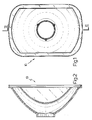
- the starting material is constituted by polyphenylene sulphide having a percentage of a conductive material such as to confer on it a volume resistivity less than 108 ohm.cm, and a headlamp reflector is formed by injection moulding to a conventional shape with parabolic portions one type of which is illustrated in Figures 1 and 2 and indicated with the reference numeral 10, such as are utilised for European motor vehicles.
- This base material is the subject of Italian Patent application entitled “Synthetic thermoplastic polymer based on polyphenylene sulphide” filed on the same date by the same applicant and the contents of which are incorporated here by reference as far as necessary; it is obtained from a stock mixture, comprising the basic polyphenylene sulphide having possible glass fibre and/or mineral fillers, mixed with the maximum percentage (25%) of the carbonaceous material (conveniently carbon black), by mixture with the polyphenylene sulphide itself in variable percentages according to the value of volume resistivity desired in the final material.
- the final percentage by weight of conductive material can vary between 1% and 25% so as to confer on the final material a volume resistivity less than 108 ohm.cm; for particular applications such as the subsequent electrostatic painting of headlamp reflectors an optimum value of the volume resistivity is about 104 ohm.cm, which can be obtained with a percentage of carbon black equal to about 5%, which gives a good compromise between the requirements of electrostatic paintability and those of not excessively modifying the mechanical characteristics.
- an injection moulding machine of the screw drive type for thermoplastic materials with plasticising temperature control up to 400°C plus or minus 3°C, with parameters of injection speed, injection pressure, post pressure and counter pressure controlled in a closed loop by means of servo valves with process control which allows for the automatic correction of the metering rate to compensate for possible variations in material density during the plasticising phase, and with a closure unit of mechanical toggle type with means for monitoring the mould clamping force and twist of each column.
- the air vents are formed with 5 mm wide apertures of a depth from 0.01 to 0.02 mm along the closure lines of the mould; the injection point is of the submerged, or direct or fan type.
- the accessories comprise: drying apparatus composed of a molecular sieve dehumidifier with dry air heating up to 170°C; insulating hopper in stainless steel of a capacity sufficient to hold granules at a temperature of about 150°C for six hours;
- a diathermic oil mould conditioning control unit for the temperature regulation of the moulding parts at a temperature between 130 and 170°C.
- the reflector 10 obtained by moulding is then subjected to an electrostatic paint treatment which can be achieved thanks to the electrical conductivity characteristics of the material constituting the reflector itself.
- the reference numeral 20 indicates a station, of conventional type, where moulded reflectors 10 are loaded onto a transport conveyor to be conveyed through subsequent stations the first of which is an electrostatic powder painting station provided in a conventional manner with a powder distribution unit 20 and a powder recovery unit 23; downstream from the painting station 21 there is a polymerisation oven 24, downstream from which there is finally a discharge station 25 for the painted reflectors 10.
- FIG 4 there is on the other hand shown a block diagram of the beginning of the cycle for performing electrostatic painting with liquid paints, which is different from the diagram of Figure 3 by the different type of electrostatic painting station (now a liquid painting station indicated with the numeral 21′) provided in a conventional manner with a liquid paint delivery unit 22′, and by the fact that downstream from the painting station 21′ before the polymerisation furnace 24, there is a drying furnace 27.
- the different type of electrostatic painting station now a liquid painting station indicated with the numeral 21′
- a drying furnace 27 downstream from the painting station 21′ before the polymerisation furnace
- conveyor speed 4 m/min supply pressure 1.5 bar voltage 60-70 KV gun to workpiece distance 70 mm paint thickness (after polymerisation) 30-40 ⁇ m paint viscosity 22"CF4 at 20°C drying 5 minutes baking 30 minutes at 140°C
- the paints utilised must have a high stretching (which translates into a high degree of lack of surface irregularities in the painted surface) and reflectance (which translates into a high coefficient of reflection of a painted surface), beyond the usual characteristics required of a paint, among which are included an excellent adherence to the support; the headlamp reflectors thus painted therefore have the necessary reflectance to be able to effect subsequent aluminising under vacuum which otherwise would result in them being lustreless.
- a headlamp reflector can be obtained by means of injection moulding of a synthetic conductive polymer based on polyphenylene suphide and subsequent electrostatic painting exploiting the electrical conductivity characteristics of this thermoplastic material so that it can be perfectly painted, combined with the fundamental characteristics of ease of moulding, with high resistance to external agents (such as hydrocarbons) and to heat, for which this reflector can be produced at relatively low cost and with significant advantages with respect to the utilisation of both thermoplastic and thermosetting materials.
- this reflector can be formed differently on the basis of a preselected mathematical formula for representation of the reflecting surface.
Landscapes
- Engineering & Computer Science (AREA)
- General Engineering & Computer Science (AREA)
- Chemical & Material Sciences (AREA)
- Dispersion Chemistry (AREA)
- Manufacturing & Machinery (AREA)
- Mechanical Engineering (AREA)
- Non-Portable Lighting Devices Or Systems Thereof (AREA)
Applications Claiming Priority (2)
| Application Number | Priority Date | Filing Date | Title |
|---|---|---|---|
| IT8867188A IT1219085B (it) | 1988-03-08 | 1988-03-08 | Procedimento per la realizzazione di un riflettore per proiettore costituito da un tecnopolimero termoplastico e riflettore per proiettore realizzato tramite il sud detto procedimento |
| IT6718888 | 1988-03-08 |
Publications (2)
| Publication Number | Publication Date |
|---|---|
| EP0332122A2 true EP0332122A2 (de) | 1989-09-13 |
| EP0332122A3 EP0332122A3 (de) | 1990-12-05 |
Family
ID=11300326
Family Applications (1)
| Application Number | Title | Priority Date | Filing Date |
|---|---|---|---|
| EP19890103938 Ceased EP0332122A3 (de) | 1988-03-08 | 1989-03-06 | Scheinwerferreflektor aus synthetischem thermoplastischem Polymer und Verfahren zu seiner Herstellung |
Country Status (2)
| Country | Link |
|---|---|
| EP (1) | EP0332122A3 (de) |
| IT (1) | IT1219085B (de) |
Cited By (6)
| Publication number | Priority date | Publication date | Assignee | Title |
|---|---|---|---|---|
| EP0351793A3 (de) * | 1988-07-19 | 1991-07-17 | VALEO VISION S.p.A. | Verfahren zur Herstellung von Scheinwerferreflektoren aus thermoplastischem Kunststoff und ein durch ein solches Verfahren hergestellter Scheinwerferreflektor |
| DE4311667A1 (de) * | 1993-04-08 | 1994-10-13 | Bosch Gmbh Robert | Reflektor für Fahrzeugscheinwerfer und Verfahren zu dessen Herstellung |
| DE4401813A1 (de) * | 1994-01-22 | 1995-07-27 | Hella Kg Hueck & Co | Hochwärmebelastbare Formteile |
| WO2002083775A1 (en) * | 2001-04-11 | 2002-10-24 | Sgl Technic, Inc. | Method of preparing expanded graphite containing polymer material and use thereof |
| WO2004022651A3 (en) * | 2002-09-06 | 2004-05-06 | Ems Chemie Ag | Method of producing polyamide nanocomposites and injection molded parts producible therefrom |
| US7875361B2 (en) | 2005-11-09 | 2011-01-25 | Ems-Chemie Ag | Metallically coated light-reflecting components based on thermoplastic molding compounds |
Family Cites Families (3)
| Publication number | Priority date | Publication date | Assignee | Title |
|---|---|---|---|---|
| US3535294A (en) * | 1966-12-08 | 1970-10-20 | Lion Fat Oil Co Ltd | Method for electrostatically coating synthetic resin moldings |
| DE3322016C2 (de) * | 1983-06-18 | 1986-07-10 | Audi AG, 8070 Ingolstadt | Verwendung von Thermoplasten oder UP-Harz-Spritzgießmassen mit homogen verteilten elektrisch leitenden Fasern |
| US4794026A (en) * | 1985-05-24 | 1988-12-27 | Phillips Petroleum Company | Reflector construction |
-
1988
- 1988-03-08 IT IT8867188A patent/IT1219085B/it active
-
1989
- 1989-03-06 EP EP19890103938 patent/EP0332122A3/de not_active Ceased
Cited By (8)
| Publication number | Priority date | Publication date | Assignee | Title |
|---|---|---|---|---|
| EP0351793A3 (de) * | 1988-07-19 | 1991-07-17 | VALEO VISION S.p.A. | Verfahren zur Herstellung von Scheinwerferreflektoren aus thermoplastischem Kunststoff und ein durch ein solches Verfahren hergestellter Scheinwerferreflektor |
| DE4311667A1 (de) * | 1993-04-08 | 1994-10-13 | Bosch Gmbh Robert | Reflektor für Fahrzeugscheinwerfer und Verfahren zu dessen Herstellung |
| EP0623782A3 (de) * | 1993-04-08 | 1995-07-12 | Bosch Gmbh Robert | Reflektor für Fahrzeugscheinwerfer und Verfahren zu dessen Herstellung. |
| DE4401813A1 (de) * | 1994-01-22 | 1995-07-27 | Hella Kg Hueck & Co | Hochwärmebelastbare Formteile |
| US6746626B2 (en) | 1994-06-20 | 2004-06-08 | Sgl Technic Inc. | Graphite polymers and methods of use |
| WO2002083775A1 (en) * | 2001-04-11 | 2002-10-24 | Sgl Technic, Inc. | Method of preparing expanded graphite containing polymer material and use thereof |
| WO2004022651A3 (en) * | 2002-09-06 | 2004-05-06 | Ems Chemie Ag | Method of producing polyamide nanocomposites and injection molded parts producible therefrom |
| US7875361B2 (en) | 2005-11-09 | 2011-01-25 | Ems-Chemie Ag | Metallically coated light-reflecting components based on thermoplastic molding compounds |
Also Published As
| Publication number | Publication date |
|---|---|
| IT1219085B (it) | 1990-04-24 |
| EP0332122A3 (de) | 1990-12-05 |
| IT8867188A0 (it) | 1988-03-08 |
Similar Documents
| Publication | Publication Date | Title |
|---|---|---|
| US5094607A (en) | Thermoplastic mold for rotational molding | |
| US4980112A (en) | Method for rotational molding | |
| US4915764A (en) | Method of making panels | |
| US4792424A (en) | Method of injection molding PVC products | |
| US4440593A (en) | Reinforced plastic composite articles and apparatus and method for producing same | |
| KR930000742B1 (ko) | 인발 성형방법, 그 장치 및 그 제품 | |
| JP3954195B2 (ja) | タイヤ成型装置およびそれを用いたタイヤ成型方法 | |
| EP0332122A2 (de) | Scheinwerferreflektor aus synthetischem thermoplastischem Polymer und Verfahren zu seiner Herstellung | |
| JPH0564822A (ja) | プラスチツク製成形品の製造装置及び方法 | |
| US4601652A (en) | Apparatus for producing a molded skin product | |
| US4146565A (en) | Rotational molding of hollow articles of uniform wall thickness | |
| CA2275316A1 (en) | Method for producing reactive plastic molded bodies with highly filled coarse-grained filling material | |
| US3988089A (en) | Apparatus for manufacturing curved bodies of fiber reinforced plastic | |
| EP0351793A2 (de) | Verfahren zur Herstellung von Scheinwerferreflektoren aus thermoplastischem Kunststoff und ein durch ein solches Verfahren hergestellter Scheinwerferreflektor | |
| US4690632A (en) | Method and apparatus for molding hollow articles | |
| US20070063370A1 (en) | Molding system and method | |
| CN213260995U (zh) | 一种用于塑料制品挤出成型的驱动装置 | |
| US10252449B1 (en) | Rotational molding with pre-formed shapes | |
| US3184525A (en) | Method of molding a film from a fluorine-containing resin | |
| CN117885314B (zh) | 一种聚四氟乙烯内衬钢管的紧衬拉挤机及其控制方法 | |
| CN218286626U (zh) | 一种封边条的制备装置 | |
| RU2072917C1 (ru) | Способ центробежного формования изделия из полимерной композиции и устройство для его осуществления | |
| KR20160115157A (ko) | 알루미늄 분말을 포함하는 폴리아세탈 수지, 폴리아세탈 수지 펠릿 및 그 제조 방법 | |
| US3943212A (en) | Method for sinter molding plastic articles | |
| US20120027943A1 (en) | Method for forming a three-dimensional polymer base |
Legal Events
| Date | Code | Title | Description |
|---|---|---|---|
| PUAI | Public reference made under article 153(3) epc to a published international application that has entered the european phase |
Free format text: ORIGINAL CODE: 0009012 |
|
| AK | Designated contracting states |
Kind code of ref document: A2 Designated state(s): AT BE DE ES FR GB NL SE |
|
| PUAL | Search report despatched |
Free format text: ORIGINAL CODE: 0009013 |
|
| AK | Designated contracting states |
Kind code of ref document: A3 Designated state(s): AT BE DE ES FR GB NL SE |
|
| 17P | Request for examination filed |
Effective date: 19910529 |
|
| 17Q | First examination report despatched |
Effective date: 19930318 |
|
| STAA | Information on the status of an ep patent application or granted ep patent |
Free format text: STATUS: THE APPLICATION HAS BEEN REFUSED |
|
| 18R | Application refused |
Effective date: 19940205 |