EP0332191A2 - Sialosyl glyceride and process for producing the same - Google Patents
Sialosyl glyceride and process for producing the same Download PDFInfo
- Publication number
- EP0332191A2 EP0332191A2 EP89104199A EP89104199A EP0332191A2 EP 0332191 A2 EP0332191 A2 EP 0332191A2 EP 89104199 A EP89104199 A EP 89104199A EP 89104199 A EP89104199 A EP 89104199A EP 0332191 A2 EP0332191 A2 EP 0332191A2
- Authority
- EP
- European Patent Office
- Prior art keywords
- compound
- hydrogen atom
- mch3
- mmol
- mixture
- Prior art date
- Legal status (The legal status is an assumption and is not a legal conclusion. Google has not performed a legal analysis and makes no representation as to the accuracy of the status listed.)
- Ceased
Links
- 238000000034 method Methods 0.000 title claims description 11
- 150000001875 compounds Chemical class 0.000 claims abstract description 70
- 125000004435 hydrogen atom Chemical group [H]* 0.000 claims abstract description 21
- 125000000217 alkyl group Chemical group 0.000 claims abstract description 12
- 229910052783 alkali metal Inorganic materials 0.000 claims abstract description 7
- 150000001340 alkali metals Chemical class 0.000 claims abstract description 7
- 125000005843 halogen group Chemical group 0.000 claims abstract description 6
- 239000003125 aqueous solvent Substances 0.000 claims description 2
- 208000037265 diseases, disorders, signs and symptoms Diseases 0.000 abstract description 5
- OKKJLVBELUTLKV-UHFFFAOYSA-N Methanol Chemical compound OC OKKJLVBELUTLKV-UHFFFAOYSA-N 0.000 description 33
- HEDRZPFGACZZDS-UHFFFAOYSA-N Chloroform Chemical compound ClC(Cl)Cl HEDRZPFGACZZDS-UHFFFAOYSA-N 0.000 description 28
- 239000002904 solvent Substances 0.000 description 19
- 239000000203 mixture Substances 0.000 description 16
- WYURNTSHIVDZCO-UHFFFAOYSA-N Tetrahydrofuran Chemical compound C1CCOC1 WYURNTSHIVDZCO-UHFFFAOYSA-N 0.000 description 14
- XEKOWRVHYACXOJ-UHFFFAOYSA-N Ethyl acetate Chemical compound CCOC(C)=O XEKOWRVHYACXOJ-UHFFFAOYSA-N 0.000 description 12
- XLYOFNOQVPJJNP-UHFFFAOYSA-N water Chemical compound O XLYOFNOQVPJJNP-UHFFFAOYSA-N 0.000 description 12
- LFQSCWFLJHTTHZ-UHFFFAOYSA-N Ethanol Chemical compound CCO LFQSCWFLJHTTHZ-UHFFFAOYSA-N 0.000 description 10
- HEDRZPFGACZZDS-MICDWDOJSA-N Trichloro(2H)methane Chemical compound [2H]C(Cl)(Cl)Cl HEDRZPFGACZZDS-MICDWDOJSA-N 0.000 description 10
- 238000004519 manufacturing process Methods 0.000 description 10
- 125000002496 methyl group Chemical group [H]C([H])([H])* 0.000 description 10
- YMWUJEATGCHHMB-UHFFFAOYSA-N Dichloromethane Chemical compound ClCCl YMWUJEATGCHHMB-UHFFFAOYSA-N 0.000 description 9
- QTBSBXVTEAMEQO-UHFFFAOYSA-N Acetic acid Chemical compound CC(O)=O QTBSBXVTEAMEQO-UHFFFAOYSA-N 0.000 description 8
- ZMXDDKWLCZADIW-UHFFFAOYSA-N N,N-Dimethylformamide Chemical compound CN(C)C=O ZMXDDKWLCZADIW-UHFFFAOYSA-N 0.000 description 8
- JUJWROOIHBZHMG-UHFFFAOYSA-N Pyridine Chemical compound C1=CC=NC=C1 JUJWROOIHBZHMG-UHFFFAOYSA-N 0.000 description 8
- 230000000704 physical effect Effects 0.000 description 8
- VYPSYNLAJGMNEJ-UHFFFAOYSA-N Silicium dioxide Chemical compound O=[Si]=O VYPSYNLAJGMNEJ-UHFFFAOYSA-N 0.000 description 7
- HEMHJVSKTPXQMS-UHFFFAOYSA-M Sodium hydroxide Chemical compound [OH-].[Na+] HEMHJVSKTPXQMS-UHFFFAOYSA-M 0.000 description 7
- RTZKZFJDLAIYFH-UHFFFAOYSA-N ether Substances CCOCC RTZKZFJDLAIYFH-UHFFFAOYSA-N 0.000 description 7
- 239000011541 reaction mixture Substances 0.000 description 7
- MEKOFIRRDATTAG-UHFFFAOYSA-N 2,2,5,8-tetramethyl-3,4-dihydrochromen-6-ol Chemical compound C1CC(C)(C)OC2=C1C(C)=C(O)C=C2C MEKOFIRRDATTAG-UHFFFAOYSA-N 0.000 description 6
- 238000005160 1H NMR spectroscopy Methods 0.000 description 5
- SQVRNKJHWKZAKO-UHFFFAOYSA-N beta-N-Acetyl-D-neuraminic acid Natural products CC(=O)NC1C(O)CC(O)(C(O)=O)OC1C(O)C(O)CO SQVRNKJHWKZAKO-UHFFFAOYSA-N 0.000 description 5
- 229910052799 carbon Inorganic materials 0.000 description 5
- 238000001816 cooling Methods 0.000 description 5
- 239000000706 filtrate Substances 0.000 description 5
- VEXZGXHMUGYJMC-UHFFFAOYSA-N Hydrochloric acid Chemical compound Cl VEXZGXHMUGYJMC-UHFFFAOYSA-N 0.000 description 4
- KDLHZDBZIXYQEI-UHFFFAOYSA-N Palladium Chemical compound [Pd] KDLHZDBZIXYQEI-UHFFFAOYSA-N 0.000 description 4
- 125000001797 benzyl group Chemical group [H]C1=C([H])C([H])=C(C([H])=C1[H])C([H])([H])* 0.000 description 4
- PEDCQBHIVMGVHV-UHFFFAOYSA-N glycerol group Chemical group OCC(O)CO PEDCQBHIVMGVHV-UHFFFAOYSA-N 0.000 description 4
- 239000000047 product Substances 0.000 description 4
- UMJSCPRVCHMLSP-UHFFFAOYSA-N pyridine Natural products COC1=CC=CN=C1 UMJSCPRVCHMLSP-UHFFFAOYSA-N 0.000 description 4
- SQVRNKJHWKZAKO-OQPLDHBCSA-N sialic acid Chemical compound CC(=O)N[C@@H]1[C@@H](O)C[C@@](O)(C(O)=O)OC1[C@H](O)[C@H](O)CO SQVRNKJHWKZAKO-OQPLDHBCSA-N 0.000 description 4
- -1 sialosyl glycerolipids Chemical class 0.000 description 4
- UMGDCJDMYOKAJW-UHFFFAOYSA-N thiourea Chemical compound NC(N)=S UMGDCJDMYOKAJW-UHFFFAOYSA-N 0.000 description 4
- SCYULBFZEHDVBN-UHFFFAOYSA-N 1,1-Dichloroethane Chemical compound CC(Cl)Cl SCYULBFZEHDVBN-UHFFFAOYSA-N 0.000 description 3
- WEVYAHXRMPXWCK-UHFFFAOYSA-N Acetonitrile Chemical compound CC#N WEVYAHXRMPXWCK-UHFFFAOYSA-N 0.000 description 3
- UIIMBOGNXHQVGW-UHFFFAOYSA-M Sodium bicarbonate Chemical class [Na+].OC([O-])=O UIIMBOGNXHQVGW-UHFFFAOYSA-M 0.000 description 3
- YXFVVABEGXRONW-UHFFFAOYSA-N Toluene Chemical compound CC1=CC=CC=C1 YXFVVABEGXRONW-UHFFFAOYSA-N 0.000 description 3
- ZMANZCXQSJIPKH-UHFFFAOYSA-N Triethylamine Chemical compound CCN(CC)CC ZMANZCXQSJIPKH-UHFFFAOYSA-N 0.000 description 3
- 238000004440 column chromatography Methods 0.000 description 3
- 239000000499 gel Substances 0.000 description 3
- 229910000039 hydrogen halide Inorganic materials 0.000 description 3
- 239000012433 hydrogen halide Substances 0.000 description 3
- VLKZOEOYAKHREP-UHFFFAOYSA-N n-Hexane Chemical compound CCCCCC VLKZOEOYAKHREP-UHFFFAOYSA-N 0.000 description 3
- 230000035484 reaction time Effects 0.000 description 3
- 239000011734 sodium Substances 0.000 description 3
- 238000005406 washing Methods 0.000 description 3
- DPEYHNFHDIXMNV-UHFFFAOYSA-N (9-amino-3-bicyclo[3.3.1]nonanyl)-(4-benzyl-5-methyl-1,4-diazepan-1-yl)methanone dihydrochloride Chemical compound Cl.Cl.CC1CCN(CCN1Cc1ccccc1)C(=O)C1CC2CCCC(C1)C2N DPEYHNFHDIXMNV-UHFFFAOYSA-N 0.000 description 2
- OKTJSMMVPCPJKN-UHFFFAOYSA-N Carbon Chemical compound [C] OKTJSMMVPCPJKN-UHFFFAOYSA-N 0.000 description 2
- OKKJLVBELUTLKV-MZCSYVLQSA-N Deuterated methanol Chemical compound [2H]OC([2H])([2H])[2H] OKKJLVBELUTLKV-MZCSYVLQSA-N 0.000 description 2
- UFHFLCQGNIYNRP-UHFFFAOYSA-N Hydrogen Chemical compound [H][H] UFHFLCQGNIYNRP-UHFFFAOYSA-N 0.000 description 2
- CSNNHWWHGAXBCP-UHFFFAOYSA-L Magnesium sulfate Chemical compound [Mg+2].[O-][S+2]([O-])([O-])[O-] CSNNHWWHGAXBCP-UHFFFAOYSA-L 0.000 description 2
- FAPWRFPIFSIZLT-UHFFFAOYSA-M Sodium chloride Chemical compound [Na+].[Cl-] FAPWRFPIFSIZLT-UHFFFAOYSA-M 0.000 description 2
- XSQUKJJJFZCRTK-UHFFFAOYSA-N Urea Natural products NC(N)=O XSQUKJJJFZCRTK-UHFFFAOYSA-N 0.000 description 2
- WETWJCDKMRHUPV-UHFFFAOYSA-N acetyl chloride Chemical compound CC(Cl)=O WETWJCDKMRHUPV-UHFFFAOYSA-N 0.000 description 2
- 239000012346 acetyl chloride Substances 0.000 description 2
- 239000002253 acid Substances 0.000 description 2
- 239000012300 argon atmosphere Substances 0.000 description 2
- 239000003054 catalyst Substances 0.000 description 2
- 229910052801 chlorine Inorganic materials 0.000 description 2
- 125000001309 chloro group Chemical group Cl* 0.000 description 2
- FOCAUTSVDIKZOP-UHFFFAOYSA-N chloroacetic acid Chemical compound OC(=O)CCl FOCAUTSVDIKZOP-UHFFFAOYSA-N 0.000 description 2
- 201000010099 disease Diseases 0.000 description 2
- 150000004820 halides Chemical class 0.000 description 2
- 239000001257 hydrogen Substances 0.000 description 2
- 229910052739 hydrogen Inorganic materials 0.000 description 2
- IXCSERBJSXMMFS-UHFFFAOYSA-N hydrogen chloride Substances Cl.Cl IXCSERBJSXMMFS-UHFFFAOYSA-N 0.000 description 2
- 229910000041 hydrogen chloride Inorganic materials 0.000 description 2
- 238000011835 investigation Methods 0.000 description 2
- NGYIMTKLQULBOO-UHFFFAOYSA-L mercury dibromide Chemical compound Br[Hg]Br NGYIMTKLQULBOO-UHFFFAOYSA-L 0.000 description 2
- FQGYCXFLEQVDJQ-UHFFFAOYSA-N mercury dicyanide Chemical compound N#C[Hg]C#N FQGYCXFLEQVDJQ-UHFFFAOYSA-N 0.000 description 2
- 239000002032 methanolic fraction Substances 0.000 description 2
- 229910052763 palladium Inorganic materials 0.000 description 2
- 229920005989 resin Polymers 0.000 description 2
- 239000011347 resin Substances 0.000 description 2
- 239000000741 silica gel Substances 0.000 description 2
- 229910002027 silica gel Inorganic materials 0.000 description 2
- LPWCRLGKYWVLHQ-UHFFFAOYSA-N tetradecanoyl chloride Chemical compound CCCCCCCCCCCCCC(Cl)=O LPWCRLGKYWVLHQ-UHFFFAOYSA-N 0.000 description 2
- NGNBDVOYPDDBFK-UHFFFAOYSA-N 2-[2,4-di(pentan-2-yl)phenoxy]acetyl chloride Chemical compound CCCC(C)C1=CC=C(OCC(Cl)=O)C(C(C)CCC)=C1 NGNBDVOYPDDBFK-UHFFFAOYSA-N 0.000 description 1
- DGAQECJNVWCQMB-PUAWFVPOSA-M Ilexoside XXIX Chemical compound C[C@@H]1CC[C@@]2(CC[C@@]3(C(=CC[C@H]4[C@]3(CC[C@@H]5[C@@]4(CC[C@@H](C5(C)C)OS(=O)(=O)[O-])C)C)[C@@H]2[C@]1(C)O)C)C(=O)O[C@H]6[C@@H]([C@H]([C@@H]([C@H](O6)CO)O)O)O.[Na+] DGAQECJNVWCQMB-PUAWFVPOSA-M 0.000 description 1
- SQVRNKJHWKZAKO-PFQGKNLYSA-N N-acetyl-beta-neuraminic acid Chemical compound CC(=O)N[C@@H]1[C@@H](O)C[C@@](O)(C(O)=O)O[C@H]1[C@H](O)[C@H](O)CO SQVRNKJHWKZAKO-PFQGKNLYSA-N 0.000 description 1
- 238000005481 NMR spectroscopy Methods 0.000 description 1
- 125000002777 acetyl group Chemical group [H]C([H])([H])C(*)=O 0.000 description 1
- 150000008044 alkali metal hydroxides Chemical class 0.000 description 1
- 239000012298 atmosphere Substances 0.000 description 1
- 238000010533 azeotropic distillation Methods 0.000 description 1
- 239000002585 base Substances 0.000 description 1
- 150000007942 carboxylates Chemical class 0.000 description 1
- 239000012295 chemical reaction liquid Substances 0.000 description 1
- 239000000460 chlorine Substances 0.000 description 1
- 229910052681 coesite Inorganic materials 0.000 description 1
- 229910052906 cristobalite Inorganic materials 0.000 description 1
- 230000000694 effects Effects 0.000 description 1
- 238000001914 filtration Methods 0.000 description 1
- 150000002270 gangliosides Chemical class 0.000 description 1
- 238000010438 heat treatment Methods 0.000 description 1
- 239000012535 impurity Substances 0.000 description 1
- 230000003902 lesion Effects 0.000 description 1
- 150000002632 lipids Chemical class 0.000 description 1
- 229960005321 mecobalamin Drugs 0.000 description 1
- 125000004674 methylcarbonyl group Chemical group CC(=O)* 0.000 description 1
- JEWJRMKHSMTXPP-BYFNXCQMSA-M methylcobalamin Chemical compound C[Co+]N([C@]1([H])[C@H](CC(N)=O)[C@]\2(CCC(=O)NC[C@H](C)OP(O)(=O)OC3[C@H]([C@H](O[C@@H]3CO)N3C4=CC(C)=C(C)C=C4N=C3)O)C)C/2=C(C)\C([C@H](C/2(C)C)CCC(N)=O)=N\C\2=C\C([C@H]([C@@]/2(CC(N)=O)C)CCC(N)=O)=N\C\2=C(C)/C2=N[C@]1(C)[C@@](C)(CC(N)=O)[C@@H]2CCC(N)=O JEWJRMKHSMTXPP-BYFNXCQMSA-M 0.000 description 1
- 235000007672 methylcobalamin Nutrition 0.000 description 1
- 239000011585 methylcobalamin Substances 0.000 description 1
- 239000002808 molecular sieve Substances 0.000 description 1
- 229930014626 natural product Natural products 0.000 description 1
- 210000000653 nervous system Anatomy 0.000 description 1
- LYGJENNIWJXYER-UHFFFAOYSA-N nitromethane Chemical compound C[N+]([O-])=O LYGJENNIWJXYER-UHFFFAOYSA-N 0.000 description 1
- 239000003208 petroleum Substances 0.000 description 1
- 125000006239 protecting group Chemical group 0.000 description 1
- 238000000746 purification Methods 0.000 description 1
- 229920006395 saturated elastomer Polymers 0.000 description 1
- 238000010898 silica gel chromatography Methods 0.000 description 1
- 239000000377 silicon dioxide Substances 0.000 description 1
- 235000012239 silicon dioxide Nutrition 0.000 description 1
- 229910052708 sodium Inorganic materials 0.000 description 1
- URGAHOPLAPQHLN-UHFFFAOYSA-N sodium aluminosilicate Chemical compound [Na+].[Al+3].[O-][Si]([O-])=O.[O-][Si]([O-])=O URGAHOPLAPQHLN-UHFFFAOYSA-N 0.000 description 1
- 235000017557 sodium bicarbonate Nutrition 0.000 description 1
- 229910000030 sodium bicarbonate Inorganic materials 0.000 description 1
- 239000007858 starting material Substances 0.000 description 1
- 229910052682 stishovite Inorganic materials 0.000 description 1
- 239000000126 substance Substances 0.000 description 1
- 125000001424 substituent group Chemical group 0.000 description 1
- 239000000725 suspension Substances 0.000 description 1
- 229910052905 tridymite Inorganic materials 0.000 description 1
- 229940088594 vitamin Drugs 0.000 description 1
- 235000013343 vitamin Nutrition 0.000 description 1
- 239000011782 vitamin Substances 0.000 description 1
- 229930003231 vitamin Natural products 0.000 description 1
- 150000003722 vitamin derivatives Chemical class 0.000 description 1
Classifications
-
- C—CHEMISTRY; METALLURGY
- C07—ORGANIC CHEMISTRY
- C07H—SUGARS; DERIVATIVES THEREOF; NUCLEOSIDES; NUCLEOTIDES; NUCLEIC ACIDS
- C07H15/00—Compounds containing hydrocarbon or substituted hydrocarbon radicals directly attached to hetero atoms of saccharide radicals
- C07H15/20—Carbocyclic rings
- C07H15/22—Cyclohexane rings, substituted by nitrogen atoms
-
- C—CHEMISTRY; METALLURGY
- C07—ORGANIC CHEMISTRY
- C07H—SUGARS; DERIVATIVES THEREOF; NUCLEOSIDES; NUCLEOTIDES; NUCLEIC ACIDS
- C07H15/00—Compounds containing hydrocarbon or substituted hydrocarbon radicals directly attached to hetero atoms of saccharide radicals
- C07H15/02—Acyclic radicals, not substituted by cyclic structures
- C07H15/04—Acyclic radicals, not substituted by cyclic structures attached to an oxygen atom of the saccharide radical
- C07H15/06—Acyclic radicals, not substituted by cyclic structures attached to an oxygen atom of the saccharide radical being a hydroxyalkyl group esterified by a fatty acid
-
- A—HUMAN NECESSITIES
- A61—MEDICAL OR VETERINARY SCIENCE; HYGIENE
- A61K—PREPARATIONS FOR MEDICAL, DENTAL OR TOILETRY PURPOSES
- A61K31/00—Medicinal preparations containing organic active ingredients
- A61K31/70—Carbohydrates; Sugars; Derivatives thereof
- A61K31/7028—Compounds having saccharide radicals attached to non-saccharide compounds by glycosidic linkages
- A61K31/7034—Compounds having saccharide radicals attached to non-saccharide compounds by glycosidic linkages attached to a carbocyclic compound, e.g. phloridzin
- A61K31/7036—Compounds having saccharide radicals attached to non-saccharide compounds by glycosidic linkages attached to a carbocyclic compound, e.g. phloridzin having at least one amino group directly attached to the carbocyclic ring, e.g. streptomycin, gentamycin, amikacin, validamycin, fortimicins
-
- A—HUMAN NECESSITIES
- A61—MEDICAL OR VETERINARY SCIENCE; HYGIENE
- A61P—SPECIFIC THERAPEUTIC ACTIVITY OF CHEMICAL COMPOUNDS OR MEDICINAL PREPARATIONS
- A61P25/00—Drugs for disorders of the nervous system
Definitions
- the present invention relates to a sialosyl glyceride and a process for producing the same.
- ganglioside (trade name: Cronassial. Please see Japanese Patent Unexamined Published Application (hereinafter referred to as 'J. P. KOKAI') No. 52-34912), which is a natural glicolipid, and Mecobalamin (a kind of a vitamin) are clinically used.
- sialosyl glycerolipids of the general formula: wherein R1 represents a hydrogen atom or CH3CO-, R2 represents an alkali metal, a hydrogen atom or a lower alkyl group and n represents a number of 1 to 30 which are useful as remedies for the nervous diseases (Please see Japanese Patent Application No. 62-283491).
- An object of the present invention is to provide a new compound which is useful as a remedy for nervous diseases, which has an excellent compatibility with the living bodies, and which can be easily produced.
- the object can be attained by introducing an ester bond into 1-position or 2-position of a glycerol moiety of a sialic acid-containing lipid derivative.
- the present invention has been completed on the basis of this finding.
- the present invention relates to:
- the alkali metal R2 in the formula [I] is preferably sodium and the lower alkyl group is preferably methyl group.
- n and n in the formula [I] each is preferably 6 to 20, particularly 14 to 16.
- Compound (2) is produced by esterifying Compound (1) with an acid halide of the formula: CH3(CH2) n COX wherein n represents a number of 0 to 30 and X represents a halogen atom, such as tetradecanoyl chloride in the presence of, if necessary, a tertiary base such as triethylamine in a solvent such as anhydrous pyridine, dichloromethane, dichloroethane, THF, ethyl acetate, DMF or chloroform at 0 to 80°C, for example, room temperature, for about 6 hrs. to 1 week.
- the alkyl moiety of the acid chloride may have a branch.
- the mixture of the acid halides can be also used.
- X is preferably a chlorine atom.
- Compound (1) is commercially available on the market and processes for producing it are well known. Although the benzyl group of Compound (1) can be replaced with various substituents, the benzyl group is much preferred from the viewpoint of the yield.
- Compound (3) is formed by eliminating the benzyl group from Compound (2).
- the benzyl group is eliminated by treating Compound (2) in the presence of a catalyst such as Pd-C (palladium on active carbon) in a solvent such as ethyl acetate, methanol, ethanol, THF or acetic acid in hydrogen stream at 0 to 40°C, for example, around room temperature, for 5 hrs. to 5 days.
- a catalyst such as Pd-C (palladium on active carbon)
- a solvent such as ethyl acetate, methanol, ethanol, THF or acetic acid
- Compound (4) is produced from N-acetylneuraminic acid (sialic acid).
- sialic acid used as the starting material and process for the production of Compound (4) from sialic acid are well known.
- Compound (4) per se is also well known and commercially available on the market.
- Compound (5) can be produced by reacting Compound (4) with a monohalogenated anhydrous acetic acid such as monochloroacetic acid.
- the reaction is conducted usually under anhydrous conditions.
- DMF is preferred.
- the temperature is -10°C to 40°C, usually around room temperature.
- the reaction time is usually about 1 hr. to 3 days.
- Compound (6) can be produced by reacting Compound (5) with a gaseous hydrogen halide in a solvent under cooling with ice.
- the solvents usable herein include acetyl halides such as acetyl chloride, as well as dichloroethane and dichloromethane.
- the hydrogen halide is preferably gaseous hydrochloric acid. After saturation with the gaseous hydrogen halide, the reaction is continued usually at -20°C to 30°C for about 5 hrs. to 5 days.
- Compound (7) can be produced by reacting Compound (3) with Compound (6) in the presence of a catalyst such as mercury (II) bromide or mercury (II) cyanide in a solvent such as dichloromethane, dichloroethane, DMF, acetonitrile, CH3NO2 or THF at -10°C to 50°C for, for example 30 mins. to 10 hrs.
- a catalyst such as mercury (II) bromide or mercury (II) cyanide
- a solvent such as dichloromethane, dichloroethane, DMF, acetonitrile, CH3NO2 or THF at -10°C to 50°C for, for example 30 mins. to 10 hrs.
- the X group of Compound (6) is preferably a chlorine atom and the R group of the carboxylate is preferably methyl group.
- Compound (7) thus produced is in the form of a mixture of ⁇ -type and ⁇ -type thereof.
- Compound (7) thus produced is then reacted with thiourea or the like to eliminate the monohalogenated acetyl group and thereby to obtain a mixture of Compound (8) and (9), i.e. the mixture of ⁇ -type compound and ⁇ -type compound.
- the solvent is pyridine, ethanol, methanol, THF or the like.
- the temperature is 30 to 100°C, preferably around room temperature.
- the reaction time is 10 mins. to 3 days, particularly preferably 30 mins. to 1 day.
- Compounds (8) and (9) are treated with an alkali metal hydroxide such as NaOH in a solvent such as THF to form Compounds (10) and (11), respectively.
- the reaction is conducted usually under cooling with ice.
- the reaction time is about 10 mins. to 2 days, for example about 30 mins. to 1 day.
Landscapes
- Chemical & Material Sciences (AREA)
- Health & Medical Sciences (AREA)
- Organic Chemistry (AREA)
- Life Sciences & Earth Sciences (AREA)
- General Health & Medical Sciences (AREA)
- Engineering & Computer Science (AREA)
- Molecular Biology (AREA)
- Genetics & Genomics (AREA)
- Biotechnology (AREA)
- Biochemistry (AREA)
- Pharmacology & Pharmacy (AREA)
- Public Health (AREA)
- Medicinal Chemistry (AREA)
- Crystallography & Structural Chemistry (AREA)
- Animal Behavior & Ethology (AREA)
- Veterinary Medicine (AREA)
- Neurosurgery (AREA)
- Chemical Kinetics & Catalysis (AREA)
- General Chemical & Material Sciences (AREA)
- Nuclear Medicine, Radiotherapy & Molecular Imaging (AREA)
- Neurology (AREA)
- Biomedical Technology (AREA)
- Bioinformatics & Cheminformatics (AREA)
- Epidemiology (AREA)
- Saccharide Compounds (AREA)
- Pharmaceuticals Containing Other Organic And Inorganic Compounds (AREA)
- Steroid Compounds (AREA)
Abstract

Description
- The present invention relates to a sialosyl glyceride and a process for producing the same.
- Many of diseases derived from lesions relating to the nervous system are intractable. The number of the remedies for these diseases are not so many. At present, ganglioside (trade name: Cronassial. Please see Japanese Patent Unexamined Published Application (hereinafter referred to as 'J. P. KOKAI') No. 52-34912), which is a natural glicolipid, and Mecobalamin (a kind of a vitamin) are clinically used.
- However, the effects of them are yet insufficient and, therefore, the development of a more effective remedy has been eagerly demanded.
- After intensive investigations made for the purpose of filling the demand, the applicant has developed sialosyl glycerolipids of the general formula:

which are useful as remedies for the nervous diseases (Please see Japanese Patent Application No. 62-283491). - In general, natural compounds contain a higher ester bond content than ether bond content. However, the sialosyl glycerolipids have ether bonds in 1-position and 2-position of the glycerol. Therefore, these compounds not always have a sufficient compatibility with the living bodies and they are not always excellent with respect to the antigen-antibody reaction. In addition, since these compounds have the ether bonds, it is difficult to select a suitable protective group in the production of them. Thus, they cannot be easily produced for the above-described reasons.
- An object of the present invention is to provide a new compound which is useful as a remedy for nervous diseases, which has an excellent compatibility with the living bodies, and which can be easily produced.
- After intensive investigations made for the purpose of attaining the above-described object of the invention, the inventors have found that the object can be attained by introducing an ester bond into 1-position or 2-position of a glycerol moiety of a sialic acid-containing lipid derivative. The present invention has been completed on the basis of this finding.
- Namely, the present invention relates to:
- 1. sialosyl glyceride of the general formula:

- 2. a process for producing a sialosyl glyceride of the general formula:

characterized by demonohalogenoacetylating a compound of the general formula:
- 3. a process for producing a sialosyl glyceride of the general formula:

characterized by treating a compound of the general formula:
with an alkaline aqueous solvent. - Now the detailed description will be made on the present invention.
- The alkali metal R² in the formula [I] is preferably sodium and the lower alkyl group is preferably methyl group.
- m and n in the formula [I] each is preferably 6 to 20, particularly 14 to 16.
- The process for producing the compound of the present invention will be described with reference to the following scheme (I):


- Compound (2) is produced by esterifying Compound (1) with an acid halide of the formula:
CH₃(CH₂)nCOX
wherein n represents a number of 0 to 30 and X represents a halogen atom,
such as tetradecanoyl chloride in the presence of, if necessary, a tertiary base such as triethylamine in a solvent such as anhydrous pyridine, dichloromethane, dichloroethane, THF, ethyl acetate, DMF or chloroform at 0 to 80°C, for example, room temperature, for about 6 hrs. to 1 week. The alkyl moiety of the acid chloride may have a branch. The mixture of the acid halides can be also used. From the viewpoint of the yield, X is preferably a chlorine atom. Compound (1) is commercially available on the market and processes for producing it are well known. Although the benzyl group of Compound (1) can be replaced with various substituents, the benzyl group is much preferred from the viewpoint of the yield. - Compound (3) is formed by eliminating the benzyl group from Compound (2). In this step, the benzyl group is eliminated by treating Compound (2) in the presence of a catalyst such as Pd-C (palladium on active carbon) in a solvent such as ethyl acetate, methanol, ethanol, THF or acetic acid in hydrogen stream at 0 to 40°C, for example, around room temperature, for 5 hrs. to 5 days.
- Compound (4) is produced from N-acetylneuraminic acid (sialic acid). Sialic acid used as the starting material and process for the production of Compound (4) from sialic acid are well known. Compound (4) per se is also well known and commercially available on the market.
- Compound (5) can be produced by reacting Compound (4) with a monohalogenated anhydrous acetic acid such as monochloroacetic acid. The reaction is conducted usually under anhydrous conditions. As the solvent, DMF is preferred. The temperature is -10°C to 40°C, usually around room temperature. The reaction time is usually about 1 hr. to 3 days.
- Compound (6) can be produced by reacting Compound (5) with a gaseous hydrogen halide in a solvent under cooling with ice. The solvents usable herein include acetyl halides such as acetyl chloride, as well as dichloroethane and dichloromethane. The hydrogen halide is preferably gaseous hydrochloric acid. After saturation with the gaseous hydrogen halide, the reaction is continued usually at -20°C to 30°C for about 5 hrs. to 5 days.
- Compound (7) can be produced by reacting Compound (3) with Compound (6) in the presence of a catalyst such as mercury (II) bromide or mercury (II) cyanide in a solvent such as dichloromethane, dichloroethane, DMF, acetonitrile, CH₃NO₂ or THF at -10°C to 50°C for, for example 30 mins. to 10 hrs. From the viewpoint of the yield, the X group of Compound (6) is preferably a chlorine atom and the R group of the carboxylate is preferably methyl group.
- Compound (7) thus produced is in the form of a mixture of α-type and β-type thereof.
- Compound (7) thus produced is then reacted with thiourea or the like to eliminate the monohalogenated acetyl group and thereby to obtain a mixture of Compound (8) and (9), i.e. the mixture of α-type compound and β-type compound. The solvent is pyridine, ethanol, methanol, THF or the like. The temperature is 30 to 100°C, preferably around room temperature. The reaction time is 10 mins. to 3 days, particularly preferably 30 mins. to 1 day.
- Compounds (8) and (9) are treated with an alkali metal hydroxide such as NaOH in a solvent such as THF to form Compounds (10) and (11), respectively. The reaction is conducted usually under cooling with ice. The reaction time is about 10 mins. to 2 days, for example about 30 mins. to 1 day.
- The following examples will further illustrate the present invention.
-

- 4.30 g (17.4 mmol) of tetradecanoyl chloride was added to 20 ml of a solution of 1.27 g (6.98 mmol) of Compound (1) in anhydrous pyridine and the mixture was stirred at room temperature for three days. The solvent was distilled off and the reaction liquid was dissolved in 300 ml of ethyl acetate. The solution was washed with a 0.1 N HCl solution, a saturated sodium hydrogencarbonate solution and saline solution, and then dried over anhydrous magnesium sulfate. The solvent was evaporated to obtain 6.2 g of an oily product. This product was purified by silica gel column chromatography (with 400 g of Kieselgel 60 (a product of Merck Co.), hexane/ethyl ether ratio = 20:1 to 10:1) to obtain 3.88 g (6.44 mmol) of Compound (2). Yield: 92.2%.
- The physical properties of Compound (2) were as follows:
500 MHz, ¹H-NMR, CDCl₃, TMS, δ 0.879 (3H, t, J=7.0Hz CH₃) 0.883 (3H, t, J=7.0Hz CH₃) 1.254 (40H, m, CH₂ x 20) 1.600 (4H, m, CH₂-3′ x 2) 2.275 (2H, t, J=7.7Hz CH₂-2′) 2.317 (2H, t, J=7.5Hz CH₂-2′) 3.578 (1H, dd, J=11.6, 5.1Hz H-3) 3.602 (1H, dd, J=11.6, 5.1Hz H′-3) 4.190 (1H, dd, J=11.9, 6.4Hz H-1) 4.344 (1H, dd, J=11.9, 3.9Hz H′-1) 4.538 (2H, dd, J=20.5, 12.1Hz 0̸-CH₂-) 5.239 (1H, m, CH-2) -
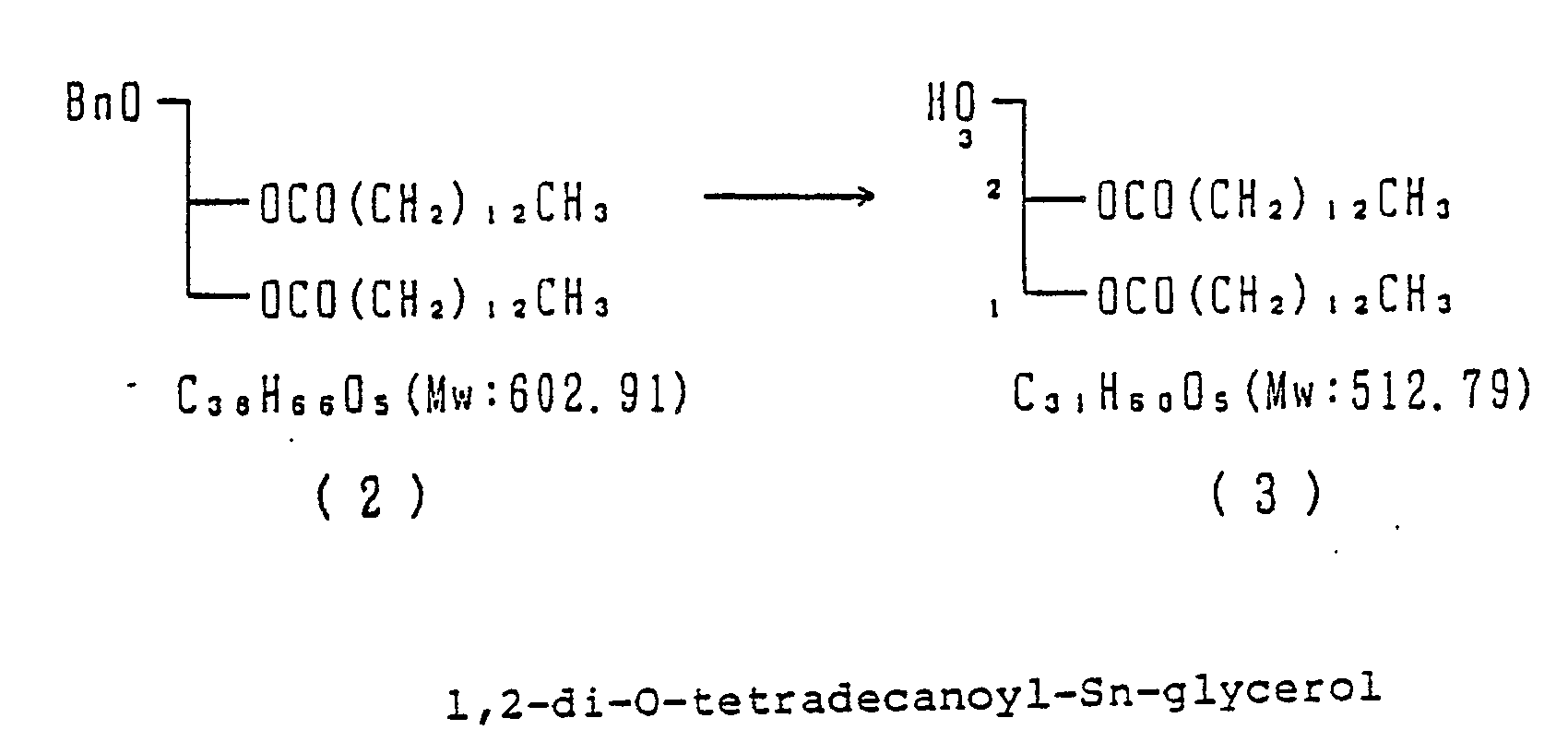
- 3.08 g (5.10 mmol) of Compound (2) was dissolved in 40 ml of ethyl acetate. 300 mg of 10% palladium on active carbon was added to the solution and the mixture was stirred at room temperature under hydrogen atmosphere for two days. The reaction mixture was filtered through Celite. The residue was washed with chloroform. The filtrate was combined with the washing solution. The solvent was evaporated. The resulting residue was recrystallized from petroleum ether to obtain 2.51 g (4.89 mmol) of Compound (3). Yield: 95.9%.
- The physical properties of Compound (3) were as follows:
500 MHz, ¹H-NMR, CDCl₃, TMS 0.880 (6H, t, J=7.0Hz CH₃ x 2) 1.271 (40H, m, CH₂ x 20) 1.613 (4H, m, CH₂-3′ x 2) 2.044 (1H, m, HO) 2.322 (2H, t, J=7.5Hz CH₂-2′) 2.344 (2H, t, J=7.5Hz CH₂-2′) 3.729 (2H, d, J=4.4Hz CH₂-3 4.236 (1H, dd, J=11.9, 5.7Hz H-1) 4.319 (1H, dd, J=11.9, 4.6Hz H′-1) 5.082 (2H, m, H-2) -

- 5.13 g (15.87 mmol) of Compound (4) was dissolved in 50 ml of anhydrous DMF. 1.53 g (19.04 mmol) of sodium hydrogencarbonate and 20.35 g (119.00 mmol) of anhydrous monochloroacetic acid were added to the solution and the mixture was stirred under argon atmosphere at room temperature for 6 hrs. The reaction mixture was poured into ice/water. An insoluble product was collected by filtration and dissolved in 500 ml of chloroform. The solution was washed with saline solution and dried over anhydrous magnesium sulfate. The solvent was evaporated. The resulting residue was purified with SiO₂ column chromatography (Wako Gel C-300, CHCl₃: MeOH = 50:1) to obtain 4.8 g of penta- and tetramonochloroacetyl compound (5). Yield: 43.9%.
- Compound (5) was used in the next step without purification.
-

- 1.80 g of Compound (5) was dissolved in 30 ml of acetyl chloride. The solution was saturated with gaseous hydrogen chloride under cooling with ice and stirred for two days in a closed vessel at room temperature. The solvent was distilled off and the residue was subjected to azeotropic distillation with toluene three times to obtain 1.6 g of Compound (6). Yield: 94.7%.
-

- A mixture of 2.5 g of molecular sieves 4A, 1.24 g (4.89 mmol) of mercury (II) cyanide and 1.76 g (4.89 mmol) of mercury (II) bromide in chloroform was stirred for 15 mins. at room temperature. Then, 2.03 g (3.95 mmol) of Compound (3) was added to the suspension and the mixture was stirred under argon atmosphere at room temperature for 2 hrs.
- The reaction mixture was cooled with ice. 15 ml of a solution of 1.60 g (2.47 mmol) of Compound (6) in anhydrous CHCl₃ was added to the reaction mixture, which was stirred at room temperature for 45 hrs. and then at 50°C for additional 2 hrs. The reaction mixture was filtered through Celite. The filtrate was combined with the washing solution, and the solvent was evaporated in vacuum. 5.1 g of the thus obtained residue was chromatographed through silica gel (230 g of Wako Gel C-300, CHCl₃: EtOH = 100:1) to give 1.92 g of a mixture of α- and β-type Compounds (7) including impurities. Since Compound (7) was unstable in the determination of the physical properties thereof (NMR), MCA groups were removed and the physical properties of Compounds (8) and (9) were determined.
- In TCL of Compounds (7), the following spots were observed:
Re; β-type compound 0.78 (CHCl₃: MeOH=40:1, Merck HPTLC)
α-type compound 0.58 (CHCl₃: MeOH=40.1, Merck HPTLC) -

- 1.74 g (1.55 mmol, of Compound (7) was dissolved in 20 ml of EtOH. 0.94 g (12.35 mmol) of thiourea and 4 ml of pyridine were added to the solution, which was stirred at room temperature for 4 hrs. and then under heating at 55°C for 1 hr. The solvent was evaporated and CHCl₃ was added to the residue and filtrated to remove insoluble substance. The solvent was evaporated from the filtrate and the residue was chromatographed through silica gel (Wake Gel C-300, CHCl₃: MeOH=10:1) to give 45.3 mg of β-type compound (8), 111.5 mg of α-type compound (9), and 402.0 mg of a mixture of β-type compound (8) and α-type compound (9).
Yield: the mixture of β-type Compound (8) and α-type Compound (9): 44.0% - The physical properties of Compound (8) were as follows:
Rf: 0.47 (CHCl₃: MeOH=10:1, Merck HPTLC) 500 MHz, ¹H-NMR, CDCl₃, TMS δ 0.880 (6H, t, J=7.0Hz CH₃ x 2) 1.256 (40H, m, CH₃ x 20) 1.600 (4H, m, CH₂-3′ x 2) 1.792 (1H, t, J=12.1Hz H-3a ax) 2.090 (3H, S, CH₃CONH) 2.350 (4H, m, CH₂-2′ x 2) 2.479 (1H, dd, J=13.2, 4.8Hz H-3a eq) 3.783 (3H, S, COOCH₃) 4.238 (1H, dd, J=12.1, 5.5Hz H-1) 4.319 (1H, dd, J=12.1, 4.6Hz H′-1) 6.260 (1H, broad, CH₃CONH) - The physical properties of Compound (9) were as follows:
Rf: 0.44 (CHCl₃: MeOH=10:1, Merck HPTLC) 500 MHz, ¹H-NMR, CDCl₃, TMS 0.880 (6H, t, J=7.0Hz CH₂ x 2) 1.260 (40H, m, CH₃ x 20) 1.590 (4H, m, CH₂-3′ x 2) 1.855 (1H, t, J=12.3Hz H-3a ax) 2.058 (3H, S, CH₃CONH-) 2.300 (2H, t, J=7.2Hz CH₂-2′) 2.315 (2H, t, J=7.2Hz CH₂-2′) 2.744 (1H, dd, J=13.0, 4.6Hz H-3a eq) 3.635 (1H, ddd, J=10.3, 4.8Hz H-4a) 3.853 (3H, S, COOCH₃) 4.106 (1H, dd, J=12.1, 6.6Hz H-1) 4.287 (1H, dd, J=12.1, 3.7Hz H′-1) 5.145 (1H, m, H-2) 6.231 (1H, d, J=7.3Hz CH₃CONH) -

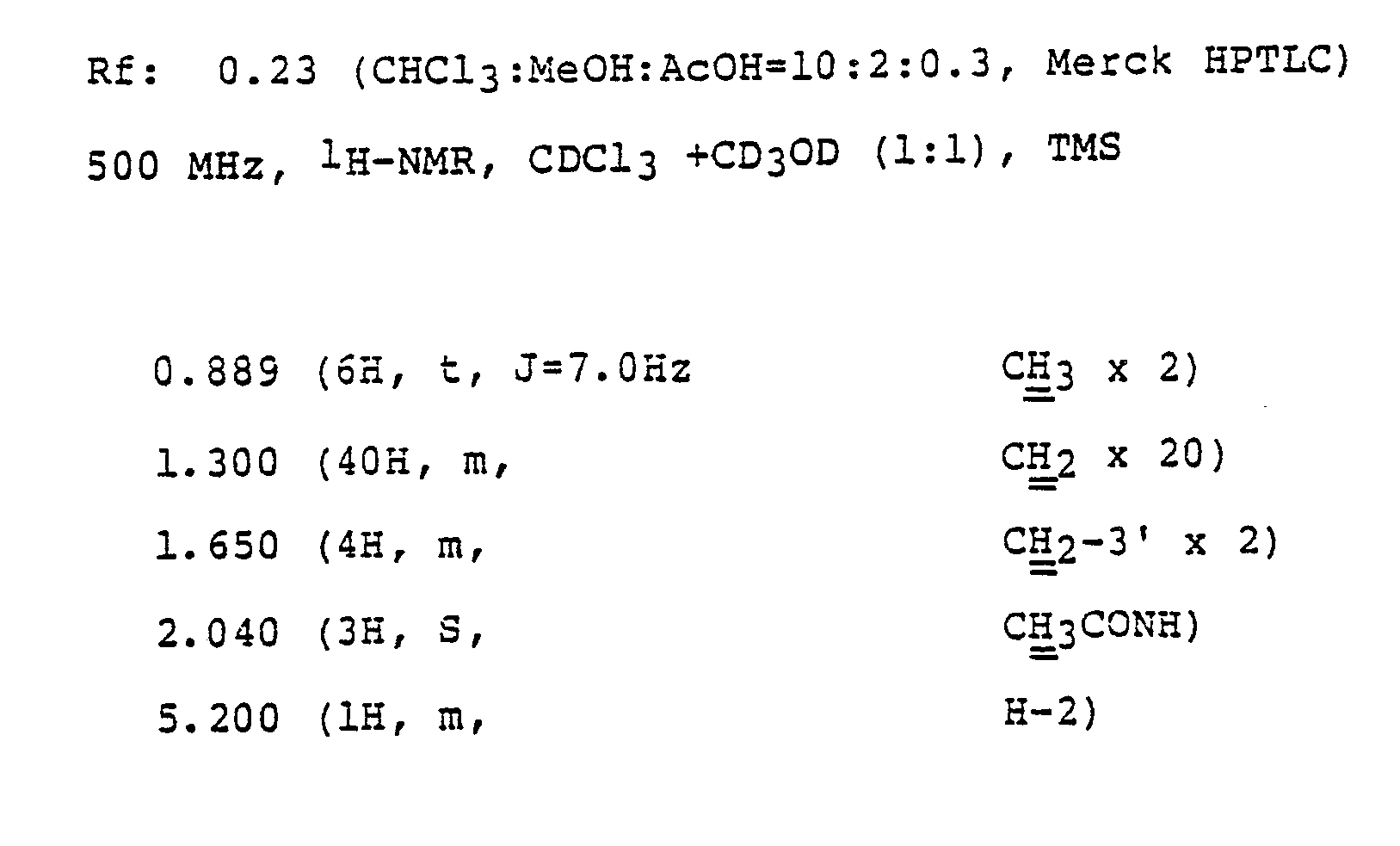
- 28.0 mg (0.03 mmol) of Compound (8) was dissolved in 0.5 ml of THF and 0.5 ml of H₂O. 30 µl (0.03 mmol) of 1N-NaOH was added to the solution under cooling and the mixture was stirred for 1 hr. The reaction mixture was neutralized to pH 8 with Amberlite IRC-50 and filtered. The resin was washed with H₂O. The filtrate was combined with the wash solution and the mixture was purified by column chromatography (Yamamura Kagaku Kenkyujo ODS 60 Å 60/200 mesh, developing solvents: H₂O and MeOH). The methanolic fraction was collected and evaporated to dryness. Then, the residue was lyophilized to give 2.1 mg (0.0025 mmol) of white powdery Compound (10) (yield: 8.3%).
- The physical properties of Compound (10) were as follows:
-

- 25.0 mg (0.03 mmol) of Compound (9) was dissolved in 1 ml of THF and 0.5 ml of H₂O. 30 µl (0.03 mmol) of 1N-NaOH was added to the solution under cooling and the mixture was stirred for 1 hr. The reaction mixture was neutralized to pH 8 with Amberlite IRC-50 and filtered. The resin was washed with H₂O. The filtrate was combined with the washing solution and the mixture was purified by column chromatography (Yamamura Kagaku Kenkyujo ODS 60 Å 60/200 mesh, developing solvents: H₂O and MeOH). The methanolic fraction was collected, the solvent was evaporated and the residue was lyophilized to give 5.9 mg (0.007 mmol) of white powdery Compound (11) (yield: 23.2%).
- The physical properties of Compound (11) were as follows:
Rf: 0.12 (CHCl₃:MeOH:AcOH=10:2:0.3, Merck HPTLC) 500 MHz, ¹H-NMR, CDCl₃ + CD₃OD (1:1) TMS 0.889 (6H, t, J=7.0Hz CH₃ x 2) 1.300 (40H, m, CH₂ x 20) 1.650 (4H, m, CH₂-3′ x 2) 2.033 (3H, S, CH₃CONH) 2.300 (4H, m, CH₂-2′ x 2) 2.822 (1H, m, H-3a eq) 4.170 (1H, m, H-2)
Claims (6)


characterized by demonohalogenoacetylating a compound having the following general formula:


characterized by treating a compound having the following general formula:

with an alkaline aqueous solvent.
Applications Claiming Priority (2)
| Application Number | Priority Date | Filing Date | Title |
|---|---|---|---|
| JP63056884A JPH01228997A (en) | 1988-03-10 | 1988-03-10 | Sialocyl glycerides and production thereof |
| JP56884/88 | 1988-03-10 |
Publications (2)
| Publication Number | Publication Date |
|---|---|
| EP0332191A2 true EP0332191A2 (en) | 1989-09-13 |
| EP0332191A3 EP0332191A3 (en) | 1990-05-16 |
Family
ID=13039846
Family Applications (1)
| Application Number | Title | Priority Date | Filing Date |
|---|---|---|---|
| EP89104199A Ceased EP0332191A3 (en) | 1988-03-10 | 1989-03-09 | Sialosyl glyceride and process for producing the same |
Country Status (12)
| Country | Link |
|---|---|
| US (1) | US4921948A (en) |
| EP (1) | EP0332191A3 (en) |
| JP (1) | JPH01228997A (en) |
| KR (1) | KR960015107B1 (en) |
| CN (1) | CN1022416C (en) |
| AU (1) | AU604410B2 (en) |
| CA (1) | CA1320720C (en) |
| FI (1) | FI90551C (en) |
| HU (1) | HU200344B (en) |
| IL (1) | IL89511A (en) |
| NO (1) | NO169590C (en) |
| NZ (1) | NZ228276A (en) |
Cited By (2)
| Publication number | Priority date | Publication date | Assignee | Title |
|---|---|---|---|---|
| EP0502827A1 (en) * | 1991-03-06 | 1992-09-09 | Nippon Zoki Pharmaceutical Co., Ltd. | Sialic acid derivatives |
| FR2765876A1 (en) * | 1997-07-07 | 1999-01-15 | Henkel Kgaa | GLYCOSIDES WITH HIGH EHL VALUE (HYDROPHILIC-LIPOPHILIC BALANCE). |
Families Citing this family (3)
| Publication number | Priority date | Publication date | Assignee | Title |
|---|---|---|---|---|
| JPS63264493A (en) * | 1986-12-29 | 1988-11-01 | Mect Corp | Sialic acid derivatives with active carbonyl groups |
| JPH01125394A (en) * | 1987-11-10 | 1989-05-17 | Mect Corp | Sialosylglycerolipids and their production method |
| CN112175103B (en) * | 2020-10-29 | 2022-07-15 | 绍兴文理学院 | A kind of polyglycerol fatty acid ester derivative containing polysialic acid group, its synthetic method and its application in pharmaceutical preparation |
Family Cites Families (7)
| Publication number | Priority date | Publication date | Assignee | Title |
|---|---|---|---|---|
| IT1046051B (en) * | 1975-08-13 | 1980-06-30 | Fidia Spa | NEW THERAPEUTIC APPLICATION OF GANGLIOSIDES AND PROCEDURE FOR THEIR EXTRACTION |
| DE3248404A1 (en) * | 1982-12-28 | 1984-06-28 | Süddeutsche Zucker AG, 6800 Mannheim | DERIVATIVES AND REDUCTION PRODUCTS OF D-GLUCOPYRANOSYL- (ALPHA) (1-> 5) -D-ARABONIC ACID, THEIR PRODUCTION AND USE |
| JPS59164798A (en) * | 1983-03-09 | 1984-09-17 | Rikagaku Kenkyusho | Cyanuric acid-containing glycolipid derivative |
| JPS59181298A (en) * | 1983-03-30 | 1984-10-15 | Rikagaku Kenkyusho | Novel glyceroglycolipids and their production method |
| JPS6344590A (en) * | 1986-08-12 | 1988-02-25 | Mect Corp | Production of sialic acid derivative |
| JPS63264493A (en) * | 1986-12-29 | 1988-11-01 | Mect Corp | Sialic acid derivatives with active carbonyl groups |
| JPH01125394A (en) * | 1987-11-10 | 1989-05-17 | Mect Corp | Sialosylglycerolipids and their production method |
-
1988
- 1988-03-10 JP JP63056884A patent/JPH01228997A/en active Pending
-
1989
- 1989-03-06 US US07/319,064 patent/US4921948A/en not_active Expired - Fee Related
- 1989-03-06 FI FI891062A patent/FI90551C/en not_active IP Right Cessation
- 1989-03-07 IL IL89511A patent/IL89511A/en unknown
- 1989-03-08 NZ NZ228276A patent/NZ228276A/en unknown
- 1989-03-08 AU AU31119/89A patent/AU604410B2/en not_active Ceased
- 1989-03-09 CA CA000593263A patent/CA1320720C/en not_active Expired - Fee Related
- 1989-03-09 HU HU891159A patent/HU200344B/en not_active IP Right Cessation
- 1989-03-09 EP EP89104199A patent/EP0332191A3/en not_active Ceased
- 1989-03-09 NO NO891025A patent/NO169590C/en unknown
- 1989-03-10 CN CN89101332A patent/CN1022416C/en not_active Expired - Fee Related
- 1989-03-10 KR KR1019890002961A patent/KR960015107B1/en not_active Expired - Lifetime
Cited By (2)
| Publication number | Priority date | Publication date | Assignee | Title |
|---|---|---|---|---|
| EP0502827A1 (en) * | 1991-03-06 | 1992-09-09 | Nippon Zoki Pharmaceutical Co., Ltd. | Sialic acid derivatives |
| FR2765876A1 (en) * | 1997-07-07 | 1999-01-15 | Henkel Kgaa | GLYCOSIDES WITH HIGH EHL VALUE (HYDROPHILIC-LIPOPHILIC BALANCE). |
Also Published As
| Publication number | Publication date |
|---|---|
| AU604410B2 (en) | 1990-12-13 |
| CN1022416C (en) | 1993-10-13 |
| NO891025L (en) | 1989-09-11 |
| FI891062L (en) | 1989-09-11 |
| KR890014572A (en) | 1989-10-24 |
| NO891025D0 (en) | 1989-03-09 |
| HUT49364A (en) | 1989-09-28 |
| NO169590C (en) | 1992-07-15 |
| CN1036773A (en) | 1989-11-01 |
| HU200344B (en) | 1990-05-28 |
| US4921948A (en) | 1990-05-01 |
| IL89511A0 (en) | 1989-09-10 |
| FI891062A0 (en) | 1989-03-06 |
| EP0332191A3 (en) | 1990-05-16 |
| JPH01228997A (en) | 1989-09-12 |
| IL89511A (en) | 1993-08-18 |
| NO169590B (en) | 1992-04-06 |
| KR960015107B1 (en) | 1996-10-28 |
| NZ228276A (en) | 1990-06-26 |
| CA1320720C (en) | 1993-07-27 |
| FI90551C (en) | 1994-02-25 |
| AU3111989A (en) | 1989-09-14 |
| FI90551B (en) | 1993-11-15 |
Similar Documents
| Publication | Publication Date | Title |
|---|---|---|
| US4797477A (en) | Process for preparing sialic acid derivatives | |
| JPH01180894A (en) | Novel production of amino sugar derivative | |
| US4921948A (en) | Sialosyl glyceride and process for producing the same | |
| US5057605A (en) | Sialocylglycerolipids and method for preparing the same | |
| US5470962A (en) | Oligosialyl-1,2-dialkyl-sn-glycerols and synthetic intermediates for their preparation | |
| AU641644B2 (en) | A process for the preparation of etoposides | |
| JPH04300879A (en) | L-talopyranoside derivative and method of manufacturing same | |
| JP2906228B2 (en) | Glucopyranose derivative salt | |
| JPH0684367B2 (en) | New method for producing forskolin derivative | |
| JPS61282390A (en) | S-neuraminic acid derivative | |
| JPH0363560B2 (en) | ||
| Hasegawa et al. | Synthesis of 2, 4-diamino-2, 4-dideoxy-L-arabinose derivatives (prumycin derivatives) | |
| JPH02295996A (en) | Preparation of glucosaminyl-epi-podophyllotoxin derivative | |
| JP3134010B2 (en) | Desalanine benanomycin A derivatives and methods for their production | |
| JPH0689041B2 (en) | Method for producing oligogalacturonic acid | |
| JPS61126094A (en) | Subunit analog on nonreducing side of lipid a | |
| JP2547125B2 (en) | 2 ', 3'-dideoxy-2', 3'-disubstituted-nucleosides and process for their production | |
| JPH0616667A (en) | Novel method for producing pyrazolo [1,5-apyridine derivative] | |
| JP3051213B2 (en) | Maltooligosaccharide derivatives, their synthetic intermediates and their production | |
| JPH07116213B2 (en) | Novel N-6,2'-O-disubstituted-adenosine-3 ', 5'-cyclic phosphate and process for producing the same | |
| JPH07107074B2 (en) | NeuAcα2 → 9 NeuAc sugar donor | |
| JPS59222500A (en) | Preparation of macrolide antibiotic substance derivative | |
| JPH0273094A (en) | 3-phenylthio-N-acetylneuraminic acid derivative and method for producing the same | |
| JPH051093A (en) | Method for succinylation of nucleosides | |
| JPH09241288A (en) | Stereoselective method for producing glycosyl compound |
Legal Events
| Date | Code | Title | Description |
|---|---|---|---|
| PUAI | Public reference made under article 153(3) epc to a published international application that has entered the european phase |
Free format text: ORIGINAL CODE: 0009012 |
|
| AK | Designated contracting states |
Kind code of ref document: A2 Designated state(s): AT BE CH DE ES FR GB GR IT LI LU NL SE |
|
| PUAL | Search report despatched |
Free format text: ORIGINAL CODE: 0009013 |
|
| AK | Designated contracting states |
Kind code of ref document: A3 Designated state(s): AT BE CH DE ES FR GB GR IT LI LU NL SE |
|
| 17P | Request for examination filed |
Effective date: 19900822 |
|
| 17Q | First examination report despatched |
Effective date: 19930118 |
|
| STAA | Information on the status of an ep patent application or granted ep patent |
Free format text: STATUS: THE APPLICATION HAS BEEN REFUSED |
|
| 18R | Application refused |
Effective date: 19941129 |