EP0332760A2 - Fenêtre acoustique et matériel à cet effet - Google Patents
Fenêtre acoustique et matériel à cet effet Download PDFInfo
- Publication number
- EP0332760A2 EP0332760A2 EP88121500A EP88121500A EP0332760A2 EP 0332760 A2 EP0332760 A2 EP 0332760A2 EP 88121500 A EP88121500 A EP 88121500A EP 88121500 A EP88121500 A EP 88121500A EP 0332760 A2 EP0332760 A2 EP 0332760A2
- Authority
- EP
- European Patent Office
- Prior art keywords
- sheet
- acoustic window
- elastomer
- window
- fibre reinforcement
- Prior art date
- Legal status (The legal status is an assumption and is not a legal conclusion. Google has not performed a legal analysis and makes no representation as to the accuracy of the status listed.)
- Granted
Links
Images
Classifications
-
- G—PHYSICS
- G10—MUSICAL INSTRUMENTS; ACOUSTICS
- G10K—SOUND-PRODUCING DEVICES; METHODS OR DEVICES FOR PROTECTING AGAINST, OR FOR DAMPING, NOISE OR OTHER ACOUSTIC WAVES IN GENERAL; ACOUSTICS NOT OTHERWISE PROVIDED FOR
- G10K11/00—Methods or devices for transmitting, conducting or directing sound in general; Methods or devices for protecting against, or for damping, noise or other acoustic waves in general
- G10K11/004—Mounting transducers, e.g. provided with mechanical moving or orienting device
- G10K11/006—Transducer mounting in underwater equipment, e.g. sonobuoys
-
- B—PERFORMING OPERATIONS; TRANSPORTING
- B29—WORKING OF PLASTICS; WORKING OF SUBSTANCES IN A PLASTIC STATE IN GENERAL
- B29C—SHAPING OR JOINING OF PLASTICS; SHAPING OF MATERIAL IN A PLASTIC STATE, NOT OTHERWISE PROVIDED FOR; AFTER-TREATMENT OF THE SHAPED PRODUCTS, e.g. REPAIRING
- B29C70/00—Shaping composites, i.e. plastics material comprising reinforcements, fillers or preformed parts, e.g. inserts
- B29C70/02—Shaping composites, i.e. plastics material comprising reinforcements, fillers or preformed parts, e.g. inserts comprising combinations of reinforcements, e.g. non-specified reinforcements, fibrous reinforcing inserts and fillers, e.g. particulate fillers, incorporated in matrix material, forming one or more layers and with or without non-reinforced or non-filled layers
- B29C70/021—Combinations of fibrous reinforcement and non-fibrous material
- B29C70/025—Combinations of fibrous reinforcement and non-fibrous material with particular filler
-
- C—CHEMISTRY; METALLURGY
- C08—ORGANIC MACROMOLECULAR COMPOUNDS; THEIR PREPARATION OR CHEMICAL WORKING-UP; COMPOSITIONS BASED THEREON
- C08J—WORKING-UP; GENERAL PROCESSES OF COMPOUNDING; AFTER-TREATMENT NOT COVERED BY SUBCLASSES C08B, C08C, C08F, C08G or C08H
- C08J5/00—Manufacture of articles or shaped materials containing macromolecular substances
- C08J5/04—Reinforcing macromolecular compounds with loose or coherent fibrous material
-
- C—CHEMISTRY; METALLURGY
- C08—ORGANIC MACROMOLECULAR COMPOUNDS; THEIR PREPARATION OR CHEMICAL WORKING-UP; COMPOSITIONS BASED THEREON
- C08J—WORKING-UP; GENERAL PROCESSES OF COMPOUNDING; AFTER-TREATMENT NOT COVERED BY SUBCLASSES C08B, C08C, C08F, C08G or C08H
- C08J5/00—Manufacture of articles or shaped materials containing macromolecular substances
- C08J5/04—Reinforcing macromolecular compounds with loose or coherent fibrous material
- C08J5/046—Reinforcing macromolecular compounds with loose or coherent fibrous material with synthetic macromolecular fibrous material
-
- C—CHEMISTRY; METALLURGY
- C08—ORGANIC MACROMOLECULAR COMPOUNDS; THEIR PREPARATION OR CHEMICAL WORKING-UP; COMPOSITIONS BASED THEREON
- C08L—COMPOSITIONS OF MACROMOLECULAR COMPOUNDS
- C08L21/00—Compositions of unspecified rubbers
-
- B—PERFORMING OPERATIONS; TRANSPORTING
- B29—WORKING OF PLASTICS; WORKING OF SUBSTANCES IN A PLASTIC STATE IN GENERAL
- B29K—INDEXING SCHEME ASSOCIATED WITH SUBCLASSES B29B, B29C OR B29D, RELATING TO MOULDING MATERIALS OR TO MATERIALS FOR MOULDS, REINFORCEMENTS, FILLERS OR PREFORMED PARTS, e.g. INSERTS
- B29K2021/00—Use of unspecified rubbers as moulding material
-
- B—PERFORMING OPERATIONS; TRANSPORTING
- B29—WORKING OF PLASTICS; WORKING OF SUBSTANCES IN A PLASTIC STATE IN GENERAL
- B29K—INDEXING SCHEME ASSOCIATED WITH SUBCLASSES B29B, B29C OR B29D, RELATING TO MOULDING MATERIALS OR TO MATERIALS FOR MOULDS, REINFORCEMENTS, FILLERS OR PREFORMED PARTS, e.g. INSERTS
- B29K2105/00—Condition, form or state of moulded material or of the material to be shaped
- B29K2105/06—Condition, form or state of moulded material or of the material to be shaped containing reinforcements, fillers or inserts
- B29K2105/12—Condition, form or state of moulded material or of the material to be shaped containing reinforcements, fillers or inserts of short lengths, e.g. chopped filaments, staple fibres or bristles
-
- B—PERFORMING OPERATIONS; TRANSPORTING
- B29—WORKING OF PLASTICS; WORKING OF SUBSTANCES IN A PLASTIC STATE IN GENERAL
- B29K—INDEXING SCHEME ASSOCIATED WITH SUBCLASSES B29B, B29C OR B29D, RELATING TO MOULDING MATERIALS OR TO MATERIALS FOR MOULDS, REINFORCEMENTS, FILLERS OR PREFORMED PARTS, e.g. INSERTS
- B29K2105/00—Condition, form or state of moulded material or of the material to be shaped
- B29K2105/06—Condition, form or state of moulded material or of the material to be shaped containing reinforcements, fillers or inserts
- B29K2105/16—Fillers
-
- C—CHEMISTRY; METALLURGY
- C08—ORGANIC MACROMOLECULAR COMPOUNDS; THEIR PREPARATION OR CHEMICAL WORKING-UP; COMPOSITIONS BASED THEREON
- C08J—WORKING-UP; GENERAL PROCESSES OF COMPOUNDING; AFTER-TREATMENT NOT COVERED BY SUBCLASSES C08B, C08C, C08F, C08G or C08H
- C08J2321/00—Characterised by the use of unspecified rubbers
Definitions
- This invention relates to acoustic devices for use in a hydraulic environment and to materials for forming portions of such acoustic devices. More specifically, this invention relates to sonar domes and sonar windows and to materials for forming such sonar domes or windows. Particularly, this invention relates to sonar windows formed from an elastomer having fiber reinforcement therein and to materials useful in the manufacture of such sonar windows.
- Acoustic windows for use in transmitting or receiving acoustic wave form signals in a liquid environment are known.
- these windows have consisted of a single thickness of a metal such as steel that may optionally have been covered by a rubber containing therein a biologically active substance such as a biocide.
- biocide containing rubbers tend to inhibit a build-up of marine life on the surfaces of the window as such build-ups can prove disfunctional to the transmission or reception of acoustic waveforms as well as contributing to disfunctional hydraulic disturbances during propagation through the marine environment of a vessel or other object which might embody such a window.
- Such windows on an exterior surface have interfaced with a body of free liquid such as an ocean, lake or tank.
- a body of free liquid such as an ocean, lake or tank.
- Such windows, on the interior surface traditionally have at least partially defined a chamber filled with water or with another liquid.
- Substantial efforts have been expended to configure such windows to be acoustically "clear", that is producing a desirably low distortion and attenuation of sound wave energy as the sound wave energy is passed through the window, and equally, a desirably low distortion of the angle characterizing the impingement of the sound wave energy against the window.
- windows have been subject to certain undesirable characteristics.
- windows made of a rigid material such as steel can generate significant quantities acoustic noise associated with the passage of water over the window and can transmit significant quantities of acoustic noise arising from vibrational frequencies associated with the operation of machinery aboard an object or vessel upon which the window is embodied.
- relatively rigid windows can generate a significant bounce or reflective effect for acoustic waveform energy impinging upon the window surface. Such bounce or reflection can result in a substantial reduction in intensity for signals being transmitted through the window. Where reflection occurs from interior surfaces of the window during transmission of an acoustic waveform from within the chamber defined by the window, spurious or erroneous determinations of the existence or position of an echo could result.
- Windows such as sonar domes can be required to transmit acoustic energy having a frequency ranging from about 500 Hz to about 500 kHz. These frequencies correspond to wavelengths of about 3 meters to about 0.003 meters in sea water, with the wavelengths being subject to some variation depending upon the liquid material through which the waveform is being propagated.
- Traditional domes of metal, or those known in the art of reinforced plastic where the thickness of the material from which the dome is fabricated deviates substantially from one half wavelength of the acoustical frequency being transmitted through the dome, reduction such as through insertion loss, that is 20 log(P0/P T ), where P0 is the incident pressure of the wave and P T is the transmitted pressure, can become unacceptable.
- a sonar dome or a sonar window must be built to withstand structurally a particular loading. This construction results in an inherently necessary thickness in the material of construction, where rigid materials are employed. Where this thickness substantially deviates from one half the wavelength being transmitted, an effective blindness to certain acoustic frequencies can result by simple reduction of the waveform energy transmitted across the material thickness.
- Relatively small windows or sonar domes have been formed frequently of unreinforced rubbers. Such rubbers are remarkably transparent to the transmission of acoustic frequencies in desired wavelength ranges. These windows formed of unreinforced rubbers, however, are susceptible to deformation from hydrostatic and hydrodynamic forces imposed upon the window by the environment in which it is operated. For example, motion of a submarine embodying such a window through the ocean waters can impose hydrodynamic forces upon a window sufficient to deform the window, possibly even into contact with the sonar array positioned therebeneath. Conversely, simple changes in hydrostatic pressure imposed upon the window by reason of a changing operating depth for a submersible embodying a window can impose hydrostatic forces producing similar distortion effects to the window. This distortion phenomenon is associated principally with a relatively low modulus associated with unreinforced rubber.
- sonar windows made employing cis-polybutadiene and including a reinforcement of polyvinyl alcohol fibers therein has found application in making sonar windows having acoustic clarity and utility in a range of 200 kHz to 500 kHz.
- Cis-polybutadiene is a somewhat difficult elastomer with which to work in forming such windows, however, and is relatively expensive.
- These windows also have not found significant application in a range of desired sonar frequencies of between about 10 kHz and 100 kHz.
- a sonar window having utility in a frequency range of between about 10 kHz and about 100 kHz in an aqueous environment, displaying essentially the sonic transparency of unreinforced rubber, and providing a desirable flexural moduli of between 2,000 and 40,000 psi (13790-275800 kPa) could find substantial utility in the manufacture of sonic windows.
- the present invention provides a sheet-like acoustic window comprising an elastomer and a fibre reinforcement.
- the elastomer is selected from a group consisting of natural, synthetic natural, chlorinated, and silicon rubbers; acrylonitrile-butadiene copolymer; styrene-butadiene copolymer; polyurethanes; and mixtures thereof and further may include a filler and a resin of either thermosetting or non-thermosetting type.
- the fibre reinforcement is selected from chopped fiber or fibrils of a material belonging to a group including steel, polyester, polyamide, polyaramid, polyimide, rayon, polyvinyl alcohols, and nylon and imparting to the acoustic window entrapped air not in excess of 0.10% of the volume of the sheet-like acoustic window.
- the extent of air entrapment does not exceed 0.05% and most preferably 0.010% of the volume of the sheet-like acoustic window.
- the fibre reinforcement, the elastomer, any filler and any resin are substantially uniformly and blendedly present in a desired and effective proportion.
- the sheet-like acoustic window formed therefrom is formed and cured to possess desired physical dimensions and is of a configuration providing effective strength when employed as a sonic window.
- any filler is present as a particulate.
- the particulate filler is typically present in a quantity of not less than about 0.0% nor no more than about 50% by weight of the sheet-like acoustic window. Most typically the filler is a particulate carbonaceous material.
- the resin employed in the sheet-like acoustic window of the invention is selected from a group consisting of both thermosetting or non-thermosetting resins such as phenol formaldehyde, resorcinol formaldehyde, coumarone indene actyl phenol formaldehydes and mixtures thereof and typically is present in a quantity of not less than 0.0% nor more than about 6% by weight of the sheet-like acoustic window.
- the resin is employed in the practice of the invention at a temperature below its softening point, if a non-thermosetting resin.
- the fibre reinforcement is a polyvinyl alcohol, a polyaramid, or a polyester fibril or fiber.
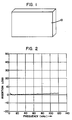
- Figure 1 represents a sheet-like acoustic window 10 made in accordance with the invention.
- the acoustic window 10 is shown in a rectilinear sheet form but could equally be formed into a curvilinear or complexly surfaced curvilinear configuration.
- the sheet-like window is formed by molding, casting or other suitable or conventional forming techniques employed in forming elastomeric or rubber goods.
- the window 10 is formed of an elastomeric material reinforced employing a fibre reinforcement.
- the material forming the window is preferably initially available as principally thermoset, thermoplastic or uncured material which is formed into a desired configuration.
- elastomer or elastomeric material what is meant is a material, such as a rubber or plastic, which at room temperature can be stretched under low stress to at least twice its original length and, upon immediate release of the stress, will return with force to its approximate original length.
- the elastomer employed in the material forming the window of the instant invention is selected from a group consisting of natural, synthetic natural, chlorinated, and silicon rubbers; acrylonitrile-butadiene copolymers; styrene butadiene copolymers; polyurethane; and mixtures thereof.
- the selection of particular elastomers for use in the practice of the invention will be a function, in part, of the flexural moduli desired in a final, cured window 10.
- a flexural moduli of between about 2,000 to about 40,000 psi (13,790-275,800 kPa) is desired.
- the selection of a particular elastomer in part will also be a function of bulk properties desired in the cured window 10.
- the desired bulk moduli properties include a longitudinal velocity propagation characteristic for an acoustic waveform being passed through the cured window 10 closely approximating that of the liquid medium or lower than that of the liquid medium in which the acoustic window 10 is immersed.
- the longitudinal velocity propagation characteristic desired in such a window 10 preferably is between about 1450 and 1700 meters per second.
- desirable flexural moduli for the material forming the window 10 would include a Young's modulus of between about 2000 psi and about 40,000 psi (13,790 kPa to 275,800 kPa).
- a static shear modulus associated with the material forming the window 10 is, in the final state, between about 660 psi and about 13,000 psi (4547 kPa and 89,570 kPa).
- the material forming the window, in a cured or final state typically is possessed of an elongation to break of at least about 5%.
- Young's modulus as used herein, what is meant is a ratio of a simple tension stress applied to the material forming the window 10 (in the final state) to the resulting strain parallel to the tension.
- the Young's modulus is also a measure of the modulus of the elasticity for the material, which modulus of elasticity may also be known as the coefficient of elasticity, the elasticity modulus, or the elastic modulus.
- static shear modulus as used herein, what is meant is the modulus of elasticity in shear or a measure of the resistance to shearing stress inherent in the material forming the final window 10, equal to the shearing stress divided by the resultant angle of deformation expressed in radians.
- the static shear modulus may also be known as a coefficient of rigidity, a modulus of rigidity, or shear modulus.
- the material forming the window 10 is a natural or synthetic natural rubber.
- natural or synthetic natural rubber is much preferred in the practice of the invention, in part as a consequence of the relatively easy moldability of such rubbers. Also in part, such rubbers are desirable from a standpoint of acoustic bulk properties.
- synthetic natural rubbers what is meant is a substantial proportion, at least half, of the rubber being formed from polyisoprene, and preferably cis-1,4-polyisoprene.
- the selection of a particular elastomer for forming the window 10 of the invention is in part a matter of of experimental trial and error to produce a cured final elastomer forming the window 10 as set forth herein having desired bulk acoustic properties and desired flexural moduli necessary for yielding desirable undersea performance characteristics.
- the elastomer comprising the material forming the window 10 of the invention may include a filler.
- This filler is generally in a particulate form and does not necessarily provide a particular reinforcing characteristic to the material forming the window 10. Some such fillers may reinforce, however.
- This filler which may be present in a quantity of between of about 0.0% and about 50% by weight of the material forming the window of the invention, preferably is present in a quantity of between of about 10% and about 30% by weight of the material forming the window 10.
- the filling agent typically is a particulate carbon black, and most particularly, KETJEN® commercially available carbon black produces desirable results with natural or synthetic natural rubbers in quantities of between about 20 and about 40 parts per hundred weight of natural or synthetic natural rubbers employed in forming the window 10 of the invention.
- rubber is used herein to modify the specifically identified species of rubber suitable for use in the practice of the invention, what is meant is a vulcanized, or cross-linked elastomer made according to suitable or conventional techniques. The use of a suitable or conventional curing agent or cross linking agent in effective quantity may be desirable depending upon the elastomer.
- the fibre reinforcement is formed of fibers or fibrils. It is important that the fibers or fibrils forming the fibre reinforcement in the material employed in forming the window 10 of the invention not entrap and carry into the window 10 a significant quantity of air.
- the window 10, as formed and cured, must not contain more than 0.10% on a volume basis as air entrapped as a function of fiber or fibrils introduced into the material forming the window 10 during preparation of the material eventually forming the window. Applicants have found that where the fibers or fibrils present in the material eventually forming the window are generated from the source wherein these fibers or fibrils are bundled or otherwise closely associated such as by twisting, the opportunity for introducing undesirably elevated quantities of air into the window 10 is unacceptable.
- Fibers or fibrils in close association are typically found where the fibers or fibrils are other than a monofilament in nature or have been twisted as monofilaments, or deformed into bundles or threads of fibres such as might occur in preparing knit or woven fabric, cording, cable, mesh, screening or other structures. Additionally, it has been found that the outer surface of each fiber or fibril must be substantially smooth as a microscopic level thereby avoiding an opportunity for air to be trapped along microscopic protuberances associated with the surface of the fiber or fibril. For this reason, relatively "hairy" fibres or fibrils such as those associated with wool or cotton do not find ready utility in the practive of the invention.
- Such fibres or fibrils have been found to be associated typically with an air entrapment of less than 0.05% on a volume basis and typically are associated with an air entrapment of less than 0.01% on a volume basis when used for the window 10 of the invention.
- Most preferred in the practice of the invention are polyvinyl alcohol fibers, polyaramid fibrils, and polyester fibers.
- the fibres or fibrils are introduced as fibre reinforcement and typically comprised between about 5% and about 35% by weight of the elastomer forming the material of window 10. Most typically these fibres or fibrils comprise between about 5% and 20% by weight of the elastomer comprising the material of the window 10.
- the fibres or fibrils are introduced as fibre reinforcement using suitable or conventional techniques such as by ordinary rubber mixing on a Banbury machine or the like.
- the fibers or fibrils typically are possessed of a denier of from 0.5 to 840 and lengths of from 0.1 millimeters to approximately 2.5 centimeters.
- the particular dimensions of the fibers or fibrils will, in part, be a function of the nature of the fibril or fiber itself, that is inherently associated with its manufacture, and also to certain extent be a function of a tendency for the fibrils to become inextricably intertwined, thereby promoting the formation of knots or tangles during handling or processing which knots or tangles could function to entrap air and thereby produce deleterious sonic opaqueness in any resulting window 10.
- the use of fibers or fibrils for fibre reinforcement in accordance with the invention produces a window having desirable bulk properties of the matrix elastomer forming the window which deviate only to a negligible extent from the bulk properties of the pure elastomer itself.
- the extent of fibre loading in the material forming the window 10 is to a certain extent a function of desired flexural moduli in the window 10 following curing.
- the material forming the window 10 may include a resin of thermosetting or non-thermosetting type.
- This resin is selected from a group consisting of phenol formaldehydes, octyl phenol formaldehydes, resorcinol formaldehydes, and coumarone indenes mixtures thereof present in the material forming the window 10 in a quantity of not more than about 9% by weight of the elastomer in the material.
- Particularly preferred the practice of the invention is P-octyl phenol formaldehyde in a quantity of not less than about 2% and no more than about 6% by weight of the elastomeric material forming the window 10.
- the fibres, the elastomer, any filler, and any resin are combined in suitable or conventional well-known rubber mixing techniques and may be formed by molding and subsequent curing including cross-linking curing or vulcanization to produce a desired window configuration 10.
- Figure 2 is a graphical representation of insertion loss in decibels plotted on an axis versus frequency in kHz plotted on an abcissa (receive gate 0.2 ms, receive gate 0.5 ms, delay into pulse 0.1 ms) for a sonic window at 6°C, 345 k pascals having a thickness of 1.4 centimeters, overall dimension of 76x76 centimeters and formed from a natural rubber elastomer, including fibre of poly vinyl alcohol present in a quantity of 26.81 grams per hundred weight elastomer, a filler of KETJEN® black present in a quantity of 23.05 grams per hundred weight elastomer, and a P-octyl phenol formaldehyde resin present in a quantity of 4.61 grams per hundred weight elastomer.
- Figure 2 depicts particularly the desirable performance of a window 10 of the invention particularly in a range of frequencies from about 10 kHz to about 100 kHz.
Landscapes
- Chemical & Material Sciences (AREA)
- Engineering & Computer Science (AREA)
- Health & Medical Sciences (AREA)
- Chemical Kinetics & Catalysis (AREA)
- Medicinal Chemistry (AREA)
- Polymers & Plastics (AREA)
- Organic Chemistry (AREA)
- Manufacturing & Machinery (AREA)
- Materials Engineering (AREA)
- Mechanical Engineering (AREA)
- Composite Materials (AREA)
- Physics & Mathematics (AREA)
- Acoustics & Sound (AREA)
- Multimedia (AREA)
- Soundproofing, Sound Blocking, And Sound Damping (AREA)
- Compositions Of Macromolecular Compounds (AREA)
- Reinforced Plastic Materials (AREA)
- Details Of Audible-Bandwidth Transducers (AREA)
- Diaphragms For Electromechanical Transducers (AREA)
- Transducers For Ultrasonic Waves (AREA)
Applications Claiming Priority (2)
| Application Number | Priority Date | Filing Date | Title |
|---|---|---|---|
| US07/168,211 US4820753A (en) | 1988-03-15 | 1988-03-15 | Acoustic window and material therefor |
| US168211 | 1988-03-15 |
Publications (3)
| Publication Number | Publication Date |
|---|---|
| EP0332760A2 true EP0332760A2 (fr) | 1989-09-20 |
| EP0332760A3 EP0332760A3 (fr) | 1991-05-08 |
| EP0332760B1 EP0332760B1 (fr) | 1994-06-22 |
Family
ID=22610566
Family Applications (1)
| Application Number | Title | Priority Date | Filing Date |
|---|---|---|---|
| EP88121500A Expired - Lifetime EP0332760B1 (fr) | 1988-03-15 | 1988-12-22 | Fenêtre acoustique et matériel à cet effet |
Country Status (5)
| Country | Link |
|---|---|
| US (1) | US4820753A (fr) |
| EP (1) | EP0332760B1 (fr) |
| JP (1) | JPH01241999A (fr) |
| CA (1) | CA1321828C (fr) |
| DE (1) | DE3850383T2 (fr) |
Cited By (3)
| Publication number | Priority date | Publication date | Assignee | Title |
|---|---|---|---|---|
| EP0460246A1 (fr) * | 1986-05-21 | 1991-12-11 | The B.F. Goodrich Company | Fenêtre pour ondes acoustiques et procédé de fabrication |
| US5696048A (en) * | 1995-05-09 | 1997-12-09 | Basf Aktiengesellschaft | Cobalt catalysts |
| FR2910476A1 (fr) * | 2006-12-22 | 2008-06-27 | Rhodia Recherches & Tech | Article elastomere silicone vulcanise ayant une bonne tenue aux huiles et une bonne tenue thermique |
Families Citing this family (5)
| Publication number | Priority date | Publication date | Assignee | Title |
|---|---|---|---|---|
| FR2672179B1 (fr) * | 1991-01-25 | 1993-04-16 | Thomson Csf | Transducteur acoustique flextenseur pour immersion profonde. |
| US5276658A (en) * | 1992-11-19 | 1994-01-04 | The United States Of America As Represented By The Secretary Of The Navy | Acoustic window |
| US20100104391A1 (en) * | 2008-05-05 | 2010-04-29 | Standard Car Truck Company | Auto-rack railroad car vehicle positioning and damage prevention system |
| EP3374095B1 (fr) | 2015-11-10 | 2023-06-21 | Koninklijke Philips N.V. | Couche de fenêtre acoustique pour un réseau à ultrasons |
| EP3459464A1 (fr) | 2017-09-20 | 2019-03-27 | Koninklijke Philips N.V. | Timbre à ultrasons vestimentaire et procédé d'application d'un tel timbre |
Family Cites Families (16)
| Publication number | Priority date | Publication date | Assignee | Title |
|---|---|---|---|---|
| US2811216A (en) * | 1954-04-28 | 1957-10-29 | Harris Transducer Corp | Acoustic baffle construction |
| US3858165A (en) * | 1970-07-29 | 1974-12-31 | Haveg Industries Inc | Acoustical window for sonar systems |
| US3888805A (en) * | 1972-11-29 | 1975-06-10 | Gen Tire & Rubber Co | Method for bonding polyamides to rubber, adhesive for the same, and adhesive coated polyamide reinforcing elements |
| US3969568A (en) * | 1974-12-04 | 1976-07-13 | Uniroyal Inc. | Aramid floc reinforcement of rubber using particular adhesive |
| US4244847A (en) * | 1978-08-10 | 1981-01-13 | The Gates Rubber Company | Fibrated admix or polymer and process therefore |
| US4532275A (en) * | 1981-02-03 | 1985-07-30 | Teijin Limited | Fiber-reinforced composite materials |
| US4387178A (en) * | 1981-11-02 | 1983-06-07 | Rogers Corporation | Compressible soft asbestos free gasket material |
| CA1213995A (fr) * | 1981-11-05 | 1986-11-12 | Shinji Yamamoto | Caoutchouc arme de fibres, sa production, et articles qui en sont faits |
| US4492779A (en) * | 1981-12-07 | 1985-01-08 | Thiokol Corporation | Aramid polymer and powder filler reinforced elastomeric composition for use as a rocket motor insulation |
| JPS5938046A (ja) * | 1982-08-27 | 1984-03-01 | Nippon Zeon Co Ltd | ゴムと繊維とから成るベルト |
| JPS59206788A (ja) * | 1983-05-11 | 1984-11-22 | Tech Res & Dev Inst Of Japan Def Agency | ソ−ナ−送受波器用保護装置 |
| US4469748A (en) * | 1983-07-05 | 1984-09-04 | The General Tire & Rubber Company | Adhesion of aramid cords to rubber |
| JPS6030786A (ja) * | 1983-07-30 | 1985-02-16 | 松下電工株式会社 | 扉付き家具 |
| US4588780A (en) * | 1984-02-09 | 1986-05-13 | Polysar Limited | Fibre containing polymers and process for production thereof |
| US4514541A (en) * | 1984-05-21 | 1985-04-30 | E. I. Du Pont De Nemours And Company | Fiber containing particulate elastomeric composition |
| DE3604744A1 (de) * | 1985-03-29 | 1986-10-09 | Hoechst Ag, 65929 Frankfurt | Verstaerkte kautschukmischungen, verfahren zu ihrer herstellung und ihre verwendung |
-
1988
- 1988-03-15 US US07/168,211 patent/US4820753A/en not_active Expired - Lifetime
- 1988-12-22 EP EP88121500A patent/EP0332760B1/fr not_active Expired - Lifetime
- 1988-12-22 DE DE3850383T patent/DE3850383T2/de not_active Expired - Fee Related
- 1988-12-28 JP JP63329489A patent/JPH01241999A/ja active Pending
-
1989
- 1989-01-31 CA CA000589650A patent/CA1321828C/fr not_active Expired - Fee Related
Cited By (4)
| Publication number | Priority date | Publication date | Assignee | Title |
|---|---|---|---|---|
| EP0460246A1 (fr) * | 1986-05-21 | 1991-12-11 | The B.F. Goodrich Company | Fenêtre pour ondes acoustiques et procédé de fabrication |
| US5696048A (en) * | 1995-05-09 | 1997-12-09 | Basf Aktiengesellschaft | Cobalt catalysts |
| FR2910476A1 (fr) * | 2006-12-22 | 2008-06-27 | Rhodia Recherches & Tech | Article elastomere silicone vulcanise ayant une bonne tenue aux huiles et une bonne tenue thermique |
| WO2008080836A1 (fr) * | 2006-12-22 | 2008-07-10 | Bluestar Silicones France | Article élastomère silicone vulcanisé ayant une bonne tenue aux huiles et une bonne tenue thermique |
Also Published As
| Publication number | Publication date |
|---|---|
| DE3850383D1 (de) | 1994-07-28 |
| JPH01241999A (ja) | 1989-09-26 |
| EP0332760A3 (fr) | 1991-05-08 |
| DE3850383T2 (de) | 1994-12-15 |
| CA1321828C (fr) | 1993-08-31 |
| US4820753A (en) | 1989-04-11 |
| EP0332760B1 (fr) | 1994-06-22 |
Similar Documents
| Publication | Publication Date | Title |
|---|---|---|
| US6764422B2 (en) | Method of bonding an ethylene•α-olefin rubber composition and a fiber and a power transmission belt made using the method | |
| US4820753A (en) | Acoustic window and material therefor | |
| US2999041A (en) | Reinforced tear-resistant material | |
| Peijs et al. | Hybrid composites based on polyethylene and carbon fibres. Part 6: Tensile and fatigue behaviour | |
| EP0460246B1 (fr) | Fenêtre pour ondes acoustiques et procédé de fabrication | |
| US3744016A (en) | Foam seismic streamer | |
| Goettler et al. | Short fiber reinforced elastomers | |
| US7638085B2 (en) | Sonar dome | |
| US6831876B1 (en) | Acoustic window | |
| CN1821614B (zh) | 动力传送带和形成动力传送带的方法 | |
| Pothan et al. | Stress relaxation behavior of banana fiber-reinforced polyester composites | |
| US3123176A (en) | greenberg | |
| EP0288984B1 (fr) | Réflecteur acoustique à basse pression pour dispositif à conformation variable | |
| JPH02245542A (ja) | 台形型の動力伝達ベルト | |
| JP3403938B2 (ja) | ゴム組成物およびこれを用いた伝動ベルト | |
| US5210720A (en) | Compliant tube baffle | |
| JP4495285B2 (ja) | 伝動ベルト | |
| JP4907807B2 (ja) | エチレン・α−オレフィンゴム組成物と繊維との接着体の製造方法及び伝動ベルト | |
| EP0291892A2 (fr) | Réflecteur creux flexible | |
| JPH0450683A (ja) | 音波形のための窓及びその製造方法 | |
| JP3020194B2 (ja) | 高周波数帯域用の水中送受波器保護容器及びその製造方法 | |
| US3663264A (en) | Process of manufacturing coated reinforced cast resin and resultant article | |
| JPH07158700A (ja) | 歯付ベルト | |
| JPH11351300A (ja) | 衝撃吸収体及びそれを用いた衝撃吸収方法 | |
| JP4392563B2 (ja) | 伝動ベルト |
Legal Events
| Date | Code | Title | Description |
|---|---|---|---|
| PUAI | Public reference made under article 153(3) epc to a published international application that has entered the european phase |
Free format text: ORIGINAL CODE: 0009012 |
|
| AK | Designated contracting states |
Kind code of ref document: A2 Designated state(s): DE FR GB IT |
|
| 17P | Request for examination filed |
Effective date: 19901208 |
|
| PUAL | Search report despatched |
Free format text: ORIGINAL CODE: 0009013 |
|
| AK | Designated contracting states |
Kind code of ref document: A3 Designated state(s): DE FR GB IT |
|
| 17Q | First examination report despatched |
Effective date: 19930427 |
|
| GRAA | (expected) grant |
Free format text: ORIGINAL CODE: 0009210 |
|
| AK | Designated contracting states |
Kind code of ref document: B1 Designated state(s): DE FR GB IT |
|
| ITF | It: translation for a ep patent filed | ||
| REF | Corresponds to: |
Ref document number: 3850383 Country of ref document: DE Date of ref document: 19940728 |
|
| ET | Fr: translation filed | ||
| PGFP | Annual fee paid to national office [announced via postgrant information from national office to epo] |
Ref country code: FR Payment date: 19940930 Year of fee payment: 7 |
|
| PGFP | Annual fee paid to national office [announced via postgrant information from national office to epo] |
Ref country code: GB Payment date: 19941003 Year of fee payment: 7 |
|
| PGFP | Annual fee paid to national office [announced via postgrant information from national office to epo] |
Ref country code: DE Payment date: 19941005 Year of fee payment: 7 |
|
| PLBE | No opposition filed within time limit |
Free format text: ORIGINAL CODE: 0009261 |
|
| STAA | Information on the status of an ep patent application or granted ep patent |
Free format text: STATUS: NO OPPOSITION FILED WITHIN TIME LIMIT |
|
| 26N | No opposition filed | ||
| PG25 | Lapsed in a contracting state [announced via postgrant information from national office to epo] |
Ref country code: GB Effective date: 19951222 |
|
| GBPC | Gb: european patent ceased through non-payment of renewal fee |
Effective date: 19951222 |
|
| PG25 | Lapsed in a contracting state [announced via postgrant information from national office to epo] |
Ref country code: FR Effective date: 19960830 |
|
| PG25 | Lapsed in a contracting state [announced via postgrant information from national office to epo] |
Ref country code: DE Effective date: 19960903 |
|
| REG | Reference to a national code |
Ref country code: FR Ref legal event code: ST |
|
| PG25 | Lapsed in a contracting state [announced via postgrant information from national office to epo] |
Ref country code: IT Free format text: LAPSE BECAUSE OF NON-PAYMENT OF DUE FEES;WARNING: LAPSES OF ITALIAN PATENTS WITH EFFECTIVE DATE BEFORE 2007 MAY HAVE OCCURRED AT ANY TIME BEFORE 2007. THE CORRECT EFFECTIVE DATE MAY BE DIFFERENT FROM THE ONE RECORDED. Effective date: 20051222 |