EP0332997A2 - Benzoxazol- oder Oxazolingruppenhaltige Polyarylsulfide - Google Patents
Benzoxazol- oder Oxazolingruppenhaltige Polyarylsulfide Download PDFInfo
- Publication number
- EP0332997A2 EP0332997A2 EP89103979A EP89103979A EP0332997A2 EP 0332997 A2 EP0332997 A2 EP 0332997A2 EP 89103979 A EP89103979 A EP 89103979A EP 89103979 A EP89103979 A EP 89103979A EP 0332997 A2 EP0332997 A2 EP 0332997A2
- Authority
- EP
- European Patent Office
- Prior art keywords
- mol
- sulfides
- formula
- chlorine
- iii
- Prior art date
- Legal status (The legal status is an assumption and is not a legal conclusion. Google has not performed a legal analysis and makes no representation as to the accuracy of the status listed.)
- Withdrawn
Links
Classifications
-
- C—CHEMISTRY; METALLURGY
- C08—ORGANIC MACROMOLECULAR COMPOUNDS; THEIR PREPARATION OR CHEMICAL WORKING-UP; COMPOSITIONS BASED THEREON
- C08G—MACROMOLECULAR COMPOUNDS OBTAINED OTHERWISE THAN BY REACTIONS ONLY INVOLVING UNSATURATED CARBON-TO-CARBON BONDS
- C08G75/00—Macromolecular compounds obtained by reactions forming a linkage containing sulfur with or without nitrogen, oxygen, or carbon in the main chain of the macromolecule
- C08G75/02—Polythioethers
- C08G75/0204—Polyarylenethioethers
- C08G75/0209—Polyarylenethioethers derived from monomers containing one aromatic ring
- C08G75/0213—Polyarylenethioethers derived from monomers containing one aromatic ring containing elements other than carbon, hydrogen or sulfur
- C08G75/0222—Polyarylenethioethers derived from monomers containing one aromatic ring containing elements other than carbon, hydrogen or sulfur containing nitrogen
Definitions
- the invention relates to new copolyarylene sulfides, preferably copolyphenylene sulfides from dihaloaromatic compounds and comonomers containing benzoxazole or oxazoline groups.
- Polyarylene sulfides are becoming increasingly interesting for the electronics industry as inert, high-temperature-resistant thermoplastics, which also allow a high degree of filling with glass fibers and / or other minerals.
- polyparaphenylene sulfide PPS
- PPS polyparaphenylene sulfide
- Microchips essentially consist of the actual chip, which carries the entire integrated circuit, and the periphery, which serves to bring the electronic signals in and out.
- the electric Conductive connection can be established by hair-fine bond wires, which are applied to the base after the chip has been mounted. This complicated and highly sensitive part has to be embedded safely and completely.
- a polyarylene sulfide, preferably PPS, suitable for chip encapsulation should not blow away the bonding wires during injection molding and should be virtually free of electrolytes.
- copolyarylene sulfide preferably copolyphenylene sulfide, which is prepared from dihalobenzene, preferably p-dichlorobenzene, and di- or trihalogenated 2-arylbenzoxazoles or 2-aryloxazolines, fulfills the above-mentioned requirements.
- the invention therefore relates to copolyarylene sulfides prepared from 0.1-30 mol%, preferably 2-10 mol%, of monomers of the formulas (I) and / or (II), preferably of monomers of the formula (I) and 70-99.9 mol%, preferably 90-98 mol%, of monomers of the formula (III) in which X1, X2, X3 and X4 independently of one another are hydrogen (H), C1-C22-alkyl, C6-C14-aryl, halogen such as chlorine, bromine, preferably methyl, phenyl or chlorine, two ortho-permanent radicals of 5-7 carbon atoms Can be around and R1, R2, R3 and R4 are independently hydrogen (H) C1-C22-alkyl, C6-C14 aryl, preferably methyl and phenyl and Hal stands for para and / or meta-standing chlorine and bromine, preferably chlorine.
- the comonomers of the formula (I) and / or (II) can be incorporated randomly or in blocks into the main chain of the copolyarylene sulfide.
- Examples of comonomers of the formula (I) are 2- (2,5-dichlorophenyl) benzoxazole, 2- (2,4-dichlorophenyl) benzoxazole, 6-chloro-2- (2,5-dichlorophenyl) benzoxazole, 6- Chloro-2- (2,4-dichlorophenyl) benzoxazole, etc.
- Examples of comonomers of the formula (II) are 2- (2,5-dichlorophenyl) oxazoline, 2- (2,4-dichlorophenyl) oxazoline, 2- (2,4-dichlorophenyl) -5-methyl-oxazoline, etc.
- dihaloaromatics of the formula III are p-dichlorobenzene, m-dichlorobenzene, p-dibromobenzene, 1,3-dichlorobenzene, 1,3-dibromobenzene, etc.
- copolyarylene sulfides according to the invention can be prepared by reacting the monomers of the formula (I) and / or (II) and (III) and a sulfur donor and an inorganic base in a dipolar aprotic solvent.
- alkali metal sulfides e.g. K2S, Na2S
- sodium sulfide can preferably be used in a known manner.
- dipolar aprotic solvents e.g. N-alkyl lactams, preferably N-methyl lactams, particularly preferably N-methyl caprolactam, etc., are used.
- the comonomers of the formula (I) and / or (II) are 0.1 to 30 mol%, preferably 2 to 10 mol%, the comonomers of the formula (III) 70 to 99.9, preferably 90 - 98 mol%, used.
- the sulfur donor preferably from the alkali sulfide, 1 to 2, preferably 1 to 1.1 equivalents are used, the volume ratio solvent / solid is 1: 1 to 10: 1.
- Alkali sulfides are used in the usual amounts and in the usual way, for example lithium, sodium, potassium and rubidium sulfide are suitable, preferably sodium and potassium sulfide.
- Alkali sulfides can be used which are prepared from hydrogen sulfides with alkali hydroxides such as LiOH, NaOH and KOH. In any case, mixtures of both the sulfides and the hydroxides can be used.
- the reaction can be carried out in the presence of catalysts such as ⁇ -caprolactam, amino acids or alkali metal acetates, chlorides, fluorides (e.g. NaCl, NaOAc, KF) and aryl or alkyl sulfonates.
- catalysts such as ⁇ -caprolactam, amino acids or alkali metal acetates, chlorides, fluorides (e.g. NaCl, NaOAc, KF) and aryl or alkyl sulfonates.
- the reaction temperature is 150-300 ° C.
- the reaction can be carried out at pressures of 1 to 20 bar.
- the alkali sulfides can be used in anhydrous form or as hydrates. Dewatering can be carried out in one or more steps, preferably by azeotropically distilling off the water, using the monomers of the formula (III) as a tug. Alkali metal hydroxides are optionally used to regenerate the alkali metal sulfides.
- the reactants can be combined in any form.
- the dihaloaromatic compounds and the comonomers of the formulas (I) and / or (II) can be added together or separately, continuously, in portions or directly all at once to the alkali metal sulfide, the solvent or a part thereof.
- alkali metal sulfide together with solvent or a part thereof to compounds of the formulas (I) and / or (II) and the dihaloaromatic compounds. All reactants can also be combined directly. Other combinations of reactant merging are also possible.
- the dosing time of the reactants lasts 0 to 10 h, the post-condensation time 3 to 24 h, preferably 6 to 14 h.
- the reaction mixture can be worked up and the polyarylene sulfides can be isolated in a known, varied manner, e.g. by precipitating the reaction mixture in isopropanol and washing the precipitated polyarylene sulfide free of electrolytes after acidification. Water, an alcohol or ketone can be used as the washing liquid.
- the polyarylene sulfides according to the invention are distinguished by a low crystallization rate with an almost unchanged high crystallite melting point.
- the melt viscosity of the copolyarylene sulfides according to the invention can be increased by heating to temperatures above the crystallite melting point.
- copolyarylene sulfides according to the invention which are not thermally aftertreated are preferably suitable for coating microchips and other electronic components.
- thermally aftertreated copolyaryl sulfides according to the invention of higher melt viscosity are preferably suitable for the production of moldings by injection molding, of films, fibers and semi-finished products.
- 2-aryl-benzoxazoles are e.g. known from Robert C. Elderfield Heterocyclich Compounds, John Wiley & Sons, London 1957.
- 608.24 g (4.16 mol) of p-dichlorobenzene and 2.5 l of N-methylcaprolactam are placed in a 5 l steel kettle, heated to 215 ° C. and a mixture of 1149.3 g (8.94 mol ) Sodium sulfide trihydrate, 325 g of water, 4 g (0.1 mol) of sodium hydroxide and 141.1 g (1.24 mol) of ⁇ -caprolactam so that the bottom temperature remains at 215 ° C. The added water and the water of hydration distill off. 608.24 g (4.16 mol) of p-dichlorobenzene are added dropwise during the addition of sodium sulfide. The addition time 4 h.
- the mixture is then heated to 240 ° C. for a further 9 h and the contents of the 4 l kettle are discharged into 40 l of isopropanol. After acidification to pH 1, the precipitated polymer is filtered off and washed free of electrolyte with distilled water.
- the characteristic physical properties of the melting temperature T m , the recrystallization temperature during re-cooling T k and the melting enthalpy H k were determined by DSC measurements.
- the polyarylene sulfide from Example 1 is heated to 306 ° C. for 16 minutes.
- the following table shows the continuous increase in melt viscosity (at 48.7 s ⁇ 1): Time (min) 2nd 4th 6 8th 10th 12 14 16 ⁇ melt (Pas) 5 6 10th 13 17th 21st 33 54
- the copolyarylene sulfide from Example 3 is heated to 306 ° C. for 16 minutes.
- the following table shows the continuous increase in melt viscosity (at 48.7 s ⁇ 1): Time (min) 2nd 4th 6 8th 10th 12 14 16 ⁇ melt (Pas) 6 8th 13 18th 23 29 33 40
Landscapes
- Chemical & Material Sciences (AREA)
- Health & Medical Sciences (AREA)
- Chemical Kinetics & Catalysis (AREA)
- Medicinal Chemistry (AREA)
- Polymers & Plastics (AREA)
- Organic Chemistry (AREA)
- Polymers With Sulfur, Phosphorus Or Metals In The Main Chain (AREA)
- Macromolecular Compounds Obtained By Forming Nitrogen-Containing Linkages In General (AREA)
- Heterocyclic Carbon Compounds Containing A Hetero Ring Having Nitrogen And Oxygen As The Only Ring Hetero Atoms (AREA)
Abstract
Description
- Die Erfindung betrifft neue Copolyarylensulfide, vorzugsweise Copolyphenylensulfide aus Dihalogenaromaten und Benzoxazol-oder Oxazolingruppen-haltigen Comonomeren.
- Polyarylensulfide werden als inerte, hochtemperaturbeständige Thermoplaste, die zudem einen hohen Füllgrad mit Glasfasern und/oder anderen Mineralien erlauben, zunehmend für die Elektroindustrie interessant.
- Der Einsatz dieser Polymeren, insbesondere des Polyparaphenylensulfids (PPS), nimmt besonders in Bereichen, die bislang Duromeren vorbehalten waren, wegen der einfacheren Verarbeitung zu. Hierzu zählen beispielsweise Bauteilen wie Transistoren, Kondensatoren, Mikrochips usw.
- Mikrochips bestehen im wesentlichen aus dem eigentlichen Chip, der die gesamte integrierte Schaltung trägt sowie der Peripherie, die dazu dient, die elektronischen Signale heran- und wieder abzuführen. Die elektrisch leitende Verbindung kann durch haarfeine Bonddrähtchen hergestellt werden, die nach der Montage des Chips auf der Unterlage aufgebracht werden. Dieses komplizierte und hochempfindliche Teil gilt es, sicher und vollständig einzubetten.
- Dieser Anforderung genügen vorzugsweise nur leichtfließende PPS-Typen, die sich jedoch nur unter Schwierigkeiten elektrolyfrei herstellen lassen.
- Ein für die Chipumhüllung geeignetes Polyarylensulfid, vorzugsweise PPS, sollte während des Spritzgusses nicht die Bonddrähtchen verwehen und nahezu elektrolytfrei sein.
- Es wurde nun gefunden, daß ein aus Dihalogenbenzol, bevorzugt p-Dichlorbenzol, und di- oder trihalogenierten 2-Aryl-benzoxazolen oder 2-Aryloxazolinen hergestelltes Copolyarylensulfid, vorzugsweise Copolyphenylensulfid die oben genannten Voraussetzungen erfüllt.
- Gegenstand der Erfindung sind daher Copolyarylensulfide hergestellt aus 0,1 - 30 Mol %, bevorzugt 2 - 10 Mol-% Monomeren der Formeln (I) und/oder (II), bevorzugt aus Monomeren der Formel (I)
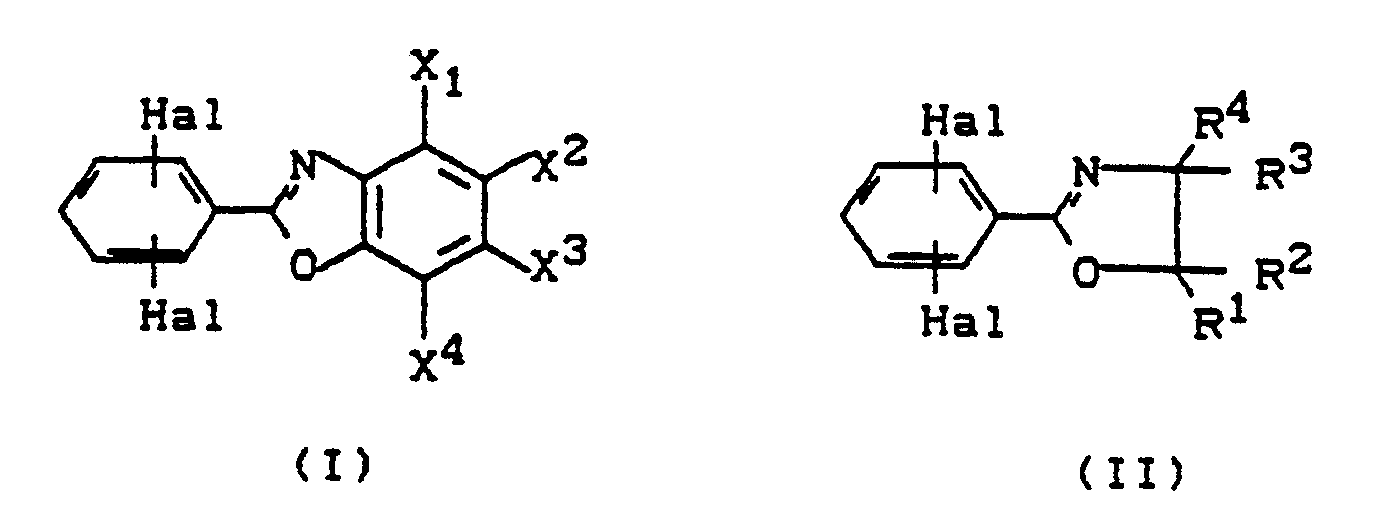

X¹, X², X³ und X⁴ unabhängig voneinander Wasserstoff (H), C₁-C₂₂-Alkyl, C₆-C₁₄-Aryl, Halogen wie Chlor, Brom, bevorzugt Methyl, Phenyl oder Chlor bedeuten, zwei orthoständige Reste Glieder eines 5-7 Kohlenstoffatome zählenden Rings sein können und
R¹, R², R³ und R⁴ unabhängig voneinander Wasserstoff (H) C₁-C₂₂-Alkyl, C₆-C₁₄-Aryl-, bevorzugt Methyl und Phenyl sind und
Hal für para und/oder metaständiges Chlor und Brom, vorzugsweise Chlor steht. - Ein weiterer Gegenstand der Erfindung ist ein Verfahren zur Herstellung von Polyarylensulfiden, dadurch gekennzeichnet, daß
- a) 70 bis 99,9 Mol-%, vorzugsweise 2 bis 10 Mol-% Dihalogenaromaten der Formel (III)

R¹, R², R³, R⁴ und Hal die oben angegebene Bedeutung haben
und - b) 0,1 bis 30 Mol-%, bevorzugt 2 bis 10 Mol-%, bezogen auf die Dihalogenaromaten der Formel III mit Comonomeren der Formeln (I) und/oder (II)

X¹, X², X³, X⁴, R¹, R², R³, R⁴ und Hal die oben angegebene Bedeutung haben, - c) Alkalisulfide, bevorzugt Natrium- oder Kaliumsulfid oder deren Mischung, bevorzugt in Form ihrer Hydrate oder wäßrigen Mischungen, gegebenenfalls zusammen mit Alkalihydroxiden wie Natrium- und Kaliumhydroxid, wobei das molare Verhältnis von Sulfiden zu Halogenaromaten im Bereich von 0,85:1 bis 1,15:1, liegt in
- d) einem organischen Lösungsmittel, gegebenenfalls unter Mitverwendung von Katalysatoren und/oder Cosolventien, wobei das molare Verhältnis von Alkalisulfiden c) zu dem organischen Lösungsmittel d) im Bereich von 1:2 bis 1:15 liegt, umgesetzt werden und die Umsetzung bei einer Temperatur von 150 bis 300°C durchgeführt wird.
- Die Comonomeren der Formel (I) und/oder (II) können dabei statistisch oder in Blöcken in die Hauptkette des Copolyarylensulfids eingebaut sein.
- Beispiele für Comonomeren der Formel (I) sind 2-(2,5-Dichlorphenyl)-benzoxazol, 2-(2,4-Dichlorphenyl)benzoxazol, 6-Chlor-2-(2,5-dichlorphenyl)-benzoxazol, 6-Chlor-2-(2,4-dichlorphenyl)-benzoxazol usw.
- Beispiel für Comonomeren der Formel (II) sind 2-(2,5-Dichlorphenyl)-oxazolin, 2-(2,4-Dichlorphenyl)-oxazolin, 2-(2,4-Dichlorphenyl)-5-methyl-oxazolin usw.
- Beispiele für Dihalogenaromaten der Formel III sind p-Dichlorbenzol, m-Dichlorbenzol, p-Dibrombenzol, 1,3-Dichlorbenzol, 1,3-Dibrombenzol usw.
- Die erfindungsgemäßen Copolyarylensulfide sind durch Umsetzung der Monomeren der Formel (I) und/oder (II) sowie (III) und einem Schwefelspender und einer anorganischen Base in einen dipolar-aprotischen Solvens herstellbar.
- Als anorganische Base und Schwefelspender können in bekannter Weise bevorzugt Alkalimetallsulfide (z.B. K₂S, Na₂S), besonders bevorzugt Natriumsulfid, eingesetzt werden. Als dipolar-aprotische Solventien werden z.B. N-Alkyl-Lactame, bevorzugt N-Methyllactame, besonders bevorzugt N-Methyl-caprolactam usw., eingesetzt.
- Die Comonomeren der Formel (I) und/oder (II) werden zu 0,1 - 30 Mol-%, bevorzugt zu 2 - 10 Mol-%, die Comonomeren der Formel (III) zu 70 - 99,9, bevorzugt zu 90 - 98 Mol-%, eingesetzt.
- Vom Schwefelspender, bevorzugt vom Alkalisulfid werden 1 bis 2, bevorzugt 1 bis 1,1 Equivalente eingesetzt, das Volumenverhältnis Lösungsmittel/Feststoff beträgt 1:1 bis 10:1.
- Alkalisulfide werden in üblichen Mengen und in üblicher Weise eingesetzt, z.B. sind Lithium-, Natrium, Kalium- und Rubidiumsulfid geeignet, vorzugsweise Natrium- und Kaliumsulfid. Es können Alkalisulfide eingesetzt werden, die aus Hydrogensulfiden mit Alkalihydroxiden wie LiOH, NaOH und KOH hergestellt werden. In jedem Fall können Mischungen sowohl der Sulfide als auch der Hydroxide eingesetzt werden.
- Die Umsetzung kann in Gegenwart von Katalysatoren wie ε-Caprolactam, Aminosäuren oder Alkaliacetaten, -chloriden, -fluoriden (z.B. NaCl, NaOAc, KF) und -aryl- bzw. -alkylsulfonaten durchgeführt werden.
- Die Reaktionstemperatur beträgt 150 - 300°C. Die Reaktion kann bei Drücken von 1 bis 20 bar durchgeführt werden.
- Die Alkalisufide können in wasserfreier Form oder als Hydrate eingesetzt werden. Die Entwässerung kann in einem oder mehreren Schritten, bevorzugt durch azeotropes Abdestillieren des Wassers, mit den Monomeren der Formel (III) als Schlepper, erfolgen. Zur Regenerierung der Alkalisulfide werden gegebenenfalls Alkalihydroxide eingesetzt.
- Das Zusammengeben der Reaktanden kann in beliebiger Form erfolgen. Die Dihalogenaromaten und die Comonomren der Formeln (I) und/oder (II) können zusammen oder getrennt, kontinuierlich, in Portionen oder direkt auf einmal zu dem Alkalisulfid, dem Lösungsmittel oder einem Teil davon gegeben werden.
- Es können auch das Alkalisulfid zusammen mit Lösungsmittel oder einem Teil davon zu Verbindungen der Formeln (I) und/oder (II) und den Dihalogenaromaten gegeben werden. Es können auch alle Reaktanden direkt zusammengegeben werden. Andere Kombinationen des Zusammengehens der Reaktanden sind ebenfalls möglich.
- Die Dosierzeit der Reaktionspartner dauert 0 bis 10 h, die Nachkondensationszeit 3 bis 24 h, bevorzugt 6 bis 14 h.
- Die Aufarbeitung des Reaktionsgemisches und die Isolierung der Polyarylensulfide kann in bekannter, mannigfaltiger Weise erfolgen, z.B. indem das Reaktionsgemisch in Isopropanol gefällt wird und das ausgefallene Polyarylensulfid nach Ansäuern elektrolytfrei gewaschen wird. Als Waschflüssigkeit kann Wasser, ein Alkohol oder Keton eingesetzt werden.
- Die erfindungsgemäßen Polyarylensulfide zeichnen sich durch eine niedrige Kristallisationsgeschwindigkeit bei fast unverändert hohem Kristallitschmelzpunkt aus.
- Durch Erwärmen auf Temperaturen oberhalb des Kristallitschmelzpunktes kann die Schmelzviskosität der erfindungsgemäßen Copolyarylensulfide erhöht werden.
- Die thermisch nicht nachbehandelten, erfindungsgemäßen Copolyarylensulfide eignen sich vorzugsweise zur Umhüllung von Mikrochips und anderen elektronischen Bauteilen.
- Die thermisch nachbehandelten, erfindungsgemäßen Copolyarylsulfide höherer Schmelzviskosität eignen sich vorzugsweise zur Herstellung von Formkörpern durch Spritzguß, von Folien, Fasern und Halbzeugen.
- 2-Aryl-benzoxazole sind z.B. aus Robert C. Elderfield Heterocyclich Compounds, John Wiley & Sons, London 1957 bekannt.
- Man mischt 255 g (2,342 mol) 2-Aminophenol, 93,7 g (2,342 mol) NaOH und 320 ml Wasser und gibt unter Eiskühlung 490,7 g (2,432 mol) 2,5-Dichlorbenzoylchlorid so zu, daß die Temperatur nicht über 10°C ansteigt. Dabei fällt 2-(2,5-Dichlorbenzoylamino)-phenol an. Man läßt auf Raumtemperatur kommen, rührt 30 Min. und saugt das 2,5-Dichlor-2′-hydroxy-benzanilid, das als Zwischenprodukt entsteht, ab und trocknet es im Vakuumtrockenschrank bei 80°C und 20 Torr. Das Amid wird anschließend 6h auf 200°C erhitzt, wobei das entstehende Reaktionswasser abdestilliert. Nach Destillation des Rückstandes erhält man 504,77 g (81,5 %) 2-(2,5-Dichlorphenyl)benzoxazol vom Siedepunkt 179°C/3 hPa und vom Schmelzpunkt 90°C.
- Man verfährt wie in Beispiel 1 beschrieben. Statt 255 g 2-Aminophenol werden 335,7 g 2-Amino-4-chlorphenol eingesetzt. Als Zwischenprodukt wird 2,5,5′-Trichlor-2′- hydroxy-benzanilid isoliert. Man erhält nach Destillation 502,3 g (71,7 %) 6-Chlor-2-(2,5-Dichlorphenyl)benzoxazol vom Siedepunkt 243°C/1,7 hPa und vom Schmelzpunkt 132°C.
- Die Elementaranalysen (C, H, N) der Substanzen aus Beispiel 1-2 stimmen mit den berechneten Werten innerhalb einer Fehlergrenze von 0,3 % überein.
- Man legt 608,24 g (4,16 Mol) p-Dichlorbenzol und 2,5 l N-Methylcaprolactam in einem 5 l-Stahlkessel vor, erhitzt auf 215°C und tropft ein Gemisch aus 1149,3 g (8,94 Mol) Natriumsulfidtrihydrat, 325 g Wasser, 4 g (0,1 Mol) Natriumhydroxid und 141,1 g (1,24 Mol) ε-Caprolactam so zu, daß die Sumpftemperatur bei 215°C bleibt. Dabei destilliert das zugesetzte Wasser und das Hydratwasser ab. Während der Natriumsulfidzugabe wird 608,24 g (4,16 Mol) p-Dichlorbenzol zugetropft. Die Zugabedauer 4 h. Anschließend wird noch 9 h auf 240°C erhitzt und der Inhalt des 4 l-Kessels in 40 l Isopropanol abgelassen. Nach Ansäuern auf pH 1 filtriert man das ausgefallene Polymer ab und wäscht mit destilliertem Wasser elktrolytfrei.
- Als charakteristische physikalische Eigenschaften wurden die Schmelztemperatur Tm, die Rekristallisationstemperatur bei Wiederabkühlen Tk und die Schmelzenthalpie Hk durch DSC-Messungen bestimmt.
- Man verfährt analog dem Vergleichsbeispiel. Es werden 567 g (3,86 Mol) p-Dichlorbenzol vorgelegt. 15 min nach der Natriumsulfidzugabe werden 79,2 g (0,3 Mol) 2-(2,5-Dichlorphenyl)benzoxazol zugegeben.
Tk (°C) Hk (J/g) Tm (°C) Vergleichsbeispiel 235 52 278 Beispiel 1 186 44 276 - Das Polyarylensulfid aus Beispiel 1 wird 16 min auf 306°C erhitzt. Die kontinuierliche Zunahme der Schmelzviskosität (bei 48,7 s⁻¹) zeigt folgende Tabelle:
Zeit (min) 2 4 6 8 10 12 14 16 ηmelt (Pas) 5 6 10 13 17 21 33 54 - Man verfährt analog dem Vergleichsbeispiel. Es werden 567 g (3,86 Mol) p-dichlorbenzol vorgelegt. 15 min nach der Natriumsulfidzugabe werden 89,55 g (0,3 Mol) 6-Chlor-2-(2,5-dichlorphenyl)-benzoxazol zugegeben.
Tk (°C) Hk (J/g) Tm (°C) Vergleichsbeispiel 235 52 278 Beispiel 3 191 30 270 - Das Copolyarylensulfid aus Beispiel 3 wird 16 min auf 306°C erhitzt. Die kontinuierliche Zunahme der Schmelzviskosität (bei 48,7 s⁻¹) zeigt folgende Tabelle:
Zeit (min) 2 4 6 8 10 12 14 16 ηmelt (Pas) 6 8 13 18 23 29 33 40 - Man verfährt analog dem Vergleichsbeispiel. Es werden 567 g (3,86 Mol) p-Dichlorbenzol vorgelegt. 15 min nach der Natriumsulfidzugabe werden 79,2 g (0,3 Mol) 2-(2,4-Dichlorphenyl)-benzoxazol zugegeben.
Tk (°C) Hk (J/g) Tm (°C) Vergleichsbeispiel 235 52 278 Beispiel 5 176 45 267 Tk (°C) Hk (J/g) Tm (°C) Vergleichsbeispiel 235 52 278 Beispiel 6 179 39 269
Claims (3)


X¹, X², X³ und X⁴ unabhängig voneinander Wasserstoff (H), C₁-C₂₂-Alkyl, C₆-C₁₄-Aryl, Halogen wie Chlor, Brom bevorzugt Methyl, Phenyl oder Chlor bedeuten, zwei ortho-ständige Reste Glieder eines 5-7 Kohlenstoffatome zählenden Rings sein können und
R¹, R², R³ und R⁴ unabhängig voneinander Wasserstoff (H) C₁-C₂₂-Alkyl-C₆-C₁₄-Aryl-, bevorzugt Methyl und Phenyl ist und
Hal für para und/oder metaständiges Halogen wie Chlor und Brom, vorzugsweise Chlor steht.
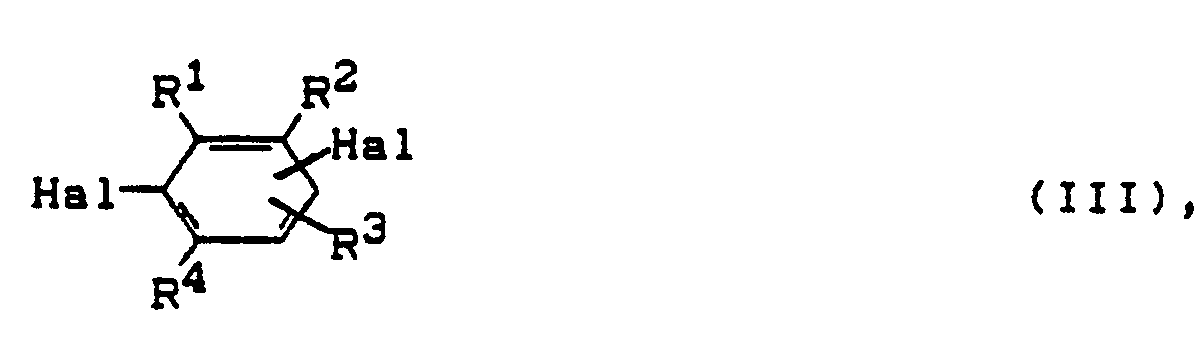
R¹, R², R⁴ und Hal die in Anspruch 1 angegebene Bedeutung haben
und

X¹, X², X³, X⁴, R¹, R², R⁴ und Hal die in Anspruch 1 angegebene Bedeutung haben,
Applications Claiming Priority (2)
| Application Number | Priority Date | Filing Date | Title |
|---|---|---|---|
| DE3808915 | 1988-03-17 | ||
| DE3808915A DE3808915A1 (de) | 1988-03-17 | 1988-03-17 | Benzoxazol- oder oxazolingruppen-haltige polyarylsulfide |
Publications (2)
| Publication Number | Publication Date |
|---|---|
| EP0332997A2 true EP0332997A2 (de) | 1989-09-20 |
| EP0332997A3 EP0332997A3 (de) | 1990-11-28 |
Family
ID=6349963
Family Applications (1)
| Application Number | Title | Priority Date | Filing Date |
|---|---|---|---|
| EP19890103979 Withdrawn EP0332997A3 (de) | 1988-03-17 | 1989-03-07 | Benzoxazol- oder Oxazolingruppenhaltige Polyarylsulfide |
Country Status (3)
| Country | Link |
|---|---|
| EP (1) | EP0332997A3 (de) |
| JP (1) | JPH01271430A (de) |
| DE (1) | DE3808915A1 (de) |
Cited By (1)
| Publication number | Priority date | Publication date | Assignee | Title |
|---|---|---|---|---|
| EP0389903A1 (de) * | 1989-03-30 | 1990-10-03 | Bayer Ag | Mischungen aus Polyarylensulfiden und Oxazolinen |
Family Cites Families (3)
| Publication number | Priority date | Publication date | Assignee | Title |
|---|---|---|---|---|
| DE3529501A1 (de) * | 1985-08-17 | 1987-02-19 | Bayer Ag | Verfahren zur herstellung von hochmolekularen, gegebenenfalls verzweigten polyarylensulfiden |
| DE3601215A1 (de) * | 1986-01-17 | 1987-07-23 | Bayer Ag | Polyarylensulfide mit definiert einstellbaren schmelzviskositaeten |
| DE3703550A1 (de) * | 1987-02-06 | 1988-08-18 | Bayer Ag | Verfahren zur herstellung von polyarylensulfiden mit regelbaren schmelzviskositaeten |
-
1988
- 1988-03-17 DE DE3808915A patent/DE3808915A1/de not_active Withdrawn
-
1989
- 1989-03-07 EP EP19890103979 patent/EP0332997A3/de not_active Withdrawn
- 1989-03-13 JP JP1058047A patent/JPH01271430A/ja active Pending
Cited By (1)
| Publication number | Priority date | Publication date | Assignee | Title |
|---|---|---|---|---|
| EP0389903A1 (de) * | 1989-03-30 | 1990-10-03 | Bayer Ag | Mischungen aus Polyarylensulfiden und Oxazolinen |
Also Published As
| Publication number | Publication date |
|---|---|
| DE3808915A1 (de) | 1989-10-05 |
| EP0332997A3 (de) | 1990-11-28 |
| JPH01271430A (ja) | 1989-10-30 |
Similar Documents
| Publication | Publication Date | Title |
|---|---|---|
| JPH0651792B2 (ja) | ポリ(p−フエニレンスルフイド)の改良製造方法 | |
| DE69222997T2 (de) | Verfahren zur Herstellung von Polyarylensulfid | |
| EP1813638B1 (de) | Verfahren zur herstellung von polyarylensulfid | |
| EP0040747B1 (de) | Verfahren zur Herstellung von Polyarylensulfiden | |
| EP0109637B1 (de) | Verfahren zur Herstellung von hochmolekularen gegebenenfalls verzweigten Polyarylensulfiden | |
| EP0023313B1 (de) | Verfahren zur Herstellung von Polyarylensulfiden | |
| EP0259188B1 (de) | Verfahren zur Herstellung eines Polyarylenthioäthers mit hoher Kristallinsationsgeschwindigkeit. | |
| EP0126369B1 (de) | Verfahren zur Herstellung von hochmolekularen, gegebenenfalls verzweigten Polyarylensulfiden | |
| EP0142024B1 (de) | Verfahren zur Herstellung von hochmolekularen, gegebenenfalls verzweigten Polyarylensulfiden | |
| EP0121206B1 (de) | Verfahren zur Herstellung von gegebenenfalls verzweigten Polyarylensulfiden | |
| EP0065689A1 (de) | Verfahren zur Herstellung von Polyarylensulfiden | |
| JPS596221A (ja) | ポリ(アリ−レンスルフイド)の処理方法 | |
| EP0108978B1 (de) | Verfahren zur Herstellung von gegebenenfalls verzweigten Polyarylensulfiden | |
| EP0395883B1 (de) | Mischungen aus Polyarylensulfiden mit Sulfonsäure und/oder Sulfonsäurederivat-Endgruppen und Polyarylensulfiden, und deren Verwendung | |
| EP0427134A1 (de) | Behandlung von Polyarylensulfid-/Sulfon-Polymeren | |
| EP0140272A1 (de) | Verfahren zur Herstellung von gegebenenfalls verzweigten Polyarylensulfiden mit verminderter Korrosivität | |
| EP0374462A2 (de) | Verfahren zur Herstellung von hochmolekularen, gegebenfalls verzweigten Polyarylensulfiden | |
| EP0372252A2 (de) | Verfahren zur Herstellung von hochmolekularen, gegebenenfalls verzweigten polyarylensulfiden | |
| DE3808915A1 (de) | Benzoxazol- oder oxazolingruppen-haltige polyarylsulfide | |
| EP0279217B1 (de) | Verfahren zur Herstellung von Polyarylensulfiden mit regelbaren Schmelzviskositäten | |
| DE3854758T2 (de) | Verfahren zur Herstellung von Poly(para-phenylen-sulfid). | |
| EP0092723A2 (de) | Verfahren zur Herstellung von hochmolekularen, gegebenenfalls verzweigten Polyarylensulfiden | |
| EP0315838A1 (de) | Verfahren zur Herstellung von Polyarylensulfiden mit definiert einstellbaren Schmelzviskositäten | |
| EP0383119B1 (de) | Statistische oder alternierende schwefelhaltige Copolymere, ein Verfahren zu ihrer Herstellung und ihre Verwendung | |
| DE4105552A1 (de) | Verfahren zur herstellung von hochmolekularen, gegebenenfalls verzweigten, polyarylensulfiden |
Legal Events
| Date | Code | Title | Description |
|---|---|---|---|
| PUAI | Public reference made under article 153(3) epc to a published international application that has entered the european phase |
Free format text: ORIGINAL CODE: 0009012 |
|
| 17P | Request for examination filed |
Effective date: 19890307 |
|
| AK | Designated contracting states |
Kind code of ref document: A2 Designated state(s): BE DE FR GB IT |
|
| PUAL | Search report despatched |
Free format text: ORIGINAL CODE: 0009013 |
|
| AK | Designated contracting states |
Kind code of ref document: A3 Designated state(s): BE DE FR GB IT |
|
| STAA | Information on the status of an ep patent application or granted ep patent |
Free format text: STATUS: THE APPLICATION HAS BEEN WITHDRAWN |
|
| 18W | Application withdrawn |
Withdrawal date: 19920624 |
|
| R18W | Application withdrawn (corrected) |
Effective date: 19920624 |