EP0332998B1 - Mélanges de polycarbonates aromatiques et/ou de polyesters aromatiques avec des copolymères spécifiques - Google Patents
Mélanges de polycarbonates aromatiques et/ou de polyesters aromatiques avec des copolymères spécifiques Download PDFInfo
- Publication number
- EP0332998B1 EP0332998B1 EP89103981A EP89103981A EP0332998B1 EP 0332998 B1 EP0332998 B1 EP 0332998B1 EP 89103981 A EP89103981 A EP 89103981A EP 89103981 A EP89103981 A EP 89103981A EP 0332998 B1 EP0332998 B1 EP 0332998B1
- Authority
- EP
- European Patent Office
- Prior art keywords
- formula
- mixtures
- weight
- vii
- alkyl
- Prior art date
- Legal status (The legal status is an assumption and is not a legal conclusion. Google has not performed a legal analysis and makes no representation as to the accuracy of the status listed.)
- Expired - Lifetime
Links
- 0 COc1ccc(*(C(C=C2)=CCC2O*)(N*)NIC)cc1 Chemical compound COc1ccc(*(C(C=C2)=CCC2O*)(N*)NIC)cc1 0.000 description 4
- FOEYMRPOKBCNCR-UHFFFAOYSA-N C(C1)C11CCCCC1 Chemical compound C(C1)C11CCCCC1 FOEYMRPOKBCNCR-UHFFFAOYSA-N 0.000 description 1
Classifications
-
- C—CHEMISTRY; METALLURGY
- C08—ORGANIC MACROMOLECULAR COMPOUNDS; THEIR PREPARATION OR CHEMICAL WORKING-UP; COMPOSITIONS BASED THEREON
- C08L—COMPOSITIONS OF MACROMOLECULAR COMPOUNDS
- C08L69/00—Compositions of polycarbonates; Compositions of derivatives of polycarbonates
-
- C—CHEMISTRY; METALLURGY
- C08—ORGANIC MACROMOLECULAR COMPOUNDS; THEIR PREPARATION OR CHEMICAL WORKING-UP; COMPOSITIONS BASED THEREON
- C08L—COMPOSITIONS OF MACROMOLECULAR COMPOUNDS
- C08L67/00—Compositions of polyesters obtained by reactions forming a carboxylic ester link in the main chain; Compositions of derivatives of such polymers
-
- C—CHEMISTRY; METALLURGY
- C08—ORGANIC MACROMOLECULAR COMPOUNDS; THEIR PREPARATION OR CHEMICAL WORKING-UP; COMPOSITIONS BASED THEREON
- C08L—COMPOSITIONS OF MACROMOLECULAR COMPOUNDS
- C08L69/00—Compositions of polycarbonates; Compositions of derivatives of polycarbonates
- C08L69/005—Polyester-carbonates
Definitions
- the average molecular weights of blocks A and B are 500 to 1,000,000, preferably 1,000 to 500,000 and particularly preferably 2,000 to 250,000; the average molecular weights of the centerpieces X 300 to 10,000, preferably 500 to 8,000.
- M n number average molecular weights (M n), which can be set for blocks A and B on the basis of the polymerization process (anionic polymerization) using the monomer / initiator ratio (see, for example, HG Elias, "Makromolecules", Hüthig and Wepf Verlag, Basen, Heidelberg (1975) , P. 518 ff).
- particularly preferred cyclic carbonates (II) and (III) are trimethyl glycol carbonate, neopentyl glycol carbonate, 1,4-butanediol carbonate and dimeric carbonates of pentanediol or hexanediol.
- the preferred lactone (IV) is ⁇ -caprolactone and / or pivalolactone.
- the average molecular weights of blocks A and B and of center pieces X can be different or almost the same size.
- the polymers each contain blocks A and B in amounts of 5 to 95% by weight (based on total amount A + B), but preferably in amounts of 5 to 80% by weight.
- the content of centerpieces X with a "tapered structure" is 5 to 50% by weight (based on A + B + X), preferably 5 to 25% by weight (based on A + B + X).
- reaction product can preferably be neutralized or the anionic polymer formed can be reacted with an alkyl halide, carboxylic acid chloride, carboxylic acid anhydride or carboxylic acid ester.
- Suitable aromatic solvents are benzene, toluene; a suitable ether is tetrahydrofuran; To achieve certain molecular weights of the copolymers, one can also use mixtures of aromatic hydrocarbons and ether work.
- Suitable alkylalkali metal compounds or arylalkali metal compounds are, for example, butyllithium, in particular secondary butyllithium, Na naphthalene and K naphthalene.
- the polymer formed can be neutralized or reacted with suitable compounds which can react with carbanions to form an uncharged stable end product.
- Suitable neutralizing agents are e.g. weak inorganic and organic acids or acidic salts of protonic acids, N-H and C-H-acidic acids;
- Compounds that can react with carbanions are e.g. Alkyl halides (in particular methyl chloride, methyl iodide, benzyl chloride, benzyl bromide), carboxylic acid chlorides (particularly benzoyl chloride, ChlorameisenTexreester, phosgene, acetyl, caproyl, stearoyl chloride), carboxylic acid (especially acetic anhydride, succinic anhydride) and Carbonklareester (particularly activated esters such as Carbonklarephenylester, Carbonklanitrophenylester and alkyl esters of carboxylic acids ), where the alkyl groups can optionally be substituted by activating groups such as nitro groups, CN groups, carboxyl groups.
- the copolymer can be isolated from the reaction product, optionally with removal of undesired impurities.
- the copolymer can be precipitated from the polymer solution and subsequently cleaned by washing; the copolymer is preferably to be isolated by evaporation. During or prior to evaporation the copolymer can be cleaned e.g. by azeotropic distillation, extraction or fractional distillation.
- the copolymers according to European Patent Application No. 87 119 217.5 have different properties from crystalline-brittle to amorphous rubber-elastic.
- the processing of the copolymers depends on their properties.
- Moldings can be produced from polymers with thermoplastic properties using known thermoplastic processing methods.
- the new copolymers are still sufficiently stable when processed above 150 ° C. and do not show any molecular degradation. For this reason, molded articles made from them have very good mechanical properties that are retained even after repeated exposure to temperature.
- copolymers according to European Patent Application No. 87 119 217.5 are preferably - depending on their chemical structure - for the production of films, seals, coatings, especially where improved long-term behavior is required; they are also suitable for the production of resinous, thermoplastic packaging materials, in particular for food.
- copolymers can be stabilized in a known manner, pigmented and made antistatic by means of conventional additives, made easier to process or make flame-resistant or filled with fillers.
- a solution of 10.6 g of neopentyl glycol carbonate and 9.3 g of ⁇ -caprolactone in 100 ml of toluene is prepared and cooled to -10 ° C.
- a third of the solution is added to 0.2 ml of sec-butyllithium (1.4 m solution in cyclohexane) in 10 ml of toluene in the reaction vessel and the mixture is stirred at -10 ° C. for 70 minutes.
- the second third of the solution is added and after a further 120 minutes the last third, which is left to react for a further 120 minutes.
- Working up was carried out by decomposing the reaction mixture with 10 ml of methanol / hydrochloric acid (weight ratio 9: 1) and precipitating with 220 ml of methanol.
- R3, R4, R5 and R6 in (VII) are the same or different and are H, C1-C6-alkyl, C3-C6-alkylene, C1-C6-alkoxy and C2-C6-alkyleneoxy-C1-C6-alkyl, preferably H , CH3 and C2H5; "m” and "n” in (VII) are independently 0, 1, 2, 3, 4, 5 or 6.
- Carbonates (V) and (VI) which are preferably used are trimethylene glycol carbonate, neopentyl glycol carbonate, 1,4-butanediol carbonate, the dimeric carbonate of pentanediol and the dimeric carbonate of hexanediol, with neopentyl glycol carbonate being particularly preferred.
- Preferred lactones (VII) are ⁇ -caprolactone and pivalolactone.
- the average molecular weights of the blocks -A- and -B- and the polymers -X- be the same or different.
- the average molecular weights ( M n number average) of blocks A and B can be adjusted due to the polymerization process (anionic polymerization) by the monomer / initiator ratio (see eg Hüthig + Wepf Verlag, Basel, Heidelberg (1975), p. 519 ff).
- the average molecular weights (Mn) for -A- are between 1,000 and 500,000, preferably between 2,000 and 250,000, for -B- between 1,000 and 500,000, preferably between 2,000 and 250,000, for -X- between 300 and 10,000, preferably between 500 and 8,000.
- the polymers each contain blocks A and B in amounts of 5-95% by weight (based on total amount A + B), but preferably in amounts of 5 to 80% by weight A and 95 to 20% by weight B (based on A + B), and 5 to 80% by weight B and 95 to 20% by weight A (based on A + B); the content of centerpieces X with a "tapered structure" is 5 to 50% by weight (based on A + B + X), preferably 5 to 25% by weight (based on A + B + X).
- copolymers of the formula (Ia) to be used according to the invention as component 2.) of the mixture can be prepared in accordance with European Patent Application No. 87 119 217.5 (Le A 24 910); this also applies to those copolymers of the formula (Ia) which are not yet in of this European patent application are recorded under formula (I).
- the copolymers (Ia) are prepared by anionic, ring-opening solution polymerization of the carbonates (V) and (VI) and the lactones (VII), the synthesis of the copolymers (Ia) in which r is greater than 1, that is to say the copolymers of structure -AXBAXB- or -AXBAXBAXB- a stepwise reaction with stepwise addition of the reactants of the formulas (V) and / or (VI) and (VII) to the copolymers -AXB- or -AXBAXB- which have already been formed in each case is required.
- the copolymers of the formula (Ia) are generally prepared as follows: A solution of a mixture of cyclic carbonates (V) and / or VI and lactone (VII) in a non-protic aromatic or aliphatic solvent or ether is made by adding a solution of an alkyl alkali metal or aryl alkali metal compound or alkali alkyl alcoholate compound as an initiator at -78 to + 30 ° C, preferably polymerized at -30 ° C to + 20 ° C, first building block A and then the tapered transition segment X and then block B. After complete conversion of the monomers, the copolymer has the structure AXB and is also polymerization-active.
- the copolymer of structure A-X-B is desired, the copolymer is neutralized with loss of the polymerization activity and isolated.
- the copolymer of this structure is desired, the copolymer is neutralized and isolated.
- the copolymer can now be neutralized and isolated.
- the copolymer of structure (AXB) 4 can be prepared, the same applies correspondingly if r is 5, 6 or another integer up to 20 .
- the diphenols of the formula (VIII) are known or can be prepared by known processes; Polydiorganosiloxanes with hydroxy-aryloxy end groups according to formula (VIIIa) are also known (compare US Pat. No. 3,419,634) or can be prepared by known processes.
- Suitable diphenols of the formula (VIII) are Hydroquinone, Resorcinol, Dihydroxy diphenyls, Bis (hydroxyphenyl) alkanes, Bis (hydroxyphenyl) cycloalkanes, Bis (hydroxyphenyl) sulfides, Bis (hydroxyphenyl) sulfones and ⁇ , ⁇ ′-bis (hydroxphenyl) diisopropylbenzenes as well as their core chlorinated and core brominated derivatives.
- diphenols of the formula (VIII) are 4,4'-dihydroxydiphenyl, 2,2-bis (4-hydroxyphenyl) propane, 2,4-bis (4-hydroxyphenyl) -2-methylbutane, 1,1 - bis (4-hydroxyphenyl) cyclohexane, 2,2-bis (3-chloro-4-hydroxyphenyl) propane and 2,2-bis (3,5-dibromo-4-hydroxyphenyl) propane.
- Preferred diphenols of the formula (VIII) are 2,2-bis (4-hydroxyphenyl) propane, 2,2-bis (3,5-dichloro-4-hydroxyphenyl) propane, 2,2-bis (3 , 5-dibromo-4-hydroxyphenyl) propane and 1,1-bis (4-hydroxyphenyl) cyclohexane.
- the diphenols of the formula (VIIIa) can be obtained, for example, from the corresponding bis-chlorine compounds of the formula (IX) and the diphenols (VIII), for example, according to US Pat. No. 3,419,635, column 3, in combination with US Pat. No. 3,189,662.
- R and m have the same meaning as in the diphenols (VIIIa) and (VIIIb).
- Polycarbonates according to component 1) which are suitable according to the invention are homopolycarbonates from one diphenol and copolycarbonates from several diphenols, the diphenols of the formula (VIIIa) being used only for the preparation of copolycarbonates with the diphenols of the formula (VIII), in a weight amount of 1-50% by weight, preferably from 1.5-25% by weight and in particular from 2 to 10% by weight, based on the total weight of the diphenols of the formulas (VIII) and (VIIIa) used.
- Polycarbonates according to component 1.) which are suitable according to the invention are also mixtures of a copolycarbonate of the diphenols of the formulas (VIIIa) and (VIII) and another siloxane-free thermoplastic polycarbonate, the content of diphenols of the formula (VIIIa) in the polycarbonate mixture, based on the Total sum of diphenols, again from 1-50% by weight.
- preferred polycarbonates are the copolycarbonates of bisphenol A with up to 15 mol%, based on the molar sum of diphenols, of 2,2-bis (3,5-dibromo-4-hydroxyphenyl) propane and the copolycarbonates of the diphenols of the formula (VIII) with 1-50% by weight of diphenols of the formula (VIIIa), preferably of the formula (VIIIb), based in each case on the total weight of the diphenols (VIII) and (VIIIa) or (VIII) and (VIIIb).
- the polycarbonates according to component 1) which are suitable according to the invention can be branched in a known manner, preferably by incorporating 0.05-2.0 mol%, based on the sum of the diphenols used, of three- or more than three-functional compounds , e.g. those with three or more than three phenolic groups.
- polycarbonates according to component 1) which are suitable according to the invention is known and can be carried out, for example, with phosgene by the phase interface process or with phosgene by the process in homogeneous phase ("Pyridine process") take place, the molecular weight can be adjusted by an appropriate amount of known chain terminators (for polydiorganosiloxane-containing polycarbonates see DE-OS 3 334 872 (Le A 22 594).
- the polycarbonates according to component 1) which are suitable according to the invention have average weight-average molecular weights (M w , measured by ultracentrifugation or scattered light measurement) of 10,000-200,000, preferably 20,000-80,000.
- Suitable chain terminators for adjusting the molecular weights of the polycarbonates according to component 1. are e.g. Phenol, p-chlorophenol, p-tert-butylphenol, 2,4,6-tribromophenol, long-chain alkylphenols, such as 4-81,3- (tetramethylbutyl) phenol (DE-OS 2 842 005), monoalkylphenols and dialkylphenols with a total of 8-20 C atoms in the alkyl substituents, such as 3,5-di-tert-butylphenol, p-isooctylphenol, p-tert-octylphenol, p-dodecylphenol and 2-) 3,5-dimethyl-heptyl) phenol and 4- (3,5-dimethylheptyl) phenol (DE-OS 3 506 472).
- Phenol e.g. Phenol, p-chlorophenol, p-tert-
- the amount of chain terminators is in each case 0.1 to 10 mol%, based on moles of diphenols in the case of the phenolic chain terminators and on moles of dicarboxylic acid dichlorides in the case of monocarboxylic acid chloride chain terminators.
- thermoplastic aromatic polyesters according to component 1) which are suitable according to the invention are thermoplastic aromatic polyesters (carbonates) based on C6-C30 diphenols, aromatic C8-C14 dicarboxylic acids, chain terminators and optionally carbonic acid halides and / or branching agents.
- Polyesters (carbonates) in the sense of the present invention are thus aromatic, optionally branched polyesters, which may also contain carbonate links, the carbonate links in the polycondensate chain being at most 99 mol%, preferably 80 mol% and in particular 50 mol% , based on the molar sum of the ester and carbonate links in the polycondensate chain, and thus the ester links being at least 1 mol%, preferably 20 mol% and in particular 50 mol%, based on the molar sum the ester and carbonate links in the polycondensate chain.
- Suitable C6-C30 diphenols are those of the formula (VIII) mentioned for the polyarbonates.
- Preferred C6-C30 diphenols are also the preferred of formula (VIII).
- Suitable aromatic dicarboxylic acids are, for example, isophthalic acid, terephthalic acid, diphenyl ether-4,4'-dicarboxylic acid and naphthalene-2,6-dicarboxylic acid.
- Preferred aromatic dicarboxylic acids are isophthalic acid, terephthalic acid and mixtures thereof in a ratio between 1:20 and 20: 1.
- the dicarboxylic acids are incorporated in the form of the dicarboxylic acid dichlorides in the polyesters or in the polyester carbonates.
- Suitable chain terminators are the phenolic ones already mentioned for the production of polycarbonates. Chlorocarbonic acid esters of these phenolic chain terminators are also suitable. Suitable chain terminators are also acid chlorides of aromatic monocarboxylic acid, for example benzoyl chloride. Suitable chain terminators are also acid chlorides of aliphatic C2-C22-acetyl chloride.
- the amount of chain terminators to be used is between 0.1 and 10 mol%, the amount being based on moles of diphenols in the case of phenolic chain terminators and the amount being based on moles of dicarboxylic acid dichlorides in the case of acid chloride chain terminators.
- the preferred carbonic acid halide is COCl2.
- phase interface method is particularly preferred.
- aliphatic components e.g. Adipic acid, 1,4-butanediol may be involved.
- polyesters (carbonates) according to component 1) which are suitable according to the invention can also contain aromatic hydroxycarboxylic acid, for example p-hydroxybenzoic acid, incorporated, this taking into account the diphenol and dicarboxylic acid units in a known manner. 1 mole of aromatic hydroxycarboxylic acid thus substitutes 1/2 mole of dicarboxylic acid and 1/2 mole of diphenol.
- ester groups and the carbonate groups can be randomly distributed or also arranged in blocks.
- thermoplastic aromatic polyesters according to component 1) which are suitable according to the invention have relative solution viscosities ( ⁇ rel ) in the range from 1.18 to 1.4, preferably 1.22 to 1.3 (measured on solutions of 0.5 g polyester in 100 ml CH2Cl2 solution at 25 ° C).
- the mixtures according to the invention composed of components 1) and 2) have excellent toughness combined with high resistance to the action of organic solvents and combined with good flow behavior.
- the mixtures according to the invention can contain further additives such as stabilizers, pigments, mold release agents, flame retardants and / or antistatic agents.
- the mixtures according to the invention comprising components 1.), 2.) and, if appropriate, further additives, can be prepared by mixing their constituents in a known manner and at temperatures of 200-330 ° C. in conventional mixing devices, such as internal kneaders, extruders or twin-screw screws , melt compounded or melt extruded.
- the present invention thus also relates to a process for the preparation of mixtures comprising components 1.), 2.) and, if appropriate, stabilizers, pigments, mold release agents, flame retardants and / or antistatic agents, which is characterized in that components 1.) and 2.) and optionally stabilizers, pigments, mold release agents, flame retardants and / or antistatic agents are mixed in a known manner and then melt-compounded or melt-extruded at temperatures from 200 ° C. to 330 ° C. in conventional mixing devices.
- the components can be mixed in a known manner both successively and simultaneously at about 20 ° C. (room temperature) and also at a higher temperature.
- molding compositions of the present invention can be used for the production of moldings of any kind.
- moldings can be produced by injection molding.
- moldings that can be produced are housing parts for household appliances, molded parts for the motor vehicle interior and in particular for the motor vehicle exterior.
- Another form of processing is the production of shaped bodies by deep drawing from previously produced plates or foils.
- the components were compounded in a 1.3 l internal kneader.
- the moldings were produced using an injection molding machine at 260 ° C. or 280 ° C.
- the notched impact strength a k according to Izod was determined on bars measuring 80x10x4 mm in accordance with ISO 180 1 A at the temperatures given in the examples.
- the stress crack behavior was investigated on bars measuring 80x10x4 mm, melt temperature 260 ° C. A mixture of 50% toluene and 50% isooctane was used as fuel simulant. The test specimens were pre-stretched using a circular arc template and 5 min. stored at room temperature in the fuel simulator. The pre-stretch ⁇ x was 0.2-2.4%. The stress crack behavior was assessed via the crack formation or the break depending on the pre-stretch.
Landscapes
- Chemical & Material Sciences (AREA)
- Health & Medical Sciences (AREA)
- Chemical Kinetics & Catalysis (AREA)
- Medicinal Chemistry (AREA)
- Polymers & Plastics (AREA)
- Organic Chemistry (AREA)
- Polyesters Or Polycarbonates (AREA)
- Compositions Of Macromolecular Compounds (AREA)
Claims (8)
- Mélanges contenant1) 10 à 98 parties en poids de polycarbonates aromatiques thermoplastiques et/ou de polyesters aromatiques thermoplastiques et2) 90 à 2 parties en poids de copolymères de formule (Ia)
⁅ A - X - B ⁆r (Ia)
dans laquelle
r est un nombre entier de 1 à 20 et dans laquelle
-A- représente des polymères de carbonates cycliques de formule (V)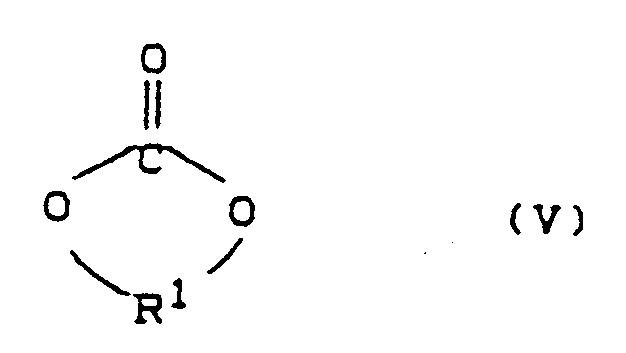


-X- représente des polymères qui contiennent aussi bien les carbonates (V) et/ou (VI) et également les lactones (VII) sous forme polymérisée, la concentration des carbonates (V) et/ou (VI) polymérisés diminuant en continu chaque fois dans la direction des séquences B et la concentration des lactones (VII) polymérisées diminuant en continu chaque fois dans la direction des séquences -A- ("tapered structure") et la somme des parties en poids des composants 1 et 2 étant chaque fois de 100 parties en poids et
R¹ dans (V) est un groupe alkylène linéaire en C₃-C₁₀ ou un des restes de formules a) à l)a) -CH₂CH₂CH(CH₃)-b) -CH₂CH₂OCH₂CH₂OCH₂CH₂-,c) -CH₂CH(CH₃)CH₂CH₂C(CH₃)₂CH₂-,d) e)
e) f)
f) g)
g) h)
h) i)
i) j)
j) k)
k) l)R² dans (VI) est un groupe alkylène linéaire en C₄-C₁₂ ou un reste de formule m) ou b)
 m) -CH₂-CH₂-O-CH₂-CH₂- oub) -CH₂-CH₂-O-CH₂-CH₂-O-CH₂-CH₂-et
R³, R⁴, R⁵ et R⁶ dans (VII) sont identiques ou différents et sont H, alkyle en C₁-C₆, alkylène en C₃-C₆, alcoxy en C₁-C₆ et (alkylène en C₂-C₆)-oxy-alkyle en C₁-C₆
où
"m" et "n" dans (VII) sont indépendamment l'un de l'autre 0, 1, 2, 3, 4, 5 ou 6. - Mélanges selon la revendication 1, caractérisés en ce qu'ils contiennent 20 à 95 parties en poids de composant 1) et 80 à 5 parties en poids en composants 2).
- Mélanges selon les revendications 1 et 2, caractérisés en ce que r dans le copolymère de formule (Ia) est un entier de 1 à 10.
- Mélanges selon les revendications 1 et 2, caractérisés en ce que le composant 1) est un polycarbonate thermoplastique à base de diphénols de formule (VIII)

A est une liaison simple, un groupe alkylène en C₁-C₅, un groupe alkylidène en C₂-C₅, un groupe cycloalkylidène en C₅ ou C₆, -S-, -SO₂- ou un reste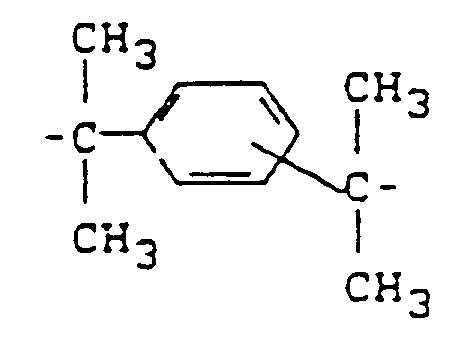
x est égal à 0, 1 ou 2 et
n est égal à 1,
et éventuellement en outre de formule (VIIIa)
A, Hal, x et n ont la signification indiquée pour la formule (VIII), les restes R sont identiques ou différents et représentent chacun un groupe alkyle linéaire en C₁-C₁₀, un groupe alkyle ramifié en C₃-C₂₀ ou un groupe aryle en C₆-C₂₀ et m est un nombre entier entre 5 et 100. - Mélanges selon les revendications 1 et 2, caractérisés en ce que le composant 1) est un polyester aromatique thermoplastique à base de diphénols en C₆-C₃₀, d'acides dicarboxyliques aromatiques en C₈-C₁₄, d'agents de coupure de chaînes et éventuellement d'halogénures d'acide carbonique et/ou d'agents de ramification.
- Mélanges selon la revendication 5, caractérisés en ce que le composant 1) est un polyestercarbonate aromatique thermoplastique.
- Mélanges selon les revendications 1 et 2, caractérisés en ce qu'ils contiennent en outre des stabilisants, des pigments, des agents de démoulage, des agents ignifugeants et/ou des agents antistatiques.
- Procédé pour la fabrication des mélanges selon les revendications 1 à 7, caractérisé en ce que l'on mélange de manière connue les composants 1) et 2) et éventuellement des stabilisants, des pigments, des agents de démoulage, des agents ignifugeants et/ou des agents antistatiques et ensuite on les combine à l'état fondu dans des mélangeurs habituels et on les extrude à l'état fondu à des températures de 200 à 330°C.
Applications Claiming Priority (2)
| Application Number | Priority Date | Filing Date | Title |
|---|---|---|---|
| DE3808837A DE3808837A1 (de) | 1988-03-17 | 1988-03-17 | Mischungen aus aromatischen polycarbonaten und/oder aromatischen polyestern mit speziellen copolymeren |
| DE3808837 | 1988-03-17 |
Publications (3)
| Publication Number | Publication Date |
|---|---|
| EP0332998A2 EP0332998A2 (fr) | 1989-09-20 |
| EP0332998A3 EP0332998A3 (fr) | 1991-03-20 |
| EP0332998B1 true EP0332998B1 (fr) | 1993-08-04 |
Family
ID=6349904
Family Applications (1)
| Application Number | Title | Priority Date | Filing Date |
|---|---|---|---|
| EP89103981A Expired - Lifetime EP0332998B1 (fr) | 1988-03-17 | 1989-03-07 | Mélanges de polycarbonates aromatiques et/ou de polyesters aromatiques avec des copolymères spécifiques |
Country Status (4)
| Country | Link |
|---|---|
| US (1) | US4908416A (fr) |
| EP (1) | EP0332998B1 (fr) |
| JP (1) | JPH01282249A (fr) |
| DE (2) | DE3808837A1 (fr) |
Families Citing this family (5)
| Publication number | Priority date | Publication date | Assignee | Title |
|---|---|---|---|---|
| US6600007B2 (en) * | 2001-03-27 | 2003-07-29 | Southwest Distributing Co. | Preparation of bromine-containing hydroxy-functional copolymers |
| US7671095B2 (en) | 2006-05-31 | 2010-03-02 | The Trustees Of The Boston University | Films and particles |
| US7666973B2 (en) * | 2007-07-30 | 2010-02-23 | Tyco Healthcare Group Lp | Carbonate copolymers |
| US8795707B2 (en) * | 2008-05-13 | 2014-08-05 | Trustees Of Boston University | Compliant composites for application of drug-eluting coatings to tissue surfaces |
| EP2834306A1 (fr) * | 2012-04-02 | 2015-02-11 | DSM IP Assets B.V. | Composition de polymère contenant un élastomère thermoplastique, comprenant des segments durs d'un polyester et/ou d'un polyuréthane et des segments mous d'un polycarbonate aliphatique |
Family Cites Families (4)
| Publication number | Priority date | Publication date | Assignee | Title |
|---|---|---|---|---|
| US3639503A (en) * | 1969-02-20 | 1972-02-01 | Union Carbide Corp | Block copolycarbonates containing polylactone blocks and cyclobutylene polycarbonate blocks |
| US4255534A (en) * | 1980-03-20 | 1981-03-10 | General Electric Company | Binary polycarbonate compositions |
| JPS60243146A (ja) * | 1984-05-17 | 1985-12-03 | Teijin Chem Ltd | ポリカ−ボネ−ト組成物 |
| US4699974A (en) * | 1986-08-07 | 1987-10-13 | General Electric Company | Method of preparing copolyester carbonate from cyclic aromatic polycarbonate oligomer and lactone |
-
1988
- 1988-03-17 DE DE3808837A patent/DE3808837A1/de not_active Withdrawn
-
1989
- 1989-03-06 US US07/318,975 patent/US4908416A/en not_active Expired - Fee Related
- 1989-03-07 EP EP89103981A patent/EP0332998B1/fr not_active Expired - Lifetime
- 1989-03-07 DE DE8989103981T patent/DE58905089D1/de not_active Expired - Fee Related
- 1989-03-13 JP JP1058048A patent/JPH01282249A/ja active Pending
Also Published As
| Publication number | Publication date |
|---|---|
| JPH01282249A (ja) | 1989-11-14 |
| EP0332998A2 (fr) | 1989-09-20 |
| EP0332998A3 (fr) | 1991-03-20 |
| DE58905089D1 (de) | 1993-09-09 |
| DE3808837A1 (de) | 1989-09-28 |
| US4908416A (en) | 1990-03-13 |
Similar Documents
| Publication | Publication Date | Title |
|---|---|---|
| EP0315868B1 (fr) | Utilisation de polymères greffés redox pour l'amélioration de la résistance contre l'essence de compositions à mouler de polycarbonates et/ou de polyestercarbonates aromatiques thermoplastiques | |
| EP0146827B1 (fr) | Polymères thermoplastiques en bloc de polysiloxane-polyester(carbonate), leur préparation et leur utilisation | |
| EP0332992B1 (fr) | Matières à mouler thermoplastiques contenant des copolymères spécifiques | |
| EP0004020B1 (fr) | Masses à mouler à ténacité améliorée à base de polycarbonates | |
| DE2310742A1 (de) | Entflammungshemmende thermoplastische zusammensetzungen | |
| DE69106879T2 (de) | Thermoplastische formmassen mit verbesserter lösungsmittelbeständigkeit und schlagfestigkeit und verwendung davon. | |
| DE2846689A1 (de) | Thermoplastische polymermassen | |
| EP0127842A1 (fr) | Monoesters de diphénol et d'acides carboxyliques, un procédé de préparation, leur utilisation pour la préparation de polyestercarbonates, les polyestercarbonates obtenus selon l'invention ainsi que des masses de moulage ignifuges contenant ces polyestercarbonates | |
| DE3638280C2 (de) | Thermoplastisches aromatisches Carbonatharz | |
| DE2633944A1 (de) | Massen aus aromatischen copolyestern | |
| DE3783890T2 (de) | Harzmischungen mit schlagzaehigkeitseigenschaften. | |
| EP0097861B1 (fr) | Polyestercarbonate aromatique ayant une résistance au choc et procédé pour sa préparation | |
| EP0201830B1 (fr) | Procédé pour la préparation de copolyphosphonates ayant une haute résistance au choc sur barreau entaillé | |
| DE2353383C2 (de) | Polycarbonat-Formmassen | |
| EP0332998B1 (fr) | Mélanges de polycarbonates aromatiques et/ou de polyesters aromatiques avec des copolymères spécifiques | |
| EP0225518B1 (fr) | Matières à mouler thermoplastiques de polycarbonate | |
| EP0065728B1 (fr) | Copolyestercarbonates et leur mélange avec des polycarbonates connus pour former des masses à mouler thermoplastiques | |
| EP0014412B1 (fr) | Compositions thermoplastiques et procédé pour leur préparation | |
| EP0472064A2 (fr) | Mélanges ternaires | |
| DE3336499A1 (de) | Formmassen aus thermoplastischem polyester und pfropfkautschuk, verfahren zu ihrer herstellung und ihre verwendung zur herstellung von formkoerpern | |
| EP0337105B1 (fr) | Matière à mouler thermoplastique contenant des polycarbonates aliphatiques | |
| EP0332989B1 (fr) | Compositions thermoplastiques de polycarbonates contenant des polycarbonates aliphatiques | |
| DE3330129A1 (de) | Aromatische polycarbonate mit hohem molekulargewicht mit verbesserter verarbeitbarkeit | |
| DE3408709C2 (fr) | ||
| DE69228587T2 (de) | Verfahren zur Herstellung von matten thermoplastischen Harzzusammensetzungen |
Legal Events
| Date | Code | Title | Description |
|---|---|---|---|
| PUAI | Public reference made under article 153(3) epc to a published international application that has entered the european phase |
Free format text: ORIGINAL CODE: 0009012 |
|
| 17P | Request for examination filed |
Effective date: 19890307 |
|
| AK | Designated contracting states |
Kind code of ref document: A2 Designated state(s): DE FR GB IT |
|
| PUAL | Search report despatched |
Free format text: ORIGINAL CODE: 0009013 |
|
| AK | Designated contracting states |
Kind code of ref document: A3 Designated state(s): DE FR GB IT |
|
| 17Q | First examination report despatched |
Effective date: 19930127 |
|
| GRAA | (expected) grant |
Free format text: ORIGINAL CODE: 0009210 |
|
| AK | Designated contracting states |
Kind code of ref document: B1 Designated state(s): DE FR GB IT |
|
| PG25 | Lapsed in a contracting state [announced via postgrant information from national office to epo] |
Ref country code: GB Effective date: 19930804 Ref country code: FR Effective date: 19930804 Ref country code: IT Free format text: LAPSE BECAUSE OF FAILURE TO SUBMIT A TRANSLATION OF THE DESCRIPTION OR TO PAY THE FEE WITHIN THE PRE;WARNING: LAPSES OF ITALIAN PATENTS WITH EFFECTIVE DATE BEFORE 2007 MAY HAVE OCCURRED AT ANY TIME BEFORE 2007. THE CORRECT EFFECTIVE DATE MAY BE DIFFERENT FROM THE ONE RECORDED.SCRIBED TIME-LIMIT Effective date: 19930804 |
|
| REF | Corresponds to: |
Ref document number: 58905089 Country of ref document: DE Date of ref document: 19930909 |
|
| EN | Fr: translation not filed | ||
| GBV | Gb: ep patent (uk) treated as always having been void in accordance with gb section 77(7)/1977 [no translation filed] |
Effective date: 19930804 |
|
| PGFP | Annual fee paid to national office [announced via postgrant information from national office to epo] |
Ref country code: DE Payment date: 19940215 Year of fee payment: 6 |
|
| PLBE | No opposition filed within time limit |
Free format text: ORIGINAL CODE: 0009261 |
|
| STAA | Information on the status of an ep patent application or granted ep patent |
Free format text: STATUS: NO OPPOSITION FILED WITHIN TIME LIMIT |
|
| 26N | No opposition filed | ||
| PG25 | Lapsed in a contracting state [announced via postgrant information from national office to epo] |
Ref country code: DE Effective date: 19951201 |