EP0333221A2 - Verfahren zur Herstellung von dünnen kornorientierten Elektrostahlblechen mit hoher magnetischer Flussdichte durch Kaltwalzen in einer einzelnen Stufe - Google Patents
Verfahren zur Herstellung von dünnen kornorientierten Elektrostahlblechen mit hoher magnetischer Flussdichte durch Kaltwalzen in einer einzelnen Stufe Download PDFInfo
- Publication number
- EP0333221A2 EP0333221A2 EP89104829A EP89104829A EP0333221A2 EP 0333221 A2 EP0333221 A2 EP 0333221A2 EP 89104829 A EP89104829 A EP 89104829A EP 89104829 A EP89104829 A EP 89104829A EP 0333221 A2 EP0333221 A2 EP 0333221A2
- Authority
- EP
- European Patent Office
- Prior art keywords
- steel sheet
- hot
- rolling
- content
- cold
- Prior art date
- Legal status (The legal status is an assumption and is not a legal conclusion. Google has not performed a legal analysis and makes no representation as to the accuracy of the status listed.)
- Granted
Links
Images


Classifications
-
- C—CHEMISTRY; METALLURGY
- C21—METALLURGY OF IRON
- C21D—MODIFYING THE PHYSICAL STRUCTURE OF FERROUS METALS; GENERAL DEVICES FOR HEAT TREATMENT OF FERROUS OR NON-FERROUS METALS OR ALLOYS; MAKING METAL MALLEABLE, e.g. BY DECARBURISATION OR TEMPERING
- C21D8/00—Modifying the physical properties of ferrous metals or ferrous alloys by deformation combined with, or followed by, heat treatment
- C21D8/12—Modifying the physical properties of ferrous metals or ferrous alloys by deformation combined with, or followed by, heat treatment during manufacturing of articles with special electromagnetic properties
- C21D8/1244—Modifying the physical properties of ferrous metals or ferrous alloys by deformation combined with, or followed by, heat treatment during manufacturing of articles with special electromagnetic properties characterised by the heat treatment
- C21D8/1261—Modifying the physical properties of ferrous metals or ferrous alloys by deformation combined with, or followed by, heat treatment during manufacturing of articles with special electromagnetic properties characterised by the heat treatment following hot rolling
-
- C—CHEMISTRY; METALLURGY
- C22—METALLURGY; FERROUS OR NON-FERROUS ALLOYS; TREATMENT OF ALLOYS OR NON-FERROUS METALS
- C22C—ALLOYS
- C22C38/00—Ferrous alloys, e.g. steel alloys
- C22C38/02—Ferrous alloys, e.g. steel alloys containing silicon
-
- C—CHEMISTRY; METALLURGY
- C21—METALLURGY OF IRON
- C21D—MODIFYING THE PHYSICAL STRUCTURE OF FERROUS METALS; GENERAL DEVICES FOR HEAT TREATMENT OF FERROUS OR NON-FERROUS METALS OR ALLOYS; MAKING METAL MALLEABLE, e.g. BY DECARBURISATION OR TEMPERING
- C21D8/00—Modifying the physical properties of ferrous metals or ferrous alloys by deformation combined with, or followed by, heat treatment
- C21D8/12—Modifying the physical properties of ferrous metals or ferrous alloys by deformation combined with, or followed by, heat treatment during manufacturing of articles with special electromagnetic properties
- C21D8/1244—Modifying the physical properties of ferrous metals or ferrous alloys by deformation combined with, or followed by, heat treatment during manufacturing of articles with special electromagnetic properties characterised by the heat treatment
- C21D8/1255—Modifying the physical properties of ferrous metals or ferrous alloys by deformation combined with, or followed by, heat treatment during manufacturing of articles with special electromagnetic properties characterised by the heat treatment with diffusion of elements, e.g. decarburising, nitriding
-
- C—CHEMISTRY; METALLURGY
- C21—METALLURGY OF IRON
- C21D—MODIFYING THE PHYSICAL STRUCTURE OF FERROUS METALS; GENERAL DEVICES FOR HEAT TREATMENT OF FERROUS OR NON-FERROUS METALS OR ALLOYS; MAKING METAL MALLEABLE, e.g. BY DECARBURISATION OR TEMPERING
- C21D8/00—Modifying the physical properties of ferrous metals or ferrous alloys by deformation combined with, or followed by, heat treatment
- C21D8/12—Modifying the physical properties of ferrous metals or ferrous alloys by deformation combined with, or followed by, heat treatment during manufacturing of articles with special electromagnetic properties
- C21D8/1277—Modifying the physical properties of ferrous metals or ferrous alloys by deformation combined with, or followed by, heat treatment during manufacturing of articles with special electromagnetic properties involving a particular surface treatment
- C21D8/1283—Application of a separating or insulating coating
-
- C—CHEMISTRY; METALLURGY
- C21—METALLURGY OF IRON
- C21D—MODIFYING THE PHYSICAL STRUCTURE OF FERROUS METALS; GENERAL DEVICES FOR HEAT TREATMENT OF FERROUS OR NON-FERROUS METALS OR ALLOYS; MAKING METAL MALLEABLE, e.g. BY DECARBURISATION OR TEMPERING
- C21D8/00—Modifying the physical properties of ferrous metals or ferrous alloys by deformation combined with, or followed by, heat treatment
- C21D8/12—Modifying the physical properties of ferrous metals or ferrous alloys by deformation combined with, or followed by, heat treatment during manufacturing of articles with special electromagnetic properties
- C21D8/1277—Modifying the physical properties of ferrous metals or ferrous alloys by deformation combined with, or followed by, heat treatment during manufacturing of articles with special electromagnetic properties involving a particular surface treatment
- C21D8/1288—Application of a tension-inducing coating
Definitions
- the present invention relates to a process for producing a grain-oriented thin electrical steel sheet having a high magnetic flux density and excellent product magnetic characteristics, by a one-stage cold-rolling method. More particularly, the present invention relates to a process for producing a thin steel sheet having a thickness of up to 0.17 mm.
- a grain-oriented electrical steel sheet is used mainly as a soft material for a magnetic core of a transformer or other electric appliances, and must have excellent magnetic characteristics such as exciting and core loss characteristics.
- the ⁇ 100> axis i.e., the easy magnetization axis
- the sheet thickness, crystal grain size, inherent resistance, and surface coating have a great influence on the magnetic characteristics.
- the directionality of an electrical steel sheet is greatly improved by a one-stage cold-rolling process conducted under a high pressure and in the presence of an inhibitor such as A1N or MnS; currently this process can produce a steel sheet having a magnetic flux density corresponding to about 96% of the theoretical value thereof.
- transformer manufacturers are attaching much importance to the use of a small-core-loss magnetic material as a material for an energy-saving transformer. Accordingly, an amorphous alloy or a high-Si alloy such as a 6.5%-Si alloy has been developed as the small-core-loss magnetic material, but this alloy is unsatisfactory as a material for a transformer from the viewpoint of cost and processability.
- the core loss of an electromagnetic steel sheet is greatly influenced by not only the Si content but also the sheet thickness, and it is known that if the sheet thickness is reduced by chemical polishing or the like, the core loss is reduced.
- the present invention proposed a process in which a silicon steel slab containing acid-soluble Al, N, and Sn is used as the starting material and a unidirectionally grain-oriented thin electrical steel sheet having a high magnetic flux density is produced by the high-pressure one-stage cold-rolling method, including the annealing of a hot-rolled steel sheet.
- This process enabled a grain-oriented thin electrical steel sheet having an excellent core loss and a high magnetic flux density, especially a thin steel sheet having a thickness reduced to 0.225 mm, to be manufactured at a low cost and on an industrial scale, and thus contributed to the eagerly desired saving of energy through a reduction of the core loss in transformers manufactured by using this steel sheet.
- a primary object of the present invention is to provide a process by which the problems of the conventional techniques are solved and grain-oriented electrical steel sheet having a thickness of up to 0.17 mm and excellent product magnetic characteristics is produced.
- Another object of the present invention to provide a process in which a thin steel sheet as mentioned above is produced by the high-pressure one-stage cold-rolling method, including the annealing of a hot-rolled steel sheet.
- these objects can be obtained by stably producing a grain-oriented thin electrical steel sheet having a high magnetic flux density, which has a complete secondary recrystallization and excellent product magnetic characteristics, by using a silicon steel slab containing acid-soluble Al, N and Sn as the starting material, adjusting the contents of N and acid-soluble Al in the slab to 0.0050 to 0.0100% and ⁇ (27/14) x N (%) + 0.0035 ⁇ to ⁇ (27/14) x N (%) + 0.0100 ⁇ %, respectively, adjusting the thickness of the hot-rolled steel sheet so that the thickness reduction at the cold-rolling step is 85 to 92%, and performing the hot-rolling so that the N as AlN content in the hot-rolled steel sheet is controlled to 0.0005 to 0.0020%.
- the hot-rolled sheets were then annealed at 1100°C for 30 seconds, and cooled to normal temperature at a rate of 35°C/sec.
- the annealed sheets were pickled and cold-rolled to a thickness of 0.15 mm, and then decarburization annealed at 850°C for 150 seconds in an atmosphere composed of 75% H2 and 25% N2 and having a dew point of 65°C.
- an annealing separating agent composed mainly of magnesia powder was coated on the sheets, and the sheets were heated to 1200°C at a temperature-elevating rate of 25°C/hr in an atmosphere composed of 85% H2 and 15% N2 , soaked at 1200°C in an H2 atmosphere for 20 hours, and then cooled.
- the annealing separating agent was then removed and tension coating was carried out to obtain the required products.
- the magnetic flux density B8 and core loss W15/50 of each product were measured, and then the coating and the glass film were removed and the macro-structure was
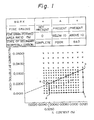
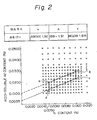
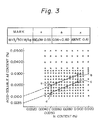
- Fig. 1 the N content is plotted on the abscissa and the acid-soluble Al content is plotted on the ordinate.
- the stage of the secondary recrystallization is indicated by marks "O", " ⁇ " and "X”.
- the secondary recrystallization was complete in the region surrounded by lines ab, bc, cd, and da in Fig. 1.
- the B8 value is lower. Namely, in the region where the Al content is low and the N content is high, the secondary recrystallization is stable but the directionality is degraded, and it becomes difficult to obtain a good core loss value.
- (27/14) x N (%) corresponds to the Al content necessary for converting all of the N contained in the steel to AlN.
- AlN is utilized as the main inhibitor, it is obvious that the domination by the secondary recrystallization of the magnetic flux density and core loss of the product is greatly influenced by the Al content based on (27/14) x N (%).
- the magnetic flux density B8 and core loss W15/50 of each product were measured, and then the coating and the glass film were removed and the macro-structure observed.
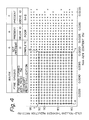
- the relationships among the N as AlN content of the hot-rolled steel sheet and the cold-rolling thickness reduction ratio and the state of the secondary recrystallization, B8 and W15/50 are shown in Figs. 4, 5, and 6, respectively.
- Fig. 4 the Nas AlN content is plotted on the abscissa, the cold-rolling thickness reduction ratio is plotted on the ordinate, and the state of the secondary recrystallization is indicated by marks "O", " ⁇ " and "X”.
- the secondary recrystallization was complete in the region surrounded by lines ab, bc, cd, and da in Fig. 4. Namely, it was found that the secondary recrystallization is complete when the N as AlN content is 0.0001 to 0.0020% and the cold-rolling thickness reduction ratio is 80 to 92%.
- Fig. 5 the N as AlN content is plotted on the ordinate, the cold-rolling thickness reduction ratio is plotted on the ordinate, and the value of B8 is indicated by marks "O", " ⁇ " and "X”.
- a good value of B8 was obtained in the region surrounded by lines ab, bc, cd, and da in Fig. 5. Namely, it was found that a good B8 value is obtained when the N as AlN content is 0.0005 to 0.0020% and the cold-rolling thickness reduction ratio is 85 to 92%.
- Fig. 6 the N as AlN content was plotted on the abscissa, the cold-rolling thickness reduction ratio is plotted on the ordinate, and the value of W15/50 is indicated by marks "O", " ⁇ " and "X”.
- a good W15/50 value was obtained in the region surrounded by lines ab, bc, cd, and da in Fig. 6. Namely, it was found that a good W15/50 value is obtained when the N as Al content is 0.0005 to 0.0020% and the cold-rolling thickness reduction ratio is 85 to 92%.
- the N as AlN content in the hot-rolled steel sheet has a slight influence on the change of the texture in the steel sheet by annealing of the hot-rolled steel sheet and the behavior of the precipitate, and that when the N as AlN content in the hot-rolled steel sheet is 0.0005 to 0.0020%, the properties of the steel sheet obtained by annealing of the hot-rolled steel sheet which are most advantageous for the characteristics of the product, will be obtained.
- the means for controlling the N as AlN content in the hot-rolled steel sheet to 0.0005 to 0.0020% there can be mentioned a method of controlling the slab-heating conditions, a method of controlling the crude rolling conditions, a method of controlling the finish rolling conditions, and a method of controlling the cooling conditions after the finish rolling, and any of these methods can be adopted.
- At least one of Cu and Sb was added to the materials used in Experiments I and II, the test was carried out in the manner as described in Experiments I and II, and similar results were obtained.
- the C content is preferably 0.060 to 0.120%, as when the C content is lower than 0.060% or higher than 0.120%, the secondary recrystallization becomes unstable.
- the Si content is preferably 2.9 to 4.5%, as when the Si content is lower than 2.9%, a good (small) core loss is not obtained, and when the Si content is higher than 4.5%, the processability (adaptability to cold-rolling) is unsatisfactory.
- the Mn content is preferably 0.050 to 0.090%, as when the Mn content is lower than 0.050% or higher than 0.090%, the secondary recrystallization becomes unstable.
- the content of at least one of S and Se is preferably 0.020 to 0.060%, as when this content is lower than 0.020%, the secondary recrystallization becomes unstable, and when this content is higher than 0.060%, the core loss characteristics are unsatisfactory.
- Slabs comprising 0.080% C, 3.25% Si, 0.076% Mn, 0, 0.015 or 0.025% S, 0, 0.015 or 0.025% Se, 0.13% Sn, 0.0045, 0.0085 or 0.0110% N, 0.0150, 0.0170, 0.0230, 0.0260 or 0.0300% acid soluble Al, 0 or 0.07% Cu and 0 or 0.020% Sb, with the balance substantially Fe, were heated at 1360°C for 60 minutes, were withdrawn from the heating furnace, and hot-rolled to a thickness of 0.92, 1.00, 1.31 or 2.43 mm. Note, the cooling conditions before, during and after the rolling were changed, and the N as AlN content in the hot-rolled sheets was 0.0002 to 0.0035%.
Landscapes
- Chemical & Material Sciences (AREA)
- Engineering & Computer Science (AREA)
- Materials Engineering (AREA)
- Mechanical Engineering (AREA)
- Metallurgy (AREA)
- Organic Chemistry (AREA)
- Physics & Mathematics (AREA)
- Electromagnetism (AREA)
- Manufacturing & Machinery (AREA)
- Thermal Sciences (AREA)
- Crystallography & Structural Chemistry (AREA)
- Manufacturing Of Steel Electrode Plates (AREA)
- Soft Magnetic Materials (AREA)
Applications Claiming Priority (4)
| Application Number | Priority Date | Filing Date | Title |
|---|---|---|---|
| JP63651/88 | 1988-03-18 | ||
| JP6365188 | 1988-03-18 | ||
| JP2395589A JPH01316421A (ja) | 1988-03-18 | 1989-02-03 | 一段冷延法による薄手高磁束密度一方向性電磁鋼板の製造方法 |
| JP23955/89 | 1989-02-03 |
Publications (3)
| Publication Number | Publication Date |
|---|---|
| EP0333221A2 true EP0333221A2 (de) | 1989-09-20 |
| EP0333221A3 EP0333221A3 (de) | 1990-05-30 |
| EP0333221B1 EP0333221B1 (de) | 1997-05-28 |
Family
ID=26361394
Family Applications (1)
| Application Number | Title | Priority Date | Filing Date |
|---|---|---|---|
| EP89104829A Expired - Lifetime EP0333221B1 (de) | 1988-03-18 | 1989-03-17 | Verfahren zur Herstellung von dünnen kornorientierten Elektrostahlblechen mit hoher magnetischer Flussdichte durch Kaltwalzen in einer einzelnen Stufe |
Country Status (3)
| Country | Link |
|---|---|
| US (1) | US4992114A (de) |
| EP (1) | EP0333221B1 (de) |
| DE (1) | DE68928065T2 (de) |
Cited By (4)
| Publication number | Priority date | Publication date | Assignee | Title |
|---|---|---|---|---|
| US5066343A (en) * | 1989-05-13 | 1991-11-19 | Nippon Steel Corporation | Process for preparation of thin grain oriented electrical steel sheet having superior iron loss and high flux density |
| US5250123A (en) * | 1991-03-15 | 1993-10-05 | Sumitomo Metal Industries, Ltd. | Oriented silicon steel sheets and production process therefor |
| EP0420238A3 (en) * | 1989-09-28 | 1993-10-20 | Nippon Steel Corp | Process for preparing unidirectional silicon steel sheet having high magnetic flux density |
| EP1179603A3 (de) * | 2000-08-08 | 2007-07-04 | Nippon Steel Corporation | Verfahren zur Herstellung eines kornorientierten Elektrobleches mit hoher magnetischer Flussdichte |
Families Citing this family (4)
| Publication number | Priority date | Publication date | Assignee | Title |
|---|---|---|---|---|
| US5759293A (en) * | 1989-01-07 | 1998-06-02 | Nippon Steel Corporation | Decarburization-annealed steel strip as an intermediate material for grain-oriented electrical steel strip |
| US5855694A (en) * | 1996-08-08 | 1999-01-05 | Kawasaki Steel Corporation | Method for producing grain-oriented silicon steel sheet |
| CN116752042A (zh) * | 2023-06-20 | 2023-09-15 | 武汉钢铁有限公司 | 一种具有自粘结性的高磁感取向硅钢极薄带的制备方法 |
| CN117867247B (zh) * | 2023-12-25 | 2026-01-09 | 鞍钢股份有限公司 | 一种生产高磁感取向硅钢的短流程常化方法 |
Family Cites Families (5)
| Publication number | Priority date | Publication date | Assignee | Title |
|---|---|---|---|---|
| US4338144A (en) * | 1980-03-24 | 1982-07-06 | General Electric Company | Method of producing silicon-iron sheet material with annealing atmospheres of nitrogen and hydrogen |
| JPS5920745B2 (ja) * | 1980-08-27 | 1984-05-15 | 川崎製鉄株式会社 | 鉄損の極めて低い一方向性珪素鋼板とその製造方法 |
| JPS58217630A (ja) * | 1982-06-09 | 1983-12-17 | Nippon Steel Corp | 鉄損の優れた薄手高磁束密度一方向性電磁鋼板の製造方法 |
| DE3571464D1 (en) * | 1985-03-05 | 1989-08-17 | Nippon Steel Corp | Grain-oriented silicon steel sheet and process for producing the same |
| JPS6240315A (ja) * | 1985-08-15 | 1987-02-21 | Nippon Steel Corp | 磁束密度の高い一方向性珪素鋼板の製造方法 |
-
1989
- 1989-03-16 US US07/324,602 patent/US4992114A/en not_active Expired - Lifetime
- 1989-03-17 EP EP89104829A patent/EP0333221B1/de not_active Expired - Lifetime
- 1989-03-17 DE DE68928065T patent/DE68928065T2/de not_active Expired - Lifetime
Cited By (6)
| Publication number | Priority date | Publication date | Assignee | Title |
|---|---|---|---|---|
| US5066343A (en) * | 1989-05-13 | 1991-11-19 | Nippon Steel Corporation | Process for preparation of thin grain oriented electrical steel sheet having superior iron loss and high flux density |
| EP0398114A3 (de) * | 1989-05-13 | 1992-09-02 | Nippon Steel Corporation | Verfahren zur Herstellung von dünnen kornorientierten Elektroblechen mit geringen Eisenverlusten und hoher Flussdichte |
| EP0420238A3 (en) * | 1989-09-28 | 1993-10-20 | Nippon Steel Corp | Process for preparing unidirectional silicon steel sheet having high magnetic flux density |
| US5250123A (en) * | 1991-03-15 | 1993-10-05 | Sumitomo Metal Industries, Ltd. | Oriented silicon steel sheets and production process therefor |
| EP1179603A3 (de) * | 2000-08-08 | 2007-07-04 | Nippon Steel Corporation | Verfahren zur Herstellung eines kornorientierten Elektrobleches mit hoher magnetischer Flussdichte |
| EP2107130A1 (de) * | 2000-08-08 | 2009-10-07 | Nippon Steel Corporation | Verfahren zur Herstellung eines kornorientierten elektrischen Stahlbleches mit hoher Magnetflussdichte |
Also Published As
| Publication number | Publication date |
|---|---|
| EP0333221B1 (de) | 1997-05-28 |
| EP0333221A3 (de) | 1990-05-30 |
| US4992114A (en) | 1991-02-12 |
| DE68928065T2 (de) | 1997-09-11 |
| DE68928065D1 (de) | 1997-07-03 |
Similar Documents
| Publication | Publication Date | Title |
|---|---|---|
| EP0219611B1 (de) | Verfahren zur Herstellung eines kornorientierten Elektro-Stahlblechs | |
| JP2983128B2 (ja) | 極めて低い鉄損をもつ一方向性電磁鋼板の製造方法 | |
| US5261972A (en) | Process for producing grain-oriented electrical steel strip having high magnetic flux density | |
| JP3212376B2 (ja) | 超高磁束密度一方向性電磁鋼板の製造方法 | |
| EP0307905B1 (de) | Verfahren zur Herstellung von kornorientierten Elektrostahlblechen mit sehr hoher magnetischer Flussdichte | |
| US4992114A (en) | Process for producing grain-oriented thin electrical steel sheet having high magnetic flux density by one-stage cold-rolling method | |
| EP0315948B1 (de) | Verfahren zur Herstellung von dünnen kornorientierten Elektrostahlblechen mit niedrigem Wattverlust und hoher Flussdichte | |
| JP3392579B2 (ja) | 極めて低い鉄損をもつ一方向性電磁鋼板の製造方法 | |
| EP0486707B1 (de) | Verfahren zur Herstellung von kornorientiertem Elektrostahlblech mit sehr hohem Si-Gehalt und das nach diesem Verfahren erhältliche Stahlblech | |
| US5013372A (en) | Semi-process non-oriented electromagnetic steel strip having low core loss and high magnetic permeability, and method of making | |
| US4548655A (en) | Method for producing cube-on-edge oriented silicon steel | |
| JP3498978B2 (ja) | 極めて低い鉄損をもつ一方向性電磁鋼板の製造方法 | |
| JPH06256847A (ja) | 磁気特性の優れた一方向性電磁鋼板の製造方法 | |
| JPH075975B2 (ja) | 方向性電磁鋼板の製造方法 | |
| JP3455019B2 (ja) | 低磁場磁気特性の優れた計器用一方向性電磁鋼板とその製造方法 | |
| JP3311021B2 (ja) | 鉄損の低い高磁束密度一方向性電磁鋼板の製造方法 | |
| JPH09227941A (ja) | 磁気特性の優れた一方向性電磁鋼板の製造方法 | |
| JPH0741860A (ja) | 一方向性電磁鋼板の製造方法 | |
| JP2762095B2 (ja) | 一段冷延法による製品磁気特性の優れた薄手高磁束密度一方向性電磁鋼板の製造方法 | |
| JPH10273725A (ja) | 方向性電磁鋼板の製造方法 | |
| JPH10121212A (ja) | 一方向性電磁鋼板およびその製造方法 | |
| JPH0717954B2 (ja) | 一段冷延法による製品磁気特性の優れた薄手高磁束密度一方向性電磁鋼板の製造方法 | |
| JPH10110217A (ja) | 一方向性電磁鋼板の製造方法 | |
| JPH01309923A (ja) | 方向性電磁鋼板の製造方法 | |
| JPH0372025A (ja) | 一段冷延法による薄手高磁束密度一方向性電磁鋼板の製造方法 |
Legal Events
| Date | Code | Title | Description |
|---|---|---|---|
| PUAI | Public reference made under article 153(3) epc to a published international application that has entered the european phase |
Free format text: ORIGINAL CODE: 0009012 |
|
| AK | Designated contracting states |
Kind code of ref document: A2 Designated state(s): DE FR GB IT |
|
| PUAL | Search report despatched |
Free format text: ORIGINAL CODE: 0009013 |
|
| AK | Designated contracting states |
Kind code of ref document: A3 Designated state(s): DE FR GB IT |
|
| 17P | Request for examination filed |
Effective date: 19900713 |
|
| 17Q | First examination report despatched |
Effective date: 19920218 |
|
| GRAG | Despatch of communication of intention to grant |
Free format text: ORIGINAL CODE: EPIDOS AGRA |
|
| GRAH | Despatch of communication of intention to grant a patent |
Free format text: ORIGINAL CODE: EPIDOS IGRA |
|
| GRAH | Despatch of communication of intention to grant a patent |
Free format text: ORIGINAL CODE: EPIDOS IGRA |
|
| GRAA | (expected) grant |
Free format text: ORIGINAL CODE: 0009210 |
|
| AK | Designated contracting states |
Kind code of ref document: B1 Designated state(s): DE FR GB IT |
|
| REF | Corresponds to: |
Ref document number: 68928065 Country of ref document: DE Date of ref document: 19970703 |
|
| ITF | It: translation for a ep patent filed | ||
| ET | Fr: translation filed | ||
| PLBE | No opposition filed within time limit |
Free format text: ORIGINAL CODE: 0009261 |
|
| STAA | Information on the status of an ep patent application or granted ep patent |
Free format text: STATUS: NO OPPOSITION FILED WITHIN TIME LIMIT |
|
| 26N | No opposition filed | ||
| REG | Reference to a national code |
Ref country code: GB Ref legal event code: IF02 |
|
| PGFP | Annual fee paid to national office [announced via postgrant information from national office to epo] |
Ref country code: GB Payment date: 20080312 Year of fee payment: 20 Ref country code: IT Payment date: 20080327 Year of fee payment: 20 |
|
| PGFP | Annual fee paid to national office [announced via postgrant information from national office to epo] |
Ref country code: FR Payment date: 20080311 Year of fee payment: 20 Ref country code: DE Payment date: 20080313 Year of fee payment: 20 |
|
| REG | Reference to a national code |
Ref country code: GB Ref legal event code: PE20 Expiry date: 20090316 |
|
| PG25 | Lapsed in a contracting state [announced via postgrant information from national office to epo] |
Ref country code: GB Free format text: LAPSE BECAUSE OF EXPIRATION OF PROTECTION Effective date: 20090316 |