EP0333612A2 - Programme multilingue - Google Patents
Programme multilingue Download PDFInfo
- Publication number
- EP0333612A2 EP0333612A2 EP89480007A EP89480007A EP0333612A2 EP 0333612 A2 EP0333612 A2 EP 0333612A2 EP 89480007 A EP89480007 A EP 89480007A EP 89480007 A EP89480007 A EP 89480007A EP 0333612 A2 EP0333612 A2 EP 0333612A2
- Authority
- EP
- European Patent Office
- Prior art keywords
- text
- language
- operational code
- program
- portions
- Prior art date
- Legal status (The legal status is an assumption and is not a legal conclusion. Google has not performed a legal analysis and makes no representation as to the accuracy of the status listed.)
- Withdrawn
Links
Images


Classifications
-
- G—PHYSICS
- G06—COMPUTING OR CALCULATING; COUNTING
- G06F—ELECTRIC DIGITAL DATA PROCESSING
- G06F3/00—Input arrangements for transferring data to be processed into a form capable of being handled by the computer; Output arrangements for transferring data from processing unit to output unit, e.g. interface arrangements
- G06F3/01—Input arrangements or combined input and output arrangements for interaction between user and computer
- G06F3/02—Input arrangements using manually operated switches, e.g. using keyboards or dials
- G06F3/023—Arrangements for converting discrete items of information into a coded form, e.g. arrangements for interpreting keyboard generated codes as alphanumeric codes, operand codes or instruction codes
-
- G—PHYSICS
- G06—COMPUTING OR CALCULATING; COUNTING
- G06F—ELECTRIC DIGITAL DATA PROCESSING
- G06F9/00—Arrangements for program control, e.g. control units
- G06F9/06—Arrangements for program control, e.g. control units using stored programs, i.e. using an internal store of processing equipment to receive or retain programs
- G06F9/44—Arrangements for executing specific programs
- G06F9/451—Execution arrangements for user interfaces
- G06F9/454—Multi-language systems; Localisation; Internationalisation
-
- G—PHYSICS
- G06—COMPUTING OR CALCULATING; COUNTING
- G06F—ELECTRIC DIGITAL DATA PROCESSING
- G06F40/00—Handling natural language data
- G06F40/40—Processing or translation of natural language
- G06F40/58—Use of machine translation, e.g. for multi-lingual retrieval, for server-side translation for client devices or for real-time translation
Definitions
- This invention relates generally to the use of a plurality of different national languages, English, French, German, Italian, etc., with the operational code of an application program, and specifically to application programs in which the operational code refers to text material, separated from the code portion, by means of tags which can be used with any language.
- Another approach involves the separation of the operational code and the text material until a particular language is selected. Subsequent to the selection of the language, the operational code and the text material are merged. The merged code and text is then run on a data processing system. This approach requires a merge operation to be performed each time a language change is made, which is not conducive to either speed or conversion or convenience to the operator.
- U.S. Patent 4,365,315 describes a machine tool control system in which messages for the operator are presented in a language selected by the operator. All messages in all languages are resident in the computer storage hierarchy at all times. Access to the particular message in a selected language is accomplished by using a message code to access a message address table, which provides the address for the message in the desired language.
- U.S. Patent 4,319,336 relates to a transaction oriented terminal system in which messages are stored at the terminal to relieve the communication link of the burden of transmitting large amounts of text.
- a primary object of the invention is to provide an application program in a selected language without substantial impact on the operational code of the program.
- An object of the invention is to provide an application program in which the operational code and the text material are separated and the operational code may be used with all language versions without modification.
- Still another object of the invention is to provide an application program in which the text material is separated from the operational code and identified by object tags in the operational code.
- Yet another object of the invention is to provide a multi-language system in which the operational code shares a plurality of different language text portions, one of which can be selected by the operator at the outset of operation.
- the program development laboratory 1 writes the operational code for application programs characterized as P1 through Pn.
- the operational code is the assemblage of instructions which, when loaded into a data processing system and run, causes the system to be directed to the solution of a particular application such as word processing, accounts receivable, etc.
- the operational code does not include actual text material. That is, even though the application program causes text material to be sent to the display screen for guidance of the user, the operational code does not contain the text material per se. Instead, the operational code identifies the text material with a multi-character identification which is unrelated to the storage address at which the text material is to be stored.
- the text materials will be written in English and stored in a separate library.
- the text material is tied to the operational code by the multi-character identification. That is, when the operational code requires the display of a text message for the user on the system display screen it will send a request for the particular message identified by the multi- character identification.
- the system will search the text library tape, locate the multi-character identification and display it to the operator.
- the programming development laboratory which writes the application program will create the operational code 2 for application program 1, shown as P1 in the drawing, and, at the same time, create the English text 2a for the application program 1.
- Each application program has an operational code portion such as 2 and 3, and a text portion shown as 2a and 3a.
- the text material is sent to the translation center 10 for conversion into other national languages such as German, French, or Italian.
- the text material for programs P1 through Pn is translated into all the national languages to provide text tape portions 12a through 13a of the application program. It will be appreciated that the operational code does not have to be retested with the individual translated national languages because the translation process does not change anything in the operational code portion.
- the operational code tape 2 and the English language text tape 3 are sent from the development laboratory 1 to the software distribution center 20.
- the translation center 10 sends the national language tapes 12a through 13a to the distribution center 20.
- the distribution center prepares the tapes which are sent directly to the customer.
- the distribution tapes can take a variety of forms. The most common form will be customized tape 21 which contains a copy of the operational code 22, 23 through 24 for application programs P1, P2 through Pn and a corresponding English text portion 22a, 23a through 24a for application programs P1, P2 through Pn. Quite commonly, the customer will also order a secondary national language text for these programs.
- a tape, or tapes, containing the text for application programs P1 through Pn will be prepared at the distribution center from the translated text received from the translation center.
- the secondary national language tape 32b can include the secondary national language text for a number of application programs P1, P2, P3, through Pn.
- These tapes are then sent from the distribution center to the customer 40, where they are installed and run on the data processing system.
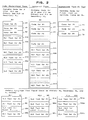
- the format of the tape sent from the distribution center to the customer may be varied according to the customer requirements. Some of the format options are shown in Fig. 2. In the event the customer orders application programs P1, P3 and P9, the operational code portions 51, 53 and 59, respectively, would be recorded on the tape to be sent to the customer.
- the tape would also include the primary national language text portions 51b, 53b and 59b corresponding to the operational code.
- a fully customized tape 50 could also contain text 51c, 53c and 59c representing an additional national language, for example NL3, corresponding to the application programs P1, P3 and P9.
- the universal tape 60 shown in FIG. 2, would contain the operational code portions 61, 62, 63 through 6n for all application programs P1 through Pn.
- Tape 60 would also contain the national language text portions 61b, 62b through 6nb, representing the national language text portion for the primary language NL1 used by all application programs P1 through Pn.
- the tape would also include national language text portions 61c, 62c through 6nc, representing the national text portion of the secondary national language NL3. It would also be possible to supply the operational code for application programs on a customized tape which is separate from the tape containing the language portion. This is shown in tape 70, which contains only the operational code portion 71, 73 and 79 for the application programs P1, P3 and P9. If a customized tape is used, the language portion must be supplied on a second tape. If this is done, the preferred form is to supply tapes such as 80, 90 and 100.
- Language portion tape 80 would contain text portion 81b, representing national language text for application program P1, text portion 82b, representing national language text for application program P2, and text portion 89b, representing national language text for application program P9. It would also be possible to supply the text for other application programs by including the text portion for these programs in 88b. This might be done to accommodate the future use of the language portion in the event that the application program operational code is later ordered by the customer.
- National language tape 90 follows the format of the national language tape 80 and includes the secondary national language text for the application programs.
- Tape 100 is an update tape. Since it is inevitable that additional or other modifications will become necessary, some format must be available for this purpose.
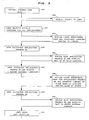
- FIG. 3 is a flow chart showing the interaction between the user, the data processing system and the application program.
- IPL initial program load
- the user is presented a generic prompt 302 on the display screen, which requires him to select a national language for the presentation of text as shown in block 303.
- the system IPL procedure locates the selected language portion containing the desired national language and places it in the system library list at a point near the beginning of the list and before any other language li brary.
- the system transfers control to the operator for the selection of a desired application program, designated as application program #1, for execution.
- the system then runs the application program #1, shown in block 306, utilizing the multiple character text identification of the operational code to seek out the text material from the first national language portion located in the system library.
- the system returns control to the user for action. It will be appreciated that the execution of application program #1 may return control of the system to the user for purposes related to the application program.
- the user may select a second application program for execution. At this time the display of Fig. 4 is presented to the user for selection of the application program and also an option to select a new national language.
- the system loads the operational code for the application program #2 and reorders the library sequence to place the language portion containing the desired national language near the beginning of the library, ahead of all other language portions.
- the user initiates operation of the system to execute the application program #2.
- the data processing system then runs the application program #2 and displays the text material relating to this application program in the second national language.
- the data processing again returns control of the system to the user, as shown in block 311. Fig.
- the first step for the operator is to make the selection of the desired application program from the list 401 representing all the application programs which are available to the system. The selection is accomplished by entering the program ID corresponding to the desired application program. The user elects to specify that a national language selection is to be made. This is done in line 410 of the display screen. The next step is the entry of the particular feature code corresponding to the national language which is desired to be selected. This is done by selecting the feature code from block 420 which represents the desired national language.
- the entry of this information selects the appropriate national language tape and places it in the system library in a position before all other language libraries, thereby ensuring that the system will encounter a match for the message identification with the desired national language portion before it reaches a match with any of the other language portions which may be on the system.
- the system uses libraries advantageously in performing the invention.
- the operating code for the application program will contain a multi-position identification number, for example, seven characters, for each text message.
- the text messages for each language are located in separate message files. That is, there is a separate message file for each language, and each message file contains all the text used by all the application programs which can be run on the system.
Landscapes
- Engineering & Computer Science (AREA)
- Theoretical Computer Science (AREA)
- General Engineering & Computer Science (AREA)
- Software Systems (AREA)
- General Physics & Mathematics (AREA)
- Physics & Mathematics (AREA)
- Human Computer Interaction (AREA)
- Computational Linguistics (AREA)
- General Health & Medical Sciences (AREA)
- Health & Medical Sciences (AREA)
- Audiology, Speech & Language Pathology (AREA)
- Artificial Intelligence (AREA)
- Stored Programmes (AREA)
- Machine Translation (AREA)
- Document Processing Apparatus (AREA)
- Digital Computer Display Output (AREA)
Applications Claiming Priority (2)
| Application Number | Priority Date | Filing Date | Title |
|---|---|---|---|
| US16956388A | 1988-03-17 | 1988-03-17 | |
| US169563 | 1988-03-17 |
Publications (2)
| Publication Number | Publication Date |
|---|---|
| EP0333612A2 true EP0333612A2 (fr) | 1989-09-20 |
| EP0333612A3 EP0333612A3 (fr) | 1991-12-04 |
Family
ID=22616223
Family Applications (1)
| Application Number | Title | Priority Date | Filing Date |
|---|---|---|---|
| EP19890480007 Withdrawn EP0333612A3 (fr) | 1988-03-17 | 1989-01-17 | Programme multilingue |
Country Status (4)
| Country | Link |
|---|---|
| EP (1) | EP0333612A3 (fr) |
| JP (1) | JPH01243162A (fr) |
| KR (1) | KR920009193B1 (fr) |
| CN (1) | CN1017284B (fr) |
Cited By (12)
| Publication number | Priority date | Publication date | Assignee | Title |
|---|---|---|---|---|
| EP0335139A3 (fr) * | 1988-03-30 | 1990-08-08 | International Business Machines Corporation | Système d'aide de langue nationale sans fichiers externes |
| EP0426909A1 (fr) * | 1989-11-06 | 1991-05-15 | Heikki Marttila Oy | Méthode pour charger et/ou remplacer des fichiers dans un logiciel d'ordinateur |
| WO1993011494A1 (fr) * | 1991-11-27 | 1993-06-10 | Icl Systems Aktiebolag | Agencement de systeme informatique et procede de transmission de donnees |
| EP0528640A3 (en) * | 1991-08-19 | 1993-06-16 | International Business Machines Corporation | Computer system for generating a user interface |
| GB2262368A (en) * | 1991-12-13 | 1993-06-16 | Kent | Generating databases. |
| EP0528570A3 (en) * | 1991-08-16 | 1993-09-22 | International Business Machines Corporation | Outputting messages in a data processing system |
| EP0701200A3 (fr) * | 1994-08-11 | 1996-03-20 | Seiko Epson Corp | |
| US5689671A (en) * | 1991-11-27 | 1997-11-18 | Icl Systems Ab | System for reducing quantity of data transmitted to a user unit by transmitting only an identifier which points to pre-stored information in the user unit |
| WO1999014660A1 (fr) * | 1997-09-18 | 1999-03-25 | Electronics For Imaging, Inc. | Architecture de code d'interface |
| WO2000073893A3 (fr) * | 1999-05-26 | 2002-05-10 | Sobrio Internat Inc | Appareil et procede de reutilisation et de pistage des biens numeriques |
| WO2006032846A3 (fr) * | 2004-09-24 | 2007-07-26 | Univ Abertay Dundee | Localisation de jeux informatiques |
| US7810031B2 (en) * | 2006-10-24 | 2010-10-05 | International Business Machines Corporation | Email generation method and system |
Families Citing this family (2)
| Publication number | Priority date | Publication date | Assignee | Title |
|---|---|---|---|---|
| US20130326347A1 (en) * | 2012-05-31 | 2013-12-05 | Microsoft Corporation | Application language libraries for managing computing environment languages |
| CN119902769A (zh) * | 2017-07-07 | 2025-04-29 | 区块链控股有限公司 | 用于将高级语言代码编译为区块链平台上可执行的脚本的系统和方法 |
Family Cites Families (4)
| Publication number | Priority date | Publication date | Assignee | Title |
|---|---|---|---|---|
| DE3483013D1 (de) * | 1983-03-30 | 1990-09-27 | Ibm | Simultaner gebrauch mehrerer sprachen in datenverarbeitungssystemen. |
| JPS6022236A (ja) * | 1983-07-18 | 1985-02-04 | Nec Corp | メツセ−ジ出力方式 |
| US4731735A (en) * | 1985-09-30 | 1988-03-15 | International Business Machines Corporation | Multilingual processing for screen image build and command decode in a word processor, with full command, message and help support |
| JP2650136B2 (ja) * | 1987-09-18 | 1997-09-03 | 富士通株式会社 | データ処理装置 |
-
1988
- 1988-12-20 JP JP63319662A patent/JPH01243162A/ja active Pending
-
1989
- 1989-01-17 EP EP19890480007 patent/EP0333612A3/fr not_active Withdrawn
- 1989-03-16 KR KR1019890003242A patent/KR920009193B1/ko not_active Expired
- 1989-03-16 CN CN89101441A patent/CN1017284B/zh not_active Expired
Cited By (16)
| Publication number | Priority date | Publication date | Assignee | Title |
|---|---|---|---|---|
| EP0335139A3 (fr) * | 1988-03-30 | 1990-08-08 | International Business Machines Corporation | Système d'aide de langue nationale sans fichiers externes |
| EP0426909A1 (fr) * | 1989-11-06 | 1991-05-15 | Heikki Marttila Oy | Méthode pour charger et/ou remplacer des fichiers dans un logiciel d'ordinateur |
| EP0528570A3 (en) * | 1991-08-16 | 1993-09-22 | International Business Machines Corporation | Outputting messages in a data processing system |
| EP0528640A3 (en) * | 1991-08-19 | 1993-06-16 | International Business Machines Corporation | Computer system for generating a user interface |
| JPH05197685A (ja) * | 1991-08-19 | 1993-08-06 | Internatl Business Mach Corp <Ibm> | ウィンドウ化ユーザ・インタフェースの複数言語による翻訳を支援するシステム及び方法 |
| US5689671A (en) * | 1991-11-27 | 1997-11-18 | Icl Systems Ab | System for reducing quantity of data transmitted to a user unit by transmitting only an identifier which points to pre-stored information in the user unit |
| WO1993011494A1 (fr) * | 1991-11-27 | 1993-06-10 | Icl Systems Aktiebolag | Agencement de systeme informatique et procede de transmission de donnees |
| GB2262368A (en) * | 1991-12-13 | 1993-06-16 | Kent | Generating databases. |
| EP0701200A3 (fr) * | 1994-08-11 | 1996-03-20 | Seiko Epson Corp | |
| US6384922B1 (en) | 1994-08-11 | 2002-05-07 | Seiko Epson Corporation | Tape printer |
| WO1999014660A1 (fr) * | 1997-09-18 | 1999-03-25 | Electronics For Imaging, Inc. | Architecture de code d'interface |
| US6065041A (en) * | 1997-09-18 | 2000-05-16 | Electronics For Imaging, Inc. | Interface code architecture |
| US6341307B1 (en) | 1997-09-18 | 2002-01-22 | Electronics For Imaging, Inc. | Interface code architecture |
| WO2000073893A3 (fr) * | 1999-05-26 | 2002-05-10 | Sobrio Internat Inc | Appareil et procede de reutilisation et de pistage des biens numeriques |
| WO2006032846A3 (fr) * | 2004-09-24 | 2007-07-26 | Univ Abertay Dundee | Localisation de jeux informatiques |
| US7810031B2 (en) * | 2006-10-24 | 2010-10-05 | International Business Machines Corporation | Email generation method and system |
Also Published As
| Publication number | Publication date |
|---|---|
| KR890015115A (ko) | 1989-10-28 |
| EP0333612A3 (fr) | 1991-12-04 |
| JPH01243162A (ja) | 1989-09-27 |
| CN1038361A (zh) | 1989-12-27 |
| CN1017284B (zh) | 1992-07-01 |
| KR920009193B1 (ko) | 1992-10-14 |
Similar Documents
| Publication | Publication Date | Title |
|---|---|---|
| EP0333612A2 (fr) | Programme multilingue | |
| US5657480A (en) | Method of recording, playback, and re-execution of concurrently running application program operational commands using global time stamps | |
| US4281379A (en) | Computer driven control system for a numerically controlled machine tool | |
| US7536294B1 (en) | Method and apparatus for translating computer programs | |
| US5926638A (en) | Program debugging system for debugging a program having graphical user interface | |
| US5101494A (en) | System for producing memory maps by interpreting a descriptor file which identifies and describes the data structures present in memory | |
| EP0549510A2 (fr) | Système et procédé pour le génie logiciel assisté par ordinateur | |
| EP0321654A2 (fr) | Méthode pour lire et/ou remplacer des données de contrôle dans un système d'exploitation d'un ordinateur | |
| JPH05346875A (ja) | コンピュータ・アプリケーション・ソフトウェアの自動化試験システム | |
| EP1906305B1 (fr) | Méthode et système pour préparer et envoyer des données entre des applications logicielles | |
| US4555759A (en) | Selective use of restored file setups | |
| GB2309805A (en) | A support system for creating multimedia contents | |
| US5781905A (en) | Program generating method combining data item part with database manipulation part | |
| Bullynck | What is an operating system? A historical investigation (1954–1964) | |
| US7353221B1 (en) | Method for the automatic retrieval of engineering data of systems | |
| US20030158767A1 (en) | Method and system for adaptive software system interface and external database synchronization | |
| US20020056058A1 (en) | Storage system with online manual | |
| US5724559A (en) | Method for displaying ISPF panels in a VM non-ISPF environment | |
| US5448736A (en) | Method for generating a program comprised of such a portion of a series of operator-inputted commands as will produce an operator-selected one of a number of results | |
| WO1995032476A1 (fr) | Systeme et procede permettant de creer des configurations de conception et de commander l'application d'outils de conception multiples | |
| KR100407009B1 (ko) | 프로그램재생방법 및 장치 및 프로그램재생을 위한프로그램을 기록한 매체 | |
| US4839803A (en) | Planning support method and system | |
| US5524192A (en) | Simplifying maintaining and displaying of program comments | |
| JP4484148B2 (ja) | Si対象ファイルおよびsi関連ファイル管理システム | |
| EP0261690B1 (fr) | Procédé pour utiliser un fichier de descripteurs décrivant un fichier de structures de contrÔle pour un programme d'analyse du contenu de la mémoire |
Legal Events
| Date | Code | Title | Description |
|---|---|---|---|
| PUAI | Public reference made under article 153(3) epc to a published international application that has entered the european phase |
Free format text: ORIGINAL CODE: 0009012 |
|
| AK | Designated contracting states |
Kind code of ref document: A2 Designated state(s): DE FR GB |
|
| PUAL | Search report despatched |
Free format text: ORIGINAL CODE: 0009013 |
|
| AK | Designated contracting states |
Kind code of ref document: A3 Designated state(s): DE FR GB |
|
| 17P | Request for examination filed |
Effective date: 19920806 |
|
| 17Q | First examination report despatched |
Effective date: 19930430 |
|
| STAA | Information on the status of an ep patent application or granted ep patent |
Free format text: STATUS: THE APPLICATION IS DEEMED TO BE WITHDRAWN |
|
| 18D | Application deemed to be withdrawn |
Effective date: 19930911 |