EP0333658B1 - Procédé pour la préparation de difluorbenzo-1,3-dioxoles substitués - Google Patents
Procédé pour la préparation de difluorbenzo-1,3-dioxoles substitués Download PDFInfo
- Publication number
- EP0333658B1 EP0333658B1 EP89810184A EP89810184A EP0333658B1 EP 0333658 B1 EP0333658 B1 EP 0333658B1 EP 89810184 A EP89810184 A EP 89810184A EP 89810184 A EP89810184 A EP 89810184A EP 0333658 B1 EP0333658 B1 EP 0333658B1
- Authority
- EP
- European Patent Office
- Prior art keywords
- formula
- compound
- radical
- coor2
- substituted
- Prior art date
- Legal status (The legal status is an assumption and is not a legal conclusion. Google has not performed a legal analysis and makes no representation as to the accuracy of the status listed.)
- Expired - Lifetime
Links
- MJJKAGLSZDDOIP-UHFFFAOYSA-N C[IH]1=[I]ONO1 Chemical compound C[IH]1=[I]ONO1 MJJKAGLSZDDOIP-UHFFFAOYSA-N 0.000 description 1
Classifications
-
- C—CHEMISTRY; METALLURGY
- C07—ORGANIC CHEMISTRY
- C07D—HETEROCYCLIC COMPOUNDS
- C07D317/00—Heterocyclic compounds containing five-membered rings having two oxygen atoms as the only ring hetero atoms
- C07D317/08—Heterocyclic compounds containing five-membered rings having two oxygen atoms as the only ring hetero atoms having the hetero atoms in positions 1 and 3
- C07D317/44—Heterocyclic compounds containing five-membered rings having two oxygen atoms as the only ring hetero atoms having the hetero atoms in positions 1 and 3 ortho- or peri-condensed with carbocyclic rings or ring systems
- C07D317/46—Heterocyclic compounds containing five-membered rings having two oxygen atoms as the only ring hetero atoms having the hetero atoms in positions 1 and 3 ortho- or peri-condensed with carbocyclic rings or ring systems condensed with one six-membered ring
-
- C—CHEMISTRY; METALLURGY
- C07—ORGANIC CHEMISTRY
- C07D—HETEROCYCLIC COMPOUNDS
- C07D405/00—Heterocyclic compounds containing both one or more hetero rings having oxygen atoms as the only ring hetero atoms, and one or more rings having nitrogen as the only ring hetero atom
- C07D405/02—Heterocyclic compounds containing both one or more hetero rings having oxygen atoms as the only ring hetero atoms, and one or more rings having nitrogen as the only ring hetero atom containing two hetero rings
- C07D405/04—Heterocyclic compounds containing both one or more hetero rings having oxygen atoms as the only ring hetero atoms, and one or more rings having nitrogen as the only ring hetero atom containing two hetero rings directly linked by a ring-member-to-ring-member bond
-
- C—CHEMISTRY; METALLURGY
- C07—ORGANIC CHEMISTRY
- C07F—ACYCLIC, CARBOCYCLIC OR HETEROCYCLIC COMPOUNDS CONTAINING ELEMENTS OTHER THAN CARBON, HYDROGEN, HALOGEN, OXYGEN, NITROGEN, SULFUR, SELENIUM OR TELLURIUM
- C07F19/00—Metal compounds according to more than one of main groups C07F1/00 - C07F17/00
-
- C—CHEMISTRY; METALLURGY
- C07—ORGANIC CHEMISTRY
- C07F—ACYCLIC, CARBOCYCLIC OR HETEROCYCLIC COMPOUNDS CONTAINING ELEMENTS OTHER THAN CARBON, HYDROGEN, HALOGEN, OXYGEN, NITROGEN, SULFUR, SELENIUM OR TELLURIUM
- C07F5/00—Compounds containing elements of Groups 3 or 13 of the Periodic Table
- C07F5/02—Boron compounds
- C07F5/025—Boronic and borinic acid compounds
-
- C—CHEMISTRY; METALLURGY
- C07—ORGANIC CHEMISTRY
- C07F—ACYCLIC, CARBOCYCLIC OR HETEROCYCLIC COMPOUNDS CONTAINING ELEMENTS OTHER THAN CARBON, HYDROGEN, HALOGEN, OXYGEN, NITROGEN, SULFUR, SELENIUM OR TELLURIUM
- C07F7/00—Compounds containing elements of Groups 4 or 14 of the Periodic Table
- C07F7/02—Silicon compounds
- C07F7/08—Compounds having one or more C—Si linkages
- C07F7/0803—Compounds with Si-C or Si-Si linkages
- C07F7/081—Compounds with Si-C or Si-Si linkages comprising at least one atom selected from the elements N, O, halogen, S, Se or Te
- C07F7/0812—Compounds with Si-C or Si-Si linkages comprising at least one atom selected from the elements N, O, halogen, S, Se or Te comprising a heterocyclic ring
- C07F7/0814—Compounds with Si-C or Si-Si linkages comprising at least one atom selected from the elements N, O, halogen, S, Se or Te comprising a heterocyclic ring said ring is substituted at a C ring atom by Si
-
- C—CHEMISTRY; METALLURGY
- C07—ORGANIC CHEMISTRY
- C07F—ACYCLIC, CARBOCYCLIC OR HETEROCYCLIC COMPOUNDS CONTAINING ELEMENTS OTHER THAN CARBON, HYDROGEN, HALOGEN, OXYGEN, NITROGEN, SULFUR, SELENIUM OR TELLURIUM
- C07F7/00—Compounds containing elements of Groups 4 or 14 of the Periodic Table
- C07F7/02—Silicon compounds
- C07F7/08—Compounds having one or more C—Si linkages
- C07F7/10—Compounds having one or more C—Si linkages containing nitrogen having a Si-N linkage
-
- Y—GENERAL TAGGING OF NEW TECHNOLOGICAL DEVELOPMENTS; GENERAL TAGGING OF CROSS-SECTIONAL TECHNOLOGIES SPANNING OVER SEVERAL SECTIONS OF THE IPC; TECHNICAL SUBJECTS COVERED BY FORMER USPC CROSS-REFERENCE ART COLLECTIONS [XRACs] AND DIGESTS
- Y02—TECHNOLOGIES OR APPLICATIONS FOR MITIGATION OR ADAPTATION AGAINST CLIMATE CHANGE
- Y02P—CLIMATE CHANGE MITIGATION TECHNOLOGIES IN THE PRODUCTION OR PROCESSING OF GOODS
- Y02P20/00—Technologies relating to chemical industry
- Y02P20/50—Improvements relating to the production of bulk chemicals
- Y02P20/55—Design of synthesis routes, e.g. reducing the use of auxiliary or protecting groups
Definitions
- the invention relates to a process for the preparation of 2,2-difluorobenzo-1,3-dioxoles substituted in the 4-position by the reaction of 2,2-difluorobenzo-1,3-dioxole with an alkali metal compound and the subsequent reaction with an electrophilic compound .
- EP-A-0 206 999 optionally describes N-substituted 3- (2,2-difluorobenzo-1,3-dioxol-4-yl) -4-cyanopyrroles, which are valuable agents for combating microorganisms.
- the compounds are prepared via a multi-stage synthesis.
- the 3- (2,2-difluorobenzo-1,3-dioxol-4-yl) -2-propenonitrile required as the starting product is converted by the diazotization of 4-amino-2,2-difluorobenzo-1,3-dioxole, followed by a reaction obtained with acrylonitrile in the presence of CuCl and dehalogenation of the 4- (2-chloro-2-cyano-eth-1-yl) -2,2-difluorobenzo-1,3-dioxole formed.
- DE-OS 2 819 788 describes, for example, (2,2-difluorobenzo-1,3-dioxol-4-yl) methyl esters of pyrethroid- or pyrethroid-like carboxylic acids as insecticides.
- the benzodioxolylmethyl alcohols are produced by customary processes, for example by reducing aldehydes.
- 2,2-difluorobenzo-1,3-dioxole-4-carbaldehyde is described in the subsequently published EP-A-291 799; however, the synthesis disclosed herein is unsuitable as an industrial manufacturing method.
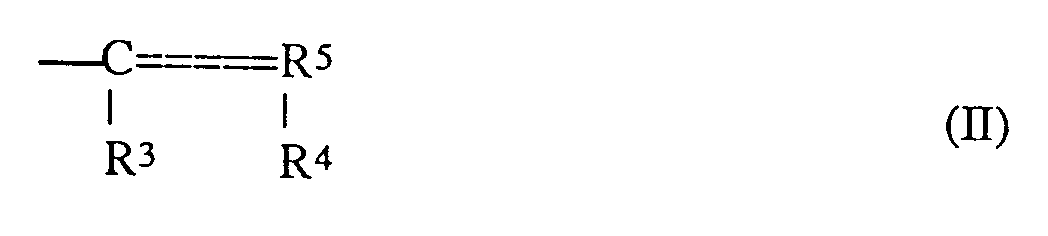
- R 1 is -CHO or a radical of the formula II wherein R5 is -CN, -COOR2 or -CONH2, R3 and R4 each represent H, or R3 is H and R4 independently has the meaning of R5.
- R2 has the meaning of a hydroxyl group reduced alcohol, it can be, for example, linear or branched alkyl having preferably 1 to 12, especially 1 to 6 carbon atoms, or unsubstituted or substituted by C1-C4-alkyl C5- or C6 -Cycloalkyl or C5- or C6-cycloalkyl-C m H 2m - or phenyl-C m H 2m act, wherein m is 0 or a number from 1 to 4, especially 0, 1 or 2.
- Examples are methyl, ethyl, the isomers of propyl, butyl, pentyl, hexyl, octyl, decyl, dodecyl, cyclopentyl, cyclohexyl, methylcyclopentyl or hexyl, (methyl- or ethylcyclohexyl) methyl, benzyl, methyl- or ethylbenzyl, phenylethyl, ( Methylphenyl) ethyl.
- n is a number from 1 to 4, especially 1 or 2.
- the -C n H 2n group can be linear or branched. Examples of this group are methylene, ethylene, ethylidene, propylidene, 1,2- or 1,3-propylene, butylidene, 1,2-, 1,3- or 1,4-butylene.
- R1 in the meaning of optionally substituted hydroxyalkyl preferably contains 1 to 6, especially 1 to 4, carbon atoms.
- the hydroxyl group can be bound to a primary, secondary or tertiary carbon atom.
- Examples of hydroxyalkyl are hydroxymethyl, 1- or 2-hydroxyethyl, 1-, 2- or 3-hydroxyprop-1- or -2-yl, 1-, 2-, 3- or 4-hydroxybut-1-or -2- yl, hydroxypentyl, hydroxyhexyl, phenyl (hydroxymethyl), 1-phenyl-2-hydroxyethyl, fluorophenyl (hydroxymethyl), 1-methoxy-2-hydroxyeth-2-yl, 1,1,1-trifluoro-2-hydroxyethyl and cyanophenyl (hydroxymethyl).
- R1 in the meaning of optionally substituted acyl preferably contains 1 to 6 and especially 1 to 4 carbon atoms.
- the acyl residue can e.g. act such a of the formula R7-CO-, wherein R7 unsubstituted or with -F, -Cl, -CN, C1-C6-alkoxy, phenyl, fluorophenyl, C1-C4-alkoxyphenyl, C1-C4-alkylphenyl, C1-C4 -Alkylthiophenyl, C1-C4-fluoroalkylphenyl, nitrophenyl or cyanophenyl substituted C1-C11-, especially C1-C6-alkyl or unsubstituted or with -F, cyano, nitro, C1-C4-alkyl or alkoxy or -alkylthio or -Fluoralkyl substituted phenyl.
- Examples are formyl, acetyl, fluoroacetyl, trifluoroacetyl, chlorodifluoroacetyl, propionyl, butyryl, benzoyl, phenylacetyl, 3-phenylpropionyl or fluorobenzoyl.
- X1 preferably contains 2 to 12, especially 2 to 8, carbon atoms as the residue of a secondary amine.
- Examples are dimethylamino, diethylamino, methoxymethylamino, ethoxymethylamino, methyl (methoxyethyl) amino, di (methoxymethyl) amino, pyrrolidino, piperidino, morpholino and N-methylpiperazino.
- R5 is preferably -CN, -CF3, -COOR2 or -CONH2.
- the leaving group X2 is preferably a halide, especially -Cl or -Br, C1-C6-alkoxy, for example methoxy, ethoxy or propoxy, C6-C10-aryloxy, for example phenoxy or naphthoxy, C1-C12-, especially C1 -C6 secondary amino, such as dimethylamino, diethylamino, piperidino, C1-C8-, especially C1-C4 acyloxy, such as acetyloxy, or the rest of a sulfonic acid.
- C1-C6-alkoxy for example methoxy, ethoxy or propoxy
- C6-C10-aryloxy for example phenoxy or naphthoxy
- C1-C12- especially C1 -C6 secondary amino, such as dimethylamino, diethylamino, piperidino, C1-C8-, especially C1-C4 acyloxy, such as acet
- An aliphatic sulfonic acid e.g. Methyl, ethyl or propyl sulfonic acid, or an aromatic sulfonic acid, e.g. Be benzene or p-toluenesulfonic acid.
- 2,2-difluorobenzo-1,3-dioxole is known and can e.g. can be obtained by fluorination of 2,2-dichlorobenzo-1,3-dioxole.
- Reaction step a) is carried out in an inert solvent, e.g. in a non-polar or polar aprotic solvent.
- Suitable solvents are aliphatic or aromatic hydrocarbons, ethers, tertiary amines, N-alkylated acid amides, lactams or cyclic ureas, sulfoxides, sulfones, nitriles or mixtures thereof.
- Examples are pentane, isopentane, hexane, heptane, cyclohexane, methylcyclohexane, benzene, toluene, xylene, diethyl ether, dibutyl ether, tetrahydrofuran, dioxane, ethylene glycol dimethyl ether, triethylamine, N, N, N ', N'-tetramethylethylene diamine, hexamamide dimethyl amide, hexamamide dimethyl amide, hexamamide dimethyl amide, N-methyl pyrrolidone, ethylene dimethyl urea, propylene dimethyl urea, dimethyl sulfoxide, tetramethylene sulfone, acetonitrile.
- Solvents which can be a reactant at the same time according to process step b), e.g. Carboxamides are only added in process step b) in the form of an excess of
- the reaction temperature in both process stages can preferably be -150 to 150 ° C, particularly -100 to 80 ° C.
- the reaction mixture additionally contains a complexing agent, for example in an amount of 0.01 mol% up to a 10-fold excess, based on the compound of the formula IV.
- complexing agents can, for example be tertiary amines or N-substituted acid amides, lactams or cyclic ureas, ethers or sulfoxides, as previously mentioned under the solvents.
- Crown ethers such as 15-crown-5, 18-crown-6, dibenzo-18-crown-6, dicyclohexyl-18-crown-6, dibenzo-24-crown-8 or dicyclohexyl-24-crown are also furthermore 8 suitable.
- Alkali metal especially lithium, sodium and potassium halides, magnesium halide or copper halide are also suitable.
- Halide is preferably chloride, bromide and iodide.
- the strongly basic anions can be, for example, linear or branched C1-C6-, especially C1-C4-alkyl ⁇ , C6-C14-aryl ⁇ , H2N ⁇ , H ⁇ , C1-C6-, especially C1-C4-alkoxy ⁇ , C1-C6-, especially C1-C4-alkyl-NH ⁇ or di (C1-C6-alkyl) N ⁇ , especially di (C1-C4-alkyl) N ⁇ or di (C3-C6-cycloalkyl) N ⁇ act.
- the alkali metal compound is a Li, Na, K, alkyl, aryl hydride, amide or alcoholate.
- the 2,2-difluorobenzo-1,3-dioxole is metalated in a manner known per se by reacting it with an alkali metal compound in an inert solvent at preferably from 20 to -80 ° C.
- the alkali metal compound can be introduced and the benzodioxole added slowly. You can also do the opposite.
- reaction b) can be carried out directly.
- the alkali metal compound of formula IV can also be previously treated with an anhydrous metal halide, e.g. MgZ2, ZnZ2, CdZ2, CuZ, CuZ2, PdZ2, NiZ2, AlZ3, SiZ4, SnZ2, SnZ4, TiZ4, BZ3 or ZrZ4, where Z is Cl, Br or I, especially Cl or Br, to a compound of formula IV , wherein Y stands for -MgZ, -ZnZ, -CdZ, -CuZ, -PdZ, -NiZ, -AlZ2, -SiZ3, -SnZ, -SnZ3, -TiZ3, -BZ2 or -ZrZ3. Z particularly denotes Cl or Br.
- the metal halide can be added in bulk or in the form of a suspension in an inert solvent.
- the reaction temperature is preferably 0 to -80 ° C.
- the electrophilic compounds used in reaction step b) are known or can be prepared by known processes. Some examples are cyanogen or cyanogen bromide, carbon dioxide, carboxylic acid dichloride or bromide, methyl chlorocarbonic acid, ethyl bromocarbonate; Formylation reagents preferably from the group C1-C6-alkoxymethylene anilines, formyl halide, especially chloride and bromide, formic acid esters with preferably 1 to 6, especially 1 to 4 carbon atoms in the alcohol residue, for example methyl or ethyl formate, orthoformic acid esters with preferably 1 to 6 C atoms in the alcohol residue, N-disubstituted formamides with 2 to 12, preferably 2 to 6 carbon atoms and optionally -O- or N-C1-C4-alkyl groups in the amide radical, for example dimethyl, diethyl, methyl methoxyformamide, formic acid morpholide or formic acid N-methylpiperaz
- reaction b) It can be advantageous to carry out reaction b) in the presence of Pd, Rh or Ru compounds.
- the reaction temperature according to step b) can e.g. -80 ° C to 100 ° C, preferably -80 ° C to 50 ° C.
- the electrophilic compound can be added in bulk or solution, it being possible to use the same or a different solvent as in reaction step a).
- the compounds of the formula I are isolated by processes known per se, by distilling, crystallizing or chromatographing the filtrate after the reaction mixture has been filtered. It is generally expedient to hydrolyze the reaction mixture, for example with dilute mineral acids, such as, for example, hydrochloric acid or sulfuric acid. If the electrophilic compound CO2, an aldehyde, an epoxy, a carboxamide or ester, salts are first formed, which for Isolation of the compounds of formula I require hydrolysis.
- the compounds of the formulas I and Ia are suitable for the preparation of insecticides or microbicides.
- the carboxylic acids and carboxylic acid derivatives, aldehydes and ketones can be reduced to the corresponding alcohols using customary reductive methods.
- Insecticidal esters can be prepared from the alcohols with pyrethroid- or pyrethroid-like carboxylic acids, as described in DE-OS 2, 819, 788 (Example 1).
- the -CF3- group can be converted into the nitrile group according to the process described in US Pat. No. 4,705,801.
- the conversion of ester and amide groups into the nitrile group is known, as is the hydrogenation of acetylenes to ethylenes.
- These compounds are intermediates for the microbicides, the preparation of which using these intermediates is described in EP-A-0 206 999.
- Example 1 Preparation of 4- (trifluoroacetyl) -2,2-difluoro-1,3-benzodioxole.
- Example 6 The procedure is as in Example 4 and ⁇ -tosyloxyacrylonitrile is used instead of pivalaldehyde. ⁇ - (2,2-Difluoro-1,3-benzodioxol-4-yl) acrylonitrile is obtained in a yield of 52%.
- Example 7 The procedure is as in Example 1 and instead of adding trifluoroacetyl-N-methylpiperazide CO2. 2,2-difluoro-1,3-benzodioxol-4-carboxylic acid is obtained in a yield of 61%.
- Example 11 Preparation of 4- (chlorodifluoroacetyl) -2,2-difluoro-1,3-benzodioxole.
- EXAMPLE 12 The procedure is as in Example 1 and trimethylchlorosilane is used instead of trifluoroacetyl-N-methylpiperazide. 4-Trimethylsilyl-2,2-difluoro-1,3-benzodioxole (bp 80-81 ° C / 160 mbar) is obtained in a yield of 73%
Landscapes
- Chemical & Material Sciences (AREA)
- Organic Chemistry (AREA)
- Organic Low-Molecular-Weight Compounds And Preparation Thereof (AREA)
- Plural Heterocyclic Compounds (AREA)
- Heterocyclic Compounds That Contain Two Or More Ring Oxygen Atoms (AREA)
- Agricultural Chemicals And Associated Chemicals (AREA)
- Heterocyclic Carbon Compounds Containing A Hetero Ring Having Nitrogen And Oxygen As The Only Ring Hetero Atoms (AREA)
- Indole Compounds (AREA)
Claims (14)
- Procédé de préparation de composés de formule I
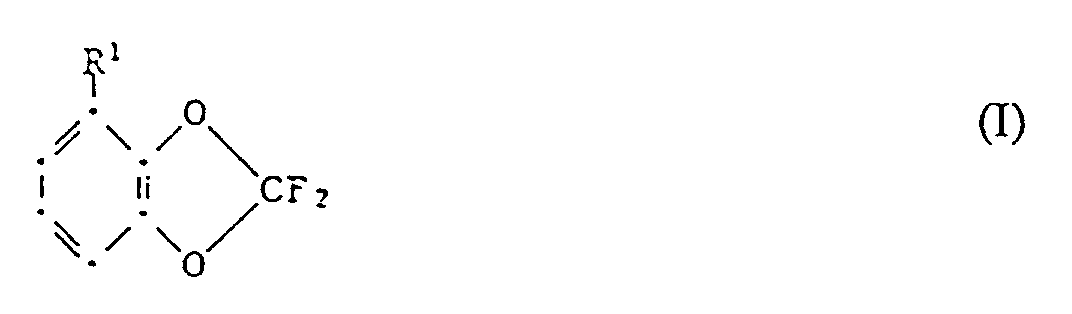
 a) on fait réagir dans un solvant inerte le 2,2-difluorobenzo-1,3-dioxole avec un dérivé de métal alcalin à anion fortement basique, ce qui donne un composé de formule IV
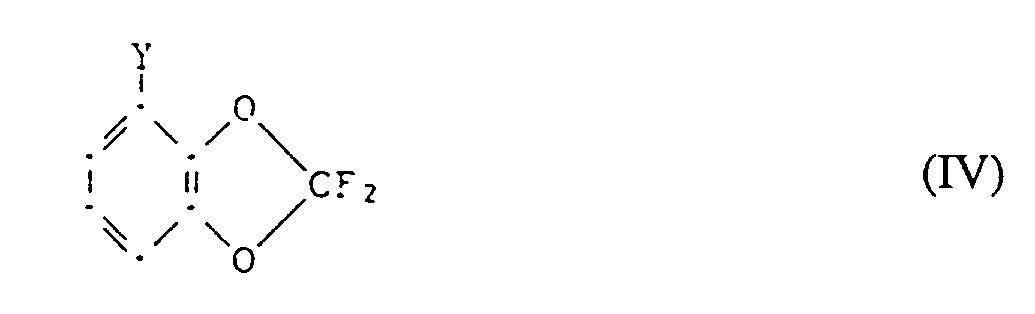 b) on fait réagir le composé de formule IV avec un composé électrophile pris dans le groupe formé par X-CN, CO₂, S₈, COX₂, B(OR²)₃, X-SiR²₃, R²O-SiR²₃ ou XCOOR², X représentant -Cl ou -Br, un réactif formylant, CH₂O, un époxyde, un benzaldéhyde non substitué ou portant des substituants F, alcoxy en C₁-C₄, alkylthio en C₁-C₄, alkyle en C₁-C₄ ou fluoralkyle en C₁-C₄, nitro, cyano, un (alkyle en C₁-C₁₁)-CHO non substitué ou portant des substituants - F, -Cl, -CN, alcoxy en C₁-C₆, phényle, fluorophényle, (alcoxy en C₁-C₄)-phényle, (alkylthio en C₁-C₄)-phényle, (alkyle en C₁-C₄)-phényle, (fluoralkyle en C₁-C₄)-phényle, nitrophényle, cyanophényle, ou encore avec (acyle en C₁-C₁₂)-X¹, X¹ représentant -Cl, -Br, un groupe alcoxy en C₁-C₆ ou le radical d'une amine secondaire, X²CnH2nCOOR² ou X²-CR³=CR⁴R⁵, X² représentant un groupe éliminable, etc) on isole le composé de formule I ou bien on hydrolyse d'abord le mélange de réaction puis on isole le composé de formule I.
 - Procédé de préparation des composés de formule I de la revendication 1

 a) on fait réagir dans un solvant inerte le 2,2-difluorobenzo-1,3-dioxole avec un dérivé de métal alcalin à anion fortement basique, ce qui donne un composé de formule IV
 b) on fait réagir le composé de formule IV avec un composé électrophile du groupe formé par X-CN, CO₂, COX₂ ou XCOOR², X représentant -Cl ou -Br, un réactif formylant, CH₂O, un (alkyle en C₁-C₁₁)-CHO non substitué ou portant des substituants -F, -CN, alcoxy en C₁-C₆, phényle, fluorophényle, (alcoxy en C₁-C₄)-phényle, (alkyle en C₁-C₄)-thiophényle, (alkyle en C₁-C₄)-phényle, (fluoralkyle en C₁-C₄)-phényle, nitrophényle, cyanophényle, un époxyde, un benzaldéhyde non substitué ou portant des substituants -F, alcoxy, alkylthio, alkyle ou fluoralkyle en C₁-C₄, nitro, cyano, (acyle en C₁-C₁₂)-X¹ dans lequel X¹ représente - Cl, -Br, un groupe alcoxy en C₁-C₆ ou le radical d'une amine secondaire, X²CnH2nCOOR² ou X²-CR³=CR⁴R⁵, X² représentant un groupe éliminable etc) on isole le composé de formule I ou bien on hydrolyse d'abord le mélange de réaction puis on isole le composé de formule I.
 - Procédé de préparation des composés de formule I de la revendication 2, dans laquelle R¹ représente -CHO, -CN, -COOH, -COX, X représentant Cl ou Br, ou un groupe de formule II
 a) on fait réagir dans un solvant inerte le 2,2-difluorobenzo-1,3-dioxole avec un dérivé de métal alcalin à anion fortement basique, ce qui donne un composé de formule IV
 b) on fait réagir le composé de formule IV avec un composé électrophile du groupe formé par X-CN, CO₂ ou COX₂, X représentant -Cl ou -Br, un réactif formylant ou X₂-CR³=CR⁴R⁵, X² représentant un groupe éliminable etc) on isole le composé de formule I ou bien on hydrolyse d'abord le mélange de réaction puis on isole le composé de formule I.
 - Procédé de préparation des composés de formule I selon la revendication 3,

- Procédé selon la revendication 2, caractérisé en ce que la réaction est effectuée entre -150 et +150°C.
- Procédé selon la revendication 2, caractérisé en ce que le solvant est un solvant non polaire ou un solvant polaire aprotonique.
- Procédé selon la revendication 6, caractérisé en ce que le solvant est un hydrocarbure aliphatique ou aromatique, un éther, une amine tertiaire, un N-alkylamide, un lactame ou une urée cyclique, un sulfoxyde, une sulfone, un nitrile ou leurs mélanges.
- Procédé selon la revendication 2, caractérisé en ce que le mélange de réaction contient en outre un agent complexant.
- Procédé selon la revendication 8, caractérisé en ce que l'agent complexant est une amine tertiaire, un carboxamide substitué à l'azote, un lactame ou une urée cyclique, un éther ou un sulfoxyde, un éther en couronne, un halogénure de métal alcalin, de magnésium ou de cuivre.
- Procédé selon la revendication 2, caractérisé en ce que le dérivé de métal alcalin est un alkyl-Li, -Na, -K ou un amidure de Li, de Na ou de K.
- Procédé selon la revendication 2, caractérisé en ce que le réactif formylant est un halogénure de formyle, un ester formique, un ester orthoformique, une alcoxyméthylène-aniline ou un formamide disubstitué à l'azote.
- Procédé selon la revendication 2, caractérisé en ce que X¹ consiste en un radical d'amine secondaire de structure (alkyle en C₁-C₄)-N-alkyle en C₁-C₄, (alkyle en C₁-C₄)-N-CH₂CH₂O-alkyle en C₁-C₄, (alkyle en C₁-C₄-0 CH₂CH₂)₂N- ou en le radical d'une amine hétérocyclique à 5 ou 6 chaînons qui peut contenir un autre hétéroatome choisi parmi -O- et =N-alkyle en C₁-C₄.
- Procédé selon la revendication 2, caractérisé en ce que X², substituant éliminable, est un substituant halogénure, alcoxy en C₁-C₆, aryloxy en C₆-C₁₀, sec.-amino en C₁-C₁₂, acyloxy en C₁-C₈ ou le radical d'un acide sulfonique.
- Procédé de préparation du 2,2-difluoro-1,3-benzodioxole-4-carbaldéhyde selon la revendication 2, caractérisé en ce que l'on fait réagir le 2,2-difluoro-1,3-benzodioxole avec le n-butyllithium puis avec le diméthylformamide.
Applications Claiming Priority (2)
| Application Number | Priority Date | Filing Date | Title |
|---|---|---|---|
| CH1044/88 | 1988-03-18 | ||
| CH01044/88A CH687877A5 (de) | 1988-03-18 | 1988-03-18 | 2,2-Difluorbenzo-1,3-dioxol-4-carbaldehyd. |
Publications (3)
| Publication Number | Publication Date |
|---|---|
| EP0333658A2 EP0333658A2 (fr) | 1989-09-20 |
| EP0333658A3 EP0333658A3 (en) | 1990-07-25 |
| EP0333658B1 true EP0333658B1 (fr) | 1995-07-26 |
Family
ID=4201152
Family Applications (1)
| Application Number | Title | Priority Date | Filing Date |
|---|---|---|---|
| EP89810184A Expired - Lifetime EP0333658B1 (fr) | 1988-03-18 | 1989-03-09 | Procédé pour la préparation de difluorbenzo-1,3-dioxoles substitués |
Country Status (10)
| Country | Link |
|---|---|
| EP (1) | EP0333658B1 (fr) |
| JP (1) | JP2855337B2 (fr) |
| KR (1) | KR970002231B1 (fr) |
| AT (1) | ATE125536T1 (fr) |
| AU (1) | AU624123B2 (fr) |
| CA (1) | CA1338936C (fr) |
| CH (1) | CH687877A5 (fr) |
| DE (1) | DE58909357D1 (fr) |
| IL (1) | IL89636A (fr) |
| ZA (1) | ZA892047B (fr) |
Families Citing this family (6)
| Publication number | Priority date | Publication date | Assignee | Title |
|---|---|---|---|---|
| US4705800A (en) * | 1985-06-21 | 1987-11-10 | Ciba-Geigy Corporation | Difluorbenzodioxyl cyanopyrrole microbicidal compositions |
| ATE104974T1 (de) * | 1988-03-18 | 1994-05-15 | Ciba Geigy Ag | Verfahren zur herstellung eines pyrrol-derivats. |
| DE4040021A1 (de) * | 1990-12-14 | 1992-06-17 | Bayer Ag | Substituierte 2,2-difluor-1,3-benzodioxyl-4-ketone |
| DE4213849A1 (de) | 1992-04-27 | 1993-10-28 | Bayer Ag | Verfahren zur â-Chlorierung von Arylethern |
| DE19530637A1 (de) * | 1995-08-21 | 1997-02-27 | Bayer Ag | Verfahren zur Herstellung von 2,2-Difluorbenzo[1.3]dioxolcarbaldehyden |
| CN101851225B (zh) * | 2010-06-09 | 2012-08-08 | 山东铂源化学有限公司 | 一种咯菌腈中间体4-醛基-2,2-二氟苯并二恶茂的合成方法 |
Family Cites Families (4)
| Publication number | Priority date | Publication date | Assignee | Title |
|---|---|---|---|---|
| BR8207267A (pt) * | 1981-12-17 | 1983-10-18 | Du Pont | Compostos composicao adequada e processo para controlar crescimento de vegetacao indesejada |
| US4722935A (en) * | 1985-04-03 | 1988-02-02 | Ciba-Geigy Corporation | Pesticidal compositions |
| US4705800A (en) * | 1985-06-21 | 1987-11-10 | Ciba-Geigy Corporation | Difluorbenzodioxyl cyanopyrrole microbicidal compositions |
| DE3716652A1 (de) * | 1987-05-19 | 1988-12-08 | Bayer Ag | Dioxyalkylenaryl-dihydropyridine, zwischenprodukte zu ihrer herstellung, verfahren zu ihrer herstellung und ihre verwendung |
-
1988
- 1988-03-18 CH CH01044/88A patent/CH687877A5/de not_active IP Right Cessation
-
1989
- 1989-03-09 DE DE58909357T patent/DE58909357D1/de not_active Expired - Lifetime
- 1989-03-09 EP EP89810184A patent/EP0333658B1/fr not_active Expired - Lifetime
- 1989-03-09 AT AT89810184T patent/ATE125536T1/de not_active IP Right Cessation
- 1989-03-16 CA CA000593962A patent/CA1338936C/fr not_active Expired - Lifetime
- 1989-03-16 IL IL8963689A patent/IL89636A/en unknown
- 1989-03-17 AU AU31452/89A patent/AU624123B2/en not_active Expired
- 1989-03-17 ZA ZA892047A patent/ZA892047B/xx unknown
- 1989-03-17 JP JP1065801A patent/JP2855337B2/ja not_active Expired - Lifetime
- 1989-03-18 KR KR1019890003441A patent/KR970002231B1/ko not_active Expired - Lifetime
Also Published As
| Publication number | Publication date |
|---|---|
| EP0333658A3 (en) | 1990-07-25 |
| AU624123B2 (en) | 1992-06-04 |
| IL89636A (en) | 1995-08-31 |
| IL89636A0 (en) | 1989-09-28 |
| DE58909357D1 (de) | 1995-08-31 |
| KR890014512A (ko) | 1989-10-24 |
| CH687877A5 (de) | 1997-03-14 |
| KR970002231B1 (ko) | 1997-02-26 |
| AU3145289A (en) | 1989-09-21 |
| CA1338936C (fr) | 1997-02-25 |
| ZA892047B (en) | 1989-11-29 |
| ATE125536T1 (de) | 1995-08-15 |
| JPH01301674A (ja) | 1989-12-05 |
| EP0333658A2 (fr) | 1989-09-20 |
| JP2855337B2 (ja) | 1999-02-10 |
Similar Documents
| Publication | Publication Date | Title |
|---|---|---|
| EP0606065B1 (fr) | Procédé pour la préparation de dérivés de biphényle | |
| DE3856293T2 (de) | Substituierte cyclische Ketone, substituierte cyclische Enone und Verfahren zu deren Herstellung | |
| US5420301A (en) | Process for the preparation of substituted difluorobenzo-1,3-dioxoles | |
| EP0317845A2 (fr) | Hydroxylamines substituées | |
| EP0333658A2 (fr) | Procédé pour la préparation de difluorbenzo-1,3-dioxoles substitués | |
| DE3939535A1 (de) | Verfahren zur herstellung teilfluorierter alkohole | |
| EP0074121B1 (fr) | Dérivés de 2,3,4,5-tétrahydro-1-benzoxépine-3,5-dione et leur procédé de préparation | |
| DE69125675T2 (de) | In situ-Herstellung von Diisopinocampheylchloroboran | |
| EP1070718B1 (fr) | Procede de production de composes de grignard et nouveaux composes de grignard | |
| EP0464639A1 (fr) | Dérivés de diols aminés | |
| US4025537A (en) | Preparation of 3-carboalkoxy or 3-alkanoyl furans | |
| EP0454623A1 (fr) | Procédé pour la préparation de dicétones-1,3 linéaires | |
| DE3343531A1 (de) | Substituierte acetylenketone | |
| EP0299277A2 (fr) | Procédé pour la préparation de pyridylalkylcétones substituées | |
| EP0391212B1 (fr) | Procédé de préparation de composés de stilbène bifonctionnels ayant la configuration Z, composés de stilbène ayant cette configuration ainsi que leur utilisation pour la préparation de polymères | |
| EP0347693B1 (fr) | Benzonitriles, benzaldéhydes et alcools benzyliques et procédés pour leur préparation | |
| EP0131130B1 (fr) | Procédé de préparation de cycloalcènylalcynes | |
| JP3241760B2 (ja) | シクロヘキサノン誘導体 | |
| EP0019719B1 (fr) | Procédé de préparation d'alcènes, nouveaux intermédiaires pour leur préparation et procédé de les préparer | |
| DE69521904T2 (de) | Verfahren zur herstellung tetrazole | |
| EP0173190A2 (fr) | Procédé de préparation de 5-acyl-pyrimidines | |
| DE2604248C2 (de) | Verfahren zur Herstellung von Thienopyridinderivaten | |
| DE19755509B4 (de) | Cyclobutanon-Derivate, Verfahren zu ihrer Herstellung und ihre Verwendung zur Herstellung flüssigkristalliner Verbindungen | |
| DE2821540C2 (fr) | ||
| DE10047111A1 (de) | Verfahren zur Herstellung von DELTA·1·-Pyrrolinen |
Legal Events
| Date | Code | Title | Description |
|---|---|---|---|
| PUAI | Public reference made under article 153(3) epc to a published international application that has entered the european phase |
Free format text: ORIGINAL CODE: 0009012 |
|
| 17P | Request for examination filed |
Effective date: 19890313 |
|
| AK | Designated contracting states |
Kind code of ref document: A2 Designated state(s): AT BE CH DE FR GB IT LI LU NL SE |
|
| PUAL | Search report despatched |
Free format text: ORIGINAL CODE: 0009013 |
|
| AK | Designated contracting states |
Kind code of ref document: A3 Designated state(s): AT BE CH DE FR GB IT LI LU NL SE |
|
| 17Q | First examination report despatched |
Effective date: 19930401 |
|
| GRAA | (expected) grant |
Free format text: ORIGINAL CODE: 0009210 |
|
| AK | Designated contracting states |
Kind code of ref document: B1 Designated state(s): AT BE CH DE FR GB IT LI LU NL SE |
|
| REF | Corresponds to: |
Ref document number: 125536 Country of ref document: AT Date of ref document: 19950815 Kind code of ref document: T |
|
| REF | Corresponds to: |
Ref document number: 58909357 Country of ref document: DE Date of ref document: 19950831 |
|
| ITF | It: translation for a ep patent filed | ||
| ET | Fr: translation filed | ||
| GBT | Gb: translation of ep patent filed (gb section 77(6)(a)/1977) |
Effective date: 19951027 |
|
| PLBE | No opposition filed within time limit |
Free format text: ORIGINAL CODE: 0009261 |
|
| STAA | Information on the status of an ep patent application or granted ep patent |
Free format text: STATUS: NO OPPOSITION FILED WITHIN TIME LIMIT |
|
| 26N | No opposition filed | ||
| REG | Reference to a national code |
Ref country code: CH Ref legal event code: PFA Free format text: CIBA-GEIGY AG TRANSFER- NOVARTIS AG |
|
| REG | Reference to a national code |
Ref country code: GB Ref legal event code: 732E |
|
| NLS | Nl: assignments of ep-patents |
Owner name: NOVARTIS AG |
|
| REG | Reference to a national code |
Ref country code: FR Ref legal event code: TP |
|
| REG | Reference to a national code |
Ref country code: GB Ref legal event code: IF02 |
|
| REG | Reference to a national code |
Ref country code: CH Ref legal event code: PUE Owner name: SYNGENTA PARTICIPATIONS AG Free format text: NOVARTIS AG#SCHWARZWALDALLEE 215#4058 BASEL (CH) -TRANSFER TO- SYNGENTA PARTICIPATIONS AG#SCHWARZWALDALLEE 215#4058 BASEL (CH) |
|
| NLS | Nl: assignments of ep-patents |
Owner name: SYNGENTA PARTICIPATIONS AG |
|
| REG | Reference to a national code |
Ref country code: FR Ref legal event code: TP |
|
| PGFP | Annual fee paid to national office [announced via postgrant information from national office to epo] |
Ref country code: CH Payment date: 20080228 Year of fee payment: 20 |
|
| PGFP | Annual fee paid to national office [announced via postgrant information from national office to epo] |
Ref country code: SE Payment date: 20080306 Year of fee payment: 20 Ref country code: GB Payment date: 20080305 Year of fee payment: 20 Ref country code: IT Payment date: 20080327 Year of fee payment: 20 Ref country code: LU Payment date: 20080313 Year of fee payment: 20 Ref country code: NL Payment date: 20080303 Year of fee payment: 20 |
|
| PGFP | Annual fee paid to national office [announced via postgrant information from national office to epo] |
Ref country code: AT Payment date: 20080313 Year of fee payment: 20 |
|
| PGFP | Annual fee paid to national office [announced via postgrant information from national office to epo] |
Ref country code: FR Payment date: 20080311 Year of fee payment: 20 Ref country code: DE Payment date: 20080306 Year of fee payment: 20 |
|
| PGFP | Annual fee paid to national office [announced via postgrant information from national office to epo] |
Ref country code: BE Payment date: 20080916 Year of fee payment: 20 |
|
| BE20 | Be: patent expired |
Owner name: *SYNGENTA PARTICIPATIONS A.G. Effective date: 20090309 |
|
| REG | Reference to a national code |
Ref country code: CH Ref legal event code: PL |
|
| REG | Reference to a national code |
Ref country code: GB Ref legal event code: PE20 Expiry date: 20090308 |
|
| NLV7 | Nl: ceased due to reaching the maximum lifetime of a patent |
Effective date: 20090309 |
|
| PG25 | Lapsed in a contracting state [announced via postgrant information from national office to epo] |
Ref country code: NL Free format text: LAPSE BECAUSE OF EXPIRATION OF PROTECTION Effective date: 20090309 |
|
| PG25 | Lapsed in a contracting state [announced via postgrant information from national office to epo] |
Ref country code: GB Free format text: LAPSE BECAUSE OF EXPIRATION OF PROTECTION Effective date: 20090308 |