EP0334152A1 - Verfahren zur Auswertung der Bildinformation bei einer optischen Oberflächenkontrolle mittels eines elektronischen Abtastsystems - Google Patents
Verfahren zur Auswertung der Bildinformation bei einer optischen Oberflächenkontrolle mittels eines elektronischen Abtastsystems Download PDFInfo
- Publication number
- EP0334152A1 EP0334152A1 EP89104403A EP89104403A EP0334152A1 EP 0334152 A1 EP0334152 A1 EP 0334152A1 EP 89104403 A EP89104403 A EP 89104403A EP 89104403 A EP89104403 A EP 89104403A EP 0334152 A1 EP0334152 A1 EP 0334152A1
- Authority
- EP
- European Patent Office
- Prior art keywords
- filter
- image
- filter value
- value
- efw
- Prior art date
- Legal status (The legal status is an assumption and is not a legal conclusion. Google has not performed a legal analysis and makes no representation as to the accuracy of the status listed.)
- Granted
Links
Images

Classifications
-
- G—PHYSICS
- G06—COMPUTING OR CALCULATING; COUNTING
- G06T—IMAGE DATA PROCESSING OR GENERATION, IN GENERAL
- G06T5/00—Image enhancement or restoration
- G06T5/70—Denoising; Smoothing
-
- G—PHYSICS
- G06—COMPUTING OR CALCULATING; COUNTING
- G06T—IMAGE DATA PROCESSING OR GENERATION, IN GENERAL
- G06T5/00—Image enhancement or restoration
- G06T5/20—Image enhancement or restoration using local operators
-
- G—PHYSICS
- G06—COMPUTING OR CALCULATING; COUNTING
- G06T—IMAGE DATA PROCESSING OR GENERATION, IN GENERAL
- G06T5/00—Image enhancement or restoration
- G06T5/50—Image enhancement or restoration using two or more images, e.g. averaging or subtraction
-
- G—PHYSICS
- G01—MEASURING; TESTING
- G01N—INVESTIGATING OR ANALYSING MATERIALS BY DETERMINING THEIR CHEMICAL OR PHYSICAL PROPERTIES
- G01N21/00—Investigating or analysing materials by the use of optical means, i.e. using sub-millimetre waves, infrared, visible or ultraviolet light
- G01N21/84—Systems specially adapted for particular applications
- G01N21/88—Investigating the presence of flaws or contamination
- G01N21/8851—Scan or image signal processing specially adapted therefor, e.g. for scan signal adjustment, for detecting different kinds of defects, for compensating for structures, markings, edges
- G01N2021/8887—Scan or image signal processing specially adapted therefor, e.g. for scan signal adjustment, for detecting different kinds of defects, for compensating for structures, markings, edges based on image processing techniques
-
- G—PHYSICS
- G06—COMPUTING OR CALCULATING; COUNTING
- G06T—IMAGE DATA PROCESSING OR GENERATION, IN GENERAL
- G06T2207/00—Indexing scheme for image analysis or image enhancement
- G06T2207/20—Special algorithmic details
- G06T2207/20212—Image combination
- G06T2207/20224—Image subtraction
-
- G—PHYSICS
- G06—COMPUTING OR CALCULATING; COUNTING
- G06T—IMAGE DATA PROCESSING OR GENERATION, IN GENERAL
- G06T2207/00—Indexing scheme for image analysis or image enhancement
- G06T2207/30—Subject of image; Context of image processing
- G06T2207/30108—Industrial image inspection
- G06T2207/30164—Workpiece; Machine component
Definitions
- the invention relates to a method for evaluating the image information in an optical surface inspection by means of an electronic scanning system, which enables the removal of disturbing background information of the surface to be examined for defects.
- the object of the invention is to ensure improved recognition of the defects in a method of the type mentioned at the outset.
- the method according to the invention is designed such that the pixel information of the source image is shifted row by row and / or column by a one-dimensional filter in a predetermined cycle, to form a target image that a first filter value of the one-dimensional filter is dependent on another Filter value is corrected to a new first filter value with each cycle, in such a way that a difference in the values when a threshold is exceeded leads to a predetermined change in the first filter value in the direction of the second filter value, and that the resulting target image is subtracted from the source image for Removal of the underground information of the surface to be examined for defects.
- a filter value at the beginning for example the first filter value
- a filter value at the end for example the last filter value
- the method according to the invention is advantageous in that the detection of small and large errors can be carried out with one method and error areas are shown true to form and closed.
- the method does not require any initial values because the surface is adapted adaptively.
- An advantageous development of the method according to the invention results from claim 3, which leads to a more precise adaptation of the subsurface.
- the method can also be implemented with a conventional electronic arrangement.
- the method is first explained in FIG. 1.
- the upper partial image shows a section of a digitized video image line with 512 pixels BP, the brightness of the image line decreasing from left to right.
- Two errors FE1, FE2 are embedded in the brightness gradient, a small one on the left (FE1) with a strong curvature and a large, slightly curved error FE2 on the right.
- the method is based on simulating the background in the area of the defect, i.e. that is, to generate a brightness curve that would have been present without the error occurring.
- the gray values in the error area are replaced by those that are adapted to the error environment.
- the algorithm described below generates from the gray value curve of the image line in the first partial image the dash-dotted curve of the background formed for this image line in the second partial image.
- a tolerance band is placed around the surface. All pixels of the original gray value course that lie outside the tolerance band belong to defects. By forming the difference between the background and the gray value curve of the original image line, the error areas shown in the lower partial image are obtained.
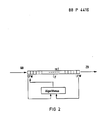
- the formation of the background which represents the core of the method, is carried out with a one-dimensional filter F of size nx 1 according to FIG. 2. Only the first (EFW) and the last filter value LFW contribute to the formation of the background.
- the image data of a source image QB are shifted by the filter F from the first filter value EFW in cycles towards the last filter value LFW and from here into a target image ZB (background image).
- the peculiarity is that with each cycle from the two values EFW old and LFW according to the formulas (1) or (2) a new value EFW is newly formed, which runs through the filter F instead of the old value EFW old .
- the corrected value is therefore written in the beginning of the filter and not - as usual - in the middle of the filter. This measure gives a recursive filter, as the corrected value EFW new as the last filter value LFW again received some bars later in the calculation of a filter value.
- the invention can be used in optical methods for surface inspection, for example of sheet metal parts in automobile construction.
Landscapes
- Physics & Mathematics (AREA)
- General Physics & Mathematics (AREA)
- Engineering & Computer Science (AREA)
- Theoretical Computer Science (AREA)
- Investigating Materials By The Use Of Optical Means Adapted For Particular Applications (AREA)
- Image Analysis (AREA)
- Image Processing (AREA)
Abstract
Description
- Die Erfindung betrifft ein Verfahren zur Auswertung der Bildinformation bei einer optischen Oberflächenkontrolle mittels eines elektronischen Abtastsystems, das eine Beseitigung störender Untergrundinformationen der auf Fehlstellen zu untersuchenden Oberfläche ermöglicht.
- Es ist bekannt aus Reihe 10 der VDI-Fortschritt-Berichte Nr. 67 "Auswahl von Texturanalyseverfahren zur Automatisierung industrieller Sichtprüfungen" von M. S. Tatari, zur Bildung einer adaptiven Grauwertschwelle aus einem Referenzfenster den mittleren Grauwert m zu berechnen. Aus diesem werden iterativ über folgende Rechenvorschrift
mneu = malt + (xakt - malt) / K1
neue Mittelwerte gebildet. Die Wahl der Zeitkonstante K1 steuert den Beitrag des aktuellen Grauwertes xakt bzw. des alten Mittelwertes malt zum neuen Mittelwert. Grauwerte weit zurückliegender Bildpunkte tragen in immer abgeschwächterer Form zum Ergebnis bei. Durch Addition bzw. Subtraktion einer Grauwertabweichung vom gebildeten Mittelwert ergeben sich eine obere und eine untere Grauwertschwelle, die zusammen einen Bereich bilden. Bildpunkte, deren Grauwerte diesen Bereich verlassen, werden als Fehler detektiert. - Der Erfindung liegt die Aufgabe zugrunde, bei einem Verfahren der eingangs genannten Art eine verbesserte Erkennbarkeit der Fehlstellen zu gewährleisten.
- Zur Lösung dieser Aufgabe ist das erfindungsgemäße Verfahren so ausgebildet, daß die Bildpunktinformationen des Quellbildes zeilen- und/oder spaltenweise durch ein eindimensionales Filter in einem vorgegebenen Takt geschoben werden, zur Bildung eines Zielbildes, daß ein erster Filterwert des eindimensionalen Filters in Abhängigkeit von einem anderen Filterwert bei jedem Takt zu einem neuen ersten Filterwert korrigiert wird, in der Weise, daß ein Unterschied der Werte bei Überschreiten einer Schwelle zu einer vorgegebenen Änderung des ersten Filterwertes in Richtung des zweiten Filterwertes führt, und daß das resultierende Zielbild vom Quellbild subtrahiert wird, zur Beseitigung der Untergrundinformation der auf Fehlstellen zu untersuchenden Oberfläche. Als Filterwerte werden in vorteilhafter Weise ein Filterwert am Anfang (beispielsweise der erste Filterwert) und ein Filterwert am Ende (beispielsweise der letzte Filterwert) gemäß Anspruch 2 gewählt.
- Das erfindungsgemäße Verfahren ist insofern vorteilhaft, da hier die Detektion kleiner und großer Fehler mit einem Verfahren durchgeführt werden kann und Fehlerbereiche formgetreu und geschlossen dargestellt werden. Das Verfahren benötigt keine Anfangswerte, da eine adaptive Anpassung des Untergrundes vorgenommen wird. Eine vorteilhafte Weiterbildung des erfindungsgemäßen Verfahrens ergibt sich gemäß Anspruch 3, die zu einer genaueren Adaption des Untergrundes führt. Das Verfahren kann weiterhin mit einer üblichen elektronischen Anordnung realisiert werden.
-
- Figur 1 zeigt einen typischen Verlauf einer digitalisierten Bildzeile, und
- Figur 2 zeigt eine Prinzipanordnung eines Filters, mit der das erfindungsgemäße Verfahren durchgeführt werden kann.
- Das Verfahren wird zunächst von Figur 1 erläutert. Das obere Teilbild zeigt einen Ausschnitt einer digitalisierten Videobildzeile mit 512 Bildpunkten BP, wobei die Helligkeit der Bildzeile von links nach rechts abnimmt. In das Helligkeitsgefälle sind zwei Fehler FE1, FE2 eingebettet, links ein kleiner (FE1) mit starker Krümmung und rechts ein großer, schwach gekrümmter Fehler FE2.
- Das Verfahren beruht darauf, den Untergrund im Fehlerbereich nachzubilden, d. h., einen Helligkeitsverlauf zu erzeugen, der ohne Auftreten des Fehlers vorhanden gewesen wäre. Die Grauwerte im Fehlerbereich werden durch solche ersetzt, die an die Fehlerumgebung angepaßt sind. Der nachfolgend beschriebene Algorithmus erzeugt aus dem Grauwertverlauf der Bildzeile im ersten Teilbild den strichpunktierten Verlauf des gebildeten Untergrundes für diese Bildzeile im zweiten Teilbild. Um den Untergrund herum wird ein Toleranzband gelegt. Alle Bildpunkte des ursprünglichen Grauwertverlaufes, die außerhalb des Toleranzbandes liegen, gehören zu Fehlstellen. Durch Differenzbildung des Untergrundes vom Grauwertverlauf der originalen Bildzeile erhält man die im unteren Teilbild gezeigten Fehlerbereiche.
- Die Bildung des Untergrundes, die den Kern des Verfahrens darstellt, erfolgt mit einem eindimensionalen Filter F der Größe n x 1 nach Figur 2. Lediglich der erste (EFW) und der letzte Filterwert LFW tragen zur Untergrundbildung bei. Die Bilddaten eines Quellbildes QB werden durch das Filter F vom ersten Filterwert EFW taktweise in Richtung zum letzten Filterwert LFW und von hier in ein Zielbild ZB (Untergrundbild) geschoben. Die Besonderheit hierbei ist, daß mit jedem Takt aus den beiden Werten EFWalt und LFW gemäß den Formeln (1)


- Die in den Formeln (1) und (2) angegebenen Filterfunktionen stellen nur eine von mehreren Lösungsmöglichkeiten dar.
- Die Erfindung ist bei optischen Verfahren zur Oberflächenkontrolle, beispielsweise von Blechteilen im Automobilbau, anwendbar.
Claims (3)
- die Bildpunktinformationen des Quellbildes (QB) zeilen- und/oder spaltenweise durch ein eindimensionales Filter (F) in einem vorgegebenen Takt geschoben werden, zur Bildung eines Zielbildes (ZB),
- ein erster Filterwert (EFWalt) des eindimensionalen Filters (F) in Abhängigkeit von einem anderen Filterwert (LFW) bei jedem Takt zu einem neuen ersten Filterwert (EFW neu) korrigiert wird,
- in der Weise, daß ein Unterschied der Werte (EFWalt, LFW) bei Überschreiten einer Schwelle zu einer vorgegebenen Änderung des ersten Filterwertes (EFW alt) in Richtung des zweiten Filterwertes führt,
und bei dem
- das resultierende Zielbild (ZB) vom Quellbild (QB) subtrahiert wird, zur Beseitigung der Untergrundinformation der auf Fehlstellen zu untersuchenden Oberfläche.
- der erste Filterwert (EFW alt) am Anfang des eindimensionalen Filters (F) und der zweite Filterwert (LFW) am Ende des eindimensionalen Filters (F) steht.
- die Bildpunktinformationen des Quellbildes (QB) zeilen- und/oder spaltenweise jeweils in beiden Richtungen durch das Filter (F) geschoben werden.
Applications Claiming Priority (2)
| Application Number | Priority Date | Filing Date | Title |
|---|---|---|---|
| DE3809448A DE3809448A1 (de) | 1988-03-21 | 1988-03-21 | Verfahren zur auswertung der bildinformation bei einer optischen oberflaechenkontrolle mittels eines elektronischen abtastsystems |
| DE3809448 | 1988-03-21 |
Publications (2)
| Publication Number | Publication Date |
|---|---|
| EP0334152A1 true EP0334152A1 (de) | 1989-09-27 |
| EP0334152B1 EP0334152B1 (de) | 1992-08-12 |
Family
ID=6350284
Family Applications (1)
| Application Number | Title | Priority Date | Filing Date |
|---|---|---|---|
| EP89104403A Expired - Lifetime EP0334152B1 (de) | 1988-03-21 | 1989-03-13 | Verfahren zur Auswertung der Bildinformation bei einer optischen Oberflächenkontrolle mittels eines elektronischen Abtastsystems |
Country Status (3)
| Country | Link |
|---|---|
| EP (1) | EP0334152B1 (de) |
| DE (2) | DE3809448A1 (de) |
| ES (1) | ES2034445T3 (de) |
Cited By (1)
| Publication number | Priority date | Publication date | Assignee | Title |
|---|---|---|---|---|
| WO1998005942A1 (fr) * | 1996-08-05 | 1998-02-12 | Kangting Gu | Procede servant a accroitre la precision d'images microscopiques et appareil associe |
Families Citing this family (2)
| Publication number | Priority date | Publication date | Assignee | Title |
|---|---|---|---|---|
| DE4401263C1 (de) * | 1994-01-18 | 1995-03-09 | Helge Dipl Ing Bohlmann | Oberflächenprofilmessgerät |
| DE10038494A1 (de) * | 2000-08-08 | 2002-02-21 | Abb Patent Gmbh | Verfahren zur Ermittlung von verrauschten oder formveränderten Bereichen in einer Zeitreihe |
Citations (4)
| Publication number | Priority date | Publication date | Assignee | Title |
|---|---|---|---|---|
| DE2709977A1 (de) * | 1976-03-09 | 1977-09-15 | Skf Ind Trading & Dev | Pruefvorrichtung zur qualitaetskontrolle von werkstueck-oberflaechen |
| GB1583073A (en) * | 1976-04-30 | 1981-01-21 | Gretag Ag | Method of assessing a printed article by point-wise comparison with an original |
| DD156635A1 (de) * | 1981-03-02 | 1982-09-08 | Rainer Gutsch | Verfahren zur trennung von gestaltabweichungen technischer oberflaechen |
| DD253295A1 (de) * | 1986-10-10 | 1988-01-13 | Technisches Glas Veb K | Verfahren und anordnung zur automatischen erkennung von unregelmaessigkeiten in transparenten pruefobjekten |
-
1988
- 1988-03-21 DE DE3809448A patent/DE3809448A1/de not_active Withdrawn
-
1989
- 1989-03-13 ES ES198989104403T patent/ES2034445T3/es not_active Expired - Lifetime
- 1989-03-13 DE DE8989104403T patent/DE58902018D1/de not_active Expired - Lifetime
- 1989-03-13 EP EP89104403A patent/EP0334152B1/de not_active Expired - Lifetime
Patent Citations (4)
| Publication number | Priority date | Publication date | Assignee | Title |
|---|---|---|---|---|
| DE2709977A1 (de) * | 1976-03-09 | 1977-09-15 | Skf Ind Trading & Dev | Pruefvorrichtung zur qualitaetskontrolle von werkstueck-oberflaechen |
| GB1583073A (en) * | 1976-04-30 | 1981-01-21 | Gretag Ag | Method of assessing a printed article by point-wise comparison with an original |
| DD156635A1 (de) * | 1981-03-02 | 1982-09-08 | Rainer Gutsch | Verfahren zur trennung von gestaltabweichungen technischer oberflaechen |
| DD253295A1 (de) * | 1986-10-10 | 1988-01-13 | Technisches Glas Veb K | Verfahren und anordnung zur automatischen erkennung von unregelmaessigkeiten in transparenten pruefobjekten |
Non-Patent Citations (1)
| Title |
|---|
| FORTSCHRITT-BERICHTE VDI, Reihe 10, Nr. 67 DIPL.ING. M. SEHRAN TATARI, Karlsruhe, "Auswahl von Text- tur-Analyseverfahren zur Automatisierung industrieller SichtprÙfungen" Seiten 86-113 * |
Cited By (1)
| Publication number | Priority date | Publication date | Assignee | Title |
|---|---|---|---|---|
| WO1998005942A1 (fr) * | 1996-08-05 | 1998-02-12 | Kangting Gu | Procede servant a accroitre la precision d'images microscopiques et appareil associe |
Also Published As
| Publication number | Publication date |
|---|---|
| DE58902018D1 (de) | 1992-09-17 |
| EP0334152B1 (de) | 1992-08-12 |
| ES2034445T3 (es) | 1993-04-01 |
| DE3809448A1 (de) | 1989-10-12 |
Similar Documents
| Publication | Publication Date | Title |
|---|---|---|
| DE3937950C2 (de) | ||
| EP0095517B1 (de) | Verfahren und Einrichtung zur automatischen optischen Inspektion | |
| DE3505331C2 (de) | Verfahren und Gerät zur Vermessung des bei der Eindringhärteprüfung in einer Probe hinterlassenen Eindrucks | |
| DE68928726T2 (de) | Bilderausrichtungsverfahren und -gerät | |
| DE3851173T2 (de) | Verfahren und Gerät zur Erkennung von Halbtonbildmustern. | |
| DE3612233C2 (de) | ||
| DE60307967T2 (de) | Bildverarbeitungsverfahren für die untersuchung des erscheinungsbildes | |
| EP0523407B1 (de) | Verfahren zur Klassifikation von Signalen | |
| DE2620611A1 (de) | Verfahren zur beurteilung eines druckerzeugnisses | |
| DE4201514A1 (de) | Verfahren zur ermittlung von fehlerhaften stellen | |
| DE69126853T2 (de) | Verfahren und Vorrichtung zur Bestimmung von Herstellungsfehlern in Festkörperbauteilen | |
| EP0409310A2 (de) | Verfahren sowie Anordnung zum Bestimmen von Kanten in Bildern | |
| DE3879015T2 (de) | Verfahren und vorrichtung zur ueberfruefung von lochmaskenplatten. | |
| DE19840969C2 (de) | Verfahren und Vorrichtung zum optoelektronischen Ermitteln der Tragbilder an Zahnflanken von Zahnrädern | |
| DE2700252C2 (de) | Verfahren zum Prüfen definierter Strukturen | |
| DE3939621C2 (de) | Verfahren und Vorrichtung zur Erfassung von Markendaten in Bilddaten | |
| EP1585059A2 (de) | Verfahren und Vorrichtung zur Ermittlung von Bewegungsvektoren, die Bildbereichen eines Bildes zugeordnet sind | |
| DE60015472T2 (de) | Telekommunikationsmasken-Testfähigkeit aufweisendes Test- und Messinstrument mit automatischer Anpassung an die Maske | |
| EP0334152A1 (de) | Verfahren zur Auswertung der Bildinformation bei einer optischen Oberflächenkontrolle mittels eines elektronischen Abtastsystems | |
| WO2008022780A2 (de) | Vorrichtung und verfahren zur reduzierung von übergangsartefakten in einem gesamtbild, das sich aus teilbildern zusammensetzt | |
| DE3113440A1 (de) | "verfahren zur ueberpruefung von gleichartigen objekten auf fehler" | |
| DE69110012T2 (de) | Linienerkennungsverfahren. | |
| DE69311429T2 (de) | Verfahren und Schaltung zur Verdoppelung der vertikalen und horizontalen Auflösung eines auf einem Bildschirm dargestellten Bildes | |
| DE3502317A1 (de) | Verfahren zur bildfehlerkorrektur | |
| DE69014485T2 (de) | Verfahren und Vorrichtung zur Bildverarbeitung von verbesserter Bewegungseinschätzung. |
Legal Events
| Date | Code | Title | Description |
|---|---|---|---|
| PUAI | Public reference made under article 153(3) epc to a published international application that has entered the european phase |
Free format text: ORIGINAL CODE: 0009012 |
|
| AK | Designated contracting states |
Kind code of ref document: A1 Designated state(s): BE DE ES FR GB IT NL SE |
|
| 17P | Request for examination filed |
Effective date: 19891026 |
|
| 17Q | First examination report despatched |
Effective date: 19910328 |
|
| GRAA | (expected) grant |
Free format text: ORIGINAL CODE: 0009210 |
|
| AK | Designated contracting states |
Kind code of ref document: B1 Designated state(s): BE DE ES FR GB IT NL SE |
|
| PG25 | Lapsed in a contracting state [announced via postgrant information from national office to epo] |
Ref country code: SE Free format text: THE PATENT HAS BEEN ANNULLED BY A DECISION OF A NATIONAL AUTHORITY Effective date: 19920812 Ref country code: NL Effective date: 19920812 |
|
| REF | Corresponds to: |
Ref document number: 58902018 Country of ref document: DE Date of ref document: 19920917 |
|
| ET | Fr: translation filed | ||
| ITF | It: translation for a ep patent filed | ||
| GBT | Gb: translation of ep patent filed (gb section 77(6)(a)/1977) | ||
| NLV1 | Nl: lapsed or annulled due to failure to fulfill the requirements of art. 29p and 29m of the patents act | ||
| PGFP | Annual fee paid to national office [announced via postgrant information from national office to epo] |
Ref country code: GB Payment date: 19930216 Year of fee payment: 5 |
|
| PGFP | Annual fee paid to national office [announced via postgrant information from national office to epo] |
Ref country code: ES Payment date: 19930311 Year of fee payment: 5 |
|
| PGFP | Annual fee paid to national office [announced via postgrant information from national office to epo] |
Ref country code: BE Payment date: 19930312 Year of fee payment: 5 |
|
| REG | Reference to a national code |
Ref country code: ES Ref legal event code: FG2A Ref document number: 2034445 Country of ref document: ES Kind code of ref document: T3 |
|
| PGFP | Annual fee paid to national office [announced via postgrant information from national office to epo] |
Ref country code: DE Payment date: 19930518 Year of fee payment: 5 |
|
| PLBE | No opposition filed within time limit |
Free format text: ORIGINAL CODE: 0009261 |
|
| STAA | Information on the status of an ep patent application or granted ep patent |
Free format text: STATUS: NO OPPOSITION FILED WITHIN TIME LIMIT |
|
| 26N | No opposition filed | ||
| PG25 | Lapsed in a contracting state [announced via postgrant information from national office to epo] |
Ref country code: GB Effective date: 19940313 |
|
| PG25 | Lapsed in a contracting state [announced via postgrant information from national office to epo] |
Ref country code: ES Free format text: LAPSE BECAUSE OF NON-PAYMENT OF DUE FEES Effective date: 19940314 |
|
| PGFP | Annual fee paid to national office [announced via postgrant information from national office to epo] |
Ref country code: FR Payment date: 19940317 Year of fee payment: 6 |
|
| PG25 | Lapsed in a contracting state [announced via postgrant information from national office to epo] |
Ref country code: BE Effective date: 19940331 |
|
| BERE | Be: lapsed |
Owner name: SIEMENS A.G. Effective date: 19940331 |
|
| GBPC | Gb: european patent ceased through non-payment of renewal fee |
Effective date: 19940313 |
|
| PG25 | Lapsed in a contracting state [announced via postgrant information from national office to epo] |
Ref country code: DE Effective date: 19941201 |
|
| PG25 | Lapsed in a contracting state [announced via postgrant information from national office to epo] |
Ref country code: FR Free format text: LAPSE BECAUSE OF NON-PAYMENT OF DUE FEES Effective date: 19951130 |
|
| REG | Reference to a national code |
Ref country code: FR Ref legal event code: ST |
|
| REG | Reference to a national code |
Ref country code: ES Ref legal event code: FD2A Effective date: 19990405 |
|
| PG25 | Lapsed in a contracting state [announced via postgrant information from national office to epo] |
Ref country code: IT Free format text: LAPSE BECAUSE OF NON-PAYMENT OF DUE FEES Effective date: 20050313 |