EP0334600A2 - Verfahren und Gerät zur Interpolation - Google Patents
Verfahren und Gerät zur Interpolation Download PDFInfo
- Publication number
- EP0334600A2 EP0334600A2 EP89302789A EP89302789A EP0334600A2 EP 0334600 A2 EP0334600 A2 EP 0334600A2 EP 89302789 A EP89302789 A EP 89302789A EP 89302789 A EP89302789 A EP 89302789A EP 0334600 A2 EP0334600 A2 EP 0334600A2
- Authority
- EP
- European Patent Office
- Prior art keywords
- value
- register
- line
- values
- output register
- Prior art date
- Legal status (The legal status is an assumption and is not a legal conclusion. Google has not performed a legal analysis and makes no representation as to the accuracy of the status listed.)
- Withdrawn
Links
Images



Classifications
-
- G—PHYSICS
- G06—COMPUTING OR CALCULATING; COUNTING
- G06F—ELECTRIC DIGITAL DATA PROCESSING
- G06F17/00—Digital computing or data processing equipment or methods, specially adapted for specific functions
- G06F17/10—Complex mathematical operations
- G06F17/17—Function evaluation by approximation methods, e.g. inter- or extrapolation, smoothing, least mean square method
-
- G—PHYSICS
- G06—COMPUTING OR CALCULATING; COUNTING
- G06T—IMAGE DATA PROCESSING OR GENERATION, IN GENERAL
- G06T15/00—Three-dimensional [3D] image rendering
- G06T15/50—Lighting effects
- G06T15/80—Shading
- G06T15/87—Gouraud shading
-
- G—PHYSICS
- G09—EDUCATION; CRYPTOGRAPHY; DISPLAY; ADVERTISING; SEALS
- G09G—ARRANGEMENTS OR CIRCUITS FOR CONTROL OF INDICATING DEVICES USING STATIC MEANS TO PRESENT VARIABLE INFORMATION
- G09G5/00—Control arrangements or circuits for visual indicators common to cathode-ray tube indicators and other visual indicators
- G09G5/20—Function-generator circuits, e.g. circle generators line or curve smoothing circuits
Definitions
- This invention relates to digital computers. More specifically, this invention relates to methods of interpolation and digital differential analysis.
- DDA digital differential analyzer
- a typical simple line DDA works on the principle of separating the line's X and Y components each into integer and fractional parts.
- the DDA increments the X and Y components in fractional steps. When the fractional portion overflows, the integer component is incremented.
- the DDA uses the integer component to form its output. As used in the computer field, one of the components is consistently incremented by one, while the other component is conditionally incremented.
- the simple DDA alglorithm may be better understood by reference to Figure 1. Assume it is desired to plot a line 102 between a start point 104 and an endpoint 106 on a display monitor. Further assume that points can only be plotted at places where the grid lines intersect (corresponding to pixels on the monitor). The initial value (V) of the line would be zero (the Y component startpoint value). The desired change (DELTA V) would be 5 (the Y component endpoint value) and the number of steps over which the value is to change (N) would be 7 (the total length of the line in the X direction). A simple BASIC language DDA such as is shown in example 1-1 could be used to perform this plot.
- the DDA program simply initializes the Y value to the line's Y start coordinate plus a rounding factor of .5, and for N iterative cycles; plots a point at the integer component of the X and Y values; increments the Y coordinate by the slope of the line (DELTA V / N; and increments the line's X component by one.
- the last plot command is added in order to plot the last point of the line.
- the Bresenham's Algorithm method is designed in order to increment one of the coordinate values by plus or minus one in each iteration; the remaining coordinate being incremented or not incremented depending on the value of an error term (i.e. Bresenham's error term) maintained by the algorithm.
- the error term is used to store the distance (measured perpendicular to the axis of greatest movement) between the exact path of the theoretical perfect line and the actual pixels which are addressed and written (i.e. illuminated as dots).
- An example of a Bresenham's Algorithm line plotting program and other examples of DDA can be found in a book entitled Principals of Interactive Computer Graphics (second edition), by William M. Newman and Robert F. Sproull, McGraw Hill (10th printing 1984), which in its entirety, is incorporated by reference herein as if printed in full below. Bresenham's algorithm, while solving the division problem, still encounters some other problems together with many conventional DDA interpolation techniques.
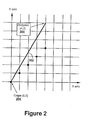
- Figure 2 shows a line 202 with its start point 204 at the X,Y origin, and its endpoint 206 at X, Y coordinates 4,7.
- N is equal to 4 (i.e. 4 minus 0) and DELTA V is equal to 7 (i.e 7 minus 0).
- DELTA V / N will therefore be equal to 1.75.
- the problem is that in two dimensional raster graphics it is difficult to determine where an exact portion of a line is plotted in order to erase or retrace it. Assume that a line L1 is to be drawn on a screen between a starting pixel P1 and an ending pixel P2. Assume the output of a chosen interpolation algorithm draws the line by plotting (by illuminating in a first color for example) a group of pixels G1. If it is necessary to erase or overwrite a portion of the line it will be necessary to retrace, (illuminate in a second color for example), a subportion of the line L.
- a new line L2 must be generated by choosing a starting pixel P4 and an ending pixel P5 which are within the original group of pixels G1. Since the new line L2 is being used to erase a portion of line L1 it is important that the entire group of pixels plotted when generating line L2 (call this group G2) by a subset of G1.
- the subset line problem is not a trivial one. If the conditions above are not satisfied, the line will not be completely erased and extra pixels will be plotted thereby causing artifacts of the display screen. It is accepted that the popular Bresenham's Algorithm does not satisfy the above conditions. Some suggestions for circumventing this problem have been offered by authors, one example suggests using a lookup table which has the digitization of every possible line on the screen stored within. Such suggestions have generally been considered to be unrealistic.
- the subset line problem is discussed in the book Data Structures for Raster Graphics, Edited by L.R.A. Kessener, F.J. Peteres and M.L.P.
- the subset line problem becomes important, particularly where it is desired to clip a line to the borders of a displayed window.
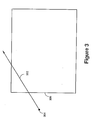
- the problem is illustrated by figure 3. Where a line displayed on a screen or window is to be calculated from a point outside the displayed screen or window, the line must be clipped. From figure 3 it will be seen that the line 302 starts at a point 304 which is outside the window 306. A portion of the line 302, must be displayed in the window while the remaining portion must be hidden. In order to accomplish this, two methods are conventionally used.
- One method of clipping is to calculate the non clipped sublines starting point and to perform a Bresenham type interpolation.
- the interpolation will start at a point other than the line's real origin and the subset line problem will be encountered. This could result in slightly different pixels being included in the clipped line than would have been drawn in the original line. If it is required to retrace the unclipped line, or the line clipped by a different window, the programmer is likely to find that a slightly different set of pixels are selected.
- a second conventional method circumvents the subset line problem by performing a Bresenham type interpolation from the start point of the line, keeping track of where the window starts, and not performing a 'write' in the non windowed area.
- This method is accurate but requires extra software overhead, and therefore computational time, to ensure that the line is not written into the non-windowed area. It also costs time by performing the full DDA, even for invisible pixels.
- Clipping and interpolation techniques including Bresenham's Algorithm, DDAs and Gouraud shading, are described in the book Principals of Interactive Computer Graphics (second edition), by William M. Newman and Robert F. Sproull, McGraw Hill (10th printing 1984).
- the programmer has been traditionally confronted with a dilemma.
- the programmer must typically choose between simple DDA type methods, which require costly divisions, and Bresenham's Algorithm together with similar techniques which limit the size of each X and Y increment to unity and produce subset line problems.
- the present invention includes a method of performing digital differential analysis using a hardware multiplier accumulator (MAC).
- the method enables the programmer to have the best of the linear interpolation worlds.
- the MAC hardware allows DDA's to be performed quickly without the divisions inherent in simple DDA's, without the subset line problems associated with Bresenham's Algorithm and without requiring added code often required to handle cases where the number of incremental steps is smaller than the range of values over which the steps are to occur.
- the present method can be used to interpolate any range of values or any number of steps.
- the relative sizes of N and DELTA V values do not effect the method whatsoever. This feature eliminates the need for extra code and allows DDA's to be performed to solve one dimensional problem where the range of values is greater than the number of steps over which the interpolation is to occur.
- the present method is used for Gouraud shading of a line.
- One of the MAC inputs is loaded with delta colour (the amount the colour is to change along the line) and the other with the reciprocal of the line length.
- the high part (MSP) of the MAC result register is preloaded with the start colour.
- the high part of the result is used as the colour for each pixel and is automatically changed when the accumulated low part of the result causes an overflow.
- the amount of change for each pixel is delta colour divided by the line length, therefore the final colour is start colour plus delta colour.
- the method makes use of simple MAC hardware, already available on many bit slice processors and microprocessor based CPU's. MAC integrated circuits may also be added at low cost, to systems not already utilizing them.
- One embodiment of the present method uses a ROM lookup table to automatically perform reciprocal operations as data is presented for processing by the MAC.
- the use of a lookup table eliminates the need to perform time costly divide operations and reduces CPU overhead. The method thereby eliminates the conventional need to avoid certain algorithms using divide operations.
- Another aspect of the invention provides a a method of clipping a line having two directional components and a given length, so as to display only a predetermined segment of the line comprising the steps of: initializing any of a multiplier accumulator's output registers with a predetermined initial value; loading a first input register of a multiplier accumulator with a value equal to the length one directional component of the line; loading a second input register of the multiplier accumulator with a value equal to the reciprocal of the length of other directional component of the line; causing the multiplier accumulator to multiply the values in its first and second input registers; accumulating the fractional part of the result of the multiply in a first output register while accumulating the overflow of the first output register in a second output register; further accumulating the integer part of the result of the multiply in the second output register; and, drawing a point on a display device whenever the value in the second output changes, the pixel having at least one coordinate value determined according to the value stored in the second output register.
- the present method can be utilized to solve a wide variety of interpolation problems and is available, in many cases, virtually cost free.
- the present invention includes a method of performing digital differential analysis using a hardware multiplier accumulator (MAC).
- MAC hardware multiplier accumulator
- the method enables the programmer to handle cases where the number of incremental steps is smaller than the range of values over which the steps are to occur.
- the method also solves several of the problems inherent in clipping methods using Bresenham's algorithm and other conventional DDA techniques.
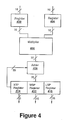
- FIG. 4 is a block diagram of a multiplier accumulator (MAC).
- the MAC 400 includes two input registers 402,404, a multiplier array 406, an adder 408, and three output registers 410, 412, 414.
- the LSP (least significant product) register is used to hold and accumulate the fractional portion of the result of the multiply operation
- the MSP (most significant product) register is used to hold and accumulate the integer portion of the result
- the XTP (extended product) register is used to hold and accumulate any overflow.
- the MAC 400 is preferably of a type with the ability to preload any of the output registers 410,412,414 and is operable in at least multiply and multiply-accumulate modes.
- the preferred multiplier accumulator (MAC) is an IDT7210 16 X 16 Parallel Multiplier-Accumulator, available from Integrated Device Technology, Inc. of Santa Clara, California. The structure and operation of the IDT7210 is described in the Integrated Device Technology, Inc. - HIGH PERFORMANCE CMOS DATA HANDBOOK available from Integrated Device Technology, Inc. of Santa Clara, California. The Integrated Device Technology, Inc. - HIGH PERFORMANCE CMOS DATA HANDBOOK is in its entirety, incorporated by reference herein as if printed in full below.
- Figure 5 shows an alternate embodiment of the hardware used by the present method which includes a 64K X 16 Read Only Memory (ROM) lookup table 502.
- the lookup table 502 is used to generate reciprocals of any value that appears at its address inputs.
- the output registers of the MAC are initially preloaded.
- the case of generating a line will first be considered.
- the LSP register is first loaded with an initial rounding value (eg 0.5).
- the starting value V for one coordinate e.g. the Y
- the MAC should be set in 'multiply-accumulate' mode as the input is loaded.
- the value of DELTA V is held at the address inputs of the first input register 402.
- the value of N is held at the address inputs of the ROM lookup table 502 until the value of 1/N appears and is stable at the first input register 402.
- both values appear and are stable at input registers 402, 404 they can be clocked into the first and second input registers 402 and 404 respectively.
- the DELTA V value can be clocked into the first input register as soon as it is stable at the MAC inputs and the reciprocal of the N value can be clocked into the second input register when it is stable.
- the stability of the data at the MAC inputs is easily ensured by the use of a suitable clocking scheme which takes into account the ROM access time.
- the MAC will multiply 1/N by the DELTA V. This result will then be added to the initial contents of the output registers 410,412,414. The accumulated value is then clocked into the output registers 410,412,414. Next, the result of the multiplication is then reclocked and accumulated with the outut register values. The process continues iteratively for the total number of steps over which the interpolation is to occur. This merely requires clocking the MACs output registers 410,412,414 a total number of times equal to the number of steps over which the DELTA V value change is to occur.
- X is incremented by 1 for every clock cycle while Y plotted at the value is in the MSP register 412 at each clock cycle.
- the MSP register 412 may be preloaded with that value (Y0) during initialization. The ability to load an initial Y value has great significance in line clipping procedures.
- the MAC is programmed similar to line generation. Essentially the initialization is identical, except that on the initial multiply/accumulate operation the first input register 402 is loaded with the number of steps n to reach the visible portion of the line (i.e. n * DELTA V). The first multiply/accumulate then sets up the output registers exactly as if n steps had been taken to achieve this setting (i.e. the result will be n * DELTA V/ N), including the 16 bit fractional error term. The first point can then be plotted. Next, the first input register is loaded with DELTA V as it would have been in the standard line drawing routine. The algorithm now proceeds normally until the end of the line, or until the line crosses out of the window. The MAC is used for the initial calculation of n * DELTA V.
- N and DELTA V are expressed as 16 bit binary values.
- the ROM lookup table 502 is programmed with the reciprocal of each address within each address location, preferably in unsigned fractional notation. In other words, address 2 should contain hexadecimal 8000, address 4 should contain 4000 etc.. Addresses one and zero are special cases.
- the MAC programming algorithm ( Figure 5) should trap out on cases where N is zero. A MAC operation is not needed where only one point is to be plotted as this can be handled comfortably by the software.
- negative slope values are not required.
- Gouraud shading the DDA can always start from the numerically lower shade and work up. In the case of drawing a line the DDA can always progress from which ever endpoint will result in a positive slope.
- the output of the lookup table ROM will naturally produce the reciprocal of the N value held at its address inputs.
- each input to the MAC is on a separate bus, and therefore both inputs can be loaded together or separately.
- the output registers can be clocked independently of the input registers, so that the input registers need only be clocked once to draw or shade a line and twice to clip to a given area.
- the system and method could also be modified to use an adder only in the inner calculation loop with a multiplier to calculate N * DELTA V once at the beginning of the algorithm. This would be particularly useful if a high degree of accuracy required
- the method could also be easily modified using the same hardware in order to move a set number of steps along the DDA. This would be particularly useful for parallel processors, which have more than one processor calculating shading for pixels along a line. For example, if a graphics system has five processors in the X direction (each looking after one pixel in a group of five), it is required to calculate 5 shading values in one step. The present system and method would make this easy providing that each processor's MAC is set up to step five steps every cycle.
Landscapes
- Engineering & Computer Science (AREA)
- Physics & Mathematics (AREA)
- General Physics & Mathematics (AREA)
- Theoretical Computer Science (AREA)
- Data Mining & Analysis (AREA)
- Pure & Applied Mathematics (AREA)
- Mathematical Optimization (AREA)
- Computational Mathematics (AREA)
- Mathematical Analysis (AREA)
- Mathematical Physics (AREA)
- Software Systems (AREA)
- Databases & Information Systems (AREA)
- General Engineering & Computer Science (AREA)
- Algebra (AREA)
- Computer Graphics (AREA)
- Computer Hardware Design (AREA)
- Image Generation (AREA)
- Complex Calculations (AREA)
- Image Processing (AREA)
Applications Claiming Priority (4)
| Application Number | Priority Date | Filing Date | Title |
|---|---|---|---|
| GB8806879A GB2215960A (en) | 1988-03-23 | 1988-03-23 | Linear interpolation method |
| GB8806880A GB2215961A (en) | 1988-03-23 | 1988-03-23 | Line clipping for a viewport display |
| GB8806879 | 1988-03-23 | ||
| GB8806880 | 1988-03-23 |
Publications (2)
| Publication Number | Publication Date |
|---|---|
| EP0334600A2 true EP0334600A2 (de) | 1989-09-27 |
| EP0334600A3 EP0334600A3 (de) | 1991-07-03 |
Family
ID=26293677
Family Applications (1)
| Application Number | Title | Priority Date | Filing Date |
|---|---|---|---|
| EP19890302789 Withdrawn EP0334600A3 (de) | 1988-03-23 | 1989-03-21 | Verfahren und Gerät zur Interpolation |
Country Status (3)
| Country | Link |
|---|---|
| EP (1) | EP0334600A3 (de) |
| JP (1) | JPH0215384A (de) |
| CA (1) | CA1304507C (de) |
Cited By (1)
| Publication number | Priority date | Publication date | Assignee | Title |
|---|---|---|---|---|
| EP0631253A3 (de) * | 1993-06-21 | 1995-10-18 | Questech Ltd | Anordnung zur Verwendung bei der digitalen Verarbeitung von Bildern mit einer geraden Linie. |
Family Cites Families (2)
| Publication number | Priority date | Publication date | Assignee | Title |
|---|---|---|---|---|
| US4667306A (en) * | 1983-07-20 | 1987-05-19 | Ramtek Corporation | Method and apparatus for generating surface-fill vectors |
| DE3376594D1 (en) * | 1983-12-22 | 1988-06-16 | Ibm | Area filling hardware for a colour graphics frame buffer |
-
1989
- 1989-03-21 EP EP19890302789 patent/EP0334600A3/de not_active Withdrawn
- 1989-03-23 JP JP7160589A patent/JPH0215384A/ja active Pending
- 1989-03-23 CA CA000594768A patent/CA1304507C/en not_active Expired - Lifetime
Cited By (1)
| Publication number | Priority date | Publication date | Assignee | Title |
|---|---|---|---|---|
| EP0631253A3 (de) * | 1993-06-21 | 1995-10-18 | Questech Ltd | Anordnung zur Verwendung bei der digitalen Verarbeitung von Bildern mit einer geraden Linie. |
Also Published As
| Publication number | Publication date |
|---|---|
| JPH0215384A (ja) | 1990-01-19 |
| CA1304507C (en) | 1992-06-30 |
| EP0334600A3 (de) | 1991-07-03 |
Similar Documents
| Publication | Publication Date | Title |
|---|---|---|
| US4760548A (en) | Method and apparatus for producing a curve image | |
| US5369737A (en) | Normalization of vectors associated with a display pixels of computer generated images | |
| US5594854A (en) | Graphics subsystem with coarse subpixel correction | |
| US4805116A (en) | Interpolated display characteristic value generator | |
| JP5294313B2 (ja) | ベジェ曲線描画装置、ベジェ曲線描画方法およびプログラム | |
| JP3797666B2 (ja) | グラフィックオブジェクトの塗りつぶしをアクティブ化する方法および装置 | |
| US5625768A (en) | Method and apparatus for correcting errors in pixel characteristics when interpolating polygons into a pixel grid | |
| JPH04222074A (ja) | テクスチャマッピングのための傾斜計算方法 | |
| JPH05307610A (ja) | テクスチャマッピング方法およびその装置 | |
| US5214754A (en) | Method and apparatus for approximating polygonal line to curve | |
| EP0377639B1 (de) | Quadratische interpolation zur schattierten bilderzeugung | |
| EP0314289B1 (de) | Mehrbildelementgenerator | |
| EP0790581B1 (de) | Alphamischungsverfahren mit Hilfe einer Gruppe von visuellen Instruktionen | |
| US6778188B2 (en) | Reconfigurable hardware filter for texture mapping and image processing | |
| EP0349182B1 (de) | Verfahren und Gerät zur Annäherung einer Kurve mit einer polygonalen Linie | |
| EP0334600A2 (de) | Verfahren und Gerät zur Interpolation | |
| GB2215960A (en) | Linear interpolation method | |
| GB2215961A (en) | Line clipping for a viewport display | |
| US5710879A (en) | Method and apparatus for fast quadrilateral generation in a computer graphics system | |
| JPH0758510B2 (ja) | 三次元図形処理装置 | |
| US5297244A (en) | Method and system for double error antialiasing in a computer display system | |
| US6646648B1 (en) | Method and system for evaluating derivatives in screen space using perspective corrected barycentric coordinates | |
| US5167018A (en) | Polygon-filling apparatus | |
| EP0389890A2 (de) | Verfahren und Vorrichtung zur Erzeugung von Abbildungen mit drei Freiheitsgraden | |
| US7061494B1 (en) | Method and apparatus for hardware optimization of graphics pipeline functions |
Legal Events
| Date | Code | Title | Description |
|---|---|---|---|
| PUAI | Public reference made under article 153(3) epc to a published international application that has entered the european phase |
Free format text: ORIGINAL CODE: 0009012 |
|
| AK | Designated contracting states |
Kind code of ref document: A2 Designated state(s): DE FR GB IT NL |
|
| RAP3 | Party data changed (applicant data changed or rights of an application transferred) |
Owner name: DU PONT PIXEL SYSTEMS LIMITED |
|
| RIN1 | Information on inventor provided before grant (corrected) |
Inventor name: LLOYD, SARAH JANE Inventor name: WILSON, MALCOLM ERIC Inventor name: TREVETT, NEIL FRANCIS |
|
| PUAL | Search report despatched |
Free format text: ORIGINAL CODE: 0009013 |
|
| AK | Designated contracting states |
Kind code of ref document: A3 Designated state(s): DE FR GB IT NL |
|
| RHK1 | Main classification (correction) |
Ipc: G06F 15/72 |
|
| 17P | Request for examination filed |
Effective date: 19911130 |
|
| STAA | Information on the status of an ep patent application or granted ep patent |
Free format text: STATUS: THE APPLICATION IS DEEMED TO BE WITHDRAWN |
|
| 18D | Application deemed to be withdrawn |
Effective date: 19931001 |