EP0334991A1 - Procédé de fabrication de vitres en verre minéral à haut pouvoir de transmission dans le spectre visible et faible transmission de l'énergie solaire et vitres fabriquées selon ce procédé - Google Patents
Procédé de fabrication de vitres en verre minéral à haut pouvoir de transmission dans le spectre visible et faible transmission de l'énergie solaire et vitres fabriquées selon ce procédé Download PDFInfo
- Publication number
- EP0334991A1 EP0334991A1 EP88113644A EP88113644A EP0334991A1 EP 0334991 A1 EP0334991 A1 EP 0334991A1 EP 88113644 A EP88113644 A EP 88113644A EP 88113644 A EP88113644 A EP 88113644A EP 0334991 A1 EP0334991 A1 EP 0334991A1
- Authority
- EP
- European Patent Office
- Prior art keywords
- layer
- transmission
- oxide
- panes
- tin
- Prior art date
- Legal status (The legal status is an assumption and is not a legal conclusion. Google has not performed a legal analysis and makes no representation as to the accuracy of the status listed.)
- Granted
Links
Images


Classifications
-
- C—CHEMISTRY; METALLURGY
- C23—COATING METALLIC MATERIAL; COATING MATERIAL WITH METALLIC MATERIAL; CHEMICAL SURFACE TREATMENT; DIFFUSION TREATMENT OF METALLIC MATERIAL; COATING BY VACUUM EVAPORATION, BY SPUTTERING, BY ION IMPLANTATION OR BY CHEMICAL VAPOUR DEPOSITION, IN GENERAL; INHIBITING CORROSION OF METALLIC MATERIAL OR INCRUSTATION IN GENERAL
- C23C—COATING METALLIC MATERIAL; COATING MATERIAL WITH METALLIC MATERIAL; SURFACE TREATMENT OF METALLIC MATERIAL BY DIFFUSION INTO THE SURFACE, BY CHEMICAL CONVERSION OR SUBSTITUTION; COATING BY VACUUM EVAPORATION, BY SPUTTERING, BY ION IMPLANTATION OR BY CHEMICAL VAPOUR DEPOSITION, IN GENERAL
- C23C14/00—Coating by vacuum evaporation, by sputtering or by ion implantation of the coating forming material
- C23C14/06—Coating by vacuum evaporation, by sputtering or by ion implantation of the coating forming material characterised by the coating material
- C23C14/08—Oxides
-
- C—CHEMISTRY; METALLURGY
- C03—GLASS; MINERAL OR SLAG WOOL
- C03C—CHEMICAL COMPOSITION OF GLASSES, GLAZES OR VITREOUS ENAMELS; SURFACE TREATMENT OF GLASS; SURFACE TREATMENT OF FIBRES OR FILAMENTS MADE FROM GLASS, MINERALS OR SLAGS; JOINING GLASS TO GLASS OR OTHER MATERIALS
- C03C17/00—Surface treatment of glass, not in the form of fibres or filaments, by coating
- C03C17/22—Surface treatment of glass, not in the form of fibres or filaments, by coating with other inorganic material
- C03C17/23—Oxides
- C03C17/245—Oxides by deposition from the vapour phase
- C03C17/2453—Coating containing SnO2
-
- C—CHEMISTRY; METALLURGY
- C03—GLASS; MINERAL OR SLAG WOOL
- C03C—CHEMICAL COMPOSITION OF GLASSES, GLAZES OR VITREOUS ENAMELS; SURFACE TREATMENT OF GLASS; SURFACE TREATMENT OF FIBRES OR FILAMENTS MADE FROM GLASS, MINERALS OR SLAGS; JOINING GLASS TO GLASS OR OTHER MATERIALS
- C03C17/00—Surface treatment of glass, not in the form of fibres or filaments, by coating
- C03C17/34—Surface treatment of glass, not in the form of fibres or filaments, by coating with at least two coatings having different compositions
- C03C17/3411—Surface treatment of glass, not in the form of fibres or filaments, by coating with at least two coatings having different compositions with at least two coatings of inorganic materials
- C03C17/3417—Surface treatment of glass, not in the form of fibres or filaments, by coating with at least two coatings having different compositions with at least two coatings of inorganic materials all coatings being oxide coatings
Definitions
- the invention relates to a method for producing panes with high transmission behavior in the visible spectral range and with low solar energy transmission according to the preamble of claim 1 and a pane according to the preamble of claim 5.
- panes are intended to let through as much of the visible light as possible and retain as much of the solar radiation as possible. These In summer, this measure is intended to prevent the undesired heat radiation from sunlight from entering rooms. This effect is particularly undesirable in motor vehicles because of the inclined and therefore very large front and rear windows.
- DOS 35 43 178 it is therefore recommended to apply a multi-layer system to substrates made of mineral glass by means of a vacuum coating process, which gives the glass a high reflection behavior for heat radiation with a high transmission behavior for visible light.
- the applied layer system enables the initially flat, coated glass pane to be subjected to a bending process in which the softening temperature of the glass of approximately 650 ° C. is reached without changing the properties of the coated glass pane in a negative sense.
- the so treated glass pane has a low electrical resistance due to the coating, so that the glass pane can be heated by applying an electrical voltage.
- panes are processed with a further uncoated pane to form sandwich panes, they are particularly suitable for use in motor vehicles as a heated front or rear pane with an additional protective function against intensive solar radiation.
- laminated glass panes VSG panes
- a tough-elastic intermediate layer made of a plastic (e.g. polyvinyl butyrate) between the two thin panes made of mineral glass, without air being trapped.
- a pane coated in this way the coated side is in direct contact with the plastic.
- the panes it is necessary for the panes to have certain minimum values for the transmission of visible light, certain reflectance values for visible light not being allowed to be exceeded.
- a light transmission of 80 ⁇ 5% is generally required as the permissible limit value for light transmission and reflection.
- coated panes are processed into laminated glass panes according to the process according to the earlier patent application (DOS 35 43 178), then in generally achieve the values for light transmission and reflection required by the European standard.
- light transmission values of approximately 77% and reflection values of 13 to 14% are typically achieved.
- the transmission values achieved are just sufficient for production, since production tolerances of at least approx. + 1% must be expected, which is still within the required limits.
- the reflection values are also within the required limit, but significantly higher than e.g. B. with uncoated panes or heat protection glazing, which are realized with mass-colored glass. With such panes, the light reflection values are approximately 8%, ie significantly lower than in the case of the coated panes. This means that parts of fittings or stored articles that are not colored in matt black can produce visible and disruptive reflections in the pane in motor vehicles.
- a conventional coating as is customary in the field of architectural glass, (solar control layers) generally consists of thin metallic layers, either as a single layer or embedded in oxide layers. If such layers are subjected to a temperature treatment, these layers react with the atmospheric oxygen and form transparent oxides, as a result of which the original sun protection function is lost. Other layers that withstand such a temperature treatment, as z. B. was described in DOS 35 43 178, can only be used in combination due to their mechanical and chemical sensitivity, for. B. as laminated safety glass or insulating glass, in which the coating itself is not directly exposed to the environmental conditions.
- the invention is based on the object of providing panes of mineral glass - in particular of clear or slightly colored (mass-colored) float glasses - with a thin layer which significantly reduces the transmission of solar energy compared to the uncoated glass.
- the glass panes should preferably be able to be coated as flat float glass panes in a continuous vacuum coating system for architectural glass with the aid of high-performance sputtering, so that they can be processed further to single-pane safety glass after the coating process.
- the properties of the layer should not change significantly after further processing into a single-pane safety glass.
- the process should be inexpensive to perform overall.
- This further processing requires that the coated panes can be cut and subjected to a temperature treatment of up to 640 ° C. With this temperature treatment, the panes are brought into their final shape and with suitable cooling conditions hardened. These finished, curved and hardened glasses should then have a reduced transmission for incident solar energy compared to normal clear or tinted glass, but the light transmission may not fall below certain limit values depending on the application. So z. B. this limit for use as a side window in the front part of a motor vehicle 70%, for rear windows, the light transmission can be reduced significantly further when using appropriate exterior mirrors. Furthermore, the coating must be mechanically and chemically very stable, since it is exposed to the environmental conditions without protection, preferably in the interior of the vehicle, and must also withstand corresponding cleaning procedures.
- this object is achieved by a layer sputtered onto the pane in a coating chamber with the aid of cathode sputtering from a target composed of an alloy of 65% tin and 35% nickel in an atmosphere with an oxygen content, the pane and layer subsequently being heated to a temperature of approximately 640 ° C, which creates a stable and electrically conductive connection.
- the proportion of oxygen admitted into the coating chamber is preferably a linear function of the power introduced into the cathode, the amount of oxygen being set correctly when the optical transmission of the sputtered layer shows a saturation value after the layer has been heated to 640 ° C. regardless of the treatment time in a range between 5 and 20 minutes.
- a protective layer made of a metal oxide for example tin oxide, indium oxide or aluminum oxide, is advantageously applied to the tin oxide / nickel oxide layer.
- a transparent metal oxide layer for example SnO2, In2O3, Al2O3 or SiO2, is applied between the substrate and the layer formed from tin oxide and nickel oxide.
- a pane of mineral glass with low solar energy transmission with a layer sputtered onto the substrate by a target made of an alloy of 65% tin and 35% nickel in an atmosphere with an oxygen content, which after sputtering to a temperature is heated from about 640 ° C, can be produced by bending the disc after the heat treatment.
- the task can be solved by using the reactive high-performance cathode sputtering to sputter a layer of clear or slightly green-colored float glass onto the flat substrate, which is sputtered from a target with a composition of 65% tin and 35% nickel, atomizing in an atmosphere containing a certain amount of oxygen.
- the proportion of the oxygen taken in is a linear function of the power introduced into the cathode and must be determined once in the experiment for a given atomization arrangement.
- the amount of oxygen is set correctly when the optical transmission of the sputtered layer reaches the desired saturation value during a temperature treatment at approx. 640 ° C. For a dusted-on layer with a thickness of approx.
- the alloy mentioned forms a stable and conductive connection if the layer was produced according to the recipe given and is subsequently heated to temperatures of approx.> 640 ° C. in air. This is evidenced by the fact that further subsequent temperature treatments do not cause any significant changes in the specific resistance and the transmission of the coated pane as soon as the coated glass has been subjected to an annealing treatment in air. This behavior makes it possible for the final state of the coated pane to depend only slightly on the exact duration and the course of the temperature treatment, ie the transmission and the specific resistance of the coated pane approach a saturation value in the course of the temperature treatment, which is already determined by the coating parameters how to determine layer thickness and oxygen content. This is the prerequisite for achieving reproducible properties of the coated glasses in the production process.
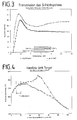
- the temperature treatment not only results in a decrease in the specific resistance, but also the desired characteristic is formed in the transmission of the layer, i. H. a transmission maximum in the visible spectral range and a reduced transmission in the near infrared range, as can be seen from the corresponding transmission curves.
- the transmission of the visible light of the tempered pane can only be adjusted simply by means of the thickness of the layer that has been sprayed on.
- the layer mentioned is preferably also provided with a further transparent oxide layer such as, for example, B. tin oxide, indium tin oxide, aluminum oxide etc. coated, since this further improves the mechanical and chemical resistance.
- the thickness of the SnNi suboxide layer alone is sufficient.
- Another manufacturing variant is the embedding of the active SnNi suboxide layer in two transparent oxide layers made of SnO2, In2O3, Al2O3, SiO2 etc. This makes it possible to achieve certain desired color effects or to influence the reflection of the coating in the visible range through interference effects the way that is commonly used in other optical layers for architectural coating.
- a special embodiment is the coating of mass-colored glass, in particular green glass, since the thermal insulation effect of these glasses is substantially increased by the coating or can be optimally adapted to the corresponding application.
- float glasses with the dimensions 2 ⁇ 50 ⁇ 50 mm were provided in a cathode sputtering system with a SnNi layer sputtered on in an argon-oxygen atmosphere, the target composition being 65% Sn and 35% Ni.
- the target composition being 65% Sn and 35% Ni.
- d. H The behavior of the voltage of the magnetron discharge at constant current as a function of the oxygen admitted via a mass flow controller can be used to define the range which is required for the desired layer composition. This area is marked in the graphically represented characteristic curve (FIGS. 4, 5, 6).
- a layer was also dusted on in the manner indicated above and a further transparent tin oxide layer was applied to this first layer, which was applied by reactive sputtering of an Sn target in a suitable Ar-oxygen atmosphere immediately after the production of the first layer in the same coating system has been.
- This layer package was also subjected to the specified temperature treatment.
- the measured transmission, resistance and thickness values are also summarized in table form. Tin-nickel (first layer), dusted with 3 sccm O2 Heat treatment before after (640 ° C / 5 min) Layer thickness 54 nm 54 nm spec.
Landscapes
- Chemical & Material Sciences (AREA)
- Engineering & Computer Science (AREA)
- Chemical Kinetics & Catalysis (AREA)
- Materials Engineering (AREA)
- Organic Chemistry (AREA)
- Life Sciences & Earth Sciences (AREA)
- General Chemical & Material Sciences (AREA)
- Geochemistry & Mineralogy (AREA)
- Mechanical Engineering (AREA)
- Metallurgy (AREA)
- Surface Treatment Of Glass (AREA)
- Physical Vapour Deposition (AREA)
Applications Claiming Priority (2)
| Application Number | Priority Date | Filing Date | Title |
|---|---|---|---|
| DE3806124A DE3806124A1 (de) | 1988-02-26 | 1988-02-26 | Verfahren zum herstellen von scheiben aus mineralglas mit hohem transmissionsverhalten im sichtbaren spektralbereich und mit niedriger sonnenenergietransmission sowie durch das verfahren hergestellte scheiben |
| DE3806124 | 1988-02-26 |
Publications (2)
| Publication Number | Publication Date |
|---|---|
| EP0334991A1 true EP0334991A1 (fr) | 1989-10-04 |
| EP0334991B1 EP0334991B1 (fr) | 1991-12-04 |
Family
ID=6348266
Family Applications (1)
| Application Number | Title | Priority Date | Filing Date |
|---|---|---|---|
| EP88113644A Expired - Lifetime EP0334991B1 (fr) | 1988-02-26 | 1988-08-23 | Procédé de fabrication de vitres en verre minéral à haut pouvoir de transmission dans le spectre visible et faible transmission de l'énergie solaire et vitres fabriquées selon ce procédé |
Country Status (5)
| Country | Link |
|---|---|
| US (1) | US5090984A (fr) |
| EP (1) | EP0334991B1 (fr) |
| JP (1) | JPH01257150A (fr) |
| DE (2) | DE3806124A1 (fr) |
| FI (1) | FI890824L (fr) |
Cited By (1)
| Publication number | Priority date | Publication date | Assignee | Title |
|---|---|---|---|---|
| EP0504790A1 (fr) * | 1991-03-18 | 1992-09-23 | Flachglas Aktiengesellschaft | Panneau de façade à basse réflection de la lumière, procédé de production et utilisation |
Families Citing this family (6)
| Publication number | Priority date | Publication date | Assignee | Title |
|---|---|---|---|---|
| DE4018399A1 (de) * | 1990-06-08 | 1991-12-19 | Leybold Ag | Verfahren zur beschichtung eines substrats, insbesondere einer glasscheibe, um eine opakwirkung zu erzielen und durch das verfahren beschichtete substrate |
| US5812405A (en) * | 1995-05-23 | 1998-09-22 | Viratec Thin Films, Inc. | Three variable optimization system for thin film coating design |
| JP2873937B2 (ja) * | 1996-05-24 | 1999-03-24 | 工業技術院長 | ガラスの光微細加工方法 |
| DE19727223B4 (de) * | 1997-06-26 | 2005-05-04 | Flabeg Solarglas Gmbh & Co.Kg | Beschichtung zur Beeinflussung des sich durch Reflexion an einer Substratsoberfläche ergebenden spektralen Farbeindrucks |
| AU5820199A (en) * | 1998-09-17 | 2000-04-03 | Libbey-Owens-Ford Co. | Heat strengthened coated glass article and method for making same |
| GB9826293D0 (en) * | 1998-12-01 | 1999-01-20 | Pilkington Plc | Inprovements in coating glass |
Citations (2)
| Publication number | Priority date | Publication date | Assignee | Title |
|---|---|---|---|---|
| DE3138998A1 (de) * | 1981-09-30 | 1983-04-14 | Max-Planck-Gesellschaft zur Förderung der Wissenschaften e.V., 3400 Göttingen | Verfahren zur herstellung von duennen metalloxidschichten |
| DE3611844A1 (de) * | 1986-02-28 | 1987-09-03 | Flachglas Ag | Verfahren zum herstellen einer vorgespannten und/oder gebogenen glasscheibe mit platinbeschichtung oder dergleichen |
Family Cites Families (23)
| Publication number | Priority date | Publication date | Assignee | Title |
|---|---|---|---|---|
| GB718189A (en) * | 1951-09-05 | 1954-11-10 | Nat Res Dev | Improvements in and relating to the production of electrically conductive films |
| DE2100295A1 (de) * | 1970-01-06 | 1971-07-15 | Nippon Sheet Glass Co Ltd | Transparenter, Wärme strahlen reflektierender Glasgegenstand und Verfahren zu seiner Herstellung |
| US3826728B2 (en) * | 1970-05-20 | 1994-07-12 | Boc Group Plc | Transparent article having reduced solar radiation transmittance and method of making same |
| JPS51112824A (en) * | 1975-03-29 | 1976-10-05 | Central Glass Co Ltd | Glass which reflects heat rays and method of producing it |
| US4349425A (en) * | 1977-09-09 | 1982-09-14 | Hitachi, Ltd. | Transparent conductive films and methods of producing same |
| DE2750500A1 (de) * | 1977-11-11 | 1979-05-17 | Leybold Heraeus Gmbh & Co Kg | Verfahren zur herstellung von infrarotreflektierenden, fuer sichtbares licht weitgehend transparenten scheiben und durch die verfahren hergestellte scheibe |
| DE2924824C3 (de) * | 1979-06-20 | 1986-07-10 | Bfg Glassgroup, Paris | Wärmereflexionsscheibe, insbesondere wärmereflektierende Fensterscheibe und deren Verwendung als Außenscheibe einer Mehrscheibenanordnung |
| DE2930373A1 (de) * | 1979-07-26 | 1981-02-19 | Siemens Ag | Verfahren zum herstellen transparenter, elektrisch leitender indiumoxid (in tief 2 o tief 3 )-schichten |
| BR8101805A (pt) * | 1980-03-28 | 1981-09-29 | Saint Gobain Vitrage | Vidraca com espectros seletivos de transmissao e de reflexao |
| US4336119A (en) * | 1981-01-29 | 1982-06-22 | Ppg Industries, Inc. | Method of and apparatus for control of reactive sputtering deposition |
| NO157212C (no) * | 1982-09-21 | 1988-02-10 | Pilkington Brothers Plc | Fremgangsmaate for fremstilling av belegg med lav emisjonsevne. |
| DE3307661A1 (de) * | 1983-03-04 | 1984-09-06 | Leybold-Heraeus GmbH, 5000 Köln | Verfahren zum herstellen von scheiben mit hohem transmissionsverhalten im sichtbaren spektralbereich und mit hohem reflexionsverhalten fuer waermestrahlung |
| DE3311815C3 (de) * | 1983-03-31 | 1997-12-04 | Leybold Ag | Verfahren zum Herstellen von Scheiben |
| US4948677A (en) * | 1984-01-31 | 1990-08-14 | Ppg Industries, Inc. | High transmittance, low emissivity article and method of preparation |
| DE3413587A1 (de) * | 1984-04-11 | 1985-10-17 | Flachglas AG, 8510 Fürth | Verfahren zum herstellen der zinndioxid-interferenzschicht (en) insbesondere von waermereflektierend beschichteten glasscheiben durch reaktive magnetron-zerstaeubung, zinntarget zu seiner durchfuehrung sowie mit einer danach hergestellten zinndioxidschicht versehene waermereflektierende glasscheibe |
| US4891113A (en) * | 1984-12-17 | 1990-01-02 | Ppg Industries, Inc. | Method of making architectural coating with interference colors |
| US4716086A (en) * | 1984-12-19 | 1987-12-29 | Ppg Industries, Inc. | Protective overcoat for low emissivity coated article |
| DE3503851A1 (de) * | 1985-02-05 | 1986-08-07 | Interpane Entwicklungs- und Beratungsgesellschaft mbH & Co. KG, 3471 Lauenförde | Hochtransparenter in durch- und aussenansicht neutral wirkender und waermedaemmender belag |
| DE3544840A1 (de) * | 1985-11-05 | 1987-05-07 | Flachglas Ag | Verfahren zum herstellen einer vorgespannten und/oder gebogenen glasscheibe mit reduzierter transmission |
| DE3543178A1 (de) * | 1985-12-06 | 1987-06-11 | Leybold Heraeus Gmbh & Co Kg | Verfahren zum herstellen von scheiben mit hohem transmissionsverhalten im sichtbaren spektralbereich und mit hohem reflexionsverhalten fuer waermestrahlung sowie durch das verfahren hergestellte scheiben |
| DE3601439C1 (de) * | 1986-01-20 | 1987-04-09 | Glyco Metall Werke | Schichtverbundwerkstoff,insbesondere fuer Gleit- und Reibelemente,sowie Verfahren zu seiner Herstellung |
| US4857094A (en) * | 1986-04-09 | 1989-08-15 | Flachglas Aktiengesellschaft | Method for the manufacture of a toughened and/or bent pane with solar control coating containing platinum or the like |
| DE3631830A1 (de) * | 1986-09-19 | 1988-03-31 | Demetron | Mehrstofflegierung fuer targets von kathodenzerstaeubungsanlagen und deren verwendung |
-
1988
- 1988-02-26 DE DE3806124A patent/DE3806124A1/de not_active Withdrawn
- 1988-08-23 DE DE8888113644T patent/DE3866695D1/de not_active Expired - Fee Related
- 1988-08-23 EP EP88113644A patent/EP0334991B1/fr not_active Expired - Lifetime
-
1989
- 1989-02-21 FI FI890824A patent/FI890824L/fi not_active Application Discontinuation
- 1989-02-23 JP JP1042000A patent/JPH01257150A/ja active Pending
-
1990
- 1990-04-30 US US07/516,810 patent/US5090984A/en not_active Expired - Fee Related
Patent Citations (2)
| Publication number | Priority date | Publication date | Assignee | Title |
|---|---|---|---|---|
| DE3138998A1 (de) * | 1981-09-30 | 1983-04-14 | Max-Planck-Gesellschaft zur Förderung der Wissenschaften e.V., 3400 Göttingen | Verfahren zur herstellung von duennen metalloxidschichten |
| DE3611844A1 (de) * | 1986-02-28 | 1987-09-03 | Flachglas Ag | Verfahren zum herstellen einer vorgespannten und/oder gebogenen glasscheibe mit platinbeschichtung oder dergleichen |
Non-Patent Citations (1)
| Title |
|---|
| APPLIED PHYSICS LETTERS, Band 49, Nr. 23, 8. Dezember 1986, Seiten 1566-1568, American Institute of Physics, New York, US; J.S.E.M. SVENSSON et al.: "Electrochromic hydrated nickel oxide coatings for energy efficient windows: optical properties and coloration mechanism" * |
Cited By (1)
| Publication number | Priority date | Publication date | Assignee | Title |
|---|---|---|---|---|
| EP0504790A1 (fr) * | 1991-03-18 | 1992-09-23 | Flachglas Aktiengesellschaft | Panneau de façade à basse réflection de la lumière, procédé de production et utilisation |
Also Published As
| Publication number | Publication date |
|---|---|
| FI890824A7 (fi) | 1989-08-27 |
| JPH01257150A (ja) | 1989-10-13 |
| US5090984A (en) | 1992-02-25 |
| DE3866695D1 (de) | 1992-01-16 |
| FI890824A0 (fi) | 1989-02-21 |
| EP0334991B1 (fr) | 1991-12-04 |
| DE3806124A1 (de) | 1989-09-07 |
| FI890824L (fi) | 1989-08-27 |
Similar Documents
| Publication | Publication Date | Title |
|---|---|---|
| DE3716860C2 (fr) | ||
| EP0303109B1 (fr) | Procédé de fabrication de vitres à haut degré de transmission dans le spectre visible et un haut degré de réflexion des infrarouges et vitres fabriquées selon ce procédé | |
| EP0229921B1 (fr) | Procédé de fabrication de vitres possédant une transmissivité dans le spectre visible et une réflexivité pour la chaleur rayonnante élevées | |
| EP2630098B1 (fr) | Vitre transparente | |
| EP3720701B1 (fr) | Vitre en verre feuilleté avec revêtement de protection solaire et revêtement réfléchissant le rayonnement thermique | |
| EP2803246B1 (fr) | Vitre transparente dotée d'un revêtement pouvant être chauffé de manière électrique | |
| DE60026157T2 (de) | Verglasung | |
| EP2803245B1 (fr) | Vitrage transparent doté d'un revêtement pouvant être chauffé de manière électrique | |
| EP0090403B1 (fr) | Revêtement thermiquement isolant, sans influence sur l'aspect intérieur ou en vue par transparence et hautement transparent | |
| EP0671641B1 (fr) | Revêtement à multicouches | |
| EP3365174B1 (fr) | Procédé de fabrication d'une vitre composite dotée d'un revêtement réfléchissant les infrarouges sur une feuille de support | |
| EP3390044B1 (fr) | Verre feuillete pouvant etre chauffe dote d'une vitre interne fine et vitre externe fine | |
| DE2533364A1 (de) | Beschichtete scheibe | |
| EP2931673A1 (fr) | Vitre transparente dotée d'un revêtement électroconducteur | |
| WO2021254976A1 (fr) | Vitre composite | |
| DE3825671A1 (de) | Verfahren zum herstellen von scheiben mit hohem transmissionsverhalten im sichtbaren spektralbereich und mit hohem reflexionsverhalten fuer waermestrahlung sowie durch das verfahren hergestellte scheiben | |
| EP0334991B1 (fr) | Procédé de fabrication de vitres en verre minéral à haut pouvoir de transmission dans le spectre visible et faible transmission de l'énergie solaire et vitres fabriquées selon ce procédé | |
| EP0464701A2 (fr) | Système multicouche avec un haut pouvoir réfléchissant dans le spectre infrarouge et une haute transmissivité dans le domaine visible | |
| EP1538131A1 (fr) | Empilement multicouche à basse émissivité trempable, procédé pour la fabrication et produit en verre à basse émissivité avec systeme multicouche | |
| DE4006804A1 (de) | Mehrschichtsystem mit hohem reflexionsvermoegen im infrarot-spektralbereich und mit hohem transmissionsvermoegen im sichtbaren bereich | |
| EP0308578A2 (fr) | Procédé de fabrication de vitres possédant une transmissivité dans le spectre visible et une réflexivité pour la chaleur rayonnante élevées et vitres produites par ce procédé | |
| EP0239750B1 (fr) | Procédé de fabrication d'une feuille de verre trempé et/ou bombé avec un revêtement de platine ou similaire | |
| DE202021100462U1 (de) | Fahrzeugscheibe | |
| DE102023100216B3 (de) | Verbundscheibe mit Sonnenschutzbeschichtung und Wärmestrahlen reflektierender Beschichtung sowie deren Verwendung | |
| WO2025247813A1 (fr) | Agencement de vitre comprenant un revêtement de carbure de titane |
Legal Events
| Date | Code | Title | Description |
|---|---|---|---|
| PUAI | Public reference made under article 153(3) epc to a published international application that has entered the european phase |
Free format text: ORIGINAL CODE: 0009012 |
|
| AK | Designated contracting states |
Kind code of ref document: A1 Designated state(s): BE DE FR GB NL SE |
|
| 17P | Request for examination filed |
Effective date: 19890904 |
|
| 17Q | First examination report despatched |
Effective date: 19910506 |
|
| GRAA | (expected) grant |
Free format text: ORIGINAL CODE: 0009210 |
|
| PGFP | Annual fee paid to national office [announced via postgrant information from national office to epo] |
Ref country code: DE Payment date: 19911107 Year of fee payment: 5 |
|
| AK | Designated contracting states |
Kind code of ref document: B1 Designated state(s): BE DE FR GB NL SE |
|
| GBT | Gb: translation of ep patent filed (gb section 77(6)(a)/1977) | ||
| REF | Corresponds to: |
Ref document number: 3866695 Country of ref document: DE Date of ref document: 19920116 |
|
| ET | Fr: translation filed | ||
| PG25 | Lapsed in a contracting state [announced via postgrant information from national office to epo] |
Ref country code: GB Effective date: 19920823 |
|
| PG25 | Lapsed in a contracting state [announced via postgrant information from national office to epo] |
Ref country code: SE Effective date: 19920824 |
|
| PG25 | Lapsed in a contracting state [announced via postgrant information from national office to epo] |
Ref country code: BE Effective date: 19920831 |
|
| PLBE | No opposition filed within time limit |
Free format text: ORIGINAL CODE: 0009261 |
|
| STAA | Information on the status of an ep patent application or granted ep patent |
Free format text: STATUS: NO OPPOSITION FILED WITHIN TIME LIMIT |
|
| 26N | No opposition filed | ||
| BERE | Be: lapsed |
Owner name: LEYBOLD A.G. Effective date: 19920831 |
|
| PG25 | Lapsed in a contracting state [announced via postgrant information from national office to epo] |
Ref country code: NL Effective date: 19930301 |
|
| NLV4 | Nl: lapsed or anulled due to non-payment of the annual fee | ||
| GBPC | Gb: european patent ceased through non-payment of renewal fee |
Effective date: 19920823 |
|
| PG25 | Lapsed in a contracting state [announced via postgrant information from national office to epo] |
Ref country code: FR Effective date: 19940429 |
|
| PG25 | Lapsed in a contracting state [announced via postgrant information from national office to epo] |
Ref country code: DE Effective date: 19940503 |
|
| REG | Reference to a national code |
Ref country code: FR Ref legal event code: ST |
|
| EUG | Se: european patent has lapsed |
Ref document number: 88113644.4 Effective date: 19930307 |
|
| PG25 | Lapsed in a contracting state [announced via postgrant information from national office to epo] |
Ref country code: FR Effective date: 19920831 |