EP0335209B1 - Procédé pour l'impression et d'application d'étiquettes - Google Patents
Procédé pour l'impression et d'application d'étiquettes Download PDFInfo
- Publication number
- EP0335209B1 EP0335209B1 EP89104868A EP89104868A EP0335209B1 EP 0335209 B1 EP0335209 B1 EP 0335209B1 EP 89104868 A EP89104868 A EP 89104868A EP 89104868 A EP89104868 A EP 89104868A EP 0335209 B1 EP0335209 B1 EP 0335209B1
- Authority
- EP
- European Patent Office
- Prior art keywords
- label
- package
- readable information
- human readable
- applier
- Prior art date
- Legal status (The legal status is an assumption and is not a legal conclusion. Google has not performed a legal analysis and makes no representation as to the accuracy of the status listed.)
- Expired - Lifetime
Links
Images


Classifications
-
- B—PERFORMING OPERATIONS; TRANSPORTING
- B65—CONVEYING; PACKING; STORING; HANDLING THIN OR FILAMENTARY MATERIAL
- B65C—LABELLING OR TAGGING MACHINES, APPARATUS, OR PROCESSES
- B65C1/00—Labelling flat essentially-rigid surfaces
- B65C1/02—Affixing labels to one flat surface of articles, e.g. of packages, of flat bands
- B65C1/021—Affixing labels to one flat surface of articles, e.g. of packages, of flat bands the label being applied by movement of the labelling head towards the article
- B65C1/023—Affixing labels to one flat surface of articles, e.g. of packages, of flat bands the label being applied by movement of the labelling head towards the article and being supplied from a stack
-
- B—PERFORMING OPERATIONS; TRANSPORTING
- B65—CONVEYING; PACKING; STORING; HANDLING THIN OR FILAMENTARY MATERIAL
- B65C—LABELLING OR TAGGING MACHINES, APPARATUS, OR PROCESSES
- B65C9/00—Details of labelling machines or apparatus
- B65C9/46—Applying date marks, code marks, or the like, to the label during labelling
-
- B—PERFORMING OPERATIONS; TRANSPORTING
- B65—CONVEYING; PACKING; STORING; HANDLING THIN OR FILAMENTARY MATERIAL
- B65C—LABELLING OR TAGGING MACHINES, APPARATUS, OR PROCESSES
- B65C9/00—Details of labelling machines or apparatus
- B65C9/0015—Preparing the labels or articles, e.g. smoothing, removing air bubbles
- B65C2009/0018—Preparing the labels
- B65C2009/005—Preparing the labels for reorienting the labels
- B65C2009/0053—Preparing the labels for reorienting the labels by rotation
Definitions
- the present invention relates generally to package labeling systems and, more particularly, to a method for coordinating the printing and application of at least two labels each including human readable information onto substantially rectangular packages by two separate label appliers such that the human readable information is oriented to be read from one side edge of at least two selectable side edges of the packages.
- EP-A-276.869 which was not published until August 3, 1988 and is thus a document according to article 54(3) EPC, discloses a method of applying two kinds of labels onto a package in a properly oriented condition by providing printing and applying units which are rotatably mounted adjacent an applying position such as to alternatively or successively brought into said applying position in order to apply two different labels onto a package wherein the orientation of the respective labels is either the same or at right angles with respect to each other.
- the printing of labels generally occurs along only one direction with respect to the labels.
- Labeling systems have been combined with weighing scales to automatically weigh and label random weight packaged items such as meat and produce in supermarkets.
- package weight, price per unit weight, total price, etc., and commonly a UPC bar code are printed onto labels which are applied to corresponding packages.
- Merchandising labels are often applied by hand such that the orientation of the merchandising label can be manually aligned to read from the same side edge of the package as the pricing label.
- their orientation must be coordinated with the orientation of pricing labels, otherwise, the labels will not read from the same side edges of the packages and will detract from their appearances and ease of readability.
- An automatic merchandising labeler is disclosed in U.S. Patent No. 4,615,757 which issued to Fritz F. grasper on October 7, 1986.
- Such a labeling method is particularly advantageous where merchandising labels are to be applied since it provides for completely automatic labeling with merchandising labels not only being automatically applied but also being oriented to be read from the same package side edge as are pricing or other labels applied to packages by label rotating appliers.
- the human readable information for the second label and any additional labels is stored as digital data which is assembled in a print buffer such that when it is printed onto a label, the information can be read from the one side edge of the package once applied thereto.
- information contained upon labels including merchandising labels which are applied to packages by one or more labelers separate and apart from a pricing labeler can be made to read from the same sides of the packages as human readable information contained upon the pricing labels even though the pricing labels and hence their human readable information may be applied to the packages in a variety of physical angular orientations.
- a method of printing and applying at least two differing labels each including human readable information onto a substantially rectangular package such that the human readable information is oriented to be read from one side edge of at least two selectable side edges of the package comprises the steps of: printing a first label including human readable information; operating a first label applier to apply the first label to a defined portion of the package in a selected physical angular orientation such that the first label can be read from one side edge of the package in accordance with how the package is to be displayed for sale; printing a second label including human readable information which is printed onto the second label in an orientation to be read from the same one side edge of the package when the second label is applied onto the package in a set physical orientation; and, operating a second label applier to apply the second label onto the package in the set physical orientation.
- the method for printing and applying at least two differing labels including human readable information onto substantially rectangular packages further comprises the steps of: selecting the one side edge of the package from which the human readable information is to be read; setting the first label applier to apply a label to the package in accordance with the selected one side edge; setting the second label applier in accordance with the selected one side edge; assembling data representative of the human readable information which is to be printed on the second label in a form corresponding to the selected one side edge of the package from which the information is to be read; and printing the second label in accordance with the assembled data.
- the method further comprises the step of generating a control signal in the first label applier to identify the selected one side edge of the package, and the step of setting the second label applier may comprise receiving the control signal from the first label applier.
- a merchandising label can be applied in accordance with the present invention such that the human readable information printed on the merchandising label is oriented to be read from the same side edge of the package as human readable information on a pricing label even though the merchandising label is always applied in a fixed angular orientation relative to the package.
- the step of assembling data representative of the human readable information can comprise the steps of: selecting a block of data representative of the human readable information to be printed on the second label; and transferring the selected block of data to a print buffer directly or at an offset of 90°, 180°, or 270° such that the human readable information resulting from printing the contents of the print buffer onto the second label can be read from the bottom side, left side, top side or right side of the label, respectively, which corresponds to the selected one side of the package.
- the step of assembling data representative of the human readable information may comprise the steps of: selecting a horizontally readable block of data or a vertically readable block of data; and transferring the selected block of data to a print buffer directly or in inverted form such that the human readable information resulting from printing the contents of the print buffer onto the second label can be read from the bottom side, top side, left side or right side of the label, respectively, which corresponds to the selected one side of the package.
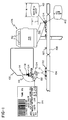
- a labeling system 100 is shown for practicing the method of the present invention. While the labelers shown in Fig. 1 can be positioned in any order relative to one another, a label rotating pricing labeler 102 is shown as first receiving and price labeling a package 104 which is then passed to a merchandising labeler 106. Specific operation of the label rotating pricing labeler 102 and the merchandising labeler 106 are unimportant to the present invention since the method can be utilized by any label rotating label applier and any fixed orientation label printer/applier which can be coordinated therewith. Accordingly, the labelers 102 and 106 will be described only to the extent necessary to gain an understanding of the present invention. Those seeking additional information regarding the specific labelers 102 and 106 are directed to previously referenced U.S. Patent US-A-4 787 953.
- packages are weighed and signals corresponding to the weights are transmitted to a printer which prints labels including such information as the weight, price per unit weight and total price of the corresponding packages.
- the printed labels have one side coated with a pressure-sensitive adhesive and are delivered to a pick-up station with the adhesive coated side facing upwardly and the printed side facing downwardly.
- a label positioned at the pick-up station is engaged by the distal end of a transfer nozzle which is pivoted from the pick-up station to a label delivery station by means of a swinging motion through approximately 180°.
- the delivery station is positioned immediately below a label applicator head which strips the label from the nozzle and forces the label downwardly into adhesive contact with a package to be labeled.
- a label transfer device 110 is positioned generally beneath a label pick-up station 112 which receives labels 114 from a source of labels (not shown) such as a printer or other means for delivering the label 114 to the label pick-up station 102.
- the label transfer device 110 comprises a label transfer arm 116 having a central axis 118, a base end 116A and a distal end 116B adapted to engage a label at the label pick-up station 112 by means of vacuum.
- the transfer arm 116 is mounted for first rotational motion about its central axis 118 and second rotational motion about a horizontal axis 120 through it's base end 116A.
- the second rotational motion about the axis 120 serves to swing the label transfer arm 116 between the label pick-up position 112 and a label delivery position 122.
- a label applicator head 124 is positioned above the label delivery position 122 and defines a slot 126 into which the label transfer arm 116 is received when the transfer arm 116 is swung into the label delivery position.
- the label delivery arm 116 engages the label 114 at the label pick-up position 112 and swings the label through approximately 180° to the label delivery position 122 immediately below the label applicator head 124 which then moves along a fixed vertical path indicated by an arrow 128 from the label delivery station 122 to a package labeling station 130 for applying labels to packages 104 positioned at the package labeling station 130.
- the positioning of packages at the package labeling station 130 is defined by package side register and a package stop or package pusher as is well known in the art, and hence, will not be described herein.
- Guide rails 130 are positioned on both sides of the label transfer arm 116 between the label pick-up position 112 and the label delivery position 122.
- An eccentric collar 132 is secured to the arm 116 for engaging the rails 130 as the arm 116 is rotated to deliver a label for application to a package.
- the collar 132 is forced to the position shown in dotted lines toward the bottom of Fig. 2 as the label transfer arm 116 is moved to the label delivery position 122 by the eccentric collar 132 engaging and being rotated by the rails 130 such that its sides 132A are substantially parallel to the rails 130. Accordingly, if the collar 132 is offset from the position shown in the lower portion of Fig. 2 which is a fixed angular orientation for the label transfer arm 116 when in the label delivery position 122, the eccentric collar 132 engages the rail 130 toward which it is directed and is forced into the position defining the fixed angular orientation for the label transfer arm 116.
- the angular orientation of labels delivered by the label transfer device 110 is defined by providing an operator controllable angle selector coupled to the label transfer arm 116 for selecting one of at least two different angular orientations of the label transfer arm 116 about its central axis 118 when the label transfer arm 116 is positioned at the label pick-up position 112.
- the angle selector comprises a collar or selector ring 134.
- the selector ring 134 is mounted for rotation about the base of the arm 116A and a torsion spring 136 couples the selector ring 134 to the eccentric collar 132. Accordingly, the angular orientation of the distal end 116B of the arm 116 about its central axis 118 when not restrained by the eccentric collar 132 being received between the rails 130 is selected by rotating the selector ring 134 to one of a number of detents.
- Three pick-up positions A, B and C are illustrated with B being the neutral pick-up position wherein the arm 116 is not rotated as it is swung from the label pick-up position 112 to the label delivery position 122.
- Positions A and C serve to rotate the distal end 116B of the arm 116 90° in either direction from the fixed angular orientation (setting B). The operator may select the desired orientation for the label by rotating the selector ring 134 such that the corresponding letter is adjacent the arrow 138.
- the merchandising labeling system 106 shown in Fig. 1 comprises a controller housing (not shown) with cantilevered support rails 152 extending therefrom for supporting a labeler 154 which moves laterally along the rails 152, i.e., in and out of the plane of Fig. 1.
- the labeler 154 includes a pivotally mounted labeling arm 156 which is biased by gravity toward a lowermost position adjacent a package conveyor 158 with the labeling arm 156 being biased such that packages 104 can pass thereunder and move the arm 118 upwardly to accommodate a substantial range of package heights varying from approximately 1,3 cm (0,5 inches) up to and including 14 cm (5,5 inches).
- the merchandising labeling system 106 prints merchandising labels prior to applying them to selected areas of the upper surfaces of the packages 104.
- the merchandising labeling system 106 is coordinated with the label rotating pricing labeler 102 such that labels are positioned in complementary locations on the upper surfaces of packages to ensure that the labels do not overlap or otherwise interfere with one another.
- a merchandising label is printed upon the sensing of a package by a package sensor 160 and is then ejected after a defined time period such that the label is applied to a selected area between the leading side edge of the package and the trailing side edge of the package as defined by the direction of package conveyance.
- the labeler 154 is also capable of being positioned laterally relative to the conveyor 158 to select preferred lateral areas of the upper surfaces of the packages 104.
- Fig. 9 is a partially broken away side view of the distal end of the labeling arm 156 of the merchandising labeling system 106 of Fig. 1.
- Label stock 161 comprising pressure sensitive labels 162 carried upon a backing strip 164 are passed between a backing roller 166 and a thermal print head 167 with the backing roller 166 being driven by a stepper motor 168 which is coupled to the backing roller 166 by a drive belt 170.
- the backing strip 164 is maintained in tension by a take-up spindle (not shown) which receives and tensions the spent backing strip 164 after labels 162 are removed therefrom by a label stripper bar 172.
- a label 162 is printed by the coordinated operation of the print head 167 and the backing roller 166 which is synchronously driven by the stepper motor 168 via the drive belt 170 to print a designated message on the label 162.
- the label Once the label has been printed, it extends beyond the print head 167 and remains secured to the backing strip 164 since the spacing between the print head 167 and the stripper bar 172 is approximately equal to the length of labels 162 to be handled by the merchandising labeling system 106.
- the printed label 162 is ejected by operation of the stepper motor 168 to advance the label stock 160.
- a method provides for printing and applying at least two differing labels each including human label information onto substantially rectangular packages such that the human label information can be read from one side edge of the package which is selected from at least two side edges of the package.
- a first label is printed and applied in a selected physical angular orientation by a first label applier such that the human readable information thereon can be read from one side edge of the package.
- a second label, and any additional labels that are to be applied, are applied in fixed physical angular orientations relative to the package by one or more additional label appliers.
- the labels are printed such that the human readable information thereon is readable from the same one side edge of the package.
- the human readable information for the second label and any additional labels is stored as digital data which is transferred to, or assembled in, a print buffer such that when it is printed onto a label, the information can be read from the one side edge of the package once applied thereto.
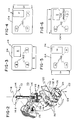
- pricing labels 114 have been applied in four different physical angular orientations B, A, D and C corresponding respectively to no rotation, 90° rotation clockwise, 180° rotation, and 270° rotation clockwise (90° rotation counterclockwise). It is noted that only orientations B, A and C are provided by the label rotating labeler 102. However, a 180° rotation, as shown in Fig. 6, as well as any angular orientation desired by the user could be provided in accordance with the present invention.
- label printing in the label rotating pricing labeler 102 could be controlled in accordance with the teachings of the present invention to perform a 180° rotation or inversion of the printed material on the pricing label to apply a D orientation pricing label.
- the labeler 102 would apply the label without rotation (B orientation) but due to the print rotation, the D orientation would be accomplished.
- Such print rotations in the labeler 102 would require the use of unprinted label stock or the provision of two alternately printed or wound label stocks which would have to be changed when changing between the B and D orientations.
- Preprinted pricing label stock is currently favored by many users since it allows them to use unique advertising logos, names and the like which cannot currently be printed in the forms and color combinations required.
- each merchandising label 162 is applied in a fixed angular orientation as shown in Figs. 3-6.
- the human readable information on the merchandising labels 162 is rotated prior to being printed such that the human readable information can be read from the same side of the packages as the physically rotated pricing labels 114 applied to the packages.
- the merchandising labels 162 are preferably applied in corners of the packages away from the pricing labels such up to that three merchandising labels can be applied to a package or a single merchandising label can be applied in one of the three preferred locations.
- additional labels could be applied to packages and could be positioned in other locations on the packages as desired.
- the method of printing and applying at least two differing labels each including human readable information onto a substantially rectangular package such that the human readable information is oriented to be read from one side edge of at least two selectable side edges of the package is performed as follows. Initially a first label, in this case one of the pricing labels 114, including human readable information, is printed by the label rotating pricing labeler 102. The labeler 102 then applies the first label to a defined portion of the package in a selected physical angular orientation (A, B, C or possibly D) such that the first label can be read from one side edge of the package in accordance with how the package is to be displayed for sale. A second label, also including human readable information, is printed, for example by the merchandising labeler 106.
- a second label also including human readable information
- the second label applier in this case the merchandising labeler 106, is operated to apply the second label onto the second package in the set physical orientation and preferably at a selected position on the package.
- the method can comprise the further steps of selecting the one side edge of the package from which the human readable information is to be read, based for example on how the package is to be displayed for sale, see previously referenced U.S. Patent US-A-4 787 953.
- the first label applier 102 is then set to apply a label to the package 104 in accordance with the selected one side edge, for example by setting the selector ring 134 to the A, B or C position.
- the second label applier in this case the merchandising labeler 106, is then set in accordance with the selected one side edge and the data representation of the human readable information is assembled to be printed on the second label in a form corresponding to the one side edge of the package from which the information is to be read.
- the second label is then printed in accordance with the assembled data.
- the method may further comprise the step of generating a control signal in the first label applier 102 to identify the selected one side edge of the package.
- the orientation designations 176 as shown in Fig. 2 can be made into switches which can be activated upon setting the selector ring 134.
- the step of setting the second label applier 106 may comprise receiving the control signal from the first label applier 102.
- a merchandising label can be applied in accordance with the present invention such that the human readable information printed on the merchandising label is oriented to be read from the same side edge of the package as human readable information on a pricing label even though the merchandising label is always applied in a fixed angular orientation relative to the package.
- the step of assembling data representative of the human readable information can comprise the following steps.
- a block of data representative of the human readable information to be printed on the second label can be selected from a number of preprogrammed messages or messages which are programmed into the controller by the user.
- the selected block of data is then transferred to a print buffer directly or at an offset of 90°, 180° or 270° such that the human readable information resulting from printing the contents of the print buffer onto the second label can be read from the bottom side, left side, top side or right side of the label, respectively, which corresponds to the selected one side of the package.
- the transfer of a data block into a print buffer is represented schematically in Fig. 7.
- the data block 180 comprises in one working embodiment of the present invention, a block of data having 154 lines of data bits with each line having 320 data bits therein.
- the absolute addresses of a given data block 180 starting with the zero data bit in the upper left-hand corner are designated in Fig. 7 as K, L, M and N progressing from the upper left-hand corner to the upper right-hand corner to the lower left-hand corner to the lower right-hand corner.
- One algorithm for transferring the data bits contained within the data block 180 to the print buffer 182 to effect 0° rotation, 90° rotation clockwise, 180° rotation, and 270° rotation clockwise (90° rotation counterclockwise) is shown in Fig. 8.
- the addresses of the corners of the block would be K (0), L (320), M (48,961) and N (49,280).
- the starting address of data transfer assuming that data is transferred into the print buffer 182 from the upper left-hand corner row by row, would be as follows: for a B label rotation (no rotation), the starting address would be K or 0 with the X increment equal to +1 and the Y increment equal to +L (+320); for an A label rotation (90° rotation clockwise) the starting address would be M or 48,961 with X equal to -L (-320) and Y equal to +1; for a D label rotation (180° rotation) the starting address would be N (49,280) with the X increment equal to -1 and the Y increment equal to -L (-320); and, for a C label rotation (270° rotation clockwise or 90° rotation counterclockwise) the starting address would be L (320) with the X increment equal to +
- the step of assembling data representative of the human readable information may comprise the following steps. For horizontally readable information, a horizontally readable block of data is selected and for vertically readable information, a vertically readable block of data is selected. The data block selected, either horizontally readable or vertically readable, is then transferred to the print buffer directly, or in inverted form, e.g., the B label orientation transfer and the D label orientation transfer for horizontally readable data, and the A label orientation transfer and the C label orientation transfer for vertically readable data, as previously described. In this way the human readable information resulting from printing the contents of the print buffer onto the second label can be read from the bottom side, top side, left side or right side of the label, respectively, which corresponds to the selected one side of the package.
- a method has been disclosed for printing and applying at least two differing labels, each including human readable information, onto substantially rectangular packages wherein a first label is applied in a selectable physical orientation by a first label applier such that the human readable information thereon can be read from one side edge of at least two selectable side edges of the packages, and a second label is applied in a fixed physical angular orientation by a second label applier but printed such that the human readable information on all labels is readable from the same side edges of the packages.
Landscapes
- Labeling Devices (AREA)
Claims (9)
- Procédé pour imprimer et appliquer au moins deux étiquettes différentes (114, 162), chacune comportant des informations lisibles, sur un emballage pratiquement rectangulaire (104) ayant une surface supérieure, une surface inférieure et quatre côtés d'une manière telle que les informations lisibles sont orientées pour être lues à partir d'un côté d'au moins deux côtés sélectionnés dudit emballage (104), le procédé comprenant les étapes consistant à :
imprimer une première étiquette (114) comportant des informations lisibles ;
sélectionner une orientation angulaire physique désirée pour appliquer ladite première étiquette (114) d'une manière telle que ladite première étiquette (114) peut être lue à partir d'un côté dudit emballage en conformité avec le fait de savoir comment ledit emballage (104) doit être placé pour la vente ;
mettre en oeuvre un premier applicateur d'étiquettes (102) pour appliquer ladite première étiquette (114) à un emplacement défini dudit emballage (104) dans ladite orientation angulaire physique sélectionnée ;
imprimer une seconde étiquette (162) comportant des informations lisibles qui sont imprimées sur la seconde étiquette (162) dans une orientation pouvant être lue à partir du même côté dudit emballage (104) lorsque ladite seconde étiquette est appliquée sur ledit emballage (104) dans une orientation angulaire physique déterminée, et
mettre en oeuvre un second applicateur d'étiquettes (106) pour appliquer ladite seconde étiquette (162) sur ledit emballage (104) dans ladite orientation angulaire physique déterminée. - Procédé selon la revendication 1, dans lequel l'étape consistant à mettre en oeuvre ledit premier applicateur d'étiquettes (102) comprend l'étape consistant à :
positionner un moyen de commande d'orientation angulaire (130, 132) sur ledit premier applicateur d'étiquettes (102) d'une manière telle que ledit premier applicateur d'étiquettes (102) appliquera ladite première étiquette (114) audit emballage (104) dans ladite orientation angulaire physique désirée sélectionnée. - Procédé selon la revendication 1 ou 2, dans lequel ledit procédé comprend de plus les étapes consistant à :
sélectionner ledit côté dudit emballage (104) à partir duquel les informations lisibles doivent être lues ;
positionner ledit premier applicateur d'étiquettes (102) pour appliquer les étiquettes (114) audit emballage (104) en conformité avec ledit côté sélectionné dudit emballage ;
positionner ledit second applicateur d'étiquettes (106) en conformité avec ledit côté sélectionné dudit emballage (104) ;
assembler les données représentatives des informations lisibles qui doivent être imprimées sur ladite seconde étiquette (162) sous une forme correspondant au côté sélectionné dudit emballage (104), et
imprimer ladite seconde étiquette (102) à partir desdites données assemblées. - Procédé selon l'une quelconque des revendications 1 à 3, ledit procédé comprenant de plus les étapes consistant à :
sélectionner ledit côté dudit emballage (104) à partir duquel les informations lisibles doivent être lues ;
positionner ledit premier applicateur d'étiquettes (102) pour appliquer les étiquettes (114) audit emballage (104) en conformité avec ledit côté sélectionné dudit emballage (104) ;
positionner ledit second applicateur d'étiquettes (106) en conformité avec ledit côté sélectionné dudit emballage ;
assembler les données représentatives des informations lisibles qui doivent être imprimées sur ladite seconde étiquette (162) sous une forme correspondant audit côté sélectionné dudit emballage (104) ;
imprimer ladite seconde étiquette (162) à partir des données assemblées, et
produire un signal de commande dans ledit premier applicateur d'étiquettes (102) pour identifier ledit côté sélectionné dudit emballage (104) et dans lequel l'étape consistant à positionner ledit second applicateur d'étiquettes (162) comprend la réception dudit signal de commande provenant dudit premier applicateur d'étiquettes. - Procédé selon la revendication 4, dans lequel l'étape consistant à assembler les données représentatives des informations lisibles comprend les étapes consistant à :
sélectionner un bloc de données représentatif des informations lisibles qui doivent être imprimées sur ladite seconde étiquette (162), et transférer le bloc sélectionné de données vers un tampon d'impression directement ou selon une rotation de 90°, 180°, ou 270° d'une manière telle que les informations lisibles résultant de l'impression des contenus dudit tampon d'impression sur une étiquette (162) peuvent être lues à partir du fond, du côté gauche, du haut ou du côté droit de ladite étiquette (162), respectivement, qui correspond au côté sélectionné dudit emballage (104). - Procédé selon la revendication 5, dans lequel l'étape consistant à assembler les données représentatives des informations lisibles comprend les étapes consistant à :
sélectionner un bloc de données lisibles horizontalement ou un bloc de données lisibles verticalement ; et transférer le bloc sélectionné de données à un tampon d'impression directement ou sous forme inversée d'une manière telle que les informations lisibles résultant de l'impression des contenus dudit tampon d'impression sur une étiquette (162) peuvent être lues à partir du fond, du haut, du côté gauche ou du côté droit de l'étiquette (162), respectivement, qui correspond au côté sélectionné dudit emballage (104). - Procédé selon la revendication 6, dans lequel ladite première étiquette (114) comprend une étiquette de prix et ladite seconde étiquette (162) comprend une étiquette commerciale ou promotionnelle.
- Procédé selon la revendication 7, dans lequel l'étape d'impression de ladite étiquette de prix comprend de plus la rotation de l'impression sur celle-ci.
- Procédé selon la revendication 1, dans lequel lesdits applicateurs d'étiquettes (102, 106) sont mis en oeuvre en séquences cadencées de façon à appliquer lesdites étiquettes audit emballage (104) en des positions qui sont relativement décalées dans la direction de l'avancée des emballages.
Applications Claiming Priority (2)
| Application Number | Priority Date | Filing Date | Title |
|---|---|---|---|
| US07/175,717 US4857121A (en) | 1988-03-31 | 1988-03-31 | Method for printing and applying labels |
| US175717 | 1988-03-31 |
Publications (2)
| Publication Number | Publication Date |
|---|---|
| EP0335209A1 EP0335209A1 (fr) | 1989-10-04 |
| EP0335209B1 true EP0335209B1 (fr) | 1993-09-29 |
Family
ID=22641361
Family Applications (1)
| Application Number | Title | Priority Date | Filing Date |
|---|---|---|---|
| EP89104868A Expired - Lifetime EP0335209B1 (fr) | 1988-03-31 | 1989-03-18 | Procédé pour l'impression et d'application d'étiquettes |
Country Status (5)
| Country | Link |
|---|---|
| US (1) | US4857121A (fr) |
| EP (1) | EP0335209B1 (fr) |
| JP (1) | JPH0245343A (fr) |
| CA (1) | CA1324991C (fr) |
| DE (1) | DE68909460T2 (fr) |
Cited By (2)
| Publication number | Priority date | Publication date | Assignee | Title |
|---|---|---|---|---|
| US7156308B2 (en) | 2001-12-17 | 2007-01-02 | International Barcode Corporation | Double-sided bar code doubling as a single bar code |
| US7182259B2 (en) | 2001-10-26 | 2007-02-27 | International Barcode Corporation | Method and apparatus for applying bar code information to products during production |
Families Citing this family (32)
| Publication number | Priority date | Publication date | Assignee | Title |
|---|---|---|---|---|
| GB2223454A (en) * | 1988-08-12 | 1990-04-11 | Scient Generics Ltd | Printers and ancillary systems |
| US5743567A (en) * | 1990-03-30 | 1998-04-28 | Vanguard Identification Systems, Inc. | Integral printed sheet products |
| US4978146B1 (en) * | 1990-03-30 | 1999-06-01 | Vanguard Identification System | Method for making uniquely encoded transaction cards and related sheet products |
| US5769457A (en) * | 1990-12-01 | 1998-06-23 | Vanguard Identification Systems, Inc. | Printed sheet mailers and methods of making |
| US5020305A (en) * | 1990-05-18 | 1991-06-04 | Hobart Corporation | Package plattering device and method |
| US5425823A (en) * | 1990-08-30 | 1995-06-20 | B.C.E. Technologies | Combination label printer and application device |
| US5219578A (en) * | 1991-02-25 | 1993-06-15 | Innovet, Inc. | Composition and method for immunostimulation in mammals |
| US5250138A (en) * | 1991-04-08 | 1993-10-05 | Gerber Garment Technology, Inc. | Label applicator having automatic height positioning |
| DE4135106C2 (de) * | 1991-10-24 | 1993-09-30 | Bizerba Werke Kraut Kg Wilh | Vorrichtung zum Aufbringen mehrerer Etiketten |
| US5221405A (en) * | 1992-07-28 | 1993-06-22 | Premark Feg Corporation | Label applying system |
| US5716469A (en) * | 1993-03-04 | 1998-02-10 | Higgins; James T. | Method and apparatus for labeling documents |
| JP2993818B2 (ja) * | 1993-04-28 | 1999-12-27 | 株式会社 寺岡精工 | ラベル印字貼付装置 |
| DE4339778A1 (de) * | 1993-11-24 | 1995-06-01 | Focke & Co | Vorrichtung zum Anbringen von Banderolen an Packungen |
| US5954913A (en) * | 1994-04-29 | 1999-09-21 | Accu-Sort Systems, Inc. | Label applicator |
| US5705021A (en) * | 1994-04-29 | 1998-01-06 | Accu-Sort Systems, Inc. | Label applicator |
| CA2147535A1 (fr) * | 1994-04-29 | 1995-10-30 | Albert Wurz | Applicateur d'etiquettes pour articles de dimensions variables detectes et traites par des capteurs et un microprocesseur |
| US8622434B1 (en) | 1995-06-07 | 2014-01-07 | Vanguard Identification Systems, Inc. | Planar identification elements and sheet product sets |
| USRE41925E1 (en) * | 1996-09-30 | 2010-11-16 | Vanguard Identification Systems, Inc. | Integral printed self-mailer sheet products |
| US6010159A (en) * | 1996-09-30 | 2000-01-04 | Vanguard Identification Systems, Inc. | Integral printed self-mailer sheet products |
| US6273986B1 (en) * | 1997-04-18 | 2001-08-14 | Kevin J. Egan | Composite labels, package labeling systems and labeling methods |
| US5897741A (en) * | 1998-02-09 | 1999-04-27 | Premark Feg L.L.C. | Apparatus for applying security tags to labels |
| US6273170B1 (en) | 1999-06-02 | 2001-08-14 | Amistar Corporation | Label shuttle and clamp bar assembly for a label placement machine |
| US6652005B2 (en) * | 2001-01-03 | 2003-11-25 | Excel Corporation | Meat product labeling and organizing method |
| FR2825343B1 (fr) * | 2001-05-30 | 2003-11-28 | Ns Testut Sas | Etiqueteuse |
| US7313894B2 (en) * | 2004-03-05 | 2008-01-01 | Teraoka Seiko Co., Ltd. | Packaging and pricing device |
| JP4892815B2 (ja) * | 2004-08-31 | 2012-03-07 | 株式会社寺岡精工 | ラベル貼付装置 |
| ITBO20070129A1 (it) | 2007-02-27 | 2007-05-29 | Gd Spa | Macchina e metodo per l' applicazione di etichette a pacchetti. |
| JP4809269B2 (ja) * | 2007-03-06 | 2011-11-09 | 株式会社サトー | 印字貼付装置 |
| DE102008032019B4 (de) * | 2008-07-07 | 2025-05-28 | Bizerba SE & Co. KG | Etikettiervorrichtung und Warenauszeichnungssystem |
| DE102011105260A1 (de) * | 2011-06-17 | 2012-12-20 | Bizerba Gmbh & Co Kg | Etikettiervorrichtung |
| US12145763B2 (en) | 2020-12-10 | 2024-11-19 | United Parcel Service Of America, Inc. | Label applicator for varied surfaces |
| US20220188558A1 (en) * | 2020-12-10 | 2022-06-16 | United Parcel Service Of America, Inc. | System and method for indicia avoidance in indicia application |
Family Cites Families (13)
| Publication number | Priority date | Publication date | Assignee | Title |
|---|---|---|---|---|
| GB1503196A (en) * | 1976-01-28 | 1978-03-08 | Avery W Ltd | Printer control circuitry |
| US4183779A (en) * | 1977-09-02 | 1980-01-15 | Datafile Limited | Automatic indicia applying machine |
| US4329191A (en) * | 1978-07-05 | 1982-05-11 | Datafile Limited | System for alphabetically labelling articles |
| JPS5777429A (en) * | 1980-10-27 | 1982-05-14 | Teraoka Seikosho Kk | Pasting device for label of good |
| DE3108177C2 (de) * | 1981-03-04 | 1983-07-21 | Max Planck Gesellschaft zur Förderung der Wissenschaften e.V., 3400 Göttingen | Verfahren und Einrichtung zum Messen der Dauer von einzelnen kohärenten Strahlungsimpulsen |
| US4497682A (en) * | 1981-05-29 | 1985-02-05 | Monarch Marking Systems, Inc. | Hand-held electrically selectable labeler |
| JPH0648250B2 (ja) * | 1984-01-23 | 1994-06-22 | 日本電子株式会社 | 電子線エネルギースペクトルの測定方法 |
| JPS61104937A (ja) * | 1984-10-15 | 1986-05-23 | 東芝テック株式会社 | ラベルプリンタ |
| US4615757A (en) * | 1985-07-03 | 1986-10-07 | Hobart Corporation | Method and apparatus for package labeling |
| US4652317A (en) * | 1986-04-04 | 1987-03-24 | Pitney Bowes Inc. | Hand held labeler having an optical reader |
| US4787953A (en) * | 1987-01-12 | 1988-11-29 | Hobart Corporation | Apparatus for label transfer |
| JPS63294339A (ja) * | 1987-01-30 | 1988-12-01 | Teraoka Seiko Co Ltd | ラベルプリンタ |
| EP0427299B1 (fr) * | 1987-01-30 | 1994-03-30 | Teraoka Seiko Co., Ltd. | Imprimante d'étiquettes |
-
1988
- 1988-03-31 US US07/175,717 patent/US4857121A/en not_active Expired - Lifetime
-
1989
- 1989-03-18 DE DE89104868T patent/DE68909460T2/de not_active Expired - Fee Related
- 1989-03-18 EP EP89104868A patent/EP0335209B1/fr not_active Expired - Lifetime
- 1989-03-30 CA CA000595184A patent/CA1324991C/fr not_active Expired - Fee Related
- 1989-03-30 JP JP1080230A patent/JPH0245343A/ja active Pending
Cited By (2)
| Publication number | Priority date | Publication date | Assignee | Title |
|---|---|---|---|---|
| US7182259B2 (en) | 2001-10-26 | 2007-02-27 | International Barcode Corporation | Method and apparatus for applying bar code information to products during production |
| US7156308B2 (en) | 2001-12-17 | 2007-01-02 | International Barcode Corporation | Double-sided bar code doubling as a single bar code |
Also Published As
| Publication number | Publication date |
|---|---|
| US4857121A (en) | 1989-08-15 |
| DE68909460T2 (de) | 1994-03-10 |
| EP0335209A1 (fr) | 1989-10-04 |
| CA1324991C (fr) | 1993-12-07 |
| JPH0245343A (ja) | 1990-02-15 |
| DE68909460D1 (de) | 1993-11-04 |
Similar Documents
| Publication | Publication Date | Title |
|---|---|---|
| EP0335209B1 (fr) | Procédé pour l'impression et d'application d'étiquettes | |
| CA1267868A (fr) | Methode et appareil d'etiquetage | |
| US4375189A (en) | Label printer | |
| EP0061144B1 (fr) | Machine à peser et à envelopper | |
| AU669272B2 (en) | Printing apparatus | |
| US5133827A (en) | Merchandising label printer/applier | |
| JPH07503216A (ja) | ラベル貼付装置 | |
| CA1087557A (fr) | Machine automatique pour appliquer des marques | |
| US4787953A (en) | Apparatus for label transfer | |
| US5427029A (en) | Method and apparatus for providing printed labels for large numbers of objects | |
| US5078816A (en) | Merchandising label printer/applier | |
| US4895614A (en) | Apparatus for label transfer | |
| US4390390A (en) | Label applicator device | |
| EP0087310A1 (fr) | Machine automatique à peser, à ligaturer et à produire des informations | |
| JP2777528B2 (ja) | ラベル貼り付け装置 | |
| US4705588A (en) | Method and apparatus for package labeling | |
| JP3589121B2 (ja) | ラベル貼付方法およびその装置 | |
| US6817287B2 (en) | System for applying printed information to a package | |
| JP2664709B2 (ja) | 梱包システム | |
| US5336359A (en) | System for applying literature to a wall of an object | |
| JPH02139330A (ja) | ラベル発行装置 | |
| CA1184807A (fr) | Imprimante d'etiquettes | |
| EP0314889A3 (en) | Set of scales for self service | |
| EP1509836A1 (fr) | Systeme pour imprimer des informations sur un emballage | |
| JP2006069571A (ja) | 包装値付装置 |
Legal Events
| Date | Code | Title | Description |
|---|---|---|---|
| PUAI | Public reference made under article 153(3) epc to a published international application that has entered the european phase |
Free format text: ORIGINAL CODE: 0009012 |
|
| AK | Designated contracting states |
Kind code of ref document: A1 Designated state(s): DE FR GB |
|
| 17P | Request for examination filed |
Effective date: 19900305 |
|
| RAP1 | Party data changed (applicant data changed or rights of an application transferred) |
Owner name: PREMARK FEG CORPORATION |
|
| 17Q | First examination report despatched |
Effective date: 19920310 |
|
| GRAA | (expected) grant |
Free format text: ORIGINAL CODE: 0009210 |
|
| AK | Designated contracting states |
Kind code of ref document: B1 Designated state(s): DE FR GB |
|
| ET | Fr: translation filed | ||
| REF | Corresponds to: |
Ref document number: 68909460 Country of ref document: DE Date of ref document: 19931104 |
|
| RAP2 | Party data changed (patent owner data changed or rights of a patent transferred) |
Owner name: PREMARK FEG CORPORATION |
|
| PLBE | No opposition filed within time limit |
Free format text: ORIGINAL CODE: 0009261 |
|
| STAA | Information on the status of an ep patent application or granted ep patent |
Free format text: STATUS: NO OPPOSITION FILED WITHIN TIME LIMIT |
|
| 26N | No opposition filed | ||
| REG | Reference to a national code |
Ref country code: GB Ref legal event code: 732E |
|
| REG | Reference to a national code |
Ref country code: FR Ref legal event code: TP |
|
| PGFP | Annual fee paid to national office [announced via postgrant information from national office to epo] |
Ref country code: FR Payment date: 20010302 Year of fee payment: 13 |
|
| PGFP | Annual fee paid to national office [announced via postgrant information from national office to epo] |
Ref country code: GB Payment date: 20010306 Year of fee payment: 13 |
|
| PGFP | Annual fee paid to national office [announced via postgrant information from national office to epo] |
Ref country code: DE Payment date: 20010307 Year of fee payment: 13 |
|
| REG | Reference to a national code |
Ref country code: GB Ref legal event code: IF02 |
|
| PG25 | Lapsed in a contracting state [announced via postgrant information from national office to epo] |
Ref country code: GB Free format text: LAPSE BECAUSE OF NON-PAYMENT OF DUE FEES Effective date: 20020318 |
|
| PG25 | Lapsed in a contracting state [announced via postgrant information from national office to epo] |
Ref country code: DE Free format text: LAPSE BECAUSE OF NON-PAYMENT OF DUE FEES Effective date: 20021001 |
|
| GBPC | Gb: european patent ceased through non-payment of renewal fee |
Effective date: 20020318 |
|
| PG25 | Lapsed in a contracting state [announced via postgrant information from national office to epo] |
Ref country code: FR Free format text: LAPSE BECAUSE OF NON-PAYMENT OF DUE FEES Effective date: 20021129 |
|
| REG | Reference to a national code |
Ref country code: FR Ref legal event code: ST |