EP0335251A1 - Montre revêtue d'un décor filiforme - Google Patents
Montre revêtue d'un décor filiforme Download PDFInfo
- Publication number
- EP0335251A1 EP0335251A1 EP89105191A EP89105191A EP0335251A1 EP 0335251 A1 EP0335251 A1 EP 0335251A1 EP 89105191 A EP89105191 A EP 89105191A EP 89105191 A EP89105191 A EP 89105191A EP 0335251 A1 EP0335251 A1 EP 0335251A1
- Authority
- EP
- European Patent Office
- Prior art keywords
- wires
- watch
- watch according
- son
- decoration
- Prior art date
- Legal status (The legal status is an assumption and is not a legal conclusion. Google has not performed a legal analysis and makes no representation as to the accuracy of the status listed.)
- Granted
Links
- 238000005034 decoration Methods 0.000 title claims abstract description 13
- 239000004744 fabric Substances 0.000 claims abstract description 15
- 239000011248 coating agent Substances 0.000 claims description 12
- 238000000576 coating method Methods 0.000 claims description 12
- 239000000758 substrate Substances 0.000 claims description 12
- 239000003086 colorant Substances 0.000 claims description 3
- 239000010970 precious metal Substances 0.000 claims description 3
- PCHJSUWPFVWCPO-UHFFFAOYSA-N gold Chemical compound [Au] PCHJSUWPFVWCPO-UHFFFAOYSA-N 0.000 abstract description 9
- 239000010931 gold Substances 0.000 abstract description 9
- 229910052737 gold Inorganic materials 0.000 abstract description 9
- 229910052751 metal Inorganic materials 0.000 abstract description 8
- 239000002184 metal Substances 0.000 abstract description 8
- 229910000679 solder Inorganic materials 0.000 abstract description 3
- 230000000694 effects Effects 0.000 description 4
- 239000010985 leather Substances 0.000 description 3
- 238000004519 manufacturing process Methods 0.000 description 2
- 239000000463 material Substances 0.000 description 2
- 238000003466 welding Methods 0.000 description 2
- 241001344923 Aulorhynchidae Species 0.000 description 1
- 241000264877 Hippospongia communis Species 0.000 description 1
- 229910000831 Steel Inorganic materials 0.000 description 1
- RTAQQCXQSZGOHL-UHFFFAOYSA-N Titanium Chemical compound [Ti] RTAQQCXQSZGOHL-UHFFFAOYSA-N 0.000 description 1
- 239000003292 glue Substances 0.000 description 1
- 238000009776 industrial production Methods 0.000 description 1
- 230000007774 longterm Effects 0.000 description 1
- 150000002739 metals Chemical class 0.000 description 1
- 239000002557 mineral fiber Substances 0.000 description 1
- 238000005192 partition Methods 0.000 description 1
- 238000007711 solidification Methods 0.000 description 1
- 230000008023 solidification Effects 0.000 description 1
- 239000010959 steel Substances 0.000 description 1
- 210000001519 tissue Anatomy 0.000 description 1
- 239000010936 titanium Substances 0.000 description 1
- 229910052719 titanium Inorganic materials 0.000 description 1
- 239000010938 white gold Substances 0.000 description 1
- 229910000832 white gold Inorganic materials 0.000 description 1
- 239000010930 yellow gold Substances 0.000 description 1
- 229910001097 yellow gold Inorganic materials 0.000 description 1
Images
Classifications
-
- G—PHYSICS
- G04—HOROLOGY
- G04B—MECHANICALLY-DRIVEN CLOCKS OR WATCHES; MECHANICAL PARTS OF CLOCKS OR WATCHES IN GENERAL; TIME PIECES USING THE POSITION OF THE SUN, MOON OR STARS
- G04B19/00—Indicating the time by visual means
- G04B19/06—Dials
- G04B19/12—Selection of materials for dials or graduations markings
-
- G—PHYSICS
- G04—HOROLOGY
- G04B—MECHANICALLY-DRIVEN CLOCKS OR WATCHES; MECHANICAL PARTS OF CLOCKS OR WATCHES IN GENERAL; TIME PIECES USING THE POSITION OF THE SUN, MOON OR STARS
- G04B45/00—Time pieces of which the indicating means or cases provoke special effects, e.g. aesthetic effects
- G04B45/0076—Decoration of the case and of parts thereof, e.g. as a method of manufacture thereof
Definitions
- the present invention relates to a watch in which at least part of the clothing serves as a substrate for a decorative coating.
- Watches have already been proposed for a long time topped with a decorative coating.
- a mosaic look is given to the dial or to the bezel of a watch by making it undergo a guilloche operation which consists in decorating the dial with engraved lines, hollowed out and crisscrossed.
- the guillochage is mainly applied to parts manufactured in large series and leaves a monotonous impression ill suited to high-end watches.
- Document FR-A-1 002 236 presents a watch strap with an invisible dial.
- the dial is formed or decorated so as to continue the bracelet or appear to continue it. If the bracelet is a fabric or a leather for example, the dial could only be decorated in trompe l'oeil, that is to say covered with a thin thickness of fabric or a thin sheet of leather which will really appear to be the continuation of the fabric or leather forming the bracelet, as the document cited teaches.
- the watch described in application EP-A-0 294 661 presents a watch of which at least part of the clothing is surmounted by a mosaic-type coating comprising a plurality of pavers juxtaposed and arranged on a bed serving as a means of fixing said paving stones to said clothing, the upper part of the interstices separating said paving stones being left empty.
- the bed is a paste of gold on which the pavers are placed and which is melted to weld the pavers to the clothing.
- the present invention provides means which, while giving the watch a high-end aesthetic reduce the manufacturing cost by implementing a way of doing better suited to industrial manufacturing.
- the decorative coating surmounting at least part of the clothing of the watch according to the invention is characterized in that this coating has a plurality of metal wires entirely covering the substrate, the wires being at least partially interlaced with one another. and applied to a bed disposed between said substrate and said coating to serve as means of fixing said wires on said substrate.
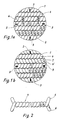
- Figure 1a is a top view of a watch dial 1 decorated according to the invention and according to a first arrangement.
- the dial has an opening 2 for the passage of the axes carrying the hands and hour markers 3.
- the decorative coating has a plurality of metal wires 5 and 6 partially nested one on the other. in the others.
- the wires 5 and 6 are twisted two by two as shown in FIG. 2 which shows a twist 4.
- twists are prepared 4 which are then placed side by side on a bed which will serve as means for fixing the wires on a plate forming the substrate of the dial, as will appear in FIGS. 4 and 5. Once the twists are fixed to the substrate, the dial is cut out in its final form shown in FIG. 1a.
- the wires 5 and 6 forming the twist 4 will preferably be made of precious metals, for example gold.
- the wires 5 and 6 can be made of gold of the same color and thus present a uniform decoration. But it is understood that the wire 5 could be in yellow gold and the wire 6 in white gold, thus creating an alternating decor.
- the invention is not limited to twists comprising only two wires, these twists possibly comprising three or four wires for example.
- the present invention is however not limited to the use of wires made of precious metals. It could be other materials, for example steel, titanium, organic or mineral fibers.
- FIG. 1a shows that the twists 4 all have the same inclination, that is to say that they are all wound in the same direction.
- Figure 1b shows another arrangement which shows the juxtaposition of twists 4 and 4 ′ where the twist 4 is wound in one direction and the twist 4 ′ in the opposite direction. We thus obtain another design and, consequently, another aesthetic effect.
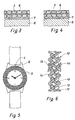
- FIG 3 is a section along line III-III of Figure 1a.
- the covering made of partially nested metallic wires 5 and 6 rests on a bed 7 which serves as means of fixing the wires on the clothing 8 which it is a question of covering.
- the wires 5 and 6 are made of gold and the clothing 8 is also made of gold, use will be made of a solder paste commonly used by goldsmiths and itself containing gold.
- the clothing 8 to be coated is coated with this paste forming the base bed 7, then the wires are deposited on the paste.
- the object is passed into the oven at a temperature of the order of 800 ° C., which welds the wires on the substrate.
- FIG. 3 also shows that the weld bed does not reach the top of the wires 5 and 6. In this way, the wires appear as roughness on the exterior surface of the decoration, a surface which then takes on a grainy appearance giving the watch has a particularly beautiful aesthetic.
- Figure 4 is a variant of what has been explained in connection with Figure 3.
- the surface of the decoration is flattened by grinding the top of the wires 5 and 6.
- the surface is thus made more regular while retaining the grainy appearance research.
- Figure 5 is a top view of a watch where the decoration according to the invention covers the middle-bezel 9 of this watch.
- the decoration according to the invention covers the middle-bezel 9 of this watch.
- Threads 5 and 6 which were discussed above.
- a covering will preferably be achieved by means of the metallic fabric which will be presented below.
- the weld bed of which we have spoken is deposited on the middle part 9, the fabric of metallic wires is applied to this bed, the solder is melted to fix this fabric on the middle. After solidification of the weld, the fabric is cut according to the desired annular shape.
- Figure 5 shows a dial without decoration. It will however be understood that the dial could also be covered by the coating of the invention.
- Figure 6 shows another way of executing the decor according to the invention.
- the wires making up the decoration are intertwined to form the metallic fabric 10.
- Each wire 11 to 16 is wound in a spiral.
- the wire 11 is interlaced with the wire 12, the wire 12 with the wire 13, the wire 13 with the wire 14, etc.
- the fabric can be placed as it is on the bed above the substrate. It may also have undergone a crushing operation before welding.
- Such a fabric is known, for example under the name of Milanese fabric and is used to make bracelets. Descriptions can be found by consulting certain documents such as, for example, documents EP-A-0 040 504, CH-A-497 150 or even CH-A-629 657.
- wire used can be of any cross section: round, triangular, square, star, etc.
- the decoration according to the invention is not limited to the watch itself, but could also take on the links making up the strap of this watch.
- the watch obtained in the manner just described gives the impression of a very rich object both by the materials used and by the texture obtained in bas-relief.
- the decoration described lends itself particularly well to industrial production.
Landscapes
- Physics & Mathematics (AREA)
- General Physics & Mathematics (AREA)
- Adornments (AREA)
Abstract
Description
- La présente invention est relative à une montre dont au moins une partie de l'habillement sert de substrat à un revêtement décoratif.
- On a déjà proposé depuis longtemps des montres surmontées d'un revêtement décoratif. Par exemple une allure de mosaïque est donnée au cadran ou à la lunette d'une montre en lui faisant subir une opération de guillochage qui consiste à orner le cadran de traits gravés, sculptés en creux et entrecroisés. Le guillochage est surtout appliqué aux pièces fabriquées en grandes séries et laisse une impression monotone convenant mal aux montres de haut de game.
- Le document FR-A-1 002 236 présente un bracelet-montre à cadran invisble. Dans ce but le cadran est constitué ou décoré de manière à continuer le bracelet ou paraître le continuer. Si le bracelet est est un tissu ou un cuir par exemple, le cadran ne pourrait être décoré qu'en trompe l'oeil, c'est-à-dire recouvert d'une mince épaisseur de tissu ou d'une mince feuille de cuir qui paraîtra être réellement la continuation du tissu ou du cuir formant le bracelet, comme l'enseigne le document cité.
- Plus élaborée est la décoration proposée par l'exposé d'invention CH-A-39 471. Ce document a pour objet une boîte de montre de poche ayant un fond formé d'une plaque de métal dans laquelle sont ménagées des dépressions remplies d'un autre métal que celui de la plaque, ces métaux pouvant être choisis de façon à obtenir des effets décoratifs analogues à ceux des fonds de boîte de montre niellés. Ici les pavés formant la mosaïque sont attenants les uns aux autres par des séparations qui remplissent complètement les interstices entre les pavés et ne donne pas l'impression de relief qui est la caractéristique d'une vraie mosaïque.
- Pour remédier à cet état de chose, la montre décrite dans la demande EP-A-0 294 661 présente une montre dont une partie au moins de l'habillement est surmontée d'un revêtement de type mosaïque comportant une pluralité de pavés juxtaposés et disposés sur un lit servant de moyen de fixation desdits pavés sur ledit habillement, la partie supérieure des interstices séparant lesdits pavés étant laissée vide. Dans le cas où les pavés sont en or et recouvrent un habillement fait également en or, le lit est une pâte d'or sur laquelle on dispose les pavés et qu'on fait fondre pour souder les pavés à l'habillement.
- Si l'aspect esthétique de la montre qui vient d'être décrite est du plus bel effet et apporte à cette montre un aspect de bienfacture élevée, il n'en reste pas moins que cet effet n'est atteint qu'à la suite d'un travail de longue haleine, les pavés étant déposés pièce par pièce sur l'objet à décorer.
- Pour pallier les inconvénients de coût de main d'oeuvre élevé, la présente invention propose des moyens qui, tout en conférant à la montre une esthétique de haut de gamme permettent d'en réduire le coût de fabrication en mettant en oeuvre une façon de faire mieux adaptée à une fabrication industrielle. Dans ce but, le revêtement décoratif surmontant au moins une partie de l'habillement de la montre selon l'invention est caractérisé en ce que ce revêtement présente une pluralité de fils métalliques recouvrant entièrement le substrat, les fils étant au moins partiellement entrelacés entre eux et appliqués sur un lit disposé entre ledit substrat et ledit revêtement pour servir de moyens de fixation desdits fils sur ledit substrat.
- L'invention va être expliquée maintenant à l'aide de la description qui suit en s'aidant du dessin qui illustre à titre d'exemple et dans lequel :
- Les figures 1a et 1b sont des vues de dessus de cadrans de montre décorés selon invention et selon deux arrangements différents,
- La figure 2 montre comment sont réalisées les torsades qui décorent les cadrans les figures 1a et 1b,
- La figure 3 est une coupe selon la ligne III-III de la figure 1a et selon un premier mode d'exécution,
- La figure 4 est une coupe selon la ligne III-III de la figure 1a et selon un second mode d'exécution,
- La figure 5 est une vue de dessus d'une montre selon l'invention où le revêtement décoratif recouvre la carrure-lunette de ladite montre et
- La figure 6 montre une autre façon d'exécution du décor selon l'invention, où ce décor se présente sous la forme d'un tissu métallique.
- La figure 1a est une vue de dessus d'un cadran de montre 1 décoré selon l'invention et selon un premier arrangement. Le cadran comporte une ouverture 2 pour le passage des axes portant les aiguilles et des index d'heures 3. Selon l'invention et comme le montre la figure 1a, le revêtement décoratif présente une pluralité de fils métalliques 5 et 6 partiellement imbriqués les uns dans les autres. Dans l'arrangement de la figure 1a, les fils 5 et 6 sont torsadés deux à deux comme cela est présenté en figure 2 qui montre une torsade 4.
- On prépare plusieurs torsades 4 qu'on dispose ensuite côte à côte sur un lit qui servira de moyens de fixation des fils sur une plaque formant le substrat du cadran, comme cela apparaîtra aux figures 4 et 5. Une fois les torsades fixées au substrat, on découpe le cadran dans sa forme définitive représentée en figure 1a.
- Comme le décor de la présente invention trouve son application principale dans des pièces de joaillerie, les fils 5 et 6 formant la torsade 4 seront de préférence en métaux précieux, en or par exemple. Les fils 5 et 6 peuvent être en or de même couleur et présenter ainsi un décor uniforme. Mais on comprend que le fil 5 pourrait être en or jaune et le fil 6 en or gris, créant ainsi un décor alterné. L'invention n'est pas limitée à des torsades comportant deux fils seulement, ces torsades pouvant comporter trois ou quatre fils par exemple.
- La présente invention n'est cependant pas limitée à l'utilisation de fils faits en métaux précieux. Il pourrait s'agir d'autres matières, par exemple d'acier, de titane, de fibres organiques ou minéraux.
- La figure 1a montre que les torsades 4 présentent toutes la même inclinaison, c'est-à-dire qu'elle sont toutes enroulées dans le même sens. La figure 1b présente un autre arrangement qui montre la juxtaposition de torsades 4 et 4′ où la torsade 4 est enroulée dans un sens et la torsade 4′ dans le sens opposé. On obtient ainsi un autre dessin et, par voie de conséquence, un autre effet esthétique.
- La figure 3 est une coupe selon la ligne III-III de la figure 1a. Comme cela a déjà été évoqué plus haut. le revêtement fait de fils métalliques 5 et 6 partiellement imbriqués repose sur un lit 7 qui sert de moyens de fixation des fils sur l'habillement 8 qu'il s'agit de recouvrir. Dans le cas où les fils 5 et 6 sont en or et que l'habillement 8 est également en or, on aura recours à une pâte à souder couramment utilisée par les orfèvres et contenant elle-même de l'or. On enduit l'habillement 8 à revêtir avec cette pâte formant le lit de base 7, puis on dépose les fils sur la pâte. On passe l'objet au four à une température de l'ordre de 800°C, ce qui soude les fils sur le substrat. On conçoit que, par capilarité, la soudure peut remonter le long des interstices existant entre les fils et ceci de façon d'autant plus importante que l'interstice est plus petit. Ainsi les fils sont-ils tenus les uns par rapport aux autres. La figure 3 montre encore que le lit de soudure ne parvient pas jusqu'au haut des fils 5 et 6. De cette façon, les fils se présentent comme des aspérités à la surface extérieure du décor, surface qui prend alors un aspect granuleux donnant à la montre une esthétique particulièrement belle.
- Dans le cas où les fils ne sont pas faits en métal, on comprendra que le lit de soudure évoqué ci-dessus pourra être remplacé par un lit de colle.
- La figure 4 est une variante de ce qui a été expliqué à propos de la figure 3. Ici la surface du décor est aplatie par meulage du sommet des fils 5 et 6. La surface est ainsi rendue plus régulière tout en conservant l'aspect granuleux recherché. Dans cette variante, il pourrait être intéressant d'utiliser du fil gainé où l'âme serait d'une couleur et la gaine d'une autre couleur. En meulant alors le sommet des fils 5 et 6, on ferait alors apparaître plus de couleurs que si on avait du fil simple.
- La figure 5 est une vue de dessus d'une montre où le décor selon l'invention recouvre la carrure-lunette 9 de cette montre. On retrouve ici les fils 5 et 6 dont il a été question plus haut. Cependant un tel recouvrement sera réalisé de préférence au moyen du tissu métallique qui sera présenté plus bas. Dans ce cas, on dépose sur la carrure 9 le lit de soudure dont on a parlé, on applique sur ce lit le tissu de fils métalliques, on fait fondre la soudure pour fixer ce tissu sur la carrure. Après solidification de la soudure, on découpe le tissu selon la forme annulaire souhaitée. La figure 5 montre un cadran sans décor. On comprendra cependant que le cadran pourrait aussi être recouvert par le revêtement de l'invention.
- La figure 6 montre une autre façon d'exécuter le décor selon l'invention. Ici les fils composant le décor sont entrelacés pour former le tissu métallique 10. Chaque fil 11 à 16 est enroulé en spirale. Le fil 11 est entrelacé avec le fil 12, le fil 12 avec le fil 13, le fil 13 avec le fil 14, etc.. On obtient ainsi un tissu relativement serré composé de fils métalliques de même couleur ou de couleurs différentes. Le tissu peut être déposé tel quel sur le lit surmontant le substrat. Il peut aussi avoir subi une opération d'écrasement avant soudage. Un tel tissu est connu, par exemple sous le nom de tissu milanais et est utilisé pour confectionner des bracelets. On en trouvera des descriptions en consultant certains documents comme, par exemple, les documents EP-A-0 040 504, CH-A-497 150 ou encore CH-A-629 657.
- Dans toutes les réalisations décrites ci-dessus, on comprendra que le fil utilisé peut être de section quelconque : ronde, triangulaire, carrée, en étoile, etc.
- Le décor selon l'invention ne se limite pas à la montre proprement dite, mais pourrait revêtir aussi des maillons composant le bracelet de cette montre.
- La montre obtenue de la façon qui vient d'être décrite donne l'impression d'un objet très riche tant par les matériaux utilisés que par la texture obtenue en bas-relief. Comme cela a déjà été signalé, le décor décrit se prête particulièrement bien à une réalisation industrielle.
Claims (10)
Applications Claiming Priority (2)
| Application Number | Priority Date | Filing Date | Title |
|---|---|---|---|
| CH1205/88A CH672866B5 (fr) | 1988-03-30 | 1988-03-30 | |
| CH1205/88 | 1988-03-30 |
Publications (2)
| Publication Number | Publication Date |
|---|---|
| EP0335251A1 true EP0335251A1 (fr) | 1989-10-04 |
| EP0335251B1 EP0335251B1 (fr) | 1991-11-06 |
Family
ID=4204959
Family Applications (1)
| Application Number | Title | Priority Date | Filing Date |
|---|---|---|---|
| EP89105191A Expired - Lifetime EP0335251B1 (fr) | 1988-03-30 | 1989-03-23 | Montre revêtue d'un décor filiforme |
Country Status (4)
| Country | Link |
|---|---|
| EP (1) | EP0335251B1 (fr) |
| CH (1) | CH672866B5 (fr) |
| DE (1) | DE68900403D1 (fr) |
| ES (1) | ES2027808T3 (fr) |
Cited By (2)
| Publication number | Priority date | Publication date | Assignee | Title |
|---|---|---|---|---|
| EP0402685A3 (fr) * | 1989-06-12 | 1991-03-06 | Giuseppe Inzerillo | Procédé de fabrication de cadrans de montres en verre de murrino et cadrans obtenus par ce procédé |
| WO2015047390A1 (fr) * | 2013-09-30 | 2015-04-02 | Bodhi Technology Ventures Llc | Maille de fils milanaise et appareil et procédé pour le tissage de maille milanaise |
Citations (4)
| Publication number | Priority date | Publication date | Assignee | Title |
|---|---|---|---|---|
| CH640690B (fr) * | 1981-04-24 | Simon Et Membrez Sa | Boite de montre bracelet. | |
| FR1002236A (fr) * | 1946-08-21 | 1952-03-04 | Cleef & Arpels Soc Van | Perfectionnements à la présentation des bracelets-montres |
| DE1973982U (de) * | 1967-07-12 | 1967-11-30 | Ernst Bucher | Grossuhr mit zifferblatt aus brokat, samt, cord, leder, gobelin, petitpoint und anderen schweren stoffen. |
| FR2464514A1 (fr) * | 1979-08-29 | 1981-03-06 | Castelbajac Jean Charles De | Instrument d'horlogerie muni d'un verre comportant des traces lineaires |
Family Cites Families (3)
| Publication number | Priority date | Publication date | Assignee | Title |
|---|---|---|---|---|
| JPS56162074A (en) * | 1980-05-19 | 1981-12-12 | Toru Mashida | Production for dial of clock |
| JPS5746178A (en) * | 1980-09-04 | 1982-03-16 | Toru Mashida | Manufacture of dial for watch |
| FR2616237B1 (fr) * | 1987-06-04 | 1989-06-30 | Lascor Spa | Montre revetue d'une mosaique |
-
1988
- 1988-03-30 CH CH1205/88A patent/CH672866B5/fr not_active IP Right Cessation
-
1989
- 1989-03-23 DE DE8989105191T patent/DE68900403D1/de not_active Expired - Lifetime
- 1989-03-23 EP EP89105191A patent/EP0335251B1/fr not_active Expired - Lifetime
- 1989-03-23 ES ES198989105191T patent/ES2027808T3/es not_active Expired - Lifetime
Patent Citations (4)
| Publication number | Priority date | Publication date | Assignee | Title |
|---|---|---|---|---|
| FR1002236A (fr) * | 1946-08-21 | 1952-03-04 | Cleef & Arpels Soc Van | Perfectionnements à la présentation des bracelets-montres |
| DE1973982U (de) * | 1967-07-12 | 1967-11-30 | Ernst Bucher | Grossuhr mit zifferblatt aus brokat, samt, cord, leder, gobelin, petitpoint und anderen schweren stoffen. |
| FR2464514A1 (fr) * | 1979-08-29 | 1981-03-06 | Castelbajac Jean Charles De | Instrument d'horlogerie muni d'un verre comportant des traces lineaires |
| CH640690B (fr) * | 1981-04-24 | Simon Et Membrez Sa | Boite de montre bracelet. |
Non-Patent Citations (3)
| Title |
|---|
| PATENT ABSTRACTS OF JAPAN, vol. 6, no. 121 (P-126)[999], 6 juillet 1982, page 16 P 126; & JP-A-57 46 178 (TOORU MASHIDA) 16-03-1982 * |
| PATENT ABSTRACTS OF JAPAN, vol. 6, no. 46 (P-107)[924], 24 mars 1982, page 76 P 107; & JP-A-56 162 074 (TOORU MASHIDA) 12-12-1981 * |
| POPULAR MECHANICS, vol. 114, no. 5, november 1960, pages 178-183; E.R. HAAN: "Hanging decorator" * |
Cited By (2)
| Publication number | Priority date | Publication date | Assignee | Title |
|---|---|---|---|---|
| EP0402685A3 (fr) * | 1989-06-12 | 1991-03-06 | Giuseppe Inzerillo | Procédé de fabrication de cadrans de montres en verre de murrino et cadrans obtenus par ce procédé |
| WO2015047390A1 (fr) * | 2013-09-30 | 2015-04-02 | Bodhi Technology Ventures Llc | Maille de fils milanaise et appareil et procédé pour le tissage de maille milanaise |
Also Published As
| Publication number | Publication date |
|---|---|
| CH672866GA3 (fr) | 1990-01-15 |
| EP0335251B1 (fr) | 1991-11-06 |
| DE68900403D1 (de) | 1991-12-12 |
| ES2027808T3 (es) | 1992-06-16 |
| CH672866B5 (fr) | 1990-07-13 |
Similar Documents
| Publication | Publication Date | Title |
|---|---|---|
| EP3378346B1 (fr) | Pierre et son procédé de réalisation | |
| EP0276184A1 (fr) | Procédé de sertissage de pierres précieuses ainsi que bijou obtenu par la mise en oeuvre de ce procédé | |
| FR2703569A1 (fr) | Bijou comportant des supports de retenue des pierres au niveau de ses faces supérieure et inférieure. | |
| EP0041481B1 (fr) | Boîte de montre | |
| EP0294661B1 (fr) | Montre revêtue d'une mosaique | |
| EP0335251B1 (fr) | Montre revêtue d'un décor filiforme | |
| EP3814553B1 (fr) | Procédé de fabrication de pièces décoratives | |
| FR2701639A1 (fr) | Bague modulable. | |
| CH715336A2 (fr) | Procédé d'assemblage d'au moins deux éléments et composant d'habillage ainsi formé. | |
| WO2012153014A1 (fr) | Bijou ou accessoire vestimentaire à mécanisme de déplacement de pierre | |
| FR2854099A1 (fr) | Coque de recouvrement et son procede de fabrication | |
| WO1986004491A1 (fr) | Ruban ornemental | |
| CH685690A5 (fr) | Pièce de joaillerie. | |
| FR2518379A1 (fr) | Pierre ornementale pour bijoux de fantaisie et joaillerie | |
| FR2505629A1 (fr) | Bijou et son procede de fabrication | |
| FR2503995A1 (fr) | Article ornemental ou de bijouterie et son procede de fabrication | |
| FR2829366A1 (fr) | Procede de bijouterie permettant la realisation d'un camouflage | |
| JP3210197U (ja) | 装飾具 | |
| EP1246550B1 (fr) | Bracelet, notamment bracelet de montre | |
| JP3072328U (ja) | 装飾具用ワイヤ | |
| WO2019158499A1 (fr) | Composant horloger intégrant au moins un élément d'ornement | |
| CH329446A (fr) | Cadran d'horlogerie | |
| Darnaud | La religion de la mort au Rwanda | |
| FR2654593A1 (fr) | Objet a contour ferme en deux parties separables. | |
| WO2025172109A1 (fr) | Support de sertissage et article de joaillerie ou d'horlogerie serti |
Legal Events
| Date | Code | Title | Description |
|---|---|---|---|
| PUAI | Public reference made under article 153(3) epc to a published international application that has entered the european phase |
Free format text: ORIGINAL CODE: 0009012 |
|
| AK | Designated contracting states |
Kind code of ref document: A1 Designated state(s): DE ES FR GB IT |
|
| 17P | Request for examination filed |
Effective date: 19891017 |
|
| 17Q | First examination report despatched |
Effective date: 19901105 |
|
| GRAA | (expected) grant |
Free format text: ORIGINAL CODE: 0009210 |
|
| AK | Designated contracting states |
Kind code of ref document: B1 Designated state(s): DE ES FR GB IT |
|
| REF | Corresponds to: |
Ref document number: 68900403 Country of ref document: DE Date of ref document: 19911212 |
|
| ITF | It: translation for a ep patent filed | ||
| GBT | Gb: translation of ep patent filed (gb section 77(6)(a)/1977) | ||
| PG25 | Lapsed in a contracting state [announced via postgrant information from national office to epo] |
Ref country code: ES Free format text: LAPSE BECAUSE OF NON-PAYMENT OF DUE FEES Effective date: 19920324 |
|
| REG | Reference to a national code |
Ref country code: ES Ref legal event code: FG2A Ref document number: 2027808 Country of ref document: ES Kind code of ref document: T3 |
|
| PLBE | No opposition filed within time limit |
Free format text: ORIGINAL CODE: 0009261 |
|
| STAA | Information on the status of an ep patent application or granted ep patent |
Free format text: STATUS: NO OPPOSITION FILED WITHIN TIME LIMIT |
|
| 26N | No opposition filed | ||
| PG25 | Lapsed in a contracting state [announced via postgrant information from national office to epo] |
Ref country code: FR Effective date: 19921130 |
|
| PG25 | Lapsed in a contracting state [announced via postgrant information from national office to epo] |
Ref country code: DE Effective date: 19921201 |
|
| REG | Reference to a national code |
Ref country code: FR Ref legal event code: ST |
|
| PG25 | Lapsed in a contracting state [announced via postgrant information from national office to epo] |
Ref country code: GB Effective date: 19930323 |
|
| GBPC | Gb: european patent ceased through non-payment of renewal fee |
Effective date: 19930323 |
|
| REG | Reference to a national code |
Ref country code: ES Ref legal event code: FD2A Effective date: 19990405 |
|
| PG25 | Lapsed in a contracting state [announced via postgrant information from national office to epo] |
Ref country code: IT Free format text: LAPSE BECAUSE OF NON-PAYMENT OF DUE FEES;WARNING: LAPSES OF ITALIAN PATENTS WITH EFFECTIVE DATE BEFORE 2007 MAY HAVE OCCURRED AT ANY TIME BEFORE 2007. THE CORRECT EFFECTIVE DATE MAY BE DIFFERENT FROM THE ONE RECORDED. Effective date: 20050323 |