EP0335275A2 - Datenaufzeichungsträger - Google Patents
Datenaufzeichungsträger Download PDFInfo
- Publication number
- EP0335275A2 EP0335275A2 EP89105303A EP89105303A EP0335275A2 EP 0335275 A2 EP0335275 A2 EP 0335275A2 EP 89105303 A EP89105303 A EP 89105303A EP 89105303 A EP89105303 A EP 89105303A EP 0335275 A2 EP0335275 A2 EP 0335275A2
- Authority
- EP
- European Patent Office
- Prior art keywords
- recording film
- storage medium
- information storage
- film
- recording
- Prior art date
- Legal status (The legal status is an assumption and is not a legal conclusion. Google has not performed a legal analysis and makes no representation as to the accuracy of the status listed.)
- Withdrawn
Links
- 238000003860 storage Methods 0.000 title claims abstract description 18
- 229910052739 hydrogen Inorganic materials 0.000 claims abstract description 21
- 239000000758 substrate Substances 0.000 claims abstract description 20
- 229910052799 carbon Inorganic materials 0.000 claims abstract description 19
- OKTJSMMVPCPJKN-UHFFFAOYSA-N Carbon Chemical compound [C] OKTJSMMVPCPJKN-UHFFFAOYSA-N 0.000 claims abstract description 17
- 239000001257 hydrogen Substances 0.000 claims abstract description 16
- 229910052714 tellurium Inorganic materials 0.000 claims abstract description 12
- PORWMNRCUJJQNO-UHFFFAOYSA-N tellurium atom Chemical compound [Te] PORWMNRCUJJQNO-UHFFFAOYSA-N 0.000 claims abstract description 12
- UFHFLCQGNIYNRP-UHFFFAOYSA-N Hydrogen Chemical compound [H][H] UFHFLCQGNIYNRP-UHFFFAOYSA-N 0.000 claims abstract description 8
- 150000002431 hydrogen Chemical class 0.000 claims abstract description 8
- 239000007789 gas Substances 0.000 claims description 26
- 238000004544 sputter deposition Methods 0.000 claims description 9
- 239000004215 Carbon black (E152) Substances 0.000 claims description 7
- 229930195733 hydrocarbon Natural products 0.000 claims description 7
- 150000002430 hydrocarbons Chemical class 0.000 claims description 7
- 238000000151 deposition Methods 0.000 claims description 3
- 230000035945 sensitivity Effects 0.000 abstract description 16
- 230000003647 oxidation Effects 0.000 abstract description 14
- 238000007254 oxidation reaction Methods 0.000 abstract description 14
- 239000000203 mixture Substances 0.000 description 12
- 230000003287 optical effect Effects 0.000 description 7
- 230000003247 decreasing effect Effects 0.000 description 6
- 238000004458 analytical method Methods 0.000 description 4
- 230000015572 biosynthetic process Effects 0.000 description 4
- 230000001133 acceleration Effects 0.000 description 3
- 238000004519 manufacturing process Methods 0.000 description 3
- 238000000034 method Methods 0.000 description 3
- 229920003229 poly(methyl methacrylate) Polymers 0.000 description 3
- 239000004417 polycarbonate Substances 0.000 description 3
- 239000004926 polymethyl methacrylate Substances 0.000 description 3
- 230000015556 catabolic process Effects 0.000 description 2
- 238000007796 conventional method Methods 0.000 description 2
- 238000006731 degradation reaction Methods 0.000 description 2
- 238000000921 elemental analysis Methods 0.000 description 2
- 150000002500 ions Chemical class 0.000 description 2
- 239000000463 material Substances 0.000 description 2
- 229920000642 polymer Polymers 0.000 description 2
- 230000005855 radiation Effects 0.000 description 2
- 238000002441 X-ray diffraction Methods 0.000 description 1
- 238000000862 absorption spectrum Methods 0.000 description 1
- 150000001875 compounds Chemical class 0.000 description 1
- 238000007865 diluting Methods 0.000 description 1
- 239000003822 epoxy resin Substances 0.000 description 1
- 239000011521 glass Substances 0.000 description 1
- 238000001755 magnetron sputter deposition Methods 0.000 description 1
- 239000011159 matrix material Substances 0.000 description 1
- 229920000515 polycarbonate Polymers 0.000 description 1
- 229920000647 polyepoxide Polymers 0.000 description 1
- 229920000098 polyolefin Polymers 0.000 description 1
- 238000002360 preparation method Methods 0.000 description 1
- 239000004065 semiconductor Substances 0.000 description 1
- 239000000126 substance Substances 0.000 description 1
Images


Classifications
-
- G—PHYSICS
- G11—INFORMATION STORAGE
- G11B—INFORMATION STORAGE BASED ON RELATIVE MOVEMENT BETWEEN RECORD CARRIER AND TRANSDUCER
- G11B7/00—Recording or reproducing by optical means, e.g. recording using a thermal beam of optical radiation by modifying optical properties or the physical structure, reproducing using an optical beam at lower power by sensing optical properties; Record carriers therefor
- G11B7/24—Record carriers characterised by shape, structure or physical properties, or by the selection of the material
- G11B7/241—Record carriers characterised by shape, structure or physical properties, or by the selection of the material characterised by the selection of the material
- G11B7/242—Record carriers characterised by shape, structure or physical properties, or by the selection of the material characterised by the selection of the material of recording layers
- G11B7/243—Record carriers characterised by shape, structure or physical properties, or by the selection of the material characterised by the selection of the material of recording layers comprising inorganic materials only, e.g. ablative layers
-
- G—PHYSICS
- G11—INFORMATION STORAGE
- G11B—INFORMATION STORAGE BASED ON RELATIVE MOVEMENT BETWEEN RECORD CARRIER AND TRANSDUCER
- G11B7/00—Recording or reproducing by optical means, e.g. recording using a thermal beam of optical radiation by modifying optical properties or the physical structure, reproducing using an optical beam at lower power by sensing optical properties; Record carriers therefor
- G11B7/24—Record carriers characterised by shape, structure or physical properties, or by the selection of the material
- G11B7/26—Apparatus or processes specially adapted for the manufacture of record carriers
-
- G—PHYSICS
- G11—INFORMATION STORAGE
- G11B—INFORMATION STORAGE BASED ON RELATIVE MOVEMENT BETWEEN RECORD CARRIER AND TRANSDUCER
- G11B7/00—Recording or reproducing by optical means, e.g. recording using a thermal beam of optical radiation by modifying optical properties or the physical structure, reproducing using an optical beam at lower power by sensing optical properties; Record carriers therefor
- G11B7/24—Record carriers characterised by shape, structure or physical properties, or by the selection of the material
- G11B7/241—Record carriers characterised by shape, structure or physical properties, or by the selection of the material characterised by the selection of the material
- G11B7/242—Record carriers characterised by shape, structure or physical properties, or by the selection of the material characterised by the selection of the material of recording layers
- G11B7/243—Record carriers characterised by shape, structure or physical properties, or by the selection of the material characterised by the selection of the material of recording layers comprising inorganic materials only, e.g. ablative layers
- G11B2007/24302—Metals or metalloids
- G11B2007/24316—Metals or metalloids group 16 elements (i.e. chalcogenides, Se, Te)
-
- G—PHYSICS
- G11—INFORMATION STORAGE
- G11B—INFORMATION STORAGE BASED ON RELATIVE MOVEMENT BETWEEN RECORD CARRIER AND TRANSDUCER
- G11B7/00—Recording or reproducing by optical means, e.g. recording using a thermal beam of optical radiation by modifying optical properties or the physical structure, reproducing using an optical beam at lower power by sensing optical properties; Record carriers therefor
- G11B7/24—Record carriers characterised by shape, structure or physical properties, or by the selection of the material
- G11B7/241—Record carriers characterised by shape, structure or physical properties, or by the selection of the material characterised by the selection of the material
- G11B7/242—Record carriers characterised by shape, structure or physical properties, or by the selection of the material characterised by the selection of the material of recording layers
- G11B7/243—Record carriers characterised by shape, structure or physical properties, or by the selection of the material characterised by the selection of the material of recording layers comprising inorganic materials only, e.g. ablative layers
- G11B2007/24318—Non-metallic elements
- G11B2007/24328—Carbon
-
- G—PHYSICS
- G11—INFORMATION STORAGE
- G11B—INFORMATION STORAGE BASED ON RELATIVE MOVEMENT BETWEEN RECORD CARRIER AND TRANSDUCER
- G11B7/00—Recording or reproducing by optical means, e.g. recording using a thermal beam of optical radiation by modifying optical properties or the physical structure, reproducing using an optical beam at lower power by sensing optical properties; Record carriers therefor
- G11B7/24—Record carriers characterised by shape, structure or physical properties, or by the selection of the material
- G11B7/241—Record carriers characterised by shape, structure or physical properties, or by the selection of the material characterised by the selection of the material
- G11B7/242—Record carriers characterised by shape, structure or physical properties, or by the selection of the material characterised by the selection of the material of recording layers
- G11B7/243—Record carriers characterised by shape, structure or physical properties, or by the selection of the material characterised by the selection of the material of recording layers comprising inorganic materials only, e.g. ablative layers
- G11B7/2437—Non-metallic elements
-
- G—PHYSICS
- G11—INFORMATION STORAGE
- G11B—INFORMATION STORAGE BASED ON RELATIVE MOVEMENT BETWEEN RECORD CARRIER AND TRANSDUCER
- G11B7/00—Recording or reproducing by optical means, e.g. recording using a thermal beam of optical radiation by modifying optical properties or the physical structure, reproducing using an optical beam at lower power by sensing optical properties; Record carriers therefor
- G11B7/24—Record carriers characterised by shape, structure or physical properties, or by the selection of the material
- G11B7/241—Record carriers characterised by shape, structure or physical properties, or by the selection of the material characterised by the selection of the material
- G11B7/252—Record carriers characterised by shape, structure or physical properties, or by the selection of the material characterised by the selection of the material of layers other than recording layers
- G11B7/253—Record carriers characterised by shape, structure or physical properties, or by the selection of the material characterised by the selection of the material of layers other than recording layers of substrates
- G11B7/2531—Record carriers characterised by shape, structure or physical properties, or by the selection of the material characterised by the selection of the material of layers other than recording layers of substrates comprising glass
-
- G—PHYSICS
- G11—INFORMATION STORAGE
- G11B—INFORMATION STORAGE BASED ON RELATIVE MOVEMENT BETWEEN RECORD CARRIER AND TRANSDUCER
- G11B7/00—Recording or reproducing by optical means, e.g. recording using a thermal beam of optical radiation by modifying optical properties or the physical structure, reproducing using an optical beam at lower power by sensing optical properties; Record carriers therefor
- G11B7/24—Record carriers characterised by shape, structure or physical properties, or by the selection of the material
- G11B7/241—Record carriers characterised by shape, structure or physical properties, or by the selection of the material characterised by the selection of the material
- G11B7/252—Record carriers characterised by shape, structure or physical properties, or by the selection of the material characterised by the selection of the material of layers other than recording layers
- G11B7/253—Record carriers characterised by shape, structure or physical properties, or by the selection of the material characterised by the selection of the material of layers other than recording layers of substrates
- G11B7/2533—Record carriers characterised by shape, structure or physical properties, or by the selection of the material characterised by the selection of the material of layers other than recording layers of substrates comprising resins
-
- G—PHYSICS
- G11—INFORMATION STORAGE
- G11B—INFORMATION STORAGE BASED ON RELATIVE MOVEMENT BETWEEN RECORD CARRIER AND TRANSDUCER
- G11B7/00—Recording or reproducing by optical means, e.g. recording using a thermal beam of optical radiation by modifying optical properties or the physical structure, reproducing using an optical beam at lower power by sensing optical properties; Record carriers therefor
- G11B7/24—Record carriers characterised by shape, structure or physical properties, or by the selection of the material
- G11B7/241—Record carriers characterised by shape, structure or physical properties, or by the selection of the material characterised by the selection of the material
- G11B7/252—Record carriers characterised by shape, structure or physical properties, or by the selection of the material characterised by the selection of the material of layers other than recording layers
- G11B7/253—Record carriers characterised by shape, structure or physical properties, or by the selection of the material characterised by the selection of the material of layers other than recording layers of substrates
- G11B7/2533—Record carriers characterised by shape, structure or physical properties, or by the selection of the material characterised by the selection of the material of layers other than recording layers of substrates comprising resins
- G11B7/2534—Record carriers characterised by shape, structure or physical properties, or by the selection of the material characterised by the selection of the material of layers other than recording layers of substrates comprising resins polycarbonates [PC]
Definitions
- the present invention relates to an information storage medium whose recording sensitivity, oxidation resistance, and reproducing laser power margin can be easily judged.
- Te-C film an information recording film called a "Te-C film" is obtained (U.S.P. No. 4,433,340).
- This Te-C film is not a chemical compound that has a stoichiometrically predetermined composition. Therefore, the contents of carbon, hydrogen, and tellurium in the film can be arbitrarily changed by changing the manufacturing conditions. In this case, the optical recording sensitivity and oxidation resistance of the film are changed with the manufacturing conditions. According to conventional techniques, oxidation resistance of an information recording film containing carbon, hydrogen, and tellurium at each composition ratio must be checked by exposing each film to acceleration conditions of high temperature and humidity for a long period of time.
- Reproduction of recording information is performed by radiating a continuously-oscillated laser beam onto a recording film and reading the difference in intensity of reflected light corresponding to the presence/absence of a pit formed in the recording film by, e.g., a heat mode scheme.
- the power of reproducing laser beam is weak.
- more heat generated by the radiation of laser beam is absorbed in the recording film, and surface deformation occurs.
- the reflectance of the film is decreased (degradation of reproduction characteristics), and the S/N ratio is decreased.
- the power of a reproducing laser beam may be decreased.
- a relationship between the laser power level within which a recording medium is free from damage and composition ratio has not been established.
- the oxidation resistance or allowable laser power margin of a recording film cannot be determined by a simple method within a short period of time, and hence a problem is posed in practice.
- an information storage medium in which information is read based on an intensity of light reflected from a recording film when reproducing light is applied to the recording film, said medium comprising: a substrate; and a recording film, formed on said substrate, comprising tellurium, carbon, and hydrogen, wherein the combined content in at.% of carbon and hydrogen satisfies the equation: 25 at.% ⁇ C + H ⁇ 38 at.%.
- an information storage medium in which information is read based on an intensity of light reflected from a recording film when reproducing light is applied to the recording film, said medium comprising: substrate; and a recording film, formed on said substrate, comprising tellurium, carbon, and hydrogen, wherein the composition ratio in at.% of the carbon and the hydrogen satisfies the following equation: 1.00 ⁇ H/C ⁇ 1.35.
- an information storage medium of the present invention stored data is read based on an intensity of light reflected from a recording film when reproducing light is applied to the recording film.
- Fig. 1 is a schematic sectional view showing an arrangement of an information storage medium according to the present invention.
- the information storage medium of the present invention comprises substrate 11 and recording film 12 formed on substrate 11.
- Substrate 11 is made of a material transparent to the laser beam that is radiated onto the information storage medium so as to record and reproduce information.
- a laser beam having a wavelength for example, near the range of near-infrared rays is used, polycarbonate (PC), polymethyl methacrylate (PMMA), glass, polyolefin, epoxy resin, and the like are used.
- the substrate may be opaque.
- Recording film 12 contains Te, C, and H, and has a structure in which Te clusters are dispersed in a C-H matrix in which carbon and hydrogen are bonded to each other by chemical bonds.
- This film is an amorphous film in which no diffraction peak is recognized from any specific diffraction angle by an X-ray diffraction analysis.
- Information is recorded by forming pits in the recording film.
- the recording film preferably has a thickness of about 100 to 1000 ⁇ . If the film thickness exceeds about 1000 ⁇ , write sensitivity is degraded since much energy is required to form pits. If it is thinner than about 100 ⁇ , the recording film becomes discontinuous, and the probability of formation of pin holes is increased. These pin holes may be erroneously detected as pits in a read operation. In addition, the pin holes become starting points for oxidation of the recording film, and hence must be decreased as much as possible.
- the information storage medium of the present invention can be obtained by, e.g., sputtering a Te target placed in a vacuum chamber by discharge of a gas mixture of a hydrocarbon gas and a rare gas, and depositing Te and C-H polymer on a substrate placed in the vaccum chamber.
- Oxidation resistance previously judged by a lengthy acceleration test in the conventional technique, can be quickly judged. At the same time, optical recording sensitivity and laser power margin can be quickly determined.
- Fig. 2 is a schematic view showing a sputtering apparatus for preparing the recording film according to the present invention.
- Chamber 1 is evacuated to 0.2 Torr by setting valve 20 to the rotary oil pump 2 side.
- valve 20 is set to the cryopump 3 side so as to further evacuate chamber 1 to 5 ⁇ 10 ⁇ 6 Torr or less.
- CH4 gas 4 and Ar gas 5 are fed into chamber 1 at 5 SCCM, respectively, through mass flow controllers 6 and 7.
- the value of Q is 50%.
- the flow rate of CH4 gas 4 is preferably set to be 10 SCCM or less. If the flow rate exceeds this value, pressure control in the vacuum chamber becomes difficult, and carbon may be deposited on the Te target surface 8 during film formation.
- Valve 20 is adjusted so as to set the pressure in chamber 1 at 5 ⁇ 10 ⁇ 3 Torr by using an ion gauge (not shown).
- a DC power of 70 W is applied from power supply 9 to Te target 8 to produce a glow-discharge.
- PC polycarbonate
- substrate 11 is rotated by a rotary unit (not shown) at 60 rpm, an optical recording film 12 containing C, H, and Te is formed on a surface of substrate 11.
- Sputtering is preferably performed by employing a so-called magnetron sputtering mode in which a magnet is arranged under a backing plate of a target.
- a magnet By use of a magnetic field, ionized species like ions and electrons are confined near the target surface. This prevents a rise in temperature caused by the electrons in the plasma applied to the substrate.
- This sputtering procedure is especially effective when a substrate material having a low thermal resistance, such as PC and PMMA, is used.
- any plasma polymer deposited on the target is sputtered away. As a result, sputtering of the Te target is facilitated, and the film formation rate is stabilized.
- Recording films are manufactured following the same procedures as described above with the Q values of 0, 20, 40, 80 and 100% by controlling flow rates of CH4 gas and Ar gas to be various values.
- Fig. 3 shows optical recording sensitivity of the recording films formed with the above-mentioned Q values.
- the ordinate axis represents the modulation amplitude ratio (B/A) of reproducing reflected light shown in Fig. 4.
- the abscissa represents laser power (a semiconductor laser having a wavelength of 830 nm being used) during a write operation.
- a pulse width is set to 80 nsec.
- Q 100%, i.e., when sputtering is performed by only using CH4 gas, the sensitivity is further decreased.
- Q 0, e.g., when a film consisting of only Te is formed, the sensitivity is low.
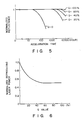
- Fig. 5 shows changes in reflectance of recording films formed with the abovementioned Q values in acceleration conditions (60°C - 90%RH).
- the reflectances are normalized assuming that a reflectance immediately after preparation of film is 1.
- a decrease in reflectance is used as a parameter of oxidation resistance of a recording film.
- the Q value is increased to 20, 40, and 80%, the reflectance is improved.
- Fig. 6 shows allowable maximum reproducing laser power values of recording films formed with the respective Q values.
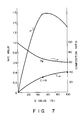
- Fig. 7 shows composition analysis values of films formed with the respective Q values.
- a composition corresponding to Q 40 to 80% satisfies 25 at.% ⁇ C + H ⁇ 38 at.%.
- Te was subjected to atomic absorption spectrum analysis, and C and H were subjected to elemental analysis. These analyses took about half a day.
- composition analysis of a given film is performed and the above composition is obtained, it is easily determined that the film has three excellent characteristics, i.e., write sensitivity, oxidation resistance, and laser power margin.
- CH4 gas was used as a source gas for carbon and hydrogen in the recording films.
- other hydrocarbon gases such as C2H6, C3H8, C2H4, and C2H2 gases may be used.
Landscapes
- Chemical & Material Sciences (AREA)
- Inorganic Chemistry (AREA)
- Engineering & Computer Science (AREA)
- Manufacturing & Machinery (AREA)
- Thermal Transfer Or Thermal Recording In General (AREA)
- Manufacturing Optical Record Carriers (AREA)
- Optical Record Carriers And Manufacture Thereof (AREA)
Applications Claiming Priority (2)
| Application Number | Priority Date | Filing Date | Title |
|---|---|---|---|
| JP76572/88 | 1988-03-31 | ||
| JP63076572A JPH01249489A (ja) | 1988-03-31 | 1988-03-31 | 情報記録媒体 |
Publications (2)
| Publication Number | Publication Date |
|---|---|
| EP0335275A2 true EP0335275A2 (de) | 1989-10-04 |
| EP0335275A3 EP0335275A3 (en) | 1990-09-19 |
Family
ID=13608954
Family Applications (1)
| Application Number | Title | Priority Date | Filing Date |
|---|---|---|---|
| EP19890105303 Withdrawn EP0335275A3 (en) | 1988-03-31 | 1989-03-23 | Information storage medium |
Country Status (2)
| Country | Link |
|---|---|
| EP (1) | EP0335275A3 (de) |
| JP (1) | JPH01249489A (de) |
Cited By (2)
| Publication number | Priority date | Publication date | Assignee | Title |
|---|---|---|---|---|
| EP0605891A3 (de) * | 1993-01-08 | 1996-08-07 | Eastman Kodak Co | Optisches Aufzeichnungselement, welches Materialien mit kleiner Absorption enthält. |
| US8192820B2 (en) | 2008-09-12 | 2012-06-05 | Brigham Young University | Data storage media containing carbon and metal layers |
Family Cites Families (2)
| Publication number | Priority date | Publication date | Assignee | Title |
|---|---|---|---|---|
| JPS5933320B2 (ja) * | 1981-04-03 | 1984-08-15 | 株式会社東芝 | 光学的情報記録媒体 |
| JPS61158051A (ja) * | 1984-12-28 | 1986-07-17 | Pioneer Electronic Corp | 光学式情報記録媒体及びその記録再生装置 |
-
1988
- 1988-03-31 JP JP63076572A patent/JPH01249489A/ja active Pending
-
1989
- 1989-03-23 EP EP19890105303 patent/EP0335275A3/en not_active Withdrawn
Cited By (2)
| Publication number | Priority date | Publication date | Assignee | Title |
|---|---|---|---|---|
| EP0605891A3 (de) * | 1993-01-08 | 1996-08-07 | Eastman Kodak Co | Optisches Aufzeichnungselement, welches Materialien mit kleiner Absorption enthält. |
| US8192820B2 (en) | 2008-09-12 | 2012-06-05 | Brigham Young University | Data storage media containing carbon and metal layers |
Also Published As
| Publication number | Publication date |
|---|---|
| EP0335275A3 (en) | 1990-09-19 |
| JPH01249489A (ja) | 1989-10-04 |
Similar Documents
| Publication | Publication Date | Title |
|---|---|---|
| US4458004A (en) | Optical information recording medium | |
| US4238803A (en) | Information recording methods using lasers | |
| JPH01252766A (ja) | 表面上にx線無定形の窒化アルミニウム又は窒化アルミニウム珪素薄層を製造する方法 | |
| JPWO2003101750A1 (ja) | 情報記録媒体及びその製造方法 | |
| KR20050033866A (ko) | 정보 기록 매체, 그 제조 방법, 및 스퍼터링 타겟 | |
| EP0762405B1 (de) | Optisches Aufzeichnungsmedium | |
| KR100237085B1 (ko) | 금속막 형성방법 및 알루미늄막 피착물 | |
| US4580146A (en) | Information recording material | |
| CA1171276A (en) | Information recording material | |
| EP0371428A2 (de) | Medium für Informationsspeicherung | |
| EP0335275A2 (de) | Datenaufzeichungsträger | |
| EP0310344A2 (de) | Optisches Aufzeichnungsmedium | |
| EP0314424B1 (de) | Magnetooptischer Aufzeichnungsträger | |
| EP0307750B1 (de) | Gebrauch eines Speichermediums in einem Verfahren zur Aufnahme von Informationen | |
| US5061563A (en) | Information storage medium comprising a recording film containing tellurium chemically bonded to an organic carbon | |
| EP0516178A2 (de) | Optischer Informationsaufzeichnungsträger in welchem eine Schutzschicht eine aus ZnS und SiO2 bestehende Mischungsschicht enthält | |
| KR930004333B1 (ko) | 광 정보 기록재료 | |
| JP2558844B2 (ja) | 情報記録媒体 | |
| US4735888A (en) | Information recording medium and manufacturing method thereof | |
| JP2731202B2 (ja) | 情報記録媒体 | |
| JP2557922B2 (ja) | 光記録媒体 | |
| JPH02169293A (ja) | 情報記録媒体 | |
| JPH02121887A (ja) | 情報記録媒体 | |
| JPH01290135A (ja) | 光情報記録媒体 | |
| JPH02121132A (ja) | 情報記録媒体 |
Legal Events
| Date | Code | Title | Description |
|---|---|---|---|
| PUAI | Public reference made under article 153(3) epc to a published international application that has entered the european phase |
Free format text: ORIGINAL CODE: 0009012 |
|
| 17P | Request for examination filed |
Effective date: 19890420 |
|
| AK | Designated contracting states |
Kind code of ref document: A2 Designated state(s): DE FR GB NL |
|
| PUAL | Search report despatched |
Free format text: ORIGINAL CODE: 0009013 |
|
| AK | Designated contracting states |
Kind code of ref document: A3 Designated state(s): DE FR GB NL |
|
| 17Q | First examination report despatched |
Effective date: 19921111 |
|
| STAA | Information on the status of an ep patent application or granted ep patent |
Free format text: STATUS: THE APPLICATION IS DEEMED TO BE WITHDRAWN |
|
| 18D | Application deemed to be withdrawn |
Effective date: 19930707 |