EP0335491A2 - Monolithische Integration von optoelektronischen und elektronischen Bauelementen - Google Patents
Monolithische Integration von optoelektronischen und elektronischen Bauelementen Download PDFInfo
- Publication number
- EP0335491A2 EP0335491A2 EP89301508A EP89301508A EP0335491A2 EP 0335491 A2 EP0335491 A2 EP 0335491A2 EP 89301508 A EP89301508 A EP 89301508A EP 89301508 A EP89301508 A EP 89301508A EP 0335491 A2 EP0335491 A2 EP 0335491A2
- Authority
- EP
- European Patent Office
- Prior art keywords
- band gap
- gap semiconductor
- conductivity type
- wide band
- layer
- Prior art date
- Legal status (The legal status is an assumption and is not a legal conclusion. Google has not performed a legal analysis and makes no representation as to the accuracy of the status listed.)
- Withdrawn
Links
Images



Classifications
-
- H—ELECTRICITY
- H10—SEMICONDUCTOR DEVICES; ELECTRIC SOLID-STATE DEVICES NOT OTHERWISE PROVIDED FOR
- H10H—INORGANIC LIGHT-EMITTING SEMICONDUCTOR DEVICES HAVING POTENTIAL BARRIERS
- H10H29/00—Integrated devices, or assemblies of multiple devices, comprising at least one light-emitting semiconductor element covered by group H10H20/00
- H10H29/10—Integrated devices comprising at least one light-emitting semiconductor component covered by group H10H20/00
Definitions
- the present invention relates generally to monolithic integration of optoelectronic and electronic devices. More particularly, the invention relates to monolithic integration of DOES and HFET devices.
- optoelectronic devices have been integrated onto the same substrate as electronic devices by growing the semiconductor layers required for optoelectronic devices onto a semiconductor substrate, etching the grown layers to expose the semiconductor substrate at locations where electronic devices are desired while masking the grown layers at locations where optoelectronic devices are desired, and forming electronic devices in the substrate and optoelectronic devices in the grown layers.
- the grown layers protrude beyond the surface of the exposed substrate so that masks used to define the electronic devices are held away from the substrate surface during photolithography. This limits the resolution of the photolithography process and correspondingly limits the density of the electronic devices.
- the electronic devices are formed at an etched surface of the substrate. The etching process degrades the quality of this surface and this affects the functioning of the resulting electronic devices.
- field effect transistors (FETs) formed at such an etched surface typically have nonuniform threshold voltages. Both of the above effects limit the yield of such integration processes.
- a groove is formed in the substrate and the semiconductor layers required for optoelectronic devices are grown only in the groove. Optoelectronic devices are then formed in the groove, while electronic devices are formed on the substrate alongside the groove.
- the groove required for this process must be made 5 microns to 10 microns deep in order to accommodate all of the semiconductor layers required for optoelectronic devices, and a step discontinuity of this magnitude impairs the resolution of photolithographic processes used to define the optoelectronic and electronic devices.
- the present invention seeks to provide a method for monolithically integrating DOES devices and HFET devices which overcomes some or all of the problems encountered in known methods for monolithically integrating optoelectronic devices with electronic devices.
- HFET devices as used in this specification is meant to encompass HFET transistors, HFET photodetectors (HFETPDs) and other similar devices.
- a method for making a monolithic integrated circuit comprising DOES devices and HFET devices, the method comprising:
- a semi-insulating substrate having regions of wide band gap semiconductor of a first conductivity type recessed therein at predetermined locations, the regions being exposed at a surface of the substrate; forming a layer of narrow band gap semiconductor having a second conductivity type opposite to the first conductivity type over the surface of the substrate; forming a sheet charge of the first conductivity type over the layer of narrow band gap semiconductor; forming a layer of wide band gap semiconductor of the second conductivity type over the sheet charge; and forming ohmic contacts to the layer of wide band gap semiconductor of the second conductivity type and to the layer of wide band gap semiconductor of the first conductivity type to define DOES devices at the predetermined locations, and forming HFET devices at other predetermined locations.
- a monolithic integrated circuit comprising: a semi-insulating substrate having regions of wide band gap semiconductor of a first conductivity type recessed therein at specific locations; a layer of narrow band gap semiconductor on the substrate, the narrow band gap semiconductor having a second conductivity type opposite to the first conductivity type and contacting the regions of wide band gap semiconductor; a sheet charge of the first conductivity type on the layer of narrow band gap semiconductor; a layer of wide band gap semiconductor of the second conductivity type on the sheet charge; and ohmic contacts to the layer of wide band gap semiconductor of the second conductivity type and to the layer of wide band gap semiconductor of the first conductivity type defining DOES devices at the specific locations, and HFET devices formed in the semiconductor layers at other specific locations.
- the wide band gap semiconductor of the first conductivity type is provided only at those predetermined locations where DOES devices are desired.
- This material is provided for carrier confinement in the overlying narrow band gap semiconductor of the second conductivity type as is required for efficient light generation in the DOES devices.
- This material is not provided at other predetermined locations where HFET devices are desired as it would constitute a shunt path which would degrade the high frequency operation of the HFET devices.
- the HFET devices are formed at a grown or deposited surface of the substrate rather than at an etched surface. As a result, the HFET devices have relatively uniform threshold voltages.
- ohmic contacts are formed to the wide band gap semiconductor of the second conductivity type by forming a layer of heavily doped wide band gap semiconductor of the second conductivity type on the wide band gap semiconductor of the second conductivity type at the predetermined locations, forming a layer of heavily doped narrow band gap semiconductor of the second conductivity type on the heavily doped wide band gap semiconductor of the second conductivity type, and forming a metallic layer on the heavily doped narrow band gap semiconductor.
- the heavily doped wide band gap semiconductor of the second conductivity type, heavily doped narrow band gap semiconductor of the second conductivity type, and the metal together constitute the ohmic contact to the wide band gap semiconductor of the second conductivity type.
- regions of narrow band gap semiconductor of the first conductivity type are provided beneath the regions of wide band gap semiconductor of the first conductivity type.
- the narrow band gap semiconductor of the first conductivity type acts as a buffer layer to ensure high quality crystal structure in the overlying wide band gap semiconductor of the first conductivity type.
- the narrow band gap semiconductor of the first conductivity type may be heavily doped, and portions of this material may be exposed and coated with a metallic layer to form an ohmic contact to the wide band gap semiconductor of the first conductivity type, the metallic layer and the heavily doped narrow band gap semiconductor of the first conductivity type constituting the ohmic contact.
- Recesses may be etched into the substrate at the predetermined locations and the layers of narrow band gap semiconductor and wide band gap semiconductor of the first conductivity type may be formed so as to substantially fill the recesses. These recesses may be an order of magnitude shallower than the grooves used in previously known integration methods described above since they need only accommodate one or two of the semiconductor layers required for optoelectronic devices. The grooves used in the previously known integration methods must accommodate all of the semiconductor layers required for optoelectronic devices and therefore must be deeper.
- layers of narrow band gap semiconductor and wide band gap semiconductor of the first conductivity type may be formed over the entire substrate and oxygen may be implanted at the other predetermined locations to render the narrow band gap semiconductor and wide band gap semiconductor at said other predetermined locations semi-insulating.
- N and P designate doping to a level between 1016 and 1018 carriers per cubic centimetre
- N- and P- designate doping to a level between 1015 and 1016 carriers per cubic centimetre
- N+ designate doping to a level between 1018 and 1019 carriers per cubic centimetre
- a monolithic integrated circuit comprising DOES and HFET devices is manufactured according to a series of process steps shown in Figures 1 to 6.
- a substantially planar semi-insulating GaAs substrate 10 is masked with photoresist and etched to define recesses 12 approximately 5000 angstroms deep at predetermined locations where DOES devices are desired.
- a layer 14 of silicon nitride is deposited on the substrate 10, masked with photoresist and etched to remove the silicon nitride only from the recesses 12.
- a layer of narrow band gap semiconductor of a first conductivity type in the form of a N+ GaAs layer 16 approximately 2000 angstroms thick and doped with approximately 5x10¹⁸ silicon atoms per cubic centimetre is deposited by molecular beam epitaxy (MBE) over the silicon nitride layer 14 and recess 12.
- MBE molecular beam epitaxy
- the N+ GaAs layer 16 is polycrystalline where it is grown on the silicon nitride layer 14 and monocrystalline in the recess 12 where it is grown directly on the semi-insulating GaAs substrate 10.
- a layer of wide band gap semiconductor of the first conductivity type in the form of a N+ GaAlAs layer 18 approximately 3000 angstroms thick and doped with approximately 5x10¹⁸ silicon atoms per cubic centimetre is deposited by MBE over the layer 16 of N+ GaAs.
- the composition of the GaAlAs layer 18 is ramped from Ga 1.0 Al 0.0 As to Ga 0.7 Al 0.3 As over the first approximately 100 angstroms of the layer.
- the N+ GaAlAs layer 18 is monocrystalline in the recess 12 and polycrystalline elsewhere according to the crystallinity of the underlying material.
- the layers 14, 16 and 18 are preferentially etched to preferentially remove polycrystalline material, leaving only the monocrystalline N+ GaAs and N+ GaAlAs layers 16, 18 in the recess 12. The remaining N+ GaAs and GaAlAs layers 16, 18 substantially fill the recess 12.
- a further series of monocrystalline layers 20, 22, 24, 26, 28 are deposited over the N+ GaAs and GaAlAs layers 16, 18 and over exposed portions of the substrate 10 by MBE.
- a layer of narrow band gap semiconductor of a second conductivity type in the form of a layer 20 of P- GaAs approximately 1 micron thick and doped with approximately 5x10¹⁵ beryllium atoms per cubic centimetre is deposited directly on the N+ GaAlAs layer 18 and substrate 10.
- a sheet charge in the form of a layer 22 of N+ Ga 0.7 Al 0.3 As approximately 40 angstroms thick and doped with approximately 1019 silicon atoms per cubic centimetre is deposited on the P- GaAs layer 20.
- Two further layers 26, 28 used in formation of ohmic contacts to the P GaAlAs layer 24 are formed over the P GaAlAs layer 24.
- These layers include a layer of heavily doped wide band gap semiconductor of the second conductivity type in the form of a P+ Ga 0.7 Al 0.3 As layer 26 approximately 500 angstroms thick and doped with approximately 1019 beryllium atoms per cubic centimetre deposited by MBE directly on the P GaAlAs layer 24, and a layer of heavily doped narrow band gap semiconductor of the second conductivity type in the form of a P+ GaAs layer 28 approximately 500 angstroms thick and doped with approximately 1019 beryllium atoms per cubic centimetre deposited by MBE on the P+ GaAlAs layer 26.
- DOES devices are defined at those predetermined locations where recesses 12 were formed and substantially filled with N+ GaAs and GaAlAs layers 16, 18.
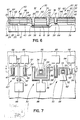
- a DOES device 30 is shown in Figure 6.
- the DOES device 30 is defined by forming ohmic contacts to the layer 24 of P GaAlAs and to the layer 18 of N+ GaAlAs.
- the ohmic contact to the layer 24 of P GaAlAs defines an emitter electrode of the DOES device and is completed depositing a metallic layer 32 on the P+ GaAs layer 28 over the recesses 12, the metallic layer 32 and the P+ semiconductor layers 26, 28 constituting the ohmic contact.
- An opening 34 is formed in the metallic layer 32 for transmission of light to and from the DOES device.
- the ohmic contact to the layer 18 of N+ GaAlAs defines a collector electrode of the DOES device and is formed by masking with photoresist and etching to form recesses 36 extending through the P+ GaAs layer 28, P+ GaAlAs layer 26, P GaAlAs layer 24, N+ GaAlAs sheet charge layer 22, P- GaAlAs layer 20 and N+ GaAlAs layer 18 to expose portions of the N+ GaAs layer 16, and forming a metallic layer 38 in the recesses 36.
- the metallic layer 38 and N+ GaAs layer 16 together constitute the ohmic contact to the N+ GaAlAs layer 18.
- HFET devices in the form of HFET transistors are formed at other predetermined locations in the semiconductor layers 20, 22, 24, 26 and 28.
- Such a HFET transistor 40 is shown in Figure 6.
- the HFET transistor 40 is formed by depositing a metallic gate electrode 42, implanting silicon into the semiconductor layers 20, 22, 24, 26 and 28 and rapid thermal annealing to activate the silicon, thereby defining self-aligned N+ source and drain regions 44, 45, and depositing metallic source and drain electrodes 47,48 over the source and drain regions respectively.
- HFET devices in the form of HFETPDs are formed at still other predetermined locations in the semiconductor layers 20, 22, 24, 26 and 28.
- a HFETPD 50 is shown in Figure 6.
- the HFETPD 50 is formed by depositing a metallic gate electrode 52, implanting silicon into the semiconductor layers 20, 22, 24, 26 and 28 and rapid thermal annealing to activate the silicon, thereby defining a self-aligned N+ anode region 54, and depositing a metallic anode 55 over the anode region 54.
- An opening 53 is formed in the gate electrode 52 for transmission of light to the HFETPD.
- the HFETPD is completed by masking with photoresist and etching to define a recess 57 extending through the P+ GaAs layer 28, P+ GaAlAs layer 26, P GaAlAs layer 24 and N+ GaAlAs sheet charge layer 22 to expose portions of the P- GaAs layer 20, and forming a metallic cathode 58 in the recess 57.
- the DOES and HFET devices are formed together rather than in succession.
- all of the gate metal layers 32, 42 and 52 are formed in a single metallization step, followed by implantation of all of the self-aligned source, drain and anode regions in a single implantation step.
- All of the collector, source, drain and anode contacts 38, 47, 48 and 55 are then made in a second single metallization step, and the cathode contact is made in a separate metallization step.
- a layer 60 of silicon nitride is formed by chemical vapour deposition (CVD) over the DOES and HFET devices, and openings 62 are etched through this layer over the contacts 32, 38, 42, 47, 48, 52, 55, 58.
- a metallic layer 64 is formed over the silicon nitride and contacts using known lift off techniques to define contact pads 66 for the DOES and HFET devices.
- isolation between adjacent HFET devices is required, known isolation techniques employing mesa etching or boron implantation may be used.
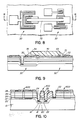
- a monolithic integrated circuit according to a second embodiment is shown in Figures 8 and 9.
- This integrated circuit comprises a DOES device 30 and a HFETPD device 50 fabricated as described above.
- the DOES device 30 and the HFETPD device 50 are optically interconnected by means of a polymer layer 70 formed at an upper surface of the integrated circuit so as to form an optical waveguide.
- the polymer layer 70 is formed with tapered end portions 72 provided with a mirror finish over the openings 34, 53 in the DOES emitter electrode 32 and the HFETPD gate electrode 52 so as to couple light emerging from the emitter opening 34 of the DOES device 30 along the polymer layer 70 and through the gate opening 53 of the HFETPD device 50.
- a third embodiment shown in Figures 10 and 11 comprises a monolithic integrated circuit having a DOES device 300 capable of operation as a laser.
- This monolithic integrated circuit is fabricated as described above for the first embodiment, except that the N+ GaAlAs layer 18 is made 1 micron thick (instead of 3000 angstroms as in the first embodiment), the P- GaAlAs layer 20 is made 1000 angstroms thick (instead of 1 micron as in the first embodiment) and the P+ GaAlAs layer 26 is made 1 micron thick (instead of 500 angstroms thick as in the first embodiment).
- the layers 18, 20 and 26 and the end facets 302, 304 define an optical cavity capable of supporting edge emitting laser action.
- the thickness of the other layers and the doping of all of the layers is as described above for the first embodiment.
- HFET devices in the form of an HFET transistor 400 and an HFET photodetector 500 can also be formed in the semiconductor layers having thicknesses modified according to the third embodiment.
- the HFET photodetector 500 will be very inefficient when illuminated through a gate opening in a direction normal to the substrate as in the first embodiment.
- the HFET photodetector is illuminated through a cleaved or dry etched edge facet 502 in a direction extending parallel to the gate, and no opening is provided in the gate contact 52.
- a suitable anti-reflection coating may be applied to the cleaved or dry etched facet 502.
- a layer 16 of N+ GaAs is formed over the entire semi-insulating substrate 10
- a layer 18 of N+ GaAlAs is formed over the entire N+ GaAs layer 16
- a layer 19 of silicon nitride is grown on the N+ GaAlAs layer 18.
- a layer 21 of photoresist is deposited on the silicon nitride layer 19 and developed to mask only predetermined locations where DOES devices are desired. Exposed portions of the silicon nitride layer 19 are then etched away so that the silicon nitride layer 19 remains only at the predetermined locations where DOES devices are desired.
- Oxygen is then implanted into the N+ GaAlAs and GaAs layers 16, 18 where they are not protected by the silicon nitride 19 and photoresist 21.
- the implanted oxygen renders the semiconducting layers 16, 18 semi-insulating except at the predetermined locations where the semiconducting layers 16, 18 are protected by the silicon nitride 19 and photoresist 21 as shown in Figure 12.
- the remaining photoresist 21 and silicon nitride 19 are then etched away to expose the semiconducting layers 16, 18, and semiconducting layers 20, 22, 24, 26 and 28 are grown as described in the first embodiment and as shown in Figure 13.
- DOES devices, HFET transistor devices 40 and HFETPD devices 50 are then formed in the semiconducting layers 20, 22, 24, 26, 28 as described in the first embodiment and as shown in Figure 14.
- an analogous integrated circuit shown in Figure 15 could be fabricated by substituting a semi-insulating InP substrate 110 for the GaAs substrate 10, an N+ InP layer 117 for the N+ GaAs and GaAlAs layers 16,18, a P- InGaAsP layer 120 for the P- GaAs layer 20, a N+ InP layer 122 for the sheet charge 22, a P InP layer 124 for the P GaAlAs layer 24, a P+ InP layer 126 for the P+ GaAlAs layer 26, and a P+ InGaAs layer 128 for the P+ GaAs layer 28.
- light could be coupled into and out of the optoelectronic devices through the InP substrate.
- the devices described above rely on an N-type channel.
- Complementary devices relying on P-type channels could be formed by replacing the N-type layers with P-type layers and vice versa.
- the N-type channel devices are preferred due to the higher mobility of majority carriers in these devices.
- Dopants other than silicon and beryllium may be used to provide the required conductivity type of the various layers.
- the devices may be optically interconnected by means other than those described above.
- Goodman et al Proceedings of the IEEE, Vol. 72, No.7, July 1984, pp 850-866 describes alternative optical interconnection methods.
Landscapes
- Solid State Image Pick-Up Elements (AREA)
- Semiconductor Lasers (AREA)
- Junction Field-Effect Transistors (AREA)
Applications Claiming Priority (2)
| Application Number | Priority Date | Filing Date | Title |
|---|---|---|---|
| CA000562996A CA1281400C (en) | 1988-03-30 | 1988-03-30 | Monolithic integration of optoelectronic and electronic devices |
| CA562996 | 1988-03-30 |
Publications (2)
| Publication Number | Publication Date |
|---|---|
| EP0335491A2 true EP0335491A2 (de) | 1989-10-04 |
| EP0335491A3 EP0335491A3 (de) | 1992-03-18 |
Family
ID=4137747
Family Applications (1)
| Application Number | Title | Priority Date | Filing Date |
|---|---|---|---|
| EP19890301508 Withdrawn EP0335491A3 (de) | 1988-03-30 | 1989-02-16 | Monolithische Integration von optoelektronischen und elektronischen Bauelementen |
Country Status (3)
| Country | Link |
|---|---|
| EP (1) | EP0335491A3 (de) |
| JP (1) | JPH01286358A (de) |
| CA (1) | CA1281400C (de) |
Family Cites Families (3)
| Publication number | Priority date | Publication date | Assignee | Title |
|---|---|---|---|---|
| US4719498A (en) * | 1984-05-18 | 1988-01-12 | Fujitsu Limited | Optoelectronic integrated circuit |
| EP0233725B1 (de) * | 1986-02-18 | 1995-04-19 | Kabushiki Kaisha Toshiba | Opto-elektronisches Bauelement und Verfahren zu seiner Herstellung |
| US4847665A (en) * | 1988-03-31 | 1989-07-11 | Northern Telecom Limited | Monolithic integration of optoelectronic and electronic devices |
-
1988
- 1988-03-30 CA CA000562996A patent/CA1281400C/en not_active Expired - Lifetime
-
1989
- 1989-02-16 EP EP19890301508 patent/EP0335491A3/de not_active Withdrawn
- 1989-03-27 JP JP1072036A patent/JPH01286358A/ja active Pending
Also Published As
| Publication number | Publication date |
|---|---|
| CA1281400C (en) | 1991-03-12 |
| JPH01286358A (ja) | 1989-11-17 |
| EP0335491A3 (de) | 1992-03-18 |
Similar Documents
| Publication | Publication Date | Title |
|---|---|---|
| US4847665A (en) | Monolithic integration of optoelectronic and electronic devices | |
| EP0233725B1 (de) | Opto-elektronisches Bauelement und Verfahren zu seiner Herstellung | |
| US4360246A (en) | Integrated waveguide and FET detector | |
| US5242839A (en) | Method of manufacturing an integrated photoelectric receiving device | |
| US4956682A (en) | Optoelectronic integrated circuit | |
| US5822349A (en) | Semiconductor device and method of manufacturing the same | |
| US4751195A (en) | Method of manufacturing a heterojunction bipolar transistor | |
| KR900000208B1 (ko) | N-채널 및 p-채널 트랜지스터들을 포함하는 반도체장치 및 그의 제조방법 | |
| US4990990A (en) | Monolithically integrated waveguide-photodiode-FET combination | |
| US6759694B1 (en) | Semiconductor phototransistor | |
| US5780880A (en) | High injection bipolar transistor | |
| US5104823A (en) | Monolithic integration of optoelectronic and electronic devices | |
| US4608696A (en) | Integrated laser and field effect transistor | |
| Suzuki et al. | InGaAsP/InP long wavelength optoelectronic integrated circuits (OEIC's) for high-speed optical fiber communication systems | |
| US4791072A (en) | Method for making a complementary device containing MODFET | |
| EP0487192A2 (de) | Optoelektronische integrierte Schaltung mit einem Langwellensender | |
| JPS62160785A (ja) | モノリシツク半導体構造およびその製造方法 | |
| US5158896A (en) | Method for fabricating group III-V heterostructure devices having self-aligned graded contact diffusion regions | |
| US5162891A (en) | Group III-V heterostructure devices having self-aligned graded contact diffusion regions and method for fabricating same | |
| US5027182A (en) | High-gain AlGaAs/GaAs double heterojunction Darlington phototransistors for optical neural networks | |
| US6876012B2 (en) | Hetero-bipolar transistor | |
| US5073895A (en) | Semiconductor laser | |
| CA1281400C (en) | Monolithic integration of optoelectronic and electronic devices | |
| US20050056862A1 (en) | Photo-diode and method for fabricating the same | |
| EP0282653B1 (de) | Monolithische Integration einer Matrix von lichtemittierenden Elementen und Steuerelektronik |
Legal Events
| Date | Code | Title | Description |
|---|---|---|---|
| PUAI | Public reference made under article 153(3) epc to a published international application that has entered the european phase |
Free format text: ORIGINAL CODE: 0009012 |
|
| AK | Designated contracting states |
Kind code of ref document: A2 Designated state(s): DE FR GB NL SE |
|
| PUAL | Search report despatched |
Free format text: ORIGINAL CODE: 0009013 |
|
| AK | Designated contracting states |
Kind code of ref document: A3 Designated state(s): DE FR GB NL SE |
|
| 17P | Request for examination filed |
Effective date: 19920723 |
|
| 17Q | First examination report despatched |
Effective date: 19931119 |
|
| STAA | Information on the status of an ep patent application or granted ep patent |
Free format text: STATUS: THE APPLICATION IS DEEMED TO BE WITHDRAWN |
|
| 18D | Application deemed to be withdrawn |
Effective date: 19940330 |