EP0336029B1 - Verfahren zur fluorimetrischen Kontrolle funktioneller Beschichtungen sowie dabei verwendete Strukturen bestehend aus einem Substrat mit dieser funktionellen Beschichtung - Google Patents
Verfahren zur fluorimetrischen Kontrolle funktioneller Beschichtungen sowie dabei verwendete Strukturen bestehend aus einem Substrat mit dieser funktionellen Beschichtung Download PDFInfo
- Publication number
- EP0336029B1 EP0336029B1 EP88303036A EP88303036A EP0336029B1 EP 0336029 B1 EP0336029 B1 EP 0336029B1 EP 88303036 A EP88303036 A EP 88303036A EP 88303036 A EP88303036 A EP 88303036A EP 0336029 B1 EP0336029 B1 EP 0336029B1
- Authority
- EP
- European Patent Office
- Prior art keywords
- coating
- group
- uvescer
- coatings
- radiant energy
- Prior art date
- Legal status (The legal status is an assumption and is not a legal conclusion. Google has not performed a legal analysis and makes no representation as to the accuracy of the status listed.)
- Expired - Lifetime
Links
Classifications
-
- G—PHYSICS
- G01—MEASURING; TESTING
- G01N—INVESTIGATING OR ANALYSING MATERIALS BY DETERMINING THEIR CHEMICAL OR PHYSICAL PROPERTIES
- G01N21/00—Investigating or analysing materials by the use of optical means, i.e. using sub-millimetre waves, infrared, visible or ultraviolet light
- G01N21/62—Systems in which the material investigated is excited whereby it emits light or causes a change in wavelength of the incident light
- G01N21/63—Systems in which the material investigated is excited whereby it emits light or causes a change in wavelength of the incident light optically excited
- G01N21/64—Fluorescence; Phosphorescence
- G01N21/6428—Measuring fluorescence of fluorescent products of reactions or of fluorochrome labelled reactive substances, e.g. measuring quenching effects, using measuring "optrodes"
- G01N21/643—Measuring fluorescence of fluorescent products of reactions or of fluorochrome labelled reactive substances, e.g. measuring quenching effects, using measuring "optrodes" non-biological material
-
- C—CHEMISTRY; METALLURGY
- C09—DYES; PAINTS; POLISHES; NATURAL RESINS; ADHESIVES; COMPOSITIONS NOT OTHERWISE PROVIDED FOR; APPLICATIONS OF MATERIALS NOT OTHERWISE PROVIDED FOR
- C09K—MATERIALS FOR MISCELLANEOUS APPLICATIONS, NOT PROVIDED FOR ELSEWHERE
- C09K11/00—Luminescent materials, e.g. electroluminescent or chemiluminescent
- C09K11/02—Use of particular materials as binders, particle coatings or suspension media therefor
-
- C—CHEMISTRY; METALLURGY
- C09—DYES; PAINTS; POLISHES; NATURAL RESINS; ADHESIVES; COMPOSITIONS NOT OTHERWISE PROVIDED FOR; APPLICATIONS OF MATERIALS NOT OTHERWISE PROVIDED FOR
- C09K—MATERIALS FOR MISCELLANEOUS APPLICATIONS, NOT PROVIDED FOR ELSEWHERE
- C09K11/00—Luminescent materials, e.g. electroluminescent or chemiluminescent
- C09K11/06—Luminescent materials, e.g. electroluminescent or chemiluminescent containing organic luminescent materials
Definitions
- the present invention relates to a method of detecting thickness, uniformity, and defects in coatings and detecting marking in coatings that have been applied to substrates, utilizing uvescence, i.e., fluorescence in the ultraviolet region of the electromagnetic spectrum.
- uvescence i.e., fluorescence in the ultraviolet region of the electromagnetic spectrum.
- it relates to a composite structure bearing a coating composition which comprises a uvescer, used in such a method.
- U.S. 3,019,336 and U.S. 3,130,303 disclose that beta rays emanating from a radioactive source such as strontium-90 and directed toward a coating are backscattered in an amount related to the thickness of the coating.
- a radioactive source such as strontium-90
- Such a technique cannot be used to monitor coating uniformity and coating defects during manufacture of web materials bearing thin coatings. In this technique only the average coating weight can be determined, not the weight at any specific point.
- U.S. 3,675,015, U.S. 3,118,060, U.S. 3,930,063, U.S. 3,956,630 and U.S. 4,250,382 disclose methods and apparatus for continuously monitoring coating weight of a coating on a web or fiber.
- a fluorescing compound, dye or pigment is added to the coating formulation and the fluorescence of the coating in the visible range of the electromagnetic spectrum is continuously and quantitatively measured while the coating is exposed to ultraviolet radiation. Fluorescence readings taken in the cross direction and machine direction of the web give an indication of the lay of the coating on the web.
- GB-A-1,422,526 relates to lacquers which fluoresce in the visible range when exposed to ultraviolet light and detection is in this visible range.
- GB-A-2,194,244 also relates to compounds (organic phosphors) which when exposed to ultraviolet light phosphoresce in the visible range and detection is in the visible range.
- US-A-3,547,827 relates to a detection system for defects in articles in which penetrant solutions, e.g. cracks, are excited by radiant energy so as to emit radiant energy at a lower energy level so as to indicate the flaws in the treated objects. There is no disclosure of a coating system on the surface of the objects and indeed coating on non-flawed areas.
- the present invention provides a process for monitoring functional coating compositions applied to a substrate, said process comprising the steps:
- said uvescer has the formula R[( ⁇ R1) ⁇ b X] a or R[( ⁇ R1) ⁇ b Y ⁇ a wherein
- the invention also provides a composite structure used in such a method comprising a substrate bearing a coating composition which comprises a uvescer having one of the formulae: and wherein R6 is one or more of lower alkyl groups (C1 to C4) or phenyl groups, and c, d, and e are integers, the sum of which is 10 to 20,000, d is 0.01% to 10% of the sum, and e is 5% to 95% of the sum, j, k and m are integers the sum of which is 10 to 10,000, k being from 0.01 to 10% of the sum of j, k and m, m being from zero to 99.5% of the sum of j, k, and m, and n being an integer from 5 to 10,000, and p and q are integers, the ratio of p/q being 0.2/1 to 5/1 and the number average molecular weights of the p and q containing polymers being 500 to 20,000.
- R6 is one or more of lower alky
- the functional coating composition can be monitored for defects, average weight, uniformity.
- the coating can be a discontinuous coating comprising marks, images, or coded information, for example.
- the instant invention is particularly useful when the substrate to which a coating is being applied is one that fluoresces (contains a luminescer), i.e., absorbs radiant energy of a wavelength in the ultraviolet and emits most or all of its radiation in the visible and/or near ultraviolet portion of the electromagnetic spectrum.
- the substrate fluorescence in the instant invention does not mask the ultraviolet emission of the coating.
- Uvescers useful in the invention generally absorb radiant energy of wavelength ⁇ 1, which is in the ultraviolet range.
- the wavelength should preferably be below 400 nm and should preferably be above 240 nm because this minimizes interference from any visible radiation emitted by the substrate; the uvescer emits in a wavelength ⁇ 2, which preferably is less than 430 nm with no more than 30 percent of the emitted light having a wavelength greater than 400 nm and more preferably is less than 350 nm. This allows for minimization of interference from any visible radiation that may be emitted by the substrate.
- the process of the invention is particularly desirable for those coatings having a utility that requires expensive components and/or for which coating thickness and uniformity are critical, especially where loss as a result of flaws and of non-optimal coating weight cannot be tolerated.
- coatings can be from about 0.01 to about 200 or more micrometers in thickness, for example and for release coatings 0.01 to 10 micrometers may be preferred.
- Such functional coating compositions include primer coatings for enhancing the adhesion of subsequently applied top coatings; protective coatings such as moisture resistant and abrasion-resistant coatings; radiation-sensitive imageable layers; adhesive coatings such as those based on synthetic and natural rubber, acrylic, epoxy, and silicone compounds; and release or abherent coatings such as those based on polymers of long chain aliphatic compounds, silicone resins and fluorochemicals.
- Prior art coatings which depend on luminescent components for monitoring emit visible light when the article is viewed. As noted above, this light will change color fidelity of the article.
- the present invention provides for monitoring by means of uvescers which emit most of their energy in the ultraviolet range.
- the amount of visible light emitted is small and hence cannot modify or alter the color of the article.
- fluorescence means emission of a photon from a substance, occurring as a result of a spin conserving transition from an excited electronic state to a lower energy electronic state
- phosphorescence means the emission of a photon from a molecule, occurring as a result of a non-spin conserving transition from an excited electronic state to a lower energy electronic state
- uvescence means fluorescent or phosphorescent emission in the ultraviolet portion of the spectrum
- luminescence means fluorescent or phosphorescent emission in the visible portion of the spectrum
- uvescer means a uvescent compound or substance which bears a uvaphore group or radical which on illumination by radiation in the ultraviolet portion of the spectrum emits ultraviolet radiation and differs from luminescent compounds of the prior art which emit light in the visible portion of the spectrum above about 400 nm
- functional coating composition is a term applied to any coating composition having utility
- organic means any compound including an organic group, e.g., an organometallic compound
- uvaphore group or radical which on illumination
- the functional coating composition comprises
- ⁇ 1 represents one or more wavelengths in the range of 240 to 400 nm
- ⁇ 2 represents a range of wavelengths of the emitted radiant energy below about 430 nm, not more than 30% of which has a wavelength above 400 nm, and preferably is in the range of 280 to 400 nm, and most preferably 290 to 350 nm.
- the coating composition preferably has a product ( ⁇ ) of molar extinction (molar absorptivity) coefficient ( ⁇ ) and quantum yield ( ⁇ ) of at least 1000.
- the product ( ⁇ ) is 10,000 or more.
- ( ⁇ ) and ( ⁇ ) are defined in A.J. Gordon et al. "The Chemist's Companion", Wiley-Interscience Publication, John Wiley & Sons, NY (1972), particularly pages 211 and 362.
- the product of the molar extinction coefficient and the quantum yield is a measure of the efficiency of a uvaphore, the greater the product the higher the efficiency of the uvaphore.
- the preferred ranges allow for minimal interference from any visible radiation emitted by the substrate.
- Uvescers which absorb radiation in the range of 240 to 290 nm and emit radiation in the range of 290 to 350 nm do not absorb solar ultraviolet radiation which is in the range of 295 to 400 nm. These uvescers thus have the advantage in contrast to prior art luminescers, that they cannot act as sensitizers for the solar photodegradation of a coating or substrate.
- Substrates to which the coating composition of the invention can be applied include any solid surface, for example, those of paper, cardboard, wood, cork, plastic such as polyester, polyurethane, polyamide, polycarbonate, polyolefin, etc., woven and nonwoven fabric such as cotton, polyester, polyolefin, nylon, etc., metals such as aluminum, iron, etc. glass, fused silica, ceramic, etc., including fabrics made therefrom.
- Substrates which are continuous webs or fibers are particularly applicable to the process of the invention and may be inspected "on-line" to permit continuous control of the process variables.
- luminescent inorganic pigments such as Y2O3:Eu, YVO4 :Eu, La2O2S:Eu, and Zn3 Cd2 S:Ag, and powders of minerals such as willemite, among many others.
- Uvescers used in the composite structure and process of the invention should preferably be capable of being stably dispersed (i.e., dissolved or finely divided such that on dispersing in a functional composition a suspension is formed from which less than ten percent by weight of the particles settle out in 24 hours) into a functional composition; more preferably, the uvescers are soluble in the coating; and most preferably, the uvescers are reacted into the coating and become chemically bound as uvaphores therein.
- the material preferably is organic, i.e., it can be aromatic, aliphatic, heterocyclic, cycloaliphatic, or inorganic. As used herein, organic includes organometallic.
- the uvescer can contain one or more elements of groups 2-17 (formerly often called IIA-VIIB) of the Periodic Table of Elements as described in Chem. and Eng. News 63 (No. 5) Feb. 4, 1985 as for example oxygen, nitrogen, sulfur, chlorine, titanium, boron, vanadium, chromium, manganese, cobalt, copper, zinc, and silicon.
- the uvescer can for example be monomeric or a polymeric compound having a molecular weight of up to 500,000 or more, including crosslinked polymers.
- derivatives of these uvescers which bear functional groups such as vinyl, vinyloxy, allyl, hydroxy, amino, carboxy, epoxy, isocyanato, acryloxy, methacryloxy, acrylamido, and hydrosilyl groups.
- compositions of the invention that are preferred comprise (1) a functional coating composition comprising a polymeric compound or polymer precursor and (2) an effective amount of a uvescent substance or more preferably of a uvaphore having attached to it one or more groups that increase the dispersibility of the uvescer in the functional coating composition, the substituted uvescer having the general formula R[( ⁇ R1) ⁇ b X] a I wherein
- Examples of preferred uvescers for functional coating compositions include the following compounds and their derivatives: 4-butylbiphenyl N-pentylindole 1-heptylnaphthalene 1-vinylnaphthalene 2-(5-hexenyl)naphthalene 1-naphthalenecarboxylic acid 1-naphthaleneneisocyanate 2-(5-isocyanatopentyl)naphthalene 1-(7-octenyl)naphthalene 1-trimethylsilylacenaphthylene 1-aminonaphthalene 1-acrylamidonaphthalene 2-acryloyloxynaphthalene 2-methacryloyloxynaphthalene 9-[(2-acryloyloxy)ethylcarbamoyl]-9H-fluorene biphenyl triphenylbenzene fluorene carbazole terphenyl quaterphenyl triphenylene naphthalene 2,5-dip
- Uvescers that are particularly preferred for use in the method and composite of the invention are polymeric uvescers that are organic condensation or addition polymers having one or more terminal or pendent uvaphore groups attached to a polymeric backbone, the pendent uvaphore group having the formula R[( ⁇ R2) ⁇ b Y ⁇ a II wherein
- Polymeric uvescers can be prepared by the reaction of a condensation or addition polymer that is to be used as the polymer or polymer precursor for a functional coating with a uvescer bearing a reactive group complementary to the reactive group of the polymer or precursor.
- Examples of such polymeric uvescers include polyvinylcarbamates, polyacrylates, polysiloxanes, polyethers, perfluoropolyethers, and polyesters. Specific examples of such polymeric uvescers include:
- Coatings of such polymers on substrates can function as a low adhesion backsize that can be monitored for thickness and coating defects by the process of the invention.
- the reaction product of a polymer of one or more acrylic esters of non-tertiary alkanols having 4 to 12 carbon atoms and one or more of acrylic acid, methacrylic acid, or itaconic acid with 2-(5-isocyanatopentyl) naphthalene the polymer having randomly arranged units in an average formula of the structure: in which R4 is a primary or secondary alkyl group having 4 to 12 carbon atoms and R5 is hydrogen, methyl, or carboxymethyl and f, g, and h are numbers the sum of which is about 10 to 20,000, g is 0.01 to 10% of the sum and h is 0 to 75% of the sum.
- Coatings of such polymers are functional as pressure-sensitive adhesives that can be monitored for thickness and coating defects by the process of the invention.
- hydrosilation reaction product of hydride-functional polydimethysiloxane fluids with 9-allyl fluorene having the average formula, wherein the units can be randomly arranged, or in which j, k, and m are numbers the sum of which is about 10 to 10,000, k being from about 0.01 to 10% of the sum of j, k and m, m being from zero to about 99.5% of the sum of j, k and m, and n being a number from about 5 to 10,000.
- Such polymers if contained in coatings on a substrate, are functional as release surfaces, or they can be dispersed in polysiloxanes to form compositions that can be coated and monitored for thickness, uniformity, and defects by the process of the invention.
- the reaction product of 9-aminofluorene with a dimethylester terminated perfluoropolyether the average polymer having the formula: in which integers p and q designate the number of randomly distributed perfluoroethyleneoxy and perfluoromethyleneoxy backbone repeating subunits respectively, the ratio p/q being 0.2/1 to 5/1, said compounds having a number average molecular weight in the range of 500 to 20,000 or higher, preferably 800 to 15,000.
- reaction product of a functional group substituted uvescer such as, for example, 9-isocyanatofluorene and polyoxyalkylenepolyols, such as the reaction product of 9-isocyanatofluorene with the ethyleneoxide adduct of a polyol having an average formula of the structure in which p designates the number of ethyleneoxy units and is a number from 1 to 30 or more, R is hydrogen or an alkyl, cycloalkyl, heterocyclic, or aryl group having a valence of s and s is an integer of 1 to 6 and, preferably, the reaction product has a molecular weight of 15 to 1000.
- a functional group substituted uvescer such as, for example, 9-isocyanatofluorene and polyoxyalkylenepolyols, such as the reaction product of 9-isocyanatofluorene with the ethyleneoxide adduct of a polyol having an average formula of the structure
- a polyester uvescer is the reaction product of diethyleneglycol and 2,5-bis(4-carboxyphenyl)furan and adipic acid.
- the reaction product has the average formula of the structure: in which v designates the number of uvaphore ester units in the reaction product and is a number from 1 to about 20 and w designates the number of ethyleneoxyethylene adipate units in the reaction product and is zero or a number up to about 30 and the molecular weight of the reaction product is from about 300 to 10,000.
- Monomeric uvescers can be present in an amount in the range of 0.001 to 10 weight percent, preferably 0.01 to 5 weight percent of the coating composition.
- Polymeric uvescers can be present in amounts up to 100% of the coating composition.
- the amount of polymeric uvescers used is such that the uvaphore component of the polymeric uvescers is present at a concentration of 0.001 to 10 weight percent of the total coating composition.
- a maximum effective amount of a uvescer for measuring thickness is an amount sufficient to allow ultraviolet radiation to penetrate the coating to its full depth and provide a maximal emitted signal consistent with there being a measurable signal from the entire depth of the coating. Amounts in excess of an effective amount will tend to absorb all of the ultraviolet radiation in the upper portion of the coating and will provide no useful signal from the lower portion to indicate its thickness. Amounts less than the maximum effective amount may be highly satisfactory or even preferred if it is desired that the coating weight be directly proportional to the measured signal.
- the maximum effective amount allows for measuring coating thickness as well as for detecting coating voids. For detecting coating voids amounts of uvescer may be substantially greater than the maximum effective amount useful for measuring thickness.
- the maximum effective amount of uvescer for a particular application it is necessary to establish the range of coating thickness for which a measurement is desired. At the maximal thickness, ultraviolet radiation must penetrate to the base of the coating to a sufficient degree to provide a useful signal. This can be established by coating the uvescer-containing composition on a substrate transparent to ultraviolet radiation and measuring the ultraviolet radiation transmission of ⁇ 1. The coating should have an absorbance no greater than 1.0 (the absorbance varies with thickness and amount of uvescer). For each application the maximum effective amount of uvescer should be individually determined.
- compositions that can be monitored for thickness, uniformity, and defects and inspected for markings by the process of the invention are prepared from any of the coating compositions known in the coating art that are not opaque to radiant energy of ⁇ 1 or ⁇ 2 (e.g., paints containing pigments such as titanium oxide and adhesive compositions containing phenolic resins which would absorb more than about 90% of the radiant energy of ⁇ 1 could not be monitored but any coating transparent to more than about 10% of the radiant energy of ⁇ 1 could be monitored; these limits do not apply if only voids are to be detected).
- paints containing pigments such as titanium oxide and adhesive compositions containing phenolic resins which would absorb more than about 90% of the radiant energy of ⁇ 1 could not be monitored but any coating transparent to more than about 10% of the radiant energy of ⁇ 1 could be monitored; these limits do not apply if only voids are to be detected.
- There is added to the coating composition e.g.
- the composition is then coated onto a substrate by any technique known in the art including spraying, curtain coating, direct or reverse roll coating, dipping, brushing, extruding, and printing, for example.
- the coating may be continuous or discontinuous and can include images or markings intended as process signals or as coded product information. Solvent, when used, is then removed from the coating by air drying, heating, vacuum drying, etc. as is known in the art.
- the coated substrate is illuminated with radiant energy of a wavelength that can excite the uvescer into uvescence (energy in the ultraviolet within the range of ⁇ 1) and the emitted energy of uvescence in the ultraviolet portion of the spectrum, ⁇ 2, measured.
- actinic radiation e.g., ultraviolet, infrared, x-ray, etc.
- electron-beam when desired, the coated substrate is illuminated with radiant energy of a wavelength that can excite the uvescer into uvescence (energy in the ultraviolet within the range of ⁇ 1) and the emitted energy of uvescence in the ultraviolet portion of the spectrum, ⁇ 2, measured.
- An instrument suitable for use in illuminating the coated substrate with excitation energy and measuring the energy of uvescence is a fluorescence spectrophotometer such as the model No. MPF-44B Fluorescence Spectrophotometer supplied by Perkin-Elmer, Norwalk, CT.
- Illumination of the coated substrate can also be provided by other sources of illumination known in the art such as by use of xenon arcs, mercury arcs, ultraviolet lasers, and "black lamps".
- sources of illumination known in the art such as by use of xenon arcs, mercury arcs, ultraviolet lasers, and "black lamps".
- filters to isolate a particular wavelength is often desirable.
- the uvescent emission from the coatings can be measured by means of photodiodes or phototubes.
- the emitted energy of uvescence is then correlated to coating weight or thickness of the coating as determined by an independent method such as gravimetric analysis, ash determination, ellipsometry, chemical, or radiochemical analysis, etc.
- a plot of emission energy versus coating weight is then made. Readings on the graph provide a standard which represents a correlation between uvescent emission and coating weight for a particular coating.
- the coating process is adjusted to obtain the uvescent energy indicative of the desired coating thickness.
- Voids, variations in coating uniformity, and other defects occurring in the coating are also made apparent by changes in the emission energy of the coating. Steps can then be taken to correct such undesirable occurrences.
- Substrates bearing functional layers or articles comprising functional layers such as primer compositions, protective coatings such as moisture resistant or abrasion resistant coatings, adhesive coatings, lubricating coatings, radiation-sensitive imageable coatings, and release or abherent coatings can advantageously be coated with uvescent compositions.
- Such uvescer-containing layers can be monitored, using the method of the present invention, for coating thickness, uniformity, and defects.
- any subsequent overcoatings may be monitored if they absorb some or all of either ⁇ 1 or ⁇ 2, since the presence of voids will be readily detected, while thickness may be adjudged by the degree of attenuation of the signal. This same principle can be used to provide markings or images for the aforementioned purposes.
- first article which is to be adhered to a second article can be ascertained if the first article comprises a functional coating of the instant invention.
- first article comprises a functional coating of the instant invention.
- release liner on an article can be detected if the release liner comprises a uvescer as taught in the present application.
- This example describes a solventless silicone release coating composition containing a soluble, essentially non-volatile, reactive uvescer; coating and curing the release composition on a substrate to yield release liners of varied coating weight; and analyzing the release liners on a fluorescence spectrophotometer to show the correlation between coating weight and uvescent emission level.
- the silicone coating composition was then applied to 60 lb. brown super-calendered kraft paper (weighing about 105 g/m2) at 4 coating weights with a 3-roll differential speed offset gravure coater, equipped with a 79 line/cm (200 line/inch) gravure cylinder, a rubber transfer roll, and a steel back-up roll; the transfer and back-up rolls turned at a surface speed of 13.7 m/min (45 ft/min.), and the gravure roll turned first at 4.1 m/min (13.5 ft/min.), then at 3.03 m/min (10.0 ft/min.), then at 2.69 m/min.
- the 4 samples of release liner thus prepared were analyzed on a Perkin-Elmer MPF-44B Fluorescence Spectrophotometer, Perkin-Elmer, Norwalk, CT utilizing an excitation wavelength of 260 nm while measuring the uvescent emission level at a wavelength of 315 nm.
- the uvescent emission level was measured 5 times for each sample and the average emission level for each coating weight is reported in Table I.
- the data of Table I show the strong correlation between coating weight and uvescent emission level: i.e., as coating weight decreases the uvescent emission level also decreases.
- This example describes the preparation of an organic based thermoplastic release composition that contains a chemically bound uvaphore; coating the release composition on a substrate to yield release liners of varied coating weight; and analyzing the release liners on a fluorescence spectrophotometer to show the correlation between coating deposition and uvescent emission level.
- This solution was applied at a variety of coating weights to 50 micrometers (2 mil) polypropylene film using wire wound stainless steel coating rods (RDS coating rods, R.D. Specialties, Inc., Webster, NY).
- RDS rod numbers 3, 4, 5, and 6, utilized for these coatings deposit wet film thicknesses of 6.9, 9.1, 11.4 and 13.7 micrometers (0.27, 0.36, 0.45, and 0,54 mils respectively.
- the coated samples were dried in a forced air oven at 70°C for 5 min and were then analyzed as in EXAMPLE 1 on a fluorescence spectrophotometer using a ⁇ 1 of 260 nm and a ⁇ 2 of 315 nm. Two measurements were taken for each sample and the average uvescent emission level obtained for each coating weight is reported in Table II below. The data of Table II show a strong correlation between coating thickness and uvescent emission level.
- This example describes preparing a solventless epoxysiloxane release coating composition containing a chemically bound uvaphore; coating and curing the release composition on a substrate to yield release liners of varied coating weight; and analyzing the release liners on a fluorescence spectrophotometer to show the correlation between coating weight and uvescent emission level.
- a solution consisting of 1250 g allylglycidylether, 800 ml toluene, and 1.13 g of a solution composed of 10 wt% chloroplatinic acid and 90 wt% isopropanol was stirred at room temperature for 16 h. before charging to the pressure equalizing addition funnel.
- the flask was heated to 75°C and maintained at this temperature as the catalyzed allylglycidylether solution was added dropwise over a period of 7 h. Heating was continued for 48 h.
- the resultant polymer having the approximate formula was a solventless epoxysiloxane release polymer containing a chemically-bound uvaphore, and having a viscosity of 475 mPas and an epoxy equivalent weight of 612 g.
- An actinic-radiation-activated catalyst was prepared by dissolving 1 part of triphenylsulfonium hexafluoroantimonate in a mixture of 25 parts of methylene chloride and 10 parts of ethanol and adding 1 part of fumed silica (Cab-O-Sil M5TM). The mixture was stirred for 15 minutes, filtered to remove solvent and was then air-dried overnight at 25°C. After drying, the silica-supported catalyst was powdered by means of a mortar and pestle and 4 g of this powdered catalyst and 96 g of epoxysiloxane polymer were mixed together for 10 min. to obtain a solventless UV radiation curing epoxysiloxane release coating composition containing a chemically bound uvaphore.
- the silicone coating composition was then applied to 90-micrometers-thick (3.5 mil) TiO2-filled polypropylene film using the equipment and technique described in EXAMPLE 1.
- the transfer and back-up rolls turned at 30.4 m/min. (100 ft/min.) and the surface speed of the gravure roll was varied from 1.5-4.6 m/min. (5-15 ft/min.) to provide 5 samples of different coating weight.
- the 5 samples were then passed through a UV processing apparatus (consisting of four 30.5 cm (12 inch) medium-pressure mercury lamps, each emitting 120 watts/centimeter) at a speed of 30.5 m/min to provide samples of cured epoxysiloxane release liners.
- the resultant coating weights were measured using a fluorescent chemical analyzer as in EXAMPLE 1 and the average of 10 measurements from each sample showed average coating weights of the 5 samples to be 0.37 g/m2, 0.33 g/m2, 0.31 g/m2, 0.24 g/m2, and 0.10 g/m2, respectively.
- the 5 samples of release liners were then analyzed on a fluorescence spectrophotometer as in EXAMPLE 1 using a ⁇ 1 of 260 nm and a ⁇ 2 of 315 nm, except that 8 measurements per sample were taken rather than the 5 measurements per sample taken previously.
- the average fluorescent emission level for each coating weight is recorded in Table III.
- This example describes a solvent based pressure-sensitive acrylic adhesive coating composition containing a soluble, essentially non-volatile uvescer; coating and drying the adhesive composition on a substrate to provide adhesive tapes of varied coating weight; and analyzing the adhesive tapes on a fluorescence spectrophotometer to show the correlation between coating weight and uvescent emission level.
- This solution was applied at a variety of coating weights to 51 micrometer (2 mil) poly(ethylene terephthalate) film using a conventional knife coating apparatus.
- Five samples were coated using orifice settings of 76, 102, 127, 152, and 178 micrometers, respectively (3, 4, 5, 6, and 7 mils, respectively).
- the coated samples were dried in a forced air oven at 70°C for 5 minutes to remove solvent and then analyzed by gravimetric analysis to obtain coating weights.
- the coating weights of the 5 samples were found to be 27.4, 37.3, 43.6, 53.8, and 62.4 g/sq.m respectively.
Landscapes
- Chemical & Material Sciences (AREA)
- Health & Medical Sciences (AREA)
- Immunology (AREA)
- Engineering & Computer Science (AREA)
- Materials Engineering (AREA)
- Organic Chemistry (AREA)
- Life Sciences & Earth Sciences (AREA)
- Physics & Mathematics (AREA)
- Optics & Photonics (AREA)
- Chemical Kinetics & Catalysis (AREA)
- Molecular Biology (AREA)
- Nuclear Medicine, Radiotherapy & Molecular Imaging (AREA)
- Analytical Chemistry (AREA)
- Biochemistry (AREA)
- General Health & Medical Sciences (AREA)
- General Physics & Mathematics (AREA)
- Pathology (AREA)
- Paints Or Removers (AREA)
- Length-Measuring Devices Using Wave Or Particle Radiation (AREA)
- Length Measuring Devices By Optical Means (AREA)
- Application Of Or Painting With Fluid Materials (AREA)
Claims (11)
- Verfahren zum Überwachen von auf einem Substrat aufgetragenen funktionellen Beschichtungszusammensetzungen, welches verfahren die Schritte umfaßt:(a) Schaffen einer funktionellen Beschichtungszusammensetzung, die eine wirksame Menge eines UV-Lumineszenzmittels aufweist, welches Strahlungsenergie der Wellenlänge λ₁ absorbiert und Strahlungsenergie längerer Wellenlänge λ₂ emittiert, wobei λ₁ und λ₂ jeweils Wellenlängen innerhalb des ultravioletten Teils des elektromagnetischen Spektrums sind; welches UV-Luminszenzmittel eine verbindung oder Substanz ist, die bei Bestrahlung durch ultraviolette Strahlung ultraviolette Strahlung längerer Wellenlänge emittiert;(b) Beschichten eines Substrats mit einer Schicht der funktionellen Beschichtungszusammensetzung;(c) Abtasten der resultierenden Beschichtung mit Strahlungsenergie der Wellenlänge λ₁;(d) Detektieren der Strahlungsenergie der Wellenlänge λ₂, die von der Beschichtung emittiert wird;(e) wahlweises Härten der resultierenden Beschichtung mit Hilfe von Wärme oder Exponierung an aktinischer Strahlung oder Elektronenstrahlung; und(f) Korrelieren der emittierten Strahlung mit den unabhängig gemessenen Standardmassen oder Dicken, um damit die Auftragsmasse, Dicke, Gleichförmigkeit oder Fehler der Beschichtung zu messen.
- Verfahren nach Anspruch 1, bei welchem die funktionelle Beschichtungszusammensetzung wahlweise ein Zeichenmuster, Bilder oder Codierungen aufweist und ausgewählt wird aus Schutzbeschichtungen, Klebstoffbeschichtungen, Grundierungsbeschichtungen, klebschwachen Trägerappreturen, strahlungsempfindlichen, bildgebenden Beschichtungen und Release-Beschichtungen.
- Verfahren nach Anspruch 1 oder 2, dadurch gekennzeichnet, daß λ₁ im Bereich von 240 ... 400 Nanometer liegt und λ₂ eine Wellenlänge unterhalb von 400 Nanometern ist.
- Verfahren nach einem der Ansprüche 1 bis 3, dadurch gekennzeichnet, daß das UV-Luminszenzmittel eine polycyclische aromatische Verbindung ist, deren Produkt (εφ) aus molarem Extiktionskoeffizient (ε) und Quantenausbeute (φ) mindestens 1.000 beträgt.
- Verfahren nach einem der Ansprüche 1 bis 4, dadurch gekennzeichnet, daß die Beschichtungszusammensetzung ein Polymer oder Polymer-Präkursor umfaßt.
- Verfahren nach Anspruch 5, dadurch gekennzeichnet, daß das UV-Luminszenzmittel die Formel
R[(̵R¹)̵bX]a oder R[(̵R¹)̵bY⁆a
hat, worin sind:R eine Gruppe, umfassend mindestens ein UV-Luminophor und mit einer Valenz "a", wobei das UV-Luminophor eine polycyclische aromatische Gruppe ist und zwei bis vier aromatische Ringe hat, von denen mindestens zwei durch eine Einfachbindung oder durch Ringkondensation verbunden sind, welche polycyclische aromatische Verbindung Strahlungsenergie mit Wellenlängen zwischen 240 ... 400 nm absorbiert, Strahlungsenergie unterhalb von 400 nm emittiert und ein (εφ) - Produkt von mindestens 1.000 hat, wobei das UV-Luminophor eine ein- oder mehrwertige Gruppe ist, die auf die monomere verbindung oder das diese enthaltende Polymer UV-Lumineszenz überträgt,R¹ eine Alkylen- oder Alkenylengruppe mit 1 ... 18 Kohlenstoffatomen;jedes X unabhängig Wasserstoff oder eine Gruppe B, worin B eine reaktionsfähige Gruppe ist, die unter Bildung einer kovalenten Bindung mit einer in dem Polymer oder Polymer-Präkursor vorhandenen komplementären reaktionsfähigen Gruppe reagieren kann;jedes Y eine Kohlenstoff-Kohlenstoff-Einfachbindung oder eine zweiwertige verbindende Gruppe ist, die aus der Reaktion einer an dem UV-Luminophor hängenden, reaktionsfähigen Gruppe mit einer in dem Polymer vorhandenen komplementären reaktionsfähigen Gruppe resultiert;a eine ganze Zahl mit einem Wert von eins bis drei; undb Null oder eins, wobei b eins ist, wenn X Wasserstoff ist. - Verfahren nach Anspruch 5 oder 6, ferner dadurch gekennzeichnet, daß das UV-Lumineszenzmittel ausgewählt wird aus: Biphenyl, Triphenylbenzol, Fluoren, Carbazol, Terphenyl, Quaterphenyl, Triphenylen, Naphthalin, 2,5-Diphenylfuran, Dibenzofuran, 2,5-Diphenyl-1,2,4-oxadiazol und deren Derivate.
- Verfahren nach einem der Ansprüche 5 bis 7, ferner dadurch gekennzeichnet, daß das UV-Lumineszenzmittel ausgewählt wird aus: 1-Naphthalinisocyanat, 9-Allylcarbazol, 9-Allylfluoren, 9-Isocyanatofluoren und 9-[(2-Methacryloyloxy)ethylcarbamoyl]fluoren.
- Verfahren nach einem der Ansprüche 5 bis 8, ferner dadurch gekennzeichnet, daß die Beschichtungszusammensetzung durch Wärme, aktinische Strahlung oder Elektronenstrahlung gehärtet wurde.
- Verbundstoffstruktur, verwendet in einem Verfahren nach einem der Ansprüche 1 bis 3, umfassend ein Substrat, das eine Beschichtungszusammensetzung trägt, die ein UV-Lumineszenzmittel mit einer der Formeln aufweist:
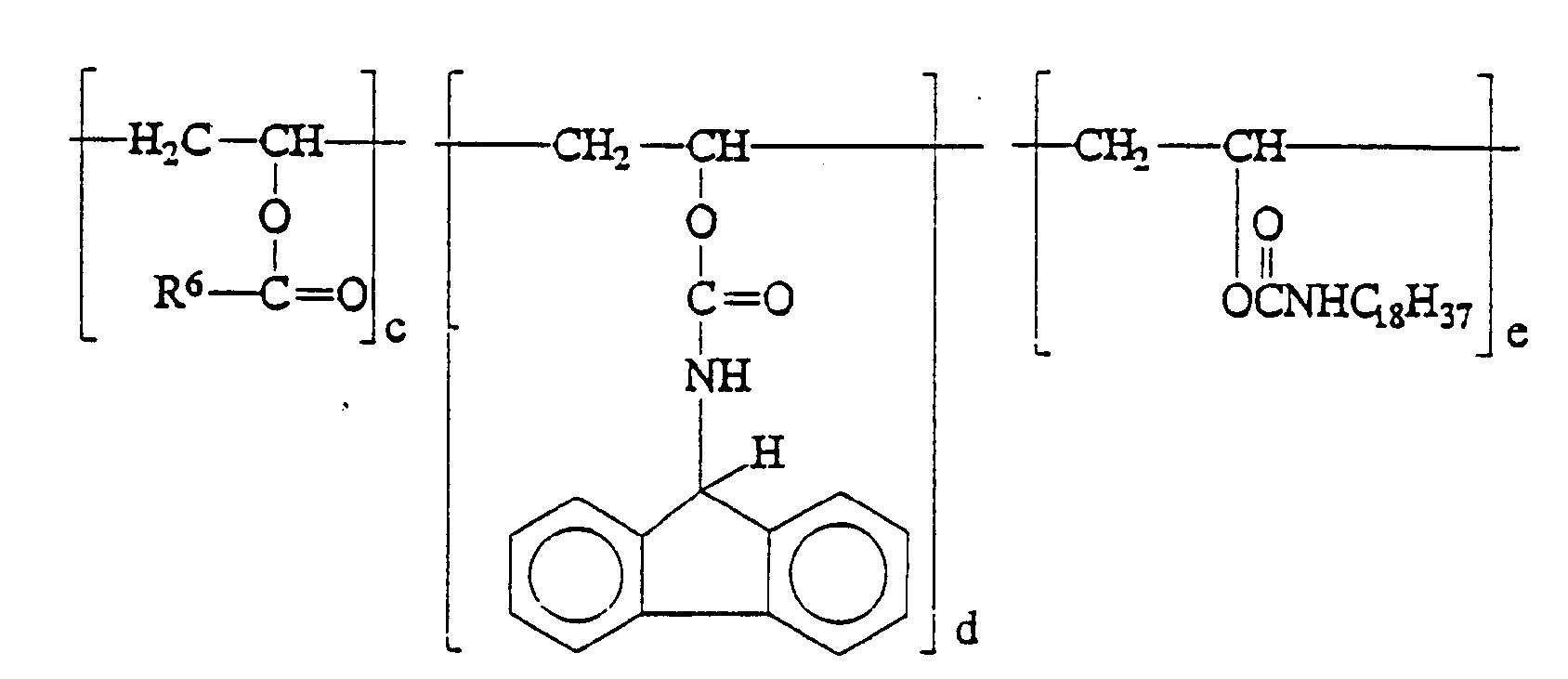


 R eine oder mehrere niedere Alkylgruppen (C₁ ... C₄) oder Phenylgruppen und c, d und e ganz Zahlen, deren Summe 10 ... 20.000 beträgt, d ist 0,01 % bis 10 % der Summe und e 5 % ... 95 % der Summe,j, k und m ganze Zahlen, deren Summe 10 ... 10.000 ist, k beträgt 0,01 ... 10 % der Summe von j, k und m, wobei m Null bis 99,5 % der Summe von j, k und m beträgt und n eine ganze Zahl von 5 ... 10.000 ist, p und q sind ganze Zahlen, wobei das Verhältnis von p/q 0,2/1 ... 5/1 beträgt und wobei die zahlengemittelten relativen Molekülmassen der p und q enthaltenen Polymere 500 ... 20.000 beträgt.
 - Verwendung einer Verbundstoffstruktur nach Anspruch 10 in einem verfahren nach einem der Ansprüche 1 bis 3.
Priority Applications (6)
| Application Number | Priority Date | Filing Date | Title |
|---|---|---|---|
| AU14054/88A AU597813B2 (en) | 1988-04-06 | 1988-03-31 | Process for fluorimetric monitoring of functional coatings and compositions and fluorescent agents therefor |
| BR8801627A BR8801627A (pt) | 1988-04-06 | 1988-04-06 | Processo para controlar composicoes de revestimento funcionais |
| ES88303036T ES2068823T3 (es) | 1988-04-06 | 1988-04-06 | Procedimiento para vigilancia fluorimetrica de revestimientos funcionales y estructuras utilizadas en el procedimiento y que comprenden un sustrato y dicho revestimiento funcional. |
| EP88303036A EP0336029B1 (de) | 1988-04-06 | 1988-04-06 | Verfahren zur fluorimetrischen Kontrolle funktioneller Beschichtungen sowie dabei verwendete Strukturen bestehend aus einem Substrat mit dieser funktionellen Beschichtung |
| DE3853207T DE3853207T2 (de) | 1988-04-06 | 1988-04-06 | Verfahren zur fluorimetrischen Kontrolle funktioneller Beschichtungen sowie dabei verwendete Strukturen bestehend aus einem Substrat mit dieser funktionellen Beschichtung. |
| HK204396A HK204396A (en) | 1988-04-06 | 1996-11-07 | Process for fluorimetric monitoring of functional coatings and structures used in the process and comprising a substrate and said functional coating |
Applications Claiming Priority (1)
| Application Number | Priority Date | Filing Date | Title |
|---|---|---|---|
| EP88303036A EP0336029B1 (de) | 1988-04-06 | 1988-04-06 | Verfahren zur fluorimetrischen Kontrolle funktioneller Beschichtungen sowie dabei verwendete Strukturen bestehend aus einem Substrat mit dieser funktionellen Beschichtung |
Publications (2)
| Publication Number | Publication Date |
|---|---|
| EP0336029A1 EP0336029A1 (de) | 1989-10-11 |
| EP0336029B1 true EP0336029B1 (de) | 1995-03-01 |
Family
ID=8200019
Family Applications (1)
| Application Number | Title | Priority Date | Filing Date |
|---|---|---|---|
| EP88303036A Expired - Lifetime EP0336029B1 (de) | 1988-04-06 | 1988-04-06 | Verfahren zur fluorimetrischen Kontrolle funktioneller Beschichtungen sowie dabei verwendete Strukturen bestehend aus einem Substrat mit dieser funktionellen Beschichtung |
Country Status (4)
| Country | Link |
|---|---|
| EP (1) | EP0336029B1 (de) |
| AU (1) | AU597813B2 (de) |
| DE (1) | DE3853207T2 (de) |
| ES (1) | ES2068823T3 (de) |
Cited By (1)
| Publication number | Priority date | Publication date | Assignee | Title |
|---|---|---|---|---|
| US7079262B2 (en) | 1999-03-16 | 2006-07-18 | Heroit-Watt University | Fluorescent materials |
Families Citing this family (16)
| Publication number | Priority date | Publication date | Assignee | Title |
|---|---|---|---|---|
| US5047444A (en) * | 1989-05-31 | 1991-09-10 | Minnesota Mining And Manufacturing Company | Fluorescent degree of cure monitors |
| US5574288A (en) * | 1995-04-17 | 1996-11-12 | Minnesota Mining And Manufacturing Company | Method for measuring residual radiation-curable monomers or oligomers |
| US5650455A (en) * | 1995-10-17 | 1997-07-22 | Eastman Chemical Company | Method for dispersing optical brighteners in waterborne coating compositions |
| ATE175777T1 (de) * | 1996-02-15 | 1999-01-15 | Herberts & Co Gmbh | Verfahren und vorrichtung zur charakterisierung lackierter oberflächen |
| EP1105550B1 (de) | 1998-07-27 | 2003-03-12 | Imperial College Of Science, Technology & Medicine | Wärmedämmschicht mit eingebettetem thermolumineszenz-indikatorwerkstoff |
| US6962670B1 (en) * | 2000-08-16 | 2005-11-08 | Eastman Chemical Company | Determination of layer thickness or non-uniformity of layer thickness based on fluorophore additives |
| WO2002033389A1 (en) * | 2000-10-19 | 2002-04-25 | General Electric Company | Methods for nondestructive evaluation of defects in a transparent coating |
| US6538725B2 (en) * | 2001-01-22 | 2003-03-25 | General Electric Company | Method for determination of structural defects of coatings |
| JP3723845B2 (ja) | 2002-03-26 | 2005-12-07 | 国立大学法人富山大学 | 有機エレクトロルミネッセンス素子に使用される有機薄膜の膜厚測定法および測定装置 |
| US20080305244A1 (en) * | 2007-06-08 | 2008-12-11 | Ji Cui | Monitoring a coating applied to a metal surface |
| DE102008033940B3 (de) * | 2008-07-18 | 2010-01-21 | Innovent E.V. | Verfahren zum Bestimmen einer Schichtqualität |
| DE102013223261A1 (de) * | 2013-11-14 | 2015-05-21 | Bayerische Motoren Werke Aktiengesellschaft | Karosseriebeschichtung, Fahrzeug, Verfahren zur Ermittlung von Karosserieschäden an einem Fahrzeug und Verwendung einer Folie mit einem Fluoreszenzmittel |
| FI126195B (en) | 2014-01-28 | 2016-08-15 | Upm Kymmene Corp | Fiber-based product |
| DE102016210357A1 (de) * | 2016-06-10 | 2017-12-14 | Fraunhofer-Gesellschaft zur Förderung der angewandten Forschung e.V. | Verfahren und Vorrichtung zur Erfassung einer Belegung einer Oberfläche mittels induzierter Fluoreszenz |
| RU2644917C1 (ru) * | 2016-12-02 | 2018-02-14 | Федеральное государственное унитарное предприятие "Центральный аэрогидродинамический институт имени профессора Н.Е. Жуковского" (ФГУП "ЦАГИ") | Люминесцентное полимерное покрытие для обнаружения повреждений конструкции |
| DE102020210484B4 (de) | 2020-08-18 | 2024-10-31 | Magna Steyr Fahrzeugtechnik Gmbh & Co Kg | Verfahren zum Prüfen einer Konservierungsschicht |
Family Cites Families (7)
| Publication number | Priority date | Publication date | Assignee | Title |
|---|---|---|---|---|
| US3547827A (en) * | 1961-10-12 | 1970-12-15 | Day Glo Color Corp | Compositions for non-visible penetrant methods of flaw detection |
| US3577885A (en) * | 1969-07-30 | 1971-05-11 | Phillips Petroleum Co | Paper coating composition |
| GB1422526A (en) * | 1972-03-28 | 1976-01-28 | Koch Light Lab Ltd | Scintillators |
| US3956630A (en) * | 1975-03-14 | 1976-05-11 | Westvaco Corporation | Fluorimetric coat weight measurement |
| GB2016370B (en) * | 1978-01-18 | 1982-02-17 | Post Office | Credit cards security documents and the like |
| US4250382A (en) * | 1979-08-14 | 1981-02-10 | Scott Paper Company | Coat detection method |
| GB2194244B (en) * | 1981-11-23 | 1988-08-10 | Post Office | Improvements in or relating to phosphorescent compounds and materials |
-
1988
- 1988-03-31 AU AU14054/88A patent/AU597813B2/en not_active Ceased
- 1988-04-06 ES ES88303036T patent/ES2068823T3/es not_active Expired - Lifetime
- 1988-04-06 EP EP88303036A patent/EP0336029B1/de not_active Expired - Lifetime
- 1988-04-06 DE DE3853207T patent/DE3853207T2/de not_active Expired - Lifetime
Cited By (1)
| Publication number | Priority date | Publication date | Assignee | Title |
|---|---|---|---|---|
| US7079262B2 (en) | 1999-03-16 | 2006-07-18 | Heroit-Watt University | Fluorescent materials |
Also Published As
| Publication number | Publication date |
|---|---|
| AU1405488A (en) | 1989-11-23 |
| EP0336029A1 (de) | 1989-10-11 |
| DE3853207D1 (de) | 1995-04-06 |
| AU597813B2 (en) | 1990-06-07 |
| DE3853207T2 (de) | 1995-09-28 |
| ES2068823T3 (es) | 1995-05-01 |
Similar Documents
| Publication | Publication Date | Title |
|---|---|---|
| US4922113A (en) | Process for fluorimetric monitoring of functional coatings and compositions and fluorescent agents therefor | |
| US5270116A (en) | Process for fluorimetric monitoring of functional coatings and compositions and fluorescent agents therefor | |
| US4978731A (en) | Process for fluorimetric monitoring of functional coatings and compositions and fluorescent agents therefor | |
| EP0336029B1 (de) | Verfahren zur fluorimetrischen Kontrolle funktioneller Beschichtungen sowie dabei verwendete Strukturen bestehend aus einem Substrat mit dieser funktionellen Beschichtung | |
| US5087670A (en) | Process for fluorimetric monitoring of functional coatings and compositions and fluorescent agents therefor | |
| EP0400972B1 (de) | Fluoreszente Härtungskontrollmittel | |
| US5182316A (en) | Fluorescent degree of cure monitors | |
| US7079262B2 (en) | Fluorescent materials | |
| US4250382A (en) | Coat detection method | |
| JP3241732B2 (ja) | 共重合された近赤外蛍光化合物を含有する水散逸性ポリエステル及びアミド | |
| Mitsuishi et al. | Characterization of an ultrathin polymer optode and its application to temperature sensors based on luminescent europium complexes | |
| US20090101837A1 (en) | Multilayer identification marker compositions | |
| JP2005500388A (ja) | 摩擦ルミネッセンス材料及びデバイス | |
| US7242443B2 (en) | Triboluminescent materials and devices | |
| JP2002105409A (ja) | 被覆組成物、その使用、発光被覆の製造方法および被覆された物品 | |
| US7767315B2 (en) | Document authentification | |
| US5556663A (en) | Excimer fluorescence method for determining cure of coatings | |
| EP2669340B1 (de) | Verbesserter binärer druckempfindlicher Anstrich | |
| EP1887066A2 (de) | Verfahren zur Identifizierung von Artikeln und Verfahren zur Aufrechterhaltung der Sicherheit | |
| US5118559A (en) | Fluorescent degree of cure monitors | |
| CA1292592C (en) | Process for fluorimetric monitoring of functional coatings and compositions and fluorescent agents therefor | |
| HK204396A (en) | Process for fluorimetric monitoring of functional coatings and structures used in the process and comprising a substrate and said functional coating | |
| JP2706463B2 (ja) | 官能性塗料組成物を監視する方法 | |
| KR970007044B1 (ko) | 기능성 코팅의 형광분석 모니터 방법 및 그 방법에 사용되는 복합 구조물 | |
| Roppolo et al. | Luminescence thermochromism of acrylic materials incorporating copper iodide clusters |
Legal Events
| Date | Code | Title | Description |
|---|---|---|---|
| PUAI | Public reference made under article 153(3) epc to a published international application that has entered the european phase |
Free format text: ORIGINAL CODE: 0009012 |
|
| AK | Designated contracting states |
Kind code of ref document: A1 Designated state(s): BE DE ES FR GB IT NL |
|
| 17P | Request for examination filed |
Effective date: 19900119 |
|
| 17Q | First examination report despatched |
Effective date: 19920127 |
|
| GRAA | (expected) grant |
Free format text: ORIGINAL CODE: 0009210 |
|
| ITF | It: translation for a ep patent filed | ||
| AK | Designated contracting states |
Kind code of ref document: B1 Designated state(s): BE DE ES FR GB IT NL |
|
| REF | Corresponds to: |
Ref document number: 3853207 Country of ref document: DE Date of ref document: 19950406 |
|
| REG | Reference to a national code |
Ref country code: ES Ref legal event code: FG2A Ref document number: 2068823 Country of ref document: ES Kind code of ref document: T3 |
|
| ET | Fr: translation filed | ||
| PLBE | No opposition filed within time limit |
Free format text: ORIGINAL CODE: 0009261 |
|
| STAA | Information on the status of an ep patent application or granted ep patent |
Free format text: STATUS: NO OPPOSITION FILED WITHIN TIME LIMIT |
|
| 26N | No opposition filed | ||
| REG | Reference to a national code |
Ref country code: GB Ref legal event code: IF02 |
|
| PGFP | Annual fee paid to national office [announced via postgrant information from national office to epo] |
Ref country code: NL Payment date: 20020321 Year of fee payment: 15 |
|
| PGFP | Annual fee paid to national office [announced via postgrant information from national office to epo] |
Ref country code: BE Payment date: 20020416 Year of fee payment: 15 |
|
| PGFP | Annual fee paid to national office [announced via postgrant information from national office to epo] |
Ref country code: ES Payment date: 20020509 Year of fee payment: 15 |
|
| PG25 | Lapsed in a contracting state [announced via postgrant information from national office to epo] |
Ref country code: ES Free format text: LAPSE BECAUSE OF NON-PAYMENT OF DUE FEES Effective date: 20030407 |
|
| PG25 | Lapsed in a contracting state [announced via postgrant information from national office to epo] |
Ref country code: BE Free format text: LAPSE BECAUSE OF NON-PAYMENT OF DUE FEES Effective date: 20030430 |
|
| BERE | Be: lapsed |
Owner name: *MINNESOTA MINING AND MFG CY Effective date: 20030430 |
|
| PG25 | Lapsed in a contracting state [announced via postgrant information from national office to epo] |
Ref country code: NL Free format text: LAPSE BECAUSE OF NON-PAYMENT OF DUE FEES Effective date: 20031101 |
|
| NLV4 | Nl: lapsed or anulled due to non-payment of the annual fee |
Effective date: 20031101 |
|
| REG | Reference to a national code |
Ref country code: ES Ref legal event code: FD2A Effective date: 20030407 |
|
| PGFP | Annual fee paid to national office [announced via postgrant information from national office to epo] |
Ref country code: DE Payment date: 20070531 Year of fee payment: 20 |
|
| PGFP | Annual fee paid to national office [announced via postgrant information from national office to epo] |
Ref country code: GB Payment date: 20070425 Year of fee payment: 20 |
|
| PGFP | Annual fee paid to national office [announced via postgrant information from national office to epo] |
Ref country code: IT Payment date: 20070523 Year of fee payment: 20 |
|
| PGFP | Annual fee paid to national office [announced via postgrant information from national office to epo] |
Ref country code: FR Payment date: 20070417 Year of fee payment: 20 |
|
| REG | Reference to a national code |
Ref country code: GB Ref legal event code: PE20 Expiry date: 20080405 |
|
| PG25 | Lapsed in a contracting state [announced via postgrant information from national office to epo] |
Ref country code: GB Free format text: LAPSE BECAUSE OF EXPIRATION OF PROTECTION Effective date: 20080405 |