EP0336629A1 - Polymerstabilisierte kolloidale Metallösung - Google Patents
Polymerstabilisierte kolloidale Metallösung Download PDFInfo
- Publication number
- EP0336629A1 EP0336629A1 EP89303062A EP89303062A EP0336629A1 EP 0336629 A1 EP0336629 A1 EP 0336629A1 EP 89303062 A EP89303062 A EP 89303062A EP 89303062 A EP89303062 A EP 89303062A EP 0336629 A1 EP0336629 A1 EP 0336629A1
- Authority
- EP
- European Patent Office
- Prior art keywords
- polymer
- metal
- solution
- stabilized colloidal
- colloidal metal
- Prior art date
- Legal status (The legal status is an assumption and is not a legal conclusion. Google has not performed a legal analysis and makes no representation as to the accuracy of the status listed.)
- Granted
Links
Images
Classifications
-
- B—PERFORMING OPERATIONS; TRANSPORTING
- B01—PHYSICAL OR CHEMICAL PROCESSES OR APPARATUS IN GENERAL
- B01J—CHEMICAL OR PHYSICAL PROCESSES, e.g. CATALYSIS OR COLLOID CHEMISTRY; THEIR RELEVANT APPARATUS
- B01J31/00—Catalysts comprising hydrides, coordination complexes or organic compounds
- B01J31/16—Catalysts comprising hydrides, coordination complexes or organic compounds containing coordination complexes
- B01J31/165—Polymer immobilised coordination complexes, e.g. organometallic complexes
- B01J31/1658—Polymer immobilised coordination complexes, e.g. organometallic complexes immobilised by covalent linkages, i.e. pendant complexes with optional linking groups, e.g. on Wang or Merrifield resins
- B01J31/1675—Polymer immobilised coordination complexes, e.g. organometallic complexes immobilised by covalent linkages, i.e. pendant complexes with optional linking groups, e.g. on Wang or Merrifield resins the linkage being to an organometallic polymer covered by groups B01J31/123 - B01J31/127, e.g. polyhydrosiloxanes
-
- B—PERFORMING OPERATIONS; TRANSPORTING
- B01—PHYSICAL OR CHEMICAL PROCESSES OR APPARATUS IN GENERAL
- B01J—CHEMICAL OR PHYSICAL PROCESSES, e.g. CATALYSIS OR COLLOID CHEMISTRY; THEIR RELEVANT APPARATUS
- B01J31/00—Catalysts comprising hydrides, coordination complexes or organic compounds
- B01J31/16—Catalysts comprising hydrides, coordination complexes or organic compounds containing coordination complexes
- B01J31/1616—Coordination complexes, e.g. organometallic complexes, immobilised on an inorganic support, e.g. ship-in-a-bottle type catalysts
-
- B—PERFORMING OPERATIONS; TRANSPORTING
- B01—PHYSICAL OR CHEMICAL PROCESSES OR APPARATUS IN GENERAL
- B01J—CHEMICAL OR PHYSICAL PROCESSES, e.g. CATALYSIS OR COLLOID CHEMISTRY; THEIR RELEVANT APPARATUS
- B01J2531/00—Additional information regarding catalytic systems classified in B01J31/00
- B01J2531/10—Complexes comprising metals of Group I (IA or IB) as the central metal
- B01J2531/16—Copper
-
- B—PERFORMING OPERATIONS; TRANSPORTING
- B01—PHYSICAL OR CHEMICAL PROCESSES OR APPARATUS IN GENERAL
- B01J—CHEMICAL OR PHYSICAL PROCESSES, e.g. CATALYSIS OR COLLOID CHEMISTRY; THEIR RELEVANT APPARATUS
- B01J2531/00—Additional information regarding catalytic systems classified in B01J31/00
- B01J2531/60—Complexes comprising metals of Group VI (VIA or VIB) as the central metal
- B01J2531/62—Chromium
-
- B—PERFORMING OPERATIONS; TRANSPORTING
- B01—PHYSICAL OR CHEMICAL PROCESSES OR APPARATUS IN GENERAL
- B01J—CHEMICAL OR PHYSICAL PROCESSES, e.g. CATALYSIS OR COLLOID CHEMISTRY; THEIR RELEVANT APPARATUS
- B01J2531/00—Additional information regarding catalytic systems classified in B01J31/00
- B01J2531/80—Complexes comprising metals of Group VIII as the central metal
- B01J2531/82—Metals of the platinum group
- B01J2531/824—Palladium
-
- B—PERFORMING OPERATIONS; TRANSPORTING
- B01—PHYSICAL OR CHEMICAL PROCESSES OR APPARATUS IN GENERAL
- B01J—CHEMICAL OR PHYSICAL PROCESSES, e.g. CATALYSIS OR COLLOID CHEMISTRY; THEIR RELEVANT APPARATUS
- B01J2531/00—Additional information regarding catalytic systems classified in B01J31/00
- B01J2531/80—Complexes comprising metals of Group VIII as the central metal
- B01J2531/82—Metals of the platinum group
- B01J2531/828—Platinum
-
- B—PERFORMING OPERATIONS; TRANSPORTING
- B01—PHYSICAL OR CHEMICAL PROCESSES OR APPARATUS IN GENERAL
- B01J—CHEMICAL OR PHYSICAL PROCESSES, e.g. CATALYSIS OR COLLOID CHEMISTRY; THEIR RELEVANT APPARATUS
- B01J2531/00—Additional information regarding catalytic systems classified in B01J31/00
- B01J2531/80—Complexes comprising metals of Group VIII as the central metal
- B01J2531/84—Metals of the iron group
- B01J2531/845—Cobalt
-
- B—PERFORMING OPERATIONS; TRANSPORTING
- B01—PHYSICAL OR CHEMICAL PROCESSES OR APPARATUS IN GENERAL
- B01J—CHEMICAL OR PHYSICAL PROCESSES, e.g. CATALYSIS OR COLLOID CHEMISTRY; THEIR RELEVANT APPARATUS
- B01J2531/00—Additional information regarding catalytic systems classified in B01J31/00
- B01J2531/80—Complexes comprising metals of Group VIII as the central metal
- B01J2531/84—Metals of the iron group
- B01J2531/847—Nickel
Definitions
- the present invention is a composition of matter which includes a polymer stabilized colloidal metal solution.
- the solution includes small metal clusters which may be used directly for catalytic activity in the liquid phase or to produce discrete metal clusters in a solid matrix which also can be used for catalytic acitivity.
- the metal clusters are prepared in various ways, including the condensation of transition metal vapors into organic liquids, the reduction of metal complexes to the metal in solution, and the thermal decomposition of metal complexes in solution.
- it is necessary to stabilize the colloidal metal particles against agglomeration and precipitation from solution.
- aqueous colloids, or colloidal solutions in polar media this is often accomplished by electrostatic repulsion - the colloid particles bear a net charge.
- organic polymers have the ability to stabilize colloids and prevent their coagulation from solution.
- One means by which this is achieved is by adsorption of the polymer molecule to the surface of the colloidal particle (steric stabilization).
- the stabilizing polymer must be "compatible" with both the dispersed phase and the diluent phase.
- copolymers containing monomers with an adsorbing functionality and those with a solubility enhancing functionality can sterically stabilize a colloidal solution.
- Organic polymers have been used to stabilize metal colloids prepared by reduction of metal salts in aqueous and non-aqueous solutions.
- the present invention discloses the use of organometallic polymers to stabilize transition metal colloids.
- the present invention is a polymer stabilized collodial metal (M) solution wherein the polymer is an organometallic polymer.
- the polymer whose monomer unit contains a second metal M′, is soluble in an inert liquid and interacts with the colloidal particles of M so as to solubilize the particles of M in the liquid.
- the polymer is also able to react with water so as to produce the oxide of M′, M′2O Z or its hydrate.
- the metal M is a transition metal; in particular, palladium, platinum, copper, nickel, cobalt or chromium.
- the polymer has the formula (R x M′O) n where R is an alkyl group, cycloalkyl group or an alkoxy group and M′ is a metal and x is two less than the valence of the metal M′ and n is the number of monomer units.
- the liquid is an organic liquid.
- M′ is aluminum and R is isobutyl.
- the present invention is composition which includes a polymer stabilized colloidal metal solution.
- the metal is present in the solutionin the form of clusters.
- the metal clusters may be generated in a number of ways, among them the condensation of the vapor of the transition metal vapor into a cold solution of the organometallic polymer in an organic solvent.
- Another means of generating the transition metal clusters is by the thermal decomposition of a complex of the transition metal. In this method the transition metal complex is heated to its decomposition temperature in a solution of the polymer in an organic solvent.
- Another method of forming the transition metal clusters is by the chemical reduction of a transition metal compound to the metal in a solution of the organometallic polymer in an organic solvent. It is anticipated that any chemical or physical method of generating elemental metals in a highly dispersed form in the presence of a solution of the polymer in an organic solvent will result in the formation of the stabilized colloids which are the subject of the present invention.
- the present invention provides the use of an organometallic polymer to stabilize transition metal microcrystallites in a fluid matrix.
- the polymers used in the present invention are chosen on the basis of several criteria. Since the colloidal metal solutions are in organic solvents, the polymer must be soluble and stable in the organic solvent of choice under the conditions used to generate the metal clusters. For example, if the clusters are to be generated by the condensation of metal vapors into a cold solution of the polymer, the polymer must be soluble in the solvent at the temperature of the condensation experiment. Alternatively, if the clusters are to be generated by the thermal decomposition of a metal complex at a high temperature, the polymer must be stable in the solvent at the temperature used to decompose the complex.
- a second criterion is that the polymer must contain functional groups which interact with the solvent used, so that the metal clusters are stabilized and solubilized in the solvent.
- a third criterion is that the polymer must have chemical properties consistent with the planned use for the colloidal solution.
- one of the uses of the colloidal solutions is to prepare oxide supported metal clusters. Accordingly a beneficial property of the organometallic polymers used in the present invention is that they are easily hydrolyzed by reaction with water to the hydrated oxide of the metal which is the constituent of the polymer. Thus a solid oxide containing clusters of the colloidal metal can be prepared by reacting the colloidal metal solutions with water.
- a collateral benefit of the reactivity of the polymer is that it reacts readily with hydroxyl groups on the surface of metal oxides such as alumina, silica and other oxides which are widely used as supports for metal catalyst particles.
- colloidal solutions of metal clusters stabilized by the organometallic polymers of the present invention can be used as a source of preformed metal clusters for supporting an oxides by allowing the polymer to react with the hydroxyl groups of the oxide.
- poly(isobutylaluminoxane), (iC4H9Al0) n was used as the stabilizing organometallic polymer for metal colloids.
- Aluminoxanes are organometallic polymers of general formula (RA10) n , synthesized by the partial hydrolysis of trialkylaluminums R3Al.
- poly(isobutylaluminoxane) and its homologs behave as organometallic soluble supporting polymers for small metal particles in organic colloidal solutions.
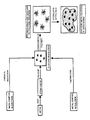
- the figure summarizes the preparation of polymer stabilized colloidal solutions of metal by three possible routes. These are the chemical reduction of a dissolved metal complex, the condensation of metal vapors into a solution, and the thermal decomposition of a metal complex to the metal in solution. Each of these procedures when performed in the presence of an organometallic polymer results in the formation of a stable colloidal solution of the metal.
- a solution of tri-isobutyl aluminum in toluene (50 mL of a 1.0M solution) was diluted to 250 mL with dry toluene (distilled from sodium benzophenoneketyl) and cooled in an ice bath, under an atmosphere of nitrogen. To the stirred solution was added water (900u, 50 mmole) in nine equal amounts at ten minute intervals. The solution was stirred and allowed to come to room temperature. Toluene was distilled from the product solution under reduced pressure, leaving a colorless viscous gum. After pumping at room temperature for one hour, the product was dissolved in dry distilled methylcyclohexane (200mL).
- Palladium metal was heated in the resistive furnace at the center of the reactor, and when the temperature of the metal had risen just above its melting point (1555°C) a brown color developed in the polymer solution film on the walls of the rotating flask as palladium vapor condensed into the liquid.
- the furnace was cooled and the flask allowed to warm to room temperature.
- the deep brown solution produced was transferred under helium to an evacuated Schlenk tube, and then to a helium filled glove box. After filtration through a medium porosity glass frit to remove any bulk metallic palladium precipitate (which to varying degrees forms in these experiments) the solution was passed through a .2 m millipore filter and stored under helium for further use.
- the solution was analyzed for palladium content as follows: A stream of nitrogen gas was sparged through a reservoir of deoxygenated water, and the water saturated gas bubbled through an aluminoxane stabilized metal colloid solution. As the aluminoxane hydrolyzed, precipitation occurred, and the gray precipitates were collected and dried at 100°C. Thermogravimetric analysis of the hydrolyzed precipitate from a pure aluminoxane solution revealed it to be Al(O)OH.H2O. Elemental analysis of the precipitate from hydrolysis of the palladium colloid revealed that >80% of the evaporated palladium had dissolved and been stabilized in colloidal form.
- a solution of poly(isobutylaluminoxane) (prepared as in Example 1 from 50 mmol. of triisobutylaluminum) in methyl cyclohexane (200 ml.) was degassed through three freeze-pump-thaw cycles and added to the evacuated reactor flask of the reactor.
- the flask was cooled to -120°C and rotated at ca. 120 rmp.
- the vapor pressure had equilibrted at 10 ⁇ 3 torr the system was diffusion pumped to 5x10 ⁇ 5 torr, and the platinum metal was evaporated into the polymer solution from the hearth of a 2 KW electron beam furnace mounted near the center of the flask.
Landscapes
- Chemical & Material Sciences (AREA)
- Organic Chemistry (AREA)
- Inorganic Chemistry (AREA)
- Engineering & Computer Science (AREA)
- Materials Engineering (AREA)
- Chemical Kinetics & Catalysis (AREA)
- Colloid Chemistry (AREA)
- Catalysts (AREA)
- Polymers With Sulfur, Phosphorus Or Metals In The Main Chain (AREA)
- Compositions Of Macromolecular Compounds (AREA)
- Emulsifying, Dispersing, Foam-Producing Or Wetting Agents (AREA)
Applications Claiming Priority (2)
| Application Number | Priority Date | Filing Date | Title |
|---|---|---|---|
| US07/174,135 US4857492A (en) | 1988-03-28 | 1988-03-28 | Transition metal organosols stabilized by organometallic polymers |
| US174135 | 1998-10-16 |
Publications (2)
| Publication Number | Publication Date |
|---|---|
| EP0336629A1 true EP0336629A1 (de) | 1989-10-11 |
| EP0336629B1 EP0336629B1 (de) | 1992-06-03 |
Family
ID=22634977
Family Applications (1)
| Application Number | Title | Priority Date | Filing Date |
|---|---|---|---|
| EP89303062A Expired EP0336629B1 (de) | 1988-03-28 | 1989-03-28 | Polymerstabilisierte kolloidale Metallösung |
Country Status (7)
| Country | Link |
|---|---|
| US (1) | US4857492A (de) |
| EP (1) | EP0336629B1 (de) |
| JP (1) | JPH01299638A (de) |
| AU (1) | AU608137B2 (de) |
| CA (1) | CA1334453C (de) |
| DE (1) | DE68901674T2 (de) |
| NO (1) | NO173640C (de) |
Cited By (1)
| Publication number | Priority date | Publication date | Assignee | Title |
|---|---|---|---|---|
| EP1121403A4 (de) * | 1998-07-31 | 2003-04-09 | Platinum Res Organization Llc | Katalysierte zusätze für schmiermittel und katalysierte schmiermittelsysteme für schnellere haftungsreaktion des schmiermittels |
Families Citing this family (11)
| Publication number | Priority date | Publication date | Assignee | Title |
|---|---|---|---|---|
| US5952421A (en) * | 1995-12-27 | 1999-09-14 | Exxon Research And Engineering Co. | Synthesis of preceramic polymer-stabilized metal colloids and their conversion to microporous ceramics |
| US5852088A (en) * | 1995-12-27 | 1998-12-22 | Exxon Research And Engineering Company | Nanoporous ceramics with catalytic functionality |
| US6258758B1 (en) | 1996-04-26 | 2001-07-10 | Platinum Research Organization Llc | Catalyzed surface composition altering and surface coating formulations and methods |
| US5877128A (en) * | 1996-04-26 | 1999-03-02 | Platinum Research Organization Ltd. | Catalyzed lubricant additives and catalyzed lubricant systems designed to accelerate the lubricant bonding reaction |
| US5905000A (en) | 1996-09-03 | 1999-05-18 | Nanomaterials Research Corporation | Nanostructured ion conducting solid electrolytes |
| US6933331B2 (en) | 1998-05-22 | 2005-08-23 | Nanoproducts Corporation | Nanotechnology for drug delivery, contrast agents and biomedical implants |
| US6169119B1 (en) * | 1997-02-14 | 2001-01-02 | Reliance Electric Technologies, Llc | Metal oxide sols and process for making the same |
| US6855426B2 (en) | 2001-08-08 | 2005-02-15 | Nanoproducts Corporation | Methods for producing composite nanoparticles |
| US7708974B2 (en) | 2002-12-10 | 2010-05-04 | Ppg Industries Ohio, Inc. | Tungsten comprising nanomaterials and related nanotechnology |
| US8791056B2 (en) | 2010-06-24 | 2014-07-29 | Board Of Regents, The University Of Texas System | Alkylphosphorofluoridothioates having low wear volume and methods for synthesizing and using same |
| US9725669B2 (en) | 2012-05-07 | 2017-08-08 | Board Of Regents, The University Of Texas System | Synergistic mixtures of ionic liquids with other ionic liquids and/or with ashless thiophosphates for antiwear and/or friction reduction applications |
Citations (5)
| Publication number | Priority date | Publication date | Assignee | Title |
|---|---|---|---|---|
| US4252678A (en) * | 1979-12-04 | 1981-02-24 | Xerox Corporation | Preparation of colloidal dispersions of ruthenium, rhodium, osmium and iridium by the polymer-catalyzed decomposition of carbonyl cluster compounds thereof |
| US4292253A (en) * | 1979-04-03 | 1981-09-29 | Ozin Geoffrey A | Organo-metal catalysts and processes for their preparation |
| US4332698A (en) * | 1981-01-19 | 1982-06-01 | Mpd Technology Corporation | Catalyst sheet and preparation |
| EP0054832A1 (de) * | 1980-12-15 | 1982-06-30 | The Dow Chemical Company | Hydrophobes Polymerteilchen von kolloidaler Grösse, worin kleine Teilchen von anorganischem Material dispergiert sind |
| EP0219911A1 (de) * | 1985-10-18 | 1987-04-29 | Unilever N.V. | Nickelborid enthaltende Polymerkatalysatorzusammensetzung |
Family Cites Families (3)
| Publication number | Priority date | Publication date | Assignee | Title |
|---|---|---|---|---|
| GB2059282B (en) * | 1979-09-08 | 1983-07-06 | Engelhard Min & Chem | Catalyst for photolytic production of hydrogen from water |
| US4665047A (en) * | 1986-08-15 | 1987-05-12 | Shell Oil Company | Stabilization of metallocene/aluminoxane catalysts |
| JP2901544B2 (ja) * | 1996-06-19 | 1999-06-07 | 日本電気情報サービス株式会社 | カーナビゲーション装置 |
-
1988
- 1988-03-28 US US07/174,135 patent/US4857492A/en not_active Expired - Fee Related
-
1989
- 1989-03-08 CA CA000593098A patent/CA1334453C/en not_active Expired - Fee Related
- 1989-03-13 NO NO891059A patent/NO173640C/no unknown
- 1989-03-23 AU AU31677/89A patent/AU608137B2/en not_active Ceased
- 1989-03-28 DE DE8989303062T patent/DE68901674T2/de not_active Expired - Lifetime
- 1989-03-28 JP JP1076358A patent/JPH01299638A/ja active Pending
- 1989-03-28 EP EP89303062A patent/EP0336629B1/de not_active Expired
Patent Citations (5)
| Publication number | Priority date | Publication date | Assignee | Title |
|---|---|---|---|---|
| US4292253A (en) * | 1979-04-03 | 1981-09-29 | Ozin Geoffrey A | Organo-metal catalysts and processes for their preparation |
| US4252678A (en) * | 1979-12-04 | 1981-02-24 | Xerox Corporation | Preparation of colloidal dispersions of ruthenium, rhodium, osmium and iridium by the polymer-catalyzed decomposition of carbonyl cluster compounds thereof |
| EP0054832A1 (de) * | 1980-12-15 | 1982-06-30 | The Dow Chemical Company | Hydrophobes Polymerteilchen von kolloidaler Grösse, worin kleine Teilchen von anorganischem Material dispergiert sind |
| US4332698A (en) * | 1981-01-19 | 1982-06-01 | Mpd Technology Corporation | Catalyst sheet and preparation |
| EP0219911A1 (de) * | 1985-10-18 | 1987-04-29 | Unilever N.V. | Nickelborid enthaltende Polymerkatalysatorzusammensetzung |
Cited By (1)
| Publication number | Priority date | Publication date | Assignee | Title |
|---|---|---|---|---|
| EP1121403A4 (de) * | 1998-07-31 | 2003-04-09 | Platinum Res Organization Llc | Katalysierte zusätze für schmiermittel und katalysierte schmiermittelsysteme für schnellere haftungsreaktion des schmiermittels |
Also Published As
| Publication number | Publication date |
|---|---|
| NO173640B (no) | 1993-10-04 |
| NO173640C (no) | 1994-01-12 |
| DE68901674T2 (de) | 1992-12-10 |
| NO891059D0 (no) | 1989-03-13 |
| US4857492A (en) | 1989-08-15 |
| CA1334453C (en) | 1995-02-14 |
| NO891059L (no) | 1989-09-29 |
| AU3167789A (en) | 1989-09-28 |
| AU608137B2 (en) | 1991-03-21 |
| DE68901674D1 (de) | 1992-07-09 |
| EP0336629B1 (de) | 1992-06-03 |
| JPH01299638A (ja) | 1989-12-04 |
Similar Documents
| Publication | Publication Date | Title |
|---|---|---|
| EP0336629B1 (de) | Polymerstabilisierte kolloidale Metallösung | |
| US5459116A (en) | Highly active catalyst for the polymerization of olefins and method for the preparation of the same | |
| US4173547A (en) | Catalyst for preparing polyalkenes | |
| Greaves et al. | Metal–acetylene complexes. II. Acetylene complexes of nickel, palladium, and platinum | |
| CA1226872A (en) | Titanium complexes and catalysts prepared therefrom | |
| US5973088A (en) | Cationic aluminum alkyl complexes incorporating amidinate ligands as polymerization catalysts | |
| US5034361A (en) | Catalyst precursor production | |
| US4871790A (en) | Colloidal metals in monomers or polymers | |
| Lancaster et al. | Synthesis and Reactivity of New Mono (Cyclopentadienyl) Zirconium and-Hafnium Alkyl Complexes. Crystal and Molecular Structure of [{C5H3 (SiMe3) 2} HfMe2 (. Eta. 6-Toluene)][BMe (C6F5) 3] | |
| Plass et al. | A novel transmetalation reaction: a route to transition metallatranes | |
| JPH07508298A (ja) | トリス(ペンタフルオロフェニル)ボラン錯体及びそれに由来する触媒 | |
| GB2099834A (en) | Preparation of olefin polymerisation catalyst | |
| KR890008178A (ko) | 지글러-나타 촉매 및 이의 제조방법 | |
| PL79149B1 (en) | Polymerization of olefins[us3901863a] | |
| Samuels et al. | Structure/volatility correlation of sodium and zirconium fluoroalkoxides | |
| JPH04334551A (ja) | ヒドロシランの重合触媒 | |
| US5108972A (en) | Process of making halide/alkoxy-containing magnesium complex | |
| US4650778A (en) | Metal halide vaporization into diluents | |
| US4065609A (en) | Polymerization process | |
| Roha et al. | Low pressure polyethylene catalysts | |
| Thomas et al. | Chemistry of C-Trimethylsilyl-Substituted Heterocarboranes. 17. Syntheses, Structures, and Reactivities of Bent-Sandwich, d0 Zirconacarboranes of the" Carbons Adjacent" C2B4 Carborane Systems | |
| Dzhardimalieva et al. | Preparation and reactivity of metal-containing monomers. 78. Scandium-containing monomers and polymers: synthesis, structure and properties | |
| Darensbourg et al. | Synthesis and x-ray crystal structure of zerovalent tungsten aryloxide dimers | |
| Zharkova et al. | X-ray diffraction study of volatile complexes of dimethylgold (III) derived from symmetrical β-diketones | |
| JPS601325B2 (ja) | ハロゲン化ビニルおよび/またはハロゲン化ビニリデンの重合法 |
Legal Events
| Date | Code | Title | Description |
|---|---|---|---|
| PUAI | Public reference made under article 153(3) epc to a published international application that has entered the european phase |
Free format text: ORIGINAL CODE: 0009012 |
|
| AK | Designated contracting states |
Kind code of ref document: A1 Designated state(s): DE GB NL |
|
| 17P | Request for examination filed |
Effective date: 19900314 |
|
| 17Q | First examination report despatched |
Effective date: 19901204 |
|
| GRAA | (expected) grant |
Free format text: ORIGINAL CODE: 0009210 |
|
| AK | Designated contracting states |
Kind code of ref document: B1 Designated state(s): DE GB NL |
|
| REF | Corresponds to: |
Ref document number: 68901674 Country of ref document: DE Date of ref document: 19920709 |
|
| PLBE | No opposition filed within time limit |
Free format text: ORIGINAL CODE: 0009261 |
|
| STAA | Information on the status of an ep patent application or granted ep patent |
Free format text: STATUS: NO OPPOSITION FILED WITHIN TIME LIMIT |
|
| 26N | No opposition filed | ||
| PGFP | Annual fee paid to national office [announced via postgrant information from national office to epo] |
Ref country code: DE Payment date: 19941219 Year of fee payment: 7 |
|
| PGFP | Annual fee paid to national office [announced via postgrant information from national office to epo] |
Ref country code: GB Payment date: 19941228 Year of fee payment: 7 |
|
| PGFP | Annual fee paid to national office [announced via postgrant information from national office to epo] |
Ref country code: NL Payment date: 19950331 Year of fee payment: 7 |
|
| PG25 | Lapsed in a contracting state [announced via postgrant information from national office to epo] |
Ref country code: GB Effective date: 19960328 |
|
| PG25 | Lapsed in a contracting state [announced via postgrant information from national office to epo] |
Ref country code: NL Effective date: 19961001 |
|
| GBPC | Gb: european patent ceased through non-payment of renewal fee |
Effective date: 19960328 |
|
| NLV4 | Nl: lapsed or anulled due to non-payment of the annual fee |
Effective date: 19961001 |
|
| PG25 | Lapsed in a contracting state [announced via postgrant information from national office to epo] |
Ref country code: DE Effective date: 19961203 |