EP0336964A1 - Antithrombotische arzneimittel und deren herstellung - Google Patents
Antithrombotische arzneimittel und deren herstellung Download PDFInfo
- Publication number
- EP0336964A1 EP0336964A1 EP87907978A EP87907978A EP0336964A1 EP 0336964 A1 EP0336964 A1 EP 0336964A1 EP 87907978 A EP87907978 A EP 87907978A EP 87907978 A EP87907978 A EP 87907978A EP 0336964 A1 EP0336964 A1 EP 0336964A1
- Authority
- EP
- European Patent Office
- Prior art keywords
- epoxy
- heparin
- group
- compound
- medical material
- Prior art date
- Legal status (The legal status is an assumption and is not a legal conclusion. Google has not performed a legal analysis and makes no representation as to the accuracy of the status listed.)
- Granted
Links
- 239000012567 medical material Substances 0.000 title claims abstract description 43
- 230000002785 anti-thrombosis Effects 0.000 title claims abstract description 39
- 239000003146 anticoagulant agent Substances 0.000 title claims abstract description 37
- 238000004519 manufacturing process Methods 0.000 title claims abstract description 23
- 238000000034 method Methods 0.000 title claims abstract description 20
- HTTJABKRGRZYRN-UHFFFAOYSA-N Heparin Chemical compound OC1C(NC(=O)C)C(O)OC(COS(O)(=O)=O)C1OC1C(OS(O)(=O)=O)C(O)C(OC2C(C(OS(O)(=O)=O)C(OC3C(C(O)C(O)C(O3)C(O)=O)OS(O)(=O)=O)C(CO)O2)NS(O)(=O)=O)C(C(O)=O)O1 HTTJABKRGRZYRN-UHFFFAOYSA-N 0.000 claims abstract description 135
- 150000001875 compounds Chemical class 0.000 claims abstract description 109
- 229920000669 heparin Polymers 0.000 claims abstract description 103
- 229960002897 heparin Drugs 0.000 claims abstract description 100
- 125000003700 epoxy group Chemical group 0.000 claims abstract description 82
- 239000004593 Epoxy Substances 0.000 claims abstract description 58
- 125000003277 amino group Chemical group 0.000 claims abstract description 31
- 125000000524 functional group Chemical group 0.000 claims abstract description 26
- 125000003396 thiol group Chemical group [H]S* 0.000 claims abstract description 9
- 238000006243 chemical reaction Methods 0.000 claims description 55
- 239000000243 solution Substances 0.000 claims description 52
- 239000002628 heparin derivative Substances 0.000 claims description 37
- 239000007864 aqueous solution Substances 0.000 claims description 30
- 239000001913 cellulose Substances 0.000 claims description 20
- 229920002678 cellulose Polymers 0.000 claims description 20
- 229920001661 Chitosan Polymers 0.000 claims description 16
- SHKUUQIDMUMQQK-UHFFFAOYSA-N 2-[4-(oxiran-2-ylmethoxy)butoxymethyl]oxirane Chemical compound C1OC1COCCCCOCC1CO1 SHKUUQIDMUMQQK-UHFFFAOYSA-N 0.000 claims description 14
- 239000007853 buffer solution Substances 0.000 claims description 13
- 239000007788 liquid Substances 0.000 claims description 13
- 125000002887 hydroxy group Chemical group [H]O* 0.000 claims description 11
- 125000003178 carboxy group Chemical group [H]OC(*)=O 0.000 claims description 10
- 239000003960 organic solvent Substances 0.000 claims description 8
- 239000007795 chemical reaction product Substances 0.000 claims description 6
- BTBUEUYNUDRHOZ-UHFFFAOYSA-N Borate Chemical compound [O-]B([O-])[O-] BTBUEUYNUDRHOZ-UHFFFAOYSA-N 0.000 claims description 4
- 229910019142 PO4 Inorganic materials 0.000 claims description 4
- NBIIXXVUZAFLBC-UHFFFAOYSA-K phosphate Chemical compound [O-]P([O-])([O-])=O NBIIXXVUZAFLBC-UHFFFAOYSA-K 0.000 claims description 4
- 239000010452 phosphate Substances 0.000 claims description 4
- 102000008186 Collagen Human genes 0.000 claims description 3
- 108010035532 Collagen Proteins 0.000 claims description 3
- 108010022355 Fibroins Proteins 0.000 claims description 3
- 229920001436 collagen Polymers 0.000 claims description 3
- 206010011416 Croup infectious Diseases 0.000 claims 1
- 201000010549 croup Diseases 0.000 claims 1
- 125000002924 primary amino group Chemical group [H]N([H])* 0.000 claims 1
- 230000000694 effects Effects 0.000 abstract description 13
- -1 hydroxy, amino, carboxyl Chemical group 0.000 abstract description 4
- 239000000463 material Substances 0.000 abstract description 4
- 238000001727 in vivo Methods 0.000 abstract 1
- HEMHJVSKTPXQMS-UHFFFAOYSA-M Sodium hydroxide Chemical compound [OH-].[Na+] HEMHJVSKTPXQMS-UHFFFAOYSA-M 0.000 description 71
- XLYOFNOQVPJJNP-UHFFFAOYSA-N water Substances O XLYOFNOQVPJJNP-UHFFFAOYSA-N 0.000 description 30
- 239000004627 regenerated cellulose Substances 0.000 description 22
- VEXZGXHMUGYJMC-UHFFFAOYSA-N Hydrochloric acid Chemical compound Cl VEXZGXHMUGYJMC-UHFFFAOYSA-N 0.000 description 16
- 238000012360 testing method Methods 0.000 description 12
- GPRLSGONYQIRFK-UHFFFAOYSA-N hydron Chemical compound [H+] GPRLSGONYQIRFK-UHFFFAOYSA-N 0.000 description 10
- 239000012153 distilled water Substances 0.000 description 9
- LFQSCWFLJHTTHZ-UHFFFAOYSA-N Ethanol Chemical compound CCO LFQSCWFLJHTTHZ-UHFFFAOYSA-N 0.000 description 8
- 239000000203 mixture Substances 0.000 description 8
- HNONEKILPDHFOL-UHFFFAOYSA-M tolonium chloride Chemical compound [Cl-].C1=C(C)C(N)=CC2=[S+]C3=CC(N(C)C)=CC=C3N=C21 HNONEKILPDHFOL-UHFFFAOYSA-M 0.000 description 8
- RTZKZFJDLAIYFH-UHFFFAOYSA-N Diethyl ether Chemical compound CCOCC RTZKZFJDLAIYFH-UHFFFAOYSA-N 0.000 description 7
- WYURNTSHIVDZCO-UHFFFAOYSA-N Tetrahydrofuran Chemical compound C1CCOC1 WYURNTSHIVDZCO-UHFFFAOYSA-N 0.000 description 7
- KWYUFKZDYYNOTN-UHFFFAOYSA-M Potassium hydroxide Chemical compound [OH-].[K+] KWYUFKZDYYNOTN-UHFFFAOYSA-M 0.000 description 6
- 239000003513 alkali Substances 0.000 description 6
- 238000010908 decantation Methods 0.000 description 6
- 230000014508 negative regulation of coagulation Effects 0.000 description 6
- 238000005259 measurement Methods 0.000 description 5
- FEMOMIGRRWSMCU-UHFFFAOYSA-N ninhydrin Chemical compound C1=CC=C2C(=O)C(O)(O)C(=O)C2=C1 FEMOMIGRRWSMCU-UHFFFAOYSA-N 0.000 description 5
- 230000035484 reaction time Effects 0.000 description 5
- 238000002835 absorbance Methods 0.000 description 4
- 210000004369 blood Anatomy 0.000 description 4
- 239000008280 blood Substances 0.000 description 4
- 229910000402 monopotassium phosphate Inorganic materials 0.000 description 4
- 239000008055 phosphate buffer solution Substances 0.000 description 4
- RYHBNJHYFVUHQT-UHFFFAOYSA-N 1,4-Dioxane Chemical compound C1COCCO1 RYHBNJHYFVUHQT-UHFFFAOYSA-N 0.000 description 3
- RNHDAKUGFHSZEV-UHFFFAOYSA-N 1,4-dioxane;hydrate Chemical compound O.C1COCCO1 RNHDAKUGFHSZEV-UHFFFAOYSA-N 0.000 description 3
- 208000007536 Thrombosis Diseases 0.000 description 3
- 230000000052 comparative effect Effects 0.000 description 3
- ZFGMDIBRIDKWMY-PASTXAENSA-N heparin Chemical compound CC(O)=N[C@@H]1[C@@H](O)[C@H](O)[C@@H](COS(O)(=O)=O)O[C@@H]1O[C@@H]1[C@@H](C(O)=O)O[C@@H](O[C@H]2[C@@H]([C@@H](OS(O)(=O)=O)[C@@H](O[C@@H]3[C@@H](OC(O)[C@H](OS(O)(=O)=O)[C@H]3O)C(O)=O)O[C@@H]2O)CS(O)(=O)=O)[C@H](O)[C@H]1O ZFGMDIBRIDKWMY-PASTXAENSA-N 0.000 description 3
- BSCHIACBONPEOB-UHFFFAOYSA-N oxolane;hydrate Chemical compound O.C1CCOC1 BSCHIACBONPEOB-UHFFFAOYSA-N 0.000 description 3
- 230000009257 reactivity Effects 0.000 description 3
- 239000002904 solvent Substances 0.000 description 3
- YLQBMQCUIZJEEH-UHFFFAOYSA-N tetrahydrofuran Natural products C=1C=COC=1 YLQBMQCUIZJEEH-UHFFFAOYSA-N 0.000 description 3
- 238000005406 washing Methods 0.000 description 3
- 108010074860 Factor Xa Proteins 0.000 description 2
- SKFFTSBCHLPDDR-UHFFFAOYSA-L [OH-].[Na+].[Cl-].[K+].OB(O)O Chemical compound [OH-].[Na+].[Cl-].[K+].OB(O)O SKFFTSBCHLPDDR-UHFFFAOYSA-L 0.000 description 2
- 230000015572 biosynthetic process Effects 0.000 description 2
- 210000004204 blood vessel Anatomy 0.000 description 2
- 239000003153 chemical reaction reagent Substances 0.000 description 2
- 238000000354 decomposition reaction Methods 0.000 description 2
- GYZLOYUZLJXAJU-UHFFFAOYSA-N diglycidyl ether Chemical class C1OC1COCC1CO1 GYZLOYUZLJXAJU-UHFFFAOYSA-N 0.000 description 2
- 238000000605 extraction Methods 0.000 description 2
- BDAGIHXWWSANSR-UHFFFAOYSA-N methanoic acid Natural products OC=O BDAGIHXWWSANSR-UHFFFAOYSA-N 0.000 description 2
- 235000019796 monopotassium phosphate Nutrition 0.000 description 2
- 238000006386 neutralization reaction Methods 0.000 description 2
- 210000000056 organ Anatomy 0.000 description 2
- PJNZPQUBCPKICU-UHFFFAOYSA-N phosphoric acid;potassium Chemical compound [K].OP(O)(O)=O PJNZPQUBCPKICU-UHFFFAOYSA-N 0.000 description 2
- 238000002360 preparation method Methods 0.000 description 2
- 239000000047 product Substances 0.000 description 2
- 229950003937 tolonium Drugs 0.000 description 2
- XNWFRZJHXBZDAG-UHFFFAOYSA-N 2-METHOXYETHANOL Chemical compound COCCO XNWFRZJHXBZDAG-UHFFFAOYSA-N 0.000 description 1
- OSWFIVFLDKOXQC-UHFFFAOYSA-N 4-(3-methoxyphenyl)aniline Chemical compound COC1=CC=CC(C=2C=CC(N)=CC=2)=C1 OSWFIVFLDKOXQC-UHFFFAOYSA-N 0.000 description 1
- 102000004411 Antithrombin III Human genes 0.000 description 1
- 108090000935 Antithrombin III Proteins 0.000 description 1
- 229920002101 Chitin Polymers 0.000 description 1
- 229920002683 Glycosaminoglycan Polymers 0.000 description 1
- 239000007836 KH2PO4 Substances 0.000 description 1
- 229920002845 Poly(methacrylic acid) Polymers 0.000 description 1
- 239000002202 Polyethylene glycol Substances 0.000 description 1
- 239000004721 Polyphenylene oxide Substances 0.000 description 1
- 239000004372 Polyvinyl alcohol Substances 0.000 description 1
- ZLMJMSJWJFRBEC-UHFFFAOYSA-N Potassium Chemical compound [K] ZLMJMSJWJFRBEC-UHFFFAOYSA-N 0.000 description 1
- 229920002125 Sokalan® Polymers 0.000 description 1
- 239000004809 Teflon Substances 0.000 description 1
- 229920006362 Teflon® Polymers 0.000 description 1
- 229960005348 antithrombin iii Drugs 0.000 description 1
- 239000012062 aqueous buffer Substances 0.000 description 1
- 238000000149 argon plasma sintering Methods 0.000 description 1
- 239000002473 artificial blood Substances 0.000 description 1
- KGBXLFKZBHKPEV-UHFFFAOYSA-N boric acid Chemical compound OB(O)O KGBXLFKZBHKPEV-UHFFFAOYSA-N 0.000 description 1
- 239000004327 boric acid Substances 0.000 description 1
- 238000005266 casting Methods 0.000 description 1
- 238000003776 cleavage reaction Methods 0.000 description 1
- 238000001816 cooling Methods 0.000 description 1
- 230000003247 decreasing effect Effects 0.000 description 1
- 238000011161 development Methods 0.000 description 1
- 238000009792 diffusion process Methods 0.000 description 1
- 238000010790 dilution Methods 0.000 description 1
- 239000012895 dilution Substances 0.000 description 1
- 125000000532 dioxanyl group Chemical group 0.000 description 1
- 230000008034 disappearance Effects 0.000 description 1
- 229910000397 disodium phosphate Inorganic materials 0.000 description 1
- 238000004090 dissolution Methods 0.000 description 1
- 235000019253 formic acid Nutrition 0.000 description 1
- 125000003055 glycidyl group Chemical group C(C1CO1)* 0.000 description 1
- 238000004128 high performance liquid chromatography Methods 0.000 description 1
- 239000012456 homogeneous solution Substances 0.000 description 1
- LWFPYLZOVOCBPZ-UHFFFAOYSA-N hydrindantin Chemical compound O=C1C2=CC=CC=C2C(=O)C1(O)C1(O)C(=O)C2=CC=CC=C2C1=O LWFPYLZOVOCBPZ-UHFFFAOYSA-N 0.000 description 1
- 238000007654 immersion Methods 0.000 description 1
- 230000005764 inhibitory process Effects 0.000 description 1
- 230000000977 initiatory effect Effects 0.000 description 1
- 210000004185 liver Anatomy 0.000 description 1
- 210000004072 lung Anatomy 0.000 description 1
- 238000012423 maintenance Methods 0.000 description 1
- 210000003205 muscle Anatomy 0.000 description 1
- 229920002401 polyacrylamide Polymers 0.000 description 1
- 239000004584 polyacrylic acid Substances 0.000 description 1
- 229920000570 polyether Polymers 0.000 description 1
- 229920001223 polyethylene glycol Polymers 0.000 description 1
- 229920002338 polyhydroxyethylmethacrylate Polymers 0.000 description 1
- 229920002451 polyvinyl alcohol Polymers 0.000 description 1
- 229910052700 potassium Inorganic materials 0.000 description 1
- 239000011591 potassium Substances 0.000 description 1
- 239000001103 potassium chloride Substances 0.000 description 1
- WCUXLLCKKVVCTQ-UHFFFAOYSA-M potassium chloride Inorganic materials [Cl-].[K+] WCUXLLCKKVVCTQ-UHFFFAOYSA-M 0.000 description 1
- GNSKLFRGEWLPPA-UHFFFAOYSA-M potassium dihydrogen phosphate Chemical compound [K+].OP(O)([O-])=O GNSKLFRGEWLPPA-UHFFFAOYSA-M 0.000 description 1
- LJSOLTRJEQZSHV-UHFFFAOYSA-L potassium;sodium;hydron;hydroxide;phosphate Chemical compound [OH-].[Na+].[K+].OP(O)([O-])=O LJSOLTRJEQZSHV-UHFFFAOYSA-L 0.000 description 1
- 230000002265 prevention Effects 0.000 description 1
- 230000007017 scission Effects 0.000 description 1
- 239000007974 sodium acetate buffer Substances 0.000 description 1
- BBMHARZCALWXSL-UHFFFAOYSA-M sodium dihydrogenphosphate monohydrate Chemical compound O.[Na+].OP(O)([O-])=O BBMHARZCALWXSL-UHFFFAOYSA-M 0.000 description 1
- 239000007787 solid Substances 0.000 description 1
- 210000000952 spleen Anatomy 0.000 description 1
- 238000007447 staining method Methods 0.000 description 1
- 239000000758 substrate Substances 0.000 description 1
- 238000002560 therapeutic procedure Methods 0.000 description 1
Images



Classifications
-
- C—CHEMISTRY; METALLURGY
- C08—ORGANIC MACROMOLECULAR COMPOUNDS; THEIR PREPARATION OR CHEMICAL WORKING-UP; COMPOSITIONS BASED THEREON
- C08B—POLYSACCHARIDES; DERIVATIVES THEREOF
- C08B37/00—Preparation of polysaccharides not provided for in groups C08B1/00 - C08B35/00; Derivatives thereof
- C08B37/006—Heteroglycans, i.e. polysaccharides having more than one sugar residue in the main chain in either alternating or less regular sequence; Gellans; Succinoglycans; Arabinogalactans; Tragacanth or gum tragacanth or traganth from Astragalus; Gum Karaya from Sterculia urens; Gum Ghatti from Anogeissus latifolia; Derivatives thereof
- C08B37/0063—Glycosaminoglycans or mucopolysaccharides, e.g. keratan sulfate; Derivatives thereof, e.g. fucoidan
- C08B37/0075—Heparin; Heparan sulfate; Derivatives thereof, e.g. heparosan; Purification or extraction methods thereof
-
- A—HUMAN NECESSITIES
- A61—MEDICAL OR VETERINARY SCIENCE; HYGIENE
- A61L—METHODS OR APPARATUS FOR STERILISING MATERIALS OR OBJECTS IN GENERAL; DISINFECTION, STERILISATION OR DEODORISATION OF AIR; CHEMICAL ASPECTS OF BANDAGES, DRESSINGS, ABSORBENT PADS OR SURGICAL ARTICLES; MATERIALS FOR BANDAGES, DRESSINGS, ABSORBENT PADS OR SURGICAL ARTICLES
- A61L33/00—Antithrombogenic treatment of surgical articles, e.g. sutures, catheters, prostheses, or of articles for the manipulation or conditioning of blood; Materials for such treatment
- A61L33/0005—Use of materials characterised by their function or physical properties
- A61L33/0011—Anticoagulant, e.g. heparin, platelet aggregation inhibitor, fibrinolytic agent, other than enzymes, attached to the substrate
Definitions
- the present invention relates to antithrombotic medical materials and a process for preparing the same. More particularly, it is concerned with antithrombotic medical materials comprising heparin bonded via an epoxy compound with a high molecular compound and a process for preparing the same.
- Anticoagulant activity of the heparin bonded with a high molecular compound remains intact and stable for a long period of time, and therefore the antithrombotic medical materials of the invention is especially useful as medical materials which may be used in contact with blood.
- Japanese Patent Laid-Open-to-Public Sho 58-10053 discloses a process in which heparin is bonded with medical materials by forming a covalent bond. According to said process, however, the active site of heparin also may participate in the covalent bonding to anticipate the loss of the anticoagulant activity and subsequent occurrence of thrombosis, and so the process is undesirable.
- Japanese Patent Laid-Open-to-Public sho 49-8583 and sho 49-44590 there are also known processes in which heparin is bonded by an ionic bond. The products of these processes are not suitable for use over a long period of time, because the bond between the heparin and the medical material is so weak that heparin is readily decomposable.
- the present invention is directed to overcoming the problems in the prior art as pointed out above. It is therefore an object of the invention to provide antithrombotic medical materials in which anticoagulant activity of heparin is maintained and solid bonding is formed between a high molecular compound such as cellulose and heparin and a process for preparing the same.
- Another object of the present invention is to provide heparin derivatives useful as an intermediate for the above-mentioned antithrombotic medical materials and a process for preparing the same.
- the present invention is composed of:
- Heparin used in the present invention is a mucopolysaccharide possessing an anticoagulant activity and is widely distributed in the muscles, lungs, spleen and liver. It is used for the therapy of thrombosis. As mentioned above, a large number of attempts to coat a variety of medical materials with heparin have been made in order to prevent formation of thrombus when used in the living body.
- epoxy compounds employed in the invention it is required for the epoxy compounds employed in the invention to possess two or more epoxy groups.
- glycidyl compounds 1,4-butanediol diglycidyl ether and polyether diglycidyl ethers (e.g., polyethylene glycol diglycidyl ethers) are preferred.
- Particularly preferred is 1,4-butanediol diglycidyl ether.
- the high molecular compounds employed in the invention are preferably those which contain at least any one of a hydroxyl group, an amino group, a carboxyl group and a mercapto group.
- cellulose cross-linked polyvinyl alcohol, poly(ethylene-vinyl alcohol) copolymer and polyhydroxyethyl methacrylate as the hydroxyl group-containing one, chitosan, fibroin, polyvinylamine, polyacrylamide and collagen as the amino group-containing one, and polymethacrylic acid, polyacrylic acid and chitin as the carboxyl group-containing one.
- Cellulose is especially preferred.
- the process for preparing the antithrombotic medical materials according to the present invention comprises carrying a step of reacting the amino group of heparin with the epoxy group of an epoxy compound and a step of reacting the functional group capable of reacting with epoxy group of a high molecular compound with the epoxy group of an epoxy compound.
- the former step is conducted by combining heparin and an epoxy compound in solution.
- the heparin and the epoxy compound are employed desirably at a molar ratio between ca. 1:4 and 1:10.
- the reaction solution should be maintained at a pH of not lower than 7, preferably between 7 and 12 and more preferably between 8 and 10.
- the reaction is carried out at a temperature above the solidifying temperature of the reaction solution but not higher than 150°C.
- a temperature above 150°C possibly collapses heparin molecules and is not applicable.
- reaction temperature should be lower when the pH is higher, and the pH should be reduced when the reaction temperature is high.
- the reaction time in general is from 30 min. to 10 days though it is variable depending upon reaction conditions such as pH and temperature.
- the reaction is suitably carried out at room temperature for 4 days when the pH is 9.
- the heparin derivatives thus obtained preferably contain 1-10 unreacted epoxy groups per molecule.
- the reaction between a functional group capable of reacting with an epoxy group in the high molecular compound and an epoxy group in the epoxy compound or the reaction between the high molecular compound and the product obtained in the above step in which the epoxy compound and heparin are bonded is carried out by contacting the high molecular compound with the epoxy compound or the heparin derivative in a liquid medium, preferably an aqueous solution at a pH not lower than 7. It is desirable that the epoxy group and the functional group capable of bonding therewith is equal in number.
- the aqueous solution referred to has the same meaning as defined above.
- the functional group in the high molecular compound is an amino group which is highly reactive with an epoxy group
- pH of the reaction solution is not lower than 7, preferably between 7 and 12 and more preferably between 8 and 10.
- the functional group in the high molecular compound is a group other than an amino group, that is, a hydroxyl group, a carboxyl group or a mercapto group
- the alkalinized compound is then reacted with the heparin derivative.
- the above-mentioned high molecular compound is immersed in an aqueous alkali solution to activate the former, which is then immersed in a solution of the heparin derivative for the reaction.
- diffusion of the alkali from the above-mentioned activated high molecular compound to the reaction solution can be inhibited by using an aqueous solution of an inert hydrophilic organic solvent as described above. This can then result in maintenance of the activity as well as prevention of pH rise and reduction in heparin activity.
- the inert hydrophilic organic solvent dioxane and tetrahydrofuran are suitable.
- the aqueous alkali solution is prepared preferably by the use of sodium hydroxide or potassium hydroxide, concentration of the alkali being 0.01% - 35%, preferably 0.1% - 10%.
- an aqueous phosphate or borate solution is preferable, for example, of potassium dihydrogen phosphate (KH 2 PO 4 )-sodium hydroxide (NaOH), boric acid (H 3 B0 3 )-potassium chloride (KC1) or potassium dihydrogen phosphate (KH 2 P0 4 )-disodium hydrogen phosphate (Na 2 HP0 4 ). If pH is below 7 during the reaction, activity of the heparin could unfavorably disappear due to reactions such as heparin decomposition.
- reaction temperature is in the range from such a temperature as not solidifying the reaction solution to 150°C. At a temperature higher than 150°C the heparin derivative could unfavorably be collapsed.
- the reaction time is about from 5 min. to 10 days though it is variable depending upon nature of the high molecular compound and other reaction conditions.
- a heparin derivative is first prepared and then the high molecular compound is immersed in an aqueous solution of the heparin derivative to cause reaction between an epoxy group of the heparin derivative and a group such as a hydroxy group of the high molecular compound.
- the latter step may be by an operation other than immersion and be any operation that can cover an aqueous solution of the heparin derivative over the surface of the high molecular compound.
- heparin is firmly bonded with a high molecular compound via an epoxy ccmpound and also the bond is stable, so that they are advantageously used as a medical material which will be used in contact with blood such as artificial blood vessel, artificial organ indwelling catheter in the blood vessel, blood filter or plasma separator.
- a piece of regenerated cellulose sheet (manufactured by ENKA ) of a surface area of 6 cm 2 was immersed in 0.5% aqueous solution of sodium hydroxide for 30 min. After swabbing up the aqueous sodium hydroxide solution attached to the regenerated cellulose sheet, the sheet was immersed in 3 ml of 0.2% aqueous solution of the heparin macromer prepared as above. After immersed for a predetermined period of time, the resulting sheet was washed with water to give a heparin-fixed regenerated cellulose sheet. Hydrogen ion concentration of the reaction solution used was measured.
- a piece of regenerated cellulose sheet (manufactured by E N K A) (surface area: 6 cm 2 ) was immersed in 0.5% aqueous solution of sodium hydroxide for 30 min. After swabbing up the aqueous sodium hydroxide solution attached to the regenerated cellulose sheet, the sheet was immersed in 3 ml of potassium dihygrogen phosphate-sodium hydroxide buffer solution (adjusted to pH 8) containing 0.2% of the heparin macromer prepared in the same way as in Example 1. After immersed for a predetermined period of time, the resulting sheet was washed with water to give a heparin-fixed regenerated cellulose sheet. Hydrogen ion concentration of the reaction solution used was measured.
- a piece of regenerated cellulose sheet (manufactured by E N K A) (surface area: 6 cm 2 ) was immersed in 0.5% aqueous solution of sodium hydroxide for 30 min. After swabbing up the aqueous sodium hydroxide solution attached to the regenerated cellulose sheet, the sheet was immersed in 3 ml of boric acid-potassium chloride-sodium hydroxide buffer solution (adjusted to pH 8) containing 0.2% of the heparin macromer. After immersed for a predetermined period of time, the resulting sheet was washed with water to give a heparin-fixed regenerated cellulose sheet. Hydrogen ion concentration of the reaction solution used was measured.
- a piece of regenerated cellulose sheet (manufactured by ENKA) (surface area: 6 cm2) was immersed in 0.5% aqueous solution of sodium hydroxide for 30 min. After swabbing up the aqueous sodium hydroxide solution attached to the regenerated cellulose sheet, the sheet was immersed in 3 ml of boric acid-potassium chloride-sodium hydroxide buffer solution (adjusted to pH 9) containing 0.2% of the heparin macromer. After immersed for a predetermined period of time, the resulting sheet was washed with water to give a heparin-fixed regenerated cellulose sheet. Hydrogen ion concentration of the reaction solution used was measured.
- heparin activity was determined by adding Antithrombin III to the reaction solution followed by reaction with a predetermined excess of Factor-Xa and quantitatively assaying activity of the remaining Factor-Xa with a color- developing synthetic substrate (s-2222). Results are shown in Table 1. Comparative value was determined by taking the initial amount of heparin prepared (theoretical value) as 100 and expressing the heparin activity in the reaction solution in percentage. The results indicate that no heparin activity was lost.
- Amounts of the heparin fixed on the chitosan sheets prepared according to Example 5 and Comparative Example 1 were determined by the staining method with Toluidine Blue-O as described below.
- Amount of the heparin on the treated chitosan sheet as determined by Toluidineblue-O method is shown in Table 2. The results show that heparin is bonded with the chitosan sheet in the present invention.
- a regenerated cellulose sheet (manufactured by ENKA) (surface area: 250 cm 2 ) was immersed in 0.5% aqueous solution of sodium hydroxide for 30 min. After swabbing up the aqueous sodium hydroxide solution attached to the regenerated cellulose sheet, the sheet was immersed for 3 days in each (70 ml) of 0.2% aqueous solution, dioxane-water (3 : 1) solution and tetrahydrofuran-water (9 : 1) solution of the heparin macromer prepared as above. The regenerated cellulose was then removed, and hydrogen ion concentration of the reaction solution was determined. (In the case where an organic solvent-water system was employed, the organic solvent was dried in an evaporator followed by dilution with an equal amount of distilled water.)
- a piece of regenerated cellulose sheet (manufactured by EN KA) (surface area: 6 cm 2 ) was immersed in 0.5% aqueous solution of sodium hydroxide for 30 min. Then, after swabbing up the aqueous sodium hydroxide solution attached to the regenerated cellulose sheet, the resulting sheet was immersed in each of 0.2% aqueous solution and dioxane-water (3 : 1) solution of the heparin macromer prepared according to Example 6. After immersed at room temperature for 24 hours, the sheet was washed with water. There was produced a heparin-fixed regenerated cellulose sheet.
- Amount of the heparin fixed on the heparin-fixed regenerated cellulose sheet thus obtained was determined by Toluidineblue-O method.
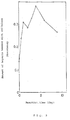
- Amount of the amino group contained in the heparin derivative prepared as above was also determined according to the ninhydrin method as described below.
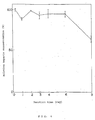
- Heparin activity during the reaction for preparing the heparin derivative was followed up to the 9th day. As shown in Fig. 4, there was no change of the activity observed until the 6th day.
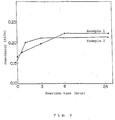
- a piece of cellulose sheet (surface area: 3 cm 2 ) was immersed in 0.5% aqueous solution of sodium hydroxide for 30 min. The alkali-treated piece of cellulose was taken out, from which the aqueous sodium hydroxide solution was gently removed. Three pieces of the cellulose prepared as above were immersed in 10 ml of 0.2% aqueous solution of the heparin derivative (375.8 IU/ml), thoroughly washed after a predetermined period of time and measured for the amount of heparin bonded.
- the antithrombotic medical material according to the present invention are favorably used as materials for a variety of medical instruments to be contacted with blood and artificial organs, because anticoagulant activity remains intact of the heparin bonded with the high molecular compound which is also stable for a long period of time.
- the present invention is utilizable in a field of medical industry.
Landscapes
- Health & Medical Sciences (AREA)
- Chemical & Material Sciences (AREA)
- Life Sciences & Earth Sciences (AREA)
- Engineering & Computer Science (AREA)
- Materials Engineering (AREA)
- General Health & Medical Sciences (AREA)
- Public Health (AREA)
- Biochemistry (AREA)
- Animal Behavior & Ethology (AREA)
- Surgery (AREA)
- Hematology (AREA)
- Veterinary Medicine (AREA)
- Molecular Biology (AREA)
- Epidemiology (AREA)
- Chemical Kinetics & Catalysis (AREA)
- Medicinal Chemistry (AREA)
- Polymers & Plastics (AREA)
- Organic Chemistry (AREA)
- Materials For Medical Uses (AREA)
- Polysaccharides And Polysaccharide Derivatives (AREA)
Applications Claiming Priority (4)
| Application Number | Priority Date | Filing Date | Title |
|---|---|---|---|
| JP28666186A JPS63139901A (ja) | 1986-12-03 | 1986-12-03 | ヘパリン誘導体およびその製造法 |
| JP286661/86 | 1986-12-03 | ||
| JP301422/86 | 1986-12-19 | ||
| JP61301422A JPS63154180A (ja) | 1986-12-19 | 1986-12-19 | 抗血栓性医用材料およびその製造法 |
Publications (3)
| Publication Number | Publication Date |
|---|---|
| EP0336964A1 true EP0336964A1 (de) | 1989-10-18 |
| EP0336964A4 EP0336964A4 (de) | 1990-02-20 |
| EP0336964B1 EP0336964B1 (de) | 1993-08-04 |
Family
ID=26556403
Family Applications (1)
| Application Number | Title | Priority Date | Filing Date |
|---|---|---|---|
| EP19870907978 Expired - Lifetime EP0336964B1 (de) | 1986-12-03 | 1987-12-02 | Antithrombotische arzneimittel und deren herstellung |
Country Status (4)
| Country | Link |
|---|---|
| EP (1) | EP0336964B1 (de) |
| DE (1) | DE3786927T2 (de) |
| DK (1) | DK430188A (de) |
| WO (1) | WO1988004183A1 (de) |
Cited By (5)
| Publication number | Priority date | Publication date | Assignee | Title |
|---|---|---|---|---|
| WO1991019521A1 (en) * | 1990-06-19 | 1991-12-26 | Holland Biomaterials Group B.V. | Method of modifying the properties of a substrate surface by covalent bonding of a compound to the surface, and membrane modified according to this method |
| WO1997032615A1 (en) * | 1996-03-04 | 1997-09-12 | Baxter International Inc. | Nonpolymeric epoxy compounds for cross-linking biological tissue and bioprosthetic grafts prepared thereby |
| WO1996020698A3 (en) * | 1995-01-05 | 1998-01-22 | Univ Michigan | Surface-modified nanoparticles and method of making and using same |
| WO1999027976A1 (en) * | 1997-11-28 | 1999-06-10 | Baxter Biotech Technology S.A.R.L. | Non thrombogenic polymers with compatibility with organic fluids and tissues |
| US6143037A (en) * | 1996-06-12 | 2000-11-07 | The Regents Of The University Of Michigan | Compositions and methods for coating medical devices |
Families Citing this family (1)
| Publication number | Priority date | Publication date | Assignee | Title |
|---|---|---|---|---|
| JP2561309B2 (ja) * | 1988-03-28 | 1996-12-04 | テルモ株式会社 | 医療用材料およびその製造方法 |
Family Cites Families (5)
| Publication number | Priority date | Publication date | Assignee | Title |
|---|---|---|---|---|
| JPS572721B2 (de) * | 1973-05-16 | 1982-01-18 | ||
| DE3109141A1 (de) * | 1981-03-11 | 1982-09-23 | Fraunhofer-Gesellschaft zur Förderung der angewandten Forschung e.V., 8000 München | Antithrombogene ausruestung von matrix-oberflaechen |
| JPS5932145B2 (ja) * | 1981-03-31 | 1984-08-07 | 工業技術院長 | アクリロニトリル系重合体に抗血液凝固性を賦与する方法 |
| JPS6238172A (ja) * | 1985-08-12 | 1987-02-19 | 株式会社 高研 | 抗血栓性医用材料の製造方法 |
| DE3782394T2 (de) * | 1986-03-28 | 1993-05-19 | Toray Industries | Immobilisiertes, physiologisch aktives material. |
-
1987
- 1987-12-02 WO PCT/JP1987/000934 patent/WO1988004183A1/ja not_active Ceased
- 1987-12-02 EP EP19870907978 patent/EP0336964B1/de not_active Expired - Lifetime
- 1987-12-02 DE DE19873786927 patent/DE3786927T2/de not_active Expired - Fee Related
-
1988
- 1988-08-02 DK DK430188A patent/DK430188A/da not_active Application Discontinuation
Cited By (5)
| Publication number | Priority date | Publication date | Assignee | Title |
|---|---|---|---|---|
| WO1991019521A1 (en) * | 1990-06-19 | 1991-12-26 | Holland Biomaterials Group B.V. | Method of modifying the properties of a substrate surface by covalent bonding of a compound to the surface, and membrane modified according to this method |
| WO1996020698A3 (en) * | 1995-01-05 | 1998-01-22 | Univ Michigan | Surface-modified nanoparticles and method of making and using same |
| WO1997032615A1 (en) * | 1996-03-04 | 1997-09-12 | Baxter International Inc. | Nonpolymeric epoxy compounds for cross-linking biological tissue and bioprosthetic grafts prepared thereby |
| US6143037A (en) * | 1996-06-12 | 2000-11-07 | The Regents Of The University Of Michigan | Compositions and methods for coating medical devices |
| WO1999027976A1 (en) * | 1997-11-28 | 1999-06-10 | Baxter Biotech Technology S.A.R.L. | Non thrombogenic polymers with compatibility with organic fluids and tissues |
Also Published As
| Publication number | Publication date |
|---|---|
| DK430188D0 (da) | 1988-08-02 |
| WO1988004183A1 (fr) | 1988-06-16 |
| DK430188A (da) | 1988-10-03 |
| EP0336964A4 (de) | 1990-02-20 |
| DE3786927D1 (de) | 1993-09-09 |
| DE3786927T2 (de) | 1993-12-23 |
| EP0336964B1 (de) | 1993-08-04 |
Similar Documents
| Publication | Publication Date | Title |
|---|---|---|
| EP0658112B1 (de) | Konjugat enthaltend ein geradkettiges organisches polymer mit gebundenen sulfatierten glukosaminoglukanen wie zum beispiel heparin, seine herstellung, verwendung und ein entsprechendes substrat | |
| EP0168093B1 (de) | Binder für Lipoproteine niedriger Dichte | |
| EP0272300B1 (de) | Material aus karboxylgruppen enthaltenden polysacchariden, sowie verfahren zur herstellung solcher polysaccharide | |
| EP1112097B1 (de) | Neues verfahren zur herstellung von mitteln zur oberflächenbehandlung | |
| EP0702699B1 (de) | Sulfatierte hyaluronsäure mit 0.5 bis weniger als 2 sulfate gruppen pro einheit | |
| AU691322B2 (en) | Wound healing agent | |
| JP4278716B2 (ja) | N−硫酸化ヒアルロン酸化合物、その誘導体および製造方法 | |
| EP0200574B1 (de) | Ein Gemisch aus einem Chitosanderivat und Kollagen enthaltendes Biomaterial sowie Verfahren zu dessen Herstellung | |
| US4871357A (en) | Ionic heparin coating | |
| US5039529A (en) | Novel heparin derivatives | |
| US5741852A (en) | Nonthrombogenic implant surfaces | |
| Erdtmann et al. | Photochemical immobilization of heparin, dermatan sulphate, dextran sulphate and endothelial cell surface heparan sulphate onto cellulose membranes for the preparation of athrombogenic and antithrombogenic polymers | |
| EP0336964A1 (de) | Antithrombotische arzneimittel und deren herstellung | |
| EP0101141A2 (de) | Verfahren zur Herstellung von niedermolekularem Heparin durch Depolymerizierung von normalem Heparin | |
| JP3342007B2 (ja) | 低分子ヘパリン修飾体及び皮膚潰瘍治療剤 | |
| EP0580871B1 (de) | Wasserlösliches cellulosederivat und bioverträgliches material | |
| JPS62172961A (ja) | 血液接触医用物品の表面を抗血栓形成にする方法 | |
| Ito et al. | In vivo and in vitro blood compatibility of polyelectrolyte complexes formed between cellulose derivatives | |
| US5728437A (en) | Articles exhibiting a blood-compatible surface layer and process for providing articles with such a surface layer | |
| JPH0334739B2 (de) | ||
| SU981322A1 (ru) | Способ получени водорастворимого линейного полисахарида | |
| JPS63139901A (ja) | ヘパリン誘導体およびその製造法 | |
| Cho et al. | Immobilization of Heparin onto the Polyurethane | |
| Ebert | A dissertati on submitted to the faculty of | |
| HK1022705A (en) | Novel heparin-like sulfated polysaccharides |
Legal Events
| Date | Code | Title | Description |
|---|---|---|---|
| PUAI | Public reference made under article 153(3) epc to a published international application that has entered the european phase |
Free format text: ORIGINAL CODE: 0009012 |
|
| 17P | Request for examination filed |
Effective date: 19890531 |
|
| AK | Designated contracting states |
Kind code of ref document: A1 Designated state(s): BE DE FR GB IT NL SE |
|
| A4 | Supplementary search report drawn up and despatched |
Effective date: 19900220 |
|
| 17Q | First examination report despatched |
Effective date: 19911230 |
|
| GRAA | (expected) grant |
Free format text: ORIGINAL CODE: 0009210 |
|
| AK | Designated contracting states |
Kind code of ref document: B1 Designated state(s): BE DE FR GB IT NL SE |
|
| REF | Corresponds to: |
Ref document number: 3786927 Country of ref document: DE Date of ref document: 19930909 |
|
| ET | Fr: translation filed | ||
| ITF | It: translation for a ep patent filed | ||
| PLBE | No opposition filed within time limit |
Free format text: ORIGINAL CODE: 0009261 |
|
| STAA | Information on the status of an ep patent application or granted ep patent |
Free format text: STATUS: NO OPPOSITION FILED WITHIN TIME LIMIT |
|
| 26N | No opposition filed | ||
| EAL | Se: european patent in force in sweden |
Ref document number: 87907978.8 |
|
| REG | Reference to a national code |
Ref country code: GB Ref legal event code: IF02 |
|
| PGFP | Annual fee paid to national office [announced via postgrant information from national office to epo] |
Ref country code: GB Payment date: 20021127 Year of fee payment: 16 |
|
| PGFP | Annual fee paid to national office [announced via postgrant information from national office to epo] |
Ref country code: SE Payment date: 20021204 Year of fee payment: 16 |
|
| PGFP | Annual fee paid to national office [announced via postgrant information from national office to epo] |
Ref country code: DE Payment date: 20021205 Year of fee payment: 16 |
|
| PGFP | Annual fee paid to national office [announced via postgrant information from national office to epo] |
Ref country code: FR Payment date: 20021210 Year of fee payment: 16 |
|
| PGFP | Annual fee paid to national office [announced via postgrant information from national office to epo] |
Ref country code: NL Payment date: 20021227 Year of fee payment: 16 |
|
| PGFP | Annual fee paid to national office [announced via postgrant information from national office to epo] |
Ref country code: BE Payment date: 20030218 Year of fee payment: 16 |
|
| PG25 | Lapsed in a contracting state [announced via postgrant information from national office to epo] |
Ref country code: GB Free format text: LAPSE BECAUSE OF NON-PAYMENT OF DUE FEES Effective date: 20031202 |
|
| PG25 | Lapsed in a contracting state [announced via postgrant information from national office to epo] |
Ref country code: SE Free format text: LAPSE BECAUSE OF NON-PAYMENT OF DUE FEES Effective date: 20031203 |
|
| PG25 | Lapsed in a contracting state [announced via postgrant information from national office to epo] |
Ref country code: BE Free format text: LAPSE BECAUSE OF NON-PAYMENT OF DUE FEES Effective date: 20031231 |
|
| BERE | Be: lapsed |
Owner name: *TERUMO K.K. Effective date: 20031231 |
|
| PG25 | Lapsed in a contracting state [announced via postgrant information from national office to epo] |
Ref country code: NL Free format text: LAPSE BECAUSE OF NON-PAYMENT OF DUE FEES Effective date: 20040701 Ref country code: DE Free format text: LAPSE BECAUSE OF NON-PAYMENT OF DUE FEES Effective date: 20040701 |
|
| GBPC | Gb: european patent ceased through non-payment of renewal fee |
Effective date: 20031202 |
|
| EUG | Se: european patent has lapsed | ||
| PG25 | Lapsed in a contracting state [announced via postgrant information from national office to epo] |
Ref country code: FR Free format text: LAPSE BECAUSE OF NON-PAYMENT OF DUE FEES Effective date: 20040831 |
|
| NLV4 | Nl: lapsed or anulled due to non-payment of the annual fee |
Effective date: 20040701 |
|
| REG | Reference to a national code |
Ref country code: FR Ref legal event code: ST |
|
| PG25 | Lapsed in a contracting state [announced via postgrant information from national office to epo] |
Ref country code: IT Free format text: LAPSE BECAUSE OF NON-PAYMENT OF DUE FEES;WARNING: LAPSES OF ITALIAN PATENTS WITH EFFECTIVE DATE BEFORE 2007 MAY HAVE OCCURRED AT ANY TIME BEFORE 2007. THE CORRECT EFFECTIVE DATE MAY BE DIFFERENT FROM THE ONE RECORDED. Effective date: 20051202 |