EP0336989A1 - Procédé de fabrication de corps creux en matière thermoplastique, en particulier des soufflets - Google Patents
Procédé de fabrication de corps creux en matière thermoplastique, en particulier des soufflets Download PDFInfo
- Publication number
- EP0336989A1 EP0336989A1 EP88105840A EP88105840A EP0336989A1 EP 0336989 A1 EP0336989 A1 EP 0336989A1 EP 88105840 A EP88105840 A EP 88105840A EP 88105840 A EP88105840 A EP 88105840A EP 0336989 A1 EP0336989 A1 EP 0336989A1
- Authority
- EP
- European Patent Office
- Prior art keywords
- blow mold
- bellows
- parting plane
- transverse
- segments
- Prior art date
- Legal status (The legal status is an assumption and is not a legal conclusion. Google has not performed a legal analysis and makes no representation as to the accuracy of the status listed.)
- Withdrawn
Links
- 238000004519 manufacturing process Methods 0.000 title claims abstract description 5
- 229920001169 thermoplastic Polymers 0.000 title abstract 2
- 239000004416 thermosoftening plastic Substances 0.000 title abstract 2
- 238000000034 method Methods 0.000 claims description 10
- 239000012815 thermoplastic material Substances 0.000 claims description 9
- 238000000926 separation method Methods 0.000 claims description 5
- 238000004904 shortening Methods 0.000 claims 1
- 239000000463 material Substances 0.000 description 8
- 238000007664 blowing Methods 0.000 description 4
- 230000000295 complement effect Effects 0.000 description 3
- 230000004323 axial length Effects 0.000 description 2
- 238000013459 approach Methods 0.000 description 1
- 238000007796 conventional method Methods 0.000 description 1
- 230000003313 weakening effect Effects 0.000 description 1
Images

Classifications
-
- B—PERFORMING OPERATIONS; TRANSPORTING
- B29—WORKING OF PLASTICS; WORKING OF SUBSTANCES IN A PLASTIC STATE IN GENERAL
- B29D—PRODUCING PARTICULAR ARTICLES FROM PLASTICS OR FROM SUBSTANCES IN A PLASTIC STATE
- B29D23/00—Producing tubular articles
- B29D23/18—Pleated or corrugated hoses
-
- B—PERFORMING OPERATIONS; TRANSPORTING
- B29—WORKING OF PLASTICS; WORKING OF SUBSTANCES IN A PLASTIC STATE IN GENERAL
- B29C—SHAPING OR JOINING OF PLASTICS; SHAPING OF MATERIAL IN A PLASTIC STATE, NOT OTHERWISE PROVIDED FOR; AFTER-TREATMENT OF THE SHAPED PRODUCTS, e.g. REPAIRING
- B29C49/00—Blow-moulding, i.e. blowing a preform or parison to a desired shape within a mould; Apparatus therefor
- B29C49/02—Combined blow-moulding and manufacture of the preform or the parison
- B29C49/04—Extrusion blow-moulding
-
- B—PERFORMING OPERATIONS; TRANSPORTING
- B29—WORKING OF PLASTICS; WORKING OF SUBSTANCES IN A PLASTIC STATE IN GENERAL
- B29C—SHAPING OR JOINING OF PLASTICS; SHAPING OF MATERIAL IN A PLASTIC STATE, NOT OTHERWISE PROVIDED FOR; AFTER-TREATMENT OF THE SHAPED PRODUCTS, e.g. REPAIRING
- B29C49/00—Blow-moulding, i.e. blowing a preform or parison to a desired shape within a mould; Apparatus therefor
- B29C49/42—Component parts, details or accessories; Auxiliary operations
- B29C49/48—Moulds
-
- B—PERFORMING OPERATIONS; TRANSPORTING
- B29—WORKING OF PLASTICS; WORKING OF SUBSTANCES IN A PLASTIC STATE IN GENERAL
- B29C—SHAPING OR JOINING OF PLASTICS; SHAPING OF MATERIAL IN A PLASTIC STATE, NOT OTHERWISE PROVIDED FOR; AFTER-TREATMENT OF THE SHAPED PRODUCTS, e.g. REPAIRING
- B29C49/00—Blow-moulding, i.e. blowing a preform or parison to a desired shape within a mould; Apparatus therefor
- B29C49/42—Component parts, details or accessories; Auxiliary operations
- B29C49/48—Moulds
- B29C49/54—Moulds for undercut articles
-
- B—PERFORMING OPERATIONS; TRANSPORTING
- B29—WORKING OF PLASTICS; WORKING OF SUBSTANCES IN A PLASTIC STATE IN GENERAL
- B29C—SHAPING OR JOINING OF PLASTICS; SHAPING OF MATERIAL IN A PLASTIC STATE, NOT OTHERWISE PROVIDED FOR; AFTER-TREATMENT OF THE SHAPED PRODUCTS, e.g. REPAIRING
- B29C49/00—Blow-moulding, i.e. blowing a preform or parison to a desired shape within a mould; Apparatus therefor
- B29C49/42—Component parts, details or accessories; Auxiliary operations
- B29C49/48—Moulds
- B29C49/54—Moulds for undercut articles
- B29C2049/542—Moulds for undercut articles having means to facilitate the removal of the blow moulded articles
- B29C2049/546—Moulds for undercut articles having means to facilitate the removal of the blow moulded articles by translatorilly actuating an auxiliary mould part while the mould is still in a closed position
-
- B—PERFORMING OPERATIONS; TRANSPORTING
- B29—WORKING OF PLASTICS; WORKING OF SUBSTANCES IN A PLASTIC STATE IN GENERAL
- B29L—INDEXING SCHEME ASSOCIATED WITH SUBCLASS B29C, RELATING TO PARTICULAR ARTICLES
- B29L2023/00—Tubular articles
- B29L2023/18—Pleated or corrugated hoses
-
- B—PERFORMING OPERATIONS; TRANSPORTING
- B29—WORKING OF PLASTICS; WORKING OF SUBSTANCES IN A PLASTIC STATE IN GENERAL
- B29L—INDEXING SCHEME ASSOCIATED WITH SUBCLASS B29C, RELATING TO PARTICULAR ARTICLES
- B29L2031/00—Other particular articles
- B29L2031/703—Bellows
Definitions
- the invention relates to a method for producing hollow bodies consisting of thermoplastic material, in particular bellows, in a blow mold which has two halves, the parting plane of which runs through the longitudinal axis of the hollow body and which can be moved apart and moved together in the radial direction, with a preform in the Blow mold inserted and expanded radially by means of internal pressure.
- Hollow bodies including bellows, are usually produced in blow molds in that a thermoplastic material is expanded radially by applying an internal pressure. It comes into contact with the inner contour of the mold cavity. This contour corresponds to the outer contour of the finished hollow body.
- the expanded material first reaches those contour areas which are furthest inwards and which later form the so-called inner bellows tips in the case of a bellows. Only then does it stretch the material spreads out into the pointed spaces protruding between them.
- the so-called bellows outer tips are only formed when the thermoplastic material has completely applied to the mold cavity.
- the invention has for its object to provide a method and a blowing tool for performing the method, with which it is possible to produce hollow bodies, and in particular bellows made of thermoplastic material, which have a wall thickness that is as uniform as possible.
- the blow mold has at least one transverse separation plane running perpendicular to the parting plane running through the longitudinal axis and the inserted preform is expanded in the axially separated state of the blow mold and then the blow mold is moved together in the opposite axial direction until the blow mold segments abut in the cross-cutting plane or in the cross-cutting planes.
- the invention solves the described problem in that, just as in the conventional method, the preform is first expanded by radial expansion to such an extent that it rests on the inner tips of the bellows, that is to say the most inwardly projecting parts of the mold cavity.
- the individual tool segments are pulled apart.
- the axial distance between the bellows inner tips is larger in this state than on the later finished bellows.
- essentially the same wall thickness of the deforming hollow body has been ensured for the radial deformation.
- the individual tool segments can be pushed together in the axial direction so that this wall thickness is now also maintained in the area that lies between the bellows inner tips.
- the tool segments are pushed together while further internal pressure is being applied and the thermoplastic material between the bellows inner tips is expanding. This can also be done with a constant air volume, which increases the pressure. Pushing them together reduces the axial distance between the adjacent bellows inner tips of the tool. In this way, the material, which previously had a greater axial length, can deform in such a way that despite the radial internal pressure which pushes the thermoplastic material outward in the direction of the later bellows tips, the material from the greater axial length continues to flow. In the final state, when the form is completely pushed together and so that its inner contour corresponds to the outer contour of the finished bellows, the material lies against the shape of the bellows outer tips and the wall thickness has remained almost the same.
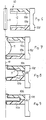
- blowing tool designated as a whole by 1, consists, as already mentioned, of two mutually complementary halves. If we speak of blow mold segments below, it must be added that these blow mold segments are double in each case are provided.
- the blow mold 1 consists of individual blow mold segments 1a to 1f.
- the blow mold 1 and thus also its blow mold segments can be divided along a longitudinal parting plane which runs through a longitudinal central axis 7.
- the blow mold segments 1a to 1f complement each other to form individual ring elements.
- the blow mold segments 1a to 1f have transverse separation planes 3a to 3e running transversely to the longitudinal parting plane. These transverse separation planes 3a to 3e run through the bellows outer tips 4a, 4b, 4c, 4d and 4e which are visible in the bellows shape shown.
- the inner bellows tips of the shape are designated 5a, 5b, 5c and 5e.
- the blow mold can be moved apart in the direction of the longitudinal axis 7, as is shown, for example, in FIG. 5. 5 that the distance between the inner bellows tips 5a, 5b, 5c and 5e is greater than the axial distance provided in the finished bellows, as can be seen in FIG.
- the individual segments are pushed together, as is indicated, for example, in the right area of FIG.
- the expanded material is pressed into the space and approaches the peaks of the Balgau as far as possible to the system. Since the axially measured distance is shortened, the material can flow into these pushed together areas, which form the outer folds, while the wall thickness remains almost the same.
- Figures 4 to 1 is the sequence of the shooting together bens shown until the blow mold segments have reached their final position. It is possible to carry out the pushing together in a different order and in a different time sequence.
- the preform 6 is only shown in Figure 5, of course it is always within the shape to be pushed together. 6a denotes the areas of the preform 6 which will later become inner bellows tips.
- FIGS. 6 to 9 Another blow molded body is shown in the illustration according to FIGS. 6 to 9.
- a preform 11 is inserted into a blow mold consisting of segments 10a and 10b and then expanded by internal pressure. 6 to 9, only one of the two halves of the entire blow mold is shown.
- the blow mold 10 has two annular blow mold segments 10a and 10b, which can be moved apart and moved together along a blow mold part 10c in the direction of the longitudinal axis 17.
- the preform 11 has almost reached its greatest width.
- the segments 10a and 10b are then pushed towards one another in the direction of the arrows 13 (cf. FIG. 8) until they have finally reached their end position (FIG. 9) and lie against one another in the transverse parting plane 14.
- the invention teaches that a blow mold is not only divided in the longitudinal direction but also in the transverse direction. Not only is the division in the transverse direction essential, which is already known for shapes which are composed of individual rings or ring segments. It is essential that to carry out the inventive method, the individual segments can be moved against each other in the axial direction. It is therefore essential to be able to move the individual segments or segment halves both in the radial and in the axial direction.
Landscapes
- Engineering & Computer Science (AREA)
- Mechanical Engineering (AREA)
- Manufacturing & Machinery (AREA)
- Blow-Moulding Or Thermoforming Of Plastics Or The Like (AREA)
- Moulds For Moulding Plastics Or The Like (AREA)
Priority Applications (1)
| Application Number | Priority Date | Filing Date | Title |
|---|---|---|---|
| EP88105840A EP0336989A1 (fr) | 1988-04-13 | 1988-04-13 | Procédé de fabrication de corps creux en matière thermoplastique, en particulier des soufflets |
Applications Claiming Priority (1)
| Application Number | Priority Date | Filing Date | Title |
|---|---|---|---|
| EP88105840A EP0336989A1 (fr) | 1988-04-13 | 1988-04-13 | Procédé de fabrication de corps creux en matière thermoplastique, en particulier des soufflets |
Publications (1)
| Publication Number | Publication Date |
|---|---|
| EP0336989A1 true EP0336989A1 (fr) | 1989-10-18 |
Family
ID=8198880
Family Applications (1)
| Application Number | Title | Priority Date | Filing Date |
|---|---|---|---|
| EP88105840A Withdrawn EP0336989A1 (fr) | 1988-04-13 | 1988-04-13 | Procédé de fabrication de corps creux en matière thermoplastique, en particulier des soufflets |
Country Status (1)
| Country | Link |
|---|---|
| EP (1) | EP0336989A1 (fr) |
Cited By (1)
| Publication number | Priority date | Publication date | Assignee | Title |
|---|---|---|---|---|
| EP1574445A1 (fr) * | 2004-03-12 | 2005-09-14 | Gohsho Company, Ltd. | Bouteille en PET et procédé pour sa fabrication |
Citations (7)
| Publication number | Priority date | Publication date | Assignee | Title |
|---|---|---|---|---|
| GB652810A (en) * | 1948-08-18 | 1951-05-02 | Dunlop Rubber Co | Apparatus and method for making corrugated rubber hose |
| FR1479870A (fr) * | 1965-05-14 | 1967-05-05 | Hoechst Ag | Procédé et dispositif de fabrication de tubes ondulés en matière plastique |
| US3371381A (en) * | 1964-03-11 | 1968-03-05 | Bull John Rubber Company Ltd | Apparatus for manufacturing corrougated or convoluted hose |
| DE1753632A1 (de) * | 1968-01-19 | 1971-07-15 | Tuboflex Kg Fritz Berghoefer & | Verfahren zur Herstellung eines druckfesten Wellrohr-Kompensators aus Kunststoff |
| US4075187A (en) * | 1976-05-12 | 1978-02-21 | W. R. Grace & Co. | Method for making blow molded generally tire shaped articles |
| US4617166A (en) * | 1985-08-26 | 1986-10-14 | Hoover Universal, Inc. | Method for blow molding articles with deeply recessed edges |
| DE3635402A1 (de) * | 1986-10-15 | 1988-04-21 | Gonzalez Augusto E Salvo | Verfahren zum herstellen von hohlkoerpern aus thermoplastischem material sowie blaswerkzeuge hierzu |
-
1988
- 1988-04-13 EP EP88105840A patent/EP0336989A1/fr not_active Withdrawn
Patent Citations (7)
| Publication number | Priority date | Publication date | Assignee | Title |
|---|---|---|---|---|
| GB652810A (en) * | 1948-08-18 | 1951-05-02 | Dunlop Rubber Co | Apparatus and method for making corrugated rubber hose |
| US3371381A (en) * | 1964-03-11 | 1968-03-05 | Bull John Rubber Company Ltd | Apparatus for manufacturing corrougated or convoluted hose |
| FR1479870A (fr) * | 1965-05-14 | 1967-05-05 | Hoechst Ag | Procédé et dispositif de fabrication de tubes ondulés en matière plastique |
| DE1753632A1 (de) * | 1968-01-19 | 1971-07-15 | Tuboflex Kg Fritz Berghoefer & | Verfahren zur Herstellung eines druckfesten Wellrohr-Kompensators aus Kunststoff |
| US4075187A (en) * | 1976-05-12 | 1978-02-21 | W. R. Grace & Co. | Method for making blow molded generally tire shaped articles |
| US4617166A (en) * | 1985-08-26 | 1986-10-14 | Hoover Universal, Inc. | Method for blow molding articles with deeply recessed edges |
| DE3635402A1 (de) * | 1986-10-15 | 1988-04-21 | Gonzalez Augusto E Salvo | Verfahren zum herstellen von hohlkoerpern aus thermoplastischem material sowie blaswerkzeuge hierzu |
Non-Patent Citations (1)
| Title |
|---|
| PATENT ABSTRACTS OF JAPAN, Band 9, Nr. 128 (M-384)[1851], 4. Juni 1985; & JP-A-60 12 228 (KIYOORAKU K.K.) 22-01-1985 * |
Cited By (1)
| Publication number | Priority date | Publication date | Assignee | Title |
|---|---|---|---|---|
| EP1574445A1 (fr) * | 2004-03-12 | 2005-09-14 | Gohsho Company, Ltd. | Bouteille en PET et procédé pour sa fabrication |
Similar Documents
| Publication | Publication Date | Title |
|---|---|---|
| DE2747382C2 (de) | Verfahren zur Herstellung eines einen hohlzylindrischen Teil aufweisenden Flanschstückes und Vorrichtung zur Durchführung des Verfahrens | |
| DE69704563T2 (de) | Verbesserte balgmanschette und verfahren zur herstellung einer solchen balgmanschette | |
| DE2200874A1 (de) | Verfahren und vorrichtung zum anbringen von innenkalibrierten einsteckmuffen mit dichtungsmittelsicke an rohren aus thermoplastischem kunststoff | |
| DE2758188C3 (de) | Verfahren zum Formen einer Ringnut im Endabschnitt eines Rohres aus thermoplastischem Kunststoff | |
| DE69119790T2 (de) | Blasformen eines Artikels mit überstehendem Rand | |
| DE2703454A1 (de) | Verfahren und vorrichtung zum blasformen | |
| DE3705426A1 (de) | Verfahren zum herstellen einer einstueckigen ventilhuelse | |
| DE2705775C2 (de) | Vorrichtung zum zweistufigen Blasformen eines Hohlkörpers aus thermoplastischem Kunststoff | |
| DE3102830C2 (de) | Verfahren zur Herstellung von einstückigen Schrotpatronenhülsen aus thermoplastischem Kunststoff | |
| EP0036444A2 (fr) | Procédé pour la fabrication de commutateurs par façonnage à froid | |
| DE102020129492B3 (de) | Verfahren und Umformvorrichtung zum Herstellen einer Ovalbuchse | |
| DE3635402A1 (de) | Verfahren zum herstellen von hohlkoerpern aus thermoplastischem material sowie blaswerkzeuge hierzu | |
| EP0984852B1 (fr) | Moule pour fa onner un corps annulaire, notamment des pneus de vehicule | |
| EP0285549B1 (fr) | Cuve à col large en matière plastique | |
| EP2159035A2 (fr) | Procédé et dispositif de fabrication d'un corps creux en matière plastique soufflé pourvu d'au moins un élément de renforcement | |
| EP0613410B1 (fr) | Instrument pour la realisation de profils interieurs sans enlevement de copeaux | |
| DE2551515A1 (de) | Formwerkzeug zum spritzen von rohr- formteilen aus thermoplastischem kunststoff | |
| EP4069492B1 (fr) | Moule de soufflage, moule de soufflage à étirage et procédé de formation d'un récipient | |
| DE2110508A1 (de) | Mehrteiliger expandierbarer Kern | |
| EP0626248A1 (fr) | Moule creux pour la fabrication de corps creuse avec poignées | |
| DE2141755C3 (de) | Verfahren und Vorrichtung zum Verformen des rohrförmigen Endes eines einseitig offenen Vorformlings | |
| DE1679970C3 (de) | Vorrichtung zum Herstellen einer ringförmigen Ausbuchtung an einem beliebigen Abschnitt eines Rohres aus thermoplastischem Werkstoff | |
| DE2356172A1 (de) | Verfahren und vorrichtung zur herstellung von mit oertlich begrenzten ausbuchtungen versehenen hohlkoerpern | |
| WO1995022420A1 (fr) | Dispositif d'elargissement pour pieces moulees a symetrie de rotation | |
| EP1270111A1 (fr) | Procédé et dispositif pour la fabrication d'une piece ayant une symetrie de revolution |
Legal Events
| Date | Code | Title | Description |
|---|---|---|---|
| PUAI | Public reference made under article 153(3) epc to a published international application that has entered the european phase |
Free format text: ORIGINAL CODE: 0009012 |
|
| AK | Designated contracting states |
Kind code of ref document: A1 Designated state(s): AT BE CH DE ES FR GB GR IT LI LU NL SE |
|
| 17P | Request for examination filed |
Effective date: 19900203 |
|
| 17Q | First examination report despatched |
Effective date: 19900731 |
|
| STAA | Information on the status of an ep patent application or granted ep patent |
Free format text: STATUS: THE APPLICATION IS DEEMED TO BE WITHDRAWN |
|
| 18D | Application deemed to be withdrawn |
Effective date: 19910111 |