EP0337716A2 - Ruban magnétique et noyau magnétique - Google Patents
Ruban magnétique et noyau magnétique Download PDFInfo
- Publication number
- EP0337716A2 EP0337716A2 EP89303542A EP89303542A EP0337716A2 EP 0337716 A2 EP0337716 A2 EP 0337716A2 EP 89303542 A EP89303542 A EP 89303542A EP 89303542 A EP89303542 A EP 89303542A EP 0337716 A2 EP0337716 A2 EP 0337716A2
- Authority
- EP
- European Patent Office
- Prior art keywords
- magnetic
- ribbon
- particles
- magnetic ribbon
- attached
- Prior art date
- Legal status (The legal status is an assumption and is not a legal conclusion. Google has not performed a legal analysis and makes no representation as to the accuracy of the status listed.)
- Granted
Links
Images




Classifications
-
- H—ELECTRICITY
- H01—ELECTRIC ELEMENTS
- H01F—MAGNETS; INDUCTANCES; TRANSFORMERS; SELECTION OF MATERIALS FOR THEIR MAGNETIC PROPERTIES
- H01F1/00—Magnets or magnetic bodies characterised by the magnetic materials therefor; Selection of materials for their magnetic properties
-
- H—ELECTRICITY
- H01—ELECTRIC ELEMENTS
- H01F—MAGNETS; INDUCTANCES; TRANSFORMERS; SELECTION OF MATERIALS FOR THEIR MAGNETIC PROPERTIES
- H01F41/00—Apparatus or processes specially adapted for manufacturing or assembling magnets, inductances or transformers; Apparatus or processes specially adapted for manufacturing materials characterised by their magnetic properties
- H01F41/02—Apparatus or processes specially adapted for manufacturing or assembling magnets, inductances or transformers; Apparatus or processes specially adapted for manufacturing materials characterised by their magnetic properties for manufacturing cores, coils, or magnets
- H01F41/0206—Manufacturing of magnetic cores by mechanical means
- H01F41/0213—Manufacturing of magnetic circuits made from strip(s) or ribbon(s)
-
- H—ELECTRICITY
- H01—ELECTRIC ELEMENTS
- H01F—MAGNETS; INDUCTANCES; TRANSFORMERS; SELECTION OF MATERIALS FOR THEIR MAGNETIC PROPERTIES
- H01F1/00—Magnets or magnetic bodies characterised by the magnetic materials therefor; Selection of materials for their magnetic properties
- H01F1/01—Magnets or magnetic bodies characterised by the magnetic materials therefor; Selection of materials for their magnetic properties of inorganic materials
- H01F1/03—Magnets or magnetic bodies characterised by the magnetic materials therefor; Selection of materials for their magnetic properties of inorganic materials characterised by their coercivity
- H01F1/12—Magnets or magnetic bodies characterised by the magnetic materials therefor; Selection of materials for their magnetic properties of inorganic materials characterised by their coercivity of soft-magnetic materials
- H01F1/14—Magnets or magnetic bodies characterised by the magnetic materials therefor; Selection of materials for their magnetic properties of inorganic materials characterised by their coercivity of soft-magnetic materials metals or alloys
- H01F1/147—Alloys characterised by their composition
- H01F1/153—Amorphous metallic alloys, e.g. glassy metals
- H01F1/15383—Applying coatings thereon
-
- H—ELECTRICITY
- H01—ELECTRIC ELEMENTS
- H01F—MAGNETS; INDUCTANCES; TRANSFORMERS; SELECTION OF MATERIALS FOR THEIR MAGNETIC PROPERTIES
- H01F1/00—Magnets or magnetic bodies characterised by the magnetic materials therefor; Selection of materials for their magnetic properties
- H01F1/01—Magnets or magnetic bodies characterised by the magnetic materials therefor; Selection of materials for their magnetic properties of inorganic materials
- H01F1/03—Magnets or magnetic bodies characterised by the magnetic materials therefor; Selection of materials for their magnetic properties of inorganic materials characterised by their coercivity
- H01F1/12—Magnets or magnetic bodies characterised by the magnetic materials therefor; Selection of materials for their magnetic properties of inorganic materials characterised by their coercivity of soft-magnetic materials
- H01F1/14—Magnets or magnetic bodies characterised by the magnetic materials therefor; Selection of materials for their magnetic properties of inorganic materials characterised by their coercivity of soft-magnetic materials metals or alloys
- H01F1/16—Magnets or magnetic bodies characterised by the magnetic materials therefor; Selection of materials for their magnetic properties of inorganic materials characterised by their coercivity of soft-magnetic materials metals or alloys in the form of sheets
- H01F1/18—Magnets or magnetic bodies characterised by the magnetic materials therefor; Selection of materials for their magnetic properties of inorganic materials characterised by their coercivity of soft-magnetic materials metals or alloys in the form of sheets with insulating coating
-
- H—ELECTRICITY
- H01—ELECTRIC ELEMENTS
- H01F—MAGNETS; INDUCTANCES; TRANSFORMERS; SELECTION OF MATERIALS FOR THEIR MAGNETIC PROPERTIES
- H01F27/00—Details of transformers or inductances, in general
- H01F27/24—Magnetic cores
- H01F27/25—Magnetic cores made from strips or ribbons
Definitions
- the present invention relates to a magnetic ribbon and a magnetic core formed by using said magnetic ribbon.
- a magnetic core is formed by winding or laminating a magnetic ribbon, and if insulation between layers of the ribbon is poor, an eddy current flowing across the ribbon layers occurs and an increase in eddy current losses results in an increase in overall core losses (magnetic losses). This tendency is particularly noticeable in the case of high frequencies. In addition, the frequency characteristics of permeability is poor, and it is impossible to expect any advantageous use at 100 kHz or more.
- an insulating layer formed of a nonmagnetic material is conventionally provided between the ribbon layers, and a uniform insulating film is formed on the ribbon surface as one means thereof, so as to solve the aforementioned problem.
- annealing is usually carried out at 400°C or thereabouts. However, if such annealing is carried out, because of a difference in the coefficient of linear expansion, i.e., since the coefficient of linear expansion of the insulating film is greater than that of the amorphous ribbon, compressive stress occurs in the ribbon, and magnetic characteristics deteriorate due to the adverse effect of magnetostriction.
- an insulating film is generally interposed between ribbon layers, and the greatest matter of concern to those skilled in the art lies in finding an insulating material having an excellent insulating performance.
- a magnetic ribbon on at least one side of which particles, preferably fine particles, formed of a nonmagnetic, preferably inorganic, substance having insulating properties are attached.
- the invention also provides a magnetic core having such a ribbon wound therearound or laminated thereon.
- the particles may be attached so as to secure a layer of air so that in the absence of a conventional insulating film, the air present between the layers can serve as an insulating layer and prevent an eddy current, and the space factor can be made as large as possible.
- particles formed of an inorganic substance are attached on at least one surface of the magnetic ribbon, so that if the magnetic ribbon is wound or laminated to form a magnetic core, the particles serve as a spacer, thereby forming a layer of air between adjacent layers of the ribbon.
- the particles may be attached uniformly and densely on at least one surface of the ribbon.
- the particles themselves function as an insulating layer. Nevertheless, in this case as well, it is possible to obtain the same effect as that obtained by securing a layer of air by means of the particles. Accordingly, the present invention includes both the case where the particles are attached coarsely and the case where they are attached densely.
- the particles may be applied by any suitable method for example by passing the magnetic ribbon through a suspension containing the particles. Where it is intended that the particles should act as a spacer trapping a layer of air between layers or windings of a core the proportion of particles in the suspension may be chosen to be suitably low. For example where the particles are antimony pentoxide suspended in toluene they may form 1% to 10%, preferably 2% to 5%, eg about 3%, by weight of the suspension.
- the particles should be attached more densely so as to act as the insulation then a higher proportion may be used in the suspension.
- a higher proportion may be used in the suspension.
- 20% by weight for example 20% to 50%, e.g. about 30% by weight.
- a magnetic ribbon and a magnetic core can be provided having excellent magnetic characteristics while securing insulating properties between ribbon layers with the space factor reduced.
- the magnetic ribbon referred to in the present invention is a thin magnetic strip, and, as magnetic materials, it is possible to cite the following: ferromagnetic elements such as Fe, Co, and Ni among transition metals, alloys of ferromagnetic elements, alloys of ferromagnetic elements and nonferromagnetic elements which are added to improve characteristics, ferrite, permalloy, amorphous alloys, etc.
- ferromagnetic elements such as Fe, Co, and Ni among transition metals
- alloys of ferromagnetic elements alloys of ferromagnetic elements and nonferromagnetic elements which are added to improve characteristics, ferrite, permalloy, amorphous alloys, etc.
- Fe-based alloys such as Fe-B, Fe-B-C, Fe-B-Si, Fe-B-Si-C, Fe-B-Si-Cr, Fe-Co-B-Si, and Fe-Ni-Mo-B
- Co-based alloys such as Co-B, Co-Fe-Si-B, Co-Fe-Ni-Mo-B-Si, Co-Fe-Ni-B-Si, Co-Fe-Mn-B-Si, Co-Fe-Mn-Ni, Co-Mn-Ni-B-Si, and Co-Fe-Mn-Ni-B, and other similar alloys.
- inorganic fine particles that are attached to such a magnetic ribbon are that it is nonmagnetic, and that it has insulating properties. If the fine particles are magnetic and conductive, an adverse effect is exerted on magnetic characteristics, and an eddy current is liable to flow.
- inorganic substances used in the present invention it is possible to cite the following: (1) inorganic substances which are stable in a natural condition, including glass (sodium silicate), mica (aluminosilicate alkali salt and phyllosilicate alkali salt), silicon carbide, calcium sulfate semi-water salt, potassium carbonate, magnesium carbonate, calcium carbonate, barium sulfate, and the like; (2) metal oxides such as aluminum oxide, boron oxide, magnesium oxide, silicon dioxide, tin dioxide, zinc oxide, zirconium dioxide, antimony pentoxide, and the like; and (3) ceramics formed of the materials cited in (2) above and double oxides such as perovskite, silicate glass, phosphate, titanic acid salt, niobium, tantalum, and tungstate; ceramics formed singly or in a combination by using such ceramic materials as nitrides, including aluminum nitride, a sintered body of aluminum oxide and nitride, boron nitrid
- the size of the fine particles of the inorganic substance if consideration is paid to the fact that the fine particles are attached to the ribbon uniformly so as to form an insulating layer, the size of the fine particles may be small. However, if the particle size is made too small, it constitutes a factor making manufacture difficult. Meanwhile, if the particle size is too large, when the magnetic core is formed by a ribbon, the gap between the adjacent layers of the ribbon becomes too large, so that the space factor of the magnetic material becomes small. For this reason, it is preferred that the size of the fine particles is set in the range of 10 nm to 2 ⁇ m.
- the fine particles may preferably be attached in such a manner that they are attached by 10 ⁇ 7cm3 to 2 x 10 ⁇ 4cm3, more preferably 3 x 10 ⁇ 6cm3 - 10 ⁇ 5cm3, per unit area (1 cm2). If this amount attached is calculated into the weight of fine particles per unit area, although its value changes depending on the specific weight of the material of the fine particles, in the case of antimony pentoxide, the weight is 3.8 x 10 ⁇ 7g/cm2 - 7.6 x 10 ⁇ 4g/cm2, preferably 1.1 x 10 ⁇ 5g/cm2 - 3.8 x 10 ⁇ 5g/cm2.
- Means for attaching the fine particles is so arranged that these fine particles are dispersed in water or a volatile organic solvent such as toluene, and, after this solution is applied to the ribbon surface, force or natural drying is carried out, thereby allowing the fine particles to be attached to the ribbon.
- the concentration of this solution determines the amount of fine particles to be attached to the ribbon.
- this inorganic substance may be dispersed in toluene in a colloidal state at a rate of from 0.1 to 30 wt% with respect to toluene. 3 wt% or thereabouts in this range is also effective, a decline in the space factor is practically nil, and the magnetic characteristics do not deteriorate.
- the thickness of the film of the solution applied is preferably 10 ⁇ m or less in determining the aforementioned amount of fine particles to be attached.
- a drying furnace may be used for evaporation of the solvent depending on the solvent, and drying may be carried out at 100°C or above.
- annealing may be carried out for 0.5 - 5 hours at the temperature of 300 - 500°C in an inert gas atmosphere such as nitrogen so as to eliminate strain, as required.
- This annealing may be effected after the ribbon is wound or laminated into a magnetic core, or may be effected in the state of the ribbon.
- annealing may be effected at a temperature 10 to 50°C higher than the Curie point, a magnetic core exhibiting excellent characteristics with respect to high frequencies can be obtained.
- annealing may be effected in a magnetic field or in a nonmagnetic field.
- the magnetic core when the amorphous magnetic core with the ribbon wound therearound or laminated thereon is annealed since the fine particles disposed between adjacent ribbon layers are powders, the magnetic core is not subjected to linear expansion. The fine particles rather exhibit the action of absorbing the stress accompanying the shrinkage of the amorphous ribbon.
- a magnetic ribbon and a solution containing fine particles are prepared.
- the solution containing the fine particles is applied to at lest one surface of the magnetic ribbon by any of the various methods of application, and the solvent is allowed to dry.
- the resultant magnetic ribbon with the fine particles attached thereto is wound under tension, thereby obtaining a toroidal-type magnetic core.
- annealing for eliminating strain is carried out, as necessary.
- tension applied at the time of winding is preferably 0.05 o 2 kg.
- the ribbon with fine particles attached thereto is cut into a predetermined configuration, and the cut pieces are laminated so as to form the magnetic core.
- Annealing which is carried out as necessary may be effected prior to the lamination or after the magnetic core has been formed subsequent to the lamination.
- an amorphous ribbon 1a (2605S-2, Fe78-B13-Si9, 10 mm width) made by Allied Corp. is fed forward into a colloidal solution 2 of antimony pentoxide.
- a colloidal solution 2 of antimony pentoxide As the colloidal solution 2 of antimony pentoxide, toluene was used as the solvent, and 3 wt% of antimony was dispersed with respect to toluene 97 wt%.
- the ribbon 1b with the particles attached thereto was fed forward via a roller 5, and was wound under tension in a final stage, thereby forming an amorphous magnetic core 6.
- a plurality of magnetic cores having the same dimensions were then formed, and were subjected to annealing for two hours at 435°C in a nitrogen atmosphere.
- Organic solvent toluene, 100 wt%
- Fine particles antimony pentoxide, 3 wt%
- Organic solvent toluene, 70 wt%
- Fine particles antimony pentoxide, 30 wt%
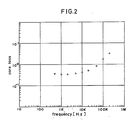
- the magnetic cores of the Examples display a hysteresis which is closer to a linear configuration, and that the core loss is low as a whole, and a rise in the high-frequency component can be reduced to a low level.
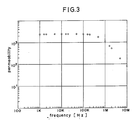
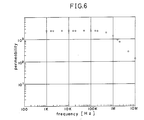
- a substantially fixed permeability was obtained up to 200 kHz.
Landscapes
- Engineering & Computer Science (AREA)
- Power Engineering (AREA)
- Chemical & Material Sciences (AREA)
- Dispersion Chemistry (AREA)
- Manufacturing & Machinery (AREA)
- Physics & Mathematics (AREA)
- Electromagnetism (AREA)
- Soft Magnetic Materials (AREA)
- Manufacturing Cores, Coils, And Magnets (AREA)
- Magnetic Heads (AREA)
- Decoration Of Textiles (AREA)
- Magnetic Record Carriers (AREA)
Applications Claiming Priority (2)
| Application Number | Priority Date | Filing Date | Title |
|---|---|---|---|
| JP63088694A JP2716064B2 (ja) | 1988-04-11 | 1988-04-11 | 磁性リボン及び磁心 |
| JP88694/88 | 1988-04-11 |
Publications (3)
| Publication Number | Publication Date |
|---|---|
| EP0337716A2 true EP0337716A2 (fr) | 1989-10-18 |
| EP0337716A3 EP0337716A3 (en) | 1990-09-19 |
| EP0337716B1 EP0337716B1 (fr) | 1995-03-01 |
Family
ID=13949956
Family Applications (1)
| Application Number | Title | Priority Date | Filing Date |
|---|---|---|---|
| EP89303542A Expired - Lifetime EP0337716B1 (fr) | 1988-04-11 | 1989-04-11 | Ruban magnétique et noyau magnétique |
Country Status (6)
| Country | Link |
|---|---|
| EP (1) | EP0337716B1 (fr) |
| JP (1) | JP2716064B2 (fr) |
| KR (1) | KR920005490B1 (fr) |
| AT (1) | ATE119309T1 (fr) |
| CA (1) | CA1340795C (fr) |
| DE (1) | DE68921363T2 (fr) |
Cited By (6)
| Publication number | Priority date | Publication date | Assignee | Title |
|---|---|---|---|---|
| WO1991018404A1 (fr) * | 1990-05-18 | 1991-11-28 | Allied-Signal Inc. | Noyaux magnetiques fabriques avec des rubans de verre metallique et un isolant interlaminaire en papier de mica |
| EP0480265A1 (fr) * | 1990-10-03 | 1992-04-15 | Nippon Steel Corporation | Procédé de fabrication d'âmes en permalloy |
| EP0625786A3 (fr) * | 1993-05-21 | 1995-01-25 | Hitachi Metals Ltd | Ruban d'alliage nanocristalline magnétiquement doux revêtu d'une couche isolante; noyau magnétique de cela et applications. |
| WO2006014632A3 (fr) * | 2004-07-22 | 2006-04-20 | Axcelis Tech Inc | Aimant perfectionne pour faisceaux ioniques de balayage |
| US9331493B2 (en) | 2012-01-13 | 2016-05-03 | Honda Motor Co., Ltd. | Electric load control apparatus |
| US11715591B2 (en) | 2020-03-27 | 2023-08-01 | Proterial, Ltd. | Method for manufacturing a wound magnetic core |
Families Citing this family (1)
| Publication number | Priority date | Publication date | Assignee | Title |
|---|---|---|---|---|
| JP2023031770A (ja) | 2021-08-25 | 2023-03-09 | Tdk株式会社 | 磁性合金薄帯、積層体および磁性コア |
Family Cites Families (4)
| Publication number | Priority date | Publication date | Assignee | Title |
|---|---|---|---|---|
| JPS61181114A (ja) * | 1985-02-07 | 1986-08-13 | Toshiba Corp | 巻鉄心の製造方法 |
| JPS61198611A (ja) * | 1985-02-27 | 1986-09-03 | Kawasaki Steel Corp | 非晶質合金薄帯鉄心による変圧器の製造方法 |
| DE3685698T2 (de) * | 1985-02-27 | 1993-01-28 | Kawasaki Steel Co | Verfahren zur herstellung eines lamellenpakets aus duennem amorphen magnetband, und eines magnetkerns aus duennem legierten band. |
| JPS6265403A (ja) * | 1985-09-18 | 1987-03-24 | Kawasaki Steel Corp | 非晶質合金薄帯の磁気特性改善方法 |
-
1988
- 1988-04-11 JP JP63088694A patent/JP2716064B2/ja not_active Expired - Fee Related
-
1989
- 1989-04-10 CA CA000596211A patent/CA1340795C/fr not_active Expired - Lifetime
- 1989-04-11 DE DE68921363T patent/DE68921363T2/de not_active Expired - Fee Related
- 1989-04-11 EP EP89303542A patent/EP0337716B1/fr not_active Expired - Lifetime
- 1989-04-11 AT AT89303542T patent/ATE119309T1/de not_active IP Right Cessation
- 1989-04-11 KR KR1019890004745A patent/KR920005490B1/ko not_active Expired
Cited By (8)
| Publication number | Priority date | Publication date | Assignee | Title |
|---|---|---|---|---|
| WO1991018404A1 (fr) * | 1990-05-18 | 1991-11-28 | Allied-Signal Inc. | Noyaux magnetiques fabriques avec des rubans de verre metallique et un isolant interlaminaire en papier de mica |
| EP0480265A1 (fr) * | 1990-10-03 | 1992-04-15 | Nippon Steel Corporation | Procédé de fabrication d'âmes en permalloy |
| EP0625786A3 (fr) * | 1993-05-21 | 1995-01-25 | Hitachi Metals Ltd | Ruban d'alliage nanocristalline magnétiquement doux revêtu d'une couche isolante; noyau magnétique de cela et applications. |
| US5486404A (en) * | 1993-05-21 | 1996-01-23 | Hitachi Metals, Ltd. | Nano-crystalline soft magnetic alloy ribbon with insulation coating and magnetic core made therefrom and pulse generator, laser unit and accelerator therewith |
| WO2006014632A3 (fr) * | 2004-07-22 | 2006-04-20 | Axcelis Tech Inc | Aimant perfectionne pour faisceaux ioniques de balayage |
| US9331493B2 (en) | 2012-01-13 | 2016-05-03 | Honda Motor Co., Ltd. | Electric load control apparatus |
| US11715591B2 (en) | 2020-03-27 | 2023-08-01 | Proterial, Ltd. | Method for manufacturing a wound magnetic core |
| US12191071B2 (en) | 2020-03-27 | 2025-01-07 | Proterial, Ltd. | Wound magnetic core |
Also Published As
| Publication number | Publication date |
|---|---|
| EP0337716A3 (en) | 1990-09-19 |
| JP2716064B2 (ja) | 1998-02-18 |
| KR920005490B1 (ko) | 1992-07-06 |
| ATE119309T1 (de) | 1995-03-15 |
| EP0337716B1 (fr) | 1995-03-01 |
| KR890016591A (ko) | 1989-11-29 |
| CA1340795C (fr) | 1999-10-19 |
| JPH01259510A (ja) | 1989-10-17 |
| DE68921363T2 (de) | 1995-07-13 |
| DE68921363D1 (de) | 1995-04-06 |
Similar Documents
| Publication | Publication Date | Title |
|---|---|---|
| US4268325A (en) | Magnetic glassy metal alloy sheets with improved soft magnetic properties | |
| US4451876A (en) | Switching regulator | |
| EP0401805B1 (fr) | Noyau magnétique | |
| JP2011061210A (ja) | 分布ギャップ電気チョーク | |
| US5242760A (en) | Magnetic ribbon and magnetic core | |
| US5091253A (en) | Magnetic cores utilizing metallic glass ribbons and mica paper interlaminar insulation | |
| JPH0254641B2 (fr) | ||
| CA1340795C (fr) | Ruban et noyau maghetiques | |
| JPS6234122B2 (fr) | ||
| KR100698606B1 (ko) | 고주파 응용 자기 유리질 합금 | |
| US7138188B2 (en) | Magnetic implement using magnetic metal ribbon coated with insulator | |
| US4834814A (en) | Metallic glasses having a combination of high permeability, low coercivity, low AC core loss, low exciting power and high thermal stability | |
| JP2898129B2 (ja) | 非晶質軟磁性多層薄膜及びその製造方法 | |
| JP2918255B2 (ja) | 磁心の製造方法 | |
| Luborsky | Perspective on application of amorphous alloys in magnetic devices | |
| JP2918254B2 (ja) | 磁心の製造方法 | |
| JP3222458B2 (ja) | 磁心の製造方法 | |
| JP2788248B2 (ja) | 高周波用磁心及びその製造方法 | |
| JP2760561B2 (ja) | 磁 心 | |
| JPS62167840A (ja) | 磁性材料とその製造方法 | |
| JPH04345007A (ja) | 複合磁性膜およびその製法並びにそれを用いたコア | |
| JP2835127B2 (ja) | 磁心およびその製造方法 | |
| JP3121641B2 (ja) | スイッチング電源 | |
| JPH03125407A (ja) | インダクタ用磁心およびその製法 | |
| JPH0817615A (ja) | 応力付加磁心 |
Legal Events
| Date | Code | Title | Description |
|---|---|---|---|
| PUAI | Public reference made under article 153(3) epc to a published international application that has entered the european phase |
Free format text: ORIGINAL CODE: 0009012 |
|
| AK | Designated contracting states |
Kind code of ref document: A2 Designated state(s): AT BE CH DE ES FR GB GR IT LI LU NL SE |
|
| PUAL | Search report despatched |
Free format text: ORIGINAL CODE: 0009013 |
|
| AK | Designated contracting states |
Kind code of ref document: A3 Designated state(s): AT BE CH DE ES FR GB GR IT LI LU NL SE |
|
| 17P | Request for examination filed |
Effective date: 19901220 |
|
| 17Q | First examination report despatched |
Effective date: 19921015 |
|
| GRAA | (expected) grant |
Free format text: ORIGINAL CODE: 0009210 |
|
| AK | Designated contracting states |
Kind code of ref document: B1 Designated state(s): AT BE CH DE ES FR GB GR IT LI LU NL SE |
|
| PG25 | Lapsed in a contracting state [announced via postgrant information from national office to epo] |
Ref country code: LI Effective date: 19950301 Ref country code: GR Free format text: LAPSE BECAUSE OF FAILURE TO SUBMIT A TRANSLATION OF THE DESCRIPTION OR TO PAY THE FEE WITHIN THE PRESCRIBED TIME-LIMIT Effective date: 19950301 Ref country code: ES Free format text: THE PATENT HAS BEEN ANNULLED BY A DECISION OF A NATIONAL AUTHORITY Effective date: 19950301 Ref country code: CH Effective date: 19950301 Ref country code: BE Effective date: 19950301 Ref country code: AT Effective date: 19950301 |
|
| REF | Corresponds to: |
Ref document number: 119309 Country of ref document: AT Date of ref document: 19950315 Kind code of ref document: T |
|
| ITF | It: translation for a ep patent filed | ||
| REF | Corresponds to: |
Ref document number: 68921363 Country of ref document: DE Date of ref document: 19950406 |
|
| REG | Reference to a national code |
Ref country code: GB Ref legal event code: 711B |
|
| PG25 | Lapsed in a contracting state [announced via postgrant information from national office to epo] |
Ref country code: LU Free format text: LAPSE BECAUSE OF NON-PAYMENT OF DUE FEES Effective date: 19950430 |
|
| ET | Fr: translation filed | ||
| PG25 | Lapsed in a contracting state [announced via postgrant information from national office to epo] |
Ref country code: SE Effective date: 19950601 |
|
| REG | Reference to a national code |
Ref country code: CH Ref legal event code: PL |
|
| REG | Reference to a national code |
Ref country code: GB Ref legal event code: 711H |
|
| ET1 | Fr: translation filed ** revision of the translation of the patent or the claims | ||
| PLBE | No opposition filed within time limit |
Free format text: ORIGINAL CODE: 0009261 |
|
| STAA | Information on the status of an ep patent application or granted ep patent |
Free format text: STATUS: NO OPPOSITION FILED WITHIN TIME LIMIT |
|
| 26N | No opposition filed | ||
| REG | Reference to a national code |
Ref country code: GB Ref legal event code: 732E |
|
| REG | Reference to a national code |
Ref country code: FR Ref legal event code: TP |
|
| NLS | Nl: assignments of ep-patents |
Owner name: NIPPON CHEMI-CON CORPORATION |
|
| NLT1 | Nl: modifications of names registered in virtue of documents presented to the patent office pursuant to art. 16 a, paragraph 1 |
Owner name: MITSUI CHEMICALS, INC. |
|
| REG | Reference to a national code |
Ref country code: GB Ref legal event code: IF02 |
|
| PGFP | Annual fee paid to national office [announced via postgrant information from national office to epo] |
Ref country code: GB Payment date: 20030409 Year of fee payment: 15 |
|
| PGFP | Annual fee paid to national office [announced via postgrant information from national office to epo] |
Ref country code: NL Payment date: 20030429 Year of fee payment: 15 |
|
| PGFP | Annual fee paid to national office [announced via postgrant information from national office to epo] |
Ref country code: FR Payment date: 20040408 Year of fee payment: 16 |
|
| PG25 | Lapsed in a contracting state [announced via postgrant information from national office to epo] |
Ref country code: GB Free format text: LAPSE BECAUSE OF NON-PAYMENT OF DUE FEES Effective date: 20040411 |
|
| PG25 | Lapsed in a contracting state [announced via postgrant information from national office to epo] |
Ref country code: NL Free format text: LAPSE BECAUSE OF NON-PAYMENT OF DUE FEES Effective date: 20041101 |
|
| GBPC | Gb: european patent ceased through non-payment of renewal fee |
Effective date: 20040411 |
|
| NLV4 | Nl: lapsed or anulled due to non-payment of the annual fee |
Effective date: 20041101 |
|
| PGFP | Annual fee paid to national office [announced via postgrant information from national office to epo] |
Ref country code: DE Payment date: 20050407 Year of fee payment: 17 |
|
| PG25 | Lapsed in a contracting state [announced via postgrant information from national office to epo] |
Ref country code: IT Free format text: LAPSE BECAUSE OF NON-PAYMENT OF DUE FEES;WARNING: LAPSES OF ITALIAN PATENTS WITH EFFECTIVE DATE BEFORE 2007 MAY HAVE OCCURRED AT ANY TIME BEFORE 2007. THE CORRECT EFFECTIVE DATE MAY BE DIFFERENT FROM THE ONE RECORDED. Effective date: 20050411 |
|
| PG25 | Lapsed in a contracting state [announced via postgrant information from national office to epo] |
Ref country code: FR Free format text: LAPSE BECAUSE OF NON-PAYMENT OF DUE FEES Effective date: 20051230 |
|
| REG | Reference to a national code |
Ref country code: FR Ref legal event code: ST Effective date: 20051230 |
|
| PG25 | Lapsed in a contracting state [announced via postgrant information from national office to epo] |
Ref country code: DE Free format text: LAPSE BECAUSE OF NON-PAYMENT OF DUE FEES Effective date: 20061101 |