EP0337802B1 - Verfahren zum Herstellen von thermoplastischen Platten-Wärmetauschern - Google Patents
Verfahren zum Herstellen von thermoplastischen Platten-Wärmetauschern Download PDFInfo
- Publication number
- EP0337802B1 EP0337802B1 EP89303717A EP89303717A EP0337802B1 EP 0337802 B1 EP0337802 B1 EP 0337802B1 EP 89303717 A EP89303717 A EP 89303717A EP 89303717 A EP89303717 A EP 89303717A EP 0337802 B1 EP0337802 B1 EP 0337802B1
- Authority
- EP
- European Patent Office
- Prior art keywords
- sheets
- panels
- heat exchanger
- inlet
- header means
- Prior art date
- Legal status (The legal status is an assumption and is not a legal conclusion. Google has not performed a legal analysis and makes no representation as to the accuracy of the status listed.)
- Expired - Lifetime
Links
- 238000000034 method Methods 0.000 title claims description 29
- 238000004519 manufacturing process Methods 0.000 title claims description 16
- 229920001169 thermoplastic Polymers 0.000 title description 9
- 239000004416 thermosoftening plastic Substances 0.000 title description 6
- 239000012530 fluid Substances 0.000 claims description 35
- 239000004952 Polyamide Substances 0.000 claims description 28
- 229920002647 polyamide Polymers 0.000 claims description 28
- 238000000576 coating method Methods 0.000 claims description 18
- 239000011248 coating agent Substances 0.000 claims description 17
- 239000008199 coating composition Substances 0.000 claims description 6
- 239000007789 gas Substances 0.000 claims description 6
- 238000010438 heat treatment Methods 0.000 claims description 6
- 239000011261 inert gas Substances 0.000 claims description 5
- IJGRMHOSHXDMSA-UHFFFAOYSA-N Atomic nitrogen Chemical compound N#N IJGRMHOSHXDMSA-UHFFFAOYSA-N 0.000 claims description 4
- 229920006345 thermoplastic polyamide Polymers 0.000 claims description 4
- 229920002302 Nylon 6,6 Polymers 0.000 claims description 3
- 230000000694 effects Effects 0.000 claims description 2
- 238000011010 flushing procedure Methods 0.000 claims description 2
- 229910052757 nitrogen Inorganic materials 0.000 claims description 2
- 238000003825 pressing Methods 0.000 claims description 2
- 229920000642 polymer Polymers 0.000 description 20
- 239000000203 mixture Substances 0.000 description 8
- ISWSIDIOOBJBQZ-UHFFFAOYSA-N Phenol Chemical compound OC1=CC=CC=C1 ISWSIDIOOBJBQZ-UHFFFAOYSA-N 0.000 description 7
- WVDDGKGOMKODPV-UHFFFAOYSA-N Benzyl alcohol Chemical compound OCC1=CC=CC=C1 WVDDGKGOMKODPV-UHFFFAOYSA-N 0.000 description 6
- OKKJLVBELUTLKV-UHFFFAOYSA-N Methanol Chemical compound OC OKKJLVBELUTLKV-UHFFFAOYSA-N 0.000 description 6
- WVDDGKGOMKODPV-ZQBYOMGUSA-N phenyl(114C)methanol Chemical group O[14CH2]C1=CC=CC=C1 WVDDGKGOMKODPV-ZQBYOMGUSA-N 0.000 description 5
- 239000007788 liquid Substances 0.000 description 4
- XLYOFNOQVPJJNP-UHFFFAOYSA-N water Substances O XLYOFNOQVPJJNP-UHFFFAOYSA-N 0.000 description 4
- KXDHJXZQYSOELW-UHFFFAOYSA-N Carbamic acid Chemical compound NC(O)=O KXDHJXZQYSOELW-UHFFFAOYSA-N 0.000 description 3
- LYCAIKOWRPUZTN-UHFFFAOYSA-N Ethylene glycol Chemical compound OCCO LYCAIKOWRPUZTN-UHFFFAOYSA-N 0.000 description 3
- -1 aluminum Chemical class 0.000 description 3
- 125000004432 carbon atom Chemical group C* 0.000 description 3
- 238000001816 cooling Methods 0.000 description 3
- 239000000463 material Substances 0.000 description 3
- 238000000465 moulding Methods 0.000 description 3
- 229920002292 Nylon 6 Polymers 0.000 description 2
- KKEYFWRCBNTPAC-UHFFFAOYSA-N Terephthalic acid Chemical compound OC(=O)C1=CC=C(C(O)=O)C=C1 KKEYFWRCBNTPAC-UHFFFAOYSA-N 0.000 description 2
- 125000001931 aliphatic group Chemical group 0.000 description 2
- 229910052782 aluminium Inorganic materials 0.000 description 2
- XAGFODPZIPBFFR-UHFFFAOYSA-N aluminium Chemical compound [Al] XAGFODPZIPBFFR-UHFFFAOYSA-N 0.000 description 2
- 235000019445 benzyl alcohol Nutrition 0.000 description 2
- 230000005540 biological transmission Effects 0.000 description 2
- 239000002131 composite material Substances 0.000 description 2
- 150000004985 diamines Chemical class 0.000 description 2
- 150000001991 dicarboxylic acids Chemical class 0.000 description 2
- 229920001971 elastomer Polymers 0.000 description 2
- 239000000806 elastomer Substances 0.000 description 2
- JBKVHLHDHHXQEQ-UHFFFAOYSA-N epsilon-caprolactam Chemical group O=C1CCCCCN1 JBKVHLHDHHXQEQ-UHFFFAOYSA-N 0.000 description 2
- 239000000835 fiber Substances 0.000 description 2
- 239000011521 glass Substances 0.000 description 2
- NAQMVNRVTILPCV-UHFFFAOYSA-N hexane-1,6-diamine Chemical compound NCCCCCCN NAQMVNRVTILPCV-UHFFFAOYSA-N 0.000 description 2
- 238000007373 indentation Methods 0.000 description 2
- 150000003951 lactams Chemical class 0.000 description 2
- 229910052751 metal Inorganic materials 0.000 description 2
- 239000002184 metal Substances 0.000 description 2
- 238000012643 polycondensation polymerization Methods 0.000 description 2
- 125000006850 spacer group Chemical group 0.000 description 2
- PWGJDPKCLMLPJW-UHFFFAOYSA-N 1,8-diaminooctane Chemical compound NCCCCCCCCN PWGJDPKCLMLPJW-UHFFFAOYSA-N 0.000 description 1
- JINGUCXQUOKWKH-UHFFFAOYSA-N 2-aminodecanoic acid Chemical compound CCCCCCCCC(N)C(O)=O JINGUCXQUOKWKH-UHFFFAOYSA-N 0.000 description 1
- QUBNFZFTFXTLKH-UHFFFAOYSA-N 2-aminododecanoic acid Chemical compound CCCCCCCCCCC(N)C(O)=O QUBNFZFTFXTLKH-UHFFFAOYSA-N 0.000 description 1
- AKVBCGQVQXPRLD-UHFFFAOYSA-N 2-aminooctanoic acid Chemical compound CCCCCCC(N)C(O)=O AKVBCGQVQXPRLD-UHFFFAOYSA-N 0.000 description 1
- WTKWFNIIIXNTDO-UHFFFAOYSA-N 3-isocyanato-5-methyl-2-(trifluoromethyl)furan Chemical compound CC1=CC(N=C=O)=C(C(F)(F)F)O1 WTKWFNIIIXNTDO-UHFFFAOYSA-N 0.000 description 1
- 241000252203 Clupea harengus Species 0.000 description 1
- 229920002943 EPDM rubber Polymers 0.000 description 1
- OFOBLEOULBTSOW-UHFFFAOYSA-N Malonic acid Chemical compound OC(=O)CC(O)=O OFOBLEOULBTSOW-UHFFFAOYSA-N 0.000 description 1
- 239000004698 Polyethylene Substances 0.000 description 1
- RHQDFWAXVIIEBN-UHFFFAOYSA-N Trifluoroethanol Chemical compound OCC(F)(F)F RHQDFWAXVIIEBN-UHFFFAOYSA-N 0.000 description 1
- 239000000654 additive Substances 0.000 description 1
- 125000003118 aryl group Chemical group 0.000 description 1
- 230000009286 beneficial effect Effects 0.000 description 1
- 238000000071 blow moulding Methods 0.000 description 1
- 210000000988 bone and bone Anatomy 0.000 description 1
- 239000000356 contaminant Substances 0.000 description 1
- 238000007334 copolymerization reaction Methods 0.000 description 1
- YQLZOAVZWJBZSY-UHFFFAOYSA-N decane-1,10-diamine Chemical compound NCCCCCCCCCCN YQLZOAVZWJBZSY-UHFFFAOYSA-N 0.000 description 1
- GJBRTCPWCKRSTQ-UHFFFAOYSA-N decanedioic acid Chemical compound OC(=O)CCCCCCCCC(O)=O.OC(=O)CCCCCCCCC(O)=O GJBRTCPWCKRSTQ-UHFFFAOYSA-N 0.000 description 1
- 229910003460 diamond Inorganic materials 0.000 description 1
- 239000010432 diamond Substances 0.000 description 1
- 150000001993 dienes Chemical class 0.000 description 1
- QFTYSVGGYOXFRQ-UHFFFAOYSA-N dodecane-1,12-diamine Chemical compound NCCCCCCCCCCCCN QFTYSVGGYOXFRQ-UHFFFAOYSA-N 0.000 description 1
- HQQADJVZYDDRJT-UHFFFAOYSA-N ethene;prop-1-ene Chemical group C=C.CC=C HQQADJVZYDDRJT-UHFFFAOYSA-N 0.000 description 1
- 239000004744 fabric Substances 0.000 description 1
- 239000000945 filler Substances 0.000 description 1
- 229920002313 fluoropolymer Polymers 0.000 description 1
- 239000003365 glass fiber Substances 0.000 description 1
- XEUHNWODXVYLFD-UHFFFAOYSA-N heptanedioic acid Chemical compound OC(=O)CCCCCC(O)=O.OC(=O)CCCCCC(O)=O XEUHNWODXVYLFD-UHFFFAOYSA-N 0.000 description 1
- 235000019514 herring Nutrition 0.000 description 1
- YVSCCMNRWFOKDU-UHFFFAOYSA-N hexanedioic acid Chemical compound OC(=O)CCCCC(O)=O.OC(=O)CCCCC(O)=O YVSCCMNRWFOKDU-UHFFFAOYSA-N 0.000 description 1
- 239000008240 homogeneous mixture Substances 0.000 description 1
- 239000002648 laminated material Substances 0.000 description 1
- 150000002739 metals Chemical class 0.000 description 1
- RTWNYYOXLSILQN-UHFFFAOYSA-N methanediamine Chemical compound NCN RTWNYYOXLSILQN-UHFFFAOYSA-N 0.000 description 1
- TVIDDXQYHWJXFK-UHFFFAOYSA-N n-Dodecanedioic acid Natural products OC(=O)CCCCCCCCCCC(O)=O TVIDDXQYHWJXFK-UHFFFAOYSA-N 0.000 description 1
- WPBWJEYRHXACLR-UHFFFAOYSA-N nonanedioic acid Chemical compound OC(=O)CCCCCCCC(O)=O.OC(=O)CCCCCCCC(O)=O WPBWJEYRHXACLR-UHFFFAOYSA-N 0.000 description 1
- TWHMVKPVFOOAMY-UHFFFAOYSA-N octanedioic acid Chemical compound OC(=O)CCCCCCC(O)=O.OC(=O)CCCCCCC(O)=O TWHMVKPVFOOAMY-UHFFFAOYSA-N 0.000 description 1
- PBLZLIFKVPJDCO-UHFFFAOYSA-N omega-Aminododecanoic acid Natural products NCCCCCCCCCCCC(O)=O PBLZLIFKVPJDCO-UHFFFAOYSA-N 0.000 description 1
- 230000000704 physical effect Effects 0.000 description 1
- 239000000049 pigment Substances 0.000 description 1
- 229920001084 poly(chloroprene) Polymers 0.000 description 1
- 229920000728 polyester Polymers 0.000 description 1
- 229920000573 polyethylene Polymers 0.000 description 1
- 229920002635 polyurethane Polymers 0.000 description 1
- 239000004814 polyurethane Substances 0.000 description 1
- 239000004800 polyvinyl chloride Substances 0.000 description 1
- 229920000915 polyvinyl chloride Polymers 0.000 description 1
- 230000005855 radiation Effects 0.000 description 1
- 238000005057 refrigeration Methods 0.000 description 1
- 150000003839 salts Chemical class 0.000 description 1
- 239000003381 stabilizer Substances 0.000 description 1
- 230000009897 systematic effect Effects 0.000 description 1
- HQHCYKULIHKCEB-UHFFFAOYSA-N tetradecanedioic acid Natural products OC(=O)CCCCCCCCCCCCC(O)=O HQHCYKULIHKCEB-UHFFFAOYSA-N 0.000 description 1
- 229920001187 thermosetting polymer Polymers 0.000 description 1
- 238000009966 trimming Methods 0.000 description 1
Images

Classifications
-
- F—MECHANICAL ENGINEERING; LIGHTING; HEATING; WEAPONS; BLASTING
- F28—HEAT EXCHANGE IN GENERAL
- F28F—DETAILS OF HEAT-EXCHANGE AND HEAT-TRANSFER APPARATUS, OF GENERAL APPLICATION
- F28F21/00—Constructions of heat-exchange apparatus characterised by the selection of particular materials
-
- F—MECHANICAL ENGINEERING; LIGHTING; HEATING; WEAPONS; BLASTING
- F28—HEAT EXCHANGE IN GENERAL
- F28F—DETAILS OF HEAT-EXCHANGE AND HEAT-TRANSFER APPARATUS, OF GENERAL APPLICATION
- F28F9/00—Casings; Header boxes; Auxiliary supports for elements; Auxiliary members within casings
- F28F9/02—Header boxes; End plates
- F28F9/026—Header boxes; End plates with static flow control means, e.g. with means for uniformly distributing heat exchange media into conduits
-
- B—PERFORMING OPERATIONS; TRANSPORTING
- B29—WORKING OF PLASTICS; WORKING OF SUBSTANCES IN A PLASTIC STATE IN GENERAL
- B29C—SHAPING OR JOINING OF PLASTICS; SHAPING OF MATERIAL IN A PLASTIC STATE, NOT OTHERWISE PROVIDED FOR; AFTER-TREATMENT OF THE SHAPED PRODUCTS, e.g. REPAIRING
- B29C49/00—Blow-moulding, i.e. blowing a preform or parison to a desired shape within a mould; Apparatus therefor
- B29C49/02—Combined blow-moulding and manufacture of the preform or the parison
- B29C49/06905—Using combined techniques for making the preform
- B29C49/0691—Using combined techniques for making the preform using sheet like material, e.g. sheet blow-moulding from joined sheets
-
- B—PERFORMING OPERATIONS; TRANSPORTING
- B29—WORKING OF PLASTICS; WORKING OF SUBSTANCES IN A PLASTIC STATE IN GENERAL
- B29C—SHAPING OR JOINING OF PLASTICS; SHAPING OF MATERIAL IN A PLASTIC STATE, NOT OTHERWISE PROVIDED FOR; AFTER-TREATMENT OF THE SHAPED PRODUCTS, e.g. REPAIRING
- B29C51/00—Shaping by thermoforming, i.e. shaping sheets or sheet like preforms after heating, e.g. shaping sheets in matched moulds or by deep-drawing; Apparatus therefor
- B29C51/26—Component parts, details or accessories; Auxiliary operations
- B29C51/266—Auxiliary operations after the thermoforming operation
- B29C51/267—Two sheets being thermoformed in separate mould parts and joined together while still in the mould
-
- F—MECHANICAL ENGINEERING; LIGHTING; HEATING; WEAPONS; BLASTING
- F24—HEATING; RANGES; VENTILATING
- F24S—SOLAR HEAT COLLECTORS; SOLAR HEAT SYSTEMS
- F24S10/00—Solar heat collectors using working fluids
- F24S10/50—Solar heat collectors using working fluids the working fluids being conveyed between plates
- F24S10/501—Solar heat collectors using working fluids the working fluids being conveyed between plates having conduits of plastic material
-
- F—MECHANICAL ENGINEERING; LIGHTING; HEATING; WEAPONS; BLASTING
- F28—HEAT EXCHANGE IN GENERAL
- F28F—DETAILS OF HEAT-EXCHANGE AND HEAT-TRANSFER APPARATUS, OF GENERAL APPLICATION
- F28F21/00—Constructions of heat-exchange apparatus characterised by the selection of particular materials
- F28F21/06—Constructions of heat-exchange apparatus characterised by the selection of particular materials of plastics material
- F28F21/065—Constructions of heat-exchange apparatus characterised by the selection of particular materials of plastics material the heat-exchange apparatus employing plate-like or laminated conduits
-
- B—PERFORMING OPERATIONS; TRANSPORTING
- B29—WORKING OF PLASTICS; WORKING OF SUBSTANCES IN A PLASTIC STATE IN GENERAL
- B29C—SHAPING OR JOINING OF PLASTICS; SHAPING OF MATERIAL IN A PLASTIC STATE, NOT OTHERWISE PROVIDED FOR; AFTER-TREATMENT OF THE SHAPED PRODUCTS, e.g. REPAIRING
- B29C65/00—Joining or sealing of preformed parts, e.g. welding of plastics materials; Apparatus therefor
- B29C65/48—Joining or sealing of preformed parts, e.g. welding of plastics materials; Apparatus therefor using adhesives, i.e. using supplementary joining material; solvent bonding
-
- B—PERFORMING OPERATIONS; TRANSPORTING
- B29—WORKING OF PLASTICS; WORKING OF SUBSTANCES IN A PLASTIC STATE IN GENERAL
- B29C—SHAPING OR JOINING OF PLASTICS; SHAPING OF MATERIAL IN A PLASTIC STATE, NOT OTHERWISE PROVIDED FOR; AFTER-TREATMENT OF THE SHAPED PRODUCTS, e.g. REPAIRING
- B29C65/00—Joining or sealing of preformed parts, e.g. welding of plastics materials; Apparatus therefor
- B29C65/48—Joining or sealing of preformed parts, e.g. welding of plastics materials; Apparatus therefor using adhesives, i.e. using supplementary joining material; solvent bonding
- B29C65/4805—Joining or sealing of preformed parts, e.g. welding of plastics materials; Apparatus therefor using adhesives, i.e. using supplementary joining material; solvent bonding characterised by the type of adhesives
- B29C65/481—Non-reactive adhesives, e.g. physically hardening adhesives
- B29C65/4815—Hot melt adhesives, e.g. thermoplastic adhesives
-
- B—PERFORMING OPERATIONS; TRANSPORTING
- B29—WORKING OF PLASTICS; WORKING OF SUBSTANCES IN A PLASTIC STATE IN GENERAL
- B29C—SHAPING OR JOINING OF PLASTICS; SHAPING OF MATERIAL IN A PLASTIC STATE, NOT OTHERWISE PROVIDED FOR; AFTER-TREATMENT OF THE SHAPED PRODUCTS, e.g. REPAIRING
- B29C66/00—General aspects of processes or apparatus for joining preformed parts
- B29C66/01—General aspects dealing with the joint area or with the area to be joined
- B29C66/05—Particular design of joint configurations
- B29C66/10—Particular design of joint configurations particular design of the joint cross-sections
- B29C66/11—Joint cross-sections comprising a single joint-segment, i.e. one of the parts to be joined comprising a single joint-segment in the joint cross-section
- B29C66/112—Single lapped joints
- B29C66/1122—Single lap to lap joints, i.e. overlap joints
-
- B—PERFORMING OPERATIONS; TRANSPORTING
- B29—WORKING OF PLASTICS; WORKING OF SUBSTANCES IN A PLASTIC STATE IN GENERAL
- B29C—SHAPING OR JOINING OF PLASTICS; SHAPING OF MATERIAL IN A PLASTIC STATE, NOT OTHERWISE PROVIDED FOR; AFTER-TREATMENT OF THE SHAPED PRODUCTS, e.g. REPAIRING
- B29C66/00—General aspects of processes or apparatus for joining preformed parts
- B29C66/40—General aspects of joining substantially flat articles, e.g. plates, sheets or web-like materials; Making flat seams in tubular or hollow articles; Joining single elements to substantially flat surfaces
- B29C66/41—Joining substantially flat articles ; Making flat seams in tubular or hollow articles
- B29C66/43—Joining a relatively small portion of the surface of said articles
-
- B—PERFORMING OPERATIONS; TRANSPORTING
- B29—WORKING OF PLASTICS; WORKING OF SUBSTANCES IN A PLASTIC STATE IN GENERAL
- B29L—INDEXING SCHEME ASSOCIATED WITH SUBCLASS B29C, RELATING TO PARTICULAR ARTICLES
- B29L2031/00—Other particular articles
- B29L2031/18—Heat-exchangers or parts thereof
-
- Y—GENERAL TAGGING OF NEW TECHNOLOGICAL DEVELOPMENTS; GENERAL TAGGING OF CROSS-SECTIONAL TECHNOLOGIES SPANNING OVER SEVERAL SECTIONS OF THE IPC; TECHNICAL SUBJECTS COVERED BY FORMER USPC CROSS-REFERENCE ART COLLECTIONS [XRACs] AND DIGESTS
- Y02—TECHNOLOGIES OR APPLICATIONS FOR MITIGATION OR ADAPTATION AGAINST CLIMATE CHANGE
- Y02E—REDUCTION OF GREENHOUSE GAS [GHG] EMISSIONS, RELATED TO ENERGY GENERATION, TRANSMISSION OR DISTRIBUTION
- Y02E10/00—Energy generation through renewable energy sources
- Y02E10/40—Solar thermal energy, e.g. solar towers
- Y02E10/44—Heat exchange systems
Definitions
- the present invention relates to a method for the manufacture of thermoplastic panel heat exchangers, especially a method for the manufacture of thermoplastic panel heat exchangers having inlet and outlet header means, and to the resultant panel heat exchangers.
- Plate or panel heat exchangers are known and, in operation, are characterized by passage of air over the relatively planar surface of that type of heat exchanger. It has been traditional to fabricate heat exchangers, including panel heat exchangers, from a heat conductive metal e.g. aluminum. However, it is difficult to form metals, including aluminum, in an economical manner into thin, light weight, structures having adequate strength.
- Plate or panel heat exchangers manufactured from thermoplastic polymers are disclosed in European patent applications viz. Publication No.s 0 286 399 and 0 286 400 of A.J. Cesaroni and J.P. Shuster, published 1988 October 12, and No. 0 287 271 of A.J. Cesaroni, published 1988 October 19, and in EP-A-304261.
- the above patent applications disclose methods for the manufacture of thermoplastic panel heat exchangers, including header means to permit the flow of liquid into and out of the heat exchanger.
- EP-A-286400 shows a distributor having an axial passage and radial passages, and flanges lying outside the panels of the exchanger.
- thermoplastic panel heat exchanger having header means An improved method for the manufacture of a thermoplastic panel heat exchanger having header means has now been found.
- the present invention provides a method for the manufacture of a panel heat exchanger from a thermoplastic polyamide, the heat exchanger consisting essentially of first and second panels (11) and inlet and outlet header means (19,22,24) with the panels being bonded together (15,15A,20,26,28) to define fluid flow passages (14,25,27) extending between the inlet and outlet header means, each of the panels being generally planar and formed from sheet of the polyamide having a thickness of less than 0.7 mm, the panels of the heat exchanger having orifices (17,18,21,23) therein cooperatively located at each of the inlet and outlet header means, each of said inlet and outlet header means including a distributor having planar ends, an axial flow passage and at least one radial flow passage, the axial flow passage of which is in register with the orifices said method comprising the sequential steps of:
- the invention includes coating at least one of the sheets with a composition for assisting bonding together of the sheets under heat and/or pressure and also of the sheets to the distributors (the distributors may also be so coated) and then juxtaposing the sheets with the distributors between them. This is sandwiched in a mould and heated. When the sheets are softened gas is forced between them. The sheets are expanded into grooves or the like in at least one of the moulds, whereby the fluid flow passages are formed. Meanwhile the influence of heat causes bonding together of edges of the sheets and of intermediate regions thereof. Orifices for inlet and outlet may have been formed in the sheets before moulding or may be cut into the sheets after moulding and bonding.
- the mould is attached, especially in a detachable manner, to a press platen, the mould having the recessed pattern therein.
- the coating composition is also applied to the ends of the distributors.
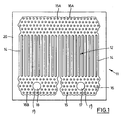
- Figure 1 shows a panel, generally indicated by 11, of a heat exchanger; in the embodiment shown, the panel has a labyrinth 12 of fluid flow passages therein. Panel 11 also has an edge 20 extending completely around it, which when sealed to edge 20 of the other panel 11 forms the edge seal of the heat exchanger.
- the labyrinth 12 on panel 11 is an example of flow fluid passages that may be provided in a panel heat exchanger between the inlet and outlet means, in this instance from inlet orifice 17 through space 16 surrounding sealed sections 15, through channels 14 to the opposing end of the panel heat exchanger, through further space 16A surrounding sealed sections 15A and back through the remainder of channels 14, through space 16B and to outlet orifice 18. Header means are provided at 19 adjacent inlet orifice 17 and outlet orifice 18.
- FIG. 2 is an alternate embodiment of a heat exchanger panel 11.
- orifices 21 and 22 for the inlet and outlet header means whose position is generally indicated by 23 and 24, are located at opposite ends of the heat exchanger panel, which in the embodiment shown is elongated.
- Such an elongated heat exchanger panel is particularly adapted to be located in, for instance, the radiator of an automobile.
- the inlet and outlet header means 22 and 24 are connected by a series of substantially linear fluid flow passages 25 that are interspaced with similarly elongated sections 26 in which the panels of the heat exchanger are sealed together.
- the inlet and outlet header means 23 and 24 of panel 11 are connected by non-linear fluid-flow passages that are formed as channels 27 between isolated sealed sections 28 that, in the embodiment shown, are substantially circular in shape.
- the sealed sections 28 may be located in the heat exchanger panel in any desired pattern, but usually in a systematic pattern. The optimum pattern may depend in part on the fluid that is to be passed through the heat exchanger. For instance, some fluids e.g. water may be less susceptible to laminar flow in the heat exchanger than other fluids e.g. oil. The latter may require a fluid flow passage that is intended to cause a greater degree of turbulence in the flow than that required for other fluids e.g. water.
- Sealed sections 28 have been described above as being circular in shape. However, other shapes may be used e.g. diamond, hexagonal, ovate, rectangular, herring bone patterns or the like.
- means are provided in the panel to cause turbulence in the fluid.
- the means to cause turbulence may be on the external surface, in order to cause turbulence in the the fluid e.g. air or liquid passing over the surface of the panel heat exchanger for the exchange of heat.
- Means to cause turbulence may also be provided on the inner surface of the panel, to cause turbulence in the fluid passing through the heat exchanger.
- Such means may be more beneficial when the liquid passing through the heat exchanger is relatively viscous e.g. for oil rather than water.
- the means may be indentations, projections or the like that extend into the space through which fluid is intended to flow through the heat exchanger, and thereby cause turbulence in the fluid passing through the heat exchanger.
- Such means may be designed into the recessed pattern on the moulds so that indentations, projections or the like are formed during the fabrication of the heat exchanger.
- Embodiments of the inlet and outlet header means are described in greater detail in the aforementioned EP-A-304261, but other inlet and outlet header means may be used.
- the panel heat exchanger of the present invention may be assembled without the use of gaskets or the like, or using one or more gaskets or the like.
- the invention has been described above with reference to a single panel heat exchanger. However, a plurality of heat exchangers may be used, the heat exchangers being arranged in parallel or more likely in series.
- the inlet and outlet header means may be modified to accommodate a plurality of heat exchangers e.g. a stack of heat exchangers, and parallel or series flow of fluid through the heat exchangers, as described in EP-A-304261. It may be preferable to use spacers between the individual heat exchangers of a stack of heat exchangers; such spacers may be fabricated separately from the parts of the headers or fabricated as part thereof.
- At least one sheet that will form the panel of the heat exchanger is coated with a coating composition that will facilitate the bonding of the panels under the influence of heat. Coating of both sheets is preferred.
- the coating not only facilitates bonding between the opposing panels but also tends to soften the polymer in the regions where bonding does not occur and, on application of heated inert gas, thereby facilitating the forming of the fluid-flow passages; the inert gas tends to remove any volatile matter in the coating.
- the sheets are formed from a polyamide, in which event the coating must facilitate the bonding of polyamide sheets.
- the sheet may be coated in a pattern corresponding to the pattern of the bonding of the sheets in the fabrication of the heat exchanger, it will normally be most convenient and preferred that the entire surface of the sheet be coated.
- the coated sheets of the first panel and of the second panel are brought into contact in a face-to-face manner, between the moulds of a press, with the coating at the interface between the sheets.
- the moulds have grooves corresponding to the labyrinth of passages to be formed in the panels, and a groove to accommodate the part of the panels corresponding to the location of the distributor i.e. the location of the inlet and outlet header means.
- the moulds of the press are heated e.g. to a temperature above the softening point of the polymer.
- a distributor having at least one passage for axial flow from one face to the other of the heat exchanger but which will also allow radial flow outwardly into between the panels is inserted between the first and second panel, at the location of the inlet and outlet header means 17, 18, 23, 24. It may be for example a manifold but is preferably in the form of a distributor ring.
- the end faces of the distributor are planar and will normally be coated with the coating composition. On heating of the panels bonding is effected between the panels and the distributor, thereby locating the inlet and outlet header means preferably in a fluid tight seal. Examples of distributor are seen in the said EP-A-304261. Distributor rings will have one and may have two or more radial ports for radial flow.
- a gas usually an inert gas e.g. nitrogen is forced between the sheets, e.g. through the distributor ring, at a pressure above atmospheric pressure.
- a pressure of gas is thus provided in the fluid passages of the labyrinth so as to cause the passages to form; the two sections of the mould may be slowly moved apart after the polymer of the sheets has been heated so as to assist in the forming of the fluid flow passages.
- the gas is preferably flushed through the heat exchanger during and/or after the forming of the fluid flow passages, which tends to remove any volatile components of the coating, for example when the coating is a composition of benzyl alcohol, phenol and polyamide, as disclosed in the aforementioned European patent publication No. 0 287 271.
- the temperature of the panels should be increased to above the expected operating temperature of the resultant heat exchanger, in order to reduce distortion of the channels during use of the heat exchanger.
- the panels of the heat exchanger require orifices at the location of the inlet and outlet header means.
- Such orifices may be provided in the sheets before the sheets are placed between the platens; such orifices are preferably cut from the sheets after any coating of the sheets.
- the orifices may be cut from the panels after forming e.g. by use of a trimming knife, hot wire or other hot tool.
- the mould is attached, preferably in a detachable manner, to a press platen, thereby facilitating expeditious changing of the pattern of the grooves in the panel.
- One or both surfaces of the platen surface that contact the sheet may have the pattern of grooves therein.
- the coating is a homogeneous admixture of benzyl alcohol, phenol and polyamide, as is disclosed in the EP-A-0 287 271.
- examples of alternative coatings are disclosed in EP-A-0 286 400.
- An alternate preferred coating is a homogeneous mixture of benzyl alcohol, phenol and methanol, especially in the ratio of about 12/80/8 by weight, as is disclosed in EP-A-0 287 271.
- the coating is a mixture of trifluoroethanol and benzyl alcohol, especially in a ratio of about 80:20 by weight.
- the sheets that form the panels are formed from a polyamide.
- the particular polyamide selected will depend primarily on the end use intended for the heat exchanger, especially the temperature of use and the environment of use, including the fluid that will be passed through the heat exchanger and the fluid e.g. air or liquid, external to the heat exchanger. In the case of use on a vehicle with air as the external fluid, the air may at times contain salt or other corrosive or abrasive matter.
- the nature of the polyamide composition used to form the sheets that become the panels of the heat exchanger may affect the efficiency of the heat exchanger, as it is believed that heat is capable of being dissipated from the heat exchanger by at least both convection and radiation.
- the polyamide may contain stabilizers, pigments, fillers and other additives known for use in polymer compositions.
- polyamides examples include the polyamides formed by the condensation polymerization of an aromatic or aliphatic dicarboxylic acid having 6-12 carbon atoms with an aliphatic primary diamine having 6-12 carbon atoms.
- the polyamide may be formed by condensation polymerization of an aliphatic lactam or alpha,omega aminocarboxylic acid having 6-12 carbon atoms.
- the polyamide may be formed by copolymerization of mixtures of such dicarboxylic acids, diamines, lactams and aminocarboxylic acids.
- dicarboxylic acids are 1,6-hexanedioic acid (adipic acid), 1,7-heptanedioic acid (pimelic acid), 1,8-octanedioic acid (suberic acid), 1,9-nonanedioic acid (azelaic acid), 1,10-decanedioic acid (sebacic acid), 1,12-dodecanedioic acid and terephthalic acid.
- diamines are 1,6-hexamethylene diamine, 1,8-octamethylene diamine, 1,10-decamethylene diamine and 1,12-dodecamethylene diamine.
- An example of a lactam is caprolactam.
- alpha,omega aminocarboxylic acids are amino octanoic acid, amino decanoic acid and amino dodecanoic acid.
- Preferred examples of the polyamides are polyhexamethylene adipamide and polycaprolactam, which are also known as nylon 66 and nylon 6, respectively.
- the polymer is a polyamide that has been filled with glass-fibre, especially such a polymer that is a toughened polyamide e.g toughened by addition of polymers having elastomeric or rubbery properties.
- the polymer of the distributor may be similar to that of the panels. However, different polymers may be used, provided that such polymers may be bonded to the polymers of the panels and/or coating on the panel, whichever contacts the distributor. Nonetheless, in preferred embodiments the distributor is fabricated from a so-called engineering polymer, especially a polyamide of the type discussed above.
- Sheets of some polymers may exhibit shrinkage in the methods of the present invention, and the amount of shrinkage may vary even within the same general class of polymers e.g. polyamides.
- the areas of the inlet and outlet header means viz. 21-24 in Figures 2 and 3 may need to be designed with some flexibility in positioning of the inlet and outlet header means, especially during the method of manufacture.
- Laminated or coated materials may often be utilized with advantage in the fabrication of the panels, provided that the laminated or coated materials are capable of being formed into panels using the method disclosed herein. Such materials could comprise a layer providing the necessary physical resistance and inner and/or outer layers to provide resistance to the working fluids or contaminants.
- An example of the laminated materials is a layer of glass or other fibre in the form of a fabric, laminated between layers of polymer.
- Composite materials may also be used e.g. glass-filled and fibre-filled composites.
- the polymer is polyamide and each sheet is coated with the aforementioned benzyl alcohol/phenol/polyamide or benzyl alcohol/phenol/methanol composition
- a film of a polyamide between the first and second sheets.
- Such a film becomes bonded to the coating and loses its integrity but it has been observed that the use of such a film may result in the production of a panel heat exchanger of more uniform properties.
- the panel heat exchangers formed by the method of the present invention have wall thicknesses, at least in those portions where transfer of heat will occur, of less than 0.7 mm, and especially in the range of 0.07-0.50 mm, particularly 0.12-0.30 mm. At such wall thicknesses, the transmission of heat through the wall becomes substantially independent of wall thickness, and thus wall thickness becomes a relatively minor or insignificant factor in the operating effectiveness of the heat exchanger. It is to be understood, however, that the polymer composition and the wall thickness must be selected so that the resultant heat exchanger will have the necessary physical properties to be acceptable for the intended end use.
- thermoplastic polymers that may be formed into sheets, at least one of which is coated to promote adhesion to the other sheet under the influence of heat, and used in the method of the present invention are fluorocarbon polymers, polyesters, thermoplastic and thermoset elastomers e.g. polyetherester elastomers, neoprene, chlorosulphonated polyethylene, and ethylene/propylene/diene (EPDM) elastomers, polyvinyl chloride and polyurethane.
- fluorocarbon polymers polyesters
- thermoplastic and thermoset elastomers e.g. polyetherester elastomers, neoprene, chlorosulphonated polyethylene, and ethylene/propylene/diene (EPDM) elastomers, polyvinyl chloride and polyurethane.
- the heat exchangers may be equipped with a by-pass system so that cold viscous oil passes from the inlet to the outlet without passing through the fluid flow passages. This may be accomplished using a heat activated by-pass valve that passes cold oil through alternate passages in the heat exchanger that go directly from inlet to oulet until such time as the oil reaches a predetermined temperature at which time the valve directs the oil through the fluid flow passages of the heat exchanger.
- the process of the present invention provides a versatile and relatively simple method of fabricating heat exchangers from thermoplastic polymers, especially from polyamides.
- the heat exchangers may be used in a variety of end uses, depending on the polymer from which the heat exchanger has been fabricated and the intended environment of use of the heat exchanger.
- heat exchangers of the invention may be inserted into the so-called end-tanks of radiators of automobiles or similar vehicles, and used for the cooling of transmission oil.
- panel heat exchangers have been described with particular reference to use in automotive end-uses, it is to be understood that the panel heat exchangers fabricated by the process of the present invention may be used in a wide variety of end-uses. Examples of other uses include refrigeration, industrial heating and cooling, solar heating, and medical and consumer end-uses e.g. heating and/or cooling of beds, chairs and car seats.
- a series of panel heat exhangers were formed from polyamide sheet using the method described above.
- the coating was a solution of benzyl alcohol, phenol and polyamide, which was applied to one of the two sheets placed between the moulds.
- the polyamide sheets had thicknesses of either 0.25 mm (10 mil) or 0.37 mm (15 mil).
- the panel heat exchangers had either a pattern of fluid flow passages as shown in Figure 2 i.e. linear passages, or as shown in Figure 3 i.e a labyrinth of passages.
- the panel heat exchangers were of approximately the same dimensions viz. 27 x 4.5 cm.
- Oil having a specific heat of 0.523 was passed through the panel heat exchangers at a rate of 2.23 kg/min. The temperature of the oil entering and passing from the panel heat exchanger was measured. Water was passed over the panel heat exchanger at a rate of about 9 kg/min.
Landscapes
- Engineering & Computer Science (AREA)
- Mechanical Engineering (AREA)
- Physics & Mathematics (AREA)
- Thermal Sciences (AREA)
- General Engineering & Computer Science (AREA)
- Sustainable Development (AREA)
- Life Sciences & Earth Sciences (AREA)
- Sustainable Energy (AREA)
- Chemical & Material Sciences (AREA)
- Combustion & Propulsion (AREA)
- Manufacturing & Machinery (AREA)
- Heat-Exchange Devices With Radiators And Conduit Assemblies (AREA)
- Lining Or Joining Of Plastics Or The Like (AREA)
- Blow-Moulding Or Thermoforming Of Plastics Or The Like (AREA)
- Laminated Bodies (AREA)
Claims (9)
- Verfahren zur Herstellung eines Plattenwärmeaustauschers aus einem thermoplastischen Polyamid, wobei der Wärmeaustauscher im wesentlichen aus einer ersten und einer zweiten Platte (11) und Einlaß- und Auslaßanschlüssen (19,22,24) besteht, wobei die Platten miteinander verbunden sind (15,15A,20,26,28), um Fluidströmungsdurchgänge (14,25,27) zu begrenzen, die sich zwischen den Einlaß- und Auslaßanschlüssen erstrecken, wobei jede der Platten im allgemeinen planar und aus Bahnmaterial aus dem Polyamid mit einer Dicke von weniger als 0,7 mm gebildet ist, wobei die Platten des Austauschers Öffnungen (17,18,21,23) darin zusammenwirkend an jedem der Einlaß- und Auslaßanschlüsse angeordnet aufweisen, wobei jeder der genannten Einlaß- und Auslaßanschlüsse einen Verteiler mit planaren Enden, einen axialen Strömungsdurchgang und zumindest einen radialen Strömungsdurchgang umfaßt, wobei der axiale Strömungsdurchgang davon mit den Öffnungen fluchtet,
wobei das genannte Verfahren folgende aufeinanderfolgende Schritte umfaßt:(a) das Anordnen der Verteiler und zwei Bahnen aus dem thermoplastischen Polyamid, von denen zumindest eine mit einer Beschichtungszusammensetzung beschichtet worden ist, die das Verbinden der Bahnen unter dem Einfluß von Wärme erleichtert, mit einander zugewandten Flächen zwischen Formen in einer erwärmten Presse, sodaß sie einander berühren, wobei die Oberfläche von zumindest einer der genannten Formen ein durch Ausnehmungen gebildetes Muster darauf ausgebildet hat, das den Fluidströmungsdurchgängen (14,25,27) des Plattenwärmeaustauschers entspricht, sodaß (i) die Bahnen einander und die planaren Enden der genannten Verteiler über im wesentlichen die gesamte Fläche der Bahnen berühren, wobei die Verteiler sich in einer beabstandeten Beziehung befinden, die ihrer Anordnung im Plattenwärmeaustauscher entspricht, und (ii) die Beschichtung sich an der Schnittfläche zwischen den Bahnen befindet; und(b) das Erwärmen und Pressen der genannten Formen, um Bindung zwischen den Bahnen und zwischen den Bahnen und den Enden der Verteiler zu bewirken, und das Spülen zwischen den genannten Einlaß- und Auslaßanschlüssen mit einem inerten Gas bei einem Druck über dem atmosphärischen Druck, wodurch Fluidströmungsdurchgänge zwischen den Einlaß- und Auslaßanschlüssen gebildet werden und flüchtige Materie von den Fluidströmungsdurchgängen entfernt wird. - Verfahren nach Anspruch 1, bei dem die Form an einer Preßandruckplatte befestigt ist, wobei die Form das durch Ausnehmungen gebildete Muster darin aufweist.
- Verfahren nach Anspruch 2, bei dem die Form auf abnehmbare Art an der Preßandruckplatte befestigt ist.
- Verfahren nach einem der vorhergehenden Ansprüche, bei dem die Beschichtungszusammensetzung auch auf die Enden der Verteiler aufgetragen wird.
- Verfahren nach einem der vorhergehenden Ansprüche, bei dem die Verteiler zumindest zwei radiale Strömungsdurchgänge aufweisen.
- Verfahren nach einem der vorhergehenden Ansprüche, bei dem die Öffnungen in den Platten an der Position der Anschlüsse in den Bahnen ausgebildet werden, bevor die Bahnen zwischen den Formen angeordnet werden.
- Verfahren nach einem der Ansprüche 1 bis 5, bei dem die Öffnungen in den Platten an der Position der Anschlüsse aus den Platten geschnitten werden, nachdem die Platten geformt worden sind.
- Verfahren nach einem der vorhergehenden Ansprüche, bei dem das Gas Stickstoff ist.
- Verfahren nach einem der vorhergehenden Ansprüche, bei dem das Polyamid Polyhexamethylenadipamid ist.
Applications Claiming Priority (2)
| Application Number | Priority Date | Filing Date | Title |
|---|---|---|---|
| GB888808944A GB8808944D0 (en) | 1988-04-15 | 1988-04-15 | Method for manufacture of thermoplastic panel heat exchangers |
| GB8808944 | 1988-04-15 |
Publications (3)
| Publication Number | Publication Date |
|---|---|
| EP0337802A2 EP0337802A2 (de) | 1989-10-18 |
| EP0337802A3 EP0337802A3 (en) | 1990-01-17 |
| EP0337802B1 true EP0337802B1 (de) | 1994-02-23 |
Family
ID=10635258
Family Applications (1)
| Application Number | Title | Priority Date | Filing Date |
|---|---|---|---|
| EP89303717A Expired - Lifetime EP0337802B1 (de) | 1988-04-15 | 1989-04-14 | Verfahren zum Herstellen von thermoplastischen Platten-Wärmetauschern |
Country Status (7)
| Country | Link |
|---|---|
| EP (1) | EP0337802B1 (de) |
| JP (1) | JP2966427B2 (de) |
| KR (1) | KR0177796B1 (de) |
| AU (1) | AU608148B2 (de) |
| CA (1) | CA1329472C (de) |
| DE (1) | DE68913222T2 (de) |
| GB (1) | GB8808944D0 (de) |
Cited By (1)
| Publication number | Priority date | Publication date | Assignee | Title |
|---|---|---|---|---|
| US20220217875A1 (en) * | 2019-04-05 | 2022-07-07 | Phase Change Energy Solutions, Inc. | Thermal Management Devices and Methods |
Families Citing this family (11)
| Publication number | Priority date | Publication date | Assignee | Title |
|---|---|---|---|---|
| JP2515795Y2 (ja) * | 1990-05-25 | 1996-10-30 | 株式会社ゼクセル | 積層型熱交換器 |
| CA2090998C (en) * | 1992-05-21 | 2000-11-28 | Anthony Joseph Cesaroni | Panel heat exchanger with integral thermoelectric device |
| GB9211413D0 (en) * | 1992-05-29 | 1992-07-15 | Cesaroni Anthony Joseph | Panel heat exchanger formed from tubes and sheets |
| FI106983B (fi) * | 1997-01-20 | 2001-05-15 | Hadwaco Ltd Oy | Kalvohaihduttimen tai -tislaimen lämmönsiirtoelementti ja sen valmistusmenetelmä |
| US20130118478A1 (en) * | 2011-11-11 | 2013-05-16 | Masdar Institute Of Science And Technology | Liquid-air transpired solar collectors |
| US9999885B1 (en) | 2014-05-30 | 2018-06-19 | Lockheed Martin Corporation | Integrated functional and fluidic circuits in Joule-Thompson microcoolers |
| US9207540B1 (en) | 2014-05-30 | 2015-12-08 | Lockheed Martin Corporation | Integrating functional and fluidic circuits in joule-thomson microcoolers |
| US9813644B1 (en) | 2014-06-19 | 2017-11-07 | Lockheed Martin Corporation | Nano-antenna array infrared imager |
| CN111366013A (zh) * | 2018-12-26 | 2020-07-03 | 浙江盾安热工科技有限公司 | 扁管及换热器 |
| EP3919262B1 (de) * | 2020-06-03 | 2025-05-07 | TI Automotive Technology Center GmbH | Verfahren zur herstellung einer rohranordnung für den transport von temperiermedium |
| WO2023063927A1 (en) * | 2021-10-12 | 2023-04-20 | Hewlett-Packard Development Company, L.P. | Three-dimensional printing |
Family Cites Families (6)
| Publication number | Priority date | Publication date | Assignee | Title |
|---|---|---|---|---|
| DE1952785A1 (de) * | 1969-10-20 | 1971-04-29 | Lissmann Alkor Werk | Verfahren zum kontinuierlichen Herstellen eines flaechenhaften Gegenstands mit kammer- bzw. kanalartigen Hohlraeumen |
| GB1465564A (en) * | 1974-04-24 | 1977-02-23 | Du Pont | Laminated article |
| GB1487440A (en) * | 1975-05-21 | 1977-09-28 | Ashford P | Production of hollow articles |
| US4411310A (en) * | 1978-04-07 | 1983-10-25 | The Boeing Company | Heat exchange apparatus having thin film flexible sheets |
| GB8708386D0 (en) * | 1987-04-08 | 1987-05-13 | Cesaroni A J | Heat sealing of polyamides |
| US4859265A (en) * | 1987-04-08 | 1989-08-22 | Du Pont Canada Inc. | Process for manufacturing of heat exchangers from polymers |
-
1988
- 1988-04-15 GB GB888808944A patent/GB8808944D0/en active Pending
-
1989
- 1989-04-07 CA CA000596060A patent/CA1329472C/en not_active Expired - Lifetime
- 1989-04-14 KR KR1019890004951A patent/KR0177796B1/ko not_active Expired - Fee Related
- 1989-04-14 EP EP89303717A patent/EP0337802B1/de not_active Expired - Lifetime
- 1989-04-14 JP JP1093297A patent/JP2966427B2/ja not_active Expired - Lifetime
- 1989-04-14 AU AU32795/89A patent/AU608148B2/en not_active Ceased
- 1989-04-14 DE DE68913222T patent/DE68913222T2/de not_active Expired - Lifetime
Cited By (1)
| Publication number | Priority date | Publication date | Assignee | Title |
|---|---|---|---|---|
| US20220217875A1 (en) * | 2019-04-05 | 2022-07-07 | Phase Change Energy Solutions, Inc. | Thermal Management Devices and Methods |
Also Published As
| Publication number | Publication date |
|---|---|
| EP0337802A3 (en) | 1990-01-17 |
| DE68913222T2 (de) | 1994-08-04 |
| CA1329472C (en) | 1994-05-17 |
| GB8808944D0 (en) | 1988-05-18 |
| JPH0222041A (ja) | 1990-01-24 |
| KR900016726A (ko) | 1990-11-14 |
| AU3279589A (en) | 1989-10-19 |
| KR0177796B1 (ko) | 1999-04-15 |
| AU608148B2 (en) | 1991-03-21 |
| DE68913222D1 (de) | 1994-03-31 |
| EP0337802A2 (de) | 1989-10-18 |
| JP2966427B2 (ja) | 1999-10-25 |
Similar Documents
| Publication | Publication Date | Title |
|---|---|---|
| CA2016391C (en) | Panel heat exchangers formed from thermoplastic polymers | |
| US5195240A (en) | Method for the manufacture of thermoplastic panel heat exchangers | |
| EP0286399B1 (de) | Mittels Polymeren hergestellter Wärmetauscher | |
| CA1316527C (en) | Comfort heat exchanger | |
| EP0572187B1 (de) | Herstellung eines Plattenwärmetauschers aus Rohren und Platten | |
| US4871017A (en) | Headers for thermoplastic panel heat exchangers | |
| EP0286400B1 (de) | Verfahren zur Herstellung eines Wärmetauschers mittels Polymeren | |
| EP0337802B1 (de) | Verfahren zum Herstellen von thermoplastischen Platten-Wärmetauschern | |
| US5114776A (en) | Corrugated thermoplastic sheet having fluid flow passages | |
| EP0673496B1 (de) | Tafelwärmetauscher, der aus vorgefertigten tafeln gebildet ist | |
| EP0486506B1 (de) | Plattenwärmetauscher |
Legal Events
| Date | Code | Title | Description |
|---|---|---|---|
| PUAI | Public reference made under article 153(3) epc to a published international application that has entered the european phase |
Free format text: ORIGINAL CODE: 0009012 |
|
| AK | Designated contracting states |
Kind code of ref document: A2 Designated state(s): BE DE FR GB IT NL SE |
|
| PUAL | Search report despatched |
Free format text: ORIGINAL CODE: 0009013 |
|
| AK | Designated contracting states |
Kind code of ref document: A3 Designated state(s): BE DE FR GB IT NL SE |
|
| 17P | Request for examination filed |
Effective date: 19900608 |
|
| 17Q | First examination report despatched |
Effective date: 19910723 |
|
| GRAA | (expected) grant |
Free format text: ORIGINAL CODE: 0009210 |
|
| AK | Designated contracting states |
Kind code of ref document: B1 Designated state(s): BE DE FR GB IT NL SE |
|
| REF | Corresponds to: |
Ref document number: 68913222 Country of ref document: DE Date of ref document: 19940331 |
|
| PGFP | Annual fee paid to national office [announced via postgrant information from national office to epo] |
Ref country code: BE Payment date: 19940420 Year of fee payment: 6 |
|
| ITF | It: translation for a ep patent filed | ||
| PGFP | Annual fee paid to national office [announced via postgrant information from national office to epo] |
Ref country code: NL Payment date: 19940430 Year of fee payment: 6 |
|
| ET | Fr: translation filed | ||
| PLBE | No opposition filed within time limit |
Free format text: ORIGINAL CODE: 0009261 |
|
| STAA | Information on the status of an ep patent application or granted ep patent |
Free format text: STATUS: NO OPPOSITION FILED WITHIN TIME LIMIT |
|
| EAL | Se: european patent in force in sweden |
Ref document number: 89303717.6 |
|
| 26N | No opposition filed | ||
| PG25 | Lapsed in a contracting state [announced via postgrant information from national office to epo] |
Ref country code: BE Effective date: 19950430 |
|
| BERE | Be: lapsed |
Owner name: CESARONI ANTHONY JOSEPH Effective date: 19950430 Owner name: DU PONT CANADA INC. Effective date: 19950430 |
|
| PG25 | Lapsed in a contracting state [announced via postgrant information from national office to epo] |
Ref country code: NL Effective date: 19951101 |
|
| NLV4 | Nl: lapsed or anulled due to non-payment of the annual fee |
Effective date: 19951101 |
|
| PGFP | Annual fee paid to national office [announced via postgrant information from national office to epo] |
Ref country code: SE Payment date: 19980316 Year of fee payment: 10 |
|
| PG25 | Lapsed in a contracting state [announced via postgrant information from national office to epo] |
Ref country code: SE Free format text: LAPSE BECAUSE OF NON-PAYMENT OF DUE FEES Effective date: 19990415 |
|
| EUG | Se: european patent has lapsed |
Ref document number: 89303717.6 |
|
| REG | Reference to a national code |
Ref country code: GB Ref legal event code: IF02 |
|
| PGFP | Annual fee paid to national office [announced via postgrant information from national office to epo] |
Ref country code: DE Payment date: 20080417 Year of fee payment: 20 Ref country code: FR Payment date: 20080312 Year of fee payment: 20 |
|
| PGFP | Annual fee paid to national office [announced via postgrant information from national office to epo] |
Ref country code: IT Payment date: 20080428 Year of fee payment: 20 |
|
| PGFP | Annual fee paid to national office [announced via postgrant information from national office to epo] |
Ref country code: GB Payment date: 20080416 Year of fee payment: 20 |
|
| REG | Reference to a national code |
Ref country code: GB Ref legal event code: PE20 Expiry date: 20090413 |
|
| PG25 | Lapsed in a contracting state [announced via postgrant information from national office to epo] |
Ref country code: GB Free format text: LAPSE BECAUSE OF EXPIRATION OF PROTECTION Effective date: 20090413 |