EP0338129A2 - Coupleur émetteur-récepteur pour câble à 2 conducteurs de réseau local à haute vitesse - Google Patents
Coupleur émetteur-récepteur pour câble à 2 conducteurs de réseau local à haute vitesse Download PDFInfo
- Publication number
- EP0338129A2 EP0338129A2 EP88120618A EP88120618A EP0338129A2 EP 0338129 A2 EP0338129 A2 EP 0338129A2 EP 88120618 A EP88120618 A EP 88120618A EP 88120618 A EP88120618 A EP 88120618A EP 0338129 A2 EP0338129 A2 EP 0338129A2
- Authority
- EP
- European Patent Office
- Prior art keywords
- signal
- transceiver
- terminal
- signals
- generating
- Prior art date
- Legal status (The legal status is an assumption and is not a legal conclusion. Google has not performed a legal analysis and makes no representation as to the accuracy of the status listed.)
- Withdrawn
Links
Images
Classifications
-
- H—ELECTRICITY
- H04—ELECTRIC COMMUNICATION TECHNIQUE
- H04B—TRANSMISSION
- H04B1/00—Details of transmission systems, not covered by a single one of groups H04B3/00 - H04B13/00; Details of transmission systems not characterised by the medium used for transmission
- H04B1/38—Transceivers, i.e. devices in which transmitter and receiver form a structural unit and in which at least one part is used for functions of transmitting and receiving
- H04B1/40—Circuits
- H04B1/54—Circuits using the same frequency for two directions of communication
- H04B1/58—Hybrid arrangements, i.e. arrangements for transition from single-path two-direction transmission to single-direction transmission on each of two paths or vice versa
- H04B1/586—Hybrid arrangements, i.e. arrangements for transition from single-path two-direction transmission to single-direction transmission on each of two paths or vice versa using an electronic circuit
-
- H—ELECTRICITY
- H04—ELECTRIC COMMUNICATION TECHNIQUE
- H04L—TRANSMISSION OF DIGITAL INFORMATION, e.g. TELEGRAPHIC COMMUNICATION
- H04L12/00—Data switching networks
- H04L12/28—Data switching networks characterised by path configuration, e.g. LAN [Local Area Networks] or WAN [Wide Area Networks]
- H04L12/40—Bus networks
- H04L12/40006—Architecture of a communication node
-
- H—ELECTRICITY
- H04—ELECTRIC COMMUNICATION TECHNIQUE
- H04L—TRANSMISSION OF DIGITAL INFORMATION, e.g. TELEGRAPHIC COMMUNICATION
- H04L12/00—Data switching networks
- H04L12/28—Data switching networks characterised by path configuration, e.g. LAN [Local Area Networks] or WAN [Wide Area Networks]
- H04L12/40—Bus networks
- H04L12/407—Bus networks with decentralised control
- H04L12/413—Bus networks with decentralised control with random access, e.g. carrier-sense multiple-access with collision detection [CSMA-CD]
Definitions
- the present invention relates to local area network communication circuitry and, more particularly, to a coupler circuit connecting a transceiver to a high-speed local area network interconnected by ordinary twisted-pair wires.
- Electronic equipment is connected to a network via a bidirectional amplifier, providing one path for transmission of data onto the network and another path for receiving data from the network. Accordingly, such bidirectional amplifiers are called transceivers, an abbreviation of transmitter and receiver.
- a 4-wire to 2-wire terminating set is used to interconnect the bidirectional amplifier, the transmit and receive side of which each utilize a 2-wire path, to the single 2-wire pair interconnection, various electronic equipment on the network.
- transmission of data preferably occurs at high speed.
- Speeds of 10 million bits per second (10MBPS) are possible with present electronic equipment.
- a single 2-wire pair is not suitable for such high transmission rates, unless special precautions are taken to avoid "collisions", where data is attempted to be transmitted and received at the same time by one of the electronic equipment.
- Couplers which allow the use of a single pair of wires for interconnecting equipment in a network operating at high speeds.
- couplers are complex and expensive.
- digitally process the signals received and the signals to be transmitted so that collisions can be avoided.
- digital processing is impractical at very high speeds, such as 10MBPS.
- two pairs of cables have been employed to interconnect equipment on LANs; one pair for transmission and one pair for reception.
- Such two-pair cabling is wasteful of materials, more expensive to install than single-pair cabling, and exacerbates close-quarter routing where space is at a premium. Furthermore, it differs from the usual one-pair cabling employed in many premises. Thus separate installation for 2-pair cabling is required in buildings already constructed. This installation is expensive and disruptive.
- the instant invention provides a circuit interconnecting a transceiver to a network in which a one-pair cable interconnects equipment to provide a 10MBPS LAN.
- a one-pair cable interconnects equipment to provide a 10MBPS LAN.
- an ordinary twisted-pair of wires such as is commonly used in telephony for premises wiring, can be used to interconnect equipment in a LAN where such equipment is separated by up to 100 metres.
- the interconnect circuit provided by the present invention is very inexpensive and in conjunction with the use of an inexpensive ordinary single twisted-pair (TP) wires, affords a very inexpensive way of interconnecting equipment in a LAN. Yet, the LAN can be used at high-speed transmission rates of 10MBPS. Since most premises are already wired with ordinary TP wires for telephony, the present invention produces an extremely inexpensive, easily-installed, LAN. Changes, additions, and deletions from the network are simplified because of the ease of working with ordinary TP wires.
- TP twisted-pair
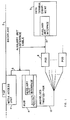
- FIG. 1 a typical installation of a local area network (LAN) having a STAR topology is shown.
- a media access unit (MAU) 1 is shown tapped into a backplane 2 of the LAN.
- the backplane 2 may be a fiber optic cable, a coaxial cable or a twisted-pair of wires.
- the MAU 1 serves to connect a transceiver Hub 4 to the LAN backplane.
- the Hub 4 has an auxiliary unit interface (AUI) which receives an AUI cable 6 from MAU 1.
- the Hub 4 performs a repeating function between the LAN backplane 2 and a number of transceiver Pods 8 connected to the Hub.
- AUI auxiliary unit interface
- Pods 8 are connected to the Hub 4 via twenty-four unshielded, twisted-pair (TP) wires 12.
- TP twisted-pair
- a 50-pin socket on the Hub serves to receive the 24 TP wires.
- Each Pod 8 is connected to two TP wires 12 to the Hub 4, thereby providing a four-wire full-duplex interconnection.
- Each Pod 8 is, in turn, connected to an AUI of data terminal equipment (DTE) 9, via an AUI cable 11.
- DTE data terminal equipment
- typical DTE is a microcomputer, a workstation, or a data entry terminal.
- Both voice and data signals may be carried on the TP wires 12. Transmission rates up to 10 million bits per second (mbps) are to be supported by the LAN shown in Fig. 1. Up to 300 feet of lineal distance is possible between Hub 4 and DTE 9.
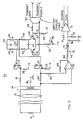
- Fig. 2 is a schematic diagram of the circuit 10 of the present invention enabling interconnection of a transmitter and a receiver (transceiver) to a high-speed network in which elements are interconnected by a single pair of wires 12.
- the single pair of wires 12 is an ordinary unshielded twisted-pair (TP) used in telephony for premises wiring.
- TP unshielded twisted-pair
- the transceiver and interconnection circuit 10 of the present invention can be employed in the media access unit 1 and the Hub 4 and Pods 8 shown in Fig. 1, as will be appreciated by those skilled in the art.
- Signal lines 12 are connected to the primary terminals of an isolation transformer 14.
- the secondary winding of transformer 14 is center-tapped and a capacitor 16 is connected between the center-tap terminal of transformer 14 and ground.
- a resistor 18 is connected between a first terminal of the secondary winding of transformer 14 and the emitter terminal of an NPN transistor 20.
- a resistor 22 is likewise connected between the second terminal of the secondary winding of transformer 14 and the emitter terminal of an NPN transitor 24.
- the collectors of transistors 20 and 24 are connected to ground and their emitters are connected to a source of negative voltage via a resistor 26 and a resistor 28, respectively.
- the bases of transistors 20 and 24 are connected to the outputs of a differential amplifier 30.
- Differential amplifier 30 includes a pair of emitter-coupled NPN transistors 32 and 34. Their common emitter junction is connected to a first terminal of a resistor 36. The second terminal of resistor 36 is connected to a diode-connected NPN transistor 38: The collector and base of transistor 38 is connected to the second terminal of resistor 36, the collector of transistor 38 is connected to a negative-voltage source.
- the collectors of transistors 32 and 34 are connected by a capacitor 40: the collector of transistor 32 is also connected to a first terminal of a resistor 42, the collector of transistor 34 is also connected to a first terminal of a resistor 44.
- the second terminals of resistors 42 and 44 are connected to the bases of transistors 20 and 24, respectively, connected to ground via resistors 46 and 48, respectively, and connected to each other by a capacitor 50.
- the junction of resistors 42 and 46 and the junctional of resistors 44 and 48 comprise the output terminals of differential amplifier 30.
- the bases of transistors 32 and 34 are connected to a true and a complemented output terminal, respectively, of an AND gate 52 via resistors 54 and 56, respectively.
- a resistor 58 and a resistor 60 are connected between the base of transistor 32 and the base of transistor 34, respectively, and a negative-voltage source.
- AND gate 52 receives at a first input terminal the data to be transmitted from the transceiver.
- AND gate 52 receives at a second input terminal a transmit enable (XMIT_EN) signal generated by the transceiver.
- AND gate 52 is preferably an emitter-coupled logic (ECL) type for fast response.
- An operational amplifier (op amp) 62 has its non-inverting input terminal connected to the common connection of resistor 22 and the secondary winding terminal of transformer 14.
- the op amp 62 has its inverting input terminal connected to the common connection of resistor 22 and the emitter of transistor 24 via a resistor 64.
- a resistor 66 is connected between the output terminal of op amp 62 and its inverting input terminal.
- the output terminal of op amp 62 is connected to a first terminal of a resistor 68.
- the second terminal of resistor 68 is connected to a first terminal of an inductor 70.
- the second terminal of inductor 70 is connected to a first input terminal of a comparator 72.
- a capacitor 74 and a capacitor 76 are connected between the first and second terminals of inductor 70 and ground, respectively.
- a resistor 78 is also connected between the second terminal of inductor 70 and ground.
- Elements 68, 70, 74, 76 and 78 comprise a passive low-pass filter (LPF).
- Comparator 72 receives at a second input a reference voltage (VREF) and generates a differential received signal at a true and complemented output terminal. This received signal is conducted to the receiver portion of the transceiver. Comparator 72 is preferbly of an ECL type.
- circuit 10 When the transceiver is receiving data from the network, the XMIT_EN signal is LOW. AND gate 52 is thus disabled causing a LOW signal to be generated at its true output terminal and a HIGH signal to be generated at its complemented output terminal. Accordingly, transistor 32 is conducting and transistor 34 is non-conducting. This, in turn, causes transistor 20 to be non-conducting and transistor 24 to conduct. This, in turn, causes the emitter of transistor 24 to be nearly at ground potential. In a similar manner, the emitter of transistor 20 is held to approximately the level of the negative-voltage source.
- the inverting terminal of op amp 64 is held at ground and the non-inverting terminal is exposed to the signals received over lines 12 and produced at the secondary of transformer 14.
- the transistors 20 and 24 are not held to any fixed state - conducting or non-conducting - but simply follow the state of the applied transmit data signal, as the analysis in the preceding paragraph demonstrates. Accordingly, approximately equal voltge appears across resistor 22 during transmission, the voltage equal to approximately half the voltage to be transmitted as applied to the secondary winding of transformer 14. The presence of equal voltages at the inputs to op amp 62 causes it to generate a near-zero output voltage. Thus, the signal to be transmitted is not conducted to the receive section of the transceiver.
- Circuit 10 is composed of very inexpensive components which together can be purchased in commercial quantities for less than 50 cents. Yet it performs its function well at high speeds up to 10MBPS.
- the circuit 10 of the present invention provides an inexpensive way of connecting a transceiver to a single-pair cable interconnecting elements of a LAN.
Landscapes
- Engineering & Computer Science (AREA)
- Computer Networks & Wireless Communication (AREA)
- Signal Processing (AREA)
- Small-Scale Networks (AREA)
- Communication Cables (AREA)
Applications Claiming Priority (2)
| Application Number | Priority Date | Filing Date | Title |
|---|---|---|---|
| US18519188A | 1988-04-22 | 1988-04-22 | |
| US185191 | 1988-04-22 |
Publications (2)
| Publication Number | Publication Date |
|---|---|
| EP0338129A2 true EP0338129A2 (fr) | 1989-10-25 |
| EP0338129A3 EP0338129A3 (fr) | 1991-06-12 |
Family
ID=22679980
Family Applications (1)
| Application Number | Title | Priority Date | Filing Date |
|---|---|---|---|
| EP19880120618 Withdrawn EP0338129A3 (fr) | 1988-04-22 | 1988-12-09 | Coupleur émetteur-récepteur pour câble à 2 conducteurs de réseau local à haute vitesse |
Country Status (2)
| Country | Link |
|---|---|
| EP (1) | EP0338129A3 (fr) |
| JP (1) | JPH0216834A (fr) |
Families Citing this family (1)
| Publication number | Priority date | Publication date | Assignee | Title |
|---|---|---|---|---|
| JPH0590914A (ja) * | 1991-02-22 | 1993-04-09 | Mitsubishi Electric Corp | 電圧制御型発振器 |
Family Cites Families (2)
| Publication number | Priority date | Publication date | Assignee | Title |
|---|---|---|---|---|
| JPS5725731A (en) * | 1980-07-22 | 1982-02-10 | Iwatsu Electric Co Ltd | Hybrid circuit |
| CA1157125A (fr) * | 1981-11-18 | 1983-11-15 | Nortel Networks Corporation | Circuits electroniques hybrides |
-
1988
- 1988-12-09 EP EP19880120618 patent/EP0338129A3/fr not_active Withdrawn
-
1989
- 1989-04-14 JP JP1095066A patent/JPH0216834A/ja active Pending
Also Published As
| Publication number | Publication date |
|---|---|
| EP0338129A3 (fr) | 1991-06-12 |
| JPH0216834A (ja) | 1990-01-19 |
Similar Documents
| Publication | Publication Date | Title |
|---|---|---|
| US6175556B1 (en) | Remote powered ethernet repeater | |
| US5253249A (en) | Bidirectional transceiver for high speed data system | |
| US5822426A (en) | Balanced hybrid circuit | |
| JP2909084B2 (ja) | ラン通信装置およびそれに使用する媒体アダプタ | |
| US4959829A (en) | Dual cable communication system | |
| EP1608119B1 (fr) | Système et procédé pour la terminaison active de ligne | |
| US4647912A (en) | Coupling discriminator and interface adaptor | |
| JPH0357663B2 (fr) | ||
| KR19980032559A (ko) | 데이터 통신 방법, 전자 장치 및 물리층 제어 집적 회로 | |
| EP0380341B1 (fr) | Système de communication optique | |
| US7761076B1 (en) | Apparatus and method for converting single-ended signals to a differential signal, and transceiver employing same | |
| US4775864A (en) | Local area network with multiple node bus topology | |
| US6327309B1 (en) | Bidirection channels using common pins for transmit and receive paths | |
| US4875205A (en) | Crosstalk reduction in unshielded twisted-pair lines | |
| KR20020035440A (ko) | 전송신호의 감쇠를 보상하기 위한 데이터통신시스템 | |
| US5305465A (en) | Interface chip for coupling modulated signals | |
| US6714558B1 (en) | System for implementing network protocols between devices on a printed circuit board | |
| CA1321416C (fr) | Reduction de la diaphonie sur les lignes a paires symetriques non blindees | |
| EP0214159A1 (fr) | Tonalite pilote dans un bus de donnees | |
| US6281605B1 (en) | Method and apparatus for passive switching hub | |
| JPH0216834A (ja) | ツイスト・ペア・ケーブルを使用した高速ネットワーク用のトランシーバ・カプラ | |
| EP0338126B1 (fr) | Méthode et appareil pour tester des câbles à paires torsadées d'un réseau local | |
| JPH06152658A (ja) | 通信制御装置のインタフェース回路 | |
| JP2005136643A (ja) | 通信システム | |
| JP3514642B2 (ja) | 光受信回路およびそれを用いた光伝送システム |
Legal Events
| Date | Code | Title | Description |
|---|---|---|---|
| PUAI | Public reference made under article 153(3) epc to a published international application that has entered the european phase |
Free format text: ORIGINAL CODE: 0009012 |
|
| AK | Designated contracting states |
Kind code of ref document: A2 Designated state(s): DE FR GB IT |
|
| PUAL | Search report despatched |
Free format text: ORIGINAL CODE: 0009013 |
|
| AK | Designated contracting states |
Kind code of ref document: A3 Designated state(s): DE FR GB IT |
|
| STAA | Information on the status of an ep patent application or granted ep patent |
Free format text: STATUS: THE APPLICATION IS DEEMED TO BE WITHDRAWN |
|
| 18D | Application deemed to be withdrawn |
Effective date: 19911213 |