EP0338911A1 - Verfahren zur Rückgewinnung von Farbröhrenphosphoren - Google Patents
Verfahren zur Rückgewinnung von Farbröhrenphosphoren Download PDFInfo
- Publication number
- EP0338911A1 EP0338911A1 EP19890401062 EP89401062A EP0338911A1 EP 0338911 A1 EP0338911 A1 EP 0338911A1 EP 19890401062 EP19890401062 EP 19890401062 EP 89401062 A EP89401062 A EP 89401062A EP 0338911 A1 EP0338911 A1 EP 0338911A1
- Authority
- EP
- European Patent Office
- Prior art keywords
- phosphors
- phosphores
- phosphorus
- les
- collected
- Prior art date
- Legal status (The legal status is an assumption and is not a legal conclusion. Google has not performed a legal analysis and makes no representation as to the accuracy of the status listed.)
- Withdrawn
Links
Images


Classifications
-
- C—CHEMISTRY; METALLURGY
- C09—DYES; PAINTS; POLISHES; NATURAL RESINS; ADHESIVES; COMPOSITIONS NOT OTHERWISE PROVIDED FOR; APPLICATIONS OF MATERIALS NOT OTHERWISE PROVIDED FOR
- C09K—MATERIALS FOR MISCELLANEOUS APPLICATIONS, NOT PROVIDED FOR ELSEWHERE
- C09K11/00—Luminescent materials, e.g. electroluminescent or chemiluminescent
- C09K11/01—Recovery of luminescent materials
-
- Y—GENERAL TAGGING OF NEW TECHNOLOGICAL DEVELOPMENTS; GENERAL TAGGING OF CROSS-SECTIONAL TECHNOLOGIES SPANNING OVER SEVERAL SECTIONS OF THE IPC; TECHNICAL SUBJECTS COVERED BY FORMER USPC CROSS-REFERENCE ART COLLECTIONS [XRACs] AND DIGESTS
- Y02—TECHNOLOGIES OR APPLICATIONS FOR MITIGATION OR ADAPTATION AGAINST CLIMATE CHANGE
- Y02W—CLIMATE CHANGE MITIGATION TECHNOLOGIES RELATED TO WASTEWATER TREATMENT OR WASTE MANAGEMENT
- Y02W30/00—Technologies for solid waste management
- Y02W30/50—Reuse, recycling or recovery technologies
Definitions
- the present invention relates to a method for recovering phosphors from color television tubes.
- Blue and green phosphors mainly contain zinc and cadmium with activators such as copper, aluminum and silver and it is generally considered that it is not profitable to recover the raw materials.
- Red phosphors essentially contain rare earths such as yttrium and europium. Red phosphors are generally returned to phosphorus producers for extraction of the rare earths, which can be profitable since red phosphors are priced about ten times higher than blue and green phosphors. To recover the rare earths, the yttrium and europium oxides are reprecipitated and the phosphors are withdrawn. Due to the various losses in the rare earth recovery process and the total cost of reprocessing the rare earths recovered, we only manage to save around half the original price of red phosphorus.
- the subject of the present invention is a process making it possible to economically recover phosphors, in particular those originating from the radiant heating device and comprising a high proportion of organic elements, both the phosphors which are normally sent for disposal as waste, or recovered as is the case for rare earths.
- the method of the invention consists in breaking in the phosphorus-based materials collected during the manufacture of the slabs the chains of organic polymers with a view to recovering the various phosphors.
- periodates such as periodic acid are used in order to break the chains of organic polymers. These periodates can be KIO4, NAIO4 or HIO4 for example.
- the collected materials are not previously heated, in particular those collected during the radiant heating of the tiles.
- oxidants such as NaOCl, NH4S2O8 or H2O2 are used to dissolve the chromium compounds.
- FIG. 1 there is shown schematically a three-color television tube of conventional structure.
- This tube comprises an envelope 1 consisting of a front panel made of a transparent material 2, a neck 3 and a flared part 4 interconnecting the neck 3 and the front panel 2.
- a luminescent screen 5 is produced on the internal surface of the front panel 2.
- Three electron guns 6, 7 and 8 are mounted in the neck 3 to emit three individual electron beams which are each controlled by the video signals representative of the colors green, blue and red respectively.
- Magnetic devices 9 are provided in a known manner around the neck to achieve in particular the convergence and deflection of the electron beams.
- a shadow mask 10 is provided between the electron guns 6, 7 and 8 and the display screen, in a well known manner.
- the display screen 5 comprises on the slab 2 a set of parallel lines or bands 11 to 13 of phosphor materials capable of emitting the colors green (V), blue (B) respectively. , red (R).
- Each line or strip 11, 12 and 13 can emit only one color.
- Each electron gun 6, 7 and 8 is aimed at a corresponding color so that the electron beam from each of the guns excites only one color.
- the slab 2 is mounted on a suitable support device and a sludge of a material of luminophore is applied to this slab.
- the mud comprises in particular the desired phosphor, an organic polymer such as polyvinyl alcohol, a suitable photosensitizer such as ammonium dichromate, sodium dichromate, or potassium dichromate and deionized water.
- additives such as ethylene glycol, triethylene glycol or methylpyrrolidone have been added to phosphors to reduce exposure time.
- the amount added is 50 to 70% by weight of polyvinyl alcohol for example.
- all the additives used to reduce the exposure time have a high boiling point of between 150 and 220 ° C. They also act as a plasticizer for the photopolymer contained in the phosphor strip and keep it above the softening point.
- the mud is distributed over the entire surface of the slab which is fixed to a support device 16 (see FIG. 3) driven in rotation at high speed by a motor 17 to remove excess mud.
- the mud is then dried with infrared drying devices 18.
- the coating of mud is then irradiated by suitable light rays through a perforated mask to record each time the design of the bands of a color on the layer of dried mud.
- the light irradiation causes the mud to polymerize and makes the irradiated surfaces insoluble in water.
- the parts of the non-irradiated mud are then eliminated by a simple washing of the slab with water. This washing leaves the design of the phosphor strips intact.
- the panel is then dried to remove the water. This procedure is repeated twice to deposit the other two strips of phosphor.
- the normal deposition sequence for the three colors of the phosphor is generally green, blue and red.
- a tube manufacturing plant generally has several sludge drying stations. In each of these stations the deposits 19 resulting from the dripping of the sludge harden and are partially burned when they are in the infrared radiation zone. Usually once a week the machines are stopped for cleaning and maintenance, the dried and burned phosphorus deposits are collected. These deposits carry a high proportion of organic matter and chromium. Usually the green and blue phosphors are eliminated due to the low market value of their constituents. The red phosphors are sent back to the producer for the recovery of rare earths.
- the phosphors collected in the development devices and in the water tanks are pumped, centrifuged and collected as a wet deposit comprising approximately 10 to 20% of water, 0.1 to 0.3% of organic materials and 80 to 90 % phosphorus.
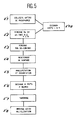
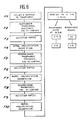
- the conventional methods for recycling these phosphors are described in detail below with reference to FIG. 4 for red phosphors and with reference to FIG. 5 for green and blue phosphors.
- Steps F8 to F10 are repeated four times.
- steps E2 to E10 of FIG. 4 are implemented, while for blue and green phosphors, steps E′2 to E′8 of FIG. 5 are implemented.
- washing the sludge using a periodate such as KIO4 or HIO4 makes it possible to break the transverse bonds of polyvinyl alcohol and reduces its viscosity.
- the method of the invention has a high efficiency of removing strong contaminations of organic materials such as polyvinyl alcohol present in the phosphors collected in the heating zone, and this without causing too strong foaming.
- Other oxidants than H2O2 cause excessive foaming and do not effectively eliminate the high contamination of organic matter.
- periodates such as periodic acid to phosphorus slurries with a high alcohol and chromium content selectively breaks down the polyvinyl alcohol chains by breaking the 1-2 glycol bonds and reduces the viscosity of the polyvinyl alcohol.
- solubilizer in water the solubilizer in water:
- the trivalent chromium is subsequently dissolved by oxidation during the washing with sodium hypochloride for the red phosphorus and the washing with ammonium persulfate of the blue and green phosphorus.
Landscapes
- Chemical & Material Sciences (AREA)
- Engineering & Computer Science (AREA)
- Materials Engineering (AREA)
- Organic Chemistry (AREA)
- Luminescent Compositions (AREA)
- Formation Of Various Coating Films On Cathode Ray Tubes And Lamps (AREA)
- Manufacture Of Electron Tubes, Discharge Lamp Vessels, Lead-In Wires, And The Like (AREA)
- Cathode-Ray Tubes And Fluorescent Screens For Display (AREA)
Applications Claiming Priority (2)
| Application Number | Priority Date | Filing Date | Title |
|---|---|---|---|
| FR8805346 | 1988-04-22 | ||
| FR8805346A FR2630585B1 (fr) | 1988-04-22 | 1988-04-22 | Procede de recuperation de phosphores de tubes de television en couleurs |
Publications (1)
| Publication Number | Publication Date |
|---|---|
| EP0338911A1 true EP0338911A1 (de) | 1989-10-25 |
Family
ID=9365566
Family Applications (1)
| Application Number | Title | Priority Date | Filing Date |
|---|---|---|---|
| EP19890401062 Withdrawn EP0338911A1 (de) | 1988-04-22 | 1989-04-18 | Verfahren zur Rückgewinnung von Farbröhrenphosphoren |
Country Status (6)
| Country | Link |
|---|---|
| EP (1) | EP0338911A1 (de) |
| JP (1) | JPH02504160A (de) |
| KR (1) | KR900700560A (de) |
| CN (1) | CN1038375A (de) |
| FR (1) | FR2630585B1 (de) |
| WO (1) | WO1989010389A1 (de) |
Cited By (3)
| Publication number | Priority date | Publication date | Assignee | Title |
|---|---|---|---|---|
| EP0453685A1 (de) * | 1990-04-21 | 1991-10-30 | Nichia Kagaku Kogyo K.K. | Methode zum Zurückgewinnen eines Phosphors |
| US5330791A (en) * | 1990-04-21 | 1994-07-19 | Nichia Kagaku Kogyo K.K. | Method of reclaiming phosphor |
| WO2014035589A1 (en) * | 2012-08-27 | 2014-03-06 | General Electric Company | Chemical bleaching for improved performance of recycled lamp phosphors |
Families Citing this family (5)
| Publication number | Priority date | Publication date | Assignee | Title |
|---|---|---|---|---|
| US6042748A (en) * | 1997-02-07 | 2000-03-28 | Kabushiki Kaisha Toshiba | Regenerating method and system for fluorescent material |
| WO2001036338A1 (en) * | 1999-11-19 | 2001-05-25 | Isolyser Company, Inc. | Process and system for treatment of waste streams containing water-soluble polymers |
| WO2006106641A1 (ja) * | 2005-04-01 | 2006-10-12 | Matsushita Electric Industrial Co., Ltd. | 蛍光体の再生方法及び蛍光ランプ |
| US8270555B2 (en) * | 2008-05-01 | 2012-09-18 | Ge-Hitachi Nuclear Energy Americas Llc | Systems and methods for storage and processing of radioisotopes |
| CN106098126B (zh) * | 2016-07-05 | 2017-08-25 | 中国核动力研究设计院 | 一种破损燃料棒水下抽取和复装系统及其使用方法 |
Family Cites Families (1)
| Publication number | Priority date | Publication date | Assignee | Title |
|---|---|---|---|---|
| JPS51131486A (en) * | 1975-05-12 | 1976-11-15 | Mitsubishi Electric Corp | Process for treatment of fluorescent substance |
-
1988
- 1988-04-22 FR FR8805346A patent/FR2630585B1/fr not_active Expired - Lifetime
-
1989
- 1989-04-18 EP EP19890401062 patent/EP0338911A1/de not_active Withdrawn
- 1989-04-18 KR KR1019890702418A patent/KR900700560A/ko not_active Withdrawn
- 1989-04-18 JP JP1504909A patent/JPH02504160A/ja active Pending
- 1989-04-18 WO PCT/FR1989/000175 patent/WO1989010389A1/fr not_active Ceased
- 1989-04-22 CN CN89102692A patent/CN1038375A/zh active Pending
Non-Patent Citations (1)
| Title |
|---|
| CHEMICAL ABSTRACTS, vol. 86, no. 22, 30 mai 1977, page 605, résumé no. 164298e, Columbus, Ohio, US; & JP-A-76 131 486 (MITSUBISHI ELECTRIC CORP.) 15-11-1976 * |
Cited By (4)
| Publication number | Priority date | Publication date | Assignee | Title |
|---|---|---|---|---|
| EP0453685A1 (de) * | 1990-04-21 | 1991-10-30 | Nichia Kagaku Kogyo K.K. | Methode zum Zurückgewinnen eines Phosphors |
| US5330791A (en) * | 1990-04-21 | 1994-07-19 | Nichia Kagaku Kogyo K.K. | Method of reclaiming phosphor |
| WO2014035589A1 (en) * | 2012-08-27 | 2014-03-06 | General Electric Company | Chemical bleaching for improved performance of recycled lamp phosphors |
| US9234128B2 (en) | 2012-08-27 | 2016-01-12 | General Electric Company | Chemical bleaching for improved performance of recycled lamp phosphors |
Also Published As
| Publication number | Publication date |
|---|---|
| CN1038375A (zh) | 1989-12-27 |
| FR2630585B1 (fr) | 1990-08-17 |
| KR900700560A (ko) | 1990-08-16 |
| JPH02504160A (ja) | 1990-11-29 |
| WO1989010389A1 (fr) | 1989-11-02 |
| FR2630585A1 (fr) | 1989-10-27 |
Similar Documents
| Publication | Publication Date | Title |
|---|---|---|
| US3599029A (en) | Fluorescent lamp envelope with transparent protective coating | |
| KR910007700B1 (ko) | 발광박막을 형성하는 졸-겔 방법 | |
| EP0338911A1 (de) | Verfahren zur Rückgewinnung von Farbröhrenphosphoren | |
| EP2419377B1 (de) | Verfahren zur rückgewinnung von seltenerdelementen aus einer festen mischung, die ein halogenphosphat und eine verbindung eines oder mehrerer seltenerdelemente enthält | |
| US3763050A (en) | Method of recovering a rare earth phosphor | |
| FR2630857A1 (fr) | Procede de recuperation de phosphores non broyes de tubes cathodiques trichromes | |
| EP0313448B1 (de) | Verfahren zur Metallisierung eines lumineszenten Schirmes | |
| FR2492159A1 (fr) | Ecran convertisseur de neutrons, intensificateur d'images comprenant un tel ecran | |
| US3954657A (en) | Process for reclaiming rare earth oxysulfide phosphor material | |
| JPH0241859B2 (de) | ||
| GB2240109A (en) | Method for treating a phosphor | |
| US5310504A (en) | Phosphor slurry composition for color Braun tubes | |
| CN100558846C (zh) | 荧光体的再生方法和荧光灯 | |
| CN1275153A (zh) | 发光材料的涂覆方法 | |
| WO1993025630A1 (fr) | POUDRE LUMINOPHORE DE Zn2SiO4:Mn ET PROCEDES DE REALISATION | |
| FR2515423A1 (fr) | Ecran d'entree pour tube amplificateur de brillance et procede pour la realisation d'un tel ecran | |
| US2164533A (en) | Luminescent materials | |
| KR100277628B1 (ko) | 칼라 음극선관의 형광막 제조방법 | |
| NO831666L (no) | Katodoluminescente partikler for flerfarve-fremvisere og fremgangsmaate for fremstilling av samme | |
| WO2013102883A1 (fr) | Couche luminescente formée d'un matériau ferroélectrique luminescent polarisé pour un dispositif cathodoluminescent | |
| CN118955929A (zh) | 一种TiMn-MOF发光材料及其制备方法 | |
| US3725297A (en) | Halophosphate phosphor treatment process | |
| JPS59936B2 (ja) | 発光スクリ−ンの製造方法 | |
| KR940000663B1 (ko) | 저속전자선여기형광체의제조방법 | |
| JP2004352900A (ja) | 蛍光ランプ用蛍光体の回収再生方法および蛍光ランプ |
Legal Events
| Date | Code | Title | Description |
|---|---|---|---|
| PUAI | Public reference made under article 153(3) epc to a published international application that has entered the european phase |
Free format text: ORIGINAL CODE: 0009012 |
|
| AK | Designated contracting states |
Kind code of ref document: A1 Designated state(s): DE ES GB IT NL |
|
| 17P | Request for examination filed |
Effective date: 19900421 |
|
| STAA | Information on the status of an ep patent application or granted ep patent |
Free format text: STATUS: THE APPLICATION HAS BEEN WITHDRAWN |
|
| 18W | Application withdrawn |
Withdrawal date: 19910115 |
|
| R18W | Application withdrawn (corrected) |
Effective date: 19910115 |