EP0339891A2 - Einrichtung zur Sprachverarbeitung - Google Patents
Einrichtung zur Sprachverarbeitung Download PDFInfo
- Publication number
- EP0339891A2 EP0339891A2 EP89304017A EP89304017A EP0339891A2 EP 0339891 A2 EP0339891 A2 EP 0339891A2 EP 89304017 A EP89304017 A EP 89304017A EP 89304017 A EP89304017 A EP 89304017A EP 0339891 A2 EP0339891 A2 EP 0339891A2
- Authority
- EP
- European Patent Office
- Prior art keywords
- speech
- frequency
- input
- talker
- processor elements
- Prior art date
- Legal status (The legal status is an assumption and is not a legal conclusion. Google has not performed a legal analysis and makes no representation as to the accuracy of the status listed.)
- Granted
Links
Images




Classifications
-
- G—PHYSICS
- G10—MUSICAL INSTRUMENTS; ACOUSTICS
- G10L—SPEECH ANALYSIS TECHNIQUES OR SPEECH SYNTHESIS; SPEECH RECOGNITION; SPEECH OR VOICE PROCESSING TECHNIQUES; SPEECH OR AUDIO CODING OR DECODING
- G10L21/00—Speech or voice signal processing techniques to produce another audible or non-audible signal, e.g. visual or tactile, in order to modify its quality or its intelligibility
- G10L21/02—Speech enhancement, e.g. noise reduction or echo cancellation
- G10L21/0272—Voice signal separating
- G10L21/028—Voice signal separating using properties of sound source
-
- G—PHYSICS
- G10—MUSICAL INSTRUMENTS; ACOUSTICS
- G10L—SPEECH ANALYSIS TECHNIQUES OR SPEECH SYNTHESIS; SPEECH RECOGNITION; SPEECH OR VOICE PROCESSING TECHNIQUES; SPEECH OR AUDIO CODING OR DECODING
- G10L25/00—Speech or voice analysis techniques not restricted to a single one of groups G10L15/00 - G10L21/00
- G10L25/03—Speech or voice analysis techniques not restricted to a single one of groups G10L15/00 - G10L21/00 characterised by the type of extracted parameters
- G10L25/18—Speech or voice analysis techniques not restricted to a single one of groups G10L15/00 - G10L21/00 characterised by the type of extracted parameters the extracted parameters being spectral information of each sub-band
Definitions
- the present invention relates to a speech processing apparatus, and particularly to a speech processing apparatus which is capable of discriminating between significant information and unnecessary information in a large amount of speech information, extracting significant information and processing it.
- the present invention relates to an apparatus which, when a large amount of speech data input from a plurality of talkers is handled, is capable of extracting as an object the speech information from a particular talker in the input information and processing it with respect to its vowels, consonants, accentuation and so on, and processing this speech.
- Each of the conventional speech processing systems of the type which has been put into practical use comprises a speech input unit 300, a processing unit 305 and an output unit 304, as shown in Fig. 9.
- the speech input unit 300 contains, for example, a microphone or the like, and serves to convert sound waves traveling through air into electrical signals which are input as aural signals.
- the processing unit 305 comprises a feature extracting section 301 for extracting the features of the aural signals that are input, a standard pattern-storing section 303 in which the characteristic patterns of standard speech have been previously stored and a recognition decision section 302 for recognizing the speech by collating the features extracted by the extracting section 301 with the standard patterns stored in the storing section 303.
- the processing unit 305 which employs a method in which various types of features are arithmetically extracted from all the input speech data and in which the intended speech is classified by searching for common features of the aural signals thereof from the various types of features extracted.
- Speech processing is performed by collating the overall feature obtained by combining the above-described plurality of features (partial feature) extracted with the overall feature of the speech stored as the object of recognition in the storing section 303.
- the above-described processing is basically performed for whole local data of the aural signals input.
- the processing of such complicated and massive speech data is generally conducted by devising an algorithm for the operational method, searching method and the like in each of the sections or by specializing, i.e., specifying, the information regions to be handled, on the assumption that the above-described arrangement and method are used.
- the processing in the feature extracting section 301 is based on digital filter processing, particularly, which is premised on a large hardware or signal processing software.
- the speech processing apparatus of the present invention comprises an input means for inputting speech from a plurality of talkers and outputting aural signals; a plurality of speech collation processor elements for performing speech collation using the aural signals input, each of the processor elements comprising at least one non-linear oscillator circuit which is designed to bring about the entrainment effect at the first frequency peculiar to the speech of a particular talker; a detection means for detecting the entrained state of each of the processor elements; and an extraction means for extracting the aural signals of a particular talker from the aural signals input therein when it receives the output from the detection means on the basis of the frequency of oscillations of the output signal of the processor element entrained.
- the speech processing apparatus of the present invention is a speech processing apparatus which serves to specify the constituent talkers of the conversion input from a plurality of specified talkers and which comprises an input means for inputting conversational speech and outputting aural signals; a plurality of speech collation processor elements for performing speech collation using the aural signals input therein, each of the processor elements comprising at least one non-linear oscillator circuit which is designed to bring about the entrainment effect at the first frequency peculiar to the speech of a particular talker; and a detection means for detecting the entrained state of each of the processor elements.
- the speech processing system of the present invention comprises an input means for inputting the speech from a plurality of talkers and outputting aural signals; a plurality of speech collation processor elements for performing speech collation of the aural signals input therein, each of the processor elements comprising at least one non-linear oscillator circuit which is designed to bring about the entrainment effect at the first frequency peculiar to the speech of a particular talker; a detection means for detecting the entrained state of each of the processor elements; an extraction means for extracting the aural signals of a particular talker from the aural signals input therein on the basis of the frequency of oscillations of the output signal from each of the processor elements entrained when the means receives the output from the detection means; and an information processing means which is connected to the extraction means and which performs information processing such as word recognition and so on of the aural signals of a particular talker extracted by the extraction means.
- each of the processor elements comprises two non-linear oscillator circuits.
- talker recognition is so set that entrainment of the corresponding processor element takes place at the average pitch frequency of a particular talker.
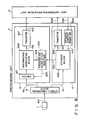
- Fig. 1 is a block diagram of a speech processing apparatus system related to this embodiment.
- reference numeral 1 denotes an input unit including a sensor for inputting information; and reference numeral 2, a preprocessing unit for extracting a significant portion in the input information, i.e, the speech of a particular talker to be handled.
- the preprocessing unit 2 comprises a speech converting block 4, an information generating unit 5 and a storage unit 6.
- Reference numeral 3 denotes a host information processing unit comprising a digital computer system.
- the input unit 1 comprises a microphone for inputting speech and outputting electrical signals 401.
- the host information processing unit 3 comprises the digital computer system.
- the information generating unit 5 comprises an information generating block 305, a transferrer 307 for transmitting the information 412 generated by the information generating block 305 to the host information processing unit 3, and a processing modifier 303 for changing "the processing regulation" in the information generating block 305 when receiving a signal output from the storage unit 6.
- the storage unit 6 comprises a storage block 306, a transferrer 308 for transmitting in a binary form "the memory recalled" by the storage unit 306 to the host information processing unit 3, and a storage modifier for changing "the storage contents" in the storage block 306 on the basis of instructions from the host information processing unit 3.
- the speech converting block 4 serves to convert the aural signals 401 input therein into signals 411 having a form suitable for processing in the information generating block 305.
- the recognition of a particular talker can be performed on the basis of differences in the physical characteristics of the sound-generating organs among talkers.
- the most typical physical characteristics of the sound-generating organs include the length of the vocal path, the frequency of the oscillations of the vocal cords and the waveform of the oscillations thereof. Such characteristics are physically observed as the frequency level of the formant, the band width, the average pitch frequency, the slope and curvature in terms the spectral outline and so forth.
- the talker recognition is performed by detecting the average pitch frequency peculiar to the relevant talker in the aural signals 401.
- This average pitch frequency is detected in such a manner that the stored pitch frequencies are recalled in the storage unit 6 of the preprocessing unit 2. Since any human speech can be expressed by superposing signals having frequencies that are integral multiples of the pitch frequencies, when a signal with a frequency of integral multiples of the average pitch frequency detected is extracted from the stored aural signals 401 by the information generating block 305, the signal extracted is an aural signal peculiar to the particular talker.
- the preprocessing unit 2 serves as a central unit of the system in this embodiment.
- Either of the information generating block 305 or the storage block 306 which serves as a central part comprises a plurality of non-linear oscillator circuits or the like.
- the contents of information can be encoded into the phase or frequency of a non-linear oscillator, and the magnification of information can be represented by using the amplitude of the oscillation thereof.
- the phase, frequency and amplitude of oscillation can be changed by causing interference between a plurality of oscillators. Causing such interference corresponds to conventional information processing.
- the interaction between a plurality of non-linear oscillators which are connected to each other causes deviation from the individual intrinsic frequencies and thus mutual excitation, that is "entrainment".
- two types of information processing i.e.
- the recall of memory performed in the storage block 306 and extraction of the aural signals of a particular talker which is performed in the information generating block 305, are carried out in the preprocessing unit 2.
- These two types of information processing in the preprocessing unit 2 are performed by using the entrainment taking place owing to the mutual interference between the nonlinear oscillator circuits.
- the entrainment is a phenomenon which is similar to resonance and in which all the oscillator circuits make oscillations with the same frequency, amplitude and phase owing to the interference therebetween even if the intrinsic frequencies of the oscillator circuits are not equal to each other.
- Such entrainment taking place by the interference between the nonlinear oscillators which are coupled with each other is explained in detail in "Entrainment of Two Coupled van der Pol Oscillators by an External Oscillation" (Bio. Cybern. 51, 325-333 (1985)).
- nonlinear oscillator circuit is configured by assembling a van der Pol oscillator circuit using resistor, capacitor, induction coil and negative resistance elements such as a Esaki diode.
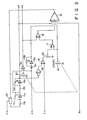
- This embodiment commonly utilizes as a nonlinear oscillator circuit such a van der Pol oscillator circuit as shown in Fig. 2.
- reference numerals 11a, 12a, 13, 14, 15a, 16 and 17 respectively denote an operational amplifier in which the signs + and - respectively denote the polarities of output and input signals.
- the resistors 11b, 12b and the capacitors 11c, 12c which are shown in the drawing are applied to the operational amplifiers 11a, 12a, respectively, to form integrators 11, 12.
- a resistor 15b and a capacitor 15c are applied to the operational amplifier 15a to form a differentiator 15.
- the resistors shown in the drawing are respectively applied to the other operational amplifiers 13, 14, 16, 17 to form adders.
- the van der Pol circuit in this embodiment is also provided with multipliers 18, 19.
- voltages are respectively input to the operational amplifiers 13, 14, 17 serving as the adders through variable resistors 20 to 22, the variable resistors 20, 21 being interlocked with each other.
- the oscillation of this van der Pol oscillator circuit is controlled through an input terminal I in such a manner that the amplitude of oscillation is increased by applying an appropriate positive voltage to the terminal I and it is decreased by applying a negative voltage thereto.
- a gain controller 23 can be controlled by using the signal input to an input terminal F so that the basic frequency of oscillation of the van der Pol oscillator circuit can be changed.
- the basic oscillation thereof is generated by a feedback circuit comprising the operational amplifiers 11, 12, 13, and another part, for example, the multiplier 18, provides the oscillation with nonlinear oscillation characteristics.
- the entrainment is achieved by utilizing interference coupling with another van der Pol oscillator circuit.
- the van der Pol oscillator circuit shown in Fig. 2 is coupled with another van der Pol oscillator circuit having the same configuration, the signal input from the other van der Pol oscillator circuit is input in the form of an oscillation wave to each of the terminals A, B shown in Fig. 2, as well as the oscillation wave being output from each of the terminals P, Q shown in the drawing (refer to Fig. 3).
- This embodiment utilizes as a processor element forming each of the storage block 306 and the information generating block 305 an element comprising the two van der Pol nonlinear oscillator circuits (621, 622) shown in Fig. 2 which are connected to each other, as shown in Fig. 3.
- one of the processor elements has input terminals 610, 611, an output terminals 616 and terminals 601, 602 for respectively setting the natural frequencies of the nonlinear oscillator circuits 621, 622.
- the processor element also has six variable resistors 630 to 635.
- each processor element having the arrangement shown in Fig. 3. It is assumed that each of the two coupled nonlinear oscillation circuits 621, 622 are already in a certain entrained state which can be obtained by setting resistors 632, 633 and 634 at appropriate values thereof. In order to be able to change the element into another entrained state in response to the input signal to terminals 610, 611, the values of the resistors 630, 631 should be appropriately set.
- the processor element When the signal input to the terminals 610, 611 has a single oscillation component, the processor element is entrained in oscillation with the same frequency as that of the input signal from the oscillation in the state wherein the processor element is entrained if the component is within a range of frequencies in which entrainment newly takes place. This represents one form of the entrainment phenomenon.
- the processor element When an input signal has a plurality of oscillation components, the processor element has a tendency to be entrained in the oscillation with the frequency closest to the frequency of the component in the entrained state among the oscillation components.
- Whether or not the processor element is activated is controlled by using a given signal input from the outside (the modifier 309 shown in Fig. 1) through terminals 605a and 605b.
- a negative voltage may be added to the terminal I from the above-described external circuit for the purpose of deactivating the processor element regardless of the signal input to the terminals 610, 611.
- the signal input to the terminal F of the van der Pol circuit is used for determining the basic frequency of the van der Pol circuit, as described above.
- the signal ⁇ A input to the terminal 601 of the van der Pol circuit 621 functions to set the frequency of the oscillator circuit 621 to ⁇ A
- the signal ⁇ B input to the terminal 602 of the van der Pol circuit 622 also functions to set the frequency ⁇ B of the oscillator circuit 622 to ⁇ B .
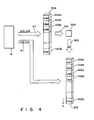
- preprocessing unit 2 serves as a central unit of the system of this embodiment, the structure and operation of this section are described in detail below with reference to Fig. 4.
- the speech input from the microphone 1 is introduced as the electrical signals 401 into the speech converting block 4 which serves as a speech converter for the preprocessing unit 2.
- the aural signals 402 converted in the block 4 are sent to the storage block 306 and the information generating block 305.
- An processor element of either of the information generating block 305 or the storage block 306 comprises the van der Pol oscillator circuit.
- the speech converting block 4 functions to convert the aural signals 401 into signals having a form suitable for being input to each van der Pol oscillator circuit (for example, the voltage level is modified).
- the storage block 306 has such processor elements as shown in Fig. 3 in a number which equals the number of the talkers to be recognized.
- the recognition of speech of r talkers requires r processor elements 403 in which center frequencies ⁇ M1 , ⁇ M2 ........ ⁇ Mr and band widths ⁇ M1 , ⁇ M2 together with ⁇ Mr must be respectively set.
- the central frequencies ⁇ M1 , ⁇ M2 ........ ⁇ Mr are substantially the same as the average pitch frequencies of the r talkers.
- a processor element 403a for detecting a talker No. 1 a given signal is input to each of the two terminals F shown in Fig. 3 so that the central frequency ⁇ M1 and the band width ⁇ M1 respectively satisfy the above-described equations (1) an (2). This setting will be described below with reference to Fig. 6.
- the aural signals 402 from the speech converting block 4 are input to the terminals 610, 611 of each of the processor elements of the storage block 306.
- the information generating block 305 also has a plurality of such processor elements 402 as shown in Fig. 3.
- q processor elements 402 are provided in the unit 305.
- the number of processor elements required in the information generating block 305 must be determined depending upon the degree of resolution with which the speech of a particular talker is desired to be extracted.
- Each of the processor elements 402 of the information generating block 305 also functions as a band pass filter in the same way as the processor elements 403 of the storage block 306.
- the transmission frequency ⁇ k at which the processor element k functions as a band pass filter is determined so as to have the relationship (3) described below to the basic pitch frequency ⁇ p of the talker recognized in the storage block 306.
- ⁇ k k ⁇ p (3)
- their central frequencies ⁇ G1 , ⁇ G2 .... ⁇ Gq and the band widths ⁇ G1 , ⁇ G2 ... ⁇ Gq are respectively set so as to satisfy the equations (1) and (2). This setting in the processor elements 402 is described in detail below with reference to Fig. 5.
- Each of the storage block 306 and the information generating block 305 has the above described arrangement.
- the processor elements 402 of the information generating block 305 and the processor elements 403 of the storage block 306 are respectively band pass filters having central frequencies which are respectively set to ⁇ M1 , ⁇ M2 ... ⁇ Mr and ⁇ G1 , ⁇ G2 ... ⁇ Gq .
- each of these processor elements does not functions simply as a replacement for a conventional known band pass filter, but it efficiently utilizes the characteristics as a processor element comprising nonlinear oscillator circuits.
- the characteristics include the easiness of modifications of the central frequencies expressed by the equation (1) and the band widths expressed by the equation (2) as well as a high level of selectivity for frequency and responsiveness, as compared with conventional band pass filters.
- collations of the aural signals 402 with the pitch frequencies previously stored for a plurality of talkers are simultaneously performed for each of the talkers to create an arrangement of the talkers contained in the conversation. That is, the arrangement of talkers contained in conversation can be determined by recognizing the talkers giving speech having the pitch frequencies contained in the conversation expressed by the aural signals 411.
- the storage of the pitch frequencies in the processor elements 403a to 403r of the storage block 306 is realized by interference oscillation of the processor elements with the basic frequency which is determined by the signals ⁇ A , ⁇ B input to the terminal F, as described above with reference to Fig. 3.
- the pitch frequencies of the talkers are respectively stored in the forms of the basic frequencies of the processor elements.
- the processor elements 403a, 403b alone interfere with the input aural signals 411, are activated so as to be entrained and make oscillation with the frequencies ⁇ 2, ⁇ 3, respectively. That is, in the case of conversation of a plurality of talkers. only the processor elements having the frequencies which are set to values close to the average pitch frequencies of the talkers are activated, this activation corresponding to the recall of memory.
- the results 501 recalled in the processor elements 403 of the storage block 306 are sent to the processing modifier 303.
- the processing modifier 303 has the function of detecting the frequencies of the output signals 501 from the processor elements 403, as well as the function of calculating the processing regulation used in the information generating block 305 from the oscillation detected. This processing regulation is defined by the equation (3).
- a significant portion that is, the feature contributing to a particular talker, is extracted from the signals 411 input from the speech converting block 4 in accordance with the processing regulation supplied from the processing regulation modifier 303, and then output as a binary signal to the host information processing unit 3 through the transferrer 307.
- the binary signal is then subjected to speech processing in the unit 3 in accordance with the demand.
- the configuration of talkers can also be recognized by virtue of the host information processing unit 3 based on the information sent from the storage block 306 to the host information processing unit 3 through the transferrer 308.
- the information generating block 305 is also capable of adding talkers to be handled and setting parameter data thereof as well as removing talkers.
- a final object of the system of this embodiment is to recognize the speech of particular talkers (plural).
- the processor elements 403 which correspond to the pitch frequencies of particular talkers are activated by the recall of memory in the storage block 306.
- the activated state is transferred to the information processing unit 3 through the transferrer 308.
- the processing regulation modifier 303 detects the frequencies of the output signals 501 from the storage block 306 and modifies the processing regulation in the processor elements 403a to 403q of the information generating block 305 in accordance with the equation (3).
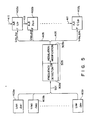
- Fig. 5 is a drawing provided for explaining the connection between the processor element 403, the processing regulation modifier 303 and the processor element 402 and for explaining in detail the connection therebetween shown in Fig. 3.
- the configuration and connection shown in Figs. 3 and 5 are used for extracting the speech of a particular talker from the conversation of a plurality of talkers. The method of recognizing the speech of only one talker is described below using the relationship between the storage block 306 and the storage content modifier 309.
- the modifier 303 comprises a frequency detector 303a and a regulation modifier 303b.
- the recognition of the average pitch frequency ⁇ p of a particular talker in the aural signals 411 by the storage block 306 represents the activation of the processor element (of the storage block 306) having a frequency that is close to ⁇ p .
- the output signal 501 from the storage block 306 therefore has a frequency ⁇ p .
- the frequency ⁇ p is detected by the frequency detector 303a of the modifier 303 and then transmitted to the regulation modifier 303b thereof.
- the regulation modifier 303b is connected to each of the processor elements 402, as shown in Fig. 5.
- signal lines ⁇ G1 , ⁇ G1 are provided between the modifier 303 and the processor element 402a so as to be connected to the two terminals F (refer to Fig. 3) of the processor element 402a.
- each of the processor elements 402a to 402q are respectively so set as to function as band pass filters with center frequencies ⁇ p , 2 ⁇ p , 3 ⁇ p , ..., q ⁇ p .
- the regulation modifier 303b outputs signals to the signal lines ⁇ G1 , ⁇ G1 , ⁇ G2 , ⁇ G2 , ... ⁇ Gk , ⁇ Gk ...
- Fig. 6 is a drawing of connection between the storage modifier 309, transferrer 308 and the processor elements 403a to 403p which is so designed as to able to recognize the speech of a particular talker in the aural signals 411.
- Three signal lines are provided between the modifier 309 and each of the processor elements. Of these three signal line, two signal lines are used for setting the central frequency ⁇ M and the band width ⁇ M of each processor element and are connected to the two terminals F thereof. The other signal line is connected to the terminal I (Fig. 3) for the purpose of forcing each of the processor elements to be in a deactivated state. As described above, a negative voltage is applied to the terminal I each processor element in order to deactivate it.
- Three types of information 409a to 409c are transferred from the host information processing unit 3 to the modifier 309, and the host information processing unit 3 is capable of setting any desired central frequency and band width of any processor element of the storage block, as well as inhibiting any activation of any desired processor element, by using these three types of information.
- the signal on the signal line 409a contains the number of a processor element in which a central frequency and band width are set or which is inhibited from being activated.
- the signal on the signal line 409b contains the data with respect to the central frequency and band width to be set, and the signal on the signal line 409c contains the data in the form of a binary form with respect to whether or not the relevant processor element is activated.
- the transferrer 308 comprises r comparators (308a to 308r).
- the comparator compares the output of the corresponding processor element with a predetermined threshold value and outputs one if the output of the corresponding element exceeds the threshold.
- the transferrer 308 transfers in a binary form the result of comparison to the processing unit 3.
- the above-described configuration enables the host information processing unit 3 to activate or deactivate any one desired processor element of the storage block 306 or to set/modify the band width and the central frequency thereof.
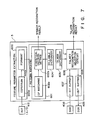
- Fig. 7 is a functional block diagram of the processing in the host information processing unit 3 in which speech recognition and talker recognition (talker collation) are mainly performed.
- One subject of the present invention lies in the processing of the speech signals used for two types of recognition in the preprocessing unit. Since these two types of recognition themselves are already known, they are briefly described below.
- the aural signal 412 from the transferrer 307 of the preprocessing unit 2 is a signal containing only the speech of a particular talker. This signal is A/D converted in the transferrer 307 and then input to the processing unit 3.
- the signal 412 is subjected to cepstrum analysis in 600a in which spectrum estimation is made for the aural signal 412.
- the formants are extracted by 600b.
- the formant frequencies are frequencies at which concentration of energy appears, and it is said that such concentration appears at several particular frequencies which are determined by phonemes. Vowels are characterized by the formant frequencies.
- the formant frequencies extracted are sent to 601 where pattern matching is conducted. In this pattern matching, speech recognition is performed by DP matching (502a) which is performed for the syllables previously stored in a syllable dictionary and the formant frequencies and by statistical processing (602b) of the results obtained.
- the talker recognition conducted in the unit 3 is more positive recognition which is carried out using a talker dictionary 605 after the rough talker recognition has been carried out.
- the talker dictionary 605 are stored data with respect to the level of the formant frequency, the band width thereof, the average pitch frequency, the slope and curvature in terms of frequency of the spectral outline and so forth of each of talkers, all of which are previously stored, as well as the time length of words peculiar to each talker and the pattern change with time of the formant frequency thereof.
- FIG. 8 An application example of the system in the embodiment shown in Fig. 1 is described below with reference to Fig. 8. This application example is configured by adding a switch 801 to the system shown in Fig. 1 so that an information generating section 5 is operated only when the speech of a particular talker is recognized by a storage section 6, and the speech of the particular talker alone is extracted and then sent to the information processing unit 3.
- a plurality of the processor elements 403 of the storage block 306 comprise one processor element which is activated to the pitch frequency of a particular talker by the modifier 309.
- the modifier 303 outputs a signal 802 to the switch 801 so as to close it.
- the switch 801 is opened, the storage block 305 does not operate. In this way, when the switch 801 is turned on, the extraction of only a portion in the aural signals 411 which is also significant from the viewpoint of time by the information generating section 5 enables rapid processing in the host unit 3.
- a talker recognition/selector circuit 606 recognizes the talkers by collating the formants extracted by the circuit 600 with the data stored in the dictionary 605.
- 607 is a r-bit buffer to store the result of talker collation detected by the transferrer 308. Each bit represents whether or not the corresponding comparator of the transferrer 308 has detected that the corresponding processor element of the storage block 306 has been entrained.
- the circuit 606 compares the result stored in the buffer 607 with the result of talker recognition based on the formant matching operation. Thereby, the talker recognition in the storage block 306 can be confirmed within the processing unit 3.
- a r-bit buffer 608 is used to temporarily store the information 409a to 409c.
- an oscillator unit utilizes as the circuit form of an oscillator unit a van der Pol circuit which has stable characteristics of the basic oscillation. This is because such a van der Pol circuit has a high level of reliability with respect to the stability of the waveform.
- an oscillator unit may be realized by using a method using another form of nonlinear circuit, a method using a digital circuit which is capable of calculating nonlinear oscillation or any optical means, mechanical means or chemical means which is capable of generating nonlinear oscillation.
- optical elements or chemical elements utilizing potential oscillation of a film as well as electrical circuit elements may be used as nonlinear oscillators.
- the present invention enables simultaneous extraction of the speech of a plurality of particular talkers. In this case, it is necessary to set regulation modifiers 303 and information generating blocks 305 in a number equivalent to the number of the talkers.
- the talker recognition is performed by detecting the average pitch frequency of speech in the storage block, it is possible to change in such a manner that a talker is recognized by detecting the formant frequency.
- circuit 606 in Fig. 7 is provided to confirm the collation result obtained by the storage block 306, it is possible to rearrange the circuit 606 in such a manner that the data stored in the buffer 607 may be used to narrow the scope of the search effected by the circuit 606. Thereby, the efficiency of talker confirmation effected by the circuit 606 is improved.
Landscapes
- Engineering & Computer Science (AREA)
- Human Computer Interaction (AREA)
- Acoustics & Sound (AREA)
- Signal Processing (AREA)
- Health & Medical Sciences (AREA)
- Audiology, Speech & Language Pathology (AREA)
- Computational Linguistics (AREA)
- Physics & Mathematics (AREA)
- Quality & Reliability (AREA)
- Multimedia (AREA)
- Telephonic Communication Services (AREA)
- Magnetic Resonance Imaging Apparatus (AREA)
- Devices For Executing Special Programs (AREA)
- Massaging Devices (AREA)
- Interconnected Communication Systems, Intercoms, And Interphones (AREA)
Applications Claiming Priority (2)
| Application Number | Priority Date | Filing Date | Title |
|---|---|---|---|
| JP101173/88 | 1988-04-23 | ||
| JP63101173A JP2791036B2 (ja) | 1988-04-23 | 1988-04-23 | 音声処理装置 |
Publications (3)
| Publication Number | Publication Date |
|---|---|
| EP0339891A2 true EP0339891A2 (de) | 1989-11-02 |
| EP0339891A3 EP0339891A3 (en) | 1990-08-16 |
| EP0339891B1 EP0339891B1 (de) | 1995-04-05 |
Family
ID=14293616
Family Applications (1)
| Application Number | Title | Priority Date | Filing Date |
|---|---|---|---|
| EP89304017A Expired - Lifetime EP0339891B1 (de) | 1988-04-23 | 1989-04-21 | Einrichtung zur Sprachverarbeitung |
Country Status (5)
| Country | Link |
|---|---|
| US (1) | US5123048A (de) |
| EP (1) | EP0339891B1 (de) |
| JP (1) | JP2791036B2 (de) |
| AT (1) | ATE120873T1 (de) |
| DE (1) | DE68922016T2 (de) |
Cited By (2)
| Publication number | Priority date | Publication date | Assignee | Title |
|---|---|---|---|---|
| DE4243831A1 (de) * | 1992-12-23 | 1994-06-30 | Daimler Benz Ag | Verfahren zur Laufzeitschätzung an gestörten Sprachkanälen |
| EP1132890A4 (de) * | 1999-08-26 | 2005-08-17 | Sony Corp | Verfahren und vorrichtung, speicherverfahren und - vorrichtung für informationsbeschaffung und -verarbeitung |
Families Citing this family (18)
| Publication number | Priority date | Publication date | Assignee | Title |
|---|---|---|---|---|
| JP2963491B2 (ja) | 1990-05-21 | 1999-10-18 | 沖電気工業株式会社 | 音声認識装置 |
| US5623539A (en) * | 1994-01-27 | 1997-04-22 | Lucent Technologies Inc. | Using voice signal analysis to identify authorized users of a telephone system |
| DE69526805T2 (de) * | 1994-12-08 | 2002-11-07 | Rutgers, The State University Of New Jersey | Verfahren und vorrichtung zur verbesserung des sprachverständnisses bei sprachbehinderten personen |
| US6021194A (en) * | 1996-03-28 | 2000-02-01 | At&T Corp. | Flash-cut of speech processing features in a telephone call |
| US5859908A (en) * | 1996-03-28 | 1999-01-12 | At&T Corp. | Method and apparatus for applying multiple speech processing features to a telephone call |
| US6453043B1 (en) | 1996-12-18 | 2002-09-17 | At&T Corp. | Flash-cut of speech processing features in a telephone call |
| US6109107A (en) | 1997-05-07 | 2000-08-29 | Scientific Learning Corporation | Method and apparatus for diagnosing and remediating language-based learning impairments |
| US5927988A (en) * | 1997-12-17 | 1999-07-27 | Jenkins; William M. | Method and apparatus for training of sensory and perceptual systems in LLI subjects |
| US6159014A (en) * | 1997-12-17 | 2000-12-12 | Scientific Learning Corp. | Method and apparatus for training of cognitive and memory systems in humans |
| US6019607A (en) * | 1997-12-17 | 2000-02-01 | Jenkins; William M. | Method and apparatus for training of sensory and perceptual systems in LLI systems |
| US6529712B1 (en) * | 1999-08-25 | 2003-03-04 | Conexant Systems, Inc. | System and method for amplifying a cellular radio signal |
| JP2002306492A (ja) * | 2001-04-16 | 2002-10-22 | Electronic Navigation Research Institute | カオス論的ヒューマンファクタ評価装置 |
| FR2848715B1 (fr) * | 2002-12-11 | 2005-02-18 | France Telecom | Procede et systeme de correction multi-references des deformations spectrales de la voix introduites par un reseau de communication |
| US7231346B2 (en) * | 2003-03-26 | 2007-06-12 | Fujitsu Ten Limited | Speech section detection apparatus |
| US20050153267A1 (en) * | 2004-01-13 | 2005-07-14 | Neuroscience Solutions Corporation | Rewards method and apparatus for improved neurological training |
| US20050175972A1 (en) * | 2004-01-13 | 2005-08-11 | Neuroscience Solutions Corporation | Method for enhancing memory and cognition in aging adults |
| US7693212B2 (en) * | 2005-10-10 | 2010-04-06 | General Electric Company | Methods and apparatus for frequency rectification |
| CN121075329B (zh) * | 2025-11-06 | 2026-04-03 | 浙江墅标智能家居科技有限公司 | 一种智能门窗多智能控制切换方法及系统 |
Family Cites Families (3)
| Publication number | Priority date | Publication date | Assignee | Title |
|---|---|---|---|---|
| DE2633656C2 (de) * | 1976-07-27 | 1984-02-16 | ANT Nachrichtentechnik GmbH, 7150 Backnang | Synchronisations-Überwachungsschaltung für einen injektionssynchronisierten Oszillator |
| DE3446370A1 (de) * | 1984-12-19 | 1986-07-03 | Siemens AG, 1000 Berlin und 8000 München | Schaltungsanordnung zur gewinnung einer einzelnen signalschwingung aus einem signal |
| DE3689101T2 (de) * | 1985-07-06 | 1994-04-28 | Japan Res Dev Corp | Mustererkennungsanlage. |
-
1988
- 1988-04-23 JP JP63101173A patent/JP2791036B2/ja not_active Expired - Fee Related
-
1989
- 1989-04-21 AT AT89304017T patent/ATE120873T1/de not_active IP Right Cessation
- 1989-04-21 EP EP89304017A patent/EP0339891B1/de not_active Expired - Lifetime
- 1989-04-21 DE DE68922016T patent/DE68922016T2/de not_active Expired - Fee Related
-
1991
- 1991-03-19 US US07/671,654 patent/US5123048A/en not_active Expired - Fee Related
Cited By (6)
| Publication number | Priority date | Publication date | Assignee | Title |
|---|---|---|---|---|
| DE4243831A1 (de) * | 1992-12-23 | 1994-06-30 | Daimler Benz Ag | Verfahren zur Laufzeitschätzung an gestörten Sprachkanälen |
| US5479517A (en) * | 1992-12-23 | 1995-12-26 | Daimler-Benz Ag | Method of estimating delay in noise-affected voice channels |
| EP1132890A4 (de) * | 1999-08-26 | 2005-08-17 | Sony Corp | Verfahren und vorrichtung, speicherverfahren und - vorrichtung für informationsbeschaffung und -verarbeitung |
| US7260226B1 (en) | 1999-08-26 | 2007-08-21 | Sony Corporation | Information retrieving method, information retrieving device, information storing method and information storage device |
| EP1887561A3 (de) * | 1999-08-26 | 2008-07-02 | Sony Corporation | Informationsabrufverfahren, Informationsabrufvorrichtung, Informationsspeicherverfahren und Informationsspeichervorrichtung |
| US8165306B2 (en) | 1999-08-26 | 2012-04-24 | Sony Corporation | Information retrieving method, information retrieving device, information storing method and information storage device |
Also Published As
| Publication number | Publication date |
|---|---|
| US5123048A (en) | 1992-06-16 |
| JP2791036B2 (ja) | 1998-08-27 |
| JPH01271832A (ja) | 1989-10-30 |
| DE68922016D1 (de) | 1995-05-11 |
| EP0339891B1 (de) | 1995-04-05 |
| DE68922016T2 (de) | 1995-08-31 |
| ATE120873T1 (de) | 1995-04-15 |
| EP0339891A3 (en) | 1990-08-16 |
Similar Documents
| Publication | Publication Date | Title |
|---|---|---|
| EP0339891B1 (de) | Einrichtung zur Sprachverarbeitung | |
| EP0085543B1 (de) | Spracherkennungsgerät | |
| EP0086589B1 (de) | Spracherkennungssystem | |
| US4661915A (en) | Allophone vocoder | |
| US5528728A (en) | Speaker independent speech recognition system and method using neural network and DTW matching technique | |
| US5144672A (en) | Speech recognition apparatus including speaker-independent dictionary and speaker-dependent | |
| JP2815579B2 (ja) | 音声認識における単語候補削減装置 | |
| US4424415A (en) | Formant tracker | |
| US7406417B1 (en) | Method for conditioning a database for automatic speech processing | |
| JPS5972496A (ja) | 単音識別装置 | |
| US5963904A (en) | Phoneme dividing method using multilevel neural network | |
| CN115104151A (zh) | 一种离线语音识别方法和装置、电子设备和可读存储介质 | |
| CN109979428B (zh) | 音频生成方法和装置、存储介质、电子设备 | |
| US4426551A (en) | Speech recognition method and device | |
| US5181256A (en) | Pattern recognition device using a neural network | |
| Loweimi et al. | Speech acoustic modelling from raw phase spectrum | |
| EP0071716A2 (de) | Allophonvokoder | |
| EP0526347A2 (de) | System zur Bestimmung einer Anzahl von Kandidaten zur Erkennung in einer Spracherkennungseinrichtung | |
| JP2000200098A (ja) | 学習装置および学習方法、並びに認識装置および認識方法 | |
| US5175799A (en) | Speech recognition apparatus using pitch extraction | |
| KR100202424B1 (ko) | 실시간 음성인식방법 | |
| Tsai et al. | A neural network model for spoken word recognition | |
| Barger et al. | A comparative study of phonemic recognition by discrete orthogonal transforms | |
| JPS63168697A (ja) | 音声認識装置 | |
| JPH10177393A (ja) | 音声認識装置 |
Legal Events
| Date | Code | Title | Description |
|---|---|---|---|
| PUAI | Public reference made under article 153(3) epc to a published international application that has entered the european phase |
Free format text: ORIGINAL CODE: 0009012 |
|
| AK | Designated contracting states |
Kind code of ref document: A2 Designated state(s): AT BE CH DE FR GB IT LI NL |
|
| PUAL | Search report despatched |
Free format text: ORIGINAL CODE: 0009013 |
|
| AK | Designated contracting states |
Kind code of ref document: A3 Designated state(s): AT BE CH DE FR GB IT LI NL |
|
| 17P | Request for examination filed |
Effective date: 19901231 |
|
| 17Q | First examination report despatched |
Effective date: 19930928 |
|
| GRAA | (expected) grant |
Free format text: ORIGINAL CODE: 0009210 |
|
| AK | Designated contracting states |
Kind code of ref document: B1 Designated state(s): AT BE CH DE FR GB IT LI NL |
|
| PG25 | Lapsed in a contracting state [announced via postgrant information from national office to epo] |
Ref country code: AT Effective date: 19950405 |
|
| REF | Corresponds to: |
Ref document number: 120873 Country of ref document: AT Date of ref document: 19950415 Kind code of ref document: T |
|
| REF | Corresponds to: |
Ref document number: 68922016 Country of ref document: DE Date of ref document: 19950511 |
|
| ET | Fr: translation filed | ||
| ITF | It: translation for a ep patent filed | ||
| PLBE | No opposition filed within time limit |
Free format text: ORIGINAL CODE: 0009261 |
|
| STAA | Information on the status of an ep patent application or granted ep patent |
Free format text: STATUS: NO OPPOSITION FILED WITHIN TIME LIMIT |
|
| 26N | No opposition filed | ||
| REG | Reference to a national code |
Ref country code: GB Ref legal event code: IF02 |
|
| PGFP | Annual fee paid to national office [announced via postgrant information from national office to epo] |
Ref country code: GB Payment date: 20030407 Year of fee payment: 15 |
|
| PGFP | Annual fee paid to national office [announced via postgrant information from national office to epo] |
Ref country code: FR Payment date: 20030422 Year of fee payment: 15 |
|
| PGFP | Annual fee paid to national office [announced via postgrant information from national office to epo] |
Ref country code: DE Payment date: 20030424 Year of fee payment: 15 |
|
| PGFP | Annual fee paid to national office [announced via postgrant information from national office to epo] |
Ref country code: CH Payment date: 20030428 Year of fee payment: 15 |
|
| PGFP | Annual fee paid to national office [announced via postgrant information from national office to epo] |
Ref country code: NL Payment date: 20030430 Year of fee payment: 15 |
|
| PGFP | Annual fee paid to national office [announced via postgrant information from national office to epo] |
Ref country code: BE Payment date: 20030508 Year of fee payment: 15 |
|
| PG25 | Lapsed in a contracting state [announced via postgrant information from national office to epo] |
Ref country code: GB Free format text: LAPSE BECAUSE OF NON-PAYMENT OF DUE FEES Effective date: 20040421 |
|
| PG25 | Lapsed in a contracting state [announced via postgrant information from national office to epo] |
Ref country code: LI Free format text: LAPSE BECAUSE OF NON-PAYMENT OF DUE FEES Effective date: 20040430 Ref country code: CH Free format text: LAPSE BECAUSE OF NON-PAYMENT OF DUE FEES Effective date: 20040430 Ref country code: BE Free format text: LAPSE BECAUSE OF NON-PAYMENT OF DUE FEES Effective date: 20040430 |
|
| BERE | Be: lapsed |
Owner name: *CANON K.K. Effective date: 20040430 |
|
| PG25 | Lapsed in a contracting state [announced via postgrant information from national office to epo] |
Ref country code: NL Free format text: LAPSE BECAUSE OF NON-PAYMENT OF DUE FEES Effective date: 20041101 |
|
| PG25 | Lapsed in a contracting state [announced via postgrant information from national office to epo] |
Ref country code: DE Free format text: LAPSE BECAUSE OF NON-PAYMENT OF DUE FEES Effective date: 20041103 |
|
| GBPC | Gb: european patent ceased through non-payment of renewal fee |
Effective date: 20040421 |
|
| REG | Reference to a national code |
Ref country code: CH Ref legal event code: PL |
|
| PG25 | Lapsed in a contracting state [announced via postgrant information from national office to epo] |
Ref country code: FR Free format text: LAPSE BECAUSE OF NON-PAYMENT OF DUE FEES Effective date: 20041231 |
|
| NLV4 | Nl: lapsed or anulled due to non-payment of the annual fee |
Effective date: 20041101 |
|
| REG | Reference to a national code |
Ref country code: FR Ref legal event code: ST |
|
| PG25 | Lapsed in a contracting state [announced via postgrant information from national office to epo] |
Ref country code: IT Free format text: LAPSE BECAUSE OF NON-PAYMENT OF DUE FEES;WARNING: LAPSES OF ITALIAN PATENTS WITH EFFECTIVE DATE BEFORE 2007 MAY HAVE OCCURRED AT ANY TIME BEFORE 2007. THE CORRECT EFFECTIVE DATE MAY BE DIFFERENT FROM THE ONE RECORDED. Effective date: 20050421 |