EP0339955A2 - Silver halide photographic light-sensitive material - Google Patents
Silver halide photographic light-sensitive material Download PDFInfo
- Publication number
- EP0339955A2 EP0339955A2 EP89304139A EP89304139A EP0339955A2 EP 0339955 A2 EP0339955 A2 EP 0339955A2 EP 89304139 A EP89304139 A EP 89304139A EP 89304139 A EP89304139 A EP 89304139A EP 0339955 A2 EP0339955 A2 EP 0339955A2
- Authority
- EP
- European Patent Office
- Prior art keywords
- silver halide
- group
- layer
- water soluble
- light
- Prior art date
- Legal status (The legal status is an assumption and is not a legal conclusion. Google has not performed a legal analysis and makes no representation as to the accuracy of the status listed.)
- Withdrawn
Links
Classifications
-
- G—PHYSICS
- G03—PHOTOGRAPHY; CINEMATOGRAPHY; ANALOGOUS TECHNIQUES USING WAVES OTHER THAN OPTICAL WAVES; ELECTROGRAPHY; HOLOGRAPHY
- G03C—PHOTOSENSITIVE MATERIALS FOR PHOTOGRAPHIC PURPOSES; PHOTOGRAPHIC PROCESSES, e.g. CINE, X-RAY, COLOUR, STEREO-PHOTOGRAPHIC PROCESSES; AUXILIARY PROCESSES IN PHOTOGRAPHY
- G03C1/00—Photosensitive materials
- G03C1/76—Photosensitive materials characterised by the base or auxiliary layers
- G03C1/825—Photosensitive materials characterised by the base or auxiliary layers characterised by antireflection means or visible-light filtering means, e.g. antihalation
- G03C1/83—Organic dyestuffs therefor
Definitions
- This invention concerns a silver halide photographic light-sensitive material.
- the light-sensitive material of this invention can be applied in various fields; for example, as silver halide photographic light-sensitive material for Ar laser-scanner which can be handled under a yellow- or red-colored safe light.
- Silver halide photographic light-sensitive materials have recently made a remarkable progress.
- silver halide light-sensitive materials which are applicable under a white fluorescent light or yellow safe light are widely used in the field of light-sensitive material for graphic art where the processing in room with ordinary lighting is proceedinging
- the color-scanner can be used either for making continuous tone color separation or dot color separation from colored original picture.
- the use of color-scanner has recently been quite popular for printing of color original.
- Laser light source especially Ar laser, is usually used for this purpose.
- the spectral sensitising method which is the technique to enlarge the inherent photosensitive wave length range of silver halide to a longer wave length side is a technique conventional in this field.
- Output wave length of Ar laser source is 488 nm. Therefore, a light-sensitive material used for the scanner of Ar laser source is usually prepared to have a photosensitivity to 488 nm light and also th make spectral sensitization so as to have a photosensitivity in a wave length range smaller than 540 nm for the purpose to make it possible to handle it under yellow or red safelight.
- Easiness of handling of the light-sensitising material is lowered if its photosensitivity is increased since the strength of safe light should be decreased.
- the situation is quite the same for the case of light-sensitive materials usable under a yellow or red safe light.
- the use of a brighter yellow or red safe light is preferable in the respect of easy handling; but, such light-sensitive materials are difficult to give high sensitivity.
- Object of the invention is to provide a silver halide photographic light-sensitive material which can be safety handled under a yellow safe light as well as commonly used red safe light, and is high sensitive to Ar-laser light.
- a silver halide photographic light-sensitive material comprising a support having thereon at least one silver halide emulsion layer containing a compound represented by the following Formula (I), and at least one layer which is being arranged on the side of the silver halide emulsion layer farther from the support and contains a water soluble dyestuff having a spectral absorption maximum within the range of from 600 nm to 800 nm, wherein R is an alkyl group; Z is a group of non-metal atoms necessary for completing a 5- or 6-member ring; Q is a group of non-metal atoms necessary for completing a 5-member heterocyclic ring; and m is an integer of 1 or 2.
- heterocyclic rings useful for this invention the following rings can be cited: thiazole ring, oxazole ring, benzothiazole ring, benzoselenazole ring, benzoxazole ring, naphthothiazole ring, naphthoselenazole ring, naphthoxazole ring, pyridine ring, quinoline ring.
- These heterocyclic rings are allowed to have substituent group such as a halogen atom, for example, chlorine or bromine; an alkyl group, preferably, an alkyl group having 1 - 4 carbons atoms, for example, methyl, ethyl or n-propyl group; a halogenated alkyl group, for example, trifluoromethyl group; an alkoxy, group, preferably an alkoxy group having 1 - 4 carbon atoms, for example, methoxy, ethoxy or n-propyloxy group, hydroxy group and an aryl group, for example, phenyl group.
- substituent group such as a halogen atom, for example, chlorine or bromine
- an alkyl group preferably, an alkyl group having 1 - 4 carbons atoms, for example, methyl, ethyl or n-propyl group
- a halogenated alkyl group for example, trifluoromethyl group
- Q is a non-metallic atom group which is necessary to compose a 5-membered heterocyclic ring such as rhodanine ring, thiohydantoin ring, thiooxazolidinedione ring and thioselenazolidinedione ring.
- These rings may have a substituent.
- substituent for example, the following groups can be cited; an alkyl group preferably having 1 to 8 carbon atoms, i.e. groups of methyl, ethyl, n-propyl, 2-hydroxyethyl, 2-hydroxyethyloxyethyl, 2-methoxyethyl, 2-acetoxyethyl, carboxymethyl, 2-carboxyethyl, 3-carboxpropyl, 4-carboxybutyl, 2-sulfoethyl, 3-sulfopropyl, 3-sulfobutyl, 4-sulfobutyl, benzyl, phenethyl, n-butyl, etc.; an aryl group, i.e. groups of phenyl, p-sulfophenyl, etc.; and a pyridyl group, i.e. 2-pyridyl, 3-pyridyl and methyl-2-pyr
- R is an alkyl group preferably having 1 to 8 carbon atoms such as groups of methyl, ethyl, 2-hydroxyethyl, 2-methoxyethyl, 2-acetoxyethyl, carboxymethyl, 2-carboxyethyl, 3-carboxypropyl, 4-carboxybutyl, 2-sulfoethyl, 3-sulfopropyl, 3-sulfobutyl, 4-sulfobutyl, vinylmethyl, benzyl, phenethyl, n-prophyl, isopropyl, n-butyl, etc.
- n 1 or 2.
- silver halide emulsion can be applied for silver halide emulsion by the methods to add a compound in the emulsion so as to dissolve in it; to dissolve a compound in water, or an organic solvent such as methanol, ethanol or acetone or their mixture and add the solution in the emulsion.
- the compound can also be added not to the silver halide emulsion layer but to the layer adjacent to it such as the protective layer or the intermediate layer, if necessary, in an extent not to interfere with the photographic properties.
- the amount of a compound indicated by Formula (I) added to the silver halide emulsion in this invention is usually in a range of 5 to 1000 mg per mol of silver halide though it changes depending on the kind of silver halide emulsion or the kind of the added compound.
- the compound represented by Formula (I) of this invention can be added at any time during the manufacturing process to the silver halide emulsion; usually it is preferable to add it at any time during ripening period of the emulsion or at any time from the end of ripening of emulsion to the start of the coating.
- the compound represented by Formula (I) can be used singly or plurally in this invention.
- water-soluble dyestuff having the absorption maximum in a range 600 - 800 nm will be explained which is used in this invention.
- dyestuffs such as oxonol dyestuff, hemioxonol dyestuff, merocyanine dyestuffs, cyanine dyestuffs and azo dyestuffs. It is necessary to be water soluble so as to prevent the remain of color after the processing.
- Examples of applicable dystuffs are: pyrazolone oxonol dyestuffs described in U.S. Patent No. 2,274,782; diaryl azo dyestuffs described in U.S. Patent No. 2,956,879; styryl dyestuffs and butadienyl dyestuffs described in U.S. Patent No. 3,423,207 and No. 3,384,487; merocyanine dyestuffs described in U.S. Patent No. 2,527,583; merocyanine and oxonol dyestuffs described in U.S. Patents Nos.
- Water-soluble dyestuffs usable in this invention should have maximum absorption in a range of from 600 to 800 nm.
- An actual example is a dyestuff having Formula (II a) or (II b):
- V is sulfone or carboxy group
- n1 is an integer of 2, 3 or 3.
- R1, R2, R3, R4, R5 and R6 independently represent a substituted or un substituted alkyl group which are either different or not different from each other, and Z1 and Z2 are nonmetallic atom group necessary to compose condensed benzo-ring or naphtho-ring either having a substituted radical or not, provided that the dyestuff contains at least three acid groups in any groups of R1, R2, R3, R4, R5 and R6 and Z1 and Z2.
- L represents a substituted or not-substituted methine group and X is an anion; n2 is 1 or 2.
- dyestuffs usable in this invention are not limited to these:
- dyestuffs which are represented by Formulas (II a) and (II b) are used by dissolving them to a proper solvent, for example, water, an alcohol such as methanol, ethanol, or propanol, acetone or a mixture of these solvents and adding them to at least one layer located on the emulsion layer containing a compound represented by the Formula (I).
- a proper solvent for example, water, an alcohol such as methanol, ethanol, or propanol, acetone or a mixture of these solvents
- Two or more of these dyestuffs can be used as the mixture.
- Applicable amount of the dyestuff is different according to its purpose; generally preferable amount is in a range of from 10 ⁇ 3 to 1 g/m3, or most preferably, from 10 ⁇ 3 to 0.5 g/m3.
- a dyestuff having an absorption maximum in a range of from 600 to 800 nm is added to the layer located on the emulsion layer. Or more preferably, it is added to a non-light-sensitive hydrophilic colloidal layer which is located on the emulsion layer.
- the protection layer is a proper one.
- a high-polymeric mordant can also be added to the hydrophilic layer together with the dyestuff.
- the following compounds can be cited as examples of mordants: a polymer derived from an ethylene-series unsaturated compound having a dialkylamino alkyl ester residue shown in British Patent No. 685,475; its copolymer shown in U.S. Patent No. 2,839,401; a copolymer of maleic acid or its derivative shown in British Patent No. 906,083; a polymer obtained by reaction of polyvinyl alkyl ketone and aminoguanidine shown in British Patent No. 850,281; a polymer having 2-methyl imidazole nucleus in its side chain shown in U.S. Patent No.
- Silver halide for an emulsion constituing the emulsion layer of the invention can be arbitrarily selected from those usual used in photographic emulsion such as silver bromide silver iodobromide, silver chlorobromide, silver chloroiodobromide and silver chloride. It should preferably be a monodispersed emulsion which is defined as the emulsion in which the diameters of 90% of the particles distribute in a range of ⁇ 40% of the mean diameter.
- Diameter of silver halide particle in the emulsion should preferably be 3 m ⁇ , or more preferably, 0.1 to 1 m ⁇ .
- a silver halide emulsion which has a single average particle diameter can be used simply; or, if desirable, two or more kinds of emulsions which have different average diameters can be used after blending so as to obtain a proper gradation. Two or more kinds of silver halide particles can also be used.
- the photographic emulsion can be prepared in accordance with the methods shown in the following texts, P. Glafkides: Chimie et Photographique; Paul Montel Co., 1967; G. F. Duffin: Photographic Emulsion Chemistry; The Focal Press, 1966; V. L. Zelikman, et. al.: Making and Coating Photographic Emulsion, The Focal Press, 1964 Either acid method, neutral method, or ammoniacal method is applicable for preparation of the emulsion.
- a soluble silver salt and a soluble halide to react either single-jet method, simultaneously mixing method or combination of these methods can be used.
- the reverse mixing method e.i. a method to form silver particles under the existence of excess amount of silver ion can also be used.
- the control double-jet method can also be applied which is a kind of simultaneous mixing method to keep pAg of the liquid phase where the silver halide is formed.
- Two or more kinds of silver halide emulsions are also applicable which have been prepared separately.
- a compound containing a metal of the VIII group of the periodic table can be coexist, such as iron, cobalt, ruthenium, rhodium, palladium, osmium, iridium and platinum.
- Especially favorable compounds are, for example, ferric chloride, potassium ferricyanide, cobalt chloride, cobalt nitrate, luteo salt, nickel chloride, ruthenium chloride, ruthenium hydroxide, rhodium chloride, ammonium hexachlororhodate, sodium hexachlororhodate, potassium hexabromorhodate, palladium chloride, palladium nitrate, potassium hexachloropalladate, osmium chloride, iridium chloride (IrCI3 and IrCI4), potassium hexachloroiridate, ammonium hexachloroiridate, potassium hexachloroplatinate.
- ferric chloride potassium ferricyanide
- cobalt chloride cobalt nitrate
- luteo salt nickel chloride
- ruthenium chloride ruthenium hydroxide
- rhodium chloride ammonium hexachlororhodate
- These compounds are added in an amount of about 10 ⁇ 8 to 10 ⁇ 6 mol per mol of silver halide as an aqueous solution at the forming stage of silver halide grains in the emulsion or physical or chemical ripening stage of the emulsion. If the desensitization or the image reversal is easily occurring due to the kind of used metal, the preparing method of the emulsion or the method of development, it is preferably to add one of these compounds in an amount of 10 ⁇ 8 to 10 ⁇ 7 mol per mol of silver halide before the end of the physical ripening.
- various methods are applicable such as the noodle washing method which is carried out by gelation of gelatin or the flocculation sedimentation method by using an inorganic salt, an anionic surfactant, an anionic polymer e.g. polystyrene sulfonic acid, or gelatin derivative e.g. gelatin acylate, gelatin carbamoylate, etc.
- an anionic surfactant e.g. polystyrene sulfonic acid
- gelatin derivative e.g. gelatin acylate, gelatin carbamoylate, etc.
- a silver halide emulsion can be used an after ordinary chemical sensitization.
- the methods can be applied such as shown in "Die Grundlagen der Photographischen remedies mit Silberhalogeniden; Akadenusche Verlagstechnik” edited by H. Frieser, 1968, P. 675 - p. 734.
- gelatin is advantageous as the binder or the protective colloid of silver halide emulsion
- other kind of hydrophilic colloids can also be used, for example, graft polymers of gelatin with other high polymers, proteins such as albumine and casein; cellulose derivatives such as hydroxyethyl cellulose, carboxymethyl cellulose, sulfuric acid ester of cellulose; cognitive derivatives such as sodium arginate and starch derivatives; various kinds of synthetic hydrophilic high polymer either homo polymer or copolymer such as partially acetalized polyvinyl alcohol, polyvinyl alcohol, poly-N-vinyl pyrolidone, polyacrylic acid, polymetacrylic acid, polyacrylic amide, polyvinyl imidazole, polyvinyl pyrazol etc.
- gelatin and gelatin derivatives can be used such as ordinary limed gelatin, acid-treated gelatin, enzyme-treated gelatin e.g. those shown in Bulletine Soc. Sciience of Photography of Japan, No. 16, P. 30 (1966), hydrolyzed gelatin, decomposed product of gelatin with enzyme; gelatin derivatives such as those treated by acid halides, acid anhydrides, isocyanates, bromoacetic acid, alkane sultones, vinyl sulfonamides, maleic imide compounds, polyalkylene oxides, epoxy compounds.
- azoles such as benzothiazolium salts, nitroindazoles, triazoles especially, its nitro- or halogen-derivatives
- heterocyelic mercapto compounds such as mercaptothiazoles, mercaptobenzothiazoles.
- mercaptobenzimidazoles mercaptothiadiazoles, mercaptotetrazoles, especially, 1-phenyl-5-mercapto-tetrazole, mercaptopyrimidines; derivatives of above-mentioned heterocylic mercaptocompounds having water-soluble groups such as carboxyl and sulfone group; thioketo-compounds such as oxazolinethion; azaindenes such as tetraazaindene, especially, 4-hydroxy-substituted tetraazaindene, (1,3,3a,7)-tetrazaindenes; benzenethiousulfonic; acids benzenesulfinic; acid; these are all known as fog-inhibitors or stabilizers of photographic emulsions.
- the following substances can be used: acetyl cellulose, cellulose nitrate, polyesters such as polyethylene telephthalate, polyolefins such as polyethylene, polystyrene, baryta paper, polyolefin-coated paper, glass, metals. These substances are used after pretreatment if it is necessary.
- Silver halide photographic emulsions of this invention can also contain various kinds of additives with various methods such as chemical sensitizing agents, stabilizing agents, tone controlling agents, hardener, fog preventing agents, suface-active agents, thickening agents, plastisizers, lublicants, developing restrainers, ultra-violet absorbents, anti-irradiation dyes, heavy metals, matting agents.
- additives such as chemical sensitizing agents, stabilizing agents, tone controlling agents, hardener, fog preventing agents, suface-active agents, thickening agents, plastisizers, lublicants, developing restrainers, ultra-violet absorbents, anti-irradiation dyes, heavy metals, matting agents.
- Silver halide photographic emulsions of this invention can also contain various kinds of polymer latex such as aqueous dispersion of homo- or co-polymers of methylacrylate, methyl metacrylate, acrylic acid, metacrylic acid, glycidyl acrylate, styrene, vinyl chloride and vinylidene chloride.
- polymer latex such as aqueous dispersion of homo- or co-polymers of methylacrylate, methyl metacrylate, acrylic acid, metacrylic acid, glycidyl acrylate, styrene, vinyl chloride and vinylidene chloride.
- Silver halide light-sensitive materials of this invention can effectively be applied to various kinds of photosensitive materials for various uses such as ordinary black-and-white film, X-ray film, color film, infrared film, micro film, silver-dye bleaching method film, reversal film, diffusion transfer process film, etc.
- Silver halide light-sensitive materials of this invention can be developed with various ordinary developing methods after exposure.
- alkali solution containing hydroxybenzenes, amino phenols, or aminobenzenes as the developing agents is used, which may further be added with sulfites, carbonates, bisulfites, bromides and iodides.
- the coating liquid for emulsion layer and others were prepared with the following procedure and the measurement of their properties is carried out.
- Solution A Water 9.7l Sodium chloride 20 g Gelatin 105 g
- Solution B Water 3.8l Sodium chloride 94 g Gelatin 365 g
- Solution C Water 3.8l Silver nitrate 1700 g
- Solution A was kept at 40°C; solutions B and C were added to solution A by keeping pH at 3 and pAg at 7.7 simultaneously and functionary for about 60 minutes. After keeping 10 minutes, pH of the mixture was adjusted to 6.6 by adding sodium carbonate solution. Then, 2l of 20% magnesium sulfate solution and 2.55l of 5% polynaphthalene sulfonic acid solution were added to flocculate at 40°C and decanted and washed with water to remove the excess soluble salts. To the mixture 3.7l of water was added and made to disperse; then, 0.9l of 20% magnesium sulfate and the excess of water-soluble salts were removed again.
- This emulsion of 2600 ml was taken and aqueous 40 ml of 1% solution of citric acid and aqueous 100 ml of 5% solution of potassium bromide were added and pH and pAg were adjusted. To the mixture were added with 20 ml of 0.1% solution of sodium thiosulfate and 30 ml of 0.1% solution of chloroauric acid, and the mixture was ripened at 60°C for 3 hours to obtain the highest sensitivity.
- Coating solution for the protective layer was prepared as follows: ten portions of aqueous solution containing 60 g of gelatin were prepared. A 10% solution of potassium bromide of 10.5 ml was added and 37.5 ml of a 1% solution of sodium 1-decyl-2-(3-isopentyl) succinate-2-sulfonate was added as the spreading agent to each portion. Then, 0.98 g of amorphous silica having a mean diameter of 3.5 ⁇ m was added so as to disperse. To ten potions of the above mixture, the aforementioned compounds II-I and II-14 were added with the amount indicated in Table 1 and agitated.
- the coating solution for the protective layer for the backing layer was prepared by adding the following agents to an aqueous solution containing 600 g of gelatine and agitated 4.48 g of polymethylmetacrylate having the mean diameter of about 0.4 ⁇ m as matting agent 360 ml of a 10% sodium chloride solution and 500 ml of a 1% solution of sodium 1-decyl-2-(3-isopentyl) succinate-2-sulfonate as spreading agent.
- the sample was prepared as follows by using coating solutions prepared with the above-mentioned methods.
- Formalin, and an aqueous solution of sodium salt of 2,4-dichloro-6-hydroxytriazine were added as hardening agents to the coating liquid for the protective layer to be provided on emulsion layer.
- Glyoxal was added as the hardening agent to the coating liquid of backing layer.
- Glyoxal was also added as the hardening agent to the protective layer to be provided on the backing layer.
- the coating was carried out on the subbed support made of polyethylene telephthalate as follows: To one side of the support the emulsion layer was coated so as to have the amount of silver of 4.25 g/m2 and simultaneously coated the protective layer on its so as to have the amount of gelatin of 1.36 g/m2.
- the unexposed sample films were exposed to a 40 W fluorescent light covered with a yellow filter film for 10 minutes from 2 meter distance. Then the samples were developed together with unexposed samples. Fog densities of the exposed and unexposed sample films were measured with the conventional method.
- a similar fog test was carried out by exposing the samples for 30 minutes to red light from a 60 W tungsten light covered with the safe light filter No. 8A of Eastman Kodak Co. from 1 m distance.
- Table 2 indicates the results of the test the sensitivities and the fog densities under each conditions of the safe light exposure.
- the sensitivity was represented by the reciprocals of exposure amount required to obtain the density of fog + 3.0.
- the fixer was prepared just before the use by adding Composition A and Composition B successively to 500 ml of water and made the total to 1l.
- the pH of the fixer was about 4.3.
- Table 2 Sample No. Sensitivity Fog density This invention or comparison 0 min expose After expose to yellow safe light for 10 min After expose to red safe light for 30 min 1 250 0.04 0.11 0.20 Comparison 2 248 0.04 0.07 0.10 Invention 3 247 0.04 0.05 0.05 Invention 4 248 0.03 0.13 0.23 Comparison 5 247 0.03 0.08 0.10 Invention 6 246 0.03 0.05 0.05 Invention 7 244 0.03 0.04 0.04 Invention 8 246 0.03 0.09 0.11 Invention 9 244 0.03 0.07 0.07 Invention 10 242 0.03 0.06 0.05 Invention
- Sample No. 1 which contains compound I-13 of Formula (I) but does not have an above-mentioned water-soluble dye is inferior in its quality such as the sensitivity of 250, the fog of 0.04 without exposure, 0.11 with the yellow safelight exposure for 10 minutes and 0.20 with the red safelight exposure for 30 minutes.
- Samples 5 - 10 of this invention all of which contain both compound (I-34) represented by Formula (I) and the above-mentioned water-soluble dye had favorable qualities such as that the sensitivities of 242 to 247, the fog of 0.03 without exposure, 0.04 to 0.09 with the yellow safelight exposure for 10 minutes and 0.04 to 0.11 with the red safelight exposure for 30 minutes.
- Sample No. 4 which contains a compound (I-34) but does not contain an above-mentioned water-soluble dye is inferior in its quality such as the sensitivity of 248, fog of 0.03 without exposure, 0.13 with the yellow safelight exposure for 10 minutes and 0.23 with the red safelight exposure for 30 minutes.
Landscapes
- Chemical & Material Sciences (AREA)
- Engineering & Computer Science (AREA)
- Materials Engineering (AREA)
- Physics & Mathematics (AREA)
- General Physics & Mathematics (AREA)
- Silver Salt Photography Or Processing Solution Therefor (AREA)
Abstract
A silver halide photographic light sensitive material is disclosed which is suitable for use in a scanner having an argon laser as light source and can be handled under an yellow or red safe light. The light-sensitive material comprises a support provided thereon a silver halide emulsion layer containing a compound represented by Formula (1) and a layer being arranged on the side of the emulsion layer farther from the support and containing a water soluble dyestuff having a spectral absorption maximum within the range of from 600 nm to 800 nm.
wherein R is an alkyl group; Z is a group of non-metal atoms necessary for completing a 5- or 6-member ring; Q is a group of non-metal atoms necessary for completing a 5-member heterocyclic ring; and m is an integer of 1 or 2.
Description
- This invention concerns a silver halide photographic light-sensitive material. The light-sensitive material of this invention can be applied in various fields; for example, as silver halide photographic light-sensitive material for Ar laser-scanner which can be handled under a yellow- or red-colored safe light.
- Silver halide photographic light-sensitive materials have recently made a remarkable progress. For example, silver halide light-sensitive materials which are applicable under a white fluorescent light or yellow safe light are widely used in the field of light-sensitive material for graphic art where the processing in room with ordinary lighting is proceding
- With these circumstances, the use of a yellow-color safe light is demanded in the photomechanical process using Ar laser-light color-scanner where a red-colored safe light has been used. The color-scanner can be used either for making continuous tone color separation or dot color separation from colored original picture. The use of color-scanner has recently been quite popular for printing of color original.
- Laser light source, especially Ar laser, is usually used for this purpose.
- By the way, the spectral sensitising method which is the technique to enlarge the inherent photosensitive wave length range of silver halide to a longer wave length side is a technique conventional in this field.
- Output wave length of Ar laser source is 488 nm. Therefore, a light-sensitive material used for the scanner of Ar laser source is usually prepared to have a photosensitivity to 488 nm light and also th make spectral sensitization so as to have a photosensitivity in a wave length range smaller than 540 nm for the purpose to make it possible to handle it under yellow or red safelight.
- Easiness of handling of the light-sensitising material is lowered if its photosensitivity is increased since the strength of safe light should be decreased. The situation is quite the same for the case of light-sensitive materials usable under a yellow or red safe light. The use of a brighter yellow or red safe light is preferable in the respect of easy handling; but, such light-sensitive materials are difficult to give high sensitivity.
- Object of the invention is to provide a silver halide photographic light-sensitive material which can be safety handled under a yellow safe light as well as commonly used red safe light, and is high sensitive to Ar-laser light.
- The above-mentioned object of the invention can be achieved by a silver halide photographic light-sensitive material comprising a support having thereon at least one silver halide emulsion layer containing a compound represented by the following Formula (I), and at least one layer which is being arranged on the side of the silver halide emulsion layer farther from the support and contains a water soluble dyestuff having a spectral absorption maximum within the range of from 600 nm to 800 nm,

- In Formula (I), as examples of heterocyclic rings useful for this invention, the following rings can be cited: thiazole ring, oxazole ring, benzothiazole ring, benzoselenazole ring, benzoxazole ring, naphthothiazole ring, naphthoselenazole ring, naphthoxazole ring, pyridine ring, quinoline ring. These heterocyclic rings are allowed to have substituent group such as a halogen atom, for example, chlorine or bromine; an alkyl group, preferably, an alkyl group having 1 - 4 carbons atoms, for example, methyl, ethyl or n-propyl group; a halogenated alkyl group, for example, trifluoromethyl group; an alkoxy, group, preferably an alkoxy group having 1 - 4 carbon atoms, for example, methoxy, ethoxy or n-propyloxy group, hydroxy group and an aryl group, for example, phenyl group.
- Q is a non-metallic atom group which is necessary to compose a 5-membered heterocyclic ring such as rhodanine ring, thiohydantoin ring, thiooxazolidinedione ring and thioselenazolidinedione ring.
- These rings may have a substituent. As the substituent, for example, the following groups can be cited; an alkyl group preferably having 1 to 8 carbon atoms, i.e. groups of methyl, ethyl, n-propyl, 2-hydroxyethyl, 2-hydroxyethyloxyethyl, 2-methoxyethyl, 2-acetoxyethyl, carboxymethyl, 2-carboxyethyl, 3-carboxpropyl, 4-carboxybutyl, 2-sulfoethyl, 3-sulfopropyl, 3-sulfobutyl, 4-sulfobutyl, benzyl, phenethyl, n-butyl, etc.; an aryl group, i.e. groups of phenyl, p-sulfophenyl, etc.; and a pyridyl group, i.e. 2-pyridyl, 3-pyridyl and methyl-2-pyridyl group.
- R is an alkyl group preferably having 1 to 8 carbon atoms such as groups of methyl, ethyl, 2-hydroxyethyl, 2-methoxyethyl, 2-acetoxyethyl, carboxymethyl, 2-carboxyethyl, 3-carboxypropyl, 4-carboxybutyl, 2-sulfoethyl, 3-sulfopropyl, 3-sulfobutyl, 4-sulfobutyl, vinylmethyl, benzyl, phenethyl, n-prophyl, isopropyl, n-butyl, etc.
- And, m represents 1 or 2.
- Examples of actual compounds represented by Formula (I) are shown in the following which can be used for this invention. Of course, compounds applicable for this invention are not limited to these.
- Examples of compounds represented by Formula (I).


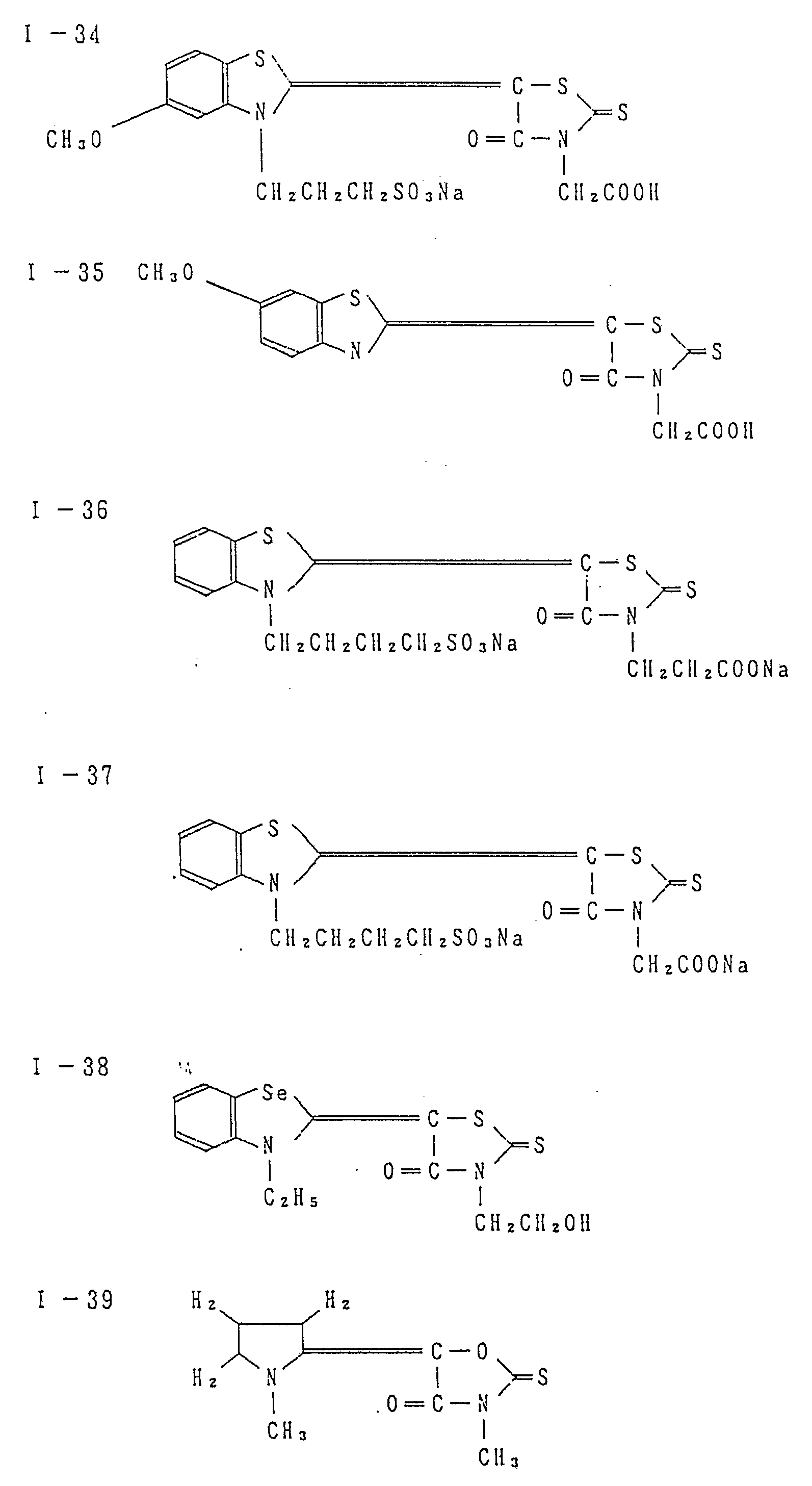
- These compounds can be synthesized easily with the method disclosed in U.S. Patent No. 2,161,331 and West Germany Patent No. 936071.
- These can be applied for silver halide emulsion by the methods to add a compound in the emulsion so as to dissolve in it; to dissolve a compound in water, or an organic solvent such as methanol, ethanol or acetone or their mixture and add the solution in the emulsion.
- The compound can also be added not to the silver halide emulsion layer but to the layer adjacent to it such as the protective layer or the intermediate layer, if necessary, in an extent not to interfere with the photographic properties.
- The amount of a compound indicated by Formula (I) added to the silver halide emulsion in this invention is usually in a range of 5 to 1000 mg per mol of silver halide though it changes depending on the kind of silver halide emulsion or the kind of the added compound.
- The compound represented by Formula (I) of this invention can be added at any time during the manufacturing process to the silver halide emulsion; usually it is preferable to add it at any time during ripening period of the emulsion or at any time from the end of ripening of emulsion to the start of the coating.
- The compound represented by Formula (I) can be used singly or plurally in this invention.
- Then, water-soluble dyestuff having the absorption maximum in a range 600 - 800 nm will be explained which is used in this invention.
- Various kinds of dyestuffs can be used such as oxonol dyestuff, hemioxonol dyestuff, merocyanine dyestuffs, cyanine dyestuffs and azo dyestuffs. It is necessary to be water soluble so as to prevent the remain of color after the processing.
- Examples of applicable dystuffs are: pyrazolone oxonol dyestuffs described in U.S. Patent No. 2,274,782; diaryl azo dyestuffs described in U.S. Patent No. 2,956,879; styryl dyestuffs and butadienyl dyestuffs described in U.S. Patent No. 3,423,207 and No. 3,384,487; merocyanine dyestuffs described in U.S. Patent No. 2,527,583; merocyanine and oxonol dyestuffs described in U.S. Patents Nos. 3,486,897, 3,652,284 and 3,718,472; vi) enaminohemioxonol dyestuffs described in U.S. Patent No. 3,976,661; and other dystuffs described in British Patents Nos. 584,609 and 1,177,429; Japanese Patent Publications Open to Public Inspection (hereinafter referred to as Japanese Patent OPI Publication) Nos. 48-85130/1973, 49-99620/1974 and 49-114420/1974; U.S. Patents Nos. 2,533,472, 3,148,187, 3,177,078, 3,247,127, 3,540,887, 3,575,704 and 3,653,905.
- Water-soluble dyestuffs usable in this invention should have maximum absorption in a range of from 600 to 800 nm. An actual example is a dyestuff having Formula (II a) or (II b):
-

- Where, V is sulfone or carboxy group; n₁ is an integer of 2, 3 or 3.
-

- Where, R¹, R², R³, R⁴, R⁵ and R⁶ independently represent a substituted or un substituted alkyl group which are either different or not different from each other, and Z¹ and Z² are nonmetallic atom group necessary to compose condensed benzo-ring or naphtho-ring either having a substituted radical or not, provided that the dyestuff contains at least three acid groups in any groups of R¹, R², R³, R⁴, R⁵ and R⁶ and Z¹ and Z². L represents a substituted or not-substituted methine group and X is an anion; n₂ is 1 or 2.
- Examples of actual dyestuffs applicable in this invention are shown in the following; of course, dyestuffs usable in this invention are not limited to these:


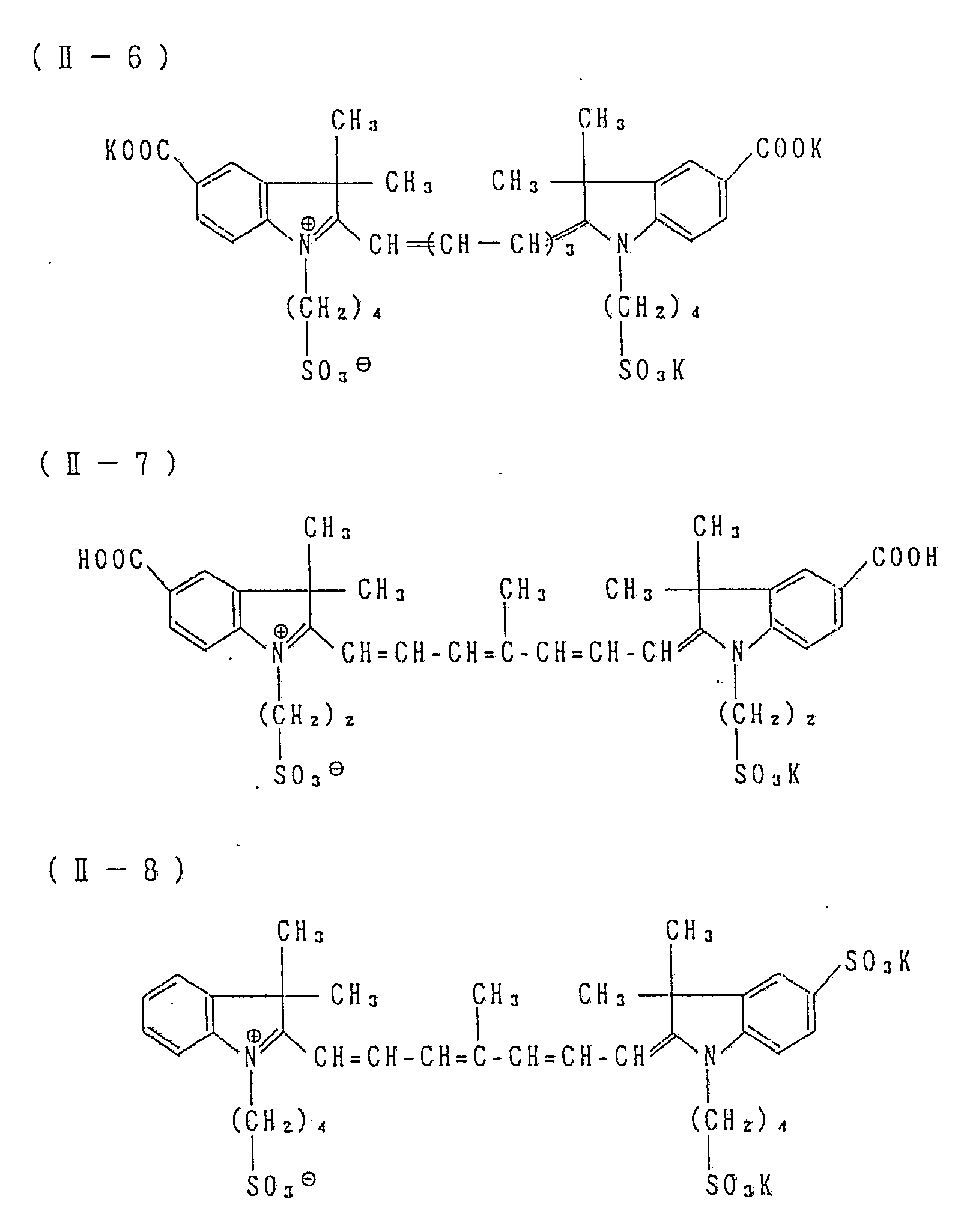


- These dyestuffs which are represented by Formulas (II a) and (II b) are used by dissolving them to a proper solvent, for example, water, an alcohol such as methanol, ethanol, or propanol, acetone or a mixture of these solvents and adding them to at least one layer located on the emulsion layer containing a compound represented by the Formula (I).
- Two or more of these dyestuffs can be used as the mixture.
- Applicable amount of the dyestuff is different according to its purpose; generally preferable amount is in a range of from 10⁻³ to 1 g/m³, or most preferably, from 10⁻³ to 0.5 g/m³.
- A dyestuff having an absorption maximum in a range of from 600 to 800 nm is added to the layer located on the emulsion layer. Or more preferably, it is added to a non-light-sensitive hydrophilic colloidal layer which is located on the emulsion layer. For example, the protection layer is a proper one.
- A high-polymeric mordant can also be added to the hydrophilic layer together with the dyestuff. The following compounds can be cited as examples of mordants: a polymer derived from an ethylene-series unsaturated compound having a dialkylamino alkyl ester residue shown in British Patent No. 685,475; its copolymer shown in U.S. Patent No. 2,839,401; a copolymer of maleic acid or its derivative shown in British Patent No. 906,083; a polymer obtained by reaction of polyvinyl alkyl ketone and aminoguanidine shown in British Patent No. 850,281; a polymer having 2-methyl imidazole nucleus in its side chain shown in U.S. Patent No. 3,445,231; addition polymerization product or its quarternary salt of bis-alylamide and secondary diamine shown in Japanese Patent OPI Publication No. 48-247330/1973; a three or four component polymer containing polyvinyl pyridine or polyvinyl quinoline shown in British Patents No. 765,520 and No. 766,202; a polymer shown in West German OSL Patent No. 1,914,361 and No. 1,914,362; other various polymers known as mordants of acid dyes which are applicable to photographic light-sensitive materials.
- Silver halide for an emulsion constituing the emulsion layer of the invention can be arbitrarily selected from those usual used in photographic emulsion such as silver bromide silver iodobromide, silver chlorobromide, silver chloroiodobromide and silver chloride. It should preferably be a monodispersed emulsion which is defined as the emulsion in which the diameters of 90% of the particles distribute in a range of ±40% of the mean diameter.
- Diameter of silver halide particle in the emulsion should preferably be 3 mµ, or more preferably, 0.1 to 1 mµ.
- A silver halide emulsion which has a single average particle diameter can be used simply; or, if desirable, two or more kinds of emulsions which have different average diameters can be used after blending so as to obtain a proper gradation. Two or more kinds of silver halide particles can also be used.
- To embody this invention, the photographic emulsion can be prepared in accordance with the methods shown in the following texts, P. Glafkides: Chimie et Photographique; Paul Montel Co., 1967; G. F. Duffin: Photographic Emulsion Chemistry; The Focal Press, 1966; V. L. Zelikman, et. al.: Making and Coating Photographic Emulsion, The Focal Press, 1964 Either acid method, neutral method, or ammoniacal method is applicable for preparation of the emulsion.
- As the method for making a soluble silver salt and a soluble halide to react, either single-jet method, simultaneously mixing method or combination of these methods can be used. The reverse mixing method e.i. a method to form silver particles under the existence of excess amount of silver ion can also be used. The control double-jet method can also be applied which is a kind of simultaneous mixing method to keep pAg of the liquid phase where the silver halide is formed. A silver halide emulsion having grains of an regular crystal form in obtained whose grain size is comparatively uniform.
- Two or more kinds of silver halide emulsions are also applicable which have been prepared separately.
- During the process to form silver halide grains or to ripen them a compound containing a metal of the VIII group of the periodic table can be coexist, such as iron, cobalt, ruthenium, rhodium, palladium, osmium, iridium and platinum. Especially favorable compounds are, for example, ferric chloride, potassium ferricyanide, cobalt chloride, cobalt nitrate, luteo salt, nickel chloride, ruthenium chloride, ruthenium hydroxide, rhodium chloride, ammonium hexachlororhodate, sodium hexachlororhodate, potassium hexabromorhodate, palladium chloride, palladium nitrate, potassium hexachloropalladate, osmium chloride, iridium chloride (IrCI₃ and IrCI₄), potassium hexachloroiridate, ammonium hexachloroiridate, potassium hexachloroplatinate. These compounds are added in an amount of about 10⁻⁸ to 10⁻⁶ mol per mol of silver halide as an aqueous solution at the forming stage of silver halide grains in the emulsion or physical or chemical ripening stage of the emulsion. If the desensitization or the image reversal is easily occurring due to the kind of used metal, the preparing method of the emulsion or the method of development, it is preferably to add one of these compounds in an amount of 10⁻⁸ to 10⁻⁷ mol per mol of silver halide before the end of the physical ripening. For the removal of soluble salts from the emulsion after the formation of sediment or the ageing, various methods are applicable such as the noodle washing method which is carried out by gelation of gelatin or the flocculation sedimentation method by using an inorganic salt, an anionic surfactant, an anionic polymer e.g. polystyrene sulfonic acid, or gelatin derivative e.g. gelatin acylate, gelatin carbamoylate, etc.
- A silver halide emulsion can be used an after ordinary chemical sensitization. For the chemical sensitization, the methods can be applied such as shown in "Die Grundlagen der Photographischenprozesse mit Silberhalogeniden; Akadenusche Verlags Gesellschaft" edited by H. Frieser, 1968, P. 675 - p. 734.
- The use of gelatin is advantageous as the binder or the protective colloid of silver halide emulsion, however, other kind of hydrophilic colloids can also be used, for example, graft polymers of gelatin with other high polymers, proteins such as albumine and casein; cellulose derivatives such as hydroxyethyl cellulose, carboxymethyl cellulose, sulfuric acid ester of cellulose; suger derivatives such as sodium arginate and starch derivatives; various kinds of synthetic hydrophilic high polymer either homo polymer or copolymer such as partially acetalized polyvinyl alcohol, polyvinyl alcohol, poly-N-vinyl pyrolidone, polyacrylic acid, polymetacrylic acid, polyacrylic amide, polyvinyl imidazole, polyvinyl pyrazol etc.
- Various kinds of gelatin and gelatin derivatives can be used such as ordinary limed gelatin, acid-treated gelatin, enzyme-treated gelatin e.g. those shown in Bulletine Soc. Sciience of Photography of Japan, No. 16, P. 30 (1966), hydrolyzed gelatin, decomposed product of gelatin with enzyme; gelatin derivatives such as those treated by acid halides, acid anhydrides, isocyanates, bromoacetic acid, alkane sultones, vinyl sulfonamides, maleic imide compounds, polyalkylene oxides, epoxy compounds.
- In embodiments of this invention, it is permitted to contain various compounds in the photographic emulsion for the purpose to prevent the fogging during the manufacturing stage, preservation stage or processing stage or for the purpose to stabilize the photographic properties. Example of such compounds are: azoles such as benzothiazolium salts, nitroindazoles, triazoles especially, its nitro- or halogen-derivatives; heterocyelic mercapto compounds such as mercaptothiazoles, mercaptobenzothiazoles. mercaptobenzimidazoles, mercaptothiadiazoles, mercaptotetrazoles, especially, 1-phenyl-5-mercapto-tetrazole, mercaptopyrimidines; derivatives of above-mentioned heterocylic mercaptocompounds having water-soluble groups such as carboxyl and sulfone group; thioketo-compounds such as oxazolinethion; azaindenes such as tetraazaindene, especially, 4-hydroxy-substituted tetraazaindene, (1,3,3a,7)-tetrazaindenes; benzenethiousulfonic; acids benzenesulfinic; acid; these are all known as fog-inhibitors or stabilizers of photographic emulsions. As base materials of the silver halide light-sensitive materials of this invention, the following substances, for example, can be used: acetyl cellulose, cellulose nitrate, polyesters such as polyethylene telephthalate, polyolefins such as polyethylene, polystyrene, baryta paper, polyolefin-coated paper, glass, metals. These substances are used after pretreatment if it is necessary.
- Silver halide photographic emulsions of this invention can also contain various kinds of additives with various methods such as chemical sensitizing agents, stabilizing agents, tone controlling agents, hardener, fog preventing agents, suface-active agents, thickening agents, plastisizers, lublicants, developing restrainers, ultra-violet absorbents, anti-irradiation dyes, heavy metals, matting agents.
- Silver halide photographic emulsions of this invention can also contain various kinds of polymer latex such as aqueous dispersion of homo- or co-polymers of methylacrylate, methyl metacrylate, acrylic acid, metacrylic acid, glycidyl acrylate, styrene, vinyl chloride and vinylidene chloride.
- Silver halide light-sensitive materials of this invention can effectively be applied to various kinds of photosensitive materials for various uses such as ordinary black-and-white film, X-ray film, color film, infrared film, micro film, silver-dye bleaching method film, reversal film, diffusion transfer process film, etc.
- Silver halide light-sensitive materials of this invention can be developed with various ordinary developing methods after exposure.
- As black-and-white developer, alkali solution containing hydroxybenzenes, amino phenols, or aminobenzenes as the developing agents is used, which may further be added with sulfites, carbonates, bisulfites, bromides and iodides.
- The invention will be explained with practical examples. Of course, this invention shall not be limited to the following examples.
- The coating liquid for emulsion layer and others were prepared with the following procedure and the measurement of their properties is carried out.
-
Solution A: Water 9.7ℓ Sodium chloride 20 g Gelatin 105 g Solution B: Water 3.8ℓ Sodium chloride 94 g Gelatin 365 g Potassium bromide 450 g 0.01% aqueous solution of potassium hexachloroiridate 28 mℓ 0.01% aqueous solution of potassium hexabromorhodate 1.0 mℓ Solution C: Water 3.8ℓ Silver nitrate 1700 g - Solution A was kept at 40°C; solutions B and C were added to solution A by keeping pH at 3 and pAg at 7.7 simultaneously and functionary for about 60 minutes. After keeping 10 minutes, pH of the mixture was adjusted to 6.6 by adding sodium carbonate solution. Then, 2ℓ of 20% magnesium sulfate solution and 2.55ℓ of 5% polynaphthalene sulfonic acid solution were added to flocculate at 40°C and decanted and washed with water to remove the excess soluble salts. To the mixture 3.7ℓ of water was added and made to disperse; then, 0.9ℓ of 20% magnesium sulfate and the excess of water-soluble salts were removed again. Water of 3.7ℓ and 141 g of gelatin were added and the mixture was kept at 55°C for 30 minutes to disperse. With this procedure, silver chlorobromide emulsion was obtained which contained of silver bromide and 68 mol% of silver chloride and had average grain size of 0.25 µm and monodispersion degree of 9.
- This emulsion of 2600 mℓ was taken and aqueous 40 mℓ of 1% solution of citric acid and aqueous 100 mℓ of 5% solution of potassium bromide were added and pH and pAg were adjusted. To the mixture were added with 20 mℓ of 0.1% solution of sodium thiosulfate and 30 mℓ of 0.1% solution of chloroauric acid, and the mixture was ripened at 60°C for 3 hours to obtain the highest sensitivity.
- To this emulsion, 25 mℓ of 0.5% solution of 1-phenyl-5-mercaptotetrazole as the fog inhibitor, 600 mℓ of 10% solution of 4-hydroxy-6-methyl-1,3,3a,7-tetrazaindene as the stabilizer, and 960 mℓ % of 10% solution of gelatin were added to stop the ripening. Then the emulsion was divided into 10 equal portions. To each portion was added with the above-mentioned compounds I-13 and I-34, both of which were examples of the compound represented by Formula (I). The adding amounts were as those indicated in Table 1. Further 7 mℓ of a 20% solution of hydroquinone as the fog inhibitor 6 mℓ of a 20% solution of saponine as the spreading agent 13 mℓ of a 4% solution of copolymer of styrene and maleic acid as the thickener and 8.4 g of a high polymer latex of acrylic ethyl and stirred. The pH and pAg of the mixture were adjusted by adding 3.5 mℓ of a 1% citric acid solution, and 6 mℓ of a 5% potassium bromide solution.
- Coating solution for the protective layer was prepared as follows: ten portions of aqueous solution containing 60 g of gelatin were prepared. A 10% solution of potassium bromide of 10.5 mℓ was added and 37.5 mℓ of a 1% solution of sodium 1-decyl-2-(3-isopentyl) succinate-2-sulfonate was added as the spreading agent to each portion. Then, 0.98 g of amorphous silica having a mean diameter of 3.5 µm was added so as to disperse. To ten potions of the above mixture, the aforementioned compounds II-I and II-14 were added with the amount indicated in Table 1 and agitated.
- To a gelatin solution containing 700 g of gelatin, the following solutions were added and agitated: 2960 mℓ of a 2% solution of undermentioned water-soluble dye III-1, 620 mℓ of a 2% solution of undermentioned water soluble dye III-2 and 499 mℓ of a 5% solution of undermentioned water-soluble dye III-3; 825 mℓ of a 0.75% methanol solution of 5-nitroindazole as the inhibitor, 210 mℓ of a 20% saponine solution as the spreading agent, 200 mℓ of a 4% solution copolymer of styrene and maleic acid 105 g of a high polymer latex of butyl acrylate and 50 mℓ of a 7% solution of citric acid. The coating solution for the backing layer was thus prepared.
- As the coating solution for the protective layer for the backing layer the mixture was prepared by adding the following agents to an aqueous solution containing 600 g of gelatine and agitated 4.48 g of polymethylmetacrylate having the mean diameter of about 0.4 µm as matting agent 360 mℓ of a 10% sodium chloride solution and 500 mℓ of a 1% solution of sodium 1-decyl-2-(3-isopentyl) succinate-2-sulfonate as spreading agent.

- The sample was prepared as follows by using coating solutions prepared with the above-mentioned methods.
- Formalin, and an aqueous solution of sodium salt of 2,4-dichloro-6-hydroxytriazine were added as hardening agents to the coating liquid for the protective layer to be provided on emulsion layer. Glyoxal was added as the hardening agent to the coating liquid of backing layer. Glyoxal was also added as the hardening agent to the protective layer to be provided on the backing layer. Then, the coating was carried out on the subbed support made of polyethylene telephthalate as follows: To one side of the support the emulsion layer was coated so as to have the amount of silver of 4.25 g/m² and simultaneously coated the protective layer on its so as to have the amount of gelatin of 1.36 g/m². To the other side of the support the backing layer was coated so as to have the amount of gelatin of 2.26 g/m² and simultaneously coated the protective layer on its so as to have the amount of gelatin of 1.34 g/m².
Table 1 No. of sample Compound Formula (I) Dye added to protective layer This invention or comparison No. of compound Coated amount mg/m² No. of compound Coated amount mg/m² 1 I-13 14 - - Comparison 2 I-13 14 II-1 20 Invention 3 I-13 14 II-1 20 Invention 4 I-34 7 - - Comparison 5 I-34 7 II-1 20 Invention 6 I-34 7 II-1 40 Invention 7 I-34 7 II-1 60 Invention 8 I-34 7 II-14 20 Invention 9 I-34 7 II-14 40 Invention 10 I-34 7 II-14 60 Invention -: No addition. - Ten sample films obtained with the above-mentioned method were exposed to Ar laser light and developed with the Konica automatic developing machine R-27 (manufactured by Konica Co., Ltd.) by using the below-mentioned developer and fixer at 38°C for 20 minutes.
- The unexposed sample films were exposed to a 40 W fluorescent light covered with a yellow filter film for 10 minutes from 2 meter distance. Then the samples were developed together with unexposed samples. Fog densities of the exposed and unexposed sample films were measured with the conventional method.
- A similar fog test was carried out by exposing the samples for 30 minutes to red light from a 60 W tungsten light covered with the safe light filter No. 8A of Eastman Kodak Co. from 1 m distance.
- Table 2 indicates the results of the test the sensitivities and the fog densities under each conditions of the safe light exposure. The sensitivity was represented by the reciprocals of exposure amount required to obtain the density of fog + 3.0.
- Formulas of the used developer and fixer were as follows:
-
Pure water (ion-exchanged water) about 800mℓ Potassium sulfite 60 g Disodium ethykenediamine-tetraacetate 2 g Potassium hydroxide 10.5 g 5-methylbenzotriazole 300 mg Diethyleneglycol 25 g 1-phenyl-4,4-dimethyl-3-pyrazolidone 300 mg 1-phenyl-5-mercaptotetrazole 60 mg Potassium bromide 3.5 g Hydroquinone 20 g Potassium carbonate 15 g - By adding pure water (ion exchanged a water) make the total volume to 1,000 mℓ. pH of the solution was about 10.8.
-
Ammonium thiosulfate (aqueous 72.5% W/V solution) 240 mℓ Sodium sulfite 17 g Sodium acetate trihydrate 6.5 g Boric acid 6 g Sodium citrate dihydrate 2 g Acetic acid (aqueous 90% W/W solution) 13.6 mℓ -
Pure water (ion exchanged water) 17 mℓ Sulfuric acid (50% W/W aqueous solution) 4.7 g Aluminum sulfate (aqueous solution; 8.1% W/W, as Aℓ₂ O₃) 26.5 g - The fixer was prepared just before the use by adding Composition A and Composition B successively to 500 mℓ of water and made the total to 1ℓ. The pH of the fixer was about 4.3.
Table 2 Sample No. Sensitivity Fog density This invention or comparison 0 min expose After expose to yellow safe light for 10 min After expose to red safe light for 30 min 1 250 0.04 0.11 0.20 Comparison 2 248 0.04 0.07 0.10 Invention 3 247 0.04 0.05 0.05 Invention 4 248 0.03 0.13 0.23 Comparison 5 247 0.03 0.08 0.10 Invention 6 246 0.03 0.05 0.05 Invention 7 244 0.03 0.04 0.04 Invention 8 246 0.03 0.09 0.11 Invention 9 244 0.03 0.07 0.07 Invention 10 242 0.03 0.06 0.05 Invention - The result of the measurement indicated in Table 2 proves that:
- Samples No. 2 and No. 3 of this invention containing compound (I-13) represented by Formula (I) and a water-soluble dye having an absorption maximum at 600 to 800 µm, the samples have favorable qualities such as the sensitivities of 247 and 248, the fog of 0.04 and 0.04 without exposure, 0.05 and 0.07 (10 minutes with the yellow safe light) exposure for 10 minutes and 0.05 and 0.10 with the red safelight exposure for 30 minutes.
- Sample No. 1 which contains compound I-13 of Formula (I) but does not have an above-mentioned water-soluble dye is inferior in its quality such as the sensitivity of 250, the fog of 0.04 without exposure, 0.11 with the yellow safelight exposure for 10 minutes and 0.20 with the red safelight exposure for 30 minutes.
- Samples 5 - 10 of this invention all of which contain both compound (I-34) represented by Formula (I) and the above-mentioned water-soluble dye had favorable qualities such as that the sensitivities of 242 to 247, the fog of 0.03 without exposure, 0.04 to 0.09 with the yellow safelight exposure for 10 minutes and 0.04 to 0.11 with the red safelight exposure for 30 minutes.
- Sample No. 4 which contains a compound (I-34) but does not contain an above-mentioned water-soluble dye is inferior in its quality such as the sensitivity of 248, fog of 0.03 without exposure, 0.13 with the yellow safelight exposure for 10 minutes and 0.23 with the red safelight exposure for 30 minutes.
- These measurement results prove that the all samples of this invention are excellent in their properties such as the ability for easy handling under either yellow or red safelight and a good sensitivity.
Claims (7)
1. A silver halide photographic light-sensitive material comprising a support having thereon at least one silver halide emulsion layer containing a compound represented by the following Formula (I), and at least one layer which is being arranged on the side of said silver halide emulsion layer farther from said support and contains a water soluble dyestuff having a spectral absorption maximum within the range of from 600 nm to 800 nm,

wherein R is an alkyl group; Z is a group of non-metal atoms necessary for completing a 5- or 6-member ring; Q is a group of non-metal atoms necessary for completing a 5-member heterocyclic ring; and m is an integer of 1 or 2.
2. The material of claim 1, wherein said water soluble dyestuff is a compound represented by the following Formula (IIa),

wherein V is a sulfo group or an carboxyl group; and n is an integer of 2, 3 or 4.
3. The material of claim 1, wherein said water soluble dyestuff is a compound represented by the following Formula (IIb),

wherein R¹, R², R³, R⁴, R⁵ and R⁶, which may be the same with or different from each other, are independently a substituted or unsubstituted alkyl group; Z¹ and Z² are independently a group of non-metal atoms necessary for completing a substituted or unsubstituted condenced benzene ring or a substituted or unsubstituted condenced naphthalene ring; L is a substituted or unsubstituted methine group; X is an anion; and n, is an integer of 1 or 2, provided that said dyestuff has at least three acid groups in any groups each represented by R¹, R², R³, R⁴, R⁵, R⁶, Z¹ and Z².
4. The material of claim 1, wherein said layer contains said water soluble dyestuff in an amount of from 10⁻³ g/m² to 1 g/m².
5. The material of claim 4, wherein said layer contains said water soluble dyestuff in an amount of from 10⁻³ a g/m² to 0.5 9/m².
6. The material of claim 1, wherein said layer containing said water soluble dyestuff is a hydrophilic colloid layer.
7. The material of claim 6, wherein said layer containing said water soluble dyestuff is a protective layer.
Applications Claiming Priority (2)
| Application Number | Priority Date | Filing Date | Title |
|---|---|---|---|
| JP104646/88 | 1988-04-27 | ||
| JP10464688A JPH01274131A (en) | 1988-04-27 | 1988-04-27 | High contrast silver halide photographic sensitive material having high sensitivity |
Publications (2)
| Publication Number | Publication Date |
|---|---|
| EP0339955A2 true EP0339955A2 (en) | 1989-11-02 |
| EP0339955A3 EP0339955A3 (en) | 1991-07-31 |
Family
ID=14386226
Family Applications (1)
| Application Number | Title | Priority Date | Filing Date |
|---|---|---|---|
| EP19890304139 Withdrawn EP0339955A3 (en) | 1988-04-27 | 1989-04-26 | Silver halide photographic light-sensitive material |
Country Status (2)
| Country | Link |
|---|---|
| EP (1) | EP0339955A3 (en) |
| JP (1) | JPH01274131A (en) |
Families Citing this family (1)
| Publication number | Priority date | Publication date | Assignee | Title |
|---|---|---|---|---|
| JP2805012B2 (en) * | 1990-03-15 | 1998-09-30 | コニカ株式会社 | Silver halide photographic material |
Family Cites Families (4)
| Publication number | Priority date | Publication date | Assignee | Title |
|---|---|---|---|---|
| BE627808A (en) * | 1962-02-03 | |||
| US4160669A (en) * | 1975-03-17 | 1979-07-10 | Teiji Habu | Argon laser flash exposure of spectrally sensitized silver halide photographic material |
| JPS61267756A (en) * | 1985-01-26 | 1986-11-27 | Konishiroku Photo Ind Co Ltd | Silver halide photographic sensitive material |
| JPS62103633A (en) * | 1985-10-09 | 1987-05-14 | Konishiroku Photo Ind Co Ltd | Silver halide photographic sensitive material |
-
1988
- 1988-04-27 JP JP10464688A patent/JPH01274131A/en active Pending
-
1989
- 1989-04-26 EP EP19890304139 patent/EP0339955A3/en not_active Withdrawn
Also Published As
| Publication number | Publication date |
|---|---|
| EP0339955A3 (en) | 1991-07-31 |
| JPH01274131A (en) | 1989-11-01 |
Similar Documents
| Publication | Publication Date | Title |
|---|---|---|
| US4173483A (en) | Silver halide photographic emulsions for use in flash exposure | |
| JPS61251842A (en) | Optical response material | |
| US4268622A (en) | Photographic light-sensitive materials having dyed layers | |
| US3623881A (en) | Silver halide emulsions sensitized with tricarbocyanine dyes containing a 1-piperazinyl group | |
| US3718470A (en) | Surface development process utilizing an internal image silver halide emulsion containing a composite nucleating agent-spectral sensitizing polymethine dye | |
| US4023972A (en) | Method of preparing a blend of fogged, direct-positive silver halide emulsions of different average grain sizes | |
| US4607003A (en) | Photographic element | |
| JPH0340371B2 (en) | ||
| EP0339955A2 (en) | Silver halide photographic light-sensitive material | |
| JP2681629B2 (en) | Silver halide photographic material | |
| US5464734A (en) | Methine compounds and silver halide photographic materials containing the compound | |
| US4073652A (en) | Direct-positive silver halide emulsions | |
| US5871897A (en) | Silver halide photographic material | |
| US3540888A (en) | Photographic silver halide emulsions containing dyes having a 5-alkoxycarbonyl - 2,4 - dioxo-1-aryl-6-thioxopiperidene moiety | |
| JPH10148909A (en) | Silver halide photographic sensitive material and image forming method | |
| JPS61282834A (en) | Silver halide photographic sensitive material | |
| JPS62103633A (en) | Silver halide photographic sensitive material | |
| JP2660421B2 (en) | Silver halide photographic material | |
| US5589325A (en) | Silver halide photographic material | |
| JPH0433822B2 (en) | ||
| JPS588499B2 (en) | Senriyouofukumushashinkankouzairiyou | |
| JPS61172140A (en) | Silver halide photographic sensitive material | |
| JPH1184562A (en) | Silver halide photographic sensitive material | |
| JPH08328195A (en) | Silver halide photographic sensitive material | |
| JPH1030060A (en) | New zeromethinemerocyanine coloring matter useful as spectral sensitizer for photographic element |
Legal Events
| Date | Code | Title | Description |
|---|---|---|---|
| PUAI | Public reference made under article 153(3) epc to a published international application that has entered the european phase |
Free format text: ORIGINAL CODE: 0009012 |
|
| AK | Designated contracting states |
Kind code of ref document: A2 Designated state(s): DE GB IT |
|
| PUAL | Search report despatched |
Free format text: ORIGINAL CODE: 0009013 |
|
| AK | Designated contracting states |
Kind code of ref document: A3 Designated state(s): DE GB IT |
|
| RHK1 | Main classification (correction) |
Ipc: G03C 1/83 |
|
| STAA | Information on the status of an ep patent application or granted ep patent |
Free format text: STATUS: THE APPLICATION IS DEEMED TO BE WITHDRAWN |
|
| 18D | Application deemed to be withdrawn |
Effective date: 19910503 |