EP0340362A1 - Carton pour récipient et un procédé de fabrication - Google Patents
Carton pour récipient et un procédé de fabrication Download PDFInfo
- Publication number
- EP0340362A1 EP0340362A1 EP19880309654 EP88309654A EP0340362A1 EP 0340362 A1 EP0340362 A1 EP 0340362A1 EP 19880309654 EP19880309654 EP 19880309654 EP 88309654 A EP88309654 A EP 88309654A EP 0340362 A1 EP0340362 A1 EP 0340362A1
- Authority
- EP
- European Patent Office
- Prior art keywords
- wax
- containerboard
- water
- liners
- board
- Prior art date
- Legal status (The legal status is an assumption and is not a legal conclusion. Google has not performed a legal analysis and makes no representation as to the accuracy of the status listed.)
- Ceased
Links
- 238000000034 method Methods 0.000 title description 44
- 238000004519 manufacturing process Methods 0.000 title description 4
- XLYOFNOQVPJJNP-UHFFFAOYSA-N water Substances O XLYOFNOQVPJJNP-UHFFFAOYSA-N 0.000 claims abstract description 46
- 239000012943 hotmelt Substances 0.000 claims abstract description 24
- 239000013053 water resistant agent Substances 0.000 claims abstract description 21
- 239000007788 liquid Substances 0.000 claims abstract description 18
- 239000001993 wax Substances 0.000 claims description 189
- 239000000203 mixture Substances 0.000 claims description 29
- 239000012188 paraffin wax Substances 0.000 claims description 13
- 238000002844 melting Methods 0.000 claims description 8
- 230000008018 melting Effects 0.000 claims description 8
- 238000007906 compression Methods 0.000 claims description 7
- 230000006835 compression Effects 0.000 claims description 7
- 239000011087 paperboard Substances 0.000 claims description 7
- 238000010521 absorption reaction Methods 0.000 claims description 5
- 239000004200 microcrystalline wax Substances 0.000 claims description 5
- 235000019808 microcrystalline wax Nutrition 0.000 claims description 5
- 230000001976 improved effect Effects 0.000 claims description 4
- 230000006735 deficit Effects 0.000 claims description 3
- 235000013305 food Nutrition 0.000 claims description 3
- 239000000155 melt Substances 0.000 claims description 3
- 239000007787 solid Substances 0.000 claims description 3
- 238000000576 coating method Methods 0.000 abstract description 24
- 239000011248 coating agent Substances 0.000 abstract description 20
- 238000005470 impregnation Methods 0.000 abstract description 9
- 239000003795 chemical substances by application Substances 0.000 abstract description 5
- 230000008569 process Effects 0.000 description 34
- 239000000123 paper Substances 0.000 description 19
- 241000251468 Actinopterygii Species 0.000 description 18
- 230000035515 penetration Effects 0.000 description 15
- 238000005520 cutting process Methods 0.000 description 9
- 239000010410 layer Substances 0.000 description 9
- 238000007598 dipping method Methods 0.000 description 8
- 238000007654 immersion Methods 0.000 description 7
- 235000019809 paraffin wax Nutrition 0.000 description 7
- 235000019271 petrolatum Nutrition 0.000 description 7
- 229920002522 Wood fibre Polymers 0.000 description 6
- 239000003292 glue Substances 0.000 description 6
- 230000000087 stabilizing effect Effects 0.000 description 5
- 238000004026 adhesive bonding Methods 0.000 description 4
- 238000005452 bending Methods 0.000 description 4
- 238000001816 cooling Methods 0.000 description 4
- 238000009826 distribution Methods 0.000 description 4
- 230000005484 gravity Effects 0.000 description 4
- 239000000463 material Substances 0.000 description 4
- 238000013021 overheating Methods 0.000 description 4
- 229920006395 saturated elastomer Polymers 0.000 description 4
- -1 strawboard Substances 0.000 description 4
- 230000008093 supporting effect Effects 0.000 description 4
- 238000004078 waterproofing Methods 0.000 description 4
- 238000004018 waxing Methods 0.000 description 4
- 238000007766 curtain coating Methods 0.000 description 3
- 239000003208 petroleum Substances 0.000 description 3
- 229920000642 polymer Polymers 0.000 description 3
- 239000004215 Carbon black (E152) Substances 0.000 description 2
- 239000012298 atmosphere Substances 0.000 description 2
- 230000015572 biosynthetic process Effects 0.000 description 2
- 238000007664 blowing Methods 0.000 description 2
- 238000009835 boiling Methods 0.000 description 2
- 239000000835 fiber Substances 0.000 description 2
- 229930195733 hydrocarbon Natural products 0.000 description 2
- 150000002430 hydrocarbons Chemical class 0.000 description 2
- 239000002655 kraft paper Substances 0.000 description 2
- 230000007246 mechanism Effects 0.000 description 2
- 230000000149 penetrating effect Effects 0.000 description 2
- 239000000047 product Substances 0.000 description 2
- 230000002035 prolonged effect Effects 0.000 description 2
- 230000009467 reduction Effects 0.000 description 2
- 230000006641 stabilisation Effects 0.000 description 2
- 238000011105 stabilization Methods 0.000 description 2
- 239000000126 substance Substances 0.000 description 2
- 239000002344 surface layer Substances 0.000 description 2
- 239000002699 waste material Substances 0.000 description 2
- 239000004698 Polyethylene Substances 0.000 description 1
- 239000004743 Polypropylene Substances 0.000 description 1
- 229920000294 Resistant starch Polymers 0.000 description 1
- 230000035508 accumulation Effects 0.000 description 1
- 238000009825 accumulation Methods 0.000 description 1
- 230000009471 action Effects 0.000 description 1
- 239000000654 additive Substances 0.000 description 1
- 230000000996 additive effect Effects 0.000 description 1
- 230000003190 augmentative effect Effects 0.000 description 1
- 239000011111 cardboard Substances 0.000 description 1
- 239000002415 cerumenolytic agent Substances 0.000 description 1
- 238000006243 chemical reaction Methods 0.000 description 1
- 230000001143 conditioned effect Effects 0.000 description 1
- 238000010276 construction Methods 0.000 description 1
- 238000005336 cracking Methods 0.000 description 1
- 230000001627 detrimental effect Effects 0.000 description 1
- 230000000694 effects Effects 0.000 description 1
- 235000021149 fatty food Nutrition 0.000 description 1
- 238000009472 formulation Methods 0.000 description 1
- 239000004519 grease Substances 0.000 description 1
- 239000011121 hardwood Substances 0.000 description 1
- 238000010438 heat treatment Methods 0.000 description 1
- 239000005457 ice water Substances 0.000 description 1
- 230000001939 inductive effect Effects 0.000 description 1
- 235000013372 meat Nutrition 0.000 description 1
- 239000002480 mineral oil Substances 0.000 description 1
- 239000003607 modifier Substances 0.000 description 1
- 238000009828 non-uniform distribution Methods 0.000 description 1
- 239000003921 oil Substances 0.000 description 1
- 230000003204 osmotic effect Effects 0.000 description 1
- 238000004806 packaging method and process Methods 0.000 description 1
- 239000012466 permeate Substances 0.000 description 1
- 229920000728 polyester Polymers 0.000 description 1
- 229920000573 polyethylene Polymers 0.000 description 1
- 229920001155 polypropylene Polymers 0.000 description 1
- 239000011148 porous material Substances 0.000 description 1
- 238000004537 pulping Methods 0.000 description 1
- 229920005989 resin Polymers 0.000 description 1
- 239000011347 resin Substances 0.000 description 1
- 235000021254 resistant starch Nutrition 0.000 description 1
- 238000007790 scraping Methods 0.000 description 1
- 235000014102 seafood Nutrition 0.000 description 1
- 238000000926 separation method Methods 0.000 description 1
- 239000011122 softwood Substances 0.000 description 1
- 239000002904 solvent Substances 0.000 description 1
- 230000003068 static effect Effects 0.000 description 1
- 238000003860 storage Methods 0.000 description 1
- 238000010998 test method Methods 0.000 description 1
- 230000008719 thickening Effects 0.000 description 1
- 239000010875 treated wood Substances 0.000 description 1
- 238000009827 uniform distribution Methods 0.000 description 1
Images

Classifications
-
- D—TEXTILES; PAPER
- D21—PAPER-MAKING; PRODUCTION OF CELLULOSE
- D21H—PULP COMPOSITIONS; PREPARATION THEREOF NOT COVERED BY SUBCLASSES D21C OR D21D; IMPREGNATING OR COATING OF PAPER; TREATMENT OF FINISHED PAPER NOT COVERED BY CLASS B31 OR SUBCLASS D21G; PAPER NOT OTHERWISE PROVIDED FOR
- D21H23/00—Processes or apparatus for adding material to the pulp or to the paper
- D21H23/02—Processes or apparatus for adding material to the pulp or to the paper characterised by the manner in which substances are added
- D21H23/22—Addition to the formed paper
- D21H23/66—Treating discontinuous paper, e.g. sheets, blanks, rolls
- D21H23/68—Treating discontinuous paper, e.g. sheets, blanks, rolls whereby the paper moves continuously
-
- D—TEXTILES; PAPER
- D21—PAPER-MAKING; PRODUCTION OF CELLULOSE
- D21H—PULP COMPOSITIONS; PREPARATION THEREOF NOT COVERED BY SUBCLASSES D21C OR D21D; IMPREGNATING OR COATING OF PAPER; TREATMENT OF FINISHED PAPER NOT COVERED BY CLASS B31 OR SUBCLASS D21G; PAPER NOT OTHERWISE PROVIDED FOR
- D21H17/00—Non-fibrous material added to the pulp, characterised by its constitution; Paper-impregnating material characterised by its constitution
- D21H17/60—Waxes
-
- D—TEXTILES; PAPER
- D21—PAPER-MAKING; PRODUCTION OF CELLULOSE
- D21H—PULP COMPOSITIONS; PREPARATION THEREOF NOT COVERED BY SUBCLASSES D21C OR D21D; IMPREGNATING OR COATING OF PAPER; TREATMENT OF FINISHED PAPER NOT COVERED BY CLASS B31 OR SUBCLASS D21G; PAPER NOT OTHERWISE PROVIDED FOR
- D21H23/00—Processes or apparatus for adding material to the pulp or to the paper
- D21H23/02—Processes or apparatus for adding material to the pulp or to the paper characterised by the manner in which substances are added
- D21H23/22—Addition to the formed paper
- D21H23/32—Addition to the formed paper by contacting paper with an excess of material, e.g. from a reservoir or in a manner necessitating removal of applied excess material from the paper
- D21H23/42—Paper being at least partly surrounded by the material on both sides
-
- Y—GENERAL TAGGING OF NEW TECHNOLOGICAL DEVELOPMENTS; GENERAL TAGGING OF CROSS-SECTIONAL TECHNOLOGIES SPANNING OVER SEVERAL SECTIONS OF THE IPC; TECHNICAL SUBJECTS COVERED BY FORMER USPC CROSS-REFERENCE ART COLLECTIONS [XRACs] AND DIGESTS
- Y10—TECHNICAL SUBJECTS COVERED BY FORMER USPC
- Y10T—TECHNICAL SUBJECTS COVERED BY FORMER US CLASSIFICATION
- Y10T428/00—Stock material or miscellaneous articles
- Y10T428/13—Hollow or container type article [e.g., tube, vase, etc.]
- Y10T428/1303—Paper containing [e.g., paperboard, cardboard, fiberboard, etc.]
-
- Y—GENERAL TAGGING OF NEW TECHNOLOGICAL DEVELOPMENTS; GENERAL TAGGING OF CROSS-SECTIONAL TECHNOLOGIES SPANNING OVER SEVERAL SECTIONS OF THE IPC; TECHNICAL SUBJECTS COVERED BY FORMER USPC CROSS-REFERENCE ART COLLECTIONS [XRACs] AND DIGESTS
- Y10—TECHNICAL SUBJECTS COVERED BY FORMER USPC
- Y10T—TECHNICAL SUBJECTS COVERED BY FORMER US CLASSIFICATION
- Y10T428/00—Stock material or miscellaneous articles
- Y10T428/24—Structurally defined web or sheet [e.g., overall dimension, etc.]
- Y10T428/24628—Nonplanar uniform thickness material
- Y10T428/24669—Aligned or parallel nonplanarities
- Y10T428/24694—Parallel corrugations
- Y10T428/24711—Plural corrugated components
-
- Y—GENERAL TAGGING OF NEW TECHNOLOGICAL DEVELOPMENTS; GENERAL TAGGING OF CROSS-SECTIONAL TECHNOLOGIES SPANNING OVER SEVERAL SECTIONS OF THE IPC; TECHNICAL SUBJECTS COVERED BY FORMER USPC CROSS-REFERENCE ART COLLECTIONS [XRACs] AND DIGESTS
- Y10—TECHNICAL SUBJECTS COVERED BY FORMER USPC
- Y10T—TECHNICAL SUBJECTS COVERED BY FORMER US CLASSIFICATION
- Y10T428/00—Stock material or miscellaneous articles
- Y10T428/24—Structurally defined web or sheet [e.g., overall dimension, etc.]
- Y10T428/24628—Nonplanar uniform thickness material
- Y10T428/24669—Aligned or parallel nonplanarities
- Y10T428/24694—Parallel corrugations
- Y10T428/24711—Plural corrugated components
- Y10T428/24727—Plural corrugated components with planar component
-
- Y—GENERAL TAGGING OF NEW TECHNOLOGICAL DEVELOPMENTS; GENERAL TAGGING OF CROSS-SECTIONAL TECHNOLOGIES SPANNING OVER SEVERAL SECTIONS OF THE IPC; TECHNICAL SUBJECTS COVERED BY FORMER USPC CROSS-REFERENCE ART COLLECTIONS [XRACs] AND DIGESTS
- Y10—TECHNICAL SUBJECTS COVERED BY FORMER USPC
- Y10T—TECHNICAL SUBJECTS COVERED BY FORMER US CLASSIFICATION
- Y10T428/00—Stock material or miscellaneous articles
- Y10T428/31504—Composite [nonstructural laminate]
- Y10T428/31801—Of wax or waxy material
- Y10T428/31804—Next to cellulosic
- Y10T428/31808—Cellulosic is paper
Definitions
- This invention relates to a corrugated container severelyboard and to a continuous high-speed process for making a corrugated containerboard impregnated with a water-resistant agent and variously known as a water-resistant corrugated paperboard, strawboard, or cardboard, which is commonly die cut, scored or creased, and then folded or folded and glued to form a box or container for storing or shipping various goods.
- Water-resistant corrugated containerboard has long been used to contain perishable or refrigeated products or foods. Where the product has a high moisture content, such as fresh meats or iced seafoods, the water resistance and durability of containerboards in common use is much less than is desired.
- a box filled with iced fresh fish, for example, is seldom treated with care and if the otherwise water-resistant corrugated box is cut or crushed during rough handling, such that the water-resistant coating is ruptured, moisure is rapidly wicked into the sidewalls of the container, which then rapidly disintegrates.
- Paper manufactured from treated wood fibres is most commonly used for corrugated containerboard and is wax treated to enhance its water resistance when required because the untreated containerboard has little wet strength.
- a commonly used containerboard comprises a corrugated paper medium spacing and glued to kraft paper liners. These papers are often pretreated with wax or other water-resistant agent prior to being formed into the containerboard. The pretreatment is not only a costly operation in itself, but the water-resistant treatment retards the subsequent gluing of the corrugated medium to the liners during fabrication of the containerboard, as compared with the gluing of untreated liners and medium.
- the fabricated pretreated containerboard is additionally waterproofed, as for examle by dipping the corrugated containerboard in a hot melt wax bath or by cascading or curtain-coating processes.
- batches of container-boards are lowered vertically into a hot melt bath of wax, then withdrawn into an oven where excess liquid wax drains back into the bath.
- An air knife may be used to blow excess liquid wax from the surface of each containerboard. Thereafter the wax cools and hardens.
- Objections to the dipping process are its slowness, the cumbersome equipment required for handling the containerboards, the difficulty of blowing excess wax uniformly from all of the containerboards in the batch, and more importantly the wasteful and nonuniform distribution of the hardened wax throughout the containerboard.
- the lower ends of the containerboards are first into the bath and last out, with the result of an uneven immersion time and temperature exposure to the hot wax for different parts of the containerboard and a costly uneven distribution of wax, whereby useless wax often clogs the lower portions of the corrugation and piles up in an excessively heavy layer near the lower exterior surfaces, which heavy wax layer is usually a waste and often a hindrance.
- the containerboard is passed vetically in a preheated condition under a cascade of hot liquid wax which runs down the flutes and exterior surfaces of the containerboard. Thereafter the board is cooled to harden the wax.
- the cascade method relies on gravity flow for the wax which results in uneven exposure of all parts of the containerboard to the wax for equal time intervals and temperature conditions. An uneven distribution of wax over the surfaces of the flutes and the exterior surfaces of the containerboard and a non-uniform impregnation of such surfaces results as the comparatively slow gravity flow of wax congeals on the containerboard.
- the resulting waxed containerboard is thus subject to most of the objections described in regard to the "dipped" containerboard.
- the die cutting and scoring required to facilitate formation of a box from the plane containerboard and, which are preferably performed during the same single operation, must be done after the dipping or cascading wax treatment.
- the scrap from the die cutting, being waxed, cannot be recycled and is thus another source of expensive waste.
- curtain process as described in US- A- 3,524,759 a curtain or cascade of a hot melt water-resistant agent is caused to flow on the surface of the containerboard as it passes horizontally under the flow.
- the curtain process coats only the exterior surfaces of the containerboard, has limited use, and is unsatisfactory for producing containerboard intended for use in humid conditions where there is a likelihood of rupturing the coated surface.
- Objects of the present invention are to provide a continuous high speed process for making a superior water-resistant containerboard wherein the above noted objections to conventional processes and the resulting containerboard are avoided.
- an object is to provie a waxed corrugated containerboard and process for making the same wherein an untreated corrugated containerboard (i.e, a corrugated board not fabricated from pretreated water-resistant paper) is immersed into a hot melt wax bath under controlled conditions such that all portions of the containerboard are exposed to the hot wax for equal preselected time periods and wax temperatures, and the immersion may be effected in a single fast, pass through the hot wax bath in a continuous, efficient maner.
- an untreated corrugated containerboard i.e, a corrugated board not fabricated from pretreated water-resistant paper
- Another object is to provide such a containerboard that has improved water resistance, strength, and flexibility compared with conventional waxed containerboards otherwise comparable prior to being waxed; that can be die cut and creased or scored prior to being waxed; and that do not require prewaxing or water-proofing of the paper from which the corrugated containerboard is fabricated in order to obtain optimum water resistance and compression strength when folded into box form.
- the invention resides in a corrugated containerboard having at least one corrugated medium spacing a pair of liners, said corrugating medium being secured at the crests of its flutes to the interior surfaces of said liners and thereby forming parallel open flutes between said liners, said liners and said medium being formed of fibrous paperboard and said containerboard being treated with a heated, liquid water-resistant agent which is solid at ambient temperatures characterised in that the water-resistant agent penetrates into the interstices betwen the fibres forming the interior portions of said liners and said corrugating medium and essentially saturates said liners and said medium without impairment of the strength and flexibility of said containerboard, and in that all of the external and internal surfaces of said liners and the external surfaces of said corrugated medium are coated with a layer of said water-resistant agent sufficient to seal the outermost extremities of fibres protruding outwardly from the surfaces of said liners and said corrugated medium and to make said treated corrugated medium and said liners water-resistant, and further characterised by
- a flat untreated corrugated containerboard or sheet is fed generally horizontally in the direction of the open flutes into a bath of hot wax in a direction to immerse the entire board in the bath and at a controlled uniform high speed sufficient to force the wax through the flutes of the board, and draining the excess wax in a uniform coating of wax on all exterior surfaces and penetrating into and essentially impregnating the interior within the liners and corrugated medium.
- the present invention differs from what is disclosed in US- A- 3,692,564 by intentionally selecting conditions of wax application which maximize penetration into the interior of the paperboard elements to assure that the interiors are essentially saturated,
- untreated containerboards are arranged horizontally in a stack, one above the other, and are fed one at a time by automatic means into a conveyor which carries the containerboards, one after another, angularly downwardly into the bath to a totally submerged horizontal condition and thence in the same generally horizontal direction angularly upwardly from the bath into a hot drain and stabilizing zone where excess hot liquid wax entrained with the moving containerboard drains back into the bath.
- the stabilizing zone is preferably located above and heated by the hot bath and is thus somewhat cooler than the bath but hotter than the melting point of the wax.
- all portions of the containerboard are exposed to the same temperature of the hot bath for the same time duration and are thus equally subject to penetration of the liner surfaces and impregnation of the interiors of the liners by the hot melt.
- the high speed of the containerboard through the hot bath in the direction of the flutes forces the melted wax completely through the flute openings regardless of partial restrictions resulting from die cutting and scoring.
- the flute openings extend longitudinally within the containerboard between the flutes and the interior surfaces of the liners for the corrugated medium, such that all portions of their sidewalls throughout their length are also exposed uniformly to the hot wax for the same time interval and temperature condition.
- the wax penetrates into the fibres and into the intestices between the fibres thereby to impregnate the interior area of the flutes, as well as penetrating and impregnating the interior areas of the liners.
- a uniform, thin surface coating on the liners is produced by ensuring that the treated board, after exiting and draining excess wax from the flutes, is allowed to remain in a horizontal position in the stabilizing zone for a time during which the wax is still liquid and continuing to penetrate and uniformly distribute itself throughout the internal areas of both the liners and the corrugated medium.
- the desirable and necessary thin surface coating on both the interior and exterior surfaces of the liners is obtained by a rapid curing, or set, of the wax once the treated board has stabilized and this setting occurs, preferably, by a fast movement of the board from the heated stabilizing zone into an adjacent ambient temperature area, or by forced air cooling or the like, as desired.
- the amount of wax in the surface coating is preferably controlled so as to ensure a depth of surface coating just sufficiently thick to cover the outermost ends of the protruding fibres which extend upwardly, or outwardly, from the liner board surfaces. This is accomplished by adjusting the viscosity of the wax both in conjunction with the temperature and immersion time in the bath as will be explained in greater detail hereinafter.
- the resulting surface of the coated containerboard will be capable of effecting a fibre to fibre bond with a similar surface when conventionally glued thereto by typical glues used to form boxes from untreated containerboards.
- glues are hot melts that will melt a thin layer of wax and in many cases contain chemicals that dissolve a thin wax layer.
- the completed containerboard contains the minimum quantity of wax required to obtain effective water resistance and is superior to conventional wax-treated containerboards in regard to strength, flexibility, and water resistance under both static conditions and when damaged by rough handling.
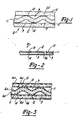
- Fig. 1 illustrates a typical two-liner containerboard 10 prior to being treated in accordance with the process of the present invention.
- the board 10 comprises a corrugated or fluted medium 11 conventionally glued at the peaks of the flutes 12 by means of a water-resistant starch type glue to the corrugation liners 13 and 14 to provide flute openings 9 extending longitudinally of the flutes and bounded by portions of the medium 11 and the adjacent liners 13 and 14.
- the liners 13 and 14 are commonly made from kraft paper comprising treated soft wood fibres.
- the corrugated medium 11 is usually made by a semi-chemical pulping process from hardwood fibres and frequently contains considerable recycled paper or scrap corrugated containerboard.
- the containerboard shown has two liners, although a single liner, triple liner, and other multiple liner corrugated containerboards can be treated and made water-resistant within the scope of the present invention.
- the containerboards 10 are fabricated in plain blanks or sheets of various sizes. A typical containerboard for a fish box for example will be approximately five feet (1.52 m) long in the direction of the flutes and may be more or less as wide as long.
- the fibrous papers of the medium 11 and liners 13 and 14 may or may not have been pretreated to render them water-resistant prior to fabrication into the containerboards 10.
- the containerboard 10 will be fabricated from papers that have not been treated to be water-resistant because such pretreatment adds to the cost of the board 10 and is entirely unnecessary.
- a board manufactured in accordance with the process of the present invention will have excellent water resistance regardless whether or not the fibrous papers from which it is made have been pretreated.
- the board 10 Prior to treatment in accordance with the present method, the board 10 is preferably die cut and prescored or creased, as at 15a and 15 respectively, Fig. 2, in accordance with conventional practice to facilitate the formation of a box from the plain containerboard sheet. Again it is immaterial to the process described herein whether or not the plain containerboard 10 is die cut and prescored, but die cutting and scoring prior to waxing in accordance with the process described herein is preferred because, as noted above, the unwaxed scrap or cuttings remaining after the board is die cut may be recycled to acheive significant economies.
- an apparatus suitable for carrying out the preferred process described herein comprises a hot melt bath 16 of wax within a substantially enclosed container or tank 17.
- a stack 10a of horizontal containerboards 10 is located on an automatic device 18 for feeding the boards 10 one by one into the tank 17.
- the device 18 may be conventional and may in fact comprise the same containerboard feeder conventionally used for feeding containerboards into a printer-slotter mechanism. Accordingly, details of the device 18 are not illustrated.
- the device 18 feeds the boards or sheets 10 one by one in turn from the bottom of the stack 10a in predetermined timed relationship and in the longitudinal direction of the flutes of flute openings 9 to a position between a pair of power driven feed rollers 19 which frictionaly engage and move each board 10 in turn into the tank 17 and between the belts of a conveyor system 20.
- the latter comprises a plurality of belts arranged laterally of the direction of movement of the board 10 and above and below the board 10 to frictionally carry it in the longitudinal direction of the flute openings 9 generally horizontally and downwardly into the hot melt bath 16, thence generally horizontally in the same continuous movement to a position totally submerged within the bath 16, then in the same continuous movement and generally horizontal direction but inclined upwardly to carry the board 10 out of the bath 16 and into the hot atmosphere 17a located above the bath 16 and heated thereby.
- the feed system 20 continues to carry the board 10 upwardly whereat excess wax entrained with the moving board 10 drains back into the bath 16.
- the belts in the system 20 are comparatively thin and are spaced laterally of the direction of movement to assure freedom of exposure of all exterior surfaces of the board 10 to the wax in the bath 16.
- the speed of travel is predetermined so that the wax 16 is forced into the leading ends of the flute openings 9 and out of the trailing ends as the board 10 is carried through the bath 16, thereby to assure absolute and complete contact of all portions of the sidewalls of the openings 9 throughout their entire lengths regardless of any partial restrictions of the flute openings, as for example at the crease 15 or at the edges of die cut portions 15a.
- the feed mechanism 18 is timed to permit a slight spacing between consecutive boards 10.
- the comparatively high speed of movement of the board 10 through the bath 16 enables use of a wax bath temperature higher than would be feasible with prolonged exposure of the board 10 to the wax 16. In consequence a wider selection of wax and wax type formulations is possible.
- the limiting temperature for bath 16 will be between the melting and flash temperatures of the wax.
- the process of this invention permits the use of wax solutions at temperatures well in excess of 212°F (100°C) because the time of treatment is too short to raise the internal temperature in the interior areas to such undesirable temepratures for a sufficient time to damage the container board with respect to its flexibility and strength during later folding into box form.
- the board 10 After a limited drainage time within the environment 17a, which time may be somewhat shorter than the immersion time within the bath 16, the board 10 is conveyed in the same continuous high-speed movement to a horizontal position by an extension 20a of the lower portion of the belt system 20, from which extension 20a the board 10 is permitted to fall by gravity to a generally vertical position between a pair of supporting brackets 22 carried by a slowly moving continuous belt 23.
- the inclined position of the containerboard 10 Prior to movement of the board 10 to the horizontal position on conveyor portion 20a, the inclined position of the containerboard 10 will result in a slightly increased thickening of the surface wax in the direction toward its trailing edge. At the horizontal position of the board 10 the liquid wax will tend to level out and stabilize by gravity flow and by surface tension to a thin uniform thickness. Such uniformity of surface thickness is obtained within the flute openings and on the undersurface of the board 10 as well as on its upper surface.
- the final thickness of the surface wax is a very thin surface coating 16a of between a fraction of a thousandth of an inch (below 0.0254mm) to a few thousandths of an inch (more than 0.0254 mm) at most, the final levelling and stabilization is important to provide a continuous water-resistant layer preferably just sufficient to cover the outer ends of the outwardly extending fibres protruding from the various surfaces of the fibreboard 10, i.e. the surfaces of the medium 1 1 and the inner and outer surfaces of the liners 13 and 14.
- the thickness of the aforesaid outer coating will be determined by the temperature conditions, the time duration of the exposure of the board 10 to the temperature conditions, and the type of wax employed in the process.
- the wax on the board 10 cools rapidly and solidifies as the belt 23 carries the boards from the heated area of the container 17.
- the very lowermost edge of the board 10 between the brackets 22 may contain a small amount of excess hardened wax that may partially close the lowermost ends of the flute openings.
- excess wax when it exists is usually nominal compared to the overall surfaces of the containerboard and does not detract from the usefulness of the board 10 as a water-resistant container, nor from the above described provision of a substantially uniform thin wax coating of essentially uniform thickness over the surfaces of the board 10a, nor from the ability of the containerboard to be glued as described.
- the board 10 is moved to the right-hand end of the belt 23, which may involve several minutes, the thin layer of surface wax is sufficiently solidified to prevent sticking to adjacent boards.
- the finished water-resistant containerboard 10 is then moved to a belt system 24 and conveyed to storage.
- non-wax agents such as various resins and polymers such as, for example, polyethylenes, polypropylenes, polyesters and other thin film-forming materials
- Certain aspects of the invention apply equally to such non-wax water-resistant agents, particularly in regard to the continuous high-speed process and resulting economies and with regard to the uniform distribution of the water-resistant agent obtained by reason of its exposure to all portions of the containerboard at the same temperature and for equal time intervals.
- waxes and wax polymer combinations known to the art and now used for impregnating and coating containerboards are preferred for use as the water-resistant agent in accordance with the present invention because they are comparatively inexpensive and easy to apply.
- the physical characteristics of suitable containerboards and numerous waxes and wax polymer combinations and in particular their reactions to various temperature conditions within the ranges customarily used for waxing containerboards are also well known to the art. Accordingly, persons skilled in the art can easily select the necessary operating conditions for optimum wax coating and impregnation in accordance with the invention without damaging the containerboard by overheating.
- the preferred waxes are the paraffin waxes.
- paraffin waxes typically have melting points in the range of about 115°F (46.1°C) to about 160°F (71.1°C) and a single wax, or a mixture of such waxes may be satisfactorily selected for use.
- Such waxes may be modified in viscosity by the addition of small quantities of compatible mineral oils or high temperature solvents to attain the best drain characteristics to give the desired coating thickness in the stabilizing zone by a few tests easily made by those skilled in the art of using such materials.
- Suitable waxes are commercially available from a number of suppliers including Sunoco, Pennzoil, etc.
- Paraffin 8126 available from Pennzoil Refineries, which is accepted by the FDA for use in food containers.
- containerboard 10 is best made from a corrugated board with "c" flutes and having a 200 pounds per square inch (13.8 bar) Mullen test rating.
- the preferred operating conditions will be varied in accordance with the quality of the containerboard, including the porosity and weight of the papers from which it is made, the cross sectional area and length of the flute openings, the type of wax and its viscosity, the speed of movement of the containerboard through the hot melt bath, the duration of immersion within the bath and the subsequent time in the drainage zone. Such conditions should be selected and co-ordinated to obtain the desired surface layers of wax and wax impregnation into the containerboard.
- the boards 10 are moved at a speed in the range of about 200 to 300 ft./min (5.08 to 7.62 m/min) although considerably higher speeds up to about 500 ft./min (12.7 m/min) are usable with a consequent reduction in the time of exposure of the containerboard 10 to the hot bath;
- the temperature of the wax in the bath 16 may be any temperature which in combination with the time of immersion of the board 10 with the bath 16 does not cause detrimental reduction of the board moisture content or overheating of the board sufficiently to render it too brittle for use as a container.
- the speed of conveyor system 20 may be retarded and at higher temperatures, even above the water boiling point, the conveyor speed will be increased to complete the wax impregnation before the board 10 is overheated.
- three variables to be controlled are the temperature of the wax bath, the speed of movement of the containerboard which determines the duration of its submersion within the bath, and the type of wax and its composition determines the melt temperature and viscosity.
- Each of the three parameters can be varied within reasonable ranges independently of the other two to obtain substantially the same effective optimum water resistance.
- An overall consideration is the time that the particular containerboard can be exposed to the temperature conditions of the bath and drain area without impairment of the strength and flexibility of the board by boiling the latent water content or otherwise overheating or damaging the materials from which the board is made.
- the wax completely surrounds the glued regions 12 and prevents separation of the liners from the medium due to water penetration during use, which water penetration is typical with prior art wax coating processes. Also, as indicated in Fig. 3, the wax is drawn by capillary action at 16c into the juncture between glued portions 12 of the medium 11 and liners 13 and 14 to strengthen the juncture and additionally protect the glue 12 from external moisture.
- the solidified wax surrounding the longitudinally extending glued regions 12 materially increases their resistance to longitudinal crushing force by supporting the glued regions transversely as compressive force is applied as, for example, when boxes are stacked one on top of another.
- the solidified wax filling the interstices between the fibres within the papers 11, 13 and 14 materially increases the resistance of the containerboard to crushing force in any direction by supporting the fibres transversely of the crushing force.
- the waxed containerboard made in accordance with this invention have water resistance superior to conventional wax-impregnated containerboards, but it also has much greater wet and dry crush resistance to an unexpected degree as illustrated in the examples.
- the liquid wax penetration of the medium 11 and liners 13 and 14 takes place at different rates as a function of their differences in composition and porosity, and as saturation is approached, the rate of wax penetration tends to decrease as the liquid wax penetrates the wood fibres and flows into tiny, interstitial spaces between the wood fibres 25 in the papers 11, 13 and 14, Fig. 1.
- Such flow is believed to be augmented by capillary and osmotic action that continues in the zone 17a while the liquid wax is on the surfaces of the papers 11, 13 and 14.
- Penetration is substantially complete to a uniform depth throughout all surfaces of the containerboard by the time the wax begins to congeal.
- the board is thus believed to be essentially saturated by the wax at least to the depth of an interface well below the outer surfaces of the liners and fluted medium which thus effectively seals all of the exposed surfaces against water penetration and confers added resilience to bending and added resistance to compression forces such as are routinely encountered during use or upon stacking a plurality of boxes on conventional pallets.
- a plain untreated corrugated containerboard i.e. an unwaxed board
- the plain containerboard was then waxed and made water resistant by using the process of this invention.
- the plain waxed containerboard was then folded along the score lines to complete a water-resistant and commercially acceptable box, 22" x 15" x 9" (559mm x 381mm x 229mm) in size and suitable for use with high moisture content.
- a water-resistant interlocking cover was made for the box.
- Corrugated paper board having the configuration of Figure 1 obtained from Westvaco and having a Mullen strength of 200 pounds per square inch (13.8 bar) was cut into rectangular samples 5" (127mm) long by 2.5" (63.5mm) wide so that the flutes ran lengthwise.
- a rectangular water absorption test area measuring 3.5" (88.9mm) long by 2" (50.8mm) wide was outlined on the surface of each sample. Each sample was then weighed.
- a dam, or wall of microcrystalline wax was then attached around the perimeter of the previously marked test area on each sample.
- the pool formed by the microcrystalline wax wall was then filled with ice water and allowed to sit undisturbed for a period of either 24 or 48 hours as shown in Table I.
- the water was then removed together with the microcrystalline wax dam and each sample was then reweighed to determine the amouont of water absorbed. The results are set forth in Table I.
- This example illustrates the relative compressive strengths of commercial fish boxes made using the cascade wax coating method, the curtain coating method and the process of this invention.
- a commercial 60 lb. (27.2 kg) fish box made from commercially preconditioned paper having a Mullen strength of 275 lbs./sq. inch (19.0 bar) was then wax coated by using the cascade wax coating method described in US- A- 3,793,056 by the Bartlett Corporation of Anderson, Indiana.
- a commercial 60 lb. (27.2 kg) fish box made from commercially preconditioned paper having a Mullen strength of 275 lbs./sq. inch (19.0 bar) was then wax coated by using the curtain coating process of US- A-3,524 ,759 by Georgia Pacific Company of Owosso, Michigan.
- a commercial 60 lb. (27.2 kg) fish box made from commercially available non-conditioned paper corrugated board having a Mullen strength of 200 lbs./sq. inch (13.8 bar) was then wax coated in accordance with the process of this invention by using Pennzoil Wax No. 8126 at a bath temperature of approximately 200°F (93.3°C) by moving the board through the bath at slightly less than 300 ft. per second (91 .44 m per sec) for an immersion time of approximately 1 to 1 1/2 seconds, draining and cooling the box as above described.
- Hiflex 100 hot melt wax has a congealing point (ASTM D-938) of 150 to 156°F (65.6 to 68.9°C) and a needle penetration at 77°F (25°C) (ASTM D-1321) of 6.0 to 8.0 and meets all FDA requirements for components of paperboard in contact with aqueous and fatty foods.
- a commercial 60 lb. (27.2 kg) fish box pre-cut corrugated board blank of untreated corrugated board from Consolidated Packaging Corporation of Flint, Michigan and having a Mullen strength of 275 psi (19.0 bar) base and 200 psi (13.8 bar) lid was provided with a wax impregnation coating by advancing the pre-cut blank, at ambient room temperature, i.e., without perliminary heating of the blank, into a wax bath in the 30 foot (9.14m) long tank portion of a wax coating machine of the type shown in Fig.
- the wax composition in the tank was a petroleum based paraffin type modified with a hot melt wax to a composition containing, in weight percent, 18% Hiflex 100 and 82% 9831 wax obtained from National Wax Company.
- the wax-impregnated board was folded along the scoring lines in the precut blank into a 60 lb. (27.2 kg) fish box.
- the bottom panel of that box was tested for wax distribution and pick-up in the medium portion, only, which comprises the flutes of that bottom panel, having dimensions of 46.4 inches (1. 18m) by 27.4 inches 0.696 m) with the flutes running parallel to the side having the shorter dimension.
- the samples including the liners and the medium were first weighed.
- the wax was separated from the liner and medium portions of each of the nine samples in a 105°F (40.6°C) wax solvent for seven hours, dried overnight and then reweighed to establish the amount of wax present in both the liners and the medium portions of each sample.
- the wax distribution in the sample portions was then calculated as a percentage of the total weight of each sample.
- the results also showed about an 11% higher wax pick up for the three samples lying along the centre line of the 27.4 inch (0.696m) dimension of the panel than the average of the wax pick-up in each of the other two rows of three samples adjacent the side edges of the larger dimension of the board and is attributed to drainage run off during cooling.
- Panwax 9653 is a microcrystalline, petroleum derived hydrocarbon having a drop melt point (ASTM D-127) of 167°F (75°C) to 176°F (80°C), a needle penetration at 77°F (25°C) (ASTM D-1321) of 20 to 25 and a viscosity at 210°F (98.9°C (ASTM- D-445) of 58.9 to 70.0 SUU.
- Paraffin wax 6971 has a melting point of 128°F (53.3°C) to 133°F (56.1°C).
- a similar sized and shaped panel was processed through the above stated wax blended composition at a speed of about 116 to 120 feet/minute (35.4 to 36.6 m per min) and at a temperature of approximately 200°F (93.3°C)
- a commercial 60 lb. (27.2 kg) fish box made from commercially preconditioned paper having a Mullen strength of 275 lbs./sq. in. (19.0 bar) by the cascade wax coating method described in US-A- 3,793,056 was sampled in a similar manner and analyzed for wax pick-up in the medium only for comparison to the panel from the 60 lb. (27.2kg) fish box made by using the above described wax blended composition.
- a 6o lb. (27.2 kg) fish box, with top, processed by using the wax blend of paraffin wax, microcrystalline wax and hot melt wax of this example was compression tested in the manner described above in Example II and the box showed vertical deformation at 1890 pounds (857 kg).
- the wax blend composition has a melt point of about 133°F, (56.1°C) a needle penetration at 79°F (26.1°C) of about 15.0 and a Saybolt viscosity at 210°F (98.9°C) of about 59.5 SSU.
- the 60 lb,. (27.2 kg) fish box blanks were processed through the tank containing the wax blend composition at a temperature of about 175°F (79.4°C) to 180°F (82.2°C) at a speed of about 110 to 210 feet/minute (33.5 to 64.0 m per min).
- a wax blend composition having a melting point range of about 115°F (46.1°C to about 210°F (98.9°C) and a Saybolt viscosity in the range of 50 to about 70 SSU is partially suitable for use in making wax-blend coated corrugated board for use in iced shipping boxes.
Landscapes
- Laminated Bodies (AREA)
- Paper (AREA)
Applications Claiming Priority (2)
| Application Number | Priority Date | Filing Date | Title |
|---|---|---|---|
| US81851686A | 1986-01-13 | 1986-01-13 | |
| US189923 | 1988-05-03 |
Publications (1)
| Publication Number | Publication Date |
|---|---|
| EP0340362A1 true EP0340362A1 (fr) | 1989-11-08 |
Family
ID=25225728
Family Applications (1)
| Application Number | Title | Priority Date | Filing Date |
|---|---|---|---|
| EP19880309654 Ceased EP0340362A1 (fr) | 1986-01-13 | 1988-10-14 | Carton pour récipient et un procédé de fabrication |
Country Status (3)
| Country | Link |
|---|---|
| US (1) | US4826714A (fr) |
| EP (1) | EP0340362A1 (fr) |
| CA (1) | CA1265712A (fr) |
Cited By (2)
| Publication number | Priority date | Publication date | Assignee | Title |
|---|---|---|---|---|
| WO2010039442A1 (fr) * | 2008-10-03 | 2010-04-08 | Georgia-Pacific Corrugated Llc | Carton doublure à onduler, carton ondulé et leurs procédés de fabrication |
| WO2021069545A1 (fr) * | 2019-10-09 | 2021-04-15 | Zeroplast Sp. Z.O O. | Article moulé |
Families Citing this family (15)
| Publication number | Priority date | Publication date | Assignee | Title |
|---|---|---|---|---|
| US5184998A (en) * | 1991-04-08 | 1993-02-09 | Volk Packaging Corporation | Corrugated cardboard or chipboard carton forming machine |
| CZ9402448A3 (cs) * | 1993-02-05 | 2002-01-16 | The Mead Corporation | Recyklovatelné obaly z voskovaného papíru |
| US5539035A (en) * | 1994-10-12 | 1996-07-23 | The Mead Corporation | Recyclable wax-coated containers |
| US5882746A (en) * | 1995-12-28 | 1999-03-16 | Hoffman Environmental Systems, Inc. | Laminated package and method of producing the same |
| US20020164453A1 (en) * | 2000-10-23 | 2002-11-07 | Babcock Bruce W. | Printable composite paperboard for packaging |
| WO2009012292A1 (fr) | 2007-07-16 | 2009-01-22 | Luzenac America, Inc. | Revêtements de cire, procédés permettant de produire des articles revêtus et articles revêtus dérivés |
| US7980450B2 (en) * | 2008-01-04 | 2011-07-19 | Dixie Consumer Products Llc | Disposable pressware prepared from wax-infused paperboard |
| US8596520B2 (en) | 2012-04-16 | 2013-12-03 | International Paper Co. | Waterproof and anti-wicking corrugated container |
| DE102013105331A1 (de) * | 2013-05-24 | 2014-11-27 | DogsNature GmbH | Frischfutterverpackung |
| US9410059B2 (en) * | 2014-01-21 | 2016-08-09 | Alltech, Inc. | Wax treated article and method of making |
| US10195832B2 (en) * | 2015-04-29 | 2019-02-05 | Wolverine Automotive Board Sales, Inc. | Extensible paper laminates and their uses |
| US10183767B2 (en) * | 2015-04-29 | 2019-01-22 | Wolverine Automotive Board Sales, Inc. | Box spring packaging method and apparatus |
| US10500825B2 (en) | 2015-04-29 | 2019-12-10 | Wolverine Automotive Board Sales, Inc. | Extensible paper laminates and their uses |
| WO2016196075A1 (fr) * | 2015-06-04 | 2016-12-08 | Triune Enterprises, Inc. | Enveloppe de revêtement d'os et procédé pour emballer des produits de viande non désossée |
| CN106882468B (zh) * | 2017-04-10 | 2018-12-07 | 滁州卷烟材料厂 | 一种纳米涂布防水防污瓦楞纸箱 |
Citations (4)
| Publication number | Priority date | Publication date | Assignee | Title |
|---|---|---|---|---|
| GB1008828A (en) * | 1962-12-27 | 1965-11-03 | Metal Box Co Ltd | Improvements in or relating to coating sheets |
| GB1116992A (en) * | 1965-12-13 | 1968-06-12 | Exxon Research Engineering Co | Process and apparatus for coating and impregnating |
| GB1502599A (en) * | 1974-05-17 | 1978-03-01 | Fukuoka Paper Mfg Co Ltd | Water resistant cardboard and a method of and apparatus for producing water resistant cardboard |
| US4668536A (en) * | 1985-12-23 | 1987-05-26 | Eagle-Picher Industries, Inc. | Method and apparatus for coating corrugated board |
Family Cites Families (6)
| Publication number | Priority date | Publication date | Assignee | Title |
|---|---|---|---|---|
| US2967116A (en) * | 1957-08-20 | 1961-01-03 | Control Pak Corp | Paperboard and method of manufacture |
| US3603219A (en) * | 1966-04-04 | 1971-09-07 | Union Oil Co | Method for improving the bending quality of water resistant corrugated paperboard |
| US3793056A (en) * | 1969-12-01 | 1974-02-19 | R Stease | Method for coating and/or impregnating substantially planar articles |
| US3635193A (en) * | 1969-12-01 | 1972-01-18 | Ralph E Stease | Apparatus for coating and/or impregnating substantially planar articles |
| US3692564A (en) * | 1970-10-14 | 1972-09-19 | Union Oil Co | Wax coating process for corrugated paperboard |
| US3962509A (en) * | 1974-05-31 | 1976-06-08 | Continental Oil Company | Waterproof paperboard and method for producing same |
-
1986
- 1986-07-22 CA CA000514360A patent/CA1265712A/fr not_active Expired
-
1988
- 1988-05-03 US US07/189,923 patent/US4826714A/en not_active Expired - Fee Related
- 1988-10-14 EP EP19880309654 patent/EP0340362A1/fr not_active Ceased
Patent Citations (4)
| Publication number | Priority date | Publication date | Assignee | Title |
|---|---|---|---|---|
| GB1008828A (en) * | 1962-12-27 | 1965-11-03 | Metal Box Co Ltd | Improvements in or relating to coating sheets |
| GB1116992A (en) * | 1965-12-13 | 1968-06-12 | Exxon Research Engineering Co | Process and apparatus for coating and impregnating |
| GB1502599A (en) * | 1974-05-17 | 1978-03-01 | Fukuoka Paper Mfg Co Ltd | Water resistant cardboard and a method of and apparatus for producing water resistant cardboard |
| US4668536A (en) * | 1985-12-23 | 1987-05-26 | Eagle-Picher Industries, Inc. | Method and apparatus for coating corrugated board |
Cited By (3)
| Publication number | Priority date | Publication date | Assignee | Title |
|---|---|---|---|---|
| WO2010039442A1 (fr) * | 2008-10-03 | 2010-04-08 | Georgia-Pacific Corrugated Llc | Carton doublure à onduler, carton ondulé et leurs procédés de fabrication |
| US8512850B2 (en) | 2008-10-03 | 2013-08-20 | Georgia-Pacific Corrugated Llc | Corrugating linerboard, corrugated board, and methods of making the same |
| WO2021069545A1 (fr) * | 2019-10-09 | 2021-04-15 | Zeroplast Sp. Z.O O. | Article moulé |
Also Published As
| Publication number | Publication date |
|---|---|
| US4826714A (en) | 1989-05-02 |
| CA1265712A (fr) | 1990-02-13 |
Similar Documents
| Publication | Publication Date | Title |
|---|---|---|
| US4826714A (en) | Impregnated corrugted sheets for packing boxes and method of manufacture | |
| DE60112841T3 (de) | Papier zur Verwendung beim Formpressen | |
| US10065779B2 (en) | Food tray and process for making same | |
| US20050123780A1 (en) | Moisture resistant, repulpable paper products and method of making same | |
| CA1058927A (fr) | Panneaux durs d'agglomeres incombustibles | |
| US3085026A (en) | Impregnated corrugated paperboard and process of making same | |
| US4313899A (en) | Process for forming laminated paperboard containers | |
| US3659772A (en) | Water resistant corrugated articles having improved fold flexibility | |
| US2443221A (en) | Method of making grease- and moistureproof coated paperboard | |
| US3635451A (en) | Corrugated paper board container having sealed fluted closure flaps | |
| US4051277A (en) | Rigid-when-wet paperboard containers and their manufacture | |
| US4778696A (en) | Method of manufacturing impregnated corrugated sheets for packing boxes | |
| EP0767852A1 (fr) | Revetement pour du carton | |
| US3529516A (en) | Method and compositions for improving the bending quality of water resistant corrugated paperboard | |
| AU611956B2 (en) | Impregnated corrugated sheets for packing boxes and method of manufacture | |
| US4096305A (en) | Rigid-when-wet paperboard containers and their manufacture | |
| US3561994A (en) | Method of making moisture resistant paperboard | |
| US3194469A (en) | Folding cartons constructed of particular laminated sheet materials | |
| JPH05302065A (ja) | 防水及び防湿ダンボール用コーティング剤 | |
| US4046935A (en) | Rigid-when-wet paperboard containers and their manufacture | |
| AU2009253717A1 (en) | Protective coating composition | |
| AU669033B2 (en) | Recyclable wax-coated containers | |
| US3692564A (en) | Wax coating process for corrugated paperboard | |
| US20240392140A1 (en) | Dual ovenable, repulpable coated paperboard for food containers and method for manufacturing thereof | |
| US2710265A (en) | Paper impregnated with potassium alum and process of impregnating |
Legal Events
| Date | Code | Title | Description |
|---|---|---|---|
| PUAI | Public reference made under article 153(3) epc to a published international application that has entered the european phase |
Free format text: ORIGINAL CODE: 0009012 |
|
| AK | Designated contracting states |
Kind code of ref document: A1 Designated state(s): AT BE CH DE ES FR GB GR IT LI NL SE |
|
| 17P | Request for examination filed |
Effective date: 19900418 |
|
| 17Q | First examination report despatched |
Effective date: 19920129 |
|
| RTI1 | Title (correction) | ||
| STAA | Information on the status of an ep patent application or granted ep patent |
Free format text: STATUS: THE APPLICATION HAS BEEN REFUSED |
|
| 18R | Application refused |
Effective date: 19930725 |