EP0340415A2 - Hochtemperaturbeständige Mischungen aus einem thermoplastischen Elastomeren und einem Thermoplasten - Google Patents
Hochtemperaturbeständige Mischungen aus einem thermoplastischen Elastomeren und einem Thermoplasten Download PDFInfo
- Publication number
- EP0340415A2 EP0340415A2 EP19890104050 EP89104050A EP0340415A2 EP 0340415 A2 EP0340415 A2 EP 0340415A2 EP 19890104050 EP19890104050 EP 19890104050 EP 89104050 A EP89104050 A EP 89104050A EP 0340415 A2 EP0340415 A2 EP 0340415A2
- Authority
- EP
- European Patent Office
- Prior art keywords
- styrene
- block copolymer
- molecular weight
- parts
- mixtures
- Prior art date
- Legal status (The legal status is an assumption and is not a legal conclusion. Google has not performed a legal analysis and makes no representation as to the accuracy of the status listed.)
- Withdrawn
Links
- 239000000203 mixture Substances 0.000 title claims description 23
- 229920002725 thermoplastic elastomer Polymers 0.000 title description 5
- 229920001955 polyphenylene ether Polymers 0.000 claims abstract description 29
- 229910052739 hydrogen Inorganic materials 0.000 claims abstract description 10
- 150000001993 dienes Chemical class 0.000 claims abstract description 7
- 229920001577 copolymer Polymers 0.000 claims abstract description 5
- 229920001400 block copolymer Polymers 0.000 claims description 24
- PPBRXRYQALVLMV-UHFFFAOYSA-N Styrene Chemical compound C=CC1=CC=CC=C1 PPBRXRYQALVLMV-UHFFFAOYSA-N 0.000 claims description 18
- 239000001257 hydrogen Substances 0.000 claims description 9
- 229920000642 polymer Polymers 0.000 claims description 8
- -1 vinyl aromatic compounds Chemical class 0.000 claims description 8
- UFHFLCQGNIYNRP-UHFFFAOYSA-N Hydrogen Chemical compound [H][H] UFHFLCQGNIYNRP-UHFFFAOYSA-N 0.000 claims description 7
- 229920000468 styrene butadiene styrene block copolymer Polymers 0.000 claims description 6
- 125000004432 carbon atom Chemical group C* 0.000 claims description 5
- 230000000379 polymerizing effect Effects 0.000 claims description 4
- 229920002554 vinyl polymer Polymers 0.000 claims description 4
- 125000004051 hexyl group Chemical group [H]C([H])([H])C([H])([H])C([H])([H])C([H])([H])C([H])([H])C([H])([H])* 0.000 claims description 2
- NXXYKOUNUYWIHA-UHFFFAOYSA-N 2,6-Dimethylphenol Chemical compound CC1=CC=CC(C)=C1O NXXYKOUNUYWIHA-UHFFFAOYSA-N 0.000 claims 2
- FACXGONDLDSNOE-UHFFFAOYSA-N buta-1,3-diene;styrene Chemical class C=CC=C.C=CC1=CC=CC=C1.C=CC1=CC=CC=C1 FACXGONDLDSNOE-UHFFFAOYSA-N 0.000 claims 1
- 229920006132 styrene block copolymer Polymers 0.000 abstract description 2
- 125000000217 alkyl group Chemical group 0.000 abstract 1
- 229920002633 Kraton (polymer) Polymers 0.000 description 13
- 239000011347 resin Substances 0.000 description 10
- 229920005989 resin Polymers 0.000 description 10
- 229920001971 elastomer Polymers 0.000 description 8
- 125000002496 methyl group Chemical group [H]C([H])([H])* 0.000 description 7
- YXFVVABEGXRONW-UHFFFAOYSA-N Toluene Natural products CC1=CC=CC=C1 YXFVVABEGXRONW-UHFFFAOYSA-N 0.000 description 5
- 239000000178 monomer Substances 0.000 description 5
- 239000002904 solvent Substances 0.000 description 5
- 239000000806 elastomer Substances 0.000 description 4
- 239000005060 rubber Substances 0.000 description 4
- 229920001169 thermoplastic Polymers 0.000 description 4
- 239000004416 thermosoftening plastic Substances 0.000 description 4
- 239000004793 Polystyrene Substances 0.000 description 3
- 230000000052 comparative effect Effects 0.000 description 3
- 238000004519 manufacturing process Methods 0.000 description 3
- 238000000034 method Methods 0.000 description 3
- 229920002223 polystyrene Polymers 0.000 description 3
- KAKZBPTYRLMSJV-UHFFFAOYSA-N Butadiene Chemical compound C=CC=C KAKZBPTYRLMSJV-UHFFFAOYSA-N 0.000 description 2
- RRHGJUQNOFWUDK-UHFFFAOYSA-N Isoprene Chemical compound CC(=C)C=C RRHGJUQNOFWUDK-UHFFFAOYSA-N 0.000 description 2
- 239000000460 chlorine Substances 0.000 description 2
- 150000001875 compounds Chemical class 0.000 description 2
- 230000009477 glass transition Effects 0.000 description 2
- 230000001771 impaired effect Effects 0.000 description 2
- 238000002156 mixing Methods 0.000 description 2
- 238000000465 moulding Methods 0.000 description 2
- 239000004014 plasticizer Substances 0.000 description 2
- 239000000243 solution Substances 0.000 description 2
- 125000004169 (C1-C6) alkyl group Chemical group 0.000 description 1
- WPWHSFAFEBZWBB-UHFFFAOYSA-N 1-butyl radical Chemical group [CH2]CCC WPWHSFAFEBZWBB-UHFFFAOYSA-N 0.000 description 1
- PYSRRFNXTXNWCD-UHFFFAOYSA-N 3-(2-phenylethenyl)furan-2,5-dione Chemical compound O=C1OC(=O)C(C=CC=2C=CC=CC=2)=C1 PYSRRFNXTXNWCD-UHFFFAOYSA-N 0.000 description 1
- ZAMOUSCENKQFHK-UHFFFAOYSA-N Chlorine atom Chemical compound [Cl] ZAMOUSCENKQFHK-UHFFFAOYSA-N 0.000 description 1
- 239000004606 Fillers/Extenders Substances 0.000 description 1
- 239000004831 Hot glue Substances 0.000 description 1
- 229920000147 Styrene maleic anhydride Polymers 0.000 description 1
- 239000002174 Styrene-butadiene Substances 0.000 description 1
- 239000000654 additive Substances 0.000 description 1
- 239000000853 adhesive Substances 0.000 description 1
- 230000001070 adhesive effect Effects 0.000 description 1
- XYLMUPLGERFSHI-UHFFFAOYSA-N alpha-Methylstyrene Chemical compound CC(=C)C1=CC=CC=C1 XYLMUPLGERFSHI-UHFFFAOYSA-N 0.000 description 1
- 239000003963 antioxidant agent Substances 0.000 description 1
- 150000004945 aromatic hydrocarbons Chemical class 0.000 description 1
- 125000003118 aryl group Chemical group 0.000 description 1
- 230000015572 biosynthetic process Effects 0.000 description 1
- MTAZNLWOLGHBHU-UHFFFAOYSA-N butadiene-styrene rubber Chemical compound C=CC=C.C=CC1=CC=CC=C1 MTAZNLWOLGHBHU-UHFFFAOYSA-N 0.000 description 1
- 229910052801 chlorine Inorganic materials 0.000 description 1
- 238000004132 cross linking Methods 0.000 description 1
- 238000010586 diagram Methods 0.000 description 1
- 239000000975 dye Substances 0.000 description 1
- 229920001198 elastomeric copolymer Polymers 0.000 description 1
- 239000000945 filler Substances 0.000 description 1
- 239000003063 flame retardant Substances 0.000 description 1
- 239000008187 granular material Substances 0.000 description 1
- 229920005669 high impact polystyrene Polymers 0.000 description 1
- 239000004797 high-impact polystyrene Substances 0.000 description 1
- 229920001519 homopolymer Polymers 0.000 description 1
- 150000002431 hydrogen Chemical class 0.000 description 1
- 125000004435 hydrogen atom Chemical group [H]* 0.000 description 1
- 238000010348 incorporation Methods 0.000 description 1
- 239000004615 ingredient Substances 0.000 description 1
- 238000001746 injection moulding Methods 0.000 description 1
- 239000004611 light stabiliser Substances 0.000 description 1
- 239000000463 material Substances 0.000 description 1
- 238000002844 melting Methods 0.000 description 1
- 239000003960 organic solvent Substances 0.000 description 1
- 238000005691 oxidative coupling reaction Methods 0.000 description 1
- GNWXVOQHLPBSSR-UHFFFAOYSA-N oxolane;toluene Chemical compound C1CCOC1.CC1=CC=CC=C1 GNWXVOQHLPBSSR-UHFFFAOYSA-N 0.000 description 1
- 150000002989 phenols Chemical class 0.000 description 1
- 239000000049 pigment Substances 0.000 description 1
- 229920003023 plastic Polymers 0.000 description 1
- 239000004033 plastic Substances 0.000 description 1
- 238000006116 polymerization reaction Methods 0.000 description 1
- 238000002360 preparation method Methods 0.000 description 1
- 238000003825 pressing Methods 0.000 description 1
- SCUZVMOVTVSBLE-UHFFFAOYSA-N prop-2-enenitrile;styrene Chemical compound C=CC#N.C=CC1=CC=CC=C1 SCUZVMOVTVSBLE-UHFFFAOYSA-N 0.000 description 1
- HJWLCRVIBGQPNF-UHFFFAOYSA-N prop-2-enylbenzene Chemical compound C=CCC1=CC=CC=C1 HJWLCRVIBGQPNF-UHFFFAOYSA-N 0.000 description 1
- 150000003254 radicals Chemical class 0.000 description 1
- 239000012744 reinforcing agent Substances 0.000 description 1
- 239000012763 reinforcing filler Substances 0.000 description 1
- 229920000638 styrene acrylonitrile Polymers 0.000 description 1
- 239000011115 styrene butadiene Substances 0.000 description 1
- 229920003048 styrene butadiene rubber Polymers 0.000 description 1
- 238000003786 synthesis reaction Methods 0.000 description 1
- 229920003051 synthetic elastomer Polymers 0.000 description 1
- 238000009864 tensile test Methods 0.000 description 1
Images


Classifications
-
- C—CHEMISTRY; METALLURGY
- C08—ORGANIC MACROMOLECULAR COMPOUNDS; THEIR PREPARATION OR CHEMICAL WORKING-UP; COMPOSITIONS BASED THEREON
- C08L—COMPOSITIONS OF MACROMOLECULAR COMPOUNDS
- C08L53/00—Compositions of block copolymers containing at least one sequence of a polymer obtained by reactions only involving carbon-to-carbon unsaturated bonds; Compositions of derivatives of such polymers
- C08L53/02—Compositions of block copolymers containing at least one sequence of a polymer obtained by reactions only involving carbon-to-carbon unsaturated bonds; Compositions of derivatives of such polymers of vinyl-aromatic monomers and conjugated dienes
- C08L53/025—Compositions of block copolymers containing at least one sequence of a polymer obtained by reactions only involving carbon-to-carbon unsaturated bonds; Compositions of derivatives of such polymers of vinyl-aromatic monomers and conjugated dienes modified
-
- C—CHEMISTRY; METALLURGY
- C08—ORGANIC MACROMOLECULAR COMPOUNDS; THEIR PREPARATION OR CHEMICAL WORKING-UP; COMPOSITIONS BASED THEREON
- C08L—COMPOSITIONS OF MACROMOLECULAR COMPOUNDS
- C08L71/00—Compositions of polyethers obtained by reactions forming an ether link in the main chain; Compositions of derivatives of such polymers
- C08L71/08—Polyethers derived from hydroxy compounds or from their metallic derivatives
- C08L71/10—Polyethers derived from hydroxy compounds or from their metallic derivatives from phenols
- C08L71/12—Polyphenylene oxides
- C08L71/123—Polyphenylene oxides not modified by chemical after-treatment
Definitions
- the invention relates to high-temperature-resistant mixtures of a thermoplastic elastomer based on block copolymers of a conjugated diene and a vinylaromatic compound and of polyphenylene ethers (PPE).
- PPE polyphenylene ethers
- compositions containing elastomeric block copolymers and low molecular weight polyphenylene ethers are also known from the prior art.
- thermoplastic composition containing a polyphenylene ether resin with an intrinsic viscosity of less than 0.4 dl / g, a styrene resin and an elastomeric block copolymer of the AB-A1 type, wherein A and A1 are the same or different polymerized vinyl aromatic hydrocarbons and the middle block is formed from a polymerized diene whose molecular weight is higher than that of the vinyl aromatic hydrocarbons in blocks A and A1.
- the polyphenylene ether resin has an intrinsic viscosity of 0.1 to 0.33 dl / g; this corresponds to a molecular weight of approximately 4,200 to 26,900 g / mol.
- the styrene resin can be a homopolystyrene, a high impact polystyrene or a styrene-containing copolymer such as. B. a styrene-acrylonitrile, styrene-butadiene or styrene-maleic anhydride copolymer. Articles with good impact resistance can be produced from these compositions. However, the heat resistance of the products is impaired by the addition of the styrene resin. This document does not provide any suggestions to the person skilled in the art for making rubbers more heat-resistant.
- DE-OS 28 16 615 describes high-melting adhesive mixtures composed of a thermoplastic, elastomeric copolymer composed of at least 2 terminal monoalkenyl- or monoalkylidene-substituted aromatic hydrocarbon blocks A and at least one elastomeric intermediate block B, two tackifying resins which must be compatible with A and B, respectively , and a low molecular weight polyphenylene ether resin.
- US Pat. No. 4,141,876 describes a hot melt adhesive composition which, in addition to 100 parts of a block copolymer with monoalkekenyl aromatic end blocks A of a molecular weight of 2,000 to 50,000 and an elastomeric hydrogenated diene center block B of a molecular weight of 20,000 to 300,000, has a block B contains compatible tackifying resin, a polyphenylene ether resin with a molecular weight of about 6,000 to 25,000 and optionally an extender oil.
- thermoplastic compositions described in U.S. Patent No. 4,154,712 which contain a low molecular weight polyphenylene ether resin with an intrinsic viscosity of less than 0.4 dl / g, an elastomeric block copolymer of the AB-A1 type and a plasticizer, can be shaped after molding Produce high impact objects.
- thermoplastic elastomers based on polyphenylene ethers and styrene-containing block copolymers of the formula A (BA) n with n ⁇ 1 have now been found, which meet the above requirements. These are characterized in that a polymer or copolymer based on polyphenylene ether used, where R a and R b each represent an n-alkyl radical having 1 to 6 carbon atoms or R a is hydrogen and R b is tert.
- R c and R d each represent hydrogen or a C1 to C6 alkyl group and m is so large that the number average molecular weight is between 450 and 5,000, preferably between 1,000 and 4,000, lies.
- the mixtures according to the invention are distinguished in that the elongation at break and heat resistance are improved in the case of moldings produced from these mixtures.
- R a and R b each represent an n-alkyl radical with 1 to 6 C atoms or R a is hydrogen and R b is a tertiary alkyl radical with 4 to 6 C atoms, in particular a tertiary butyl radical.
- R a and R b are preferably methyl.
- R c and R d have the meaning of an alkyl radical having 1 to 6 carbon atoms or preferably hydrogen.
- the number of monomer units m present in the polymer depends on the respective meanings of the radicals R a , R b , R c and R d and is so large that the number average molecular weight M n is between 450 and 5,000, preferably 1,000 and 4 000.
- polyphenylene ethers with a certain molecular weight can be prepared in a known manner, either by adding a set amount of a molecular weight regulator, such as e.g. B. 2,6-dimethyl-4-tert. butylphenol is added or the polymerization batch is stopped in good time.
- a molecular weight regulator such as e.g. B. 2,6-dimethyl-4-tert. butylphenol
- the elastomeric block copolymer is of the A (BA 1) n type.
- n is a whole number between 1 and 5; preferably n has the value 1.
- the end blocks A and A1 are obtained by polymerizing the same or different monomers of the formula educated.
- R1 can be hydrogen and methyl and R2 can be hydrogen, methyl and chlorine.
- p has the meaning of 1 or 2.
- the following monomers are preferred: styrene, alpha-methylstyrene and vinyltoluene.
- the middle block B is obtained by polymerizing dienes of the formula educated.
- R3, R4 and R5 are each independently hydrogen and methyl. Butadiene and isoprene are preferred.
- the ratio of the blocks to one another can vary within wide limits if the molecular weight of the block or blocks B is greater than that of the sum of the end blocks A and A '.
- the molecular weight of blocks A and A ' is between about 2,000 and 100,000 and that of the block or blocks B is between 25,000 and 1,000,000.
- block copolymers are known (cf., for example, US Pat. No. 3,251,905 and US Pat. No. 3,231,635) and is described, for example, in US Pat. B. in "Polymer Chemistry of Synthetic Elastomers", published by: Kennedy et al., Interscience Publishers, Volume 23, Part II, in particular pages 553-559 (1969).
- Fully and partially hydrogenated block copolymers and mixtures thereof can also be used.
- the end blocks A and A1 have a molecular weight of 4,000 to 11,000 and the block or blocks B have a molecular weight of 20,000 to 450,000.
- a process for the preparation of hydrogenated block copolymers is e.g. Described in U.S. Patent No. 3,431,323.
- 100 parts of the elastomer contain 5 to 70, preferably 10 to 40 parts of polyphenylene ether and 95 to 30, preferably 90 to 60 parts of block copolymers.
- thermoplastic elastomers can also other additives such.
- thermoplastic elastomers can be produced by first mixing the components dry and then intimately mixing them in an extruder at a temperature of 160 ° C to 320 ° C in the molten state. The extrudate is then cooled and granulated. The granules can e.g. B. be brought into the desired shape by injection molding. You can also mix the ingredients in an organic solvent and then remove the solvent.
- the torsional vibration diagrams were recorded by determining the free torsion when vibrating with the Lonza pendulum (cf. G. Wegner et al., Angew. Makromol. Chemie 74 , 295 ff. (1978).
- the increase in tensile strength at break through the addition of low molecular weight PPE is shown in Figures 1 and 2.
- the increase in yield stress due to the addition of low molecular weight PPE is shown in Figure 3.
- the increase in the glass transition temperature of the hard phase (polystyrene or polystyrene / PPE phases) due to the addition of low molecular weight PPE is shown in Figures 4 to 6.
Landscapes
- Chemical & Material Sciences (AREA)
- Health & Medical Sciences (AREA)
- Chemical Kinetics & Catalysis (AREA)
- Medicinal Chemistry (AREA)
- Polymers & Plastics (AREA)
- Organic Chemistry (AREA)
- Compositions Of Macromolecular Compounds (AREA)
Abstract
Aufgabe der Erfindung war es, Kautschuke durch den Zusatz von niedrigmolekularen Polyphenylenethern wärmeformbeständiger zu machen und gleichzeitig die mechanischen Eigenschaften zu verbessern. Es wurden jetzt Mischungen gefunden, die neben einem elastomeren Blockcopolymer vom Typ A(BA¹)n einen Polyphenylenether mit einem Zahlenmittel des Molekulargewichts zwischen 450 und 5 000 enthalten. Die Mischungen werden zur Herstellung wärmeformbeständiger Artikel in der kunststoffverarbeitenden Industrie benötigt.
Description
- Gegenstand der Erfindung sind hochtemperaturbeständige Mischungen aus einem thermoplastischen Elastomeren auf Basis von Blockcopolymeren eines konjugierten Diens und einer vinylaromatischen Verbindung sowie von Polyphenylenethern (PPE). Derartige Polymere werden in jüngster Zeit vor allem zur Herstellung von Artikeln in der kunststoffverarbeitenden Industrie benötigt.
- Es gibt grundsätzlich mehrere Möglichkeiten, um Elastomere wärmeformbeständiger zu machen. So kann man z. B. in Blockcopolymeren aus Dienen und alkenylaromatischen Verbindungen die "physikalische Vernetzungsdichte" erhöhen, indem man die thermoplastischen Einheiten verkleinert und deren Anteil erhöht. Dies hat aber schlechtere Verarbeitungseigenschaften zur Folge. Durch Einbau von Füllstoffen läßt sich zwar die Wärmeformbeständigkeit von Kautschuken erhöhen, gleichzeitig werden aber in der Regel die mechanischen Werte beeinträchtigt. Man kann auch Monomere, deren Homopolymer eine höhere Glastemperatur als Polystyrol aufweist, in das Elastomer mit einbauen. Ein solches Verfahren ist vielfach aufwendig, da die Monomeren in der Regel sehr unterschiedliche Polymerisationsneigungen aufweisen. Schließlich kann man das Elastomer auch mit einem weiteren Polymeren, das eine höhere Wärmeformbeständigkeit besitzt, vermischen. Dieser Weg ist in der Vergangenheit häufig beschritten worden, zumal mit den hochtemperaturbeständigen hochmolekularen Polyphenylenethern ein Material zur Verfügung steht, das mit den Styrolblöcken eines elastomeren Kautschukes gut verträglich ist.
- Aus dem Stand der Technik sind auch Zusammensetzungen bekannt, die elastomere Blockcopolymere und niedrigmolekulare Polyphenylenether enthalten.
- So wird z. B. in der DE-OS 27 51 329 eine thermoplastische Zusammensetzung beansprucht, die ein Polyphenylenetherharz mit einer grundmolaren Viskositätszahl von weniger als 0,4 dl/g, ein Styrolharz und ein elastomeres Blockcopolymer vom A-B-A¹-Typ enthält, wobei A und A¹ gleiche oder unterschiedliche, polymerisierte vinylaromatische Kohlenwasserstoffe sind und der Mittelblock aus einem polymerisierten Dien gebildet wird, dessen Molekulargewicht höher ist als das der vinylaromatischen Kohlenwasserstoffe in den Blöcken A und A¹. Gemäß Anspruch 2 weist das Polyphenylenätherharz eine grundmolare Viskositätszahl von 0,1 bis 0,33 dl/g auf; dies entspricht einem Molekulargewicht von etwa 4 200 bis 26 900 g/Mol. Das Styrolharz kann ein Homopolystyrol, ein hochschlagfestes Polystyrol oder ein styrolhaltiges Copolymer wie z. B. ein Styrol-Acrylnitril-, Styrol-Butadien- oder Styrol-Maleinsäureanhydrid-Copolymer sein. Aus diesen Zusammensetzungen lassen sich Gegenstände mit guter Schlagfestigkeit herstellen. Durch den Zusatz des Styrolharzes wird die Wärmeformbeständigkeit der Produkte allerdings beeinträchtigt. Diese Schrift vermittelt dem Fachmann keine Anregungen, Kautschuke wärmeformbeständiger zu machen.
- Aus der DE-OS 28 16 615 sind hochschmelzende Klebstoffgemische aus einem thermoplastischen, elastomeren Copolymeren aus mindestens 2 endständigen monoalkenyl- oder monoalkyliden-substituierten aromatischen Kohlenwasserstoffblöcken A und mindestens einem elastomeren Zwischenblock B, zwei klebrigmachenden Harzen, die mit A bzw. B verträglich sein müssen, und einem niedrigmolekularen Polyphenylenetherharz bekannt.
- In der US-PS 4 141 876 wird eine Schmelzkleberzusammensetzung beschrieben, die neben 100 Teilen eines Blockcopolymeren mit monoalkekenylaromatischen Endblöcken A eines Molekulargewichts von 2 000 bis 50 000 und einem elastomeren hydrierten Dien-Mittelblock B eines Molekulargewichts von 20 000 bis 300 000 ein mit Block B verträgliches, klebrigmachendes Harz, ein Polyphenylenetherharz mit einem Molekulargewicht von etwa 6 000 bis 25 000 und gegebenenfalls ein Strecköl enthält.
- Aus den thermoplastischen Zusammensetzungen, die in der US-PS 4 154 712 beschrieben werden und ein niedrigmolekulares Polyphenylenetherharz mit einer Grundviskosität von weniger als 0,4 dl/g, ein elastomeres Blockcopolymer vom Typ A-B-A¹ und einen Weichmacher enthalten, lassen sich nach Formgebung Gegenstände hoher Schlagzähigkeit herstellen.
- Dem Stand der Technik sind also keine Anregungen zu entnehmen, Kautschuke durch alleinigen Zusatz von niedrigmolekularen Polyphenylenethern wärmeformbeständiger zu machen und gleichzeitg die mechanischen Eigenschaften zu verbessern.
- Es wurden jetzt überraschend Mischungen aus thermoplastischen Elastomeren auf Basis von Polyphenylenethern und styrolhaltigen Blockcopolymeren der Formel A(BA)n mit n ≧ 1 gefunden, die den obengenannten Anforderungen gerecht werden. Diese sind dadurch gekennzeichnet, daß man als Polyphenylenether ein Polymeres oder Copolymeres auf Basis von

Das Blockcopolymer wird durch Polymerisation von vinylaromatischen Verbindungen der Formel
R₂ = H, CH₃, Cl und
p = 1, 2
und konjugierten Dienen der Formel
- Die Mischungen gemäß der Erfindung zeichnen sich dadurch aus, daß bei aus diesen Mischungen hergestellten Formteilen die Reißdehnung und Wärmeformbeständigkeit verbessert ist.
- Als Polyphenylenether werden Polymere bzw. Copolymere eingesetzt, die auf bekannte Weise durch oxidative Kupplungsreaktion von einem bzw. mehreren Phenolen der Formel

- Die Herstellung von Polyphenylenethern ist bekannt. Es sei verwiesen auf die DE-OSS 32 24 691, 32 24 692, 33 13 864, 33 32 377, 34 19 601, 34 42 141, 36 14 995 und 36 17 187 sowie auf den dort zitierten Stand der Technik. Polyphenylenether mit einem bestimmten Molekulargewicht lassen sich auf bekannte Weise herstellen, indem man entweder dem Polymerisationansatz eine eingestellte Menge eines Molekulargewichtsreglers wie z. B. 2,6- Dimethyl-4-tert. butylphenol zusetzt oder den Polymerisationsansatz rechtzeitig abstoppt.
- Das elastomere Blockcopolymer weist den A(BA¹)n-Typ auf. Hierbei bedeutet n eine ganze zwischen Zahl 1 und 5; vorzugsweise hat n den Wert 1. Die Endblöcke A und A¹ werden durch Polymerisation von gleichen oder unterschiedlichen Monomeren der Formel

- Bevorzugt sind folgende Monomere: Styrol, Alpha-Methylstyrol und Vinyltoluol.
- Der Mittelblock B wird durch Polymerisation von Dienen der Formel

- Das Verhältnis der Blöcke zueinander kann in weiten Grenzen schwanken, sofern das Molekulargewicht des bzw. der Blöcke B größer ist als das der Summe der Endblöcke A und A′. Üblicherweise liegt das Molekulargewicht der Blöcke A und A′ zwischen etwa 2 000 und 100 000 und das des bzw. der Blöcke B zwischen 25 000 und 1 000 000.
- Die Herstellung von derartigen Blockcopolymeren ist bekannt (vgl. z. B. US-PS 3 251 905 und US-PS 3 231 635) und wird z. B. in "Polymer Chemistry of Synthetic Elastomers", Herausgeber: Kennedy et al., Interscience Publishers, Band 23, Teil II, insbesondere Seite 553 - 559 (1969) beschrieben.
- Es können auch vollständig und teilweise hydrierte Blockcopolymere sowie deren Mischungen eingesetzt werden. Im Falle der hydrierten Blockcopolymeren weisen die Endblöcke A bzw. A¹ ein Molekulargewicht von 4 000 bis 11 000 und der bzw. die Blöcke B ein Molekulargewicht von 20 000 bis 450 000 auf. Ein Verfahren zur Herstellung von hydrierten Blockcopolymeren wird z. B. in der US-PS 3 431 323 beschrieben.
- 100 Teile des Elastomeren enthalten 5 bis 70, vorzugsweise 10 bis 40 Teile Polyphenylenether und 95 bis 30, vorzugsweise 90 bis 60 Teile Blockcopolymere.
- Die thermoplastischen Elastomeren können daneben weitere Zusatzstoffe wie z. B. Pigmente, Farbstoffe, Flammschutzmittel, Weichmacher, Antioxydationsmittel, Lichtschutzmittel, Verstärkungsmittel und Füllstoffe enthalten.
- Die thermoplastischen Elastomeren können hergestellt werden, indem die Komponenten zunächst trocken gemischt und anschließend in einem Extruder bei einer Temperatur von 160 °C bis 320 °C im schmelzflüssigen Zustand innig vermischt werden. Anschließend wird das Extrudat abgekühlt und granuliert. Das Granulat kann z. B. durch Spritzguß in die gewünschte Form gebracht werden. Man kann auch die Bestandteile in einem organischen Lösemittel mischen und anschließend das Lösemittel entfernen.
- Das oligomere PPE (Mn = 3 400 g/Mol) wurde gemäß Macromolecular Synthesis Vol. 1, 75 (1963) hergestellt.
- Es wurden folgende Blockcopolymeren eingesetzt:
TUFPRENER A = Styrol-Butadien-Styrol-Blockcopolymeres der Fa. Asahi, Osaka, Japan
KRATONR D 1102 = Styrol-Butadien-Styrol-Blockcopolymeres der Shell Chemical Co., London, SE1 7PG, GB
KRATONR D 1104 = Styrol-Butadien-Styrol-Blockcopolymeres der Shell Chemical Co., London, SE1 7PG, GB
KRATONR G 1650 = Styrol-Ethylen-Butylen-Styrol-Blockcopolymeres der der Shell Chemical Co., London, SE1 7PG, GB - Die Eigenschaften der Produkte sind den einschlägigen Firmenschriften zu entnehmen.
- Die Torsionsschwingungensdiagramme wurden aufgenommen, indem man die freie Torsion bei Schwingung mit dem Lonza-Pendel bestimmte (vgl. G. Wegner et al., Angew. Makromol. Chemie 74, 295 ff. (1978).
- Es wurden gemäß Tabelle 1 Lösungen von Styrol-Butadien-Styrol-Blockcopolymeren hergestellt. Anschließend wurde durch das Lösemittel bei Raumtemperatur verdampft und die erhaltenen Filme im Vakuum bei Raumtemperatur bis zur Gewichtskonstanz getrocknet.
- In den Beispielen E, F und G wurde durch Schmelzepressen ein Formkörper hergestellt.
Tabelle 1 Vergleichsbeispiel A B C Blockcopolymer TUFPRENER A TUFPRENER A KRATONR G 1650 Lösungsmittel Toluol THF Toluol Elastizitätsmodul in N/mm² 26,4 38,2 7,1 Vergleichsbeispiel D E F G Blockcopolymer KRATONR D KRATONR D KRATONR KRATONR D 1102 1102 G 1650 1104 Lösungsmittel bzw. Schmelze THF Schmelze Schmelze Schmelze Elastizitätsmodul in N/mm² 9,4 7,1 12,6 1,73 - Es wurden gemäß Tabelle 2 Mischungen aus Blockcopolymeren und oligomerem PPE in toluolischen Lösungen hergestellt. Das Lösemittel wurde bei Raumtemperatur verdampft und die erhaltenen Filme bis zur Gewichtskonstanz getrocknet.
Tabelle 2 Bsp. 1 2 3 4 5 6 7 8 9 10 Teile TUFPRENER 100 100 100 - - - - - - - Teile KRATONR D 1102 - - - 100 100 100 100 - - Teile KRATONR G 1650 - - - - - - - 100 100 100 Teile PPE 5,25 11,1 25,0 5,3 11,1 25,0 42,8 11,2 42,8 66,6 - Analog zu der Vorgehensweise in den Beispielen 1 bis 10 wurden Mischungen in THF hergestellt und aus ihnen Filme gewonnen.
Tabelle 3 Bsp. 11 12 13 14 15 16 17 18 19 Teile TUFPRENER 100 100 100 100 - - - - - Teile KRATONR D 1102 - - - - 100 100 100 100 100 Teile PPE 5,25 11,1 25,0 42,8 5,3 11,1 25,0 42,8 66,6 - Die Abmischungen in den Beispielen 20 bis 25 wurden durch Coextrusion der Komponenten hergestellt.
Tabelle 4 Bsp. 20 21 22 23 24 25 Teile KRATONR D 1104 100 100 - - 100 100 Teile KRATONR G 1650 - - 100 100 - - Teile PPE 8,4 14 8,4 14 10 20 - Die Erhöhung des Elastizitätsmoduls (E-Modul) (am Zugversuch bestimmt) durch den Zusatz des niedermolekularen PPE's ist in der Tabelle 5 dargestellt.
Tabelle 5 Bsp. Nr. E-Modul Bsp. Nr. E-Modul 1 29,8 14 93,4 2 46,5 15 16,0 3 70,8 16 31,9 4 11,7 17 43,7 5 41,7 18 85,3 6 100,8 19 122,7 7 118,7 20 17,3 8 81,7 21 21,9 9 124,6 22 17,7 10 224,4 23 44,4 11 44,3 24 2,2 12 47,4 25 10,0 13 82,4 - Die Erhöhung der Reißspannung durch den Zusatz an niedermolekularem PPE ist in den Abbildungen 1 und 2 dargestellt. Die Erhöhung der Streckspannung durch den Zusatz an niedermolekularem PPE ist in Abbildung 3 dargestellt. Die Erhöhung der Glasübergangstemperatur der Hartphase (Polystyrol- bzw. Polystyrol-/PPE- Phasen) durch den Zusatz an niedermolekularem PPE ist in den Abbildungen 4 bis 6 dargestellt.
Claims (5)
1. Hochtemperaturbeständige Mischungen auf Basis von Polyphenylenethern und styrolhaltigen Blockcopolymeren der Formel A(B A)n mit n ≧ 1,
dadurch gekennzeichnet,
daß man als
Polyphenylenether ein Polymeres oder Copolymeres auf Basis von 
einsetzt, wobei Ra und Rb jeweils für einen n-Alkylrest mit 1 bis 6 C-Atomen stehen oder Ra Wasserstoff und Rb ein tert. C₄- bis C₆-Alkyrest ist, Rc und Rd jeweils für Wasserstoff oder einen C₁- bis C₆-Alkylrest stehen und m so groß ist, daß das Zahlenmittel des Molekulargewichts zwischen 450 und 5 000 liegt,
und das Blockcopolymer durch Polymerisation von vinylaromatischen Verbindungen der Formel 
mit R₁ = H, CH₃,
R₂ = H, CH₃, Cl und
p = 1, 2
und konjugierten Dienen der Formel 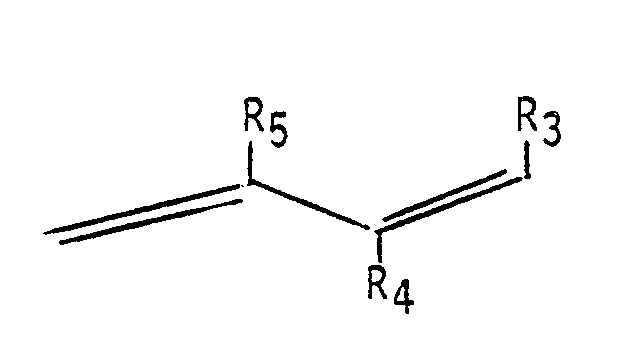
mit R₃, R₄, R₅ = H, CH₃
erhalten wird,
wobei, bezogen auf 100 Teile der Mischungen
5 - 70 Teile Polyphenylenether und
95 - 30 Teile Blockcopolymer
kommen.
dadurch gekennzeichnet,
daß man als
Polyphenylenether ein Polymeres oder Copolymeres auf Basis von
und das Blockcopolymer durch Polymerisation von vinylaromatischen Verbindungen der Formel
R₂ = H, CH₃, Cl und
p = 1, 2
und konjugierten Dienen der Formel
erhalten wird,
wobei, bezogen auf 100 Teile der Mischungen
5 - 70 Teile Polyphenylenether und
95 - 30 Teile Blockcopolymer
kommen.
2. Mischungen gemäß Anspruch 1,
dadurch gekennzeichnet,
daß als Polyphenylenether ein Polymeres des 2,6-Dimethylphenols mit einem Molekulargewicht von 3 000 bis 3 500 eingesetzt wird.
dadurch gekennzeichnet,
daß als Polyphenylenether ein Polymeres des 2,6-Dimethylphenols mit einem Molekulargewicht von 3 000 bis 3 500 eingesetzt wird.
3. Mischung gemäß den Ansprüchen 1 und 2,
dadurch gekennzeichnet,
daß als Blockcopolymer ein Styrol-Butadien-Styrol-Blockcopolymer eingesetzt wird.
dadurch gekennzeichnet,
daß als Blockcopolymer ein Styrol-Butadien-Styrol-Blockcopolymer eingesetzt wird.
4. Mischung gemäß Anspruch 3,
dadurch gekennzeichnet,
daß der Anteil des Styrols im Blockcopolymer zwischen 20 und 50 % beträgt.
dadurch gekennzeichnet,
daß der Anteil des Styrols im Blockcopolymer zwischen 20 und 50 % beträgt.
5. Mischungen gemäß den Ansprüchen 3 und 4,
dadurch gekennzeichnet,
daß ein hydriertes Styrol-Butadien-Styrol-Blockcopolymer eingesetzt wird.
dadurch gekennzeichnet,
daß ein hydriertes Styrol-Butadien-Styrol-Blockcopolymer eingesetzt wird.
Applications Claiming Priority (2)
| Application Number | Priority Date | Filing Date | Title |
|---|---|---|---|
| DE3815254 | 1988-05-05 | ||
| DE19883815254 DE3815254A1 (de) | 1988-05-05 | 1988-05-05 | Hochtemperaturbestaendige mischungen aus einem thermoplastischen elastomeren und einem thermoplasten |
Publications (1)
| Publication Number | Publication Date |
|---|---|
| EP0340415A2 true EP0340415A2 (de) | 1989-11-08 |
Family
ID=6353662
Family Applications (1)
| Application Number | Title | Priority Date | Filing Date |
|---|---|---|---|
| EP19890104050 Withdrawn EP0340415A2 (de) | 1988-05-05 | 1989-03-08 | Hochtemperaturbeständige Mischungen aus einem thermoplastischen Elastomeren und einem Thermoplasten |
Country Status (3)
| Country | Link |
|---|---|
| EP (1) | EP0340415A2 (de) |
| JP (1) | JPH0216154A (de) |
| DE (1) | DE3815254A1 (de) |
Cited By (2)
| Publication number | Priority date | Publication date | Assignee | Title |
|---|---|---|---|---|
| EP0389837A1 (de) * | 1989-03-07 | 1990-10-03 | Mitsubishi Cable Industries, Ltd. | Phenylenoxydpolymer-Zusammensetzung |
| US5118748A (en) * | 1989-03-07 | 1992-06-02 | Mitsubishi Cable Industries Ltd. | Phenylene oxide polymer composition |
Families Citing this family (2)
| Publication number | Priority date | Publication date | Assignee | Title |
|---|---|---|---|---|
| AU676667B2 (en) * | 1992-10-22 | 1997-03-20 | Kabushiki Kaisha Ace Denken | Screen display type slot machine |
| US6004208A (en) * | 1992-11-04 | 1999-12-21 | Kabushiki Kaisha Ace Denken | Slot machine that can superimpose on a display screen images from different storage locations |
-
1988
- 1988-05-05 DE DE19883815254 patent/DE3815254A1/de not_active Withdrawn
-
1989
- 1989-03-08 EP EP19890104050 patent/EP0340415A2/de not_active Withdrawn
- 1989-05-02 JP JP11227989A patent/JPH0216154A/ja active Pending
Cited By (2)
| Publication number | Priority date | Publication date | Assignee | Title |
|---|---|---|---|---|
| EP0389837A1 (de) * | 1989-03-07 | 1990-10-03 | Mitsubishi Cable Industries, Ltd. | Phenylenoxydpolymer-Zusammensetzung |
| US5118748A (en) * | 1989-03-07 | 1992-06-02 | Mitsubishi Cable Industries Ltd. | Phenylene oxide polymer composition |
Also Published As
| Publication number | Publication date |
|---|---|
| JPH0216154A (ja) | 1990-01-19 |
| DE3815254A1 (de) | 1989-11-16 |
Similar Documents
| Publication | Publication Date | Title |
|---|---|---|
| DE2750514C2 (de) | ||
| US3963804A (en) | Thermoplastic blend composition | |
| DE2000118B2 (de) | Thermoplastische Masse und Verfahren zu ihrer Herstellung | |
| DE3015514A1 (de) | Aromatische polyaetherharzmassen | |
| DE2713455C2 (de) | ||
| DE2119301B2 (de) | Thermoplastische Massen mit hoher Schlagzähigkeit | |
| EP0545181B1 (de) | Thermoplastische Formmasse | |
| DE69031210T2 (de) | Polyindane als Verfahrenshilfsmittel für Thermoplasten | |
| DE3442273C2 (de) | Thermoplastische Massen auf Basis von Polyphenylenethern, Styrolpolymerisaten und Polyoctenylenen sowie Verfahren zu ihrer Herstellung | |
| DE3400540A1 (de) | Thermoplastische zubereitungen mit herabgesetzter schmelzviskositaet und verfahren zu ihrer herstellung | |
| DE60015403T2 (de) | Syndiotaktische Polystyrolharzzusammensetzung mit guter Schlagfestigkeit | |
| DE69118956T2 (de) | Mischungen auf Basis von vinylaromatischen Polymeren mit guten mechanischen Eigenschaften | |
| DE2254202B2 (de) | Thermoplastische Mischmasse | |
| DE2751496C2 (de) | Flammhemmende, biegsam gemachte Polyphenylenäther-Zusammensetzungen | |
| EP0307818A2 (de) | Transparente, schlagfeste thermoplastische Formmasse, Verfahren zur Herstellung derselben und ihre Verwendung | |
| EP0340415A2 (de) | Hochtemperaturbeständige Mischungen aus einem thermoplastischen Elastomeren und einem Thermoplasten | |
| DE3332325A1 (de) | Thermoplastische formmasse | |
| DE3127233A1 (de) | "thermoplastische zubereitung" | |
| DE3138401A1 (de) | Thermoplastische formmassen | |
| EP0048388B1 (de) | Thermoplastische Formmasse | |
| DE69419536T2 (de) | Formmasse auf Basis von Polyphenylenäthern | |
| EP0149141B1 (de) | Thermoplastische Formmassen | |
| DE2253221C3 (de) | Zusammensetzung aus einem Polyphenylenäther und einem Acrylharzmodifizierten Polyisopren | |
| DE2136837B2 (de) | Verfahren zur Herstellung von amorphen Polyphenylenoxiden | |
| EP0751185A2 (de) | Thermoplastische Polyphenyletherformmassen mit verbesserter Haftung an Polyurethanschaum |
Legal Events
| Date | Code | Title | Description |
|---|---|---|---|
| PUAI | Public reference made under article 153(3) epc to a published international application that has entered the european phase |
Free format text: ORIGINAL CODE: 0009012 |
|
| AK | Designated contracting states |
Kind code of ref document: A2 Designated state(s): AT BE CH DE FR GB IT LI NL |
|
| STAA | Information on the status of an ep patent application or granted ep patent |
Free format text: STATUS: THE APPLICATION HAS BEEN WITHDRAWN |
|
| 18W | Application withdrawn |
Withdrawal date: 19900928 |
|
| R18W | Application withdrawn (corrected) |
Effective date: 19900928 |