EP0340654A2 - Détecteur potentiométrique pour déterminer l'activité en oxygène à des températures basses - Google Patents
Détecteur potentiométrique pour déterminer l'activité en oxygène à des températures basses Download PDFInfo
- Publication number
- EP0340654A2 EP0340654A2 EP89107735A EP89107735A EP0340654A2 EP 0340654 A2 EP0340654 A2 EP 0340654A2 EP 89107735 A EP89107735 A EP 89107735A EP 89107735 A EP89107735 A EP 89107735A EP 0340654 A2 EP0340654 A2 EP 0340654A2
- Authority
- EP
- European Patent Office
- Prior art keywords
- oxygen
- electrode
- potentiometric sensor
- sensor according
- periodic table
- Prior art date
- Legal status (The legal status is an assumption and is not a legal conclusion. Google has not performed a legal analysis and makes no representation as to the accuracy of the status listed.)
- Withdrawn
Links
- 239000001301 oxygen Substances 0.000 title claims abstract description 84
- QVGXLLKOCUKJST-UHFFFAOYSA-N atomic oxygen Chemical compound [O] QVGXLLKOCUKJST-UHFFFAOYSA-N 0.000 title claims abstract description 83
- 229910052760 oxygen Inorganic materials 0.000 title claims abstract description 83
- 230000000694 effects Effects 0.000 title claims description 18
- 239000007772 electrode material Substances 0.000 claims abstract description 20
- 239000012528 membrane Substances 0.000 claims abstract description 14
- 230000000737 periodic effect Effects 0.000 claims abstract description 14
- 229910052723 transition metal Inorganic materials 0.000 claims abstract description 12
- 150000003624 transition metals Chemical class 0.000 claims abstract description 12
- 239000007788 liquid Substances 0.000 claims abstract description 6
- 239000008151 electrolyte solution Substances 0.000 claims abstract description 5
- 238000006243 chemical reaction Methods 0.000 claims description 22
- 239000000203 mixture Substances 0.000 claims description 16
- 239000003792 electrolyte Substances 0.000 claims description 15
- 229910000314 transition metal oxide Inorganic materials 0.000 claims description 10
- 150000002500 ions Chemical class 0.000 claims description 6
- 229910052751 metal Inorganic materials 0.000 claims description 5
- 239000002184 metal Substances 0.000 claims description 5
- 239000010955 niobium Substances 0.000 claims description 5
- 229910052721 tungsten Inorganic materials 0.000 claims description 5
- 229910052758 niobium Inorganic materials 0.000 claims description 4
- QGLKJKCYBOYXKC-UHFFFAOYSA-N nonaoxidotritungsten Chemical compound O=[W]1(=O)O[W](=O)(=O)O[W](=O)(=O)O1 QGLKJKCYBOYXKC-UHFFFAOYSA-N 0.000 claims description 4
- WFKWXMTUELFFGS-UHFFFAOYSA-N tungsten Chemical compound [W] WFKWXMTUELFFGS-UHFFFAOYSA-N 0.000 claims description 4
- 239000010937 tungsten Substances 0.000 claims description 4
- 229910001930 tungsten oxide Inorganic materials 0.000 claims description 4
- GUCVJGMIXFAOAE-UHFFFAOYSA-N niobium atom Chemical compound [Nb] GUCVJGMIXFAOAE-UHFFFAOYSA-N 0.000 claims description 3
- 229910000484 niobium oxide Inorganic materials 0.000 claims description 3
- URLJKFSTXLNXLG-UHFFFAOYSA-N niobium(5+);oxygen(2-) Chemical compound [O-2].[O-2].[O-2].[O-2].[O-2].[Nb+5].[Nb+5] URLJKFSTXLNXLG-UHFFFAOYSA-N 0.000 claims description 3
- -1 silver-silver halide Chemical class 0.000 claims description 3
- 239000007795 chemical reaction product Substances 0.000 claims description 2
- 229910052746 lanthanum Inorganic materials 0.000 claims description 2
- 229910052750 molybdenum Inorganic materials 0.000 claims description 2
- 229910052697 platinum Inorganic materials 0.000 claims description 2
- 239000004065 semiconductor Substances 0.000 claims description 2
- 229910052715 tantalum Inorganic materials 0.000 claims description 2
- 229910052747 lanthanoid Inorganic materials 0.000 claims 2
- 150000002602 lanthanoids Chemical class 0.000 claims 2
- 229910052684 Cerium Inorganic materials 0.000 claims 1
- 229910052692 Dysprosium Inorganic materials 0.000 claims 1
- 229910052691 Erbium Inorganic materials 0.000 claims 1
- 229910052693 Europium Inorganic materials 0.000 claims 1
- 229910052688 Gadolinium Inorganic materials 0.000 claims 1
- 229910052689 Holmium Inorganic materials 0.000 claims 1
- 229910052765 Lutetium Inorganic materials 0.000 claims 1
- 229910052779 Neodymium Inorganic materials 0.000 claims 1
- 229910052777 Praseodymium Inorganic materials 0.000 claims 1
- 229910052772 Samarium Inorganic materials 0.000 claims 1
- 229910052771 Terbium Inorganic materials 0.000 claims 1
- 229910052775 Thulium Inorganic materials 0.000 claims 1
- 229910052769 Ytterbium Inorganic materials 0.000 claims 1
- 150000001450 anions Chemical class 0.000 claims 1
- 229910052788 barium Inorganic materials 0.000 claims 1
- 229910052791 calcium Inorganic materials 0.000 claims 1
- 229940075397 calomel Drugs 0.000 claims 1
- ZOMNIUBKTOKEHS-UHFFFAOYSA-L dimercury dichloride Chemical compound Cl[Hg][Hg]Cl ZOMNIUBKTOKEHS-UHFFFAOYSA-L 0.000 claims 1
- 229910052735 hafnium Inorganic materials 0.000 claims 1
- 229910052741 iridium Inorganic materials 0.000 claims 1
- 229910052749 magnesium Inorganic materials 0.000 claims 1
- 229910052748 manganese Inorganic materials 0.000 claims 1
- 229910052759 nickel Inorganic materials 0.000 claims 1
- 229910052762 osmium Inorganic materials 0.000 claims 1
- 229910052763 palladium Inorganic materials 0.000 claims 1
- 229910052702 rhenium Inorganic materials 0.000 claims 1
- 229910052703 rhodium Inorganic materials 0.000 claims 1
- 229910052707 ruthenium Inorganic materials 0.000 claims 1
- 229910052712 strontium Inorganic materials 0.000 claims 1
- 229910052727 yttrium Inorganic materials 0.000 claims 1
- 229910052726 zirconium Inorganic materials 0.000 claims 1
- 238000005259 measurement Methods 0.000 description 28
- 239000000243 solution Substances 0.000 description 22
- 238000000034 method Methods 0.000 description 16
- 230000035945 sensitivity Effects 0.000 description 16
- 239000000523 sample Substances 0.000 description 11
- 239000000463 material Substances 0.000 description 7
- 230000015572 biosynthetic process Effects 0.000 description 6
- 238000005260 corrosion Methods 0.000 description 6
- 230000007797 corrosion Effects 0.000 description 6
- 238000004090 dissolution Methods 0.000 description 5
- 230000002441 reversible effect Effects 0.000 description 5
- MCMNRKCIXSYSNV-UHFFFAOYSA-N Zirconium dioxide Chemical compound O=[Zr]=O MCMNRKCIXSYSNV-UHFFFAOYSA-N 0.000 description 4
- 230000008859 change Effects 0.000 description 4
- 238000010586 diagram Methods 0.000 description 4
- 230000008569 process Effects 0.000 description 4
- XLYOFNOQVPJJNP-UHFFFAOYSA-N water Chemical compound O XLYOFNOQVPJJNP-UHFFFAOYSA-N 0.000 description 4
- IJGRMHOSHXDMSA-UHFFFAOYSA-N Atomic nitrogen Chemical compound N#N IJGRMHOSHXDMSA-UHFFFAOYSA-N 0.000 description 3
- 230000008901 benefit Effects 0.000 description 3
- 150000001875 compounds Chemical class 0.000 description 3
- 239000007789 gas Substances 0.000 description 3
- 238000007731 hot pressing Methods 0.000 description 3
- 238000011835 investigation Methods 0.000 description 3
- 230000007774 longterm Effects 0.000 description 3
- 238000004519 manufacturing process Methods 0.000 description 3
- 230000009467 reduction Effects 0.000 description 3
- 239000000126 substance Substances 0.000 description 3
- 229910020350 Na2WO4 Inorganic materials 0.000 description 2
- 238000000026 X-ray photoelectron spectrum Methods 0.000 description 2
- 238000009825 accumulation Methods 0.000 description 2
- 229910052783 alkali metal Inorganic materials 0.000 description 2
- 239000007864 aqueous solution Substances 0.000 description 2
- 150000001768 cations Chemical class 0.000 description 2
- 239000000919 ceramic Substances 0.000 description 2
- GTKRFUAGOKINCA-UHFFFAOYSA-M chlorosilver;silver Chemical compound [Ag].[Ag]Cl GTKRFUAGOKINCA-UHFFFAOYSA-M 0.000 description 2
- 239000013078 crystal Substances 0.000 description 2
- 238000003411 electrode reaction Methods 0.000 description 2
- 238000007654 immersion Methods 0.000 description 2
- 230000002427 irreversible effect Effects 0.000 description 2
- ZKATWMILCYLAPD-UHFFFAOYSA-N niobium pentoxide Chemical compound O=[Nb](=O)O[Nb](=O)=O ZKATWMILCYLAPD-UHFFFAOYSA-N 0.000 description 2
- 238000007254 oxidation reaction Methods 0.000 description 2
- 239000011224 oxide ceramic Substances 0.000 description 2
- 230000036284 oxygen consumption Effects 0.000 description 2
- 239000000047 product Substances 0.000 description 2
- 230000004044 response Effects 0.000 description 2
- XMVONEAAOPAGAO-UHFFFAOYSA-N sodium tungstate Chemical compound [Na+].[Na+].[O-][W]([O-])(=O)=O XMVONEAAOPAGAO-UHFFFAOYSA-N 0.000 description 2
- 238000001179 sorption measurement Methods 0.000 description 2
- 238000002336 sorption--desorption measurement Methods 0.000 description 2
- 241000894007 species Species 0.000 description 2
- 241001136792 Alle Species 0.000 description 1
- 229910000906 Bronze Inorganic materials 0.000 description 1
- MYMOFIZGZYHOMD-UHFFFAOYSA-N Dioxygen Chemical compound O=O MYMOFIZGZYHOMD-UHFFFAOYSA-N 0.000 description 1
- ZOKXTWBITQBERF-UHFFFAOYSA-N Molybdenum Chemical compound [Mo] ZOKXTWBITQBERF-UHFFFAOYSA-N 0.000 description 1
- 239000004809 Teflon Substances 0.000 description 1
- 229920006362 Teflon® Polymers 0.000 description 1
- 230000002378 acidificating effect Effects 0.000 description 1
- 150000001340 alkali metals Chemical class 0.000 description 1
- 229910045601 alloy Inorganic materials 0.000 description 1
- 239000000956 alloy Substances 0.000 description 1
- 239000008280 blood Substances 0.000 description 1
- 210000004369 blood Anatomy 0.000 description 1
- 238000009530 blood pressure measurement Methods 0.000 description 1
- 210000001124 body fluid Anatomy 0.000 description 1
- 239000010839 body fluid Substances 0.000 description 1
- 238000009835 boiling Methods 0.000 description 1
- 239000010974 bronze Substances 0.000 description 1
- 238000010276 construction Methods 0.000 description 1
- KUNSUQLRTQLHQQ-UHFFFAOYSA-N copper tin Chemical compound [Cu].[Sn] KUNSUQLRTQLHQQ-UHFFFAOYSA-N 0.000 description 1
- 125000004122 cyclic group Chemical group 0.000 description 1
- 238000001514 detection method Methods 0.000 description 1
- 238000009792 diffusion process Methods 0.000 description 1
- 229910001873 dinitrogen Inorganic materials 0.000 description 1
- 229910001882 dioxygen Inorganic materials 0.000 description 1
- 238000002848 electrochemical method Methods 0.000 description 1
- 238000005516 engineering process Methods 0.000 description 1
- 230000002349 favourable effect Effects 0.000 description 1
- PCHJSUWPFVWCPO-UHFFFAOYSA-N gold Chemical compound [Au] PCHJSUWPFVWCPO-UHFFFAOYSA-N 0.000 description 1
- 229910052737 gold Inorganic materials 0.000 description 1
- 239000010931 gold Substances 0.000 description 1
- XLYOFNOQVPJJNP-ZSJDYOACSA-N heavy water Substances [2H]O[2H] XLYOFNOQVPJJNP-ZSJDYOACSA-N 0.000 description 1
- 238000000338 in vitro Methods 0.000 description 1
- 238000001727 in vivo Methods 0.000 description 1
- 239000012212 insulator Substances 0.000 description 1
- 238000005184 irreversible process Methods 0.000 description 1
- 238000000691 measurement method Methods 0.000 description 1
- 230000007246 mechanism Effects 0.000 description 1
- 229910044991 metal oxide Inorganic materials 0.000 description 1
- 150000004706 metal oxides Chemical class 0.000 description 1
- 238000001465 metallisation Methods 0.000 description 1
- 150000002739 metals Chemical class 0.000 description 1
- 239000011733 molybdenum Substances 0.000 description 1
- 229910052757 nitrogen Inorganic materials 0.000 description 1
- 230000003647 oxidation Effects 0.000 description 1
- 238000002186 photoelectron spectrum Methods 0.000 description 1
- 239000004033 plastic Substances 0.000 description 1
- 230000010287 polarization Effects 0.000 description 1
- 239000000843 powder Substances 0.000 description 1
- 229920006395 saturated elastomer Polymers 0.000 description 1
- 229910052709 silver Inorganic materials 0.000 description 1
- 239000004332 silver Substances 0.000 description 1
- 238000003746 solid phase reaction Methods 0.000 description 1
- 238000010671 solid-state reaction Methods 0.000 description 1
- 238000003756 stirring Methods 0.000 description 1
- 238000010408 sweeping Methods 0.000 description 1
- GUVRBAGPIYLISA-UHFFFAOYSA-N tantalum atom Chemical compound [Ta] GUVRBAGPIYLISA-UHFFFAOYSA-N 0.000 description 1
- 230000007704 transition Effects 0.000 description 1
- 238000007740 vapor deposition Methods 0.000 description 1
Images


Classifications
-
- G—PHYSICS
- G01—MEASURING; TESTING
- G01N—INVESTIGATING OR ANALYSING MATERIALS BY DETERMINING THEIR CHEMICAL OR PHYSICAL PROPERTIES
- G01N27/00—Investigating or analysing materials by the use of electric, electrochemical, or magnetic means
- G01N27/26—Investigating or analysing materials by the use of electric, electrochemical, or magnetic means by investigating electrochemical variables; by using electrolysis or electrophoresis
- G01N27/403—Cells and electrode assemblies
- G01N27/4035—Combination of a single ion-sensing electrode and a single reference electrode
Definitions
- transition metal oxides as sensor materials for determining oxygen activities in gas mixtures while operating the sensor at high temperatures (T> 300 ° C.) is state of the art.
- the measured variable is either the conductivity of p- or n-conducting semiconductors, which depends strongly in part on the O2 partial pressure of the measuring medium or, for example, in the system known as the lambda probe p O2 ′, Pt / ZrO2 / Pt, p O2 ⁇ the EMF is measured between the two Pt electrodes.
- the latter system is characterized by Nernst's potential behavior, very quick response and very good reversibility or long-term stability. Both systems however, it is common that they must be operated at temperatures above 300 ° C and therefore cannot be used if low sensor temperatures are unavoidable (eg in aqueous solutions).
- the invention is based on a potentiometric sensor according to the preamble of claim 1, which is particularly suitable for applications in gaseous or liquid samples at temperatures below the boiling point of aqueous solutions.
- a known method of this type uses so-called tungsten bronzes for the potentiometric oxygen measurement as electrode material for the oxygen-sensitive electrode, which in addition to W contain only monovalent cations, namely alkali metals or T1.
- these bronze materials known as inclusion compounds, there is a mechanism generating the sensitivity to oxygen-generating potential on the electrode surface by adsorption of O2 molecules, which is, however, promoted by the presence of OH ⁇ ions at the interface.
- a first oxygen-sensitive electrode (measuring electrode) and a second reference electrode are immersed in an electrochemical cell which contains an internal electrolyte solution.
- the electrochemical cell is covered or formed from a gas-permeable membrane.
- the electrochemical cell is immersed in the sample whose oxygen partial pressure is to be measured, the gas-permeable membrane being permeable to oxygen, however is impermeable to liquids or ions.
- the sensitive first electrode consists of the metals tungsten, molybdenum, tantalum and their alloys, their half-cell potential representing the potential for a corrosion reaction, that of both cathodic (electron-delivering) dissolution reactions of the metal electrode and of the electrode-consuming electrode-oxidation reactions depends. So two circumstances are essential here.
- the oxygen is reduced at the electrode, which creates a potential that depends on the oxygen activity.
- the electrons necessary for the reaction are supplied by the metal electrode through the dissolution reaction.
- the potential difference between the measuring electrode and the reference electrode which can be a silver-silver chloride electrode, is measured with a voltmeter with a high input impedance, nevertheless, depending on the kinetics of the corrosion reaction, a more or less high consumption of electrode material occurs, but above all from oxygen to.
- the high input impedance of the voltmeter is necessary in order to disturb the reaction balance as little as possible.
- This known potentiometric oxygen sensor is specially designed for the determination of the oxygen partial pressure in body fluids such as blood and can be used for measurements in vitro or in vivo.
- Another known possibility for the determination of oxygen dissolved in liquids is the amperometric measuring method, which usually uses Clark's oxygen measuring cells.
- a measuring cell is provided which is connected to the measuring solution via an oxygen-permeable membrane and in the interior of which a cathode, which mostly consists of gold, and an anode, which mostly consists of silver, are arranged.
- the cathode and anode are immersed in an internal electrolyte in the measuring cell.
- a current can be measured (so-called diffusion limit current) which is proportional to the oxygen concentration in the measuring medium.
- the main serious disadvantages with this method are that: - Because of the linear dependence of the measuring current on the activity of the dissolved oxygen, only relatively high oxygen concentrations can be measured; - The measuring principle results in constant consumption of the internal electrolyte (cause of drift phenomena); - The measuring medium is influenced by constant oxygen reduction (formation of an oxygen partial pressure gradient) and thus the signal does not reach a stable value in the case of poor convection; - The sensitivity of the sensor changes with often unavoidable changes, including the membrane properties, the flow velocity and the viscosity of the measurement solution.
- the invention is therefore based on the object of creating a potentiometric oxygen sensor which has high sensitivity in the entire relevant application range from oxygen-enriched sample, air-saturated sample down to the oxygen trace range (below 1 ppb) and is simple in construction and inexpensive and easy to produce is and provides flawless measurement results at low temperatures.
- the invention solves this problem with the characterizing features of the main claim and has the advantage that the use of electronically conductive transition metal oxides as oxygen sensitive Electrode materials - A large measuring range ( ⁇ 0.001 ppm -> 8.3 ppm) can be achieved at - faster response time, - high (electro) chemical stability of the electrode material with negligible changes in the inner solution due to electrode reactions, - without influencing the measuring medium by oxygen consumption. It also follows - No influence of membrane properties or flow velocities on the sensitivity or the accuracy of the measurement result.
- the invention therefore also uses the potentiometric measuring principle mentioned at the outset, which - depending on the application - can be measured directly in the sample or can also be separated via an oxygen-permeable membrane inner solution and measuring solution, but shows very good reversibility in the case of changes in oxygen activity, at only very low potential drift, with the ability to detect traces of oxygen, which has not been achieved to date, of particular importance.
- the basic idea of the present invention is to produce the oxygen-sensitive half cell from an electronically conductive transition metal oxide in a chemical measuring cell operating according to the potentiometric measuring principle for determining the oxygen partial pressure, the transition metal from IV., V., VI., VII. And VIII Subgroup of the periodic table and is preferably tungsten or niobium. It is irrelevant which method the electrode material is made with and which geom. Shape the electrode finally has. It is conceivable e.g. the production as a compact from transition metal oxide powder obtained beforehand by a solid state reaction or a planar electrode configuration, produced by means of thick-film or vapor deposition techniques.
- the membrane can consist of any suitable materials; it must be non-permeable for liquids of all kinds or for ions. Teflon is a suitable material; further materials for such a membrane are specified as suitable, for example, in DE-OS 23 49 579, already mentioned above.
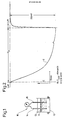
- the preferably highly oxygen-permeable, ion-impermeable, non-diffusion-limiting (plastic) membrane 12 separates the internal electrolyte and the electrode arrangement from the measurement sample, into which the electrochemical cell thus formed is immersed and whose oxygen partial pressure is to be measured.
- a crucial feature of the present invention is the formation of the oxygen-sensitive half-cell 14, that is to say the material of this electrode from an electronically conductive oxide, which contains at least one transition metal from subgroup IV, V, VI, VII or VIII of the periodic table and as further components Oxides of elements from main group II or III.
- Subgroup of the periodic table can contain.
- metal oxides are normally electrically non-conductive; the use of a transition metal oxide and ensuring its electronic conductivity is based on the fact that the transition metal oxide used in each case is not present in the component oxidized to the highest stage, for example WO3, but also contains correspondingly reduced oxide components. So not the fully oxidized WO3, which practically forms an insulator, is used, but a tungsten oxide with the composition WO x , where x is approximately between 2 and 3. A similar effect is achieved by the occupation of crystallographically well-defined vacancies of an oxidic structure with cations without additionally changing their crystallographic character. In the present example, this is the statistical occupation of the spaces between the BO6 octahedra in the perovskite structure with La.
- Nb2O5 is also not used here, but a correspondingly reduced composition NbO x with x between about 2 to 2.5.
- a tungsten oxide ceramic of the composition W18O49 was produced by hot pressing. The material was then provided with an ohmic contact and the EMF of the measuring half-cell thus produced was measured against a reference half-cell in 0.1N KOH as internal electrolyte as a function of the oxygen partial pressure p O2 . This resulted in a curve profile I of the measured potential E over time, with two switching between different oxygen concentrations or oxygen partial pressures. The measurement was carried out using an oxygen / nitrogen gas mixture with adjustable oxygen partial pressure, which was introduced into a solution.
- the curve course II in FIG. 2 shows the advantageous properties of the oxygen-sensitive half cell according to the invention even more strikingly.
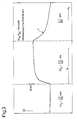
- a niobium oxide ceramic with the composition NbO 2.49 was produced in accordance with the above method and the EMF dependence on the oxygen partial pressure P O2 was also determined.
- the procedure was such that, starting from the normal oxygen partial pressure in air, it was reduced to almost zero, ie the measurement was carried out with pure nitrogen for the time period recognizable in the illustration in FIG. 2 (a time scale is always indicated); Subsequent change of the oxygen partial pressure to the value corresponding to the partial pressure in air resulted in an immediate steep rise to practically the original value of the measured potential, that is to say essentially full reversibility.
- FIG. 2 is based on a measurement over approximately 6 decades of oxygen partial pressure, so that it can be seen that the invention is also used for the detection of traces of oxygen suitable is.
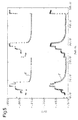
- curve profiles shown in Fig. 4 relate to a La 0.175 WO3 (III) single crystal electrode, wherein the crystal production can be carried out by a known electrochemical method.
- the sensor properties of a phase-pure La 0.2 WO3 ceramic were measured, which was produced by hot pressing. 5 shows the measurement results at I ', while the comparison course is again shown above at II'. Measurements were made in a solution of 0.1N KCl / 0.1N KOH / 0.1M Na2WO4, as in the third example.
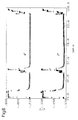
- the measurement data from FIG. 6 plotted in FIG. 6 show particularly impressively the linear dependence of the emf of the measuring cell on the logarithm of the concentration of the dissolved oxygen (determined from the emf of the ⁇ probe) and the extraordinarily good reproducibility of the emf when the cyclic sweep is repeated several times Oxygen activity range.
- What is important here, however, and this can be clearly seen from the diagram in FIG. 7, is that the measuring points are reproducible, so that there are no problems in terms of measuring technology, because the curve in FIG.
- the lowest adjustable oxygen concentration of about 10 -0.7 ppb represents the limit of the measuring apparatus and in no way represents the sensitivity limit of the measuring cell according to claim 1.
- Deviations of the measurement data from the linearity between the accumulation points are due to non-equilibrium states of the O2 partial pressure between the adjusted gas mixture and the current oxygen concentration in the electrolyte and always occur during the change in the N2 / O2 mixture. So this is a measuring effect and not a sensor property.
- the electrode material As it is after the end of the manufacturing processes, has no or only poor O2 sensitivity.
- the transition metal oxide reacts irreversibly with it until the new, O2-sensitive surface (top layer) that forms is in thermodynamic equilibrium with the solution. Only when these irreversible processes come to a standstill, ie the electrode is chemically stable against the solution, is the EMF, ie the sensor signal, determined by reversible processes alone.
- La 0.175 (111) and W18O49 could be shown by recording X-ray photoelectron spectra (XPS) before and after immersion in the electrolyte that by selective dissolution of the fully oxidized component (WO3) of the sample to form WO42 ⁇ the O2-sensitive top layer is created, which has a lower degree of oxidation than the inside of the electrode.
- UV photoelectron spectra (UPS) show that this cover layer also has a different valence band structure of the electron states.
- the studies also showed that the oxygen adsorption reaction is not alone potential determining.
- the EMF is a mixed potential, which in addition to the described reaction with dissolved oxygen is determined by other reversible reactions in which protons and dissolution products of the electrode material (eg WO zB2 ⁇ , see above) are involved.
- La x WO3 as electrode material: WO3 + 2OH ⁇ ⁇ WO42 ⁇ + H2O; the reaction is irreversible (heterogeneous dissolution of the electrode material) with the formation of the O2-sensitive top layer.
Landscapes
- Chemical & Material Sciences (AREA)
- Life Sciences & Earth Sciences (AREA)
- Health & Medical Sciences (AREA)
- Physics & Mathematics (AREA)
- Chemical Kinetics & Catalysis (AREA)
- Electrochemistry (AREA)
- Molecular Biology (AREA)
- Analytical Chemistry (AREA)
- Biochemistry (AREA)
- General Health & Medical Sciences (AREA)
- General Physics & Mathematics (AREA)
- Immunology (AREA)
- Pathology (AREA)
- Measuring Oxygen Concentration In Cells (AREA)
- Separation Using Semi-Permeable Membranes (AREA)
Applications Claiming Priority (2)
| Application Number | Priority Date | Filing Date | Title |
|---|---|---|---|
| DE19883814735 DE3814735A1 (de) | 1988-04-30 | 1988-04-30 | Potentiometrischer sensor zur bestimmung des sauerstoff-partialdrucks |
| DE3814735 | 1988-04-30 |
Publications (2)
| Publication Number | Publication Date |
|---|---|
| EP0340654A2 true EP0340654A2 (fr) | 1989-11-08 |
| EP0340654A3 EP0340654A3 (fr) | 1990-09-26 |
Family
ID=6353315
Family Applications (1)
| Application Number | Title | Priority Date | Filing Date |
|---|---|---|---|
| EP19890107735 Withdrawn EP0340654A3 (fr) | 1988-04-30 | 1989-04-28 | Détecteur potentiométrique pour déterminer l'activité en oxygène à des températures basses |
Country Status (2)
| Country | Link |
|---|---|
| EP (1) | EP0340654A3 (fr) |
| DE (1) | DE3814735A1 (fr) |
Cited By (4)
| Publication number | Priority date | Publication date | Assignee | Title |
|---|---|---|---|---|
| EP0395927A1 (fr) * | 1989-04-29 | 1990-11-07 | Drägerwerk Aktiengesellschaft | Détecteur électrochimique pour la mesure d'ammoniac ou hydrazine |
| EP0724152A3 (fr) * | 1995-01-25 | 1998-09-23 | Przedsiebiorstwo Zagraniczne Htl | Dispositif, procédé et électrode de mesure pour déterminer des paramètres d'un liquide |
| DE102017223707A1 (de) | 2017-12-22 | 2019-06-27 | Technische Universität Dresden | Verfahren und Kontrollvorrichtung zur automatisierten, kontinuierlichen und autarken Bestimmung der Sauerstoffkonzentration im Abwasser einer dezentralen Abwasserbehandlungsanlage |
| DE102022120539A1 (de) | 2022-08-15 | 2024-02-15 | Technische Universität Dresden, Körperschaft des öffentlichen Rechts | Mikrobiologische sensorvorrichtung zur bestimmung der sauerstoffkonzentration in flüssigkeiten |
Families Citing this family (1)
| Publication number | Priority date | Publication date | Assignee | Title |
|---|---|---|---|---|
| DE102019108890A1 (de) | 2018-04-09 | 2019-10-10 | Endress+Hauser Conducta Gmbh+Co. Kg | Sensorelement für einen potentiometrischen Sensor |
Family Cites Families (5)
| Publication number | Priority date | Publication date | Assignee | Title |
|---|---|---|---|---|
| US3839178A (en) * | 1972-10-05 | 1974-10-01 | Gen Electric | Potentiometric oxygen sensor |
| US3856634A (en) * | 1973-03-19 | 1974-12-24 | Univ Iowa State Res Found Inc | Method for measuring dissolved oxygen in aqueous solution using tungsten bronzes as a potentiometric indicating electrode |
| GB1597493A (en) * | 1978-03-13 | 1981-09-09 | Nat Res Dev | Ion selective electrodes |
| DE3639518A1 (de) * | 1985-12-03 | 1987-06-04 | Conducta Mess & Regeltech | Chemische halbzelle |
| DE8805762U1 (de) * | 1988-04-30 | 1988-08-04 | Conducta Gesellschaft für Meß- und Regeltechnik mbH & Co, 7016 Gerlingen | Potentiometrischer Sensor zur Bestimmung des Sauerstoff-Partialdrucks |
-
1988
- 1988-04-30 DE DE19883814735 patent/DE3814735A1/de not_active Withdrawn
-
1989
- 1989-04-28 EP EP19890107735 patent/EP0340654A3/fr not_active Withdrawn
Cited By (4)
| Publication number | Priority date | Publication date | Assignee | Title |
|---|---|---|---|---|
| EP0395927A1 (fr) * | 1989-04-29 | 1990-11-07 | Drägerwerk Aktiengesellschaft | Détecteur électrochimique pour la mesure d'ammoniac ou hydrazine |
| EP0724152A3 (fr) * | 1995-01-25 | 1998-09-23 | Przedsiebiorstwo Zagraniczne Htl | Dispositif, procédé et électrode de mesure pour déterminer des paramètres d'un liquide |
| DE102017223707A1 (de) | 2017-12-22 | 2019-06-27 | Technische Universität Dresden | Verfahren und Kontrollvorrichtung zur automatisierten, kontinuierlichen und autarken Bestimmung der Sauerstoffkonzentration im Abwasser einer dezentralen Abwasserbehandlungsanlage |
| DE102022120539A1 (de) | 2022-08-15 | 2024-02-15 | Technische Universität Dresden, Körperschaft des öffentlichen Rechts | Mikrobiologische sensorvorrichtung zur bestimmung der sauerstoffkonzentration in flüssigkeiten |
Also Published As
| Publication number | Publication date |
|---|---|
| DE3814735A1 (de) | 1989-11-09 |
| EP0340654A3 (fr) | 1990-09-26 |
Similar Documents
| Publication | Publication Date | Title |
|---|---|---|
| DE3750302T2 (de) | Sauerstoffsensor. | |
| DE19827927C2 (de) | Gassensor | |
| DE69220915T2 (de) | Ionenselektive Festkörperelektroden auf Graphitbasis mit Polymermembran | |
| DE3851951T2 (de) | Amperometrische Messmethode Amperometrische Messmethode. | |
| DE3405431C2 (fr) | ||
| DE10144862B4 (de) | Elektrochemischer Gassensor mit Diamantelektrode | |
| DE19726453A1 (de) | Elektrochemischer Sauerstoffsensor | |
| DE2548405A1 (de) | Miniatursonde | |
| DE102008033828A1 (de) | Elektrochemischer Gassensor | |
| DE69737627T2 (de) | Analysezelle | |
| DE69016385T2 (de) | Festkörpersensor zur Bestimmung der Konzentration von mit Wasserstoff reaktionsfähigen Gasen. | |
| DE69225818T2 (de) | Elektroden für potentiometrische Sensoren | |
| DE69123896T2 (de) | pH-Messelektrode und Verfahren zur Herstellung derselben | |
| DE19734861C2 (de) | Sensorelement zur Bestimmung der Konzentration oxidierbarer Bestandteile in einem Gasgemisch | |
| EP0395927B1 (fr) | Détecteur électrochimique pour la mesure d'ammoniac ou hydrazine | |
| DE102013007872A1 (de) | Elektrochemischer Gassensor, Verfahren zu dessen Herstellung und dessen Verwendung | |
| DE3490037T1 (de) | Elektrode für einen Festelektrolyt-Sauerstoff(meß)fühl r, Verfahren zu seiner Herstellung und mindestens eine derartige Elektrode enthaltender Sauerstoff(meß)fühler | |
| DE2349579A1 (de) | Potentiometrischer sauerstoff-sensor | |
| EP0340654A2 (fr) | Détecteur potentiométrique pour déterminer l'activité en oxygène à des températures basses | |
| DE2838230A1 (de) | Sauerstoffsensor | |
| EP1480038B1 (fr) | Electrode potentiométrique et sélectivement sensible aux ions | |
| EP0526479B1 (fr) | Procede de determination de la concentration de gaz et capteur de gaz a electrolyte solide | |
| EP0408039A2 (fr) | Détecteur de courant limite pour mesurer la pression partielle d'un gaz | |
| DE69029446T2 (de) | Vorrichtung und Verfahren zur Minimierung der Effekte, des in einem Elektrolyten gelösten Sauerstoffgehaltes, bei Analysatoren für niedrige Sauerstoffkonzentrationen | |
| DE2454339A1 (de) | Vorrichtung zur relativen messung der konzentration einer probe in einem fluid |
Legal Events
| Date | Code | Title | Description |
|---|---|---|---|
| PUAI | Public reference made under article 153(3) epc to a published international application that has entered the european phase |
Free format text: ORIGINAL CODE: 0009012 |
|
| AK | Designated contracting states |
Kind code of ref document: A2 Designated state(s): AT BE CH DE ES FR GB GR IT LI LU NL SE |
|
| PUAL | Search report despatched |
Free format text: ORIGINAL CODE: 0009013 |
|
| AK | Designated contracting states |
Kind code of ref document: A3 Designated state(s): AT BE CH DE ES FR GB GR IT LI LU NL SE |
|
| 17P | Request for examination filed |
Effective date: 19901112 |
|
| 17Q | First examination report despatched |
Effective date: 19920731 |
|
| STAA | Information on the status of an ep patent application or granted ep patent |
Free format text: STATUS: THE APPLICATION IS DEEMED TO BE WITHDRAWN |
|
| 18D | Application deemed to be withdrawn |
Effective date: 19931006 |