EP0340983A2 - Méthode d'échange de protons pour former des guides d'onde optiques - Google Patents
Méthode d'échange de protons pour former des guides d'onde optiques Download PDFInfo
- Publication number
- EP0340983A2 EP0340983A2 EP89304293A EP89304293A EP0340983A2 EP 0340983 A2 EP0340983 A2 EP 0340983A2 EP 89304293 A EP89304293 A EP 89304293A EP 89304293 A EP89304293 A EP 89304293A EP 0340983 A2 EP0340983 A2 EP 0340983A2
- Authority
- EP
- European Patent Office
- Prior art keywords
- substrate
- exchange
- proton
- sulfuric acid
- depth
- Prior art date
- Legal status (The legal status is an assumption and is not a legal conclusion. Google has not performed a legal analysis and makes no representation as to the accuracy of the status listed.)
- Granted
Links
- 238000000034 method Methods 0.000 title claims abstract description 46
- 230000003287 optical effect Effects 0.000 title claims abstract description 14
- 239000000758 substrate Substances 0.000 claims abstract description 69
- QAOWNCQODCNURD-UHFFFAOYSA-N Sulfuric acid Chemical compound OS(O)(=O)=O QAOWNCQODCNURD-UHFFFAOYSA-N 0.000 claims abstract description 54
- WHXSMMKQMYFTQS-UHFFFAOYSA-N Lithium Chemical compound [Li] WHXSMMKQMYFTQS-UHFFFAOYSA-N 0.000 claims abstract description 14
- 229910052744 lithium Inorganic materials 0.000 claims abstract description 11
- 229910003327 LiNbO3 Inorganic materials 0.000 claims description 4
- 230000000873 masking effect Effects 0.000 claims description 3
- 229910012463 LiTaO3 Inorganic materials 0.000 claims description 2
- 230000000694 effects Effects 0.000 claims description 2
- 230000005012 migration Effects 0.000 claims description 2
- 238000013508 migration Methods 0.000 claims description 2
- FGUUSXIOTUKUDN-IBGZPJMESA-N C1(=CC=CC=C1)N1C2=C(NC([C@H](C1)NC=1OC(=NN=1)C1=CC=CC=C1)=O)C=CC=C2 Chemical compound C1(=CC=CC=C1)N1C2=C(NC([C@H](C1)NC=1OC(=NN=1)C1=CC=CC=C1)=O)C=CC=C2 FGUUSXIOTUKUDN-IBGZPJMESA-N 0.000 claims 1
- 239000013078 crystal Substances 0.000 claims 1
- 238000010438 heat treatment Methods 0.000 claims 1
- 239000002253 acid Substances 0.000 abstract description 14
- 230000001965 increasing effect Effects 0.000 abstract description 8
- WPYMKLBDIGXBTP-UHFFFAOYSA-N benzoic acid Chemical compound OC(=O)C1=CC=CC=C1 WPYMKLBDIGXBTP-UHFFFAOYSA-N 0.000 description 20
- 230000008569 process Effects 0.000 description 19
- GQYHUHYESMUTHG-UHFFFAOYSA-N lithium niobate Chemical compound [Li+].[O-][Nb](=O)=O GQYHUHYESMUTHG-UHFFFAOYSA-N 0.000 description 18
- 239000005711 Benzoic acid Substances 0.000 description 9
- 235000010233 benzoic acid Nutrition 0.000 description 9
- 239000000463 material Substances 0.000 description 9
- 239000001257 hydrogen Substances 0.000 description 8
- 229910052739 hydrogen Inorganic materials 0.000 description 8
- 238000007654 immersion Methods 0.000 description 8
- UFHFLCQGNIYNRP-UHFFFAOYSA-N Hydrogen Chemical compound [H][H] UFHFLCQGNIYNRP-UHFFFAOYSA-N 0.000 description 7
- 230000008859 change Effects 0.000 description 7
- 238000001004 secondary ion mass spectrometry Methods 0.000 description 6
- 238000004519 manufacturing process Methods 0.000 description 5
- 238000005259 measurement Methods 0.000 description 4
- WSMQKESQZFQMFW-UHFFFAOYSA-N 5-methyl-pyrazole-3-carboxylic acid Chemical compound CC1=CC(C(O)=O)=NN1 WSMQKESQZFQMFW-UHFFFAOYSA-N 0.000 description 3
- 230000008901 benefit Effects 0.000 description 3
- VYPSYNLAJGMNEJ-UHFFFAOYSA-N Silicium dioxide Chemical compound O=[Si]=O VYPSYNLAJGMNEJ-UHFFFAOYSA-N 0.000 description 2
- IPCSVZSSVZVIGE-UHFFFAOYSA-N hexadecanoic acid Chemical compound CCCCCCCCCCCCCCCC(O)=O IPCSVZSSVZVIGE-UHFFFAOYSA-N 0.000 description 2
- 239000010410 layer Substances 0.000 description 2
- 229910052751 metal Inorganic materials 0.000 description 2
- 239000002184 metal Substances 0.000 description 2
- 230000001902 propagating effect Effects 0.000 description 2
- XLYOFNOQVPJJNP-UHFFFAOYSA-N water Chemical compound O XLYOFNOQVPJJNP-UHFFFAOYSA-N 0.000 description 2
- UBDHSURDYAETAL-UHFFFAOYSA-N 8-aminonaphthalene-1,3,6-trisulfonic acid Chemical compound OS(=O)(=O)C1=CC(S(O)(=O)=O)=C2C(N)=CC(S(O)(=O)=O)=CC2=C1 UBDHSURDYAETAL-UHFFFAOYSA-N 0.000 description 1
- 235000021314 Palmitic acid Nutrition 0.000 description 1
- RTAQQCXQSZGOHL-UHFFFAOYSA-N Titanium Chemical compound [Ti] RTAQQCXQSZGOHL-UHFFFAOYSA-N 0.000 description 1
- 150000007513 acids Chemical class 0.000 description 1
- 230000004075 alteration Effects 0.000 description 1
- 238000010420 art technique Methods 0.000 description 1
- QVGXLLKOCUKJST-UHFFFAOYSA-N atomic oxygen Chemical compound [O] QVGXLLKOCUKJST-UHFFFAOYSA-N 0.000 description 1
- 230000015572 biosynthetic process Effects 0.000 description 1
- 230000015556 catabolic process Effects 0.000 description 1
- 238000004891 communication Methods 0.000 description 1
- 239000000356 contaminant Substances 0.000 description 1
- 238000007796 conventional method Methods 0.000 description 1
- 230000008878 coupling Effects 0.000 description 1
- 238000010168 coupling process Methods 0.000 description 1
- 238000005859 coupling reaction Methods 0.000 description 1
- 239000008367 deionised water Substances 0.000 description 1
- 229910021641 deionized water Inorganic materials 0.000 description 1
- -1 hydrogen ions Chemical class 0.000 description 1
- 230000001939 inductive effect Effects 0.000 description 1
- 239000007788 liquid Substances 0.000 description 1
- WQEPLUUGTLDZJY-UHFFFAOYSA-N n-Pentadecanoic acid Natural products CCCCCCCCCCCCCCC(O)=O WQEPLUUGTLDZJY-UHFFFAOYSA-N 0.000 description 1
- 229910052758 niobium Inorganic materials 0.000 description 1
- 239000010955 niobium Substances 0.000 description 1
- GUCVJGMIXFAOAE-UHFFFAOYSA-N niobium atom Chemical compound [Nb] GUCVJGMIXFAOAE-UHFFFAOYSA-N 0.000 description 1
- 239000001301 oxygen Substances 0.000 description 1
- 229910052760 oxygen Inorganic materials 0.000 description 1
- 230000002035 prolonged effect Effects 0.000 description 1
- 235000012239 silicon dioxide Nutrition 0.000 description 1
- 239000000377 silicon dioxide Substances 0.000 description 1
- 239000000126 substance Substances 0.000 description 1
- 235000011149 sulphuric acid Nutrition 0.000 description 1
- 239000002344 surface layer Substances 0.000 description 1
- 239000010409 thin film Substances 0.000 description 1
- 239000010936 titanium Substances 0.000 description 1
- 229910052719 titanium Inorganic materials 0.000 description 1
- 238000009827 uniform distribution Methods 0.000 description 1
- 230000008016 vaporization Effects 0.000 description 1
- 238000009834 vaporization Methods 0.000 description 1
Images

Classifications
-
- G—PHYSICS
- G02—OPTICS
- G02B—OPTICAL ELEMENTS, SYSTEMS OR APPARATUS
- G02B6/00—Light guides; Structural details of arrangements comprising light guides and other optical elements, e.g. couplings
- G02B6/10—Light guides; Structural details of arrangements comprising light guides and other optical elements, e.g. couplings of the optical waveguide type
-
- G—PHYSICS
- G02—OPTICS
- G02B—OPTICAL ELEMENTS, SYSTEMS OR APPARATUS
- G02B6/00—Light guides; Structural details of arrangements comprising light guides and other optical elements, e.g. couplings
- G02B6/10—Light guides; Structural details of arrangements comprising light guides and other optical elements, e.g. couplings of the optical waveguide type
- G02B6/12—Light guides; Structural details of arrangements comprising light guides and other optical elements, e.g. couplings of the optical waveguide type of the integrated circuit kind
- G02B6/13—Integrated optical circuits characterised by the manufacturing method
- G02B6/134—Integrated optical circuits characterised by the manufacturing method by substitution by dopant atoms
- G02B6/1345—Integrated optical circuits characterised by the manufacturing method by substitution by dopant atoms using ion exchange
Definitions
- U.S. Patent 4,547,262 issued to W. Spillman, Jr. et al.
- the present invention addresses the need remaining in the prior art and relates to an alternative proton-exchange method of forming optical waveguides and, more particularly, to such a method which utilizes sulfuric acid as the proton donor source.
- the optical substrate (lithium niobate, for example) is appropriately masked and lowered into a sulfuric acid bath maintained at a constant temperature (150°C, for example).
- the substrate is immersed in the acid for a period of time sufficient to provide the requisite exchange of the hydrogen from the acid and the lithium from the substrate.
- the substrate surface is rinsed with deionized water to remove any residual acid and the mask is removed.
- the substrate must then be annealed at an elevated temperature for a period of time sufficient to drive the protons to the depth required to form the optical waveguide.
- An advantage of the utilization of the sulfuric acid proton-exchange technique of the present invention is that this acid has a liquid range from below room temperature to well above the temperature required for the exchange process.
- the benzoic acid used in the prior art techniques begins to sublime at 120°C, and is thus dangerous to use at the elevated temperatures (perhaps greater than 200°C) required for the proton exchange process.
- Another advantage with the utilization of sulfuric acid is that the exchange process may require a shorter period of time than a similar process using benzoic acid. This is due to the fact that sulfuric acid is a much stronger acid than benzoic acid.
- inventive technique describes waveguide formation on a lithium niobate (LiNbO3) substrate.
- inventive proton-exchange technique utilizing sulfuric acid (H2SO4) as the proton donor is also capable of forming waveguides on a lithium tantalate (LiTaO3) substrate, or any other similar material of the form LiXO3.
- H2SO4 sulfuric acid
- the inventive technique merely relies on the ability of the lithium present in the substrate to exchange location with the hydrogen in the sulfuric acid.
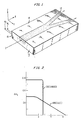
- Waveguide 12 is formed along the X-direction of the substrate.
- the proton exchange process of the present invention results in increasing the extraordinary refractive index ⁇ n e in the unmasked (waveguide) region.
- substrate 10 is immersed in a bath of sulfuric acid, where the acid is maintained at a temperature of, for example, 150°C.
- the proton-exchange process of the present invention may utilize a sulfuric acid bath maintained at a temperature anywhere in the range of, for example, 110°C to 210°C, where only the immersion time, T, must be altered as a function of temperature to obtain the same exchange depth.
- T the immersion time
- the substrate is left in the sulfuric acid bath for a length of time (T) sufficient to provide an adequate exchange of protons and lithium atoms.
- both the immersion time T and sulfuric acid bath temperature t determine the depth d1 (see FIG. 1) which the exchange will reach beneath surface 14 of substrate 10.
- the as-formed waveguide will exhibit a step-shaped refractive index profile, as shown by the curve labeled "Exchanged" in FIG. 2.
- a change in the extraordinary refractive index, ⁇ n e of approximately 0.10 is exhibited in the waveguide region from top surface 14 of substrate 10 to a depth d1 of approximately 2.5 microns. Since this depth which may be reached with the proton exchange process) is not sufficient to allow the coupling and propagation of an input light signal, substrate 10 must be annealed at an elevated temperature for a period of time sufficient to drive the protons to an adequate depth.
- an anneal in an air ambient at 360°C for 4-5 hours has been found to provide a sufficient proton migration, resulting in the gradient-shaped refractive index profile, labeled "Annealed", as shown in FIG. 2.
- the particular anneal process utilized to provide this movement results in migrating a portion of the proton population to a depth d2 of approximately 6 microns into the lithium niobate substrate.
- the "Anneal" profile also indicates a decrease in the refractive index change at the surface of the substrate, dropping from a ⁇ n e of 0.10 after exchange to a ⁇ n e of 0.06 after anneal. This latter value has been found to be sufficient to providing adequate guiding of the TE mode through the proton-exchange waveguide.
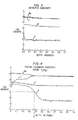
- Oxygen is likewise uniformly present, although at a lesser quantity (approximately 8x10⁴ counts/area). A slight amount of hydrogen (approximately 100 counts/area) is also present at the top of the substrate, due to water and other hydrogen-containing contaminants which may be present on the surface.
- the sulfuric acid proton exchange process of the present invention introduces a substantial amount of hydrogen into the surface of the substrate, from a level of approximately 5x10⁴ counts/area at top surface 14, to a level of 1x10³ counts/area at a depth d1 of approximately 0.35 microns.
- This particular SIMS profile is the result of analyzing a proton-exchanged waveguide formed by immersing the masked substrate into a 144°C bath of sulfuric acid for several hours (immersions may be for any time period from 30 minutes to over 15 hours).
- the lithium population exhibits a significant decrease (of approximately two orders of magnitude) within the portion of the substrate that experienced the exchange with the hydrogen.
- FIG. 5 illustrates the same substrate, subsequent to an anneal at a temperature of 360°C for approximately 4-5 hours.
- the hydrogen has migrated further into the lithium niobate substrate, resulting in a relatively uniform distribution from the surface to a depth d2 of at least 1.0 micron.
- This anneal process also causes the lithium present below the exchange layer to migrate upwards, providing a lithium population near the surface substantially equal to that present prior to the exchange process (see FIG. 3). This return of lithium to the surface is seen as ensuring that the annealed lithium niobate structure is relatively stable and impervious to further change.
- ⁇ T and d1 there is a distinct linear relationship between ⁇ T and d1, with the exchange depth increasing as the immersion time is increased.
- the exchange depth is likewise increased, in other words, the slope of the proton-exchange depth rate line increases with increasing temperature.
- an exchange process carried out at 164°C for a time of approximately one hour yields an exchange depth of approximately 0.22 microns.
- Increasing the sulfuric acid bath temperature to 184°C while keeping the immersion time at one hour results in an exchange depth of 0.41 microns, a two-fold increase in depth.
Landscapes
- Physics & Mathematics (AREA)
- General Physics & Mathematics (AREA)
- Optics & Photonics (AREA)
- Engineering & Computer Science (AREA)
- Microelectronics & Electronic Packaging (AREA)
- Optical Integrated Circuits (AREA)
Applications Claiming Priority (2)
| Application Number | Priority Date | Filing Date | Title |
|---|---|---|---|
| US18991488A | 1988-05-03 | 1988-05-03 | |
| US189914 | 1988-05-03 |
Publications (3)
| Publication Number | Publication Date |
|---|---|
| EP0340983A2 true EP0340983A2 (fr) | 1989-11-08 |
| EP0340983A3 EP0340983A3 (en) | 1990-10-10 |
| EP0340983B1 EP0340983B1 (fr) | 1993-07-28 |
Family
ID=22699289
Family Applications (1)
| Application Number | Title | Priority Date | Filing Date |
|---|---|---|---|
| EP89304293A Expired - Lifetime EP0340983B1 (fr) | 1988-05-03 | 1989-04-28 | Méthode d'échange de protons pour former des guides d'onde optiques |
Country Status (6)
| Country | Link |
|---|---|
| EP (1) | EP0340983B1 (fr) |
| JP (1) | JPH079494B2 (fr) |
| KR (1) | KR890017554A (fr) |
| CA (1) | CA1324261C (fr) |
| DE (1) | DE68907781T2 (fr) |
| ES (1) | ES2041993T3 (fr) |
Cited By (2)
| Publication number | Priority date | Publication date | Assignee | Title |
|---|---|---|---|---|
| EP0518059A1 (fr) * | 1991-05-10 | 1992-12-16 | ALENIA AERITALIA & SELENIA S.P.A. | Fabrication de guides d'onde optiques en forme de sillon en LiNbO3 |
| GB2340957A (en) * | 1998-07-31 | 2000-03-01 | Litton Systems Inc | Making proton-exchange waveguides |
Family Cites Families (3)
| Publication number | Priority date | Publication date | Assignee | Title |
|---|---|---|---|---|
| US4547262A (en) * | 1984-08-30 | 1985-10-15 | Sperry Corporation | Method for forming thin film passive light waveguide circuit |
| JPS6159403A (ja) * | 1984-08-31 | 1986-03-26 | Canon Inc | 光導波路レンズの作製方法 |
| JPS61275806A (ja) * | 1985-05-31 | 1986-12-05 | Matsushita Electric Ind Co Ltd | 光素子形成方法 |
-
1989
- 1989-04-26 CA CA000597817A patent/CA1324261C/fr not_active Expired - Fee Related
- 1989-04-28 ES ES198989304293T patent/ES2041993T3/es not_active Expired - Lifetime
- 1989-04-28 EP EP89304293A patent/EP0340983B1/fr not_active Expired - Lifetime
- 1989-04-28 DE DE89304293T patent/DE68907781T2/de not_active Expired - Fee Related
- 1989-05-01 KR KR1019890005806A patent/KR890017554A/ko not_active Ceased
- 1989-05-02 JP JP1112402A patent/JPH079494B2/ja not_active Expired - Lifetime
Cited By (2)
| Publication number | Priority date | Publication date | Assignee | Title |
|---|---|---|---|---|
| EP0518059A1 (fr) * | 1991-05-10 | 1992-12-16 | ALENIA AERITALIA & SELENIA S.P.A. | Fabrication de guides d'onde optiques en forme de sillon en LiNbO3 |
| GB2340957A (en) * | 1998-07-31 | 2000-03-01 | Litton Systems Inc | Making proton-exchange waveguides |
Also Published As
| Publication number | Publication date |
|---|---|
| DE68907781D1 (de) | 1993-09-02 |
| JPH0277003A (ja) | 1990-03-16 |
| CA1324261C (fr) | 1993-11-16 |
| DE68907781T2 (de) | 1994-02-10 |
| EP0340983B1 (fr) | 1993-07-28 |
| EP0340983A3 (en) | 1990-10-10 |
| KR890017554A (ko) | 1989-12-16 |
| JPH079494B2 (ja) | 1995-02-01 |
| ES2041993T3 (es) | 1993-12-01 |
Similar Documents
| Publication | Publication Date | Title |
|---|---|---|
| Armenise | Fabrication techniques of lithium niobate waveguides | |
| US4547262A (en) | Method for forming thin film passive light waveguide circuit | |
| US4400052A (en) | Method for manufacturing birefringent integrated optics devices | |
| US4740265A (en) | Process for producing an optical waveguide and the product therefrom | |
| US4948407A (en) | Proton exchange method of forming waveguides in LiNbO3 | |
| EP0260416B1 (fr) | Dispositif à guide d'onde planaire | |
| EP0340983B1 (fr) | Méthode d'échange de protons pour former des guides d'onde optiques | |
| Zavada et al. | Correlation of refractive index profiles with substitutional hydrogen concentrations in annealed proton‐exchanged LiNbO3 waveguides | |
| Wong et al. | Characterisation of proton-exchange slab optical waveguides in x-cut LiNbO3 | |
| Ziling et al. | Proton exchanged and post-exchange annealed LiTaO sub (3) waveguides. | |
| Pun et al. | Proton-exchanged optical waveguides in Z-cut LiNbO/sub 3/using phosphoric acid | |
| Loni et al. | Optical characterisation of Z-cut proton-exchanged LiNbO3 waveguides fabricated using orthophosphoric and pyrophosphoric acid | |
| Dutta et al. | Use of laser annealing to achieve low loss in Corning 7059 glass, ZnO, Si3N4, Nb205, and Ta205 optical thin-film waveguides | |
| US6518078B2 (en) | Articles useful as optical waveguides and method for manufacturing same | |
| Chartier et al. | Low temperature ion substitution in soda-lime glass by means of an electric field | |
| Yip et al. | Characterisation of proton-exchanged and annealed proton-exchanged planar waveguides in z-cut LiNbO3 | |
| Chen | A new technique for waveguide formation in LiNbO3 | |
| SU1295352A1 (ru) | Способ изготовлени оптического волновода на основе кристалла ниобата лити | |
| Chung et al. | Comparative analysis of refractive-index profiles in diffused optical waveguides | |
| Göring et al. | Optimization of integrated optic components by refractive index profile measurements | |
| JPS6385506A (ja) | 中赤外スペクトル用光導波路の製造方法 | |
| Onodera et al. | Nb‐diffused LiTaO3 waveguides and light modulators by use of guided‐to‐radiation mode coupling | |
| Parmenter et al. | Fabrication of Titanium-In-Diffused Lithium Niobate Optical Waveguides by Laser Annealing at 10.6 μm | |
| GB2340957A (en) | Making proton-exchange waveguides | |
| GB2215855A (en) | Manufacture of an optical waveguide using ion exchange |
Legal Events
| Date | Code | Title | Description |
|---|---|---|---|
| PUAI | Public reference made under article 153(3) epc to a published international application that has entered the european phase |
Free format text: ORIGINAL CODE: 0009012 |
|
| AK | Designated contracting states |
Kind code of ref document: A2 Designated state(s): DE ES FR GB NL SE |
|
| PUAL | Search report despatched |
Free format text: ORIGINAL CODE: 0009013 |
|
| AK | Designated contracting states |
Kind code of ref document: A3 Designated state(s): DE ES FR GB NL SE |
|
| 17P | Request for examination filed |
Effective date: 19901212 |
|
| 17Q | First examination report despatched |
Effective date: 19920622 |
|
| GRAA | (expected) grant |
Free format text: ORIGINAL CODE: 0009210 |
|
| AK | Designated contracting states |
Kind code of ref document: B1 Designated state(s): DE ES FR GB NL SE |
|
| REF | Corresponds to: |
Ref document number: 68907781 Country of ref document: DE Date of ref document: 19930902 |
|
| ET | Fr: translation filed | ||
| REG | Reference to a national code |
Ref country code: ES Ref legal event code: FG2A Ref document number: 2041993 Country of ref document: ES Kind code of ref document: T3 |
|
| PLBE | No opposition filed within time limit |
Free format text: ORIGINAL CODE: 0009261 |
|
| STAA | Information on the status of an ep patent application or granted ep patent |
Free format text: STATUS: NO OPPOSITION FILED WITHIN TIME LIMIT |
|
| RAP4 | Party data changed (patent owner data changed or rights of a patent transferred) |
Owner name: AT&T CORP. |
|
| 26N | No opposition filed | ||
| EAL | Se: european patent in force in sweden |
Ref document number: 89304293.7 |
|
| PGFP | Annual fee paid to national office [announced via postgrant information from national office to epo] |
Ref country code: SE Payment date: 20010321 Year of fee payment: 13 |
|
| PGFP | Annual fee paid to national office [announced via postgrant information from national office to epo] |
Ref country code: FR Payment date: 20010322 Year of fee payment: 13 |
|
| PGFP | Annual fee paid to national office [announced via postgrant information from national office to epo] |
Ref country code: GB Payment date: 20010326 Year of fee payment: 13 |
|
| PGFP | Annual fee paid to national office [announced via postgrant information from national office to epo] |
Ref country code: NL Payment date: 20010327 Year of fee payment: 13 |
|
| PGFP | Annual fee paid to national office [announced via postgrant information from national office to epo] |
Ref country code: ES Payment date: 20010418 Year of fee payment: 13 |
|
| PGFP | Annual fee paid to national office [announced via postgrant information from national office to epo] |
Ref country code: DE Payment date: 20010629 Year of fee payment: 13 |
|
| REG | Reference to a national code |
Ref country code: GB Ref legal event code: IF02 |
|
| PG25 | Lapsed in a contracting state [announced via postgrant information from national office to epo] |
Ref country code: GB Free format text: LAPSE BECAUSE OF NON-PAYMENT OF DUE FEES Effective date: 20020428 |
|
| PG25 | Lapsed in a contracting state [announced via postgrant information from national office to epo] |
Ref country code: SE Free format text: LAPSE BECAUSE OF NON-PAYMENT OF DUE FEES Effective date: 20020429 Ref country code: ES Free format text: LAPSE BECAUSE OF NON-PAYMENT OF DUE FEES Effective date: 20020429 |
|
| PG25 | Lapsed in a contracting state [announced via postgrant information from national office to epo] |
Ref country code: NL Free format text: LAPSE BECAUSE OF NON-PAYMENT OF DUE FEES Effective date: 20021101 Ref country code: DE Free format text: LAPSE BECAUSE OF NON-PAYMENT OF DUE FEES Effective date: 20021101 |
|
| EUG | Se: european patent has lapsed |
Ref document number: 89304293.7 |
|
| GBPC | Gb: european patent ceased through non-payment of renewal fee |
Effective date: 20020428 |
|
| PG25 | Lapsed in a contracting state [announced via postgrant information from national office to epo] |
Ref country code: FR Free format text: LAPSE BECAUSE OF NON-PAYMENT OF DUE FEES Effective date: 20021231 |
|
| NLV4 | Nl: lapsed or anulled due to non-payment of the annual fee |
Effective date: 20021101 |
|
| REG | Reference to a national code |
Ref country code: FR Ref legal event code: ST |
|
| REG | Reference to a national code |
Ref country code: ES Ref legal event code: FD2A Effective date: 20030514 |