EP0343092A1 - Verfahren und Anlage für die Entkeimung von Badewasser durch elektrochemisch in situ-erzeugtes Natriumhypochlorit - Google Patents
Verfahren und Anlage für die Entkeimung von Badewasser durch elektrochemisch in situ-erzeugtes Natriumhypochlorit Download PDFInfo
- Publication number
- EP0343092A1 EP0343092A1 EP89430013A EP89430013A EP0343092A1 EP 0343092 A1 EP0343092 A1 EP 0343092A1 EP 89430013 A EP89430013 A EP 89430013A EP 89430013 A EP89430013 A EP 89430013A EP 0343092 A1 EP0343092 A1 EP 0343092A1
- Authority
- EP
- European Patent Office
- Prior art keywords
- water
- circuit
- main circuit
- sodium chloride
- cells
- Prior art date
- Legal status (The legal status is an assumption and is not a legal conclusion. Google has not performed a legal analysis and makes no representation as to the accuracy of the status listed.)
- Granted
Links
- XLYOFNOQVPJJNP-UHFFFAOYSA-N water Substances O XLYOFNOQVPJJNP-UHFFFAOYSA-N 0.000 title claims abstract description 126
- 238000000034 method Methods 0.000 title claims abstract description 29
- SUKJFIGYRHOWBL-UHFFFAOYSA-N sodium hypochlorite Chemical compound [Na+].Cl[O-] SUKJFIGYRHOWBL-UHFFFAOYSA-N 0.000 title claims abstract description 29
- 238000004659 sterilization and disinfection Methods 0.000 title claims abstract description 24
- 239000005708 Sodium hypochlorite Substances 0.000 title claims abstract description 19
- 238000003287 bathing Methods 0.000 title claims abstract description 14
- 238000004519 manufacturing process Methods 0.000 title description 5
- 238000011065 in-situ storage Methods 0.000 title 1
- FAPWRFPIFSIZLT-UHFFFAOYSA-M Sodium chloride Chemical compound [Na+].[Cl-] FAPWRFPIFSIZLT-UHFFFAOYSA-M 0.000 claims abstract description 85
- 239000011780 sodium chloride Substances 0.000 claims abstract description 43
- ZAMOUSCENKQFHK-UHFFFAOYSA-N Chlorine atom Chemical compound [Cl] ZAMOUSCENKQFHK-UHFFFAOYSA-N 0.000 claims abstract description 41
- 239000000460 chlorine Substances 0.000 claims abstract description 41
- 229910052801 chlorine Inorganic materials 0.000 claims abstract description 41
- 238000011282 treatment Methods 0.000 claims abstract description 38
- 239000000523 sample Substances 0.000 claims abstract description 30
- 230000033228 biological regulation Effects 0.000 claims abstract description 17
- 230000008929 regeneration Effects 0.000 claims abstract description 16
- 238000011069 regeneration method Methods 0.000 claims abstract description 16
- VEXZGXHMUGYJMC-UHFFFAOYSA-N Hydrochloric acid Chemical compound Cl VEXZGXHMUGYJMC-UHFFFAOYSA-N 0.000 claims abstract description 14
- 230000008569 process Effects 0.000 claims abstract description 14
- 230000001105 regulatory effect Effects 0.000 claims abstract description 11
- 239000000243 solution Substances 0.000 claims description 44
- 238000009434 installation Methods 0.000 claims description 34
- 238000005868 electrolysis reaction Methods 0.000 claims description 21
- 238000002156 mixing Methods 0.000 claims description 17
- 238000005259 measurement Methods 0.000 claims description 16
- 150000003839 salts Chemical class 0.000 claims description 13
- 230000000249 desinfective effect Effects 0.000 claims description 12
- 238000007792 addition Methods 0.000 claims description 11
- 238000005086 pumping Methods 0.000 claims description 9
- 238000005660 chlorination reaction Methods 0.000 claims description 8
- 238000002360 preparation method Methods 0.000 claims description 5
- 238000012545 processing Methods 0.000 claims description 3
- RTAQQCXQSZGOHL-UHFFFAOYSA-N Titanium Chemical compound [Ti] RTAQQCXQSZGOHL-UHFFFAOYSA-N 0.000 claims description 2
- 239000002253 acid Substances 0.000 claims description 2
- 238000007599 discharging Methods 0.000 claims description 2
- 238000003487 electrochemical reaction Methods 0.000 claims description 2
- 229910001925 ruthenium oxide Inorganic materials 0.000 claims description 2
- WOCIAKWEIIZHES-UHFFFAOYSA-N ruthenium(iv) oxide Chemical compound O=[Ru]=O WOCIAKWEIIZHES-UHFFFAOYSA-N 0.000 claims description 2
- 239000010936 titanium Substances 0.000 claims description 2
- 229910052719 titanium Inorganic materials 0.000 claims description 2
- 230000009466 transformation Effects 0.000 claims description 2
- 238000009795 derivation Methods 0.000 claims 2
- 238000002347 injection Methods 0.000 claims 2
- 239000007924 injection Substances 0.000 claims 2
- 230000009182 swimming Effects 0.000 abstract description 20
- 238000000746 purification Methods 0.000 abstract description 3
- 230000009471 action Effects 0.000 abstract description 2
- 238000004064 recycling Methods 0.000 abstract description 2
- 238000010586 diagram Methods 0.000 description 7
- CBENFWSGALASAD-UHFFFAOYSA-N Ozone Chemical compound [O-][O+]=O CBENFWSGALASAD-UHFFFAOYSA-N 0.000 description 5
- 239000003381 stabilizer Substances 0.000 description 5
- 239000000645 desinfectant Substances 0.000 description 4
- WQYVRQLZKVEZGA-UHFFFAOYSA-N hypochlorite Chemical compound Cl[O-] WQYVRQLZKVEZGA-UHFFFAOYSA-N 0.000 description 4
- 238000003860 storage Methods 0.000 description 4
- 238000001914 filtration Methods 0.000 description 3
- 238000011045 prefiltration Methods 0.000 description 3
- 239000003643 water by type Substances 0.000 description 3
- KZBUYRJDOAKODT-UHFFFAOYSA-N Chlorine Chemical compound ClCl KZBUYRJDOAKODT-UHFFFAOYSA-N 0.000 description 2
- XEEYBQQBJWHFJM-UHFFFAOYSA-N Iron Chemical compound [Fe] XEEYBQQBJWHFJM-UHFFFAOYSA-N 0.000 description 2
- 241000700605 Viruses Species 0.000 description 2
- 230000008901 benefit Effects 0.000 description 2
- 239000007844 bleaching agent Substances 0.000 description 2
- 239000012267 brine Substances 0.000 description 2
- GDTBXPJZTBHREO-UHFFFAOYSA-N bromine Substances BrBr GDTBXPJZTBHREO-UHFFFAOYSA-N 0.000 description 2
- 229910052794 bromium Inorganic materials 0.000 description 2
- 230000008859 change Effects 0.000 description 2
- 230000001276 controlling effect Effects 0.000 description 2
- 201000010099 disease Diseases 0.000 description 2
- 208000037265 diseases, disorders, signs and symptoms Diseases 0.000 description 2
- 239000013505 freshwater Substances 0.000 description 2
- 230000006870 function Effects 0.000 description 2
- ZFSLODLOARCGLH-UHFFFAOYSA-N isocyanuric acid Chemical compound OC1=NC(O)=NC(O)=N1 ZFSLODLOARCGLH-UHFFFAOYSA-N 0.000 description 2
- 239000007788 liquid Substances 0.000 description 2
- 238000012986 modification Methods 0.000 description 2
- 230000004048 modification Effects 0.000 description 2
- 238000005457 optimization Methods 0.000 description 2
- 238000011084 recovery Methods 0.000 description 2
- HPALAKNZSZLMCH-UHFFFAOYSA-M sodium;chloride;hydrate Chemical compound O.[Na+].[Cl-] HPALAKNZSZLMCH-UHFFFAOYSA-M 0.000 description 2
- 241000224489 Amoeba Species 0.000 description 1
- 206010002383 Angina Pectoris Diseases 0.000 description 1
- 241000193830 Bacillus <bacterium> Species 0.000 description 1
- WKBOTKDWSSQWDR-UHFFFAOYSA-N Bromine atom Chemical compound [Br] WKBOTKDWSSQWDR-UHFFFAOYSA-N 0.000 description 1
- VEXZGXHMUGYJMC-UHFFFAOYSA-M Chloride anion Chemical compound [Cl-] VEXZGXHMUGYJMC-UHFFFAOYSA-M 0.000 description 1
- 206010010741 Conjunctivitis Diseases 0.000 description 1
- 241000195493 Cryptophyta Species 0.000 description 1
- 201000004624 Dermatitis Diseases 0.000 description 1
- 208000004232 Enteritis Diseases 0.000 description 1
- DGAQECJNVWCQMB-PUAWFVPOSA-M Ilexoside XXIX Chemical compound C[C@@H]1CC[C@@]2(CC[C@@]3(C(=CC[C@H]4[C@]3(CC[C@@H]5[C@@]4(CC[C@@H](C5(C)C)OS(=O)(=O)[O-])C)C)[C@@H]2[C@]1(C)O)C)C(=O)O[C@H]6[C@@H]([C@H]([C@@H]([C@H](O6)CO)O)O)O.[Na+] DGAQECJNVWCQMB-PUAWFVPOSA-M 0.000 description 1
- 206010022998 Irritability Diseases 0.000 description 1
- 241000224437 Naegleria gruberi Species 0.000 description 1
- 208000005141 Otitis Diseases 0.000 description 1
- 241000295644 Staphylococcaceae Species 0.000 description 1
- 230000006978 adaptation Effects 0.000 description 1
- 238000005273 aeration Methods 0.000 description 1
- 239000003619 algicide Substances 0.000 description 1
- 230000000844 anti-bacterial effect Effects 0.000 description 1
- 208000010668 atopic eczema Diseases 0.000 description 1
- 230000005540 biological transmission Effects 0.000 description 1
- 238000004061 bleaching Methods 0.000 description 1
- 230000009134 cell regulation Effects 0.000 description 1
- 239000003795 chemical substances by application Substances 0.000 description 1
- 238000005352 clarification Methods 0.000 description 1
- 230000003749 cleanliness Effects 0.000 description 1
- 150000001875 compounds Chemical class 0.000 description 1
- 238000011109 contamination Methods 0.000 description 1
- 238000001816 cooling Methods 0.000 description 1
- 230000001934 delay Effects 0.000 description 1
- 230000001419 dependent effect Effects 0.000 description 1
- 238000013461 design Methods 0.000 description 1
- 238000011161 development Methods 0.000 description 1
- 230000018109 developmental process Effects 0.000 description 1
- 239000003651 drinking water Substances 0.000 description 1
- 235000020188 drinking water Nutrition 0.000 description 1
- 208000019258 ear infection Diseases 0.000 description 1
- 230000000694 effects Effects 0.000 description 1
- 206010014599 encephalitis Diseases 0.000 description 1
- 238000011049 filling Methods 0.000 description 1
- 230000037406 food intake Effects 0.000 description 1
- 230000000855 fungicidal effect Effects 0.000 description 1
- 239000000417 fungicide Substances 0.000 description 1
- 230000036541 health Effects 0.000 description 1
- 238000010438 heat treatment Methods 0.000 description 1
- QWPPOHNGKGFGJK-UHFFFAOYSA-N hypochlorous acid Chemical compound ClO QWPPOHNGKGFGJK-UHFFFAOYSA-N 0.000 description 1
- 230000006872 improvement Effects 0.000 description 1
- 239000008235 industrial water Substances 0.000 description 1
- 229910052500 inorganic mineral Inorganic materials 0.000 description 1
- 229910052742 iron Inorganic materials 0.000 description 1
- 238000012423 maintenance Methods 0.000 description 1
- 201000011475 meningoencephalitis Diseases 0.000 description 1
- 239000011707 mineral Substances 0.000 description 1
- 210000004400 mucous membrane Anatomy 0.000 description 1
- 210000003097 mucus Anatomy 0.000 description 1
- 238000006386 neutralization reaction Methods 0.000 description 1
- 210000000056 organ Anatomy 0.000 description 1
- 230000002093 peripheral effect Effects 0.000 description 1
- 230000000644 propagated effect Effects 0.000 description 1
- 230000004044 response Effects 0.000 description 1
- 239000013535 sea water Substances 0.000 description 1
- 201000009890 sinusitis Diseases 0.000 description 1
- 239000010802 sludge Substances 0.000 description 1
- 239000011734 sodium Substances 0.000 description 1
- 229910052708 sodium Inorganic materials 0.000 description 1
- 159000000000 sodium salts Chemical class 0.000 description 1
- 238000001179 sorption measurement Methods 0.000 description 1
Images

Classifications
-
- C—CHEMISTRY; METALLURGY
- C02—TREATMENT OF WATER, WASTE WATER, SEWAGE, OR SLUDGE
- C02F—TREATMENT OF WATER, WASTE WATER, SEWAGE, OR SLUDGE
- C02F1/00—Treatment of water, waste water, or sewage
- C02F1/46—Treatment of water, waste water, or sewage by electrochemical methods
- C02F1/461—Treatment of water, waste water, or sewage by electrochemical methods by electrolysis
- C02F1/467—Treatment of water, waste water, or sewage by electrochemical methods by electrolysis by electrochemical disinfection; by electrooxydation or by electroreduction
- C02F1/4672—Treatment of water, waste water, or sewage by electrochemical methods by electrolysis by electrochemical disinfection; by electrooxydation or by electroreduction by electrooxydation
- C02F1/4674—Treatment of water, waste water, or sewage by electrochemical methods by electrolysis by electrochemical disinfection; by electrooxydation or by electroreduction by electrooxydation with halogen or compound of halogens, e.g. chlorine, bromine
-
- C—CHEMISTRY; METALLURGY
- C02—TREATMENT OF WATER, WASTE WATER, SEWAGE, OR SLUDGE
- C02F—TREATMENT OF WATER, WASTE WATER, SEWAGE, OR SLUDGE
- C02F1/00—Treatment of water, waste water, or sewage
- C02F1/001—Processes for the treatment of water whereby the filtration technique is of importance
-
- C—CHEMISTRY; METALLURGY
- C02—TREATMENT OF WATER, WASTE WATER, SEWAGE, OR SLUDGE
- C02F—TREATMENT OF WATER, WASTE WATER, SEWAGE, OR SLUDGE
- C02F2103/00—Nature of the water, waste water, sewage or sludge to be treated
- C02F2103/42—Nature of the water, waste water, sewage or sludge to be treated from bathing facilities, e.g. swimming pools
-
- C—CHEMISTRY; METALLURGY
- C02—TREATMENT OF WATER, WASTE WATER, SEWAGE, OR SLUDGE
- C02F—TREATMENT OF WATER, WASTE WATER, SEWAGE, OR SLUDGE
- C02F2201/00—Apparatus for treatment of water, waste water or sewage
- C02F2201/46—Apparatus for electrochemical processes
- C02F2201/461—Electrolysis apparatus
- C02F2201/46105—Details relating to the electrolytic devices
- C02F2201/4618—Supplying or removing reactants or electrolyte
-
- C—CHEMISTRY; METALLURGY
- C02—TREATMENT OF WATER, WASTE WATER, SEWAGE, OR SLUDGE
- C02F—TREATMENT OF WATER, WASTE WATER, SEWAGE, OR SLUDGE
- C02F2209/00—Controlling or monitoring parameters in water treatment
- C02F2209/05—Conductivity or salinity
-
- C—CHEMISTRY; METALLURGY
- C02—TREATMENT OF WATER, WASTE WATER, SEWAGE, OR SLUDGE
- C02F—TREATMENT OF WATER, WASTE WATER, SEWAGE, OR SLUDGE
- C02F2209/00—Controlling or monitoring parameters in water treatment
- C02F2209/06—Controlling or monitoring parameters in water treatment pH
-
- C—CHEMISTRY; METALLURGY
- C02—TREATMENT OF WATER, WASTE WATER, SEWAGE, OR SLUDGE
- C02F—TREATMENT OF WATER, WASTE WATER, SEWAGE, OR SLUDGE
- C02F2209/00—Controlling or monitoring parameters in water treatment
- C02F2209/29—Chlorine compounds
-
- C—CHEMISTRY; METALLURGY
- C02—TREATMENT OF WATER, WASTE WATER, SEWAGE, OR SLUDGE
- C02F—TREATMENT OF WATER, WASTE WATER, SEWAGE, OR SLUDGE
- C02F2301/00—General aspects of water treatment
- C02F2301/04—Flow arrangements
- C02F2301/043—Treatment of partial or bypass streams
-
- C—CHEMISTRY; METALLURGY
- C02—TREATMENT OF WATER, WASTE WATER, SEWAGE, OR SLUDGE
- C02F—TREATMENT OF WATER, WASTE WATER, SEWAGE, OR SLUDGE
- C02F2303/00—Specific treatment goals
- C02F2303/04—Disinfection
Definitions
- the present invention relates to methods and installations for electrochemical treatment by electrolysis for the disinfection of bathing water by sodium hypochlorite.
- the sector of the invention is that of installations for the treatment and recycling of basins and the purification of water and bathing.
- One of the main applications of the invention is the treatment of fitted bathing water, such as that of public and community swimming pools, or that of water park basins, but also for industrial water.
- the present invention relates essentially to disinfection treatments and, in particular, those of bathing water in basins.
- the regeneration treatment of swimming pool water relates more particularly to "public swimming pools”, but similar standards must be adopted for "private collective swimming pools” and can also apply with some modifications to "leisure pools” than the one meets more and more often in the installations of the amusement parks; much larger than the traditional swimming pool, generally shallow, the leisure pool artificially imitates the natural environment: it can include sandy beaches, etc.
- the swimming pool water regeneration system must be designed to ensure perfect sanitary conditions, but its design is closely linked to regulations which may differ more or less depending on the country. As an example, we will cite the French regulations to which we can refer whenever there is no special regulation in a given country.
- Disinfection is an extremely important stage of treatment. It has a hygienic and an aesthetic purpose. The first consists in avoiding the transmission of diseases by contagion between the different bathers. The second consists in avoiding the development of microcospic algae which cloud the water by giving it a green color.
- the pond water must have a very definite permanent disinfecting power.
- ozone which is the most powerful disinfectant that we know; it does not give any taste or odor and it gives the water a bluish color.
- additional disinfection must be added to the basin because the ozone treatment lacks residual disinfecting power in the water, which is then sensitive to subsequent contamination.
- Ozone water is produced on site using expensive, technically sophisticated equipment that requires energy 20 W / m3 of recycled water. To avoid annoying bathers, it is essential that the ozone is completely eliminated before the reintroduction of water into the basins.
- This type of ozone disinfection was the subject of a patent application such as that of 23.09.1987 in GERMANY by TAMIS and SHLOMO NO. OF. 360,249. However, due to the cost of installation and the absence of residual disinfecting power, barely 5% of swimming pools use this treatment.
- Chlorine and its derivatives which is most commonly used with more than 90% of French swimming pools equipped with facilities using this type of disinfectant. It uses either chlorine gas (more and more abandoned because it is dangerous), or a solution of sodium hypochlorite (bleach), or granular or pebbles incorporating chlorine and a stabilizing agent (most expensive product) .
- the problem is to be able to disinfect the water, in particular in swimming pools, such that the quality of the water complies with the regulations regardless of the number of users and without using active products of difficult and expensive handling brought from the water. 'outside.
- a solution to the problem posed object of the present invention is a method of disinfecting water by treatment of hypochlorite sodium, in particular for the waters of bathing basins, which are recycled, on the one hand in a main regeneration circuit comprising, inter alia, a pumping system discharging into the bottom of said basins and, on the other hand, in a secondary branch circuit parallel to this main circuit and comprising at least one mixing tank for the preparation of a sodium chloride solution and electrolysis cells of any type, under conditions such that it breaks down the chloride of sodium according to known electrochemical reactions, in which: - Preparing said sodium chloride solution at a dosage at least equal to 6 g / liter; - the percentage of active chlorine contained in the water in the basin is measured in said main circuit and this measurement is compared to a set level set and included in a range which may be that required by regulations; - The acidity level of the water or PH is also measured in the main regeneration circuit and it is compared with respect to an optimum setpoint level complying with regulatory standards
- Another solution to the problem posed is an installation for disinfecting water by treatment with sodium hypochlorite, in particular for swimming pools, comprising, on the one hand, a main regeneration circuit composed inter alia of a system of pumping, pumping into the bottom of said basins and, on the other hand, at least one secondary circuit for bypass in parallel with this main circuit and comprising at least one mixing tank, containing a solution of sodium chloride and electrolysis cells of any type and which are regulated in a known manner so that the sodium chloride contained in the water which passes through them, is decomposed to obtain sodium hypochlorite, said installation also includes: - Means for renewing the sodium chloride solution prepared in said mixing tank on the one hand, by external additions of salt, and on the other hand, by water from the main circuit diverted on demand, such so that the solution is concentrated to a minimum dosage of 6 g / liter; - at least one continuous measurement probe per cycle of active chlorine level in the main circuit; another secondary circuit, independent of that containing said cells and connected in diversion
- the result is a new process and a new treatment plant for water disinfection, in particular in treatment basins for water disinfection, in particular in closed-circuit regeneration basins intended for bathing.
- hypochlorite on site makes it possible to adapt to immediate needs with therefore a very short response time and thus real protection for users by permanent compliance with standards.
- this process avoids the addition of stabilizers, in general isocyanuric acid, which is often incorporated in the products providing the necessary chlorine so that it does not evaporate too quickly depending on the temperature and the outdoor humidity.
- this stabilizer is not consumed and must not have a concentration greater than 75 ppm. Also, it is necessary to renew the water to reduce its concentration, which in some cases may require more than 30 liters / day per new water bather.
- Another advantage of the present process is its absence of risk with regard to the personnel responsible for the maintenance of the swimming pools, who no longer handle more than a few dangerous products.
- the entire processing part can indeed be automated and operate without supervision and in complete safety.
- the application of the methods and installations which are the subject of the present invention is the treatment for the disinfection of bathing water in all types of pools, such as those of public and collective pools, competition pools of Olympic type, and those of parks. leisure water sports.
- Said basins can be single, multiple and / or mixed type depending on the case, the corresponding installation can then be modulated and adapted to each need.
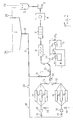
- Figure 1 is an installation diagram for the electrolysis treatment for the disinfection of the water of a basin 1, to receive for example from the public and can be permanently salted.
- FIG. 1 This diagram of FIG. 1 comprises a known main regeneration circuit 9, which operates according to the principle of reverse hydraulicity.
- the water in the basin 1, which is therefore here salty is collected in an overflow chute 24 placed at the level of the water surface.
- the water then flows into a recovery tank 2 where one carries out, on the one hand any contributions of dilute sodium chloride NaCl and the additional fresh water necessary 23 to maintain the level in the basin and to ensure a possible renewal.
- This water is then sucked by pumps 4 through a prefilter 3 to be discharged into a filtration system 5, then into a heater 6, before being sent to the bottom of the basin 1 through the stop valve 15.
- the first circuit 17 itself comprises two parallel circuits composed on the one hand of a tank 7 containing a concentrated solution of sodium chloride NaCl, and on the other hand of a tank 8 containing a concentrated solution of hydrochloric acid . These two tanks are supplied to keep a constant level through two 251, 252 valves. Additions of basic product are also made regularly in these tanks to maintain in them a level of concentration greater than that required in circuit 9.
- the tank 7 is equipped with a metering pump 162, controlled manually or automatically by the salinometric probe 22 placed at the inlet of the second secondary circuit 18 and which measures the level of sodium chloride contained in the main circuit.
- this rate is chosen to be low and can be fixed for example between two thresholds between 2 and 6 g / liter of water.
- the metering pump 162 starts up and adds sodium chloride solution to the main circuit until the upper threshold is reached.
- the tank 8 is also equipped with a metering pump 161 controlled manually or automatically by the probe 20 placed at the outlet of the second secondary circuit 18 and which measures the pH of the water.
- a metering pump 161 controlled manually or automatically by the probe 20 placed at the outlet of the second secondary circuit 18 and which measures the pH of the water.
- this pH level can be fixed around 7.1 to 7.4.
- the second secondary circuit 18 comprises, in addition to the two probes 20 and 22, one or two inlet valves 12, jointly controlled manually or automatically, with the valve 11 of the main circuit, in order to adjust the respective flow passing through the two circuits.
- These valves are controlled as a function of the measurement of the active chlorine HClO detected by the probe 21.
- the bypass valves 11 and 12 then send water flow in the secondary circuit 18 to be treated in the electrochemical cells 10.
- Those -these can be of the bipolar type with titanium plate coated with ruthenium oxide, supplied with variable low-voltage direct current up to 48 V s, preferably with a maximum of 32 V at an intensity of 300 amperes per m2, for treat the water which is in low saline concentration, ie from 2 to 30 g / l for example.
- NaCl + H2O ⁇ NaClO + H2 distributed between the cathode and the anode.
- NaClO sodium hypochlorite or bleach
- the installation includes several cells placed in parallel and which can be activated by independent circuit, here, we have figured for example, two groups of three cells.
- probes, valves, cells and pumps can be controlled and operated manually, but also automatically, from a programmable controller controlling a control cabinet. This then receives input information, the measurements sent by probes 20, 21 and 22, the liquid levels in tanks 7 and 8, the flowmeter values 19 and any fault alarm signal.
- Set points are set in the PLC program memory corresponding to the set thresholds defined for each NaCl, HC1 and NaClO rate, and which can be changed by the user.
- Cycle durations can be defined, for example 10 minutes at the start of which all the measurements of the probes are taken and compared with respect to the maximum threshold, then the flow rate, the theoretical time and the number of cells necessary for the calculation are calculated. water treatment in order to raise the ClO and NaCl content to these maximum thresholds, while maintaining a pH content within the chosen range.
- the regulation automaton then controls, during the calculated time, the opening of the valves, the starting of the pumps and the cells corresponding to the results of said calculation.
- FIG. 2 is a diagram of an installation for treatment by electrolysis, with a view to disinfecting the water of a basin 1 ′ which must receive, for example from the public, but which must not be salted, either for reasons of competition , or for practical reasons of regulation when there are several basins to be treated comprising a single main regeneration circuit, when their needs for active chlorine may be different.
- the first circuit 17 ′ is equivalent to one of the branches of the circuit 17 of FIG. 1. It comprises a tank 8 ′ containing a concentrated solution of hydrochloric acid supplied through a valve 25′1 by the main circuit. This tank is equipped with a dosing pump 16′1, controlled manually or automatically by the probe 20 ′ placed at the inlet of this circuit 17 ′ and which measures the pH of the water. The operation and the pH levels are identical to those of FIG. 1.
- the second circuit 18 ′ also closes on the main circuit but has a closed loop, buffer tanks 26 and 27, which do not exist in the diagram in FIG. 1.
- valves 31 and 32 being then closed, the valve 30 is opened, all the other valves 12 ′ and 13 ′ remaining open, and a circulation flow is ensured by a pump 27 through the electrochemical cells 10 ′ which may be of the same type as those defined in Figure 1 and which are arranged in parallel and in series to treat the maximum flow circulating in this secondary circuit, itself dependent on the volumes of the tank 26 and the duration of the cycles, defined themselves according to the volume of the basin l and its rate of frequentation of users.
- the duration of the treatment by the cells is calculated so that in end of cycle the NaClO level or the chlorine concentration contained in the chlorination tank 26, for example from 10 to 70 g / liter and that the sodium chloride is practically eliminated by transformation.
- Said chlorination tank thus remains full until said storage tank 28 is empty.
- the valve 31 is then opened by simultaneously closing the valve 30 and the concentrated solution containing 2g / liter of NaClO from the tank 26 is transferred to the tank 28 by the pump 27.
- the position of the valves 30 and 31 is then reversed and a new cycle solution preparation in closed circuit from the brine prepared in the tank 7 ′ can start again.
- the concentrated NaClO solution is injected independently into the main circuit 9 ′ through a metering pump 29, controlled manually or automatically by a probe 21 ′ measuring the level of active chlorine in the main circuit as described in figure 1.
- a probe 21 ′ measuring the level of active chlorine in the main circuit as described in figure 1.
- this operation of probes, valves, cells and pumps can be controlled manually, but also automatically from a programmable controller controlling a control cabinet.
- the program is simplified, but the input organs and output controls are the same, and the regulation of cells more difficult.
Landscapes
- Chemical & Material Sciences (AREA)
- Engineering & Computer Science (AREA)
- Electrochemistry (AREA)
- General Chemical & Material Sciences (AREA)
- Life Sciences & Earth Sciences (AREA)
- Hydrology & Water Resources (AREA)
- Chemical Kinetics & Catalysis (AREA)
- Environmental & Geological Engineering (AREA)
- Water Supply & Treatment (AREA)
- Organic Chemistry (AREA)
- Water Treatment By Electricity Or Magnetism (AREA)
- Treatment Of Water By Oxidation Or Reduction (AREA)
- Apparatus For Disinfection Or Sterilisation (AREA)
Priority Applications (1)
| Application Number | Priority Date | Filing Date | Title |
|---|---|---|---|
| AT89430013T ATE88165T1 (de) | 1988-05-20 | 1989-05-19 | Verfahren und anlage fuer die entkeimung von badewasser durch elektrochemisch in situerzeugtes natriumhypochlorit. |
Applications Claiming Priority (2)
| Application Number | Priority Date | Filing Date | Title |
|---|---|---|---|
| FR8806984A FR2631622B1 (fr) | 1988-05-20 | 1988-05-20 | Procede et installation de desinfection des eaux de baignade par de l'hypochlorite de sodium produit electrochimiquement in situ |
| FR8806984 | 1988-05-20 |
Publications (2)
| Publication Number | Publication Date |
|---|---|
| EP0343092A1 true EP0343092A1 (de) | 1989-11-23 |
| EP0343092B1 EP0343092B1 (de) | 1993-04-14 |
Family
ID=9366621
Family Applications (1)
| Application Number | Title | Priority Date | Filing Date |
|---|---|---|---|
| EP89430013A Expired - Lifetime EP0343092B1 (de) | 1988-05-20 | 1989-05-19 | Verfahren und Anlage für die Entkeimung von Badewasser durch elektrochemisch in situ-erzeugtes Natriumhypochlorit |
Country Status (4)
| Country | Link |
|---|---|
| EP (1) | EP0343092B1 (de) |
| AT (1) | ATE88165T1 (de) |
| DE (1) | DE68905957D1 (de) |
| FR (1) | FR2631622B1 (de) |
Cited By (12)
| Publication number | Priority date | Publication date | Assignee | Title |
|---|---|---|---|---|
| FR2682673A1 (fr) * | 1991-10-18 | 1993-04-23 | Nicoloff Pierre | Generateur electrolytique d'hypochlorite de sodium pour le traitement de l'eau. |
| FR2704872A1 (fr) * | 1993-05-07 | 1994-11-10 | Nicoloff Pierre | Dispositif producteur d'hypochlorite de sodium pour la désinfection de l'eau en particulier l'eau de piscine. |
| WO1999024369A3 (en) * | 1997-11-07 | 1999-09-10 | Bioquest | Amperometric halogen control system |
| FR2803841A1 (fr) * | 2000-01-18 | 2001-07-20 | Inst Francais Du Petrole | Dispositif et procede de desinfection et de lutte contre la legionellose dans des equipements de distribution d'eau chaude sanitaire |
| EP1108683A3 (de) * | 1999-12-14 | 2002-01-09 | Sanyo Electric Co., Ltd. | Wasserbehandlungsvorrichtung |
| EP1108684A3 (de) * | 1999-12-16 | 2002-01-09 | Sanyo Electric Co., Ltd. | Wasserbehandlungsvorrichtung |
| EP1118589A3 (de) * | 1993-10-27 | 2002-02-27 | Halox Technologies Corp. | Verfahren und Vorrichtung zur Vor-Ort-Halogenbehandlung von wässrigen Lösungen |
| EP1262459A1 (de) * | 2001-05-28 | 2002-12-04 | Sanyo Electric Co., Ltd. | Wasserbehandlungsanlage |
| EP1721868A1 (de) * | 2005-05-13 | 2006-11-15 | Osg Corporation Co., Ltd. | Zusatzlösung zur Verwendung in der Herstellung von sterilisierendem, unterchlorige Säure enthaltenden elektrolysierten Wasser |
| WO2012011107A1 (en) * | 2010-07-22 | 2012-01-26 | Argad Eyal Water Treatment Industries Ltd | A method and apparatus for treating drinking water |
| CN104338427A (zh) * | 2013-08-09 | 2015-02-11 | 攀钢集团钛业有限责任公司 | 一种镁电解含氯废气的处理方法 |
| US8986606B2 (en) | 2008-05-23 | 2015-03-24 | Kemira Oyj | Chemistry for effective microbe control with reduced gas phase corrosiveness in pulp and paper processing systems |
Citations (7)
| Publication number | Priority date | Publication date | Assignee | Title |
|---|---|---|---|---|
| FR1221375A (fr) * | 1959-03-21 | 1960-06-01 | Procédé et système pour chlorer l'eau des piscines ou nappes analogues | |
| US3458414A (en) * | 1967-11-24 | 1969-07-29 | William W T Crane | Swimming pool water conditioner |
| US3718540A (en) * | 1971-04-19 | 1973-02-27 | Int Research & Dev Co Ltd | Electrolytic cells |
| GB1426017A (en) * | 1973-04-27 | 1976-02-25 | Discovery R D Ltd | Water treatment |
| US4085028A (en) * | 1974-11-21 | 1978-04-18 | Electro-Chlor Corporation | Electrolytic chlorination device |
| US4171256A (en) * | 1978-11-03 | 1979-10-16 | Tim Themy | Chlorine generation apparatus |
| US4381240A (en) * | 1981-05-05 | 1983-04-26 | Harry M. Weiss | Swimming pool water conditioning system |
-
1988
- 1988-05-20 FR FR8806984A patent/FR2631622B1/fr not_active Expired - Lifetime
-
1989
- 1989-05-19 DE DE8989430013T patent/DE68905957D1/de not_active Expired - Lifetime
- 1989-05-19 EP EP89430013A patent/EP0343092B1/de not_active Expired - Lifetime
- 1989-05-19 AT AT89430013T patent/ATE88165T1/de not_active IP Right Cessation
Patent Citations (7)
| Publication number | Priority date | Publication date | Assignee | Title |
|---|---|---|---|---|
| FR1221375A (fr) * | 1959-03-21 | 1960-06-01 | Procédé et système pour chlorer l'eau des piscines ou nappes analogues | |
| US3458414A (en) * | 1967-11-24 | 1969-07-29 | William W T Crane | Swimming pool water conditioner |
| US3718540A (en) * | 1971-04-19 | 1973-02-27 | Int Research & Dev Co Ltd | Electrolytic cells |
| GB1426017A (en) * | 1973-04-27 | 1976-02-25 | Discovery R D Ltd | Water treatment |
| US4085028A (en) * | 1974-11-21 | 1978-04-18 | Electro-Chlor Corporation | Electrolytic chlorination device |
| US4171256A (en) * | 1978-11-03 | 1979-10-16 | Tim Themy | Chlorine generation apparatus |
| US4381240A (en) * | 1981-05-05 | 1983-04-26 | Harry M. Weiss | Swimming pool water conditioning system |
Cited By (20)
| Publication number | Priority date | Publication date | Assignee | Title |
|---|---|---|---|---|
| FR2682673A1 (fr) * | 1991-10-18 | 1993-04-23 | Nicoloff Pierre | Generateur electrolytique d'hypochlorite de sodium pour le traitement de l'eau. |
| FR2704872A1 (fr) * | 1993-05-07 | 1994-11-10 | Nicoloff Pierre | Dispositif producteur d'hypochlorite de sodium pour la désinfection de l'eau en particulier l'eau de piscine. |
| EP1118589A3 (de) * | 1993-10-27 | 2002-02-27 | Halox Technologies Corp. | Verfahren und Vorrichtung zur Vor-Ort-Halogenbehandlung von wässrigen Lösungen |
| WO1999024369A3 (en) * | 1997-11-07 | 1999-09-10 | Bioquest | Amperometric halogen control system |
| US6238555B1 (en) | 1997-11-07 | 2001-05-29 | Bioquest | Amperometric halogen control system |
| US6270680B1 (en) | 1997-11-07 | 2001-08-07 | Bioquest | Amperometric sensor probe for an automatic halogen control system |
| AU749759B2 (en) * | 1997-11-07 | 2002-07-04 | Bioquest Llc | Amperometric halogen control system |
| EP1108683A3 (de) * | 1999-12-14 | 2002-01-09 | Sanyo Electric Co., Ltd. | Wasserbehandlungsvorrichtung |
| US6627053B2 (en) | 1999-12-14 | 2003-09-30 | Sanyo Electric Co., Ltd. | Water treatment device |
| US6627073B2 (en) | 1999-12-16 | 2003-09-30 | Sanyo Electric Co, Ltd. | Water treatment device |
| KR100404949B1 (ko) * | 1999-12-16 | 2003-11-10 | 산요덴키가부시키가이샤 | 용수처리장치 |
| EP1108684A3 (de) * | 1999-12-16 | 2002-01-09 | Sanyo Electric Co., Ltd. | Wasserbehandlungsvorrichtung |
| EP1118586A1 (de) * | 2000-01-18 | 2001-07-25 | Institut Francais Du Petrole | Verfahren und Vorrichtung zur Desinzifierung und Bekämpfung von Legionellosis in Warmwasserversorgungseinrichtungen |
| FR2803841A1 (fr) * | 2000-01-18 | 2001-07-20 | Inst Francais Du Petrole | Dispositif et procede de desinfection et de lutte contre la legionellose dans des equipements de distribution d'eau chaude sanitaire |
| EP1262459A1 (de) * | 2001-05-28 | 2002-12-04 | Sanyo Electric Co., Ltd. | Wasserbehandlungsanlage |
| US6814858B2 (en) | 2001-05-28 | 2004-11-09 | Sanyo Electric Co., Ltd. | Water treatment system |
| EP1721868A1 (de) * | 2005-05-13 | 2006-11-15 | Osg Corporation Co., Ltd. | Zusatzlösung zur Verwendung in der Herstellung von sterilisierendem, unterchlorige Säure enthaltenden elektrolysierten Wasser |
| US8986606B2 (en) | 2008-05-23 | 2015-03-24 | Kemira Oyj | Chemistry for effective microbe control with reduced gas phase corrosiveness in pulp and paper processing systems |
| WO2012011107A1 (en) * | 2010-07-22 | 2012-01-26 | Argad Eyal Water Treatment Industries Ltd | A method and apparatus for treating drinking water |
| CN104338427A (zh) * | 2013-08-09 | 2015-02-11 | 攀钢集团钛业有限责任公司 | 一种镁电解含氯废气的处理方法 |
Also Published As
| Publication number | Publication date |
|---|---|
| ATE88165T1 (de) | 1993-04-15 |
| FR2631622A1 (fr) | 1989-11-24 |
| FR2631622B1 (fr) | 1993-07-09 |
| DE68905957D1 (de) | 1993-05-19 |
| EP0343092B1 (de) | 1993-04-14 |
Similar Documents
| Publication | Publication Date | Title |
|---|---|---|
| US4416854A (en) | Method for killing water borne microorganisms | |
| EP2746227B1 (de) | Ortsgebundenes Desinfektionsverfahren für große Gewässer | |
| EP0343092B1 (de) | Verfahren und Anlage für die Entkeimung von Badewasser durch elektrochemisch in situ-erzeugtes Natriumhypochlorit | |
| US8470143B2 (en) | Advanced chlorine generating system | |
| US7575691B2 (en) | Method for cleaning contained bodies of water | |
| WO2016017896A1 (ko) | 멸균 양식수 제조방법과 이를 이용한 유수식 멸균수 어류 양식방법 | |
| WO2002038507A1 (en) | Method and apparatus for maintaining the water in a swimming pool in a safe state | |
| US20160122210A1 (en) | Water sanitizing system with a hydrolysis cell and ozone generator | |
| FR3027612A1 (fr) | Dispositif de desinfection de l'eau a configurations multiples utilisant une cellule d'electrolyse | |
| KR100947256B1 (ko) | 수처리용 전해 장치 | |
| EP1167297B1 (de) | Verfahren zur physikalisch-chemischen Behandlung von Wasser eines Schwimmbeckens | |
| KR100679181B1 (ko) | 수영장용 살균처리장치 | |
| JP3843365B2 (ja) | 水質浄化方法及びその機構 | |
| JP7763478B2 (ja) | 魚介類の閉鎖循環式陸上養殖用浄化システム、および該システムに適用される陸上養殖用電解処理装置、養殖水槽の水質改善方法 | |
| JP2716768B2 (ja) | 水の次亜臭素化 | |
| US20130118917A1 (en) | Bathing water, method for the production and system comprising a bathing or swimming pool | |
| RU2182125C1 (ru) | Комбинированный способ обеззараживания воды | |
| JP4039869B2 (ja) | 水処理装置 | |
| KR100922866B1 (ko) | 수처리용 전해방법 | |
| JPH11347556A (ja) | 電気化学的水処理装置及び方法 | |
| CN103880128B (zh) | 用于大型水体的局部化消毒系统 | |
| FR2915988A1 (fr) | Procede et dispositif de potabilisation de l'eau. | |
| JPH11114572A (ja) | 電気化学的水処理方法 | |
| AGINA et al. | PERFORMANCE EVALUATION OF THE UNIVERSITY OF NIGERIA NSUKKA SWIMMING POOL | |
| FR2638446A1 (fr) | Procede cyclique de sterilisation de l'eau des piscines et dispositifs d'exploitation du procede |
Legal Events
| Date | Code | Title | Description |
|---|---|---|---|
| PUAI | Public reference made under article 153(3) epc to a published international application that has entered the european phase |
Free format text: ORIGINAL CODE: 0009012 |
|
| AK | Designated contracting states |
Kind code of ref document: A1 Designated state(s): AT BE CH DE ES GB GR IT LI LU NL SE |
|
| 17P | Request for examination filed |
Effective date: 19900303 |
|
| 17Q | First examination report despatched |
Effective date: 19910528 |
|
| GRAA | (expected) grant |
Free format text: ORIGINAL CODE: 0009210 |
|
| AK | Designated contracting states |
Kind code of ref document: B1 Designated state(s): AT BE CH DE ES GB GR IT LI LU NL SE |
|
| PG25 | Lapsed in a contracting state [announced via postgrant information from national office to epo] |
Ref country code: IT Free format text: LAPSE BECAUSE OF FAILURE TO SUBMIT A TRANSLATION OF THE DESCRIPTION OR TO PAY THE FEE WITHIN THE PRESCRIBED TIME-LIMIT;WARNING: LAPSES OF ITALIAN PATENTS WITH EFFECTIVE DATE BEFORE 2007 MAY HAVE OCCURRED AT ANY TIME BEFORE 2007. THE CORRECT EFFECTIVE DATE MAY BE DIFFERENT FROM THE ONE RECORDED. Effective date: 19930414 Ref country code: ES Free format text: THE PATENT HAS BEEN ANNULLED BY A DECISION OF A NATIONAL AUTHORITY Effective date: 19930414 Ref country code: SE Effective date: 19930414 Ref country code: DE Effective date: 19930414 Ref country code: GR Free format text: LAPSE BECAUSE OF FAILURE TO SUBMIT A TRANSLATION OF THE DESCRIPTION OR TO PAY THE FEE WITHIN THE PRESCRIBED TIME-LIMIT Effective date: 19930414 Ref country code: NL Effective date: 19930414 Ref country code: GB Effective date: 19930414 Ref country code: AT Effective date: 19930414 |
|
| REF | Corresponds to: |
Ref document number: 88165 Country of ref document: AT Date of ref document: 19930415 Kind code of ref document: T |
|
| REF | Corresponds to: |
Ref document number: 68905957 Country of ref document: DE Date of ref document: 19930519 |
|
| PG25 | Lapsed in a contracting state [announced via postgrant information from national office to epo] |
Ref country code: BE Effective date: 19930531 Ref country code: LI Effective date: 19930531 Ref country code: CH Effective date: 19930531 Ref country code: LU Free format text: LAPSE BECAUSE OF NON-PAYMENT OF DUE FEES Effective date: 19930531 |
|
| NLV1 | Nl: lapsed or annulled due to failure to fulfill the requirements of art. 29p and 29m of the patents act | ||
| GBV | Gb: ep patent (uk) treated as always having been void in accordance with gb section 77(7)/1977 [no translation filed] |
Effective date: 19930414 |
|
| BERE | Be: lapsed |
Owner name: BILLES JEAN-LOUIS Effective date: 19930531 |
|
| REG | Reference to a national code |
Ref country code: CH Ref legal event code: PL |
|
| PLBE | No opposition filed within time limit |
Free format text: ORIGINAL CODE: 0009261 |
|
| STAA | Information on the status of an ep patent application or granted ep patent |
Free format text: STATUS: NO OPPOSITION FILED WITHIN TIME LIMIT |
|
| 26N | No opposition filed |