EP0343111A2 - Convoyeur à rouleaux pour le transport de palettes, notamment de palettes en bois - Google Patents
Convoyeur à rouleaux pour le transport de palettes, notamment de palettes en bois Download PDFInfo
- Publication number
- EP0343111A2 EP0343111A2 EP89810348A EP89810348A EP0343111A2 EP 0343111 A2 EP0343111 A2 EP 0343111A2 EP 89810348 A EP89810348 A EP 89810348A EP 89810348 A EP89810348 A EP 89810348A EP 0343111 A2 EP0343111 A2 EP 0343111A2
- Authority
- EP
- European Patent Office
- Prior art keywords
- roller conveyor
- pallets
- conveyor according
- chains
- rollers
- Prior art date
- Legal status (The legal status is an assumption and is not a legal conclusion. Google has not performed a legal analysis and makes no representation as to the accuracy of the status listed.)
- Withdrawn
Links
Images
Classifications
-
- B—PERFORMING OPERATIONS; TRANSPORTING
- B65—CONVEYING; PACKING; STORING; HANDLING THIN OR FILAMENTARY MATERIAL
- B65G—TRANSPORT OR STORAGE DEVICES, e.g. CONVEYORS FOR LOADING OR TIPPING, SHOP CONVEYOR SYSTEMS OR PNEUMATIC TUBE CONVEYORS
- B65G1/00—Storing articles, individually or in orderly arrangement, in warehouses or magazines
- B65G1/02—Storage devices
- B65G1/04—Storage devices mechanical
- B65G1/06—Storage devices mechanical with means for presenting articles for removal at predetermined position or level
- B65G1/08—Storage devices mechanical with means for presenting articles for removal at predetermined position or level the articles being fed by gravity
Definitions
- the invention relates to a roller conveyor for conveying pallets, in particular wooden pallets, with a plurality of idler rollers arranged in a plurality of parallel rows and rotatable in the conveying direction and an intermediate carrier.
- a pallet that has come to a standstill on the side rollers has a high starting resistance, and it has to in the event of a runway with a large gradient of more than 3%, to ensure a safe start.
- Such a gradient entails great risks because of the large potential energy stored in the pallets on the inclined plane.
- the difficulty lies in the material combination between the idlers, which must have a small center distance and thus must not exceed a diameter of approx. 80 mm, and the nailed inaccurate floor surface of the wooden pallet.
- the pallets are standardized, exist in very large numbers, and a new construction of them, only for their better use on roller conveyors, is not to be expected.
- the object of the invention described here is to build a roller conveyor that can work with a very low rolling resistance that is reproducible with little scattering and thus also works on the downward gradient principle without having the disadvantages of known roller conveyors mentioned, by any direct contact between the rollers and the unsafe bottom of the pallet is avoided.
- the chains arranged in two or more strands lie on idler rollers with roller bearings, the center distance of which is preferably less than the width of the support boards of a standard pallet and the diameter of which is correspondingly small.
- Mechanically correctly executed chains, e.g. link or roller chains, on the rollers ensure the required low rolling friction along the entire roller conveyor.
- the tabs of such chains are usually so angular on the outside that the wooden boards of the pallet lie immovably on the chain.
- the chains can also have additional means for non-slip mounting of the pallets. The pallet can therefore only move together with the chain, which in turn has a rolling resistance with the roller system that is only a fraction of that of a roller conveyor in which the pallets rest directly on the rollers.
- the chains provide an extremely high resistance against lateral displacement of the pallet lying on them (approx. 100% of the weight on them), but even on the flanks of the circumferential grooves or ribs of the idler rollers, the pallets are guided sideways without any friction Conveyor line immovable in the planned track Side rollers and other guides on the pallet sides with their operational risks are therefore not necessary.
- Conveyor systems for pallets are usually equipped with feed devices which set drivers in motion which act on the pallets or on their bases and in this way bring about the conveying movement of the pallets.
- a preferred embodiment of the roller conveyor according to the invention consists in the fact that the feed device has drivers individually assigned to the chains, which can be moved against the feed device to achieve the conveying movement and each engage in the backward-running chain center.
- the drivers can be arranged on a push rod extending below the rollers along the path, which, under the influence of a return spring, assumes a rest position in which the drivers are out of engagement with the chains.
- the working stroke of the push rod can e.g. be effected by a working cylinder.
- the path inclination can be selected on the basis of the defined rolling friction conditions so that pallets resting on the path do not move by themselves, but pallets moving on the path remain in motion , in which case the feed device serves to set stationary pallets in motion with a single push.
- the working stroke of the push rod with the drivers can be effected, for example, by a force transmission element which is arranged at the end of the track intended for the removal of pallets and is actuated in each case by the pallet which is removed from the roller conveyor during removal. If a pallet is entered at the entry end of the inclined roller conveyor, it will run through to the exit end at the speed it was given and does not require any further initiation.
- a version is suitable for a roller conveyor, which forms an insertion channel with the supply and removal of the pallets at one and the same end of the conveyor, in which the individual chains each wrap around all the rollers of a row.
- the roller conveyor of an insertion channel with an inclined or approximately horizontal path is to be equipped with a feed device which, when a pallet is removed, replenishes the other pallets located in the insertion channel.
- a feed device can be used, which is arranged at the end of the track intended for the removal of the pallets and has a chain gear serving as a deflection roller for the chain, which cooperates via a one-way clutch with a drive wheel arranged next to the chain track, the radius of which is larger than the outside Radius of the chain in the deflection area and that in each case due to the pallet in Dre moving away from the roller conveyor when it is removed hung.
- roller conveyor consists of three track sections, namely an end section receiving a pallet at each end of the track for the supply or removal of the pallets and a central section receiving several pallets, serving as a buffer section, whereby the chains in the end sections each wrap around all and in the middle section two successive rolls of the relevant web section in the conveying direction.
- Each path section can have its own feed device which, in this horizontally running roller path, serves to bring about a step-by-step conveying movement by repeated actuation of the same.
- the pallets roll only a little further.
- a buffer channel of this type can be operated as follows:
- the feed device then executes a defined number of working strokes in order to convey the pallet which is ready by its own length into the entry station of the buffer channel.
- the feed device carries out a predetermined number of working strokes in order to convey the pallet from the exit station of the buffer channel to the receiving location of the subsequent system.
- the pallets are pushed on by the entry station each time a new pallet is picked up. No tax funds are required for this process.
- the buffer section is ge close to the entry station fills until the control limits the number of pallets.
- the middle section of the roller conveyor always conveys a pallet into the starting station when it has become free.
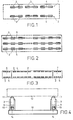
- roller 1 has a plurality of idle rollers 3 arranged in two parallel rows 1 and 2 and rotatable in the conveying direction. Chains 4 guided in the conveying direction are provided as intermediate carriers, each loosely wrapping around two successive rollers 3 of a row. The center distance of the rollers 3 is less than the width of the support boards of a standard pallet.
- roller conveyors of this type can be arranged one behind the other.
- the roller conveyor shown in FIG. 3, intended for a buffer channel consists of three track sections, namely an end section 6 or 7, each receiving a pallet, on both track ends for the supply or removal of the pallets, and a central section, which serves as a buffer section and receives several pallets 8, the chains 5 in the end sections 6 and 7 loop around all the rollers 3 of these sections, while the chains 4 in the middle section 8 according to FIG. 1 each loop around two successive rollers 3 in the conveying direction.
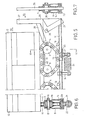
- the roller conveyor in its various embodiments is basically constructed according to the schematic illustration in FIG. 4.
- the rollers 3 are mounted in U-shaped rails 9, which rest on cross members 10 of a base frame, not shown.
- the upper run 11 of the chains wrapping around the rollers 3 each serves as an intermediate carrier for the pallets 12, while the lower run 13 of the chains in the present example rests on a C-shaped push rod 14 which is mounted in the profile rail 9 so as to be longitudinally movable and is part of a feed device forms, which is explained in connection with FIG. 5.
- the rollers 3 have a circumferential rib 15, on the flanks of which the chains 4 are guided laterally.
- the rollers 3 are each supported with rolling elements 16 on a sleeve 17 which is seated on a screw bolt 18 which connects the two legs of the U-shaped rail 9 to one another.
- the feed device has chains 19 individually assigned to the chains 4, which are arranged on the upper side of the longitudinally displaceable push rod 14 and which, in order to achieve the conveying movement, can be moved counter to the conveying direction indicated by arrow 20 and each engage in the backward, loosely hanging chain center 13.
- the push rod 14 is under the influence of a pretensioned return spring 21, which is anchored on the one hand with a screw bolt 22 on the profile rail 9 reinforced at this point with a profile piece 23 and on the other hand engages on a screw bolt 24 fastened to the push rod 14. Under the action of the return spring 21, the push rod 14 assumes a rest position in which the drivers 19 are out of engagement with the chains 4.
- the working stroke of the push rod 14 is effected by a lever 25 which is arranged on the end of the conveyor intended for the removal of pallets and which can be pivoted about the axis 26 and in each case by the removal from the roller conveyor remote pallet 12 is actuated.
- the pallet 12 engages the upper lever arm 27 so that the lever 25 is pivoted clockwise and the lower lever arm 28 moves the push rod 14 against the force of the return spring 21.
- the pallets following the removed pallet 12 are thereby set in motion and are stopped again when the foremost of the subsequent pallets runs onto the ramp 29.
- supporting webs 42 serving as emergency slides can be arranged between the rollers which follow one another in the conveying direction.
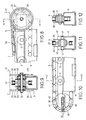
- FIGS. 8 to 12 show details of a roller conveyor for an insertion channel, FIG. 8 representing the end of the conveyor intended for the supply and removal of the pallets and FIG. 10 the opposite end of the conveyor.
- the profiled rail 9 has cranked leg ends 30 which are at a smaller distance from one another than the legs at the rail base.
- the rollers 3 are mounted in the region of these leg ends 30 on the profile rail 9 and have a smooth running surface.
- the aforementioned leg ends 30 serve as a chain guide, it being additionally possible for sliding linings, for example made of Teflon, to be attached to the inside of the leg ends. Otherwise, the roller bearing corresponds to that according to FIG. 6.
- the feed device is arranged at the end of the track intended for the supply and removal of the pallets 12 and has a chain gear 31 serving as a deflection roller for the chain 5. This interacts via a one-way clutch 32 with two drive wheels 33 arranged next to the chain track, the radius of which is greater than the outer radius of the chain 5 in the deflection area.
- the common axis 34 of the feed device is supported with roller bearings 35 at the end of two supports 36 which are arranged in the extension of the profile rail 9 and are fastened to the latter.
- the one-way clutch 32 comes into engagement, so that the sprocket wheel 31 is also rotated and the subsequent pallets on the trailed chain 5 are moved in the conveying direction.
- the drive wheels 33 are rotated in the opposite direction of rotation, the freewheel clutch being released and the insertion movement not being impeded.
- 8 and 9 sprockets are provided as drive wheels.
- a chain tensioning device is provided at the other end of this roller conveyor.
- a chain sprocket 37 which is mounted on an axis 38 which can be displaced in the longitudinal direction of the chain track, also serves as a deflection roller for the chain 5.
- This axis 38 is in longitudinal slots 39 of two with the profile rail 9 ver bound carriers 40 held and fixable with clamping screws 41 in the desired position.
- Link or roller chains are inserted as intermediate carriers between the lower surface of the pallet and the small diameter rollers so that the pallets do not run directly on the rollers.
- the link or roller chains have a high degree of friction, particularly transversely to the chain axis, compared to the pallet, but the rollers in the running direction together with the chain have low rolling resistance.
- the chain runs are closed at very short intervals and thus allow unimpeded opening up to the center distance of the short chain run, so that each pallet can be moved on its own.
- the The web is divided into three sections, each of which can be actuated by a pneumatic drive.
- the first section of approx. Pallet length is used for evacuation of the upstream and the last section of approx. Pallet length is used for filling the subsequent work station, while this is as long as desired Center piece conveys pallets into the last section as soon as it is empty.
- the track is preferably designed in such a way that the inclination of the track in the running direction is just enough to keep a pallet that is already in motion rolling, while a special push-on system actuated by the removed frontmost pallet moves the pallets from the state of the rest position into the state triggers the rolling friction.
- the push-on system has drivers that abut the pallet via positive locking (cross boards) or via friction locking (longitudinal boards).
- the coupling between the foremost pallet to be removed and the drivers sitting on the push-on system is released as soon as it is pushed to the planned length so that the pallet can be transported away undisturbed in the horizontal direction and does not get stuck even if the forklift driver behaves incorrectly.
- the chain link advantageously has an outer radius which corresponds to the greatest distance from the center of the idler roller in order to render the chain's polygon effect ineffective, which could otherwise occur at this point.
Landscapes
- Engineering & Computer Science (AREA)
- Mechanical Engineering (AREA)
- Rollers For Roller Conveyors For Transfer (AREA)
Applications Claiming Priority (4)
| Application Number | Priority Date | Filing Date | Title |
|---|---|---|---|
| CH185488 | 1988-05-17 | ||
| CH1854/88 | 1988-05-17 | ||
| DE19883838206 DE3838206A1 (de) | 1988-11-11 | 1988-11-11 | Rollenbahn fuer die foerderung von paletten, insbesondere holzpaletten |
| DE3838206 | 1988-11-11 |
Publications (2)
| Publication Number | Publication Date |
|---|---|
| EP0343111A2 true EP0343111A2 (fr) | 1989-11-23 |
| EP0343111A3 EP0343111A3 (fr) | 1990-11-28 |
Family
ID=25688854
Family Applications (1)
| Application Number | Title | Priority Date | Filing Date |
|---|---|---|---|
| EP19890810348 Withdrawn EP0343111A3 (fr) | 1988-05-17 | 1989-05-11 | Convoyeur à rouleaux pour le transport de palettes, notamment de palettes en bois |
Country Status (1)
| Country | Link |
|---|---|
| EP (1) | EP0343111A3 (fr) |
Cited By (4)
| Publication number | Priority date | Publication date | Assignee | Title |
|---|---|---|---|---|
| WO1998039235A1 (fr) * | 1997-03-03 | 1998-09-11 | Gilgen Fördersysteme Ag | Dispositif convoyeur pour canaux de rayonnages d'installations de stockage a rayonnages |
| US5895193A (en) * | 1997-01-21 | 1999-04-20 | Ung; Lu-Hsiung | Container having caterpillar mechanism for fast loading/unloading of cargos |
| CN104044961A (zh) * | 2014-06-19 | 2014-09-17 | 牛永杰 | 适用于圆形存储架的线缆托盘 |
| CN107187791A (zh) * | 2017-06-29 | 2017-09-22 | 安徽力丰实业有限公司 | 一种石材加工线输送机 |
Family Cites Families (3)
| Publication number | Priority date | Publication date | Assignee | Title |
|---|---|---|---|---|
| GB1107211A (en) * | 1963-08-14 | 1968-03-27 | Acrow Eng Ltd | Improvements in and relating to storage equipment |
| DE2718477A1 (de) * | 1977-04-26 | 1978-11-02 | Juergens Walter | Durchlaufregal |
| US4662511A (en) * | 1984-08-30 | 1987-05-05 | Greener Richard C | Pallet track with speed retarder |
-
1989
- 1989-05-11 EP EP19890810348 patent/EP0343111A3/fr not_active Withdrawn
Cited By (7)
| Publication number | Priority date | Publication date | Assignee | Title |
|---|---|---|---|---|
| US5895193A (en) * | 1997-01-21 | 1999-04-20 | Ung; Lu-Hsiung | Container having caterpillar mechanism for fast loading/unloading of cargos |
| WO1998039235A1 (fr) * | 1997-03-03 | 1998-09-11 | Gilgen Fördersysteme Ag | Dispositif convoyeur pour canaux de rayonnages d'installations de stockage a rayonnages |
| AU727109B2 (en) * | 1997-03-03 | 2000-11-30 | Gilgen Fordersysteme Ag | Conveyor device for shelf channels in shelf-storage systems |
| US6179109B1 (en) | 1997-03-03 | 2001-01-30 | Gilgen Fordersysteme | Conveyor device for shelf channels in shelf-storage systems |
| CN104044961A (zh) * | 2014-06-19 | 2014-09-17 | 牛永杰 | 适用于圆形存储架的线缆托盘 |
| CN104044961B (zh) * | 2014-06-19 | 2016-08-17 | 牛永杰 | 适用于圆形存储架的线缆托盘 |
| CN107187791A (zh) * | 2017-06-29 | 2017-09-22 | 安徽力丰实业有限公司 | 一种石材加工线输送机 |
Also Published As
| Publication number | Publication date |
|---|---|
| EP0343111A3 (fr) | 1990-11-28 |
Similar Documents
| Publication | Publication Date | Title |
|---|---|---|
| DE2522299C3 (de) | Transportvorrichtung zum umlaufenden horizontalen Transport von Trägern für die Förderung von Gegenständen | |
| EP1189825B1 (fr) | Dispositif de transport et/ou de stockage pour marchandises en colis | |
| EP0600057B1 (fr) | Rail porteur pour palettes et rayons de chargement comportant des rails porteurs pour palettes et piste de transport | |
| DE4400925C2 (de) | Speicher für Warenstücke | |
| EP0276409A2 (fr) | Convoyeur pour l'alimentation intermittente | |
| DE20214153U1 (de) | Vorrichtung zum Aufteilen eines ungeordneten Stromes von zylindrischen Gegenständen, zum Beispiel Getränkeflaschen, auf mehrere Gassen | |
| DE69103565T2 (de) | Rollenförderer. | |
| DE3228453A1 (de) | Vorrichtung zum verbreitern und verlangsamen eines stroms aufrechtstehender flaschen oder dgl. | |
| EP0541850B1 (fr) | Transporteur à palettes curviligne | |
| DE68916788T2 (de) | Förderer mit Transporttrageinheiten. | |
| DE2127310C3 (de) | Fördereinrichtung für Flaschen oder ähnliches Fördergut | |
| DE3935627A1 (de) | Verbundsystem zwischen einer spinnmaschine und einem spulautomaten | |
| CH714085A1 (de) | Förderanlage. | |
| DE3336988C2 (de) | Vorrichtung zum Zufördern von in großer Anzahl anfallenden Gegenständen | |
| EP1447356B1 (fr) | Convoyeur à rouleaux pour le transport et/ou le stockage d'articles | |
| DE2938757A1 (de) | Lagervorrichtung | |
| DE3838206A1 (de) | Rollenbahn fuer die foerderung von paletten, insbesondere holzpaletten | |
| DE4113092C2 (de) | Zapfenschlitten-Überführungsvorrichtung an einer Ringspinnmaschine | |
| DE19912391A1 (de) | Rollenbahn oder Rollenbahnabschnitt | |
| EP0196582A2 (fr) | Dispositif de déplacement pour palettes | |
| EP0614830B1 (fr) | Installation de transport munie d'un chariot de transfert transversal et de transporteurs à rouleaux | |
| DE102024124039B3 (de) | Rollenbahn zum Fördern von Fördergut sowie Verfahren zum Betrieb der Rollenbahn | |
| EP1230137B1 (fr) | Dispositif pour rassembler et preparer des marchandises de detail | |
| DE4318056A1 (de) | Einrichtung zum Transport und Austausch von Spinnkannen | |
| DE4430562A1 (de) | Vorrichtung und Verfahren zum Fördern von Stückgut auf parallel und drehbar gelagerten Rollen |
Legal Events
| Date | Code | Title | Description |
|---|---|---|---|
| PUAI | Public reference made under article 153(3) epc to a published international application that has entered the european phase |
Free format text: ORIGINAL CODE: 0009012 |
|
| AK | Designated contracting states |
Kind code of ref document: A2 Designated state(s): AT BE CH DE ES FR GB GR IT LI LU NL SE |
|
| PUAL | Search report despatched |
Free format text: ORIGINAL CODE: 0009013 |
|
| AK | Designated contracting states |
Kind code of ref document: A3 Designated state(s): AT BE CH DE ES FR GB GR IT LI LU NL SE |
|
| 17P | Request for examination filed |
Effective date: 19910307 |
|
| 17Q | First examination report despatched |
Effective date: 19920330 |
|
| STAA | Information on the status of an ep patent application or granted ep patent |
Free format text: STATUS: THE APPLICATION IS DEEMED TO BE WITHDRAWN |
|
| 18D | Application deemed to be withdrawn |
Effective date: 19920811 |