EP0344109A2 - Substituierte Naphthacen-5,12-dione und deren Verwendung - Google Patents
Substituierte Naphthacen-5,12-dione und deren Verwendung Download PDFInfo
- Publication number
- EP0344109A2 EP0344109A2 EP89810363A EP89810363A EP0344109A2 EP 0344109 A2 EP0344109 A2 EP 0344109A2 EP 89810363 A EP89810363 A EP 89810363A EP 89810363 A EP89810363 A EP 89810363A EP 0344109 A2 EP0344109 A2 EP 0344109A2
- Authority
- EP
- European Patent Office
- Prior art keywords
- alkyl
- phenyl
- substituted
- substituent
- alkoxy
- Prior art date
- Legal status (The legal status is an assumption and is not a legal conclusion. Google has not performed a legal analysis and makes no representation as to the accuracy of the status listed.)
- Granted
Links
- 0 C*1CCCC1 Chemical compound C*1CCCC1 0.000 description 3
- CFSFEIZUJGTCRB-UHFFFAOYSA-N CC1CC(C2)C2C1 Chemical compound CC1CC(C2)C2C1 CFSFEIZUJGTCRB-UHFFFAOYSA-N 0.000 description 1
Classifications
-
- C—CHEMISTRY; METALLURGY
- C07—ORGANIC CHEMISTRY
- C07D—HETEROCYCLIC COMPOUNDS
- C07D295/00—Heterocyclic compounds containing polymethylene-imine rings with at least five ring members, 3-azabicyclo [3.2.2] nonane, piperazine, morpholine or thiomorpholine rings, having only hydrogen atoms directly attached to the ring carbon atoms
- C07D295/04—Heterocyclic compounds containing polymethylene-imine rings with at least five ring members, 3-azabicyclo [3.2.2] nonane, piperazine, morpholine or thiomorpholine rings, having only hydrogen atoms directly attached to the ring carbon atoms with substituted hydrocarbon radicals attached to ring nitrogen atoms
- C07D295/10—Heterocyclic compounds containing polymethylene-imine rings with at least five ring members, 3-azabicyclo [3.2.2] nonane, piperazine, morpholine or thiomorpholine rings, having only hydrogen atoms directly attached to the ring carbon atoms with substituted hydrocarbon radicals attached to ring nitrogen atoms substituted by doubly bound oxygen or sulphur atoms
- C07D295/112—Heterocyclic compounds containing polymethylene-imine rings with at least five ring members, 3-azabicyclo [3.2.2] nonane, piperazine, morpholine or thiomorpholine rings, having only hydrogen atoms directly attached to the ring carbon atoms with substituted hydrocarbon radicals attached to ring nitrogen atoms substituted by doubly bound oxygen or sulphur atoms with the ring nitrogen atoms and the doubly bound oxygen or sulfur atoms separated by carbocyclic rings or by carbon chains interrupted by carbocyclic rings
- C07D295/116—Heterocyclic compounds containing polymethylene-imine rings with at least five ring members, 3-azabicyclo [3.2.2] nonane, piperazine, morpholine or thiomorpholine rings, having only hydrogen atoms directly attached to the ring carbon atoms with substituted hydrocarbon radicals attached to ring nitrogen atoms substituted by doubly bound oxygen or sulphur atoms with the ring nitrogen atoms and the doubly bound oxygen or sulfur atoms separated by carbocyclic rings or by carbon chains interrupted by carbocyclic rings with the doubly bound oxygen or sulfur atoms directly attached to a carbocyclic ring
-
- B—PERFORMING OPERATIONS; TRANSPORTING
- B05—SPRAYING OR ATOMISING IN GENERAL; APPLYING FLUENT MATERIALS TO SURFACES, IN GENERAL
- B05D—PROCESSES FOR APPLYING FLUENT MATERIALS TO SURFACES, IN GENERAL
- B05D1/00—Processes for applying liquids or other fluent materials
- B05D1/18—Processes for applying liquids or other fluent materials performed by dipping
- B05D1/20—Processes for applying liquids or other fluent materials performed by dipping substances to be applied floating on a fluid
- B05D1/202—Langmuir Blodgett films (LB films)
-
- B—PERFORMING OPERATIONS; TRANSPORTING
- B82—NANOTECHNOLOGY
- B82Y—SPECIFIC USES OR APPLICATIONS OF NANOSTRUCTURES; MEASUREMENT OR ANALYSIS OF NANOSTRUCTURES; MANUFACTURE OR TREATMENT OF NANOSTRUCTURES
- B82Y30/00—Nanotechnology for materials or surface science, e.g. nanocomposites
-
- B—PERFORMING OPERATIONS; TRANSPORTING
- B82—NANOTECHNOLOGY
- B82Y—SPECIFIC USES OR APPLICATIONS OF NANOSTRUCTURES; MEASUREMENT OR ANALYSIS OF NANOSTRUCTURES; MANUFACTURE OR TREATMENT OF NANOSTRUCTURES
- B82Y40/00—Manufacture or treatment of nanostructures
-
- C—CHEMISTRY; METALLURGY
- C07—ORGANIC CHEMISTRY
- C07C—ACYCLIC OR CARBOCYCLIC COMPOUNDS
- C07C205/00—Compounds containing nitro groups bound to a carbon skeleton
- C07C205/45—Compounds containing nitro groups bound to a carbon skeleton the carbon skeleton being further substituted by at least one doubly—bound oxygen atom, not being part of a —CHO group
- C07C205/46—Compounds containing nitro groups bound to a carbon skeleton the carbon skeleton being further substituted by at least one doubly—bound oxygen atom, not being part of a —CHO group the carbon skeleton containing carbon atoms of quinone rings
- C07C205/47—Anthraquinones containing nitro groups
- C07C205/48—Anthraquinones containing nitro groups the carbon skeleton being further substituted by singly-bound oxygen atoms
-
- C—CHEMISTRY; METALLURGY
- C07—ORGANIC CHEMISTRY
- C07C—ACYCLIC OR CARBOCYCLIC COMPOUNDS
- C07C225/00—Compounds containing amino groups and doubly—bound oxygen atoms bound to the same carbon skeleton, at least one of the doubly—bound oxygen atoms not being part of a —CHO group, e.g. amino ketones
- C07C225/24—Compounds containing amino groups and doubly—bound oxygen atoms bound to the same carbon skeleton, at least one of the doubly—bound oxygen atoms not being part of a —CHO group, e.g. amino ketones the carbon skeleton containing carbon atoms of quinone rings
- C07C225/26—Compounds containing amino groups and doubly—bound oxygen atoms bound to the same carbon skeleton, at least one of the doubly—bound oxygen atoms not being part of a —CHO group, e.g. amino ketones the carbon skeleton containing carbon atoms of quinone rings having amino groups bound to carbon atoms of quinone rings or of condensed ring systems containing quinone rings
- C07C225/32—Compounds containing amino groups and doubly—bound oxygen atoms bound to the same carbon skeleton, at least one of the doubly—bound oxygen atoms not being part of a —CHO group, e.g. amino ketones the carbon skeleton containing carbon atoms of quinone rings having amino groups bound to carbon atoms of quinone rings or of condensed ring systems containing quinone rings of condensed quinone ring systems formed by at least three rings
-
- C—CHEMISTRY; METALLURGY
- C07—ORGANIC CHEMISTRY
- C07C—ACYCLIC OR CARBOCYCLIC COMPOUNDS
- C07C255/00—Carboxylic acid nitriles
- C07C255/01—Carboxylic acid nitriles having cyano groups bound to acyclic carbon atoms
- C07C255/32—Carboxylic acid nitriles having cyano groups bound to acyclic carbon atoms having cyano groups bound to acyclic carbon atoms of a carbon skeleton containing at least one six-membered aromatic ring
- C07C255/40—Carboxylic acid nitriles having cyano groups bound to acyclic carbon atoms having cyano groups bound to acyclic carbon atoms of a carbon skeleton containing at least one six-membered aromatic ring the carbon skeleton being further substituted by doubly-bound oxygen atoms
-
- C—CHEMISTRY; METALLURGY
- C07—ORGANIC CHEMISTRY
- C07C—ACYCLIC OR CARBOCYCLIC COMPOUNDS
- C07C255/00—Carboxylic acid nitriles
- C07C255/01—Carboxylic acid nitriles having cyano groups bound to acyclic carbon atoms
- C07C255/32—Carboxylic acid nitriles having cyano groups bound to acyclic carbon atoms having cyano groups bound to acyclic carbon atoms of a carbon skeleton containing at least one six-membered aromatic ring
- C07C255/41—Carboxylic acid nitriles having cyano groups bound to acyclic carbon atoms having cyano groups bound to acyclic carbon atoms of a carbon skeleton containing at least one six-membered aromatic ring the carbon skeleton being further substituted by carboxyl groups, other than cyano groups
-
- C—CHEMISTRY; METALLURGY
- C07—ORGANIC CHEMISTRY
- C07C—ACYCLIC OR CARBOCYCLIC COMPOUNDS
- C07C255/00—Carboxylic acid nitriles
- C07C255/49—Carboxylic acid nitriles having cyano groups bound to carbon atoms of six-membered aromatic rings of a carbon skeleton
- C07C255/56—Carboxylic acid nitriles having cyano groups bound to carbon atoms of six-membered aromatic rings of a carbon skeleton containing cyano groups and doubly-bound oxygen atoms bound to the carbon skeleton
-
- C—CHEMISTRY; METALLURGY
- C07—ORGANIC CHEMISTRY
- C07C—ACYCLIC OR CARBOCYCLIC COMPOUNDS
- C07C323/00—Thiols, sulfides, hydropolysulfides or polysulfides substituted by halogen, oxygen or nitrogen atoms, or by sulfur atoms not being part of thio groups
- C07C323/10—Thiols, sulfides, hydropolysulfides or polysulfides substituted by halogen, oxygen or nitrogen atoms, or by sulfur atoms not being part of thio groups containing thio groups and singly-bound oxygen atoms bound to the same carbon skeleton
- C07C323/18—Thiols, sulfides, hydropolysulfides or polysulfides substituted by halogen, oxygen or nitrogen atoms, or by sulfur atoms not being part of thio groups containing thio groups and singly-bound oxygen atoms bound to the same carbon skeleton having the sulfur atom of at least one of the thio groups bound to a carbon atom of a six-membered aromatic ring of the carbon skeleton
- C07C323/20—Thiols, sulfides, hydropolysulfides or polysulfides substituted by halogen, oxygen or nitrogen atoms, or by sulfur atoms not being part of thio groups containing thio groups and singly-bound oxygen atoms bound to the same carbon skeleton having the sulfur atom of at least one of the thio groups bound to a carbon atom of a six-membered aromatic ring of the carbon skeleton with singly-bound oxygen atoms bound to carbon atoms of the same non-condensed six-membered aromatic ring
-
- C—CHEMISTRY; METALLURGY
- C07—ORGANIC CHEMISTRY
- C07C—ACYCLIC OR CARBOCYCLIC COMPOUNDS
- C07C323/00—Thiols, sulfides, hydropolysulfides or polysulfides substituted by halogen, oxygen or nitrogen atoms, or by sulfur atoms not being part of thio groups
- C07C323/22—Thiols, sulfides, hydropolysulfides or polysulfides substituted by halogen, oxygen or nitrogen atoms, or by sulfur atoms not being part of thio groups containing thio groups and doubly-bound oxygen atoms bound to the same carbon skeleton
-
- C—CHEMISTRY; METALLURGY
- C07—ORGANIC CHEMISTRY
- C07C—ACYCLIC OR CARBOCYCLIC COMPOUNDS
- C07C50/00—Quinones
- C07C50/24—Quinones containing halogen
-
- C—CHEMISTRY; METALLURGY
- C07—ORGANIC CHEMISTRY
- C07C—ACYCLIC OR CARBOCYCLIC COMPOUNDS
- C07C50/00—Quinones
- C07C50/26—Quinones containing groups having oxygen atoms singly bound to carbon atoms
- C07C50/36—Quinones containing groups having oxygen atoms singly bound to carbon atoms the quinoid structure being part of a condensed ring system having four or more rings
-
- C—CHEMISTRY; METALLURGY
- C07—ORGANIC CHEMISTRY
- C07C—ACYCLIC OR CARBOCYCLIC COMPOUNDS
- C07C69/00—Esters of carboxylic acids; Esters of carbonic or haloformic acids
- C07C69/017—Esters of hydroxy compounds having the esterified hydroxy group bound to a carbon atom of a six-membered aromatic ring
-
- C—CHEMISTRY; METALLURGY
- C07—ORGANIC CHEMISTRY
- C07C—ACYCLIC OR CARBOCYCLIC COMPOUNDS
- C07C69/00—Esters of carboxylic acids; Esters of carbonic or haloformic acids
- C07C69/02—Esters of acyclic saturated monocarboxylic acids having the carboxyl group bound to an acyclic carbon atom or to hydrogen
- C07C69/12—Acetic acid esters
- C07C69/14—Acetic acid esters of monohydroxylic compounds
- C07C69/145—Acetic acid esters of monohydroxylic compounds of unsaturated alcohols
- C07C69/157—Acetic acid esters of monohydroxylic compounds of unsaturated alcohols containing six-membered aromatic rings
-
- C—CHEMISTRY; METALLURGY
- C07—ORGANIC CHEMISTRY
- C07C—ACYCLIC OR CARBOCYCLIC COMPOUNDS
- C07C69/00—Esters of carboxylic acids; Esters of carbonic or haloformic acids
- C07C69/02—Esters of acyclic saturated monocarboxylic acids having the carboxyl group bound to an acyclic carbon atom or to hydrogen
- C07C69/12—Acetic acid esters
- C07C69/16—Acetic acid esters of dihydroxylic compounds
-
- C—CHEMISTRY; METALLURGY
- C07—ORGANIC CHEMISTRY
- C07C—ACYCLIC OR CARBOCYCLIC COMPOUNDS
- C07C69/00—Esters of carboxylic acids; Esters of carbonic or haloformic acids
- C07C69/62—Halogen-containing esters
- C07C69/63—Halogen-containing esters of saturated acids
-
- C—CHEMISTRY; METALLURGY
- C07—ORGANIC CHEMISTRY
- C07D—HETEROCYCLIC COMPOUNDS
- C07D307/00—Heterocyclic compounds containing five-membered rings having one oxygen atom as the only ring hetero atom
- C07D307/02—Heterocyclic compounds containing five-membered rings having one oxygen atom as the only ring hetero atom not condensed with other rings
- C07D307/04—Heterocyclic compounds containing five-membered rings having one oxygen atom as the only ring hetero atom not condensed with other rings having no double bonds between ring members or between ring members and non-ring members
- C07D307/10—Heterocyclic compounds containing five-membered rings having one oxygen atom as the only ring hetero atom not condensed with other rings having no double bonds between ring members or between ring members and non-ring members with substituted hydrocarbon radicals attached to ring carbon atoms
- C07D307/12—Radicals substituted by oxygen atoms
-
- C—CHEMISTRY; METALLURGY
- C07—ORGANIC CHEMISTRY
- C07F—ACYCLIC, CARBOCYCLIC OR HETEROCYCLIC COMPOUNDS CONTAINING ELEMENTS OTHER THAN CARBON, HYDROGEN, HALOGEN, OXYGEN, NITROGEN, SULFUR, SELENIUM OR TELLURIUM
- C07F7/00—Compounds containing elements of Groups 4 or 14 of the Periodic Table
- C07F7/02—Silicon compounds
- C07F7/08—Compounds having one or more C—Si linkages
- C07F7/0803—Compounds with Si-C or Si-Si linkages
- C07F7/081—Compounds with Si-C or Si-Si linkages comprising at least one atom selected from the elements N, O, halogen, S, Se or Te
-
- C—CHEMISTRY; METALLURGY
- C08—ORGANIC MACROMOLECULAR COMPOUNDS; THEIR PREPARATION OR CHEMICAL WORKING-UP; COMPOSITIONS BASED THEREON
- C08F—MACROMOLECULAR COMPOUNDS OBTAINED BY REACTIONS ONLY INVOLVING CARBON-TO-CARBON UNSATURATED BONDS
- C08F2/00—Processes of polymerisation
- C08F2/46—Polymerisation initiated by wave energy or particle radiation
- C08F2/48—Polymerisation initiated by wave energy or particle radiation by ultraviolet or visible light
- C08F2/50—Polymerisation initiated by wave energy or particle radiation by ultraviolet or visible light with sensitising agents
-
- C—CHEMISTRY; METALLURGY
- C08—ORGANIC MACROMOLECULAR COMPOUNDS; THEIR PREPARATION OR CHEMICAL WORKING-UP; COMPOSITIONS BASED THEREON
- C08G—MACROMOLECULAR COMPOUNDS OBTAINED OTHERWISE THAN BY REACTIONS ONLY INVOLVING UNSATURATED CARBON-TO-CARBON BONDS
- C08G61/00—Macromolecular compounds obtained by reactions forming a carbon-to-carbon link in the main chain of the macromolecule
- C08G61/12—Macromolecular compounds containing atoms other than carbon in the main chain of the macromolecule
- C08G61/122—Macromolecular compounds containing atoms other than carbon in the main chain of the macromolecule derived from five- or six-membered heterocyclic compounds, other than imides
- C08G61/123—Macromolecular compounds containing atoms other than carbon in the main chain of the macromolecule derived from five- or six-membered heterocyclic compounds, other than imides derived from five-membered heterocyclic compounds
-
- H—ELECTRICITY
- H01—ELECTRIC ELEMENTS
- H01B—CABLES; CONDUCTORS; INSULATORS; SELECTION OF MATERIALS FOR THEIR CONDUCTIVE, INSULATING OR DIELECTRIC PROPERTIES
- H01B1/00—Conductors or conductive bodies characterised by the conductive materials; Selection of materials as conductors
- H01B1/06—Conductors or conductive bodies characterised by the conductive materials; Selection of materials as conductors mainly consisting of other non-metallic substances
- H01B1/12—Conductors or conductive bodies characterised by the conductive materials; Selection of materials as conductors mainly consisting of other non-metallic substances organic substances
- H01B1/121—Charge-transfer complexes
-
- C—CHEMISTRY; METALLURGY
- C07—ORGANIC CHEMISTRY
- C07C—ACYCLIC OR CARBOCYCLIC COMPOUNDS
- C07C2601/00—Systems containing only non-condensed rings
- C07C2601/02—Systems containing only non-condensed rings with a three-membered ring
-
- C—CHEMISTRY; METALLURGY
- C07—ORGANIC CHEMISTRY
- C07C—ACYCLIC OR CARBOCYCLIC COMPOUNDS
- C07C2603/00—Systems containing at least three condensed rings
- C07C2603/02—Ortho- or ortho- and peri-condensed systems
- C07C2603/40—Ortho- or ortho- and peri-condensed systems containing four condensed rings
- C07C2603/42—Ortho- or ortho- and peri-condensed systems containing four condensed rings containing only six-membered rings
- C07C2603/44—Naphthacenes; Hydrogenated naphthacenes
Definitions
- the present invention relates to substituted naphthacen-5,12-diones and their use as photoinitiators or sensitizers for the photopolymerization of compounds having at least one polymerizable or dimerizable ethylenically unsaturated double bond, or for electroless metal deposition on the surface of polymers which contain hydroxyalkyl groups.
- Japanese patent publication 49-81440 describes 1-hydroxyl- or 1-amino-naphthacen-5,12-diones, which are substituted in the 4-position and optionally in the 3-position, as fluorescent disperse dyes.
- F.F. y T. Torres describes the Quimica, Ser. C, 81 (2), pp. 133-138 (1982) the production of 2-hydroxy, 2-methoxy, 2-ethoxy, 2- (2'-hydroxyethoxy) naphthacen-5,12-dione.
- Naphthacen-5,12-diones with methoxy groups in the 6, 7, 8 and 9 positions are e.g. described in D.C.C. Smith, J. Chem. Soc., P.
- R 1 to R 8 are C 1 -C 20 -alkyl ( ⁇ X) ⁇ P in the context of the preceding definitions, the alkyl group can be linear or branched and preferably 1 to 18, particularly 1 to 12 and in particular 1 to 6 C atoms contain.
- alkyl groups are methyl, ethyl and the isomers of propyl, butyl, pentyl, hexyl, heptyl, octyl, nonyl, decyl, undecyl, dodecyl, tridecyl, tetradecyl, pentadecyl, hexadecyl, heptadecyl, octadecyl and eicosyl.
- P is preferably 1.
- R 1 to R 8 are C 2 -C 18 alkenyl ( ⁇ X) ⁇ p in the context of the preceding definitions, the alkenyl group can be linear or branched and preferably contain 3 to 12, in particular 3 to 6, C atoms.
- the alkenyl preferably contains terminal double bonds.
- Some examples are ethenyl, allyl, prop-1-en-1-or -2-yl, but-1-en-1- or -2- or -3- or -4-yl, but-2-en-1 - or -2-yl, pent-1-ene or pent-2-en-1-or -2- or -3- or -4- or -5-yl, hex-1-ene or hex-2 -en- or hex-3-en-1- or -2- or -3- or -4- or -5-or -6-yl, heptenyl, octenyl, nonenyl, decenyl, undecenyl, dodecenyl, tetracenyl, hexadecenyl and Octadecenyl.
- P is preferably 1.
- R 1 to R 8 are C 2 -C 18 -alkynyl ( ⁇ X) ⁇ P in the context of the preceding definition, the alkynyl group can be linear or branched and preferably contain 3 to 12, in particular 3 to 6, C atoms.
- the triple bond is preferably in the terminal position.
- Some examples are ethynyl, propargyl, but-1-in-3- or -4-yl, but-2-in-1-yl, pent-1-in-3- or -4- or -5-yl, hex -1-in-3- or -4- or -5- or -6-yl, hex-2-in-1- or -4- or -5- or -6-yl, hex-3-in-1 - or -2-yl, heptinyl, octinyl, noninyl, decinyl, undecinyl and dodecinyl.
- P is preferably 1.
- R 1 to R 8 are C 3 -C 8 -cycloalkyl ( ⁇ X) ⁇ P in the context of the preceding definitions, it can be cyclopropyl, cyclobutyl, cyclopentyl, cyclohexyl, cycloheptyl or cyclooctyl.
- X preferably represents -0-.
- C 3 -C 6 cycloalkyl is preferred.
- P is preferably 1.
- R 1 to R 8 in the context of the foregoing definitions C 3 -C 8 cycloalkyl-C r H 2r ( ⁇ X) ⁇ p , (C 1 -C 12 alkyl) -C 3 -C 8 cycloalkyl ( ⁇ X) ⁇ P or (C 1 -C 12 alkyl) -C 3 -C 8 cycloalkyl-C r H 2r ( ⁇ X) ⁇ P , the alkyl group can be linear or branched and preferably 1 to 6, especially 1 to 4 C- Contain atoms.
- r is preferably 1.
- X is preferably -0-.
- the cycloalkyl group is preferably C 3 -Cs-cycloalkyl.
- P is preferably 1.
- R 1 to R 8 in the context of the preceding definitions are C 1 -C 12 -alkyl) phenyl ( ⁇ X) ⁇ P , phenyl-C r H 2r ( ⁇ X) ⁇ p or (C 1 -C 12 -alkyl) phenyl ( ⁇ X ) ⁇ P
- the alkyl group can be linear or branched and preferably contain 1 to 6, especially 1 to 4, carbon atoms.
- r is preferably 1.
- p is preferably 1.
- R 1 to R 8 can be unsubstituted or substituted one or more times, preferably one to three times, in particular once or twice, within the scope of the preceding definitions. If the substituent is halogen, it is preferably -F, -CI or -Br. If the substituent is -NR 9 R 10 , R 9 and R 1 preferably independently of one another denote H or C 1 -C 4 alkyl and especially methyl or ethyl.
- R 9 preferably represents H, C 1 -C 4 -alkyl or -O ( ⁇ C m H 2m O) ⁇ n R 11 , where R 11 is H or C 1 -C 4 alkyl and m is 2 or 3 and n is 1 to 12.
- R 1 to R 8 are halogen within the scope of the preceding definitions, it is in particular -F, -CI or -Br.
- R 1 to R 8 in the context of the preceding definitions are -NR 9 R 10 or -CONR 9 R 10
- R 9 and R 10 are, independently of one another, preferably C 1 -C 6 -alkyl or R 9 and R 10 together are preferably tetra- or pentamethylene or 3-oxapentylene.
- R 1 to R 8 in the context of the preceding definitions are -Si (C 1 -C 4 alkyl) 3, it is preferably -Si (C 1 or C 2 alkyl) 3 and in particular trimethylsilyl.
- R to R 8 in the context of the preceding definitions are -O ( ⁇ C m H 2m -O) ⁇ n R 11 , R 11 preferably represents H or C 1 -C 4 alkyl, m preferably represents 2 or 3 and n preferably for 1 to 12, especially 1 to 6.
- Adjacent radicals for the groups -CO-O-CO- and -CO-NR 9- CO- are especially R 2 and R 3 and / or R 6 and R 7 .
- R 9 and R10 preferably contain 1 to 6, especially 1 to 4, carbon atoms and are in particular methyl or ethyl.
- the alkyl can be linear or branched.
- R 9 and R 10 are the group ( ⁇ C m H 2m -O) ⁇ n R 11 , then preferably m 2 or 3, n represent 1 to 12, especially 2 to 6 and R 11 H or C 1 -C 4 alkyl represents.
- R 9 and R 10 independently of one another are H, C 1 -C 4 -alkyl, phenyl, or R 9 and R 10 together are tetramethylene, pentamethylene or 3-oxapentylene.
- Preferred embodiments of compounds of the formula I are those in which a) R 5 or R 8 , or R 4 , R 5 or R 8 , or R 1 , R 4 , R 5 or R 8 are H, or b) R 2 or R 3 or R 2 and R 3 represent a substituent, or c) R 1 , R 2 and R 3 or R 1 and R 2 or R 1 and R 3 represent a substituent, or d) R 2 and R 3 or R 2 or R 3 represent a substituent and R 6 or R 7 or R 6 and R 7 represent a substituent, or e) R 1 , R 2 and R 3 or R 1 and R 2 or R 1 and R 3 represent a substituent and R 4 , R 5 and R 8 are H and R 6 or R 7 or R 6 and R 7 are H or a substituent.
- Preferred compounds of the formula I are also those in which R 4 is H or in the substituent p is 1.
- a further preferred subgroup are those compounds of the formula in which R 5 to R 8 are H and R 1 is unsubstituted C 1 -C 12 -alkylthio, C 1 -C 12 -alkoxy, phenyloxy, (C 1 -C 6 -alkyl) phenyloxy or (C 1 -C 6 alkyl) phenylthio or phenylthio substituted with -F, -CI, -OH, C 1 -C 4 alkoxy or Ci-C 4 alkylthio or (C 1 -C 6 alkyl) phenylthio.
- R 2 and R 3 represent as substituted alkyl, in particular with -CN or -COO (C 1 -C 12 alkyl) substituted C 1 -C 6 -, especially C 1 - or C 2 -alkyl, or benzyl.
- the compounds of formula I can be prepared by, according to Friedel-Crafts, a naphthalenedicarboxylic acid anhydride of formula II in the presence of a Lewis acid with a benzene of the formula III implemented, wherein R 1 to R 8 have the meanings given above, and optionally compounds of the formula 1, in which at least one of R 1 to R 8 is -N0 2 or halogen, are substituted with a nucleophilic compound.
- Halogen is preferred -Br, -CI and especially -F.
- Compounds suitable for nucleophilic substitution are particularly those of the formula (R 1 to R 8 ) ⁇ X-H, where X is -O-, -S-, -SO- or -S0 2 -, H-NR 9 R 10 , malonic acid ester or nitriles and phenylacetic acid nitrile.
- the compounds can be used in the form of their alkali salts, for example Li, Na or K salts. It is also possible to carry out the nucleophilic substitution in the presence of bases, such as, for example, alkali metal lyes or carbonates.
- the compounds of formula I can also be prepared by a compound of formula IV in a Diels-Alder reaction wherein R 5 , R 6 , R 7 and R 8 have the meanings given above and X 1 and X 2 independently of one another are -CI, -Br - or -J, with the elimination of HX 1 and HX 2 with a compound of the formula V wherein R 1 , R 2 , R 3 and R 4 have the meanings given above.
- p is preferably 1.
- the reaction is advantageously carried out at temperatures from 50 to 250 ° C., preferably 80 to 200 ° C.
- An inert solvent is expediently used, for example polar aprotic solvents.
- Some examples are aromatic hydrocarbons (benzene, toluene, xylene, chlorobenzene and dichlorobenzene), nitriles (acetonitrile), ethers (dibutyl ether, dioxane, tetrahydrofuran, ethylene glycol or diethylene glycol dimethyl ether).
- Isolation and purification can be carried out using customary methods, for example crystallization, sublimation or chromatography.
- the 1,4-naphthoquinones of formula V are known and, for example, by nucleophilic substitution of optionally protected and substituted halogen or nitro-1,4-naphthoquinones with, for example, the compounds described above in the presence of alkali metal compounds (K 2 C0 3 , C S2 C0 3 , KOH, NaOH, NaNH 2 , NaOCH 3 , NaOC 2 H 5 ) or with alkali metal compounds, for example from Li, K, Na, Rb or Cs.
- alkali metal compounds K 2 C0 3 , C S2 C0 3 , KOH, NaOH, NaNH 2 , NaOCH 3 , NaOC 2 H 5
- alkali metal compounds for example from Li, K, Na, Rb or Cs.
- Halogen and nitro-naphthoquinones are described, for example, in Houben-Weyl, Chinone I, Volume 7 / 3b (1977).
- the naphthoquinones of the formula V can also be prepared in a known manner by electrophilic or nucleophilic substitution of optionally substituted naphthalenes, dihydro- or tetrahydronaphthalenes and subsequent conversion into the substituted 1,4-naphthoquinones.
- the compounds of formula 1 can also be prepared by using 1,2-bis (dihalomethyl) benzenes of the formula wherein Y 1 is CI, Br or I, in the presence of Nal in an organic solvent with a compound of formula V. This method is described by JW McOmie in Synthesis, pp. 416-417 (1973).
- R 1 to R 8 represent a polyoxaalkylene radical
- such compounds are also obtained by reacting compounds of the formula 1 with R 1 to R 8 equal to hydroxyalkyl with epoxides. It is also possible to modify the radicals R 1 to R 8 by conventional reactions, such as hydrolysis, esterification or transesterification, amidation, oxidation or reduction. Carboxylic acid esters can be converted into the trifluoromethyl derivatives using HF / SF 4 in a known manner.
- the compounds of the formula are generally crystals and are notable for high thermal stability.
- Compounds with oxy, sulfinyl or alkyl substituents can be dissolved very well in curable compositions, optionally together with a solvent.
- H donors such as z-B.
- tertiary amines or alcohols or phenylacetic acid derivatives as effective photoinitiators or sensitizers for the light-induced polymerization or dimerization of ethylenically unsaturated compounds. They are characterized by good light sensitivity and effectiveness over a wavelength range from approx. 200 nm (UV light) to approx. 600 nm.
- the properties of the compounds according to the invention e.g. Solubility, melting point and absorption range can be specifically influenced by the choice of substituents.
- the present invention further provides a radiation-polymerizable composition
- a radiation-polymerizable composition comprising (a) at least one non-volatile, monomeric, oligomeric or polymeric compound having at least one photopolymerizable or photodimerizable ethylenically unsaturated double bond and (b) at least one compound of the formula Ia as a photoinitiator or sensitizer, wherein at least one of R 1 to R 4 , R 6 and R 7 represent a substituent, R 1 and R 4 independently of one another H, C 1 -C 18 alkoxy, -O ( ⁇ C m H 2m -O) ⁇ n R 11 where m is 2 to 4, n is 1 to 20 and R 11 is H or C 1 -C 12 alkyl, R 2 , R 3 , R 6 and R 7 independently of one another HC 1 -C 18 alkoxy, C 1 - C 18 alkyl SO-, -O ( ⁇ C m H 2m -
- compositions may contain other photoinitiators or sensitizers other than (B).
- the amount of compounds according to the invention added depends essentially on economic aspects, their solubilities and the desired sensitivity. In general, 0.01 to 20, preferably 0.05-10 and especially 0.1 to 5% by weight are used, based on component (a).
- Suitable component (a) are those ethylenically unsaturated monomeric, oligomeric and polymeric compounds which react by photopolymerization to give higher molecular weight products and thereby change their solubility.
- Esters of ethylenically unsaturated carboxylic acids and polyols or polyepoxides, and polymers with ethylenically unsaturated groups in the chain or in side groups such as e.g. unsaturated polyesters, polyamides and polyurethanes and copolymers thereof, polybutadiene and butadiene copolymers, polyisoprene and isoprene copolymers, polymers and copolymers with (meth) acrylic groups in side chains, and also mixtures of one or more such polymers.
- unsaturated carboxylic acids are acrylic acid, methacrylic acid, crotonic acid, itaconic acid, cinnamic acid, unsaturated fatty acids such as linolenic acid or oleic acid.
- Acrylic and methacrylic acid are preferred.
- Aromatic and particularly aliphatic and cycloaliphatic polyols are suitable as polyols.
- aromatic polyols are hydroquinone, 4,4'-dihydroxydiphenyl, 2,2-di (4-hydroxyphenyl) propane, and novolaks and resols.
- polyepoxides are those based on the polyols mentioned, especially the aromatic polyols and epichlorohydrin.
- polymers or copolymers containing hydroxyl groups in the polymer chain or in side groups such as e.g. Polyvinyl alcohol and copolymers thereof or polymethacrylic acid hydroxyalkyl esters or copolymers thereof, are suitable as polyols.
- Other suitable polyols are oligoesters with hydroxyl end groups.
- aliphatic and cycloaliphatic polyols are alkylene diols with preferably 2 to 12 carbon atoms, such as ethylene glycol, 1,2- or 1,3-propanediol, 1,2-, 1,3 or 1,4-butanediol, pentanediol, hexanediol, Octanediol, dodecanediol, diethylene glycol, triethylene glycol, polyethylene glycols with molecular weights of preferably 200 to 1500, 1,3-cyclopentanediol, 1,2-, 1,3- or 1,4-cyclohexanediol, 1,4-dihydroxymethylcyclohexane, glycerol, tris ( ⁇ -hydroxyethyl) amine, trimethylolethane, trimethylolpropane, pentaerythritol. Dipentaerythritol and sorbitol.
- the polyols can be partially or completely esterified with one or different unsaturated carboxylic acids, the free hydroxyl groups in partial esters being modified, e.g. can be etherified or esterified with other carboxylic acids.
- component (a) are the amides of identical or different unsaturated carboxylic acids of aromatic, cycloaliphatic and aliphatic polyamines with preferably 2 to 6, particularly 2 to 4, amino groups.
- polyamines are ethylenediamine, 1,2- or 1,3-propylenediamine, 1,2-, 1,3- or 1,4-butylenediamine, 1,5-pentylenediamine, 1,6-hexylenediamine, octylenediamine, dodecylenediamine, 1,4-diaminocyclohexane, isophoronediamine, phenylenediamine, bisphenylenediamine, di-ß-aminoethyl ether, diethylenetriamine, triethylenetetramine, di- (ß-aminoethoxy) - or di (ß-aminopropoxy) ethane.
- Other suitable polyamines are polymers and copolymers with amino groups in the side chain and oligoamide
- Examples of such unsaturated amides are: methylene-bis-acrylamide, 1,6-hexamethylene-bis-acrylamide, diethylenetriamine-tris-methacrylamide, bis (methacrylamidopropoxy) ethane, ⁇ -methacrylamidoethyl methacrylate, N [( ⁇ -hydroxyethoxy) ethyl] - acrylamide.
- Suitable unsaturated polyesters and polyamides are derived e.g. on maleic acid and diols or diamines.
- Maleic acid can be partially replaced by other dicarboxylic acids. They can be used together with ethylenically unsaturated comonomers, e.g. Styrene.
- the polyesters and polyamides can also be derived from dicarboxylic acids and ethylenically unsaturated diols or diamines, especially from long-chain ones with e.g. 6 to 20 carbon atoms.
- polyurethanes are those which are composed of saturated or unsaturated diisocyanates and unsaturated or saturated diols.
- Polybutadiene and polyisoprene and copolymers thereof are known.
- Suitable comonomers are, for example, polyolefins such as ethylene, propene, butene, hexene, (meth) acrylates, acrylonitrile, styrene or vinyl chloride.
- Polymers with (meth) acrylate groups in the side chain are also known.
- It can be, for example, reaction products of novolak-based epoxy resins with (meth) acrylic acid, homopolymers or copolymers of polyvinyl alcohol or their hydroxyalkyl derivatives which are esterified with (meth) acrylic acid, or homopolymers and copolymers of (meth) acrylates are esterified with hydroxyalkyl (meth) acrylates.
- the photopolymerizable compounds can be used alone or in any mixtures. Mixtures of polyol (meth) acrylates are preferably used.
- Suitable dimerizable compounds are those which, for example, cinnamic acid residues, dimethylmaleimidyl residues or contain. These residues are generally bound to oligomers or polymers, for example in the polymer chain or as side groups. Polymers with dimethylmaleimidyl groups are described, for example, in DE-A-2626795. Epoxy resins with are described, for example, in DE-A-2342407.
- Binders can also be added to the compositions according to the invention, which is particularly expedient if the photopolymerizable or photodimerizable compounds are liquid or viscous substances.
- the quantity of binder may, for example 5-95, preferably 10-90 and particularly 50-90 wt. 0 / o amount, based on the total composition.
- the choice of binder depends on the field of application and the properties required for this, such as developability in aqueous and organic solvent systems, adhesion to substrates and sensitivity to oxygen.
- Suitable binders are e.g. Polymers with a molecular weight of about 5000-2,000,000, preferably 10,000 to 1,000,000. Examples are: homo- and copolymeric acrylates and methacrylates, e.g. Copolymers of methyl methacrylate / ethyl acrylate / methacrylic acid, poly (methacrylic acid alkyl ester), poly (acrylic acid alkyl ester); Cellulose esters and ethers such as cellulose acetate, cellulose acetate butyrate, methyl cellulose, ethyl cellulose; Polyvinyl butyral, polyvinyl formal, cyclized rubber, polyethers such as polyethylene oxide, polypropylene oxide, polytetrahydrofuran; Polystyrene, polycarbonate, polyurethane, chlorinated polyolefins, polyvinyl chloride, copolymers of vinyl chloride / vinylidene chloride, copolymers of vinylidene chloride
- compositions according to the invention are suitable as coating compositions for substrates of all kinds, e.g. Wood, paper, ceramics, plastics, such as polyester and cellulose acetate films, and metals, such as copper and aluminum, in which a protective layer or a photographic image is to be applied by photopolymerization.
- substrates of all kinds, e.g. Wood, paper, ceramics, plastics, such as polyester and cellulose acetate films, and metals, such as copper and aluminum, in which a protective layer or a photographic image is to be applied by photopolymerization.
- Another object of the present invention are the coated substrates and a method for applying photographic images to the substrates.
- the coated substrates can also be used as recording material for holograms (volume-phase diagram), it being advantageous that no wet development is necessary for this purpose.
- the substrates can be coated. by applying a liquid composition, solution or suspension to the substrate. Liquid compositions without solvents are preferred.
- the choice of solvent and the concentration depend mainly on the type of composition and the coating process.
- the composition is applied uniformly to a substrate using known coating methods, e.g. by dipping, knife coating, curtain casting, electrophoresis, brushing, spraying or reverse roll coating.
- the application quantity (layer thickness) and type of substrate (layer carrier) depend on the desired application area.
- Serving as layer supports for photographic information recording e.g. Foils made of polyester, cellulose acetate or paper coated with plastic; Specially treated aluminum for offset printing forms and copper-clad laminates for the production of printed circuits.
- the layer thicknesses for photographic materials and offset printing forms are generally about 0.5 to about 10 pm; for printed circuits in general 1 to approx. 100 jim. If solvents are also used, they are removed after coating.
- photocurable compositions as used for the various purposes usually contain a number of other additives. It is therefore common practice to add thermal inhibitors which are intended to protect against premature polymerization, especially during the preparation of the compositions, by mixing the components. Hydroquinone, hydroquinone derivatives, p-methoxyphenol, ⁇ -naphthols or sterically hindered phenols such as e.g. 2,6-di (tert-butyl) -p-cresol used. Small amounts of UV absorbers can also be added, e.g. those of the benzotriazole, benzophenone or oxalanilide type. Sterile hindered amine (HALS) light stabilizers can also be added.
- HALS Sterile hindered amine
- copper compounds such as copper naphthenate, stearate, or octoate
- phosphorus compounds such as triphenylphosphine, tributylphosphine, triethylphosphite, triphenylphosphite or tribenzylphosphite
- quaternary ammonium compounds such as tetramethylammonium chloride or trimethyl-benzylamonium, e.g. N-diethylhydroxylamine can be added.
- photo-curable mixtures are often added to paraffin or similar waxy substances. These swim due to the start of the polymerization insufficient solubility in the polymer and form a transparent surface layer that prevents the entry of air.
- photosensitizers which absorb in certain wavelengths and pass on the absorbed energy to the initiators or themselves act as an additional initiator. Examples of these are, in particular, thioxanthone, anthracene, anthraquinone and coumarin derivatives.
- amine-type accelerators which are particularly important in pigmented preparations, since they act as chain transfer agents. Examples include N-methyldietlianolamine, triethylamine, ethyl p-dimethylaminobenzoate or Michler's ketone. The effect of the amines can be enhanced by adding aromatic ketones of the benzophenone type.
- additives are e.g. Fillers, pigments, dyes, adhesives, wetting agents and leveling agents.
- Photocuring is of great importance for printing inks, since the drying time of the binder is a decisive factor for the production speed of graphic products and should be on the order of fractions of a second. UV-curable printing inks are particularly important for screen printing.
- the photocurable compositions according to the invention are also very suitable for the production of printing plates, in particular flexographic printing plates.
- a photoinitiator e.g. Mixtures of soluble linear polyamides or of styrene-butadiene rubber with photopolymerizable monomers, for example acrylamides or acrylates, and a photoinitiator are used. Films and plates from these systems are exposed via the negative (or positive) of the artwork and the uncured portions are then eluted with a solvent.
- metal coating for example in the coating of sheet metal for tubes, cans or bottle closures, as well as the photo curing of plastic coatings, for example floor or wall coverings based on PVC.
- Examples of the photocuring of paper coatings are the colorless coating of labels, record sleeves or book covers.
- the exposed areas are cross-linked polymer and therefore insoluble and remain on the support. With appropriate coloring, visible images are created.
- the carrier is a metallized layer, the metal can, after exposure and development, be etched away at the unexposed areas or reinforced by electroplating. In this way, printed circuits can be produced.
- the composition according to the invention can also be used as a photoresist.
- Light sources with a high proportion of short-wave light are suitable for exposure.
- Corresponding technical devices and various types of lamps are available for this today. Examples are carbon arc lamps, xenon arc lamps, mercury vapor lamps, metal halogen lamps, fluorescent lamps, argon lamps or photographic floodlights.
- Laser light sources have also recently been used. These have the advantage that no photo masks are necessary; the controlled laser beam writes directly on the photocurable layer.
- the compounds of formula 1 are also valuable intermediates for the preparation of substituted tetrathio- or tetraselenotetracenes (cf. US Pat. No. 4,617,151).
- Such chalcogenated tetracenes can be used to produce electrically conductive charge transfer complexes (CT complexes) with electron acceptors. With their functional substituents, they can be bound to polymers, for example incorporated as side groups in polymers (cf. US Pat. No. 4,617,151).
- CT complexes are also suitable for producing, for example, antistatic coatings on photographic film elements, magnetic tapes, electrophotographic film elements and electronic components (see US Pat. No. 3,634,336).
- the chalcogenated tetracenes also have electrochromic properties; they can be used for electrochromic displays. They are also suitable as laser-optical data storage [Nach. Chem. Techn. Lab. 35, pp. 255 ff (1987)] and as anode material in organic solid-state batteries (EP-A-0 090 598). CT complexes of substituted tetrathio- or tetraselenotetracenes can also be incorporated into thermoplastic, thermosetting or elastomeric polymers to achieve antistatic properties.
- the substituted tetrathio- or tetraselenotetracenes together with a soluble polymer or a precursor thereof and an electron acceptor for example a halogen-forming agent (organic halogenated compounds such as bromoform, trichlorobromomethane, tetrabromomethane, hexachloropropane, perchlorobutadiene, 1,3- or 1,4- Dichloro-2-butene, 1,4-bis (trichloromethyl) benzene, iodoacetonitrile, iodoform, tetrachlorethylene, perchlorocyclobutadiene, N-chloro, bromine or iodosuccinimide) optionally dissolved together with another inert solvent and the excess halogen-forming agent and the solvent evaporates at a higher temperature.
- a halogen-forming agent organic halogenated compounds such as bromoform, trichloro
- composition formed contains a network of needle-shaped crystals of the CT complex in the polymer if the chalcogenized tetracene is unsubstituted or contains small substituents (eg F, CH 3 , CF 3 ).
- Such compositions have high electrical conductivity. This can be further improved if a substituted tetrathio- or tetraselenotetracene, which does not form such a network and which is present in the polymer matrix in a fine distribution, is also used, since such substituted tetrathio- or tetraselenotetracenes have no or only a small amount Have tendency to crystallize in the polymer.
- Naphthacen-5,12-dione can also be used in electrochromic display elements (JP-OS 61-43680).
- the compounds of the formula I can also be used for electroless metal deposition on the surface of polymers containing hydroxyalkyl groups, for example copolymers of methacrylates with alkyl and hydroxyalkyl ester groups, or epoxy resins which are cured, for example, with amino alcohols.
- compounds of the formula 1 are mixed with the polymers, for example in an amount of 0.1 to 10% by weight, based on the polymer, optionally exposed under a negative pressure and treated with a metalation bath which preferably contains a copper salt.
- Example 58 2,3-bis (trifluoromethyl -) - naphthacen-5,12-dione; Yield 59%; Mp> 280 ° C.
- Example 59 1- (Trifluoromethyl -) - naphthacen-5,12-dione-3-carboxylic acid methyl ester; Yield 60%; Mp 234-235 ° C.
- Example 60 2-Ethoxy-naphthacen-5,12-dione-3-carboxylic acid methyl ester; Yield 30%; Mp 192-194 ° C.
- Example 61 2-ethoxy-naphthacen-5,12-dione-3-dicarboxylic acid diethyl ester; Yield 41%; Mp 163-164 ° C.
- the substituted naphthoquinones of Examples 57 to 60 are obtained by Diels-Alder reaction of corresponding a-pyrones with p-benzoquinone, the trifluoromethyl derivatives being prepared by fluorination with HF / SF 4 of the carboxylic acid ethyl ester.
- the naphthoquinone of Example 60 is through Diels-Alder reaction of 1-ethoxy-2,4-dicarbethoxy-1,4-butadiene with p-benzoquinone obtained.
- Example 96 Photo-curing of an acrylate mixture to produce a relief image.
- a photocurable composition is made by mixing the following components:
- the samples mixed with initiator are applied with a spiral doctor knife from 150 11 m to 200 ⁇ m aluminum foil (10 x 15 cm).
- the solvent is removed by heating to 60 ° C for 15 minutes in a forced air oven.
- the result is a dry layer thickness of approximately 35 ⁇ m.
- a 76 ⁇ m thick polyester film is placed on the layer and a standardized test negative with 21 levels of different optical density (Stouffer wedge) is placed on it.
- a second polyester film is placed over it and the laminate thus obtained is fixed on a metal plate by means of vacuum.
- the sample is then exposed with a 5 KW metal halide lamp (type MO 23) at a distance of 30 cm, in a first test series 20 seconds and a second test series 40 seconds.
- the exposed layer is developed in an ultrasonic bath for 120 seconds with developer A for 2 minutes and then dried at 60 ° C. for 15 minutes in a forced air oven.
- the sensitivity of the initiator system used is characterized by the indication of the last wedge step shown without sticking. The higher the number of levels, the more sensitive the system is. An increase by two steps means a doubling of the hardening speed.
- Developer A contains 15 g sodium metasilicate ⁇ 9 H 2 0; 0.16 g KOH; 3 g polyethylene glycol 6000; 0.5 g levulinic acid and 1000 g deionized water.
- a solution of the composition is divided into equal portions of 10 grams each. 0.05 g of naphthacenedione and 0.5 g of glycerol are dissolved in this solution under red light. With a wire doctor blade, coatings are applied in a 12 micron wet film thickness on transparent polyester film. The wet films are dried in a forced air oven at 80 ° C for 30 minutes.
- an oxygen barrier layer is applied in a thickness of 0.5 micrometers.
- the dry film is exposed to a 5000 W mercury lamp (MO 33 from Staub, Neu Isenburg) through a step wedge with increments of 0.15 (log OD) and then in a solution of the composition developed into a relief image.
- the light intensity is measured using a power meter from Oriel with a 365 nm sensor. Table 11 shows the exposure energy required to reach step 7 of the step wedge.
- a copolymer of 65 mol% hydroxypropyl methacrylate and 35 mol% methyl methacrylate with a molecular weight of 120,000 daltons (measured by light scattering in dioxane at 25 ° C.) is dissolved in DMF and mixed with 5 mol% anthracenedione according to Example 37 (based on polymer hydroxyl groups).
- Films are produced by knife coating the solution onto a polyester support and then drying it at 80 ° C. for 2 hours in a forced air oven. The films are exposed on a thermostatically Vakuumbuildtisch at 50 ° C under a negative using a high-pressure mercury lamp of 40 mW / cm 2 intensity. A dark, negative image of the original is obtained, which is in a deposition bath of the composition is amplified to a copper image at 45 ° C.
- Example 99 Sensitization of the 2 + 2 cycloaddition
- the solution is knife-coated onto a copper-coated glass fiber epoxy laminate using a wire doctor knife in a 24 ⁇ m wet film thickness and dried at 80 ° C. for 1 hour.
- the dry film is exposed to a 5000 W mercury lamp (MO 33, Fa. Staub) through a step wedge with increments of 0.15 (log O.D.) and then developed in 1,1,1-trichloroethane to form a relief image.
- the exposure energy required to reach step 7 of the step wedge is 231 mJ x cm-2.
Landscapes
- Chemical & Material Sciences (AREA)
- Organic Chemistry (AREA)
- Engineering & Computer Science (AREA)
- Nanotechnology (AREA)
- Physics & Mathematics (AREA)
- Health & Medical Sciences (AREA)
- Medicinal Chemistry (AREA)
- Polymers & Plastics (AREA)
- Crystallography & Structural Chemistry (AREA)
- Condensed Matter Physics & Semiconductors (AREA)
- General Physics & Mathematics (AREA)
- Chemical Kinetics & Catalysis (AREA)
- Composite Materials (AREA)
- Materials Engineering (AREA)
- Spectroscopy & Molecular Physics (AREA)
- Manufacturing & Machinery (AREA)
- Medicines That Contain Protein Lipid Enzymes And Other Medicines (AREA)
- Furan Compounds (AREA)
- Organic Low-Molecular-Weight Compounds And Preparation Thereof (AREA)
- Compositions Of Macromolecular Compounds (AREA)
- Polymerisation Methods In General (AREA)
Abstract

Description
- Die vorliegende Erfindung betrifft substituierte Naphthacen-5,12-dione und deren Verwendung als Photoinitiatoren oder Sensibilisatoren zur Photopolymerisation von Verbindungen mit mindestens einer polymerisierbaren oder dimerisierbaren ethylenisch ungesättigten Doppelbindung, oder zur stromlosen Metallabscheidung auf der Oberfläche von Polymeren, die Hydroxyalkylgruppen enthalten.
- Es sind bis heute nur wenige substituierte Naphthacen-5,12-dione bekannt geworden. Sie stellen wertvolle Zwischenprodukte zur Herstellung von tetrachalkogenierten Tetracenen dar. Solche tetrachalkogenierten Tetracene bilden mit Elektronendonoren elektrisch leitende Charge-Transferkomplexe. In der US-PS 4,617,151 sind z.B. 2- bzw. 2,3-Carbonsäuren und Carbonsäurederivate von Naphthacen-5,12-dion beschrieben. In der DE-OS 3,635,124 sind 2,7- und 2,8-Difluornaphthacen-5,12-dion erwähnt.
- In der Japanischen Patentveröffentlichung 49-81440 sind 1-Hydroxyl- bzw. 1-Amino-naphthacen-5,12-dione, die in 4-Stellung und gegebenenfalls in 3-Stellung substituiert sind, als fluoreszierende Dispersionsfarbstoffe beschrieben. F.F. y T. Torres beschreibt in Annales die Quimica, Ser. C, 81(2), S. 133-138 (1982) die Herstellung von 2-Hydroxy-, 2-Methoxy-, 2-Ethoxy-, 2-(2'Hydroxyethoxy)naphthacen-5,12-dion. Naphthacen-5,12-dione mit Methoxygruppen in den 6-, 7-, 8- und 9-Stellungen sind z.B. beschrieben in D.C.C. Smith, J. Chem. Soc., S. 673 (1962), J.F.W. McOmie et al., Synthesis, S. 416 (1973), und J. Laduranty et al., Can. J. Chem., Vol. 58, S. 1161 (1980). 7-Methyl-naphthacen-5,12-dion ist von L.K. Bee et al. in J. Chem. Res. (M), S. 4301 (1981) beschrieben. 2-Isopropylnaphthacen-5,12-dion ist in CA 86, 189773u (1977) erwähnt.
- Gegenstand vorliegender Erfindung sind Verbindungen der Formel I

- a) Rl, R2, R3 und R4 H sind,
und R5 bis R8 je für H stehen und mindestens einer der Reste R5 bis R8 unabhängig voneinander einen Substituenten aus der Gruppe unsubstituiertes oder mit Halogen, -CN, Furfuryl, -NR9R10, -OR9, -SR9 oder -COOR9 substituiertes C1-C20-Alkyl(̵X)̵P mit Ausnahme von Methyl und Methoxy, C2-C18-Alke- nyl(̵X)̵P, C2-C18-Alkinyl(̵X)̵p, C3-C8-Cycloalkyl(̵X)̵P, (C1-C12-Alkyl)-C3-C8-cycloalkyl(̵X)̵P, C3-C8-Cycloalkyl-CrH2(̵X)̵P , (C1-C12-Alkyl)-C3-C8-cycloalkyl-CrH2(̵X)̵P , Pheny(̵X)̵P , (C1-C12-Alkyl)phenyl(̵X)̵p, Phenyl-CrH2r(̵X)̵ P, (C1-C12-Alkyl)phenyl-CrH2r(̵X)̵ p darstellen, r für 1 oder 2 und p für 0 oder 1 stehen und X -O-, -SO- oder -S02-bedeutet, oder R5 bis R8 unabhängig einen Substituenten aus der Gruppe Halogen, -N02, -CF3, -CN, -NR9R10, -COOR9, -CONR9R10, -COCl, -SH, -Si(C1-C4-Alkyl)3 oder-O (̵CmH2m-O)̵n R11 bedeuten, oder je zwei benachbarte Reste von R5 bis R8 zusammen für -CO-O-CO-oder -CO-NR9-CO- stehen, R9 und R10 unabhängig voneinander H, C1-C12-Alkyl, Phenyl oder (̵CmH2mO)̵q R11, oder R9 und R10 zusammen Tetramethylen, Pentamethylen, 3-Oxapentylen oder -CH2CH2NR9CH2CH2- bedeuten, R11 H oder C1-C12-Alkyl ist,
m für eine Zahl von 2 bis 4, n für eine Zahl von 2 bis 20 und q für eine Zahl von 1 bis 20 stehen, oder - b) R1 bis R8 unabhängig voneinander H oder einen der zuvor definierten Substituenten einschliesslich Methyl und Methoxy darstellen, wobei R1, R4, R5 und R8 auch Substituenten mit X in der Bedeutung von -S- sind und mindestens eines von R1 bis R4 sowie R5 bis R8 einen Substituenten bedeuten, mit Ausnahme von R2 und R6 oder R7 gleich -F, oder
- c) R5 bis R8 für H stehen, mindestens eines von R1, R2, R3 und R4 einen Substituenten bedeuten, und R1 und R4 unabhängig voneinander H oder einen Substituenten aus der Gruppe -N02, -CF3, -CN, -COOR9, -CONR9R10, -COCI, -Si(C1-C4-Alkyl)3 -S(̵CmH2m O)̵n R11, -O-(-CmH2m O)̵n R11, unsubstituiertes oder wie zuvor unter a) definiert substituiertes C1-C20-Alkyl-X- mit X gleich -SO- oder -S02-; C2-C18-Alkenyl(̵X)̵P, C2-C18-Alkinyl(̵X)̵P, C3-C8-Cycloalkyl(̵X)̵P, (C1-C12-Alkyl)-C3-C8-cyclo- alkyl(̵X)̵P , C3-C8-Cycloalkyl-CrH2r(̵X)̵P, (C1-C12-Alkyl)-C3-C8-cycloalkyl-CrH2r(̵X)̵P ; Phe- nyl(̵X)̵P oder (C1-C12-Alkyl)phenyl(̵X)̵P mit X gleich -SO- oder -S02-; Phenyl-CrH2r(̵X)̵P , (C1-C12-Alkyl)phenyl-CrH2r(̵X)̵P ; wie zuvor unter a) definiert substituiertes Ci-C2o-Alkylthio, Phenyloxy, (Ci-C12-Alkyl)phenyloxy oder mit Halogen, -CN, -NR9R1o, -SR9, -OR9 oder COOR9 substituiertes C1-C20-Alkoxy darstellen; wobei R1 nicht -COOH ist, wenn R2, R3 und R4 H bedeuten, und R2 und R3 unabhängig voneinander H oder einen Substituenten aus der Gruppe unsubstituiertes oder wie zuvor unter a) definiert substituiertes Cs-C2o-Alkyl, C3-C2o-Alkoxy, Ci-C2o-Alkyl-X- mit X gleich -SO- oder -S02-; Phenyl-X-, (C1-C12-Alkyl)phenyl(̵X)̵p , (C1-C12-Alkyl)phenyl-CrH2r(̵X)̵P,
- Phenyl-CrH2r(̵X)̵p, C2-C20-Alkenyl(̵X)̵p , C2-C20-Alklnyl(̵X)̵P, C3-C8-Cycloalkyl(̵X)̵P, (C1-C12-Alkyl)-C3-C8-cycloalkyl(̵X)̵P, C3-C8-Cycloalkyl-CrH2r(̵X)̵P oder (Ci-C12-Alkyl)-C3-C8-cycloalkyl-CrH2r(̵X)̵P, mit X gleich -O-, -SO- oder -SO2;
- oder eines von R2 und R3 oder R2 und R3 einen Substituenten aus der Gruppe wie zuvor unter a) definiert substituiertes Phenyl; oder eines von R2 und R3 oder R2 und R3 einen Substituenten aus der Gruppe mit Halogen, -CN, -NR9R10, OR9, -SR9, -COOR9, substituiertes C1-C4-Alkyl mit Ausnahme von 2-Hydroxyethyl oder C1-C2-Alkoxy; oder eines von R2 und R3 oder R2 und R3 einen Substituenten aus der Gruppe SH, -N02, -CF3, -CN, -NR9R10, -Si(C1-C4-Alkyl)3 oder -O(̵CmH2mO)̵n R1 darstellen,
- oder eines von R2 und R3 Halogen, -COOR9, -CONR9R10 oder -COCI und das andere von R2 und R3 einen wie unter a) definierten Substituenten darstellen, oder das andere von R2 und R3 H ist, wenn mindestens eines von R1 und R4 einen der zuvor definierten Substituenten darstellt;
- oder R2 und R3 zusammen -CO-O-CO- oder -CO-NR9-CO- und mindestens eines von R1 und R4 einen der zuvor definierten Substituenten darstellen, oder R2 und R3 zusammen unabhängig voneinander C1-C2-Alkoxy sind, wobei R9, R10, R11, X, m, n, p, q, r und s, wenn nicht anders gekennzeichnet, die unter a) angegebenen Bedeutungen haben, oder
- d) R5 bis R8 H bedeuten und R1 unsubstituiertes C1-C20-Alkylthio, C1-C20-Alkoxy, Phenyloxy, Phenylthio, C1-C12-Alkylphenyloxy, C1-C12-Alkylphenylthio, oder wie unter a) definiert substituiertes Phenylthio oder C1-C12-Alkylphenylthio darstellen.
- Bedeuten im Rahmen der vorangehenden Definitionen R1 bis R8 C1-C20-Alkyl(̵X)̵P, so kann die Alkylgruppe linear oder verzweigt sein und vorzugsweise 1 bis 18, besonders 1 bis 12 und insbesondere 1 bis 6 C-Atome enthalten. Beispiele für Alkylgruppen sind Methyl, Ethyl und die Isomeren von Propyl, Butyl, Pentyl, Hexyl, Heptyl, Octyl, Nonyl, Decyl, Undecyl, Dodecyl, Tridecyl, Tetradecyl, Pentadecyl, Hexadecyl, Heptadecyl, Octadecyl und Eicosyl. Bevorzugt steht p für 1.
- Bedeuten im Rahmen der vorangehenden Definitionen R1 bis R8 C2-C18-Alkenyl(̵X)̵p so kann die Alkenylgruppe linear oder verzweigt sein und vorzugsweise 3 bis 12, besonders 3 bis 6 C-Atome enthalten. Das Alkenyl enthält bevorzugt terminale Doppelbindungen. Einige Beispiele sind Ethenyl, Allyl, Prop-1-en-1-oder -2-yl, But-1-en-1- oder -2- oder -3- oder -4-yl, But-2-en-1- oder -2-yl, Pent-1-en- oder Pent-2-en-1-oder -2- oder -3- oder -4- oder -5-yl, Hex-1-en- oder Hex-2-en- oder Hex-3-en-1- oder -2- oder -3- oder -4- oder -5-oder -6-yl, Heptenyl, Octenyl, Nonenyl, Decenyl, Undecenyl, Dodecenyl, Tetracenyl, Hexadecenyl und Octadecenyl. Bevorzugt steht p für 1.
- Bedeuten im Rahmen der vorangehenden Definition R1 bis R8 C2-C18-Alkinyl(̵X)̵P, so kann die Alkinylgruppe linear oder verzweigt sein und vorzugsweise 3 bis 12, besonders 3 bis 6 C-Atome enthalten. Die Dreifachbindung befindet sich vorzugsweise in terminaler Stellung. Einige Beispiele sind Ethinyl, Propargyl, But-1-in-3- oder -4-yl, But-2-in-1-yl, Pent-1-in-3- oder -4- oder -5-yl, Hex-1-in-3- oder -4- oder -5- oder -6-yl, Hex-2-in-1- oder -4- oder -5- oder -6-yl, Hex-3-in-1- oder -2-yl, Heptinyl, Octinyl, Noninyl, Decinyl, Undecinyl und Dodecinyl. Bevorzugt steht p für 1.
- Bedeuten R1 bis R8 im Rahmen der vorangehenden Definitionen C3-C8-Cycloalkyl(̵X)̵P, so kann es sich um Cyclopropyl, Cyclobutyl, Cyclopentyl, Cyclohexyl, Cycloheptyl oder Cyclooctyl handeln. X steht bevorzugt für -0-. Bevorzugt ist C3-C6-Cycloalkyl. Bevorzugt steht p für 1.
- Bedeuten R1 bis R8 im Rahmen der vorangehenden Definitionen C3-C8-Cycloalkyl-CrH2r(̵X)̵p, (C1-C12-Alkyl)-C3-C8-cycloalkyl(̵X)̵P oder (C1-C12-Alkyl)-C3-C8-cycloalkyl-CrH2r(̵X)̵P, so kann die Alkylgruppe linear oder verzweigt sein und vorzugsweise 1 bis 6, besonders 1 bis 4 C-Atome enthalten. In der -CrH2r-Gruppe steht r bevorzugt für 1. X steht bevorzugt für -0-. Die Cycloalkylgruppe stellt in diesen Substituenten bevorzugt C3-Cs-Cycloalkyl dar. Bevorzugt steht p für 1.
- Bedeuten R1 bis R8 im Rahmen der vorangehenden Definitionen C1-C12-Alkyl)phenyl(̵X)̵P , Phenyl-CrH2r(̵X)̵p oder (C1-C12-Alkyl)phenyl(̵X)̵P, so kann die Alkylgruppe linear oder verzweigt sein und vorzugsweise 1 bis 6, besonders 1 bis 4 C-Atome enthalten. In der -CrH2r-Gruppe steht r bevorzugt für 1. Bevorzugt steht p für 1.
- R1 bis R8 können im Rahmen der vorangehenden Definitionen unsubstituiert oder ein- oder mehrfach, bevorzugt ein- bis dreifach, insbesondere ein-oder zweifach substituiert sein. Ist der Substituent Halogen, so handelt es sich bevorzugt um -F, -CI oder -Br. Ist der Substituent -NR9R10, so bedeuten R9 und R1 bevorzugt unabhängig voneinander H oder C1-C4-Alkyl und besonders Methyl oder Ethyl. Ist der Substituent -OR9, -SR9 oder -COOR9, so stellt R9 bevorzugt H, C1-C4-Alkyl oder -O(̵CmH2mO)̵n R11 dar, worin R11 H oder C1-C4-Alkyl bedeutet und m für 2 oder 3 und n für 1 bis 12 stehen.
- Sind R1 bis R8 im Rahmen der vorangehenden Definitionen Halogen, so handelt es sich besonders um -F, -CI oder -Br.
- Sind R1 bis R8 im Rahmen der vorangehenden Definitionen -NR9R10 oder -CONR9R10, so sind R9 und R10 unabhängig voneinander bevorzugt C1-C6-Alkyl oder R9 und R10 zusammen bevorzugt Tetra- oder Pentamethylen oder 3-Oxapentylen.
- Sind R1 bis R8 im Rahmen der vorangehenden Definitionen -Si(C1-C4-Alkyl)3, so handelt es sich bevorzugt um -Si(C1 oder C2-Alkyl)3 und insbesondere um Trimethylsilyl.
- Sind R bis R8 im Rahmen der vorangehenden Definitionen -O (̵CmH2m-O)̵ n R11, so stellt R11 bevorzugt H oder C1-C4-Alkyl dar, m steht bevorzugt für 2 oder 3 und n bevorzugt für 1 bis 12, besonders 1 bis 6.
- Benachbarte Reste für die Gruppen -CO-O-CO- und -CO-NR9-CO- sind besonders R2 und R3 und/oder R6 und R7.
- R9 und R10 enthalten als Alkyl bevorzugt 1 bis 6, besonders 1 bis 4 C-Atome und sind insbesondere Methyl oder Ethyl. Das Alkyl kann linear oder verzweigt sein.
- Bedeuten R9 und R10 die Gruppe (̵CmH2m-O)̵n R11, so stellen bevorzugt m 2 oder 3, n 1 bis 12, besonders 2 bis 6 und R11 H oder C1-C4-Alkyl dar.
- In einer bevorzugten Ausführungsform stehen R9 und R10 unabhängig voneinander für H, Ci-C4-Alkyl, Phenyl, oder R9 und R10 zusammen für Tetramethylen, Pentamethylen oder 3-Oxapentylen.
- Bevorzugte Ausführungsformen von Verbindungen der Formel I sind solche, worin a) R5 oder R8, oder R4, R5 oder R8, oder R1, R4, R5 oder R8 für H stehen, oder b) R2 oder R3 oder R2 und R3 einen Substituenten darstellen, oder c) Rl,R2 und R3 oder R1 und R2 oder R1 und R3 einen Substituenten darstellen, oder d) R2 und R3 oder R2 oder R3 einen Substituenten und R6 oder R7 oder R6 und R7 einen Substituenten darstellen, oder e) Rl,R2 und R3 oder R1 und R2 oder R1 und R3 einen Substituenten und R4, R5 und R8 H bedeuten und R6 oder R7 oder R6 und R7 H oder einen Substituenten darstellen. Bevorzugte Verbindungen der Formel I sind auch solche, worin R4 für H steht, oder worin im Substituenten p für 1 steht.
- Eine bevorzugte Untergruppe von Verbindungen der Formel sind solche, worin R1 bis R4 und R5 und R8 H bedeuten;
- mindestens einer der Reste R6 oder R7 einen Substituenten aus der Gruppe unsubstituiertes oder mit F, Cl, Br, -CN, -NR9R10, -OR9, -SR9 oder -COOR9 substituiertes C1-C18 Alkyl(̵X)̵P , Phenyl(̵X)̵P , (C1-C6-Alkyl)phenyl(̵X)̵P , Benzyl(̵X)̵P, (C1-C6-Alkyl)benzyl(̵X)̵P;
- unsubstituiertes C3-C12-Alkenoxy oder C3-C6-Alkinoxy, deren Alken- bzw. Alkingruppe nicht an das O-Atom gebunden ist; oder -F, -CI, -Br, -N02, -CF3, -CN, -NR9R10, COOR9, -CONR9R10, -Si(CH3)3 oder -O(̵C2H4O)̵n R11 darstellt; R11 H oder Ci-C4-Alkyl ist;
- X -O-, -SO- oder -S02-, Y -O-, p 0 oder 1 und n 2 bis 20 darstellen, und wobei R9 und R10 je für H, C1-C6-Alkyl oder R9 und R10 zusammen Tetra-oder Pentamethylen, 3-Oxapentylen oder -CH2CH2N(C1-C6-Alkyl)CH2CH2-stehen.
- Eine andere bevorzugte Untergruppe von Verbindungen der Formel I sind solche, worin R4, R5 und R8 H sind;
- mindestens einer der Reste R1, R2 und R3 sowie mindestens einer der Reste R6 und R7 einen Substituenten aus der Gruppe unsubstituiertes oder mit F, CI, Br, -CN, -NR9R10, -OR9, -SR9 oder -COOR9 substituiertes C1-C18 Alkyl(̵X)̵P einschliesslich Methyl und Methoxy, Phenyl(̵X)̵P , (C1-C6-Alkyl)phenyl(̵X)̵p, Benzyl(̵X)̵P , (C1-C6-Alkyl)benzyl(̵X)̵P;
- unsubstituiertes C3-C12-Alkenoxy oder C3-C6-Alkinoxy, deren Alken- bzw. Alkingruppe nicht an das O-Atom gebunden ist; oder -F, -CI, -Br, -N02, -CF3, -CN, -NR9R10, -COOR9, -CONR9R10, -Si(CH3)3, -O(̵C2H4O)̵n R11 darstellt; R11 H oder C1-C4-Alkyl ist;
- X -O-, -SO- oder -S02-, Y -O-, p 0 oder 1 und n 2 bis 20 darstellen; und R9 und R1 0 je für H, C1-C6-Alkyl oder R9 und R10 zusammen Tetra- oder Pentamethylen, 3-Oxapentylen oder-CH2CH2N(C1-C6-Alkyl)CH2CH2- stehen.
- Eine bevorzugte Untergruppe von Verbindungen der Formel sind auch solche, worin R5 bis R8 H sind; R1 und R4 unabhängig voneinander H oder einen Substituenten aus der Gruppe -N02, -CF3, -CN, -COOR9, -CONR9R10, -Si(CH3)3, -S(̵C2H4-O)̵n R11, -O(̵C2H4-O)̵n R11 bedeuten, wobei R9 und R10 je für H, C1-C6-Alkyl, und R9 und R10 zusammen Tetramethylen, Pentamethylen oder 3-Oxapentylen stehen; R2 und R3 unabhängig voneinander H oder einen Substituenten aus der Gruppe C5-C18-Alkyl, C3-C18-Alkoxy, C1-C18-Alkyl-X-mitX = -SO-oder-SO2-, Phenyl-X-, (C1-C6-Alkyl)phenyl-X-, Benzyl(̵X)̵P , oder (C1-C6-Alkyl)benzyl(̵X)̵p mit X gleich -O-, -SO- oder -SO2 und p gleich 0 oder 1, die unsubstituiert oder mit -F, -CI, -Br, -CN, -NR9R10 -OR9, -SR9 oder -COOR9 substituiert sind,
oder unsubstituiertes C3-C12-Alkoxy oder C3-C12-Alkinoxy, deren Alkan-bzw. Alkingruppe nicht an das O-Atom gebunden ist; oder mit -F, -CI, -Br, -CN, -NR9R10, -SR9 oder -OR9 substituiertes Ci-C4-Alkyl oder C1-C2-Alkoxy; oder -F, -CI, -Br, -N02, -CF3, -CN, -NR9R10, -Si(CH3)3, oder (̵OC2H4O)̵n R11 mit R11 gleich H oder C1-C4-Alkyl; oder eines von R2 und R3 -F, -CI, -COOR9 oder -CONR9R10 sind und das andere von R2 und R3 ein wie in Anspruch 8 für R6 definierter Substituent sind, oder das andere von R2 und R3 H ist, wenn R1 ein Substituent ist; oder R2 und R3 -COOR9, -CONR9R1°, oder zusammen -CO-O-CO- oder -CO-NR9-CO- sind, wenn R1 die zuvor als Substituent angegebenen Bedeutungen hat; oder R2 und R3 unabhängig Methoxy oder Ethoxy sind; - R9 und R10 je für H, C1-C6-Alkyl oder R9 und R10 zusammen für Tetramethylen, Pentamethylen, 3-Oxapentylen oder -CH2CH2N(C1-C6-Alkyl)CH2CH2-stehen und n 2 bis 12 ist.
- Eine weitere bevorzugte Untergruppe sind solche Verbindungen der Formel worin R5 bis R8 H sind und R1 unsubstituiertes C1-C12-Alkylthio, C1-C12-Alkoxy, Phenyloxy, (C1-C6-Alkyl)phenyloxy oder (C1-C6-Alkyl)phenylthio oder mit -F, -CI, -OH, C1-C4-Alkoxy oder Ci-C4-Alkylthio substituiertes Phenylthio oder (C1-C6-Alkyl)phenylthio darstellt. R2 und R3 stellen als substituiertes Alkyl insbesondere mit -CN oder -COO(C1-C12-Alkyl) substituiertes C1-C6-, besonders C1- oder C2-Alkyl, oder Benzyl dar.
- Eine besonders bevorzugte Untergruppe sind solche Verbindungen der Formel worin R1 H, -N02, -CF3 oder -COO(C1-C4-A)kyl) ist; R4, R5 und R8 H bedeuten; R3, R6 und R7 H sind und R2 für C3 bis C18-Alkoxy, C3-C12-Hydroxyalkyl, C3-C6-Dihydroxyalkyl; C3-C12-Alkenoxy oder C3-C6-Alkinoxy, bei dem das -O-Atom nicht an die Alken- bzw. Alkingruppe gebunden ist, -O(̵CH2CH2-O)̵n R11 mit n = 2 bis 12 und R11 gleich H oder C1-C6-Alkyl; unsubstituiertes oder mit -F, -CI, C1-C4-Alkyl, C1-C4-Alkoxy oder Ci-C4-Alkylthio substituiertes Phenyloxy; -NR9R10 mit R9 und R10 gleich C1-C6-Alkyl, oder zusammen Pentamethylen oder 3-Oxapentylen; C1-C6-Alkyl-SO-, C1-C6-Alkyl-SO2-, Phenyl-SO- oder Phenyl-S02-; mit -CN oder -COO(C1-C6-Alkyl) substituiertes C1-C4-Alkyl oder Benzyl; oder -CN oder -CF3 darstellt;
- R2 und R3 unabhängig C1-C2-Alkoxy, (̵O-CH2CH2)-2 OR11 mit R11 gleich H oder C1-C6-Alkyl und n gleich 2 bis 12; oder -F, -CI, -Br darstellen oder die zuvor für R2 angegebenen Bedeutungen haben; und R5 und R8 H sind, sowie R6 und R7 unabhängig H, -F, -CI, -Br, -CN, -CF3, -Si(CH3)3, -N02, C1-C12-Alkoxy oder -COO(C1-C6-Alkyl) bedeuten, mit Ausnahme von R2 und R6 oder R7 gleich -F und R1, R4, R5 und R8 gleich H; oder R1 bis R5 und R8 H sind, R6 oder R7 H und R7 oder R6, oder R6 und R7 unabhängig voneinander -F, -CI, -Br, -CN, -N02, -CF3, -Si(CH3)3, -N02, -COO(C1-C4-Alkyl) oder Cl-C12-Alkoxy darstellen.
- Die Verbindungen der Formel I können hergestellt werden, indem man nach Friedel-Crafts ein Naphthalindicarbonsäureanhydrid der Formel II


- Die Verbindungen der Formel I können auch hergestellt werden, indem man in einer Diels-Alder-Reaktion eine Verbindung der Formel IV


- Die Reaktion wird vorteilhaft bei Temperaturen von 50 bis 250°C, bevorzugt 80 bis 200°C durchgeführt. Zweckmässig wird ein inertes Lösungsmittel verwendet, zum Beispiel polare aprotische Lösungsmittel. Einige Beispiele sind aromatische Kohlenwasserstoffe (Benzol, Toluol, Xylol, Chlorbenzol und Dichlorbenzol), Nitrile (Acetonitril), Ether (Dibutylether, Dioxan, Tetrahydrofuran, Ethylenglykol- oder Diethylenglykoldimethylether). Die Isolierung und Reinigung kann nach üblichen Methoden erfolgen, z.B. Kristallisation, Sublimation oder Chromatographie.
- Verbindungen der Formel IV sind teilweise bekannt (siehe z.B. H.P. Cava et al., J. Am. Chem. Soc., S. 1701 (1957) und J.W. Barton et al., J. Chem. Soc. Perkin Trans. 1, S. 967-971 (1986)), bzw. nach analogen Verfahren herstellbar. Die für die Herstellung benötigten substituierten 1,2-Bis(dichlor- oder -dibrommethyl)benzole sind ebenfalls teilweise bekannt oder durch übliche elektrophile oder nukleophile Substitutionsreaktionen entsprechender o-Dimethylbenzole, und deren anschliessenden Chlorierung oder Bromierung mit z.B. N-Chlor- oder N-Bromsuccinimid erhältlich.
- Die 1,4-Naphthochinone der Formel V sind bekannt und z.B. durch nukleophile Substitution von gegebenenfalls geschützten und substituierten Halogen-oder Nitro-1,4-naphthochinonen mit z.B. den zuvor beschriebenen Verbindungen in Gegenwart von Alkalimetallverbindungen (K2C03, CS2C03, KOH, NaOH, NaNH2, NaOCH3, NaOC2H5) oder mit Alkalimetall-Verbindungen z.B. von Li, K, Na, Rb oder Cs, erhältlich. Halogen-und Nitro-naphthochinone sind z.B. in Houben-Weyl, Chinone I, Band 7/3b (1977) beschrieben. Die Naphthochinone der Formel V können auch in bekannter Weise durch elektrophile oder nukleophile Substitution von gegebenenfalls substituierten Naphthalinen, Dihydro- oder Tetrahydronaphthalinen und anschliessende Umwandlung in die substituierten 1,4-Naphthochinone hergestellt werden.
- Die Verbindungen der Formel 1 können auch hergestellt werden, indem man 1,2-Bis(dihalogenmethyl)benzole der Formel

- Verbindungen der Formel I können auch erhalten werden, indem man Anthracen-1,4-chinone der Formel


- Verbindungen der Formeln VI und VII sind z.B. folgendermassen erhältlich; wobei X3 ein Alkalimetall bedeutet:
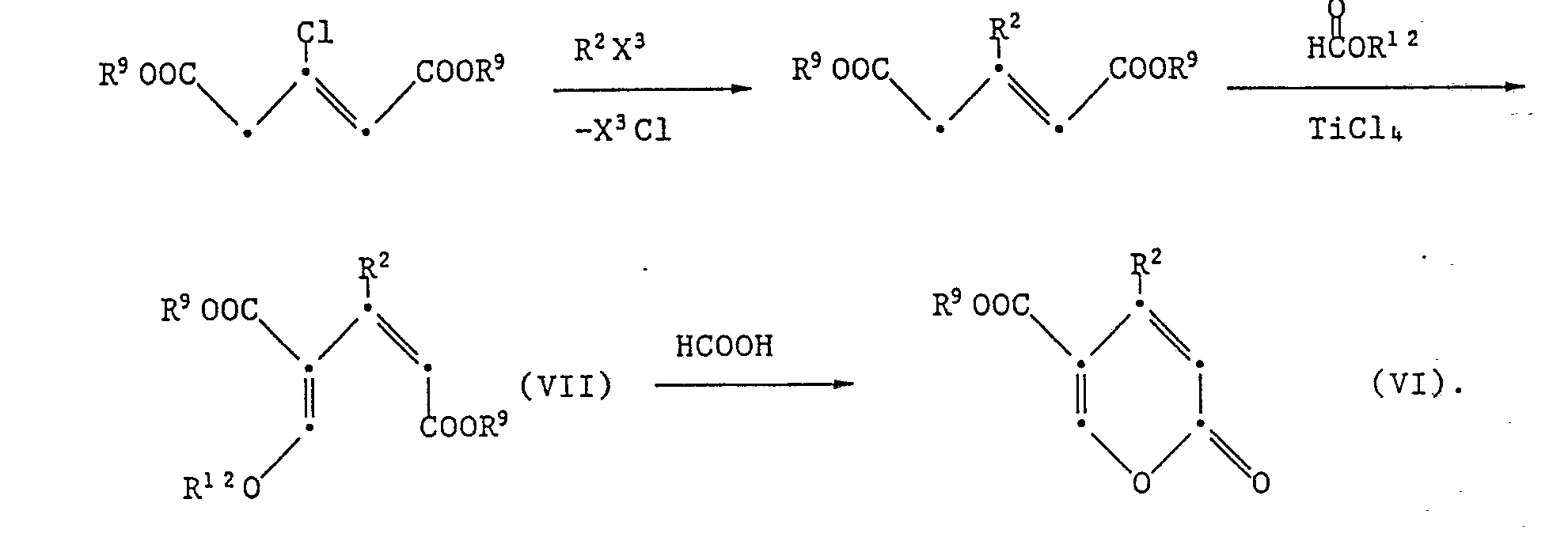
- Wenn R1 bis R8 einen Polyoxaalkylenrest bedeuten, so erhält man solche Verbindungen auch durch Umsetzung von Verbindungen der Formel 1 mit R1 bis R8 gleich Hydroxyalkyl mit Epoxiden. Ferner ist es möglich die Reste R1 bis R8 durch klassische Reaktionen abzuwandeln, wie z.B. Hydrolyse, Ver- oder Umesterung, Amidierung, Oxidation oder Reduktion. Carbonsäureester können in bekannter Weise mit HF/SF4 in die Trifluormethylderivate umgewandelt werden.
- Die Verbindungen der Formel sind im allgemeinen kristallen und zeichnen sich durch eine hohe thermische Stabilität aus. Verbindungen mit Oxy-, Sulfinyl- oder Alkylsubstituenten können sehr gut in härtbaren Zusammensetzungen gelöst werden, gegebenenfalls zusammen mit einem Lösungsmittel.
- Sie eignen sich alleine oder zusammen mit H-Donoren wie z-B. tertiären Aminen oder Alkoholen oder Phenylessigsäurederivaten als wirksame Photoinitiatoren bzw. Sensibilisatoren für die lichtinduzierte Polymerisation bzw. Dimerisation ethylenisch ungesättigter Verbindungen. Sie zeichnen sich hierbei durch eine gute Lichtempfindlichkeit und Wirksamkeit über einen Wellenlängenbereich von ca. 200 nm (UV-Licht) bis etwa 600 nm aus.
- Die Eigenschaften der erfindungsgemässen Verbindungen, z.B. Löslichkeit, Schmelzpunkt und Absorptionsbereich lassen sich durch die Wahl von Substituenten gezielt beeinflussen.
- Ein weiterer Gegenstand vorliegender Erfindung ist eine durch Strahlung polymerisierbare Zusammensetzung, enthaltend (a) mindestens eine nichtflüchtige, monomere, oligomere oder polymere Verbindung mit mindestens einer photopolymerisierbaren oder photodimerisierbaren ethylenisch ungesättigten Doppelbindung und (b) mindestens eine Verbindung der Formel la als Photoinitiator oder Sensibilisator,

- Die Zusammensetzungen können weitere von (B) verschiedene Photoinitiatoren oder Sensibilisatoren enthalten.
- Die Zusatzmenge an erfindungsgemässen Verbindungen richtet sich im wesentlichen nach wirtschaftlichen Gesichtspunkten, deren Löslichkeiten und nach der gewünschten Empfindlichkeit. Im allgemeinen werden 0,01 bis 20, vorzugsweise 0,05-10 und besonders 0,1 bis 5 Gew.0/o verwendet, bezogen auf die Komponente (a).
- Als Komponente (a) kommen solche ethylenisch ungesättigten monomeren, oligomeren und polymeren Verbindungen in Frage, die durch Photopolymerisation zu höhermolekularen Produkten reagieren und hierbei ihre Löslichkeit verändern.
- Besonders geeignet sind z.B. Ester von ethylenisch ungesättigten Carbonsäuren und Polyolen oder Polyepoxiden, und Polymere mit ethylenisch ungesättigten Gruppen in der Kette oder in Seitengruppen, wie z.B. ungesättigte Polyester, Polyamide und Polyurethane und Copolymere hiervon, Polybutadien und Butadien-Copolymere, Polyisopren und lsopren-Copolymere, Polymere und Copolymere mit (Meth)Acrylgruppen in Seitenketten, sowie Mischungen von einem oder mehreren solcher Polymerer.
- Beispiele für ungesättigte Carbonsäuren sind Acrylsäure, Methacrylsäure, Crotonsäure, Itaconsäure, Zimtsäure, ungesättigte Fettsäuren wie Linolensäure oder Oelsäure. Bevorzugt sind Acryl- und Methacrylsäure.
- Als Polyole sind aromatische und besonders aliphatische und cycloaliphatische Polyole geeignet. Beispiele für aromatische Polyole sind Hydrochinon, 4,4'-Dihydroxydiphenyl, 2,2-Di(4-hydroxyphenyl)-propan, sowie Novolake und Resole. Beispiele für Polyepoxide sind solche auf der Basis der genannten Polyole, besonders der aromatischen Polyole und Epichlorhydrin. Ferner sind auch Polymere oder Copolymere, die Hydroxylgruppen in der Polymerkette oder in Seitengruppen enthalten, wie z.B. Polyvinylalkohol und Copolymere davon oder Polymethacrylsäurehydroxyalkylester oder Copolymere davon, als Polyole geeignet. Weitere geeignete Polyole sind Oligoester mit Hydroxylendgruppen.
- Beispiele für aliphatische und cycloaliphatische Polyole sind Alkylendiole mit bevorzugt 2 bis 12 C-Atomen, wie Ethylenglykol, 1,2- oder 1,3-Propandiol, 1,2-, 1,3 oder 1,4-Butandiol, Pentandiol, Hexandiol, Octandiol, Dodecandiol, Diethylenglykol, Triethylenglykol, Polyethylenglykole mit Molekulargewichten von bevorzugt 200 bis 1500, 1,3-Cyclopentandiol, 1,2-, 1,3- oder 1,4-Cyclohexandiol,1,4-Dihydroxymethylcyclohexan, Glycerin, Tris-(ß-hydroxyethyl)amin, Trimethylolethan, Trimethylolpropan, Pentaerythrit. Dipentaerythrit und Sorbit.
- Die Polyole können teilweise oder vollständig mit einer oder verschiedenen ungesättigten Carbonsäuren verestert sein, wobei in Teilestern die freien Hydroxylgruppen modifiziert, z.B. verethert oder mit anderen Carbonsäuren verestert sein können.
- Beispiele für Ester sind:
- Trimethylolpropantriacrylat, Trimethylolethantriacrylat, Trimethylolpropantrimethacrylat, Trimethylolethantrimethacrylat, Tetramethylenglykoldimethacrylat, Triethylenglykoldimethacrylat, Tetraethylenglykoldiacrylat, Pentaerythritdiacrylat, Pentaerythrittriacrylat, Pentaerythrittetraacrylat, Dipentaerythritdiacrylat, Dipentaerythrittriacrylat, Dipentaerythrittetraacrylat, Dipentaerythritpentaacrylat, Dipentaerythrithexaacrylat, Tripentaerythritoctaacrylat, Pentaerythritdimethacrylat, Pentaerythrittrimethacrylat, Dipentaerythritdimethacrylat, Dipentaerythrittetramethacrylat, Tripentaerythritoctamethacrylat, Pentaerythritdiitaconat, Dipentaerythrittrisitaconat, Dipentaerythritpentaitaconat, Dipentaerythrithexaitaconat, Ethylenglykoldimethacrylat, 1,3-Butandioldiacrylat, 1,3-Butandioldimethacrylat, 1,4-Butandioldiitaconat, Sorbittriacrylat, Sorbittetraacrylat, Pentaerythrit-modifiziert-triacrylat, Sorbittetramethacrylat, Sorbitpentaacrylat, Sorbithexaacrylat, Oligoesteracrylate und -methacrylate, Glyzerindi- und -triacrylat, 1,4-Cyclohexandiacrylat, Bisacrylate und Bismethacrylate von Polyethylenglykol mit Molekulargewicht von 200-1500, oder Gemische davon.
- Als Komponente (a) sind auch die Amide gleicher oder verschiedener ungesättigter Carbonsäuren von aromatischen, cycloaliphatischen und aliphatischen Polyaminen mit bevorzugt 2 bis 6, besonders 2 bis 4 Aminogruppen geeignet. Beispiele für solche Polyamine sind Ethylendiamin, 1,2-oder 1,3-Propylendiamin, 1,2-, 1,3- oder 1,4-Butylendiamin, 1,5-Pentylendiamin, 1,6-Hexylendiamin, Octylendiamin, Dodecylendiamin, 1,4-Diaminocyclohexan, Isophorondiamin, Phenylendiamin, Bisphenylendiamin, Di-ß-aminoethylether, Diethylentriamin, Triethylentetramin, Di-(ß-aminoethoxy)- oder Di(ß-aminopropoxy)ethan. Weitere geeignete Polyamine sind Polymere und Copolymere mit Aminogruppen in der Seitenkette und Oligoamide mit Aminoendgruppen.
- Beispiele für solche ungesättigten Amide sind: Methylen-bis-acrylamid, 1,6-Hexamethylen-bis-acrylamid, Diethylentriamin-tris-methacrylamid, Bis(methacrylamidopropoxy)-ethan, β-Methacrylamidoethylmethacrylat, N [(ß-Hydroxyethoxy) ethyl]-acrylamid.
- Geeignete ungesättigte Polyester und Polyamide leiten sich z.B. von Maleinsäure und Diolen oder Diaminen ab. Die Maleinsäure kann teilweise durch andere Dicarbonsäuren ersetzt sein. Sie können zusammen mit ethylenisch ungesättigten Comonomeren, z.B. Styrol, eingesetzt werden. Die Polyester und Polyamide können sich auch von Dicarbonsäuren und ethylenisch ungesättigten Diolen oder Diaminen ableiten, besonders von längerkettigen mit z.B. 6 bis 20 C-Atomen. Beispiele für Polyurethane sind solche, die aus gesättigten oder ungesättigten Diisocyanaten und ungesättigten bzw. gesättigten Diolen aufgebaut sind.
- Polybutadien und Polyisopren und Copolymere davon sind bekannt. Geeignete Comonomere sind z.B. Polyolefine wie Ethylen, Propen, Buten, Hexen, (Meth)Acrylate, Acrylnitril, Styrol oder Vinylchlorid. Polymere mit (Meth)Acrylatgruppen in der Seitenkette sind ebenfalls bekannt. Es kann sich z.B. um Umsetzungsprodukte von Epoxidharzen auf Novolakbasis mit (Meth)Acrylsäure handeln, um Homo- oder Copolymere des Polyvinylalkohols oder deren Hydroxyalkylderivaten, die mit (Meth)Acrylsäure verestert sind, oder um Homo-und Copolymere von (Meth)Acrylaten, die mit Hydroxyalkyl(meth)acrylaten verestert sind.
- Die photopolymerisierbaren Verbindungen können alleine oder in beliebigen Mischungen eingesetzt werden. Bevorzugt werden Gemische von Polyol(Meth)Acrylaten verwendet.
- Geeignete dimerisierbare Verbindungen sind solche, die z.B. Zimtsäurereste, Dimethylmaleinimidylreste oder


- Den erfindungsgemässen Zusammensetzungen können auch Bindemittel zugesetzt werden, was besonders zweckmässig ist, wenn es sich bei den photopolymerisierbaren bzw. photodimerisierbaren Verbindungen um flüssige oder viskose Substanzen handelt. Die Menge des Bindemittels kann z.B. 5-95, vorzugsweise 10-90 und besonders 50-90 Gew.0/o betragen, bezogen auf die gesamte Zusammensetzung. Die Wahl des Bindemittels erfolgt je nach dem Anwendungsgebiet und hierfür geforderter Eigenschaften wie Entwickelbarkeit in wässrigen und organischen Lösungsmittelsystemen, Adhäsion auf Substraten und Sauerstoffempfindlichkeit.
- Geeignete Bindemittel sind z.B. Polymere mit einem Molekulargewicht von etwa 5000-2 000 000, bevorzugt 10 000 bis 1 000 000. Beispiele sind: Homo- und copolymere Acrylate und Methacrylate, z.B. Copolymere aus Methylmethacrylat/Ethylacrylat/Methacrylsäure, Poly(methacrylsäurealkylester), Poly(acrylsäurealkylester); Celluloseester und -ether wie Celluloseacetat, Celluloseacetatbutyrat, Methylcellulose, Ethylcellulose; Polyvinylbutyral, Polyvinylformal, cyclisierter Kautschuk, Polyether wie Polyethylenoxid, Polypropylenoxid, Polytetrahydrofuran; Polystyrol, Polycarbonat, Polyurethan, chlorierte Polyolefine, Polyvinylchlorid, Copolymere aus Vinylchlorid/Vinylidenchlorid, Copolymere von Vinylidenchlorid mit Acrylnitril, Methylmethacrylat und Vinylacetat, Polyvinylacetat, Copoly(ethylen/vinylacetat), Polyamide wie Polycaprolactam und Poly(hexame- thylenadipamid), Polyester wie Poly(äthylenglykolterephthalat) und Poly(hexamethylenglykolsuccinat),
- Die erfindungsgemässen Zusammensetzungen eignen sich als Beschichtungsmittel für Substrate aller Art, z.B. Holz, Papier, Keramik, Kunststoffe, wie Polyester und Celluloseacetatfilme, und Metalle, wie Kupfer und Aluminium, bei denen durch Photopolymerisation eine Schutzschicht oder eine photographische Abbildung aufgebracht werden soll. Ein weiterer Gegenstand vorliegender Erfindung sind die beschichteten Substrate und ein Verfahren zum Aufbringen photographischer Abbildungen auf den Substraten. Die beschichteten Substrate können auch als Aufzeichnungs material für Hologramme (Volumen-Phasen-Diagramm) verwendet werden, wobei vorteilhaft ist, dass für diesen Zweck keine Nassentwicklung notwendig ist.
- Die Beschichtung der Substrate kann erfolgen. indem man eine flüssige Zusammensetzung, eine Lösung oder Suspension auf das Substrat aufbringt. Flüssige Zusammensetzungen ohne Lösungsmittel sind bevorzugt.
- Die Wahl des Lösungsmittels und die Konzentration richtet sich hauptsächlich nach der Art der Zusammensetzung und nach dem Beschichtungsverfahren. Die Zusammensetzung wird mittels bekannter Beschichtungsverfahren auf ein Substrat gleichförmig aufgebracht, z.B. durch Tauchen, Rakelbeschichtung, Vorhanggiessverfahren, Elektrophorese, Aufpinseln, Sprayen oder Reverseroll-Beschichtung. Die Auftragsmenge (Schichtdicke) und Art des Substrates (Schichtträger) sind abhängig vom gewünschten Applikationsgebiet. Als Schichtträger für photographische Informationsaufzeichnung dienen z.B. Folien aus Polyester, Celluloseacetat oder mit Kunststoff beschichtete Papiere; für Offsetdruckformen speziell behandeltes Aluminium und für die Herstellung gedruckter Schaltungen kupferkaschierte Laminate. Die Schichtdicken für photographische Materialien und Offsetdruckformen betragen im allgemeinen ca. 0,5 bis ca. 10 pm; für gedruckte Schaltungen im allgemeinen 1 bis ca. 100 jim. Bei Mitverwendung von Lösungsmitteln werden diese nach dem Beschichten entfernt.
- Photohärtbare Zusammensetzungen, wie sie für die verschiedenen Zwecke verwendet werden, enthalten meist ausser den photopolymerisierbaren Verbindungen und den Photoinitiatoren eine Reihe sonstiger Zusätze. So ist es vielfach üblich, thermische Inhibitoren zuzusetzen, die vor allem während der Herstellung der Zusammensetzungen durch Mischen der Komponenten vor einer vorzeitigen Polymerisation schützen sollen. Hierzu werden beispielsweise Hydrochinon, Hydrochinonderivate, p-Methoxyphenol, β-Naphthole oder sterisch gehinderte Phenole wie z.B. 2,6-Di(tert-butyl)-p-kresol verwendet. Weiter können geringe Mengen von UV-Absorbern zugesetzt werden, wie z.B. solche vom Benztriazol-, Benzophenon- oder Oxalanilid-Typ. Ebenso lassen sich Lichtschutzmittel vom Typus sterisch gehinderter Amine (HALS) zusetzen.
- Zur Erhöhung der Dunkellagerstabilität können Kupferverbindungen, wie Kupfernaphthenat, -stearat, oder -octoat, Phosphorverbindungen, wie Triphenylphosphin, Tributylphosphin, Triethylphosphit, Triphenylphosphit oder Tribenzylphosphit, quaternäre Ammoniumverbindungen, wie Tetramethylammoniumchlorid oder Trimethyl-benzylammoniumchlorid oder Hydroxylaminderivate, wie z.B. N-Diethylhydroxylamin, zugesetzt werden.
- Um die inhibierende Wirkung des Luftsauerstoffs auszuschliessen, setzt man photohärtbaren Gemischen häufig Paraffin oder ähnliche wachsartige Stoffe zu. Diese schwimmen bei Beginn der Polymerisation wegen mangelnder Löslichkeit im Polymeren aus und bilden eine transparente Oberflächenschicht, die den Zutritt von Luft verhindert.
- Weitere übliche Zusätze sind Photosensibilisatoren, welche in bestimmten Wellenlängen absorbieren und die absorbierte Energie an den Initiatoren weitergeben oder selbst als zusätzlicher Initiator fungieren. Beispiele hierfür sind vor allem Thioxanthon-, Anthracen-, Anthrachinon- und Cumarinderivate.
- Weitere übliche Zusätze sind Beschleuniger vom Amin-Typ, die vor allem in pigmentierten Zubereitungen von Bedeutung sind, da sie als Kettenüberträger wirken. Beispiele hierfür sind N-Methyldietlianolamin, Triethylamin, p-Dimethylaminobenzoesäureethylester oder Michler's Keton. Die Wirkung der Amine kann verstärkt werden durch den Zusatz von aromatischen Ketonen vom Benzophenontyp.
- Weitere übliche Zusätze sind z.B. Füllstoffe, Pigmente, Farbstoffe, Haft-, Netz- und Verlaufmittel.
- Grosse Bedeutung hat die Photohärtung für Druckfarben, da die Trocknungszeit des Bindemittels ein massgeblicher Faktor für die Produktionsgeschwindigkeit graphischer Erzeugnisse ist und in der Grössenordnung von Bruchteilen von Sekunden liegen soll. Insbesondere für den Siebdruck sind UV-härtbare Druckfarben von Bedeutung.
- Gut geeignet sind die erfindungsgemässen photohärtbaren Zusammensetzungen auch zur Herstellung von Druckplatten, insbesondere Flexodruckplatten. Hierbei werden z.B. Gemische von löslichen linearen Polyamiden oder von Styrol-Butadien-Kautschuk mit photopolymerisierbaren Monomeren, beispielsweise Acrylamiden oder Acrylaten, und einem Photoinitiator verwendet. Filme und Platten aus diesen Systemen werden über das Negativ (oder Positiv) der Druckvorlage belichtet und die ungehärteten Anteile anschliessend mit einem Lösungsmittel eluiert.
- Ein weiteres Einsatzgebiet der Photohärtung ist die Metallbeschichtung, beispielsweise bei der Lackierung von Blechen für Tuben, Dosen oder Flaschenverschlüsse, sowie die Photohärtung von Kunststoffbeschichtungen, beispielsweise von Fussboden- oder Wandbelägen auf PVC-Basis.
- Beispiele für die Photohärtung von Papierbeschichtungen sind die farblose Lackierung von Etiketten, Schallplatten-Hüllen oder Buchumschlägen.
- Wichtig ist auch die Verwendung der photohärtbaren Zusammensetzungen für Abbildungsverfahren und zur optischen Herstellung von Informationsträgern. Hierbei wird die auf dem Träger aufgebrachte Schicht (nass oder trocken) durch eine Photomaske mit kurzwelligem Licht bestrahlt und die unbelichteten Stellen der Schicht durch Behandlung mit einem Lösungsmittel (= Entwickler) entfernt. Die belichteten Stellen sind vernetztpolymer und dadurch unlöslich und bleiben auf dem Träger stehen. Bei entsprechender Anfärbung entstehen sichtbare Bilder. Ist der Träger eine metallisierte Schicht, so kann das Metall nach dem Belichten und Entwickeln an den unbelichteten Stellen weggeätzt oder durch Galvanisieren verstärkt werden. Auf diese Weise lassen sich gedruckte Schaltungen herstellen. Die erfindungsgemässe Zusammensetzung kann auch als Photoresist verwendet werden.
- Zur Belichtung eignen sich Lichtquellen mit hohem Anteil an kurzwelligem Licht. Hierfür stehen heute entsprechende technische Vorrichtungen und verschiedene Lampenarten zur Verfügung. Beispiele sind Kohlelichtbogenlampen, Xenonlichtbogenlampen, Quecksilberdampflampen, Metall-Halogenlampen, Fluoreszenzlampen, Argonlampen oder photographische Flutlicht lampen. Neuerdings werden auch Laserlichtquellen verwendet. Diese haben den Vorteil, dass keine Photomasken notwendig sind; der gesteuerte Laserstrahl schreibt direkt auf die photohärtbare Schicht.
- Weitere Gegenstände der Erfindung sind somit
- a) ein beschichtetes Substrat, das auf mindestens einer Oberfläche mit einer erfindungsgemässen Zusammensetzung beschichtet ist;
- b) ein Verfahren zur photographischen Herstellung von Reliefabbildungen oder Beschichtungen, dadurch gekennzeichnet, dass man ein beschichtetes Substrat bildmässig oder flächenmässig belichtet und unbelichtete Anteile danach mit einem Lösungsmittel entfernt;
- c) die Verwendung von Verbindungen der Formel la als Initiatoren und Sensibilisatoren für die Photopolymerisation oder Photodimerisation von nichtflüchtigen monomeren, oligomeren oder polymeren Verbindungen mit mindestens einer photopolymerisierbaren oder photodimerisierbaren ethylenisch ungesättigten Doppelbindung; und
- d) die Verwendung einer erfindungsgemässen Zusammensetzung zur Herstellung von Lacken, Druckfarben, Druckplatten, Resistmaterialien sowie als Bildaufzeichnungsmaterial und Beschichtungsmittel.
- Die Verbindungen der Formel 1 sind auch wertvolle Zwischenprodukte zur Herstellung von substituierten Tetrathio- bzw. Tetraselenotetracenen (vgl. US-PS 4 617 151). Aus solchen chalkogenierten Tetracenen können mit Elektronenacceptoren elektrisch leitende Charge-Transferkomplexe (CT-Komplexe) hergestellt werden. Mit deren funktionellen Substituenten kann man sie an Polymere binden, z.B. als Seitengruppen in Polymere einbauen (vgl. US-PS 4,617,151). Die CT-Komplexe eignen sich auch zur Herstellung z.B. von antistatischen Beschichtungen photographischer Filmelemente, Magnetbänder, elektrophotographischer Filmelemente und elektronischer Komponenten (siehe US-PS 3,634,336). Die chalkogenierten Tetracene weisen ferner elektrochrome Eigenschaften auf; sie können für elektrochrome Displays verwendet werden. Sie eignen sich auch als laser-optische Datenspeicher [Nach. Chem. Techn. Lab. 35, S. 255 ff (1987)] und als Anodenmaterial in organischen Solid-State-Batterien (EP-A-0 090 598). CT-Komplexe von substituierten Tetrathio- oder Tetraselenotetracenen können zur Erzielung antistatischer Eigenschaften auch in thermoplastische, duroplastische oder elastomere Polymere einge arbeitet werden. Hierzu werden zweckmässig z.B. die substituierten Tetrathio- bzw. Tetraselenotetracene zusammen mit einem löslichen Polymer oder einer Vorstufe davon und einem Elektronenacceptor, z.B. einem Halogen bildenden Mittel (organische halogenierte Verbindungen wie z.B. Bromoform, Trichlorbrommethan, Tetrabrommethan, Hexachlorpropan, Perchlorbutadien, 1,3-oder 1,4-Dichlor-2-buten, 1,4-Bis(trichloromethyl)benzol, lodacetonitril, lodoform, Tetrachlorethylen, Perchlorcyclobutadien, N-Chlor-, -brom oder -iodsuccinimid) gegebenenfalls zusammen mit einem weiteren inerten Lösungsmittel gelöst und das überschüssige Halogen bildende Mittel und das Lösungsmittel bei höherer Temperatur verdampft. Die gebildete Zusammensetzung enthält im Polymer ein Netzwerk nadelförmiger Kristalle des CT-Komplexes, wenn das chalkogenierte Tetracen unsubstituiert ist oder kleine Substituenten (z.B. F, CH3, CF3) enthält. Solche Zusammensetzungen weisen eine hohe elektrische Leitfähigkeit auf. Diese kann noch verbessert werden, wenn man ein aus den Verbindungen der Formel 1 hergestelltes substituiertes Tetrathio-oder Tetraselenotetracen mitverwendet, das kein solches Netzwerk bildet und das in der Polymermatrix in feiner Verteilung vorliegt, da solche substituierten Tetrathio- oder Tetraselenotetracene keine oder nur eine geringe Kristallisationstendenz im Polymer besitzen. Naphthacen-5,12-dione können ferner auch in elektrochromen Displayelementen verwendet werden (JP-OS 61-43680). Die Verbindungen der Formel I können auch zur stromlosen Metallabscheidung auf der Oberfläche von Hydroxyalkylgruppen enthaltenden Polymeren, z.B. Copolymeren von Methacrylaten mit Alkyl- und Hydroxyalkylestergruppen, oder Epoxiharzen, die z.B. mit Aminoalkoholen gehärtet sind. Hierzu vermischt man Verbindungen der Formel 1 mit den Polymeren, z.B. in einer Menge von 0,1 bis 10 Gew.-%, bezogen auf das Polymer, belichtet gegebenenfalls unter einer Negatiworlage und behandelt mit einem Metallierungsbad, das vorzugsweise ein Kupfersalz enthält.
- Die nachfolgenden Beispiele erläutern die Erfindung näher.
- 20 g (72,4 mMol) 2-Fluor-naphthacen-5,12-dion, 94,3 g 1-Octanol, 30,01 g (217,2 mMol) wasserfreies Kaliumcarbonat und 200 ml Dimethylsulfoxid (DMSO) werden während 20 Std. bei 100°C Badtemperatur gerührt. Das Reaktionsgemisch wird abgekühlt, mit Toluol/verdünnter Salzsäure versetzt, die organische Phase abgetrennt, zweimal mit Wasser gewaschen, mit Natriumsulfat getrocknet und eingedampft. Der Rückstand wird mit Pentan gewaschen und aus Cyclohexan umkristallisiert. Ausbeute: 22,9 g (82 o/o), Schmelzpunkt 127-129°C.
- Analog werden die in Tabelle 1 beschriebenen Verbindungen unter Verwendung der entsprechenden Alkohole hergestellt.

- 27,6 g (0,1 mol) 2-Fluor-5,12-naphthacenchinon, 32,5 g (0,1 mol) Cs2C03 und 300 ml Ethylenglycol werden in einem Sulfierkolben unter Stickstoff vorgelegt. Nach Erwärmen auf 125°C wird 3¼ h gerührt. Danach wird das Reaktionsgemisch in 3000 ml salzsaures Wasser gegossen, das ausgefallene Produkt abfiltriert und mehrmals mit Wasser gewaschen. Nach dem Trocknen im Vakuum bei 80°C werden 30,3 g (97,1 0/0) reines Produkt erhalten, Smp. 208,8°C. Analog wird in den Beispielen 19-23 verfahren (s. Tabelle 2).
- 10 g (0,036 mol) 2-Fluor-5,12-naphthacenchinon, 26 g (0,028 mol) Cs2C03 und 10,41 g (0,14 mol) 3-Butenol werden in 200 ml DMF unter Stickstoff vorgelegt. Die Reaktionsmischung wird auf 125°C erwärmt und 4½ h gerührt. Nach dem Fällen in 4000 ml salzsaurem Wasser wird abfilteriert (Rohausbeute 94%). Nach Chromatographie an Silicagel (CH2CI2) werden 63 % reines Produkt erhalten; Smp. 149°C. Analog wird in den Beispielen 25-27 verfahren (s. Tabelle 2).

-
- 1 g (3,62 mMol) 2-Fluor-naphthacen-5,12-dion, 0,92 g (10,86 mMol) Piperidin, 1,50 g (10,86 mMol) Kaliumcarbonat und 10 ml DMSO werden während 45 Min bei 60°C Badtemperatur gerührt. Nach dem Abkühlen wird das Gemisch auf Wasser ausgetragen und das orange Produkt abfiltriert. Die Kristalle werden in Tetrahydrofuran (THF)/Toluol gelöst, die Lösung über Natriumsulfat getrocknet und eingedampft. Der Rückstand wird aus Toluol/Pentan umkristallisiert. Ausbeute: 1,11 g (90%); Smp. 230-233°C.
- Analog wird in den Beispielen 29-32 verfahren (siehe Tabelle 3.

- 1 g (3,62 mMol) 2-Fluor-naphthacen-5,12-dion, 0,89 g (5,43 mMol) Benzolsulfinsäure-Natriumsalz (Natrium-Benzolsulfinat) und 10 ml DMSO werden während 3 Stunden bei 100°C gerührt. Nach dem Abkühlen wird das Gemisch auf Wasser ausgetragen. Die Kristalle werden abfiltriert und in THF/Toluol gelöst. Die Lösung wird über Natriumsulfat getrocknet und eingedampft. Der Rückstand wird aus THF/Toluol/Pentan umkristallisiert. Ausbeute: 1,35 g (94%), Smp. >260°C.
- Analog Beispiel 33 wird mit Natrium-Methansulfinat durch sechsstündiges Rühren bei 80° C 2-(Methylsulfonyl-)-naphthacen-5,12-dion hergestellt. Ausbeute: 57%.
- 3,62 mMol 2-Fluor-naphthacen-5,12-dion (hergestellt gemäss US-PS 4,522,754), 3,98 mMol NaSCH2, 10,86 mMol Kaliumcarbonat und 10 ml DMSO werden während 3 Min. bei 25°C gerührt. Das Gemisch wird auf Wasser ausgetragen. Die Kristalle werden abfiltriert und in Tetrahydrofuran/Toluol gelöst, die Lösung über Natriumsulfat getrocknet und eingedampft. Der Rückstand wird aus THF/Toluol/Pentan umkristallisiert. Ausbeute 1 g (83%) ; Smp. 195-196°C.
- 10 g (32,86 mMol) 2-Methylthio-naphthacen-5,12-dion, 3,72 g (32,86 mMol) 30 % H202 und 110 ml Eisessig werden während 4 Std. bei 80° C gerührt. Das Gemisch wird abgekühlt und in Methylenchlorid/Wasser aufgenommen. Die organische Phase wird abgetrennt, dreimal mit Wasser und dreimal mit NaHCO3-Lösung gewaschen, über Natriumsulfat getrocknet und eingeengt. Durch Chromatographie (Laufmittel: 15 % Aceton, 85% CH2Cl2) über Kieselgel werden 7,72 g (73%) reines Sulfoxid erhalten, Smp. 260-263°C.
- 50 g (181 mMol) 2-Fluor-naphthacen-5,12-dion, 71,74 g (543 mMol) Malonsäuredimethylester, 75,04 g (543 mMol) Kaliumcarbonat und 500 ml DMSO werden während 2 Std. bei 100° C Badtemperatur gerührt. Nach dem Abkühlen wird das Gemisch auf verdünnte Salzsäure ausgetragen. Der Niederschlag wird abfiltriert, mit Wasser und Methanol gewaschen, dann aus Toluol umkristallisiert. Ausbeute 63,97 g (91 %) ; Smp. 211-215° C.
- Analog wird in den Beispielen 37 bis 40 verfahren (siehe Tabelle 4):

- 8 g (20,6 mMol) (2-Naphthacen-5,12-dionyl-)-malonsäuredimethylester (Beispiel 36), 60 ml Eisessig und 60 ml konzentrierte HCI-Lösung werden während 4,5 Std. am Rückfluss gerührt. Das Gemisch wird auf Eis/Wasser ausgetragen. Die Kristalle werden abfiltriert, mit Diethylether gewaschen und aus THF/Pentan umkristallisiert. Ausbeute 4,88 g (75 %); Smp. >220°C.
- 30 g (147,7 mMol) 5-Nitronaphtho-1,4-chinon, 58,02 g (ca. 220 mMol) 1,2-Dibrombenzocyclobuten (verunreinigt mit etwas 1-Jod-2-brombenzocyclobuten) und 300 ml Toluol werden während 2 Tagen am Rückfluss gerührt, wobei die entstehende Bromwasserstoffsäure zusammen mit etwas Toluol abdestilliert wird und das dabei verlorene Toluol durch frisches ersetzt wird. Das Gemisch wird auf 25° C abgekühlt, der Niederschlag abfiltriert, mit Toluol gewaschen und im Vakuum bei 140°C getrocknet. Ausbeute: 43,46 g (97 %) ; Smp. > 250° C. Das Produkt kann aus y-Butyrolacton umkristallisiert werden; Ausbeute: 77 %.
- 3 g (9,9 mMol) 1-Nitronaphthacen-5,12-dion (Beispiel 42), 2,73 g (19,8 mMol) Kaliumcarbonat, 1,39 g (14,8 mMol) Phenol und 30 ml DMSO werden während 6 Std. bei 100°C Badtemperatur gerührt. Nach dem Abkühlen wird das Gemisch zwischen Methylenchlorid/verdünnter Salzsäure verteilt. Die organische Phase wird abgetrennt, mit Wasser gewaschen, über Natriumsulfat getrocknet, und eingedampft. Durch Chromatographie an Kieselgel (Laufmittel: Methylenchlorid) wird das Produkt rein erhalten; Ausbeute 2,52 g (73 %); Smp. 195-200° C.
- Analog wird in den Beispielen 44-51 verfahren (siehe Tabelle 5)

- 1 g (3,4 mMol) 2,3-Difluornaphthacen-5,12-dion, 0,94 g (6,8 mMol) Kaliumcarbonat, 3,24 g Methanol und 20 ml Tetrahydrofuran (THF) werden 18 Std. bei 25° C und 3 Tage am Rückfluss gerührt. Das Gemisch wird abgekühlt und mit verdünnter Salzsäure versetzt. Das Produkt wird abfiltriert, mit Wasser gewaschen, getrocknet und mit Methylenchlorid an Kieselgel chromatographiert. Nach der Sublimation bei 1,3x 10⁻¹ bar/180-310°C werden 0,26 g (25%) reines Produkt erhalten, Smp. >250°C.
- 1 g (3,4 mMol) 2,3-Difluor-naphthacen-5,12-dion, 0,94 g (6,8 mMol) K2C03, 2,18 g Methanol und 20 ml DMSO werden während 22 Std. bei 110°C gerührt. Das Gemisch wird auf verdünnte Salzsäure ausgetragen. Das Produkt wird abfiltriert, viermal mit Wasser gewaschen, getrocknet und aus CH2CI2/Pentan umkristallisiert; Ausbeute 0,72 g (67 %); Smp. > 250° C.
- 1 g (3,4 mMol) 2,3-Difluor-naphthacen-5,12-dion, 0,94 g (6,8 mMol) Kaliumcarbonat, 1,48 g (17 mMol) Morpholin und 20 ml THF werden während 23 Std. am Rückfluss gerührt. Das Gemisch wird auf Wasser ausgetragen. Das Produkt wird abfiltriert, mit Wasser gewaschen, getrocknet und aus Dioxan umkristallisiert; Ausbeute 0,78 g (64%); Smp. >240°C.
- 1 g (3,4 mMol) 2,3-Difluor-naphthacen-5,12-dion, 0,94 g (6,8 mMol) Kaliumcarbonat, 0,89 g (6,8 mMol) Malonsäuredimethylester und 20 ml DMSO werden während 22 Stunden bei 50° C gerührt. Das Gemisch wird auf verdünnte Salzsäure ausgetragen und mit THF/Toluol extrahiert. Die organische Phase wird mit Wasser gewaschen, über Natriumsulfat getrocknet, und eingedampft. Durch Chromatographie über Kieselgel (Laufmittel: 1 % Aceton/99 % CH2CI2) wird das Produkt gereinigt; Ausbeute 1,25 g (91 %); Smp. 225-230° C.
- 10 g (33,2 mMol) Naphthacen-5,12-dion-2-carbonsäureamid, 10,18 g (66,4 mMol) POCl3 und 200 ml DMF werden bei 10°C, dann bei 25° C während 2 Stunden gerührt. Das Gemisch wird auf Eiswasser ausgetragen. Der Niederschlag wird abfiltriert, dreimal mit Wasser gewaschen und getrocknet. Aus o-Dichlorbenzol umkristallisiert, werden 7,35 g (78%) Rohprodukte erhalten.
IR-Spektrum (KBr): 1678 cm-1: Chinon; 2240 cm-1: CN
Massenspektrum: M/e = 283 (M+) (Basispeak); 255; 227; 226; 100. - 5,65 g (25 mMol) 6-(Trifluormethyl-)-1,4-naphthochinon, 9,82 g (ca 37 mMol) 1,2-Dibrombenzocyclobuten (verunreinigt mit etwas 2-Brom-1-jodbenzocyclobuten) und 100 ml Xylol werden während 16 Stunden mit Wasserabscheider am Rückfluss gehalten. Das Gemisch wird abgekühlt und der Niederschlag abfiltriert umd mit Xylol gewaschen. Ausbeute 5,82 g (71 o/o); Smp. 253-254°C. In den Beispielen 58 bis 61 wird analog verfahren.
- Beispiel 58: 2,3-bis-(Trifluormethyl-)-naphthacen-5,12-dion; Ausbeute 59%; Smp. >280°C.
- Beispiel 59: 1-(Trifluormethyl-)-naphthacen-5,12-dion-3-carbonsäuremethylester; Ausbeute 60 %; Smp. 234-235° C.
- Beispiel 60: 2-Ethoxy-naphthacen-5,12-dion-3-carbonsäuremethylester; Ausbeute 30%; Smp. 192-194°C.
- Beispiel 61:2-Ethoxy-naphthacen-5,12-dion-3-dicarbonsäurediethyiester; Ausbeute 41 %; Smp.163-164°C.
- Die substituierten Naphthochinone der Beispiele 57 bis 60 werden durch Diels-Alder-Reaktion entsprechender a-Pyrone mit p-Benzochinon erhalten, wobei die Trifluormethylderivate durch Fluorierung mit HF/SF4 der Carbonsäureethylester hergestellt werden. Das Naphthochinon von Beispiel 60 wird durch Diels-Alder-Reaktion von 1-Ethoxy-2,4-dicarbethoxy-1,4-butadien mit p-Benzochinon erhalten.
- Eine Mischung aus 1 Mol entsprechend substituiertem Dibrom- bzw. Bromjod-benzocyclobuten*, 1,5 Mol Naphthochinon und 7 Liter Lösungsmittel wird während 4-16 Stunden am Rückfluss erhitzt. Nach dem Abkühlen wird das ausgefallene Naphthacenchinon abfiltriert und durch Kristallisation bzw. Sublimation im Hochvakuum gereinigt (siehe Tabelle 6)

- Eine Mischung aus 0,1 Mol entsprechend substituiertem Bis-dibromomethylbenzol, 0,12-0,2 Mol gegebenenfalls substituiertem Naphthochinon, 0,6 Mol Natriumjodid und 1000 ml Aceton bzw. Acetonitril wird unter Rühren und N2-Atmosphäre während 2-6 Stunden am Rückfluss gekocht. Nach dem Abkühlen wird der ausgefallene Niederschlag abfiltriert und mit Wasser digeriert. Das auf diese Weise erhaltene substituierte Naphthacendion wird zur Weiterreinigung entweder umkristallisiert oder im Hochvakuum sublimiert (vgl. Tabellen 7, 8 und 9).


- Es wird eine photohärtbare Zusammensetzung hergestellt durch Mischen der folgenden Komponenten:

- Portionen dieser Zusammensetzung werden mit 0,2 % (bezogen auf die Zusammensetzung) der in der folgenden Tabelle angegebenen Photoinitiatoren vermischt. Alle Operationen werden unter Rotlicht oder Gelblicht ausgeführt.
- Die mit Initiator versetzten Proben werden mit einem Spiralrakel von 150 11m auf 200 µm Aluminiumfolie (10 x 15 cm) aufgetragen. Das Lösungsmittel wird durch Erwärmung auf 60°C während 15 Minuten im Umluftofen entfernt. Es resultiert eine Trockenschichtdicke von etwa 35 µm. Auf die Schicht wird eine 76 µm dicke Polyesterfolie gelegt und auf diese ein standardisiertes Testnegativ mit 21 Stufen verschiedener optischer Dichte (Stouffer-Keil) gelegt. Darüber wird eine zweite Polyesterfolie gelegt und das so erhaltene Laminat mittels Vakuum auf einer Metallplatte fixiert. Die Probe wird dann mit einer 5 KW-Metallhalogenid-Lampe (Typ MO 23) im Abstand von 30 cm belichtet und zwar in einer ersten Testreihe 20 Sekunden und einer zweiten Testreihe 40 Sekunden. Nach der Belichtung werden die Folien und die Maske entfernt, die belichtete Schicht in einem Ultraschallbad 120 Sekunden mit Entwickler A 2 Minuten lang entwickelt und anschliessend bei 60° C 15 Minuten im Umluftofen getrocknet. Die Empfindlichkeit des verwendeten Initiatorsystems wird durch die Angabe der letzten klebefrei abgebildeten Keilstufe charakterisiert. Je höher die Zahl der Stufen ist, desto empfindlicher ist das System. Eine Erhöhung um zwei Stufen bedeutet dabei etwa eine Verdopplung der Härtungsgeschwindigkeit. Die Ergebnisse sind in Tabelle 10 angegeben. Entwickler A enthält 15 g Natriummetasilikat·9 H20; 0,16 g KOH; 3 g Polyethylenglykol 6000; 0,5 g Lävulinsäure und 1000 g deionisiertes Wasser.

- Eine Lösung der Zusammensetzung:

- Durch Eintauchen in eine Lösung aus


- Ein Copolymer aus 65 Mol% Hydroxypropylmethacrylat und 35 Mol% Methylmethacrylat mit einem Molekulargewicht von 120,000 Dalton (gemessen durch Lichtstreuung in Dioxan bei 25°C) wird in DMF gelöst und mit 5 Mol% Anthracendion gemäss Beispiel 37 (bezogen auf Polymerhydroxylgruppen) versezt. Durch Aufrakeln der Lösung auf einen Polyesterträger und anschliessende Trocknung bei 80° C für 2 Stunden in einem Umluftofen werden Filme hergestellt. Die Filme werden auf einem thermostatisierbaren Vakuumheiztisch bei 50°C unter einem Negativ mit einer HG-Hochdrucklampe mit 40 mW/cm-2 Intensität belichtet. Man erhält ein dunkles, negatives Abbild der Vorlage, das in einem Abscheidungsbad der Zusammensetzung

- In einer 20 % (w/w) Lösung eines Copolymers mit Molekulargewicht 140,000 Dalton (gemessen durch Lichtstreuung in Dioxan bei 25°C) aus 20 Mol% Ethylacrylat und 80 Mol% N-(5-methyl-3-oxa-4-oxohexen-5-yl)-dimethylmaleinimid (hergestellt nach dem Verfahren in Angew. Makromol. Chem. 115 (1983) 163ff) werden 5 % (w/w) 2-Methoxy-anthracen-5,12-dion gelöst. Die Lösung wird als Film mit einem Drahtrakel in 24 µm Nassfilmdicke auf ein kupferbeschichtetes Glasfaser-Epoxidlaminat aufgerakelt und bei 80° C 1 Stunde lang getrocknet. Der trockene Film wird mit einer 5000 W Quecksilberlampe (MO 33, Fa. Staub) durch einen Stufenkeil mit Inkrementen von 0.15 (log O.D.) belichtet und anschliessend in 1,1,1-Trichlorethan zu einem Reliefbild entwickelt. Die zur Erreichung der Stufe 7 des Stufenkeils benötigte Belichtungsenergie beträgt 231 mJ x cm-2.
Claims (23)


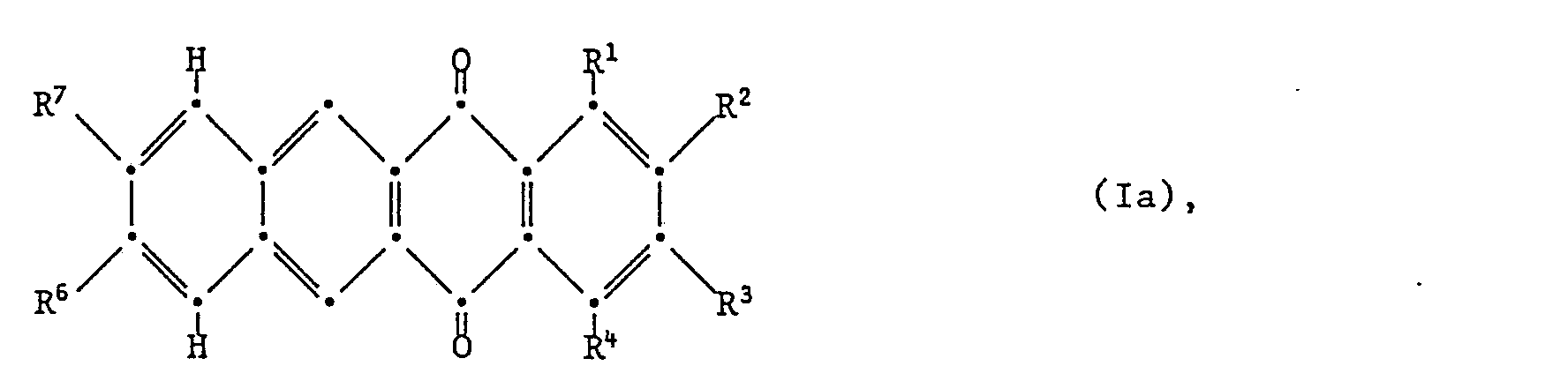
Applications Claiming Priority (4)
| Application Number | Priority Date | Filing Date | Title |
|---|---|---|---|
| CH200888 | 1988-05-27 | ||
| CH2008/88 | 1988-05-27 | ||
| CH275788 | 1988-07-19 | ||
| CH2757/88 | 1988-07-19 |
Publications (3)
| Publication Number | Publication Date |
|---|---|
| EP0344109A2 true EP0344109A2 (de) | 1989-11-29 |
| EP0344109A3 EP0344109A3 (en) | 1990-03-21 |
| EP0344109B1 EP0344109B1 (de) | 1994-04-27 |
Family
ID=25689252
Family Applications (1)
| Application Number | Title | Priority Date | Filing Date |
|---|---|---|---|
| EP89810363A Expired - Lifetime EP0344109B1 (de) | 1988-05-27 | 1989-05-18 | Substituierte Naphthacen-5,12-dione und deren Verwendung |
Country Status (4)
| Country | Link |
|---|---|
| US (2) | US5112977A (de) |
| EP (1) | EP0344109B1 (de) |
| JP (1) | JPH0228130A (de) |
| DE (1) | DE58907546D1 (de) |
Cited By (2)
| Publication number | Priority date | Publication date | Assignee | Title |
|---|---|---|---|---|
| EP0554219A1 (de) * | 1992-01-29 | 1993-08-04 | Ciba-Geigy Ag | Kunststoffzusammensetzung mit Charge-Transfer Komplexen, deren Herstellung und deren Verwendung |
| WO2022184292A1 (en) * | 2021-03-01 | 2022-09-09 | Arkema France | Type-ii photoinitiators |
Families Citing this family (5)
| Publication number | Priority date | Publication date | Assignee | Title |
|---|---|---|---|---|
| EP0344109B1 (de) * | 1988-05-27 | 1994-04-27 | Ciba-Geigy Ag | Substituierte Naphthacen-5,12-dione und deren Verwendung |
| US5442059A (en) * | 1992-08-13 | 1995-08-15 | American Cyanamid Company | 9-[(substituted glycyl)amido)]-6-demethyl-6-deoxytetracyclines |
| US5539100A (en) * | 1993-07-01 | 1996-07-23 | The United States Of America As Represented By The United States Department Of Energy | Organic solid state switches incorporating porphyrin compounds and method for producing organic solid state optical switches |
| JP5004169B2 (ja) | 2007-05-30 | 2012-08-22 | ローム株式会社 | マイクロチップの製造方法 |
| TW201001102A (en) * | 2008-04-16 | 2010-01-01 | Smart Holograms Ltd | Photopolymerizable compositions |
Family Cites Families (14)
| Publication number | Priority date | Publication date | Assignee | Title |
|---|---|---|---|---|
| US3787212A (en) * | 1972-08-04 | 1974-01-22 | Monsanto Co | Polymeric photosensitive compositions and methods using same |
| CH593992A5 (de) * | 1972-12-23 | 1977-12-30 | Roehm Gmbh | |
| US4046577A (en) * | 1975-06-09 | 1977-09-06 | The Richardson Company | Photoreactive compositions comprising polymers containing alkoxyaromatic glyoxy groups |
| US4316985A (en) * | 1979-01-16 | 1982-02-23 | Hoffmann-La Roche Inc. | Cyclic compounds |
| US4309413A (en) * | 1979-01-22 | 1982-01-05 | Monsanto Company | Method of producing immune response by administering polymeric composition |
| US4522754A (en) * | 1982-11-12 | 1985-06-11 | Ciba Geigy Corporation | Metallically conducting (2-fluoro-5,6,11,12-tetraselenotetracene)2 -bromide |
| EP0112798B1 (de) * | 1982-11-25 | 1987-05-13 | Ciba-Geigy Ag | Zu Kondensations- oder Additionsreaktionen befähigte lichtempfindliche und gegebenenfalls vernetzbare Stoffgemische, daraus herstellbare Reaktionsprodukte und deren Verwendung |
| CH662567A5 (de) * | 1984-03-23 | 1987-10-15 | Ciba Geigy Ag | In 2-stellung substituiertes 5,6,11,12-tetrathio- und 5,6,11,12-tetraselenotetracene, verfahren zu ihrer herstellung und ihre verwendung. |
| BE902790A (fr) * | 1984-07-12 | 1986-01-02 | Sandoz Sa | Procede de preparation de xanthones et de thioxanthones. |
| DE3673040D1 (de) * | 1985-03-11 | 1990-09-06 | Ciba Geigy Ag | Enolether, verfahren zu deren herstellung, alpha-pyrone, verfahren zu deren herstellung und verwendung der alpha-pyrone. |
| CH664963A5 (de) * | 1985-10-18 | 1988-04-15 | Ciba Geigy Ag | Difluorierte (5,6,11,12-tetraselenotetracen)2-halogenide, verfahren zu deren herstellung und deren verwendung. |
| US4855319A (en) * | 1986-05-06 | 1989-08-08 | The United States Of America As Represented By The Secretary Of Agriculture | Control of pests with annonaceous acetogenins |
| EP0344110B1 (de) * | 1988-05-27 | 1992-09-16 | Ciba-Geigy Ag | Substituierte Naphthacen-5,12-dione und deren Verwendung |
| EP0344109B1 (de) * | 1988-05-27 | 1994-04-27 | Ciba-Geigy Ag | Substituierte Naphthacen-5,12-dione und deren Verwendung |
-
1989
- 1989-05-18 EP EP89810363A patent/EP0344109B1/de not_active Expired - Lifetime
- 1989-05-18 DE DE58907546T patent/DE58907546D1/de not_active Expired - Fee Related
- 1989-05-24 US US07/356,830 patent/US5112977A/en not_active Expired - Fee Related
- 1989-05-29 JP JP1132910A patent/JPH0228130A/ja active Pending
-
1992
- 1992-02-28 US US07/843,656 patent/US5391749A/en not_active Expired - Fee Related
Cited By (4)
| Publication number | Priority date | Publication date | Assignee | Title |
|---|---|---|---|---|
| EP0554219A1 (de) * | 1992-01-29 | 1993-08-04 | Ciba-Geigy Ag | Kunststoffzusammensetzung mit Charge-Transfer Komplexen, deren Herstellung und deren Verwendung |
| US5378744A (en) * | 1992-01-29 | 1995-01-03 | Ciba-Geigy Corporation | Synthetic polymer compositions containing charge transfer complexes, their preparation and the use thereof |
| US5482984A (en) * | 1992-01-29 | 1996-01-09 | Ciba-Geigy Corporation | Synthetic polymer compositions containing charge transfer complexes, their preparation and the use thereof |
| WO2022184292A1 (en) * | 2021-03-01 | 2022-09-09 | Arkema France | Type-ii photoinitiators |
Also Published As
| Publication number | Publication date |
|---|---|
| EP0344109B1 (de) | 1994-04-27 |
| EP0344109A3 (en) | 1990-03-21 |
| DE58907546D1 (de) | 1994-06-01 |
| US5391749A (en) | 1995-02-21 |
| JPH0228130A (ja) | 1990-01-30 |
| US5112977A (en) | 1992-05-12 |
Similar Documents
| Publication | Publication Date | Title |
|---|---|---|
| EP0255486B1 (de) | Titanocene und deren Verwendung | |
| AT404729B (de) | Alkylphenylbisacylphosphinoxide und photoinitiatormischungen | |
| DE3620677C2 (de) | Photoresist-Zubereitungen | |
| EP0186626B1 (de) | Titanocene und diese Titanocene enthaltende strahlungspolymerisierbare Zusammensetzung | |
| AT402298B (de) | Alkoxyphenyl-substituierte bisbenzoylphosphinoxide | |
| AT401265B (de) | Alkyl-bisacylphosphinoxide, diese enthaltende zusammensetzungen und ihre verwendung | |
| DE69734959T2 (de) | Polymerische polyionische Verbindungen, Verfahren zu deren Herstellung sowie deren Anwendung als Photoinitiatoren | |
| AT407157B (de) | Oximsulfonsäureester und deren verwendung als latente sulfonsäuren | |
| EP0007508B1 (de) | Acylphosphinoxidverbindungen, ihre Herstellung und ihre Verwendung | |
| DE2802440C2 (de) | ||
| EP0344110B1 (de) | Substituierte Naphthacen-5,12-dione und deren Verwendung | |
| EP0670323B1 (de) | Dimere Bisacylphosphine, -oxide und -sulfide | |
| EP0401166B1 (de) | Neue, stickstoffhaltige Titanocene und deren Verwendung | |
| EP0401165B1 (de) | Neue sauerstoffhaltige Titanocene und deren Verwendung | |
| KR20010102461A (ko) | 옥심 유도체 및 광개시제로서의 이의 용도 | |
| DE19753655A1 (de) | Neue alpha-Aminoacetophenon-Photostarter | |
| CH640849A5 (de) | Thioxanthoncarbonsaeureester, -thioester und -amide. | |
| EP0775706A2 (de) | Borat Photoinitiatoren aus Polyboranen | |
| EP0565488A1 (de) | Fluorfreie Titanocene und deren Verwendung | |
| DE69128343T2 (de) | Photopolymerisierbare zusammensetzung und photopolymerisierbares element | |
| EP0344109B1 (de) | Substituierte Naphthacen-5,12-dione und deren Verwendung | |
| DE69310401T2 (de) | (Oxo)Sulfoniumkomplex, diese enthaltende polymerisierbare Zusammensetzung und Verfahren zur Polymerisation | |
| EP0242330A1 (de) | Flüssige Photoinitiatorgemische | |
| DE3732801C2 (de) | ||
| EP0560724B1 (de) | Benzoyl substituierte Phosphabicycloalkane und -sulfide als Photoinitiatoren |
Legal Events
| Date | Code | Title | Description |
|---|---|---|---|
| PUAI | Public reference made under article 153(3) epc to a published international application that has entered the european phase |
Free format text: ORIGINAL CODE: 0009012 |
|
| 17P | Request for examination filed |
Effective date: 19890520 |
|
| AK | Designated contracting states |
Kind code of ref document: A2 Designated state(s): CH DE FR GB IT LI NL |
|
| PUAL | Search report despatched |
Free format text: ORIGINAL CODE: 0009013 |
|
| AK | Designated contracting states |
Kind code of ref document: A3 Designated state(s): CH DE FR GB IT LI NL |
|
| 17Q | First examination report despatched |
Effective date: 19911108 |
|
| GRAA | (expected) grant |
Free format text: ORIGINAL CODE: 0009210 |
|
| AK | Designated contracting states |
Kind code of ref document: B1 Designated state(s): CH DE FR GB IT LI NL |
|
| REF | Corresponds to: |
Ref document number: 58907546 Country of ref document: DE Date of ref document: 19940601 |
|
| PGFP | Annual fee paid to national office [announced via postgrant information from national office to epo] |
Ref country code: CH Payment date: 19940613 Year of fee payment: 6 |
|
| ITF | It: translation for a ep patent filed | ||
| GBT | Gb: translation of ep patent filed (gb section 77(6)(a)/1977) |
Effective date: 19940621 |
|
| ET | Fr: translation filed | ||
| PLBE | No opposition filed within time limit |
Free format text: ORIGINAL CODE: 0009261 |
|
| STAA | Information on the status of an ep patent application or granted ep patent |
Free format text: STATUS: NO OPPOSITION FILED WITHIN TIME LIMIT |
|
| PGFP | Annual fee paid to national office [announced via postgrant information from national office to epo] |
Ref country code: FR Payment date: 19950407 Year of fee payment: 7 |
|
| 26N | No opposition filed | ||
| PGFP | Annual fee paid to national office [announced via postgrant information from national office to epo] |
Ref country code: DE Payment date: 19950424 Year of fee payment: 7 |
|
| PGFP | Annual fee paid to national office [announced via postgrant information from national office to epo] |
Ref country code: GB Payment date: 19950427 Year of fee payment: 7 |
|
| PG25 | Lapsed in a contracting state [announced via postgrant information from national office to epo] |
Ref country code: LI Effective date: 19950531 Ref country code: CH Effective date: 19950531 |
|
| PGFP | Annual fee paid to national office [announced via postgrant information from national office to epo] |
Ref country code: NL Payment date: 19950531 Year of fee payment: 7 |
|
| REG | Reference to a national code |
Ref country code: CH Ref legal event code: PL |
|
| PG25 | Lapsed in a contracting state [announced via postgrant information from national office to epo] |
Ref country code: GB Effective date: 19960518 |
|
| PG25 | Lapsed in a contracting state [announced via postgrant information from national office to epo] |
Ref country code: NL Effective date: 19961201 |
|
| GBPC | Gb: european patent ceased through non-payment of renewal fee |
Effective date: 19960518 |
|
| PG25 | Lapsed in a contracting state [announced via postgrant information from national office to epo] |
Ref country code: FR Effective date: 19970131 |
|
| PG25 | Lapsed in a contracting state [announced via postgrant information from national office to epo] |
Ref country code: DE Effective date: 19970201 |
|
| NLV4 | Nl: lapsed or anulled due to non-payment of the annual fee |
Effective date: 19961201 |
|
| REG | Reference to a national code |
Ref country code: FR Ref legal event code: ST |
|
| PG25 | Lapsed in a contracting state [announced via postgrant information from national office to epo] |
Ref country code: IT Free format text: LAPSE BECAUSE OF NON-PAYMENT OF DUE FEES;WARNING: LAPSES OF ITALIAN PATENTS WITH EFFECTIVE DATE BEFORE 2007 MAY HAVE OCCURRED AT ANY TIME BEFORE 2007. THE CORRECT EFFECTIVE DATE MAY BE DIFFERENT FROM THE ONE RECORDED. Effective date: 20050518 |