EP0344543B1 - Diazépinones condensées, procédé pour leur préparation et médicaments les contenant - Google Patents
Diazépinones condensées, procédé pour leur préparation et médicaments les contenant Download PDFInfo
- Publication number
- EP0344543B1 EP0344543B1 EP89109040A EP89109040A EP0344543B1 EP 0344543 B1 EP0344543 B1 EP 0344543B1 EP 89109040 A EP89109040 A EP 89109040A EP 89109040 A EP89109040 A EP 89109040A EP 0344543 B1 EP0344543 B1 EP 0344543B1
- Authority
- EP
- European Patent Office
- Prior art keywords
- general formula
- methyl
- dihydro
- benzodiazepin
- group
- Prior art date
- Legal status (The legal status is an assumption and is not a legal conclusion. Google has not performed a legal analysis and makes no representation as to the accuracy of the status listed.)
- Expired - Lifetime
Links
- 0 CCCC(*(C)NN*)=O Chemical compound CCCC(*(C)NN*)=O 0.000 description 6
- XDTMQSROBMDMFD-UHFFFAOYSA-N C1CCCCC1 Chemical compound C1CCCCC1 XDTMQSROBMDMFD-UHFFFAOYSA-N 0.000 description 2
- MHDTYZPVCWJYTD-UHFFFAOYSA-N C(C12)C1C1C3C2C3C1 Chemical compound C(C12)C1C1C3C2C3C1 MHDTYZPVCWJYTD-UHFFFAOYSA-N 0.000 description 1
- NQQRXZOPZBKCNF-IHWYPQMZSA-N C/C=C\C(N)=O Chemical compound C/C=C\C(N)=O NQQRXZOPZBKCNF-IHWYPQMZSA-N 0.000 description 1
- YQXIXKGXDPJENR-UHFFFAOYSA-N CC(C)=C(C)N Chemical compound CC(C)=C(C)N YQXIXKGXDPJENR-UHFFFAOYSA-N 0.000 description 1
- GDOPTJXRTPNYNR-UHFFFAOYSA-N CC1CCCC1 Chemical compound CC1CCCC1 GDOPTJXRTPNYNR-UHFFFAOYSA-N 0.000 description 1
Classifications
-
- C—CHEMISTRY; METALLURGY
- C07—ORGANIC CHEMISTRY
- C07D—HETEROCYCLIC COMPOUNDS
- C07D487/00—Heterocyclic compounds containing nitrogen atoms as the only ring hetero atoms in the condensed system, not provided for by groups C07D451/00 - C07D477/00
- C07D487/02—Heterocyclic compounds containing nitrogen atoms as the only ring hetero atoms in the condensed system, not provided for by groups C07D451/00 - C07D477/00 in which the condensed system contains two hetero rings
- C07D487/04—Ortho-condensed systems
-
- C—CHEMISTRY; METALLURGY
- C07—ORGANIC CHEMISTRY
- C07D—HETEROCYCLIC COMPOUNDS
- C07D471/00—Heterocyclic compounds containing nitrogen atoms as the only ring hetero atoms in the condensed system, at least one ring being a six-membered ring with one nitrogen atom, not provided for by groups C07D451/00 - C07D463/00
- C07D471/02—Heterocyclic compounds containing nitrogen atoms as the only ring hetero atoms in the condensed system, at least one ring being a six-membered ring with one nitrogen atom, not provided for by groups C07D451/00 - C07D463/00 in which the condensed system contains two hetero rings
- C07D471/04—Ortho-condensed systems
-
- A—HUMAN NECESSITIES
- A61—MEDICAL OR VETERINARY SCIENCE; HYGIENE
- A61P—SPECIFIC THERAPEUTIC ACTIVITY OF CHEMICAL COMPOUNDS OR MEDICINAL PREPARATIONS
- A61P1/00—Drugs for disorders of the alimentary tract or the digestive system
- A61P1/08—Drugs for disorders of the alimentary tract or the digestive system for nausea, cinetosis or vertigo; Antiemetics
-
- A—HUMAN NECESSITIES
- A61—MEDICAL OR VETERINARY SCIENCE; HYGIENE
- A61P—SPECIFIC THERAPEUTIC ACTIVITY OF CHEMICAL COMPOUNDS OR MEDICINAL PREPARATIONS
- A61P25/00—Drugs for disorders of the nervous system
-
- A—HUMAN NECESSITIES
- A61—MEDICAL OR VETERINARY SCIENCE; HYGIENE
- A61P—SPECIFIC THERAPEUTIC ACTIVITY OF CHEMICAL COMPOUNDS OR MEDICINAL PREPARATIONS
- A61P25/00—Drugs for disorders of the nervous system
- A61P25/08—Antiepileptics; Anticonvulsants
-
- A—HUMAN NECESSITIES
- A61—MEDICAL OR VETERINARY SCIENCE; HYGIENE
- A61P—SPECIFIC THERAPEUTIC ACTIVITY OF CHEMICAL COMPOUNDS OR MEDICINAL PREPARATIONS
- A61P25/00—Drugs for disorders of the nervous system
- A61P25/28—Drugs for disorders of the nervous system for treating neurodegenerative disorders of the central nervous system, e.g. nootropic agents, cognition enhancers, drugs for treating Alzheimer's disease or other forms of dementia
-
- A—HUMAN NECESSITIES
- A61—MEDICAL OR VETERINARY SCIENCE; HYGIENE
- A61P—SPECIFIC THERAPEUTIC ACTIVITY OF CHEMICAL COMPOUNDS OR MEDICINAL PREPARATIONS
- A61P9/00—Drugs for disorders of the cardiovascular system
- A61P9/04—Inotropic agents, i.e. stimulants of cardiac contraction; Drugs for heart failure
-
- C—CHEMISTRY; METALLURGY
- C07—ORGANIC CHEMISTRY
- C07D—HETEROCYCLIC COMPOUNDS
- C07D243/00—Heterocyclic compounds containing seven-membered rings having two nitrogen atoms as the only ring hetero atoms
- C07D243/06—Heterocyclic compounds containing seven-membered rings having two nitrogen atoms as the only ring hetero atoms having the nitrogen atoms in positions 1 and 4
- C07D243/10—Heterocyclic compounds containing seven-membered rings having two nitrogen atoms as the only ring hetero atoms having the nitrogen atoms in positions 1 and 4 condensed with carbocyclic rings or ring systems
- C07D243/38—[b, e]- or [b, f]-condensed with six-membered rings
-
- C—CHEMISTRY; METALLURGY
- C07—ORGANIC CHEMISTRY
- C07D—HETEROCYCLIC COMPOUNDS
- C07D495/00—Heterocyclic compounds containing in the condensed system at least one hetero ring having sulfur atoms as the only ring hetero atoms
- C07D495/02—Heterocyclic compounds containing in the condensed system at least one hetero ring having sulfur atoms as the only ring hetero atoms in which the condensed system contains two hetero rings
- C07D495/04—Ortho-condensed systems
Definitions
- the invention relates to new condensed diazepinones, processes for their preparation and medicaments containing these compounds.
- EP-A-0 156 191 describes that, by introducing novel aminoacyl radicals, completely different, valuable pharmacological properties can be induced compared to the compounds of the abovementioned publications. Compared to these compounds, the condensed diazepinones according to the invention are distinguished by a significantly enhanced activity and pronounced stability to hydrolysis, with comparable or improved selectivity and absorption after oral administration.
- R 3 can not represent a chlorine atom and A 2 can not contain double or triple bonds.
- the compounds of the general formula can also be present in the form of their physiologically tolerable salts.
- acids are hydrochloric acid, hydrobromic acid, sulfuric acid, methylsulfuric acid, phosphoric acid, tartaric acid, fumarate Acid, citric acid, maleic acid, succinic acid, gluconic acid, malic acid, p-toluenesulfonic acid, methanesulfonic acid, amidosulfonic acid or cyclohexanesulfamic acid have been found to be suitable.
- aminoalkylation is advantageously carried out after prior metalation and / or in the presence of catalytically active copper compounds.
- the basic substituted fused diazepinones of the general formula according to the invention contain up to three chiral centers in the side chain and can therefore optionally occur in up to four diastereomeric forms, which in turn can be split into (+) - and (-) - enantiomers.
- Diastereomeric cis / trans forms are also possible if A 2 in the claimed compounds of the general formula denotes an alkylene radical containing an olefinic double bond. Only compounds of the general formula I containing a chiral center are present as racemates, which can be separated into the respective (+) and (-) - antipodes.
- the invention includes the individual isomers as well as their mixtures.
- the respective diastereomers can be separated due to the different physico-chemical properties, e.g. B. by fractional recrystallization from suitable solvents, by high pressure liquid chromatography, column chromatography or gas chromatography methods.
- racemates of the compounds of the general formula 1 can be cleaved by known processes, for example using an optically active acid, such as (+) - or (-) - tartaric acid, or a derivative thereof, such as (+) - or ( -) - Diacetyltartaric acid, (+) - or (-) - monomethyltartrate or (+) - camphorsulfonic acid.
- an optically active acid such as (+) - or (-) - tartaric acid, or a derivative thereof, such as (+) - or ( -) - Diacetyltartaric acid, (+) - or (-) - monomethyltartrate or (+) - camphorsulfonic acid.
- the racemate of a compound of the general formula is reacted with one of the optically active acids given above in an equimolar amount in a solvent and the crystalline diastereomeric salts obtained are separated using their different solubilities.
- This reaction can be carried out in any type of solvent as long as it has a sufficient difference in the solubility of the salts. Methanol, ethanol or mixtures thereof are preferably used, for example in a volume ratio of 50:50.
- each of the optically active salts is dissolved in water, neutralized with a base such as sodium carbonate or potassium carbonate, and the corresponding free compound is thus obtained in the (+) or (-) form.
- the starting compounds of the general formula V are synthesized based on methods known from the literature by arylmethylation of tricycles of the general formula II in the presence of bases, for. B. of sodium hydride, potassium carbonate, sodium carbonate, sodium hydroxide or triethylamine (see also: DAS 24 24 811 from May 22, 1974 / December 18, 1975 / October 2, 1980).
- the starting compounds of the general formula IX are also commercially available or can be easily synthesized from commercially available precursors by known methods.
- the starting compounds of the general formula X are commercially available or known (see for example: DE-A-36 26 095).
- the basic substituted condensed diazepinones of general formula 1 and their acid addition salts have valuable properties; in particular, with complete hydrolysis stability, high selectivity and good absorption after oral administration, they have favorable effects on the heart rate and, in the absence of gastric acid secretion-inhibiting, salivation-inhibiting and mydriatic influences, are suitable as vagal pacemakers for the treatment of bradycardia and bradyarrhythmias in human and also veterinary medicine; some of the compounds also show spasmolytic properties on peripheral organs, particularly the colon and bladder.
- the compounds of general formula 1 are also suitable for preventing travel and seasickness and, in view of their favorable effects on cerebral blood flow, for use in geriatrics and migraines.
- the compounds owing to their high lipophilicity, the compounds generally show good CNS mobility and are therefore used for the therapy of diseases of the central nervous system, in particular Alzheimer's disease and Parkinson's disease; in Alzheimer's disease, the compounds influence the autoregulatory function of presynaptic muscarinic receptors on the release of acetylcholine and thereby lead to an increase in the pulse pattern of the cholinergic fibers still present; in Parkinson's disease, the advantage of using compounds of the general formula instead of the previously non-selective antimuscarinics is the lack of non-tolerable peripheral and central atropine-like side effects.
- the organ homogenates were incubated at a specific concentration of the radioligand and a series of concentrations of the non-radioactive test substances in the Eppendorf centrifuge tube at 30 ° C. The incubation period was 45 minutes. 0.3 nmolar 3H-N-methylscopolamine ( 3 H-NMS) was used as the radioligand. The incubation was ended by adding ice-cold buffer followed by vacuum filtration. The filters were rinsed with cold buffer and their radioactivity determined. It represents the sum of the specific and non-specific binding of 3 H-NMS. The proportion of non-specific binding was defined as the radioactivity that was bound in the presence of 1 ⁇ molar quinuclidinyl benzilate. Quadruple determinations were always made.
- the IC 50 values of the unlabelled test substances were determined graphically. They represent the concentration of the test substance at which the specific binding of 3 H-NMS to the muscarinic receptors in the various organs was inhibited by 50%. The results can be seen from Table 1.
- Substances with antimuscarinic properties inhibit the effects of exogenously supplied agonists or of acetylcholine, which is released from cholinergic nerve endings.
- the following is a description of methods which are suitable for the detection of cardioselective antimuscarinics.
- cerebral cortex tissue was used in a manner analogous to the binding study on the imipramine receptor mentioned above.
- homogenization was carried out in Tris-HCl buffer (50 mM Tris pH 7.7; 5.7 mM ascorbic acid) using an Ultra-Turrax. The homogenate was then centrifuged at 50,000 x g and the pellet was diluted 1: 250 in relation to the tissue weight.
- the incubation buffer in the binding mixture additionally contained 0.1 mM nialamide.
- the incubation was carried out at room temperature with 0.3 nM 3H-ketanserin and a concentration series of the test substances for 60 minutes and the batches were then filtered under vacuum.
- the filters were then fed to the radioactivity measurement.
- the non-specific binding was determined by means of approaches which additionally contained 3 ⁇ M ketanserin.
- the evaluation was carried out as in the binding studies on the imipramine receptor. The results are shown in Table IV.
- the table shows that the compounds indicated in the concentrations which already inhibit the muscarinic receptor have no effect on the imipramine, histamine HI or serotonin S2 receptor. The side effects associated with these receptors are therefore not expected in therapeutic doses.
- the substances mentioned have a significantly increased potency compared to the already known compound D.
- the selectivity that can be used therapeutically is retained. This leads to a lower substance load on the patient without increasing the risk of muscarinic side effects.
- the compounds prepared according to the invention are well tolerated, so that even at the highest doses administered, no toxic side effects were observed in the pharmacological tests.
- the compounds of the general formula can be prepared in a manner known per se in the customary pharmaceutical preparation forms, e.g. B. incorporate in solutions, suppositories, tablets, coated tablets, capsules or tea preparations.
- the daily dose is generally between 0.02 and 5 mg / kg, preferably 0.02 and 2.5 mg / kg, in particular 0.05 and 1.0 mg / kg body weight, optionally in the form of several, preferably 1 to 3 Individual doses are administered to achieve the desired results.
- the active substance and sodium cyclamate are dissolved in approx. 70 ml of water and glycerin is added. Dissolve p-hydroxybenzoic acid ester, anise oil and menthol in ethanol and add this solution to the aqueous solution with stirring. Finally, make up to 100 ml with water and filter free of suspended particles.
Landscapes
- Chemical & Material Sciences (AREA)
- Organic Chemistry (AREA)
- Health & Medical Sciences (AREA)
- Engineering & Computer Science (AREA)
- Bioinformatics & Cheminformatics (AREA)
- Public Health (AREA)
- General Health & Medical Sciences (AREA)
- Chemical Kinetics & Catalysis (AREA)
- General Chemical & Material Sciences (AREA)
- Medicinal Chemistry (AREA)
- Nuclear Medicine, Radiotherapy & Molecular Imaging (AREA)
- Veterinary Medicine (AREA)
- Pharmacology & Pharmacy (AREA)
- Life Sciences & Earth Sciences (AREA)
- Animal Behavior & Ethology (AREA)
- Biomedical Technology (AREA)
- Neurology (AREA)
- Neurosurgery (AREA)
- Hospice & Palliative Care (AREA)
- Cardiology (AREA)
- Heart & Thoracic Surgery (AREA)
- Pain & Pain Management (AREA)
- Psychiatry (AREA)
- Otolaryngology (AREA)
- Pharmaceuticals Containing Other Organic And Inorganic Compounds (AREA)
- Nitrogen Condensed Heterocyclic Rings (AREA)
- Plural Heterocyclic Compounds (AREA)
- Nitrogen And Oxygen Or Sulfur-Condensed Heterocyclic Ring Systems (AREA)
- Macromonomer-Based Addition Polymer (AREA)
- Thermal Transfer Or Thermal Recording In General (AREA)
- Heterocyclic Carbon Compounds Containing A Hetero Ring Having Oxygen Or Sulfur (AREA)
- Acyclic And Carbocyclic Compounds In Medicinal Compositions (AREA)
Claims (10)


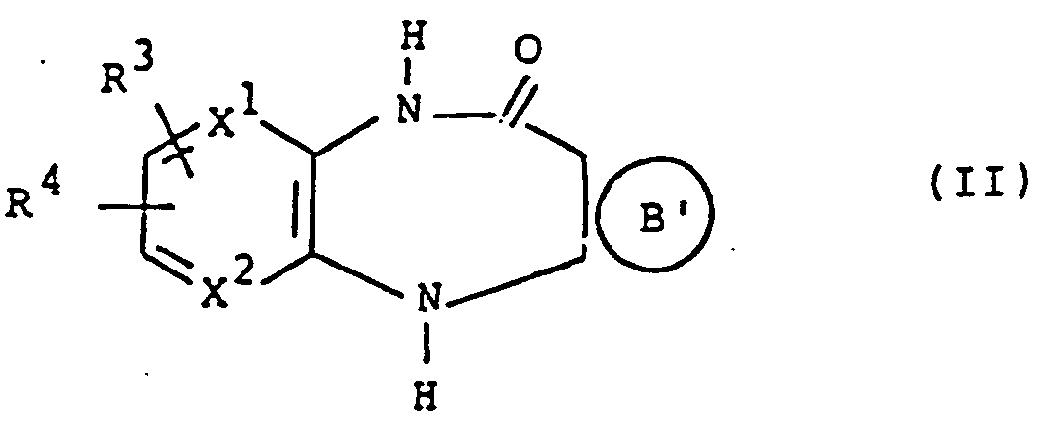


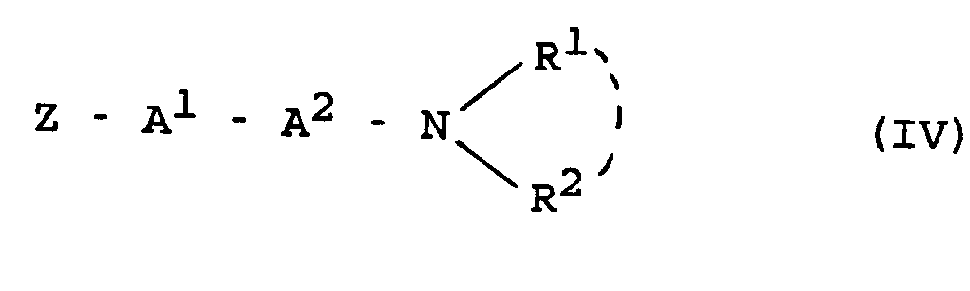
ou bien


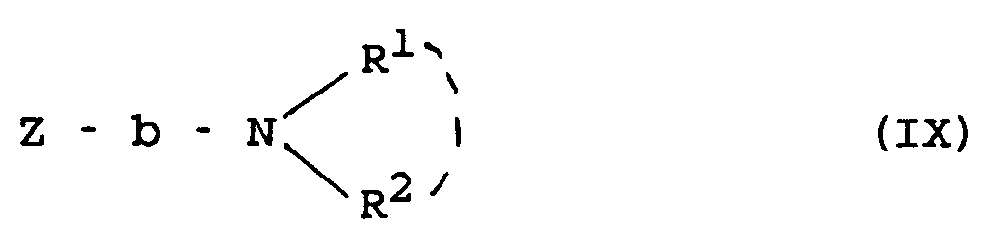
puis éventuellement un composé de formule générale I ainsi obtenu est résolu en ses isomères et/ou un composé de formule générale I ainsi obtenu est converti en ses sels d'addition d'acide, de préférence en ses sels d'addition d'acide compatibles du point de vue physiologique, avec des acides inorganiques ou organiques.


et M est le groupe MgHa (Hal = atome d'halogène), est mis à réagir dans un solvant avec une alcoxyamine de formule générale IXc

Priority Applications (1)
| Application Number | Priority Date | Filing Date | Title |
|---|---|---|---|
| AT89109040T ATE78479T1 (de) | 1988-05-30 | 1989-05-19 | Neue kondensierte diazepinone, verfahren zu ihrer herstellung und diese verbindungen enthaltende arzneimittel. |
Applications Claiming Priority (2)
| Application Number | Priority Date | Filing Date | Title |
|---|---|---|---|
| DE3818299 | 1988-05-30 | ||
| DE3818299A DE3818299A1 (de) | 1988-05-30 | 1988-05-30 | Neue kondensierte diazepinone, verfahren zu ihrer herstellung und diese verbindungen enthaltende arzneimittel |
Publications (3)
| Publication Number | Publication Date |
|---|---|
| EP0344543A2 EP0344543A2 (fr) | 1989-12-06 |
| EP0344543A3 EP0344543A3 (en) | 1990-08-22 |
| EP0344543B1 true EP0344543B1 (fr) | 1992-07-22 |
Family
ID=6355412
Family Applications (1)
| Application Number | Title | Priority Date | Filing Date |
|---|---|---|---|
| EP89109040A Expired - Lifetime EP0344543B1 (fr) | 1988-05-30 | 1989-05-19 | Diazépinones condensées, procédé pour leur préparation et médicaments les contenant |
Country Status (17)
| Country | Link |
|---|---|
| US (1) | US5006522A (fr) |
| EP (1) | EP0344543B1 (fr) |
| JP (1) | JPH0228163A (fr) |
| KR (1) | KR900018101A (fr) |
| AT (1) | ATE78479T1 (fr) |
| AU (1) | AU617814B2 (fr) |
| DD (1) | DD283822A5 (fr) |
| DE (2) | DE3818299A1 (fr) |
| DK (1) | DK261289A (fr) |
| FI (1) | FI892596A7 (fr) |
| HU (1) | HU203887B (fr) |
| IL (1) | IL90418A0 (fr) |
| NO (1) | NO169539C (fr) |
| NZ (1) | NZ229307A (fr) |
| PT (1) | PT90677B (fr) |
| SU (1) | SU1731057A3 (fr) |
| ZA (1) | ZA894048B (fr) |
Families Citing this family (8)
| Publication number | Priority date | Publication date | Assignee | Title |
|---|---|---|---|---|
| DE3726908A1 (de) * | 1987-08-13 | 1989-02-23 | Thomae Gmbh Dr K | Neue kondensierte diazepinone, verfahren zu ihrer herstellung und diese verbindungen enthaltende arzneimittel |
| DE69031845T2 (de) * | 1989-04-20 | 1998-05-07 | Boehringer Ingelheim Pharma | 6,11-Dihydro-5H-pyrido(2,3-b)(1,5)benzodiazepin-5-one und Thione und ihre Verwendung für die Vorbeugung oder Behandlung von AIDS |
| DE3919076A1 (de) * | 1989-06-10 | 1990-12-13 | Thomae Gmbh Dr K | Mittel zur behandlung von erkrankungen des zentralnervensystems und zur foerderung der cerebralen durchblutung |
| EP0693070B1 (fr) * | 1993-04-05 | 2002-07-24 | Pharmaceutical Discovery Corporation | PYRIDO[2,3-b](1,4)BENZODIAZEPINONES EN TANT QUE LIGAND DE RECEPTEUR M2 POUR LE TRAITEMENT DE TROUBLES NEUROLOGIQUES |
| US5561127A (en) * | 1994-12-19 | 1996-10-01 | Allelix Biopharmaceuticals, Inc. | Muscarinic receptor ligands |
| JP3521569B2 (ja) * | 1995-09-05 | 2004-04-19 | ブラザー工業株式会社 | 印字制御装置 |
| FR2850654A1 (fr) * | 2003-02-03 | 2004-08-06 | Servier Lab | Nouveaux derives d'azepines tricycliques, leur procede de preparation et les compositions pharmaceutiques qui les contiennent |
| US20100247688A1 (en) * | 2007-07-02 | 2010-09-30 | Andrea Pfeifer | Pirenzepine and derivatives thereof as anti-amyloid agents |
Family Cites Families (6)
| Publication number | Priority date | Publication date | Assignee | Title |
|---|---|---|---|---|
| US3150125A (en) * | 1959-09-22 | 1964-09-22 | Wander Ag Dr A | 5-(basic substituted)-10, 11-dihydro-11-oxo-5h-dibenzo[b, e][1, 4]diazepine compounds |
| US3105125A (en) * | 1959-10-30 | 1963-09-24 | Bell Telephone Labor Inc | Power separation filter |
| EP0213293B1 (fr) * | 1985-06-27 | 1992-01-02 | Dr. Karl Thomae GmbH | 5,11-Dihydro-6H-pyrido[2,3-b][1,4]benzodiazépine-6-ones substituées en position 11, procédé pour leur préparation et médicament les contenant |
| US4749788A (en) * | 1987-04-13 | 1988-06-07 | A. H. Robins Company, Incorporated | Process for the preparation of aryl-pyrido(1,4) benzodiazepines |
| DE3819444A1 (de) * | 1988-06-08 | 1989-12-14 | Thomae Gmbh Dr K | Neue kondensierte diazepinone, verfahren zu ihrer herstellung und diese verbindungen enthaltende arzneimittel |
| DE3820346A1 (de) * | 1988-06-15 | 1989-12-21 | Thomae Gmbh Dr K | Neue kondensierte diazepinone, verfahren zu ihrer herstellung und diese verbindungen enthaltende arzneimittel |
-
1988
- 1988-05-30 DE DE3818299A patent/DE3818299A1/de not_active Withdrawn
-
1989
- 1989-05-15 SU SU894614115A patent/SU1731057A3/ru active
- 1989-05-19 EP EP89109040A patent/EP0344543B1/fr not_active Expired - Lifetime
- 1989-05-19 DE DE8989109040T patent/DE58901872D1/de not_active Expired - Lifetime
- 1989-05-19 AT AT89109040T patent/ATE78479T1/de not_active IP Right Cessation
- 1989-05-26 NZ NZ229307A patent/NZ229307A/en unknown
- 1989-05-26 IL IL90418A patent/IL90418A0/xx unknown
- 1989-05-29 DK DK261289A patent/DK261289A/da not_active Application Discontinuation
- 1989-05-29 KR KR1019890007154A patent/KR900018101A/ko not_active Withdrawn
- 1989-05-29 DD DD89329002A patent/DD283822A5/de not_active IP Right Cessation
- 1989-05-29 FI FI892596A patent/FI892596A7/fi not_active Application Discontinuation
- 1989-05-29 NO NO892152A patent/NO169539C/no unknown
- 1989-05-29 ZA ZA894048A patent/ZA894048B/xx unknown
- 1989-05-29 PT PT90677A patent/PT90677B/pt not_active IP Right Cessation
- 1989-05-29 HU HU892717A patent/HU203887B/hu not_active IP Right Cessation
- 1989-05-29 JP JP1135700A patent/JPH0228163A/ja active Pending
- 1989-05-30 AU AU35850/89A patent/AU617814B2/en not_active Ceased
- 1989-05-30 US US07/358,740 patent/US5006522A/en not_active Expired - Fee Related
Also Published As
| Publication number | Publication date |
|---|---|
| EP0344543A2 (fr) | 1989-12-06 |
| AU617814B2 (en) | 1991-12-05 |
| JPH0228163A (ja) | 1990-01-30 |
| DD283822A5 (de) | 1990-10-24 |
| AU3585089A (en) | 1989-11-30 |
| FI892596A7 (fi) | 1989-12-01 |
| EP0344543A3 (en) | 1990-08-22 |
| NO892152L (no) | 1989-12-01 |
| US5006522A (en) | 1991-04-09 |
| PT90677B (pt) | 1994-11-30 |
| KR900018101A (ko) | 1990-12-20 |
| PT90677A (pt) | 1989-11-30 |
| DK261289D0 (da) | 1989-05-29 |
| HU203887B (en) | 1991-10-28 |
| ZA894048B (en) | 1991-02-27 |
| HUT50343A (en) | 1990-01-29 |
| DK261289A (da) | 1989-12-01 |
| FI892596A0 (fi) | 1989-05-29 |
| DE3818299A1 (de) | 1989-12-07 |
| ATE78479T1 (de) | 1992-08-15 |
| SU1731057A3 (ru) | 1992-04-30 |
| NO169539C (no) | 1992-07-08 |
| NZ229307A (en) | 1990-11-27 |
| IL90418A0 (en) | 1990-01-18 |
| DE58901872D1 (de) | 1992-08-27 |
| NO892152D0 (no) | 1989-05-29 |
| NO169539B (no) | 1992-03-30 |
Similar Documents
| Publication | Publication Date | Title |
|---|---|---|
| EP0156191B1 (fr) | Diazépinones condensées, procédé pour leur préparation et médicaments contenant les composés | |
| DE69815700T2 (de) | Tetrahydro gamma-carboline | |
| DE69720715T2 (de) | Hexahydro-pyrido (4,3-b)indolderivate als antipsychotische arzneimittel | |
| EP0344543B1 (fr) | Diazépinones condensées, procédé pour leur préparation et médicaments les contenant | |
| EP0254955B1 (fr) | Pyrido[2,3-b][1,4]benzodiazépin-6-ones substituées, leur procédé de préparation et médicaments contenant ces composés | |
| DE4116582A1 (de) | Bicyclische 1-aza-cycloalkane | |
| EP0306698B1 (fr) | Diazépinones condensées, procédés pour leur préparation et médicament contenant ces composés | |
| EP0213293B1 (fr) | 5,11-Dihydro-6H-pyrido[2,3-b][1,4]benzodiazépine-6-ones substituées en position 11, procédé pour leur préparation et médicament les contenant | |
| EP0085892B1 (fr) | Benzodiazépinones substituées, procédé pour leur préparation et médicaments les contenant | |
| EP0312895A2 (fr) | Diazépinones condensées, procédé pour leur préparation et médicaments les contenant | |
| EP0508370B1 (fr) | Diazépinones condensées, procédé pour leur préparation et compositions les contenant pour le traitement de maladies du système nerveux central et pour augmenter la perfusion cérébrale | |
| DE3204403A1 (de) | Neue pyridobenzodiazepinone, verfahren zu ihrer herstellung und diese verbindungen enthaltende arzneimittel | |
| DD284016A5 (de) | Verfahren zur herstellung von kondensierten diazepinonen | |
| EP0345629B1 (fr) | Diazépinones condensées, procédé pour leur préparation et médicaments les contenant | |
| EP0086982A1 (fr) | Thienobenzodiazépinones substituées, procédé pour leur fabrication et médicaments les contenant | |
| DE3643666A1 (de) | Neue kondensierte diazepinone, verfahren zu ihrer herstellung und diese verbindungen enthaltende arzneimittel | |
| DE3523002A1 (de) | Neue in 11-stellung substituierte 5,11-dihydro-6h-pyrido(2,3-b) (1,4)benzodiazepin-6-one, verfahren zu ihrer herstellung und diese verbindungen enthaltende arzneimittel | |
| EP0326066A2 (fr) | Diazépinones condensées, procédé pour leur préparation et médicament les contenant | |
| EP0346744A1 (fr) | Diazépinones condensés, procédé pour leur préparation et médicaments les contenant | |
| EP0137993A2 (fr) | 11-Pipérazinyl-5H-imidazo[2,1-c][1,4]benzodiazépines, procédé pour leur préparation et intermédiaires et médicaments les contenant |
Legal Events
| Date | Code | Title | Description |
|---|---|---|---|
| PUAI | Public reference made under article 153(3) epc to a published international application that has entered the european phase |
Free format text: ORIGINAL CODE: 0009012 |
|
| AK | Designated contracting states |
Kind code of ref document: A2 Designated state(s): AT BE CH DE ES FR GB GR IT LI LU NL SE |
|
| PUAL | Search report despatched |
Free format text: ORIGINAL CODE: 0009013 |
|
| AK | Designated contracting states |
Kind code of ref document: A3 Designated state(s): AT BE CH DE ES FR GB GR IT LI LU NL SE |
|
| 17P | Request for examination filed |
Effective date: 19900908 |
|
| 17Q | First examination report despatched |
Effective date: 19910513 |
|
| GRAA | (expected) grant |
Free format text: ORIGINAL CODE: 0009210 |
|
| AK | Designated contracting states |
Kind code of ref document: B1 Designated state(s): AT BE CH DE ES FR GB GR IT LI LU NL SE |
|
| PG25 | Lapsed in a contracting state [announced via postgrant information from national office to epo] |
Ref country code: IT Free format text: LAPSE BECAUSE OF FAILURE TO SUBMIT A TRANSLATION OF THE DESCRIPTION OR TO PAY THE FEE WITHIN THE PRESCRIBED TIME-LIMIT;WARNING: LAPSES OF ITALIAN PATENTS WITH EFFECTIVE DATE BEFORE 2007 MAY HAVE OCCURRED AT ANY TIME BEFORE 2007. THE CORRECT EFFECTIVE DATE MAY BE DIFFERENT FROM THE ONE RECORDED. Effective date: 19920722 Ref country code: FR Effective date: 19920722 Ref country code: BE Effective date: 19920722 Ref country code: GR Free format text: LAPSE BECAUSE OF FAILURE TO SUBMIT A TRANSLATION OF THE DESCRIPTION OR TO PAY THE FEE WITHIN THE PRESCRIBED TIME-LIMIT Effective date: 19920722 Ref country code: SE Effective date: 19920722 Ref country code: ES Free format text: THE PATENT HAS BEEN ANNULLED BY A DECISION OF A NATIONAL AUTHORITY Effective date: 19920722 Ref country code: NL Effective date: 19920722 |
|
| REF | Corresponds to: |
Ref document number: 78479 Country of ref document: AT Date of ref document: 19920815 Kind code of ref document: T |
|
| REF | Corresponds to: |
Ref document number: 58901872 Country of ref document: DE Date of ref document: 19920827 |
|
| GBT | Gb: translation of ep patent filed (gb section 77(6)(a)/1977) | ||
| EN | Fr: translation not filed | ||
| NLV1 | Nl: lapsed or annulled due to failure to fulfill the requirements of art. 29p and 29m of the patents act | ||
| PG25 | Lapsed in a contracting state [announced via postgrant information from national office to epo] |
Ref country code: AT Effective date: 19930519 Ref country code: GB Effective date: 19930519 |
|
| PLBE | No opposition filed within time limit |
Free format text: ORIGINAL CODE: 0009261 |
|
| STAA | Information on the status of an ep patent application or granted ep patent |
Free format text: STATUS: NO OPPOSITION FILED WITHIN TIME LIMIT |
|
| PG25 | Lapsed in a contracting state [announced via postgrant information from national office to epo] |
Ref country code: LU Free format text: LAPSE BECAUSE OF NON-PAYMENT OF DUE FEES Effective date: 19930531 Ref country code: LI Effective date: 19930531 Ref country code: CH Effective date: 19930531 |
|
| 26N | No opposition filed | ||
| GBPC | Gb: european patent ceased through non-payment of renewal fee |
Effective date: 19930519 |
|
| REG | Reference to a national code |
Ref country code: CH Ref legal event code: PL |
|
| PG25 | Lapsed in a contracting state [announced via postgrant information from national office to epo] |
Ref country code: DE Effective date: 19940201 |