EP0345514B1 - Matériau photographique couleur à l'halogénure d'argent - Google Patents
Matériau photographique couleur à l'halogénure d'argent Download PDFInfo
- Publication number
- EP0345514B1 EP0345514B1 EP89109108A EP89109108A EP0345514B1 EP 0345514 B1 EP0345514 B1 EP 0345514B1 EP 89109108 A EP89109108 A EP 89109108A EP 89109108 A EP89109108 A EP 89109108A EP 0345514 B1 EP0345514 B1 EP 0345514B1
- Authority
- EP
- European Patent Office
- Prior art keywords
- alkyl
- hydrogen
- aryl
- halogen
- alkoxy
- Prior art date
- Legal status (The legal status is an assumption and is not a legal conclusion. Google has not performed a legal analysis and makes no representation as to the accuracy of the status listed.)
- Expired - Lifetime
Links
- -1 silver halide Chemical class 0.000 title claims description 55
- 229910052709 silver Inorganic materials 0.000 title claims description 35
- 239000004332 silver Substances 0.000 title claims description 35
- 239000000463 material Substances 0.000 title claims description 27
- 125000003118 aryl group Chemical group 0.000 claims description 35
- 229910052736 halogen Inorganic materials 0.000 claims description 33
- 150000002367 halogens Chemical class 0.000 claims description 33
- 125000000217 alkyl group Chemical group 0.000 claims description 30
- 229910052739 hydrogen Inorganic materials 0.000 claims description 27
- 239000001257 hydrogen Substances 0.000 claims description 27
- 239000000839 emulsion Substances 0.000 claims description 25
- 125000004178 (C1-C4) alkyl group Chemical group 0.000 claims description 23
- UFHFLCQGNIYNRP-UHFFFAOYSA-N Hydrogen Chemical compound [H][H] UFHFLCQGNIYNRP-UHFFFAOYSA-N 0.000 claims description 19
- 125000003710 aryl alkyl group Chemical group 0.000 claims description 18
- 125000003545 alkoxy group Chemical group 0.000 claims description 16
- 239000006096 absorbing agent Substances 0.000 claims description 14
- 125000001997 phenyl group Chemical group [H]C1=C([H])C([H])=C(*)C([H])=C1[H] 0.000 claims description 14
- 239000004848 polyfunctional curative Substances 0.000 claims description 14
- NQRYJNQNLNOLGT-UHFFFAOYSA-N Piperidine Chemical compound C1CCNCC1 NQRYJNQNLNOLGT-UHFFFAOYSA-N 0.000 claims description 13
- 125000004209 (C1-C8) alkyl group Chemical group 0.000 claims description 12
- 125000003342 alkenyl group Chemical group 0.000 claims description 12
- GLUUGHFHXGJENI-UHFFFAOYSA-N Piperazine Chemical compound C1CNCCN1 GLUUGHFHXGJENI-UHFFFAOYSA-N 0.000 claims description 10
- 125000000623 heterocyclic group Chemical group 0.000 claims description 10
- 125000006273 (C1-C3) alkyl group Chemical group 0.000 claims description 9
- 239000007788 liquid Substances 0.000 claims description 9
- VEXZGXHMUGYJMC-UHFFFAOYSA-M Chloride anion Chemical compound [Cl-] VEXZGXHMUGYJMC-UHFFFAOYSA-M 0.000 claims description 8
- 125000001424 substituent group Chemical group 0.000 claims description 7
- CPELXLSAUQHCOX-UHFFFAOYSA-M Bromide Chemical compound [Br-] CPELXLSAUQHCOX-UHFFFAOYSA-M 0.000 claims description 6
- YNAVUWVOSKDBBP-UHFFFAOYSA-N Morpholine Chemical group C1COCCN1 YNAVUWVOSKDBBP-UHFFFAOYSA-N 0.000 claims description 6
- 125000004104 aryloxy group Chemical group 0.000 claims description 6
- 239000013078 crystal Substances 0.000 claims description 6
- 229920000642 polymer Polymers 0.000 claims description 6
- 125000004169 (C1-C6) alkyl group Chemical group 0.000 claims description 5
- 125000002887 hydroxy group Chemical group [H]O* 0.000 claims description 5
- 125000002947 alkylene group Chemical group 0.000 claims description 4
- 125000004429 atom Chemical group 0.000 claims description 4
- 125000004400 (C1-C12) alkyl group Chemical group 0.000 claims description 3
- 150000001450 anions Chemical class 0.000 claims description 3
- 125000000732 arylene group Chemical group 0.000 claims description 3
- 125000004432 carbon atom Chemical group C* 0.000 claims description 3
- 125000001495 ethyl group Chemical group [H]C([H])([H])C([H])([H])* 0.000 claims description 3
- 125000002496 methyl group Chemical group [H]C([H])([H])* 0.000 claims description 3
- 125000001436 propyl group Chemical group [H]C([*])([H])C([H])([H])C([H])([H])[H] 0.000 claims description 3
- 229910021607 Silver chloride Inorganic materials 0.000 claims description 2
- 125000006615 aromatic heterocyclic group Chemical group 0.000 claims description 2
- XMBWDFGMSWQBCA-UHFFFAOYSA-N hydrogen iodide Chemical compound I XMBWDFGMSWQBCA-UHFFFAOYSA-N 0.000 claims description 2
- 125000000449 nitro group Chemical group [O-][N+](*)=O 0.000 claims description 2
- HKZLPVFGJNLROG-UHFFFAOYSA-M silver monochloride Chemical compound [Cl-].[Ag+] HKZLPVFGJNLROG-UHFFFAOYSA-M 0.000 claims description 2
- 125000004435 hydrogen atom Chemical class [H]* 0.000 claims 10
- 239000010410 layer Substances 0.000 description 88
- 150000001875 compounds Chemical class 0.000 description 42
- 229920000159 gelatin Polymers 0.000 description 23
- 235000019322 gelatine Nutrition 0.000 description 23
- 108010010803 Gelatin Proteins 0.000 description 22
- DOIRQSBPFJWKBE-UHFFFAOYSA-N dibutyl phthalate Chemical compound CCCCOC(=O)C1=CC=CC=C1C(=O)OCCCC DOIRQSBPFJWKBE-UHFFFAOYSA-N 0.000 description 22
- 235000011852 gelatine desserts Nutrition 0.000 description 22
- 239000008273 gelatin Substances 0.000 description 20
- 238000000034 method Methods 0.000 description 19
- 235000013339 cereals Nutrition 0.000 description 15
- 150000002431 hydrogen Chemical class 0.000 description 14
- SQGYOTSLMSWVJD-UHFFFAOYSA-N silver(1+) nitrate Chemical compound [Ag+].[O-]N(=O)=O SQGYOTSLMSWVJD-UHFFFAOYSA-N 0.000 description 12
- 239000000975 dye Substances 0.000 description 11
- 230000015572 biosynthetic process Effects 0.000 description 9
- 239000003795 chemical substances by application Substances 0.000 description 9
- 239000000203 mixture Substances 0.000 description 9
- 230000008569 process Effects 0.000 description 9
- 239000011230 binding agent Substances 0.000 description 8
- 125000003917 carbamoyl group Chemical group [H]N([H])C(*)=O 0.000 description 8
- 238000012545 processing Methods 0.000 description 8
- 125000000020 sulfo group Chemical group O=S(=O)([*])O[H] 0.000 description 8
- 238000003786 synthesis reaction Methods 0.000 description 8
- RWRDLPDLKQPQOW-UHFFFAOYSA-N Pyrrolidine Chemical compound C1CCNC1 RWRDLPDLKQPQOW-UHFFFAOYSA-N 0.000 description 7
- 238000005266 casting Methods 0.000 description 7
- 230000008878 coupling Effects 0.000 description 7
- 238000010168 coupling process Methods 0.000 description 7
- 238000005859 coupling reaction Methods 0.000 description 7
- 229910052757 nitrogen Inorganic materials 0.000 description 7
- 238000001556 precipitation Methods 0.000 description 7
- 125000003837 (C1-C20) alkyl group Chemical group 0.000 description 6
- 125000003860 C1-C20 alkoxy group Chemical group 0.000 description 6
- 238000011161 development Methods 0.000 description 6
- 150000004820 halides Chemical class 0.000 description 6
- 125000004433 nitrogen atom Chemical group N* 0.000 description 6
- 125000000008 (C1-C10) alkyl group Chemical group 0.000 description 5
- 206010070834 Sensitisation Diseases 0.000 description 5
- 230000003647 oxidation Effects 0.000 description 5
- 238000007254 oxidation reaction Methods 0.000 description 5
- 239000011241 protective layer Substances 0.000 description 5
- 230000035945 sensitivity Effects 0.000 description 5
- 230000008313 sensitization Effects 0.000 description 5
- 230000003595 spectral effect Effects 0.000 description 5
- JUJWROOIHBZHMG-UHFFFAOYSA-N Pyridine Chemical group C1=CC=NC=C1 JUJWROOIHBZHMG-UHFFFAOYSA-N 0.000 description 4
- 238000006243 chemical reaction Methods 0.000 description 4
- 238000004519 manufacturing process Methods 0.000 description 4
- 150000003254 radicals Chemical class 0.000 description 4
- 150000003839 salts Chemical class 0.000 description 4
- 125000006850 spacer group Chemical group 0.000 description 4
- 239000000126 substance Substances 0.000 description 4
- 239000006188 syrup Substances 0.000 description 4
- 235000020357 syrup Nutrition 0.000 description 4
- QVLXDGDLLZYJAM-UHFFFAOYSA-N 2,5-dioctylbenzene-1,4-diol Chemical compound CCCCCCCCC1=CC(O)=C(CCCCCCCC)C=C1O QVLXDGDLLZYJAM-UHFFFAOYSA-N 0.000 description 3
- WVDDGKGOMKODPV-UHFFFAOYSA-N Benzyl alcohol Chemical compound OCC1=CC=CC=C1 WVDDGKGOMKODPV-UHFFFAOYSA-N 0.000 description 3
- 125000003277 amino group Chemical group 0.000 description 3
- 125000005605 benzo group Chemical group 0.000 description 3
- 125000003178 carboxy group Chemical group [H]OC(*)=O 0.000 description 3
- 239000001913 cellulose Substances 0.000 description 3
- 235000010980 cellulose Nutrition 0.000 description 3
- 229920002678 cellulose Polymers 0.000 description 3
- 239000011248 coating agent Substances 0.000 description 3
- 238000000576 coating method Methods 0.000 description 3
- 239000008139 complexing agent Substances 0.000 description 3
- 125000001072 heteroaryl group Chemical group 0.000 description 3
- RAXXELZNTBOGNW-UHFFFAOYSA-N imidazole Natural products C1=CNC=N1 RAXXELZNTBOGNW-UHFFFAOYSA-N 0.000 description 3
- XEEYBQQBJWHFJM-UHFFFAOYSA-N iron Substances [Fe] XEEYBQQBJWHFJM-UHFFFAOYSA-N 0.000 description 3
- 125000001570 methylene group Chemical group [H]C([H])([*:1])[*:2] 0.000 description 3
- 238000002360 preparation method Methods 0.000 description 3
- 238000011160 research Methods 0.000 description 3
- 230000005070 ripening Effects 0.000 description 3
- 238000000926 separation method Methods 0.000 description 3
- 150000003378 silver Chemical class 0.000 description 3
- 239000002904 solvent Substances 0.000 description 3
- 230000008961 swelling Effects 0.000 description 3
- XLYOFNOQVPJJNP-UHFFFAOYSA-N water Substances O XLYOFNOQVPJJNP-UHFFFAOYSA-N 0.000 description 3
- 125000000229 (C1-C4)alkoxy group Chemical group 0.000 description 2
- KJCVRFUGPWSIIH-UHFFFAOYSA-N 1-naphthol Chemical compound C1=CC=C2C(O)=CC=CC2=C1 KJCVRFUGPWSIIH-UHFFFAOYSA-N 0.000 description 2
- QGZKDVFQNNGYKY-UHFFFAOYSA-N Ammonia Chemical compound N QGZKDVFQNNGYKY-UHFFFAOYSA-N 0.000 description 2
- 125000005915 C6-C14 aryl group Chemical group 0.000 description 2
- WSFSSNUMVMOOMR-UHFFFAOYSA-N Formaldehyde Chemical compound O=C WSFSSNUMVMOOMR-UHFFFAOYSA-N 0.000 description 2
- YLQBMQCUIZJEEH-UHFFFAOYSA-N Furan Chemical compound C=1C=COC=1 YLQBMQCUIZJEEH-UHFFFAOYSA-N 0.000 description 2
- 238000001016 Ostwald ripening Methods 0.000 description 2
- ISWSIDIOOBJBQZ-UHFFFAOYSA-N Phenol Chemical compound OC1=CC=CC=C1 ISWSIDIOOBJBQZ-UHFFFAOYSA-N 0.000 description 2
- 239000004698 Polyethylene Substances 0.000 description 2
- KAESVJOAVNADME-UHFFFAOYSA-N Pyrrole Chemical compound C=1C=CNC=1 KAESVJOAVNADME-UHFFFAOYSA-N 0.000 description 2
- YSMRWXYRXBRSND-UHFFFAOYSA-N TOTP Chemical compound CC1=CC=CC=C1OP(=O)(OC=1C(=CC=CC=1)C)OC1=CC=CC=C1C YSMRWXYRXBRSND-UHFFFAOYSA-N 0.000 description 2
- YTPLMLYBLZKORZ-UHFFFAOYSA-N Thiophene Chemical compound C=1C=CSC=1 YTPLMLYBLZKORZ-UHFFFAOYSA-N 0.000 description 2
- 239000002253 acid Substances 0.000 description 2
- 230000002378 acidificating effect Effects 0.000 description 2
- 150000007513 acids Chemical class 0.000 description 2
- 125000002252 acyl group Chemical group 0.000 description 2
- 125000004442 acylamino group Chemical group 0.000 description 2
- 125000004397 aminosulfonyl group Chemical group NS(=O)(=O)* 0.000 description 2
- 125000005161 aryl oxy carbonyl group Chemical group 0.000 description 2
- JEHKKBHWRAXMCH-UHFFFAOYSA-N benzenesulfinic acid Chemical compound O[S@@](=O)C1=CC=CC=C1 JEHKKBHWRAXMCH-UHFFFAOYSA-N 0.000 description 2
- 239000007844 bleaching agent Substances 0.000 description 2
- 238000009835 boiling Methods 0.000 description 2
- 229910052793 cadmium Inorganic materials 0.000 description 2
- 125000001951 carbamoylamino group Chemical group C(N)(=O)N* 0.000 description 2
- 229920001577 copolymer Polymers 0.000 description 2
- 238000009792 diffusion process Methods 0.000 description 2
- 239000006185 dispersion Substances 0.000 description 2
- AFOSIXZFDONLBT-UHFFFAOYSA-N divinyl sulfone Chemical compound C=CS(=O)(=O)C=C AFOSIXZFDONLBT-UHFFFAOYSA-N 0.000 description 2
- 125000000524 functional group Chemical group 0.000 description 2
- 229910052742 iron Inorganic materials 0.000 description 2
- 239000006224 matting agent Substances 0.000 description 2
- DZVCFNFOPIZQKX-LTHRDKTGSA-M merocyanine Chemical compound [Na+].O=C1N(CCCC)C(=O)N(CCCC)C(=O)C1=C\C=C\C=C/1N(CCCS([O-])(=O)=O)C2=CC=CC=C2O\1 DZVCFNFOPIZQKX-LTHRDKTGSA-M 0.000 description 2
- 229910052751 metal Inorganic materials 0.000 description 2
- 239000002184 metal Substances 0.000 description 2
- 150000002739 metals Chemical class 0.000 description 2
- 230000007935 neutral effect Effects 0.000 description 2
- 230000000269 nucleophilic effect Effects 0.000 description 2
- 239000002245 particle Substances 0.000 description 2
- 229920000573 polyethylene Polymers 0.000 description 2
- XSCHRSMBECNVNS-UHFFFAOYSA-N quinoxaline Chemical compound N1=CC=NC2=CC=CC=C21 XSCHRSMBECNVNS-UHFFFAOYSA-N 0.000 description 2
- 239000007787 solid Substances 0.000 description 2
- 238000005406 washing Methods 0.000 description 2
- RBIIKVXVYVANCQ-CUWPLCDZSA-N (2s,4s,5s)-5-amino-n-(3-amino-2,2-dimethyl-3-oxopropyl)-6-[4-(2-chlorophenyl)-2,2-dimethyl-5-oxopiperazin-1-yl]-4-hydroxy-2-propan-2-ylhexanamide Chemical group C1C(C)(C)N(C[C@H](N)[C@@H](O)C[C@@H](C(C)C)C(=O)NCC(C)(C)C(N)=O)CC(=O)N1C1=CC=CC=C1Cl RBIIKVXVYVANCQ-CUWPLCDZSA-N 0.000 description 1
- JYEUMXHLPRZUAT-UHFFFAOYSA-N 1,2,3-triazine Chemical group C1=CN=NN=C1 JYEUMXHLPRZUAT-UHFFFAOYSA-N 0.000 description 1
- YXIWHUQXZSMYRE-UHFFFAOYSA-N 1,3-benzothiazole-2-thiol Chemical class C1=CC=C2SC(S)=NC2=C1 YXIWHUQXZSMYRE-UHFFFAOYSA-N 0.000 description 1
- YHMYGUUIMTVXNW-UHFFFAOYSA-N 1,3-dihydrobenzimidazole-2-thione Chemical class C1=CC=C2NC(S)=NC2=C1 YHMYGUUIMTVXNW-UHFFFAOYSA-N 0.000 description 1
- ZRHUHDUEXWHZMA-UHFFFAOYSA-N 1,4-dihydropyrazol-5-one Chemical compound O=C1CC=NN1 ZRHUHDUEXWHZMA-UHFFFAOYSA-N 0.000 description 1
- CBCKQZAAMUWICA-UHFFFAOYSA-N 1,4-phenylenediamine Chemical compound NC1=CC=C(N)C=C1 CBCKQZAAMUWICA-UHFFFAOYSA-N 0.000 description 1
- CARFETJZUQORNQ-UHFFFAOYSA-N 1h-pyrrole-2-thiol Chemical class SC1=CC=CN1 CARFETJZUQORNQ-UHFFFAOYSA-N 0.000 description 1
- JAAIPIWKKXCNOC-UHFFFAOYSA-N 1h-tetrazol-1-ium-5-thiolate Chemical class SC1=NN=NN1 JAAIPIWKKXCNOC-UHFFFAOYSA-N 0.000 description 1
- SMZOUWXMTYCWNB-UHFFFAOYSA-N 2-(2-methoxy-5-methylphenyl)ethanamine Chemical compound COC1=CC=C(C)C=C1CCN SMZOUWXMTYCWNB-UHFFFAOYSA-N 0.000 description 1
- QTLHLXYADXCVCF-UHFFFAOYSA-N 2-(4-amino-n-ethyl-3-methylanilino)ethanol Chemical compound OCCN(CC)C1=CC=C(N)C(C)=C1 QTLHLXYADXCVCF-UHFFFAOYSA-N 0.000 description 1
- FJGQBLRYBUAASW-UHFFFAOYSA-N 2-(benzotriazol-2-yl)phenol Chemical class OC1=CC=CC=C1N1N=C2C=CC=CC2=N1 FJGQBLRYBUAASW-UHFFFAOYSA-N 0.000 description 1
- NIXOWILDQLNWCW-UHFFFAOYSA-N 2-Propenoic acid Natural products OC(=O)C=C NIXOWILDQLNWCW-UHFFFAOYSA-N 0.000 description 1
- URDCARMUOSMFFI-UHFFFAOYSA-N 2-[2-[bis(carboxymethyl)amino]ethyl-(2-hydroxyethyl)amino]acetic acid Chemical compound OCCN(CC(O)=O)CCN(CC(O)=O)CC(O)=O URDCARMUOSMFFI-UHFFFAOYSA-N 0.000 description 1
- KRTDQDCPEZRVGC-UHFFFAOYSA-N 2-nitro-1h-benzimidazole Chemical compound C1=CC=C2NC([N+](=O)[O-])=NC2=C1 KRTDQDCPEZRVGC-UHFFFAOYSA-N 0.000 description 1
- CBHTTYDJRXOHHL-UHFFFAOYSA-N 2h-triazolo[4,5-c]pyridazine Chemical class N1=NC=CC2=C1N=NN2 CBHTTYDJRXOHHL-UHFFFAOYSA-N 0.000 description 1
- OWIRCRREDNEXTA-UHFFFAOYSA-N 3-nitro-1h-indazole Chemical compound C1=CC=C2C([N+](=O)[O-])=NNC2=C1 OWIRCRREDNEXTA-UHFFFAOYSA-N 0.000 description 1
- XRZDIHADHZSFBB-UHFFFAOYSA-N 3-oxo-n,3-diphenylpropanamide Chemical compound C=1C=CC=CC=1NC(=O)CC(=O)C1=CC=CC=C1 XRZDIHADHZSFBB-UHFFFAOYSA-N 0.000 description 1
- XVEPKNMOJLPFCN-UHFFFAOYSA-N 4,4-dimethyl-3-oxo-n-phenylpentanamide Chemical compound CC(C)(C)C(=O)CC(=O)NC1=CC=CC=C1 XVEPKNMOJLPFCN-UHFFFAOYSA-N 0.000 description 1
- QNGVNLMMEQUVQK-UHFFFAOYSA-N 4-n,4-n-diethylbenzene-1,4-diamine Chemical compound CCN(CC)C1=CC=C(N)C=C1 QNGVNLMMEQUVQK-UHFFFAOYSA-N 0.000 description 1
- 102000009027 Albumins Human genes 0.000 description 1
- 108010088751 Albumins Proteins 0.000 description 1
- 125000003358 C2-C20 alkenyl group Chemical group 0.000 description 1
- 101100493713 Caenorhabditis elegans bath-45 gene Proteins 0.000 description 1
- CKDWPUIZGOQOOM-UHFFFAOYSA-N Carbamyl chloride Chemical class NC(Cl)=O CKDWPUIZGOQOOM-UHFFFAOYSA-N 0.000 description 1
- 229920002134 Carboxymethyl cellulose Polymers 0.000 description 1
- KCXVZYZYPLLWCC-UHFFFAOYSA-N EDTA Chemical compound OC(=O)CN(CC(O)=O)CCN(CC(O)=O)CC(O)=O KCXVZYZYPLLWCC-UHFFFAOYSA-N 0.000 description 1
- 239000001828 Gelatine Substances 0.000 description 1
- VVQNEPGJFQJSBK-UHFFFAOYSA-N Methyl methacrylate Chemical compound COC(=O)C(C)=C VVQNEPGJFQJSBK-UHFFFAOYSA-N 0.000 description 1
- JCXJVPUVTGWSNB-UHFFFAOYSA-N Nitrogen dioxide Chemical class O=[N]=O JCXJVPUVTGWSNB-UHFFFAOYSA-N 0.000 description 1
- YGYAWVDWMABLBF-UHFFFAOYSA-N Phosgene Chemical compound ClC(Cl)=O YGYAWVDWMABLBF-UHFFFAOYSA-N 0.000 description 1
- 239000004372 Polyvinyl alcohol Substances 0.000 description 1
- CZPWVGJYEJSRLH-UHFFFAOYSA-N Pyrimidine Chemical compound C1=CN=CN=C1 CZPWVGJYEJSRLH-UHFFFAOYSA-N 0.000 description 1
- BQCADISMDOOEFD-UHFFFAOYSA-N Silver Chemical compound [Ag] BQCADISMDOOEFD-UHFFFAOYSA-N 0.000 description 1
- 229920002125 Sokalan® Polymers 0.000 description 1
- 229920002472 Starch Polymers 0.000 description 1
- NINIDFKCEFEMDL-UHFFFAOYSA-N Sulfur Chemical compound [S] NINIDFKCEFEMDL-UHFFFAOYSA-N 0.000 description 1
- 239000002250 absorbent Substances 0.000 description 1
- 230000002745 absorbent Effects 0.000 description 1
- 230000001133 acceleration Effects 0.000 description 1
- 230000009471 action Effects 0.000 description 1
- 239000000654 additive Substances 0.000 description 1
- 229920000615 alginic acid Polymers 0.000 description 1
- 235000010443 alginic acid Nutrition 0.000 description 1
- 125000004453 alkoxycarbonyl group Chemical group 0.000 description 1
- 125000004457 alkyl amino carbonyl group Chemical group 0.000 description 1
- 125000004448 alkyl carbonyl group Chemical group 0.000 description 1
- 125000005278 alkyl sulfonyloxy group Chemical group 0.000 description 1
- 230000002152 alkylating effect Effects 0.000 description 1
- 229910021529 ammonia Inorganic materials 0.000 description 1
- SOIFLUNRINLCBN-UHFFFAOYSA-N ammonium thiocyanate Chemical compound [NH4+].[S-]C#N SOIFLUNRINLCBN-UHFFFAOYSA-N 0.000 description 1
- 125000000129 anionic group Chemical group 0.000 description 1
- 239000002216 antistatic agent Substances 0.000 description 1
- 150000001491 aromatic compounds Chemical class 0.000 description 1
- 125000005279 aryl sulfonyloxy group Chemical group 0.000 description 1
- 244000052616 bacterial pathogen Species 0.000 description 1
- 150000001558 benzoic acid derivatives Chemical class 0.000 description 1
- IOJUPLGTWVMSFF-UHFFFAOYSA-N benzothiazole Chemical class C1=CC=C2SC=NC2=C1 IOJUPLGTWVMSFF-UHFFFAOYSA-N 0.000 description 1
- 150000001565 benzotriazoles Chemical class 0.000 description 1
- 125000003236 benzoyl group Chemical group [H]C1=C([H])C([H])=C(C([H])=C1[H])C(*)=O 0.000 description 1
- 235000019445 benzyl alcohol Nutrition 0.000 description 1
- 229910052797 bismuth Inorganic materials 0.000 description 1
- 238000004061 bleaching Methods 0.000 description 1
- BDOSMKKIYDKNTQ-UHFFFAOYSA-N cadmium atom Chemical compound [Cd] BDOSMKKIYDKNTQ-UHFFFAOYSA-N 0.000 description 1
- 125000002837 carbocyclic group Chemical group 0.000 description 1
- 239000001768 carboxy methyl cellulose Substances 0.000 description 1
- 235000010948 carboxy methyl cellulose Nutrition 0.000 description 1
- 239000008112 carboxymethyl-cellulose Substances 0.000 description 1
- 239000005018 casein Substances 0.000 description 1
- BECPQYXYKAMYBN-UHFFFAOYSA-N casein, tech. Chemical compound NCCCCC(C(O)=O)N=C(O)C(CC(O)=O)N=C(O)C(CCC(O)=N)N=C(O)C(CC(C)C)N=C(O)C(CCC(O)=O)N=C(O)C(CC(O)=O)N=C(O)C(CCC(O)=O)N=C(O)C(C(C)O)N=C(O)C(CCC(O)=N)N=C(O)C(CCC(O)=N)N=C(O)C(CCC(O)=N)N=C(O)C(CCC(O)=O)N=C(O)C(CCC(O)=O)N=C(O)C(COP(O)(O)=O)N=C(O)C(CCC(O)=N)N=C(O)C(N)CC1=CC=CC=C1 BECPQYXYKAMYBN-UHFFFAOYSA-N 0.000 description 1
- 235000021240 caseins Nutrition 0.000 description 1
- 229920006317 cationic polymer Polymers 0.000 description 1
- 230000008859 change Effects 0.000 description 1
- 229910001914 chlorine tetroxide Inorganic materials 0.000 description 1
- KRKNYBCHXYNGOX-UHFFFAOYSA-N citric acid Chemical class OC(=O)CC(O)(C(O)=O)CC(O)=O KRKNYBCHXYNGOX-UHFFFAOYSA-N 0.000 description 1
- 150000001868 cobalt Chemical class 0.000 description 1
- 239000000084 colloidal system Substances 0.000 description 1
- 238000004040 coloring Methods 0.000 description 1
- 229940126214 compound 3 Drugs 0.000 description 1
- 238000004132 cross linking Methods 0.000 description 1
- 125000004122 cyclic group Chemical group 0.000 description 1
- QSAWQNUELGIYBC-UHFFFAOYSA-N cyclohexane-1,2-dicarboxylic acid Chemical compound OC(=O)C1CCCCC1C(O)=O QSAWQNUELGIYBC-UHFFFAOYSA-N 0.000 description 1
- 238000000586 desensitisation Methods 0.000 description 1
- 235000014113 dietary fatty acids Nutrition 0.000 description 1
- 230000029087 digestion Effects 0.000 description 1
- 239000002270 dispersing agent Substances 0.000 description 1
- 238000009826 distribution Methods 0.000 description 1
- 238000001035 drying Methods 0.000 description 1
- 230000000694 effects Effects 0.000 description 1
- 238000005516 engineering process Methods 0.000 description 1
- 239000000194 fatty acid Substances 0.000 description 1
- 229930195729 fatty acid Natural products 0.000 description 1
- 230000006870 function Effects 0.000 description 1
- 150000002344 gold compounds Chemical class 0.000 description 1
- 238000000227 grinding Methods 0.000 description 1
- 125000005843 halogen group Chemical group 0.000 description 1
- 125000005842 heteroatom Chemical group 0.000 description 1
- 230000002209 hydrophobic effect Effects 0.000 description 1
- 229920013821 hydroxy alkyl cellulose Polymers 0.000 description 1
- 239000001866 hydroxypropyl methyl cellulose Substances 0.000 description 1
- 235000010979 hydroxypropyl methyl cellulose Nutrition 0.000 description 1
- 229920003088 hydroxypropyl methyl cellulose Polymers 0.000 description 1
- UFVKGYZPFZQRLF-UHFFFAOYSA-N hydroxypropyl methyl cellulose Chemical compound OC1C(O)C(OC)OC(CO)C1OC1C(O)C(O)C(OC2C(C(O)C(OC3C(C(O)C(O)C(CO)O3)O)C(CO)O2)O)C(CO)O1 UFVKGYZPFZQRLF-UHFFFAOYSA-N 0.000 description 1
- 239000012535 impurity Substances 0.000 description 1
- 238000010348 incorporation Methods 0.000 description 1
- LOCAIGRSOJUCTB-UHFFFAOYSA-N indazol-3-one Chemical compound C1=CC=C2C(=O)N=NC2=C1 LOCAIGRSOJUCTB-UHFFFAOYSA-N 0.000 description 1
- 239000003112 inhibitor Substances 0.000 description 1
- 150000002500 ions Chemical class 0.000 description 1
- 229910052741 iridium Inorganic materials 0.000 description 1
- 229920000126 latex Polymers 0.000 description 1
- 229910052745 lead Inorganic materials 0.000 description 1
- 238000002844 melting Methods 0.000 description 1
- 230000008018 melting Effects 0.000 description 1
- QSHDDOUJBYECFT-UHFFFAOYSA-N mercury Chemical compound [Hg] QSHDDOUJBYECFT-UHFFFAOYSA-N 0.000 description 1
- 229910052753 mercury Inorganic materials 0.000 description 1
- 125000001434 methanylylidene group Chemical group [H]C#[*] 0.000 description 1
- 238000012986 modification Methods 0.000 description 1
- 230000004048 modification Effects 0.000 description 1
- 239000000178 monomer Substances 0.000 description 1
- 229930014626 natural product Natural products 0.000 description 1
- 239000012038 nucleophile Substances 0.000 description 1
- 239000011146 organic particle Substances 0.000 description 1
- WCPAKWJPBJAGKN-UHFFFAOYSA-N oxadiazole Chemical compound C1=CON=N1 WCPAKWJPBJAGKN-UHFFFAOYSA-N 0.000 description 1
- 230000001590 oxidative effect Effects 0.000 description 1
- 125000004043 oxo group Chemical group O=* 0.000 description 1
- 235000015927 pasta Nutrition 0.000 description 1
- VLTRZXGMWDSKGL-UHFFFAOYSA-M perchlorate Chemical compound [O-]Cl(=O)(=O)=O VLTRZXGMWDSKGL-UHFFFAOYSA-M 0.000 description 1
- JRKICGRDRMAZLK-UHFFFAOYSA-L persulfate group Chemical group S(=O)(=O)([O-])OOS(=O)(=O)[O-] JRKICGRDRMAZLK-UHFFFAOYSA-L 0.000 description 1
- 125000006678 phenoxycarbonyl group Chemical group 0.000 description 1
- WVDDGKGOMKODPV-ZQBYOMGUSA-N phenyl(114C)methanol Chemical compound O[14CH2]C1=CC=CC=C1 WVDDGKGOMKODPV-ZQBYOMGUSA-N 0.000 description 1
- 125000000843 phenylene group Chemical group C1(=C(C=CC=C1)*)* 0.000 description 1
- 150000003009 phosphonic acids Chemical class 0.000 description 1
- 150000003014 phosphoric acid esters Chemical class 0.000 description 1
- 125000001557 phthalyl group Chemical group C(=O)(O)C1=C(C(=O)*)C=CC=C1 0.000 description 1
- 238000005554 pickling Methods 0.000 description 1
- 125000003386 piperidinyl group Chemical group 0.000 description 1
- 229920003229 poly(methyl methacrylate) Polymers 0.000 description 1
- 229920002401 polyacrylamide Polymers 0.000 description 1
- 239000004584 polyacrylic acid Substances 0.000 description 1
- 238000006068 polycondensation reaction Methods 0.000 description 1
- 230000000379 polymerizing effect Effects 0.000 description 1
- 239000004926 polymethyl methacrylate Substances 0.000 description 1
- 229920002451 polyvinyl alcohol Polymers 0.000 description 1
- 125000002924 primary amino group Chemical group [H]N([H])* 0.000 description 1
- 235000018102 proteins Nutrition 0.000 description 1
- 108090000623 proteins and genes Proteins 0.000 description 1
- 102000004169 proteins and genes Human genes 0.000 description 1
- UMJSCPRVCHMLSP-UHFFFAOYSA-N pyridine Natural products COC1=CC=CN=C1 UMJSCPRVCHMLSP-UHFFFAOYSA-N 0.000 description 1
- HBCQSNAFLVXVAY-UHFFFAOYSA-N pyrimidine-2-thiol Chemical class SC1=NC=CC=N1 HBCQSNAFLVXVAY-UHFFFAOYSA-N 0.000 description 1
- GZTPJDLYPMPRDF-UHFFFAOYSA-N pyrrolo[3,2-c]pyrazole Chemical compound N1=NC2=CC=NC2=C1 GZTPJDLYPMPRDF-UHFFFAOYSA-N 0.000 description 1
- 229910052703 rhodium Inorganic materials 0.000 description 1
- 229920006395 saturated elastomer Polymers 0.000 description 1
- 150000003335 secondary amines Chemical class 0.000 description 1
- 230000001235 sensitizing effect Effects 0.000 description 1
- AQRYNYUOKMNDDV-UHFFFAOYSA-M silver behenate Chemical compound [Ag+].CCCCCCCCCCCCCCCCCCCCCC([O-])=O AQRYNYUOKMNDDV-UHFFFAOYSA-M 0.000 description 1
- MCKXPYWOIGMEIZ-UHFFFAOYSA-M silver;2h-benzotriazole-4-carboxylate Chemical compound [Ag+].[O-]C(=O)C1=CC=CC2=NNN=C12 MCKXPYWOIGMEIZ-UHFFFAOYSA-M 0.000 description 1
- 239000002356 single layer Substances 0.000 description 1
- 239000003381 stabilizer Substances 0.000 description 1
- 230000000087 stabilizing effect Effects 0.000 description 1
- 235000019698 starch Nutrition 0.000 description 1
- 239000008107 starch Substances 0.000 description 1
- 238000003860 storage Methods 0.000 description 1
- 239000000758 substrate Substances 0.000 description 1
- 235000000346 sugar Nutrition 0.000 description 1
- 150000003455 sulfinic acids Chemical class 0.000 description 1
- 229910052717 sulfur Inorganic materials 0.000 description 1
- 239000011593 sulfur Substances 0.000 description 1
- 239000004094 surface-active agent Substances 0.000 description 1
- 229910052716 thallium Inorganic materials 0.000 description 1
- VLLMWSRANPNYQX-UHFFFAOYSA-N thiadiazole Chemical compound C1=CSN=N1.C1=CSN=N1 VLLMWSRANPNYQX-UHFFFAOYSA-N 0.000 description 1
- JJJPTTANZGDADF-UHFFFAOYSA-N thiadiazole-4-thiol Chemical class SC1=CSN=N1 JJJPTTANZGDADF-UHFFFAOYSA-N 0.000 description 1
- 150000003568 thioethers Chemical class 0.000 description 1
- 125000003396 thiol group Chemical group [H]S* 0.000 description 1
- ANRHNWWPFJCPAZ-UHFFFAOYSA-M thionine Chemical compound [Cl-].C1=CC(N)=CC2=[S+]C3=CC(N)=CC=C3N=C21 ANRHNWWPFJCPAZ-UHFFFAOYSA-M 0.000 description 1
- 229930192474 thiophene Natural products 0.000 description 1
- 150000003852 triazoles Chemical class 0.000 description 1
- 150000003639 trimesic acids Chemical class 0.000 description 1
- 238000000108 ultra-filtration Methods 0.000 description 1
- 125000006839 xylylene group Chemical group 0.000 description 1
- 229910052725 zinc Inorganic materials 0.000 description 1
Classifications
-
- G—PHYSICS
- G03—PHOTOGRAPHY; CINEMATOGRAPHY; ANALOGOUS TECHNIQUES USING WAVES OTHER THAN OPTICAL WAVES; ELECTROGRAPHY; HOLOGRAPHY
- G03C—PHOTOSENSITIVE MATERIALS FOR PHOTOGRAPHIC PURPOSES; PHOTOGRAPHIC PROCESSES, e.g. CINE, X-RAY, COLOUR, STEREO-PHOTOGRAPHIC PROCESSES; AUXILIARY PROCESSES IN PHOTOGRAPHY
- G03C1/00—Photosensitive materials
- G03C1/005—Silver halide emulsions; Preparation thereof; Physical treatment thereof; Incorporation of additives therein
- G03C1/06—Silver halide emulsions; Preparation thereof; Physical treatment thereof; Incorporation of additives therein with non-macromolecular additives
- G03C1/30—Hardeners
-
- G—PHYSICS
- G03—PHOTOGRAPHY; CINEMATOGRAPHY; ANALOGOUS TECHNIQUES USING WAVES OTHER THAN OPTICAL WAVES; ELECTROGRAPHY; HOLOGRAPHY
- G03C—PHOTOSENSITIVE MATERIALS FOR PHOTOGRAPHIC PURPOSES; PHOTOGRAPHIC PROCESSES, e.g. CINE, X-RAY, COLOUR, STEREO-PHOTOGRAPHIC PROCESSES; AUXILIARY PROCESSES IN PHOTOGRAPHY
- G03C1/00—Photosensitive materials
- G03C1/76—Photosensitive materials characterised by the base or auxiliary layers
- G03C1/815—Photosensitive materials characterised by the base or auxiliary layers characterised by means for filtering or absorbing ultraviolet light, e.g. optical bleaching
Definitions
- the invention relates to a color photographic silver halide recording material, in particular one with a reflective base, which provides higher color densities.
- Color photographic materials are known from EP 0 243 199 A2, in particular color negative paper, which contain in at least one light-sensitive layer a silver halide with at least 80 mol% of chloride, which have a layer with a UV light-absorbing agent which is liquid at room temperature, and which are hardened with a vinyl sulfone hardener.
- This color negative paper can be used in the so-called short-term process, in which the development time is 45 seconds, to produce color image images.
- the material is characterized by reduced pressure desensitization, but still does not provide really satisfactory maximum densities.
- the invention thus relates to a color photographic silver halide recording material which, on a support, preferably a reflective support, contains at least one silver halide emulsion layer, the silver halide grains of which contain at least 80 mol% of silver chloride, and at least one layer, preferably a non-light-sensitive layer, which contains an ultraviolet light absorbent, which is liquid at 15 ° C, contains and the material is hardened with an instant hardener.
- Immediate hardeners are understood to mean compounds which crosslink suitable binders in such a way that the hardening is completed to such an extent immediately after casting, at the latest after 24 hours, preferably at the latest after 8 hours, that no further change in the sensitometry caused by the crosslinking reaction and the swelling of the layer structure occurs .
- Swelling is understood to mean the difference between the wet film thickness and the dry film thickness during the aqueous processing of the film (Photogr. Sci. Eng. 8 (1964); 275; Photogr. Sci. Eng. (1972), 449).
- the instant hardener is used in particular in an amount of 0.1 to 5 mmol / m2, preferably 0.5 to 1.7 mmol / m2.
- Alkyl is especially C1-C20-alkyl optionally substituted by halogen, hydroxy, sulfo, C1-C20-alkoxy.
- Aryl unless otherwise defined, is in particular optionally substituted by halogen, sulfo, C1-C20-alkoxy or C1-C20-alkyl C6-C14 aryl.
- Aralkyl unless otherwise defined, is in particular substituted by halogen, C1-C20-alkoxy, sulfo or C1-C20-alkyl C7-C20-aralkyl, alkoxy, unless otherwise defined, in particular is C1-C20-alkoxy.
- X ⁇ is preferably a halide ion such as Cl ⁇ , Br ⁇ or BF4 ⁇ , NO3 ⁇ , (SO4 2 ⁇ ) 1/2 , ClO4 ⁇ , CH3OSO3 ⁇ , PF6 ⁇ , CF3SO3 ⁇ and in particular a -SO3 ⁇ covalently linked to the hardener molecule Group, where the -SO3 ⁇ group can be directly connected to the heterocycle via a substituent (see definitions alkyl, aryl, aralkyl) or in the formulas (a), (b), (c).
- a substituent see definitions alkyl, aryl, aralkyl
- Alkenyl is especially C2-C20 alkenyl
- alkylene is especially C2-C20 alkylene
- Arylene in particular phenylene, aralkylene in particular benzylene and alkaralkylene in particular xylylene.
- Suitable N-containing ring systems that can represent Z are shown on the previous page.
- the pyridine ring is preferred.
- R36 and R37 together with the nitrogen atom to which they are attached, in particular form a pyrrolidine or piperidine ring bonded by 2 oxo groups in the o- and o'-position, which may be benzo, cyclohexeno- or [2.2.1] -bicyclohexenocondensed .
- Acyl is especially C1-C10 alkylcarbonyl or benzoyl; Carbalkoxy is especially C1-C10 alkoxycarbonyl; Carbamoyl is especially mono- or di-C1-C4 alkylaminocarbonyl; Carbaroxy is especially phenoxycarbonyl.
- Groups R24 which can be split off by nucleophilic agents are, for example, halogen atoms, C1-C15 alkylsulfonyloxy groups, C7-C15 aralkylsulfonyloxy groups, C6-C15 arylsulfonyloxy groups and 1-pyridinyl radicals.
- the compounds can be prepared in a simple manner known from the literature.
- the secondary amines are e.g. with phosgene, the carbamic acid chlorides, which are then reacted with aromatic, heterocyclic nitrogen-containing compounds in the absence of light.
- the preparation of compound 3 is described in Chemical Reports 40, (1907), page 1831. Further information on the synthesis can be found in DE-OS 2 225 230, DE-OS 2 317 677 and DE-OS 2 439 551.
- JP-OSs 44 140/82 and 46 538/82 and JP-PS 50 669/83 Methods for the synthesis of these compounds are described in more detail in JP-OSs 44 140/82 and 46 538/82 and JP-PS 50 669/83.
- the compounds (a) are particularly preferred.
- the binder to be cured used in the layers which are subjected to the curing process according to the invention is a proteinaceous binder which contains free amino groups and free carboxyl groups.
- Gelatin is a preferred example. Gelatin is mainly used in photographic recording materials as a binder for the light-sensitive substances, the coloring compounds and, if appropriate, other additives. Such recording materials often have a large number of different layers.
- the hardening by means of an immediate hardener is usually carried out in such a way that the hardening agent is applied as the last layer to the layers to be hardened, whereby further substances, such as the UV absorbers, antistatic agents, matting agents and polymeric organic particles, can be added to the hardening coating solution.
- the layer containing the hardening agent can be applied simultaneously with or after the casting of the remaining layers by means of cascade or curtain coaters.
- the casting temperature can be varied over a wide range, e.g. B. between 45 and 5 ° C, preferably between 38 and 18 ° C.
- UV absorbers which are liquid according to the invention are given below.
- the UV absorbers that are liquid at room temperature can be used individually or as a mixture with one another.
- UV absorbers that are liquid at room temperature with UV absorbers that are solid at room temperature, or to produce mixtures of UV absorbers that are solid at room temperature, as long as the mixture is liquid even at 15 ° C.
- the 2- (2-hydroxyphenyl) benzotriazole compounds are known and are described, for example, in US Pat. Nos. 3,754,919, 4,220,711 and 4,518,686.
- UV absorber it can also be advantageous to divide up the total amount of UV absorber, to use a part in the uppermost, non-light-sensitive protective layer and a part in a non-light-sensitive intermediate layer, in particular over the purple layer or in a light-sensitive layer over the purple layer.
- the photographic material according to the invention contains in particular at least one blue-sensitive layer, to which at least one yellow coupler is assigned, at least a green-sensitive layer to which at least one magenta coupler is assigned and at least one red-sensitive layer to which at least one cyan coupler is assigned.
- the at least one blue-sensitive layer is preferably located closest to the support and the at least one red-sensitive layer is most distant from the support.
- the silver halides of all light-sensitive layers preferably contain at least 80 mol% of chloride, in particular 95 to 100 mol% of chloride, 0 to 5 mol% of bromide and 0 to 1 mol% of iodide.
- the silver halide can be predominantly compact crystals, e.g. are regular cubic or octahedral or can have transitional forms.
- platelet-shaped crystals may preferably also be present, the average ratio of diameter to thickness of which is preferably at least 5: 1, the diameter of a grain being defined as the diameter of a circle with a circle content corresponding to the projected area of the grain.
- the layers can also have tabular silver halide crystals in which the ratio of diameter to thickness is greater than 5: 1, e.g. 12: 1 to 30: 1.
- the silver halide grains can also have a multi-layered grain structure, in the simplest case with an inner and an outer grain area (core / shell), the halide composition and / or other modifications, such as doping the one individual grain areas are different.
- the average grain size of the emulsions is preferably between 0.2 ⁇ m and 2.0 ⁇ m, the grain size distribution can be either homodisperse or heterodisperse.
- the emulsions can also contain organic silver salts, for example silver benzotriazolate or silver behenate.
- Two or more kinds of silver halide emulsions, which are prepared separately, can be used as a mixture.
- the photographic emulsions can be prepared using various methods (e.g. P. Glafkides, Chimie et Physique Photographique, Paul Montel, Paris (1967), GF Duffin, Photographic Emulsion Chemistry, The Focal Press, London (1966), VL Zelikman et al, Making and Coating Photographic Emulsion, The Focal Press, London (1966) from soluble silver salts and soluble halides.
- various methods e.g. P. Glafkides, Chimie et Physique Photographique, Paul Montel, Paris (1967), GF Duffin, Photographic Emulsion Chemistry, The Focal Press, London (1966), VL Zelikman et al, Making and Coating Photographic Emulsion, The Focal Press, London (1966) from soluble silver salts and soluble halides.
- the silver halide is preferably precipitated in the presence of the binder, for example the gelatin, and can be carried out in the acidic, neutral or alkaline pH range, silver halide complexing agents preferably being additionally used.
- the latter include, for example, ammonia, thioether, imidazole, ammonium thiocyanate or excess halide.
- the water-soluble silver salts and the halides are combined either in succession by the single-jet process or simultaneously by the double-jet process or by any combination of the two processes. Prefers the dosage increases with increasing inflow rates, whereby the "critical" feed rate, at which no new germs are just emerging, should not be exceeded.
- the pAg range can vary within wide limits during the precipitation, preferably the so-called pAg-controlled method is used, in which a certain pAg value is kept constant or a defined pAg profile is traversed during the precipitation.
- so-called inverse precipitation with an excess of silver ions is also possible.
- the silver halide crystals can also grow by physical ripening (Ostwald ripening) in the presence of excess halide and / or silver halide complexing agent.
- the growth of the emulsion grains can even take place predominantly by Ostwald ripening, preferably a fine-grained, so-called Lippmann emulsion, mixed with a less soluble emulsion and redissolved on the latter.
- Salts or complexes of metals such as Cd, Zn, Pb, Tl, Bi, Ir, Rh, Fe may also be present during the precipitation and / or physical ripening of the silver halide grains.
- the precipitation can also be carried out in the presence of sensitizing dyes.
- Complexing agents and / or dyes can be rendered ineffective at any time, for example by changing the pH or by an oxidative treatment.
- Gelatin is preferably used as the binder. However, this can be replaced in whole or in part by other synthetic, semi-synthetic or naturally occurring polymers. Synthetic gelatin substitutes are, for example, polyvinyl alcohol, poly-N-vinylpyrolidone, polyacrylamides, polyacrylic acid and their derivatives, in particular their copolymers.
- Naturally occurring gelatin substitutes are, for example, other proteins such as albumin or casein, cellulose, sugar, starch or alginates, semi-synthetic gelatin substitutes are generally modified natural products, cellulose derivatives such as hydroxyalkyl cellulose, carboxymethyl cellulose and phthalyl cellulose as well as gelatin derivatives, which are reacted with alkylating or acylating agents or by grafting of polymerizable monomers are examples of this.
- the binders should have a sufficient amount of functional groups so that enough resistant layers can be produced by reaction with suitable hardening agents.
- functional groups are in particular amino groups, but also carboxyl groups, hydroxyl groups and active methylene groups.
- the gelatin which is preferably used can be obtained by acidic or alkaline digestion.
- the production of such gelatins is described, for example, in The Science and Technology of Gelatine, published by AG Ward and A. Courts, Academic Press 1977, page 295 ff.
- the gelatin used in each case should contain the lowest possible level of photographically active impurities (inert gelatin). High viscosity, low swelling gelatins are particularly advantageous.
- the gelatin can be partially or completely oxidized.
- the soluble salts are removed from the emulsion, e.g. by pasta and washing, by flakes and washing, by ultrafiltration or by ion exchangers.
- the photographic emulsions may contain compounds to prevent fogging or to stabilize the photographic function during production, storage or photographic processing.
- Azaindenes are particularly suitable, preferably tetra- and penta-azaindenes, in particular those which are substituted by hydroxyl or amino groups.
- Such connections are e.g. B. von Birr, Z. Wiss. Phot. 47 (1952), pp. 2-58.
- Salts of metals such as mercury or cadmium, aromatic sulfonic or sulfinic acids such as benzenesulfinic acid, or nitrogen-containing heterocycles such as nitrobenzimidazole, nitroindazole, (subst.) Benzotriazoles or benzothiazolium salts can also be used as antifoggants.
- Heterocycles containing mercapto groups e.g. B.
- mercaptobenzthiazoles mercaptobenzimidazoles, Mercaptotetrazoles, mercaptothiadiazoles, mercaptopyrimidines, these mercaptoazoles also containing a water-solubilizing group, for example a carboxyl group or sulfo group.
- a water-solubilizing group for example a carboxyl group or sulfo group.
- the stabilizers can be added to the silver halide emulsions before, during or after their ripening.
- the compounds can also be added to other photographic layers which are assigned to a halogen silver layer.
- the silver halide emulsions are usually chemically ripened, for example by the action of gold compounds or compounds of divalent sulfur.
- the photographic emulsion layers or other hydrophilic colloid layers of the light-sensitive material produced according to the invention can contain surface-active agents for various purposes, such as coating aids, to prevent electrical charging, to improve the sliding properties, to emulsify the dispersion, to prevent adhesion and to improve the photographic characteristics (eg acceleration of development, high contrast, sensitization etc.).
- the photographic emulsions can be spectrally sensitized using methine dyes or other dyes.
- Particularly suitable dyes are cyanine dyes, merocyanine dyes and complex merocyanine dyes.
- Color couplers for producing the blue-green partial color image are usually couplers of the phenol or ⁇ -naphthol type; suitable examples of this are known in the literature.
- Color couplers for producing the yellow partial color image are generally couplers with an open-chain ketomethylene group, in particular couplers of the ⁇ -acylacetamide type; Suitable examples are ⁇ -benzoylacetanilide couplers and ⁇ -pivaloylacetanilide couplers, which are also known from the literature.
- Color couplers for producing the purple partial color image are generally couplers of the 5-pyrazolone, indazolone or pyrazoloazole type; Suitable examples of this are described in large numbers in the literature.
- the color couplers can be 4-equivalent couplers, but also 2-equivalent couplers.
- the latter are derived from the 4-equivalent coupler in that they contain a substituent in the coupling site, which is split off during the coupling.
- the 2-equivalent couplers include those that are colorless and those that have an intense inherent color have, which disappears during the color coupling or is replaced by the color of the image dye produced (mask coupler) and white couplers which, when reacted with color developer oxidation products, essentially give colorless products.
- the 2-equivalent couplers also include couplers that contain a detachable residue at the coupling point, which is released upon reaction with color developer oxidation products and thereby either directly or after one or more further groups have been split off from the primarily split off residue (e.g. DE-A-27 03-145, DE-A-28 55 697, DE-A-31 05 026, DE-A-33 19 428), a certain desired photographic activity unfolds, for example as a development inhibitor or accelerator.
- Examples of such 2-equivalent couplers are the known DIR couplers as well as DAR or. FAR coupler.
- DIR, DAR or FAR couplers mainly the effectiveness of the residue released during coupling is desired and the color-forming properties of these couplers are less important, such DIR, DAR or FAR couplers are also suitable, which give essentially colorless products on coupling (DE-A-1 547 640).
- the cleavable residue can also be a ballast residue, so that upon reaction with color developer oxidation products coupling products are obtained which are diffusible or at least have a weak or restricted mobility (US Pat. No. 4,420,556).
- High molecular weight color couplers are described, for example, in DE-C-1 297 417, DE-A-24 07 569, DE-A-31 48 125, DE-A-32 17 200, DE-A-33 20 079, DE-A-33 24 932, DE-A-33 31 743, DE-A-33 40 376, EP-A-27 284, US-A-4 080 211.
- the high molecular weight color couplers are usually produced by polymerizing ethylenically unsaturated monomeric color couplers. However, they can also be obtained by polyaddition or polycondensation.
- the couplers or other compounds can be incorporated into silver halide emulsion layers by first preparing a solution, a dispersion or an emulsion of the compound in question and then adding it to the casting solution for the layer in question.
- the selection of the suitable solvent or dispersing agent depends on the solubility of the compound.
- Hydrophobic compounds can also be introduced into the casting solution using high-boiling solvents, so-called oil formers. Corresponding methods are described for example in US-A-2 322 027, US-A-2 801 170, US-A-2 801 171 and EP-AO 043 037.
- oligomers or polymers instead of the high-boiling solvents, oligomers or polymers, so-called polymeric oil formers, can be used.
- the compounds can also be introduced into the casting solution in the form of loaded latices.
- anionic water-soluble compounds e.g. dyes
- pickling polymers e.g. acrylic acid
- Suitable oil formers for other couplers and other compounds are e.g. Alkyl phthalates, phosphoric acid esters, citric acid esters, benzoic acid esters, alkylamides, fatty acid esters and trimesic acid esters.
- Each of the light-sensitive layers can consist of a single layer or can also comprise two or more silver halide emulsion partial layers (DE-C-1 121 470).
- the red-sensitive silver halide emulsion layers can be arranged closer to the support than the green-sensitive silver halide emulsion layers and these in turn closer than the blue-sensitive layers, a non-light-sensitive yellow filter layer generally being located between green-sensitive layers and blue-sensitive layers.
- the green or Red-sensitive layers can be chosen without the yellow filter layer, other layer arrangements in which e.g. the blue-sensitive, then the green-sensitive and finally the red-sensitive layers follow.
- the non-light-sensitive intermediate layers which are generally arranged between layers of different spectral sensitivity, can contain agents which prevent an undesired diffusion of developer oxidation products from one light-sensitive layer into another light-sensitive layer with different spectral sensitization.
- sub-layers of the same spectral sensitization can differ with regard to their composition, in particular with regard to the type and amount of the silver halide grains.
- the sublayer with higher sensitivity will be located further away from the support than the sublayer with lower sensitivity.
- Partial layers of the same spectral sensitization can be adjacent to one another or separated by other layers, for example by layers of different spectral sensitization.
- all highly sensitive and all low-sensitive layers can be combined to form a layer package (DE-A 1 958 709, DE-A 2 530 645, DE-A 2 622 922).
- the photographic material may further contain whites, spacers, formalin scavengers and others.
- Suitable whiteners are e.g. in Research Disclosure December 1978, page 22 ff, Unit 17 643, Chapter V.
- binder layers in particular the most distant layer from the support, but also occasionally intermediate layers, especially if they are the most distant layer from the support during manufacture, may contain photographically inert particles of inorganic or organic nature, e.g. as a matting agent or as a spacer (DE-A 3 331 542, DE-A 3 424 893, Research Disclosure December 1978, page 22 ff, Unit 17 643, Chapter XVI).
- photographically inert particles of inorganic or organic nature e.g. as a matting agent or as a spacer (DE-A 3 331 542, DE-A 3 424 893, Research Disclosure December 1978, page 22 ff, Unit 17 643, Chapter XVI).
- the average particle diameter of the spacers is in particular in the range from 0.2 to 10 ⁇ m.
- the spacers are water-insoluble and can be alkali-insoluble or alkali-soluble, the alkali-soluble ones generally being removed from the photographic material in the alkaline development bath.
- suitable polymers are polymethyl methacrylate, copolymers of acrylic acid and methyl methacrylate and hydroxypropyl methyl cellulose hexahydrophthalate.
- polyethylene-coated paper can be used as a reflective support.
- the color photographic recording material according to the invention is developed with a color developer compound.
- All developer compounds which have the ability to react in the form of their oxidation product with color couplers to form azomethine dyes can be used as the color developer compound.
- Suitable color developer compounds are aromatic compounds of the p-phenylenediamine type containing at least one primary amino group, for example N, N-dialkyl-p-phenylenediamines, such as N, N-diethyl-p-phenylenediamine, 1- (N-ethyl-N-methylsulfonamidoethyl) -3 -methyl-p-phenylenediamine, 1- (N-ethyl-N-hydroxyethyl-3-methyl-p-phenylenediamine and 1- (N-ethyl-N-methoxyethyl) -3-methyl-p-phenylenediamine.
- N, N-dialkyl-p-phenylenediamines such as N, N-diethyl-p-phenylenediamine, 1- (N-ethyl-N-methylsulfonamidoethyl) -3 -methyl-p-phenylenediamine, 1- (N-eth
- the recording material according to the invention is particularly suitable for processing in an abbreviated processing process, for example in a processing process whose development step at temperatures between 25 and 45 ° C. lasts less than 3 minutes, preferably less than 1 minute. Particularly when developing with developer baths free of benzyl alcohol, advantageous results are obtained.
- the color developer solution preferably contains ⁇ 0.01 mol / l bromide and ⁇ 5 ml / l benzyl alcohol.
- the material is usually bleached and fixed. Bleaching and fixing can be carried out separately or together.
- the usual compounds can be used as bleaching agents, e.g. Fe3+ salts and Fe3+ complex salts such as ferricyanides, dichromates, water-soluble cobalt complexes, etc.
- Particularly preferred are iron III complexes of aminopolycarboxylic acids, in particular e.g. Ethylenediaminetetraacetic acid, N-hydroxyethylethylenediamine triacetic acid, alkyliminodicarboxylic acids and corresponding phosphonic acids.
- Persulphates are also suitable as bleaching agents.
- compositions and processing times of the developing and bleach-fixing bath in which the material according to the invention is processed are given below. Watering is followed by usual drying.
- the material can also be treated with a conventional stabilizing bath.
- a color photographic recording material which is suitable for a rapid processing process was produced by applying the following layers in the order given to a support on paper coated on both sides with polyethylene.
- the quantities given relate to 1 m2.
- the corresponding amounts of AgNO3 are given.
- UV-15 is used as a UV absorber with 0.4 g DBP as an oil former.
- 0.15 g UV-15 with 0.1 g DBP are used.
- 0.4 g UV-15 and 0.2 g UV-9 with 0.4 g DBP are used as oil formers and in layer 7 0.1 g UV-15 with 0.05 g UV-9 with 0 , 1 g DBP used.
- the five structures are exposed behind a blue color separation filter with a 3 / 2 wedge and developed according to the above information.
- the yellow color separation wedges obtained are measured with a densitometer, thereby determining sensitivity, shoulder gradation and maximum color density. The results are shown in the following overview:
- a wedge in which all three color separations were exposed in such a way that a neutral gray wedge was obtained showed in the yellow the gradation and density in the same way depending on the UV layer composition.
- the maximum density of purple was also 0.1 - 0.2 higher for superstructures 2 - 5.
- UV layers composed according to the invention result in a substantially better color density in the color structures.
Landscapes
- Physics & Mathematics (AREA)
- Chemical & Material Sciences (AREA)
- Engineering & Computer Science (AREA)
- Materials Engineering (AREA)
- General Physics & Mathematics (AREA)
- Spectroscopy & Molecular Physics (AREA)
- Chemical Kinetics & Catalysis (AREA)
- Silver Salt Photography Or Processing Solution Therefor (AREA)
Claims (9)
- Matériau photographique en couleurs à l'halogénure d'argent, qui est durci par un durcisseur immédiat et qui contient sur un support au moins une couche d'émulsion d'halogénure d'argent dont les grains d'halogénure d'argent contiennent au moins 80 mol% de chlorure d'argent et au moins une couche qui contient une substance absorbant la lumière ultraviolette, qui est liquide à 15°C.
- Matériau photographique en couleurs selon la revendication 1, caractérisé en ce qu'il contient au moins une couche sensible au bleu à laquelle est associé un coupleur pour jaune, au moins une couche sensible au vert à laquelle est associé au moins un coupleur pour magenta et au moins une couche sensible au rouge à laquelle est associé un coupleur pour cyan.
- Matériau photographique en couleurs selon la revendication 1, caractérisé en ce qu'il contient un support réfléchissant.
- Matériau photographique en couleurs selon la revendication 1, caractérisé en ce que les halogénures d'argent de toutes les couches photosensibles contiennent au moins 80 mol% de chlorure.
- Matériau photographique en couleurs selon la revendication 1, caractérisé en ce que les halogénures d'argent de toutes les couches photosensibles contiennent 95 à 100 mol% de chlorure, 0 à 5 mol% de bromure et 0 à 1 mol% d'iodure.
- Matériau photographique en couleurs selon la revendication 1, caractérisé en ce que les absorbeurs d'UV liquides répondent à la formule générale :
 R₁ et R₂ représentent chacun un groupe alkyle, aryle, alcoxy ou aryloxy etR₃ représente un atome d'hydrogène ou d'halogène ou un groupe alkyle, aryle, alcoxy, aryloxy, alcényle, nitro ou hydroxy.
 - Matériau photographique en couleurs selon la revendication 6, dans lequel les substituants R₁, R₂ et R₃ présentent les combinaisons de définitions I, II, III, IV et V suivantes :I: R₁: méthyle, éthyle, propyle,
R₂ : sec-alkyle en C₄-C₁₂,
R₃ : hydrogène, halogène, alkyle en C₁-C₈, alcoxy en C₁-C₈,II : R₁, R₂ et R₃ : alkyle en C₄-C₁₂, l'un d'eux étant un reste sec-alkyle,III: R₁: alkyle en C₁-C₁₂,
R₂ : (alcoxy en C₁-C₁₂)carbonyl-alkyle en C₁-C₆,
R₃ : hydrogène, halogène, alkyle en C₁-C₈, alcoxy en C₁-C₈,IV: R₁, R₂ : sec-alkyle en C₄-C₁₂,
R₃ : hydrogène, halogène, alkyle en C₁-C₈, alcoxy en C₁-C₈,V: R₁: alkyle en C₁₀-C₁₅ ramifié,
R₂ : alkyle en C₁-C₄,
R₃ : hydrogène, halogène, alkyle en C₁-C₈, alcoxy en C₁-C₈. - Matériau photographique en couleurs selon la revendication 1, caractérisé en ce que le durcisseur immédiat répond à la formule générale :
 R₁ représente un groupe alkyle, aryle ou aralkyle,R₂ a la même signification que R₁ ou représente un groupe alkylène, arylène, aralkylène ou alcaralkylène, la seconde liaison étant reliée à un groupe de formule :ou bien
 R₁ et R₂ représentent ensemble les atomes nécessaires pour compléter un noyau hétérocyclique éventuellement substitué, par exemple, un noyau pipéridine, pipérazine ou morpholine, le noyau pouvant être substitué par exemple par alkyle en C₁-C₃ ou halogène,R₃ représente un atome d'hydrogène ou un groupe alkyle, aryle, alcoxy, -NR₄-COR₅, -(CH₂)m-NR₈R₉, -(CH₂)n-CONR₁₃R₁₄ ou
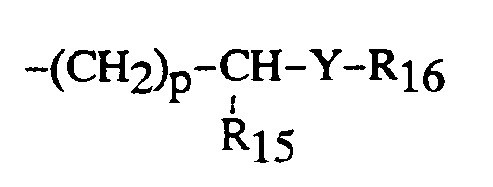 R₅ représente un atome d'hydrogène ou un groupe alkyle en C₁-C₄ ou -NR₆R₇,R₈ représente un groupe -COR₁₀R₁₀ représente un groupe -NR₁₁R₁₂R₁₁ représente un groupe alkyle en C₁-C₄ ou aryle, en particulier phényle,R₁₂ représente un atome d'hydrogène ou un groupe alkyle en C₁-C₄ ou aryle, en particulier phényle,R₁₃ représente un atome d'hydrogène ou un groupe alkyle en C₁-C₄ ou aryle, en particulier phényle,R₁₆ représente un atome d'hydrogène ou un groupe alkyle en C₁-C₄,-COR₁₈ ou -CONHR₁₉,m est un nombre de 1 à 3,n est un nombre de 0 à 3,p est un nombre de 2 à 3 etY représente -O- ou 〉NR₁₇,R₄, R₆, R₇, R₉, R₁₄, R₁₅, R₁₇, R₁₈ et R₁₉ représentent un atome d'hydrogène ou un groupe alkyle en C₁-C₄,R₁₃ et R₁₄, pris ensemble, représentent les atomes nécessaires pour compléter un noyau hétérocyclique éventuellement substitué, par exemple un noyau pipéridine, pipérazine ou morpholine, le noyau pouvant être substitué par exemple par alkyle en C₁-C₃ ou halogène,Z représente les atomes de carbone nécessaires pour compléter un noyau hétérocyclique aromatique à 5 ou 6 chaînons, éventuellement condensé avec un noyau benzénique, etX⊖ représente un anion qui peut être relié par une liaison covalente au reste de la molécule.
 - Matériau photographique en couleurs selon la revendication 1, caractérisé en ce que le durcisseur immédiat est utilisé en quantité de 0,1 à 5 mmol/m².
Applications Claiming Priority (2)
| Application Number | Priority Date | Filing Date | Title |
|---|---|---|---|
| DE3819082 | 1988-06-04 | ||
| DE3819082A DE3819082A1 (de) | 1988-06-04 | 1988-06-04 | Farbfotografisches silberhalogenidmaterial |
Publications (3)
| Publication Number | Publication Date |
|---|---|
| EP0345514A2 EP0345514A2 (fr) | 1989-12-13 |
| EP0345514A3 EP0345514A3 (en) | 1990-09-26 |
| EP0345514B1 true EP0345514B1 (fr) | 1994-08-31 |
Family
ID=6355882
Family Applications (1)
| Application Number | Title | Priority Date | Filing Date |
|---|---|---|---|
| EP89109108A Expired - Lifetime EP0345514B1 (fr) | 1988-06-04 | 1989-05-20 | Matériau photographique couleur à l'halogénure d'argent |
Country Status (3)
| Country | Link |
|---|---|
| EP (1) | EP0345514B1 (fr) |
| JP (1) | JPH0237339A (fr) |
| DE (2) | DE3819082A1 (fr) |
Families Citing this family (5)
| Publication number | Priority date | Publication date | Assignee | Title |
|---|---|---|---|---|
| US5601971A (en) * | 1991-06-18 | 1997-02-11 | Sterling Diagnsotic Imaging, Inc. | Hardening of hydrophilic colloids with imidazolium and triazine combinations |
| DE4119982C2 (de) * | 1991-06-18 | 1993-09-30 | Du Pont Deutschland | 1,3-Bis-carbamoylimidazoliumverbindungen und Verfahren zum Härten von Gelatine enthaltenden Schichten |
| KR100833057B1 (ko) * | 2005-11-23 | 2008-05-27 | 주식회사 엘지화학 | 관형 고정층 촉매 반응기에서 온도를 측정하는 도구 및방법 |
| US10574014B2 (en) | 2017-03-27 | 2020-02-25 | Aptiv Technologies Limited | Method for sealing electric terminal assembly |
| US10017659B1 (en) | 2017-10-09 | 2018-07-10 | Delphi Technologies, Inc | Robust sealed electric terminal assembly |
Family Cites Families (3)
| Publication number | Priority date | Publication date | Assignee | Title |
|---|---|---|---|---|
| DE2439551C2 (de) * | 1974-08-17 | 1985-11-21 | Agfa-Gevaert Ag, 5090 Leverkusen | Verfahren zur Härtung photographischer Schichten |
| JP2627147B2 (ja) * | 1986-04-24 | 1997-07-02 | コニカ株式会社 | ハロゲン化銀写真感光材料 |
| DE3744004A1 (de) * | 1987-12-24 | 1989-07-06 | Agfa Gevaert Ag | Farbfotografisches aufzeichnungsmaterial und verfahren zur herstellung einer fotografischen silberhalogenidemulsion |
-
1988
- 1988-06-04 DE DE3819082A patent/DE3819082A1/de not_active Withdrawn
-
1989
- 1989-05-20 EP EP89109108A patent/EP0345514B1/fr not_active Expired - Lifetime
- 1989-05-20 DE DE58908257T patent/DE58908257D1/de not_active Expired - Fee Related
- 1989-05-31 JP JP1136232A patent/JPH0237339A/ja active Pending
Also Published As
| Publication number | Publication date |
|---|---|
| EP0345514A2 (fr) | 1989-12-13 |
| EP0345514A3 (en) | 1990-09-26 |
| JPH0237339A (ja) | 1990-02-07 |
| DE3819082A1 (de) | 1989-12-14 |
| DE58908257D1 (de) | 1994-10-06 |
Similar Documents
| Publication | Publication Date | Title |
|---|---|---|
| DE3736410A1 (de) | Farbfotografisches silberhalogenidmaterial | |
| EP0358071B1 (fr) | Matériau de reproduction photographique | |
| EP0351588B1 (fr) | Matériau de reproduction photographique couleur | |
| EP0537545B1 (fr) | Produit photographique à l'halogénure d'argent | |
| EP0370226B1 (fr) | Matériel photographique à l'halogénure d'argent et sa méthode de traitement | |
| EP0607801A1 (fr) | Matériau photographique couleur d'enregistrement | |
| EP0345514A2 (fr) | Matériau photographique couleur à l'halogénure d'argent | |
| EP0377889B1 (fr) | Matériel d'enregistrement à l'halogénure d'argent | |
| EP0363820A2 (fr) | Matériau photographique couleur à l'halogénure d'argent | |
| EP0607800A1 (fr) | Matériau photographique couleur d'enregistrement | |
| EP0369235B1 (fr) | Matériau d'enregistrement photographique | |
| DE4318438A1 (de) | Fotografisches Aufzeichnungsmaterial | |
| EP0345553B1 (fr) | Matériau de reproduction photographique | |
| EP0373339B1 (fr) | Matériau d'enregistrement photosensible à l'halogénure d'argent | |
| EP0377181A2 (fr) | Matériau photographique couleur | |
| DE4320828A1 (de) | Farbfotografisches Aufzeichnungsmaterial | |
| EP0312837A2 (fr) | Procédé de traitement photographique sans lavage à l'eau et bain de stabilisation utilisé pour ce procédé | |
| EP0317825B1 (fr) | Matériau de reproduction photographique couleur | |
| DE3744004A1 (de) | Farbfotografisches aufzeichnungsmaterial und verfahren zur herstellung einer fotografischen silberhalogenidemulsion | |
| EP0267523B1 (fr) | Matériau photographique couleur à l'halogénure d'argent sensible à la lumière | |
| EP0330948A2 (fr) | Procédé de production d'images colorées | |
| EP0447657B1 (fr) | Matériau d'enregistrement photographique | |
| DE3838467A1 (de) | Fotografisches aufzeichnungsmaterial | |
| EP0286913A2 (fr) | Matériau d'enregistrement photographique couleur | |
| EP0616256A1 (fr) | Matériau photographique couleur d'enregistrement |
Legal Events
| Date | Code | Title | Description |
|---|---|---|---|
| PUAI | Public reference made under article 153(3) epc to a published international application that has entered the european phase |
Free format text: ORIGINAL CODE: 0009012 |
|
| 17P | Request for examination filed |
Effective date: 19890520 |
|
| AK | Designated contracting states |
Kind code of ref document: A2 Designated state(s): DE FR GB NL |
|
| PUAL | Search report despatched |
Free format text: ORIGINAL CODE: 0009013 |
|
| AK | Designated contracting states |
Kind code of ref document: A3 Designated state(s): DE FR GB NL |
|
| 17Q | First examination report despatched |
Effective date: 19930804 |
|
| GRAA | (expected) grant |
Free format text: ORIGINAL CODE: 0009210 |
|
| AK | Designated contracting states |
Kind code of ref document: B1 Designated state(s): DE FR GB NL |
|
| REF | Corresponds to: |
Ref document number: 58908257 Country of ref document: DE Date of ref document: 19941006 |
|
| GBT | Gb: translation of ep patent filed (gb section 77(6)(a)/1977) |
Effective date: 19941028 |
|
| ET | Fr: translation filed | ||
| PLBE | No opposition filed within time limit |
Free format text: ORIGINAL CODE: 0009261 |
|
| STAA | Information on the status of an ep patent application or granted ep patent |
Free format text: STATUS: NO OPPOSITION FILED WITHIN TIME LIMIT |
|
| 26N | No opposition filed | ||
| REG | Reference to a national code |
Ref country code: GB Ref legal event code: 746 Effective date: 19951016 |
|
| PGFP | Annual fee paid to national office [announced via postgrant information from national office to epo] |
Ref country code: DE Payment date: 19980414 Year of fee payment: 10 |
|
| PGFP | Annual fee paid to national office [announced via postgrant information from national office to epo] |
Ref country code: GB Payment date: 19980511 Year of fee payment: 10 |
|
| PGFP | Annual fee paid to national office [announced via postgrant information from national office to epo] |
Ref country code: FR Payment date: 19980520 Year of fee payment: 10 |
|
| PGFP | Annual fee paid to national office [announced via postgrant information from national office to epo] |
Ref country code: NL Payment date: 19980531 Year of fee payment: 10 |
|
| PG25 | Lapsed in a contracting state [announced via postgrant information from national office to epo] |
Ref country code: GB Free format text: LAPSE BECAUSE OF NON-PAYMENT OF DUE FEES Effective date: 19990520 |
|
| PG25 | Lapsed in a contracting state [announced via postgrant information from national office to epo] |
Ref country code: NL Free format text: LAPSE BECAUSE OF NON-PAYMENT OF DUE FEES Effective date: 19991201 |
|
| GBPC | Gb: european patent ceased through non-payment of renewal fee |
Effective date: 19990520 |
|
| PG25 | Lapsed in a contracting state [announced via postgrant information from national office to epo] |
Ref country code: FR Free format text: LAPSE BECAUSE OF NON-PAYMENT OF DUE FEES Effective date: 20000131 |
|
| NLV4 | Nl: lapsed or anulled due to non-payment of the annual fee |
Effective date: 19991201 |
|
| PG25 | Lapsed in a contracting state [announced via postgrant information from national office to epo] |
Ref country code: DE Free format text: LAPSE BECAUSE OF NON-PAYMENT OF DUE FEES Effective date: 20000301 |
|
| REG | Reference to a national code |
Ref country code: FR Ref legal event code: ST |