EP0346616A2 - Installation pour la fabrication de corps granulaires recouverts d'une matière de rejet pulvérulente à partir de boues déshydratées mécaniquement - Google Patents
Installation pour la fabrication de corps granulaires recouverts d'une matière de rejet pulvérulente à partir de boues déshydratées mécaniquement Download PDFInfo
- Publication number
- EP0346616A2 EP0346616A2 EP89108676A EP89108676A EP0346616A2 EP 0346616 A2 EP0346616 A2 EP 0346616A2 EP 89108676 A EP89108676 A EP 89108676A EP 89108676 A EP89108676 A EP 89108676A EP 0346616 A2 EP0346616 A2 EP 0346616A2
- Authority
- EP
- European Patent Office
- Prior art keywords
- slots
- sludge
- plate
- shaped
- rotor
- Prior art date
- Legal status (The legal status is an assumption and is not a legal conclusion. Google has not performed a legal analysis and makes no representation as to the accuracy of the status listed.)
- Withdrawn
Links
Images


Classifications
-
- C—CHEMISTRY; METALLURGY
- C02—TREATMENT OF WATER, WASTE WATER, SEWAGE, OR SLUDGE
- C02F—TREATMENT OF WATER, WASTE WATER, SEWAGE, OR SLUDGE
- C02F11/00—Treatment of sludge; Devices therefor
- C02F11/12—Treatment of sludge; Devices therefor by de-watering, drying or thickening
-
- B—PERFORMING OPERATIONS; TRANSPORTING
- B01—PHYSICAL OR CHEMICAL PROCESSES OR APPARATUS IN GENERAL
- B01J—CHEMICAL OR PHYSICAL PROCESSES, e.g. CATALYSIS OR COLLOID CHEMISTRY; THEIR RELEVANT APPARATUS
- B01J2/00—Processes or devices for granulating materials, e.g. fertilisers in general; Rendering particulate materials free flowing in general, e.g. making them hydrophobic
- B01J2/12—Processes or devices for granulating materials, e.g. fertilisers in general; Rendering particulate materials free flowing in general, e.g. making them hydrophobic in rotating drums
-
- B—PERFORMING OPERATIONS; TRANSPORTING
- B01—PHYSICAL OR CHEMICAL PROCESSES OR APPARATUS IN GENERAL
- B01J—CHEMICAL OR PHYSICAL PROCESSES, e.g. CATALYSIS OR COLLOID CHEMISTRY; THEIR RELEVANT APPARATUS
- B01J2/00—Processes or devices for granulating materials, e.g. fertilisers in general; Rendering particulate materials free flowing in general, e.g. making them hydrophobic
- B01J2/14—Processes or devices for granulating materials, e.g. fertilisers in general; Rendering particulate materials free flowing in general, e.g. making them hydrophobic in rotating dishes or pans
Definitions
- the invention relates to a device for producing pellet-shaped moldings powdered with powdery drainage material from mechanically dewatered sludge, in particular sewage sludge, with a rotor, on the base of which the sludge is divided into portions by means of knives rotating above the rotor base and thereby shaped into the shaped bodies.
- the sludge discharge of the pre-dewatering stage which often occurs in larger lumps or patties, B. centrifuge, into smaller portions, that is to say divided into lumps of preferably 1 to 15 mm in size, called moldings below.
- these moldings have to be coated with a layer of the powdered drainage material.
- the shaped bodies coated with the powdery drainage material are produced within a so-called pelletizing drum which is inclined in the axial direction, rotates slowly and rotating knives are arranged in the interior thereof.
- both the pre-dewatered material to be molded and a subset of the drainage dust are added and, as a result of the rotation of the drum, are fed to the area of action of the knives, which ensure that the sludge material is broken up.
- the added dust prevents the newly formed surfaces from sticking together again.
- the material transport in the drum takes place essentially as a result of the inclination of the drum, which is followed by the shaped sludge bodies rolling on the ascending drum wall.
- the drainage material is deposited, the remaining amount, for example is added in the drum area where the majority of the shaped bodies have already been formed.
- the invention has for its object to provide a device for the production of pellet-shaped sludge powdered with powdery drainage material, which is comparatively simple and small and still allows high throughput, and produces the molded body, which is very effective in the downstream press squeeze out and allow to drain again.
- the device according to the invention is not a conventional pelletizing machine such as rotating pelletizing drum or rotating pelletizing plate, each with an impermeable bottom, as is suitable for so-called build-up granulation, in which pellets are formed starting from fine-grained material with the addition of a wetting agent.
- the invention is an independent machine, the rotor bo which is deliberately permeable by being provided with circumferential slots for the passage of the molded sludge molded body.
- the slots have two main functions. They are used for the rapid exit of sufficiently small pellet-shaped shaped bodies from the rotor, these shaped bodies only having a short dwell time in the rotor themselves, and at the same time they effectively prevent the exit of oversized shaped bodies.
- the throughput is increased considerably in the device according to the invention and at the same time the stress on the z. B. in a centrifuge dewatered sludge due to the shorter residence time in the device according to the invention more gently.
- Much more moist sludge material which also tends to thixotropy (for example port silt), can be formed into shaped bodies, whereas such a material would build up into thick lumps in the known pelletizing drum.
- the rotor of the device according to the invention can be a drum with a substantially horizontal axis of rotation and a curved drum shell as a rotating base, the slots in the drum shell extending essentially over the entire length of the drum in the circumferential direction of rotation or helically are arranged horizontally.
- a rotor drum only the relatively small proportion of the available slot surfaces in the region of the drum wall rising from the bottom to the top is in contact with sludge material and contributes to the throughput. Since the throughput of a rotor drum only increases linearly with its size in the present case, the high throughputs of sludge material to be formed, which would be required in practice, would lead to extremely large drum dimensions.
- the rotor of the device for producing the pellet-shaped sludge-shaped body is a plate with a plate bottom inclined to the horizontal plane, in which the slots for the passage of the shaped molded body are arranged concentrically or spirally.
- a rotating main knife shaft for dividing the applied sludge and for the greatest possible distribution of the shaped bodies formed on the bottom of the drum or arranged of the plate. This ensures a high probability of the finished molded article passing through the slots.
- At least one transport device for feeding and metering in the powdery drainage material is arranged above the bottom of the rotor.
- the device according to the invention consists of the following main components:
- the adjustable in inclination and speed, provided with a plurality of concentrically or spirally arranged slots (10, 10a, etc.) plate bottom (11) is circular and it closes at his Periphery with a side wall (12).
- the slots (10, 10a, etc.) are distributed in several rows of slots over the entire circumference of the plate base (11).
- a main knife shaft (13) which runs essentially radially to the plate (11) and is arranged with a large number of knives, preferably rotating in opposite directions to the plate, is arranged to separate the sludge that is fed in (13a, 13b etc.) is equipped and which is expediently driven by its own rotary drive. Also in the area of the area of the plate bottom (11) rising from bottom to top and in the direction of plate rotation behind the main knife shaft (13) is above the plate bottom At least one scraper arranged, in the embodiment of FIG.
- the sludge material to be molded into the pellet-shaped body is preferably in the downward moving area of the plate base (11) z. B. by means of a conveyor belt or directly from a centrifuge on the plate bottom, shown schematically in Fig. 2 by the hatched oval sludge feed point (17), such that it with the help of Guide plates (16a, 16b, 16c) are fed to the main knife shaft (13) as evenly as possible.
- the pre-shredded sludge material can pass through the area of influence of the knife shaft (13), too large parts are knocked back by the knives (13a, 13b) and, with the help of the plate base (11) moved up here, are subjected to renewed stress by the knives.
- the pre-divided sludge material reaches the area of the wipers (14a) to (14c), where the material builds up and is moved to more central plate areas.
- the material jam in front of the wipers (14a) to (14c), which is set into a rolling circulating movement by a preferred embodiment thereof, at the same time ensures in this area a particularly high probability of sufficiently small, shaped pellet-shaped bodies to pass through the plate slots (10, 10a, etc. .).
- the knife shafts (15a, 15b, 15c) arranged above the wipers (14a, 14b, 14c) and rotating in the opposite direction to the plate bottom surface ensure in the area of the rolling circulation movement of the sludge material an effective redistribution of those lumps of material that are still too large as pellet-shaped moldings.
- a portion of the drainage dust required for powdering the shaped sludge moldings is expediently applied in the area of the main knife shaft (13) over its entire length in order to dust the freshly formed moist surfaces and to prevent them from sticking together again.
- this is not absolutely necessary, since with sufficient dust dosing in the area of the main knife shaft (13) sufficient free dust gets into the areas of the other knife shafts (15a) to (15c).
- the plate (11) itself, in order to achieve a material movement that is as loosened as possible, is inclined at 10 o to 45 o, preferably 20 o to 30 o , against the horizontal. In order to largely avoid sticking of the sludge material to be formed, it is expediently made of plastic.
- the plate (11) is also lightweight and easy to work with.
- FIG. 3 shows such a groove (18) in the region of the slot (10) and FIG. 4 shows the same groove (18) in a region between two successive slots, seen in the longitudinal direction of the slot.
- Sufficiently small pellet-shaped shaped bodies catch in these grooves (18) when they roll over the plate base (11) and are thus acceleratedly fed to the slots (10, 10a, etc.).
- the side wall (12) that closes the plate is advantageously also pierced with a plurality of circumferential slots (10f), which are preferably arranged directly above the plate base (11).
- the preferred design of the slots corresponds to the following description for the plate slots.
- the bottom surface of the plate is expediently prismatic with an angle of 10 o to about 30 o , z. B. 15 o , opening slots (10, 10a, etc.), as far as compatible with the design of the plate (11), as long as possible and they preferably have three differently shaped sections.
- the ratio of the narrower to the enlarged slot portions influences the resulting size distribution of the pellet-shaped shaped bodies.
- the pellet-shaped moldings discharged through the slots on the underside of the plate may in some cases not be sufficiently and completely dusted with drainage dust.
- these and the free dust which has fallen through the slot bottom (11) of the plate can be connected to a downstream powdering device, for example in the form of a rotating drum mel are supplied, in which the sludge moldings are subjected to a rolling motion substantially.
- the powdering device is expediently integrated into the disk rotor (11), in which one of the following devices is provided as an alternative or in combination:
- a truncated cone-shaped funnel is arranged according to a), which is set in vibration, so that the rolling behavior of the pellet-shaped body is favored and the funnel walls can run flat.
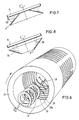
- a truncated cone-shaped funnel (24) - Fig. 8 - or cone (25) - Fig. 7 - is arranged below the slotted plate bottom (11) concentrically with the same shaft, with a surface condition such that the through the slots of the plate bottom ( 11) roll down the pellet-shaped sludge body (26) falling down onto the funnel or cone surface and cover it with further powdery drainage material.
- the required inclination of the funnel (24) or cone (25) depends on the angle of repose of the molding material (26). It must be greater than the difference between the angle of repose and the angle of inclination of the plate (11).
- the apex lines of the funnel (24) or cone (25) assume different inclinations with respect to the horizontal in the course of one revolution.
- the funnel or conical surface is preferably roughened or provided in the direction of the apex lines with grooves, grooves or other shaped depressions or elevations or with inclined spirally extending grooves, grooves or other shaped depressions or elevations in such a way that the downward movement of the Shaped body from the funnel or from the truncated cone preferably takes place as a rolling movement.
- the conical surface can alternatively be designed such that the imaginary cone tip lies above the plate (11) and the pellet-shaped bodies (26) fall onto the outer truncated cone jacket (25) and roll on it (FIG.
- the funnel surface ( 24) directly adjoins the plate (11) at its largest diameter or at a certain distance and tapers downwards in a funnel shape, so that the shaped bodies (26) fall inside the funnel (24) and roll there (FIG. 8).
- the molded bodies (26) are ejected in a comparatively limited angular range in relation to the entire plate rotation.
- the devices reaching into the rotating plate (11), such as knife shafts (13, 15), guide plates (16) and wipers (14), can expediently be combined in two or more units which are connected to a non-rotatable plate frame which in turn adjusts the plate inclination participates.
- the units are then pivotally attached to the plate frame so that they can be pivoted out of the plate (11) for maintenance or cleaning purposes, and that both the distance to the plate and the angular position to the plate axis are adjustable.
- the devices are preferably combined into two units, namely into one unit consisting of the main knife shaft (13) and guide plates (16) and into a second unit consisting of the scraper plates (14) and the possibly associated knife shafts (15).
- the plate weight and / or the material accumulation in the plate are measured alternatively or in combination.
- the weight measurement is advantageously carried out in a known manner via force transducers which register the plate weight.
- the accumulation of material in the plate (11) can expediently be monitored by a signal flag (sheet metal flag) which dips into the plate in the edge area and which actuates a limit switch in the event of critical deflection.
- the local speed of stress results in the opposite direction of rotation of the knife to the plate (11) in each case as the sum of the local peripheral speed of the plate and the peripheral speed of the knife. Since the local peripheral speed on the plate (11) increases linearly with the plate radius, it is proposed to shorten the knife length towards larger plate radii accordingly in order to keep the sum of the speeds constant. Since the knife distance to the plate (11) is expediently constant, the knife shaft itself is then inclined with respect to the plate. - The knife distance to the plate (11) is less than about 15 mm, preferably 1 to 5 mm depending on the material.
- the knives on the knife shafts (13, 15) are expediently arranged helically in such a way that the imaginary helical surface causes a conveying direction to the center of the plate (11).
- the baffles arranged above the plate (11) (16) are preferably given a distance from their lower edge to the plate base in the order of the maximum permissible size of the pellet-shaped shaped bodies.
- the knife shafts In an inhomogeneous material such as sewage sludge, fibrous ingredients such as hair are inevitable, which can build up on the knives of the knife shafts (13, 15). These need to be removed from time to time. It is proposed to temporarily lower a comb-like device arranged above the knife shafts to such an extent that the deposited material is effectively stripped off.
- the knife shafts preferably run briefly in the opposite direction of rotation.
- both the pre-dewatered sludge and the drainage dust are carried out through one or both front openings of the rotating drum (27). Both materials are fed through the slowly rotating drum (27) to the knife shaft (28), which in turn is arranged in the area of the rising drum wall.
- the knives (29) rotating in the same direction at a higher peripheral speed than the drum effect the desired, very gentle division of the pre-dewatered sludge.
- Sufficiently small pellet-shaped bodies leave the drum (27) through the slots (30, 30a etc.) in the drum wall.
- the slots (30, 30a etc.) are in principle designed analogously to the slots (10, 10a etc.) of FIG. 2.
- Pellet-shaped bodies which are too large are retained by the slots and are re-divided by the knife shaft (28).
- the pre-dewatered sludge is preferably applied in the area of the drum axis, the drainage dust, on the other hand, preferably in the area of the knife shaft, in particular to dust the freshly formed surfaces and to prevent them from sticking together again. Most of the required drainage dust is already taken up in the drum (27).
- these and the dust that has fallen through the slit drum wall can in turn be fed to a downstream powdering device, for example a powdering drum.
- the settings of the device with regard to the speeds of the drum (27) and knife shaft (28) are dependent on the material, ie both on the pre-dewatered material and on the drainage material.
- the drum is to be operated at a speed of about 5 to 25%, preferably 12 to 15% of the critical speed at which the material would be taken over the upper apex of the drum.
- both the pre-dewatered material and the drainage material are distributed over the length of the drum.
- conveying elements in the form of employed paddles or sections of a screw helix (31) are attached to the knife shaft (28), which ensure a longitudinal distribution of the pre-dewatered sludge material in one or more places in the drum (27).
- the longitudinal distribution of the pre-dewatered material in the drum (27) can also take place in that the entire drum or drum sections have a suitable gradient starting from the feed points.
- the distance between the periphery of the knives (29) and the drum inner wall is equal to or less than about 15 mm.
- the invention is applicable not only for mechanically pre-dewatered sludge but also for any materials which form a pasty, separable mass, for. B. from the food sector, the molded bodies then formed may not need to be powdered.
Landscapes
- Chemical & Material Sciences (AREA)
- Organic Chemistry (AREA)
- Chemical Kinetics & Catalysis (AREA)
- Life Sciences & Earth Sciences (AREA)
- Hydrology & Water Resources (AREA)
- Engineering & Computer Science (AREA)
- Environmental & Geological Engineering (AREA)
- Water Supply & Treatment (AREA)
- Treatment Of Sludge (AREA)
Applications Claiming Priority (2)
| Application Number | Priority Date | Filing Date | Title |
|---|---|---|---|
| DE3819910A DE3819910A1 (de) | 1988-06-11 | 1988-06-11 | Einrichtung zur herstellung von pelletfoermigen mit pulvrigem drainagematerial bepuderten formkoerpern aus mechanisch entwaessertem schlamm |
| DE3819910 | 1988-06-11 |
Publications (2)
| Publication Number | Publication Date |
|---|---|
| EP0346616A2 true EP0346616A2 (fr) | 1989-12-20 |
| EP0346616A3 EP0346616A3 (fr) | 1990-10-17 |
Family
ID=6356338
Family Applications (1)
| Application Number | Title | Priority Date | Filing Date |
|---|---|---|---|
| EP19890108676 Withdrawn EP0346616A3 (fr) | 1988-06-11 | 1989-05-13 | Installation pour la fabrication de corps granulaires recouverts d'une matière de rejet pulvérulente à partir de boues déshydratées mécaniquement |
Country Status (2)
| Country | Link |
|---|---|
| EP (1) | EP0346616A3 (fr) |
| DE (1) | DE3819910A1 (fr) |
Cited By (1)
| Publication number | Priority date | Publication date | Assignee | Title |
|---|---|---|---|---|
| FR2882277A1 (fr) * | 2005-02-23 | 2006-08-25 | Marc Gombart | Utilisation et procede de nodulisation pour faciliter le conditionnement, la manutention, le traitement et/ou la tenue en tas d'un dechet humide, generalement pateux et/ou collant, obtenu a partir d'une boue |
Families Citing this family (1)
| Publication number | Priority date | Publication date | Assignee | Title |
|---|---|---|---|---|
| FI126951B (en) * | 2016-01-20 | 2017-08-31 | Rakeistus Oy | Granulation of ash-containing material |
Family Cites Families (2)
| Publication number | Priority date | Publication date | Assignee | Title |
|---|---|---|---|---|
| DE1216846B (de) * | 1962-05-23 | 1966-05-18 | Eirich Wilhelm | Austragvorrichtung fuer Schraegtellergranulatoren |
| DE3446520A1 (de) * | 1984-12-20 | 1986-07-03 | Schröder, Herbert, 5431 Ebernhahn | Verfahren zur herstellung eines duengemittels in form eines granulates aus organischen rohstoffen sowie anlage zur durchfuehrung des verfahrens |
-
1988
- 1988-06-11 DE DE3819910A patent/DE3819910A1/de not_active Withdrawn
-
1989
- 1989-05-13 EP EP19890108676 patent/EP0346616A3/fr not_active Withdrawn
Cited By (1)
| Publication number | Priority date | Publication date | Assignee | Title |
|---|---|---|---|---|
| FR2882277A1 (fr) * | 2005-02-23 | 2006-08-25 | Marc Gombart | Utilisation et procede de nodulisation pour faciliter le conditionnement, la manutention, le traitement et/ou la tenue en tas d'un dechet humide, generalement pateux et/ou collant, obtenu a partir d'une boue |
Also Published As
| Publication number | Publication date |
|---|---|
| DE3819910A1 (de) | 1989-12-21 |
| EP0346616A3 (fr) | 1990-10-17 |
Similar Documents
| Publication | Publication Date | Title |
|---|---|---|
| EP1631371A1 (fr) | Dispositif pour le traitement de solides | |
| EP2065174B1 (fr) | Dispositif de remplissage pour une presse à comprimés rotative | |
| DE3723588C2 (fr) | ||
| DE2703329A1 (de) | Anordnung zum niveaugleichen auffuellen von senkrechtstehenden behaeltern | |
| EP0101701B1 (fr) | Dispositif d'enrobage de dragees | |
| CH660073A5 (de) | Vakuum-trocken-vorrichtung. | |
| DE2834491C2 (de) | Siebzentrifuge mit gekrümmten Siebtaschen | |
| CH615384A5 (fr) | ||
| EP3939777B1 (fr) | Dispositif pour séparer des substances de fluidités différentes mélangées entre elles | |
| DE1667038A1 (de) | Verfahren und Vorrichtung zur Herstellung von Kuegelchen aus Mischungen | |
| DE3333733A1 (de) | Granuliervorrichtung | |
| EP0736370A2 (fr) | Appareil de déshydratation de matériaux | |
| DE3819910A1 (de) | Einrichtung zur herstellung von pelletfoermigen mit pulvrigem drainagematerial bepuderten formkoerpern aus mechanisch entwaessertem schlamm | |
| EP0459475A1 (fr) | Dispositif pour le dosage de matière en vrac sortant d'un récipient | |
| DE2814494C2 (de) | Vorrichtung zum Aufgeben einer Sintermischung | |
| DE2334789C2 (de) | Misch- und Auflösemaschine | |
| EP3300793B1 (fr) | Dispositif de mélange d'un article en poudre avec un liquide | |
| EP1592500B1 (fr) | Dispositif pour traiter un produit particulaire et procede permettant d'actionner ledit dispositif | |
| DE69807553T2 (de) | Vorrichtung zum Herstellen keramischer Gegenstände | |
| WO2011144196A1 (fr) | Désintégrateur doté d'une chambre d'introduction et d'une chambre de refoulement | |
| DE102009029935B4 (de) | Befeuchtungsvorrichtung zum Befeuchten von rieselfähigem Gut, insbesondere Mehl, und Verfahren zum Befeuchten von rieselfähigem Gut, insbesondere Mehl | |
| DE19754873A1 (de) | Extrusionsvorrichtung | |
| DE4402834C2 (de) | Behälter zum Sammeln von Garnabfall | |
| EP3406437B1 (fr) | Dispositif de remplissage pour une machine à fabriquer des comprimés | |
| DE2840084C2 (fr) |
Legal Events
| Date | Code | Title | Description |
|---|---|---|---|
| PUAI | Public reference made under article 153(3) epc to a published international application that has entered the european phase |
Free format text: ORIGINAL CODE: 0009012 |
|
| AK | Designated contracting states |
Kind code of ref document: A2 Designated state(s): AT BE CH DE ES FR GB IT LI NL SE |
|
| PUAL | Search report despatched |
Free format text: ORIGINAL CODE: 0009013 |
|
| AK | Designated contracting states |
Kind code of ref document: A3 Designated state(s): AT BE CH DE ES FR GB IT LI NL SE |
|
| 17P | Request for examination filed |
Effective date: 19901210 |
|
| 17Q | First examination report despatched |
Effective date: 19910819 |
|
| STAA | Information on the status of an ep patent application or granted ep patent |
Free format text: STATUS: THE APPLICATION HAS BEEN WITHDRAWN |
|
| RAP1 | Party data changed (applicant data changed or rights of an application transferred) |
Owner name: KLOECKNER-HUMBOLDT-DEUTZ AG |
|
| 18W | Application withdrawn |
Withdrawal date: 19911221 |