EP0346635A2 - Procédé et dispositif pour le codage d'images - Google Patents
Procédé et dispositif pour le codage d'images Download PDFInfo
- Publication number
- EP0346635A2 EP0346635A2 EP89108913A EP89108913A EP0346635A2 EP 0346635 A2 EP0346635 A2 EP 0346635A2 EP 89108913 A EP89108913 A EP 89108913A EP 89108913 A EP89108913 A EP 89108913A EP 0346635 A2 EP0346635 A2 EP 0346635A2
- Authority
- EP
- European Patent Office
- Prior art keywords
- motion
- coding
- image
- partial image
- coded
- Prior art date
- Legal status (The legal status is an assumption and is not a legal conclusion. Google has not performed a legal analysis and makes no representation as to the accuracy of the status listed.)
- Granted
Links
Images
Classifications
-
- G—PHYSICS
- G06—COMPUTING OR CALCULATING; COUNTING
- G06T—IMAGE DATA PROCESSING OR GENERATION, IN GENERAL
- G06T9/00—Image coding
- G06T9/008—Vector quantisation
-
- H—ELECTRICITY
- H04—ELECTRIC COMMUNICATION TECHNIQUE
- H04N—PICTORIAL COMMUNICATION, e.g. TELEVISION
- H04N19/00—Methods or arrangements for coding, decoding, compressing or decompressing digital video signals
- H04N19/50—Methods or arrangements for coding, decoding, compressing or decompressing digital video signals using predictive coding
- H04N19/503—Methods or arrangements for coding, decoding, compressing or decompressing digital video signals using predictive coding involving temporal prediction
- H04N19/51—Motion estimation or motion compensation
-
- H—ELECTRICITY
- H04—ELECTRIC COMMUNICATION TECHNIQUE
- H04N—PICTORIAL COMMUNICATION, e.g. TELEVISION
- H04N19/00—Methods or arrangements for coding, decoding, compressing or decompressing digital video signals
- H04N19/10—Methods or arrangements for coding, decoding, compressing or decompressing digital video signals using adaptive coding
- H04N19/102—Methods or arrangements for coding, decoding, compressing or decompressing digital video signals using adaptive coding characterised by the element, parameter or selection affected or controlled by the adaptive coding
- H04N19/13—Adaptive entropy coding, e.g. adaptive variable length coding [AVLC] or context adaptive binary arithmetic coding [CABAC]
-
- H—ELECTRICITY
- H04—ELECTRIC COMMUNICATION TECHNIQUE
- H04N—PICTORIAL COMMUNICATION, e.g. TELEVISION
- H04N19/00—Methods or arrangements for coding, decoding, compressing or decompressing digital video signals
- H04N19/60—Methods or arrangements for coding, decoding, compressing or decompressing digital video signals using transform coding
-
- H—ELECTRICITY
- H04—ELECTRIC COMMUNICATION TECHNIQUE
- H04N—PICTORIAL COMMUNICATION, e.g. TELEVISION
- H04N19/00—Methods or arrangements for coding, decoding, compressing or decompressing digital video signals
- H04N19/90—Methods or arrangements for coding, decoding, compressing or decompressing digital video signals using coding techniques not provided for in groups H04N19/10-H04N19/85, e.g. fractals
- H04N19/91—Entropy coding, e.g. variable length coding [VLC] or arithmetic coding
Definitions
- the invention relates to an image coding method according to the preamble of claim 1 and an image coding device.
- the HPC (Hierarchical Predictive Coding) method is based on the combination of prediction coding and interpolation.
- the transformation coding for example the ADCT (Adaptive Cosine Transform) coding
- the local sample values of an image block are transformed by means of a mathematical agreement in order to obtain uncorrelated coefficients.
- Data compression is achieved by clipping coefficients and nonlinear quantization.
- vector quantization the image is turned into a large number divided into small cells, e.g. 2x2 or 4x4 picture elements. Each cell of k picture elements is then interpreted as a vector in k dimensional space. A number of representative vectors are selected for transmission.
- the current image vectors are described by the representative vectors in their neighborhood.
- the object of the invention is, based on the preamble of claim 1 or 2, to provide an image coding method which enables a constant local reconstruction quality.
- an image coding device is to be specified. This object is achieved with respect to the method by the features of claims 1 or 2 and with respect to the device by the features of claims 7 or 8. Claims 3 to 6 show further developments of the method.
- the invention is suitable for all image coding methods in which only a part of the information changed compared to the previous image is transmitted due to a low transmission capacity, for example the channel data rate (conditional replenishment method).
- the method according to the invention can be used for all block-oriented image coding methods, such as transformation coding, pyramid transformation (ASST'87, 6th Aachen Symposium for Signal Theory, Computer Science Technical Reports 153, September 1987, pages 203 to 206) and vector coding. It can also be used for DCPM coding can be used if, for example, several successive pixels are combined to form a block.
- the selection of the sub-picture areas / blocks to be transmitted on the basis of the quality criterion and, if necessary, the adaptation of the coding bit rate to the limited capacity of the transmission channel enables a constant local reconstruction quality.
- the data stream of the data-reduced image signal is generally composed of statistically encoded image data, synchronous information and control information, which may also be statistically encoded.
- image data e.g. CCIR Rec.-H120
- the fill level of the buffer memory is usually used to control the image data rate CCIR Rec.-H120
- a buffer overflow is prevented by measures such as Avoiding a coarse quantization of the spectral values or increasing decision thresholds for conditional replenishment.
- the reverse control of the encoder from the buffer fill level has the following disadvantages that no longer occur in the method:
- the local reconstruction quality of the image is not stable because it depends on the global control variable "buffer level" and not directly on the image content. Depending on the buffer level, parts of the same picture can be encoded with different quality.
- the reconstruction quality of the buffer level-controlled encoder is more stable the larger the buffer memory is.
- the shortest possible runtime and thus the smallest possible buffer memory should be aimed for.
- a moving picture codec with 64 kbit / s for video telephones can be realized with stabilization of the local reconstruction quality of the picture.
- the local reconstruction quality of the image is therefore more stable than with conventional systems, because the selection of the partial image areas / blocks to be transmitted depends solely on the residual error and not on the chronological order of processing. Due to the forward control used, the buffer memory of the codec can be dimensioned smaller than with the usual reverse control. The basic delay of the codec decreases accordingly.
- the entire image or difference image is assessed.
- the buffer storage runtime can be minimized.
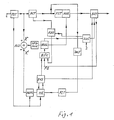
- a PCM image sequence for example from 2 full images, is fed in at point 1.
- This image sequence is forwarded to an image memory PST.
- the stored image sequence is supplied both to a motion estimator ME and via an adder ADD to a device for determining residual errors DFD-SUM and to a perception-adaptive transformation coding device DCT.
- a known device can be used as a motion estimator.
- a hierarchically structured motion estimator according to EP 236 519 A1 is particularly suitable.
- the device known from Esprit'86, pages 217 to 218, see above, can be used as the transformation coding device or also devices according to EP 13 069 A1, GB 21 41 847 A or Philips techn. Rev. 38, 1978/79, No.
- the image sequence subjected to the DCT transformation is stored in a memory FST and is subjected to a transformation inverse to the DCT transformation in the device JDCT.
- the back-transformed image sequence is made available to the motion estimator ME via a further image memory FIT.
- the motion estimator ME delivers via an interpolator MCFI (motion compensating frame interpolator) pixels X ′ from the motion-compensated partial image area of the previous image.
- interpolator MCFI motion compensating frame interpolator
- Known implementations can be used for the interpolator MCFI, for example the "Motion Compensating Interpolation Filter" known from EP 236 519 A1. This calculates each pixel as a function of the motion vectors that the motion estimator ME supplies and the temporal position of the pixels.
- the motion vectors which are determined with the displacement estimator ME and are stored in a vector memory BVS, are coded, for example, VWL (variable word length) and also fed to the buffer memory BUF.
- Synchronous and control information is fed via point 2 to a preparation stage ZUS. Together with the information about the ordered residual errors - BSEL - this additional information is prepared and coded and sent to the buffer memory BUF.
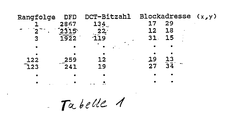
- It contains, for example, the block address (last 2 columns in Table 1) and the DCT bit number, ie the number of bits required for the DCT coding of a field area / block.
- the latter information is supplied by a DCT block bit number memory BBZ which is connected to the transformation coding device.
- a bit counter BITC is provided, which in turn is supplied with the vector bit number from the vector memory BVS, the DCT block bit number and the fill level FS of the buffer memory BUF as a control criterion.
- the BITC bit counter always enables the maximum possible utilization of the transmission channel.
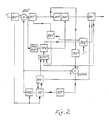
- FIG. 2 A device for this is shown in FIG. 2, the subassemblies corresponding to those in FIG. 1 being shown with crossed reference numerals.
- an adder ADD ' is connected between the corresponding input image memory and the transform coding device DCT'.
- the adder ADD ' is the output signal of the corresponding interpolator MCFI' supplied at the end of the minute.
- Another adder ADDW is connected between the corresponding device for inverse DCT transformation JDCT 'and memory FIT'. The output signal of the corresponding interpolator MCFI 'is fed to this additional adder ADDW at its minute end input.
- the motion estimator ME ' is not fed the back-transformed image, but the reconstructed image, the motion-compensated prediction image (output signal of the interpolator MCFI') and the non-transformed error image being used for the reconstruction.
- This motion-compensated prediction error is also used as the input signal of the device DFD-SUM '.
- DFD SUM
- DFD ′ SUM (xx ′) 2 used or similar relationships.
- the quality criterion can be used not only to select the blocks to be transmitted, but also to control the coding data rate, for example by changing the quantization.
- partial image area was understood to mean a matrix-shaped area - block. Instead of such matrix areas, another structure, e.g. in the form of elements of a pattern.
Landscapes
- Engineering & Computer Science (AREA)
- Multimedia (AREA)
- Physics & Mathematics (AREA)
- General Physics & Mathematics (AREA)
- Theoretical Computer Science (AREA)
- Signal Processing (AREA)
- Compression Or Coding Systems Of Tv Signals (AREA)
- Compression, Expansion, Code Conversion, And Decoders (AREA)
Applications Claiming Priority (2)
| Application Number | Priority Date | Filing Date | Title |
|---|---|---|---|
| DE3820037 | 1988-06-13 | ||
| DE3820037A DE3820037A1 (de) | 1988-06-13 | 1988-06-13 | Bildcodierverfahren und einrichtung |
Publications (3)
| Publication Number | Publication Date |
|---|---|
| EP0346635A2 true EP0346635A2 (fr) | 1989-12-20 |
| EP0346635A3 EP0346635A3 (fr) | 1991-03-27 |
| EP0346635B1 EP0346635B1 (fr) | 1994-09-07 |
Family
ID=6356418
Family Applications (1)
| Application Number | Title | Priority Date | Filing Date |
|---|---|---|---|
| EP89108913A Expired - Lifetime EP0346635B1 (fr) | 1988-06-13 | 1989-05-18 | Procédé et dispositif pour le codage d'images |
Country Status (2)
| Country | Link |
|---|---|
| EP (1) | EP0346635B1 (fr) |
| DE (2) | DE3820037A1 (fr) |
Cited By (9)
| Publication number | Priority date | Publication date | Assignee | Title |
|---|---|---|---|---|
| EP0439675A3 (en) * | 1990-02-01 | 1992-08-12 | Ant Nachrichtentechnik Gmbh | Method for the processing of picture data, especially for still picture transmission |
| FR2716556A1 (fr) * | 1994-02-23 | 1995-08-25 | Bosch Gmbh Robert | Procédé de codage source, pour subdiviser une image en des plages d'image de taille fixée. |
| WO1997016026A1 (fr) * | 1995-10-27 | 1997-05-01 | University Of Strathclyde | Compression de donnees |
| WO1997047138A1 (fr) * | 1996-06-06 | 1997-12-11 | Berners Lee C P | Systeme et procede de codage de donnees |
| EP0734179A3 (fr) * | 1995-03-20 | 1998-03-04 | Daewoo Electronics Co., Ltd | Procédé et appareil pour coder/décoder sélectivement un signal d'image |
| US6061401A (en) * | 1995-03-20 | 2000-05-09 | Daewoo Electronics Co., Ltd. | Method and apparatus for selectively encoding/decoding a video signal |
| US7039108B2 (en) | 2000-09-29 | 2006-05-02 | Robert Bosch Gmbh | Method and device for coding and decoding image sequences |
| US7464027B2 (en) | 2004-02-13 | 2008-12-09 | Fraunhofer-Gesellschaft Zur Foerderung Der Angewandten Forschung E.V. | Method and device for quantizing an information signal |
| US7716042B2 (en) | 2004-02-13 | 2010-05-11 | Gerald Schuller | Audio coding |
Families Citing this family (1)
| Publication number | Priority date | Publication date | Assignee | Title |
|---|---|---|---|---|
| DE102004007200B3 (de) | 2004-02-13 | 2005-08-11 | Fraunhofer-Gesellschaft zur Förderung der angewandten Forschung e.V. | Audiocodierung |
Family Cites Families (2)
| Publication number | Priority date | Publication date | Assignee | Title |
|---|---|---|---|---|
| US4670851A (en) * | 1984-01-09 | 1987-06-02 | Mitsubishi Denki Kabushiki Kaisha | Vector quantizer |
| US4727422A (en) * | 1985-06-03 | 1988-02-23 | Picturetel Corporation | Method and apparatus for efficiently communicating image sequence having improved motion compensation |
-
1988
- 1988-06-13 DE DE3820037A patent/DE3820037A1/de not_active Withdrawn
-
1989
- 1989-05-18 DE DE58908301T patent/DE58908301D1/de not_active Expired - Lifetime
- 1989-05-18 EP EP89108913A patent/EP0346635B1/fr not_active Expired - Lifetime
Cited By (13)
| Publication number | Priority date | Publication date | Assignee | Title |
|---|---|---|---|---|
| EP0439675A3 (en) * | 1990-02-01 | 1992-08-12 | Ant Nachrichtentechnik Gmbh | Method for the processing of picture data, especially for still picture transmission |
| FR2716556A1 (fr) * | 1994-02-23 | 1995-08-25 | Bosch Gmbh Robert | Procédé de codage source, pour subdiviser une image en des plages d'image de taille fixée. |
| EP0734179A3 (fr) * | 1995-03-20 | 1998-03-04 | Daewoo Electronics Co., Ltd | Procédé et appareil pour coder/décoder sélectivement un signal d'image |
| US6061401A (en) * | 1995-03-20 | 2000-05-09 | Daewoo Electronics Co., Ltd. | Method and apparatus for selectively encoding/decoding a video signal |
| GB2306840B (en) * | 1995-10-27 | 1999-12-01 | Univ Strathclyde | Data compression |
| US6049632A (en) * | 1995-10-27 | 2000-04-11 | University Of Strathclyde | Data compression |
| WO1997016026A1 (fr) * | 1995-10-27 | 1997-05-01 | University Of Strathclyde | Compression de donnees |
| FR2749688A1 (fr) * | 1996-06-06 | 1997-12-12 | Berners Lee C P | Appareil et procede de codage de donnees |
| WO1997047138A1 (fr) * | 1996-06-06 | 1997-12-11 | Berners Lee C P | Systeme et procede de codage de donnees |
| US5999217A (en) * | 1996-06-06 | 1999-12-07 | Berners-Lee; Charles Peter | Apparatus and method for encoding data |
| US7039108B2 (en) | 2000-09-29 | 2006-05-02 | Robert Bosch Gmbh | Method and device for coding and decoding image sequences |
| US7464027B2 (en) | 2004-02-13 | 2008-12-09 | Fraunhofer-Gesellschaft Zur Foerderung Der Angewandten Forschung E.V. | Method and device for quantizing an information signal |
| US7716042B2 (en) | 2004-02-13 | 2010-05-11 | Gerald Schuller | Audio coding |
Also Published As
| Publication number | Publication date |
|---|---|
| DE3820037A1 (de) | 1989-12-14 |
| EP0346635A3 (fr) | 1991-03-27 |
| EP0346635B1 (fr) | 1994-09-07 |
| DE58908301D1 (de) | 1994-10-13 |
Similar Documents
| Publication | Publication Date | Title |
|---|---|---|
| DE69522861T2 (de) | Verfahren und Einrichtung zur Codeumwandlung von codiertem Datenstrom | |
| DE69323523T2 (de) | Einrichtung zur Kodierung von digitalen bilddarstellenden Signalen und entsprechende Dekodierungseinrichtung | |
| DE69323156T2 (de) | Bilddatenkomprimierungs/Dekomprimierungssystem | |
| DE10190285B4 (de) | Verfahren und System zur Verarbeitung von komprimierten Videosignalen | |
| DE69033508T2 (de) | Verfahren zur Dekodierung eines Videosignals | |
| DE69021500T2 (de) | Bedingungsgemässe bewegungskompensierte Interpolation von digitalen Bewegtbildsignalen. | |
| DE69414931T2 (de) | Transkodierer | |
| DE69225556T2 (de) | Verfahren zum Bild-zu-Bild-Prädiktion und Bildsignal-Kodier/Dekodiervorrichtung | |
| DE69521238T2 (de) | Bilddatenquantisierung in Bildkomprimierung | |
| DE69530336T2 (de) | Bewegungskompensation für digitale Videosignale mit Zeilensprung | |
| DE69027710T2 (de) | Bewegtbildsignalkodier- und -dekodiervorrichtung | |
| DE69512548T2 (de) | Verfahren und Vorrichtung zur Vermeidung von wiederholenden Zufallsfehlern in Transformationskoeffizienten von Bewegtbildsignalen | |
| DE3814627C2 (fr) | ||
| DE69430877T2 (de) | Bildkodierungsverfahren und -vorrichtung | |
| DE69031045T2 (de) | Einrichtung zur adaptiven Zwischenbild-Prädiktionsdekodierung eines Videosignals | |
| DE69224250T2 (de) | Ableitung und Verwendung von Bewegungsvektoren in einem Differenzpulskodemodulationssystem | |
| EP0276753B1 (fr) | Méthode et appareil pour la transmission d'informations numériques et/ou l' enregistrement et la reproduction | |
| DE69825811T2 (de) | Kodiergerät und Kodierverfahren mit Bewegungskompensation für hocheffiziente Videokodierung durch selektive Auswahl von vergangenen Bewegungsvektoren statt Benutzung von Bewegungsvektoren abgeleitet von Bewegungsschätzung | |
| DE69106415T2 (de) | Einrichtung zur Kodierung/Dekodierung von Bildsignalen. | |
| DE69736852T2 (de) | Codierung- und Decodierungssystem für bewegte Bilder mit beliebig geformten Objekten | |
| DE3874703T2 (de) | Kodier- und dekodierverfahren und vorrichtung fuer die bilduebertragung ueber ein netz mit einem variablen datenfluss. | |
| DE69428034T2 (de) | Bildsignalkodierung und -dekodierung | |
| DE69232215T2 (de) | Einrichtung zur Bildkodierung | |
| EP0346635B1 (fr) | Procédé et dispositif pour le codage d'images | |
| DE69017838T2 (de) | Vorrichtung zum Kodieren von Bildern. |
Legal Events
| Date | Code | Title | Description |
|---|---|---|---|
| PUAI | Public reference made under article 153(3) epc to a published international application that has entered the european phase |
Free format text: ORIGINAL CODE: 0009012 |
|
| AK | Designated contracting states |
Kind code of ref document: A2 Designated state(s): DE FR GB IT NL |
|
| PUAL | Search report despatched |
Free format text: ORIGINAL CODE: 0009013 |
|
| 17P | Request for examination filed |
Effective date: 19901228 |
|
| AK | Designated contracting states |
Kind code of ref document: A3 Designated state(s): DE FR GB IT NL |
|
| 17Q | First examination report despatched |
Effective date: 19930225 |
|
| GRAA | (expected) grant |
Free format text: ORIGINAL CODE: 0009210 |
|
| ITF | It: translation for a ep patent filed | ||
| AK | Designated contracting states |
Kind code of ref document: B1 Designated state(s): DE FR GB IT NL |
|
| REF | Corresponds to: |
Ref document number: 58908301 Country of ref document: DE Date of ref document: 19941013 |
|
| ET | Fr: translation filed | ||
| GBT | Gb: translation of ep patent filed (gb section 77(6)(a)/1977) |
Effective date: 19941125 |
|
| PLBE | No opposition filed within time limit |
Free format text: ORIGINAL CODE: 0009261 |
|
| STAA | Information on the status of an ep patent application or granted ep patent |
Free format text: STATUS: NO OPPOSITION FILED WITHIN TIME LIMIT |
|
| 26N | No opposition filed | ||
| REG | Reference to a national code |
Ref country code: FR Ref legal event code: D9 Free format text: CORRECTION |
|
| REG | Reference to a national code |
Ref country code: GB Ref legal event code: IF02 |
|
| PGFP | Annual fee paid to national office [announced via postgrant information from national office to epo] |
Ref country code: IT Payment date: 20080526 Year of fee payment: 20 |
|
| PGFP | Annual fee paid to national office [announced via postgrant information from national office to epo] |
Ref country code: NL Payment date: 20080523 Year of fee payment: 20 Ref country code: DE Payment date: 20080728 Year of fee payment: 20 |
|
| PGFP | Annual fee paid to national office [announced via postgrant information from national office to epo] |
Ref country code: GB Payment date: 20080522 Year of fee payment: 20 |
|
| REG | Reference to a national code |
Ref country code: GB Ref legal event code: PE20 Expiry date: 20090517 |
|
| NLV7 | Nl: ceased due to reaching the maximum lifetime of a patent |
Effective date: 20090518 |
|
| PG25 | Lapsed in a contracting state [announced via postgrant information from national office to epo] |
Ref country code: NL Free format text: LAPSE BECAUSE OF EXPIRATION OF PROTECTION Effective date: 20090518 |
|
| PG25 | Lapsed in a contracting state [announced via postgrant information from national office to epo] |
Ref country code: GB Free format text: LAPSE BECAUSE OF EXPIRATION OF PROTECTION Effective date: 20090517 |
|
| PGFP | Annual fee paid to national office [announced via postgrant information from national office to epo] |
Ref country code: FR Payment date: 20080519 Year of fee payment: 20 |