EP0346750B1 - Dispositif pour le codage par MICD avec un débit de données élevé - Google Patents
Dispositif pour le codage par MICD avec un débit de données élevé Download PDFInfo
- Publication number
- EP0346750B1 EP0346750B1 EP89110290A EP89110290A EP0346750B1 EP 0346750 B1 EP0346750 B1 EP 0346750B1 EP 89110290 A EP89110290 A EP 89110290A EP 89110290 A EP89110290 A EP 89110290A EP 0346750 B1 EP0346750 B1 EP 0346750B1
- Authority
- EP
- European Patent Office
- Prior art keywords
- input
- predictor
- subtraction means
- adder
- output
- Prior art date
- Legal status (The legal status is an assumption and is not a legal conclusion. Google has not performed a legal analysis and makes no representation as to the accuracy of the status listed.)
- Expired - Lifetime
Links
- 238000001514 detection method Methods 0.000 claims description 8
- 238000012545 processing Methods 0.000 claims description 6
- 230000008054 signal transmission Effects 0.000 claims 2
- 238000013139 quantization Methods 0.000 description 23
- 238000007792 addition Methods 0.000 description 11
- 238000011161 development Methods 0.000 description 10
- 230000018109 developmental process Effects 0.000 description 10
- 230000006870 function Effects 0.000 description 7
- 230000005540 biological transmission Effects 0.000 description 4
- 230000015572 biosynthetic process Effects 0.000 description 3
- 230000001934 delay Effects 0.000 description 3
- 238000010586 diagram Methods 0.000 description 3
- 238000005516 engineering process Methods 0.000 description 3
- 238000000034 method Methods 0.000 description 3
- 238000011156 evaluation Methods 0.000 description 2
- 238000004364 calculation method Methods 0.000 description 1
- 238000010276 construction Methods 0.000 description 1
- 230000002542 deteriorative effect Effects 0.000 description 1
- 238000003780 insertion Methods 0.000 description 1
- 230000037431 insertion Effects 0.000 description 1
- 238000005070 sampling Methods 0.000 description 1
Images


Classifications
-
- H—ELECTRICITY
- H04—ELECTRIC COMMUNICATION TECHNIQUE
- H04N—PICTORIAL COMMUNICATION, e.g. TELEVISION
- H04N19/00—Methods or arrangements for coding, decoding, compressing or decompressing digital video signals
- H04N19/50—Methods or arrangements for coding, decoding, compressing or decompressing digital video signals using predictive coding
-
- H—ELECTRICITY
- H03—ELECTRONIC CIRCUITRY
- H03M—CODING; DECODING; CODE CONVERSION IN GENERAL
- H03M7/00—Conversion of a code where information is represented by a given sequence or number of digits to a code where the same, similar or subset of information is represented by a different sequence or number of digits
- H03M7/30—Compression; Expansion; Suppression of unnecessary data, e.g. redundancy reduction
- H03M7/3002—Conversion to or from differential modulation
- H03M7/3044—Conversion to or from differential modulation with several bits only, i.e. the difference between successive samples being coded by more than one bit, e.g. differential pulse code modulation [DPCM]
Definitions
- DPCM differential pulse code modulation
- the difference formation required for DPCM coding takes place according to FIG. 1 in a subtractor 2, the first input of which is connected to the input 1 and the second input of which is connected to a predictor 3.
- a recursive signal path is provided, which starts from a switching point 7 on the output side of the quantizer 4, contains a first adder 8, a limiter device 9 and the predictor 3 and is routed to the second input of the subtractor 2.
- the output of the predictor 3 is also connected to a second input of the first adder 8, which forms a so-called reconstructed pixel signal s R by adding the quantized difference signal ⁇ q and the prediction value ⁇ . For each current pixel signal s, the predictor 3 delivers the prediction value aus from at least one of the previous pixel signals
- the current image point lying in line n in a television picture m is designated by X
- the picture point scanned immediately before by A the picture point corresponding to X of the previous line n-1 by C and the one adjacent to the latter, immediately before or after this scanned picture elements with B and D and if the corresponding picture elements of the previous picture m - l are labeled with X 'and A' to D '
- the formation of the prediction value ⁇ for the picture element signal of X use the pixel signals from at least one of the points A to D, where one speaks of a two-dimensional (2D) prediction.
- Claims 2 to 11 are directed to preferred refinements and developments of the invention.
- the quantized prediction error ⁇ q arises in that the associated quantization error q is added to the prediction error ⁇ at the output of the subtractor 2a.
- the output 13 of the further adder 12, which supplies the quantized prediction error ⁇ q, is connected to a transmission channel via an encoder (not shown).
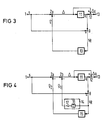
- a recursive signal path is provided which starts from the output of the arrangement for outputting a quantization error 11 associated with a difference signal, contains a first adder 8 and a predictor 10 and is led to the second input of the subtractor 2a.
- the output of the first adder like the DPCM structure according to Figure 1, supplies a so-called reconstructed pixel signal s R. According to the known DPCM structure from FIG.
- An input of the second additional subtractor 2c is connected to the current pixel signal s, while a further input is connected to input 1 of the DPCM structure via the first part 18 of the one-dimensional predictor.
- the output of the last-mentioned subtractor 2c is at the first input of the first subtractor 2a and the output of the first subtractor 2a is at the first input of the third additional subtractor 2b and the output of this subtractor 2b is provided with the device for outputting a quantization error associated with a difference signal 11 connected.
- the second part 19 of the one-dimensional predictor is arranged.
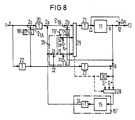
- FIG. 6 A development of the DPCM structure according to the invention Fig. 5 with a shortest possible critical path is shown in Fig. 6.
- the predictor is divided into a 2D or 3D predictor 15 'and one 1D predictor, which consists of a first and second part 18 ', 19'.
- a further comparison with the last-mentioned DPCM structure shows that some registers have been arranged or supplemented elsewhere, whereas a register 24 from the line or image memory of the 2D or. 3D predictor was removed, which is indicated by the description with "-T".
- a "T" register follows a 2D or 3D predictor l5 used in FIGS. 4 and 5.
- Further registers 20, 21 with respect to the DPCM structure according to FIG. 5 are reproduced between the first and second subtractors 2a, 2c and between the third subtractor 2b and the input of the device for outputting a quantization error 11 associated with a difference signal, while the signal path is also shown the current pixel signal to the second input of the first adder 8 is provided with a series connection of two registers 22, 23.
- the first part 18 'of the one-dimensional predictor is connected with its first connection between the two last-mentioned registers 22, 23 and with its second connection to the second input of the second subtractor 2c.
Landscapes
- Engineering & Computer Science (AREA)
- Theoretical Computer Science (AREA)
- Multimedia (AREA)
- Signal Processing (AREA)
- Compression, Expansion, Code Conversion, And Decoders (AREA)
- Compression Or Coding Systems Of Tv Signals (AREA)
Claims (11)
- Dispositif pour réaliser le codage MICD avec une cadence élevée de données, dans lequel respectivement des valeurs de prédiction sont soustraites de signaux numérisés de points d'image à l'entrée (1) et les signaux de différence obtenus sont utilisés après un traitement pour la transmission de signaux, et comportant une voie récursive des signaux, qui possède un premier additionneur (8) servant à former des signaux reconstitués de points d'image (sR), un dispositif de prédiction (10) pour former les valeurs estimées et un premier dispositif de soustraction (2a) servant à former les signaux de différence, caractérisé par le fait que pour le traitement des signaux de différence (Δ), ces derniers sont envoyés par l'intermédiaire d'un dispositif servant à délivrer une erreur de quantification (11) associée à un signal de différence, à une première entrée d'un second additionneur (12), qu'une seconde entrée du second additionneur (12) est chargée par les signaux de différence (Δ) et que des signaux (Δq) sont prélevés à la sortie du second additionneur (13) en vue de leur transmission, qu'une sortie du dispositif servant à délivrer une erreur de quantification (11) associée à un signal de différence est raccordée à la première entrée du premier additionneur (8) et qu'une seconde entrée du premier additionneur (8) est chargée par les signaux numérisés de points d'image (s) et que la sortie du premier additionneur (8) est raccordée, par l'intermédiaire du dispositif de prédiction (10) au premier dispositif de soustraction (2a).
- Dispositif suivant la revendication 1, caractérisé par le fait que le dispositif de prédiction est subdivisé en un dispositif de prédiction unidimensionnel (14) et un dispositif de prédiction bidimensionnel/tridimensionnel (15), que le dispositif de prédiction bidimensionnel/tridimensionnel (15) est branché entre la sortie du premier additionneur (8) et le premier dispositif de soustraction (2a) et que le dispositif de prédiction unidimensionnel (14) est branché entre la sortie du premier additionneur (8) et un second dispositif de soustraction (2b), et que le second dispositif de soustraction (2b) est branché entre le premier dispositif de soustraction (2a) et le dispositif servant à délivrer une erreur de quantification (11) associée à un signal de différence.
- Dispositif suivant la revendication 2, caractérisé par le fait que le dispositif de prédiction unidimensionnel (14) comporte un circuit série formé d'un registre (16) et d'un dispositif de pondération (17).
- Dispositif suivant la revendication 1, caractérisé par le fait que le dispositif de prédiction est subdivisé en un dispositif de prédiction unidimensionnel et en un dispositif de prédiction bidimensionnel/tridimensionnel, que le dispositif de prédictionbidimensionnel/tridimensionnel (15) est branché entre la sortie du premier additionneur (8) et le premier dispositif de soustraction (2a), que le dispositif de prédiction unidimensionnel est subdivisé en des première et seconde parties (18,19), que la seconde partie (19) du dispositif de prédiction est branchée entre la première entrée du premier additionneur (8) et un second dispositif de soustraction (2b) et que la première partie (18) du dispositif de prédiction est branchée entre la première entrée du premier additionneur (8) et un troisième dispositif de soustraction (2c), que le troisième dispositif de soustraction (2c) est monté en amont du premier dispositif de soustraction (2a) et que le second dispositif de soustraction (2b) est disposé en aval du premier dispositif de soustraction (2a).
- Dispositif suivant la revendication 4, caractérisé par le fait que les première et seconde parties (18,19) du dispositif de prédiction comportent chacune un circuit série formé d'un registre (16',16") et d'un dispositif de pondération (17',17").
- Dispositif suivant la revendication 4, caractérisé par le fait qu'un premier registre (20) est disposé entre les troisième et premier dispositifs de soustraction (2c,2a) et qu'un second registre (21) est disposé en aval du second dispositif de soustraction (2b), qu'un circuit série formé par des troisième et quatrième registres (22,23) est raccordé par une première borne à la seconde entrée du premier additionneur (8) et reçoit, au niveau d'une seconde borne, des signaux numérisés de points d'image, que la seconde partie (19') du dispositif de prédiction est raccordée par l'intermédiaire du quatrième registre (23) au troisième dispositif de soustraction (2c) et qu'une mémoire d'images ou de lignes, qui est prévue dans le dispositif de prédiction bidimensionnel/tridimensionnel (15), est réduite d'un registre (24).
- Dispositif suivant la revendication 6, caractérisé par le fait qu'un cinquième registre (25) est branché entre les premier et second dispositifs de soustraction, qu'un sixième registre (26) est disposé entre la première borne d'un circuit série formé par les troisième et quatrième registres (22,23), et la seconde entrée du premier additionneur (18) et une mémoire d'images ou de lignes, contenue dans le dispositif de prédiction bidimensionnel/tridimensionnel (15'), est réduite d'un second registre (27).
- Dispositif suivant la revendication 6 ou 7, caractérisé par le fait qu'il comporte des premier et second multiplexeurs (28,29), une unité (30) d'identification de dépassement de capacité et un quatrième dispositif de soustraction (31), que l'unité d'identification de dépassement de capacité (30) est branchée entre la sortie du premier additionneur (8) et une entrée de commande des premier et second multiplexeurs (28,29), que la première entrée du premier multiplexeur (28) est raccordée à une valeur limite inférieure (G⁻), que la seconde entrée de ce multiplexeur est raccordée à une valeur limite supérieure (G⁺) et qu'une troisième entrée du premier multiplexeur (28) est raccordée à la sortie du premier additionneur (8), qu'une sortie du premier multiplexeur (28) est reliée au dispositif de prédiction bidimensionnel/tridimensionnel (15'), que le second multiplexeur (29) est raccordé, par une première entrée et par une première sortie, entre le second dispositif de soustraction (2b) et le second registre (21), que les seconde et troisième entrées du second multiplexeur (29) sont raccordées au quatrième dispositif de soustraction (31), la première entrée du quatrième dispositif de soustraction (31) étant raccordée à la sortie du dispositif de protection bidimensionnel/tridimensionnel (15'), tandis qu'une seconde entrée du troisième dispositif de soustraction (31) est raccordé à un point (32) du circuit situé entre les troisième et quatrième registres (22,23).
- Dispositif suivant la revendication 8, caractérisé par le fait que le quatrième dispositif de soustraction (31) comporte des premier, second et troisième soustracteurs (33,34,35), respectivement des première et seconde entrées du premier soustracteur (33) étant raccordées respectivement aux première et seconde entrées du quatrième dispositif de soustraction (31), tandis qu'une sortie du premier soustracteur (33) est raccordée respectivement à une première entrée des second et troisième soustracteurs (34,35), que la seconde entrée du second soustracteur (34) est raccordée à une valeur limite inférieure (G⁻) et que la seconde entrée du troisième soustracteur (35) est raccordée à une valeur limite supérieure (G⁺), et que la sortie des second et troisième soustracteurs (34,35) forme respectivement les première et seconde sorties du quatrième dispositif de soustraction (31).
- Dispositif suivant la revendication 9, caractérisé par le fait qu'un dispositif de pondération (36) est monté entre la valeur limite supérieure (G⁺) et la seconde entrée du second soustracteur (34) et qu'un autre dispositif de pondération (37) est situé entre la valeur limite inférieure (G⁻) et la seconde entrée du troisième soustracteur (35).
- Dispositif suivant l'une des revendications 6 à 10, caractérisé par le fait que les première et seconde parties (18',19') du dispositif de prédiction comportent chacune un dispositif de pondération (17',17").
Applications Claiming Priority (2)
| Application Number | Priority Date | Filing Date | Title |
|---|---|---|---|
| DE3820234 | 1988-06-14 | ||
| DE3820234 | 1988-06-14 |
Publications (3)
| Publication Number | Publication Date |
|---|---|
| EP0346750A2 EP0346750A2 (fr) | 1989-12-20 |
| EP0346750A3 EP0346750A3 (en) | 1990-07-25 |
| EP0346750B1 true EP0346750B1 (fr) | 1993-06-09 |
Family
ID=6356527
Family Applications (1)
| Application Number | Title | Priority Date | Filing Date |
|---|---|---|---|
| EP89110290A Expired - Lifetime EP0346750B1 (fr) | 1988-06-14 | 1989-06-07 | Dispositif pour le codage par MICD avec un débit de données élevé |
Country Status (5)
| Country | Link |
|---|---|
| US (1) | US4893184A (fr) |
| EP (1) | EP0346750B1 (fr) |
| JP (1) | JPH0233288A (fr) |
| CA (1) | CA1312382C (fr) |
| DE (1) | DE58904598D1 (fr) |
Cited By (1)
| Publication number | Priority date | Publication date | Assignee | Title |
|---|---|---|---|---|
| CN100484071C (zh) * | 2002-09-12 | 2009-04-29 | 国际商业机器公司 | 差分方式变迁编码的方法以及相应的编码和解码系统 |
Families Citing this family (5)
| Publication number | Priority date | Publication date | Assignee | Title |
|---|---|---|---|---|
| JPH0828875B2 (ja) * | 1989-08-21 | 1996-03-21 | 三菱電機株式会社 | 符号化装置および復号化装置 |
| JP3100447B2 (ja) * | 1992-01-10 | 2000-10-16 | 三菱電機株式会社 | 適応等化器および受信機 |
| DE4308417C1 (de) * | 1993-03-17 | 1994-09-15 | Deutsche Forsch Luft Raumfahrt | Verfahren zur Übertragung von Bildern mit niedriger Übertragungsbitrate |
| TW297202B (fr) * | 1993-10-13 | 1997-02-01 | Rca Thomson Licensing Corp | |
| US8654838B2 (en) | 2009-08-31 | 2014-02-18 | Nxp B.V. | System and method for video and graphic compression using multiple different compression techniques and compression error feedback |
Family Cites Families (3)
| Publication number | Priority date | Publication date | Assignee | Title |
|---|---|---|---|---|
| JPS62214792A (ja) * | 1986-03-14 | 1987-09-21 | Fujitsu Ltd | 差分符号化装置 |
| DE3679545D1 (de) * | 1986-04-19 | 1991-07-04 | Itt Ind Gmbh Deutsche | Datenreduzierschaltung mit einem differenz-pulscodemodulator fuer videosignale. |
| CA1334871C (fr) * | 1987-02-26 | 1995-03-21 | Norio Suzuki | Dispositif pour quantifier un signal de facon adaptative afin qu'un signal decode local ne sorte jamais de la dynamique du signal d'entree |
-
1989
- 1989-05-01 US US07/346,084 patent/US4893184A/en not_active Expired - Fee Related
- 1989-06-07 EP EP89110290A patent/EP0346750B1/fr not_active Expired - Lifetime
- 1989-06-07 DE DE8989110290T patent/DE58904598D1/de not_active Expired - Fee Related
- 1989-06-07 JP JP1145034A patent/JPH0233288A/ja active Pending
- 1989-06-12 CA CA000602481A patent/CA1312382C/fr not_active Expired - Fee Related
Cited By (1)
| Publication number | Priority date | Publication date | Assignee | Title |
|---|---|---|---|---|
| CN100484071C (zh) * | 2002-09-12 | 2009-04-29 | 国际商业机器公司 | 差分方式变迁编码的方法以及相应的编码和解码系统 |
Also Published As
| Publication number | Publication date |
|---|---|
| EP0346750A3 (en) | 1990-07-25 |
| CA1312382C (fr) | 1993-01-05 |
| JPH0233288A (ja) | 1990-02-02 |
| US4893184A (en) | 1990-01-09 |
| EP0346750A2 (fr) | 1989-12-20 |
| DE58904598D1 (de) | 1993-07-15 |
Similar Documents
| Publication | Publication Date | Title |
|---|---|---|
| DE4302898C2 (de) | Arithmetische Recheneinheit mit Akkumulierfunktion | |
| DE3874703T2 (de) | Kodier- und dekodierverfahren und vorrichtung fuer die bilduebertragung ueber ein netz mit einem variablen datenfluss. | |
| EP0517324B1 (fr) | Appareil pour commander le quantificateur d'un codeur hybride | |
| DE2625973B2 (de) | Verfahren und Anordnung zur redundanzvermindernden Transformation von Bildern | |
| DD293933A5 (de) | Bewegungsabschaetzeinrichtung | |
| DE69032548T2 (de) | Korrelationsberechnungseinrichtung | |
| EP0077089B1 (fr) | Dispositif pour stocker ou transmettre des signaux d'image codés par transformation et pour regagner ces signaux d'image | |
| DE4444304C2 (de) | Verfahren zum Erzeugen eines zusammengesetzten Videobildes | |
| EP0346750B1 (fr) | Dispositif pour le codage par MICD avec un débit de données élevé | |
| DE3714589A1 (de) | Videosignal-codierer mit dpcm und adaptiver praediktion | |
| EP0525900B1 (fr) | Circuit de filtrage pour le pré-traitement d'un signal vidéo | |
| DE69320218T2 (de) | Digitales Filter | |
| DE69130553T2 (de) | Arithmetisch logische Einheit | |
| DE3810916A1 (de) | Delta-pulscodemodulation | |
| DE3545106C2 (fr) | ||
| DE69636352T2 (de) | Hierarchische Kodierungs-Vorrichtung und -Verfahren mit Speicher für ein digitales Bildsignal | |
| EP0288783B1 (fr) | Dispositif pour le codage DPCM de signaux de télévision | |
| DE69222626T2 (de) | Hochauflösendes Digitalfilter | |
| EP0148528B1 (fr) | Méthode et circuit pour augmenter la résolution d'un signal digital dépendant du temps | |
| DE3326388C2 (fr) | ||
| DE102009039430B4 (de) | Vorrichtung und Verfahren mit ersten und zweiten Zeittakten | |
| DE3621446A1 (de) | Geraet zum digitalen verarbeiten von kontinuierlichen bitstroemen | |
| EP0144066A2 (fr) | Montage de circuit pour la détection rapide de la plus grande différence de trois valeurs numériques représentées | |
| DE3417139C2 (fr) | ||
| EP0241745A1 (fr) | Procédé de réduction de signaux d'images numériques par quantification de coefficients obtenus par une transformation orthonormale au moyen d'une matrice Hadamard symétrique quasi-cyclique |
Legal Events
| Date | Code | Title | Description |
|---|---|---|---|
| PUAI | Public reference made under article 153(3) epc to a published international application that has entered the european phase |
Free format text: ORIGINAL CODE: 0009012 |
|
| AK | Designated contracting states |
Kind code of ref document: A2 Designated state(s): DE FR GB IT |
|
| PUAL | Search report despatched |
Free format text: ORIGINAL CODE: 0009013 |
|
| AK | Designated contracting states |
Kind code of ref document: A3 Designated state(s): DE FR GB IT |
|
| 17P | Request for examination filed |
Effective date: 19901220 |
|
| 17Q | First examination report despatched |
Effective date: 19920917 |
|
| GRAA | (expected) grant |
Free format text: ORIGINAL CODE: 0009210 |
|
| AK | Designated contracting states |
Kind code of ref document: B1 Designated state(s): DE FR GB IT |
|
| REF | Corresponds to: |
Ref document number: 58904598 Country of ref document: DE Date of ref document: 19930715 |
|
| ITF | It: translation for a ep patent filed | ||
| GBT | Gb: translation of ep patent filed (gb section 77(6)(a)/1977) |
Effective date: 19930813 |
|
| ET | Fr: translation filed | ||
| PLBE | No opposition filed within time limit |
Free format text: ORIGINAL CODE: 0009261 |
|
| STAA | Information on the status of an ep patent application or granted ep patent |
Free format text: STATUS: NO OPPOSITION FILED WITHIN TIME LIMIT |
|
| 26N | No opposition filed | ||
| PGFP | Annual fee paid to national office [announced via postgrant information from national office to epo] |
Ref country code: DE Payment date: 19960819 Year of fee payment: 8 |
|
| PGFP | Annual fee paid to national office [announced via postgrant information from national office to epo] |
Ref country code: GB Payment date: 19970521 Year of fee payment: 9 |
|
| PGFP | Annual fee paid to national office [announced via postgrant information from national office to epo] |
Ref country code: FR Payment date: 19970626 Year of fee payment: 9 |
|
| PG25 | Lapsed in a contracting state [announced via postgrant information from national office to epo] |
Ref country code: DE Free format text: LAPSE BECAUSE OF NON-PAYMENT OF DUE FEES Effective date: 19980303 |
|
| PG25 | Lapsed in a contracting state [announced via postgrant information from national office to epo] |
Ref country code: GB Free format text: LAPSE BECAUSE OF NON-PAYMENT OF DUE FEES Effective date: 19980607 |
|
| GBPC | Gb: european patent ceased through non-payment of renewal fee |
Effective date: 19980607 |
|
| PG25 | Lapsed in a contracting state [announced via postgrant information from national office to epo] |
Ref country code: FR Free format text: LAPSE BECAUSE OF NON-PAYMENT OF DUE FEES Effective date: 19990226 |
|
| REG | Reference to a national code |
Ref country code: FR Ref legal event code: ST |
|
| PG25 | Lapsed in a contracting state [announced via postgrant information from national office to epo] |
Ref country code: IT Free format text: LAPSE BECAUSE OF NON-PAYMENT OF DUE FEES;WARNING: LAPSES OF ITALIAN PATENTS WITH EFFECTIVE DATE BEFORE 2007 MAY HAVE OCCURRED AT ANY TIME BEFORE 2007. THE CORRECT EFFECTIVE DATE MAY BE DIFFERENT FROM THE ONE RECORDED. Effective date: 20050607 |