EP0346836A2 - Procédé et dispositif de production en continu de 2-furaldéhyde, cellulose et lignine à partir de matériaux lignocellulosiques - Google Patents
Procédé et dispositif de production en continu de 2-furaldéhyde, cellulose et lignine à partir de matériaux lignocellulosiques Download PDFInfo
- Publication number
- EP0346836A2 EP0346836A2 EP89110697A EP89110697A EP0346836A2 EP 0346836 A2 EP0346836 A2 EP 0346836A2 EP 89110697 A EP89110697 A EP 89110697A EP 89110697 A EP89110697 A EP 89110697A EP 0346836 A2 EP0346836 A2 EP 0346836A2
- Authority
- EP
- European Patent Office
- Prior art keywords
- suspension
- furaldehyde
- liquid
- stage
- hydrolysis
- Prior art date
- Legal status (The legal status is an assumption and is not a legal conclusion. Google has not performed a legal analysis and makes no representation as to the accuracy of the status listed.)
- Withdrawn
Links
- HYBBIBNJHNGZAN-UHFFFAOYSA-N furfural Chemical compound O=CC1=CC=CO1 HYBBIBNJHNGZAN-UHFFFAOYSA-N 0.000 title claims abstract description 114
- 238000000034 method Methods 0.000 title claims abstract description 43
- 239000001913 cellulose Substances 0.000 title claims abstract description 20
- 229920002678 cellulose Polymers 0.000 title claims abstract description 20
- 239000012978 lignocellulosic material Substances 0.000 title claims abstract description 18
- 238000010924 continuous production Methods 0.000 title claims abstract description 6
- 230000007062 hydrolysis Effects 0.000 claims abstract description 74
- 238000006460 hydrolysis reaction Methods 0.000 claims abstract description 74
- 239000000725 suspension Substances 0.000 claims abstract description 55
- 239000000463 material Substances 0.000 claims abstract description 35
- 229920005610 lignin Polymers 0.000 claims abstract description 27
- 238000000605 extraction Methods 0.000 claims abstract description 10
- 238000003825 pressing Methods 0.000 claims abstract description 4
- 239000007788 liquid Substances 0.000 claims description 40
- XLYOFNOQVPJJNP-UHFFFAOYSA-N water Substances O XLYOFNOQVPJJNP-UHFFFAOYSA-N 0.000 claims description 33
- 238000010438 heat treatment Methods 0.000 claims description 14
- 238000012546 transfer Methods 0.000 claims description 13
- 238000003860 storage Methods 0.000 claims description 12
- CSCPPACGZOOCGX-UHFFFAOYSA-N Acetone Chemical compound CC(C)=O CSCPPACGZOOCGX-UHFFFAOYSA-N 0.000 claims description 8
- 238000011049 filling Methods 0.000 claims description 6
- 238000000926 separation method Methods 0.000 claims description 5
- 235000011114 ammonium hydroxide Nutrition 0.000 claims description 4
- 238000011143 downstream manufacturing Methods 0.000 claims description 4
- 230000008961 swelling Effects 0.000 claims description 4
- NLXLAEXVIDQMFP-UHFFFAOYSA-N Ammonium chloride Substances [NH4+].[Cl-] NLXLAEXVIDQMFP-UHFFFAOYSA-N 0.000 claims description 3
- VHUUQVKOLVNVRT-UHFFFAOYSA-N Ammonium hydroxide Chemical compound [NH4+].[OH-] VHUUQVKOLVNVRT-UHFFFAOYSA-N 0.000 claims description 3
- 239000002245 particle Substances 0.000 claims description 3
- 239000003795 chemical substances by application Substances 0.000 claims description 2
- 238000002156 mixing Methods 0.000 claims description 2
- 238000005191 phase separation Methods 0.000 claims description 2
- 230000002040 relaxant effect Effects 0.000 claims description 2
- QGZKDVFQNNGYKY-UHFFFAOYSA-N ammonia Natural products N QGZKDVFQNNGYKY-UHFFFAOYSA-N 0.000 claims 1
- 238000003780 insertion Methods 0.000 claims 1
- 230000037431 insertion Effects 0.000 claims 1
- 238000003303 reheating Methods 0.000 claims 1
- 239000000126 substance Substances 0.000 abstract description 5
- 239000007791 liquid phase Substances 0.000 abstract description 4
- 238000004519 manufacturing process Methods 0.000 description 15
- VEXZGXHMUGYJMC-UHFFFAOYSA-N Hydrochloric acid Chemical compound Cl VEXZGXHMUGYJMC-UHFFFAOYSA-N 0.000 description 11
- 239000002253 acid Substances 0.000 description 11
- 239000012071 phase Substances 0.000 description 11
- 150000007513 acids Chemical class 0.000 description 10
- 239000002699 waste material Substances 0.000 description 10
- 239000000047 product Substances 0.000 description 9
- IXCSERBJSXMMFS-UHFFFAOYSA-N hydrogen chloride Substances Cl.Cl IXCSERBJSXMMFS-UHFFFAOYSA-N 0.000 description 7
- 229910000041 hydrogen chloride Inorganic materials 0.000 description 7
- SRBFZHDQGSBBOR-IOVATXLUSA-N D-xylopyranose Chemical compound O[C@@H]1COC(O)[C@H](O)[C@H]1O SRBFZHDQGSBBOR-IOVATXLUSA-N 0.000 description 6
- 229910052500 inorganic mineral Inorganic materials 0.000 description 5
- 239000011707 mineral Substances 0.000 description 5
- 238000012545 processing Methods 0.000 description 5
- 239000002994 raw material Substances 0.000 description 5
- 241000196324 Embryophyta Species 0.000 description 4
- 239000012530 fluid Substances 0.000 description 4
- QTBSBXVTEAMEQO-UHFFFAOYSA-N Acetic acid Chemical compound CC(O)=O QTBSBXVTEAMEQO-UHFFFAOYSA-N 0.000 description 3
- PYMYPHUHKUWMLA-UHFFFAOYSA-N arabinose Natural products OCC(O)C(O)C(O)C=O PYMYPHUHKUWMLA-UHFFFAOYSA-N 0.000 description 3
- SRBFZHDQGSBBOR-UHFFFAOYSA-N beta-D-Pyranose-Lyxose Natural products OC1COC(O)C(O)C1O SRBFZHDQGSBBOR-UHFFFAOYSA-N 0.000 description 3
- 238000001816 cooling Methods 0.000 description 3
- 238000005516 engineering process Methods 0.000 description 3
- 235000013305 food Nutrition 0.000 description 3
- 239000011541 reaction mixture Substances 0.000 description 3
- 239000010902 straw Substances 0.000 description 3
- 239000002028 Biomass Substances 0.000 description 2
- YLQBMQCUIZJEEH-UHFFFAOYSA-N Furan Chemical compound C=1C=COC=1 YLQBMQCUIZJEEH-UHFFFAOYSA-N 0.000 description 2
- 229920002488 Hemicellulose Polymers 0.000 description 2
- 240000006394 Sorghum bicolor Species 0.000 description 2
- 239000003054 catalyst Substances 0.000 description 2
- 239000007795 chemical reaction product Substances 0.000 description 2
- 239000003153 chemical reaction reagent Substances 0.000 description 2
- 238000009833 condensation Methods 0.000 description 2
- 230000005494 condensation Effects 0.000 description 2
- 238000010276 construction Methods 0.000 description 2
- 238000005260 corrosion Methods 0.000 description 2
- 230000007797 corrosion Effects 0.000 description 2
- 238000011161 development Methods 0.000 description 2
- 230000000694 effects Effects 0.000 description 2
- 238000001125 extrusion Methods 0.000 description 2
- BDAGIHXWWSANSR-UHFFFAOYSA-N methanoic acid Natural products OC=O BDAGIHXWWSANSR-UHFFFAOYSA-N 0.000 description 2
- 239000004033 plastic Substances 0.000 description 2
- 229920003023 plastic Polymers 0.000 description 2
- 238000011084 recovery Methods 0.000 description 2
- 239000000243 solution Substances 0.000 description 2
- 239000002023 wood Substances 0.000 description 2
- 239000002916 wood waste Substances 0.000 description 2
- OSWFIVFLDKOXQC-UHFFFAOYSA-N 4-(3-methoxyphenyl)aniline Chemical compound COC1=CC=CC(C=2C=CC(N)=CC=2)=C1 OSWFIVFLDKOXQC-UHFFFAOYSA-N 0.000 description 1
- 102000004190 Enzymes Human genes 0.000 description 1
- 108090000790 Enzymes Proteins 0.000 description 1
- WQZGKKKJIJFFOK-GASJEMHNSA-N Glucose Natural products OC[C@H]1OC(O)[C@H](O)[C@@H](O)[C@@H]1O WQZGKKKJIJFFOK-GASJEMHNSA-N 0.000 description 1
- 240000008042 Zea mays Species 0.000 description 1
- 235000005824 Zea mays ssp. parviglumis Nutrition 0.000 description 1
- 235000002017 Zea mays subsp mays Nutrition 0.000 description 1
- 238000010521 absorption reaction Methods 0.000 description 1
- 238000009825 accumulation Methods 0.000 description 1
- 238000005903 acid hydrolysis reaction Methods 0.000 description 1
- 239000000654 additive Substances 0.000 description 1
- 230000000996 additive effect Effects 0.000 description 1
- 238000012271 agricultural production Methods 0.000 description 1
- 238000005904 alkaline hydrolysis reaction Methods 0.000 description 1
- 239000012736 aqueous medium Substances 0.000 description 1
- 239000008346 aqueous phase Substances 0.000 description 1
- QVGXLLKOCUKJST-UHFFFAOYSA-N atomic oxygen Chemical compound [O] QVGXLLKOCUKJST-UHFFFAOYSA-N 0.000 description 1
- WQZGKKKJIJFFOK-VFUOTHLCSA-N beta-D-glucose Chemical compound OC[C@H]1O[C@@H](O)[C@H](O)[C@@H](O)[C@@H]1O WQZGKKKJIJFFOK-VFUOTHLCSA-N 0.000 description 1
- 239000006227 byproduct Substances 0.000 description 1
- 238000005266 casting Methods 0.000 description 1
- 230000003197 catalytic effect Effects 0.000 description 1
- 238000006555 catalytic reaction Methods 0.000 description 1
- 238000012824 chemical production Methods 0.000 description 1
- 239000002894 chemical waste Substances 0.000 description 1
- 238000002485 combustion reaction Methods 0.000 description 1
- 239000012141 concentrate Substances 0.000 description 1
- 239000007859 condensation product Substances 0.000 description 1
- 239000000470 constituent Substances 0.000 description 1
- 239000000498 cooling water Substances 0.000 description 1
- 235000005822 corn Nutrition 0.000 description 1
- 238000005520 cutting process Methods 0.000 description 1
- 239000007857 degradation product Substances 0.000 description 1
- 230000018044 dehydration Effects 0.000 description 1
- 238000006297 dehydration reaction Methods 0.000 description 1
- 238000003795 desorption Methods 0.000 description 1
- 230000029087 digestion Effects 0.000 description 1
- 238000010790 dilution Methods 0.000 description 1
- 239000012895 dilution Substances 0.000 description 1
- 239000000428 dust Substances 0.000 description 1
- 238000005265 energy consumption Methods 0.000 description 1
- 238000001704 evaporation Methods 0.000 description 1
- 230000008020 evaporation Effects 0.000 description 1
- 230000005294 ferromagnetic effect Effects 0.000 description 1
- 235000019253 formic acid Nutrition 0.000 description 1
- GTHHQEQNVAHFKK-UHFFFAOYSA-N furan-2-carbaldehyde Chemical compound O=CC1=CC=CO1.O=CC1=CC=CO1 GTHHQEQNVAHFKK-UHFFFAOYSA-N 0.000 description 1
- 239000008103 glucose Substances 0.000 description 1
- 239000004009 herbicide Substances 0.000 description 1
- 230000003301 hydrolyzing effect Effects 0.000 description 1
- 238000005470 impregnation Methods 0.000 description 1
- 239000008235 industrial water Substances 0.000 description 1
- 239000011261 inert gas Substances 0.000 description 1
- 238000002347 injection Methods 0.000 description 1
- 239000007924 injection Substances 0.000 description 1
- 238000009413 insulation Methods 0.000 description 1
- 239000006148 magnetic separator Substances 0.000 description 1
- 238000011089 mechanical engineering Methods 0.000 description 1
- VNWKTOKETHGBQD-UHFFFAOYSA-N methane Chemical compound C VNWKTOKETHGBQD-UHFFFAOYSA-N 0.000 description 1
- 230000002906 microbiologic effect Effects 0.000 description 1
- 244000005700 microbiome Species 0.000 description 1
- 239000000203 mixture Substances 0.000 description 1
- 239000003960 organic solvent Substances 0.000 description 1
- 239000001301 oxygen Substances 0.000 description 1
- 229910052760 oxygen Inorganic materials 0.000 description 1
- 239000003973 paint Substances 0.000 description 1
- 230000035515 penetration Effects 0.000 description 1
- 150000002972 pentoses Chemical class 0.000 description 1
- 239000003348 petrochemical agent Substances 0.000 description 1
- 238000002360 preparation method Methods 0.000 description 1
- 102000004169 proteins and genes Human genes 0.000 description 1
- 108090000623 proteins and genes Proteins 0.000 description 1
- 239000000376 reactant Substances 0.000 description 1
- 239000012429 reaction media Substances 0.000 description 1
- 238000011160 research Methods 0.000 description 1
- 239000007858 starting material Substances 0.000 description 1
- 239000000758 substrate Substances 0.000 description 1
- 229920003002 synthetic resin Polymers 0.000 description 1
- 239000000057 synthetic resin Substances 0.000 description 1
- 235000012712 vegetable carbon Nutrition 0.000 description 1
- 239000004108 vegetable carbon Substances 0.000 description 1
- 239000005418 vegetable material Substances 0.000 description 1
- 235000013311 vegetables Nutrition 0.000 description 1
- 239000002918 waste heat Substances 0.000 description 1
Images
Classifications
-
- D—TEXTILES; PAPER
- D21—PAPER-MAKING; PRODUCTION OF CELLULOSE
- D21C—PRODUCTION OF CELLULOSE BY REMOVING NON-CELLULOSE SUBSTANCES FROM CELLULOSE-CONTAINING MATERIALS; REGENERATION OF PULPING LIQUORS; APPARATUS THEREFOR
- D21C3/00—Pulping cellulose-containing materials
- D21C3/20—Pulping cellulose-containing materials with organic solvents or in solvent environment
-
- C—CHEMISTRY; METALLURGY
- C07—ORGANIC CHEMISTRY
- C07D—HETEROCYCLIC COMPOUNDS
- C07D307/00—Heterocyclic compounds containing five-membered rings having one oxygen atom as the only ring hetero atom
- C07D307/02—Heterocyclic compounds containing five-membered rings having one oxygen atom as the only ring hetero atom not condensed with other rings
- C07D307/34—Heterocyclic compounds containing five-membered rings having one oxygen atom as the only ring hetero atom not condensed with other rings having two or three double bonds between ring members or between ring members and non-ring members
- C07D307/38—Heterocyclic compounds containing five-membered rings having one oxygen atom as the only ring hetero atom not condensed with other rings having two or three double bonds between ring members or between ring members and non-ring members with substituted hydrocarbon radicals attached to ring carbon atoms
- C07D307/40—Radicals substituted by oxygen atoms
- C07D307/46—Doubly bound oxygen atoms, or two oxygen atoms singly bound to the same carbon atom
- C07D307/48—Furfural
- C07D307/50—Preparation from natural products
-
- D—TEXTILES; PAPER
- D21—PAPER-MAKING; PRODUCTION OF CELLULOSE
- D21C—PRODUCTION OF CELLULOSE BY REMOVING NON-CELLULOSE SUBSTANCES FROM CELLULOSE-CONTAINING MATERIALS; REGENERATION OF PULPING LIQUORS; APPARATUS THEREFOR
- D21C3/00—Pulping cellulose-containing materials
- D21C3/02—Pulping cellulose-containing materials with inorganic bases or alkaline reacting compounds, e.g. sulfate processes
- D21C3/024—Pulping cellulose-containing materials with inorganic bases or alkaline reacting compounds, e.g. sulfate processes with NH3 or H2O
Definitions
- the invention relates to a method and a device for producing 2-furaldehyde, cellulose and lignin from lignocellulosic materials, in particular agricultural lignocellulosic materials, e.g. Corn on the cob, straw and other waste products from annual plants, also from wood and wood waste.
- lignocellulosic materials e.g. Corn on the cob, straw and other waste products from annual plants, also from wood and wood waste.
- gaseous hydrogen chloride is used for the hydrolysis; however, it was found that the desired hydrolysis is only achieved at a hydrogen chloride concentration of more than 90%.
- the whole process is in three stages divided: The absorption of hydrogen chloride, the hydrolysis and the desorption of the hydrogen chloride. Difficulties of this procedure are in particular that considerable amounts of heat are released when hydrogen chloride comes into contact with moist lignocellulose material, as a result of which the hydrolyzed material obtains an unsuitable consistency and is in particular no longer suitable for processing in fluid layers or fluidized beds. On the other hand, insufficiently moist raw materials are hydrolyzed with only a low yield.
- Lignocellulosic materials can also be digested by using microorganisms or with enzymes with decrystallization and hydrolysis. So far, these processes have also not been suitable for the economic use of biomass, in particular not for the digestion of lignocellulose materials.
- the course of the hydrolysis of lignocellulose materials also depends to a large extent on the other constituents of the reaction medium.
- the previously known production processes for 2-furaldehyde (furfural) are predominantly one-stage; the hydrolysis of the pentosans and the dehydration of the pentoses are carried out in pressure plants at a pressure of 0.7 to 1.8 MPa; if necessary, catalysts, mostly mineral acids, are used, the acids released in the process, especially acetic acid and formic acid, acting as catalysts.
- the solutions of the previously known processes which are obtained in very high dilution can only be worked up with a high expenditure of energy;
- the use of mineral acids in the previously known processes complicates the separation of 2-furaldehyde from the reaction mixture;
- a disadvantage of the lignin isolated from waste during industrial delignification is that it has only a low solubility, is structurally significantly changed and is contaminated with delignification chemicals;
- Further disadvantages in the production of lignin by conventional hydrolysis processes are the high degree of condensation of the lignin obtained, the low yield and the presence of dissolved hemicellulose component as an
- the invention has for its object an effective, technically simple and economically working process for the production of 2-furaldehyde, cellulose and lignin for the use of appropriate phytomasses, especially in agriculture, the food industry, pharmacy and chemistry, and a corresponding device for this specify where the above-mentioned disadvantages of the prior art are avoided;
- the three desired products are to be obtained continuously and without waste in a thermal pressure system by hydrolysis without the use of alkalis or acids and enable high yields of 2-furaldehyde, cellulose and lignin.
- the task is solved according to the requirements.
- the swelling in stage B is advantageously carried out over a period of 20 to 180 minutes.
- the first continuous hydrolysis in stage D is advantageously carried out for 10 to 20 minutes, while the first phase of the second continuous hydrolysis in stage F is preferably carried out for 10 to 15 minutes and the second phase of the second continuous hydrolysis in stage F is preferably carried out for 0.5 to 3 minutes will.
- the device according to the invention for the continuous production of 2-furaldehyde, cellulose and lignin from lignocellulose materials which is particularly suitable for carrying out the above process, is characterized by - a storage container for dry lignocellulose material, a suspension reservoir which can be heated to at least 70 to 90 ° C.
- a filling press which is connected to the lower part of the suspension reservoir and serves to squeeze out a part of the water from the suspension of the lignocellulosic material and, if necessary, has a return device for returning the pressed liquid to the suspension reservoir
- a first continuous, pressurized hydrolysis reactor connected to the outlet of the filling press and having a device for introducing liquid under pressure for heating and generating pressure
- a transfer press connected to the outlet of the hydrolysis reactor for separating liquid from the suspension from the hydrolysis reactor and transferring the pressed suspension and the separated liquid into the downstream process
- a second continuous hydrolysis reactor connected to the outlet of the transfer press with two devices for introducing the liquid separated from the transfer press under pressure for heating and pressure generation, the first device at the entrance of the hydrolysis reactor immediately after the outlet of the transfer press and the second device in the flow direction thereafter , preferably in the area between the middle and end of
- the pressure fluid with the main part of the 2-furaldehyde passes through the first rectification column, in which an azeotropic rectification of the 2-furaldehyde takes place and the vapors formed by expansion and enriched with 2-furaldehyde are condensed; the condensate is separated into a 2-furaldehyde and a water phase in the separating device, which works similarly to a separating funnel, the 2-furaldehyde phase being concentrated in the downstream second rectification column and the 2-furaldehyde being subsequently purified.
- the steam from the expansion device which contains a residual content of 2-furaldehyde and is produced during expansion to atmospheric pressure, also enters the first rectification column in the first rectification column is introduced.
- an extracting agent advantageously with an aqueous or aqueous-ethanolic ammonia solution and / or with acetone.
- the liquid introduced into the second hydrolysis reactor which is also used for heating and for generating pressure, is passed from the transfer press to the second hydrolysis reactor through a heat exchanger, in which it is heated to 130 to 144 ° C .; this heat exchanger is advantageously operated with the liquid which emerges from the extrusion press after the second hydrolysis reactor and which, since it contains the majority of 2-furaldehyde, is introduced into the first rectification column; the liquid introduced into the second continuous hydrolysis reactor is further, according to a preferred embodiment, reheated in a heating device in which the division into the two partial streams takes place at the same time. A corresponding two-stage hydrolysis takes place in the second hydrolysis reactor.
- the loosely stored lignocellulose base material ie the Raw material used, e.g. corn cobs, straw, etc.
- the loosely stored lignocellulose base material is transported, for example with a grab crane, to a feed device, at the outlet of which there is a magnetic separator for separating any unwanted ferromagnetic admixtures, and from there with a transport device to a cutting machine and impact mill promoted where the input dry matter is crushed to a particle size of about 2 to about 10 mm.
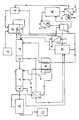
- This material is further pneumatically conveyed into the storage container 1, from where it is continuously introduced in an amount of 500 kg / h into the suspension storage container 2, into which industrial water in an amount of 250 kg / h is fed from the water storage 3; the mass ratio of lignocellulose material / water is from 1: 7 to 1:10.
- the suspension obtained is heated with evaporation to a temperature of 70 to 90 ° C. with a residence time of at least 20 to 180 min, which causes the dry substance to swell.
- the swollen suspension is then conveyed from the lower part of the suspension storage container 2 into the filling press 4, in which water is squeezed out in an amount of approximately 4700 kg / h, which is pumped into the suspension storage container 2.
- the suspended lignocellulose material then passes through the filling press 4 in the form of a suspension plug with a mass ratio of lignocellulose material / water of 1: 0.6 to 1: 1 in a throughput of 800 kg / h, of which 500 kg / h dry substance and 300 kg / h water are, in the first continuously operated hydrolysis reactor 5, in which the suspension by injecting a liquid also used for heating and pressure generation, in particular from the first rectifying aqueous phase, at a temperature of 115 to 150 ° C, in the example, 146 ° C, is continuously maintained at a hydrolysis temperature of 130 ° C; here is a mass ratio of lignocellulose material / water of 1: 1.5 to 1: 3 with a mass throughput of 1200 kg / h.
- the suspension After passage of the suspension through the first hydrolysis reactor 5 with a dwell time of 10 to 20 min, the suspension passes through the transfer press 6 in the form of a suspension plug into the second continuous hydrolysis reactor 7, with a throughput of 635 kg / h, of which 397 kg / h for dry matter, 221 kg / h for water and 17 kg / h for xylose.
- liquid phase is also squeezed in an amount of 1365 kg / h, of which 1265 kg / h is water and 100 kg / h is xylose.
- This squeezed liquid runs through the first heat exchanger 8, in which it is heated by the liquid from 130 to 144 ° C., which is squeezed out of the hydrolysis mixture with the squeezing press 9 at the outlet of the second hydrolysis reactor 7.
- the liquid passes from the first heat exchanger 8 into a heating device 10 which is designed as a tube furnace and in which it is reheated for injection into the second hydrolysis reactor 7.
- the heating device 10 the division into two partial streams 11 and 12 takes place at the same time, the partial stream 11 having a temperature of 200 ° C. and a throughput of 910 kg / h; the partial stream 12 has a temperature of 230 ° C. with a throughput of 455 kg / h.
- the partial flow 11 is introduced into the suspension plug behind the outlet of the transfer press 6 in the hydrolysis reactor 7, while the partial flow 12 is introduced in a position which is closer to the pressing press 9.
- this second hydrolysis there is a mass ratio of lignocellulose material / water from 1: 1.5 to 1: 1.3.
- the suspension plug is destroyed and the suspension in the first part is heated to 150 to 180 ° C. in a first time by injecting the partial stream 11 of the liquid which is also used for heating and pressure generation, with a residence time of 10 to 18 min; when passing through the subsequent part of the hydrolysis reactor 7, the suspension is heated to 200 to 235 ° C. by the injected second partial stream 12 with a residence time of 0.5 to 3 min.
- the second hydrolysis reactor 7 is supplied with heat from an external source (not shown).
- the suspension passes into the squeezing press 9, in the first part of which the aforementioned liquid phase at a temperature of 230 ° C. is squeezed out in an amount of 1365 kg / h, of which 1301 kg / h on water and 64 kg / h for 2-furaldehyde.
- the liquid is then cooled in the heat exchanger 8 to 190 to 205 ° C. and passed to the first rectifying column 13, which works under atmospheric pressure and is completely heated by its own heat.
- the first rectification column steam at a temperature of 100 ° C, possibly up to 80 ° C, is generated by the expansion;
- the condensate arrives in the specified amount, possibly via a cooler, to the separating device 15 for 2-furaldehyde, which is constructed in the manner of a separating funnel and where the 2-furaldehyde phase is separated from the water phase.
- the 2-furaldehyde is introduced from the separating device 15 into a second rectification column 16 which is heated from the outside and in which the 2-furaldehyde is concentrated and subsequently purified.
- the concentrate enters a heat exchanger 17 cooled with cooling water 20, the water outlet of which is connected to the water reservoir 3, and from there it enters the reservoir 18 for 2-furaldehyde.
- a second condenser 21 is provided between the rectifying column 16 and the separating device 15 and, like the first condenser 14, is connected to a cooling system (not shown). The outlet of the condenser 21 is connected to the separator 15.
- the insoluble lignocellulose residue which emerges from the extrusion press 9 in plug form, arrives from there into the expansion device 19, where expansion to atmospheric pressure occurs during expansion.
- the lignocellulose material disintegrates.
- the expanded steam is passed via a line (not shown) via the suspension reservoir 2 to the first rectification column 13 in order to thereby also obtain the 2-furaldehyde content contained therein.
- the disintegrated, insoluble lignocellulose residue is then transferred from the relaxation device 19 into an extraction device 22, in which the lignin is extracted and thus lignin and cellulose are obtained.
- Aqueous or aqueous-ethanolic ammonia solutions or acetone are used as extractants; extraction takes place at temperatures of 15 to 40 ° C.
- the mass ratio of lignocellulose material / water is in the range of 1: 3 in both hydrolysis reactors.
- the water reservoir 3 is made with water from the second heat exchanger 17 filled. It is also connected to the liquid outlet of the first rectification column 13, which is also connected to the liquid inlet of the first hydrolysis reactor 5 via the heating device 10.
- 2-furaldehyde with a yield of about 15%, based on the mass of input dry matter of the lignocellulose material, which corresponds to 55 to 62% of the theoretical yield, ie about 150 kg / t; Cellulose in a yield of 80 to 90% of the theoretical yield, ie about 330 kg / t; - Lignin in a yield of 75 to 90% of the theoretical yield, ie in an amount of about 130 kg / t.
- the concept of the invention leads to a significant reduction in operating costs or processing costs based on the mass of the input dry matter compared to conventional systems by 35 to 55%, while at the same time achieving higher product quality.
- the method and the device also work completely environmentally friendly from an ecological point of view, since no waste products are produced.
- the continuous system according to the invention which works in an aqueous medium, furthermore facilitates the separation of the 2-furaldehyde from the reaction mixture with higher yields than in the prior art, while at the same time allowing a lower mass ratio (hydromodule) of lignocellulose material / water due to the short residence times in the two hydrolysis reactors which is also achieved through the high temperature of up to 235 ° C. Furthermore, the separation of the 2-furaldehyde is considerably more energy-efficient than in previous processes.
- the process according to the invention enables the production of reactive, uncondensed lignin, which can be used advantageously for the production of synthetic resins, plastics and as an active additive in the production of rubber and rubber.
- the reactive lignin is readily soluble in organic solvents and can easily be separated from the other components of the reaction mixture in high purity.
- the resulting cellulose can also be used as a very pure, energy-containing component, for example for animal feeding or further processed into sugar solutions.
- the method according to the invention and the device according to the invention can consequently be used to a very wide extent, and the same also applies to the reaction products obtained.
- the technology according to the invention can be used in particular in the field of agriculture in the processing of vegetable waste products, i.e. Use waste from primary production in particular, such as corn cobs, various types of straw and other waste products from annual plants.
- the optimal processing and utilization of the main components of lignocellulosic materials make agricultural by-products possible, with which the effectiveness of agricultural production can be increased considerably.
- the same also applies to forestry, where wood waste can be processed accordingly, and also to cellulose factories.
- the 2-furaldehyde can be used in a wide range, especially in the construction industry, in the production of furan plastic concrete and in the production of fural floor coverings.
- chemistry there are possible uses in the production of herbicides, paints, putty materials, impregnation systems and the like. given, in mechanical engineering in the production of casting cores and molds for foundry purposes, also in the pharmaceutical industry, in petrochemicals and many more.
- the resulting hydrolysates can also be used advantageously in the feed industry, e.g. in combination with feed protein materials, in the microbiological industry, in the production of substrates and the like, and also in the pharmaceutical industry in the production of pure sugar, pure glucose, xylose and the like, and in the food industry.
Landscapes
- Chemical & Material Sciences (AREA)
- Organic Chemistry (AREA)
- Inorganic Chemistry (AREA)
- Polysaccharides And Polysaccharide Derivatives (AREA)
- Organic Low-Molecular-Weight Compounds And Preparation Thereof (AREA)
Applications Claiming Priority (2)
| Application Number | Priority Date | Filing Date | Title |
|---|---|---|---|
| CS406088A CS274575B2 (en) | 1988-06-13 | 1988-06-13 | Method of 2-furaldehyde,cellulose and lignin production from lignocellulosic materials |
| CS4060/88 | 1988-06-13 |
Publications (2)
| Publication Number | Publication Date |
|---|---|
| EP0346836A2 true EP0346836A2 (fr) | 1989-12-20 |
| EP0346836A3 EP0346836A3 (fr) | 1991-10-23 |
Family
ID=5382487
Family Applications (1)
| Application Number | Title | Priority Date | Filing Date |
|---|---|---|---|
| EP19890110697 Withdrawn EP0346836A3 (fr) | 1988-06-13 | 1989-06-13 | Procédé et dispositif de production en continu de 2-furaldéhyde, cellulose et lignine à partir de matériaux lignocellulosiques |
Country Status (5)
| Country | Link |
|---|---|
| EP (1) | EP0346836A3 (fr) |
| CS (1) | CS274575B2 (fr) |
| DK (1) | DK289889A (fr) |
| FI (1) | FI892888L (fr) |
| HU (1) | HUT50802A (fr) |
Cited By (5)
| Publication number | Priority date | Publication date | Assignee | Title |
|---|---|---|---|---|
| WO1996025553A1 (fr) * | 1995-02-08 | 1996-08-22 | F + S Market, Spol. S.R.O. | Procede de traitement de matieres lignocellulosiques par hydrolyse sous pression constante, et installation correspondante |
| WO2000047569A1 (fr) * | 1999-02-11 | 2000-08-17 | Steiner, Philipp, Daniel | Procede servant a preparer furfural |
| WO2009089439A1 (fr) * | 2008-01-11 | 2009-07-16 | Novozymes A/S | Délignification d'une matière contenant de la lignocellulose |
| WO2011073253A1 (fr) | 2009-12-16 | 2011-06-23 | Shell Internationale Research Maatschappij B.V. | Procédé de production de furfural à partir d'un matériau biomassique lignocellulosique |
| US9023628B2 (en) | 2006-10-26 | 2015-05-05 | Xyleco, Inc. | Processing biomass |
Families Citing this family (1)
| Publication number | Priority date | Publication date | Assignee | Title |
|---|---|---|---|---|
| CZ301471B6 (cs) * | 2008-04-30 | 2010-03-17 | Kratochvíl@Zdenek | Zpusob a zarízení pro zpracování lignocelulózového materiálu tlakovou hydrolýzou |
Family Cites Families (4)
| Publication number | Priority date | Publication date | Assignee | Title |
|---|---|---|---|---|
| US2999783A (en) * | 1957-10-05 | 1961-09-12 | Hodogaya Chemical Co Ltd | Process for simultaneous production of high alpha-pulp with furfural from latifoliate tree materials |
| FR2600063A1 (fr) * | 1986-06-11 | 1987-12-18 | Technip Cie | Procede et installation de traitement des matieres vegetales pour produire notamment du furfural |
| AT387247B (de) * | 1987-05-12 | 1988-12-27 | Voest Alpine Ind Anlagen | Kombiniertes verfahren zur thermischen und chemischen behandlung von lignocellulosehaltiger biomasse und zur gewinnung von furfural |
| BR8800691A (pt) * | 1988-02-12 | 1989-09-19 | Rhodia | Processo para fabricacao de furfural a partir de residuos lignocelulosicos |
-
1988
- 1988-06-13 CS CS406088A patent/CS274575B2/cs unknown
-
1989
- 1989-06-13 EP EP19890110697 patent/EP0346836A3/fr not_active Withdrawn
- 1989-06-13 FI FI892888A patent/FI892888L/fi not_active Application Discontinuation
- 1989-06-13 DK DK289889A patent/DK289889A/da not_active Application Discontinuation
- 1989-06-13 HU HU893068A patent/HUT50802A/hu unknown
Cited By (10)
| Publication number | Priority date | Publication date | Assignee | Title |
|---|---|---|---|---|
| WO1996025553A1 (fr) * | 1995-02-08 | 1996-08-22 | F + S Market, Spol. S.R.O. | Procede de traitement de matieres lignocellulosiques par hydrolyse sous pression constante, et installation correspondante |
| WO2000047569A1 (fr) * | 1999-02-11 | 2000-08-17 | Steiner, Philipp, Daniel | Procede servant a preparer furfural |
| AU772210B2 (en) * | 1999-02-11 | 2004-04-22 | Proserpine Co-Operative Sugar Milling Association Ltd | Process for the manufacture of furfural |
| US6743928B1 (en) | 1999-02-11 | 2004-06-01 | International Furan Technology (Pty) Limited | Process for the manufacture of furfural |
| US9023628B2 (en) | 2006-10-26 | 2015-05-05 | Xyleco, Inc. | Processing biomass |
| US10287730B2 (en) | 2006-10-26 | 2019-05-14 | Xyleco, Inc. | Processing biomass |
| US10704196B2 (en) | 2006-10-26 | 2020-07-07 | Xyleco, Inc. | Processing biomass |
| WO2009089439A1 (fr) * | 2008-01-11 | 2009-07-16 | Novozymes A/S | Délignification d'une matière contenant de la lignocellulose |
| WO2011073253A1 (fr) | 2009-12-16 | 2011-06-23 | Shell Internationale Research Maatschappij B.V. | Procédé de production de furfural à partir d'un matériau biomassique lignocellulosique |
| US8901325B2 (en) | 2009-12-16 | 2014-12-02 | Shell Oil Company | Method for producing furfural from lignocellulosic biomass material |
Also Published As
| Publication number | Publication date |
|---|---|
| FI892888A7 (fi) | 1989-12-14 |
| FI892888A0 (fi) | 1989-06-13 |
| HUT50802A (en) | 1990-03-28 |
| DK289889A (da) | 1989-12-14 |
| CS8804060A1 (en) | 1990-11-14 |
| CS274575B2 (en) | 1991-08-13 |
| FI892888L (fi) | 1989-12-14 |
| EP0346836A3 (fr) | 1991-10-23 |
| DK289889D0 (da) | 1989-06-13 |
Similar Documents
| Publication | Publication Date | Title |
|---|---|---|
| DE3216004C2 (fr) | ||
| EP0098490B1 (fr) | Procédé et dispositif pour l'obtention de la cellulose, des sucres simples et de la lignine soluble à partir d'une biomasse végétale | |
| EP2632930B1 (fr) | Procédé d'extraction de lignine | |
| CH645131A5 (de) | Verfahren zur kontinuierlichen verzuckerung von pflanzlichem rohstoff. | |
| DE2944789A1 (de) | Kontinuierliches verfahren zur verzuckerung von cellulosematerialien | |
| EP0035679A1 (fr) | Procédé et appareillage pour l'hydrolyse continue de matières végétales cellulosiques pour l'obtention de sucres | |
| CH678183A5 (fr) | ||
| DE102016225827B4 (de) | Zweistufiges Aufschlussverfahren zur chemischen Fraktionierung von Lignocellulose | |
| DE2449635A1 (de) | Verfahren zur gewinnung von fermentierbarem siruppulver und alpha-cellulose aus xerophyten | |
| EP0689526B1 (fr) | Engrais organique et son procede de production | |
| WO1979000119A1 (fr) | Procede permettant la delignification et la transformation en sucre de materiaux vegetaux lignocellulosiques par utilisation de solvants organiques | |
| EP0346836A2 (fr) | Procédé et dispositif de production en continu de 2-furaldéhyde, cellulose et lignine à partir de matériaux lignocellulosiques | |
| DE19730486C2 (de) | Verfahren zur Behandlung von lignocellulosehaltiger Biomasse | |
| DE2553647C3 (de) | Verfahren zum zweistufigen Aufschließen der Hemicellulosen von xylanhaltigen Naturprodukten zwecks Gewinnung von Xylose | |
| DE10145338C1 (de) | Verfahren zum Abtrennen von Hemicellulosen aus hemicellulosehaltiger Biomasse | |
| AT525944B1 (de) | Verfahren und anlage zur verarbeitung von lignozellulose-biomasse | |
| DE3539492C2 (fr) | ||
| DE69428376T2 (de) | Verfahren zur hydrolyse von materialien, die zellulose und/oder stärke enthalten | |
| DE10049340C1 (de) | Verfahren zur Herstellung von Holocellulose durch Delignifizieren von lignocellulosehaltiger Biomasse | |
| DE69013652T2 (de) | Verfahren und Einrichtung zur Herstellung einer zumindest 80% Xylose enthaltende Zuckermischung aus einem lignocellulosischen Substrat. | |
| DE2736864C2 (de) | Verfahren zur Herstellung von Futtermitteln und zuckerhaltigen Lösungen aus pflanzlichen Rohstoffen | |
| AT369787B (de) | Verfahren zur gewinnung von zuckern aus cellulosehaeltigem pflanzlichem material | |
| CH646584A5 (de) | Verfahren und vorrichtung zum herstellen eines tierfutters aus einem ruebenmaterial. | |
| DD201845A5 (de) | Verfahren und vorrichtung zur herstellung von viehfutter aus ruebenmaterial | |
| AT241958B (de) | Verfahren zur Verarbeitung von pflanzlichen Produkten zu Faserstoff |
Legal Events
| Date | Code | Title | Description |
|---|---|---|---|
| PUAI | Public reference made under article 153(3) epc to a published international application that has entered the european phase |
Free format text: ORIGINAL CODE: 0009012 |
|
| AK | Designated contracting states |
Kind code of ref document: A2 Designated state(s): AT DE FR IT SE |
|
| PUAL | Search report despatched |
Free format text: ORIGINAL CODE: 0009013 |
|
| AK | Designated contracting states |
Kind code of ref document: A3 Designated state(s): AT DE FR IT SE |
|
| STAA | Information on the status of an ep patent application or granted ep patent |
Free format text: STATUS: THE APPLICATION IS DEEMED TO BE WITHDRAWN |
|
| 18D | Application deemed to be withdrawn |
Effective date: 19920102 |