EP0346848A2 - Luftgekühlter Dampfkondensator mit Vakuum - Google Patents
Luftgekühlter Dampfkondensator mit Vakuum Download PDFInfo
- Publication number
- EP0346848A2 EP0346848A2 EP89110718A EP89110718A EP0346848A2 EP 0346848 A2 EP0346848 A2 EP 0346848A2 EP 89110718 A EP89110718 A EP 89110718A EP 89110718 A EP89110718 A EP 89110718A EP 0346848 A2 EP0346848 A2 EP 0346848A2
- Authority
- EP
- European Patent Office
- Prior art keywords
- steam
- tubes
- condensing
- headers
- condenser
- Prior art date
- Legal status (The legal status is an assumption and is not a legal conclusion. Google has not performed a legal analysis and makes no representation as to the accuracy of the status listed.)
- Granted
Links
Images



Classifications
-
- F—MECHANICAL ENGINEERING; LIGHTING; HEATING; WEAPONS; BLASTING
- F28—HEAT EXCHANGE IN GENERAL
- F28B—STEAM OR VAPOUR CONDENSERS
- F28B9/00—Auxiliary systems, arrangements, or devices
- F28B9/10—Auxiliary systems, arrangements, or devices for extracting, cooling, and removing non-condensable gases
-
- F—MECHANICAL ENGINEERING; LIGHTING; HEATING; WEAPONS; BLASTING
- F28—HEAT EXCHANGE IN GENERAL
- F28B—STEAM OR VAPOUR CONDENSERS
- F28B1/00—Condensers in which the steam or vapour is separate from the cooling medium by walls, e.g. surface condenser
- F28B1/06—Condensers in which the steam or vapour is separate from the cooling medium by walls, e.g. surface condenser using air or other gas as the cooling medium
Definitions
- This invention relates to improved air-cooled vacuum steam condensers serving steam turbine power cycles or the like and, more particularly, to improved apparatus for condensing steam or other vapors and draining the condensate over a wide range of loads, pressures and ambient air temperatures and also completely removing the steam-transported, undesirable, non-condensible gasses that migrate and collect at the end of the steam condensing system.
- One technique for generating mechanical energy is the use of a turbine, boiler and an array of coupling conduits. Water is first converted to steam in the boiler. The steam is then conveyed to the turbine wherein the steam is expanded in its passage through rotating blades thereby generating shaft power. An array of conduits couple the turbine and the boiler and also define a working fluid return path from the turbine back to the boiler through steam condenser mechanisms in a continuing cycle of operation.
- Steam condenser mechanisms include air-cooled vacuum steam condensers which may be considered as being comprised of four basic elements or systems: the steam condensing system, the air moving system, the condensate drain system and the non-condensible gas removal system.
- Patents Numbers 4,177,859 to Gatti and 4,168,742 to Kluppel while U-shaped tubes are disclosed in U.S. Patents Numbers 3,705,621 and 3,887,002 to Schoonman.
- applicant Larinoff describes a wide variety of improvements in air-cooled heat exchangers in his prior U.S. Patents Numbers 3,968,836; 4,129,180; 4,240,502 and 4,518,035. Such improvements relate to condensate removal, air removal, tube construction, cooling controls and the like.
- various improvements in mechanisms for non- analogous technologies are disclosed in U.S. Patents Numbers Numbers 2,924,438 to Malkoff; 3,922,880 to Morris and 4,220,121 to Maggiorana.
- the condensing mechanisms include a plurality of finned tubes through which the expanded exhaust steam flows and is condensed; a plurality of bundle front headers at the lower ends of the condensing tubes for receiving exhaust steam from the turbine; a plurality of bundle rear headers at the output ends of the condensing tubes for receiving condensate and non-condensible gasses; and means in the rear headers to remove non-condensible gasses from the rear headers.
- the invention may be incorporated into an improved steam powered system comprising a turbine for converting steam energy into mechanical energy upon expansion of steam therein, a boiler for generating steam to be fed to the turbine, and a conduit arrangement coupling the boiler to the turbine and then recoupling the turbine exhaust to the boiler through steam condensing mechanisms, the condensing mechanisms including a plurality of finned tubes through which the expanded exhaust steam flows and is condensed; a plurality of bundle front headers at the lower ends of the condensing tubes for receiving exhaust steam from the turbine; a plurality of bundle rear headers at the higher ends of the condensing tubes for receiving non-condensible gasses; and means in the rear headers to remove non-condensible gasses from the rear headers.
- the last mentioned means includes a suction sparger extending the length of each rear header with a plurality of orifices spaced along the length of the sparger.
- the draining condensate inside the tubes flows downwardly against the upward flow of the steam in a scrubbing manner for reheating purposes.
- the system further includes condensate reheating means in the front headers positioned in the path of the falling condensate to bring the condensate back to saturation temperature.
- the invention may also be incorporated into a condensing and draining mechanism for use in a steam condenser comprising a plurality of condensing tubes through which steam may flow for being condensed into water and continually drained therefrom; a plurality of front headers at the lower ends of the condensing tubes for receiving steam to be condensed; a plurality of rear headers at the upper ends of the condensing tubes for receiving non-condensible gasses from the condensing tubes; and heat transfer fins on the condensing tubes to facilitate steam condensing within the tubes, such fins extending downwardly from the rear headers toward the front headers and in the area below the pre-condensers the fins are of varying predetermined lengths to control air temperature enveloping the pre-condenser tubes.
- the invention may also be incorporated into a mechanism to remove non-condensible gasses in a steam condenser comprising a plurality of condensing tubes through which exhaust steam may flow for being condensed into water and non-condensible gasses to be removed; a plurality of lower headers at the input end of the condensing tubes for receiving exhaust steam to be condensed; a plurality of rear headers at the output ends of the condensing tubes for receiving non-condensible gasses from the condensing tubes; suction sparger with orifices installed within each of the rear headers to receive non-condensible gas mixtures; and connecting piping extending downwardly from each suction sparger toward the front headers to couple to each pre-condenser tube for the removal of the non-condensible gasses.
- the plurality of condensing tubes are arranged in bundles with a plurality of rows of condensing tubes in each bundle and with each row of each bundle terminating in a separate rear header and with a separate suction sparger installed in each rear header.
- the mechanism further includes an air-cooled pre-condenser tube set in a select and predetermined air temperature zone of the main condenser coupling a preselected suction sparger from each tube row of each bundle.
- the mechanism further includes a fist-stage steam jet air ejector for each pre-condenser tube row.
- the mechanism further includes a second-stage ejector, an inter-condenser and an after-condenser coupled to the output of the first-stage steam jet air ejector.
- the orifices in the suction sparger are of varying diameters for equalizing the mass flow of non-condensible gas mixtures (i) along the length of the rear headers and from the (ii) various bundles as located throughout the tower structure.
- the mechanism further includes a windshield covering the condensing tubes with connecting piping extending downwardly from the rear headers a predetermined distance as a function of the extent of temperature control desired.
- the invention may also be incorporated into a device for condensing steam and for removing the non-condensible gasses therefrom, an improved conduit arrangement defining a gas/vapor path extending from a lower header to an upper header with condensing tubes extending therebetween for steam as it moves from the first header toward the second header, a sparger located in operative association with the second header for receiving the non-condensible gasses freed from the steam during its condensation and for the removing of such non-condensible gasses from the system.
- the invention may also be incorporated into apparatus for removing non-condensible gasses from steam being condensed as it moves upwardly through tubes from a front header toward a rear header, means located in the rear header for the receipt of the non-condensible gasses generated from the steam being condensed, the means having a plurality of orifices along its length and adapted to be coupled to a first stage ejector.
- a power system 10 for converting thermal energy into mechanical energy.
- the system includes a boiler 12 for generating steam and a turbine 14 which expands the high pressure steam thereby converting its energy into shaft power.
- the waste steam exhausted from the turbine is condensed in an air-cooled steam condenser 18 and the condensate is returned to the power cycle via conduits 16 and auxiliaries.
- the steam condensing mechanism 18 consists of sub-systems which may be considered as including a steam condensing system 22, an air moving system 24, a condensate drain system 26 and a gas removal vacuum system 28.
- the steam condensing mechanism employed in the preferred embodiment of the present invention consists of a main steam duct 33 feeding a steam supply duct 35 to which the steam condensing bundles 56 are attached at the front header 34.
- the exhaust steam flows upward through a plurality of parallel finned tubes 32 where it is condensed and the condensate runs downward in the same tubes in counter-flow manner back into the steam supply duct 35.
- the bundles 56 are arranged in two banks 46 and 48 in an A-frame configuration with the front header 34 on the bottom and the rear headers 36, 38, 40 and 42 on the top.
- the tubes 32 are provided with fins 52 to facilitate and promote more efficient heat transfer.
- the heat transfer involves the flow of ambient air 50 over the finned tubes for cooling purposes to condense the steam into water.
- the condenser tubes of each bank are separated into a plurality of bundles 56 as shown in Figures 1 and 9. Within each bundle, the tubes are arranged in a plurality of rows 60, 62, 64 and 66, four in the disclosed preferred embodiment as shown in Figure 5. The four parallel rows are symmetrically positioned in the bundle with the cold ambient air striking row 60 first while the heated air leaving row 66 is discharged back into the atmosphere.
- Each row of tubes has its own rear header 36, 38, 40 and 42 which are the terminal points of the steam condensing system and therefore the gathering points for all the non-condensible gasses released by the condensing steam. While the steam moves upward through the tubes, the condensate flows downward by gravity in the same tubes and drains into the steam supply duct 35.
- the steam condensing system employed in this invention may be considered as consisting of a single-pass, multi-row, extended surface, air-cooled, heat exchanger bundles with a separate rear header for each row.
- the tubes are in a single pass arrangement in relation to the air flow on the outside and the steam flows counter to its condensate inside the tubes.
- the bundle arrangement must be inclined toward the front header 34 sufficiently so that the condensate can drain by gravity back into the steam supply duct 35. From that minimum position it can be tilted upward until it is completely vertical to meet design/installation requirements.
- This design does not require additional devices for the withdrawal of condensate from the bundles.
- B. The counter-flow movement of steam and condensate inside the same tubes produces a condensate temperature close to the saturation temperature of the steam.
- C. Final condensate saturation temperature can be achieved by the use of a separate reheating element installed in the steam supply duct.
- D. Most importantly, this design has a low internal steam pressure drop because of its short steam-condensing path length. This means the condenser can operate with a lower turbine exhaust pressure during cold weather which is very desirable from a plant thermal efficiency aspect.
- the air moving system 24 employed in the disclosed preferred embodiments of this invention is the conventional industry type shown in the patent literature. It preferably employs either mechanical draft fans 86, natural draft or some combination of both.
- the fan arrangements can be either of the induced or forced draft type. In all cases the forced air flow across the outside of the finned tubes is the cooling medium that condenses the steam inside the tubes.
- the condensate drain system starts at the point where the condensate flows out of the finned condensing tubes 32 into the steam supply duct 35 by gravity as shown in Figure 2. Its vertical fall is intercepted by a condensate reheating element 166.
- the condensate reheating element 166 can do this with an interwoven mesh material or some other such device that is at saturation temperature being suspended in this steam atmosphere.
- the reheating element can also be constructed of trays and baffles similar to designs presently employed in commercial heaters. This element provides the added contact surface area and time delay that is necessary to bring the condensate back up to the desired saturation temperature.
- condensate flow from steam supply duct 35 is via pipe manifold 82 into drain pipe 83 and then into tank 84.
- the steam pressure inside tank 84 is the same as that in supply duct 35 because of piping connection 100.
- the condensate flow from supply duct 35 to storage tank 84 is entirely by gravity.
- Condensate pumps 88 take suction from the storage tank and return the condensate back to the power cycle to repeat the process.
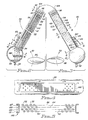
- Figures 10A, 10B, 10C and 10D present the various design attempts in removing the undesirable gasses from the condenser.
- the IDEAL gas removal design shown in Figure 10A would be a cone-shaped bundle where steam (S) enters the cavity and is condensed leaving the gasses behind. As more steam enters and condenses, the gasses are pushed further and further ahead until finally they reach the tip of the cone where there is practically no steam and all gas. The first-stage ejector then "sucks" out nearly pure gas and discharges it from the system. There are no stagnant pockets in the IDEAL design because of its cone shape, however, this bundle cannot be built and remains only as an ideal concept.
- Scheme A, Figure 10B shows past attempts by industry at solving this problem.
- the total steam condensing surface is built in two sections or zones. They could be separate bundles as shown or they could be incorporated in the same bundle.
- the attempt here is to try to concentrate the inert gasses before they are withdrawn at point Y.
- the two sections could have the same heat transfer capacity or the second section could be as small five per cent of the heat transfer surface area of the first section.
- the rear header 36 of the first section may or may not be the cavity which serves as the front header 34 for the second section. There are many design variations on this connection.
- the patent literature shows the following names for the first section: Main Condenser, Primary Condenser, First Condensing Zone and First Plurality Tubes.
- the second section names have been shown as: Dephlegmator, Vent Condenser, Secondary Condenser, After Condenser, After-cooler Section, Second Condensing Zone, Second Plurality of Tubes and Reflux Condenser.
- the design aim is always to drive the gasses toward the terminal end (E) of the condenser and then remove them with an ejector system.
- a typical rear header length which is the bundle width (W)
- W could be as large as ten feet.
- the gas quantities entrapped in the steam are minute by comparison to the total mass of steam being condensed.
- Scheme B has a main condenser where each bundle rear header 36 has a vent tube or tubes.
- This vent tube 170 is finned similar to the main condenser. It is in essence a pre-condenser to the first stage ejector which is built into the same bundle as the main condenser.
- This scheme does a better scavenging job of the rear header than does Scheme A.
- the mass volume of gas/vapor mixture leaving the bundle at (Y) and entering the ejector at (Z) is the same for both Scheme A and B.
- the mass volume of gas/vapor leaving the rear header of Scheme B at point (X) is considerably larger than that leaving at point (Y), Scheme A, due to the condensation of steam vapor in the vent tube.
- Scheme C shown in figure 10D, is the new invention with its suction sparger that shows how it proposes to scavenge the rear header by the vary nature of its construction.
- the gas removal starts with the suction sparger 116 installed in all rear headers; then piping 121, 123, 125 and 127 connecting the suction spargers to pre-condensers 120, 122, 124 and 126; then additional piping connects the pre-condensers to a liquid/vapor separator 128 where the liquid flows to the condensate storage tank 84 by gravity while the gasses and vapors flow to the first-stage ejectors; then the gasses and vapors enter the steam jet air ejector package 130 where the gasses are further concentrated and then ejected from the system into the atmosphere at point 134 while the condensate from the steam vapors is returned to the cycle.
- the inert gasses all end up in the rear headers 36, 38, 40 and 42. To remove them from the rear headers, it is necessary to create a higher vacuum which is a lower absolute pressure than that which exists in the rear headers. This is accomplished by the first-stage ejectors 144 and completed by the remainder of the steam jet air ejector package 130.
- the suction sparger 116 is the starting point for the gas removal process.
- Each rear header, of which there are four per bundle has its own suction sparger running the full length of the rear header as shown in Figure 7.
- the spargers have orifices 114 drilled along the entire length through which the gasses and vapors enter.
- any condensate which enters the sparger either flows out of a single small drain hole 136 shown in Figure 8 and located at the closed end, or it flows into connecting piping 121, 123, 125 and 127 and then drains into the pre-condenser.
- the vapor/gas flow from the rear header through the orifices is induced by the action of the steam jet ejectors.
- the orifices are positioned such that they face a calm area 138 as shown in Figure 8 and are located midway between two adjacent tubes 32.
- the other side of the sparger pipe faces the heat exchanger tube 32 openings which is the turbulent zone or area 140. It is turbulent because there is some steam flow in the rear header between tubes in the same row.
- This steam interchange amongst tubes 32 occurs as a result of uneven cooling air velocities across the face of the bundle. Locating the suction orifices in the calm zone of the rear headers insures a more effective scavenging job. Since each condensing tube 32 discharges some gas, the multiplicity of suction orifices 114 means that the gasses have only to travel a few inches in the rear header before they enter an orifice in the suction sparger 116. This is unlike the usual steam condenser bundle rear header which has but one suction pipe connection where the gasses must travel from a minimum of a few inches to a maximum of five to ten feet, depending on the suction pipe location.
- the orifices 114 are of different diameters along the length of the suction sparger 114 and also vary from bundle to bundle depending on the bundle location in the tower structure. These orifices are sized to perform several important flow-equalizig functions.
- the national steam condenser code specifies the required evacuation capacity (lbs/hr) of the steam jet air ejector package 130 based on the size of steam condenser, i.e., mass quantity of steam condensed (lbs/hr).
- the orifices are sized to flow the code mandated capacity plus the steam vapor capacity condensed in a pre-condenser, if used.
- an orifice diameter is found knowing total flow quantities, total bundles and total orifices.
- the first adjustment to the orifice diameters is to equalize the flows irrespective of the bundle location in the tower structure. That means that bundles located close to the first-stage ejectors will have smaller orifices than the bundles located at the end of the tower. With this adjustment all bundles will now deliver the same mass quantity of gas/vapor to the evacuation system. There is a second adjustment to be made to the orifice diameters which concerns operations inside the rear headers. Flow through the sparger orifices must be equalized along its entire length.
- each finned tube 32 is discharging very nearly the same quantity of gas.
- the orifice 114 openings near the front end of the sparger 116 will be slightly smaller than the orifices near the closed end which are further away and therefore have a larger piping pressure drop.
- the rear header evacuation piping 121, 123, 125 and 127 is run inside the bundle channel frame 148 as shown in Figures 3, 5, 6 and 7 and then brought outside with piping 30 running on top of the bundle frames near the steam supply duct 35 as shown in Figures 1, 2, 3, 6 and 9.
- piping 30 running on top of the bundle frames near the steam supply duct 35 as shown in Figures 1, 2, 3, 6 and 9.
- fins 53 By installing fins 53 on pipes 30, low-cost air-cooled pre-condensers 120, 122, 124 and 126 can be made to serve the first-stage ejectors 144.
- Such a pre-condenser increases the scavenging rate of the rear headers by the amount of steam vapor it condenses. In the process of doing that, it provides a more concentrated inert gas mixture to the ejectors which makes them more efficient.
- the steam vapor condensing capability of this air-cooled pre-condenser is dependent upon, amongst other things, the temperature of the cooling air 50 passing through its fins 53 as it lies on top of the main steam condensing tubes 32.
- This air temperature in turn is controlled by the number of fins 52 installed on tubes 32 located directly below the pre-condensers. As the fins are stripped back along the tubes as shown in Figure 2 the temperature of the air reaching the pre-condensers drops and then more steam vapor is condensed.
- Figure 2 shows the top row fins stripped to a distance L while the bottom row is left intact; rows 2 and 3 are stripped varying amounts. This control of the number of heat dissipating fins built into the path of this small segment of cooling air gives the designer flexibility to maximize the steam vapor condensing capability of the pre-condenser and minimize the potential for freezing.
- the air-cooled pre-condenser is installed in the warm air stream of the bundle air discharge to protect it from freezing.
- the vapor/gas mixture flowing in the pre-condenser tubes 30 does not carry much steam so that it does not have the self protection features as does the regular steam condensing tube 32.
- the pre-condenser is protected by being surrounded with heated air, it is still subject to freezing if it is not protected from cold blasting winds. In cold climate installations a removable, sheet-metal, protective wind shield 162, would be installed to partially cover the pre-condenser.
- the pre-condenser is shown installed on the bottom of the bundles 56 near the steam supply duct 35 to achieve greatest freeze protection. In warmer climate installations the pre-condenser could be installed near the to of the bundles just below rear header 42. This would save piping costs for items 121, 123, 125 and 127.
- Condensate levels in these water legs are above the water level in the tank and each is at a different height because they all have different internal vapor pressures.
- the small condensate pipes 71, 73, 75 and 77 are fastened to the much larger and warmer pipe 83 and then all five pipes are wrapped with heat insulation as a single line.
- the vapors and gasses leaving the fluid separator 128 enter the first-stage ejectors 144 of which there are four; one for each bundle row because they all have different pressures and cannot be tied together.
- the use of multiple first-stage ejectors discharging into a common inter-condenser is generally known in the existing art in the process, petrochemical, pharmaceutical and related industries.
- the process cycles generally have several points, at different pressures, which must be evacuated with their own first- stage ejectors which then discharge into the shell of a common condenser.
- the first-stage ejectors then discharge their mixture into inter-condenser 150 and the second-stage ejector 154 withdraws that shell mixture and discharges it to the after-condenser 152.
- the after-condenser condenses the remaining steam vapor and discharges the residue of inert gasses into the atmosphere via vent 134.
- This air ejection package 130 is a conventional two-stage steam ejector unit with inter and after-condensers. Motor driven vacuum pumps with or without air ejectors could be readily substituted for the steam operated device shown.
- the low-cost pre-condenser 120, 122, 124 and 126 would be installed when operating conditions indicated the need for additional scavenging of the rear headers. If they were not needed, then there would be some cost savings by eliminating the fins 53 on piping 30, the fluid separating connection 128 and the four condensate drain lines 71, 73, 75 and 77 and running the extraction piping 30 in the cavity below bundle air seal 164 Figures 2 and 3.
- the invention may thus be considered as apparatus for condensing steam and for removing the non-condensible gasses therefrom.
- the apparatus includes an improved conduit arrangement defining a gas/vapor path extending from a lower first header to an upper second or last header with condensing tubes extending therebetween for steam as it moves upwardly through the condensing tubes from the first header toward the second header.
- a sparger is located in operative association with the second header and is formed with a plurality of orifices along its length for receiving the non-condensible gasses freed from the steam during its condensation and for the removing of such non-condensible gasses from the system. The sparger is then coupled to a first stage ejector.
- each row may have a different finned tube diameter such as, the first row could be one and one-half inch in diameter, the second row one and one-forth inch in diameter and the third row one inch in diameter.
Landscapes
- Engineering & Computer Science (AREA)
- Mechanical Engineering (AREA)
- General Engineering & Computer Science (AREA)
- Vaporization, Distillation, Condensation, Sublimation, And Cold Traps (AREA)
- Heat-Exchange Devices With Radiators And Conduit Assemblies (AREA)
Applications Claiming Priority (2)
| Application Number | Priority Date | Filing Date | Title |
|---|---|---|---|
| US20609588A | 1988-06-13 | 1988-06-13 | |
| US206095 | 1988-06-13 |
Publications (3)
| Publication Number | Publication Date |
|---|---|
| EP0346848A2 true EP0346848A2 (de) | 1989-12-20 |
| EP0346848A3 EP0346848A3 (en) | 1990-02-14 |
| EP0346848B1 EP0346848B1 (de) | 1994-02-23 |
Family
ID=22764967
Family Applications (1)
| Application Number | Title | Priority Date | Filing Date |
|---|---|---|---|
| EP89110718A Expired - Lifetime EP0346848B1 (de) | 1988-06-13 | 1989-06-13 | Luftgekühlter Dampfkondensator mit Vakuum |
Country Status (3)
| Country | Link |
|---|---|
| EP (1) | EP0346848B1 (de) |
| DE (1) | DE68913233T2 (de) |
| ZA (1) | ZA894479B (de) |
Cited By (7)
| Publication number | Priority date | Publication date | Assignee | Title |
|---|---|---|---|---|
| WO2017223139A1 (en) * | 2016-06-21 | 2017-12-28 | Evapco, Inc. | Mini-tube air cooled industrial steam condenser |
| WO2017223185A1 (en) | 2016-06-21 | 2017-12-28 | Evapco, Inc. | All-secondary air cooled industrial steam condenser |
| EP3287732A1 (de) | 2016-08-24 | 2018-02-28 | SPX Dry Cooling Belgium sprl | Durch angesaugte zugluft gekühlter kondensator |
| CN110494712A (zh) * | 2016-12-22 | 2019-11-22 | 艾威普科公司 | 微型管的空气冷却式工业蒸汽冷凝装置 |
| US10527354B2 (en) | 2012-05-23 | 2020-01-07 | Spg Dry Cooling Usa Llc | Modular air cooled condenser apparatus and method |
| US11486646B2 (en) | 2016-05-25 | 2022-11-01 | Spg Dry Cooling Belgium | Air-cooled condenser apparatus and method |
| CN120028098A (zh) * | 2025-04-24 | 2025-05-23 | 苏州盛地自动化设备有限公司 | 一种锅炉汽水智能化取样装置 |
Family Cites Families (10)
| Publication number | Priority date | Publication date | Assignee | Title |
|---|---|---|---|---|
| US2217410A (en) * | 1938-02-17 | 1940-10-08 | Gen Electric | Heat exchange apparatus |
| DE1082286B (de) * | 1957-01-28 | 1960-05-25 | Arbed | Luftgekuehlter Oberflaechenkondensator |
| FR1386255A (fr) * | 1963-09-18 | 1965-01-22 | Gea Luftkuehler Happel Gmbh | Condenseur à surface refroidi par air et procédé pour faire fonctionner ce condenseur |
| FR1389944A (fr) * | 1964-04-08 | 1965-02-19 | G E A Luftkuehlergesellschaft | Condenseur à surface refroidi à l'air |
| US3887002A (en) * | 1974-01-28 | 1975-06-03 | Lummus Co | Air-cooled heat exchanger with after-condenser |
| US3922880A (en) * | 1974-03-11 | 1975-12-02 | Herman H Morris | Flooder refrigerant condenser systems |
| US4168742A (en) * | 1978-03-27 | 1979-09-25 | Hudson Products Corporation | Tube bundle |
| US4220121A (en) * | 1978-04-05 | 1980-09-02 | Brunswick Corporation | Heat exchanger for marine propulsion engines |
| US4417619A (en) * | 1978-06-05 | 1983-11-29 | Sasakura Engineering Co., Ltd. | Air-cooled heat exchanger |
| US4518035A (en) * | 1983-02-14 | 1985-05-21 | Hudson Products Corporation | Air-cooled, vacuum steam condenser |
-
1989
- 1989-06-13 ZA ZA894479A patent/ZA894479B/xx unknown
- 1989-06-13 EP EP89110718A patent/EP0346848B1/de not_active Expired - Lifetime
- 1989-06-13 DE DE68913233T patent/DE68913233T2/de not_active Expired - Fee Related
Cited By (15)
| Publication number | Priority date | Publication date | Assignee | Title |
|---|---|---|---|---|
| US11112180B2 (en) | 2012-05-23 | 2021-09-07 | Spg Dry Cooling Usa Llc | Modular air cooled condenser apparatus and method |
| US10527354B2 (en) | 2012-05-23 | 2020-01-07 | Spg Dry Cooling Usa Llc | Modular air cooled condenser apparatus and method |
| US11662146B2 (en) | 2012-05-23 | 2023-05-30 | Spg Dry Cooling Usa Llc | Modular air cooled condenser apparatus and method |
| US10551126B2 (en) | 2012-05-23 | 2020-02-04 | Spg Dry Cooling Usa Llc | Modular air cooled condenser apparatus and method |
| US11486646B2 (en) | 2016-05-25 | 2022-11-01 | Spg Dry Cooling Belgium | Air-cooled condenser apparatus and method |
| US10024600B2 (en) | 2016-06-21 | 2018-07-17 | Evapco, Inc. | Mini-tube air cooled industrial steam condenser |
| WO2017223185A1 (en) | 2016-06-21 | 2017-12-28 | Evapco, Inc. | All-secondary air cooled industrial steam condenser |
| AU2017280203B2 (en) * | 2016-06-21 | 2022-07-14 | Evapco, Inc. | All-secondary air cooled industrial steam condenser |
| WO2017223139A1 (en) * | 2016-06-21 | 2017-12-28 | Evapco, Inc. | Mini-tube air cooled industrial steam condenser |
| AU2022252840B2 (en) * | 2016-06-21 | 2024-09-19 | Evapco, Inc. | All-secondary air cooled industrial steam condenser |
| WO2018037043A1 (en) | 2016-08-24 | 2018-03-01 | Spx Dry Cooling Belgium | Induced draft air-cooled condenser |
| EP3287732A1 (de) | 2016-08-24 | 2018-02-28 | SPX Dry Cooling Belgium sprl | Durch angesaugte zugluft gekühlter kondensator |
| CN110494712A (zh) * | 2016-12-22 | 2019-11-22 | 艾威普科公司 | 微型管的空气冷却式工业蒸汽冷凝装置 |
| CN110494712B (zh) * | 2016-12-22 | 2021-02-26 | 艾威普科公司 | 微型管的空气冷却式工业蒸汽冷凝装置 |
| CN120028098A (zh) * | 2025-04-24 | 2025-05-23 | 苏州盛地自动化设备有限公司 | 一种锅炉汽水智能化取样装置 |
Also Published As
| Publication number | Publication date |
|---|---|
| ZA894479B (en) | 1990-07-25 |
| EP0346848B1 (de) | 1994-02-23 |
| EP0346848A3 (en) | 1990-02-14 |
| DE68913233D1 (de) | 1994-03-31 |
| DE68913233T2 (de) | 1994-09-08 |
Similar Documents
| Publication | Publication Date | Title |
|---|---|---|
| US4905474A (en) | Air-cooled vacuum steam condenser | |
| US4926931A (en) | Freeze protected, air-cooled vacuum steam condensers | |
| US4903491A (en) | Air-cooled vacuum steam condenser | |
| US5018572A (en) | Steam condenser | |
| AU679154B1 (en) | Steam condensing module with integral, stacked vent condenser | |
| CN102427874B (zh) | 自然通风型气冷式蒸汽冷凝器及其方法 | |
| US20060151154A1 (en) | Combined air cooled condenser | |
| KR100203196B1 (ko) | 동결방지된 환기응축기가 구비된 증기응축장치 | |
| US5787970A (en) | Air-cooled vacuum steam condenser with mixed flow bundle | |
| EP0794401A2 (de) | Dampfkondensator | |
| EP0545366A1 (de) | Luftgekühlter Vakuum-Dampfkondensator mit Kleinbündeln mit Ausgleich des Durchflusses | |
| EP0346848A2 (de) | Luftgekühlter Dampfkondensator mit Vakuum | |
| US4202405A (en) | Air cooled condenser | |
| EP0369298A1 (de) | Luftgekühlter Dampfkondensator mit Vakuum und Schutz gegen Vereisung | |
| US6128901A (en) | Pressure control system to improve power plant efficiency | |
| KR102662738B1 (ko) | 공냉식 응축기를 위한 3단계 열교환기 | |
| US7096666B2 (en) | Air-cooled condensing system and method | |
| KR101005066B1 (ko) | 공냉식 응축기 | |
| AU722526B2 (en) | Steam condenser | |
| US4193446A (en) | Intermediate steam superheater | |
| US6289976B1 (en) | Air-cooled vacuum steam condenser bundle isolation | |
| EP0480710B1 (de) | Isolierung eines luftgekühlten Dampfkondensators mit Vakuum | |
| CN1162103A (zh) | 蒸汽冷凝器 | |
| US3391911A (en) | Mixing condensers | |
| JP2025528559A (ja) | 有機ランキンサイクル設備のための空気凝縮器 |
Legal Events
| Date | Code | Title | Description |
|---|---|---|---|
| PUAI | Public reference made under article 153(3) epc to a published international application that has entered the european phase |
Free format text: ORIGINAL CODE: 0009012 |
|
| AK | Designated contracting states |
Kind code of ref document: A2 Designated state(s): BE DE ES FR GB IT |
|
| PUAL | Search report despatched |
Free format text: ORIGINAL CODE: 0009013 |
|
| AK | Designated contracting states |
Kind code of ref document: A3 Designated state(s): BE DE ES FR GB IT |
|
| 17P | Request for examination filed |
Effective date: 19900516 |
|
| 17Q | First examination report despatched |
Effective date: 19900718 |
|
| GRAA | (expected) grant |
Free format text: ORIGINAL CODE: 0009210 |
|
| AK | Designated contracting states |
Kind code of ref document: B1 Designated state(s): BE DE ES FR GB IT |
|
| PG25 | Lapsed in a contracting state [announced via postgrant information from national office to epo] |
Ref country code: FR Free format text: THE PATENT HAS BEEN ANNULLED BY A DECISION OF A NATIONAL AUTHORITY Effective date: 19940223 Ref country code: ES Free format text: THE PATENT HAS BEEN ANNULLED BY A DECISION OF A NATIONAL AUTHORITY Effective date: 19940223 Ref country code: BE Effective date: 19940223 |
|
| REF | Corresponds to: |
Ref document number: 68913233 Country of ref document: DE Date of ref document: 19940331 |
|
| ITF | It: translation for a ep patent filed | ||
| EN | Fr: translation not filed | ||
| PGFP | Annual fee paid to national office [announced via postgrant information from national office to epo] |
Ref country code: GB Payment date: 19941021 Year of fee payment: 6 |
|
| PGFP | Annual fee paid to national office [announced via postgrant information from national office to epo] |
Ref country code: DE Payment date: 19941110 Year of fee payment: 6 |
|
| PLBE | No opposition filed within time limit |
Free format text: ORIGINAL CODE: 0009261 |
|
| STAA | Information on the status of an ep patent application or granted ep patent |
Free format text: STATUS: NO OPPOSITION FILED WITHIN TIME LIMIT |
|
| 26N | No opposition filed | ||
| PG25 | Lapsed in a contracting state [announced via postgrant information from national office to epo] |
Ref country code: GB Effective date: 19950613 |
|
| GBPC | Gb: european patent ceased through non-payment of renewal fee |
Effective date: 19950613 |
|
| PG25 | Lapsed in a contracting state [announced via postgrant information from national office to epo] |
Ref country code: DE Effective date: 19960301 |
|
| PG25 | Lapsed in a contracting state [announced via postgrant information from national office to epo] |
Ref country code: IT Free format text: LAPSE BECAUSE OF NON-PAYMENT OF DUE FEES;WARNING: LAPSES OF ITALIAN PATENTS WITH EFFECTIVE DATE BEFORE 2007 MAY HAVE OCCURRED AT ANY TIME BEFORE 2007. THE CORRECT EFFECTIVE DATE MAY BE DIFFERENT FROM THE ONE RECORDED. Effective date: 20050613 |