EP0347529A2 - Mode d'opération d'une lampe à vapeur de sodium à haute pression - Google Patents
Mode d'opération d'une lampe à vapeur de sodium à haute pression Download PDFInfo
- Publication number
- EP0347529A2 EP0347529A2 EP89105240A EP89105240A EP0347529A2 EP 0347529 A2 EP0347529 A2 EP 0347529A2 EP 89105240 A EP89105240 A EP 89105240A EP 89105240 A EP89105240 A EP 89105240A EP 0347529 A2 EP0347529 A2 EP 0347529A2
- Authority
- EP
- European Patent Office
- Prior art keywords
- pressure sodium
- pulse
- sodium
- pulses
- lamp according
- Prior art date
- Legal status (The legal status is an assumption and is not a legal conclusion. Google has not performed a legal analysis and makes no representation as to the accuracy of the status listed.)
- Granted
Links
Images

Classifications
-
- H—ELECTRICITY
- H05—ELECTRIC TECHNIQUES NOT OTHERWISE PROVIDED FOR
- H05B—ELECTRIC HEATING; ELECTRIC LIGHT SOURCES NOT OTHERWISE PROVIDED FOR; CIRCUIT ARRANGEMENTS FOR ELECTRIC LIGHT SOURCES, IN GENERAL
- H05B41/00—Circuit arrangements or apparatus for igniting or operating discharge lamps
- H05B41/14—Circuit arrangements
- H05B41/36—Controlling
- H05B41/38—Controlling the intensity of light
- H05B41/39—Controlling the intensity of light continuously
- H05B41/392—Controlling the intensity of light continuously using semiconductor devices, e.g. thyristor
- H05B41/3921—Controlling the intensity of light continuously using semiconductor devices, e.g. thyristor with possibility of light intensity variations
- H05B41/3927—Controlling the intensity of light continuously using semiconductor devices, e.g. thyristor with possibility of light intensity variations by pulse width modulation
- H05B41/3928—Controlling the intensity of light continuously using semiconductor devices, e.g. thyristor with possibility of light intensity variations by pulse width modulation for high-pressure lamps, e.g. high-intensity discharge lamps, high-pressure mercury or sodium lamps
-
- H—ELECTRICITY
- H01—ELECTRIC ELEMENTS
- H01J—ELECTRIC DISCHARGE TUBES OR DISCHARGE LAMPS
- H01J61/00—Gas-discharge or vapour-discharge lamps
- H01J61/02—Details
- H01J61/12—Selection of substances for gas fillings; Specified operating pressure or temperature
- H01J61/18—Selection of substances for gas fillings; Specified operating pressure or temperature having a metallic vapour as the principal constituent
- H01J61/22—Selection of substances for gas fillings; Specified operating pressure or temperature having a metallic vapour as the principal constituent vapour of an alkali metal
-
- H—ELECTRICITY
- H01—ELECTRIC ELEMENTS
- H01J—ELECTRIC DISCHARGE TUBES OR DISCHARGE LAMPS
- H01J61/00—Gas-discharge or vapour-discharge lamps
- H01J61/82—Lamps with high-pressure unconstricted discharge having a cold pressure > 400 Torr
- H01J61/825—High-pressure sodium lamps
-
- Y—GENERAL TAGGING OF NEW TECHNOLOGICAL DEVELOPMENTS; GENERAL TAGGING OF CROSS-SECTIONAL TECHNOLOGIES SPANNING OVER SEVERAL SECTIONS OF THE IPC; TECHNICAL SUBJECTS COVERED BY FORMER USPC CROSS-REFERENCE ART COLLECTIONS [XRACs] AND DIGESTS
- Y02—TECHNOLOGIES OR APPLICATIONS FOR MITIGATION OR ADAPTATION AGAINST CLIMATE CHANGE
- Y02B—CLIMATE CHANGE MITIGATION TECHNOLOGIES RELATED TO BUILDINGS, e.g. HOUSING, HOUSE APPLIANCES OR RELATED END-USER APPLICATIONS
- Y02B20/00—Energy efficient lighting technologies, e.g. halogen lamps or gas discharge lamps
Definitions
- the invention relates to a high-pressure sodium vapor lamp with increased color temperature, high luminous efficacy and improved color rendering properties, which for general lighting purposes, such as. B. for street, object or interior lighting can be used.
- Characteristic of the spectral radiation distribution of conventional high pressure sodium lamps is the concentrated radiation in the area of the widely broadened and self-reversed main resonance lines. Since this spectral range is close to the maximum eye sensitivity, lamps of this type have very high luminous efficacies, for which, depending on the electrical power, values between 75 lm / W for 35 W lamps and 150 lm / W for 1000 W lamps Lamps can be specified. Unfortunately, the color temperature (T c ) with approx. 2000 K and the general color rendering index (R a ) with approx. 20 are relatively low, so that such lamps are not suitable for more demanding lighting tasks.
- Another option that is suitable for influencing the color properties of high-pressure sodium lamps is to use a time-modulated energy feed that differs from the operation with the mains frequency.
- the lamp is supplied with the energy in the form of pulses, the average power and thus the temperature of the discharge vessel not being increased, although the current strength in the pulse is clearly above the usual values.
- a high pressure sodium vapor lamp operated according to this method has been described in the patent literature (US Pat. No. 4,137,484, DE 2,657,824), f being varied between 500 and 2000 Hz and ⁇ between 0.1 and 0.3.
- the color temperature could be raised to 2300 to 2600 K by stimulating correspondingly higher electronic levels of sodium and mercury, which usually acts as a buffer gas.
- these values are still too low for the use of such light sources in interior lighting, particularly in the living area, since color temperatures of 3000 K and more are desirable here.
- the tests showed that the visual efficiency of lamps operated in this way decreases when the pulse duty factor falls below a certain value for a given pulse repetition frequency.
- a modified variant of the pulse feed can be found in DE-OS 3 636 901 and DE-OS 3 641 070.
- bipolar current pulses with a pulse duty factor of 0.2 to 0.6 are used to generate a higher-frequency current of e.g. B. 20 to 50 kHz superimposed.
- This superimposition is intended to reduce the flicker observed in pulse-operated high-pressure lamps without directly influencing the lighting data.
- the color temperature for 30-watt lamps is given a value of 2700 K at a duty cycle of 0.3.
- the invention has for its object to develop a light source which is capable of emitting considerable radiation components in the range of maximum eye sensitivity and thus has a high luminous efficacy, the total radiation distribution of which enables color temperatures of 3000 to 4000 K, and which with high luminous efficiency and high Lifetime has good color rendering properties and a most similar color temperature in the range of 3000 to 4000 K.
- this object is achieved in that an electrical discharge in sodium vapor is operated in a translucent discharge vessel, the other substances, such as. B. mercury can be added, the sodium mole fraction deviates from the usual lamp fillings> 0.9.
- m Hg and m Na mean the masses of mercury and sodium in the amalgam.
- the discharge is fed with electrical pulses, the power of which exceeds the total mean value by at least five times, in such a way that the average power and thus the thermal load on the lamp does not exceed the value permitted for operation with mains alternating current.
- a pulse duty factor below 0.1 is suitable for achieving the desired radiation properties, the pulse repetition frequency being above the flicker fusion frequency of the human visual apparatus. Separation of different discharge media by cataphoresis can be prevented by using pulses with alternating polarity.
- the discharge between the pulses can continue to be operated with the lowest possible basic power. In this operating mode, it is advantageous if the basic power is realized by a current which is polarity-synchronous with the pulses.
- the combination according to the invention of pulses with a low pulse duty factor and substance mixtures with a high sodium content leads, in addition to the known increase in the plasma temperature with an accompanying increase in the emission in the short-wave part of the visible spectrum, to a relatively strong excitation of the sodium 4d level. Since the spectral line emitted by this level, in contrast to the resonance lines, is emitted without self-reversal, the choice of a high sodium partial pressure, which of course could also be achieved in another way, brings about a further increase in the radiation intensity also in the area of the line center. The result is a high visual efficiency, because under these conditions a considerable proportion of the radiation is emitted close to the maximum of the eye sensitivity.
- the lamp according to the invention combines high light yields with good color properties.
- the pulse duty factor should not be less than 0.01, since otherwise the plasma temperature is too high and an increasing proportion of the electrical energy is converted into less effective radiation processes.
- Discharge lamps with different substance fillings were examined when operated with electrical impulses.
- the instantaneous power based on the value during stationary operation was gradually increased to over 100 times.
- color temperatures and color rendering indices of lamps with sodium fillings were partly raised with the participation of other additives such as mercury, the light output reached a maximum at about ten times the output, which is surprisingly up to 60% above the stationary value. Then there is a drop in such a way that the light output generally drops below the value achieved during stationary operation when the overload is about 100 times.
- the proposed optimized pulse shaping should therefore be aimed for.
- the holding power should be kept as low as possible, since the luminous efficacy in this phase is still significantly below the values usual in normal operation. Since an electronic control of the power is connected to active components such as transistors with additional heat losses in the ballast, only an approximately rectangular pulse shape with multiple link delay chains was used, which consist of capacitors and inductors. With a suitable adaptation, the charging voltage of the capacitors, which is available for gating the plasma, is thus approximately twice as high as the lamp lamp voltage which is formed, thus achieving a rapid transition to the second phase. This is followed by the formation of an adapted performance plateau, followed by a rapid decay.
- the pulse shaping that can be achieved in this way also enables a reduction in the peak current strengths, which means that the requirements for electronic construction elements in the ballasts and in the interest of a long service life, the load on the lamp electrodes can be reduced.
- the color rendering properties of the lamp according to the invention can be further improved by adding cesium and / or rubidium to the discharge medium.
- cesium and / or rubidium In pulse mode, these elements emit a strong continuum that fills up the sodium radiation on the short-wave side of the visible spectrum.
- FIG. 1 a cylindrical discharge tube 1 shown in FIG. 1 made of translucent sintered aluminum oxide with an inner diameter of 3.5 mm with two electrodes 2 opposite one another at a distance of 36 mm and with power supply lines cemented in a vacuum-tight manner 3 was used.
- These discharge vessels are surrounded by evacuated outer bulbs 4, frame structures 5 taking over the mechanical mounting and the electrical connection to the bases 6.
- Discharge tube, frame structure, outer bulb and base together form a discharge lamp which is fed by the power supply device 7.
- multi-link delay chains consisting of inductors and capacitors are used, which have wave resistances adapted to the discharge plasma.
- the discharge vessel is filled with 3 mg sodium, 2 mg mercury, 0.5 mg cesium and 30 kPa xenon.
- the lamp is supplied with 1000 current pulses per second with a duty cycle of 0.05 and alternating polarity. These pulses are superimposed on a basic supply in the form of a 1 kHz square-wave alternating current of 0.1 A in phase synchronization.
- the lamp operated in this way emits a luminous flux of 5.3 klm at an average power consumption of 70 W.
- Their color temperature is 3600 K and their general color rendering index is 70.
- the lamp is supplied with 400 current pulses per second with a duty cycle of 0.08 and alternating polarity.
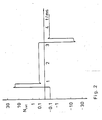
- a runtime chain with three identical links consisting of inductances of 68 ⁇ H and capacities of 4 ⁇ F is used for pulse formation. These pulses are superimposed on a basic supply in the form of a 200 Hz square-wave alternating current of 0.1 A in phase synchronization.
- FIG. 2 shows the course of the lamp power N rel based on the value during steady-state operation as a function of time t.
- the high-pressure sodium vapor lamp operated in this way emits a luminous flux of 6 klm with an average power consumption of 70 W. Its color temperature is 3200 K and its general color rendering index is 45.
- the lamp is supplied with 200 current pulses per second with a duty cycle of 0.02 and uniform polarity.
- a basic supply in the form of a holding current with an effective value of 0.1 A is carried out between the pulses.
- the lamp operated in this way emits a luminous flux of 4.5 klm at an average power consumption of 70 W.
- Their color temperature is 3500 K and their general color rendering index is 55.
Landscapes
- Discharge Lamp (AREA)
- Vessels And Coating Films For Discharge Lamps (AREA)
Applications Claiming Priority (2)
| Application Number | Priority Date | Filing Date | Title |
|---|---|---|---|
| DD3140295 | 1988-03-25 | ||
| DD88314029A DD270405A1 (de) | 1988-03-25 | 1988-03-25 | Natriumdampf-hochdrucklampe |
Publications (3)
| Publication Number | Publication Date |
|---|---|
| EP0347529A2 true EP0347529A2 (fr) | 1989-12-27 |
| EP0347529A3 EP0347529A3 (fr) | 1991-04-24 |
| EP0347529B1 EP0347529B1 (fr) | 1995-06-14 |
Family
ID=5597900
Family Applications (1)
| Application Number | Title | Priority Date | Filing Date |
|---|---|---|---|
| EP89105240A Expired - Lifetime EP0347529B1 (fr) | 1988-03-25 | 1989-03-23 | Mode d'opération d'une lampe à vapeur de sodium à haute pression |
Country Status (5)
| Country | Link |
|---|---|
| US (1) | US4963796A (fr) |
| EP (1) | EP0347529B1 (fr) |
| DD (1) | DD270405A1 (fr) |
| DE (1) | DE58909285D1 (fr) |
| HU (1) | HU203426B (fr) |
Families Citing this family (7)
| Publication number | Priority date | Publication date | Assignee | Title |
|---|---|---|---|---|
| DD293021A5 (de) * | 1990-03-16 | 1991-08-14 | Komb. Veb Narva "Rosa Luxemburg",De | Verfahren zum impulsbetrieb von hochdruckentladungslampen |
| JPH076734A (ja) * | 1992-05-01 | 1995-01-10 | Oyo Kagaku Kenkyusho | 放電装置 |
| US5637965A (en) * | 1995-10-18 | 1997-06-10 | Matsushita Electric Works R&D Laboratory, Inc. | Low pressure sodium-mercury lamp yielding substantially white light |
| US5684367A (en) | 1996-01-16 | 1997-11-04 | Osram Sylvania Inc. | Color control and arc stabilization for high-intensity, discharge lamps |
| US6184633B1 (en) * | 1999-06-17 | 2001-02-06 | Philips Electronics North America Corporation | Reduction of vertical segregation in a discharge lamp |
| US6476566B2 (en) | 2000-12-27 | 2002-11-05 | Infocus Systems, Inc. | Method and apparatus for canceling ripple current in a lamp |
| US7265794B2 (en) * | 2005-09-01 | 2007-09-04 | Texas Instruments Incorporated | Managing the color temperature for a light source array |
Family Cites Families (5)
| Publication number | Priority date | Publication date | Assignee | Title |
|---|---|---|---|---|
| US3384798A (en) * | 1966-04-26 | 1968-05-21 | Gen Electric | High pressure saturation vapor sodium lamp containing mercury |
| HU172011B (hu) * | 1976-03-05 | 1978-05-28 | Egyesuelt Izzolampa | Razrjadnyj material dlja ehlektricheskoj razrjdnoj lampi s vysokoj jarkost'ju celesoobrazno dlja natrievoj lampi s vysokim davleniem |
| US4128789A (en) * | 1976-06-30 | 1978-12-05 | General Electric Company | Method of operating gaseous discharge lamps |
| GB2133925B (en) * | 1982-12-29 | 1987-02-18 | Gen Electric | Control of radial distributions in high intensity discharge lamps |
| US4884009A (en) * | 1987-12-18 | 1989-11-28 | Gte Products Corporation | Color selectable source for pulsed arc discharge lamps |
-
1988
- 1988-03-25 DD DD88314029A patent/DD270405A1/de not_active IP Right Cessation
-
1989
- 1989-02-27 US US07/316,386 patent/US4963796A/en not_active Expired - Fee Related
- 1989-03-23 DE DE58909285T patent/DE58909285D1/de not_active Expired - Fee Related
- 1989-03-23 EP EP89105240A patent/EP0347529B1/fr not_active Expired - Lifetime
- 1989-03-24 HU HU891522A patent/HU203426B/hu not_active IP Right Cessation
Also Published As
| Publication number | Publication date |
|---|---|
| HUT49962A (en) | 1989-11-28 |
| DD270405A1 (de) | 1989-07-26 |
| HU203426B (en) | 1991-07-29 |
| EP0347529A3 (fr) | 1991-04-24 |
| DE58909285D1 (de) | 1995-07-20 |
| EP0347529B1 (fr) | 1995-06-14 |
| US4963796A (en) | 1990-10-16 |
Similar Documents
| Publication | Publication Date | Title |
|---|---|---|
| DE2815014C2 (de) | Hochdrucknatriumdampfentladungslampe | |
| DE69616000T2 (de) | Neongas-Entladungslampe und Pulsbetriebsverfahren | |
| DE2906383C2 (de) | Hochdrucknatriumdampfentladungslampe | |
| DE2936544A1 (de) | Elektrodenlose lampenanordnung | |
| DE69128438T2 (de) | Vorrichtung für Edelgas-Fluoreszenzentladungslampen | |
| DE1940539A1 (de) | Quecksilberdampf-Hochdruckentladungslampe mit Metallhalogenidzusatz | |
| DE3938827C2 (fr) | ||
| DE3506295A1 (de) | Kompakte hochdruckentladungslampe | |
| DE10044562A1 (de) | Niederdruckgasentladungslampe mit quecksilberfreier Gasfüllung | |
| DE2746671A1 (de) | Elektrische hochdruckentladungslampe | |
| DE1764979A1 (de) | Quecksilber-Metallhalogenid-Dampflampe mit Regeneration | |
| EP0347529B1 (fr) | Mode d'opération d'une lampe à vapeur de sodium à haute pression | |
| DE830984C (de) | Entladungslampe zur Erzeugung von Blitzlicht hoher Intensitaet und Verfahren zum Betrieb der Lampe | |
| DE69318817T2 (de) | Elektrodenlose Niederdruck-Entladungslampe | |
| EP0456907B1 (fr) | Lampe à décharge à haute pression | |
| DE905414C (de) | Entladungslampe mit langgestreckter Glashuelle und je einer Elektrode an beiden Enden dieser Huelle | |
| DE69115521T2 (de) | Hochdrucknatriumdampfentladungslampe | |
| DE1489406C3 (de) | Hochdruck-Quecksilberdampf entladungslampe | |
| DE2461568A1 (de) | Dampfentladungslampe | |
| DE3632430A1 (de) | Magnesiumdampf-entladungslampe | |
| DE2255165C3 (de) | 40 Watt-Leuchtstofflampe | |
| EP0334355B1 (fr) | Lampe à décharge à haute pression à paroi stabilisée | |
| DE2945714C2 (fr) | ||
| DE2722694A1 (de) | Quecksilberdampf-niederdruckentladungslampe | |
| DE2255164C3 (de) | 20 Watt-Leuchtstofflampe |
Legal Events
| Date | Code | Title | Description |
|---|---|---|---|
| PUAI | Public reference made under article 153(3) epc to a published international application that has entered the european phase |
Free format text: ORIGINAL CODE: 0009012 |
|
| AK | Designated contracting states |
Kind code of ref document: A2 Designated state(s): BE DE FR GB NL |
|
| RAP1 | Party data changed (applicant data changed or rights of an application transferred) |
Owner name: KOMBINAT VEB NARVA |
|
| PUAL | Search report despatched |
Free format text: ORIGINAL CODE: 0009013 |
|
| AK | Designated contracting states |
Kind code of ref document: A3 Designated state(s): BE DE FR GB NL |
|
| 17P | Request for examination filed |
Effective date: 19910716 |
|
| RAP1 | Party data changed (applicant data changed or rights of an application transferred) |
Owner name: NARVA BERLINER GLUEHLAMPENWERK GMBH |
|
| 17Q | First examination report despatched |
Effective date: 19931026 |
|
| RAP1 | Party data changed (applicant data changed or rights of an application transferred) |
Owner name: PRIAMOS LICHT, INDUSTRIE & DIENSTLEISTUNGS GMBH |
|
| GRAA | (expected) grant |
Free format text: ORIGINAL CODE: 0009210 |
|
| AK | Designated contracting states |
Kind code of ref document: B1 Designated state(s): BE DE FR GB NL |
|
| ET | Fr: translation filed | ||
| GBT | Gb: translation of ep patent filed (gb section 77(6)(a)/1977) |
Effective date: 19950614 |
|
| REF | Corresponds to: |
Ref document number: 58909285 Country of ref document: DE Date of ref document: 19950720 |
|
| PLBE | No opposition filed within time limit |
Free format text: ORIGINAL CODE: 0009261 |
|
| STAA | Information on the status of an ep patent application or granted ep patent |
Free format text: STATUS: NO OPPOSITION FILED WITHIN TIME LIMIT |
|
| 26N | No opposition filed | ||
| PGFP | Annual fee paid to national office [announced via postgrant information from national office to epo] |
Ref country code: FR Payment date: 19980318 Year of fee payment: 10 |
|
| PGFP | Annual fee paid to national office [announced via postgrant information from national office to epo] |
Ref country code: GB Payment date: 19980323 Year of fee payment: 10 |
|
| PGFP | Annual fee paid to national office [announced via postgrant information from national office to epo] |
Ref country code: BE Payment date: 19980325 Year of fee payment: 10 |
|
| PGFP | Annual fee paid to national office [announced via postgrant information from national office to epo] |
Ref country code: NL Payment date: 19980331 Year of fee payment: 10 |
|
| PGFP | Annual fee paid to national office [announced via postgrant information from national office to epo] |
Ref country code: DE Payment date: 19980929 Year of fee payment: 10 |
|
| PG25 | Lapsed in a contracting state [announced via postgrant information from national office to epo] |
Ref country code: GB Free format text: LAPSE BECAUSE OF NON-PAYMENT OF DUE FEES Effective date: 19990323 |
|
| PG25 | Lapsed in a contracting state [announced via postgrant information from national office to epo] |
Ref country code: BE Free format text: LAPSE BECAUSE OF NON-PAYMENT OF DUE FEES Effective date: 19990331 |
|
| BERE | Be: lapsed |
Owner name: PRIAMOS LICHT INDUSTRIE & DIENSTLEISTUNGS G.M.B.H Effective date: 19990331 |
|
| PG25 | Lapsed in a contracting state [announced via postgrant information from national office to epo] |
Ref country code: NL Free format text: LAPSE BECAUSE OF NON-PAYMENT OF DUE FEES Effective date: 19991001 |
|
| GBPC | Gb: european patent ceased through non-payment of renewal fee |
Effective date: 19990323 |
|
| PG25 | Lapsed in a contracting state [announced via postgrant information from national office to epo] |
Ref country code: FR Free format text: LAPSE BECAUSE OF NON-PAYMENT OF DUE FEES Effective date: 19991130 |
|
| NLV4 | Nl: lapsed or anulled due to non-payment of the annual fee |
Effective date: 19991001 |
|
| REG | Reference to a national code |
Ref country code: FR Ref legal event code: ST |
|
| PG25 | Lapsed in a contracting state [announced via postgrant information from national office to epo] |
Ref country code: DE Free format text: LAPSE BECAUSE OF NON-PAYMENT OF DUE FEES Effective date: 20000101 |