EP0347917B1 - Lentille ophtalmique avec indice de réfraction à gradient - Google Patents
Lentille ophtalmique avec indice de réfraction à gradient Download PDFInfo
- Publication number
- EP0347917B1 EP0347917B1 EP89111396A EP89111396A EP0347917B1 EP 0347917 B1 EP0347917 B1 EP 0347917B1 EP 89111396 A EP89111396 A EP 89111396A EP 89111396 A EP89111396 A EP 89111396A EP 0347917 B1 EP0347917 B1 EP 0347917B1
- Authority
- EP
- European Patent Office
- Prior art keywords
- refractive index
- spectacle lens
- lens according
- gradient
- astigmatism
- Prior art date
- Legal status (The legal status is an assumption and is not a legal conclusion. Google has not performed a legal analysis and makes no representation as to the accuracy of the status listed.)
- Expired - Lifetime
Links
- 201000009310 astigmatism Diseases 0.000 claims description 48
- 230000003287 optical effect Effects 0.000 claims description 28
- 238000012937 correction Methods 0.000 claims description 27
- 230000000750 progressive effect Effects 0.000 claims description 10
- 230000007547 defect Effects 0.000 claims description 9
- 230000007423 decrease Effects 0.000 claims description 5
- 239000011521 glass Substances 0.000 description 92
- 230000000694 effects Effects 0.000 description 56
- 238000013461 design Methods 0.000 description 36
- 208000014733 refractive error Diseases 0.000 description 30
- 238000003384 imaging method Methods 0.000 description 29
- 230000004075 alteration Effects 0.000 description 27
- 230000035515 penetration Effects 0.000 description 16
- 238000004519 manufacturing process Methods 0.000 description 15
- 238000005342 ion exchange Methods 0.000 description 13
- 238000000034 method Methods 0.000 description 11
- 239000000463 material Substances 0.000 description 10
- 230000008092 positive effect Effects 0.000 description 9
- 230000009467 reduction Effects 0.000 description 9
- 238000004364 calculation method Methods 0.000 description 5
- 230000008859 change Effects 0.000 description 5
- 239000002537 cosmetic Substances 0.000 description 4
- 230000008901 benefit Effects 0.000 description 3
- 238000005457 optimization Methods 0.000 description 3
- 230000002093 peripheral effect Effects 0.000 description 3
- 230000003247 decreasing effect Effects 0.000 description 2
- 210000000887 face Anatomy 0.000 description 2
- 230000002349 favourable effect Effects 0.000 description 2
- 230000012447 hatching Effects 0.000 description 2
- 230000008569 process Effects 0.000 description 2
- 230000009471 action Effects 0.000 description 1
- 238000005352 clarification Methods 0.000 description 1
- 238000011161 development Methods 0.000 description 1
- 230000018109 developmental process Effects 0.000 description 1
- 238000009792 diffusion process Methods 0.000 description 1
- 230000004418 eye rotation Effects 0.000 description 1
- 238000010438 heat treatment Methods 0.000 description 1
- 230000004371 high visual acuity Effects 0.000 description 1
- 230000006872 improvement Effects 0.000 description 1
- 238000012545 processing Methods 0.000 description 1
- 239000007858 starting material Substances 0.000 description 1
- 230000002195 synergetic effect Effects 0.000 description 1
Images









Classifications
-
- G—PHYSICS
- G02—OPTICS
- G02C—SPECTACLES; SUNGLASSES OR GOGGLES INSOFAR AS THEY HAVE THE SAME FEATURES AS SPECTACLES; CONTACT LENSES
- G02C7/00—Optical parts
- G02C7/02—Lenses; Lens systems ; Methods of designing lenses
- G02C7/022—Ophthalmic lenses having special refractive features achieved by special materials or material structures
-
- G—PHYSICS
- G02—OPTICS
- G02C—SPECTACLES; SUNGLASSES OR GOGGLES INSOFAR AS THEY HAVE THE SAME FEATURES AS SPECTACLES; CONTACT LENSES
- G02C2202/00—Generic optical aspects applicable to one or more of the subgroups of G02C7/00
- G02C2202/12—Locally varying refractive index, gradient index lenses
Definitions
- DE-OS 36 16 888 generally takes into account refractive indices that change rotationally symmetrically with respect to the optical axis.
- the gradient with radial dependency used in particular in the exemplary embodiments of DE-OS 36 16 888 is comparatively complex, for example by “twisting” and subsequent heat treatment of concentric cylinders or hollow cylinders with a different refractive index.
- refractive index variations can be produced comparatively simply by means of an ion exchange bath in which a block of glass or plastic is dipped.
- the ion exchange in the bath leads to the creation of a so-called "surface normal” gradient.
- a "normal” to the boundary surfaces of a lens, i.e. vertical gradient, however - as has been recognized according to the invention - has only a low optical effectiveness.
- the invention has for its object to provide a spectacle lens with a changing refractive index, the course of which is adapted to the particular problem, as well as a method for its production, which allows a flexible adjustment by the for the generation of Variation of the refractive index (refractive index) to the respective optical problem, and in particular the correction task, resulting in the index gradient of the selected method.
- the invention is based on the following basic idea: According to the invention, it has been recognized that a gradient normal to a surface, ie the front surface or the eye-side surface of the "finished" spectacle lens, that is to say, for example, a gradient profile, as is the case with an ion exchange method, is only slight at the penetration depths characteristic of these methods Has an influence on the correction of the aberrations.
- a gradient according to the characterizing part of claim 1, ie a refractive index variation which depends both on the coordinate z in the direction of the connection axis of the glass apex and on the coordinates x, y perpendicular to the connection axis, allows the correction of the Aberrations and the minimization of the critical thickness.
- Analytical continuation is understood to mean an “extension" of the level surfaces on the basis of the anointing education law which describes the level surfaces in the spectacle lens.
- Compliance with this condition ensures that the level shares have a position relative to the boundary surfaces, taking into account their depth of penetration, that the change in the refractive index has a sufficient "optical effect”.
- Such level surfaces with a constant refractive index can be produced, for example, by first producing a blank, one or both of whose surfaces are parallel surfaces to the surface array (s) with a constant refractive index. The variation of the refractive index is then generated perpendicular to this surface or the two surfaces using known methods, for example by ion exchange. Therefore, the surface of the blank or the two surfaces of the blank that is subjected to an ion exchange is also referred to as a gradient-generating surface.
- the rotationally symmetrical gradient-generating surfaces can be not only aspherical surfaces, but in particular spherical surfaces (claim 6) or even planes (claim 7).
- the use of flat surfaces as Gradient-generating surfaces has the advantage that no additional processing steps are required to produce a spectacle lens according to the invention compared to the manufacture of conventional spectacle lenses.
- the refractive index gradient according to the invention which is formed by at least one family of level surfaces with a constant refractive index, has a number of other very advantageous properties in addition to the aforementioned properties: If the two surfaces of a conventional spectacle lens are chosen so that there is a small critical thickness, ie the spectacle lens is appealing from a cosmetic point of view, the imaging properties of the spectacle lens are generally unacceptable. Even with little effect (correction value) of the spectacle lens, the refractive error and the astigmatic error exceed values of 1 D even at comparatively small viewing angles of approx. 25 °.
- the intersection of the flat areas is less than the apex depth, so that the "correction effect” only “starts” at a certain distance from the optical axis (claim 15) or “stops” at a certain distance, so that the refractive index from that distance onwards is constant and the edge region of the glass is designed as an “optically uncorrected supporting edge” (claim 16), ie it can have, for example, a reversal of curvature. It is also particularly advantageous that the range of variation on the order of a few mm is precisely the depth of penetration that typically results from ion exchange processes.
- the refractive index must increase on the image side (towards the eye) to correct a positive astigmatism value (meridional refractive index - sagittal refractive index) and / or a positive refractive error or to correct a negative astigmatism value or refractive error.
- the thickness of the layer in which the refractive index changes towards the edge in the case of the "concave" surfaces usually used on the eyes and in the configuration of the individual level surfaces specified in claims 10 and 8, respectively increases; this means that the effects achieved by the variation of the refractive index also increase towards the edge; on the other hand, the aberrations which are to be corrected by the refractive index gradient also become larger towards the edge, so that there is a synergetic effect of the effect of the refractive index gradient and of the sizes to be corrected!
- the variation of the refractive index proposed according to the invention now has a number of unexpected advantages within such a base curve system: Due to the refractive index which varies according to the invention for correcting the imaging errors in the part of the glass material "behind" the apex of the surface on the eye side, the correction of the spectacle lens practically does not depend on the front surface chosen to achieve a specific prescription value. This means that with a variation of the front surface, as is typically required in order to be able to produce the various prescription values in the desired gradation, the aberrations of the spectacle lens can be kept below a certain limit in any case for a given surface on the outside and a fixed index profile.
- the course of the refractive index selected in accordance with the invention thus permits rational production of spectacle lenses over a large effective range.
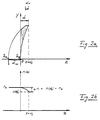
- the so-called apex depth is of importance in the glasses shown in FIG. 1 with a positive effect, ie the elevation of the apex S 1 above the plane through the glass edge, which is shown in FIG.
- the larger this elevation the more "unsightly" the look of the glasses is Use of fashionably large frames.
- the choice of so-called flatter base curves therefore has the goal of reducing the apex depth in addition to reducing the center thickness, which is decisive for the weight of the lens.
- the front surface 1 and the eye-side surface 2 are rotationally symmetrical surfaces without restriction of the general inventive concept, so that the z-axis is also the optical axis.
- surfaces for one or both surfaces the surface profile of which is similar to that of spectacle lenses with an astigmatic and / or progressive effect and homogeneous refractive index.
- the gradient-generating surfaces 3 and 4 are arranged such that their centers are not on the axis z connecting the two glass apexes S1 and S2, and / or that the surfaces 3 and 4 have surfaces other than in the exemplary embodiments described below are:
- the individual parallel surfaces each have a constant refractive index in the meridian section, i.e. in the section shown in FIG. 1, a common evolute.
- Compliance with this condition ensures that the level shares have a position relative to the boundary surfaces, taking into account their depth of penetration, that the change in the refractive index has a sufficient "optical effect”.
- the gradient-generating surfaces 3 and 4 can, however, also have a surface design similar to progressive surfaces, as are currently used in spectacle lenses with a constant refractive index to produce an increase in effectiveness. If such "progressive" surfaces are used as the gradient-generating surface, a progressive increase in action is obtained even if the boundary surfaces 1 and 2 worked out later from the blank are rotationally symmetrical surfaces.
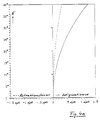
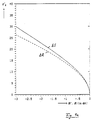
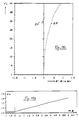
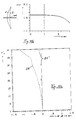
- the partial figures a and c show the astigmatism ⁇ S and the refractive error ⁇ R for an eyeglass lens according to the invention, i.e. a lens with a varying refractive index and a "homogeneous" comparison lens, i.e. a glass with the same surface design as the glass according to the invention, but constant, i.e. homogeneous refractive index.
- the refractive index varies in accordance with the function shown in sub-figures b.
- the refractive index (refractive index) n is plotted as a function of the coordinate z defined in FIGS. 1 to 3. Furthermore, a lens section through the respective spectacle lens is entered in part in the partial figures b.
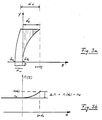
- FIGS. 2 and 3 show a representation similar to FIG. 1 for the case where 4 is used as the gradient-generating surface and in one example also for the gradient-generating surface Surface 3 a plane is used which is perpendicular to the axis connecting the two glass apexes.
- the coordinate system used is again entered in FIGS. 2 and 3 for clarification.
- edge thickness d r and the so-called apex depth d s are also shown in FIG. 2a.
- FIG. 2b schematically shows the associated course of the refractive index n according to the invention, which results when a plane is used for the gradient-generating surface 4.
- the refractive index in this case is only a function of the coordinate z. If only a correction of peripheral aberrations is to be made by varying the refractive index, then the refractive index n between the vertices S 1 and S 2 of the glass, ie constant for z ⁇ 0, and has the value n o , ie the gradient-generating line shown in FIG. 1 Area 3 is not "used".
- the refractive index then varies only in the material (in the beam direction) behind the x / y plane lying through the glass apex S2 on the eye side; in the schematic example, the refractive index n for values of z ⁇ 0 decreases from the value n o to the value n (d s ). This is indicated by a corresponding hatching.
- FIG. 3a shows a corresponding cross section through a spectacle lens with a minus effect.
- the sizes are the same 1 and 2 with the same reference numerals, so that a detailed description can be omitted.
- Figure 8c shows the effect of a refractive index variation "behind the surface vertex S2" on the imaging errors.
- the surface design of the glass and thus also the center and edge thickness correspond to the glass shown in Figure 8a.
- the individual size of the conical section can be found in Table 2.
- the imaging errors shown in FIG. 8a and caused by the surface design can be corrected to very small values.
- the gradient-generating surfaces 4 is a spherical surfaces without restricting the general inventive concept, whose center of curvature designated SZ2 is also the center of symmetry for the respective parallel surfaces.
- the center of the spherical surface 4 is on the glass vertex S1 and S2 connecting axis z. In the case of rotationally symmetrical surfaces 1 and 2, this axis coincides with the optical axis of the spectacle lens.
- the front surface 1 and the eye-side surface 2 of the spectacle lens are rotationally symmetrical surfaces.
- the gradient-generating surface 3 is not used in the exemplary embodiments shown in order to produce a variation of the refractive index on the optical axis between the glass apexes, so that the variation of the refractive index essentially only to correct the aberrations, but not to reduce the center thickness d m for spectacle lenses with a positive effect or for reducing the edge thickness d r for spectacle lenses with a negative effect.
- Examples 5 and 7 are spectacle lenses with a positive effect and an apex refractive index of +8 D
- Examples 6 and 8 are spectacle lenses with a negative effect and an apex refractive index of -10 Dpt.
- Examples 5 and 7 or 6 and 8 differ in that in Examples 5 and 6 the optically usable zone is equal to the overall diameter of the spectacle lens, while in Examples 7 and 8 the optically usable zone is smaller than the diameter of the spectacle lens , so that there is a "supporting rim" in the outer area, as is currently customary, for example, with so-called star glasses.
- the course of the refractive index shown in FIG. 9b can be obtained, for example, by exposing a blank provided with a gradient-generating surface 4 to different ion exchange baths in succession. If necessary, the gradient-generating surface can also be ground between the individual ion exchange steps and replaced by another gradient-generating surface, which is preferably a parallel surface to the first gradient-generating surface.
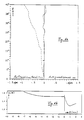
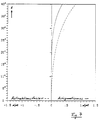
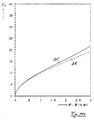
- Fig. 10a shows the course of the refraction error ⁇ R and the astigmatism ⁇ S in diopter as a function of the viewing angle ⁇ 'for an eyeglass lens with the surface design specified above and a constant refractive index.
- 10b shows the course of the refractive index on the optical axis.
- the zero point is in the rear surface vertex S2.
- the penetration depth d s of the gradient is 10.7 mm.
- a lens section through a third embodiment of the invention is shown, in which the reference numerals used have the same meaning as in Fig. 1, so that a renewed presentation is dispensed with.
- a viewing angle of 30 ° would result in image errors of the order of magnitude of more than 1 D.
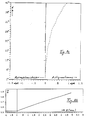
- Fig. 12a shows the course of the refractive error .DELTA.R and the astigmatism .DELTA.S in diopter as a function of the viewing angle ⁇ 'for a lens with the above Surface design and constant refractive index.
- the variation in the refractive index and its penetration depth, due to the use of an optically uncorrected supporting edge, the necessary for correcting the imaging errors is even lower than in the second exemplary embodiment, in which the imaging errors are corrected to the edge.
- the variation of the refractive index according to the invention has been used to reduce the image errors of single-vision glasses with a specially selected surface design and / or to reduce the central thickness.
- the gradient it is also possible to use the gradient to produce an astigmatic and / or progressive effect, the surface design contributing nothing or only partially to the astigmatic and / or progressive effect.
- an astigmatic effect ie a cylindrical effect
- the boundary surfaces 1 and 2 (see FIG. 1) of the spectacle lens are rotationally symmetrical surfaces and thus do not contribute to the astigmatic effect.
- the spectacle lens should have a spherical effect of 4.00 D and a cylindrical effect of 1.5 D with an axis of 0 ° TABO (hereinafter referred to as "horizontal" without restricting generality).
- the spectacle lens according to the invention thus has a center thickness of 5.3 mm.
- the following table 3 shows the arrow heights z (in mm) of the gradient-generating surface 4 in relation to the coordinate system defined in FIG. 1, the zero point of which coincides with the vertex of the gradient-generating surface in this exemplary embodiment.
- Table 3 y / x 0 4th 8th 12th 16 20th 0 0.000 0.046 0.183 0.412 0.733 1,147 4th 0.086 0.132 0.269 0.498 0.820 1,233 8th 0.349 0.395 0.533 0.763 1,087 1.504 12th 0.800 0.847 0.990 1,227 1,560 1,990 16 1.475 1,526 1,680 1,937 2,297 2,763 20th 2,488 2,547 2,727 3,028 3,451 3,999
- the refractive error ⁇ R is defined as (mean effect is - mean effect should ) and the astigmatism ⁇ S as a deviation from the prescription value (astigmatism).
- the inhomogeneous layer ie the layer within which the refractive index changes, has a thickness d s of 4.0 mm (cf. FIG. 1), the refractive index decreasing parabolically along the surface normal of the gradient-generating surface from 1.825 to 1.525.
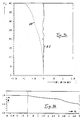
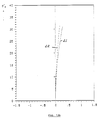
- FIG. 13a shows the resulting refractive error ⁇ R (dashed line) and the astigmatism ⁇ S (solid line) along a vertical meridian
- FIG. 13b shows these quantities along a horizontal meridian.
- 14a and 14b show the corresponding sizes for a conventional toric lens, which has a toric front surface with a horizontal radius of 77.4 mm and a vertical radius of 64.18 mm and the same inner surface as the eyeglass lens according to the invention shown by way of example above .
- n 1.525
- the inner surface has a refractive index of -3 dpt.
- the spherical effect of this glass is 4.00 D, the cylindrical effect 1.5 D with an axis of 0 ° TABO.
- the aspherical surface can be varied accordingly in a next step.
- a conic section surface instead of a pure conic section surface, a conic section surface can be used which is "modified" by higher order terms.
Landscapes
- Health & Medical Sciences (AREA)
- Ophthalmology & Optometry (AREA)
- Physics & Mathematics (AREA)
- General Health & Medical Sciences (AREA)
- General Physics & Mathematics (AREA)
- Optics & Photonics (AREA)
- Eyeglasses (AREA)
- Lenses (AREA)
Claims (23)
- Verre ophtalmique avec une face antérieure (1) et une face postérieure (2) ainsi qu'avec un indice de réfraction variable qui contribue à la correction des aberrations, caractérisé par au moins une famille de surfaces de niveau se succédant dans la direction du regard qui sont définies dans chaque cas par un indice de réfraction constant, n(x,y,z)= cte, moyennant quoi l'indice de réfraction de surfaces contiguës diffère et ces surfaces de niveau présentent entre elles, en tous points, un même intervalle dans le sens de leur normale à la surface, sont par conséquent des surfaces dites parallèles et la ou leur prolongement analytique coupe l'axe (z) qui relie les sommets (S1,S2) de la face antérieure (1) et de la face postérieure (2) à une distance A du sommet de verre le plus proche, pour laquelle on a

où
- Verre ophtalmique selon la revendication 1, caractérisé en ce que les familles de surfaces de niveau coupent perpendiculairement l'axe (z).
- Verre ophtalmique selon la revendication 1 ou 2, caractérisé en ce que les familles de surfaces de niveau sont des surfaces parallèles à des surfaces toriques ou atoriques.
- Verre ophtalmique selon la revendication 1 ou 2, caractérisé en ce que les familles de surfaces de niveau sont des surfaces parallèles à une surface ayant une forme semblable à la forme des surfaces de verres ophtalmiques progressifs contribuant à l'accroissement de la convergence.
- Verre ophtalmique selon la revendication 1 ou 2, caractérisé en ce que les surfaces de niveau sont des surfaces à symétrie de révolution qui possèdent une développée commune dans la section méridienne.
- Verre ophtalmique selon la revendication 6, caractérisé en ce que les surfaces de niveau à symétrie de révolution sont des surfaces sphériques.
- Verre ophtalmique selon la revendication 6, caractérisé en ce que les surfaces de niveau sont des plans.
- Verre ophtalmique selon la revendication 7, caractérisé en ce que seule la variation de l'indice de réfraction pour z ≧ 0 sert à la correction des aberrations, z = 0 étant le sommet (S₂) de la face postérieure (2).
- Verre ophtalmique selon la revendication 8, caractérisé en ce que, pour la correction de l'astigmatisme et/ou du défaut de réfraction, l'indice de réfraction pour z ≧ 0 augmente lorsque les valeurs d'astigmatisme ou de défaut de réfraction pour une conformation de surface identique et un indice de réfraction constant sont positives et diminue lorsque les valeurs d'astigmatisme ou de défaut de réfraction sont négatives.
- Verre ophtalmique selon une des revendications 1 à 6, caractérisé en ce que, pour la correction des aberrations, les surfaces de niveau ayant chaque fois un indice de réfraction constant traversent la ligne de jonction (z) en dehors des deux sommets du verre ophtalmique.
- Verre ophtalmique selon l'une des revendications 5, 6, 9 ou 10, caractérisé en ce que le point de départ de la développée pour les surfaces de niveau, n(x,y,z) = cte, avec un indice de réfraction constant se situe dans l'espace objet.
- Verre ophtalmique selon l'une des revendications 5, 6 ou 9 à 11, caractérisé en ce que l'indice de réfraction du côté image augmente pour la correction d'une valeur d'astigmatisme positive, à savoir convergence tangentielle - convergence sagittale, et/ou d'un défaut de réfraction positif ou diminue pour la correction d'une valeur d'astigmatisme ou de défaut de réfraction négative.
- Verre ophtalmique selon l'une des revendications 2 à 12, caractérisé en ce que l'allure des deux surfaces (1,2) est choisie de telle manière que l'épaisseur critique (dm, respect.dr) du verre ophtalmique ne dépasse pas une valeur prédéterminée.
- Verre ophtalmique selon l'une des revendications 1 à 13, caractérisé en ce que, pour la réduction de ce que l'on appelle la profondeur au sommet du verre, l'indice de réfraction varie sur la ligne de jonction des sommets (S₁,S₂) du verre ophtalmique.
- Verre ophtalmique selon l'une des revendications 1 à 14, caractérisé en ce qu'au moins une des surfaces (1, 2) est une surface asphérique.
- Verre ophtalmique selon l'une des revendications 1 à 15, caractérisé en ce que les surfaces sont des surfaces à symétrie de révolution de sorte que l'axe reliant les sommets du verre (S₁, S₂) est l'axe optique.
- Verre ophtalmique selon l'une des revendications 1 à 16, caractérisé en ce que, pour la réduction de l'épaisseur critique du verre ophtalmique, l'indice de réfraction sur l'axe optique entre le sommet S₁(
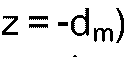
- Verre ophtalmique à effet positif selon l'une des revendications 15 à 17, caractérisé en ce que la face asphérique est la face antérieure (1).
- Verre ophtalmique à effet négatif selon l'une des revendications 15 à 17, caractérisé en ce que la face asphérique est la face postérieure (2).
- Verre ophtalmique selon l'une des revendications 1 à 19, caractérisé en ce que l'indice de réfraction possède une valeur constante dans une zone limitée autour de l'axe optique.
- Verre ophtalmique selon l'une des revendications 1 à 19, caractérisé en ce que la zone marginale du verre se présente sous la forme d'une facette optiquement non correctrice.
- Série de verres ophtalmiques, dans laquelle une face pour le recouvrement d'une zone utile déterminée à l'aide d'un certain nombre de courbes dites "de base" à courbure au sommet échelonnée est disponible et dans laquelle la courbure au sommet de l'autre face est choisie à l'intérieur d'une zone déterminée pour l'obtention de l'effet prescrit selon l'une des revendications 1 à 21, caractérisée en ce que la variation d'indice de réfraction dans la zone utile concernée est indépendante de la courbure au sommet de l'autre face.
- Série de verres ophtalmiques selon la revendication 22, caractérisée en ce que la variation d'indice de réfraction est identique pour au moins quelques-unes des courbes de base.
Priority Applications (1)
| Application Number | Priority Date | Filing Date | Title |
|---|---|---|---|
| AT89111396T ATE99426T1 (de) | 1988-06-22 | 1989-06-22 | Brillenglas mit einem sich aenderndem brechungsindex. |
Applications Claiming Priority (4)
| Application Number | Priority Date | Filing Date | Title |
|---|---|---|---|
| DE3821079 | 1988-06-22 | ||
| DE3821079A DE3821079A1 (de) | 1988-06-22 | 1988-06-22 | Brillenglas mit einem sich aendernden brechungsindex |
| DE3901775A DE3901775A1 (de) | 1988-06-22 | 1989-01-21 | Brillenglas mit einem sich aendernden brechungsindex |
| DE3901775 | 1989-01-21 |
Publications (2)
| Publication Number | Publication Date |
|---|---|
| EP0347917A1 EP0347917A1 (fr) | 1989-12-27 |
| EP0347917B1 true EP0347917B1 (fr) | 1993-12-29 |
Family
ID=25869347
Family Applications (1)
| Application Number | Title | Priority Date | Filing Date |
|---|---|---|---|
| EP89111396A Expired - Lifetime EP0347917B1 (fr) | 1988-06-22 | 1989-06-22 | Lentille ophtalmique avec indice de réfraction à gradient |
Country Status (7)
| Country | Link |
|---|---|
| US (1) | US5148205A (fr) |
| EP (1) | EP0347917B1 (fr) |
| JP (1) | JP3170785B2 (fr) |
| AU (1) | AU633006B2 (fr) |
| DE (2) | DE3901775A1 (fr) |
| ES (1) | ES2048239T3 (fr) |
| WO (1) | WO1989012841A1 (fr) |
Families Citing this family (49)
| Publication number | Priority date | Publication date | Assignee | Title |
|---|---|---|---|---|
| US5689324A (en) | 1992-08-18 | 1997-11-18 | Q2100, Inc. | Progressive lens |
| DE4242267A1 (de) * | 1992-12-15 | 1994-06-16 | Rodenstock Optik G | Brillenglas mit astigmatischer Wirkung |
| DE19540186A1 (de) * | 1995-10-28 | 1997-04-30 | Rodenstock Optik G | Einstärken-Brillenglas mit zwei asphärischen Flächen |
| US5995295A (en) * | 1995-12-13 | 1999-11-30 | Olympus Optical Co., Ltd. | Lens system |
| US5861934A (en) * | 1996-05-06 | 1999-01-19 | Innotech, Inc. | Refractive index gradient lens |
| US5847803A (en) * | 1996-09-17 | 1998-12-08 | Innotech, Inc. | Optic incorporating a power gradient |
| ATE238573T1 (de) * | 1997-07-18 | 2003-05-15 | Sola Int Holdings | Linse mit starker krümmung für eine brille |
| US6000798A (en) * | 1997-10-06 | 1999-12-14 | Innotech Inc. | Ophthalmic optic devices |
| US6183084B1 (en) * | 1998-07-30 | 2001-02-06 | Johnson & Johnson Vision Care, Inc. | Progressive addition lenses |
| WO2002083078A2 (fr) * | 2001-04-16 | 2002-10-24 | Tracey Technologies, Llc | Procede permettant de determiner une refraction clinique d'un oeil a partir d'une source objective |
| US6409345B1 (en) | 2000-08-08 | 2002-06-25 | Tracey Technologies, Llc | Method and device for synchronous mapping of the total refraction non-homogeneity of the eye and its refractive components |
| UA46833C2 (uk) * | 1998-10-07 | 2002-06-17 | Інститут Біомедичної Техніки Та Технологій Академії Технологічних Наук України | Вимірювач абераційної рефракції ока |
| US7303281B2 (en) * | 1998-10-07 | 2007-12-04 | Tracey Technologies, Llc | Method and device for determining refractive components and visual function of the eye for vision correction |
| UA67870C2 (uk) | 2002-10-04 | 2004-07-15 | Сергій Васильович Молебний | Спосіб вимірювання хвильових аберацій ока |
| US6619799B1 (en) | 1999-07-02 | 2003-09-16 | E-Vision, Llc | Optical lens system with electro-active lens having alterably different focal lengths |
| US7293871B2 (en) * | 2000-11-27 | 2007-11-13 | Ophthonix, Inc. | Apparatus and method of correcting higher-order aberrations of the human eye |
| US6813082B2 (en) | 2000-11-27 | 2004-11-02 | Ophthonix, Inc. | Wavefront aberrator and method of manufacturing |
| US7217375B2 (en) * | 2001-06-04 | 2007-05-15 | Ophthonix, Inc. | Apparatus and method of fabricating a compensating element for wavefront correction using spatially localized curing of resin mixtures |
| US6712466B2 (en) * | 2001-10-25 | 2004-03-30 | Ophthonix, Inc. | Eyeglass manufacturing method using variable index layer |
| US7014317B2 (en) | 2001-11-02 | 2006-03-21 | Essilor International (Compagnie Generale D'optique) | Method for manufacturing multifocal lenses |
| DE10211033A1 (de) * | 2002-03-13 | 2003-09-25 | Rodenstock Gmbh | Progressives Brillenglas mit zwei asphärischen und insbesondere progressiven Flächen |
| US7420743B2 (en) * | 2002-07-11 | 2008-09-02 | Ophthonix, Inc. | Optical elements and methods for making thereof |
| US6836371B2 (en) * | 2002-07-11 | 2004-12-28 | Ophthonix, Inc. | Optical elements and methods for making thereof |
| SE0203564D0 (sv) | 2002-11-29 | 2002-11-29 | Pharmacia Groningen Bv | Multifocal opthalmic lens |
| US7896916B2 (en) | 2002-11-29 | 2011-03-01 | Amo Groningen B.V. | Multifocal ophthalmic lens |
| US20050260388A1 (en) * | 2004-05-21 | 2005-11-24 | Lai Shui T | Apparatus and method of fabricating an ophthalmic lens for wavefront correction using spatially localized curing of photo-polymerization materials |
| US7922326B2 (en) | 2005-10-25 | 2011-04-12 | Abbott Medical Optics Inc. | Ophthalmic lens with multiple phase plates |
| FR2884622B1 (fr) * | 2005-04-19 | 2007-08-10 | Essilor Int | Verre ophtalmique comprenant une couche d'indice de refraction variable |
| JPWO2007026591A1 (ja) * | 2005-08-30 | 2009-03-05 | コニカミノルタオプト株式会社 | 光学フィルム及びその製造方法、並びにそれを用いた偏光板及び液晶表示装置 |
| US7740354B2 (en) | 2006-10-25 | 2010-06-22 | Volk Donald A | Multi-layered gradient index progressive lens |
| US7735998B2 (en) | 2006-10-25 | 2010-06-15 | Volk Donald A | Multi-layered multifocal lens with blended refractive index |
| DE102007020031A1 (de) * | 2007-04-27 | 2008-10-30 | Rodenstock Gmbh | Brille, Verfahren zur Herstellung einer Brille und Computerprogrammprodukt |
| JP2012233959A (ja) | 2011-04-28 | 2012-11-29 | Seiko Epson Corp | 眼鏡用レンズ、眼鏡、眼鏡レンズの設計方法、及び設計装置 |
| CN108013952A (zh) | 2012-08-31 | 2018-05-11 | Amo格罗宁根私人有限公司 | 用于扩展焦深的多环晶状体、系统和方法 |
| JP2016026324A (ja) * | 2015-10-05 | 2016-02-12 | イーエイチエス レンズ フィリピン インク | 眼鏡用レンズ、眼鏡、眼鏡レンズの設計方法、及び設計装置 |
| CA3013858A1 (fr) | 2016-02-09 | 2017-08-17 | Amo Groningen B.V. | Lentille intraoculaire progressive et ses procedes d'utilisation et de fabrication |
| ES2773523T5 (es) | 2016-10-21 | 2023-05-10 | Zeiss Carl Vision Int Gmbh | Cristal para gafas y procedimiento de impresión 3D para su fabricación |
| WO2019141386A1 (fr) * | 2018-01-19 | 2019-07-25 | Carl Zeiss Vision International Gmbh | Verre de lunettes progressif à indice de réfraction variable et son procédé de conception et de fabrication |
| EP3352001B1 (fr) | 2017-01-20 | 2023-03-29 | Carl Zeiss Vision International GmbH | Verre de lunette à foyer progressif ayant un indice de réfraction variable et son procédé de conception et de fabrication |
| EP3595584A1 (fr) | 2017-03-17 | 2020-01-22 | AMO Groningen B.V. | Lentilles intraoculaires de diffraction permettant une plage de vision étendue |
| US11523897B2 (en) | 2017-06-23 | 2022-12-13 | Amo Groningen B.V. | Intraocular lenses for presbyopia treatment |
| WO2019002390A1 (fr) | 2017-06-28 | 2019-01-03 | Amo Groningen B.V. | Plage étendue et lentilles intraoculaires associées pour le traitement de la presbytie |
| AU2018292024A1 (en) | 2017-06-28 | 2020-01-02 | Amo Groningen B.V. | Diffractive lenses and related intraocular lenses for presbyopia treatment |
| US11327210B2 (en) | 2017-06-30 | 2022-05-10 | Amo Groningen B.V. | Non-repeating echelettes and related intraocular lenses for presbyopia treatment |
| US12204178B2 (en) | 2018-12-06 | 2025-01-21 | Amo Groningen B.V. | Diffractive lenses for presbyopia treatment |
| EP3979895B1 (fr) | 2019-06-06 | 2023-04-26 | Essilor International | Procédé et instrument pour fournir au moins un il d'un sujet à l'aide d'une première et d'une seconde corrections de réfraction à comparer les unes avec les autres |
| WO2021136617A1 (fr) | 2019-12-30 | 2021-07-08 | Amo Groningen B.V. | Lentilles ayant des profils de diffraction ayant une largeur irrégulière pour le traitement de la vision |
| EP3940449A1 (fr) * | 2020-07-15 | 2022-01-19 | Essilor International | Système et procédé permettant de déterminer une valeur arrondie d'une propriété optique d'une lentille ophtalmique adaptée pour fournir une correction dioptrique pour améliorer la vision d'un sujet |
| EP4124902A1 (fr) | 2021-07-30 | 2023-02-01 | Carl Zeiss Vision International GmbH | Conception de verre de lunettes pour une lentille à puissance progressive, détermination d'une telle conception de verre de lunettes et fabrication d'un verre de lunettes |
Citations (1)
| Publication number | Priority date | Publication date | Assignee | Title |
|---|---|---|---|---|
| DE2707601A1 (de) * | 1976-03-22 | 1977-10-06 | American Optical Corp | Ophthalmische linsen und verfahren zur ausbildung einer achsentfernten korrektur derselben |
Family Cites Families (6)
| Publication number | Priority date | Publication date | Assignee | Title |
|---|---|---|---|---|
| US3486808A (en) * | 1966-03-14 | 1969-12-30 | Bausch & Lomb | Gradient refractive index optical lenses |
| FR2193989B2 (fr) * | 1972-07-26 | 1975-03-07 | Essilor Int | |
| DE3229577A1 (de) * | 1982-08-07 | 1984-02-09 | Fa. Carl Zeiss, 7920 Heidenheim | Brillenlinse fuer stark fehlsichtige |
| US4676610A (en) * | 1983-07-22 | 1987-06-30 | Sola International Holdings Ltd. | Method of making progressive lens surface and resulting article |
| DE3430334C2 (de) * | 1984-08-17 | 1987-02-05 | Optische Werke G. Rodenstock, 8000 München | Progressives Brillenglas mit zwei asphärischen Flächen |
| DE3616888A1 (de) * | 1986-05-20 | 1987-11-26 | Rodenstock Optik G | Einstaerken-brillenglas mit einem sich zur optischen achse rotationssymmetrisch aendernden brechungsindex |
-
1989
- 1989-01-21 DE DE3901775A patent/DE3901775A1/de not_active Withdrawn
- 1989-06-22 WO PCT/DE1989/000410 patent/WO1989012841A1/fr not_active Ceased
- 1989-06-22 AU AU37750/89A patent/AU633006B2/en not_active Ceased
- 1989-06-22 ES ES89111396T patent/ES2048239T3/es not_active Expired - Lifetime
- 1989-06-22 JP JP50663689A patent/JP3170785B2/ja not_active Expired - Fee Related
- 1989-06-22 US US07/490,700 patent/US5148205A/en not_active Expired - Lifetime
- 1989-06-22 EP EP89111396A patent/EP0347917B1/fr not_active Expired - Lifetime
- 1989-06-22 DE DE89111396T patent/DE58906531D1/de not_active Expired - Fee Related
Patent Citations (1)
| Publication number | Priority date | Publication date | Assignee | Title |
|---|---|---|---|---|
| DE2707601A1 (de) * | 1976-03-22 | 1977-10-06 | American Optical Corp | Ophthalmische linsen und verfahren zur ausbildung einer achsentfernten korrektur derselben |
Non-Patent Citations (1)
| Title |
|---|
| W.N. CHARMAN : "Gradient Index Optics", The Ophthalmic Optician 1981, pp. 72-84 * |
Also Published As
| Publication number | Publication date |
|---|---|
| AU633006B2 (en) | 1993-01-21 |
| AU3775089A (en) | 1990-01-12 |
| JPH03500094A (ja) | 1991-01-10 |
| WO1989012841A1 (fr) | 1989-12-28 |
| DE58906531D1 (de) | 1994-02-10 |
| ES2048239T3 (es) | 1994-03-16 |
| EP0347917A1 (fr) | 1989-12-27 |
| JP3170785B2 (ja) | 2001-05-28 |
| DE3901775A1 (de) | 1990-07-26 |
| US5148205A (en) | 1992-09-15 |
Similar Documents
| Publication | Publication Date | Title |
|---|---|---|
| EP0347917B1 (fr) | Lentille ophtalmique avec indice de réfraction à gradient | |
| EP0300415B1 (fr) | Lentille ophtalmique à effet astigmatique | |
| DE2044639C3 (de) | Ophthalmische Linse mit progressiv sich ändernder Brechkraft | |
| DE69626797T2 (de) | Gleitsichtglas mit progressiver fläche und astigmatismuskorrektur auf der rückseite | |
| DE69938027T9 (de) | Torische ophthalmische Linsen | |
| DE69232283T2 (de) | Linse für Brillen. | |
| EP0039498B1 (fr) | Verre de lunettes à effet astigmatique | |
| DE3616888C2 (fr) | ||
| DE1805561C3 (de) | Ophthalmische Linse mit starker Brechkraft und vorgegebenem Astigmatismus | |
| EP0318035B1 (fr) | Lentille de lunettes progressive | |
| DE2941733C2 (fr) | ||
| DE8104023U1 (de) | Brillenglas mit zunehmender brennpunktverstaerkung | |
| EP1277079A2 (fr) | Procede permettant de calculer des valeurs relatives a un verre de lunettes progressif, et procede de realisation dudit verre de lunettes progressif | |
| EP1410098A2 (fr) | Procede de production de verres progressifs | |
| EP3824343A1 (fr) | Verre de lunettes progressif présentant un indice de réfraction variable dans l'espace et procédé de conception dudit verre | |
| DE10132793B4 (de) | Entwurfs- und Herstellverfahren für Brillengläser | |
| DE102018115412B4 (de) | Computerimplementiertes Verfahren, Datenverarbeitungssystem zum Erzeugen eines Zieldesigns sowie Computerprogramm, Speichermedium mit Instruktionen zum Erzeugen eines Zieldesigns, Verfahren zum Bereitstellen eines Brillenglases, Speichermedium mit einer numerischen Darstellung eines Brillenglases und Verfahren zum Herstellen eines Brillenglases | |
| EP3891552B1 (fr) | Verre de lunettes, famille de verres de lunettes, procédé de conception d'une famille de verres de lunettes et procédé de fabrication d'un verre de lunettes | |
| EP1240541B1 (fr) | Verre correcteur simple | |
| DE2707601A1 (de) | Ophthalmische linsen und verfahren zur ausbildung einer achsentfernten korrektur derselben | |
| EP3278173A1 (fr) | Procédé de conception d'une face de réception d'une lentille multifocale et lentille multifocale pourvue d'une telle face de réception | |
| EP1277075B1 (fr) | Verre de lunettes progressif a faibles differences de grossissement | |
| DE29624440U1 (de) | Einstärken-Brillenglas mit zwei asphärischen Flächen | |
| DE102017000777A1 (de) | Verfahren zur Berücksichtigung unterschiedlicher prismatischer Korrekturen in der Ferne und der Nähe | |
| DE4238067C3 (de) | Gruppe von progressiven Brillengläsern |
Legal Events
| Date | Code | Title | Description |
|---|---|---|---|
| PUAI | Public reference made under article 153(3) epc to a published international application that has entered the european phase |
Free format text: ORIGINAL CODE: 0009012 |
|
| AK | Designated contracting states |
Kind code of ref document: A1 Designated state(s): AT BE CH DE ES FR GB GR IT LI LU NL SE |
|
| 17P | Request for examination filed |
Effective date: 19891129 |
|
| 17Q | First examination report despatched |
Effective date: 19920313 |
|
| ITF | It: translation for a ep patent filed | ||
| GRAA | (expected) grant |
Free format text: ORIGINAL CODE: 0009210 |
|
| AK | Designated contracting states |
Kind code of ref document: B1 Designated state(s): AT BE CH DE ES FR GB GR IT LI LU NL SE |
|
| PG25 | Lapsed in a contracting state [announced via postgrant information from national office to epo] |
Ref country code: GR Free format text: LAPSE BECAUSE OF FAILURE TO SUBMIT A TRANSLATION OF THE DESCRIPTION OR TO PAY THE FEE WITHIN THE PRESCRIBED TIME-LIMIT Effective date: 19931229 Ref country code: BE Effective date: 19931229 |
|
| REF | Corresponds to: |
Ref document number: 99426 Country of ref document: AT Date of ref document: 19940115 Kind code of ref document: T |
|
| REF | Corresponds to: |
Ref document number: 58906531 Country of ref document: DE Date of ref document: 19940210 |
|
| GBT | Gb: translation of ep patent filed (gb section 77(6)(a)/1977) |
Effective date: 19940117 |
|
| REG | Reference to a national code |
Ref country code: ES Ref legal event code: FG2A Ref document number: 2048239 Country of ref document: ES Kind code of ref document: T3 |
|
| ET | Fr: translation filed | ||
| ITTA | It: last paid annual fee | ||
| PG25 | Lapsed in a contracting state [announced via postgrant information from national office to epo] |
Ref country code: LU Free format text: LAPSE BECAUSE OF NON-PAYMENT OF DUE FEES Effective date: 19940630 |
|
| PLBE | No opposition filed within time limit |
Free format text: ORIGINAL CODE: 0009261 |
|
| STAA | Information on the status of an ep patent application or granted ep patent |
Free format text: STATUS: NO OPPOSITION FILED WITHIN TIME LIMIT |
|
| 26N | No opposition filed | ||
| EAL | Se: european patent in force in sweden |
Ref document number: 89111396.1 |
|
| REG | Reference to a national code |
Ref country code: GB Ref legal event code: IF02 |
|
| PGFP | Annual fee paid to national office [announced via postgrant information from national office to epo] |
Ref country code: SE Payment date: 20030526 Year of fee payment: 15 |
|
| PGFP | Annual fee paid to national office [announced via postgrant information from national office to epo] |
Ref country code: AT Payment date: 20030527 Year of fee payment: 15 |
|
| PGFP | Annual fee paid to national office [announced via postgrant information from national office to epo] |
Ref country code: CH Payment date: 20030610 Year of fee payment: 15 |
|
| PGFP | Annual fee paid to national office [announced via postgrant information from national office to epo] |
Ref country code: NL Payment date: 20030620 Year of fee payment: 15 |
|
| REG | Reference to a national code |
Ref country code: GB Ref legal event code: 732E |
|
| REG | Reference to a national code |
Ref country code: CH Ref legal event code: PUE Owner name: RODENSTOCK GMBH Free format text: OPTISCHE WERKE G. RODENSTOCK#ISARTALSTRASSE 39-43#D-80469 MUENCHEN 5 (DE) -TRANSFER TO- RODENSTOCK GMBH#ISARTALSTRASSE 43#80469 MUENCHEN (DE) |
|
| REG | Reference to a national code |
Ref country code: CH Ref legal event code: PFA Owner name: RODENSTOCK GMBH Free format text: OPTISCHE WERKE G. RODENSTOCK#ISARTALSTRASSE 43#80469 MUENCHEN (DE) -TRANSFER TO- RODENSTOCK GMBH#ISARTALSTRASSE 43#80469 MUENCHEN (DE) Ref country code: CH Ref legal event code: NV Representative=s name: ARNOLD & SIEDSMA AG |
|
| NLS | Nl: assignments of ep-patents |
Owner name: RODENSTOCK GMBH |
|
| REG | Reference to a national code |
Ref country code: FR Ref legal event code: TP |
|
| PG25 | Lapsed in a contracting state [announced via postgrant information from national office to epo] |
Ref country code: AT Free format text: LAPSE BECAUSE OF NON-PAYMENT OF DUE FEES Effective date: 20040622 |
|
| PG25 | Lapsed in a contracting state [announced via postgrant information from national office to epo] |
Ref country code: SE Free format text: LAPSE BECAUSE OF NON-PAYMENT OF DUE FEES Effective date: 20040623 |
|
| PG25 | Lapsed in a contracting state [announced via postgrant information from national office to epo] |
Ref country code: LI Free format text: LAPSE BECAUSE OF NON-PAYMENT OF DUE FEES Effective date: 20040630 Ref country code: CH Free format text: LAPSE BECAUSE OF NON-PAYMENT OF DUE FEES Effective date: 20040630 |
|
| REG | Reference to a national code |
Ref country code: FR Ref legal event code: TP |
|
| REG | Reference to a national code |
Ref country code: FR Ref legal event code: CD |
|
| PG25 | Lapsed in a contracting state [announced via postgrant information from national office to epo] |
Ref country code: NL Free format text: LAPSE BECAUSE OF NON-PAYMENT OF DUE FEES Effective date: 20050101 |
|
| EUG | Se: european patent has lapsed | ||
| EUG | Se: european patent has lapsed | ||
| REG | Reference to a national code |
Ref country code: CH Ref legal event code: PL |
|
| REG | Reference to a national code |
Ref country code: GB Ref legal event code: 732E |
|
| NLV4 | Nl: lapsed or anulled due to non-payment of the annual fee |
Effective date: 20050101 |
|
| PGFP | Annual fee paid to national office [announced via postgrant information from national office to epo] |
Ref country code: DE Payment date: 20050504 Year of fee payment: 17 |
|
| PGFP | Annual fee paid to national office [announced via postgrant information from national office to epo] |
Ref country code: FR Payment date: 20050517 Year of fee payment: 17 |
|
| PGFP | Annual fee paid to national office [announced via postgrant information from national office to epo] |
Ref country code: ES Payment date: 20050621 Year of fee payment: 17 |
|
| PGFP | Annual fee paid to national office [announced via postgrant information from national office to epo] |
Ref country code: GB Payment date: 20050622 Year of fee payment: 17 |
|
| REG | Reference to a national code |
Ref country code: FR Ref legal event code: TP Ref country code: FR Ref legal event code: CD |
|
| REG | Reference to a national code |
Ref country code: GB Ref legal event code: 732E |
|
| PG25 | Lapsed in a contracting state [announced via postgrant information from national office to epo] |
Ref country code: GB Free format text: LAPSE BECAUSE OF NON-PAYMENT OF DUE FEES Effective date: 20060622 |
|
| PG25 | Lapsed in a contracting state [announced via postgrant information from national office to epo] |
Ref country code: ES Free format text: LAPSE BECAUSE OF NON-PAYMENT OF DUE FEES Effective date: 20060623 |
|
| PGFP | Annual fee paid to national office [announced via postgrant information from national office to epo] |
Ref country code: IT Payment date: 20060630 Year of fee payment: 18 |
|
| PG25 | Lapsed in a contracting state [announced via postgrant information from national office to epo] |
Ref country code: DE Free format text: LAPSE BECAUSE OF NON-PAYMENT OF DUE FEES Effective date: 20070103 |
|
| GBPC | Gb: european patent ceased through non-payment of renewal fee |
Effective date: 20060622 |
|
| REG | Reference to a national code |
Ref country code: FR Ref legal event code: ST Effective date: 20070228 |
|
| REG | Reference to a national code |
Ref country code: ES Ref legal event code: FD2A Effective date: 20060623 |
|
| PG25 | Lapsed in a contracting state [announced via postgrant information from national office to epo] |
Ref country code: FR Free format text: LAPSE BECAUSE OF NON-PAYMENT OF DUE FEES Effective date: 20060630 |
|
| PG25 | Lapsed in a contracting state [announced via postgrant information from national office to epo] |
Ref country code: IT Free format text: LAPSE BECAUSE OF NON-PAYMENT OF DUE FEES Effective date: 20070622 |