EP0350273A2 - Procédé pour la détermination d'endotoxines - Google Patents
Procédé pour la détermination d'endotoxines Download PDFInfo
- Publication number
- EP0350273A2 EP0350273A2 EP89306795A EP89306795A EP0350273A2 EP 0350273 A2 EP0350273 A2 EP 0350273A2 EP 89306795 A EP89306795 A EP 89306795A EP 89306795 A EP89306795 A EP 89306795A EP 0350273 A2 EP0350273 A2 EP 0350273A2
- Authority
- EP
- European Patent Office
- Prior art keywords
- endotoxin
- concentration
- spiked
- test sample
- samples
- Prior art date
- Legal status (The legal status is an assumption and is not a legal conclusion. Google has not performed a legal analysis and makes no representation as to the accuracy of the status listed.)
- Granted
Links
- 239000002158 endotoxin Substances 0.000 title claims abstract description 63
- 238000000034 method Methods 0.000 title claims description 42
- 238000012360 testing method Methods 0.000 claims abstract description 78
- 238000001879 gelation Methods 0.000 claims abstract description 71
- 230000003287 optical effect Effects 0.000 claims abstract description 21
- 238000012421 spiking Methods 0.000 claims abstract description 16
- 241001529572 Chaceon affinis Species 0.000 claims abstract description 10
- 210000003677 hemocyte Anatomy 0.000 claims abstract description 9
- 229940000351 hemocyte Drugs 0.000 claims abstract description 8
- 239000006166 lysate Substances 0.000 claims abstract description 8
- 239000000243 solution Substances 0.000 claims description 84
- 238000011088 calibration curve Methods 0.000 claims description 47
- 238000005259 measurement Methods 0.000 claims description 33
- XLYOFNOQVPJJNP-UHFFFAOYSA-N water Chemical compound O XLYOFNOQVPJJNP-UHFFFAOYSA-N 0.000 claims description 29
- 239000012153 distilled water Substances 0.000 claims description 12
- 238000002347 injection Methods 0.000 claims description 12
- 239000007924 injection Substances 0.000 claims description 12
- 239000000203 mixture Substances 0.000 claims description 6
- 230000001678 irradiating effect Effects 0.000 claims description 2
- 239000000126 substance Substances 0.000 abstract description 9
- 239000000523 sample Substances 0.000 description 87
- 238000002360 preparation method Methods 0.000 description 14
- FBPFZTCFMRRESA-JGWLITMVSA-N D-glucitol Chemical compound OC[C@H](O)[C@@H](O)[C@H](O)[C@H](O)CO FBPFZTCFMRRESA-JGWLITMVSA-N 0.000 description 10
- 230000000875 corresponding effect Effects 0.000 description 10
- FBPFZTCFMRRESA-FSIIMWSLSA-N D-Glucitol Natural products OC[C@H](O)[C@H](O)[C@@H](O)[C@H](O)CO FBPFZTCFMRRESA-FSIIMWSLSA-N 0.000 description 9
- 239000000600 sorbitol Substances 0.000 description 9
- 238000012545 processing Methods 0.000 description 8
- 229920002307 Dextran Polymers 0.000 description 6
- 241000239218 Limulus Species 0.000 description 5
- 239000003153 chemical reaction reagent Substances 0.000 description 4
- 238000004090 dissolution Methods 0.000 description 4
- 238000002834 transmittance Methods 0.000 description 4
- 230000001276 controlling effect Effects 0.000 description 3
- 238000007796 conventional method Methods 0.000 description 3
- 238000010790 dilution Methods 0.000 description 3
- 239000012895 dilution Substances 0.000 description 3
- 230000000694 effects Effects 0.000 description 3
- 238000013208 measuring procedure Methods 0.000 description 3
- 230000035945 sensitivity Effects 0.000 description 3
- 241000588724 Escherichia coli Species 0.000 description 2
- 238000010586 diagram Methods 0.000 description 2
- 238000007865 diluting Methods 0.000 description 2
- -1 etc. for infusions Substances 0.000 description 2
- 238000001802 infusion Methods 0.000 description 2
- 241000239216 Carcinoscorpius Species 0.000 description 1
- 239000012480 LAL reagent Substances 0.000 description 1
- 206010037660 Pyrexia Diseases 0.000 description 1
- 241000239222 Tachypleus Species 0.000 description 1
- 239000005862 Whey Substances 0.000 description 1
- 102000007544 Whey Proteins Human genes 0.000 description 1
- 108010046377 Whey Proteins Proteins 0.000 description 1
- 210000004369 blood Anatomy 0.000 description 1
- 239000008280 blood Substances 0.000 description 1
- 238000004113 cell culture Methods 0.000 description 1
- 230000003247 decreasing effect Effects 0.000 description 1
- 238000001514 detection method Methods 0.000 description 1
- 238000003113 dilution method Methods 0.000 description 1
- 230000002401 inhibitory effect Effects 0.000 description 1
- 230000005764 inhibitory process Effects 0.000 description 1
- 229920006008 lipopolysaccharide Polymers 0.000 description 1
- 239000007788 liquid Substances 0.000 description 1
- 238000002156 mixing Methods 0.000 description 1
- 239000013307 optical fiber Substances 0.000 description 1
- 239000002510 pyrogen Substances 0.000 description 1
- 238000004445 quantitative analysis Methods 0.000 description 1
- 239000012488 sample solution Substances 0.000 description 1
- 230000035939 shock Effects 0.000 description 1
- 239000007858 starting material Substances 0.000 description 1
- 238000003756 stirring Methods 0.000 description 1
- 238000010267 two-fold dilution method Methods 0.000 description 1
- 239000003643 water by type Substances 0.000 description 1
Images


Classifications
-
- G—PHYSICS
- G01—MEASURING; TESTING
- G01N—INVESTIGATING OR ANALYSING MATERIALS BY DETERMINING THEIR CHEMICAL OR PHYSICAL PROPERTIES
- G01N33/00—Investigating or analysing materials by specific methods not covered by groups G01N1/00 - G01N31/00
- G01N33/48—Biological material, e.g. blood, urine; Haemocytometers
- G01N33/50—Chemical analysis of biological material, e.g. blood, urine; Testing involving biospecific ligand binding methods; Immunological testing
- G01N33/579—Chemical analysis of biological material, e.g. blood, urine; Testing involving biospecific ligand binding methods; Immunological testing involving limulus lysate
-
- G—PHYSICS
- G01—MEASURING; TESTING
- G01N—INVESTIGATING OR ANALYSING MATERIALS BY DETERMINING THEIR CHEMICAL OR PHYSICAL PROPERTIES
- G01N33/00—Investigating or analysing materials by specific methods not covered by groups G01N1/00 - G01N31/00
- G01N33/48—Biological material, e.g. blood, urine; Haemocytometers
- G01N33/50—Chemical analysis of biological material, e.g. blood, urine; Testing involving biospecific ligand binding methods; Immunological testing
- G01N33/53—Immunoassay; Biospecific binding assay; Materials therefor
- G01N33/569—Immunoassay; Biospecific binding assay; Materials therefor for microorganisms, e.g. protozoa, bacteria, viruses
- G01N33/56911—Bacteria
- G01N33/56916—Enterobacteria, e.g. shigella, salmonella, klebsiella, serratia
Definitions
- This invention relates to a process for measuring the concentration of endotoxin (hereinafter abbreviated as "ET”) in a test sample by measuring an optical change due to a gelation reaction caused by reacting horseshoe crab hemocyte lysate (hereinafter abbreviated as "AL solution”) with ET, which process can be employed even when there is a fear that the test sample may affects the gelation reaction caused by the reaction of AL solution with ET.
- ET endotoxin
- ET's are known as typical pyrogens. It is known that when blood, an infusion or an injection, which is contaminated by ET, is injected into a body, the ET produces serious side effects such as fever, shock, etc. Therefore, it is considered indispensable to prevent troubles by measuring the amount of ET in starting materials, starting waters, etc. for infusions, injections and the like, or various preparations which are injected into a living body.
- AL solution has a property of being activated by ET to cause gelation reaction, and a simple, low-cost ET detecting method utilizing this property, i.e., the so-called Limulus test, is widely employed in the fields of medical science, pharmacy and microbiology.
- the method of Limulus test has been variously improved, and in place of semi-quantitative method according to gel-clat technique which was employed at the beginning, an optical measuring method has come to be employed generally. As a result, more precise determination has become possible.
- the optical measuring method comprises noting a turbidity due to a gel formed by the gelation reaction of AL solution with ET, measuring the change of turbidity as an optical change, for example, a change of the amount of transmitted light, and determining ET from the change of the amount of transmitted light.
- the ET concentration in a test sample is determined, for example, from a graph showing the calibration relation (a calibration curve) obtained from a time required for the ratio of transmittance to reach a predetermined value (hereinafter abbreviated as "gelation time") and ET concentration.
- the above measuring method employed at present can be employed without a particular trouble for measuring the concentration of ET contained in water itself such as starting water, wash water, etc. or for measuring the ET concentration in a test sample which does not affect the gelation reaction of AL solution with ET, it is inapplicable to a test sample which has an inhibitory or enhancement effect on the gelation reaction.
- a test sample which inhibits the gelation reaction the gelation time is increased, resulting in a measured value lower than a real value.
- the gelation time is reduced, resulting in a measured value higher than a real value.
- the amount of ET in a test sample is measured using a calibration curve showing the relationship between ET concentration and gelation time which is obtained using, as samples, solutions of predetermined amounts of ET spiked in distilled water (hereinafter abbreviated as "water calibration curve”), and a calibration curve showing the relationship between ET concentration and gelation time which is prepared using three or more samples prepared by spiking predetermined amounts of ET to identical preparations of a test sample (hereinafter abbreviated as "test sample calibration curve).
- the calibration curve showing the relationship between ET concentration and gelation time which is obtained using samples prepared by spiking predetermined amount of ET to identical preparations of a test sample containing no ET originally, coincides with the water calibration curve when the test sample does not affect the gelation reaction at all; the former is above the latter when the test sample inhibits the gelation reaction; the former is below the latter when the test sample enhances the gelation reaction; and in most of the cases, the former calibration curve is originally parallel to the water calibration curve.
- the test sample calibration curve has a portion not parallel to the water calibration curve is that the test sample calibration curve undergoes some influence of ET originally contained in the test sample, and therefore the ET content of the test sample can be measured by comparing the test sample calibration curve with the water calibration curve.
- the ET content of the test sample cannot be measured unless as samples prepared by spiking ET to identical preparations of test sample, there are prepared at least one sample containing spiked ET in an amount substantially equal to or smaller than the amount of ET originally present in the test sample, and two or more samples containing spiked ET in such amounts that the amount of ET originally present in the test sample can be neglected. Accordingly, said process is disadvantageous, for example, in that the ET content of the test sample should be predicted to a certain degree and that procedures such as the preparation of the samples are troublesome. Thus, further improvement of said process is desirable.
- This invention was made in consideration of such conditions and is intended to provide a process which permits simple and rapid measurement of the ET concentration in a test sample which tends to affect the gelation of AL solution by ET.
- This invention provides a process for measuring an endotoxin concentration in a test sample by measuring optical changes due to a gelation reaction caused by a reaction of a horseshoe crab hemocyte lysate with endotoxin, which comprises
- This invention also provides an apparatus for measuring such ET concentrations.
- This invention is conducted, for example, as follows.
- ET spiked solutions different in ET concentrations are prepared by spiking ET in various concentrations to substantially identical preparations of a solution which neither contains ET nor affects a gelation reaction caused by reacting AL solution with ET, and each of them is reacted with AL solution, after which a calibration curve showing the relationship between ET concentration and gelation time (hereinafter abbreviated as "ET calibration curve") is prepared.
- ET calibration curve showing the relationship between ET concentration and gelation time
- the apparent ET concentration (E app ) of each ET spiked sample prepared from the preparation of test sample is determined.
- E app a + b x E s
- suitable amounts of ET are spiked to the test sample and the solution containing no ET.
- the amounts (or concentration) of ET to be spiked are not particularly limited but preferably selected from the range of 0.2 to 20 times, more preferably 0.5 to 10 times, as large as the predetermined endotoxin concentration for judgement depending on purposes (E det ).
- At least three known different concentrations of ET are spiked to each test sample and each solution containing no ET to give at least 6 sample solutions to be measured. In this case, when E c and E det are quite different, there is a tendency to lower reliability of E c measured.
- the optical change to reach a predetermined proportion (R th ) is provided in the range of 75 to 97% in terms of R(t).
- R th when R th is provided at higher than 97%, the moving (convection) in the mixture immediately after mixing the AL solution with ET spiked sample or ET spiked solution, or the variation of R(t) due to the movement of bubbles is possibly judged as gelation by mistake. Therefore, in order to prevent an erroneous detection due to such noises, the range of 3% is necessary for allowance of noise.
- R th is provided in the range of 75 to 97%, preferably in the range of 80 to 95%.
- the process of this invention is applicable not only to a test sample which is clearly known to affect the gelation reaction but also to a test sample which is not clearly known to affect and a test sample which does not affect.
- pyrogen-free distilled water more specifically, distilled water for injection, is usually preferably used, for example, because it is easily available.
- the AL solution usable in the process of this invention is not critical so long as it can be used for usual measurement of ET.
- AL solutions prepared from freeze-dried products of AL solutions which are commercially available, for instance, from Associates of Cape Cod Inc. (ACC), HAEMACHEM, Inc., Whittaker Bioproducts, Inc, and Teikoku Hormon Mfg. Co., Ltd.
- any AL solution without particular restriction so long as it is extracted from hemocytes of horseshoe crab belonging to Limulus genus, Tachypleus genus or Carcinoscorpius genus and reacts with ET to undergo gelation reaction.
- the measuring process of this invention can easily be practiced by means of an apparatus exclusively for kinetic turbidimetric technique such as Toxinometer ET-201 (mfd. by Wako Pure Chemical Industries, Ltd.), LAL-5000 (mfd. by ACC Inc.), etc., it can be practiced also by means of a measuring apparatus utilizing an optical principle, such as MS-2 of Abbot Laboratries, etc.
- an apparatus exclusively for kinetic turbidimetric technique such as Toxinometer ET-201 (mfd. by Wako Pure Chemical Industries, Ltd.), LAL-5000 (mfd. by ACC Inc.), etc.
- an optical principle such as MS-2 of Abbot Laboratries, etc.
- the present invention also provides an apparatus for measuring endotoxin comprising:
- a plurality of cuvette holders 7 for holding cuvettes for measurement are provided in one apparatus.
- Each one optical system for measuring transmitted light amounts is provided in one holder 7. It is also possible to apply a light to each holder by using an optical fiber from one light source. Further, all the holders are kept at a constant temperature such as at 37°C by a constant temperature bath (not shown in Fig. 5) or a dry temperature controlling apparatus.
- the reaction solution can be maintained at a still state until the end of the measurement and the measurement can be conducted without giving any moving so as to break the gel state.
- a switch 8 for instructing the beginning of the measurement is instantly pushed to begin the measurement of the sample.
- the switch 8 is pushed every time when a cuvette for measurement is fixed in a holder 7 in a similar manner to conduct the parallel measurement of a plurality of samples with an optional timing within the number of cuvette holders provided in the apparatus.
- Fig. 5 shows that it is possible to fix 16 cuvettes in the holders in the apparatus. But the number of cuvettes measurable at a time is not limited to such a number of 16 and can be increased or decreased if desired so long as the capacity for control is permissible. It is also possible to connect switches for instructing the beginning of measurement to each cuvette holder 7. It is further possible to automatically switch on when each cuvette is placed in each cuvette holder so as to instruct the beginning of measurement.
- a display control switch 12 can be used for changing one after another the display of each T g of each sample when a plurality of samples are measured. It is also possible to display as a whole by using another display method such as CRT display.
- a keyboard 20 connected to the main body of the apparatus is used for appointment of operational function, input of numeral data, and the like.
- the display panel 11 is also used for confirming display of input data.
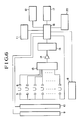
- Fig. 6 is a block diagram showing an electric system of one example of the apparatus of this invention.
- the constant temperature controlling system around the cuvettes for measurement is omitted for simplicity and only the optical measurement controlling system is shown.
- the transmitted light amounts obtained from a plurality of photoelectric detectors 6 are selected one after another successively by a multiplexer 13, converted to R(t) by a ration operating circuit 14, and input into an A/D converter 15.
- the signal converted to digital amount by the A/D converter is processed by a computer 16 to give the judgement of gelation and the determination of T g .
- the gelation judgement display 10 and the display panel 11 are also controlled by the computer.
- the computer 16 prepares and stores calibration curves relating to the gelation time and the ET concentration from the measuring results regarding samples containing ET in known concentrations based on the data input from the keyboard 20. Further, by properly using programs in the computer 16, it is possible to obtain apparent ET concentrations in samples from the gelation times of the samples to which ET is spiked using said calibration curves, to detect linearity between the spiked ET concentrations and the apparent ET concentrations so as to obtain an equation of linear relationship between both concentrations, and to obtain the ET concentration in the sample from a slope and an intercept of the equation of linear relationship. It is also possible to print out the measurement results and the data processing results by a printer 17. It is still possible to connect the computer 16 to one or more outer computers, if required, depending on purposes.
- this invention provides an apparatus for measuring endotoxin in a plurality of samples in parallel and effectively with high reliability. Further, by using the apparatus of the present invention, the measurement can be carried out precisely even when a test sample includes substances which may affect the gelation reaction caused by the reaction of AL solution with ET.
- a freeze-dried product of AL solution derived from horseshoe crab belonging to Limulus genus (herein nonethelessafter the freeze-dried product being abbreviated as "LAL”; available from Associated of Cape Cod, Inc.; labeled sensitivity 0.03 EU/ml; for dissolution in 5 ml) was dissolved in 5 ml of distilled water for injection, and the LAL solution thus obtained was used as AL solution.
- LAL freeze-dried product of AL solution derived from horseshoe crab belonging to Limulus genus
- Solutions having a sorbitol concentration of 2% and a concentration of spiked ET of 0.01, 0.025, 0.05 or 0.1 EU/ml, respectively, were prepared as samples by dissolving sorbitol (mfd. by Wako Pure Chemical Industries, Ltd.; guaranteed reagent) in distilled water for injection to a concentration of 2.2%, followed by adding thereto each of ET solutions having predetermined concentrations.
- Solutions having a sorbitol concentration of 2% and a concentration of spiked ET of 0.01, 0.025, 0.05 or 0.1 EU/ml, respectively, were prepared as samples by dissolving the same sorbitol as used in i) above in ET solution (0.011 EU/ml) to a concentration of 2.2%, followed by adding thereto each of ET solutions having predetermined concentrations.
- T g a time required for reducing the transmittance by 5%
- E s denotes the concentration of spiked ET
- each value of E app is the average of three measurements.
- Table 1 E s (EU/ml) E app (EU/ml) 0.010 0.020 0.025 0.040 0.050 0.069 0.100 0.138
- Fig. 2 the relationship between the E app value and the corresponding E s value which was determined for each sample of Group 1 is shown by - ⁇ -.
- the straight line - ⁇ - in Fig. 2 is a regression line obtained according to individual data by the least squares method.
- Fig. 2 the relationship between the E app value and the corresponding E s value which was determined for each sample of Group II is shown by -o-.
- the straight line -o- in Fig. 2 is a regression line obtained according to individual data by the least squares method.
- LAL solution obtained by dissolving LAL (available from Associated of Cope Cod. Inc.; labeled sensitivity 0.25 EU/ml; for dissolution in 5 ml) in 5 ml of distilled water for injection.
- Solutions having a dextran concentration of 5% and a concentration of spiked ET of 0.05, 0.2 or 2.0 EU/ml were prepared as samples by dissolving dextran (available from Wako Pure Chemical Industries, Ltd.; molecular weight 100,000 to 200,000) in distilled water for injection to a concentration of 5.5%, followed by adding thereto each of ET solutions having predetermined concentrations.
- E s denotes the concentration of spiked ET
- each value of E app is the average of three measurements.
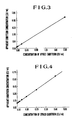
- the relationship between the E app values obtained and the corresponding E s values is shown in Fig. 3.
- the straight line in Fig. 3 is a regression line obtained according to individual data by the least squares method.
- LAL solution obtained by dissolving LAL (available from Wako Pure Chemical Industries, Ltd.; labeled sensitivity 0.03 EU/ml; for dissolution in 5 ml) in 5 ml of distilled water for injection.
- Solutions having a concentration of added ET of 0.0125, 0.025, 0.050, 0.10, 0.20 or 0.40 EU/ml, respectively, were prepared as samples by diluting GIT medium (a synthetic medium for cell culture, mfd. by Wako Pure Chemical Industries, Ltd.) in 20 times with distilled water for injection, and adding 0.1 ml of each of ET solutions having predetermined concentrations to 0.9 ml of the diluted medium.
- GIT medium a synthetic medium for cell culture, mfd. by Wako Pure Chemical Industries, Ltd.
- E s denotes the concentration of spiked ET
- each value of E app is the average of three measurements.
- the relationship between the E app values obtained and the corresponding E s values is shown in Fig. 4.
- the straight line in Fig. 4 is a regression line obtained by the least squares method.
- this invention provides a process by which the ET concentration in a test sample which tends to affect the gelation reaction of AL solution by ET can be measured easily and rapidly without a troublesome procedure required in conventional methods.
Landscapes
- Health & Medical Sciences (AREA)
- Life Sciences & Earth Sciences (AREA)
- Engineering & Computer Science (AREA)
- Immunology (AREA)
- Urology & Nephrology (AREA)
- Hematology (AREA)
- Biomedical Technology (AREA)
- Chemical & Material Sciences (AREA)
- Molecular Biology (AREA)
- Medicinal Chemistry (AREA)
- Biochemistry (AREA)
- Cell Biology (AREA)
- Pathology (AREA)
- Biotechnology (AREA)
- Food Science & Technology (AREA)
- General Physics & Mathematics (AREA)
- Physics & Mathematics (AREA)
- Analytical Chemistry (AREA)
- Microbiology (AREA)
- General Health & Medical Sciences (AREA)
- Virology (AREA)
- Tropical Medicine & Parasitology (AREA)
- Investigating Or Analysing Biological Materials (AREA)
- Investigating Or Analysing Materials By The Use Of Chemical Reactions (AREA)
- Medicines Containing Antibodies Or Antigens For Use As Internal Diagnostic Agents (AREA)
- Measuring Or Testing Involving Enzymes Or Micro-Organisms (AREA)
Applications Claiming Priority (2)
| Application Number | Priority Date | Filing Date | Title |
|---|---|---|---|
| JP167068/88 | 1988-07-05 | ||
| JP16706888 | 1988-07-05 |
Publications (3)
| Publication Number | Publication Date |
|---|---|
| EP0350273A2 true EP0350273A2 (fr) | 1990-01-10 |
| EP0350273A3 EP0350273A3 (en) | 1990-10-10 |
| EP0350273B1 EP0350273B1 (fr) | 1994-07-13 |
Family
ID=15842811
Family Applications (1)
| Application Number | Title | Priority Date | Filing Date |
|---|---|---|---|
| EP89306795A Expired - Lifetime EP0350273B1 (fr) | 1988-07-05 | 1989-07-04 | Procédé pour la détermination d'endotoxines |
Country Status (5)
| Country | Link |
|---|---|
| EP (1) | EP0350273B1 (fr) |
| JP (1) | JPH07113643B2 (fr) |
| AT (1) | ATE108558T1 (fr) |
| DE (1) | DE68916714T2 (fr) |
| ES (1) | ES2057128T3 (fr) |
Cited By (3)
| Publication number | Priority date | Publication date | Assignee | Title |
|---|---|---|---|---|
| EP0690308A3 (fr) * | 1994-06-30 | 1996-06-26 | Seikagaku Kogyo Kabushiki Kaisha (Seikagaku Corporation) | Agent stabilisant d'endotoxine, composition d'endotoxine et procédé de dosage d'endotoxine |
| EP1499643A4 (fr) * | 2002-04-30 | 2008-04-16 | Biowhittaker Technologies Inc | Systemes automatises d'analyse d'injections sequentielles servant a determiner des niveaux d'endotoxine a l'etat de traces |
| EP2261642A4 (fr) * | 2008-03-19 | 2011-10-26 | Toru Obata | Dispositif de mesure de la formation de particules de gel |
Families Citing this family (1)
| Publication number | Priority date | Publication date | Assignee | Title |
|---|---|---|---|---|
| US9658218B2 (en) * | 2012-05-07 | 2017-05-23 | Siemens Healthcare Diagnostics Inc. | Determination of total analyte concentration |
Family Cites Families (4)
| Publication number | Priority date | Publication date | Assignee | Title |
|---|---|---|---|---|
| CA1040081A (fr) * | 1974-05-01 | 1978-10-10 | Baxter Travenol Laboratories | Methode pour le dosage des endotoxines a l'aide d'un precipite de lysat de limulus |
| US4038029A (en) * | 1976-01-20 | 1977-07-26 | Worthington Biochemical Corporation | Limulus lysate turbidity test for pyrogens |
| EP0347951B1 (fr) * | 1984-06-27 | 1993-08-04 | Wako Pure Chemical Industries, Ltd. | Appareil pour mesurer l'endotoxine |
| JPS62110153A (ja) * | 1985-04-03 | 1987-05-21 | Wako Pure Chem Ind Ltd | エンドトキシン定量方法 |
-
1989
- 1989-07-04 AT AT89306795T patent/ATE108558T1/de not_active IP Right Cessation
- 1989-07-04 DE DE68916714T patent/DE68916714T2/de not_active Expired - Fee Related
- 1989-07-04 ES ES89306795T patent/ES2057128T3/es not_active Expired - Lifetime
- 1989-07-04 EP EP89306795A patent/EP0350273B1/fr not_active Expired - Lifetime
- 1989-07-05 JP JP1173693A patent/JPH07113643B2/ja not_active Expired - Fee Related
Cited By (6)
| Publication number | Priority date | Publication date | Assignee | Title |
|---|---|---|---|---|
| EP0690308A3 (fr) * | 1994-06-30 | 1996-06-26 | Seikagaku Kogyo Kabushiki Kaisha (Seikagaku Corporation) | Agent stabilisant d'endotoxine, composition d'endotoxine et procédé de dosage d'endotoxine |
| US5648230A (en) * | 1994-06-30 | 1997-07-15 | Seikagaku Kogyo Kabushiki Kaisha (Seikagaku Corporation) | Endotoxin stabilizing agent, endotoxin composition and method for assaying endotoxin |
| US5876955A (en) * | 1994-06-30 | 1999-03-02 | Seikagaku Kogyo Kabushiki Kaisha | Endotoxin stabilizing agent, endotoxin composition and method for assaying endotoxin |
| EP1499643A4 (fr) * | 2002-04-30 | 2008-04-16 | Biowhittaker Technologies Inc | Systemes automatises d'analyse d'injections sequentielles servant a determiner des niveaux d'endotoxine a l'etat de traces |
| EP2261642A4 (fr) * | 2008-03-19 | 2011-10-26 | Toru Obata | Dispositif de mesure de la formation de particules de gel |
| US8462340B2 (en) | 2008-03-19 | 2013-06-11 | Toru Obata | Gel particle measuring apparatus |
Also Published As
| Publication number | Publication date |
|---|---|
| DE68916714T2 (de) | 1995-01-12 |
| ATE108558T1 (de) | 1994-07-15 |
| EP0350273B1 (fr) | 1994-07-13 |
| JPH02124466A (ja) | 1990-05-11 |
| EP0350273A3 (en) | 1990-10-10 |
| JPH07113643B2 (ja) | 1995-12-06 |
| DE68916714D1 (de) | 1994-08-18 |
| ES2057128T3 (es) | 1994-10-16 |
Similar Documents
| Publication | Publication Date | Title |
|---|---|---|
| Funk | Coagulation assays and anticoagulant monitoring | |
| Coe et al. | Variations in vitreous humor chemical values as a result of instrumentation | |
| EP0173021B1 (fr) | Procédé pour le dosage de l'endotoxine | |
| EP0649021A1 (fr) | Réactif pour essai spécifique à endotoxine | |
| CN109061125A (zh) | 对检测系统的定量检测项目的结果进行可靠性评估的方法及用途 | |
| Kitchen et al. | Laboratory tests of hemostasis | |
| Bernard et al. | Retinol binding protein in urine: a more practical index than urinary beta 2-microglobulin for the routine screening of renal tubular function. | |
| CN111721936A (zh) | 一种盐酸纳布啡原料药中细菌内毒素的检测方法 | |
| Wolf et al. | Automated Hydrolysis of Nonreducing Sugars and Fructosans from Plant Tissue 1 | |
| EP0350273B1 (fr) | Procédé pour la détermination d'endotoxines | |
| US6306577B1 (en) | Method for measuring enzyme reaction | |
| Larrán et al. | Influence of haemolysis on blood biochemistry profiles in cattle | |
| Manita et al. | Detectability of and interference by major and minor hemoglobin variants using a new-generation ion-exchange HPLC system with two switchable analysis modes | |
| KR102916959B1 (ko) | 응고 검정 장치 및 이의 방법 | |
| CN101592636A (zh) | 一种新的复方头孢噻肟钠舒巴坦钠的检测方法 | |
| EP0731354A1 (fr) | Procede de dosage d'une substance reagissant avec un reactif de limulus | |
| Peters et al. | Determination of the mean normal prothrombin time for assessment of international normalized ratios | |
| OISHI et al. | An automated analysis system of Limulus amebocyte lysate (LAL)-endotoxin reaction kinetics using turbidimetric kinetic assay | |
| CN112964709B (zh) | 一种样品中蛋白质的检测方法 | |
| Canfield et al. | Assessment of a new blood glucose strip: comparison of Visidex, Visidex II, and Chemstrip bG with glucose analyzer determination of blood glucose | |
| CN1296714C (zh) | 测定鲎试剂灵敏度的方法 | |
| Popovska et al. | Determination of bacterial endotoxins in parenteral solutions produced on a small scale in a clinical hospital. | |
| CN1281960C (zh) | 一种测定鲎试剂灵敏度的方法 | |
| Sasikala et al. | Significance of method validation/verification: estimation of total proteins in cerebro spinal fluid by 3% trichloro acetic acid method in limited resources areas. | |
| CN117054362A (zh) | 一种脉血康胶囊抗凝血酶活性的检测方法 |
Legal Events
| Date | Code | Title | Description |
|---|---|---|---|
| PUAI | Public reference made under article 153(3) epc to a published international application that has entered the european phase |
Free format text: ORIGINAL CODE: 0009012 |
|
| AK | Designated contracting states |
Kind code of ref document: A2 Designated state(s): AT BE CH DE ES FR GB GR IT LI LU NL SE |
|
| PUAL | Search report despatched |
Free format text: ORIGINAL CODE: 0009013 |
|
| AK | Designated contracting states |
Kind code of ref document: A3 Designated state(s): AT BE CH DE ES FR GB GR IT LI LU NL SE |
|
| 17P | Request for examination filed |
Effective date: 19910301 |
|
| 17Q | First examination report despatched |
Effective date: 19920316 |
|
| GRAA | (expected) grant |
Free format text: ORIGINAL CODE: 0009210 |
|
| AK | Designated contracting states |
Kind code of ref document: B1 Designated state(s): AT BE CH DE ES FR GB GR IT LI LU NL SE |
|
| PG25 | Lapsed in a contracting state [announced via postgrant information from national office to epo] |
Ref country code: LI Effective date: 19940713 Ref country code: GR Free format text: LAPSE BECAUSE OF FAILURE TO SUBMIT A TRANSLATION OF THE DESCRIPTION OR TO PAY THE FEE WITHIN THE PRESCRIBED TIME-LIMIT Effective date: 19940713 Ref country code: CH Effective date: 19940713 Ref country code: AT Effective date: 19940713 |
|
| REF | Corresponds to: |
Ref document number: 108558 Country of ref document: AT Date of ref document: 19940715 Kind code of ref document: T |
|
| ITF | It: translation for a ep patent filed | ||
| REF | Corresponds to: |
Ref document number: 68916714 Country of ref document: DE Date of ref document: 19940818 |
|
| PG25 | Lapsed in a contracting state [announced via postgrant information from national office to epo] |
Ref country code: SE Effective date: 19941013 |
|
| REG | Reference to a national code |
Ref country code: ES Ref legal event code: FG2A Ref document number: 2057128 Country of ref document: ES Kind code of ref document: T3 |
|
| ET | Fr: translation filed | ||
| REG | Reference to a national code |
Ref country code: CH Ref legal event code: PL |
|
| PLBE | No opposition filed within time limit |
Free format text: ORIGINAL CODE: 0009261 |
|
| STAA | Information on the status of an ep patent application or granted ep patent |
Free format text: STATUS: NO OPPOSITION FILED WITHIN TIME LIMIT |
|
| 26N | No opposition filed | ||
| PG25 | Lapsed in a contracting state [announced via postgrant information from national office to epo] |
Ref country code: LU Free format text: LAPSE BECAUSE OF NON-PAYMENT OF DUE FEES Effective date: 19950731 |
|
| PGFP | Annual fee paid to national office [announced via postgrant information from national office to epo] |
Ref country code: ES Payment date: 19970711 Year of fee payment: 9 |
|
| PGFP | Annual fee paid to national office [announced via postgrant information from national office to epo] |
Ref country code: NL Payment date: 19970731 Year of fee payment: 9 |
|
| PG25 | Lapsed in a contracting state [announced via postgrant information from national office to epo] |
Ref country code: ES Free format text: LAPSE BECAUSE OF THE APPLICANT RENOUNCES Effective date: 19980706 |
|
| PG25 | Lapsed in a contracting state [announced via postgrant information from national office to epo] |
Ref country code: NL Free format text: LAPSE BECAUSE OF NON-PAYMENT OF DUE FEES Effective date: 19990201 |
|
| NLV4 | Nl: lapsed or anulled due to non-payment of the annual fee |
Effective date: 19990201 |
|
| REG | Reference to a national code |
Ref country code: ES Ref legal event code: FD2A Effective date: 20001102 |
|
| REG | Reference to a national code |
Ref country code: GB Ref legal event code: IF02 |
|
| PGFP | Annual fee paid to national office [announced via postgrant information from national office to epo] |
Ref country code: GB Payment date: 20020626 Year of fee payment: 14 |
|
| PGFP | Annual fee paid to national office [announced via postgrant information from national office to epo] |
Ref country code: DE Payment date: 20020705 Year of fee payment: 14 |
|
| PGFP | Annual fee paid to national office [announced via postgrant information from national office to epo] |
Ref country code: FR Payment date: 20020725 Year of fee payment: 14 |
|
| PGFP | Annual fee paid to national office [announced via postgrant information from national office to epo] |
Ref country code: BE Payment date: 20020905 Year of fee payment: 14 |
|
| PG25 | Lapsed in a contracting state [announced via postgrant information from national office to epo] |
Ref country code: GB Free format text: LAPSE BECAUSE OF NON-PAYMENT OF DUE FEES Effective date: 20030704 |
|
| PG25 | Lapsed in a contracting state [announced via postgrant information from national office to epo] |
Ref country code: BE Free format text: LAPSE BECAUSE OF NON-PAYMENT OF DUE FEES Effective date: 20030731 |
|
| BERE | Be: lapsed |
Owner name: *WAKO PURE CHEMICAL INDUSTRIES LTD Effective date: 20030731 |
|
| PG25 | Lapsed in a contracting state [announced via postgrant information from national office to epo] |
Ref country code: DE Free format text: LAPSE BECAUSE OF NON-PAYMENT OF DUE FEES Effective date: 20040203 |
|
| GBPC | Gb: european patent ceased through non-payment of renewal fee |
Effective date: 20030704 |
|
| PG25 | Lapsed in a contracting state [announced via postgrant information from national office to epo] |
Ref country code: FR Free format text: LAPSE BECAUSE OF NON-PAYMENT OF DUE FEES Effective date: 20040331 |
|
| REG | Reference to a national code |
Ref country code: FR Ref legal event code: ST |
|
| PG25 | Lapsed in a contracting state [announced via postgrant information from national office to epo] |
Ref country code: IT Free format text: LAPSE BECAUSE OF NON-PAYMENT OF DUE FEES;WARNING: LAPSES OF ITALIAN PATENTS WITH EFFECTIVE DATE BEFORE 2007 MAY HAVE OCCURRED AT ANY TIME BEFORE 2007. THE CORRECT EFFECTIVE DATE MAY BE DIFFERENT FROM THE ONE RECORDED. Effective date: 20050704 |